Common octopus is anything but

Story and slideshow by KEITH R. ARANEO-YOWELL

Go to any Asian food market in Salt Lake City, and you will likely find bags of deep, blood-red flesh packed in ice. Go to any sushi restaurant and you’re likely to see on the sashimi or nigiri menu an item called “tako” (pronounced like the Mexican “taco”). Buy or order it for the first time and you’ll likely change any previously held beliefs about octopus.

Long considered a delicacy in Mediterranean and Asian (especially Japanese) cuisine, octopus is thought of by many to be prohibitively tough to prepare and chew.

“It’s rubbery, hard to bite and it doesn’t break apart very easily, even when it’s fully cooked,” said George Mateo, a visitor to the Living Planet Aquarium in Sandy.

Still, others wouldn’t hesitate to try it. Mason Childs, 21, works as a server at Market Street Grill. He said, “If it was on our menu at work I would probably try it once or twice.”

Splendidtable.com contributor Mark Bittman writes, “If octopus is properly handled, without fuss, it is reasonably tender. It remains chewy, but so does lobster, or sirloin steak.”

Home cooks can reduce the rubbery texture of octopus using a number of different strategies.  These range from the unusual Italian method of boiling it with wine corks to the brutish, yet obvious, method of beating it against rocks.

Bittman wrote even though these methods are effective, the key to eliminating most of the toughness is slow cooking time at very low temperatures.

Sue Kim, the owner of the Oriental Food Market at 667 S. 700 East in Salt Lake City, said she probably only sells one bag containing four tentacles and the head of an adult common octopus every day on average.

Kim attributes the relatively low rate of sales to the “rubbery” label attached to octopus meat as well as its alien appearance, and at $24.99 per bag, and similar pricing in restaurants around town, it’s considered a delicacy and not a staple.

Nina Clark, 23, is an exercise and sports science major at the University of Utah who said she hopes to pursue a career in public health education. She said octopus is an uncommon dish in Utah because there’s no coast. “We’re not exposed to it,” Clark said. “We’re land-locked.”

Childs said he could see why some people would be hesitant to eat octopus. “They’re scary creatures. To think they can open a mason jar without hands and do it while sitting on top of it. They’re pretty violent in the ocean.”

Others hesitate because of the octopus’ unusual appearance. Lacy Mateo, 20, who was visiting the Living Planet Aquarium with her husband, George, said she would never eat octopus because of the suction cups. Clark expressed similar reservations because of the fluidity of octopus movement.

With a single bulbous sack (or mantle) housing all their internal organs, surrounded by eight suction cup-covered arms and skin that looks like it’s been dead for a number of decades along with its reputation for rubberiness, it’s no wonder Clark and the Mateos find the look of the meat “gross.”

For all their physical irregularities, however, John Lambert, aquarist at the Monterey Bay Aquarium, said they pale in comparison to the strange behaviors he observes on a daily basis.

They can change the color and texture of their skin in a blink of an eye to avoid detection from predators. An article that appeared in Advanced Aquarists Online Magazine described the mimic octopus, which reproduces the rough appearance and movement of more than 15 different marine species native to its habitat of tropical Southeast Asia.

While feeding cancer crabs to the Giant Pacific Octopi at the California aquarium, Lambert, 52, and Aquarium Communications Director Ken Peterson, 61, described the difficulty associated with keeping their two Giant Pacific Octopi, Nano and November.

“There was an institution that was losing fish out of one of its tanks,” Lambert said. “They set up a camera over night and discovered that an octopus in an adjacent tank was crawling out at night, making its way over to the tank the fish were in, and helping itself and then returning to its own exhibit.”

Peterson later added that it had actually happened at the Monterey Bay Aquarium.

Because of the octopi’s desire to explore outside their enclosures, all outer edges of the octopus habitats are lined with Astroturf, which “prevents the octopus from being able to get a grip on it with their suction cups,” Peterson said.

Despite anecdotes of rather adventurous octopi, they spend most of their time in small crevices between rocks on the sea floor and are, therefore, extremely hard to fish. A fisherman for Monterey Fish Co Inc., who wished only to be called Dane, said just shrimp-trapping boats in Monterey regularly catch octopus.

Because the only hard structure in their bodies is a small parrot-like beak where all its tentacles converge, octopi can fit through the extremely small holes in shrimp traps. Lambert also said octopi are apt problem solvers and shrimping traps don’t really pose a challenge.

“They’re certainly very intelligent animals,” Lambert said. “[Researchers] put an item in a jar with a screw lid and the octopus can figure out how to unscrew the lid and get to the item. The first time they see it, it will be a challenge, but they work at it. They’re very tenacious animals.”

Their intelligence and ability to deform their bodies causes problems for shrimping boats in Monterey. Dane said, “Octopi will crawl into the traps and eat the shrimp.”

Shrimpers in Monterey lose an indeterminable amount of money each year due to octopus. According to the California Department of Fish and Game’s 2010-2011 Ocean Sport Fishing Regulations, octopi can only be caught and kept if line or hand-caught.

“[Shrimpers] usually throw [octopi] back,” Dane said. One shrimper who doesn’t always follow regulations said, “If I’m going to lose my catch, I at least want to sell the thing that cost me my paycheck.” For obvious reasons, this fisherman asked that he and his boat not be identified.

With the exception of when fishermen actually bring in an octopus, it is very difficult to find restaurants in Monterey that serve octopus. This is partly due to the aquarium’s decade-long effort to raise awareness across the U.S. about common fishing practices.

The Monterey Bay Aquarium publishes reports on commonly eaten seafood items. According to the 2008 report for common octopus (the species that is sold for food), most of what is sourced for use in the American sushi industry is sold as common octopus, even if it is of a different species.

Kim said she orders the octopus in her store from a Japanese fishery.

According to the report, Kim’s octopus comes from either Morocco or Thailand where the preferred method of octopus fishing is a practice called bottom trawling, in which boats drag fishing nets along the sea floor.

Octopus distributors in Japan also work with fisheries in Spain that catch octopus in pots, which is an artificial habitat perfectly suited to octopus. These pots lie on the sea floor for two to three days before fishermen reel them back in to collect the octopi.

In either case, after it is caught, it is blanched and shipped to Japan to be prepared for sushi by removing the beak, the poison and ink glands, the eyes and the internal organs. It is then frozen and re-exported to the U.S.

Monterey Bay Aquarium’s Seafood Watch Program assesses the ecological sustainability as well as the safety of eating seafood items commonly found in U.S. fish markets. According to the report, “due to the difficulty associated with discerning the actual country of origin of octopus found in US sushi restaurants, [octopus] should be avoided as a general rule. While Spanish octopus (especially pot-caught) is a preferred alternative to North African and Vietnamese octopus, it is rare that sufficient sourcing information is available to the consumer.”

The report, however, does little to address the adverse health effects of heavy metals that continue to build in species moving up the food chain.

In their report titled, “Bioaccumulation of Lead, Calcium and Strontium and Their Relationships in the Octopus vulgaris,” researchers Sonia Seixas and Graham Pierce found that “aquatic animals take up and accumulate lead from water, sediment and food.”

Because there is no way to rid tissue of lead by natural means, Seixas and Pierce observed “concentrations higher than the maximum legally permitted concentration of lead in food.”

Being conscious of how food gets to the dinner plate is a crucial element in public health, exercise and sports science major Nina Clark said. “That’s a big reason I try to avoid seafood in general. I’m aware of the patterns of how fish is shipped, exported and re-exported.”

Market Street server Mason Childs said the surprise he felt learning how octopus gets to the dinner table in a land-locked region illuminates a good deal about his previously held beliefs about seafood and sustainability. At the end of the interview, he asked for a copy of Seafood Watch.

“Eating is one of the most intimate things humans do,” Clark said. “It’s crucial that we educate ourselves on the repercussions of our choices.”

UACC strives to educate people about the organization

But outreach takes time, money

by KEITH R. ARANEO-YOWELL

The Utah Asian Chamber of Commerce (UACC) was founded “to foster Asian … small businesses with activities that result in a prosperous and economically healthy Asian community,” according to its online mission statement.

But, leaders in Salt Lake’s Asian community say the city’s demographics — and current economic woes — make it difficult to reach out to prospective members.

Between 1990 and 2004, Utah’s Asian population nearly doubled in size, from 25,696 to 46,132. Still, Asians comprise only about 2.1 percent of the total population of 2.7 million and own only 1.5 percent of the businesses in Utah, according to the Utah Office of Ethnic Affairs and U. S. Census Bureau.

According to the UACC website, chamber membership can cost businesses between $100 and $1,000 per year, depending on the number of employees.

Most of the Asian-owned businesses in Salt Lake City’s 9th and 9th neighborhood would have to pay only $200 per year to maintain membership.

Despite the nominal cost, the owners of one Salt Lake City supermarket — who wished to remain nameless — wondered: Why spend marketing dollars on 2 percent of the population?

Other local entrepreneurs also said they had to weigh membership costs against the benefits it offers.

Sue Kim has been operating the Oriental Food Market at 667 S. 700 East for 37 years. Even though the chamber is around to benefit businesses like hers, she said she’s unsure membership will help more than the hard work she already invests in her business.

“I know such a thing exists,” Kim said in an interview, “but I don’t even know if the Asian Chamber of Commerce is actively working to help Asian businesses or not.” She added that Utah’s Asian community is so small, the chamber seems almost unnecessary.

Kim’s isn’t the only well-established business that hasn’t joined the chamber.

Linda Lin has owned and operated Big Ed’s, the beer bar-cum-hamburger joint across from the University of Utah, for 29 years.

“I don’t have time. I work too hard,” Lin said while preparing four different meals in a kitchen that can barely accommodate two people. “Most people are regulars who come every day. It’s very busy here all the time and I get very good business.”

She said the money and time UACC membership would cost her might detract from the hard work that keeps regulars in the stools.

Roger Tsai, an attorney with Parsons, Behle & Latimer and the former president of the Utah Asian Chamber of Commerce, said there isn’t a perceived need for an entity like the UACC because the lack of cultural diversity makes ethnicity almost a non-issue for people and businesses like Big Ed’s and the Oriental Food Market.

“[The Asian chamber] is primarily a shoestring organization that’s volunteer-run,” Tsai said in a phone interview. “Our outreach efforts have been purely by word of mouth through events that get media attention.”

Those events include the annual scholarship and awards gala, which recognizes outstanding Asian business owners and celebrates young leaders in the area. On April 2, 2011, 10 scholarships were awarded.

Tsai believes the online membership directory does not adequately reflect the organization or its members, who must remember to add and update their own contact information.

When the chamber first started in 2005, he said a group of members assembled a directory of Korean businesses and families. But after five years, only 30 percent of the information was still relevant.

Also, the high turnover rate for new small businesses, not just those that are Asian-owned, makes it increasingly difficult to maintain an up-to-date directory. Tsai said even the Salt Lake Chamber of Commerce, which represents every business in Salt Lake City, has a 40 percent turnover rate for small businesses from year to year.

Robert Rendon said the number of entries in an online member directory is not a fair assessment of the health of an organization such as the UACC. Rendon, who serves on the advisory board for the UACC and is also a member of the board of directors for the Utah Hispanic Chamber of Commerce, said educating an entire ethnic community is a learning process that can take a number of years.

In a telephone interview, Rendon recalled the speed at which the Hispanic chamber was able to gain traction as a real benefit in the Hispanic community.

“If you look at the Hispanic chamber, they have a business directory with probably 300 members,” Rendon said. “But, they started in 1992.”

He also noted that the UACC does not have a full-time employee. “It really makes a difference,” Rendon said, “when you have someone working on your chamber full-time” and promoting it to the community.

UACC board member Raymond Uno believes the recent economic downturn has affected the chamber’s ability to attract members. “When people are struggling financially it’s really hard to get them to sacrifice money and time when they’re having a hard time just feeding the family,” said in a phone interview.

Aprirak Pruksirisumbut, 35, is the owner of Tasty Thai at 1302 S. 500 East. He hasn’t pursued membership with the chamber yet because his restaurant has only been open since 2009.

“It’s been very busy, so I don’t have time to become a member,” Pruksirisumbut said in an interview. He added that it is important for Asian-owned businesses to network and help each other build their clientele and that in the future he will probably put more thought into joining the UACC.

Networking is one reason to join the chamber. But Tsai said the cultural homogeneity and the relatively small Asian population in Utah are additional reasons for supporting the UACC.

“Something that almost every major business based in Utah knows, understands and is facing, is how do we make Utah a more diverse welcoming place? Not just for people who are minorities,” he said, “but for people coming from out of state who feel like Utah is different.”

Businesses make more money in a diverse marketplace of ideas, Tsai said. “So, it’s within the larger business community’s interest to foster a vibrant minority community, because at the end of the day, that’s what every other major city has.” Membership in the chamber is just one of the ways businesses can foster diversity.

Lost in translation: A check-up with a Burmese refugee

by BRADY LEAVITT

Reporter’s note: Journalists traditionally remove themselves from the narrative of their articles to create an authoritative, objective tone in their writing. As I see it, the goal of the reporter is to become the invisible lens through which the reader, listener or viewer gets the truth. However, as I did the reporting for this story I unwittingly became an active participant in the day’s events. It was irresistible. To remove myself from the story would be to be to withhold the truth from the reader. So, in the interest of objectivity, this story is about me.

Zuli is a Burmese hill tribe refugee. As of November 2008, he had been in the United States for one year and two months. He has no last name. His medical records separate the second syllable from the first to form the required first-name, last-name construction: Zu Li.

For Zuli, everything is difficult. His wife is sick. He cannot find work. His shoulder aches all the time. As a Muslim living in Salt Lake City, he finds it hard to find Halaal meals, foods consistent with Islamic dietary code. Above all else, Zuli has a single, suffocating problem that envelops every part of his life — he speaks no English.

On Nov. 18, I accompanied Peter Robson, a translator from the Asian Association of Utah, to take Zuli to a routine doctor’s appointment to have his shoulder checked.

As climbed into his car, Robson, 23, explained he would be translating the medical staff’s questions from English to Thai. We were driving to pick up his partner, Kamar, who would translate from Thai to a mixture of Burmese and Karen, two of the languages Zuli speaks. The process would then repeat in reverse to convey Zuli’s responses to the nurses and doctors.

Kamar, 19, also a Burmese refugee, learned to speak Thai while growing up in refugee camps near the Thailand-Myanmar border. He has been in the U.S. for a little more than one year. Utah-born Robson, a native English speaker, learned to speak Thai while serving a two-year mission for The Church of Jesus Christ of Latter-day Saints. That is where Robson and I first met, and where I also learned to speak Thai.

“Do you ever worry that when you translate something…?” I started to ask.

“Yes,” he replied without hesitation. “Always”

I asked Robson how he knows when the chain of translation has broken down.

“By the answer they give,” Robson said. “I mean, you ask them the last time they threw up and they answer ‘No’ — you know something got lost.”

Kamar, Robson said, was very excited that I was coming. When we saw Kamar, Robson commented on how “dressed up” he was, saying that Kamar normally wears ragged jeans and T-shirts. That day he wore khaki slacks, a green dress shirt and faded red, white and blue flip-flops.

“Why aren’t you listening to music,” he asked Robson in Thai from the back seat of the car.

“Because I’m enduring an interview,” Robson responded, now speaking in Thai and motioning to me.

Kamar pulled out a knockoff mp3 player and informed me that he and Robson only listen to Burmese hip-hop in the car.

“What do you think of America,” I asked in Thai as we drove.

Kamar looked slightly annoyed. “I don’t think,” he said. “I’m listening to music.”

* * *

Zuli lives in a one-bedroom apartment in Rose Park with his wife, Poriba, and his five or six grandchildren. I say “five or six” because nobody, including Zuli, could give me a sure answer of how many people live there. He is either 55 or 59 years old, depending on whether one trusts his medical records or Zuli.

A pile of shoes lined the small entryway of the apartment. A moist, sour smell blanketed the apartment as we walked in. A collection of cardboard sheets ripped from packing boxes lined the wall, the names and phone numbers written on them. The names were written in Burmese making it impossible to tell to whom they belonged, but Zuli quickly asked me for my number which he added to the collection. The only other real decorations were the Islamic wall calendars, unidentifiable stains on the carpet and family pictures printed on inexpensive copy -paper and stuck to the wall with masking tape.

We sat cross-legged on the floor just next to a full-length sofa. Zuli began speaking in a dizzying blend of backwoods Thai and Burmese. He was animated and cheerful as he spoke. Peter listened to him and nodded.
Zuli said something to me, and flashed a tobacco-stained smile in my direction. I stared, hoping that whatever he said would eventually trickle into the part of my brain that could make sense of it. It never got that far. I smiled, nodded and tried to slink out of the conversation as fast as I could. They chatted for another few minutes before I heard something I did understand.

“Pete, you’re Christian, aren’t you?” Zuli asked.

Robson said he was.

“Christianity and Islam are really similar, you know,” Zuli said. “I say it, EE-bra-him, you say it Abraham.” He rattled off a few more Old Testament names. “They’re practically the same. The only difference is how we say it.”

I slowly began making sense of Zuli’s accent as the conversation continued.

Robson began asking Zuli questions about the day’s events. Zuli responded in garbled Thai half of the time and the rest of the time in a language that lies somewhere along the Thai-Burmese spectrum. Kamar filled the conversation’s gaps. Zuli told Robson that he thought he had an ulcer. He wanted medicine for that in addition to getting his shoulder checkup.

I was understanding about 25 percent of the proceedings when the volume of the conversation grew. Zuli was visibly amused that Robson had forgotten a detail from a previous appointment. Zuli erupted into belly-shaking laughter and pointed at Robson.

“I liked it better when we weren’t friends and he didn’t yell at me,” Robson said quietly to me with a smile.

We left for the clinic.

* * *

I had intended to spend as much time in the background as possible, to avoid interrupting the flow of activities. It was, I found, more and more impossible as we got closer to the doctor’s office.

In the car, Robson told Zuli I am engaged.

“You’ve got a woman?” Zuli cried in an excited spray of spit. “If you get married, I’m coming for sure, and I’ll bring you something.” He trailed off and gestured with his hands to show me just how large the intended gift would be.

A storm of confusion ensued upon our arrival at the University Healthcare Redwood Health Center in Salt Lake City. The translation system was about to be stretched to the limit.

A woman sitting with a nervous-looking Asian man was in the waiting room, which was full of people who spoke at least half a dozen languages. She jumped up to ask if we were the translators. The woman, an LDS service missionary, told us she had scheduled an appointment for her client but the hospital did not have anyone they could even call who speaks his language, Karen. The woman pleaded for our help after Zuli’s appointment as we were whisked into the exam room.

In the exam room, Zuli’s demeanor changed. He had been laughing and smiling and speaking almost non-stop, but now he was now silent and stared blankly at the wall, making eye contact with no one. A medical assistant came in and asked Zuli how tall he was.

“Zuli, how tall are you?” Robson translated.

Kamar translated the question into Burmese. Zuli spoke.

“Eight,” Kamar said, in Thai.

“What? What do you mean eight? He said eight,” Robson said in Thai and English.

In a flurry of further translation, and after standing Zuli back to back with Kamar, it was determined that Zuli is 5 feet 2 inches tall. The assistant did not seem too worried about actually measuring Zuli and entered his height into the computer.

“How is your shoulder,” the assistant asked.

Another 45-second volley of translation passed and Zuli again said, “Eight.”
It then became clear that Zuli was referring to a picture chart that medical staff uses to help patients rate the level of pain they are feeling. A rating of one is on the 10-point chart is associated with no pain and has a corresponding smiley face. An eight corresponds to a face with furrowed eyebrows and squinting eyes, the level of pain Zuli was feeling.

“Oh! I get it,” Kamar said. “See, I thought you were asking ‘how tall does it hurt’ a minute ago.”

The nurse laughed. I laughed. Robson laughed. Zuli did not. The medical assistant left and the room fell silent.

“Pete. Pete, help me, OK? Help me get this ulcer taken care of,” Zuli said quietly. Robson nodded and looked down at the floor.

The doctor came in and began to ask Zuli questions via the translation team. He said he was amazed at how efficient they were when compared to some he has worked with. The doctor checked Zuli’s shoulder and recommended an injection. Robson mentioned Zuli wanted medicine for an ulcer. The doctor said he would schedule a colonoscopy.

Robson stopped and looked at me. “How do you say colonoscopy in Thai?”
I thought about it and came up with the rough translation — a combination of words: check, look at and butt. We looked at Kamar who stared blankly at us.

“Oh wait. Yeah, I think my dad had one of those,” he said. He fired a stream of Burmese at Zuli who did not respond.

Robson then mentioned to the doctor that the Primary Care Network, a low-budget insurance plan provided by the Utah Department of Health for jobless refugees, covered Zuli.

The doctor stopped smiling and began typing furiously at his computer.

“I’m sorry, there’s nothing else I can do, then,” he said. “That’s the worst insurance on the planet. It doesn’t cover anything.”

The doctor had been planning to refer Zuli to an orthopedic surgeon to inject medicine into his shoulder and to have Zuli return for colonoscopy. Because of the insurance, all he could recommend was to have Robson help Zuli file an appeal to the local insurance representative to have the treatments covered, he said. Kamar was still explaining the treatment plan to Zuli who said, “Look, I don’t know what’s wrong with me. All I know is that I hurt. And I don’t want it to hurt anymore.”

The doctor said if the appeal was denied, the best he could do was to schedule an appointment to have the injection done by a non-specialist doctor at the clinic. He asked whether Robson would accompany Zuli at that time or if it would be some other, “clueless translator.” Robson asked the doctor several more questions about Zuli’s options, to which the doctor replied he did not know.

At that moment that I became suddenly disenchanted with the whole process. The translation had been fun and somewhat exciting, if cumbersome, but now I felt as though Robson was the only one who understood Zuli’s needs and no one seemed able to tell him what to do.

We took Zuli to the pharmacy to buy the Tylenol the doctor recommended and some medicine for his wife. We passed the LDS service missionary who was still waiting with her client for a non-existent translator. A friend of Kamar happened to walk by at that moment and offered to help translate.

Robson decided to stop by the Asian Association to report to Zuli’s caseworker. This was Robson’s first time to meet the person primarily responsible for Zuli’s needs, but was his tenth time to help Zuli. Even the caseworker had difficulty giving Robson clear direction of how to help Zuli further.

* * *

Before we headed home, I decided to seal my lack of objectivity and journalistic disinterest by inviting Zuli, Kamar and Robson to lunch. We ate at an Indian restaurant called Curry in a Hurry, which, Zuli was delighted to find out, serves Halaal food.

Back at the apartment, Robson began explaining to Zuli how to take the medicine. Zuli wrote the directions on the bottles in Burmese. I noticed six or seven other orange bottles that held medicine similar to what we had just picked up. Robson asked Zuli to throw them away.

We were about to leave when Zuli insisted he wanted to give me something. He went into the back room and returned with a plain white T-shirt. He presented it to me as a token of his thanks. He could not remember my name so he called me “my son” and restated his intention to get me something “really good” for my wedding. We left.

Robson told me he would be paid only for the time he spent translating, excluding transportation time, or about three of the six hours that he had spent helping Zuli that day. But he gets more than money out the deal, he said.

“There’s something compelling about the refugee, something charismatic about spending time with them,” Robson said quietly as we drove, listening to a mix of Thai patriotic music played by a squeaky brass band. “It helps me keep things in perspective – if school or my social life isn’t going how I want, it helps me realize how outrageously well-off I am.”

He summarized the day by saying, “It’s pretty healthy, I think, to hang with these people.”

I think so too.

Local chef finds success and celebrity after fleeing Cuba

by DAVID SERVATIUS

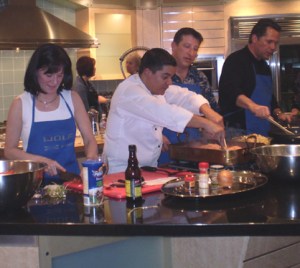
Adalberto Diaz makes his weekly cooking class a hands-on experience for students. Photo by David Servatius.

Adalberto Diaz makes his weekly cooking class a hands-on experience for students. Photo by David Servatius.

It is seafood and pasta night. The menu includes smoked spinach fettuccini with shrimp, fresh tuna seviche and crab cakes on fennel angel nests. The room is full of upscale, white, middle-aged men and women, some seated, some up and moving around. The atmosphere is unruly, the air full of laughter, shouting and clapping.

At first glance the kitchen area looks like a bizarre three-ring circus with shooting flames, flashing blades and a grinning, wise-cracking Cuban in the middle of it all, barking directions. Like a ringmaster, he is stirring with one hand, pointing with the other, telling the crowd how to chop onions correctly and instructing a woman at his side to drop her battered scallops into the fryer one at a time.

It is not a circus, though. It is just a typical night at the popular weekly cooking class taught by local chef and television personality Adalberto Diaz. Every Wednesday in the center showroom of the Roth Concept Center in Salt Lake City, Diaz creates a unique menu and a beautifully presented, delicious meal for 24 emerges from this organized chaos. But before everyone finally sits down and eats, there are two hours of fun.

“This is not a cooking show,” Diaz tells the audience at the outset. “I’m not cooking for you. You are cooking with me. Now who wants to help me with skewers?”

One class member yells, “I do. I do.”

“Not you,” Diaz snaps. “You are the pan washer.”

The crowd erupts into laughter and applause.

“I don’t know how he does it,” kitchen assistant Chelsea Smoltz says. “Every night I’m sure that we won’t get done in time to eat, or that someone will lose a finger or burn their face. But it always works out better than I’m expecting. The people just love him.”

Diaz, 35, has come from a different place and a different life than what he knows now. He says it is hard to believe that just seven short years ago he was sitting alone in a Texas detention center, terrified, between two worlds and unsure what would become of him.

Born in Havana in 1972, Diaz grew up with three brothers, two aunts, a grandmother and a great-grandmother in what he calls “the family house,” a modest but spacious two-story structure built by his grandfather in 1948.

“There were at least 10 people living there all the time,” Diaz says. “I always cooked with my grandmother. I never got any credit, I was just a helper for her, but I loved doing it and I learned a lot.”

When he was 9 years old, he used a pressure cooker — most Cuban families were too poor to afford traditional ovens — to make a lemon sponge cake. A neighbor tasted it, loved it and wanted one. He says he made another, charged his neighbor three pesetas, or about 15 cents, and realized he had a way to earn extra money for the family.

In Castro’s Cuba, however, the capital to purchase supplies for a private business was hard to come by. Diaz says he set up a system in which he would repair leather shoes in exchange for rum, which he would, in turn, trade for eggs, flour and other essentials.

Later, after high school and his required two years of service in the Cuban military, Diaz enrolled in the culinary school at the Hotel Sevilla in central Havana, where he also worked as a tourist entertainer. From the hotel, he ran a private, forbidden, baking business on the side, sometimes working all night to keep up with the ever-growing demand for his pastries, cakes and breads.

He says he became friends with three Salt Lake City nightclub promoters who made frequent trips to host parties on the island in violation of U.S. law. For years, Diaz helped them prepare the food for their parties.

In 2000, he was noticed by the Cuban government.

“I found out I had been what we called ‘tagged,’” Diaz says. “Not for my business, though. It was because I had had too much direct contact with the Americans. I couldn’t work at the hotel anymore unless I spied on my friends for the government. I’m not that kind of person so I lost my job.”

That May, he says his best friend Rafael Labrada convinced him it was time for both of them to leave the country for good. Diaz was unemployed, probably now unemployable, and as officials snooped into his life there was suddenly the very real possibility of jail.

“I found out that a big project linking all of the government computers was almost done,” his friend Labrada says. “That would make it impossible for a marked person like Adalberto to ever leave the country, for any reason. If he was going he had to do it within a week or so.”

The two went into hiding in Havana while the necessary documents were secured, going out only early in the morning or late at night. On May 24, Diaz told his family he was going on a camping trip and began a journey out of Cuba to a new life with his three American friends in Salt Lake City who had urged him to come.

“I was afraid to stay in Cuba, I had a big fear of jail, but I also wanted to leave,” Diaz says. “It wasn’t just fear. I knew that if I didn’t leave I would not improve as a chef, or as a person. The hardest thing was leaving my mother, not knowing when I would see her again.”

Using phony work visas, Diaz and Labrada took a short flight to Mexico City. Under the U.S. “Wet Feet, Dry Feet” policy, implemented in 1995, Cubans caught at sea trying to enter the country are turned back, but those apprehended on American soil are allowed to apply for asylum. Because of this policy, the U.S. Department of Homeland Security says Mexico has become the most popular route into the country for Cuban refugees.

In Mexico City the two were picked up by a “mule,” an American man they paid $3,000 to smuggle them to the border town of Reynosa. When they arrived in Reynosa, Diaz says they were instructed by their mule to cross the bridge over the Rio Bravo River into Hidalgo, Texas, on foot, and to tell the guards on the other side they were Cuban and seeking political asylum.

When the two refused to return to the Mexican side of the border to wait for their paperwork, they were taken by federal agents to the U.S. Immigration and Naturalization Service processing center at Port Isabel, on the Gulf Coast of Texas. Labrada would be released in a matter of days, but Diaz would stay for what he says were the worst three weeks of his life.

“There were cells, with bars,” he says. “It was a jail. There were six or seven curved buildings with big walls and lots of fences, and everything was ugly gray, everything, except for the uniforms. They were bright blue, for the good guys, like me, and bright orange for the criminals.”

Labrada says he and Diaz were separated as soon as they arrived. “They didn’t like anyone having friendships inside the place,” he says. “But we would see each other sometimes, at meals or in the bathrooms.”

Diaz says the bathrooms were probably the worst part of the entire ordeal. “There was no privacy,” he says. “If someone happened to have diarrhea you could hear it all over, and, even worse, smell it. Cubans are private people. I was so stressed that my hair turned white with dandruff.”

After what he says seemed like an eternity, his paperwork was processed and Diaz was free and in America. He and Labrada reunited in Miami and, after a long bus ride, arrived in Utah in the wee hours of the morning on the Fourth of July.

“I was stinky and tired, but the first thing I did was go to the Fourth of July parade in Provo, to celebrate being in America,” Diaz says. “I remember thinking, ‘This is a parade? This is how they celebrate?’ It was lame! There was no music, no dancing. I was expecting Brazilian Carnival and it was a bunch of white people walking.”

When the parade was over, however, the reality of life as a new immigrant in America set in. For almost a year Diaz worked as a laborer, painting and installing Sheetrock for a construction company. He says it was hard physical work. Then, in 2001, two of his friends opened a restaurant called Orbit in downtown Salt Lake City. They heard Diaz had been well-known in Cuba for his pastries and hired him as the restaurant’s pastry chef.

A year later he was running his own show as head chef at a trendy new restaurant and deli called Juhl Haus where, just like with his neighbor and his lemon cake all those years ago, a stranger was so impressed with something he cooked that it changed the direction of his life.

Marie Ritchie, the showroom manager at the Roth Concept Center, where most of the cooking programs on local television networks are taped, hired Juhl Haus to cater a party. One of the menu items Diaz prepared for the event was a spicy tomato soup.

“It was the best tomato soup I had ever tasted in my life,” Ritchie says. “I had wanted to start cooking classes in the big center showroom where we do television, so Adalberto and I talked about it that night. Within days we were working together and within two or three weeks we offered our first class.”

Ritchie says the weekly classes quickly started filling up and she noticed it was Diaz himself that people were coming for as much as it was his food or his recipes.

“He is like an artist, and he is a natural entertainer,” she says.

Ritchie knew that local television station KUTV needed someone for a cooking segment on its mid-day news program, and, on a hunch, recommended Diaz to the producers. The station hired him in 2003 and he was a hit with viewers.

Today, in addition to teaching his weekly classes, Diaz hosts a cooking segment every Tuesday on local television station Fox 13 and is the head chef for Granatos Restaurants, overseeing a staff of 13 people in four Salt Lake Valley locations.

As this week’s class ends and his assistants clean up the dishes, a crowd of students lingers to chat with Diaz. Some are thanking him, some cracking jokes and others asking questions.

“That was the most fun I’ve had in a very long time,” Tooele resident Karen Doolittle says. “He is very amusing, and the meal was incredible. I feel like I just had Thanksgiving dinner.”

A lot has changed for Diaz in a very short time, less than eight years, but he says he’s only just begun. He plans to publish a cookbook in the near future and would like to open an authentic Cuban restaurant in Salt Lake City at some point.

“I’ve packed 70 years of life into 35 years,” he says. “I am going to relax for at least a little while and enjoy this life I have. Celebrity is not important to me. Seeing someone’s face light up because of something you said to them or gave them to eat is what is important to me.”

Navajo Hogan serves traditional foods

by JESSICA DUNN

Squanto, of the Wampanoag tribe, helped the starving pilgrims of the Plymouth Colony 387 years ago. He lived with them and taught them how to fish and plant corn and other local vegetables.

The American Indians originally cultivated about 60 percent of the foods we eat today, said Forrest S. Cuch, executive director of the Utah Division of Indian Affairs. Those foods include corn, potatoes, tomatoes, chocolates and coffee beans.

While mainstream America has taken these native foods and created new recipes with them, the Navajo Hogan, a Salt Lake City restaurant, keeps Native American food traditions alive with their fry bread and Navajo taco.

The concrete building at 447 E 3300 South looks plain at first glance, with only a big yellow and red sign adorning its gray walls. The inside has a few simple, metal tables and chairs and a long counter in front of the open kitchen. The walls are decorated with Native American murals, strings of dried chili peppers, tribal maps, painted animal hides and various weaponry and trinkets.

Bill and Marcie Espinoza, originally from New Mexico, opened the Navajo Hogan in 1989. The building first housed the Espinozas’ arcade for the teenagers attending nearby Granite High School. One night, though, as Marcie was making dinner, Bill had the idea to sell the traditional Navajo taco that his wife made. He wanted everyone to have to opportunity to enjoy it. She refused at first because she had a full-time job, but after some persuasion from Bill she was convinced.

The restaurant’s main menu item is the Navajo taco. The traditional is the most popular, made with fresh fry bread topped with homemade chili beans, cheddar cheese, chopped lettuce, tomatoes and onions. The Navajo Hogan offers about 10 other variations as well, including vegetarian, chili cheese, blue corn and chicken.

Most North American tribes were never taught how to make bread but they experimented and learned to prepare fry bread, Cuch said in an e-mail. After surrendering to the U.S. Cavalry, Native Americans were issued rations of “salted pork or bacon, refined flour, salt, sugar, and lard,” Cuch said. They had to use the white settlers’ food to create the bread.

“The Indians mixed the flour with water and salt and made a dough,” Cuch said. “With the grease from the bacon or lard, they place the dough in the grease and created grease/fry bread.”

The Navajo Hogan also makes a sweet fry bread with cinnamon and sugar.
Mutton stew is also a staple of the Navajo tradition, Cuch said. The Navajo Hogan makes a limited amount of mutton stew with vegetables every Saturday and is served on a first come first serve basis.

Regulars come in every Saturday for the stew. Some will even call in advance to reserve their bowl, Bill said.

Mutton stew comes from the Navajo tradition of herding sheep. Their eating habits are different from other tribes, even within Utah. The Utes, the Native American tribe that Utah is named for, don’t have any well-known food traditions, Cuch said.

The food diversity stems from the Utes’ nomadic background as opposed to the Navajo’s early settling. Mormon pioneers eventually forced the Utes to change their ways. The move to a reservation restricted their eating habits and food sources.

“[The Utes used to] eat more wild game, including deer, elk, buffalo, antelope [and] trout,” Cuch said. “They learned to plant and eat corn from the Hopi.”

Though the Utes’ eating habits have changed from their traditional ways, Utahns still have the opportunity to try the Navajo taco and mutton stew at the Navajo Hogan.

Bill smiles and greets a pair of his regular customers and writes down their order from memory. He cooks their Navajo tacos according to each of their specifications, even cutting one into quarters.

People from all around the world have come to eat at the Navajo Hogan, especially during the 2002 Winter Olympics. There have been customers from New York, Alaska, Japan and Australia, Bill said.

Similar to Squanto, Bill is teaching and spreading the Native American ways and knowledge, all while feeding new people traditional Navajo foods.