Finding her way out

by EMILY A. SHOWGREN

It seemed fun and exciting. Meeting someone online, chatting for some time, greeting him when he traveled from Utah to Australia for a visit. This woman had fallen in love.

Harmony, who asked that her full name not be used for safety and legal reasons, was 36 at the time. She had two daughters, ages 6 and 9. The small family moved from Australia to Utah where she and her fiancé were soon married.

But the fun and excitement quickly vanished. Harmony was about to find out what kind of man he really was.

“He was a master of manipulation,” she said. “He conditioned me and then reinforced it throughout the marriage.”

Harmony and her husband were married for just over two years. During that time, he belittled her and ignored her daughters.

“He never physically hit them but he played mind games and ignored them. When I wasn’t there, he wouldn’t feed them or pay any attention to them,” she said.

He mostly abused Harmony emotionally and psychologically but that all changed in February 2007.

“He grabbed her arm and threw her on the bed and then began to hit her on the left side of her head,” said Marlene Gonzalez, Harmony’s attorney from the Multi-Cultural Legal Center. “He continued to hit her until she saw a bright light and became dizzy.”

Harmony and her daughters were eventually able to escape the room where he was holding them and went to a trusted neighbor. She called police and they started investigating. Julie Johansen, a Murray City Crime Victim Advocate, was called to the scene shortly after and began speaking with Harmony.

“I spoke with her and gave her information on where she could go to get help for domestic violence,” Johansen said. “I also went through the signs with her and showed her that it was definitely abuse. I told her that he would come back and try to apologize and make things better.”

After the attack, Harmony’s husband overdosed on medications he used for his bipolar disorder and post traumatic stress disorder. He was admitted to the psychiatric ward after the overdose and was there for a couple days.

During that time, Harmony went to the Legal Aid Society of Salt Lake (LAS) and obtained a protective order. He was served and told to stay away from Harmony and her daughters.

“After he received the protective order, he called me 17 to 20 times. I had to unplug all the phones in the house,” Harmony said.

He didn’t stop there. A couple days after the incident, Harmony was on the phone with the police when she heard someone at the door. She could see him through the window above the door; he was holding flowers and ready to apologize, just as Johansen had predicted.

“I told the police that he was at the door. They told me to not open the door and they were on the way. He went around the back but since he’s a bigger guy, he couldn’t get his arm through the gate,” she said.

He left but returned to remove the price tag from the flowers he left behind. By that time the police showed up and took him to jail. After a couple weeks, he violated the protection order yet again and was back in jail.

Harmony went to LAS to obtain a divorce. She obtained her protective order there but when she went for the divorce, she overestimated her income and was not able to receive help. Her friend helped her and took her down to the 3rd District courthouse in West Jordan, Utah, where Harmony was able to file for divorce online. She continued to help her estranged husband, though.

“Harmony had been going to counseling with her LDS bishop,” said Marlene Gonzalez, Harmony’s attorney. “Her bishop asked if she needed help finding a new home. All she wanted was for him to help her estranged husband find a place to stay after the divorce. She didn’t have any family here. She used the people who had become family to help him. She was very unselfish.”

Two weeks after the divorce, Harmony’s ex-husband was married for the third time. Harmony had been his second wife. The harassment didn’t stop after he remarried. Not only did he start sending harassing e-mails to Harmony, so did his wife. The police couldn’t do anything about her e-mails because there wasn’t proof he had told her to send those.

After 18 months Harmony had not heard from her ex-husband or his new wife. She says she is working as a business systems analyst and her daughters, now 13 and 10, are doing well.

“Harmony is an amazing woman. Statistics show that it usually takes eight or 10 times of being abused before someone gets out. She got out the first time,” Johansen said.

Legal help brings new hope

by PAIGE KASTELER

Jennifer Edwards, a Salt Lake City resident who wanted to file for a divorce, received the help she needed from Legal Aid Society of Salt Lake (LAS), a nonprofit organization that provides legal aid to low-income individuals.

Edwards, like many other low-income individuals, needed legal help but couldn’t afford it. After losing her husband’s income, Edwards didn’t have the means to acquire legal help to assist her with her divorce and gaining child support. In doing research, she came across LAS.

“I knew they didn’t have the resources and time to give to my case like another for-profit lawfirm would have. But I knew I had to try it,” Edwards said.

When asked about her legal case, Edwards wondered where to begin. She can trace it back to 2005 when her estranged husband, Ray, kept avoiding Edwards’s attempts to go to mediation for divorce. Ray kept putting it off, claiming that he needed to save money to marry another woman. After Ray remarried, Edwards asked again to go to mediation. This time, she said Ray told her no. Edwards told him that she would take him to court.

“I guess he thought I was bluffing because he didn’t take me seriously. He never thought that I could afford to get legal help,” Edwards said.

That was partly true: Edwards was supporting herself and her daughter on just her income, without alimony or child support. After discovering LAS, she began the application process by going to the Matheson Courthouse and filling out some initial paperwork.

Stewart Ralphs, director of LAS, says this can take up to four to five hours. “It is not something you can do on your lunch break,” Ralphs said.

Edwards made it through the screening process and was assigned her first attorney, Mary Peck Kashman, whom Edwards described as “awesome.” Edwards said Kashman always showed a personal interest and attentiveness with her case.

“She really knew my case backwards and front,” she said.

Edwards’s case has lasted several years, unlike a lot of the cases that LAS deals with. There was a lot of “contention,” as Edwards put it, between her and Ray. In addition to refusing to go to mediation, she said Ray tried at one point to get her to pay child support, and was emotionally manipulating their 3-year-old daughter, Maya. A lot of legal work was done to help fix the situation — work that took about two years and two different lawyers.

Edwards didn’t always have court victories with LAS. In fact, she described her first court appearance as “devastating.” The commissioner hearing the case had not read Edwards’s case file and simply scolded her and Ray for fighting.

Edwards said she left in tears. “I was trying to hold it together but I just broke down sobbing in the middle of the courtroom,” she said. But soon afterward came the first sign of hope. The commissioner read her file and awarded Edwards temporary partial custody of Maya.

But that was not the end of the legal headache for Edwards.

“I would have to call the police a lot on Ray,” she said. “Especially when I was going to pick up Maya. He would just do things like either not be home when he knew I was supposed to come, or he would just flat out refuse to hand her over.”

She also had trouble with Ray “emotionally manipulating” Maya. “I didn’t know what to do for her, I didn’t know how to help. So I took her to counseling which turned out to be a success,” Edwards said.

Then came another breakthrough. Ray was assigned another attorney whom Edwards described as a “reasonable man.” Edwards believes the new attorney helped Ray see that he needed to hold up his end of the bargain.

Edwards was also assigned another attorney after Kashman had to fly home to be with her sick mother. At first Edwards was frustrated when her new attorney didn’t seem to know her case, but eventually he “got caught up” and finished out the rest of the legal work. They finally got Ray into mediation, he is paying child support, and Edwards was awarded full custody of Maya.

One of the paralegals working on the case was Michelle Beddoes, who said they had to approach Ray with six different parenting plans before Ray and Edwards finally agreed.

“It always takes a while to reach an agreement when the opposing party is really difficult to deal with,” Beddoes said.

Overall, Edwards is very happy with the way her case turned out and the services she received from LAS.

“[LAS] completely saved my sanity,” she said. “They gave me new hope, another chance, and I hate to think where I would still be without them.”

Edwards has been out of the courtroom for a couple years and her daughter Maya is doing well after counseling. Edwards said she is now able to move on with her life, thanks to the Legal Aid Society of Salt Lake.

Abuse victim gets out, rebuilds life

by ELIZABETH PEZQUEDA

Shauna Lewis is at a wonderful stage of her life. She’s a 32-year-old, beautiful, longhaired, dark-eyed woman with a radiant smile and an incredibly contagious laugh that can lighten even the darkest of conversations. She loves her job and has been awarded two promotions in the short time she’s been there. She lives in a cute two-story town home and feels very blessed by her success. Her four beautiful children are the pride and joy of her life and like any loving mother, she’s been devoted to protecting them.

However, Lewis has also been to hell and back to get where she is today.

You’d never know by looking at Lewis that she has experienced years of depression; she lost a former boyfriend to suicide and was the victim of domestic violence episodes staggered over a seven-year period.

Remarkably, Lewis has let these experiences shape her into a strong and independent woman. While she says the repercussions of these events still linger and resurface in different areas of her life, she has an optimist’s attitude about her past, as well as the future for herself and her children.

Lewis said she first started taking anti-depressant medication regularly after the father of her son committed suicide. Her son was 1 at the time.

“He had a serious on-going issue with drugs and alcohol, and it just finally took its toll,” Lewis said. “I was heartbroken.”

She endured several emotionally difficult months, but said she put all her strength into being a good mother to her child. She relied on friends and family to get through the aftereffects of what had happened and eventually started dating again.

Lewis first met her husband-to-be at a popular Utah bar when she was 21. She immediately liked his sense of humor and charm. She was flattered that he was also interested in her.

Lewis had been shattered emotionally from the death of her son’s father and was wary about getting involved with someone new. She worried that her son would get attached to someone she dated, and then she would have to explain to him that he couldn’t see that person anymore because the relationship had ended.

Lewis took her time carefully getting to know this new man and eventually, their relationship became serious.

“We never really dated,” Lewis said. “We just hung out a lot and became best friends and fell in love at the same time. Our relationship just sort of happened.”

The two only dated a few months before marrying when Lewis was 22. Lewis felt like she had found her fairytale prince in the charming and hard-working 24-year-old. She was excited to start a new chapter of her life with him.

Soon after marrying, Lewis learned she was pregnant with another son. She and her husband began planning for the addition to their family.

During her pregnancy, things began to change.

When Lewis was seven months pregnant, her husband pushed her. It was the first time he had ever put his hands on her in a violent manner. Lewis was shocked, scared and heartbroken. He apologized for getting physical with her and begged for her forgiveness. Lewis forgave him and the two agreed to start over.

But not long after that incident, he pushed Lewis again, this time causing her to fall down. According to Lewis, he apologized countless times and sobbed desperately. She again forgave him.

In an article about domestic violence published by the FBI in 1997, author Lt. Douglas Marvin says this is typical of abusive relationships.

“The batterer may be genuinely sorry for the pain he has caused his partner,” the article states. “He acts out of his greatest fear — that his partner will leave him. He attempts to make up for his brutal behavior and believes that he can control himself and never again hurt the woman he loves.”

According to Lewis, her husband wouldn’t change.

Contrary to his repeated promises, Lewis said the abuse continued and got gradually worse with every episode. Lewis wore long sleeves and jeans to cover her bruises and tried to keep what was happening under everyone’s radar.

“I knew it was wrong and that it needed to stop,” she said. “I just felt trapped. I didn’t know what I was supposed to do.”

Lewis was also subjected to extreme emotional and mental abuse from her husband. According to Lewis, he talked down to her and called her names. He became increasingly jealous, controlling and manipulative, and put a stranglehold on Lewis’s freedom and decision-making abilities.

When the two first married, Lewis said her husband gave her the option to stay at home and raise their children. However, one son and two daughters later, his desire had turned into her obligation.

“I wasn’t allowed to have a job, or really anything of my own.  It was just another way for him to control me,” Lewis said.

Because Lewis didn’t have a job, every purchase she made had to be cleared by her husband. Even things like the utility bills, groceries and medicine for their children had to be approved, she said.

Alma Perez, a paralegal at Legal Aid Society of Salt Lake who helped Lewis with her divorce, said she immediately noticed the ex-husband’s feelings about money during the divorce.

“He put up a fight for anything that pertained to money,” Perez said.

Despite Lewis’s attempts to clear purchases with her husband, she said he still complained about the money she was spending, in addition to countless other things.

“He complained about everything. I couldn’t cook well enough, clean well enough, take care of the kids well enough, nothing,” Lewis said. “I lost all my confidence and self-esteem.”

Lewis then learned that her husband had been cheating on her. After his secret was out in the open, Lewis said he told her his encounters were going to happen once a week. He said he’d tell her the day and time and that he’d be home at night, but it was just something he needed.

She pleaded in vain for him to be faithful to her but he was constantly on the road and she felt she couldn’t trust him.

Heartbroken, with four children to care for and no time, money or place of her own, Lewis became increasingly depressed and emotionally overwhelmed.

Friends and family begged Lewis to leave, but she still felt as though she had no power to do so.

“I told her after the first couple of times that he hit her that I couldn’t be her friend anymore if she didn’t leave him,” said her best friend, Kelly Lim. “She wasn’t doing anything to protect herself, and I told her I couldn’t support her in that. It broke my heart that she wouldn’t get out.”

It wasn’t until one of the couple’s sons walked in on his father abusing her that Lewis finally found the power to leave.

“He was sitting on my chest with all his weight and I couldn’t breathe,” Lewis said.  “I was struggling and telling him to stop when my son walked in. That was it.”

Moments later, Lewis called the police and within the next few days filed for divorce at Legal Aid Society. Still her husband pleaded for her to reconsider.

It has been two and a half years since Lewis found her will to leave. She has found a job she loves, received two promotions and regained her confidence, strength and independence. She said she has a better relationship with her four children. She and her ex-husband share custody and the children see him on Wednesdays and some weekends. Lewis said she no longer has the need to take anti-depressants and is looking forward to an increasingly peaceful and happy future.

While her ex-husband never had to serve any time in jail for the abuse, Lewis said she is still happy with the outcome.

“I don’t have to worry about [being abuse]  anymore. I got my life back and I’m so happy,” she said.

“It’s such a remarkable difference between [Lewis] now and how she used to be,” Lim said. “She has this light about her again, and she’s confident and happy. I love it!”

Lewis said she hopes her story will help other women escape from similar situations.

“You just have to make the decision to leave. I promise it’s so much better on the other side,” Lewis said.

Mediation saves families money

by TYLER COBB

Going to court for a divorce can be stressful, both monetarily and emotionally. In Utah couples are required to sit down with a mediator to work through their problems in an attempt to avoid a court trial and a hefty legal bill.

The State of Utah began requiring mediation in 2005 to help people avoid going to court by talking with a neutral mediator, trained in how to handle family conflicts and how to navigate the law.

Stewart Ralphs, executive director of the Legal Aid Society of Salt Lake, said hundreds of low-income families need legal advice and most lawyers do pro bono work to keep costs low. But it costs even less when couples can solve problems through a mediator.

“We’re trained in law school to be very zealous advocates for our clients and go to the mat and take these cases to trial and bring in all the evidence and win, win, win,” Ralphs said. “Mediation is just the opposite – it’s trying to come up with a resolution for everybody as a winner.”

Ralphs said the organization generally works with mediators from Utah Dispute Resolution, a nonprofit mediation organization where most mediators work as volunteers to keep costs low for struggling families.

If the parties can resolve their dispute using mediation it’s much cheaper than going to trial, and there is a fairly high rate of resolution. “It can vary between 60 to 75 percent of the time, which is certainly cheaper than going through the whole trial process,” Ralphs said.

Mediators spend hours negotiating with both parties to reach a fair conclusion, but they have to remain neutral despite what is said.

The courts require that mediators spend at least 40 hours in training, which they can receive at the dispute resolution center. Nancy McGahey, executive director of the center, said most mediators the center hires are well-trained and have certain skills and personality traits that help them work with couples.

“People in dispute need time. As a mediator you need to sit with people and be comfortable with people who are emotional,” McGahey said. “It’s also important to know oneself and be aware of your own internal biases, especially when you’re starting to lose neutrality.”

At the Legal Aid Society, attorneys rely “very heavily” on mediation to avoid court dispute, Ralphs said. Going to court can increase costs for all families. Ralphs said the organization charges anywhere from $200 to $600 for family-law cases, just for lawyer and court costs. However, there are other expenses depending on the results of the court and how long it drags out.

“You come up with an agreement that people are actually going to implement and make work,” Ralphs said. “These are people that have got to live the rest of their lives together. They have kids together. They have property together, and they can usually come up with a better solution than a judge can in a one- or two-day trial.”

Many women and/or men who come to the Legal Aid Society for a family-law case have multiple factors they need to consider and resolve, especially those seeking a divorce. The couple will have to review childcare, health care, child support, property resolution and other issues.

The Legal Aid Society sees so many family-law cases that they usually request mediators trained specifically for family law.

McGahey said family-law mediators need additional training beyond most mediators.

“They’re more experienced and have more training,” McGahey said. “To be approved on the court roster, a domestic mediator needs 20 hours of practical experience, an ethics exam, a criminal background check and in addition, the person needs a minimum of 32 hours domestic training and a formal mentorship, which involves six mediation sessions at a minimum.”

With a good mediator, a session can be successful and help couples find a solution.

Some women requesting legal help come from an abusive or closed relationship and sometimes need to say what they’re feeling, Ralphs said. A mediator can provide an atmosphere to work through problems without arguing or yelling.

If mediation or negotiation doesn’t work, attorneys will start preparing to take the case to court. “The custody battle follows,” Ralphs said.

Safety available for abuse victims

by ELIZABETH PEZQUEDA

At the Legal Aid Society of Salt Lake, domestic violence cases are a priority. The nonprofit organization keeps its doors open to all individuals and families dealing with domestic abuse, no matter the person’s income.

Legal Aid, which is one-third of the non-profit group “…And Justice For All”, seeks to help battered women, men and children gain the safety they deserve by aiding victims in a number of different ways.

Stewart Ralphs, executive director of the Legal Aid Society, said victims who are living with or have a child with the abuser most commonly need help to file civil protective orders. Those victims who do not live with or have a family with the abuser are helped with filing civil stalking injunctions.

Legal Aid also provides emergency safety planning for the victim if it is needed. In these types of cases, victims are educated about how to stay safe or get to safety if they are confronted by their attackers again.

“We do a safety plan with our clients, so if they have to flee immediately, they are more prepared to do so,” Ralphs said.

During the emergency planning, victims are encouraged by a staff member to be aware of different ways they can get out of their residence. Some of the things that these safety plans stress are keeping doors and windows locked, talking to neighbors, keeping a phone in another part of the house and having a suitcase ready with a change of clothes, medicine and copies of important documents. These documents may include a birth certificate, Social Security card and driver’s license.

Victims are also instructed to keep in mind where close relatives and trusted friends are located, in case there is an immediate need to go somewhere else.

Legal Aid understands there is often a criminal side to the victim’s case as well. If the state decides to press charges against the abuser, the victim also faces interviews with police and possibly testifying in court, among other actions.

“Victims often have to deal with both the criminal and civil side of the law,” Ralphs said. “It can be very confusing for them.”

Because there are often many different facets in each individual case, Legal Aid tries to provide the victim with numerous different sources for help in potentially every area in which the abuse has affected her or his life. Some of these resources may include the YWCA, Department of Workforce Services, Division of Child and Family Services and the Salt Lake Area Family Justice Center.

Asha Parekh, director of the Salt Lake Area Family Justice Center, said it is a place where victims of abuse can come and get access to all the different services available to them.

“Our goal is to make it easier to access the services in the community,” Parekh said.

The Family Justice Center provides help in filing civil protective orders and civil stalking injunctions through a Legal Aid Society paralegal. Through the YWCA, the center also tries to work out any and all housing issues that may pose a threat to the victim.

“Short-term emergency housing is available to victims of violence, and long-term housing is available for families and single women,” Parekh said.

Unfortunately, many women who are dealing with domestic abuse have children who have also been affected by the situation.

“Children are always secondary victims to domestic violence, if not primary victims,” Ralphs said.

Legal Aid and the Family Justice Center try to provide a place for the children who come in with a parent who has been abused, so the parent can get the help they need without the child being directly involved.

Ralphs said that providing a means to safety for the victim and her or his children is a priority for the Legal Aid Society.

“It’s very important that victims get all the protections that the law affords them,” Ralphs said.

Communication difficulties at court disappoint woman

Story and photo by JED LAYTON

Lana McKinsey left the Layton City Courthouse bewildered.

She had arrived at the courthouse, not because of something she did, but because she was a victim. But when the time arose for her to tell what happened, she was not able to.

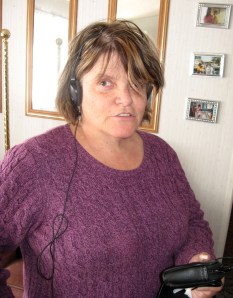
McKinsey is visually impaired and has partial hearing loss. She can only hear with the help of hearing aids and describes her sight as looking through a pinhole.

Lana McKinsey wears a listening device that will be made available at the Layton City Courthouse.

Lana McKinsey wears a listening device that will be made available at the Layton City Courthouse.

The Helen Keller National Center estimates that more than 70,000 Americans deal with the dual disabilities, a combination McKinsey calls life changing.

It changed her life when she attempted to give her side of the story regarding a plea bargain her neighbor was making for assaulting McKinsey. But when she tried to use the devices for the hearing impaired, she couldn’t hear.

She couldn’t hear the questions and couldn’t give the answers. McKinsey felt she was again the victim.

“They treated me wrong,” McKinsey said. “They wouldn’t let me say my say and excused me from the room. I thought that was not right.”

The whole experience left a negative impression in McKinsey’s mind of the court system and left her unhappy with the way a settlement was reached.

Six months later, McKinsey is still perturbed by her negative experience but has since worked hard to make sure that no one will have to go through what she did.

McKinsey received help from Kirsten Gwilliams, with the Utah Division of Services for the Blind and Visually Impaired, and Lisa Fine, an attorney with the Disability Law Center.

McKinsey arrived in court because on June 1, 2008, she was struck multiple by times by her neighbor, Stephanie Galbraith, in their trailer park in Layton, Utah, McKinsey said. McKinsey had gone over to Galbraith’s home to donate some dog food and other items she thought her neighbor needed.

McKinsey said Galbraith apparently also wanted the pearl necklace around her neck and attempted to take it from her. The struggle over the necklace then escalated to violence, she said.

Galbraith was charged with assault and intoxication a few days later.
The case went to court in September 2008 and Galbraith pleaded guilty to the assault charges as part of a plea bargain. During the proceedings, the court gave McKinsey an opportunity to make a statement.

“When it was my turn to talk, I could not use the device they gave me to use,” McKinsey said. “I couldn’t hear anything. It seemed like they had never had a deaf and blind person there before.”

Gwilliams said most public places have few problems with the assisted hearing devices similar to the one McKinsey attempted to use.

“However, problems arise in two ways,” Gwilliams said. “First, most people don’t know what they are or how to use them, or how to help if they are not working.”

In McKinsey’s case, no one understood why the devices weren’t working and there were no other options for her to try. Typically the Layton City Courthouse uses sign language for those who are completely deaf and can’t use the hearing devices. But McKinsey’s blindness prevented that option.

“The other problem is that there are two types of assistive listening devices typically used,” Gwilliams said. “One is a device that uses infrared and comes with ear phones. She had to take her hearing aids out to use them, but that did not accommodate her.”

McKinsey said taking her hearing aids out makes her lose nearly all of her hearing. She left the courthouse frustrated, upset and offended. Gwilliams said most courts use infrared devices because the signals do not pass through walls.

McKinsey contacted Fine and the Disability Law Center through Gwilliams. Fine listened to McKinsey’s story and quickly realized there was a problem.

“We arranged to meet with some of the Layton Courthouse administrators who were very receptive and concerned about the situation,” Fine said.

Fine said she was surprised by how quickly and professionally courthouse officials dealt with the situation. Fine also said the Layton Courthouse was not in violation of the Americans with Disabilities Act — a piece of legislation that makes it illegal to discriminate against people who have disabilities.

The Americans with Disabilities Act requires public entities to ensure communication with individuals with disabilities. It recommends the use of auxiliary aids, assistive listening systems, interpreters and many other options, all of which the Layton Courthouse had on hand. However, McKinsey was in a unique position because she could use none of them.

“It was an example of exactly how these types of things should be handled. They realized something had gone wrong and fixed it,” Fine said, notin that officials included McKinsey in the decision making process.

McKinsey was able to pick between varieties of different assistive hearing devices borrowed from neighboring courthouses. The devices were of a different type using radio frequencies instead of infrared signals. These devices used headphones instead of earphones.

“I was able to put them on and listen and had Lisa try them on too,” McKinsey said. “It was obvious which one was better and they said they would purchase one and put it in the court.”

McKinsey said that while she was not pleased with the way her own case with the court was handled, she was pleased to know someone else like her will not have to go through the stress and emotion.

“I wondered if there is another person that could have the same problem I did,” McKinsey said. “I didn’t want them to go through that.”

Fine said dealing with the Layton Courthouse was simple and easy. “They deserve a lot of credit. They did most of the work,” she said.

Since meeting with Fine and Layton Courthouse officials, McKinsey said she has moved beyond the problem and has started to move on with her life. But she said it is a relief to her that she knows that there is a way for her to communicate if she needs to go back into court.

McKinsey said she still worries that her neighbor, who lives just a short walk down the road, might seek retribution and is concerned she won’t obey the stipulations of her sentencing.

“If she doesn’t do what she is told, I will go back to the Disability Law Center, and they will represent me,” McKinsey said.

“…And Justice For All” serves rights on a silver platter

by MADISON MURPHY

On Jan. 29, 2009, steamy pancakes and sizzling bacon filled the hungry bellies of the Salt Lake community to help raise awareness of the services “…And Justice For All” provides.

Currently the majority of Utah’s low-income families that are facing civil legal problems do not know that legal aid programs exist and are right within their grasp. “…And Justice For All” is a sanctuary for these people, providing them with “silver platter” quality service at no cost to them.

“…And Justice For All” is an organization that receives money from federal and state grant programs. To promote services for all aspects of legal aid, the organization is the umbrella over three other agencies: the Legal Aid Society of Salt Lake, Utah Legal Services and the Disability Law Center.

The first requirement to receive pro bono help from this organization is to have a low income. Typically, a single mother cannot be making more than $14 per hour through her employment. The second requirement is the obvious one: a legal problem.

Many people are not aware as to what exactly constitutes a legal problem. They would be surprised to know that civil legal problems are so common, two out of three low-income households in Utah encounter a civil legal problem each year. Only 13 percent are receiving legal help.

“It has been around almost 10 years and people still say, ‘Oh, I didn’t know you guys existed!’” said Matt Knotts, executive director of the Disability Law Center.

The Disability Law Center mainly encounters abused and neglected clients. The center helps to protect the rights of people with disabilities in Utah.

According to “The Justice Gap,” a survey provided by “…And Justice For All,” about one-third of clients did not know where to turn for help and more than 22 percent felt it was too much hassle; 21 percent indicated they feared the cost. Unfortunately, 19 percent felt nothing could even be done and 17 percent did not think their problem was a legal issue.

“Other reasons for not seeking help included fear of retaliation, waiting to see if things change, feeling the problem is not important enough and an inability to speak enough English to seek legal counsel,” according to the study.

“We would love to get to the point of assisting as many people as other existing states,” said Kai Wilson, executive director of “…And Justice For All.” One of the most successful legal aid organizations is in Washington, which sets a high standard for legal aid organizations in other states.

Civil legal problems range from domestic violence, public housing disputes, police harassment and immigration issues.

Susan, who asked that her last name not be used to protect her from her ex-husband, is a client of Legal Aid Society of Salt Lake. She filed a protective order against her abusive husband to keep herself and her two children safe. Despite the protective order, Susan’s husband took the children to Florida without her consent. Legal Aid Society had police arrest Susan’s spouse and extradite him to Utah. With further help from Legal Aid, Susan filed for divorce and now has full custody of her children.

“…And Justice For All” strives to help Utahns like Susan who experience abuse and neglect. The organization works to offer equal and appropriate services to clients who might not otherwise be able to obtain aid due to cost or bad credit.

“’…And Justice For All’ is shedding light on the importance of social justice in our community, and not just the legal community,” Knotts said.

Although it may not literally be on a silver platter, the organization still succeeds in teaching the people of Utah their legal rights, as well as offering pro bono services.

One success story was told in “The Justice Gap” about Maria, a deaf client. A pro bono attorney was able to help Maria regain custody of her children from her spouse. “This attorney donated 50 hours in three months of pro bono work worth over $7,500 of billable hours,” Maria states on the organization’s Web site.

Attorney General Robert Kennedy said, “The poor man looks upon the law as an enemy, not as a friend. For him, the law is always taking something away.”

But for a majority of clients, many said they left feeling positive and unburdened from the legal system.

One-stop shop for domestic violence victims

by DANIELLE MURPHY

Traumatic experiences, such as domestic violence, can leave people feeling alone, lost and confused. Victims live in fear while grasping for a lifeline. When they figure out where to turn, they are forced to recount the horrors of their situation over and over again.

Utah’s first, and only, Family Justice Center provides a haven for victims of domestic violence to gain shelter while meeting with representatives of various organizations that can help their plight. This minimizes time, travel and emotional heartache for the victim as he or she relays his or her story to the organizations that can provide an escape from the fears confronted on a daily basis.

Stewart Ralphs is the executive director of the Legal Aid Society of Salt Lake, one of the organizations represented at the FJC. “It is important to provide services so victims of domestic violence have someone who knows the processes, so they get the protection that the law affords them,” Ralphs said.

Ralphs describes most victims as coming in as “basket cases” because of the combination of harrowing abuse situations and unfamiliarity with what to do next. Most victims are referred to the FJC by other organizations, so victims arrive without much expectation. The average victim is a 23-year-old female with several children, Ralphs said.

The staff at the FJC is trained to be empathetic and culturally sensitive. When victims arrive, they are assisted with obtaining a protective order, filing for criminal charges, obtaining proper protection for children, getting shelter and finding a job. Initial services at the FJC take between four and five hours to complete.

One of the first actions a victim goes through upon arriving at the FJC is meeting with the Legal Aid Society of Salt Lake. A Legal Aid Society paralegal checks for conflicts of interest before the victim summarizes his or her situation. This allows the LAS to provide the client with specific help that best serves his or her individual needs.

Once that process is complete, the victim will meet with an LAS paralegal to prepare the protective order. When the protective order is ready, it will be filed with the sheriff and subsequently served to the individual the complaint was filed against.

The protective order is effective from the time it is served through the court hearing, which is typically two weeks later. The order stays in place for the rest of the involved parties’ lives, unless the petitioner withdraws the order.

Aside from preparing protective orders, the Legal Aid Society helps the victim devise a plan to keep him or her safe. These plans typically include notifying neighbors of the situation, keeping weapons out of the house, maintaining a packed suitcase and getting locks for all doors and windows.

“We want to make people think of steps to take to protect themselves … what is the worst case scenario and how would you respond to it?” Ralphs said.

He said the Legal Aid Society’s Domestic Violence Victim Assistance Program helps almost 3,000 people in the Salt Lake valley per year. “Domestic violence never decreases. Either society addresses the problem professionally and corrects it or the problem escalates and becomes more and more serious over time,” he said.

The Legal Aid Society has been instrumental in addressing the problem of domestic violence. It is the oldest legal aid nonprofit organization in Utah. The more recent addition of the Family Justice Center in 2007 signaled another dimension to helping victims of these horrific experiences.

Marlene Gonzalez, the executive director of the Multi-Cultural Legal Center, another organization represented at the FJC, said the Family Justice Center allows for good collaboration and it is a great tool for serving the needs of the victim.

The Family Justice Center provides representatives from the Department of Workforce Services, Division of Child & Family Services, Salt Lake Police Department, YWCA, Legal Aid Society of Salt Lake, Salt Lake City Prosecutors Office and Multi-Cultural Legal Center.

If you or someone you know is a victim of domestic violence or abuse, you can call the YWCA at (801) 537-8600 or the National Domestic Violence Hotline at (800) 799-SAFE (7233).

Legal Aid Society levels playing field for domestic victims

by PATRICK HARRINGTON

Stewart Ralphs’ passion is apparent when speaking about the Legal Aid Society of Salt Lake’s work with domestic abuse victims. “I get to level the playing field, sometimes it is the first time in my client’s life that someone has stuck up for them,” he said.

Legal Aid Society of Salt Lake is the oldest functioning pro bono legal office in Utah. Formed in 1922, Legal Aid Society continues to focus primarily on domestic violence and family law cases in which the client is filing for personal protection, custody rights or divorce in a court of law.

Ralphs, the executive director, has devoted his legal career to domestic violence issues since joining LAS in 1991.

“Within the domestic violence program, just over 3,000 people are helped per year,” Ralphs said. The most common way to deal with certain domestic violence issues is to have the client fill out a protective order, with one of the experienced attorneys at LAS.

To obtain a permanent protective order against someone, the client must be a cohabitant with the person they are filing the claim against. A cohabitant must have a relation by blood, marriage, mutual child or common living situation to be awarded a full protective order.

Cases in which the client is just dating the person being served and has no official legal connection may file a civil stalking injunction. Injunctions are limited to 150 days of protection, whereas the full protective order lasts indefinitely, or until the judge feels a temporary order will suffice.

Dealing with certain clients proves to be difficult. “ Most of the people that we deal with are basket cases,” Ralphs said. “They have just come off one of the most traumatic experiences of their life. A loved one hurt them, and they are going through trauma. We have to be sensitive with people’s needs.”

Sensitivity also has to be met with determination and persistence. Legal Aid Society lawyers have to deal with massive caseloads that demand much of their time.

“The majority of our lawyers are dealing with case loads in the hundreds every year, and if they are family law cases they may take several months to a few years to get a judgment,” Ralphs said.

Even the application and registration process for obtaining legal counsel from Legal Aid Society is a laborious and time-consuming effort. Every prospective client is run through a conflict check to ensure their current case will not be compromised by another they were previously involved with.

“Once a client, always a client. Once an opposing party, always an opposing party,” is the way that Ralphs describes the policy of conflict checks.

After a client is approved, obtaining a protective order can take four to five hours.

“Many of our clients are either illiterate or cannot speak English, so our involvement is crucial to ensure the quality of the legal process,” he said.

Over time the office has brought on board more qualified personnel and assistants (such as translators) to assist the tireless legal team. However, in its infancy Legal Aid was nothing but a small group of raw and talented individuals who had to take care of everyone that walked into their office; regardless of the circumstance.

John Scheaffer, who worked as an associate attorney at the Legal Aid Society before serving as executive director for five years, cannot speak highly enough about the work that the Legal Aid Society does for Salt Lake City families.

“Legal Aid has come such a long way since it was started by Allan Crockett in the 1920s,” he said. “When I first began working at Legal Aid, there were only three lawyers and three staff members. The lead attorney, Bill Shelton, was blind and he was in court every day with his Seeing-Eye dog, working so hard to help his clients get what they deserved.”

Through the free assistance of LAS, families can afford the help of top-notch legal counsel for their case, at little or no cost. The pro bono service offered through the organization is offered year round and pertains to anything from brief consultation to full representation in any family law or domestic violence case.

“ I have a great deal of respect for what they do at Legal Aid,” Scheaffer said. “It serves not only as a place for clients to seek legal help, but as a training ground for Utah’s next best lawyers.”

Fighting domestic violence means getting help for you and your children

by EMILY A. SHOWGREN

He tried pushing her out of a moving vehicle but when he couldn’t, he slammed her head against the window. He punched her face until her mouth filled with blood and splattered onto her clothes and the inside of the car. He placed her in a headlock and bit her ear and fingers and continued to apply pressure until she came close to unconsciousness. He also threatened to kill her.

This incident may have happened in Hollywood but it was very real. On Feb. 8, 2009, pop star Rihanna was attacked by her boyfriend, fellow pop star Chris Brown. Details are found in the police affidavit.

Instances like this happen every day and if you are a victim, advocates say don’t be afraid to ask for help. In fact, it may be the only way to save your life. According to the Legal Aid Society of Salt Lake (LAS) and the Utah Domestic Violence Council (UDVC), even if your partner promises it won’t happen again, it will.

“Domestic violence never decreases,” said Stewart Ralphs, executive director of LAS.

Some people may think that as long as the abuse is inflicted only on them, it isn’t hurting their children.

“Children are harmed by domestic violence even if they never see it and are never physically abused themselves,” said an official from Utah’s Division of Child and Family Services (DCFS) who has experience in domestic violence cases. “If there is even a possibility that a child has heard or witnessed the abuse, it is enough for a substantial case.” The official did not want his name used because reporters are normally directed to a public relations specialist at DCFS.

In the Brown case, The L.A. Times reported he comes from an abusive background. His stepfather used to beat him and his mother. Some mental experts have said it isn’t uncommon for someone to repeat a traumatic event or its circumstances over and over.

“Witnessing domestic violence on a regular basis can definitely have an effect on a child’s relationships later on,” said the DCFS official. “It messes with their self-esteem and the way they view themselves. However, it is no excuse. They are responsible for their own actions.”

The DCFS employee also said some victims who have been abused in the past will go looking for a mate who is abusive. This is one of the many reasons why it is so important for a parent who is being abused to get help right away. It could save the child from potential danger now and from other problems later.

Obtaining a protective order is a step in the right direction for a victim’s protection as well as for children’s. To get a protective order, the victim must be able to prove they have been harmed or threatened with harm and are a cohabitant with the accused. The process can seem scary but the attorneys and paralegals at LAS can help ease any tension or fear. Ralphs said LAS helps just under 3,000 victims a year.

“We do a lot of training with our employees on how to counsel victims,” Ralphs said. The victims who come in are usually not on their own. “The average victims we see are women around the ages of 23 or 24 with about two kids.”

LAS can explain what can be included in a protective order and how the process works. The agency will also help victims formulate a safety plan with tips on how to make a quick escape and where to go for help.

UDVC has a safety plan specifically for children. It has children identify where safe exits are in the home and people whom they can go to for help.

If you are a victim, don’t be afraid to go for help. Many places, including The National Women’s Health Information Center, remind victims that it is not their fault and encourage people to take extra precautions to keep safe.

Those who aren’t sure if they are a victim of abuse are encouraged to call, go online or go in person to find out. According to the Children’s Defense Fund, maltreatment of children is present in an estimated 30 to 60 percent of families, where there is some form of domestic violence.