Program helps older adults get around

by Lee Horton

For most of us, the ability to drive is a privilege. Having that privilege taken away would be akin to having our independence taken away.

When people obtain their driver’s license as a teenager, they gain the ability to go almost anywhere they want, provided they have the resources. The freedom to roam as they please only increases over the next 30, 40 or 50 years. The older people get, though, the more their physical abilities start to dwindle. Often, the privilege of independent transportation is taken away, but their need for transportation still exists.

“Things weaken with loss,” said Scott Wright, director of the Gerontology Interdisciplinary Program at the University of Utah. “It’s important to let (older adults) know they have options.”

When it comes to catching a ride to an important doctor’s appointment or the pharmacy, or to do other essential errands, an option older adults in Salt Lake County have is the Salt Lake County Aging Services’ Senior Transportation Program.

The Senior Transportation Program provides rides to people 60 years old and older who have no other means of transportation.

“A lot of people in their 70s and 80s can drive,” said program manager Bob Prottas. “(A person) might be able to drive to the store, the library, church or other places near her home, but she might not be comfortable driving to the University of Utah.”

Prottas reports the free service has been put to good use.

“We do 50,000 rides per year,” Prottas said. “We’re north of 200 every week.”

According to the Aging Services Web site, the Senior Transportation Program drives older adults to medical appointments, physical therapy, pick up prescriptions or to visit family members in hospitals. Some riders only use the services when their usual modes of transportation are unavailable. Others use it on a regular basis. The frequency often depends on the rider’s nearby family support.

“Some don’t have family, or they’re out of town, or they don’t give a damn,” Prottas said.

Wright and other gerontologists feel such programs go beyond the medical benefits in helping adults live healthier, longer lives.

“We feel mobility is critical for older adults,” Wright said.

Many older adults fear crime and the other dangers of the world. Statistics, however, show they are not often victims of crimes. Wright feels it is important these fears don’t stop older adults from venturing beyond the walls of their home. Just being out and interacting with the world is crucial.

“The fountain of youth is being mentally and physically active,” Wright said.

Prottas adds internal pride and a type of self-esteem to the list of benefits of the Senior Transportation Program. “It helps them maintain their independence,” he said.

The program allows older adults to not only take care of their essentials, but also to arrange the weekday rides to fit their schedules.

Driving positions are filled by both employees and volunteers, all of whom must pass a criminal background check. They also must possess the right kind of personality. Prottas considers driving older adults a “social-type job,” and therefore looks to hire outgoing people.

The Senior Transportation Program has 64 volunteers and is always looking for more. Just about anybody with a clean record and a driver’s license can volunteer.

“(The volunteers) range from their mid-20s to their mid-60s,” Prottas said. “Some of our volunteers are more apt to be clients.”

The service is available Monday, Tuesday, Wednesday and Friday from 8 a.m. to 4:15 p.m., and Thursdays from 9:30 a.m. to 4:15 p.m. Rides can be scheduled up to a week in advance. Prottas recommends getting it scheduled as close to that week as possible, as the schedules fill up fast.

There is no cost, though Aging Services sends out slips recommending a $2 donation for each trip. Because some clients do not pay and others pay more than $2, Prottas says the average received donation per ride is $1.75. With 50,000 trips in a year, according to Prottas, the program brings in approximately $87,000 per year.

Among those 50,000 rides are group grocery shopping trips prearranged with participating senior centers. Individual grocery excursions, though, do not fall within the “essential” category. The same is true for rides to movies, hairdressers or to the mall. Prottas and the Senior Transportation program will help people meet their needs, but satisfying wants is left up to the riders themselves.

Live long and live well

Story and photo by Alexis Young

When she underwent back surgery a year ago, the doctor told Lois Stromberg to expect at least 12 months for a full recovery. However, only five months after surgery, she was exercising 20 minutes a day and walking more than expected.

Lois Stromberg believes if you Incorporate this food into your diet every day, it will assist in a healthy long life.

Stromberg has been diagnosed with osteoporosis, has had three hip replacements, several broken bones and faced back surgery, all within the last 15 years.

Carrie Hinckley, Stromberg’s daughter, thinks it is remarkable that her mother has little to no pain on a daily basis and hardly ever complains.

Stromberg, 88, believes the solution to no pain and a healthy, long life is “daily exercises, a positive mental attitude, and a support group: your family.” Not your sedentary senior citizen, Stromberg explains word for word the key principles to aging well.

The idea of aging well is for people to maintain a healthy lifestyle as they age by applying choices that improve active, strong and secure lives. As with any sport, if you have a routine and practice it on a daily basis, your game can improve. The same principle can be applied to aging.

“It is within your power to motivate yourself, to exercise and keep practicing by going the extra mile,” Virginia Rhodes, a service coordinator for senior citizens, said.

In Rhodes’ nine years of experience with seniors, she has seen how lifestyle positively affects aging and assists in the avoidance of illness. With the results exercising generates, it is especially beneficial when you plant the center of attention on abdomen exercises.

“It has significantly helped them with their posture, back pain, and getting up from chairs,” Rhodes said.

Rhodes’ career goal is to stay educated with the latest developments to healthy aging. She takes several courses to enhance her knowledge, and is always creating new exercises to keep seniors motivated.

Motivation is certainly one area in which Lois Stromberg is not lacking. Before she even gets out of bed to wander through her home, which has the sensational aroma of fresh coffee, she commits to accomplishing one goal before starting her day. The goal can be anything from dusting, watering her garden, walking to and from her daughter’s house, or when she is in the need of a challenge, changing sheets.

“It gives me the greatest satisfaction to know I can still do it,” Stromberg said.

Directly after completing her goal, her next mission is to get a “full dose” of exercise.

“I reserve at least 20 minutes a day…. It’s what the rehabilitation center recommended after my back surgery.”

Stromberg’s basic reason for staying motivated is the fulfillment she achieves through her accomplishments. In addition, she is always concerned that if she does not continue to be persistent with her goals and positive outlook, she will lose her enthusiasm toward life.

“Having a vibrant mentality can lead to the aspiration of living young at any age,” Stromberg said.

You live a high-quality life, with working joints and a high sense of energy until the day you die. “So aim to feel like you’re 30 even when you’re 80,” Stromberg said. “Staying young involves your emotions and physical health, personal hygiene, close contact with family and friends, and paying close attention to your eating habits.”

Having the energy of an 8-year-old, hardly any wrinkles and being slim as a toothpick, Stromberg’s ambition is to always feel young. In a kitchen that has nothing but an abundance of fruit, vegetables, yogurt and fish, she claims her energy levels skyrocketed when she changed eating habits nearly 10 years ago.

Aside from exercising daily, eating healthy foods and continuing with her goals, Stromberg shares her final secret to aging well. Family, she said, has been the key to motivation, the drive to achieving her accomplishments, the desire to live long and live well. It gave her the will to carry on when her husband died three years ago. The days are now lonesome, and the evenings are unpleasant, but Stromberg said she remains in high spirits. Eager to spend time with her friends and family every day, Stromberg whispered, “If you haven’t got a family, you haven’t got much.”

Apple’s iPhone: a benefit for senior citizens

by James Williams

The Gateway Mall in Salt Lake City has something for just about everyone. There are clothing stores, sporting good stores, restaurants and even a movie theater. Nestled among them all is the only Apple Store in the city.

Here, customers come and go all day looking at the various computers, iPods and iPhones on display. Though looking is nice, experimenting with devices such as the iPhone is even better.

“They are very easy to use,” said Katie Towne, an iPhone specialist at the store. “There are applications on the iPhone for just about everyone,” she said. And that includes senior citizens.

“Utah is the fifth fastest growing state for the aging population,” said Scott Wright, director of gerontology at the University of Utah. Senior citizens want to know what they can do and where they can move to live longer, he said. For many seniors, Utah is one of those places. Technology, like the iPhone, can help them navigate their new community.

“We are living longer and it is going to revolutionize our society much like the industrial revolution in England,” Wright said. For senior citizens this type of technology can ease the challenges they face today. “Technology is one thing that can help aging adults the most,” Wright said. “It’s the intersect between the generations.”

With more than 85,000 downloadable applications, known as apps, available to iPhone users, senior citizens are sure to find something on the iPhone that can benefit them. One such app that Towne demonstrated is “Evernote,” which helps users with memory troubles. People can record voice notes, type notes and even create visual notes using the iPhone’s camera. All of the stored notes are easily accessible, which is another benefit to users. Evernote “creates sort of a to-do list for people with a bad memory,” Towne said.

One feature that comes standard on the iPhone and can assist senior citizens is the built-in map. It will show the current location of the iPhone on the screen, and when a user double taps the screen, it activates the built-in compass, which will help seniors find addresses and other places of interest.

Another map application designed specifically for senior citizens helps users locate local senior centers.

Yet another app helps senior citizens find decent and affordable housing.

“Sensory loss is a normal part of aging,” said Wright, which is something that Apple has taken into consideration.

The iPhone has almost no buttons, Towne said. “It is easy to use and you do not have to over-think it,” she said.

For senior citizens who have trouble reading small text on cell phone screens, the iPhone‘s zoom feature can help. Towne demonstrated this feature by double tapping the screen with three fingers. Users can also enable the high-contrast mode, which can make the screen more visible.

Towne pointed out the voice-over feature that users can enable if the text still is too small to read. When users enable this feature, the iPhone reads the contents of the screen.

The iPhone seems to appeal to senior citizens. “I’m surprised actually. Many people 60 and above use them,” Towne said.

However, there’s a major drawback to technology like the iPhone. It’s often expensive. According to PC World’s Web site, today’s version of the iPhone costs approximately $235.99 after taxes and fees, with an additional $159.82 in monthly user fees. Senior citizens on a tight monthly budget might find the price tough to afford.

While the iPhone is not a viable option for all seniors, learning about technology can be. The Apple Store at the Gateway Mall can assist senior citizens who want to experiment with cheaper forms of new technology. “It’s never too late to start,” Wright said.

Senior drivers: an annoyance, safety concern or best drivers on the road?

Story and photo by Paige Fieldsted

Seniors on the road is something everyone seems to have an opinion about.

Some say older people should have their driver’s licenses taken away completely. Others think seniors’ driving should just be monitored more closely. Still another group believes seniors are the best drivers on the road.

photo2

Seniors represent 9 percent of the drivers on the road but account for 11 percent of people involved crashes. Senior drivers also make up 11 percent of people involved in fatal accidents.

Although many cite slow driving as the main reason for wanting seniors off the road, are older drivers really posing a risk to other travelers?

According to the 2007 Utah Crash Summary, senior drivers accounted for 10 percent of all crashes and 11 percent of all people involved in accidents.

Sgt. David Moreno of the Utah Highway Patrol said seniors driving the wrong direction on freeways, ramps and other roads is the No. 1 reason for calls involving seniors.

“If we pull someone over going the wrong way, we take their license away,” Moreno said. “We send their license to the driver’s license division where they have to pass a driving test to get it back.”

While seniors (age 65 and older) represented the age group with the smallest number of people in crashes, they were 2.4 times more likely to die in a crash than any other age group.

Accidents caused by health-related issues such as heart attack were the second-highest reason for senior-related calls, Moreno said.

Emily Daines, whose 85-year-old grandfather and 77-year-old grandmother still drive themselves around, said driving with them can be a scary thing.

“I went with my grandpa to a family event this summer, and he nearly got us hit because he assumed a two-way stop was a four-way,” Daines said.

Daines’ other grandma is no longer driving, so she and her parents are responsible for taking her places. Although it is an inconvenience, Daines said it is a necessary precaution.

“Grandma is resentful that she is no longer driving, but she simply doesn’t have the reflexes or the memory to remember where she’s going or how to get home,” Daines said. “It was at that point we knew we had to take the keys.”

There are programs designed to help seniors retain their driving skills and keep them independent longer.

Drivability Adventures in Daily Living, located in Sandy, Utah, is just one of those programs. Paulette Welch, an occupational therapist at Drivability, said not being able to drive reduces quality of life.

“The biggest concern we have is that the senior will not seek driving rehabilitation in time to improve their driving skills and will lose their independence,” Welch said. “The other concern is that some seniors continue to drive thinking that they are fine, but they are unable to learn new skills or change driving behavior.”

Moreno said there is no requirement to repass the driving test in order to keep a license once an individual reaches a certain age. Further, each senior is evaluated on an individual basis when pulled over. He added that without a mandatory retesting age for driver’s licenses in Utah, families should help in keeping unsafe seniors off the roads.

“Family should be involved,” Moreno said. “Families should be really aware and take action as needed.”

Daines said based on the experience she’s had with her grandparents, she feels that having laws in place requiring seniors to pass driving and eyesight tests at a certain age is something that should be implemented.

“I do think they should have to pass a test,” Daines said. “I think lumping people together as unable to drive just because they hit a certain age seems like a blanket judgment, that is a poor idea.”

Welch disagreed, saying that putting such a law in place would amount to age discrimination.

“I am not in favor of such discrimination,” she said. “There are people of all ages that are dangerous drivers.”

Welch did say, however, that if senior drivers are unable to learn new skills and change their driving behavior, they shouldn’t be on the road.

Moreno said that implementation of a senior driving test is not something that is of concern to the highway patrol.

“For now we don’t have the data showing that they are a big enough hazard,” Moreno said. “Teenagers are where all of our energy and focus is right now.”

College isn’t just for the young

by Evan Frank

College is sometimes said to be the best time in a young person’s life. What isn’t said is college can be the best time in any person’s life, regardless of age.

Something that has become more prevalent on campuses is the nontraditional student. According to America.gov, in 2003 around 6.1 million nontraditional students were enrolled in U.S. colleges and universities.

According to the registrar’s office at the University of Utah, the number of nontraditional students over the age of 60 has risen over the past four years.
In 2004, a total of 202 students who were 61 years or older attended the university. This includes both undergraduate and graduate students. Since then, the number has increased to 275. The number of graduate students has remained in the teens from 2004 to 2008.

Life takes people in many directions. People may have children at a young age or decide there isn’t enough time for school at that point in their lives.

Whatever the reason, things tend to get in the way. The good news is that universities don’t have an age limit for learning and growing.

Wendy Thomas, an instructor at the University of Utah, teaches a class that examines lifelong learning for older adults from a global perspective.

“In this course we explore the value of lifelong learning through economic and social lenses, and compare lifelong learning as it currently exists in the United States with models from other countries,” Thomas said.

“This class is for college students young or old,” Thomas said. “The intention is not to help older adults adjust to college, but to teach students about the learning opportunities available to older adults around the globe.”

Scott Wright, director of the Gerontology Interdisciplinary Program at the University of Utah, believes older students are returning to rebuild their skills and knowledge. Another reason is to stay mentally active.

Staying mentally active is important for adults. If this is not achieved, people may mentally decline, which is a result of altered connections among brain cells, Wright said.

According to the Alzheimer’s Association, the organization was founded in 1980. It focuses on providing care and support and conducting research on the disease. The organization states low levels of education have been found to be related to a higher risk of Alzheimer’s later in life.

Thomas, who is also the director at a senior center, says she encourages older adults to continue learning, be active and to be social.

“So many older adults in our country are lonely and isolated, and I’ve seen great outcomes from attendance at senior centers,” Thomas said. “Providing learning opportunities for older adults is one way for them to continue being active.”

While in class, Thomas feels that it is best for her students to interact with each other. Group discussions and group activities are also encouraged.

“In the research that I have done, there are different techniques for students that are older and things that you should consider,” Thomas said. “Older students typically enjoy interaction, especially question-and-answer sessions and discussion.”

Thomas added that older students appreciate instructors who are organized and passionate about their subject.

For most younger students, the purpose of going to college is to obtain a diploma. Older adults may not have the same goals.

“For most older adults the motivation to learn is for personal growth, knowledge enhancement and socialization, not a degree,” Thomas said.

The University of Utah Alumni Association has a scholarship for nontraditional undergraduate students. Students who have been out of school for at least three consecutive years are eligible for the $2,000 scholarship.

“Learning opportunities can be found in everything,” Thomas said. “Informal opportunities are everywhere, learning doesn’t always have to be in a formal setting.”

For example, Thomas said going to a doctor can morph into a formal setting.

“You or your loved one are diagnosed with an illness and after learning of it, you set out to learn more about the illness and you talk to others,” Thomas said.

Joining a support group or taking a class on how to manage the illness are just two examples Thomas mentioned.

College is just one option for older adults to help keep the mind active.

Removing the stigma of senior sex

by Alicia Williams

Many consider sex to be one of life’s greatest pleasures. Yet the topic of sex among aging individuals is often considered taboo.

“People generally get pretty squeamish when they think about older folks having sex,” said Mimi Beattie, a geriatric nurse practitioner at the University of Utah. “But the reality is older folks have sex too.”

Shaun & Annette

Shaun Michel and his wife, Annette, spend time together in the backyard of their home in Sandy, Utah

Whenever Beattie hears someone say, “EEEUUUW. That’s gross,” she takes the opportunity to have a teaching moment. She said her middle-aged perspective of aging sexuality is different than younger people, because they haven’t gained the experiences needed to grasp the idea of a long lasting relationship.
So, Beattie asks them, “When would you like to stop having sex?”

Questioning stereotypes of aging and sexuality challenges our perspective, forcing us to conceptualize the absolute fact: We’re all going to be old one day. Suddenly, when we visualize ourselves as aged, the idea of being asexual, without sexual desire or sexually unattractive becomes completely illogical.

“You know what, as you get older, you don’t think older. I’m 56 and I still think I need to ask my mom for permission to buy things,” said Shaun Michel.

Shaun and his wife, Annette, 60, are uncommonly communicative about the intimate aspect of their 36-year marriage. Shaun said intimacy in a relationship is romance. It doesn’t matter how old you are, if your relationship stinks outside of the bedroom, it won’t be any better in the bedroom.

“You can’t go to the stove of life and say, ‘Give me some heat, and then I will put some wood in.’ You’ve got to put the wood in first, and then you’ll get heat,” Shaun said.

Society’s identification with the aging body as ugly, wrinkled, gross and definitely not sexy further perpetuates the stifling stigma encompassing the topic of aging sexuality. The taboo subject has healthcare professionals, even gerontologists, strategically steering clear of sexual discussions with their elderly patients.

Amanda Smith Barusch, a professor and associate dean of research in the College of Social Work at the University of Utah, wrote an article for “Social Work Today” titled, “Love and Ageism – A Social Work Perspective.” She recalls participating in a conference, about four years ago, and posing a question to an audience of 200 medical professionals.

“How many of you ask your clients about romantic love as part of your assessment?” Astonishingly, she said only two hands rose, and one of them was her assistant’s.

Several factors propel the ageism permeating society’s personal and cultural expectations, Barusch said. She defines the term ageism as a negative attitude towards older people and the process of aging. She finds it’s most often used while considering people of a certain age to be “too old” to accomplish something.

“I think mature sexuality challenges our stereotypes about age, and about sex. The notion that a lovely grandmother can enjoy intense passion goes against ageist notions of what old age is supposed to be like,” Barusch said.

A growing interest in romantic issues among older adults led Barusch to conduct a five-year qualitative research project and ultimately inspired her to publish a book in 2008, “Love Stories of Later Life.” She invites her readers to explore late-life romantic possibilities. And she believes romantic love, given its depth, pervasiveness and power, deserves to be targeted by medical professionals treating older adults.

“Professionals need to get past their own stereotypes and embarrassment, and talk seriously with older adults about their romantic experiences,” Barusch said. “This will help reassure them that they aren’t weird, and give them someone to talk to about the complications of late-life love.”

The Michels’ ability to easily converse about taboo subjects represents a sliver of light breaking through the dark wall of secrecy. Annette said even though the world worships youth, everyone has to eventually face the reality of their body changing as they age. For her, great physical experiences start with romance.

“It’s really important that your spouse lets you feel like you are a sexual being, and that you’re still wanted and desirable to that person,” Annette said.

Shaun said, “As we mature and our testosterone levels decrease, for a man, our vision improves on the things that are most important. She probably doesn’t feel as beautiful about herself as I feel about her. But it’s the whole package I love.”

“Yes,” Annette said, “and then you look at all these people that are known for their beauty and their youth. You know what? They’re gonna get old too. You don’t stay like that for very long.”

“And they aren’t necessarily happy,” Shaun said.

“Well,” Annette said, “if you judge your worth by the way that you look physically, you’re going to be really unhappy once you get older.”

Salt Lake County provides haven for Parkinson’s patients

Story and photos by Jessica Gonzales

Every morning, Fred Buchanan, 78, wakes up and takes his medication to prevent and relieve the uncontrollable shaking of his hands and feet. In 1992, he was diagnosed with Parkinson’s disease and over the course of 15 hours, he’ll take 18 pills to help alleviate his symptoms.

IMG_2175

Fred Buchanan works on exercises to improve his balance at the Rehabilitation and Wellness Clinic.

For nearly one million Americans nationwide who have been diagnosed with Parkinson’s disease (PD), most are of the aging population. This neurological disease develops in patients due to a lack of dopamine, a key neurotransmitter that aids in the roles of cognition and movement. As time progresses, stages of the disease become more apparent with symptoms including tremors, rigidity and postural instability. There is currently no cure for the disease.

According to the Parkinson’s Disease Foundation, currently one million Americans suffer from the disease and nearly 130 out of 100,000 Americans over 65 will be diagnosed with it every year.

For those suffering from Parkinson’s disease in the Salt Lake Valley, the University of Utah provides information resources for patients and their families. Sylinda Lee is the program coordinator for Utah’s chapter of the American Parkinson’s Disease Association (APDA) Information Center, which devotes its time to finding guidance for patients suffering from the disease and their families. The information center is a haven for those who have been diagnosed with Parkinson’s and offers a wide array of support groups, referrals to local neurological doctors and physical therapy options.

“Support centers and education helps them to manage their disease better so that they’ll be able to have a better life and quality of life,” Lee said. “As they learn more about their disease, they learn how to deal with it better.”

Through providing educational opportunities for Parkinson’s patients in Utah, Lee believes in focusing on the mental and physical health aspects. Called the “Four-legged stool,” she highlights four attributes that will help ease the symptoms of those going through PD: communication with a medical professional, physical therapy and exercise, a positive attitude and social support. By targeting these elements, namely support among family and friends, Lee believes patients will still be able to lead active and productive lifestyles while living with the disease.

“It’s really healthy for them to get involved,” Lee said. “It helps them contribute and feel like they’re fighting their disease.”

At the University of Utah Rehabilitation Clinic, the Parkinsonism Exercise and Wellness program provides PD patients with physical therapy and strength training exercises. These exercises target balance, strength and mobility to alleviate some of the symptoms many patients experience as a result of having Parkinson’s.

IMG_2199

Parkinson's disease patients exercise at different workout stations at the Rehabilitation and Wellness Clinic.

Jim Ballard is a physical therapist at the program and typically works with five to 10 patients twice a week, most who are 65 and older. While noticing the physical benefits that therapy provides, he says there are social benefits as well.

“The Parkinsonism Exercise and Wellness Program also provides a social and an educational benefit,” Ballard said. “Individuals with PD are able to meet others with the same disease and interact with them on a regular basis.”

Buchanan, who was diagnosed with Parkinson’s disease 18 years ago, has participated in the Parkinson’s Wellness Program since 2004. Attending twice a week for approximately one hour, Buchanan credits his overall health to his wife and the physical therapists at the rehabilitation clinic.

“My wife has been very supportive for me over the years,” Buchanan said. “And the staff really puts themselves out to reach our goals. It’s social and we find people that we can relate to.”

Reaching patients and their families is seen as a vital asset for the APDA and its programs. With awareness through newsletters and support groups, the University of Utah and the APDA aim to supply PD patients with the tools they need to continue carrying out their daily activities. Through networking and support, Lee hopes that patients will find a sanctuary among their families and communities.

“Right now there’s no cure, so people don’t have that light at the end of the tunnel,” Lee said. “But what they do have is the ability to really continue to have a quality of life, even if they have the disease.”

Elderly share stories at the of end of life

Story and photo by Alicia Williams

  • Watch a slide show of Tina Chavez telling her favorite story (best viewed in full screen mode).
  • Editor’s note: Tina Chavez passed away Dec. 22, a little over a month after this interview was given.

Stories told by the elderly express memories collected over a lifetime and filled with loving moments, tragic and monumental events and the valuable lessons learned through mistakes and successes. Sharing these stories offers undeniable joy, especially to individuals who have a preciously short amount of time left in their life.

Tina Chavez at her home in West Jordan, Utah.

Evidence of the truthfulness of this shines in the ailing face of Augustina “Tina” Chavez, 71, as she recounts the memories of her beloved home in Las Cruces, N.M. It’s one of her many treasured stories recently published in a book for future generations to cherish.

“Where I come from, Las Cruces, it’s nothing but desert, dry heat, and the skies are always blue. There’s no pollution and the sun is 103 degrees in the summer. It’s warm and it’s beautiful,” Chavez said in a strained whisper as she tries to be heard above the soft whirling hum of a machine tucked neatly beside her recliner.

Chavez has been physically bound to her home in West Jordan and to the dialysis machine helping to keep her alive since her kidneys began to fail in 2004. While Chavez admits to desperately missing her Catholic Church back home, she said God brought a wonderful blessing into her life when she moved to Utah in 2007.

“When you’re an active person like I was, and then all of a sudden it stops just this quick. You can’t walk, you can’t move and the only thing you have left is God and the angels he sends,” Chavez said. “The people who come to visit me, I call them my angels, because they are angels, angels unaware, because God is telling me I am not alone.”

She is referring to the people associated with LifePath Home Health, Hospice & Family Care. Located in several major cities across Utah, the in-home medical service is offered to terminally-ill patients diagnosed with six months or less to live.

The patient receives visits from doctors and registered nurses to address medical health issues, and licensed clinical social workers to manage the needs of the family. There are bereavement specialists to help with grief, certified nurse assistants to address a patient’s personal care and chaplaincy for spiritual needs. Finally, hospice volunteers befriend and support patients during the last days of their life.

Hospice support consists of patient companionship, respite care for family caregivers, oral histories, yard and house work and all types of therapy: pet, music, massage and aroma. Shannon Thompson, the volunteer coordinator at LifePath Hospice, said she draws upon her 25-plus years of experience to complete the daunting process of locating qualified volunteers, training them in end-of-life care and then diligently matching them with an individual in need of comfort.

“The hospice program is extremely important, because it’s a setting in which someone is willing, from the heart, to give, listen and participate in what an individual is going through or what an individual needs,” Thompson said. “The support is freely given from a volunteer to share that life, those moments, and the end with an individual who is ultimately going to pass.”

For Tina Chavez, Thompson expertly chose Brady Petersen, a 23-year-old pre-med student studying exercise physiology at the University of Utah. Peterson said he learned of LifePath at the Lowell Bennion Community Service Center on campus and began volunteering a year and half ago.

“It’s been a blessing, because they send me visitors once a week like Brady. When Brady first came, he wanted to know a little bit about me and I just started talking,” Chavez said. “He asked me if I minded if he wrote a book about the interesting stories I had been telling him.”

Volunteers who seek knowledge from the experiences of the elderly find a unique opportunity to actually feel the lessons being taught.

“You do gain a lot from them when they are talking about their lives. They have a different attitude about life, and the important things in life,” Petersen said.

At the same time, whenever someone engages the elderly in sharing their stories, and when they take the time to listen to them, they’re validating the worthiness of that individual’s life experiences.

“It’s usually takes a visit or two and then it doesn’t feel like I’m volunteering anymore. It doesn’t feel like I am working, it’s just visiting with a person who really appreciates your time,” Petersen said.

The inspiration to write Chavez’s life story, or oral history, came to Petersen after his initial visit with her. She was down, emotionally, but he said he noticed a drastic change once she began talking about the stories of her past.

Completely absorbed in her storytelling, Chavez becomes animated and descriptive. At one point, she beautifully sings a song in Spanish, stopping intermittently to translate it into English. At times she laughs; at other times she cries, but the clear sparkle in her eyes signifies the overwhelming pride she holds in the precious memories of her life.

“Brady told me I have wonderful stories and I told him that’s my life, the stories. I’ve had a good life,” Chavez said.

Seniors find fun downtown without breaking the bank

Story and photo by James Williams

With today’s economic situation, some senior citizens who live on tight budgets have had to cut back on activities like entertainment in order to afford necessary items, like food and medication.

Library

Librarians at The City Library downtown read stories to preschool children every Wednesday and Thursday mornings.

This doesn’t need to be the case. Downtown Salt Lake City offers many free activities for seniors during the day.

For seniors who enjoy art, the Salt Lake Art Center offers free exhibits. The art center is located at 20 S. West Temple, with most exhibits done by local artists. One recent exhibit focused on scenic photographs of Salt Lake City’s Jordan River. The exhibit highlighted the beauty and serenity of the area’s natural environment.

According to the art center’s Web site, hours are Tuesday through Thursday from 11 a.m. until 6 p.m., and Friday from 11 a.m. until 9 p.m.

During the summertime, seniors can enjoy Utah’s largest farmers market at Pioneer Park,  300 S. 300 West. According to downtownslc.org, the market features fresh produce from more than 80 Utah farmers.

The market is free and open on Saturdays beginning in June from 8 a.m. until 1 p.m. It is also open on Thursdays beginning in August from 4 p.m. until 8p.m. Both conclude in mid-October.

There is more to do at the market than purchasing freshly grown produce.
Seniors can stroll through the park, socialize with other people and listen to featured musicians from 11 a.m. until 1 p.m.

However, seniors don’t have to wait for summertime to have fun and socialize downtown. Activities are scheduled during winter, too.

Seniors who are more adventurous can take advantage of the senior discount at the ice rink at the Gallivan Center and skate for $3. Those who do not feel up to skating can use it as an opportunity to spend time with their grandchildren; bring them to the rink and watch them skate.

According to the Gallivan Center’s Web site, the ice rink opens for the season in mid-November.

Seniors who have younger, preschool-age grandchildren might be interested in Story Time for Preschoolers, a program offered by the The City Library. Every Wednesday and Thursday at 10 a.m., librarians read stories to the youngsters. After the story, seniors can head to the adjoining Hemingway Café for lunch with their grandchildren.

Another popular place downtown is Temple Square, which offers free activities during the summer and winter to people from all religious backgrounds.

“There are movies, tours, concerts and restaurants,” said tour guide Amy Crandall. “All of them are free except for the restaurants,” she said.

According to a Temple Square visitor’s pamphlet, free tours of Temple Square are available in more than 30 languages and begin daily at 9 a.m. The tour lasts approximately 30 minutes, Crandall said.

In addition to the free tours, seniors can enjoy a free 30-minute organ recital at Temple Square, which takes place Mondays through Saturdays at noon in the Tabernacle.

Seniors who visit Temple Square might also enjoy a trip to the adjacent Family History Library.

“The average patron is a 64- or 65-year-old woman with no children at home,” said Daniel Poffenberger, who serves as both a genealogist and statistician at the library. The  library averages about 850 patrons every day, he said.

The library is open to everyone, but library officials ask guests to come prepared with some background information, such as a name and birth date of a loved one, and have a goal of what they would like to learn.

First-time guests take a 10-minute orientation class. Afterward, guests are assigned a library staff member who will demonstrate more research techniques, answer questions and provide additional assistance.

The library is the largest of its kind in the world, with more than 2 million rolls of microfilm, 10,000 books and 50,000 digital books, Poffenberger said.

Today’s economy does not mean seniors need to remain at home with nothing to do. There are numerous things that seniors can do for fun downtown and not break the bank.

Staying active into your senior years

Story and photo by Evan Frank

  • Watch a slide show on how Jane and Lowell Frank stay active.

Staying active for some people can be a difficult task. Remaining energetic into your 60s and beyond can be a lot more difficult.

“We’re beat,” Jane Frank said shortly after coming into her home. “We were raking leaves all day.”

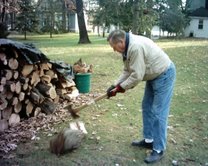
Lowell Frank chops wood in the yard during the early morning.

Jane, 79, has worked part-time cleaning homes for three days a week for the past 15 years. She said iit may be about time to retire, though.

Her husband, Lowell, 80, keeps busy with several different activities. When he was in his 60s, he was an avid sailor with his wife. They participated in a race two or three times a week and once every weekend.

“It kept us physically active and mentally sharp,” he said.

In addition to burning leaves, mowing the lawn and trimming trees, Lowell now stays active by going to the local airport and tending to his plane. When his sailing days came to a close, he became more interested in flying. Keeping an airplane has kept him busy for over 20 years.

“You have to tie down the plane so it doesn’t get away from you,” he said. “I wipe it all down before I go out, then clean it up again when I’m done.”

Keeping active, according to Jane, is important at this point in their lives. But there are other things necessary to staying active.

“It’s what you do at the beginning of your life that’s the most important, rather than later on,” Jane said.

According to a study by the U.S. Department of Health and Human Services in 2006, the leading cause of death for adults 65 years and older was heart disease. Heart disease is just one of many problems older adults have to worry about.

The Salt Lake County Healthy Aging Program helps people who are 60 years or older have healthier lifestyles. Michaelene Waters, a health educator for the Healthy Aging Program, said there is an enhanced fitness class offered to older adults. Most of the programs are held between two and three days a week. Waters says the purpose is for elderly people to be “able to do things better in life.”

“There’s good feedback from the classes,” Waters said. “Doctors are pleased and seeing improvements.”

The program consists of a warm-up focusing on one’s balance. Strength training with weights is another important part of the program. During this section, the class works on major muscle groups, including deltoids, triceps and biceps. Average weights consist of three pounds with no weights being heavier than five pounds. Staying at a level that helps seniors maintain their heartbeat is part of the endurance section.

Before a senior can participate in the class, permission from a doctor is required.

Though the minimum age requirement is 60 years old, Waters says the average age of participants is around 75.

“The social aspects of the class are important as well,” Waters said. Having the seniors stay socially active can help improve their mental and emotional health, she added.

Seniors aren’t the only ones who enjoy interacting with each other. “One of the instructors likes to end on a joke,” Waters said.

Lowell and Jane have been married more than 50 years and continue to keep their acre and a half of land in good condition.

“Our company holds one-hour presentations at local senior center or churches,” said Kathy Hoenig, a health educator at the Healthy Aging Program.

Topics such as healthy eating and being prepared for winter are covered during the presentations.

However, one of the most important parts of the presentation is fall prevention. According to the Fall Prevention Center of Excellence, falls can result in hip fractures, head injuries or even death.

A Colorado State University study showed that falls are the leading cause of death from injury among people 65 or over. The organization was established to help improve practice and develop sustainable fall prevention programs. Approximately 9,500 deaths in older Americans are associated with falls each year.

According to the Fall Prevention Center of Excellence, an elderly person is more likely to fall if they are 80 years or older, or if they have previously fallen. Fear in not wanting to fall again can cause an individual to stay away from physical activity.

A workshop designed for healthy living with chronic conditions is also offered at the Healthy Aging Program. Hoenig said the workshop is six weeks long and offered to people who live with any long-term health problems such as asthma, arthritis and pains.

“It gives people strategies and the tools to help them positively manage their health problems and conditions,” Hoenig said. “In the fall, flu clinics for senior centers are offered.”

There are also medicine checks where pharmacy students will meet individually with seniors.

During the session, the seniors can ask questions about their medications, as well as have their medications looked at and checked if they are current or expired.

Taking information classes can help keep seniors aware of certain health risks.

Spreading the word out to seniors is critical in making sure people know what options are available. The Healthy Aging Program advertises on radio and television and in newspapers, local valley journals and even in the doctor’s office.

Whether it’s raking leaves in your backyard or attending classes at the Healthy Aging Program, there are a number of ways to stay active and fit.