Utah Krishna Temple holds annual Festival of Colors

The Krishna Temple in Spanish Fork

Story, video and photos by ANDREAS RIVERA

When the time came for the flinging of colors and burning of Holika, the temple priest counted down from 20. Hundreds of students waited in anticipation to throw colors at their friends. When the countdown came to one, everybody threw their powder and the temple grounds erupted into a storm of colors. As the dusty air cleared, people were covered in a mixture of pink, purple, yellow, green and other colors. Impatient people had already been dipping into their colors and smearing them on each other, but when the final countdown came, nobody came out from the cloud of colors untouched.

With the end of winter and the dawn of spring comes the Holi Festival, also known as the Festival of Colors. Celebrated all over the world by followers of Hare Krishna, it is one of the largest and best known Hindu holidays.

In Utah, it is celebrated at the Lotus Krishna Temple in Spanish Fork. Many people, who are not even Hindu, come to celebrate the changing of the seasons with traditional Indian festivities. All are invited, especially college students looking for a fun Saturday afternoon.

Caru Das Adikari, the temple priest, said that the festival celebrates diversity.

As the master of ceremonies, he got up on stage and described the origins of the festival. He told the Hindu story of Holika the witch who was immune to fire and would take babies with her into the fire and burn them. One day she took a boy named Prahlad. This boy was a devout follower of Krishna, and prayed every day. So when Holika took Prahlad into the fire, Krishna protected him and it was the witch who burned to death in the fire. Caru said if you put your faith in God, he would always have your back.

Traditionally the festival is celebrated by burning an effigy of Holika. The throwing of colors is the main event of the festival. The colors are a dyed flour, which is imported from India.

This year 20,000 people attended the festival, about double that of last year. Last year’s turnout forced the temple to conduct two separate festivals, one in the morning and another in the afternoon.

Caru said only 500 Indian families live in the Utah Valley, and even fewer who regularly attend the temple.

Caru said students are so attracted to the festival because it enriches and enhances relationships, both “horizontally” and “vertically.”

“Horizontally, meaning the people around you, and vertically, meaning with God,” he said at the festival.

He said it is known as Brigham Young University’s spring break.

“It is so integrated on BYU, that all you need to do is tell one person on campus the date, and within 40 minutes, everybody knows,” he said.

Caru conducted a poll among the attendees, and discovered 35 percent to 40 percent of the attendees were BYU students.

“At first people will feel uncomfortable, but you look around and you see everyone is having a good time and no one is taking themselves seriously,” he said.

After a 20-second countdown, the temple grounds erupted

The festival is said to have been celebrated for 5,000 years in India and was started by Krishna himself, Caru said. The celebration is on a much bigger scale in India and a lot less organized. It is at such a scale that people will be throwing colors in the streets, at friends and strangers alike.

Caru was born Christopher Warden in New Jersey. In 1969 he traveled to Sydney, Australia, where he visited the Krishna Temple regularly and later became a member of the International Society for Krishna Consciousness. He returned to America in 1975 and traveled the country spreading Krishna Consciousness.

According to an essay by BYU student Chad Young, the Utah temple was established by Caru and his wife, Vaibhavi, in 1987. That year, he bought an old AM radio station along with an acre of land in Spanish Fork so that he could conduct a Krishna themed radio station and start a temple. The temple started off in a smaller building, but a newer, more traditional temple was built in 2001 next to the old one. Ever since, they have been maintaining and living on the temple grounds, sharing Krishna culture and traditions such as Holi Festival with Utahns.

“The temple is more of a tourist attraction, we don’t really go around converting one or two people, but we try to spread awareness throughout the area,” Caru said.

On stage, Caru mentioned that the first Holi Festival in Utah 12 years ago only had about a dozen participants throwing colors at one another and chanting together.

Caru said one of his favorite aspects of the festival was the massive chanting of Hare Krishna. “Saying the name of God, effectively gets you closer to God,” he said.

People who go to the festival usually return, Caru said, and each time they do, they gain a greater understanding of what the festival is about.

“If nothing else they take away the Hare Krishna mantra, ringing in their ears for days,” Caru said as he laughed.

The festival featured performers such as the band Mantra Rock and a troupe of traditional Indian dancers, Shatakshi Goyal. Inside the temple, attendees danced and chanted to the rhythmic sounds of India. Participants respected the traditions of the temple and removed their shoes before entering the temple. People who attended the festival were treated to fresh orange juice and could purchase authentic Indian cuisine such as curry with rice.

Brooke Richmond, a sophomore from Utah Valley University, said her roommates dragged her out to the festival. At first she didn’t think it would be fun, but when she got there, she got into the spirit of things.

“I’m definitely going again next year,” Richmond said.

Hilary Dalton, a senior from Hillcrest High School, said it was her second year attending and it gets better every year.

“I love the atmosphere and vibe of the whole gathering,” Dalton said.

Apple’s iPhone: a benefit for senior citizens

by James Williams

The Gateway Mall in Salt Lake City has something for just about everyone. There are clothing stores, sporting good stores, restaurants and even a movie theater. Nestled among them all is the only Apple Store in the city.

Here, customers come and go all day looking at the various computers, iPods and iPhones on display. Though looking is nice, experimenting with devices such as the iPhone is even better.

“They are very easy to use,” said Katie Towne, an iPhone specialist at the store. “There are applications on the iPhone for just about everyone,” she said. And that includes senior citizens.

“Utah is the fifth fastest growing state for the aging population,” said Scott Wright, director of gerontology at the University of Utah. Senior citizens want to know what they can do and where they can move to live longer, he said. For many seniors, Utah is one of those places. Technology, like the iPhone, can help them navigate their new community.

“We are living longer and it is going to revolutionize our society much like the industrial revolution in England,” Wright said. For senior citizens this type of technology can ease the challenges they face today. “Technology is one thing that can help aging adults the most,” Wright said. “It’s the intersect between the generations.”

With more than 85,000 downloadable applications, known as apps, available to iPhone users, senior citizens are sure to find something on the iPhone that can benefit them. One such app that Towne demonstrated is “Evernote,” which helps users with memory troubles. People can record voice notes, type notes and even create visual notes using the iPhone’s camera. All of the stored notes are easily accessible, which is another benefit to users. Evernote “creates sort of a to-do list for people with a bad memory,” Towne said.

One feature that comes standard on the iPhone and can assist senior citizens is the built-in map. It will show the current location of the iPhone on the screen, and when a user double taps the screen, it activates the built-in compass, which will help seniors find addresses and other places of interest.

Another map application designed specifically for senior citizens helps users locate local senior centers.

Yet another app helps senior citizens find decent and affordable housing.

“Sensory loss is a normal part of aging,” said Wright, which is something that Apple has taken into consideration.

The iPhone has almost no buttons, Towne said. “It is easy to use and you do not have to over-think it,” she said.

For senior citizens who have trouble reading small text on cell phone screens, the iPhone‘s zoom feature can help. Towne demonstrated this feature by double tapping the screen with three fingers. Users can also enable the high-contrast mode, which can make the screen more visible.

Towne pointed out the voice-over feature that users can enable if the text still is too small to read. When users enable this feature, the iPhone reads the contents of the screen.

The iPhone seems to appeal to senior citizens. “I’m surprised actually. Many people 60 and above use them,” Towne said.

However, there’s a major drawback to technology like the iPhone. It’s often expensive. According to PC World’s Web site, today’s version of the iPhone costs approximately $235.99 after taxes and fees, with an additional $159.82 in monthly user fees. Senior citizens on a tight monthly budget might find the price tough to afford.

While the iPhone is not a viable option for all seniors, learning about technology can be. The Apple Store at the Gateway Mall can assist senior citizens who want to experiment with cheaper forms of new technology. “It’s never too late to start,” Wright said.

Seniors find fun downtown without breaking the bank

Story and photo by James Williams

With today’s economic situation, some senior citizens who live on tight budgets have had to cut back on activities like entertainment in order to afford necessary items, like food and medication.

Library

Librarians at The City Library downtown read stories to preschool children every Wednesday and Thursday mornings.

This doesn’t need to be the case. Downtown Salt Lake City offers many free activities for seniors during the day.

For seniors who enjoy art, the Salt Lake Art Center offers free exhibits. The art center is located at 20 S. West Temple, with most exhibits done by local artists. One recent exhibit focused on scenic photographs of Salt Lake City’s Jordan River. The exhibit highlighted the beauty and serenity of the area’s natural environment.

According to the art center’s Web site, hours are Tuesday through Thursday from 11 a.m. until 6 p.m., and Friday from 11 a.m. until 9 p.m.

During the summertime, seniors can enjoy Utah’s largest farmers market at Pioneer Park,  300 S. 300 West. According to downtownslc.org, the market features fresh produce from more than 80 Utah farmers.

The market is free and open on Saturdays beginning in June from 8 a.m. until 1 p.m. It is also open on Thursdays beginning in August from 4 p.m. until 8p.m. Both conclude in mid-October.

There is more to do at the market than purchasing freshly grown produce.
Seniors can stroll through the park, socialize with other people and listen to featured musicians from 11 a.m. until 1 p.m.

However, seniors don’t have to wait for summertime to have fun and socialize downtown. Activities are scheduled during winter, too.

Seniors who are more adventurous can take advantage of the senior discount at the ice rink at the Gallivan Center and skate for $3. Those who do not feel up to skating can use it as an opportunity to spend time with their grandchildren; bring them to the rink and watch them skate.

According to the Gallivan Center’s Web site, the ice rink opens for the season in mid-November.

Seniors who have younger, preschool-age grandchildren might be interested in Story Time for Preschoolers, a program offered by the The City Library. Every Wednesday and Thursday at 10 a.m., librarians read stories to the youngsters. After the story, seniors can head to the adjoining Hemingway Café for lunch with their grandchildren.

Another popular place downtown is Temple Square, which offers free activities during the summer and winter to people from all religious backgrounds.

“There are movies, tours, concerts and restaurants,” said tour guide Amy Crandall. “All of them are free except for the restaurants,” she said.

According to a Temple Square visitor’s pamphlet, free tours of Temple Square are available in more than 30 languages and begin daily at 9 a.m. The tour lasts approximately 30 minutes, Crandall said.

In addition to the free tours, seniors can enjoy a free 30-minute organ recital at Temple Square, which takes place Mondays through Saturdays at noon in the Tabernacle.

Seniors who visit Temple Square might also enjoy a trip to the adjacent Family History Library.

“The average patron is a 64- or 65-year-old woman with no children at home,” said Daniel Poffenberger, who serves as both a genealogist and statistician at the library. The  library averages about 850 patrons every day, he said.

The library is open to everyone, but library officials ask guests to come prepared with some background information, such as a name and birth date of a loved one, and have a goal of what they would like to learn.

First-time guests take a 10-minute orientation class. Afterward, guests are assigned a library staff member who will demonstrate more research techniques, answer questions and provide additional assistance.

The library is the largest of its kind in the world, with more than 2 million rolls of microfilm, 10,000 books and 50,000 digital books, Poffenberger said.

Today’s economy does not mean seniors need to remain at home with nothing to do. There are numerous things that seniors can do for fun downtown and not break the bank.

Aging with flair

Story and photo by Jessica Calderwood

It all started with a red fedora and a poem.

The items were a 55th birthday present from Sue Ellen Cooper to a good friend in 1998.

“When I am an old woman I shall wear purple with a red hat which doesn’t go and doesn’t suit me,” wrote English poet Jenny Joseph in her 1961 poem titled “Warning.”

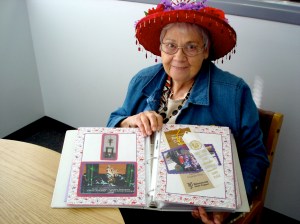
Doris Isom

Doris Isom of the Jordan Jewels proudly displays her Red Hat scrapbook.

This poet’s wry words inspired Cooper and a group of five friends in Fullerton, Calif., to dress up in red hats and purple clothing and go out for tea on April 25, 1998.
Thus began the Red Hat Society.

Word spread, and soon thousands of local chapters consisting of 20 to 25 members began to dot the map. Women everywhere wanted to join in this light-hearted attitude toward aging. The poem has become the credo of Red Hatters worldwide.

Today, there are approximately 30,000 chapters in all 50 states and more than 25 countries. In order to wear the red hat and purple clothing, one must be a woman over 50. Those not meeting the age requirement wear pink and lavender. Leaders of the chapters are referred to as Queen Mother and members call themselves Red Hatters.

It is almost inevitable for us to reach a stage in life when loss becomes very prominent, whether it is loss of loved one, health, mobility or even enthusiasm for life. Linda Torres sees this in the lives of the people she interacts with every day. Torres is the Engage Life Director at Atria Senior Living in Sandy, Utah.

Doris Isom, 86, is Queen Mother to the Jordan Jewels, who consider the West Jordan Senior Center their home base. Isom began frequenting the senior center to ward off loneliness after her husband died six years ago. In response to the urging of the staff, Isom headed up organizing a chapter of the RHS at the senior center in 2006.

The Red Hat Society “provides an avenue for silliness,” Torres said.

Each member in the Atria Sandy RHS chapter embraced silliness to create their own Red Hat name, not required for Red Hatters, but still fun. “Sexy Savannah,” “Magical Millie,” “Bold and Beautiful Bernice,” “Ruthless Ruth,” “Whimsical Wendy” and “Witty Wanda” have enjoyed ice cream socials, facials, makeovers and a formal tea party with fine china.

“I think everyone likes to feel that they belong to something,” Torres said.

For Judi Freegardy, 58, that was the biggest reason she sought out the Red Hat Society in the little town of Payson, Ariz. Freegardy grew up in Phoenix and relishes the country life she now enjoys in Payson. The population difference is significant, with Phoenix at about 1.5 million and Payson a mere 14,000.

“I wanted to feel connected to my little community,” Freegardy said.

After hearing about the Red Hat Society in Payson, Freegardy knew she’d found her way to get connected. But she discovered neither of the two existing chapters was open to new members. Each chapter tries to keep their number around 20 to 25 so they can gather more easily.

So, Freegardy decided to put an ad in the newspaper inviting the women of Red Hat age in the community to gather for lunch at a local restaurant. She was floored when 72 women showed up.

Now years later, there are 10 to 15 chapters in the small community of Payson. Freegardy is part of a chapter of women who don their personalized red hats and go out to lunch every week.

To show her personality and love of gardening, Freegardy sports purple overalls with her red hat. “Embellishing your hat shows who you are in the tribe,” Freegardy said.

Doris Isom is especially proud of her elaborately decorated hat. Isom’s hat features a tiara, by virtue of her status as Queen Mother, and dangling purple beads trim the brim. She smiles as she recalled her reaction after affixing the beads; her hat reminded her of one of her mother’s lamp shades.

“Ninety-nine point nine percent of the girls in Red Hats reach out and volunteer for their community, we’re not just out being silly and having lunch,” Freegardy said.

That is especially true for the Jordan Jewels, whose activities are largely service oriented. A look through Isom’s lovingly compiled scrapbook shows the Jordan Jewels decorating the Children’s Justice Center of Salt Lake County every year for Christmas, volunteering for the county by making more than 200 scarves for the homeless and crafting quilts for Project Linus.

Isom fondly recounts cruising through West Jordan on the back of a Harley, her feather boa streaming in the wind. The Jordan Jewels join with the Bikers Against Child Abuse in West Jordan on its annual ride.

Simply put, there are no rules. Members show up if they want, there’s no pressure or dues. The RHS is women coming together to edify one another and embrace life and aging with humor and flair.

Refugees celebrate First Thanksgiving in America

by MATT BERGSTROM

  • Virtually attend the First Thanksgiving celebration.

Each of us probably has many unique memories of Thanksgiving, but they probably all centered on turkey, stuffing, mashed potatoes, pumpkin pie and family. We remember the pilgrims who broke bread with their native hosts in this new land. And eventually we go around the table and take turns naming things for which we are grateful. Family, friends, freedom, the list goes on, and these are just the Fs.

But who remembers their first Thanksgiving? All the memories seem to blend together over the years, the result of too much stuffing and tryptophan-induced comas. Most of us likely can’t recall the first time we tasted cranberry sauce, or watched with trepidation as dad carved the bird; cautiously keeping his fingers clear of the blade.

For the thousands of refugees who come to this country every year, these experiences are as foreign to them as their many languages and traditions are to us.

That’s why this year the International Rescue Committee and American Express decided to hold a First Thanksgiving celebration for new refugees.

The First Thanksgiving is a new national celebration organized by the IRC’s corporate headquarters in New York. Salt Lake was one of three cities to host a dinner, along with Boston and Phoenix. American Express offered to house the Salt Lake event Thursday, Nov. 18, at its Taylorsville office.

Smiling volunteers and employees from the IRC greeted refugees arriving at their first Thanksgiving dinner. Once checked in they were ushered through the spacious lobby of American Express’ office past an 8-foot-tall Statue of Liberty. Just beyond the statue lay a long red carpet rolled out for the guests of honor.

Servers greeted guests along the red carpet and offered them drinks and appetizers as the refugee families meandered closer to the office lunchroom that had been transformed into a banquet hall for the evening.

All the while the journey down the hallway was accompanied by a Middle Eastern melody. At the end of the carpet, two men, Iraqi refugees, sang while one of them kept time on a small, Yamaha keyboard. An older Iraqi woman stopped to listen and sing along to the music as everyone else arriving followed suit.

The long hallway continued to fill with people as those arriving paused to admire the black and white photographs propped on easels along the carpet. Pictures of women and children, mothers and their newborn babies, stood single file on either side of the red carpet like members of a reception line.

This exhibit of photos was the premier of The Newest Americans series by Salt Lake-based photographer Stanna Frampton.

Frampton is a longtime friend of Patrick Poulin, the IRC’s Salt Lake resettlement director. For years she had asked Poulin if there was some way she could help him in his work. They came up with the idea of photographing the newest Americans, children born to refugee mothers. She began taking the photographs a year ago. Frampton said it was difficult at first because many of the mothers didn’t fully understand why someone wanted to take their picture.

Frampton recalls a Somali woman in particular who was so nervous to be in the studio it was all the photographer could do to get her to smile. Every time the woman would begin to laugh she would cover her face. Yet the resulting photograph is one of the most memorable of the series. The slender young woman in a long dark gown shields her smiling face from the camera as her young child lies lazily against her shoulder.

Every photograph has an interesting story, Frampton said. She asked each of the mothers a series of questions about their new life in America during the shoot. When she asked them how they felt knowing their babies were born American citizens they were unanimously overjoyed.

Frampton has found her own joy in getting to know these new mothers. “I have learned so much,” she said. “I’m still learning.”

Joy spilled over from the refugees, government officials, and refugee service providers as they all continued to spill into the banquet hall. More than 20 finely dressed tables filled the large room that usually accommodated American Expresses employees on their breaks.

The music died down as the nearly 200 guests began taking their seats.

George Biddle, executive vice-president of the IRC, emceed the evening. Biddle took a moment to thank all the participants and especially those who helped plan the event. He then introduced Salt Lake County Mayor Peter Corroon and former Salt Lake City Mayor Palmer DePaulis. DePaulis, who was recently appointed director of community and culture by Gov. Jon Huntsman Jr., appeared behalf of the governor who was celebrating his wedding anniversary.

Corroon and DePaulis presented proclamations, one from the county and one from the state, declaring Nov. 14, through Nov. 20, Refugee Appreciation and Celebration Week.

Next, Janet Harris, vice president of development for the IRC, addressed the crowd. Harris related a story about taking a taxi from the airport to her hotel in Salt Lake. Her cab driver happened to be a Somali refugee who was resettled by the IRC a few years ago.

She asked the driver how he liked his new life here. He told her he was happy because he has three things here he did not have at home: freedom, opportunity and safety.

Harris revealed why the IRC decided to hold it’s largest event in conjunction with Thanksgiving. “All cultures have some form of harvest holiday,” she said. “So there is common ground there.”

She then reminded everyone about the pilgrim’s very first Thanksgiving; a dinner held by a group of people who had been forced to leave their homes in search of freedom, opportunity and safety.

With the speeches done it was time for the entertainment.

A group of women and young girls from Burundi and Rwanda performed rollicking native dances in traditional costumes.

They were followed by a quartet of young Burundian men in green and white robes, each with a tall drum. The men set up their instruments on stage and began a 20-minute marathon of intense drumming and call-and-response shouts. By the time they were done they were drenched with sweat and the audience was as excited from their robust meal and lively entertainment.

As the evening wound down the attendees discussed their new memories. Their reveries were filled with hope of future events and newborn traditions. This Thanksgiving dinner was a bit different from the traditional memories of the holiday so many have, but the new memories it provided for it’s guests, both the refugee families and the others there, will surely be no less poignant and no less meaningful.

The smiling faces leaving the American Express building that evening may have seemed foreign and each was unquestionably different, but as Patrick Poulin pointed out earlier that evening, whether you say markozy, banyaba, or ji shu tin baday, it still just means thanks.

Miss Utah Navajo

by CADE SORENSEN

  • See a slideshow of Hokti Miles (best viewed in full-screen mode)

Hokti Miles of Salt Lake City was born into a family where her mother is Navajo and her father is white. Her mother speaks both Navajo and English, but her father speaks only English. Because of this, Navajo was not spoken much at home. Consequently, Miles never learned the language. But, her mother did try to teach her what she knew about the traditional Navajo way of life and the culture.

Miles was crowned Miss Utah Navajo in September 2007 and passed on her crown to another young woman in September 2008. Winners of the Miss Utah Navajo pageant typically are full-blooded Navajos and speak the language. But, Miles’ experiences and blend of cultures helped her connect with younger Navajos who do not speak the language. Because of the respect that comes with the crown of Miss Utah Navajo, she was also able to help older people understand what they can do differently to help children learn the language and culture.

After being crowned, Miles met Jonathea Tso, the 2007 Miss Navajo Nation, at a Veterans Day event. Tso invited her to go to a leadership conference for Miss Navajo pageant winners where Tso and other Navajo Nation leaders taught the girls how to behave as representatives of the Navajo Nation.

“You’ve got to learn to be reserved and got to watch what you do and watch what you say,” Miles said. “You’ve just got to act with respect and dignity at all times.”

As Miss Utah Navajo, Miles participated in several programs representing the Navajo Nation. She taught about the culture, promoted good health and living, and the traditional Navajo way of life. She felt it was very important to inspire Navajo children and teenagers who do not know the language to start learning it because they can learn so much about themselves and their culture.

“I would stress the importance of knowing your elders, like your grandparents, before they pass on to another world,” Miles said. “And all the lessons that they can teach you, it’s just amazing. You can become such a good person just from learning from them.”

Sharee Varela, a graduate student in the University of Utah’s Department of Languages and Literature, who teaches Miles Navajo, said, “One of the Navajo philosophers who was one of my teachers back home on the tribal reservation…says that in order for the youth to regain their identity and self-respect again in society, in both western society and Navajo society, is to retain the language and the traditional teachings of Navajo.”

Since she holds this knowledge, Varela feels that it is her responsibility to pass it on to the kids. “Only if they want to learn it though,” she said. “I tell my kids, if you really want to know, if you really want to learn, I’ll teach you, but only when you are ready.”

During her reign, Miles felt the need to tell parents and grandparents they have a responsibility to teach their children the language and Navajo traditions. She often related to them her own experiences.

Her grandparents were never a major part of her life because they died when she was very young. “My mom didn’t teach me much Navajo and it is such a struggle now,” Miles said. “They look down on the younger generations because we don’t know Navajo, and yet it’s their fault that we don’t know Navajo.” When speaking to the elders she often encouraged them not to criticize young people, but to help them instead.

One experience Miles had where she felt criticized was at a charity event called Tip-A-Royalty. This is an event involving all eight royalties from the Navajo Nation. They served as waitresses at Earl’s Restaurant in Gallop, N.M., and all the tips they received were donated to help with the Special Olympics.

While waiting tables, a man asked her a question in Navajo. Miles said she understood bits and pieces of what he said but couldn’t quite comprehend everything. He asked her where she was from and when she told him he said, “Why don’t you know Navajo then? That area is full of culture!” Miles explained her situation, but the man replied, “You should still know.” Miles said in return, “I’m learning now, is that not enough?”

Miles said that was one of the worst experiences she had because she felt so bad afterward. “It was just rough to hear that from people,” she said.

Varela said the way this man spoke to her is appropriate in Navajo culture, especially if he is a close relative.

“An older person getting after you like that, culturally it’s appropriate, especially if they are related to you as an uncle. So, if he was related to her as an uncle he has every right to get after her like a father,” she said. “Navajo culture not only teaches respect but it also teaches you the roles you take in Navajo society. He took appropriate role as an uncle in going after her for whatever he felt he needed to say.” Varela said that culturally this is not being mean or rude. He is just telling her, in his own opinion, what she needs know.

Miles participated in several cultural events as Miss Utah Navajo, including: The Utah Navajo Fair, The Navajo Nation Parade and The Days of ’47 Parade. Some of her greatest experiences as Miss Utah Navajo came while speaking at different schools across the state. She said she loved going to elementary schools because the children all looked up to her. They respected her and would almost always sit quietly while she was speaking. Several have recognized her in other settings, such as while shopping. The children pull on their mother’s hand and whisper with a big smile, “That is Miss Utah Navajo.”

Before being crowned, Miles said she was not a very good person. She didn’t care much about her culture and traditions. But, because of her experiences with being Miss Utah Navajo she said she has became a much better person. She has more respect and love for her culture, language and people. She has also received the love and respect she felt she has needed from the older generations.

“A lot of the elders they would come up to me and call me ‘shideezhi,’” which means little sister in Navajo. “It just felt really great. It seemed like they really respected me for what I was doing,” Miles said. “I just wanted the other kids to know how great it felt to be loved by their elders and to be respected by them.”

Gallery creates a space for diversity

by STEPHANIE FERRER-CARTER

John F. Kennedy, the 35th president of the United States of America, stated, “If art is to nourish the roots of our culture, society must set the artist free to follow his vision wherever it takes him.”

During this year’s Pride at the U, artists of all sexual preferences found a venue for their visions.

“Art is a big part of queer culture,” said Bonnie Owens, 21, a senior at the University of Utah and an intern at the LGBT Resource Center on campus. “It’s a big part of any culture, so I thought it was important that it was included.”

The theme of the 2007 Pride Week held Oct. 15-20 was “Culture with a Q.” Owens was inspired by the theme, and chose to revamp the idea of an art gallery as part of Pride Week.

“In the past it’s never been successful, but I really wanted it to run well this year,” Owens said.

The art show was originally titled “Beautifully Obscene,” but was renamed “The Good Stuff” after some concern over what would be displayed in the gallery located in the U’s student lounge.

“The best thing about the gallery is that it crosses so many different boundaries,” Owens said. “We’ve got staff, faculty, alumni, community members and students all in here.”

Though it was labeled a LGBTQ art gallery, Owens said anyone could submit their art. Artists did not have to describe the subject matter, just the dimensions of their work.

“Something like this is so odd,” Owens said. “It’s so queer to have a gallery designed for queer students and faculty. So it’s very, very liberating for an artist that’s having a hard time finding their niche. It’s a good place to be.”

A variety of art was displayed in the gallery, including photography, drawings, oil, water color, mixed media and pottery.

While some works were more subdued, the gallery did feature a series of nudes painted by a former alumna who lives in Santa Quin County. Owens said the woman found out about the gallery through a culture article in the Salt Lake Tribune and was eager to show her work, not only because the county did not have a gallery that would display the nudes, but also because two of the woman’s children are gay.

The gallery became a canvas of emotion and statement for some.

Orbin Rockford, 27, submitted five pieces from a series of 25 Sharpie and acrylic paint drawings to the gallery. The dark images portrayed, both in color and tone, stood out starkly from their clean, white backgrounds.

The inspiration came from an emotional break-up that happened while Rockford was in college at a Boston art school.

“I was in a relationship that was totally messed up,” Rockford said. “It was my first real relationship with a guy.”

Drawing, Rockford said, is a form of therapy, what he calls “instinct art.”

“It’s a great outlet,” he said. “It’s been about coming to terms with myself.” 

But Rockford said he does not want his artwork to be defined only by his sexuality.

“It’s very much a part of my work, some pieces more than others,” he said.

Aside from putting the show together, Owens also submitted her own series of black and white photographs. Each one featured student leaders and activists from the U’s LGBTQ groups.

“They [Owens’ photographs] were designed to be shown, so they’re a little more apparent,” she said. “They’re something that you can look at them and say, why is this queer, what is going on here.”

The pieces were on display for the week, and the gallery full of artwork was proof of a goal accomplished, according to Owens.

“Pretty much everyone from different identities and cultures submitted something, which is something the resource center has had a hard time with in the past,” Owens said. “A lot of events this year cater to people who are often forgotten in programming like this, so people of color, transgender individuals, women, straight allies especially. So it’s great to see some of their work in this.”

‘Faces from the Land’ depicts powwow dancers and regalia

by JESSICA DUNN

Painted black lips and a bright yellow jaw sit below a set of dark, piercing eyes. The beautiful array of a feathered headdress, buckskin fringes and a fan of feathers ceases to distract the viewer as the dark eyes pull them directly in. They show a strength and confidence, and they portray a pride in tradition and heritage that is honored at the powwows.

Travis Ike, of the Omaha Tribe, wearing his Native regalia is one of many powwow participants photographed by Ben Marra.

Ben and his wife, Linda Marra, of Seattle, Wash., have followed Native American powwows for 20 years. Their traveling documentary photo exhibit, Faces from the Land, features Ben’s portrait photography and personal statements from each of his subjects.

The Faces from the Land exhibit was at the Main Library in downtown Salt Lake City from Sept. 20 to Nov. 15, 2008. Ann Morris, a librarian there, estimated that about 30 people a day walked through the exhibit, the majority of those being adults.

The Marras attended their first powwow in 1988 when Ben was given an assignment to take a color photograph depicting the theme, “Celebrate Washington State.” Recently returned from photographing people in Nepal, Ben immediately discarded all the played-out Washington icons and came up with the idea of photographing Native Americans from the Northwest.

“At my first powwow, I saw beautiful imagery right here in our country,” Ben said. He wanted to photograph and share it.

After the photo assignment, the Marras continued to attend powwows across the United States and Canada, and the photography grew into a larger project for them.

“We did this on the side for fun, to take off for the weekends, but you keep learning of more powwows and seeing people you know,” Linda said.

The Marras became more dedicated to their photography project when they decided to use the images to strengthen or spark an interest in the Native American community. On their Web site, they write their hopes that the photos can teach people about the importance of tradition and family, and about beliefs associated with powwows, dances and native regalia. 

Due to a lack of education about Native Americans in school, neither of them knew much in the beginning and had no idea what to expect at a powwow.

Linda was surprised at how welcome they were. The Marras made sure to keep their word and treat everyone well so they weren’t seen as “ugly, white people.” Relationships have been very important to their success.

“This whole project has been based on relationships and we’ve been careful to form and nurture those relationships, and honor those promises made,” Linda said.

Their relationships with powwow dancers are also based on cultural respect. For example, if an elder asks individuals to dance, they have to. It is respectful and an honor for the invitation to be given and accepted. Linda and Ben have been asked to dance before and obliged, even though Linda said she is self-conscious and doesn’t dance. It wasn’t a real dance, Ben said. It was more of a two-step while circling around, something that anyone can pick up after a minute.

The Marras used to search for their subjects at the powwows. They would look for someone with a certain presence and a unique way of carrying themselves.

These days, though, powwow dancers seek them out and ask for their photo to be taken. The dancers come between songs and usually only have five or 10 minutes where Ben can create a few photographs.

“We make [the process] fast for them because they are here to be dancing,” Ben said. Sometimes during a shoot, someone will run in and tell the dancer that his song is next. They will run out, regardless of if Ben is done.

Linda meets the dancers before the shoot to take down their name and tribal affiliation. Then Ben tries to make them feel comfortable despite what setting they may be using. Whether it’s a school hallway or a portable trailer, they try to always create privacy so that it is just Ben and the dancer.

The dancer stands in front of the same brown cloth that the Marras have had since the beginning of the project. The lighting is also kept similar. This helps to keep the photos consistent with one another, so that a photo from 10 years go can be placed right alongside a photo from today.

Ben uses a color slide film to get the most vibrant colors. His color portraits are a unique and signature work. Few photographers have such an extensive portfolio of portraits. Ben’s color portraits have a different feel to them, especially when compared to the sepia-toned Native American images made by Edward S. Curtis in the late 1800s and early 1900s, said Morris, the Salt Lake City librarian.

Some of Curtis’ photographs appeared on a television alongside the exhibit. Native Americans have rarely been shown in traditional attire in color. Most of the historical pictures are black and white or sepia, which don’t allow for the full effect of their regalia to be seen.

Ben also photographs the dancing at powwows. He manages to get close up and has a knack for getting great action shots since he is familiar with the music.

“He’s been doing it for so long that he recognizes the dances and knows when they’re up in the air or when the last beat of the song is,” Linda said.

Every dancer who is photographed by Ben receives a copy, which is usually proudly displayed in their homes, Linda said.

The Marras have a book coming out in April 2009 called “Faces from the Land: 20 Years of Powwow Tradition.” The book will feature 150 of the best color portraits over their 20 years of following the powwows. A personal narrative will accompany each of the photos.

Navajo rug sale supports American Indian elders

by JAMIE A. WELCH

Life on the Navajo reservation and in traditional hogans made people strong. Years of following sheep around the desert, watching children move away from their homes and weaving together strand after strand of coarse sheep’s wool to create hundreds of rugs in a single lifetime has given the elders at the 19th Annual Navajo Rug Show and Sale their dedication to each piece.

The rug show took place Nov. 7-9, 2008 in Deer Valley Resort’s Snow Park Lodge in Park City, Utah.

Rug weaving is a historic Navajo, or Diné, tradition and is honored in the show that was formed specifically to support the Adopt-A-Native Elder Program (ANE).

This program, created to benefit Navajo elders, began in the 1980s through the efforts of Linda Myers, a Park City woman who was impressed by an early display of Navajo rugs from elders in northern Arizona. Soon after that event, Myers got involved in collecting and distributing medical, food, and hygienic supplies to elders living on the Navajo reservation in southern Utah and northern Arizona.

A group of supporters eventually joined Myers and the Adopt-A-Native Elder Program was established. Mary Phillips, one of the many volunteers at the rug sale, said it is “an honor to work with Linda. The program’s success is truly inspiring and shows Linda’s devotion not only to the elders themselves, but to the Navajo tradition [of rug weaving.]”

According to the program’s Web site, there are more than 2,500 people involved in the program today. Most are from the United States but some are from other countries as well.

Rosita Van den Berg is one such volunteer. Rosita is from Holland and became interested in the program while visiting a fan site of American Indian actor Jay Tavare. 

Tavare, an avid supporter of ANE, has information regarding the program on his personal Web site and on his Facebook and MySpace pages. Van den Berg, who attended the event this year, created a painting to honor American Indian people and donated it to be auctioned off with its proceeds going to the program.

Tavare, known best for his roles in the TV miniseries “Into the West” and films “The Missing” and “Cold Mountain,” has supported ANE for seven years. He has attended the rug show for the past three years. “It definitely brings awareness about the culture of Native Americans,” he said. He hopes his support can act as “a symbol to reach across nations and get the message as far out as possible.”

Another supporter at the show was author Rose Johnson-Tsosie of “Finding Helen – A Navajo Miracle.” Tsosie was born on the Hopi reservation of northern Arizona in 1950 but she and her twin were taken from her biological mother at birth and were placed for adoption. The siblings were raised by a white family, Albert and Wilmont Johnson, in Cache Valley, Utah, where they grew up never learning much about their American Indian heritage. Tsosie said all she was aware of was that “growing up Navajo in a white society was different only because I knew my skin was different.”

In 1983, Tsosie reconnected with her biological mother, a Navajo, while serving a mission for The Church of Jesus Christ of Latter-day Saints in the Arizona Holbrook Mission. Through tears Tsosie said, “there are many exciting times in my life but this is the ultimate dream when I got to hold my mother and my mother got to hold me.”

Since then, Tsosie has been actively involved in the American Indian communities of California and Utah. She now travels around the country promoting her books and speaking about and on behalf of American Indians.

Attending the ANE rug show gave Tsosie a chance to show the reason she says she loves being Navajo: “learning the tradition of my heritage.” Tsosie also said, “I do respect my heritage. I am still learning about who I am, about where I am going and where I have been.”

About 28 weavers were featured in this year’s rug show. Their ages ranged from the early teens to nearly 100 years old.

Patrina and Diana Furcap, ages 13 and 12, are sisters. They learned to weave from their mother at about 6 years old. Each sold one hand-made rug on the first day of the show. “I think it’s important to keep the tradition going from one generation to the next. We shouldn’t lose it because it’s art,” Patrina said.

Most of the weavers present were women. However, four men also participated. William Whitehair, who has been weaving since he was 7, said gender differences might be rooted in history. When European settlers arrived, they brought with them their traditional form of household with women at home doing domestic activities and men outside working in farms. Although the American Indian way is matriarchal, many Native people adopted the European style and over time, weaving became primarily a female activity. Still, Whitehair said, he weaves because he’s “always enjoyed the art.”

At the show, rugs were sold at prices ranging anywhere from $150 to several thousand dollars. Prices are indicators of the quality of each rug and the amount of labor involved.

Linda Myers explained, “It’s not about the weaving itself. It’s about how when you go up and feel these rugs and you feel the hands of the weavers…that’s one of the gifts of purchasing the Navajo rugs all woven by hand. All these rugs carry that beautiful spirit of the weaver and their hands and the patterns.”

Designs range from the simplistic “Diamond” pattern (a single shape woven throughout a rug) to the intricate “Tree of Life.” This rug is a story, beginning with a “wedding basket.” At the bottom of the rug is the basket, usually woven in yellow or brown, which symbolizes the beginning of a family. From the basket grows a tall corn stalk with many branches growing from both sides. Birds of all colors are perched on the branches, each representing older generations of the family. There are also birds in flight on either side of the stalk, which stand for the younger generations. At the top is the “tassel” of the corn which holds the pollen. In Navajo tradition, corn pollen is offered with prayers, giving significance to the tassel being the tallest point on the Tree of Life. This rug can be woven in any color assortment ranging from rich dark colors to pastels.

Proceeds from the rug sales go to support the ANE program in buying food, firewood, and other items for Native elders. Individuals also could purchase balls of yarn in various shades to donate to elders for use in weaving. Some customers chose to sponsor a specific elder and invited him or her to choose the colors they liked the best. Additional donations can be made at the Web site.

The Adopt-A-Native Elder program has been a success for more than 20 years. One weaver has been a part of the program since its inception. Weaver Grace Smith-Yellowhammer of Teesto, Ariz., feels blessed to play a part in ANE and is proud of the international community involved. “We are all connected,” she said, “One voice, one prayer, one heart.”