Southeast Supermarket – helping to maintain culture and diversify Utah

Story and photo by RICH FAHEY

For the majority of Utahns, eating a traditional meal means going to the grocery store for a wide selection of American foods. For the Asian community, eating traditional cuisine requires a little more effort. While most chain grocery stores offer an ethnic aisle, it lacks in authentic Asian food. But several specialty food stores that stock a wide selection of Asian cuisine can be found throughout the valley.

These Asian-specific supermarkets not only supply tasty foods, they also help the Asian community to maintain its heritage and culture.

“Just like language is part of their culture, so is their food,” said Linda Oda, director of Asian Affairs in the Utah State Office of Ethnic Affairs.

Southeast Supermarket, located at 422 E. 900 South in Salt Lake City, is one of these stores. The family-owned and operated business is the largest Asian-specific supermarket in the downtown area. It carries Chinese, Japanese, Korean, Hmong and Thai goods, including foods, drinks, teas, medicines, decorations and kitchen supplies.

Aisle

A wide range of items, both in bulk and individual portions, can be purchased at Southeast Supermarket.

Southeast Supermarket caters to a large number of Asian students from the University of Utah. According to the University of Utah Center for Ethnic Student Affairs, more than 1,300 Asian students are enrolled at the U. This creates a sizeable customer base for the store, especially while school is in session.

“We see a lot of international students, because we have products that they identify with,” said Thanh Trang, a Southeast Market employee and son of the owner.

According to Trang, items like dumplings, pot stickers and instant noodles are popular choices for students because they are quick and easy for people on the go.

These specialty food stores can also have a large impact on Asian-American children growing up in Utah. Growing up in a primarily white city, it is easy for children to become assimilated with American culture.

“You start becoming more American by being part of the community,” Oda said.

Without being exposed to traditional Asian cuisine, a portion of Asian culture can be lost in younger generations. By being part of both communities, children are able to retain some of their heritage and keep an important part of who they are.

“Although I was raised here in the States, and in Japan, I prefer to cook Japanese food for myself because it is always a nostalgic reminder of my childhood,” said Penelope Moffett, 20, a fine-arts graphic design student at the U. “Southeast Supermarket is the only way I can go to Japan, without actually flying anywhere.”

More recently, Southeast Supermarket has seen the number of white customers rise. According to Trang, over the past several years the clientele has changed from mostly Asian, to nearly half Asian and half white. This increase in white patrons shows a larger acceptance of the Asian culture. Oda said this acceptance of Asian cuisine is great for both cultures, and can be attributed to the availability of Asian restaurants and markets throughout the valley.

“It’s a substantiation that I’m OK, and you’re OK,” Oda said.

Another reason for the diversity among customers is the staff at Southeast Supermarket. The store takes pride in its customer service, and the fact that most of the staff speaks English makes it easier for American customers who are unfamiliar with the items.

“I can’t get to this place enough. The place is packed with aisle upon aisle of ingredients to bring your cooking alive,” wrote Stuart M., a Southeast Supermarket customer who posted a review on Yelp.

Coffee Shop in Salt Lake City’s Little America Hotel strives for authenticity with Asian cuisines

Story and photos by CHLOE NGUYEN

Asian seafood salad; beef tournedos with Asian-style salmon steak; vegetable stir fry; grilled chicken breast marinated with a ginger plum sauce — all food you would typically find in an Asian restaurant, right? Not quite.

You can actually find these dishes at the Coffee Shop, located inside the Little America Hotel, a three-star hotel in downtown Salt Lake City. The Coffee Shop is ranked 7th out of the 104 restaurants in the Salt Lake area, according to Virtual Tourist. It has always been known for its traditional “comfort food,” as Ashley Bollinger, 26, the hotel’s community relations manager, calls it. Its menus have had limited changes over the years because they have been well received by customers. But this does not mean there haven’t been accommodations.

“Most of the guests are very vocal with the dishes they like and what they would like to see added,” Bollinger said. “We feel the best way to review or make changes on our menu is to listen to them firsthand.”

Customers want diverse dishes, including those from Asian cultures, such as seafood salad and marinated ginger plum chicken. And while these dishes are only available through the hotel’s banquet menu, the hotel’s Coffee Shop is always serving their customers Asian vegetable stir fry. And if a dish is requested often enough, the decision to include it in the regular menu is considered.

Besides the customers, the people who make the dishes also contribute to what is on the menu. The hotel’s kitchen staff consists of a diverse group of individuals, including Caucasians, Chinese, Vietnamese, Koreans and Hispanics. “[Because of this,] over the years I have incorporated many different dishes from all around the world in our daily cooking techniques and final products,” said Bernhard Götz, Little America’s executive chef.

Those final products are something to be proud of. Unlike some Americanized Asian dishes served at chain restaurants such as Panda Express or P.F. Chang’s China Bistro, the Coffee Shop is different. The chefs value the authenticity of a dish and the culture behind it.

“The traditional Asian dishes are prepared by my Asian cooks,” Götz said. “They are cooked in the traditional way with authentic ingredients.”

Ingredients native to Southeast Asia are included in the making of the dishes. Soy sauce, pineapple juice and ginger are some of the ingredients that go into the ginger plum sauce. Tofu, Napa cabbage, Bok Choy cabbage and Chinese mushroom are among the native vegetables of Southeastern Asian countries that are included in the vegetable stir fry. And like any authentic Asian dish, rice is always included.

If you ask people of Asian ethnicity, many will tell you that rice is a critical part of their culture. In most Asian cultures, “to eat” is often synonymous with the phrase “eat rice.” This can suggest that rice is of high importance to the people of Asia. Rice can be said to be an identification of the Asian community. “It’s important to keep the ingredients the way they would be as if in Asia,” Götz said. “You can’t get more authentic than that.”

But in America, it’s not always easy to keep the ingredients authentic. Chinese restaurant owners developed American Chinese cuisine when they modified their dishes to suit a more Western appetite. According to China Insight, these restaurants adapted by using local ingredients that were familiar to their customers, like flour. Rice was often replaced with noodles, made from flour. As a result, American Chinese cuisine is usually less pungent than authentic cuisine.

Many of these new dishes were quickly and easily prepared. According to an article by Yao-Wen Huang at Flavor & Fortune, they tend to be cooked with a lot of oil, monosodium glutamate (MSG) and sugar, which authentic cuisines do not commonly use.

It is rare to find an Asian American restaurant that serves Asian dishes with authentic ingredients and cooking methods. But the Little America Hotel recognizes and values the importance of diversity and culture in food. Just like language is a part of culture, so is food. “If we serve Asian food, we want it to be real, not fake,” Götz said. “That’s the whole point of why people come looking for authentic food.”

Utah Domestic Violence Council aims to aid members of Asian community affected by abuse

The Utah Domestic Violence Council works with many women's shelters, including the YWCA in Salt Lake City.

Story and photo by DANA IGO

Kenneth Warhola arrived at his Layton home Sept. 8 to find his wife locked in their children’s room. After several attempts to persuade her to open the door he broke it down. She was sitting next to the couple’s two children, Jean, 7, and James, 8, who were covered with a sheet and unresponsive. His wife, Sun Cha Warhola, 44, is charged with strangling them to death.

As the information came out in the Salt Lake Tribune and Deseret News, it was learned that disputes between Sun Cha Warhola and her husband had been ongoing for more than four years.

According to the Tribune, Kenneth Warhola was charged with domestic violence in 2007. In another incident both Warholas were charged after an altercation in a parking lot. One report just weeks before the murders showed that Sun Cha Warhola alleged that her husband had sexually abused their children. The Davis County Attorney’s office reviewed the case and determined the accusations were unsubstantiated, as reported by the Tribune.

The Deseret News wrote that before the murders, Sun Cha Warhola called a Korean newspaper in a desperate attempt for help. She told Inseon Cho Kim, director of the Korean Times of Utah, that she dreaded leaving her husband with their children in the event of a divorce.

While all women have difficulty coming forward to get help for domestic abuse, women in the Asian community face a particular quandary. Prevention and educational programs on domestic crime aren’t targeted to Asian women. A report published by the National Asian Women’s Health Organization suggested that this is because society tends to view the Asian population as a “model minority,” meaning that they are viewed as achieving high rates of success.

Asian women have the lowest rate of domestic violence of any of the major racial groups. A small number of Asian and Pacific Islander women, 12.8 percent, reported having experienced physical assault by a partner at least once in their lifetime, according to a study published by the Asian & Pacific Islander Institute on Domestic Violence. This was the lowest percentage among any racial class surveyed, which was cited by experts as being due to underreporting.

The unwillingness to come forward in cases of domestic violence among Asian women may also be perpetuated by culture.

Dr. Linda Oda, director of Asian Affairs at the Utah Office of Ethnic Affairs, said that abuse in Asian families isn’t often reported because their cultural values tend to stress keeping things within the family.

Unlike Western culture, traditional Eastern culture puts emphasis on the family instead of the individual, leaving Asian women feeling less inclined to report physical and domestic abuse.

The Utah Domestic Violence Council (UDVC), 205 N. 400 West, a nonprofit organization with resources throughout the state, is reaching out to the underserved communities across Utah in an effort to prevent future domestic crimes. In preparation for Domestic Violence Awareness Month in October, the council’s diversity coordinator, Hildegard Koenig, provided information to the Asian Advisory Council so its eleven members could pass it to their respective communities. She approached the council because it connects the Asian community with Oda and her office.

“By working and educating community leaders and building those strong relationships we can start a dialogue on how we can better assist victims of domestic violence in their communities,” Koenig said.

Sometimes the educational materials fall short. Salman Masud, the council’s representative of the Pakistani community, said the materials offered by the UDVC were only written in a few languages, which narrows the ability of non-English speaking Asian immigrants and refugees to know whom to contact in a domestic abuse situation. Currently the brochures are offered in seven languages, including Chinese, Tongan and Samoan. Koenig is seeking individuals to help translate the material into other languages.

Non-English speakers can call The Utah Domestic Violence Link Line, 800-897-LINK (5465). The hotline is currently available in 144 languages, making it a good resource for members of all communities who may not be able to get the printed materials in his or her language.  Many of the UDVC‘s resources can be accessed online, including special reports, training materials and a map of domestic violence programs throughout the state.

U student dreams of becoming a filmmaker

Story and photo by ANDREAS RIVERA

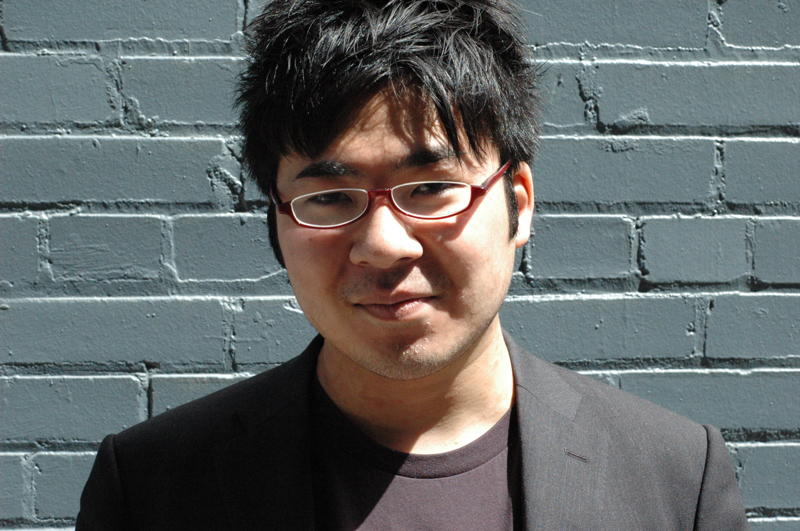
Hirotaka Yoshikawa is described by classmates in his screenwriting class as quiet and well-mannered, but one of the most interesting people they’ve ever met.

Yoshikawa was born in Tokyo, Japan, on June 26, 1987. He grew up close to an American Air Force base, which was his first introduction to American culture. The neighborhood he lived in was very conservative, and this clashed with the American ideals of the base.

He went to an international elementary school where he was taught English.

Yoshikawa wanted to leave the country for his education, so his school contacted a teacher in Utah who put him on an exchange program. In 2001 he came to Salt Lake City for high school and college.

“I wasn’t scared, I was too excited to be scared,” Yoshikawa said.

It was easy adjusting to the new culture, he said.

“People were the main things that were different, but other than that I had no complaints,” he said.

Even before coming to the U.S. he had wanted to be in the movie business, and upon attending the University of Utah, decided he wanted to go into movie production and write screenplays. He is currently a film major at the university.

“I like to try different types of writing, but I really like comedies,” he said. His favorite movies are comedies, including “Back to the Future,which is his favorite film.

“I’ve actually stopped watching films after becoming a film major,” Yoshikawa said. “I’m not huge into big budget films, so I hardly watch new ones.”

He and other students in the film department bash films, both big-budget and independent films, he said.

One of his biggest influences is Charlie Kaufman, who is famous for writing “Being John Malkovich and “Eternal Sunshine of the Spotless Mind.”

“He always leaves in something unexpected,” he said.

Yoshikawa has submitted two scripts, “Where You Wereand Run, to several contests. He hopes they will get picked up and made into movies. But if they don’t, he may make them himself. His script, “Where You Were,” has recently made it into the quarter finals of a screenwriting contest by Fernleif Productions.

Paul Larsen, a professor of film studies and instructor of Yoshikawa’s screenwriting class, said Yoshikawa produces a lot of pages.

He said Yoshikawa’s style of writing is very unique to him as well as being funny and witty.

Besides writing scripts, Yoshikawa has made a few short films, both for school and for personal experience. His favorite one is called, “A Color of Summer.”

“The film is about someone trying to find satisfaction in cultural things, but he can’t find what exactly he’s looking for,” Yoshikawa said. “However, what he is really looking for finds him.”

He said making a short film is a threeday process for him. On the first day he comes up with the plot and writes the first draft and then revises it. On the second day he films the movie. He said filming shouldn’t take any longer than a day for him. He spends the third day editing the movie, which also shouldn’t take longer than a day, he said.

Valerie Douroux, a fellow film major at the U described Yoshikawa’s filming style as very abstract and experimental, which she believes reflects from his personality.

Douroux, who met Yoshikawa in a screenwriting class they shared, said her first impression of him was that he was very quiet, studious and thoughtful.

“He has a very Buddha-like personality,” Douroux said. “Whenever I see him he is very mellow-tune.”

She said despite his low-key personality, his writing is very funny.

“As a filmmaker, I have learned from Hirotaka you have to have dedication,” Douroux said. “He has dedication and that’s exactly what you need to elaborate a story.”

Yoshikawa will graduate in May 2010. He plans to work all summer at the U’s Marriott Library to earn enough money to move. He plans to leave Utah within a year and go to California. That is where the business is, Yoshikawa said.

His family is still in Japan, and occasionally comes to visit him. His father is an editor of a golfing magazine and his mother owns an antique store. His older brother works as a graphic designer. “Two years ago was my last visit, but they are very proud of me,” Yoshikawa said.

The most important thing he has learned as a filmmaker, he said, is “just do it, don’t stop, you need to finish what you have started.”

Asian expectations

Story by EMILY RODRIGUEZ-VARGAS

The life of an immigrant or refugee means facing financial, safety and cultural challenges all along the way of the journey. This includes leaving one’s home country to adopt another country and culture as one’s own. The legacy these trials imprint on families of immigrants still has its traces throughout the education system.

Gerald Brown, director of the Utah Office of Refugee Services, said of those who have come to the U.S., “They are very smart people, and they are going to do everything they can to live a better life here.”

According to the 2006 report compiled by the Utah Office of Ethnic Affairs, 2 percent of Utahns are Asian. Of that number, 1.6 percent is in public schools, and that same percentage of students will graduate from high school. With their background and history, many of them will also have the drive to live up to their parents’ legacy.

Kathleen Villanueva, 19, is a political science and economics major at the University of Utah. She was born in the Philippines, but spent the majority of her life in the U.S. because her parents sought out a life out of the poverty at home. When still at Northridge High School in Layton, Utah, they expected her to maintain a 4.0 GPA.

“If I brought home a grade lower than that, I knew I’d be grounded,” she said. Challenging her parents and higher authorities just wasn’t an option. Villanueva carries on this high standard for herself as she maintains a nearly perfect GPA to keep her scholarship at the U.

Emily Park Grady is a doctoral candidate in the School of Music whose family moved to the U.S. when she was a toddler. In Korean culture, Grady said that knowledge itself shows sophistication and is held in very high regard. This prized experience and wisdom is no small thing.

Although she did always succeed in school, she said that she had a different experience than Villanueva even though her parents didn’t push her in academics. Growing up in New York City, Grady had a lot of friends who, like herself, were from Korea.

“The real pressure wasn’t really coming from my parents, it was just keeping up with my friends,” she said. “There was an immense peer pressure and competition among the people I hung out with.”

Wesley Sakaki-Uemura, an associate professor of history at the U whose grandparents emigrated from Japan, said the expectations set on students by family members is often significant. But there is also the unrealistic perspective for Asian Americans returning to their home country. He said there is a notion that people who look Asian automatically speak their family’s native language and know about all of the cultural norms and traditions they didn’t grow up with.

Funding for college could possibly be more accessible through wise saving by parents, or students may receive scholarships for their academic endeavors. Roger Tsai, an immigration attorney in Salt Lake City, said many Asian parents are more willing to pay for their children’s undergraduate and graduate degrees because they might not have had the chance to access higher education themselves.

Vinh Thanh Ma, 26, left Vietnam with her family at the age of 13. She received her Bachelor of Science in biology and medical laboratory science at the U on a full-ride five-year Utah Opportunity Scholarship.

Ma said when she saw this was a land of opportunity, she wanted to get the best education and life she could. “Discipline and determination were all I brought with me,” she said. “I was able to advance faster than most students that have everything coming too easy in life for them.”

Realizing her parents’ hardship in trying to support her family and provide Ma and her siblings with an education, she said she wanted to do well in school because her parents went through so much to get her there. Ma said she set herself goals like achieving excellent grades to get into a good school. “I did it for my parents without realizing it was for my own good in the future,” she said.

Alysha Franz Lagaras, 18, a Filipina student at the University of Utah, has a similar story. She was born in the U.S. after her parents left their home to start a new life. Her life wouldn’t be the same if it wasn’t for her mother.

Lagaras said her mom was an example to her for her diligence and persistence. “She worked so hard to be where she is now,” she said of her mom, who was the first in their family to leave the Philippines and to get a college education. “When we moved to Utah, my mom was raising my brother and I by herself.”

About growing up in Utah, she said, “I noticed how different I was not for just being Asian, but also being a part of the LDS church, being a different race other than being white.” She also said that society often has the wrong image of what it means to be Asian. “For being an Asian girl, they really expect you to look the part, like to be tiny and skinny.”

One of Lagaras’ pet peeves is being stereotyped for being smart and loving videogames and Hello Kitty. “Even though I do, I just hate how people think they know you because all Asians are the same.”

She said now she’s older, she regrets not learning her native language, Tagalog. When she was in elementary school, Lagaras tried to convince her peers that she was Mexican so they wouldn’t make fun of her “chinky” eyes.  “When you’re a child, you just want to fit in,” she said.

“Now I love being Asian, when you’re older and more mature, you notice that you should love being different, standing out and being exotic.”

Utah Krishna Temple holds annual Festival of Colors

The Krishna Temple in Spanish Fork

Story, video and photos by ANDREAS RIVERA

When the time came for the flinging of colors and burning of Holika, the temple priest counted down from 20. Hundreds of students waited in anticipation to throw colors at their friends. When the countdown came to one, everybody threw their powder and the temple grounds erupted into a storm of colors. As the dusty air cleared, people were covered in a mixture of pink, purple, yellow, green and other colors. Impatient people had already been dipping into their colors and smearing them on each other, but when the final countdown came, nobody came out from the cloud of colors untouched.

With the end of winter and the dawn of spring comes the Holi Festival, also known as the Festival of Colors. Celebrated all over the world by followers of Hare Krishna, it is one of the largest and best known Hindu holidays.

In Utah, it is celebrated at the Lotus Krishna Temple in Spanish Fork. Many people, who are not even Hindu, come to celebrate the changing of the seasons with traditional Indian festivities. All are invited, especially college students looking for a fun Saturday afternoon.

Caru Das Adikari, the temple priest, said that the festival celebrates diversity.

As the master of ceremonies, he got up on stage and described the origins of the festival. He told the Hindu story of Holika the witch who was immune to fire and would take babies with her into the fire and burn them. One day she took a boy named Prahlad. This boy was a devout follower of Krishna, and prayed every day. So when Holika took Prahlad into the fire, Krishna protected him and it was the witch who burned to death in the fire. Caru said if you put your faith in God, he would always have your back.

Traditionally the festival is celebrated by burning an effigy of Holika. The throwing of colors is the main event of the festival. The colors are a dyed flour, which is imported from India.

This year 20,000 people attended the festival, about double that of last year. Last year’s turnout forced the temple to conduct two separate festivals, one in the morning and another in the afternoon.

Caru said only 500 Indian families live in the Utah Valley, and even fewer who regularly attend the temple.

Caru said students are so attracted to the festival because it enriches and enhances relationships, both “horizontally” and “vertically.”

“Horizontally, meaning the people around you, and vertically, meaning with God,” he said at the festival.

He said it is known as Brigham Young University’s spring break.

“It is so integrated on BYU, that all you need to do is tell one person on campus the date, and within 40 minutes, everybody knows,” he said.

Caru conducted a poll among the attendees, and discovered 35 percent to 40 percent of the attendees were BYU students.

“At first people will feel uncomfortable, but you look around and you see everyone is having a good time and no one is taking themselves seriously,” he said.

After a 20-second countdown, the temple grounds erupted

The festival is said to have been celebrated for 5,000 years in India and was started by Krishna himself, Caru said. The celebration is on a much bigger scale in India and a lot less organized. It is at such a scale that people will be throwing colors in the streets, at friends and strangers alike.

Caru was born Christopher Warden in New Jersey. In 1969 he traveled to Sydney, Australia, where he visited the Krishna Temple regularly and later became a member of the International Society for Krishna Consciousness. He returned to America in 1975 and traveled the country spreading Krishna Consciousness.

According to an essay by BYU student Chad Young, the Utah temple was established by Caru and his wife, Vaibhavi, in 1987. That year, he bought an old AM radio station along with an acre of land in Spanish Fork so that he could conduct a Krishna themed radio station and start a temple. The temple started off in a smaller building, but a newer, more traditional temple was built in 2001 next to the old one. Ever since, they have been maintaining and living on the temple grounds, sharing Krishna culture and traditions such as Holi Festival with Utahns.

“The temple is more of a tourist attraction, we don’t really go around converting one or two people, but we try to spread awareness throughout the area,” Caru said.

On stage, Caru mentioned that the first Holi Festival in Utah 12 years ago only had about a dozen participants throwing colors at one another and chanting together.

Caru said one of his favorite aspects of the festival was the massive chanting of Hare Krishna. “Saying the name of God, effectively gets you closer to God,” he said.

People who go to the festival usually return, Caru said, and each time they do, they gain a greater understanding of what the festival is about.

“If nothing else they take away the Hare Krishna mantra, ringing in their ears for days,” Caru said as he laughed.

The festival featured performers such as the band Mantra Rock and a troupe of traditional Indian dancers, Shatakshi Goyal. Inside the temple, attendees danced and chanted to the rhythmic sounds of India. Participants respected the traditions of the temple and removed their shoes before entering the temple. People who attended the festival were treated to fresh orange juice and could purchase authentic Indian cuisine such as curry with rice.

Brooke Richmond, a sophomore from Utah Valley University, said her roommates dragged her out to the festival. At first she didn’t think it would be fun, but when she got there, she got into the spirit of things.

“I’m definitely going again next year,” Richmond said.

Hilary Dalton, a senior from Hillcrest High School, said it was her second year attending and it gets better every year.

“I love the atmosphere and vibe of the whole gathering,” Dalton said.

Finding the needle to success

Story and photos by EMILY RODRIGUEZ-VARGAS

A 3-year-old boy sits barefoot on the pavement at 2248 S. 440 East in South Salt Lake City, with a weary look on his face. Watching other children laugh and play at the Hser Ner Moo community center for refugees, he remains on the sidewalk alone.

Unfortunately, not all Asian individuals have been lucky enough to have had the kind of upbringing and opportunities to succeed. Some of them have never had the chance to learn and grow.

This necklace made out of coconut was brought over from Thailand.

More than 2,000 immigrants arrive in Salt Lake City each year, according to reports by the International Rescue Committee. The majority of these immigrants come from Burma and other Asian countries. Many of them were allowed asylum into the U.S. due to political persecution. Many children have never lived outside of refugee camps, or have been exposed to the freedoms they find in Utah.

Roger Tsai, an immigration attorney at Parsons, Behle & Latimer and former president of the Utah Asian Chamber of Commerce, said that although many refugees from Japan, Korea and China generally tend to have more education under their belt, many other people in Asian countries still struggle to access basic schooling.

In the Hser Ner Moo Community Center for refugees, students of all ages are learning English in school while acclimating to American culture. In the afterschool program, they come together to do homework, play games, and use the English vocabulary they picked up in school. With the help of volunteers, the center coordinates activities, outings and trainings for the children to enjoy.

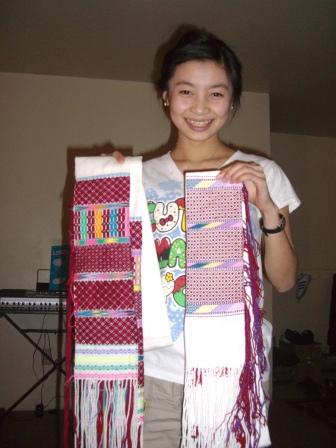
Lewe La Sa shows off a traditional scarf.

Lewe La Sa, 17, who is Burmese, arrived in the U.S. only 18 months ago from a refugee camp in Thailand. She came to the center to get help with her homework, as she was trying to get through a full class load during her last year at Cottonwood High School. Sa showed motivation to learn for her classes and improve her English skills as she transitions from the life she knew growing up in the camp, where she was an excellent student. She speaks Karen, some Thai and now English. She said her mother never had the opportunity to go to school.

Sa dreams of attending the University of Utah and becoming a nurse. If that doesn’t work out, she said, she wants to be a social worker and help refugees from her country.

“Many people come here that speak Karen, but it’s very difficult for them to understand English at first,” she said. “I also want to be an interpreter, they really need one.”

Sa and her younger sister, Paw Ku Sher, currently teach a refresher course of Karen to refugee children between the ages of 4 and 14 every Saturday.

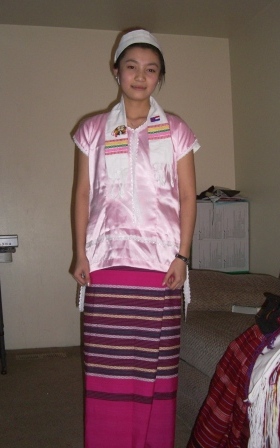
Special occasions in Burma require specific dresses.

“If they have lived here for a long time, they don’t remember their family’s native language very well,” she said. Her next step toward achieving her academic goals is succeeding at the upcoming college entrance exams.

Kaity Dixon, an IRC volunteer coordinator, said in an orientation to volunteers in Salt Lake City that it’s a true struggle to learn to read and write in a foreign language when you haven’t learned to do so in your own native tongue.

“In an instant, reading directions and completing necessary paperwork for daily life becomes a barrier to progress in a new country,” she said.

Without organizations like the IRC and other offices, as well as on-site tutoring for refugee children and services for whole families, personal, financial or educational achievements for these individuals might be too far out of reach.

A Japanese saying captured this complex situation of giving direction right at its point: “When one has no needle, thread is of little use.” The programs offered now could expand or improve in the near future by greater participation and community involvement for maintaining these vital services.

Maybe there is hope for the young boy on the sidewalk after all.

Creating opportunities for artisans

Story by EMILY RODRIGUEZ-VARGAS

Those looking for unique Asian or African handwork and artisanship in Utah need not look much farther. These homemade treasures and more are now available for sale through a nonprofit organization for artisan refugees recently organized in Salt Lake City, Pathways to Self-Sufficiency.

Photo courtesy of Wanda Gayle

At the launching of the Global Artisans project of this organization on March 30, 2010, at the Salt Lake City Main Library, tables were lined up in a conference room displaying true cultural riches. Handcrafted jewelry, knitted clothing for young and old, homemade cards and other objects were portrayed and sold by artisans. Not only are these crafts practical, but they also show the potential of self-sufficiency of refugees.

As women and men craft these gifts for sale they are actively pursuing the chance to provide for themselves. At the same time they learn vital business skills. The artisans from many different countries presented and sold their work to attendees. Although not all of them spoke English fluently, they were all eager to use the language skills they did have to sell their merchandise. Some of them even worked on their various projects at the event, creating traditional woven baskets from Africa and knitted baby socks. As refugees, they can put their skills to work and offer local shoppers diverse and unique selections.

According to the Pathways’ Web site, a refugee is “any person who is outside any country of such person’s nationality, and who is unable to return to, and is unable to avail himself or herself of the protection of that country because of persecution or a well-founded fear of persecution on account of race, religion, nationality, membership in a particular social group, or political opinion.”

Photo by Emily Rodriguez-Vargas

The best part about this nonprofit program is that the artisans are able to make some profit without extensive business education and marketing skills. Pathways and its volunteers support the artisans in the promotion of merchandise. In a step-by-step process the artisans learn the craft, like sewing or knitting, with supervised assistance from volunteers, then they prepare it for sale on the Global Artisans‘s online store.

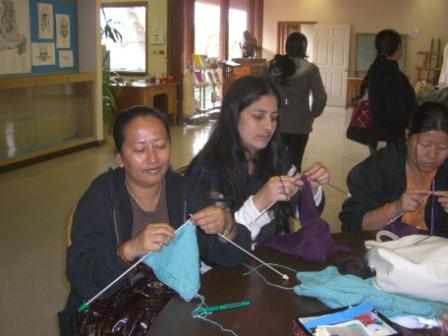
Once a week, men and women who want to make an extra income meet for a few hours of training. At the Pioneer Craft House they receive supervision by experts in the respective fields, and together they learn, talk and laugh. Many times the artisans bring in knitting work they’ve completed at home for a last check, or they ask questions about how to improve their craft.

The artisans have a supervisor to help improve their sewing and knitting. Photo by Emily Rodriguez-Vargas

This program also offers free entrepreneurial training at Salt Lake City Community College by a group of volunteers. The Global Artisans project can only accept a limited number of people at one time. Through these business courses, training by specialists and on-the-job help, the artisans are placed in the best position to know how a business works for the future.

Missy Larsen, a volunteer coordinator for Pathways, said the project helps to close the gap between other organizations and services. While there are various groups to support refugees, this specific opportunity not only helps them immediately, but also gives them long-lasting business knowledge and skills they can apply to supporting themselves later on.

Larsen said she first got involved in helping refugees when she supervised a service project for youth. But it turned into something she couldn’t walk away from.

Photo courtesy of Wanda Gayle

“There are so many needs a refugee family has, from finding a job to needing to drive to appointments,” Larsen said. This program directly helps them to succeed and make some money to live on.

Ze Min Xiao, refugee services liaison for Salt Lake County, is a volunteer and one of the driving forces behind Pathways. She advocates helping refugees in Salt Lake City to become self-reliant, which she said is a great step forward. With the support from American Express in providing a grant for the market goods, the artisans can take home their profit, with only 10 percent of the proceeds going to cover overhead costs.

“We volunteer,” Xiao said of those who make Global Artisans happen. “We don’t keep a penny.”

Xiao explained how getting a job and being able to successfully integrate into the community is especially challenging for refugees. Learning to live in a new country can create emotional stress and people often encounter financial difficulties if they cannot find work because of language barriers.

Participants are working on necklaces, pillow cases and jewelry. Photo by Emily Rodriguez-Vargas

Laxmi Timsina, 23, makes necklaces and bracelets. She’s also trying her hand at sewing artwork on pillowcases. She has been involved with Global Artisans since she arrived from a refugee camp in Nepal in 2009. She was practically raised in a refugee camp, she said, after her family left Bhutan because they were Hindu under a Moslem ruler. Although she already learned to speak English in the camps, she said it’s particularly difficult to find a job as a refugee. This is especially unsettling when working against a deadline.

“The government helps us for six months, but after that we are on our own,” she said. Although money is tight, she hopes that other family members can join her here in Utah soon.

Her friend Nirmala Kattel, 22, is also involved with making jewelry for Global Artisans. A Bhutanese herself, she said her family was forced to go against their religious beliefs when the King had Hindus persecuted. They then stayed in Nepalese refugee camps, where she spent most of her life. Kattel said it was a challenge to acclimate to life in Utah, especially in the first months. She lives with her husband and in-laws, and she is still getting used to the greasy and sweet American food.

“It takes time,” Xiao said. “Refugees have to learn English and learn how to operate in a new society.” That is where Global Artisans steps in to help out.  The services teach those seeking an extra source of income to work for it and benefit from the promotion of the program. They also learn to start a business, Xiao said. “It’s all about empowering others.”

Common octopus is anything but

Story and slideshow by KEITH R. ARANEO-YOWELL

Go to any Asian food market in Salt Lake City, and you will likely find bags of deep, blood-red flesh packed in ice. Go to any sushi restaurant and you’re likely to see on the sashimi or nigiri menu an item called “tako” (pronounced like the Mexican “taco”). Buy or order it for the first time and you’ll likely change any previously held beliefs about octopus.

Long considered a delicacy in Mediterranean and Asian (especially Japanese) cuisine, octopus is thought of by many to be prohibitively tough to prepare and chew.

“It’s rubbery, hard to bite and it doesn’t break apart very easily, even when it’s fully cooked,” said George Mateo, a visitor to the Living Planet Aquarium in Sandy.

Still, others wouldn’t hesitate to try it. Mason Childs, 21, works as a server at Market Street Grill. He said, “If it was on our menu at work I would probably try it once or twice.”

Splendidtable.com contributor Mark Bittman writes, “If octopus is properly handled, without fuss, it is reasonably tender. It remains chewy, but so does lobster, or sirloin steak.”

Home cooks can reduce the rubbery texture of octopus using a number of different strategies.  These range from the unusual Italian method of boiling it with wine corks to the brutish, yet obvious, method of beating it against rocks.

Bittman wrote even though these methods are effective, the key to eliminating most of the toughness is slow cooking time at very low temperatures.

Sue Kim, the owner of the Oriental Food Market at 667 S. 700 East in Salt Lake City, said she probably only sells one bag containing four tentacles and the head of an adult common octopus every day on average.

Kim attributes the relatively low rate of sales to the “rubbery” label attached to octopus meat as well as its alien appearance, and at $24.99 per bag, and similar pricing in restaurants around town, it’s considered a delicacy and not a staple.

Nina Clark, 23, is an exercise and sports science major at the University of Utah who said she hopes to pursue a career in public health education. She said octopus is an uncommon dish in Utah because there’s no coast. “We’re not exposed to it,” Clark said. “We’re land-locked.”

Childs said he could see why some people would be hesitant to eat octopus. “They’re scary creatures. To think they can open a mason jar without hands and do it while sitting on top of it. They’re pretty violent in the ocean.”

Others hesitate because of the octopus’ unusual appearance. Lacy Mateo, 20, who was visiting the Living Planet Aquarium with her husband, George, said she would never eat octopus because of the suction cups. Clark expressed similar reservations because of the fluidity of octopus movement.

With a single bulbous sack (or mantle) housing all their internal organs, surrounded by eight suction cup-covered arms and skin that looks like it’s been dead for a number of decades along with its reputation for rubberiness, it’s no wonder Clark and the Mateos find the look of the meat “gross.”

For all their physical irregularities, however, John Lambert, aquarist at the Monterey Bay Aquarium, said they pale in comparison to the strange behaviors he observes on a daily basis.

They can change the color and texture of their skin in a blink of an eye to avoid detection from predators. An article that appeared in Advanced Aquarists Online Magazine described the mimic octopus, which reproduces the rough appearance and movement of more than 15 different marine species native to its habitat of tropical Southeast Asia.

While feeding cancer crabs to the Giant Pacific Octopi at the California aquarium, Lambert, 52, and Aquarium Communications Director Ken Peterson, 61, described the difficulty associated with keeping their two Giant Pacific Octopi, Nano and November.

“There was an institution that was losing fish out of one of its tanks,” Lambert said. “They set up a camera over night and discovered that an octopus in an adjacent tank was crawling out at night, making its way over to the tank the fish were in, and helping itself and then returning to its own exhibit.”

Peterson later added that it had actually happened at the Monterey Bay Aquarium.

Because of the octopi’s desire to explore outside their enclosures, all outer edges of the octopus habitats are lined with Astroturf, which “prevents the octopus from being able to get a grip on it with their suction cups,” Peterson said.

Despite anecdotes of rather adventurous octopi, they spend most of their time in small crevices between rocks on the sea floor and are, therefore, extremely hard to fish. A fisherman for Monterey Fish Co Inc., who wished only to be called Dane, said just shrimp-trapping boats in Monterey regularly catch octopus.

Because the only hard structure in their bodies is a small parrot-like beak where all its tentacles converge, octopi can fit through the extremely small holes in shrimp traps. Lambert also said octopi are apt problem solvers and shrimping traps don’t really pose a challenge.

“They’re certainly very intelligent animals,” Lambert said. “[Researchers] put an item in a jar with a screw lid and the octopus can figure out how to unscrew the lid and get to the item. The first time they see it, it will be a challenge, but they work at it. They’re very tenacious animals.”

Their intelligence and ability to deform their bodies causes problems for shrimping boats in Monterey. Dane said, “Octopi will crawl into the traps and eat the shrimp.”

Shrimpers in Monterey lose an indeterminable amount of money each year due to octopus. According to the California Department of Fish and Game’s 2010-2011 Ocean Sport Fishing Regulations, octopi can only be caught and kept if line or hand-caught.

“[Shrimpers] usually throw [octopi] back,” Dane said. One shrimper who doesn’t always follow regulations said, “If I’m going to lose my catch, I at least want to sell the thing that cost me my paycheck.” For obvious reasons, this fisherman asked that he and his boat not be identified.

With the exception of when fishermen actually bring in an octopus, it is very difficult to find restaurants in Monterey that serve octopus. This is partly due to the aquarium’s decade-long effort to raise awareness across the U.S. about common fishing practices.

The Monterey Bay Aquarium publishes reports on commonly eaten seafood items. According to the 2008 report for common octopus (the species that is sold for food), most of what is sourced for use in the American sushi industry is sold as common octopus, even if it is of a different species.

Kim said she orders the octopus in her store from a Japanese fishery.

According to the report, Kim’s octopus comes from either Morocco or Thailand where the preferred method of octopus fishing is a practice called bottom trawling, in which boats drag fishing nets along the sea floor.

Octopus distributors in Japan also work with fisheries in Spain that catch octopus in pots, which is an artificial habitat perfectly suited to octopus. These pots lie on the sea floor for two to three days before fishermen reel them back in to collect the octopi.

In either case, after it is caught, it is blanched and shipped to Japan to be prepared for sushi by removing the beak, the poison and ink glands, the eyes and the internal organs. It is then frozen and re-exported to the U.S.

Monterey Bay Aquarium’s Seafood Watch Program assesses the ecological sustainability as well as the safety of eating seafood items commonly found in U.S. fish markets. According to the report, “due to the difficulty associated with discerning the actual country of origin of octopus found in US sushi restaurants, [octopus] should be avoided as a general rule. While Spanish octopus (especially pot-caught) is a preferred alternative to North African and Vietnamese octopus, it is rare that sufficient sourcing information is available to the consumer.”

The report, however, does little to address the adverse health effects of heavy metals that continue to build in species moving up the food chain.

In their report titled, “Bioaccumulation of Lead, Calcium and Strontium and Their Relationships in the Octopus vulgaris,” researchers Sonia Seixas and Graham Pierce found that “aquatic animals take up and accumulate lead from water, sediment and food.”

Because there is no way to rid tissue of lead by natural means, Seixas and Pierce observed “concentrations higher than the maximum legally permitted concentration of lead in food.”

Being conscious of how food gets to the dinner plate is a crucial element in public health, exercise and sports science major Nina Clark said. “That’s a big reason I try to avoid seafood in general. I’m aware of the patterns of how fish is shipped, exported and re-exported.”

Market Street server Mason Childs said the surprise he felt learning how octopus gets to the dinner table in a land-locked region illuminates a good deal about his previously held beliefs about seafood and sustainability. At the end of the interview, he asked for a copy of Seafood Watch.

“Eating is one of the most intimate things humans do,” Clark said. “It’s crucial that we educate ourselves on the repercussions of our choices.”

Truthfulness, compassion, tolerance: How Falun Gong saved a life

by KEITH R. ARANEO-YOWELL

Lang-hao Lin shifted uncomfortably in her seat when she flipped to the page in a Falun Gong history book with an image of a young girl bound to a chair with rope, and surgical tubing going into her bloody nostril.

“This is similar to what happened to me,” Lin said. “They put some kind of medicine into the thing they force-feed you. After feeding, you’re in semi-consciousness, dreaming all day, you’re not clear-minded anymore.”

Lin, who asked that her real name not be used, was referring to the treatment she received while serving a two-and-a-half-year sentence in a forced labor camp in Shanghai, China. Her crime was practicing Falun Gong or Falun Dafa, a philosophy that holds tolerance, compassion and honesty as its three pillars of spirituality.

“It’s not a religion,” Lin said. “It’s culture generated from the 5,000-year-old Chinese history.”

Started in 1992 by Li Hongzhi, Falun Gong draws from Buddhist and Taoist principles of self-improvement without the worship of a deity. It emphasizes qigong, a meditative practice that uses slow movements and controlled breathing as a way of spiritual enrichment.

Hongzhi’s book, “Falun Gong,” teaches the physical and spiritual aspects as well as how to meditate. Practitioners begin by assuming four standing meditation positions and one final sitting position. The legs and torso remain static while the hands move slowly around the body in ways that “mix and merge the universe’s energy with the energy inside the body.”

In this way, many practitioners believe that the ritual has powerful supernatural healing capabilities.

Because of the changes she perceived in those around her, Lin, 37 started attending Falun Gong meditation in Shanghai in 1997.

“I witnessed with my own eyes so many people getting healthy bodies by just doing [Falun Gong] exercises,” Lin said. “Before, they even had cancer. It was like a miracle happening around me.”

Lin said the practice grew rapidly because of its simplicity and effectiveness and, while there is no official entity monitoring the number of practitioners, the Congressional Research Service’s report titled “China and Falun Gong” estimates the number of practitioners during the mid-1990s to be anywhere from 3 million to 70 million.

Despite its wide adoption in Chinese society, however, the Chinese government made the practice of Falun Gong illegal in July 1999.

Roger Tsai is an attorney for Parsons, Behle & Latimer who would later help Lin attain status as a political asylee. He said the Chinese government felt threatened by Falun Gong’s popularity.

“[The Chinese Communist Party] was worried about how popular Falun Gong was,” Tsai said. “At one point the size of this group was larger than the size of the communist party, so it was a potential challenge.”

A government official was later quoted in print and broadcast for the Xinhua News Agency (a Chinese news outlet) as saying, “Those who jeopardize social stability under the pretext of practicing any qigong will be dealt with according to the law.”

Even though there is no official record of the number of arrests for practicing Falun Gong, the Wall Street Journal reported in 2000 that more than 30,000 practitioners had been arrested in the first year of the Chinese government’s ban of the practice.

Lin was pregnant with her daughter and working in Shanghai when Falun Gong was made illegal. She continued to openly attend Falun Gong meditation even though she had heard stories of the Chinese government sending practitioners to prisons and labor camps. “I was scared,” Lin said. “I did not want to be persecuted, but I did not stop.”

In 2001, Chinese authorities found Lin at her work. “At first, I was not [arrested] because I had a baby, and they gave me a one-year nursing period,” Lin said. “They told me, if after one year [I did] not denounce Falun Gong, they would send me to a labor camp.”

After receiving threats from the government and hearing accounts of life in labor camps, she decided she had no choice.

Lin went into hiding for a year in Nanjing, a city roughly 200 miles northwest of Shanghai. “My husband and my daughter didn’t know where I was. I dared not go out. After one year,” Lin said, “I missed home so much, I made one phone call to my husband. I told him where we could meet, but when I went, there were police waiting already. I didn’t even get to see [him].” Lin believes her husband’s phone was tapped.

Lin would spend the next two-and-a-half years in a forced labor camp assembling American products, a task she said was assigned to her because she could read English. She slept on a plank of wood. She was not allowed to talk. She shared a single toilet and a cell the size of two standard parking spaces with up to 10 other women.

For 10 days, Lin did not eat or drink water as a way of protest. “If you refuse to eat or drink, they use a tube to force-feed you,” Lin said stoically. “It’s not to save your life, it’s for punishment.”

Had Lin simply signed a document renouncing Falun Gong, authorities would have allowed her to go free. She said she couldn’t do it because it goes against the truthfulness that Falun Gong holds paramount over suffering. “It isn’t true, so I couldn’t do it,” Lin said.

After her release from the labor camp in 2005, Lin was only able to continue her Falun Gong practice in secret because the Chinese government continued to monitor her activity. Lin was unable to attend public meetings, protests, rallies or Falun Gong meditation.

Reprieve came only in 2008, when Lin’s husband accepted The University of Utah’s offer to study for one year as a visiting scholar. Her husband left China while Lin and her daughter acquired passports and visas to stay in the United States for the rest of his time at the University of Utah.

After a few months of talking with her husband about staying in the U.S., Lin approached Roger Tsai to obtain status as a political asylee, which would grant her one year of legal residence in the U.S. With Tsai’s help, she submitted her case for political asylum to the U.S. Department of Homeland Security’s office of U.S. Citizenship and Immigration Services in 2009. Two months later, she and her family were allowed an extra year in the United States after her husband’s visiting scholarship ended in August 2009.

Lin still studies Falun Gong year round. Once a week, she and a group of other practitioners meet in Salt Lake City’s Liberty Park during the spring and summer, and with one of the elderly practitioners at a nursing home on 700 East during the rest of the year. Robin, who asked that his full name not be used, practices Falun Gong with the group of other adherents at the park. He said Falun Gong does not advertise and is open to anyone who wishes to participate.

When Lin and her family became political asylees, they became eligible to apply for permanent residency in the U.S. Tsai assisted in this process and Lin and her family submitted the paperwork in March 2010. They are still waiting to find out if they’ll be able to stay in Utah indefinitely.