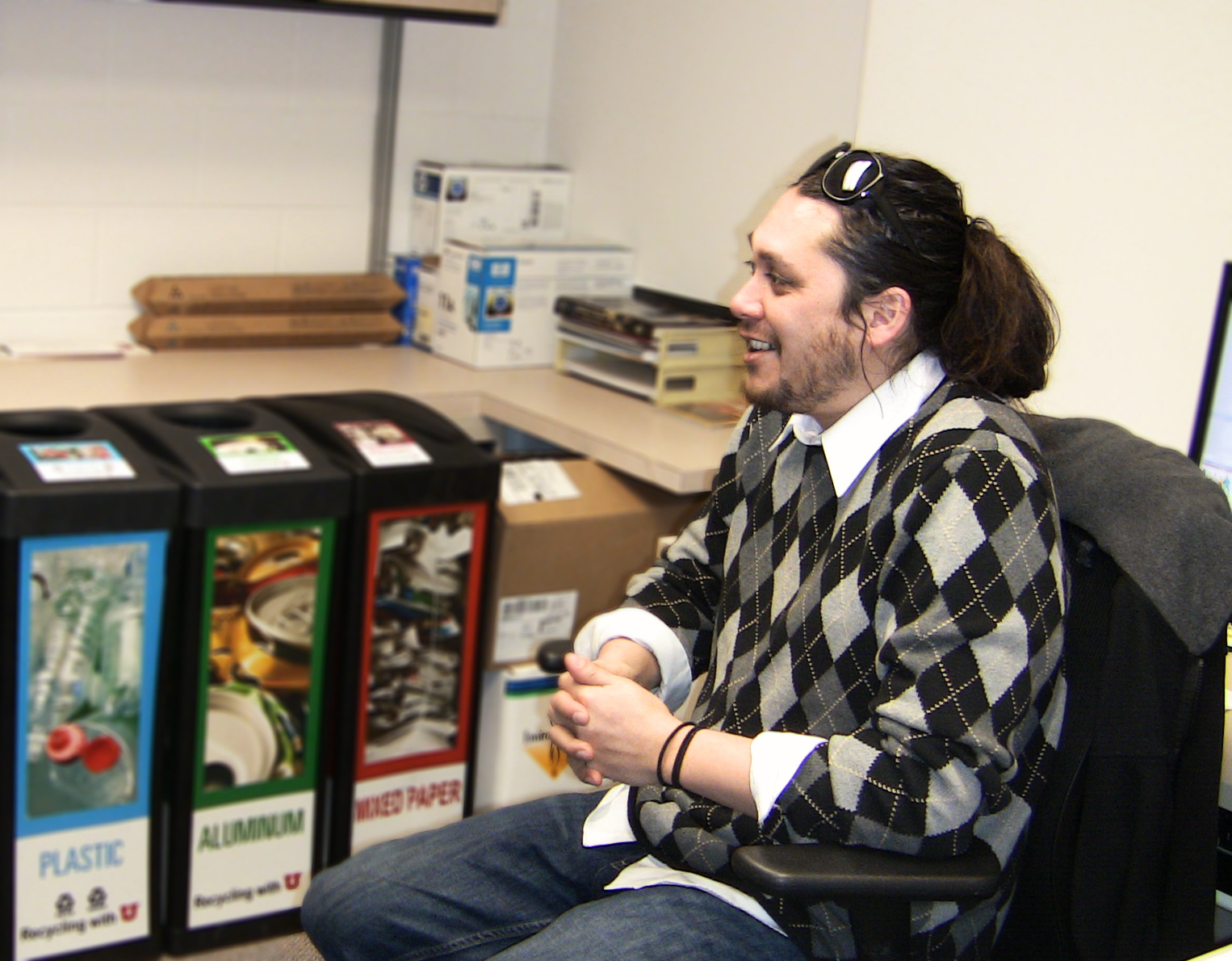
University grants students money for sustainable projects

Watch a news broadcast about the Sustainable Campus Initiative Fund.

Story and multimedia by JENNA LEVETAN

The Office of Sustainability is making students green ideas a reality with the Sustainable Campus Initiative Fund. The program also known as SCIF oversees competitive grants for student projects focused on sustainability, education and energy efficiency at the University of Utah.

SCIF’s mission is to provide funding for real-world projects that improve the University of Utah’s environmental quality and make the campus more sustainable. Student funding like these are often known to get the ax because of school budget cuts. However, SCIF coordinator, Whitney Williams, says the program is safe because it actually creates jobs once the ideas are approved.

“I would say that we are in a little bubble,” Williams said. “We are not really affected by the economy. If anything we are more attractive because some students can use this as funding their own research, so it is sort of a job opportunity.”

A $2.50 fee in every student’s tuition solely funds the projects. The students involved in the Association Students at the University of Utah (ASUU) approved the charge in 2009, and they voted very much in favor of the campaign. With an estimated 30,000 students who pay tuition it designates about $75,000 to be granted to students.

Myron Willson, Director of the Office of Sustainability, believes that even though students have to pay a fee in the long haul they are actually reaping the benefits.

“There is a lot of student involvement and even though the program has only been going for one year I believe they will start seeing the evidence of sustainability soon,” Willson said.

Since the programs launch in January 2010, SCIF has funded 24 student projects; however, last year they did not use all of their money leaving them with $160,000 to award this semester.

“The average amount that usually goes to one project is $4,000,” Williams said. “So take that divided by $160,000 and that is a lot of projects we hope to fund.”

There is no set number of projects that will receive funding. It depends on how much money each project asks for.

SCIF funds projects that address financial, environmental, educational, visibility, creativity and longevity. With the economy hitting a lull, the financial aspect is considered the most important factor to the committee who determines which projects will receive funding. Student projects should be able to either make or save money and all projects should have a return on investment.

The organic gardens located at the Still Center were one project that was approved and is now in bloom. The project was submitted by a masters in science and technology graduate student, Alex Parvaz who was also an intern at the Office of Sustainability. She was given $2,828 for garden tools, compost bins and seeds. Her project is helping the university’s campus financially because the gardens produce organic food that are being sold to on-campus dining facilities, such as Chartwells as well as selling them to the community at the U’s farmers market.

“Selling the food at the farmers market has given us the money to help pay for basic maintenance, and students being able to eat the very food that they grow has been cool and delicious,” Parvaz said.

Another invention that you can see cycling around campus is the recycle cycle made by environmental studies undergraduate Derk Harris. He was given $4,200 to make five bicycles retrofitted with a bucket on the back to be used at campus events, especially football games.

“It is projected that eight tons of trash per game is thrown into our waste stream,” said Harris. “So the idea of the bike being able to have our volunteers at lease being able to have fun while they are riding around putting recycles in the bike.”

The bike is being made with the help of local bike shop Madsen Cycles. The owner of the bike shop, Jared Madsen, opted to split the cost of each bike. Because of this each bike only cost the Office of Sustainability and Harris $850 versus $1400.

Harris’s vision of the recycle cycle is to raise awareness of recycling on campus and increase the amount of goods recycled at campus events. So far only one bike has been made, but the other four are on the way. Any student can volunteer to ride the bike around campus to help clean up.

Because of all the money the SCIF program now has to give, Harris plans on applying for more grants and suggests that students to do the same. “The money is there and the office is willing to hear whatever as long as it helps students and campus,” said Harris. “Even if you do not have a complete idea they are willing to work with you to bring it to life.”

Every student is eligible to apply for funding to start a sustainable project or business on campus. Grants are awarded once a semester and students must find a facility member to sponsor them. To find out more information on how to apply visit the Office of Sustainability website.

University of Utah music majors plan for mainstream careers

Story and photo by HELEN COX

To ensure employment after college, many University of Utah music majors are investing in additional studies in order to focus on more realistic, contemporary career paths including accounting, medicine and business.

Music major Clark Newell enjoys playing piano and writing music at home, but is planning for a more business-oriented career.

The University of Utah School of Music offers both undergraduate and graduate levels of music study, and its mission statement places much emphasis on education, composition, conducting, performance and theory.

It does not, however, mention career preparedness.

Many students, still passionate about receiving a music education, are thinking of new ways to become financially successful. In modern times and in a down economy, traditional art and music degrees are not typically suited for most careers.

Freshman Richard Contreras, a pianist since age 7, has decided to boost his chances by applying for a double major in piano performance and accounting. While his status at the university allows him to teach piano lessons around Salt Lake City, he only sees this as a way to make some extra cash while in school.

Contreras agrees there is not much of a future in the current job market for anyone who is only majoring in music – there simply aren’t enough jobs out there. He hopes to find a career as an accountant after graduation, and continue playing music on the side.

Ryan Ingle, a junior in the school of music, has a similar story. He is double majoring in music and chemistry. Although he has been singing his entire life and is working toward his Bachelor of Arts in music, Ingle has different career plans – he is going to attend medical school.

“I study music entirely for personal fulfillment,” he said.

Utah’s school of music is well known for its choral, classical and jazz training and has been an accredited member of the National Association of Schools of Music since 1952. But some students suggest the school is not what it could be because the curriculum does not seem to have changed much since 1952, either.

“The program is old-fashioned and inefficient,” said senior Clark Newell, who will receive his Bachelor of Arts in music next year. “I think the degree should still exist and be preserved in its tradition, but they really need to modernize the program and start having some classes that help students to be marketable.”

Newell came to the U with a passion for pop music. A pianist and composer, he joined his first band in junior high school and is concerned that the school of music is ignoring the needs of students who want to write pop or rock and want a more practical major.

“As much as I love music, if I were to do it again I would have chosen a different degree,” Newell said.

Newell decided to add a business minor to his major to gain some business and marketing skills, which he feels are not taught in the music program. With plans to get his Master of Business Administration, Newell hopes to go into arts administration or work in the record industry ­– but realizes that, too, is in danger due to technological advances and a down economy.

Things seem to be up in the air for the school of music, as well. When the acclaimed director of choral studies, Dr. Brady Allred, resigned unexpectedly during fall semester 2010 for “personal and family circumstances,” the school of music started a national search to replace him.

Some students are concerned the U School of Music’s credibility has gone down since he left, canceling the fall concert and leaving many choir students without a permanent professor. Allred has been temporarily replaced by Barlow Bradford, co-founder of the Utah Chamber Artists. The school is still suffering from Allred’s resignation.

“I know a lot of students left when he did,” said Megan McFarland, an a cappella student.

It is certain the music program is exceptional, and is bringing many new faces to the university who may not have enrolled otherwise. The school of music will unquestionably continue to move forward, but with some obvious changes in store for them and their students.

“Music got me into school, but business is gonna get me out,” Newell said.

The University of Utah’s hidden gem: community-based art education

Story and photo by MICHAEL OMAN

Amidst a struggling economy and proposed budget cuts, two things remain clear: education remains an attractive job market and the University of Utah holds a vital key for students seeking to become art educators.

It’s a key few realize exist. Not only is it beneficial to students but also to communities in general.

A group of University of Utah students discuss how to get the word out about their art in the community class.

The magic number: 7.6 percent. Utah’s unemployment rate hovered around this figure for the past several months, according to an online report Utah’s Department of Workforce Service (DWS) published January 2011. The national rate remains at 9 percent.

Mark Knold, DWS’ senior economist, said the reason Utah’s unemployment rate is below the national average is because of its younger demographics. Younger people are more likely able to afford going back to school, “hang out in Mom’s basement, whatever it takes to ride this thing out,” he said in an online podcast.

Those returning to school or those already there should consider this: Despite proposed budget cuts to higher education and public education, one area that maintains strong employment is education — particularly higher education.

According to DWS’ online report, higher education employment projections from 2008 to 2018 should see substantial growth, even though the number of annual job openings might be slim.

In addition, the need for art educators remains a constant.

In an email exchange, Dr. Beth Krensky, associate professor of art at the University of Utah, explained the reason behind that need. “Art education is federally-mandated to be taught in public schools, which may explain the need for faculty members in higher ed,” she said.

That high demand is one reason future educators should start thinking about how to stand out to potential employers now.

College students studying art education, for example, should strongly consider adding service-learning courses to their curriculum. Fine arts advisor at the University of Utah, Liz Abbott explained “some students will do the minimum requirement and they will sometimes wonder why they can’t get a job after school.”

She said students looking to attract future employers must take full advantage of their academic career and find ways of using what they learn outside the classroom.

“I worked in career services and there were lots of students who would show up and say ‘Ok, I’ve graduated, now what do I do to start my job search?’” Abbott said. “They were not going to be as successful in a job search as someone who had already gotten some experience through an internship or something like that.”

Several courses at the university’s College of Fine Arts offer students that ability.

For several years now Krensky has reached out to underserved communities through her class, “Art in the Community.” It does so by harnessing the community-based art education model (CBAE) to provide youth with a stimulating art education.

Trevor Wright participated last year in the service-learning class Krensky offers. It’s “a great way to get started into the art education program, I think,” he said.

“She’s taking two needs and meeting them with one class,” Wright said. “She is actually taking students that are studying art here at the U and trying to put them into the community.”

He noted that communities the class serves are generally underfunded or may even lack interest in the arts.

“It’s their [the youth’s] first time experience with some of the arts,” Wright continued, “but there’s some art forms such as photography — maybe they’ve taken pictures before — but maybe not in the way that was presented to them.”

Another former student of Krensky, Heidi Justice, is now a 2012 master candidate of public service at the Clinton School of Public Service in Arkansas. She speaks fondly of her experience in the class.

During her time in the class Justice noticed the impact CBAE has on kids. It provides opportunities where kids can unleash their natural talents. “One day we had students that spent most of [the] time working on digging up the garden,” she said.

But the kids aren’t the only ones who benefit from the CBAE model the class employs.  “I really enjoyed it!” Justice exclaimed.

She said it provides a valuable set of skills that not only helps in the classroom but also makes finding employment a greater possibility. “[With a big project] there’s a really big necessity to take the time to plan,” she said. It’s something she feels is heavily stressed when designing art lessons for the youth, which is a core essential of the “Art in the Community” class. Taking that experience to future employers is “very important,” Justice explained.

“I think it’s important and it makes you more marketable,” Abbott confirmed.

Krensky previously said she constantly receives such praise from former students. “I’ve certainly heard from my students as they finish up their time at the University of Utah about the impact the class has had on them — in a positive way,” she said.

Wright is among that group of former students who praise the class.

“It’s helped me to develop a personal statement [and] it’s helped me understand why I want to educate,” he said.

Wright believes many at the University of Utah don’t realize the class exists. He notes that students are required to take art courses but many don’t consider “[the] ‘Art in the Community’ class as a class they could take.” Students who do take the course, however, shine like beacons in the sea of future employees.

Students rely on scholarships, loans to pay tuition

Story and Photos by ARMIN HAMZA

Tuition increases have forced current and future college students to worry about their future plans in higher education. However, many say if funds from financial aid or student loans continue to be available they won’t have to worry about the tuition increase as much as anticipated.

Students study in the communication building.

According to finaid.org, tuition prices have been increasing nationally by an average of 7 percent since 1958. This statistic shows that students who decide to go to on for higher education must face the fact that their tuition will likely continue to increase until they graduate. Either way, the funds to pay for college must come from somewhere.

“I’m not worried too much about the tuition hike as long as I have the money available from financial aid or students loans to pay for it,”  Steve Christiansen, a student at Salt Lake Community College said.

According to Higher Education Utah, an informational website by the Utah System of Higher Education, the reason why these funds are available to students is because in 2010, the Governor and legislature prevented additional large cuts to higher education making it possible for institutions to accommodate student enrollments.

Students that transfer from private schools, where education often costs three to four times more than public schools, say they won’t have to worry about the tuition increase because they are paying now less than before. One example would be Westminster College versus the University of Utah.

“Transfer students from Westminster College usually transfer because of the enormous cost difference and that is the biggest reason why I transferred,” Matt Smith, who transferred from Westminster College to the University of  Utah, said.

On the other hand, students that transfer from a community college or other public schools, usually transfer to continue their education.

“I am transferring to the University of Utah because I want to get a better education and also with a mind set that the money will be available,” Adrianna Osorio, who is currently attending Salt Lake Community College, said.

There are generally two different motivation aspects for students: money and the quality of education. Some people would argue which one of those two is more important.

“I believe the quality of education is always the most important aspect, but if the money is not available to the student to get that desired quality of education then of course the student must consider the money aspect,” Chris Morgan, a graduate student at Westminster College, said.

Students such as Chris Morgan understand the importance of the quality of education, but is quality of education really important when students do not have the money to pay for it?

“When I  enrolled at Westminster College I knew how much I would have to pay, but I also knew that I wouldn’t be able to attend Westminster College without financial aid or student loans,” Morgan said.

According to Osorio, the majority of students she knows pay for their tuition through financial aid, or student loans. “That is the only way that I can go to school, otherwise I would be working two jobs,” Osorio said, adding that, “paying this way never really gives the student an idea how much tuition costs.”

Students expressed concerns about the tuition increase, but they believe as long as the aid money continues to be available, they will continue to enroll into college.

According to Higher Education Utah, student enrollment has increased by 6,389 full-time equivalent students, an increase of 6.2 percent over the past semesters –  another sign students are putting aside worries about tuition increases to continue their education.

According to Christiansen, to have a better future financially or economically these days, a better education is necessary.

“Us students don’t really have an option when it comes to paying for school and in order to have a better future we must go to school, no matter how much it costs, so all we can count on is financial aid or student loans,” Christiansen said.

PAC-12 conference change brings increased revenue

Story and photos by SCOTT WISEMAN

The University of Utah’s athletic department is an organization that has been acknowledged nationally for its prestige in facilities, recruitment, scholarship and ability to thrive.

Freshman Tight End Jake Murphy performs a dead-lift excerise during training. The Dee Glen Smith Athletic Center recieved a large amount of funding from PAC-12 television contracts and private donors for reconstruction and expansion.

Starting in the fall of 2011, the department will undergo its largest change yet— a migration from the Mountain West Athletic Conference to the newly-restructured, illustrious PAC-12 Athletic Conference.

Although details about the myriad changes the conference switch might bring are still mostly speculation, it is obvious that some form of change is imminent.

One of the major highlights that has people buzzing is the fact that Utah will now be placed in a Bowl Championship Series conference. Being in one of these six conferences means they will receive a chance at an automatic bid to a BCS bowl game. This is the highest achievement for a team in American college football.

Previously located in the MWC, the Utes did not automatically qualify for BCS bowl games, and found it extremely difficult to appear in those games. If the Utes were to perform at the same competitive level in the PAC-12 as they did in the MWC, they will get the opportunity to routinely appear in games such as the Rose Bowl and the College National Championship.

One of the many changes that are looming in the horizon for Utah’s athletic department— specifically football— include the guaranteed increase in revenue generated from television contracts, ticket sales and the Bowl Championship Series.

Dr. Chris Hill, Athletic Director for the University of Utah, explained that the Utes are guaranteed $2.5 million in television contracts, an increase of $500,000 from last year’s television generated revenue.

When Utah joined the PAC-12, the athletic department agreed on a payment plan for television contracts where they would receive 50 percent of the usual share for their second year in the league, 75 percent for their third year and 100 percent of the revenue share after their fourth year, Hill said.

While Hill did not know the exact figures for the money that the newly restructured television revenue contracts would bring in after the Utes’ fourth year in the league, it is only expected to increase rapidly.

“Money is everything,” said Morgan Scalley, Utah’s football recruiting coordinator. “It allows us to build well-equipped facilities, upgraded equipment, academic services and ton of other options depending on different priorities.”

Dumbells are part of the improved equipment replaced in the Dee Glen Smith Athletic Center.

Utah’s athletic department is a separate organization from the university, and the revenue generated from athletics is kept in an internal budget, Hill said. The revenue produced is used for the constant improvement of the athletic department.

This means that all of the student benefits of joining the PAC-12 conference will have to be indirect. Whether or not the addition of a more prestigious athletic department will translate into a more well-known university has yet to be seen.

For Utah’s football team, money comes from a variety of different sources. The revenue is generated from the stadium, ticket sales and private donors, sometimes called boosters, Scalley said.

When asked where the new revenue generated would end up, Hill said the athletic department planned on first upgrading the football center on campus, and then it would turn its attention to recruiting. With an increase in budget, higher salaried coaches and recruiters are given a chance to come to Utah, all with the supreme goal of making Utah the best of the West, Hill said.

“The shift to the PAC-12 conference will make Utah more attractive to talented recruits, leading to more respect for our department,” Hill said. “We hope the change will add visibility to the U as well.”

Students from across the university are becoming increasingly aware of the decision to migrate to a new athletic conference and the implications of the decision.

“I’m extremely excited for football season,” said Christopher Leeson, a student at the University of Utah. “Most importantly, I believe the conference switch will lead to an increase of students at the U, making it an exciting place to attend school.”

Todd Patton, a student at the university studying mass communication, believes the migration to a more prestigious athletic conference will be beneficial to the school in several different ways.

“Getting more revenue leads to having a better team,” Patton said. “If the team generates higher revenue, they have the budget to spend on recruiting, new facilities and top coaches, all of which are things that make a championship team.”

Both students said they did not think the transition of athletic conferences would affect their lives as students dramatically at the university. The transition might take several years to complete, and by that time, several students currently studying at the university will have graduated, Leeson said.

Utah’s athletic department is a separate organization from the university, and the revenue generated from athletics is kept in an internal budget, Hill said. The revenue produced is used for the constant improvement of the athletic department.

“Unfortunately, I wish that some of the extra revenue generated by the athletic department would be shared with other campus organizations,” Leeson said. “Greeks, the Bennion Center and several other clubs are in need of funding so that they can continue to aid the community.”

Utah women have high workforce participation

Story and photo by WHITNEY BUTTERS

A common Utah stereotype is that of the college girl who wants nothing more than to get her “M.R.S. degree” long before the first strains of “Pomp and Circumstance” play on graduation day. With a ring on her finger and marital bliss complete, she promptly quits both school and work to have children.

But this stereotype fails to acknowledge the truth about the women in Utah’s labor force.

Elizabeth Peterson rings up a customer’s purchase at Carter’s children’s clothing store. In addition to working 20 hours a week as a sales associate, Peterson works as a preparation chef at a reception all in order to earn sufficient income.

In reality, there are more Utah women in the workforce than the national average. According to Utah Department of Workforce Services (UDWS), approximately 61 percent of Utah women were in the workforce in 2009 compared to 59 percent nationally.

Beyond that, 82 percent of Utah women age 20-24 are in the labor force, making them the age group most likely to work.

While it is true that Utah women marry and have children at a younger age, many are breaking the supposedly rigid tradition of the “M.R.S. degree” by working to provide income and gain job experience. Especially in a time of economic recession, finding employment is necessary for women to be able to survive.

“It’s counterintuitive to how we perceive the culture in that we tend to think that Utah women don’t work,” Lecia Langston, labor economist for the UDWS, said. “The reality is that most women work, so we kind of have a faulty view of what’s really going on in the economy.”

Chloe Garfield, 20, is among the Utah women contributing to the unexpectedly high rates of workforce participation. As a newlywed, she works to make ends meet while she continues to study photography at the University of Utah.

“Since both my husband and I are in school and work, both incomes are crucial,” she said. “With both part-time salaries, it is enough to get us through school.”

Elizabeth Peterson, 20, a full time student at the U. studying communication science disorders, works two part-time jobs to be self-sufficient.

“I work because I have to,” she said. “If I didn’t work, I couldn’t pay for school, books, my car, gas, clothes makeup, getting my hair done or anything.”

Because young people like Garfield and Peterson make up approximately 32 percent of Utah’s population, the age group is not only the most likely to work but is also among the most likely to be unemployed. For men and women ages 20-24, the unemployment rate was 13 percent in 2010, second only to 16-19 year olds at 21 percent. This makes it hard for women in both age brackets to keep and find suitable employment.

Peterson was forced to seek new employment when her previous job cut her hours. She initially found work as a preparation chef at a reception hall in Bountiful called The Canterbury Place. But a downturn in the economy decreased the number of catered events, so she was forced to look for a second job. After her previous experience looking for a summer job, she knew the search would not be easy.

“I remembered all of the hours I had spent looking for companies who were hiring and applying for 30 plus jobs without any positive response, and I knew that it was going to be a stretch to find another job,” she said. “I was absolutely desperate, and I would have taken anything I could at that point.”

Peterson eventually found a second job working as a part-time sales associate at Carter’s children’s clothing store in Salt Lake City, where she works 20 hours a week in addition to her catering job

Garfield also had a hard time finding work.

“I was very frustrated that I was applying for jobs that I was more than qualified for but would not get,” she said. “I was even donating plasma trying to make some extra money.”

She got a job as a student caller for the University of Utah Development Office, which raises money for the school. She was promoted to student assistant after two years and tries to work more hours to help support herself and her husband.

Despite any difficulty younger women may face while seeking employment, Langston of the UDWS said it has benefits.

“(Older generations) aren’t like young women today that grew up with an expectation of working,” she said. “A lot of them have never been in the workforce, so there’s not even an interest in that unless they have to.”

Women today are gaining work experience early on, which Langston said will help build resumes and promote future job security.

Garfield cited the opportunity to gain experience as a reason she works.

“I feel that working and getting an education now will give me the skills to raise a family and will also allow me to be able to have the skills to return to work when I need to,” she said.

Langston believes building work experience is vital regardless of current conditions.

“Even if you do have the most wonderful situation where you don’t have to work, stuff happens,” she said. “Your husband loses his job or he gets hurt or you get divorced. All of those things make it so women need to protect themselves.”

Peterson agreed, saying she plans to prepare herself since life is unpredictable.

“Someday when I’m married and have children, I may or may not have an actual 9-to-5 job. I guess that will depend on my circumstances at that time,” she said. “Despite that, I know that I will continue to work hard.”

Fan Fest at risk with budget cuts

Story by JANITA BADON

At the end of each summer, an average of 14,000 fans usually gather with family and friends to meet and greet the University of Utah varsity athletes as part of the annual Fan Fest. But with budgets tight, the popular program is in danger of being cut.

Sophomore guard for the University of Utah women’s basketball team Iwalani Rodrigues takes the fan fest seriously, and believes the Fan Fest helps the program.

“I met so many people because of the Fan Fest,” Rodrigues said. “If they take that away from us, I don’t know of another way to actually get more fans.”

Rodrigues, like many other varsity athletes at Utah, thinks the Fan Fest is beneficial to not only the attendance at the games, but also the support that it brings.

“I mean, of course, we don’t have as many fans as the men’s basketball team or as the football team, but when we have the Fan Fest it’s our (women’s basketball team) way of stealing fans,” Rodrigues said.

Losing the Fan Fest would also disappoint its main audience: the fans. Sasha McKinnon, a self-proclaimed “die hard” football fan, said she loves the Fan Fest, and thinks the Utes could potentially lose fans without it.

“I just think that the Fan Fest gives you a chance to talk to your favorite athlete, and ask all the questions that you want,” McKinnon said. “I think all the women on the varsity team at the U get fans because fans get to know them and are interested in seeing them in action, after meeting them at the Fan Fest. I honestly don’t think people know how good the soccer team is, or how good the volleyball women are, but when they go to the Fan Fest and interact with the players they’re more obligated to go to a game.”

Supporters say the Fan Fest is a great way for the fans to meet the players, get autographs, and eat free food, but Mary Bowman is the one who’s in charge of if it proceeds or not. Bowman, the Associate Athletic director at the U, says simple and plain, we don’t have the money for it.

“The Fan Fest is about $20,000 and it leaves us with not enough money for anything else,” Bowman said. “I personally love the Fan Fest but with economy being as bad as it is I just don’t we have enough money to have it, and have other activities that other fans enjoy.”

Understanding that the Fan Fest is beneficial to the Utah programs and the support for the athletes, Bowman said if they don’t have the funding there’s no way to have a Fan Fest as productive as the ones in the past. Doing a certain number of activities where the athletes are involved such as Scholarship Dinner, Athletes Interaction, and Halloween bowl night, money is limited and needs to be split evenly throughout the year. The Fan Fest just happens to be the one that cost the most money.

Recycle-mania kicks off at the University of Utah

Story and photos by JENNA LEVETAN

The economy is affecting almost everyone, including the recycling market.

Joshua James, recycling coordinator for the University of Utah, talks about recycling on campus.the University of Utah campus the Office of Sustainability and Facilities Management are doing everything they can to keep students excited and involved with recycling. They hope the recycling competition, Recycle-mania will positively affect the way students think about where they put there trash.

This year the University will be competing with 630 other colleges and universities to see who can reduce, reuse and recycle the most on-campus waste. Recycle-mania is set up to create student involvement in recycling. Recyclables are removed at a lower cost than trash bound for the landfill, meaning if students are recycling more, the school spends less, and saves money.

The competition takes place over an eight-week period. All the schools will track and report how much is being recycled on campus by weight each week. Schools are then ranked according to who collects the largest amount of recyclables per capita, the largest amount of total recyclables, the least amount of trash per capita, or the highest recycling rate.

This is the University of Utah’s fourth year competing in the competition. The school began tracking recycling weights on February 6 and will do so until March 27.

Recycle-mania coordinator Joshua James has committed himself to making campus more sustainable. He wants the university to be a leader in sustainable efforts.

Recycling centers are used across campus to promote recycling.

“Students thinking more green is definitely happening,” James said. “Students becoming more involved with recycling has been easy with our poor economy.” James also says he hopes this competition will help expand economic opportunities while addressing environmental issues in a positive way.

Each year the university places higher in the competition. After a 75th-place finish in 2010 they are now hoping to get into the top 50. This year the university will be competing in the paper and plastic reduction category because they are the university’s most recycled materials.  According to the Recycle-mania website, on average, the University of Utah recycles about 8,000 pounds of paper and 300 pounds of plastic per week.

The Office of Sustainability is also reducing the waste of plastic by providing a water bottle filling station in the Union cafeteria. When students use the fountain it documents the number of water bottles saved per use.

To get more students involved, coordinators are amping up promotion this year by starting a Facebook page and twitter feed. Increased promotion of the competition will give students, faculty and staff an opportunity to respond and boost their recycling habits to earn the higher ranking they are shooting for.

Rob Wallace, vice president of communications for Recyle-mania, says making recycling appealing on college campus is important because students are an extremely influential demographic.

“I like to say that every 40-year-old wants to be 22, and so does every 12-year-old,” Wallace said. “Recycling is good for the environment, good for the economy, creates jobs and saves energy. If college students are saying it’s the right thing to do, others might start to pick up on it.”

The University of Utah’s recycling program was launched in July 2007. Since then, the program has continued to grow and is expected to increase by 40 percent this year.

Recycling has been made easy on campus with portable recycling centers. Each center has a bin for trash, paper, plastic and aluminum and some have bins for glass and cardboard. There are recycling centers in all of the 853 buildings on campus.

Putting the recyclables in the correct bin is crucial. If inappropriate materials are placed in the bins the stream will be contaminated and then rejected. James encourages everyone to look for the triangle reduce, reuse, recycle logo when recycling there products. To help prevent recycling contamination, if your trash does not have the triangle symbol do not put it in a recycling container.

If students and faculty commit to recycling there waste it will decrease disposal volumes in landfills. The good news is that recycling is growing. Just 30 years ago, very few facilities or campuses had any access to recycling at all. In 30 years, a strong and vital industry has grown with the help of students who want to protect natural resources. Though the future is still to be determined, this generation of youth can be the ones to take recycling to the next level. It can create more jobs, more supply and more demand. This generation can help innovate new products and processes, and create new uses for recovered materials. It’s a wide- open opportunity and it all starts with the commitment to do more. That’s what Recycle-mania is all about.

University of Utah pushes to become more sustainable

Watch Myron Willson, Director of Office of Sustainability at the University of Utah, talk about sustainability.

Story and multimedia by JENNA LEVETAN

With the help of the Office of Sustainability, the University of Utah is taking on major efforts to become more sustainable and carbon neutral.  Despite the falling economy, the budget for the Office of Sustainability is staying concrete and student projects have been expanding.

The Office of Sustainability is an on-campus program that is looking to help improve sustainable efforts. The office has been up and running since October 2007 and is located in the Annex building.

Over the last three years the sustainability staff has been working on promoting responsible practices and encouraging students to think green and adopt more eco-friendly behaviors. They want students to ask themselves if they are living beyond their ecological means. In other words, are you consuming more natural resources than nature can regenerate?

The sustainability office has also been mapping out a strategic plan for enhanced campus sustainability with anticipated cost savings and external funding opportunities.

The Office of Sustainability may seem like a program in danger of budget cuts, but because the office is funded by several different sources they are standing strong. The main base of funding comes from the health science campus, academic affairs and the facilities management program. The secondary source of funding comes from students. Every student gives the office $2.50 each semester in their tuition for a total of $150,000 a year.

The Office of Sustainability director, Myron Willson knows students don’t typically support these fees, but believes in the long run it will actually save students money.

“We are starting to see a difference,” Willson said. “We have energy saving programs, we have sponsored undergraduates for research opportunities, we are getting more and more students applying for funding to do their research or to do projects that they are interested in on campus. So I think people will start to see more evidence in the coming year.”

For the most part, budgeting priorities usually are given to projects that will help with green house gas reduction. However, they are willing to re-direct priorities when it comes to student ideas.

“This is an educational institute,” Willson said. “So when opportunities come up to work with students and curriculum to make a difference, there are programs and efforts that we do that may not have a direct or measurable impact, but long term it will grow support.”

With that money they are also sponsoring graduate students to do environmental research.

Getting students to become more sustainable has been easier for the office because the idea of being green has become somewhat trendy. The environmental studies program has been at the University of Utah since 1994, much before it was cool to be concerned with climate change. Since then it has been getting more popular every year.  According to University records, five years ago there were only 150 declared majors and today there are 265.

John Pruitt is a junior at the University of Utah and decided to become an environmental study major because he wants to make an economic impact.

“I’m interested in saving energy,” said Pruitt. “It could be argued economically, but I also look at it as being more efficient. All money starts from energy and it makes sense to be involved around it, and some may rub off on me more so in that field.”

Student involvement is increasing outside of the environmental study major as well. According to the University’s Recycling Coordinator Joshua James, being involved is as easy as knowing what the difference is between the black and blue garbage cans.  “With our poor economy students are doing more and more to help save them money,” James said. “With recycling increases, we have saved about $60,000 on trash dumping fees.”

The money that is saved from the trash dumping fees goes back into the recycling program and facilities management fund.

The university has evaluated virtually every aspect and mapped a path to a sustainable campus by doing everything from organic gardens, to recycling, to building energy and providing shuttles. While the economy continues to rise the campus is becoming more eco-friendly with changes the students can see.

Community-based art education used as tool by artists to build communities, change lives

Story and photo by MICHAEL OMAN

On a bad day she challenges you to a shouting match. Sometimes she resorts to hitting but not always. Generally she sits in silence, hunched over in her chair, ignoring the world around her. If you’re lucky enough to get a response it comes in the form of inaudible murmurings or a quick nod.

A mural by V. Kim Martinez's University of Utah students on the HB Boys building located at 2280 S. Main St. in Salt Lake City.

This is the scene Dr. Beth Krensky, associate professor of art at the University of Utah, sets in chapter four of the book she co-authored with colleague Seana Steffen. Engaging Classrooms and Communities through Art is a guide on reaching out to people through community-based art education (CBAE) programs.

The girl’s name is Amber. She was 12 years old then. The project: to build a tile entrance for Multimedia Park in Colorado. Some might describe her as a recluse but CBAE changed Amber’s life for the better.

“I have found it remarkable how profound the impact of participating in CBAE has been for so many of the youth and adults I have worked with over the years,” Krensky said. “In my experience, there have always been one or multiple ‘Amber[s].’”

It’s one reason Krensky stands behind CBAE, even in the face of a possible budget cut.

Continued support and patience from a contributing artist, identified as Rae in the book, changed Amber’s attitude. Art became a tool Amber used to express herself. As time progressed she began speaking to others without screaming. She became a leader by encouraging other youth to come and participate in the project. The once shy, tempered Amber even spoke to the media and gave a presentation once the project was completed.

Typically, CBAE works by non-profit organizations encouraging a community to work with a professional artist to produce a work of art.

“[The] facilitator of the project is making sure that people are building community, they’re coming to understand themselves and others,” Krensky said. “Artistic skills are being learned.”

The skills CBAE participants gain benefit those seeking productive careers later in life.

Independent studies confirm the importance of art education. A study published by the Teachers College Press, Studio Thinking, says art education creates “Eight Studio Habits of Mind.” Students learn to “envision, express, observe, reflect, and stretch and explore.” According to the study, the arts often lead to better SAT scores, too.

What makes CBAE unique, Krensky says, is that these projects change the landscape of communities and cross “ethnic barriers, racial barriers, socio-economic barriers, age barriers.” It brings communities together. “It is a place where a message from the community is put forth,” she said.

V. Kim Martinez, associate professor of painting and drawing at the University of Utah, echoes this sentiment.

Martinez teaches a class on murals. Towards the end of each semester the class ventures out into the community to paint a mural they designed in class — sometimes two. She says residents tend to develop a sense of pride for each piece. “They’re more willing to keep the area looking nice,” and, she says, even “businesses tend to remove unsightly drainage pipes.”

The presence of these murals can decrease the presence of graffiti, too. Martinez often hears communities warn, “If you tag this I’ll call the police.”

Her class is only one example of service-oriented classes offered by the university. For the last seven years, Krensky’s class, “Art in the Community,” worked with youth in the Salt Lake area using the CBAE model. Her class currently works with youth through South Salt Lake’s Pioneer Craft House.

Both classes face a major hurdle. The state needs to cut 7 percent from its budget for this upcoming fiscal year. Earlier this month legislation passed that proposes cuts to public education and higher education. Legislators stress the cuts could be temporary. Yet, if put into effect, some funding generally allocated to the University of Utah may vanish.

“We do not have the same funding opportunities that many other colleges have on campus,” Martinez said.

An online Deseret News article published January 31 explains, “The reason for the cuts is what’s being called a structural imbalance totaling some $313 million.” It’s a side effect of no longer receiving federal stimulus money or other sources of revenue the state received during the economic downturn, according to the article.

During the February 2 legislative session Representative Michael Morley R-Spanish Fork, chair member of the Higher Education Appropriations Subcommittee, supported the education cuts. “We think that it is responsible and will help us in solving our structural imbalance,” he said.

The proposed cuts could prove disastrous for some universities, which worries Martinez. “The mural class will not continue if I cannot find funding,” she says. “I often spend well over $700 on supplies a semester.”

Krensky remains hopeful for her class. “I don’t think the cuts will affect the class,” she says. By the earnest look on her face, it’s clear how seriously she takes her commitment to the youth of South Salt Lake. “We’d find a way to make it work regardless.”