EnhanceFitness program targets seniors

by Jessica Gonzales

From popular TV shows such as “The Biggest Loser” to magazines showing you how to “flatten that tummy,” it isn’t hard to miss all the attention people are paying to the advantages of physical fitness. Doctors say the benefits of exercise are enormous, particularly for the elderly who suffer from increased health problems such as diabetes and joint problems and arthritis.

Dr. Scott Wright, director of the Gerontology Interdisciplinary Center at the University of Utah, says exercise and fitness of all levels is key to maintaining a healthy and wholesome lifestyle.

“The fountain of youth is being active, it’s not a secret formula,” Wright said. “It’s being mentally and physically active.”

For many adults, attending fitness classes at a health gym is a popular way to stay in shape as well as socialize with others in a community. But for those with certain health and physical needs, such as the elderly, available programs that accommodate the aging population have been few and far between in the fitness industry.

That is, until an alternative known as EnhanceFitness came onto the scene. It is an exercise program that caters specifically to older adults and is located in senior centers across the United States. It was originally developed in Seattle in the 1990s by a nonprofit agency called Senior Services and became a popular fitness trend for the aging population in the Northwest. Since then, the program has expanded to 28 different states nationwide while promoting and endorsing fitness among those 65 and older.

For the past year and a half, Michaelene Waters, the health educator at the Salt Lake County Aging Services, has pushed for the implementation of EnhanceFitness in local senior centers. In January 2009, she brought the program to the Salt Lake Valley and now two senior centers offer it to participants.

“It’s a new program and it’s different,” Waters said. “People are starting to recognize that it’s a huge market and that it’s really an important thing to focus on.”

According to the National Institute for Aging, exercises focusing on endurance, strength, balance and flexibility are key to maintaining a healthy lifestyle for adults over 65. Instructors of EnhanceFitness classes are specially trained to adapt to participants’ needs by utilizing weight training, cardiovascular activities and balancing exercises. By focusing on those three aspects during routines, Waters says she has seen a wide array of benefits and personal gains among participants.

“The biggest advantage people are seeing is their activities of daily living improve,” Waters said. “They can get out of their chairs easier and they can walk a little quicker than they used to.”

Not only are there physical benefits to fitness, but also emotional benefits. According to a recent Gallup poll conducted in May 2009, researchers found those who participate in forms of physical activity at least twice a week experience more happiness and less stress in their daily lives.

Jerry Urlacher, director of the 10th East Senior Center, has noticed the valuable emotional and social characteristics that participants can gain from group fitness. The center features the class three times a week. About 15 people with different levels of fitness and ability attend each session.

“It takes some dedication and I think it makes a difference, it’s a lot of fun,” Urlacher said. “People do it at their own pace and it’s designed to be interactive.”

With the help of grants and Salt Lake County funding, the EnhanceFitness program has expanded to seven additional senior centers. Waters said she hopes to see fitness and physical activity among the aging community become more prominent on a local scale, such as at local recreation centers and gyms. With the benefits and qualities of physical fitness, Waters hopes to see the EnhanceFitness program and other programs targeting the aging population thrive.

“People are being able to age in place, in their homes and have a good quality of life,” Waters said, “and I believe that physical activity enhances that.”

Many campus, community services available to American Indians

by RITA TOTTEN

American Indians and anyone interested in learning more about Indian culture can visit the many centers in Salt Lake City and at the University of Utah campus.

Transitioning from high school to college or from one college to another can be a difficult process. Assisting in that transition is the American Indian Resource Center at the U. Becky McKean, an administrative assistant at AIRC, said staff work with different offices on campus to establish partnerships.

“We draw from each other,” McKean said.

Some of the groups working with the AIRC are academic, such as the American Indian Science and Engineering Society. Others, like the Inter Tribal Student Association, focus on student life. The Center for Ethnic Student Affairs has within its office a Native American coordinator who advises students and helps with scholarships, McKean said.

She said this year, AIRC Director Beverly Fenton was able to get the Ute Mountain Ute Tribe in-state tuition for its students.

“The Ute Mountain Utes are located in Colorado, but since they are part of the Ute Tribe they were granted in-state tuition thanks to Beverly’s work,” McKean said.

AIRC is located near the dorms in a house donated by Fort Douglas. McKean said that when the Fort downsized 15 years ago, the house was given to the American Indians.

AIRC encourages students to use the building as a meeting place for groups and activities and strengthens connections with the community. It also helps students get involved with internships and work-study programs.

McKean said they are trying to be active in bringing people into the center. Twice a week a writing tutor comes to the AIRC to assist students with papers and homework assignments and to help improve their writing, McKean said. The AIRC also has a computer lab available for students and McKean hopes to get a grant to purchase more computers.

“The goal of the Center is to act as a liaison between the U and tribal communities,” McKean said. The Center is currently working on developing a brochure and a Web site to advertise the available services throughout the community. McKean said she hopes to bring the community into the center. This fall, while visiting the U, tribal leaders from across Utah and neighboring states were welcomed into the Center. A potluck was also hosted which brought a sizeable crowd of students and faculty to the Center.

Other on-campus resources include the American West Center, which is working with the Utah Division of Indian Affairs to develop teaching guides for grade school children to inform and educate them on current issues and history of Utah’s American Indians. Also, the Center for American Indian Languages focuses on the study of indigenous languages.

The state of Utah gets its name from the Ute Tribe. Support for members of the Tribe and other American Indian tribes come from a variety of places.

A local resource available to tribal members is the Indian Walk-In Center.

Brenda Chambers, an employee and health specialist for the center, said in an e-mail that the purpose of the Walk-In Center is to support and provide wellness services to people with respect to values and heritage of American Indians and Alaska Natives.

The Walk-In Center sees members from tribes all over Utah, including the Utes, Paiutes, Goshute, Shoshone and Navajo. Chambers said the Walk-In Center serves as a meeting place. In addition, anyone who wants to learn more about American Indians can gather at the Center and take advantage of the services and information available.

Chambers said the Center offers services in many different areas, including health services, counseling, community outreach, events and general assistance. Within each area different services are available to the community. For example, people seeking housing can take advantage of housing referral services. Children visiting the center can take part in the literacy project and attend leadership meetings.

A major issue for American Indians is health-related problems such as diabetes. The Walk-In Center offers nutrition information and presentations as well as screenings for diabetes. Health promotion and prevention is a big part of what the Walk-In Center does.

Supporting all aspects of native life is important, but it’s also important to inform non-native people as well. McKean said she hopes the resources available on and off campus will “help educate the community and bring us closer together.”

Acquiring health care a dangerous struggle for American Indians

by JAMIE A. WELCH

American Indians are 249 percent more likely to die from diabetes compared to the general U.S. population. They are also 533 percent more likely to die from tuberculosis and 627 percent more likely to die from alcoholism. Without enough medical treatment and health care coverage, American Indians are subjected to a life expectancy of 71.1 years. This is four years less than that of the general U.S. population.

According to a report by the Utah Department of Health in 2001, 17.3 percent of American Indians and Alaska Natives have been unable to get the health care they need. This figure can only be fought by tackling some of the most difficult problems within the health care world as it pertains to American Indians.

A major factor is geography. Melissa Zito of the Utah Department of Health serves as the Indian health liaison/health policy consultant. She compared the state of American Indian health to a ripple effect in a pond. “The closer you are to the center, the higher quality you will receive,” she said. Many American Indians live far away from major cities and hospital clinics. The farther they are from a clinic, the lesser their chance of attaining quality health care.

One resource, the Indian Walk-In Center of Salt Lake City, assists registered American Indians with gaining access to medical resources such as immunizations, acute or chronic health care, eye care services, nutrition counseling, dental services, and primary health care. Often, however, the help the center offers is limited and can be difficult to attain.

To qualify for coverage at the Walk-In Center, Zito says individuals must be registered members of an American Indian tribe. The center’s Web site lists the steps individuals must take to register for health services. An individual must bring a photo ID, documentation of income, proof of residency, Social Security numbers for self and family members, documentation of Indian blood, and a basic knowledge of which type of health insurance is needed. Because nearly 50 percent of Utah’s American Indians live on reservations, it can be difficult to obtain such documentation without traveling to a larger city and filling out forms for each article, which can be a time-consuming task.

LeAnna VanKeuren, health program manager of the Indian Walk-In Center, recognizes the challenges facing American Indians. She said another major struggle the health care world encounters is the “lack of data to accurately describe the health status of American Indians who live on reservations.” In other words, without detailed information, it is difficult to estimate exactly what kind of help most American Indians need and how many need it.

So, if an American Indian needed emergency care and didn’t know the kind of coverage he or she had or the medical history of the patient, time could run out for the patient, assuming the distance traveled to get urgent treatment was not a factor involved.

Anthony Shirley, coordinator of recruitment and financial aid at the University of Utah College of Nursing, says health care access for American Indians is in a worse state than it was 10 years ago.

In an e-mail interview, Shirley said “most American Indians are not insured so they [are referred] out of the Indian Walk-In Center in Salt Lake City. These doctors and nurses and health professionals are unknowledgeable of our culture so we often do not get referrals within the Salt Lake Valley.” Also, many people are forced to return to the reservation to find an Indian health service clinic or hospital.

Another problem, Zito admitted, is that “it’s difficult to get folks enrolled in the health care they need so desperately.” Older generations of American Indians are not accustomed to receiving regular health check-ups and therefore see little reason to travel far away to get them. This is especially dangerous because American Indians are at a high risk for developing diabetes. Without habitual care, suffering can be prolonged.

“Diabetes is at all-time high for American Indians,” Shirley wrote in his e-mail. He said the problem “is a combination of education/awareness and demographics. Many American Indians are not educated on proper diet and with many American Indians living on the reservation, the only resources they have are cheap foods that contribute to diabetes.”

Zito recognizes this as well, saying, “Diabetes is a problem in the social, cultural and physiological parts of American Indian society.” It is a problem that is especially difficult to combat without modern treatment such as insulin and medications.

Currently, the Utah Department of Health uses the Utah Indian Health Advisory Board (UIHAB) to connect tribal, state and federal governments in an effort to better address American Indian health policies and concerns. UIHAB is also used to establish trust among governmental groups and American Indian organizations. And, according to Article III of the board’s bylaws: “UIHAB will advise and make recommendations for improved physical, mental, emotional, and spiritual health of American Indian people in Utah.”

Zito quoted a historic phrase used by Cherokee leaders to say, “as long as the grass grows and the rivers flow the government will provide for the Native people.”

Lost in translation: A check-up with a Burmese refugee

by BRADY LEAVITT

Reporter’s note: Journalists traditionally remove themselves from the narrative of their articles to create an authoritative, objective tone in their writing. As I see it, the goal of the reporter is to become the invisible lens through which the reader, listener or viewer gets the truth. However, as I did the reporting for this story I unwittingly became an active participant in the day’s events. It was irresistible. To remove myself from the story would be to be to withhold the truth from the reader. So, in the interest of objectivity, this story is about me.

Zuli is a Burmese hill tribe refugee. As of November 2008, he had been in the United States for one year and two months. He has no last name. His medical records separate the second syllable from the first to form the required first-name, last-name construction: Zu Li.

For Zuli, everything is difficult. His wife is sick. He cannot find work. His shoulder aches all the time. As a Muslim living in Salt Lake City, he finds it hard to find Halaal meals, foods consistent with Islamic dietary code. Above all else, Zuli has a single, suffocating problem that envelops every part of his life — he speaks no English.

On Nov. 18, I accompanied Peter Robson, a translator from the Asian Association of Utah, to take Zuli to a routine doctor’s appointment to have his shoulder checked.

As climbed into his car, Robson, 23, explained he would be translating the medical staff’s questions from English to Thai. We were driving to pick up his partner, Kamar, who would translate from Thai to a mixture of Burmese and Karen, two of the languages Zuli speaks. The process would then repeat in reverse to convey Zuli’s responses to the nurses and doctors.

Kamar, 19, also a Burmese refugee, learned to speak Thai while growing up in refugee camps near the Thailand-Myanmar border. He has been in the U.S. for a little more than one year. Utah-born Robson, a native English speaker, learned to speak Thai while serving a two-year mission for The Church of Jesus Christ of Latter-day Saints. That is where Robson and I first met, and where I also learned to speak Thai.

“Do you ever worry that when you translate something…?” I started to ask.

“Yes,” he replied without hesitation. “Always”

I asked Robson how he knows when the chain of translation has broken down.

“By the answer they give,” Robson said. “I mean, you ask them the last time they threw up and they answer ‘No’ — you know something got lost.”

Kamar, Robson said, was very excited that I was coming. When we saw Kamar, Robson commented on how “dressed up” he was, saying that Kamar normally wears ragged jeans and T-shirts. That day he wore khaki slacks, a green dress shirt and faded red, white and blue flip-flops.

“Why aren’t you listening to music,” he asked Robson in Thai from the back seat of the car.

“Because I’m enduring an interview,” Robson responded, now speaking in Thai and motioning to me.

Kamar pulled out a knockoff mp3 player and informed me that he and Robson only listen to Burmese hip-hop in the car.

“What do you think of America,” I asked in Thai as we drove.

Kamar looked slightly annoyed. “I don’t think,” he said. “I’m listening to music.”

* * *

Zuli lives in a one-bedroom apartment in Rose Park with his wife, Poriba, and his five or six grandchildren. I say “five or six” because nobody, including Zuli, could give me a sure answer of how many people live there. He is either 55 or 59 years old, depending on whether one trusts his medical records or Zuli.

A pile of shoes lined the small entryway of the apartment. A moist, sour smell blanketed the apartment as we walked in. A collection of cardboard sheets ripped from packing boxes lined the wall, the names and phone numbers written on them. The names were written in Burmese making it impossible to tell to whom they belonged, but Zuli quickly asked me for my number which he added to the collection. The only other real decorations were the Islamic wall calendars, unidentifiable stains on the carpet and family pictures printed on inexpensive copy -paper and stuck to the wall with masking tape.

We sat cross-legged on the floor just next to a full-length sofa. Zuli began speaking in a dizzying blend of backwoods Thai and Burmese. He was animated and cheerful as he spoke. Peter listened to him and nodded.
Zuli said something to me, and flashed a tobacco-stained smile in my direction. I stared, hoping that whatever he said would eventually trickle into the part of my brain that could make sense of it. It never got that far. I smiled, nodded and tried to slink out of the conversation as fast as I could. They chatted for another few minutes before I heard something I did understand.

“Pete, you’re Christian, aren’t you?” Zuli asked.

Robson said he was.

“Christianity and Islam are really similar, you know,” Zuli said. “I say it, EE-bra-him, you say it Abraham.” He rattled off a few more Old Testament names. “They’re practically the same. The only difference is how we say it.”

I slowly began making sense of Zuli’s accent as the conversation continued.

Robson began asking Zuli questions about the day’s events. Zuli responded in garbled Thai half of the time and the rest of the time in a language that lies somewhere along the Thai-Burmese spectrum. Kamar filled the conversation’s gaps. Zuli told Robson that he thought he had an ulcer. He wanted medicine for that in addition to getting his shoulder checkup.

I was understanding about 25 percent of the proceedings when the volume of the conversation grew. Zuli was visibly amused that Robson had forgotten a detail from a previous appointment. Zuli erupted into belly-shaking laughter and pointed at Robson.

“I liked it better when we weren’t friends and he didn’t yell at me,” Robson said quietly to me with a smile.

We left for the clinic.

* * *

I had intended to spend as much time in the background as possible, to avoid interrupting the flow of activities. It was, I found, more and more impossible as we got closer to the doctor’s office.

In the car, Robson told Zuli I am engaged.

“You’ve got a woman?” Zuli cried in an excited spray of spit. “If you get married, I’m coming for sure, and I’ll bring you something.” He trailed off and gestured with his hands to show me just how large the intended gift would be.

A storm of confusion ensued upon our arrival at the University Healthcare Redwood Health Center in Salt Lake City. The translation system was about to be stretched to the limit.

A woman sitting with a nervous-looking Asian man was in the waiting room, which was full of people who spoke at least half a dozen languages. She jumped up to ask if we were the translators. The woman, an LDS service missionary, told us she had scheduled an appointment for her client but the hospital did not have anyone they could even call who speaks his language, Karen. The woman pleaded for our help after Zuli’s appointment as we were whisked into the exam room.

In the exam room, Zuli’s demeanor changed. He had been laughing and smiling and speaking almost non-stop, but now he was now silent and stared blankly at the wall, making eye contact with no one. A medical assistant came in and asked Zuli how tall he was.

“Zuli, how tall are you?” Robson translated.

Kamar translated the question into Burmese. Zuli spoke.

“Eight,” Kamar said, in Thai.

“What? What do you mean eight? He said eight,” Robson said in Thai and English.

In a flurry of further translation, and after standing Zuli back to back with Kamar, it was determined that Zuli is 5 feet 2 inches tall. The assistant did not seem too worried about actually measuring Zuli and entered his height into the computer.

“How is your shoulder,” the assistant asked.

Another 45-second volley of translation passed and Zuli again said, “Eight.”
It then became clear that Zuli was referring to a picture chart that medical staff uses to help patients rate the level of pain they are feeling. A rating of one is on the 10-point chart is associated with no pain and has a corresponding smiley face. An eight corresponds to a face with furrowed eyebrows and squinting eyes, the level of pain Zuli was feeling.

“Oh! I get it,” Kamar said. “See, I thought you were asking ‘how tall does it hurt’ a minute ago.”

The nurse laughed. I laughed. Robson laughed. Zuli did not. The medical assistant left and the room fell silent.

“Pete. Pete, help me, OK? Help me get this ulcer taken care of,” Zuli said quietly. Robson nodded and looked down at the floor.

The doctor came in and began to ask Zuli questions via the translation team. He said he was amazed at how efficient they were when compared to some he has worked with. The doctor checked Zuli’s shoulder and recommended an injection. Robson mentioned Zuli wanted medicine for an ulcer. The doctor said he would schedule a colonoscopy.

Robson stopped and looked at me. “How do you say colonoscopy in Thai?”
I thought about it and came up with the rough translation — a combination of words: check, look at and butt. We looked at Kamar who stared blankly at us.

“Oh wait. Yeah, I think my dad had one of those,” he said. He fired a stream of Burmese at Zuli who did not respond.

Robson then mentioned to the doctor that the Primary Care Network, a low-budget insurance plan provided by the Utah Department of Health for jobless refugees, covered Zuli.

The doctor stopped smiling and began typing furiously at his computer.

“I’m sorry, there’s nothing else I can do, then,” he said. “That’s the worst insurance on the planet. It doesn’t cover anything.”

The doctor had been planning to refer Zuli to an orthopedic surgeon to inject medicine into his shoulder and to have Zuli return for colonoscopy. Because of the insurance, all he could recommend was to have Robson help Zuli file an appeal to the local insurance representative to have the treatments covered, he said. Kamar was still explaining the treatment plan to Zuli who said, “Look, I don’t know what’s wrong with me. All I know is that I hurt. And I don’t want it to hurt anymore.”

The doctor said if the appeal was denied, the best he could do was to schedule an appointment to have the injection done by a non-specialist doctor at the clinic. He asked whether Robson would accompany Zuli at that time or if it would be some other, “clueless translator.” Robson asked the doctor several more questions about Zuli’s options, to which the doctor replied he did not know.

At that moment that I became suddenly disenchanted with the whole process. The translation had been fun and somewhat exciting, if cumbersome, but now I felt as though Robson was the only one who understood Zuli’s needs and no one seemed able to tell him what to do.

We took Zuli to the pharmacy to buy the Tylenol the doctor recommended and some medicine for his wife. We passed the LDS service missionary who was still waiting with her client for a non-existent translator. A friend of Kamar happened to walk by at that moment and offered to help translate.

Robson decided to stop by the Asian Association to report to Zuli’s caseworker. This was Robson’s first time to meet the person primarily responsible for Zuli’s needs, but was his tenth time to help Zuli. Even the caseworker had difficulty giving Robson clear direction of how to help Zuli further.

* * *

Before we headed home, I decided to seal my lack of objectivity and journalistic disinterest by inviting Zuli, Kamar and Robson to lunch. We ate at an Indian restaurant called Curry in a Hurry, which, Zuli was delighted to find out, serves Halaal food.

Back at the apartment, Robson began explaining to Zuli how to take the medicine. Zuli wrote the directions on the bottles in Burmese. I noticed six or seven other orange bottles that held medicine similar to what we had just picked up. Robson asked Zuli to throw them away.

We were about to leave when Zuli insisted he wanted to give me something. He went into the back room and returned with a plain white T-shirt. He presented it to me as a token of his thanks. He could not remember my name so he called me “my son” and restated his intention to get me something “really good” for my wedding. We left.

Robson told me he would be paid only for the time he spent translating, excluding transportation time, or about three of the six hours that he had spent helping Zuli that day. But he gets more than money out the deal, he said.

“There’s something compelling about the refugee, something charismatic about spending time with them,” Robson said quietly as we drove, listening to a mix of Thai patriotic music played by a squeaky brass band. “It helps me keep things in perspective – if school or my social life isn’t going how I want, it helps me realize how outrageously well-off I am.”

He summarized the day by saying, “It’s pretty healthy, I think, to hang with these people.”

I think so too.

Sports are their safe haven

by BRAD TAGGART

When the air starts to get cold and the grass begins to freeze it means one thing here in Utah: church basketball is about to begin.

For many men and women in Utah church basketball is a way to spend time with friends and get to know new members of their communities. However, for two individuals it is much more than that. 

For brothers Hau, 17, and Minh Nguyen, 13, church basketball is a place to belong, an organization to be part of. Church basketball is their release from the harsh reality that invades their past and their minds.

Hau and a friend in Salt Lake City.

Hau and a friend in Salt Lake City. Photo by Brad Taggart

In their home country of Vietnam, Hau and Minh were victims of war and poverty.  They spent most of their childhood in refugee camps where they weren’t able to play sports, much less basketball.

But these two boys were among the lucky ones.  After spending the first nine years of their lives in the refugee camps they were given the opportunity to come to the U.S.  This is a process that takes time and many efforts from many people on their behalf.

“I remember praying to God while I was in the camp to let me free and to live a good life,” Hau said.  “At first nothing happened and I didn’t know if there was a God but then we were helped and freed. I will never forget that God rescued me.”

The International Rescue Committee was the answer to Hau’s prayer.  The IRC is an organization based in New York City that helps individuals and families like these boys come into the U.S. and escape the horrific life of the refugee camps. 

Minh, 13, moved to Dallas before settling in Salt Lake City.

Minh, 13, moved to Dallas before settling in Salt Lake City. Photo courtesy of the Nguyen family.

Once the necessary paperwork was complete the two boys and their mother ended up in Dallas.  This is where they were introduced to the game of basketball and were shown the ropes by some of the volunteers at the IRC.

After spending a few years in Dallas the boys and their mother moved to Utah to be with some relatives from Vietnam.

“All I wanted to know was if there would be basketball in our new home,” Hau said.  “When I found out that there was I was very excited because I really like basketball now.”

The boys were told about church basketball by a friend from school and have not stopped going ever since.  “I didn’t know if it was OK to play basketball at a church,” Nguyen said. “I asked my mom and she said it was OK and that I should have fun. I was really happy when she told me that.”

Randy Kruger, activities coordinator for the Riverside Stake in Salt Lake City, said, “Its great to see so many new faces. They [Hau and Minh] seem to really enjoy the basketball and it’s a good way to befriend some kids or adults in our community that may not be LDS.”

Church ball has been around for several years and every year it seems to get more popular. Members of the LDS church are the ones responsible for inviting those friends who like to play basketball but don’t have anywhere to play it. 

“I have invited a couple of friends,” said Kalab Cox, a member of the 29th Ward basketball team in the Riverside Stake. “My one buddy said that he thought the church was cool for putting together this league.” 

Basketball isn’t the only sport refugees can find in Utah. Soccer is a very popular sport around the world and many refugees have found places to play in the valley on a weekly basis.

In Rose Park soccer begins every Sunday at 9:00 a.m. and lasts until about 1:00 p.m.  Anyone is welcome to play.

Hau is one of many people who play soccer there. “I like to play basketball in the winter and soccer in the summer,” Hau said. “I am really bad at soccer though. I think I am better at basketball so I play that more.”

The sports continue to gain followers and more and more refugees are finding a way to get involved and play the sports they love.

“Over 30 players come out on a regular basis,” said Gilbert Sanchez, a member of the family that started playing every Sunday. “Every Sunday it seems to get bigger and bigger.” Some of the players come from all over the world. 

A small town just a few miles from where Hau and Minh grew up in Vietnam.

A small town just a few miles from where Hau and Minh grew up in Vietnam. Photo courtesy of the Nguyen family.

“We have players from Africa, Asia, South America and from here in Utah,”  Sanchez said. “We want everyone to come play and have fun.”

But Kruger and others hope refugees will continue to find their way to the basketball court.

“I just want to continue to see more and more newcomers,” Kruger said. “If they are or aren’t refugees I want them to feel invited and welcome. That is our whole goal with this church basketball league.”

Hau and his younger brother Minh will continue to play as long as they can. “If they will let me play ’til I am 70 years old I will still come and play,” Minh said. “As long as I can walk and shoot the ball I will keep coming.”

Refugees receive health care in Salt Lake Valley

Story and photos by MICHAEL  OLSON

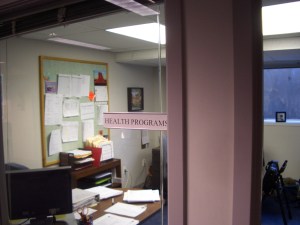
A translator enters Amelia Self’s office at the International Rescue Committee. She greets him while handing him a piece of paper. It is a form for the doctor to fill out during a refugee’s medical appointment.amelia-selfs-office

“Will you ask the doctor if he needs to make a follow-up appointment for when he finishes the prescription?” Self tells the translator. “Let me know and I’ll make the appointment, OK?”

Self, 28, is one of the health programs coordinators at the IRC in Salt Lake City. She is responsible for the health care of more than 400 refugees, coordinating their appointments with primary care physicians, specialists and dentists. Self must also make sure their appointments are scheduled with doctors who accept Medicaid, the insurance refugees are given for their first eight months here.

Trying to schedule their medical appointments during this eight-month time frame can be tricky. It can take as long as five months to get in to see a specialist, should a refugee need it. Then Self only has a three-month window to schedule any follow-up appointments.

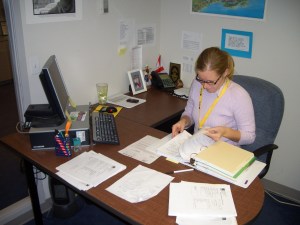
Amelia Self works at her desk at the IRC.

Amelia Self works at her desk at the IRC.

Self also has to make sure an interpreter is present for the appointments. These translators usually provide transportation for refugees to the doctor’s office as well.

“It’s pretty intense but it keeps us busy,” Self said.

The medical needs of refugees coming to the US vary greatly. Some have received medical care before their arrival; others may not have received proper medical care since birth.

Dr. Margaret Solomon, 37, specializes in internal medicine and pediatrics at the University of Utah Redwood Health Center. She sees refugees after their medical screenings and makes sure their children are in good health.

The Burmese and the Bhutanese have been in refugee camps for 10 to 20 years. Their health has not been monitored the way it should have been, Solomon said. People coming out of these camps usually need to be treated for things like malnutrition and skin rashes.

Self said refugees from Iraq are often treated for high blood pressure and trauma-inflicted injuries because a lot of them are torture survivors. These individuals are referred to the Utah Health and Human Rights Project, a nonprofit mental health agency.

Self sends her clients only to doctors who have worked with refugees in the past, or who have expressed interest in working with them so she can be sure they are getting the best care possible.

It also helps that these physicians want to be involved with refugees because appointments can be time consuming. Self said working through an interpreter and trying to get through all of the refugee’s concerns can turn a 15-minute appointment into 45 minutes.

Within 30 days of their arrival in America refugees need to have a medical screening, which is a basic physical examination. Doctors also check for any communicable diseases, the most common among refugees being tuberculosis, Hepatitis B and Guardia.

Translators are vital to the information gathering process. Through them the IRC coordinates with refugees and other care providers.

“We rely heavily on on-call medical interpreters,” Self said. “Most of them are former refugees themselves.” They must have a proficiency in English and their native language.

“We’ll assign them appointments and they will contact the family to make sure they know about it,” she said. Then interpreters report back to her any follow-up appointments.

Many refugees are sent to the Redwood clinic to see specialists such as gastroenterologists and cardiologists. Any specialists not on staff are just a phone call away and refugees are referred to them if necessary.

Many refugees speak very little English and the doctor’s office is full of medical terminology that can be difficult to understand. Solomon is grateful that translators are present during appointments.

“They’ll clue us in on some of the cultural things and other things refugees are worried about that we don’t think about,” Solomon said.

It can be difficult to find translators for some languages, Solomon said, but they make due with the help they can get.

She remembers an appointment with a patient from Sudan who spoke only her native tribal dialect. Solomon had to speak through an Arabic translator, who relayed the information to the patient’s son, who translated for his mother.

Solomon said it can be difficult to rely on translators to explain complex medicine instructions.

“It’s hard for me to know what is being translated to the patient,” she said.

Han Win, one of the IRC’s Burmese interpreters, has worked as an English translator for more than 14 years. He finds it challenging to accompany refugees to the doctor’s office.

Interpreter Han Win

Interpreter Han Win

Like most translators, Win must find words to explain what the doctor is trying to convey while gauging the refugee’s reaction and expounding upon anything they have difficulty understanding.

“If I said it directly the same words to them they don’t understand what it means. I have to explain that term in detail more than what the doctor said,” Win said.

Providing for refugees’ health needs can be a frustrating task, but also a rewarding one, Solomon believes.

“I really enjoy providing health care for refugees,” Solomon said. “I’ve been here [at the Redwood Health Center] three years and I’ve been seeing some of these families that whole time.”

For poverty-stricken Navajo Nation, a wrenching choice between development and the environment

by CHRIS MUMFORD

Elouise Brown stands at the edge of a rise in the middle of the New Mexico desert, pointing toward a barely distinguishable plot of land in the distance that has become the center of a battle in which her family and the entire Navajo Nation have become bitterly divided.

Brown is the head of Dooda Desert Rock (dooda means “no” in Navajo), an organization she formed to oppose the Desert Rock power plant that has been proposed for the nondescript stretch of earth a few miles away. She stands on the edge of the Dooda Desert Rock Camp, located an hour’s drive southwest of Farmington, N.M. 

The controversy over the plant is hardly new to the Navajo Nation and the broader Four Corners community of which it is part: The coal-fired facility would be the region’s third.

But this time things are different. This time the threat is not posed solely by outsiders who intend to plunder the area’s resources, offering a pittance in royalties for the mess they leave behind. Rather, the developers are members of Brown’s own family and tribe, acting with funds and official authorization from the Navajo Nation.

The company co-developing the project, Dine Power Authority (DPA), is an enterprise of the Navajo Nation. And the company’s general manager, Steven C. Begay, by dint of the complexities of Navajo clan structure, is considered Brown’s grandfather.

“He’s not in his right mind, I don’t think,” Brown said of Begay, noting that she treats him with customary familial respect but doesn’t receive the same treatment in return.

Taking a Stand

It’s the first day of Dooda Desert Rock’s (DDR) second annual four-day protest and Brown has returned from pointing out the construction site. She is now sitting in the camp’s central plywood shack, wearing a black Dooda Desert Rock T-shirt and a camouflage army jacket with her last name embroidered on the sleeve.

“We’re nothing to them, we’re nobody to them,” she says, speaking of DPA and its partner, Sithe Global. “They say we’re out in the middle of nowhere, but we don’t consider it the middle of nowhere.”

The walls of the shack are hung with news clippings and timelines that chronicle DDR’s efforts to kill the Desert Rock project. An illustration posted outside, near the entrance, depicts the plant in stark black, a skull and crossbones painted in red inside a column of noxious CO2 rising into the air.

“We don’t have a choice, we have to do this,” she says forcefully. “There’s nobody else doing this so we have to do it.”

But the involvement of DPA has added a unique wrinkle to the issue, one that has opened fault lines within Brown’s family and the broader Navajo Nation community.

With a 25 percent equity stake, the Navajo Nation Council could potentially generate desperately needed jobs and revenue for its 180,000 people, nearly half of whom are unemployed. Yet for Brown, whose activism has been central in stalling environmental approval for Desert Rock in court, the potential for economic benefits means little when the true costs are accounted for.

“It’s totally insignificant,” she said, in a telephone interview before the protest. “What’s more important, money or health?”

Health and the Environment

A passage from the invitation to the DDR protest makes plain Brown’s feelings about the involvement of the Navajo Nation’s government in the Desert Rock project: “Our Navajo leaders are forsaking Traditional Ways to take corporate money to poison our land, foul our air, and steal our waters. This abuse must STOP!”

By “Traditional Ways,” Brown explains that she means “care for everything and everybody.” She was raised by her parents, she says, to “take care of the whole cosmos.”

From the same vantage point where the Desert Rock site is visible, one can also see smoke billowing from the Four Corners power plant, leaving a brown-black streak along the horizon just above Farmington. And just a few miles east from there, barely beyond sight, is the San Juan power plant.

“The two combined are putting high levels of mercury particulates into the air and into the water, because they’re both using the San Juan River,” says Miles Lessen, a math coach for Navajo Nation schools who has lived in the nearby town of Shiprock for about a year, in an interview at the DDR protest. “So people who live down in Sanostee [a town west of Shiprock], this breaks my heart, they’re drinking the water from both plants that are coming through, so they’re getting a higher dosage than even I’m getting.”

For Brown, the health effects she believes were caused by this pollution catalyzed her efforts to block construction of a third coal-fired plant. 

“I’m not going to pinpoint this certain person with this certain ailment, but there’s a lot of cancer patients,” she says. “If you go to the cancer center in Farmington, there’s a lot of people. I’m not just speaking for the Navajo Nation, I’m speaking for all walks of life, all living species. There’s a lot of kids with asthma, respiratory problems of all sorts. There’s babies that were still-born. These don’t just happen constantly for no reason, there’ve got to be reasons behind it,” Brown continues, identifying chemicals, like mercury, released by the San Juan and Four Corners plants as the cause. 

“That’s how I got involved, I wanted to know ‘what can I do?'” she says.

Yet, when confronted with Brown’s dire claims, Desert Rock’s top officials react with a mixture of puzzlement and frustration.

“From a total impact standpoint, I think it’s going to get better before it gets worse. I don’t even see it getting worse, I just see it getting better,” said Nathan Plagens, vice president of Desert Rock LLC, in a telephone interview.

“We have an agreement with the Navajo Nation that for SO2 [sulfur dioxide], every time we emit, we will mitigate 110 percent by reducing SO2 emissions from another source,” he said in describing the first of a three-tier arrangement in which Desert Rock is contractually bound to reduce emissions not only from its own plant, but also from the two existing coal-fired facilities.

After SO2, Desert Rock has pledged to reduce nitrous oxide and acid rain using similar formulas at the contractually mandated second and third tiers respectively.

As for mercury, the plant wouldn’t use the San Juan River. Instead, its water would come from an aquifer located a mile below the surface of the land. And Desert Rock is classified as a non-discharge plant, meaning none of the water it uses will be re-released into the environment, Plagens said.

“The majority of the water that we’re using is basically for pollution control,” he said, with a hint of irony in his voice. “I don’t know where mercury can get in to come in contact with the water.”

But the real sticking point, from the standpoint of the courts and the Environmental Protection Agency, has been carbon dioxide (CO2) emissions. The gas is a major contributor to global warming, yet the EPA is not currently authorized to regulate it, according to Plagens. And a coalition of environmental groups, including DDR, has used the lack of CO2 regulations to appeal the EPA’s permit for the Desert Rock plant in court.

“The Environmental Appeals Board will say whether the EPA has to regulate CO2 permits,” said Plagens. “If they do have to regulate CO2, then a lot of things would be thrown on the table.”

At the DDR protest, Brown stresses the widespread consequences of allowing another coal-fired power plant to be built.

“Where are kids in their future generation going to go when the global warming gets worse? When there’s no more good air quality for them to breathe? What are they supposed to do?” she says.

And she’s not alone in her concern. “Unfortunately, every day, I’m losing my life expectancy. I eat healthy and I take care of myself, but I’m inhaling carcinogenic material,” Lessen says. “People down here, they’re getting it even worse.”

And while Sithe Global and DPA have promised to set aside funds generated by the plant to disassemble the facility and restore the environment after its resources are exhausted, there are currently no such plans for CO2 reduction.

Begay refers to the global warming claims of Brown and her associates as “nebulous.” “There are no rules the EPA can go by,” he said.

“It’s the same old garbage they’re coming up with that’s already been discussed,” he said.

The Promises

In forming DPA, the Navajo Nation set the standard for a broad paradigm shift currently taking place in Native American communities nationwide. Alongside tribes like the Crow and Blackfeet, the Navajo are pursuing a more active role in developing their own energy resources, including renewables like wind and solar in addition to traditional coal, oil and gas.

“The old-school is to lease the land, lease the resources,” said Begay, DPA’s general manager, in a telephone interview.

“We’re doing things under a new approach, with more participation and more equity,” he said.

Projections for the Desert Rock facility indicate that the equity Begay speaks of could translate into as much as $50 million in annual revenue for the Navajo Nation, whose yearly budget is $96 million, according to the 2000 census.

In testimony before the Committee on Indian Affairs on May 1, 2008, Begay emphasized the potential economic impact of the proposed plant.

“This project, which would create thousands of jobs during its four-year construction phase, 200 permanent, family-wage jobs in the power plant and another 200 well paying jobs in the adjacent Navajo mine during its lifespan, is absolutely critical to the economic future of the Navajo Nation, one of the most impoverished areas of the United States, with 50 percent unemployment,” he said, in a transcript of his testimony retrieved from the Department of the Interior’s Web site.

And, while already substantial, the revenues become all the more significant in the face of the potential closure of several plants that use Navajo-owned coal, which Desert Rock Vice President Plagens predicts could cost the Navajo Nation $40 million to $60 million per year in lost royalties.

The looming shortfall underscores the vagaries inherent in royalty schemes that have become a major force behind the push to take on a more active, management role in energy resource development.

“A lot of underhanded tactics have taken place in the past,” said Duane Matt, technology coordinator for the Office of Surface Mining, a division of the Department of the Interior. “I think [Native American tribes] need to have a personal, vested interest in what’s going on.”

In particular, Matt, who provides technology and training to Native American mining enterprises, referred to a recent lawsuit in which a Blackfoot woman sued the U.S. government for $47 billion in unpaid royalties.

Decided on Aug. 7, 2008, for 1 percent – $455 million – of the amount originally sought, the Cobell v. Kempthorne case exposed the flaws of the “old school” land-lease system of which Begay spoke. He said the case is partly responsible for a stipulation in agreements between DPA and Sithe Global requiring that all financial disputes be resolved in Navajo courts rather than in U.S. federal courts.

Royalty graft is likewise part of the checkered legacy left by the San Juan and Four Corners plants that has engendered deep mistrust among Brown and her supporters. But they remain unconvinced that the equity arrangement with Desert Rock will offer a significant improvement over the past.

“There were a lot of things promised that were not fulfilled – jobs, economic growth,” said Brown, adding later that the Navajo people would have to be “stupid to fall for this again.”

Miles Lessen, the math coach, points to inadequacies in the status quo to explain why he is pessimistic about the idea of things changing much under the Desert Rock model. “I think you talk to most people, stay around here for a while, talk to most people over in Sanostee and Shiprock and Gallup and all over and they’ll tell you there’s a lot of money that the tribe gets and most of the people here don’t see any of it,” he says.

Moreover, extravagant promises of economic development have a hollow ring to Brown and her supporters, who question whether the Navajo Nation will ultimately be able to raise the hundreds of millions of dollars necessary to purchase an equity stake in the project.

“If it’s projected as a 3.7-billion-dollar project and it’s not going to be built for another four or five years, I almost guarantee it’s going to be double that,” said Michael Eisenfeld, an environmentalist with the San Juan Citizens Alliance, an organization that opposes the plant.

“Where do they think they’re going to get the money for this?” he asked in a telephone interview.

Moved Yet Unmoved

At the Dooda Desert Rock Camp, Brown talks about being forced from her previous three protest campsites, which were located closer to the Desert Rock construction zone. Members of her own family even attempted to drive her off the current site, summoning grazing officials and Navajo rangers to expel her.

“We can’t trust anybody,” she says. “Everybody’s doing this for greed.”

For Brown and her supporters, who include major environmental groups like the Sierra Club in addition to concerned area residents, opposition to the plant is not a simple choice between economic rewards and environmental preservation. It is a rejection of the premise that money cures all ills and brings nothing but happiness.

“To me, money’s not everything,” Brown says. “Money can buy a lot of things, but when your relative’s going to die from cancer, you’re not going to take that money that you earned from the coal-burning power plant and go buy your relative back.”

Perhaps the most tragic fallacy of all, she says, is the notion that people can no longer live without the comforts of modern technology.

“We’ve done without electricity coming into our house, we’re doing fine,” she says. “We live as good as any of you, anybody out there. We’re living as well as DPA does, or Sithe. And we may be hauling water; I don’t see any faucet in here, do you? They don’t need it either, they’re just lazy.”

Latin dancing has style and flavor

by KASSIDY MATHER

Looking for something to spice up a boring Saturday night?

“Salsa can be spicy, or not so much. There are a lot of flavors,” says Latin dance instructor Victor Mosquera. Mosquera has been teaching Latin dancing at Studio 600 for about six months and loves every minute of it.

Studio 600 is a non-smoking, alcohol-free dance club at 26 East and 600 South in Salt Lake City. It features Latin dancing on Saturday nights from 9 p.m. to 1:30 a.m. The first hour is dedicated to dance lessons, then dancers get to try out what they’ve learned.

Mosquera, who along with teaching is in charge of the Latin dancing instructors, teaches a mix of beginning Merengue, Bachata, Cumbia and Cha-Cha-Cha, but Salsa is his favorite. “Salsa is unique. There are so many stylings in Salsa,” he said. “Salsa is my life.”

Born in Cuenca, Ecuador, Mosquera started Latin dancing about three years ago. A friend recommended dancing when Mosquera became depressed after his five-year marriage ended. “It made my self-esteem go up,” he said. Mosquera taught Latin dancing lessons at Salsa Chocolate (cho-co-la-tay) in Provo for a year prior to coming to Studio 600.

“When you are dancing, your whole brain is working,” says Mosquera.test He went on to explain that when you’re talking, you’re only using half of your brain, but when you’re dancing or doing some kind of sport, your whole brain is working. Listening to the music and planning what you’re going to do next really requires concentration. “That’s what makes you feel good out there,” he said.

Yony Lopez agrees. He and his wife, Eagan, come to Studio 600 every Saturday to Latin dance. They enjoy the clean, conservative atmosphere. “Latin music is super fun,” he said. He said Latin dancing is a hard way to move your body, so it’s a good way to lose a lot of weight.

Salsa music has a fast beat, it is loud and happy. It usually features a strong percussion section, with instruments like claves, cowbells, timbales and the conga. Other instruments include trumpets, trombones and bass. Guitar and piano can be used as accompaniment. According to Mosquera, salsa bands can have 12 to 18 people playing, which makes it special.

“In our culture, the way we meet girls and guys is dancing,” says Lopez, who was born and raised in Guatemala.

Lopez thinks that the club attracts a lot of Latino people because the variety of styles draws an assortment of different people and languages. “All kinds of people [come] from different backgrounds and countries,” he said. Merengue and Bachata are popular in the Dominican Republic, Cumbia originates from Colombia and Cha-Cha-Cha is Cuban. Salsa, he explained, is from all over, including Cuba, Puerto Rico and Colombia.

But Studio 600 has more than just Latin dancing. Tuesday and Thursday nights are dedicated to country dancing; Wednesday is Reggae and 80s night and Friday features Top-40 music. Plus, there are three separate dance floors, each featuring a different style each night, and even a room with karaoke and pool tables. There really is something for everyone, every night.

Steve Ames, the founder and owner of Studio 600, mixes up the styles to attract the mainstream crowd and make it more diverse. “It kind of hit me last week when we started this reggae floor and it really has attracted the Polynesian crowd,” Ames said. “I just got thinking about it, and … we really cater to all the ethnicities, the larger ethnic groups in the city and state. We have something for everyone, for the most part.”

Ames has worked hard to expand the club into what it is today. He began with a small group at Trolley Square, where he held country dancing Tuesdays and Thursdays, Top-40 on Fridays and Latin dancing on Saturdays.

The crowds have grown slowly and steadily. After almost eight years, the group had outgrown the original Trolley Square location, and his lease was up, so Ames had to find somewhere else to go. He had passed the old building on 26 East and 600 South for years and never noticed it. “When I needed a place there was a for lease sign on the building,” Ames said.

He made a deal with the owner and went to work. The building was originally built in the 1940s and Ames put $1.2 million into renovations. The process from the time he signed the lease to the day the doors opened took three years.

The move has proved beneficial. “Latin night at Trolley Square used to be about 200 people,” Ames said. “Now we’re over 800 to 900 every single Saturday.”

The club hosts about 2,000 dancers a week. The most popular nights are Thursdays and Saturdays, although once a month larger parties are held which attract a good sized crowd. These parties are usually held on a Friday and include New Year’s Eve, Valentine’s Day, St. Patrick’s Day and an End-of-Summer party.

The club also hosts a disc jockey every night and often has live performances by up-and-coming local artists. The entrance line is usually stretches to the street, but it moves quickly and is worth the wait.

Studio 600 is one-of-a-kind. The environment attracts people who just want to dance. “It fits the community, you know, a large base of the community,” Ames explained. “You have literally hundreds of bars and nightclubs that serve alcohol,” he said. “We cater to a different crowd.”

Ames went on to say that compared to other nearby nightclubs, Studio 600 has a more conservative crowd, and offers a greater variety of dancing styles. Plus, he bragged, “You could put four of their clubs inside of our club.”

Mosquera agrees. “I think there’s no other place to go,” he said. “Here, you come for dancing.”

Beginners and experienced dancers alike can enjoy this club; few places offer to teach dance lessons before the crowds come. Even Mosquera takes lessons to learn new moves, often traveling to Los Angeles, New York and Las Vegas to learn the latest techniques. When he returns he shares them with the dancers at the club.

Mosquera plans to finish the year teaching at Studio 600, but after that will probably move on. “I always like to move forward,” he said. His two children have kept him in Utah for now, but he likes to compete and is considering going to Los Angeles to take part in the salsa congress there.

A salsa congress is a meeting of professional and beginner dancers to enjoy and learn about the evolving dance. The meetings include shows, workshops, live bands, master classes and competitions. Congresses can be found throughout the world.

Stop by Studio 600 and experience the fun for yourself. Country lessons are taught from 8 to 9 p.m. Tuesday, Thursday and Friday, and Latin lessons from 9 to 10 p.m. Saturday. The earlier you go, the lower the entrance fee, which ranges from $4 to $10. Once the lessons end, the open dancing begins.

Niños on skis

by ERIK DAENITZ

Twelve years ago the Rev. Bob Bussen, pastor of Saint Mary’s of the Assumption Parish in Park City, Utah, saw a divide in the community.

“I noticed that we had challenges in Park City embracing our diversity,” Bussen said. “I challenged the city that we needed to find ways to build bridges, noticing that I needed to do that as well.”

The result of Bussen’s challenge was the Niños on Skis program, which he envisioned as a way for Hispanic and non-Hispanic families and children to come together while having fun skiing.

The success of the program is due in part to the efforts of sponsor families who agree to ski with children who otherwise might not be able to enjoy the slopes of Park City.

In addition, Park City Mountain Resort, Aloha Ski and Snowboard Rental, and St. Mary’s provide equipment and services that make skiing free for children who participate.

Normally, a youth day ticket at the resort costs $50 while passes for Utah students between ages seven to 17 range from $175 to $225. However, the resort’s involvement with the Niños program lifts this burden.

“Park City Mountain Resort has just been fabulous because they give all our kids free passes and make it possible to do everything,” Bussen said. “Aloha we just kind of got to know and they got involved, too. St. Mary’s provides clothes through the St. Lawrence thrift store in Heber City.”

However, these opportunities did not always exist, and it has taken some effort to get the program where it is today.

“We live in this world-class resort and have many Hispanic families here,” said Ernest Oriente, the Niños on Skis program director. “Many of them were going back and forth to work or school every day looking up at these amazing mountains but never getting to experience them.”

Oriente became involved in the program 10 years ago after reading about it in a church bulletin. With Puerto Rican heritage on his mother’s side of his family, Oriente identifies with diversity and the need to extend opportunities to all.

“We must remember that we are a nation of immigrants,” Oriente said. “We are a melting pot of cultures.”

Starting out with eight children, the Niños program has consistently grown under Oriente’s direction. This year 51 boys and girls participated.

“Ernest and Father Bob collaborated on the program,” said Garrett Glenn, a Park City High School student who volunteers with the program. “Ernest is the director and does a lot of the work, and Father Bob is there to provide support.”

Niños on Skis enables children with minimal or no ski experience to eventually ski some of the most challenging terrain at the resort, such as runs off the Jupiter lift, which services black and double black diamond terrain.

“My favorite part of the mountain is King Con, but I’ve been up to Jupiter too,” said Martin Heredia, 9, who began learning to ski with the program two years ago.

The ability of new participants to rapidly improve their skills is due mainly to the structure of the program.

During the first three Saturdays of December, sponsor families pick up the children and bring them to the resort by 9 a.m. Half an hour later children are grouped based on skill level and experience with ski instructors who teach the children until noon.

After the free lessons, all of the children, instructors, and sponsor families converge at the bottom of the Payday lift and head to lunch at the resort center.

“It’s not unusual that lunch will run over $1,000,” Oriente said. “Lunch is paid for by St. Mary’s church and wonderful donations that are given to us by the community.”

When participants are filled up and warmed up, the sponsors take the children back out if they want to continue skiing into the afternoon.

“After the first three Saturdays it’s ski whenever you want and as much as you want with the children,” Oriente said. “The kids I have now, we’ve skied over 15 times with them already.”

Also, many times a boy or girl will be paired with a sponsor who is in middle school or high school, fostering new friendships.

Jessica Murphy, a 9th-grade student at Treasure Mountain International School, skis with Oladyd Angeles, a 2nd-grade student at Trailside Elementary School.

The two ski together throughout the season and Murphy further aids Angeles in learning better technique.

“I usually go in front and she follows,” Murphy said.

Angeles, who has lived in Park City her whole life, said she likes the mountains and that her favorite part of the program is getting to ski.

Another pair who ski together is the duo of high school student Garret Glenn and Martin Heredia, a 4th-grade student at McPolin Elementary School.

“I like the big jumps,” said Heredia, when discussing his favorite part of skiing. “But I’ve made friends, too.”

When skiing together, Glenn said he prefers to let Heredia lead as he watches from behind to make sure Heredia is OK.

“It’s a good program,” Glenn said. “I like to be able to ski with him and help him out, help him get a little more practice and experience.”

Although he is only 9, Heredia already has a plan for his skiing future.

“When I am older I will teach other people to ski, too,” he said.

These examples of service and friendship illustrate that the program is about much more than just skiing.

“In my opinion this program has gone on to become the most interconnected relationship between the Hispanic and non-Hispanic community that exists in Park City,” Oriente said. “This is more than a cursory event. This can be a 12-month relationship, an ongoing relationship that takes many shapes and forms.”

While the Niños program fosters these connections, St. Mary’s is behind other efforts to improve integration.

“We have Spanish masses, but we also have a bilingual mass that we do during Lent and Holy Week,” Bussen said.

He also said he has seen improvements in the school systems, healthcare services and with other programs such as the Big Brothers and Big Sisters program, the Boy’s and Girl’s Club and the tennis program that St. Mary’s helps run.

In fact, the children who participate in Niños on Skis can segue straight into St. Mary’s tennis program, Oriente said. It provides another opportunity for interaction and learning by allowing boys and girls to transfer from a winter sport to a summer sport.

It seems that the divide that once existed in Park City is being joined.

“You keep making steps, you keep making strides,” Oriente said. ” I don’t know about the rest of Utah, but I know that in my own world in Park City we care. In the Niños program we can’t touch 10,000 lives, but I know we can touch the lives of 51 children, and that for me means a lot. I know that in some small way we are making a contribution.”

‘Goodtime’ for a good cause

by ERIC WATSON

Unlike many bowling leagues that attract members by offering big prize money, Goodtime Bowling League in Salt Lake City offers members a chance to bowl each week for a charitable cause.

Dean White, owner of Bonwood Bowl in South Salt Lake, said the Goodtime league has been making donations to various charities since they began bowling at his establishment in 1990.

“They’re a very charitable bunch,” White said.  “We get thank you notes all the time from places they donate to.”

Goodtime donates roughly $1,500 spread out over approximately six different charities each year, but as membership numbers continue growing, donations are becoming more plentiful.

Goodtime has grown from 14 to 24 teams since last year alone, according to league president Nate Christensen.  “My goal from last year to this year was to build the league,” Christensen said.  “We added 10 teams.  It was phenomenal.”

The league is up to 96 bowlers, which Christensen said directly connects to the $1,700 in donations so far this year.

Goodtime has donated to the Ronald McDonald House, Huntsman Cancer Institute, Utah AIDS Foundation and the Utah Pride Center this year.  Also, a donation was made to the family of a Bonwood Bowl employee who died in a traffic accident in 2007.

Some people assume that, since Goodtime is a lesbian, gay, bisexual and transgender bowling league, donations are strictly made toward LGBT organizations, but Christensen said that is not the case.

“Every bowler has a vote for which charities they would like to donate to each year,” Christensen said.  “The majority of our charities are not LGBT affiliates.”

The majority of the donations are collected from membership fees and various buy-in tournaments that Goodtime organizes.  The types of tournaments vary from week to week, but the charity theme remains the same. 

One example of a tournament called “strike it rich” gives bowlers a chance to win some money while still making a contribution.  The amount of winnings change each week depending on how many players buy-in, and the winner receives half the pot while the other half goes towards charity.

“If the pot is $100,” Christensen said, “$50 goes to charity.  A few weeks ago the pot was $180.”

Christensen explained that Goodtime does not simply “cut a check to each charity and say ‘see ya next year.’”  Goodtime contacts each charity individually to explain who they are and what they are doing in the community.

“I explain that we are a lesbian, gay, bisexual and transgender bowling league that is doing something good in our community,” Christensen said.  “We are individuals, and we do care.”

Goodtime has been a part of the International Gay Bowling Organization since the IGBO was founded in 1980.  Back then, Goodtime bowled at the University of Utah.

IGBO hosts prize tournaments for LGBT leagues all across the nation. Salt Lake Goodtime has hosted two IGBO tournaments, but Christensen said it did not turn out as well as he had hoped.

“[IGBO] wasn’t as successful as it could’ve been,” Christensen said.  “I have gone [to an IGBO tourney] in Orange County and it was an amazing turnout.”

In order to be a part of IGBO, Goodtime pays the organization $150 per year, giving Goodtime members the option to attend any IGBO tournaments nationwide.  Dallas, Texas will host the next national IGBO tournament this year, according to Christensen.

To ensure Goodtime remains successful each year, Christensen explained that the league tries to create a fun atmosphere for the bowlers while keeping charity at the forefront of the league’s agenda.

Recognizing Goodtime’s charitable donations, White recently wrote a letter to the Goodtime league expressing the importance of what they do for the community each and every bowling season.

“They get very little publicity,” White said, “but they’re not after publicity, and they’re never pretentious about their donations.”  He continued to say that not many people realize how much Goodtime is contributing to the community every year. 

White said that Goodtime, like many bowling leagues at Bonwood, hold a “turkey shoot” during Thanksgiving, where each team has a chance to win a turkey, “but instead of keeping their turkeys, 10 individuals from [Goodtime] donated to the food bank,” he said. 

 “I do their in-house banking,” White said, “so I know what they do with their prize money.  They keep very little for themselves.  They buy trophies once a year, and that’s about it.”

According to league member and former Goodtime secretary Chad Hall, 33, the league was at its largest during the 1995 to 1996 season, with 36 registered teams.

“Scheduling 36 teams for one night was tough,” Hall said.  “Twenty-four teams is probably our limit.”

Christensen said the league still has room to grow, but admitted adding too many teams might cause problems.  “I would feel comfortable having 28 teams,” Christensen said.  “As president, I would like to see the league stay within two-thirds of the lanes at Bonwood.”

Keeping a few extra lanes open gives the public an opportunity to experience what the league is all about, Christiansen said, and having too many teams could make the league feel impersonal.

Goodtime is open to anyone to join.  The league currently has members of all ages and sexual orientations.

Although Goodtime bowlers come and go, Christensen said he has bowlers that have been with the league over 10 years.  He estimates that 60 percent of the league changes from year to year, but he and former president Scott Mallar have added stability to a once shaky bowling league.

“We’ve gone through some growing pains,” Christensen said.  “[Mallar] did a great job of building up consistency within the league.  My goal is to keep it consistent and fun.”