Proud to be a Vietnamese nail technician

Story and multimedia by KENDRA WILMARTH

Tour the Sparkling Spa & Nails salon in Centerville

In a small town on a small corner lies a small nail salon where you will find the Ly family. Tuan, the father, sits across from a younger woman working on a manicure. He sits quietly with his head bowed, humming his favorite melody. Lien, his wife, sits two tables away, facing a new client as the two try to carry on a conversation.

“It’s a family business,” said Tien Ly, a son of the owners and an employee of Sparkling Spa & Nails salon, located at 274 E. Pages Lane in Centerville.

Although patrons of this nail salon know why Tuan hums and why the word “try” is used when speaking of Lien’s communication activities, neither of them speak English well.

“I will usually translate things for them,” Tien said. “Sometimes it can be difficult and frustrating for my parents to speak with clients so they usually just smile.”

Tien characterizes his parents as traditional Vietnamese people, strict. As a child growing up in West Valley City, he had to follow rigid rules. But now, Tien said his parents have become more relaxed.

“They are more Americanized now, like me,” Tien said. “They work in this business every day talking and listening to women who help them learn more about culture here.”

Tien Ly

Tien Ly

Nail salons are commonly known for being Vietnamese-operated. According to vietSalon Magazine, about 24,000 salons are owned and staffed by Vietnamese salon professionals. That number represents about 40 percent of the nationwide total.

Tien says the reason why Vietnamese individuals are seen more often in the beauty world is because of their judgmental history.

“We want everything to be perfect, so if we go into beauty field we can make everyone beautiful,” Tien said.

However, Tien has been negatively stereotyped for being a Vietnamese nail technician. Comedians — as well as some of his friends — have made jabs at Vietnamese-Americans for owning so many nail salons. However, Tien doesn’t take it personally. In fact, he likes to joke back with people.

“People who don’t know me say things like, ‘Well, if you’re Vietnamese then your mom must own a beauty salon,’ and I say, ‘Yes she does, and I work there too,’” Tien said. “Then people usually become embarrassed.”

Tien wasn’t always interested in the beauty industry. In truth, he thought the business was “girly” and wanted nothing to do with it. He said when the salon first opened he wouldn’t even come into the shop because he was uncomfortable. But when he was laid off from his last job, Tien asked to join the family business in 2008. His mother paid for him to attend a Vietnamese nail technician school, the same school she attended when getting her license. Now, Tien says he doesn’t mind working in the beauty realm.

“My dad works here too, so why should I be embarrassed?” Tien said. “We work hard, do a good job, and I’ve learned a lot about business.”

Life before the salon

Tien Ly, now 22, immigrated to America with his family when he was 4 years old. He was born in Vietnam; his extended family remains there.

“Back then houses were like shacks,” Tien said. “You get those banana leaves and put them together and if the wind blows, well there goes your house …. My parents were very poor.”

His mother, Lien, was born into poverty. She was one of eight children in her family. Her nights consisted of a hungry stomach and tears running down her face as she wished for a larger dinner.

“No money, no food, no nothing,” Lien said.

She married Tuan when, as a teenager, she became pregnant with their first child. After Tien, their second child, was born, the couple decided to look for better job opportunities in the United States. A Catholic charity sponsored the young family and helped them leave Vietnam and move to Utah. The program helped Tuan learn to speak some English and assisted him with finding a job.

Tuan worked for a corporation that sold ATMs to banks around the world, but he was let go when the recession hit. He joined Lien at the salon in 2007, but says he wants to get out.

“You know America we pay a lot of bills right, make money that’s why I do nails right now,” Tuan said.

He says the nail business isn’t for him, but rather a way to provide for his family. Tuan doesn’t like the feeling of being ordered around by women. He says clients can be demanding, even rude in some cases.

Lien had worked in the nail business for five years before she opened Sparkling Spa & Nails salon in 2005. She joined the beauty world because finding work elsewhere was too difficult. Lien had struggled at many different salons due to bosses who took advantage of their employees or work environments that weren’t right for her. Lien finally decided it was time to start her own business.

“Nail salon open because of opportunity,” Lien said. “Everyone want beauty and I’m my own boss now, no one tell me what to do.”

The beauty business hasn’t been easy, however. During their first year, Lien debated closing the salon because customers were few. But business picked up during the second year. Three to four customers stopped in daily, and Lien soon learned that the key to owning a successful salon was keeping customers happy so they keep coming back.

Now, the Ly family barely has enough time to sleep. The salon is open eight hours a day, six days a week and closed very few holidays. Tien says that most days they put in about 10 hours of work. Tuan jokes about not keeping track of his hours anymore.

“Most people don’t think this work hard, but we have trouble every day,” Tuan said. “We work hard because we want to be successful here in America.”

Ogden’s Japantown disappears

Story and multimedia by TAUNA LYNNE PRICE

Listen to Raymond Uno narrate a mini-documentary about Japantown


The world came to Ogden, Utah, with the completion of the Union Station Depot for the railroad in 1850. A few decades later, in the late 1800s, the Japanese people began migrating. The Union Pacific Railroad brought in hundreds of railroad workers, and many of them were Japanese, according to Hub Tours, which has dedicated a page on the Web site to Ogden Japantown Day of Remembrance.

They began building their own businesses close to the Union Station and 25th Street. They began replacing the cheap restaurants, beer and gambling halls and the reoccurring red-light district and reinventing the area, according to the site.

Raymond Uno was born in Ogden and raised on 25th Street. Both parents came from Japan, making him a Nisei, or a first-generation Japanese American.

The concentrated area in Ogden that soon became known as Japantown was 25th Street to 24th Street and Grant Avenue to Lincoln. Most of the Japanese Americans lived around or on 25th Street, Uno recalled.

Uno witnessed first-hand the growth of Japantown on 25th Street and saw his people develop into a community and thrive as a culture. He recalled the many businesses that were established during his childhood.

A hospital, staffed with Japanese doctors, was established for strictly Japanese railroad workers. No safety regulation existed during this time, therefore injuries were common, Uno said. The hospital stayed open for a number of years while the Japanese railroad workers were still active.

Merchant owners began opening their own shops, which included restaurants, a barbershop, fish market and cafés. The first Japanese dentist had an office on 25th Street and Grant Ave on the second floor of the building. The Japanese Association was established to assist people with problems and eventually a Japanese school opened up adjacent to the Japanese Association, Uno said.

A men’s boarding house opened up. Rooms were available to single men; it was a place for them to stay, be surrounded by their culture and eat Japanese food.

In February 1942, President Roosevelt signed Executive Order 9066 and an influx of Japanese from the West Coast flooded Utah by the hundreds to avoid internment.

According to an article in the Utah Humanities Council Newsletter, “Not all Japanese citizens in Ogden welcomed this influx of people, suddenly competing for jobs and housing.” But in time, they too became contributing members of this community, eventually taking part in the establishment and growth of Japantown.

The Japanese had a language barrier, a religious barrier, a cultural barrier and most of all a racial barrier, and all these worked against them, Uno said. Those who originally moved to Ogden stayed in Ogden for some time. But the business opportunities were slipping away.

Unlike the tradition of taking over the family business, parents pushed their children to want better than they had, through education, said Marion Hori, creator of a photo display for the Japantown Reunion in Ogden, in a phone interview. Hori is also involved with her culture and community in preserving the history of Japantown.

“One of the things the Japanese always did, was they stressed education. They wanted the kids to go to school. They didn’t want them to go through the same things they went through when they became immigrants…. [They] had to fight for everything that they got,” said Uno, who was the first minority to sit on Utah’s Third Judicial District Court.

Uno said these families owned the barbershops, beauty parlors, restaurants and shops. They farmed and worked at Hill Field. As the children grew up, job opportunities for Ogden’s graduates were scarce. As the children migrated away, Japantown began to disappear, Uno recalled.

“From the heydays of 1940 to about 1948, there were a lot of Japanese in the community and things were pretty active,” Uno said. “The churches were active and everything. And from that time on, things have slowly diminished, because people like myself, after graduating out of Weber College in ’52 migrated to Salt Lake City.”

Uno added, “As the Japanese progressed economically, the housing market opened up. The restrictions of the racial covenants that prohibited people from living in certain areas were stricken down, so the Japanese were able to move into other areas. … The Japanese community just disintegrated along with the businesses because people quit coming to 25th Street and living on 25th Street,” Uno said.

American dream true for Utah woman who went from poverty to community leader

Eunice Jones speaks with University of Utah journalism students about her life.

Story and photo by DANA IGO

As a child growing up poor in the Philippines, Eunice Jones paid for school supplies by selling fried dough rolled in sugar to the local townspeople.

Now Jones, 51, sells properties as an associate broker of a Re/Max Masters franchise in Salt Lake City.

How she moved from living in a hut in a seaside village to living in Utah as a distinguished member of the community is a true story of success that begins at her roots.

“My parents always told us that they could not give us anything but education,” Jones said.

As the seventh of 11 children, she was used to feeling hungry and going to school barefoot. Her family’s home had no electricity or running water and she often did school work by the dim light of a gas lamp. Yet her parents made sure she and her siblings studied hard and went to school every day.

Her parents’ strong emphasis on education pushed Jones to excel and in 1980 she graduated in the top-10 of her class at the University of Manila with a degree in marketing.

In 1986 she was offered an opportunity to work in the United States as a catering manager at the former Hyatt Wilshire in Los Angeles.

Jones, a single mother, had to leave her sons, Thomas, 2, and Andrew, 2 months, with her mother and sister in order to move to the U.S.

Even though she had to part with her children, the chance to come to America was something she couldn’t refuse. With the help of her friends and family, she scraped together the money for airfare and got on a plane to California.

“I only had a suitcase, $50 in my pocket and a dream of a better life,” Jones said about her arrival in the U.S.

Los Angeles was like nothing she’d experienced before. She saw a washing machine for the first time. Her friend’s mother had to help her figure out how to use it and it didn’t turn out well – ­ all of her clothes shrank. Until she got her first paycheck, Jones had to borrow everything from friends.

She moved to Las Vegas to work at the Las Vegas Hilton in 1989. It was there that she felt secure enough in her job and situation that she obtained visas to bring her sons from the Philippines to join her.

In 1995 Jones remarried and moved to Utah with her new husband and children. She was hired by the Salt Lake City Hilton, but the work wasn’t challenging so she took real estate classes at night in order to switch careers. A year later she received the Better Homes & Gardens Rookie of the Year award. She opened her own Re/Max franchise in 2003.

When she and her husband divorced in 2009 she sold her franchise to Re/MAX Masters, where she now works as an associate broker.

Aside from real estate, Jones also devoted considerable time and energy to the Asian community of Utah.

She is a leader in the Utah Filipino community and organizes the Utah Asian Festival. In 2005 Jones and Judge Raymond Uno founded the Utah Asian Chamber of Commerce, which helps bring Asian businesses together throughout the state. Jones is also head of the Asian Advisory Council, which is a part of the Utah Office of Ethnic Affairs.

Jones’ story is a testament to the American dream and she has no regrets about coming to the U.S.

“My lifestyle [in the Philippines] was not as free as it is now,” she said.

Her son, Andrew “A.J.” Jones, 24, feels the same way. He has visited the Philippines twice with his mother and says it was a humbling experience.

“It was definitely a culture shock for me to see 12 people living in a small home, or in their shop/home on the side of the road,” he said.

A.J., who is currently working on a bachelor’s degree in education at the University of Utah, also attributes who he is today to his mother. In high school, when he wanted to play sports, his mother would tell him grades came first. Now he balances sports and school as a Little League coach at Olympus High School. He says his mother set the example for making education his focus.

“She has taught me to be very passionate and to want something,” he said. “She wanted a better life for us and she knew this was the only way.”

Catholic Community Services helps refugees in Utah

by LAUREN CARTER

Approximately 1,000 Asian refugees take solace in Utah every year, according to the State of Utah Refugee Office. Most of these refugees come from Third World Countries, and have lived in refugee camps for the majority of their lives.

The majority of these people were driven from their homes because they did not support the ruling class that was currently in power. Some refugees are from the formal ruling class and ended up living in camps because their group was thrown from power, said Linda Oda, the director of Asian Affairs in Utah.

According to the State Department’s Foreign Affairs Manual, all refugees go through a several year process before being allowed to come live in the U.S. This process involves the work of the United Nations High Commissioner for Refugees and the Department of State’s Bureau for Population, Refugees and Migration.

It usually takes about three to four generations for a refugee family to become in tune with the American way, Oda said. This transition involves learning English, taking life skills classes, learning American culture and establishing a life in the U.S.

Since 1945, the Catholic Community Services of Utah, has been helping refugee families throughout the first year of their lives in Utah.

“Utah is considered a welcoming state because we have organizations that truly advocate refugees,” Oda said.

When a refugee is relocated to Utah, their case is assigned to CCS or the International Rescue Committee. CCS and IRC are the only two agencies in the state of Utah that are allowed to handle refugee resettlements, said Rebecca Van Maren, the former assistant volunteer coordinator for CCS who also worked with Bhutanese refugees.

CCS’s work begins before the refugee or their family arrives in Utah. CCS finds out information about the family to arrange housing for the family. This information involves knowing the number of people within the family, and if they have any children, knowing the ages and gender of the children. CCS makes sure that the house is ready for the family to move in upon arrival, including fully furnishing the entire house, Van Maren said.

Van Maren said when refugees arrive, CCS sends a case manager to greet them at the airport. From the airport, the case manager then helps the refugee and their family get settled into their new housing. The refugee’s case manager’s job is to help the refugee and their family adapt to American life, and are available for the first year that the refugee is living in the U.S.

“Their case manager is primarily the person who is explaining the services that CCS provides,” Van Maren said.

CCS’s goal is to help the refugees and their families reach a state of self-sufficiency in Utah. This goal is achieved through taking classes, creating a stable life within the community and with the help of their case manager. A case manager’s help can range from signing the refugee up for classes, to explaining how to shop at a grocery store.

One of the biggest difficulties that refugees face is not being able to speak or understand English. CCS can find education classes that teach people who are 90 years old, down to small children the English language, Oda said.

“Without English these people will never get anywhere,” said Maung Maung, an Asian Advisory Council member in Salt Lake City.

CCS offers life skills classes that refugees can take. They also can coordinate volunteers and interns to mentor and visit with the families. These mentors can go to the refugee’s home to teach them basic life skills, as well.

CCS has job developers, who will work with the refugee’s case manager, to find employment for the refugee. These job developers can also help refugees write resumes in English, because a lot of CCS employees speak multiple languages, such as Vietnamese and Mandarin Chinese.

They also offer a refugee foster care program for children. This program provides guardians until the child’s family can be found or until the child reaches 18 years of age.

CCS occasionally works in conjunction with other agencies in Salt Lake to provide opportunities for people from other countries, Van Maren said. Over the summer, CCS provided filing work for Koreans who were here for a three-month language learning internship, she said.

They also offer an array of assistance programs, which include help with immigration status, substance abuse treatment facilities and many facilities to help provide basic services and goods to low-income and homeless individuals all across Utah.

Educating the community about Filipino culture through dance

Story by RICH FAHEY

Filipino children in the Salt Lake Valley are getting involved in a new dance group as a way to help maintain tradition. Kulturang Pinoy Ensemble, or Filipino culture ensemble, gives Filipino youngsters the opportunity to learn traditional dances, and educates the community about the culture as well.

“We have a lot of young Filipinos growing up here, and we’d like for them to learn their culture,” said Teena Jensen, vice president of the Kulturang Pinoy Ensemble, in a phone interview. “It’s also a way to keep them out of trouble.”

The ensemble was developed at the end of August 2010 when some Filipino families became concerned that their children were losing their heritage. Jensen was a dancer in a similar Salt Lake City program that discontinued performances in 1998. The group’s main focus was to educate others about Filipino culture. While the new ensemble is following in their footsteps, it is a learning tool for both the audience and performers.

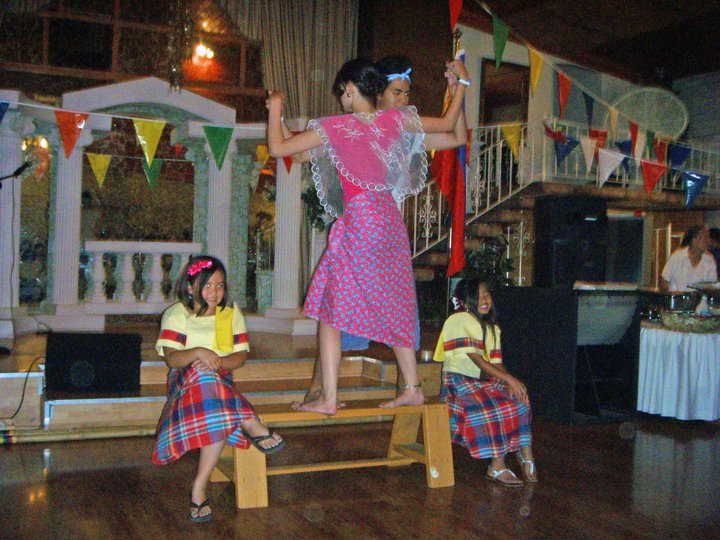
Dancers performing Sayaw sa Bangko, or the bench dance, at the fundraiser. Photo courtesy of Teena Jensen.

The Kulturang Pinoy Ensemble currently consists of 10 children between the ages of 13 and 18. The first performance was held on the evening of Sept. 11, 2010, during a fundraiser to raise money for costumes and props. The girls will wear a balintawak, which is a long dress with butterfly sleeves and a brightly colored overskirt that matches the sleeves. The boys will wear a chino, or brightly colored shirt. When the children outgrow them, plans are in place to pass the costumes down to younger children in hopes of getting more people involved in the ensemble.

Jensen said the program has seen a lot of interest from parents and children alike. When fully developed, the ensemble will have children as young as 5 years old dancing with the group.

“The younger ones come out and watch their brothers and sisters and say, ‘when are we going to start dancing,’” Jensen said.

However, it’s not just about the dancing. The ensemble also encourages the youngsters to learn the Filipino language. During each practice and performance, the children are given a Filipino word of the day. The group includes children who are from the Philippines, as well as those born here. The interaction between them is good for both groups, especially those learning the Pinoy language, Jensen said.

“It’s also learning respect from other Filipino children,” she said. “In the Philippines they respect their parents more than some of the children here do.”

The Philippines are made up of more than 7,000 islands, which creates diversity between the various areas. Jensen said each island has a unique dialect and is like a totally different culture. These different cultures allow for variety in the dances. Each dance has its own meaning and represents a story. Every performance is divided into suites that feature a dance native to a particular area or Filipino culture.

In an e-mail interview, Jensen said one dance suite the ensemble will perform is the Barrio Fiesta Suite. This is comprised of four different dances. The first is the Pista, which displays the lavish preparation for a party. Next is the Gala, also known as the Boholano. This dance comes alive with the clashing of pans, pots, plates, ladles and brooms with firewood, pails and knives to represent a wedding. The third dance is the Kalatong, a popular dance from the province of Batangas that uses bamboo percussion tubes. The finale, and perhaps the most well known of all Filipino dances, is the Tinikling, named after the Tikling bird. For this part the dancers imitate the bird as it avoids traps set by farmers.

The ensemble plans to perform the Barrio Fiesta Suite and others at schools, churches, fundraisers and any time the opportunity presents itself. However, the ultimate goal is to dance at the Living Traditions Festival in May and the Utah Asian Festival in June.

“That’s one of the main reasons for the ensemble, because people were asking – how come there are no Filipino groups performing at these events?” Jensen said.

Eunice Jones, president of the Kulturang Pinoy Ensemble and chairwoman of the Utah Asian Festival, said, “It’s not going to be just a dance group for one organization. It has to be for the whole community.”

Both Jensen and Jones are excited to share the Filipino culture with the community through the Kulturang Pinoy Ensemble.

Nepalis work hard to keep their culture alive in Utah

Story and photo by KENDRA WILMARTH

Imagine you are in a store. Casually running your hands along various items, looking for something that grabs your attention. Wishing you could find apparent character in a product, something different from the same old mass-produced item you saw at your neighbor’s house on Tuesday. For Salt Lake County residents, stores are starting to fill their shelves with something a little more unique.

Artisans from all over the world are working hard right here in Salt Lake City to provide the local consumer with products such as gloves, necklaces, scarves, blankets and handbags.

Many of these artists are refugees who have come from countries around the globe, such as Somalia, Burma and Nepal. They left their homes due to the dangers of war and moved to refugee camps. Now they have found refuge here in Utah.

The Global Artisans program was created by Salt Lake County to assist these refugees in countless ways and to also help ease their transition to a new way of life. The program was founded in 2008 and is a division of the Pathways to Self Sufficiency project. Ze Min Xiao, refugee services liaison for Salt Lake County, said it was set up as a way to address the gap in the refugee community.

“There is a large population of refugees who are not being engaged,” Xiao said. “This program provides them with the opportunity to get together in a safe place, keep their traditions alive and earn supplemental income for their family and also at the same time gives them the opportunity to be encouraged and empowered to achieve more.”

One of the largest groups seeking refuge here in Utah are the Bhutanese from Nepal. After 18 years of being in camps these refugees have found freedom in Salt Lake City. Now, these individuals are provided the opportunity to capitalize on their own skills by taking part in the Global Artisans program.

Xiao said around 80 participants are enrolled in this program and more than half of them are Nepali refugees. They meet a couple times (sometimes more) per week to knit and sew.

When crafts are complete, artisans have the opportunity to sell their products to the Global Artisans program for an estimated $32,000 a year. However, program participants can also independently sell their own products if they wish to do so.

“It’s teaching them that they can take their culture and make some good of it,” said Linda Oda, director of Asian Affairs.

Oda calls Utah the “welcoming state” because of the state’s willingness to allow refugees to settle within its borders. According to the State of Utah Refugee Services Office an estimated 1,000 refugees have resettled in Utah just in 2010 alone.

Several stores around Salt Lake County sell Global Artisan products, including Little America Boutique, Dancing Queen and Jolley’s Pharmacy. Soon BYU and the University of Utah’s bookstores will  carry their goods. Many of the artisans are also selling their products on Overstock.com. Xiao says the program is in the process of finding new businesses to carry their handcrafted items. They hope to add another 10 stores to the list by the end of 2010.

Refugees meet in the Pioneer Craft House in South Salt Lake, where they are given the proper instruments to fashion various crafts. This equipment is financed through a grant given to the program from American Express.

“This generous grant allows us to purchase supplies, equipment, hire a part-time coordinator and also for marketing purposes,” Xiao said.

Heidi Ferguson is the project coordinator of Global Artisans. Ferguson meets regularly with the program participants. She said most of the individuals in the program already possess the talent and ability to knit and sew and that her job is to help train refugees in the basics of business and teach them new ways to improve their craft.

“All of these refugees are very talented and willing to work hard,” Ferguson said. “They feel comfortable here in Utah, and are glad they can add a little more to the community that has given them a safe place to live.”

Bullying, stereotyping must give way to acceptance, say Asian-American women of Utah

Story and photos by KAREN HOLT BENNION

No one realized that when she entered the room, this petite 5-foot-2-inch tall frame would pack such a powerful punch.

Linda Oda grew up in Ogden’s “Red Light District.” It was known for being the toughest and most violent section of town. At an early age, she learned how to protect herself from bullies and thieves. When she was 12 years old, she stood up to a potential thief (called a “dorobo” in the Japanese culture). He pressed a knife against her stomach and told her he could kill her. She then flashed a knife she had been using to trim heads of lettuce and said, ” I could kill you too.” She was unhurt. Even more tragic was the death of her father. One day, he came upon a “dorobo” robbing the store. The thief took $100.

Then he bludgeoned her father to death.

These experiences were some of the many that toughened Oda on a daily basis and drove her into survival mode. In elementary school, Oda soon found out that fighting back was the only way she could endure. “A lot of times I had to fight for my life,” Oda said. Name calling and being driven apart from the “white kids” was her way of life. It was yet another element that motivated her to eventually stand up and walk away from being labeled as an “other” by students with racist attitudes.

Oda said that during the 1940s and 1950s, Japanese-Americans who were not sent to internment camps were relegated to the lower-income neighborhoods. They were ignored and made to feel invisible. For her, it was all a matter of having to prove herself and to break out of the tightly-woven stereotypical mold of being a soft-spoken, passive Asian-American woman.

She admits that her hard childhood was the key motivator for her to succeed as an adult. Right after high school she headed to college and eventually earned her doctorate at Weber State University. She has been an elementary school  teacher, a middle school principal and a dominant figure in helping new refugees adjust to life in Utah and find well paying jobs.

She is now the director of Asian Affairs for the Governor’s Office of Ethnic Affairs. Although she has made a name for herself, she admits that even today she still feels that she must constantly prove herself in the “white man’s world,” as she calls it. Her optimism overflows as she speaks of communities in Utah helping the growing number of minorities and immigrants feel included, especially women. She is driven to bring positive changes to her community. For example, Oda is currently working on bringing young Asian men and women together for an Asian Youth Leadership Summit. The conference will teach teens to overcome feelings of doubt and offer them tools to be successful in education and in leadership roles after high school graduation.

Today, the number of Asian-Americans in Utah is steadily increasing. According to both the U.S. Census Bureau and The Utah Minority Bar Association, the Asian-American population is second only to the Hispanic population. Asian-Americans make up 4.1 percent of the state’s citizens.

Another advocate for the Asian-American community works at the University of Utah. Tricia Sugiyma works at the Student Center for Ethnic Affairs and is the adviser for the school’s Asian-American Student Association. At the AASA’s first meeting of the fall semester, Sugiyama’s face lit up as more and more curious students entered the room. Soon, more than 40 students filled the room. Their families had come from places such as Southern China, Japan, the Philippines, Vietnam and Korea.

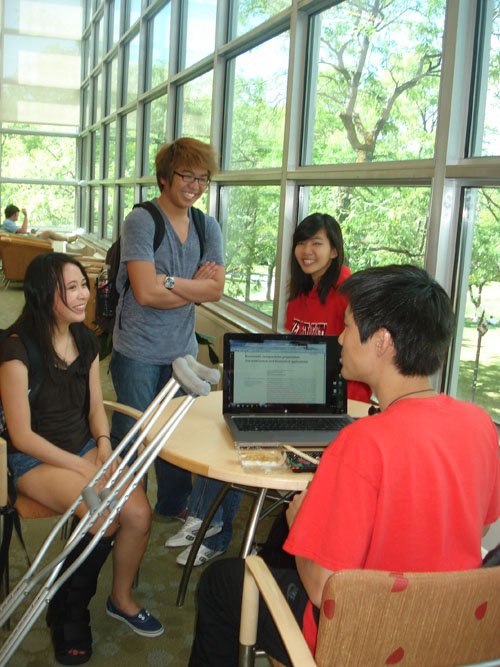
Chaw Wguyen, left, and Ming Lam attend AASA's first meeting of fall term.

After hearing the story about Oda, a small group of freshman women said they hadn’t experienced the same type of bullying that she did. They said their families and friends are supportive of them and have encouraged them to get a good education. Chaw Wguyen and Ming Lam, both 18, said the U is already pretty diverse and so far they haven’t noticed any kind of outward bullying. However, others in the group said they have noticed a more subtle type of disdain arising from various comments they hear. One student said because she is Asian, people automatically expect her to be extremely smart. “I’m really not; I have to study hard like everybody else.”

“I know,” said another student. “I get so sick of complete strangers coming up to me and telling me how silky and smooth my skin looks, like I’m some sort of a doll or something.”

Sugiyama said the definition of bullying has changed since the days of WWII. “Taunting of Asian-Americans still exists,” she said, “just in different ways.” “Cyber bullying” is a real danger, especially among young girls. Other methods of intimidation aren’t as extreme; however, the impact can be felt just the same.

“Asians-Americans are viewed by many, especially in the media as perpetual foreigners,” Sugiyama said. She believes that many movies and televisions programs portray Asian women as exotic looking seductresses, or passive subservient women who make good wives. Men don’t fare much better. They are depicted as warriors and Kung-Fu fighters.

Talking with peers is a good way to feel secure about oneself, say Linda Oda and Tricia Sugiyama.

Sugiyama’s parents were born in Japan, but she grew up in Sandy. She was raised and assimilated into the prevailing culture of that area. It was when she was in college that she realized much of her family’s culture had been forgotten. She now maintains a balance of being “Americanized” as she puts it, and still celebrates her family’s heritage while helping other young women find their own place in today’s society.

Both Oda and Sugiyama feel all young women need a support system. Becoming involved with clubs and organizations is a good way to secure and build confidence. Sharing feelings of being left out with a trusted peer or mentor can also help students realize they aren’t alone, they aren’t invisible, they don’t have to be an  “other.”

Utah Domestic Violence Council aims to aid members of Asian community affected by abuse

The Utah Domestic Violence Council works with many women's shelters, including the YWCA in Salt Lake City.

Story and photo by DANA IGO

Kenneth Warhola arrived at his Layton home Sept. 8 to find his wife locked in their children’s room. After several attempts to persuade her to open the door he broke it down. She was sitting next to the couple’s two children, Jean, 7, and James, 8, who were covered with a sheet and unresponsive. His wife, Sun Cha Warhola, 44, is charged with strangling them to death.

As the information came out in the Salt Lake Tribune and Deseret News, it was learned that disputes between Sun Cha Warhola and her husband had been ongoing for more than four years.

According to the Tribune, Kenneth Warhola was charged with domestic violence in 2007. In another incident both Warholas were charged after an altercation in a parking lot. One report just weeks before the murders showed that Sun Cha Warhola alleged that her husband had sexually abused their children. The Davis County Attorney’s office reviewed the case and determined the accusations were unsubstantiated, as reported by the Tribune.

The Deseret News wrote that before the murders, Sun Cha Warhola called a Korean newspaper in a desperate attempt for help. She told Inseon Cho Kim, director of the Korean Times of Utah, that she dreaded leaving her husband with their children in the event of a divorce.

While all women have difficulty coming forward to get help for domestic abuse, women in the Asian community face a particular quandary. Prevention and educational programs on domestic crime aren’t targeted to Asian women. A report published by the National Asian Women’s Health Organization suggested that this is because society tends to view the Asian population as a “model minority,” meaning that they are viewed as achieving high rates of success.

Asian women have the lowest rate of domestic violence of any of the major racial groups. A small number of Asian and Pacific Islander women, 12.8 percent, reported having experienced physical assault by a partner at least once in their lifetime, according to a study published by the Asian & Pacific Islander Institute on Domestic Violence. This was the lowest percentage among any racial class surveyed, which was cited by experts as being due to underreporting.

The unwillingness to come forward in cases of domestic violence among Asian women may also be perpetuated by culture.

Dr. Linda Oda, director of Asian Affairs at the Utah Office of Ethnic Affairs, said that abuse in Asian families isn’t often reported because their cultural values tend to stress keeping things within the family.

Unlike Western culture, traditional Eastern culture puts emphasis on the family instead of the individual, leaving Asian women feeling less inclined to report physical and domestic abuse.

The Utah Domestic Violence Council (UDVC), 205 N. 400 West, a nonprofit organization with resources throughout the state, is reaching out to the underserved communities across Utah in an effort to prevent future domestic crimes. In preparation for Domestic Violence Awareness Month in October, the council’s diversity coordinator, Hildegard Koenig, provided information to the Asian Advisory Council so its eleven members could pass it to their respective communities. She approached the council because it connects the Asian community with Oda and her office.

“By working and educating community leaders and building those strong relationships we can start a dialogue on how we can better assist victims of domestic violence in their communities,” Koenig said.

Sometimes the educational materials fall short. Salman Masud, the council’s representative of the Pakistani community, said the materials offered by the UDVC were only written in a few languages, which narrows the ability of non-English speaking Asian immigrants and refugees to know whom to contact in a domestic abuse situation. Currently the brochures are offered in seven languages, including Chinese, Tongan and Samoan. Koenig is seeking individuals to help translate the material into other languages.

Non-English speakers can call The Utah Domestic Violence Link Line, 800-897-LINK (5465). The hotline is currently available in 144 languages, making it a good resource for members of all communities who may not be able to get the printed materials in his or her language.  Many of the UDVC‘s resources can be accessed online, including special reports, training materials and a map of domestic violence programs throughout the state.

Asian expectations

Story by EMILY RODRIGUEZ-VARGAS

The life of an immigrant or refugee means facing financial, safety and cultural challenges all along the way of the journey. This includes leaving one’s home country to adopt another country and culture as one’s own. The legacy these trials imprint on families of immigrants still has its traces throughout the education system.

Gerald Brown, director of the Utah Office of Refugee Services, said of those who have come to the U.S., “They are very smart people, and they are going to do everything they can to live a better life here.”

According to the 2006 report compiled by the Utah Office of Ethnic Affairs, 2 percent of Utahns are Asian. Of that number, 1.6 percent is in public schools, and that same percentage of students will graduate from high school. With their background and history, many of them will also have the drive to live up to their parents’ legacy.

Kathleen Villanueva, 19, is a political science and economics major at the University of Utah. She was born in the Philippines, but spent the majority of her life in the U.S. because her parents sought out a life out of the poverty at home. When still at Northridge High School in Layton, Utah, they expected her to maintain a 4.0 GPA.

“If I brought home a grade lower than that, I knew I’d be grounded,” she said. Challenging her parents and higher authorities just wasn’t an option. Villanueva carries on this high standard for herself as she maintains a nearly perfect GPA to keep her scholarship at the U.

Emily Park Grady is a doctoral candidate in the School of Music whose family moved to the U.S. when she was a toddler. In Korean culture, Grady said that knowledge itself shows sophistication and is held in very high regard. This prized experience and wisdom is no small thing.

Although she did always succeed in school, she said that she had a different experience than Villanueva even though her parents didn’t push her in academics. Growing up in New York City, Grady had a lot of friends who, like herself, were from Korea.

“The real pressure wasn’t really coming from my parents, it was just keeping up with my friends,” she said. “There was an immense peer pressure and competition among the people I hung out with.”

Wesley Sakaki-Uemura, an associate professor of history at the U whose grandparents emigrated from Japan, said the expectations set on students by family members is often significant. But there is also the unrealistic perspective for Asian Americans returning to their home country. He said there is a notion that people who look Asian automatically speak their family’s native language and know about all of the cultural norms and traditions they didn’t grow up with.

Funding for college could possibly be more accessible through wise saving by parents, or students may receive scholarships for their academic endeavors. Roger Tsai, an immigration attorney in Salt Lake City, said many Asian parents are more willing to pay for their children’s undergraduate and graduate degrees because they might not have had the chance to access higher education themselves.

Vinh Thanh Ma, 26, left Vietnam with her family at the age of 13. She received her Bachelor of Science in biology and medical laboratory science at the U on a full-ride five-year Utah Opportunity Scholarship.

Ma said when she saw this was a land of opportunity, she wanted to get the best education and life she could. “Discipline and determination were all I brought with me,” she said. “I was able to advance faster than most students that have everything coming too easy in life for them.”

Realizing her parents’ hardship in trying to support her family and provide Ma and her siblings with an education, she said she wanted to do well in school because her parents went through so much to get her there. Ma said she set herself goals like achieving excellent grades to get into a good school. “I did it for my parents without realizing it was for my own good in the future,” she said.

Alysha Franz Lagaras, 18, a Filipina student at the University of Utah, has a similar story. She was born in the U.S. after her parents left their home to start a new life. Her life wouldn’t be the same if it wasn’t for her mother.

Lagaras said her mom was an example to her for her diligence and persistence. “She worked so hard to be where she is now,” she said of her mom, who was the first in their family to leave the Philippines and to get a college education. “When we moved to Utah, my mom was raising my brother and I by herself.”

About growing up in Utah, she said, “I noticed how different I was not for just being Asian, but also being a part of the LDS church, being a different race other than being white.” She also said that society often has the wrong image of what it means to be Asian. “For being an Asian girl, they really expect you to look the part, like to be tiny and skinny.”

One of Lagaras’ pet peeves is being stereotyped for being smart and loving videogames and Hello Kitty. “Even though I do, I just hate how people think they know you because all Asians are the same.”

She said now she’s older, she regrets not learning her native language, Tagalog. When she was in elementary school, Lagaras tried to convince her peers that she was Mexican so they wouldn’t make fun of her “chinky” eyes.  “When you’re a child, you just want to fit in,” she said.

“Now I love being Asian, when you’re older and more mature, you notice that you should love being different, standing out and being exotic.”

Finding the needle to success

Story and photos by EMILY RODRIGUEZ-VARGAS

A 3-year-old boy sits barefoot on the pavement at 2248 S. 440 East in South Salt Lake City, with a weary look on his face. Watching other children laugh and play at the Hser Ner Moo community center for refugees, he remains on the sidewalk alone.

Unfortunately, not all Asian individuals have been lucky enough to have had the kind of upbringing and opportunities to succeed. Some of them have never had the chance to learn and grow.

This necklace made out of coconut was brought over from Thailand.

More than 2,000 immigrants arrive in Salt Lake City each year, according to reports by the International Rescue Committee. The majority of these immigrants come from Burma and other Asian countries. Many of them were allowed asylum into the U.S. due to political persecution. Many children have never lived outside of refugee camps, or have been exposed to the freedoms they find in Utah.

Roger Tsai, an immigration attorney at Parsons, Behle & Latimer and former president of the Utah Asian Chamber of Commerce, said that although many refugees from Japan, Korea and China generally tend to have more education under their belt, many other people in Asian countries still struggle to access basic schooling.

In the Hser Ner Moo Community Center for refugees, students of all ages are learning English in school while acclimating to American culture. In the afterschool program, they come together to do homework, play games, and use the English vocabulary they picked up in school. With the help of volunteers, the center coordinates activities, outings and trainings for the children to enjoy.

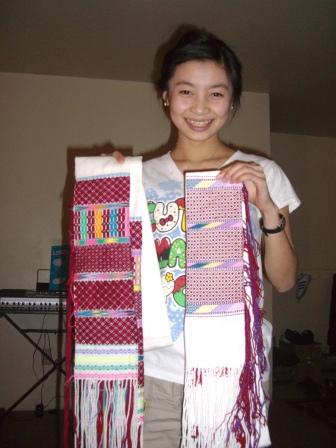
Lewe La Sa shows off a traditional scarf.

Lewe La Sa, 17, who is Burmese, arrived in the U.S. only 18 months ago from a refugee camp in Thailand. She came to the center to get help with her homework, as she was trying to get through a full class load during her last year at Cottonwood High School. Sa showed motivation to learn for her classes and improve her English skills as she transitions from the life she knew growing up in the camp, where she was an excellent student. She speaks Karen, some Thai and now English. She said her mother never had the opportunity to go to school.

Sa dreams of attending the University of Utah and becoming a nurse. If that doesn’t work out, she said, she wants to be a social worker and help refugees from her country.

“Many people come here that speak Karen, but it’s very difficult for them to understand English at first,” she said. “I also want to be an interpreter, they really need one.”

Sa and her younger sister, Paw Ku Sher, currently teach a refresher course of Karen to refugee children between the ages of 4 and 14 every Saturday.

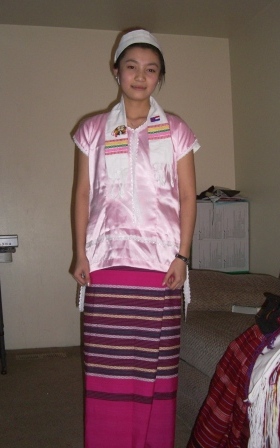
Special occasions in Burma require specific dresses.

“If they have lived here for a long time, they don’t remember their family’s native language very well,” she said. Her next step toward achieving her academic goals is succeeding at the upcoming college entrance exams.

Kaity Dixon, an IRC volunteer coordinator, said in an orientation to volunteers in Salt Lake City that it’s a true struggle to learn to read and write in a foreign language when you haven’t learned to do so in your own native tongue.

“In an instant, reading directions and completing necessary paperwork for daily life becomes a barrier to progress in a new country,” she said.

Without organizations like the IRC and other offices, as well as on-site tutoring for refugee children and services for whole families, personal, financial or educational achievements for these individuals might be too far out of reach.

A Japanese saying captured this complex situation of giving direction right at its point: “When one has no needle, thread is of little use.” The programs offered now could expand or improve in the near future by greater participation and community involvement for maintaining these vital services.

Maybe there is hope for the young boy on the sidewalk after all.