Creating opportunities for artisans

Story by EMILY RODRIGUEZ-VARGAS

Those looking for unique Asian or African handwork and artisanship in Utah need not look much farther. These homemade treasures and more are now available for sale through a nonprofit organization for artisan refugees recently organized in Salt Lake City, Pathways to Self-Sufficiency.

Photo courtesy of Wanda Gayle

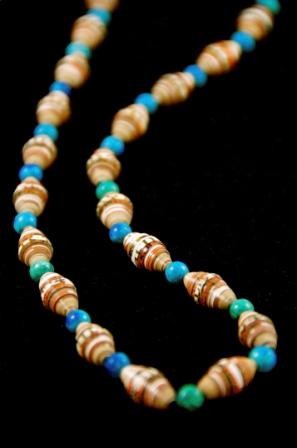
At the launching of the Global Artisans project of this organization on March 30, 2010, at the Salt Lake City Main Library, tables were lined up in a conference room displaying true cultural riches. Handcrafted jewelry, knitted clothing for young and old, homemade cards and other objects were portrayed and sold by artisans. Not only are these crafts practical, but they also show the potential of self-sufficiency of refugees.

As women and men craft these gifts for sale they are actively pursuing the chance to provide for themselves. At the same time they learn vital business skills. The artisans from many different countries presented and sold their work to attendees. Although not all of them spoke English fluently, they were all eager to use the language skills they did have to sell their merchandise. Some of them even worked on their various projects at the event, creating traditional woven baskets from Africa and knitted baby socks. As refugees, they can put their skills to work and offer local shoppers diverse and unique selections.

According to the Pathways’ Web site, a refugee is “any person who is outside any country of such person’s nationality, and who is unable to return to, and is unable to avail himself or herself of the protection of that country because of persecution or a well-founded fear of persecution on account of race, religion, nationality, membership in a particular social group, or political opinion.”

Photo by Emily Rodriguez-Vargas

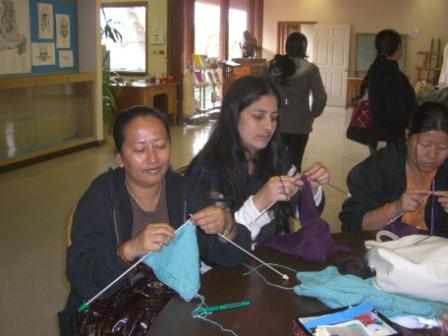
The best part about this nonprofit program is that the artisans are able to make some profit without extensive business education and marketing skills. Pathways and its volunteers support the artisans in the promotion of merchandise. In a step-by-step process the artisans learn the craft, like sewing or knitting, with supervised assistance from volunteers, then they prepare it for sale on the Global Artisans‘s online store.

Once a week, men and women who want to make an extra income meet for a few hours of training. At the Pioneer Craft House they receive supervision by experts in the respective fields, and together they learn, talk and laugh. Many times the artisans bring in knitting work they’ve completed at home for a last check, or they ask questions about how to improve their craft.

The artisans have a supervisor to help improve their sewing and knitting. Photo by Emily Rodriguez-Vargas

This program also offers free entrepreneurial training at Salt Lake City Community College by a group of volunteers. The Global Artisans project can only accept a limited number of people at one time. Through these business courses, training by specialists and on-the-job help, the artisans are placed in the best position to know how a business works for the future.

Missy Larsen, a volunteer coordinator for Pathways, said the project helps to close the gap between other organizations and services. While there are various groups to support refugees, this specific opportunity not only helps them immediately, but also gives them long-lasting business knowledge and skills they can apply to supporting themselves later on.

Larsen said she first got involved in helping refugees when she supervised a service project for youth. But it turned into something she couldn’t walk away from.

Photo courtesy of Wanda Gayle

“There are so many needs a refugee family has, from finding a job to needing to drive to appointments,” Larsen said. This program directly helps them to succeed and make some money to live on.

Ze Min Xiao, refugee services liaison for Salt Lake County, is a volunteer and one of the driving forces behind Pathways. She advocates helping refugees in Salt Lake City to become self-reliant, which she said is a great step forward. With the support from American Express in providing a grant for the market goods, the artisans can take home their profit, with only 10 percent of the proceeds going to cover overhead costs.

“We volunteer,” Xiao said of those who make Global Artisans happen. “We don’t keep a penny.”

Xiao explained how getting a job and being able to successfully integrate into the community is especially challenging for refugees. Learning to live in a new country can create emotional stress and people often encounter financial difficulties if they cannot find work because of language barriers.

Participants are working on necklaces, pillow cases and jewelry. Photo by Emily Rodriguez-Vargas

Laxmi Timsina, 23, makes necklaces and bracelets. She’s also trying her hand at sewing artwork on pillowcases. She has been involved with Global Artisans since she arrived from a refugee camp in Nepal in 2009. She was practically raised in a refugee camp, she said, after her family left Bhutan because they were Hindu under a Moslem ruler. Although she already learned to speak English in the camps, she said it’s particularly difficult to find a job as a refugee. This is especially unsettling when working against a deadline.

“The government helps us for six months, but after that we are on our own,” she said. Although money is tight, she hopes that other family members can join her here in Utah soon.

Her friend Nirmala Kattel, 22, is also involved with making jewelry for Global Artisans. A Bhutanese herself, she said her family was forced to go against their religious beliefs when the King had Hindus persecuted. They then stayed in Nepalese refugee camps, where she spent most of her life. Kattel said it was a challenge to acclimate to life in Utah, especially in the first months. She lives with her husband and in-laws, and she is still getting used to the greasy and sweet American food.

“It takes time,” Xiao said. “Refugees have to learn English and learn how to operate in a new society.” That is where Global Artisans steps in to help out.  The services teach those seeking an extra source of income to work for it and benefit from the promotion of the program. They also learn to start a business, Xiao said. “It’s all about empowering others.”

Truthfulness, compassion, tolerance: How Falun Gong saved a life

by KEITH R. ARANEO-YOWELL

Lang-hao Lin shifted uncomfortably in her seat when she flipped to the page in a Falun Gong history book with an image of a young girl bound to a chair with rope, and surgical tubing going into her bloody nostril.

“This is similar to what happened to me,” Lin said. “They put some kind of medicine into the thing they force-feed you. After feeding, you’re in semi-consciousness, dreaming all day, you’re not clear-minded anymore.”

Lin, who asked that her real name not be used, was referring to the treatment she received while serving a two-and-a-half-year sentence in a forced labor camp in Shanghai, China. Her crime was practicing Falun Gong or Falun Dafa, a philosophy that holds tolerance, compassion and honesty as its three pillars of spirituality.

“It’s not a religion,” Lin said. “It’s culture generated from the 5,000-year-old Chinese history.”

Started in 1992 by Li Hongzhi, Falun Gong draws from Buddhist and Taoist principles of self-improvement without the worship of a deity. It emphasizes qigong, a meditative practice that uses slow movements and controlled breathing as a way of spiritual enrichment.

Hongzhi’s book, “Falun Gong,” teaches the physical and spiritual aspects as well as how to meditate. Practitioners begin by assuming four standing meditation positions and one final sitting position. The legs and torso remain static while the hands move slowly around the body in ways that “mix and merge the universe’s energy with the energy inside the body.”

In this way, many practitioners believe that the ritual has powerful supernatural healing capabilities.

Because of the changes she perceived in those around her, Lin, 37 started attending Falun Gong meditation in Shanghai in 1997.

“I witnessed with my own eyes so many people getting healthy bodies by just doing [Falun Gong] exercises,” Lin said. “Before, they even had cancer. It was like a miracle happening around me.”

Lin said the practice grew rapidly because of its simplicity and effectiveness and, while there is no official entity monitoring the number of practitioners, the Congressional Research Service’s report titled “China and Falun Gong” estimates the number of practitioners during the mid-1990s to be anywhere from 3 million to 70 million.

Despite its wide adoption in Chinese society, however, the Chinese government made the practice of Falun Gong illegal in July 1999.

Roger Tsai is an attorney for Parsons, Behle & Latimer who would later help Lin attain status as a political asylee. He said the Chinese government felt threatened by Falun Gong’s popularity.

“[The Chinese Communist Party] was worried about how popular Falun Gong was,” Tsai said. “At one point the size of this group was larger than the size of the communist party, so it was a potential challenge.”

A government official was later quoted in print and broadcast for the Xinhua News Agency (a Chinese news outlet) as saying, “Those who jeopardize social stability under the pretext of practicing any qigong will be dealt with according to the law.”

Even though there is no official record of the number of arrests for practicing Falun Gong, the Wall Street Journal reported in 2000 that more than 30,000 practitioners had been arrested in the first year of the Chinese government’s ban of the practice.

Lin was pregnant with her daughter and working in Shanghai when Falun Gong was made illegal. She continued to openly attend Falun Gong meditation even though she had heard stories of the Chinese government sending practitioners to prisons and labor camps. “I was scared,” Lin said. “I did not want to be persecuted, but I did not stop.”

In 2001, Chinese authorities found Lin at her work. “At first, I was not [arrested] because I had a baby, and they gave me a one-year nursing period,” Lin said. “They told me, if after one year [I did] not denounce Falun Gong, they would send me to a labor camp.”

After receiving threats from the government and hearing accounts of life in labor camps, she decided she had no choice.

Lin went into hiding for a year in Nanjing, a city roughly 200 miles northwest of Shanghai. “My husband and my daughter didn’t know where I was. I dared not go out. After one year,” Lin said, “I missed home so much, I made one phone call to my husband. I told him where we could meet, but when I went, there were police waiting already. I didn’t even get to see [him].” Lin believes her husband’s phone was tapped.

Lin would spend the next two-and-a-half years in a forced labor camp assembling American products, a task she said was assigned to her because she could read English. She slept on a plank of wood. She was not allowed to talk. She shared a single toilet and a cell the size of two standard parking spaces with up to 10 other women.

For 10 days, Lin did not eat or drink water as a way of protest. “If you refuse to eat or drink, they use a tube to force-feed you,” Lin said stoically. “It’s not to save your life, it’s for punishment.”

Had Lin simply signed a document renouncing Falun Gong, authorities would have allowed her to go free. She said she couldn’t do it because it goes against the truthfulness that Falun Gong holds paramount over suffering. “It isn’t true, so I couldn’t do it,” Lin said.

After her release from the labor camp in 2005, Lin was only able to continue her Falun Gong practice in secret because the Chinese government continued to monitor her activity. Lin was unable to attend public meetings, protests, rallies or Falun Gong meditation.

Reprieve came only in 2008, when Lin’s husband accepted The University of Utah’s offer to study for one year as a visiting scholar. Her husband left China while Lin and her daughter acquired passports and visas to stay in the United States for the rest of his time at the University of Utah.

After a few months of talking with her husband about staying in the U.S., Lin approached Roger Tsai to obtain status as a political asylee, which would grant her one year of legal residence in the U.S. With Tsai’s help, she submitted her case for political asylum to the U.S. Department of Homeland Security’s office of U.S. Citizenship and Immigration Services in 2009. Two months later, she and her family were allowed an extra year in the United States after her husband’s visiting scholarship ended in August 2009.

Lin still studies Falun Gong year round. Once a week, she and a group of other practitioners meet in Salt Lake City’s Liberty Park during the spring and summer, and with one of the elderly practitioners at a nursing home on 700 East during the rest of the year. Robin, who asked that his full name not be used, practices Falun Gong with the group of other adherents at the park. He said Falun Gong does not advertise and is open to anyone who wishes to participate.

When Lin and her family became political asylees, they became eligible to apply for permanent residency in the U.S. Tsai assisted in this process and Lin and her family submitted the paperwork in March 2010. They are still waiting to find out if they’ll be able to stay in Utah indefinitely.

In search of a new life

Story and photos by Leigh Walsh

The transition into old age is an inevitable life experience that can be a daunting thought for many. However, the transition into a new life and culture presents Utah’s aging refugees with the most challenges.

As the American flag is raised outside Catholic Community Services in Salt Lake City, three Bhutanese refugees have begun their day’s work inside. Padma Dhungle, Tara Gautam and Krishne Adhikari, each over the age of 65, arrived in the U.S. in 2008 with little more than hope packed in their hearts.

The American flag stands outside Catholic Community Services in Salt Lake.

They had spent the last 17 years in a refugee camp in Nepal, hopeful they would be offered a second chance at life. Their prayers were answered when they were relocated through the United Nations High Commissioner for Refugees (UNHCR) resettlement program.

“We had the feeling of happiness when we heard we could come to the United States,” Dhungle said through an interpreter. “So far it has been good,” he added with a smile.

Catholic Community Services in Salt Lake brings in about 600 refugees each year. The organization does its utmost to make the transition as smooth as possible for each of the immigrants. Aden Batar, director of refugee resettlement and immigration at CCS, explained the main goal is to integrate refugees into the community and provide them with the tools necessary for them to become self-sufficient.

“We help them with case management, job placement, housing, health services and immigration,” Batar said.

Life can be tough for many of the refugees who are resettled in Utah. “Everything is foreign to them when they first arrive,” Batar said. “The weather, the people, the food. It is all different.”

Simple everyday tasks can present obstacles for the refugees. Refrigerators, toilets and ovens are basic concepts to many of us, but are unrecognizable to some immigrants.

These difficulties pose an even bigger challenge for older refugees. They have spent most of their lives surrounded by a culture they are both familiar and comfortable with.

“Country by country the religion and culture is different. It is important to adjust to the new life cultures and new traditions,” Dhungle said.

According to Batar, older refugees can feel isolated, particularly when family members go to work and school. “In the culture where they come from, every day they go to their neighborhood and everybody knows each other. They have people they can talk with,” he said. “I think they miss that socialization.”

Dhungle, Gautam and Adhikari have benefited from the fact they all embarked on this journey together. They have been united since they first entered the refugee camp in Nepal in the early 1990s.

Keshab Adhikari, a case manager at CCS, said it helped greatly that they arrived here with their families. This provided the refugees with some stability as the environment around them changed dramatically.

From left to right: Keshab Adhikari, Krishne Adhikari, Tara Gautam and Padma Dhungel.

The three older refugees are very appreciative of everything the CCS has done for them.

“Each day we learn new things,” Gautam said. “At first we were unsure where to go, who to talk to, how to travel. Day by day we are learning new things and adapting to life in the U.S.”

They each work with CCS and are responsible for various chores around the center. Keshab Adhikari explained they would be paid by the state because they are all part of Salt Lake County Aging Services.

Batar recognizes language as one of the biggest barriers to a successful transition into the community. Dhungle, Gautam and Adhikari speak Nepalese among themselves but they have not yet grasped English. “We take classes to learn English for one hour each night,” Adhikari said. The refugees are hoping to improve their English so everyday tasks, like going to the grocery store, become easier for them.

A smooth transition into a new community is integral to the success of CCS resettlement efforts. Batar said one of the keys to this is community acceptance. “The community here has been very receptive to the refugees,” he said. “We would not be able to bring as many refugees into the state otherwise.”

Many religious groups around Utah get involved with volunteer work and provide much-needed support to the older refugees when they first arrive. “The Salt Lake community has been excellent to us,” Dhungel said. “They are lovely people.”

Along with the voluntary effort from the community, CCS depends heavily on donations from local people.

“Donations are the main source of funding for our program,” Batar said. Monetary and in-kind donations are fundamental in giving the refugees the best help possible. “All the furniture, household items, clothing and children’s toys that are given to the refugees are donated by the community,” he added.

It is important for older refugees to have some stability around them as they adapt into a new culture. For many, their family is their rock, but others depend on their faith to get them through the hard times.

“We have a lot of diverse religious groups in the state of Utah so they easily find a place that they can worship freely,” Batar said. Many refugees have found comfort in practicing their beliefs without reprisal from other religious groups.

With the current wars in Iraq and Afghanistan, the civil unrest in Somalia and the human rights issues in Burma, many older people continue to be stranded in refugee camps around these areas. The community support for refugees is extremely important if the resettlement efforts are to continue.

The majority of refugees the CCS works with are younger children. However, Batar said many of the refugees coming from Bhutan are older adults. They are immigrating with their families and all their children are over the age of 18.

The UNHCR, a branch of the U.N. established in 1951, has assisted millions of refugees over the years, including Dhungle, Gautam and Adhikari. Camps were set up in Nepal in 1991 after the Bhutanese government attempted to implement a “one nation, one people” program. This campaign attempted to integrate the minority groups into mainstream society and it was met with backlash. Many people in Southern Bhutan were forced to flee as a result.

According to the UNHCR Web site, refugees have to move if they are to save their lives or preserve their freedom. “If other countries do not let them in, and do not help them once they are in, then they may be condemning them to death — or to an intolerable life in the shadows, without sustenance and without rights.”

The foundations of American culture are built on freedom and opportunity for all and the Salt Lake community has been very helpful to CCS in their resettlement efforts. There are numerous opportunities to help refugees who are living in overcrowded camps around the world. As Batar said, they are not just relocating for a better quality of life, they are fleeing their circumstances.

Dhungle, Gautam and Adhikari have reached a stage in their lives where stability is vital. They are not focusing on returning to Bhutan. In fact, they want to bring more family here. “We are trying to make Salt Lake our home. We will be living here for the rest of our lives,” Dhungel said.

Salt Lake Community College welcomes refugees with open arms, minds

by REED NELSON

The South City campus of Salt Lake Community College (SLCC) is teeming with students, some ambitious, some reluctantly present, some looking to further their education, some looking to quiet nagging parents. Then there are those who come from far away, one group to whom this confusion seems mundane. With all the diverse qualities that envelope the students at SLCC, there is one group that shares a mutual bond far deeper than the institution could provide on its own. They are the refugee population.

The refugees are not all from the same place, the same region even, but they do share the same difficult past that brought them to Salt Lake. Now that they are here, however, their opportunities will not be hindered.

One of the main reasons refugees have found so much success in Salt Lake City is because of the opportunity to receive encouragement and development at SLCC. The school has made a point of welcoming the students with open arms, even with the language barrier.

“We have only had a little trouble incorporating the refugee students into a normal student life,” said Cindy Clark, an early-enrollment advisor who is also in charge of the Sudanese Student Association at SLCC. “But that is made easier by the wearing down of the language barrier. That is why our ESL [English as a Second Language] Program is so essential.”

Clark said English is one of the biggest issues that an incoming refugee student will face at school. Other issues usually are individualized. This could mean culture shock for one student or finances for another. This is why she has to remain close with the students.

“A lot of these kids are used to never having anywhere to turn, never having someone to ask how to handle a tough situation,” Clark said. “My job with them is to make sure that they don’t slip off the grid due to simple neglect. I never want to lose one that could have been avoided.”

SLCC has even included space on its application to denote refugee status, which might include long-standing documented refugees to people who have lived here for 24 months or less. This can allow someone like Clark to identify who requires more attention in the beginning.

Refugees come from an extremely adverse political, religious, environmental, or social situation. This makes it very difficult from the outset to proceed with what is considered a traditional Western education.

A war-torn state can produce an exponential amount of refugees, depending on the group being persecuted. When these refugees are exiled, it is a long road before they are granted the chance to start over.

This process can often take years to sort out, depending on the gravity of the situation, and can frequently lead to disheartening times.

“I was only 5 years old when we were told to leave our home,” said George Artsistas, a student at the University of Utah. Artsistas was born to Greek parents in Croatia in 1989, two years before the war broke out. By 1994, his parents were being forced out of the country and were made to stay in camps. Because of some work by his father, George ended up in Marin County, Calif., in 1996.

“I was introduced to a life in which formal schooling was nonexistent,” Artsistas said. “It was the polar opposite to what I had been told, and I lost a few key years in my schooling. When we came in, I had to play catch up, but thanks to my parents, that wasn’t too difficult.”

Now these students are in an environment that is conducive to learning and interacting, rather than destructive. Artsistas is working to become a film major at the University of Utah after a brief stint at SLCC.

“I have the opportunity that I would have never been afforded, and my parents are beyond excited,” Artsistas said. “They never thought in a million years that they would see their son go to college.”

The genuine thirst for an education is not uncommon among refugee students, and it is this attribute that could serve them well, especially now that they are making life decisions.

“I was told everything that I was allowed to do my whole life,” said Sean Keranovic of Prijedor, Bosnia. “When I went, it was the first time that I was told that I could do something that I wanted to do.”

Keranovic is about to graduate and has found work through connections he made while at SLCC. He met a speaker in a business class, and through frequent contact eventually landed a job with POWDR Corp., a holding company, based in Park City, that operates eight winter resorts.

“Sean has showed a phenomenal work ethic, a yes-man through and through, you can tell this job means a lot to him,” said Rick DesVaux, the former CFO of POWDR, and the man who hired Keranovic. “We have him in a type of quasi-internship, one that allows him the flexibility to continue school, if he chooses to, but also become competent in the work place. He has really shown that he cares not only about his job, but his future as well.”

Keranovic is only putting together presentations, in which he often will construct the display pieces, but he enjoys the responsibility. “I didn’t learn that I could go to college until I heard about Salt Lake Community College’s refugee program,” Keranovic said. “I mean I come from Bosnia, Clinton’s only political blemish,” he said, laughing.

Keranovic is one of a handful of SLCC graduates who have found work in the corporate world.

Another successful graduate is Simon Kuay, 33, a Sudanese “Lost Boy” who owns K&K African Market. The store doubles as a hangout for other Sudanese refugees. He has managed to fuse old and new traditions.

“This started as a business for me,” Kuay said. “Who would have thought it would become some sort of center for us.”

And while K&K might be one social and cultural center for the Sudanese, the, like other refugees, are happy to settle on SLCC as a rallying point.

“That is what we try to do here,” Clark said. “We embrace them with open arms. They receive no special academic treatment while they are here, mind you, but as far as everything else goes, we are here for them 100 percent. They are always worth it.”

So the bustle around the SLCC campus continues, stretching all across the valley, from campus to campus, classroom to classroom. Now, however, that bustle includes those who feel fortunate to have access to education.

“Granted I was very young, but my family came over here under refugee circumstances, which immediately put us at a disadvantage,” Keranovic said. “But now, I go to school and have a job where I have to wear a tie. That is a pretty cool change.” 

Refugees celebrate First Thanksgiving in America

by MATT BERGSTROM

  • Virtually attend the First Thanksgiving celebration.

Each of us probably has many unique memories of Thanksgiving, but they probably all centered on turkey, stuffing, mashed potatoes, pumpkin pie and family. We remember the pilgrims who broke bread with their native hosts in this new land. And eventually we go around the table and take turns naming things for which we are grateful. Family, friends, freedom, the list goes on, and these are just the Fs.

But who remembers their first Thanksgiving? All the memories seem to blend together over the years, the result of too much stuffing and tryptophan-induced comas. Most of us likely can’t recall the first time we tasted cranberry sauce, or watched with trepidation as dad carved the bird; cautiously keeping his fingers clear of the blade.

For the thousands of refugees who come to this country every year, these experiences are as foreign to them as their many languages and traditions are to us.

That’s why this year the International Rescue Committee and American Express decided to hold a First Thanksgiving celebration for new refugees.

The First Thanksgiving is a new national celebration organized by the IRC’s corporate headquarters in New York. Salt Lake was one of three cities to host a dinner, along with Boston and Phoenix. American Express offered to house the Salt Lake event Thursday, Nov. 18, at its Taylorsville office.

Smiling volunteers and employees from the IRC greeted refugees arriving at their first Thanksgiving dinner. Once checked in they were ushered through the spacious lobby of American Express’ office past an 8-foot-tall Statue of Liberty. Just beyond the statue lay a long red carpet rolled out for the guests of honor.

Servers greeted guests along the red carpet and offered them drinks and appetizers as the refugee families meandered closer to the office lunchroom that had been transformed into a banquet hall for the evening.

All the while the journey down the hallway was accompanied by a Middle Eastern melody. At the end of the carpet, two men, Iraqi refugees, sang while one of them kept time on a small, Yamaha keyboard. An older Iraqi woman stopped to listen and sing along to the music as everyone else arriving followed suit.

The long hallway continued to fill with people as those arriving paused to admire the black and white photographs propped on easels along the carpet. Pictures of women and children, mothers and their newborn babies, stood single file on either side of the red carpet like members of a reception line.

This exhibit of photos was the premier of The Newest Americans series by Salt Lake-based photographer Stanna Frampton.

Frampton is a longtime friend of Patrick Poulin, the IRC’s Salt Lake resettlement director. For years she had asked Poulin if there was some way she could help him in his work. They came up with the idea of photographing the newest Americans, children born to refugee mothers. She began taking the photographs a year ago. Frampton said it was difficult at first because many of the mothers didn’t fully understand why someone wanted to take their picture.

Frampton recalls a Somali woman in particular who was so nervous to be in the studio it was all the photographer could do to get her to smile. Every time the woman would begin to laugh she would cover her face. Yet the resulting photograph is one of the most memorable of the series. The slender young woman in a long dark gown shields her smiling face from the camera as her young child lies lazily against her shoulder.

Every photograph has an interesting story, Frampton said. She asked each of the mothers a series of questions about their new life in America during the shoot. When she asked them how they felt knowing their babies were born American citizens they were unanimously overjoyed.

Frampton has found her own joy in getting to know these new mothers. “I have learned so much,” she said. “I’m still learning.”

Joy spilled over from the refugees, government officials, and refugee service providers as they all continued to spill into the banquet hall. More than 20 finely dressed tables filled the large room that usually accommodated American Expresses employees on their breaks.

The music died down as the nearly 200 guests began taking their seats.

George Biddle, executive vice-president of the IRC, emceed the evening. Biddle took a moment to thank all the participants and especially those who helped plan the event. He then introduced Salt Lake County Mayor Peter Corroon and former Salt Lake City Mayor Palmer DePaulis. DePaulis, who was recently appointed director of community and culture by Gov. Jon Huntsman Jr., appeared behalf of the governor who was celebrating his wedding anniversary.

Corroon and DePaulis presented proclamations, one from the county and one from the state, declaring Nov. 14, through Nov. 20, Refugee Appreciation and Celebration Week.

Next, Janet Harris, vice president of development for the IRC, addressed the crowd. Harris related a story about taking a taxi from the airport to her hotel in Salt Lake. Her cab driver happened to be a Somali refugee who was resettled by the IRC a few years ago.

She asked the driver how he liked his new life here. He told her he was happy because he has three things here he did not have at home: freedom, opportunity and safety.

Harris revealed why the IRC decided to hold it’s largest event in conjunction with Thanksgiving. “All cultures have some form of harvest holiday,” she said. “So there is common ground there.”

She then reminded everyone about the pilgrim’s very first Thanksgiving; a dinner held by a group of people who had been forced to leave their homes in search of freedom, opportunity and safety.

With the speeches done it was time for the entertainment.

A group of women and young girls from Burundi and Rwanda performed rollicking native dances in traditional costumes.

They were followed by a quartet of young Burundian men in green and white robes, each with a tall drum. The men set up their instruments on stage and began a 20-minute marathon of intense drumming and call-and-response shouts. By the time they were done they were drenched with sweat and the audience was as excited from their robust meal and lively entertainment.

As the evening wound down the attendees discussed their new memories. Their reveries were filled with hope of future events and newborn traditions. This Thanksgiving dinner was a bit different from the traditional memories of the holiday so many have, but the new memories it provided for it’s guests, both the refugee families and the others there, will surely be no less poignant and no less meaningful.

The smiling faces leaving the American Express building that evening may have seemed foreign and each was unquestionably different, but as Patrick Poulin pointed out earlier that evening, whether you say markozy, banyaba, or ji shu tin baday, it still just means thanks.

Lost in translation: A check-up with a Burmese refugee

by BRADY LEAVITT

Reporter’s note: Journalists traditionally remove themselves from the narrative of their articles to create an authoritative, objective tone in their writing. As I see it, the goal of the reporter is to become the invisible lens through which the reader, listener or viewer gets the truth. However, as I did the reporting for this story I unwittingly became an active participant in the day’s events. It was irresistible. To remove myself from the story would be to be to withhold the truth from the reader. So, in the interest of objectivity, this story is about me.

Zuli is a Burmese hill tribe refugee. As of November 2008, he had been in the United States for one year and two months. He has no last name. His medical records separate the second syllable from the first to form the required first-name, last-name construction: Zu Li.

For Zuli, everything is difficult. His wife is sick. He cannot find work. His shoulder aches all the time. As a Muslim living in Salt Lake City, he finds it hard to find Halaal meals, foods consistent with Islamic dietary code. Above all else, Zuli has a single, suffocating problem that envelops every part of his life — he speaks no English.

On Nov. 18, I accompanied Peter Robson, a translator from the Asian Association of Utah, to take Zuli to a routine doctor’s appointment to have his shoulder checked.

As climbed into his car, Robson, 23, explained he would be translating the medical staff’s questions from English to Thai. We were driving to pick up his partner, Kamar, who would translate from Thai to a mixture of Burmese and Karen, two of the languages Zuli speaks. The process would then repeat in reverse to convey Zuli’s responses to the nurses and doctors.

Kamar, 19, also a Burmese refugee, learned to speak Thai while growing up in refugee camps near the Thailand-Myanmar border. He has been in the U.S. for a little more than one year. Utah-born Robson, a native English speaker, learned to speak Thai while serving a two-year mission for The Church of Jesus Christ of Latter-day Saints. That is where Robson and I first met, and where I also learned to speak Thai.

“Do you ever worry that when you translate something…?” I started to ask.

“Yes,” he replied without hesitation. “Always”

I asked Robson how he knows when the chain of translation has broken down.

“By the answer they give,” Robson said. “I mean, you ask them the last time they threw up and they answer ‘No’ — you know something got lost.”

Kamar, Robson said, was very excited that I was coming. When we saw Kamar, Robson commented on how “dressed up” he was, saying that Kamar normally wears ragged jeans and T-shirts. That day he wore khaki slacks, a green dress shirt and faded red, white and blue flip-flops.

“Why aren’t you listening to music,” he asked Robson in Thai from the back seat of the car.

“Because I’m enduring an interview,” Robson responded, now speaking in Thai and motioning to me.

Kamar pulled out a knockoff mp3 player and informed me that he and Robson only listen to Burmese hip-hop in the car.

“What do you think of America,” I asked in Thai as we drove.

Kamar looked slightly annoyed. “I don’t think,” he said. “I’m listening to music.”

* * *

Zuli lives in a one-bedroom apartment in Rose Park with his wife, Poriba, and his five or six grandchildren. I say “five or six” because nobody, including Zuli, could give me a sure answer of how many people live there. He is either 55 or 59 years old, depending on whether one trusts his medical records or Zuli.

A pile of shoes lined the small entryway of the apartment. A moist, sour smell blanketed the apartment as we walked in. A collection of cardboard sheets ripped from packing boxes lined the wall, the names and phone numbers written on them. The names were written in Burmese making it impossible to tell to whom they belonged, but Zuli quickly asked me for my number which he added to the collection. The only other real decorations were the Islamic wall calendars, unidentifiable stains on the carpet and family pictures printed on inexpensive copy -paper and stuck to the wall with masking tape.

We sat cross-legged on the floor just next to a full-length sofa. Zuli began speaking in a dizzying blend of backwoods Thai and Burmese. He was animated and cheerful as he spoke. Peter listened to him and nodded.
Zuli said something to me, and flashed a tobacco-stained smile in my direction. I stared, hoping that whatever he said would eventually trickle into the part of my brain that could make sense of it. It never got that far. I smiled, nodded and tried to slink out of the conversation as fast as I could. They chatted for another few minutes before I heard something I did understand.

“Pete, you’re Christian, aren’t you?” Zuli asked.

Robson said he was.

“Christianity and Islam are really similar, you know,” Zuli said. “I say it, EE-bra-him, you say it Abraham.” He rattled off a few more Old Testament names. “They’re practically the same. The only difference is how we say it.”

I slowly began making sense of Zuli’s accent as the conversation continued.

Robson began asking Zuli questions about the day’s events. Zuli responded in garbled Thai half of the time and the rest of the time in a language that lies somewhere along the Thai-Burmese spectrum. Kamar filled the conversation’s gaps. Zuli told Robson that he thought he had an ulcer. He wanted medicine for that in addition to getting his shoulder checkup.

I was understanding about 25 percent of the proceedings when the volume of the conversation grew. Zuli was visibly amused that Robson had forgotten a detail from a previous appointment. Zuli erupted into belly-shaking laughter and pointed at Robson.

“I liked it better when we weren’t friends and he didn’t yell at me,” Robson said quietly to me with a smile.

We left for the clinic.

* * *

I had intended to spend as much time in the background as possible, to avoid interrupting the flow of activities. It was, I found, more and more impossible as we got closer to the doctor’s office.

In the car, Robson told Zuli I am engaged.

“You’ve got a woman?” Zuli cried in an excited spray of spit. “If you get married, I’m coming for sure, and I’ll bring you something.” He trailed off and gestured with his hands to show me just how large the intended gift would be.

A storm of confusion ensued upon our arrival at the University Healthcare Redwood Health Center in Salt Lake City. The translation system was about to be stretched to the limit.

A woman sitting with a nervous-looking Asian man was in the waiting room, which was full of people who spoke at least half a dozen languages. She jumped up to ask if we were the translators. The woman, an LDS service missionary, told us she had scheduled an appointment for her client but the hospital did not have anyone they could even call who speaks his language, Karen. The woman pleaded for our help after Zuli’s appointment as we were whisked into the exam room.

In the exam room, Zuli’s demeanor changed. He had been laughing and smiling and speaking almost non-stop, but now he was now silent and stared blankly at the wall, making eye contact with no one. A medical assistant came in and asked Zuli how tall he was.

“Zuli, how tall are you?” Robson translated.

Kamar translated the question into Burmese. Zuli spoke.

“Eight,” Kamar said, in Thai.

“What? What do you mean eight? He said eight,” Robson said in Thai and English.

In a flurry of further translation, and after standing Zuli back to back with Kamar, it was determined that Zuli is 5 feet 2 inches tall. The assistant did not seem too worried about actually measuring Zuli and entered his height into the computer.

“How is your shoulder,” the assistant asked.

Another 45-second volley of translation passed and Zuli again said, “Eight.”
It then became clear that Zuli was referring to a picture chart that medical staff uses to help patients rate the level of pain they are feeling. A rating of one is on the 10-point chart is associated with no pain and has a corresponding smiley face. An eight corresponds to a face with furrowed eyebrows and squinting eyes, the level of pain Zuli was feeling.

“Oh! I get it,” Kamar said. “See, I thought you were asking ‘how tall does it hurt’ a minute ago.”

The nurse laughed. I laughed. Robson laughed. Zuli did not. The medical assistant left and the room fell silent.

“Pete. Pete, help me, OK? Help me get this ulcer taken care of,” Zuli said quietly. Robson nodded and looked down at the floor.

The doctor came in and began to ask Zuli questions via the translation team. He said he was amazed at how efficient they were when compared to some he has worked with. The doctor checked Zuli’s shoulder and recommended an injection. Robson mentioned Zuli wanted medicine for an ulcer. The doctor said he would schedule a colonoscopy.

Robson stopped and looked at me. “How do you say colonoscopy in Thai?”
I thought about it and came up with the rough translation — a combination of words: check, look at and butt. We looked at Kamar who stared blankly at us.

“Oh wait. Yeah, I think my dad had one of those,” he said. He fired a stream of Burmese at Zuli who did not respond.

Robson then mentioned to the doctor that the Primary Care Network, a low-budget insurance plan provided by the Utah Department of Health for jobless refugees, covered Zuli.

The doctor stopped smiling and began typing furiously at his computer.

“I’m sorry, there’s nothing else I can do, then,” he said. “That’s the worst insurance on the planet. It doesn’t cover anything.”

The doctor had been planning to refer Zuli to an orthopedic surgeon to inject medicine into his shoulder and to have Zuli return for colonoscopy. Because of the insurance, all he could recommend was to have Robson help Zuli file an appeal to the local insurance representative to have the treatments covered, he said. Kamar was still explaining the treatment plan to Zuli who said, “Look, I don’t know what’s wrong with me. All I know is that I hurt. And I don’t want it to hurt anymore.”

The doctor said if the appeal was denied, the best he could do was to schedule an appointment to have the injection done by a non-specialist doctor at the clinic. He asked whether Robson would accompany Zuli at that time or if it would be some other, “clueless translator.” Robson asked the doctor several more questions about Zuli’s options, to which the doctor replied he did not know.

At that moment that I became suddenly disenchanted with the whole process. The translation had been fun and somewhat exciting, if cumbersome, but now I felt as though Robson was the only one who understood Zuli’s needs and no one seemed able to tell him what to do.

We took Zuli to the pharmacy to buy the Tylenol the doctor recommended and some medicine for his wife. We passed the LDS service missionary who was still waiting with her client for a non-existent translator. A friend of Kamar happened to walk by at that moment and offered to help translate.

Robson decided to stop by the Asian Association to report to Zuli’s caseworker. This was Robson’s first time to meet the person primarily responsible for Zuli’s needs, but was his tenth time to help Zuli. Even the caseworker had difficulty giving Robson clear direction of how to help Zuli further.

* * *

Before we headed home, I decided to seal my lack of objectivity and journalistic disinterest by inviting Zuli, Kamar and Robson to lunch. We ate at an Indian restaurant called Curry in a Hurry, which, Zuli was delighted to find out, serves Halaal food.

Back at the apartment, Robson began explaining to Zuli how to take the medicine. Zuli wrote the directions on the bottles in Burmese. I noticed six or seven other orange bottles that held medicine similar to what we had just picked up. Robson asked Zuli to throw them away.

We were about to leave when Zuli insisted he wanted to give me something. He went into the back room and returned with a plain white T-shirt. He presented it to me as a token of his thanks. He could not remember my name so he called me “my son” and restated his intention to get me something “really good” for my wedding. We left.

Robson told me he would be paid only for the time he spent translating, excluding transportation time, or about three of the six hours that he had spent helping Zuli that day. But he gets more than money out the deal, he said.

“There’s something compelling about the refugee, something charismatic about spending time with them,” Robson said quietly as we drove, listening to a mix of Thai patriotic music played by a squeaky brass band. “It helps me keep things in perspective – if school or my social life isn’t going how I want, it helps me realize how outrageously well-off I am.”

He summarized the day by saying, “It’s pretty healthy, I think, to hang with these people.”

I think so too.

Sports are their safe haven

by BRAD TAGGART

When the air starts to get cold and the grass begins to freeze it means one thing here in Utah: church basketball is about to begin.

For many men and women in Utah church basketball is a way to spend time with friends and get to know new members of their communities. However, for two individuals it is much more than that. 

For brothers Hau, 17, and Minh Nguyen, 13, church basketball is a place to belong, an organization to be part of. Church basketball is their release from the harsh reality that invades their past and their minds.

Hau and a friend in Salt Lake City.

Hau and a friend in Salt Lake City. Photo by Brad Taggart

In their home country of Vietnam, Hau and Minh were victims of war and poverty.  They spent most of their childhood in refugee camps where they weren’t able to play sports, much less basketball.

But these two boys were among the lucky ones.  After spending the first nine years of their lives in the refugee camps they were given the opportunity to come to the U.S.  This is a process that takes time and many efforts from many people on their behalf.

“I remember praying to God while I was in the camp to let me free and to live a good life,” Hau said.  “At first nothing happened and I didn’t know if there was a God but then we were helped and freed. I will never forget that God rescued me.”

The International Rescue Committee was the answer to Hau’s prayer.  The IRC is an organization based in New York City that helps individuals and families like these boys come into the U.S. and escape the horrific life of the refugee camps. 

Minh, 13, moved to Dallas before settling in Salt Lake City.

Minh, 13, moved to Dallas before settling in Salt Lake City. Photo courtesy of the Nguyen family.

Once the necessary paperwork was complete the two boys and their mother ended up in Dallas.  This is where they were introduced to the game of basketball and were shown the ropes by some of the volunteers at the IRC.

After spending a few years in Dallas the boys and their mother moved to Utah to be with some relatives from Vietnam.

“All I wanted to know was if there would be basketball in our new home,” Hau said.  “When I found out that there was I was very excited because I really like basketball now.”

The boys were told about church basketball by a friend from school and have not stopped going ever since.  “I didn’t know if it was OK to play basketball at a church,” Nguyen said. “I asked my mom and she said it was OK and that I should have fun. I was really happy when she told me that.”

Randy Kruger, activities coordinator for the Riverside Stake in Salt Lake City, said, “Its great to see so many new faces. They [Hau and Minh] seem to really enjoy the basketball and it’s a good way to befriend some kids or adults in our community that may not be LDS.”

Church ball has been around for several years and every year it seems to get more popular. Members of the LDS church are the ones responsible for inviting those friends who like to play basketball but don’t have anywhere to play it. 

“I have invited a couple of friends,” said Kalab Cox, a member of the 29th Ward basketball team in the Riverside Stake. “My one buddy said that he thought the church was cool for putting together this league.” 

Basketball isn’t the only sport refugees can find in Utah. Soccer is a very popular sport around the world and many refugees have found places to play in the valley on a weekly basis.

In Rose Park soccer begins every Sunday at 9:00 a.m. and lasts until about 1:00 p.m.  Anyone is welcome to play.

Hau is one of many people who play soccer there. “I like to play basketball in the winter and soccer in the summer,” Hau said. “I am really bad at soccer though. I think I am better at basketball so I play that more.”

The sports continue to gain followers and more and more refugees are finding a way to get involved and play the sports they love.

“Over 30 players come out on a regular basis,” said Gilbert Sanchez, a member of the family that started playing every Sunday. “Every Sunday it seems to get bigger and bigger.” Some of the players come from all over the world. 

A small town just a few miles from where Hau and Minh grew up in Vietnam.

A small town just a few miles from where Hau and Minh grew up in Vietnam. Photo courtesy of the Nguyen family.

“We have players from Africa, Asia, South America and from here in Utah,”  Sanchez said. “We want everyone to come play and have fun.”

But Kruger and others hope refugees will continue to find their way to the basketball court.

“I just want to continue to see more and more newcomers,” Kruger said. “If they are or aren’t refugees I want them to feel invited and welcome. That is our whole goal with this church basketball league.”

Hau and his younger brother Minh will continue to play as long as they can. “If they will let me play ’til I am 70 years old I will still come and play,” Minh said. “As long as I can walk and shoot the ball I will keep coming.”

Iraqi refugees in SLC find differences and similarities

by BRETT PERFILI

  • View a slideshow of the families and the Humanitarian Center (best viewed in full-screen mode)

In the spring of 2003, the U.S. government sent in troops to invade Iraq because it was believed the country held weapons of mass destruction. The invasion also aimed to put an end to Suddam Hussein’s support for terrorism and to free the Iraqi people.

Since then, the United States is still there fighting for the freedom of the Iraqi people. However, U.S. troops have been able to capture Iraq’s leader and also see him executed.

Many Iraqi people have fled from their country to avoid persecution, discrimination and even death. Some of the Iraqis who have fled their native country have come to Utah.

Mazen Hamoudi, 32, an Iraqi native, is a doctor in Salt Lake City. Hamoudi said when American troops first arrived in Iraq there were differing feelings toward the soldiers.

“When the American soldiers came during the first few months, most not all, most of the Iraqi people say hello,” Hamoudi said. “But, after three months people started to hate the American soldiers. Americans angered Iraqis because of their behavior.”

Hamoudi did not flee his country as a refugee; he came by choice. He can speak fluent English, which he was taught beginning in the fifth grade. Hamoudi received his medical degree from Baghdad University and decided to come to the United States to avoid the dangers of living in Iraq and also to seek more money.

In late December 2006 Hussein was hung at Camp Justice, an Iraqi army base in a neighborhood of Baghdad. And again, mixed emotions existed among the Iraqi people, Hamoudi said.

“It is difficult to express my emotion,” he said. “He killed people, so he had to be killed, but not by this behavior. I was not happy at the time.”

Hamoudi said he now finds it was the right thing to do, but will always feel that Hussein contributed many positives to his native country.

“I consider him the perpetrator of the Iraqi people,” he said.

Omar Shakir, 40, a patient of Hamoudi’s, feels the same about Hussein, but still is mourning over his execution. Shakir cried after the execution of the Iraqi leader.

Speaking in Arabic, Shakir said he was still very sad.

“Omar thinks as leader and Arabic leader,” said Hamoudi, who translated the conversation.

Before Hussein’s execution U.S. soldiers marched into Firdos Square in Baghdad and pulled down a tall concrete statue of the Iraqi.

This was also a devastating moment, Shakir said.

“From his [Shakir’s] perspective the falling down of the statue all of Iraq was falling down,” Hamoudi said. “I was happy because I did not see the falling of the country. When he fell down I considered Saddam falling down.”

Shakir said he feels the invasion of Iraq by the United States was not a smart move. But, now he fears if U.S. soldiers pull out, there will be a civil war. Shakir feels this would only create larger problems for his country.

Unlike Hamoudi, Shakir was forced from Iraq. He literally was chased out of his country with bullets being fired at him because of his religious beliefs.

Shakir has lived in Utah for four months. He has only recently begun earning a salary for income at the Deseret Industries through the LDS church.

Shakir said language is the biggest barrier for employment at this point. He finds life in the United States frustrating because in his country he was considered a rich man, and in Utah he is not. Shakir was a businessman in Iraq where he owned his own supermarket.

When Shakir arrived from Jordan he was able to bring his wife, Huda Shakir, 33, their son and daughter and his brother, Mahmoud, 32. They are all living in a Salt Lake City apartment on 309 E.  4500 South in the Cottonwood Creek Apartment Community.

Faris Ali, 45, is also a refugee from Iraq who has lived in Utah for four weeks. He lives in the east side of Salt Lake City in an apartment.

Ali has taken a different path to the United States than Shakir. He also holds dissimilar beliefs about Iraq, however, he does find some things in common.

Ali sided with the United States during the 2003 invasion, which is why he left Iraq to come to Utah.

“I was the first Iraqi to go for the United States when America raised for our help,” Ali said in a telephone interview. “I made a pledge to help this country through the good times and the bad times.”

In contrast to Shakir, Ali was not saddened by Hussein’s execution.

“I felt great on that day,” Ali said. “He killed lots of people. He was dangerous to all of the war. He was the biggest terrorist in the war.”

Like Hamoudi, Ali attended Baghdad University. He received a degree in mechanical engineering. He is seeking a job here that will allow him to use his skills. One problem he faces in finding a job with those skills is no social security in the United States.

Right now he is working temporarily as an interpreter at the International Rescue Committee in downtown Salt Lake City. The IRC is an organization helping refugees find housing, employment and medical care.

Ali never plans on returning to Iraq, He considers Utah his home now, he said.

“I forget about my birth country. This is my new one,” Ali said. “I don’t miss anything about my country.”

However, he is still waiting for the arrival of his family within the next year or two.

Shakir and Ali agree that people are very kind and nice in Utah. Neither one said they feel discriminated against because of where they come from.

“They are so friendly, so nice,” Ali said. “Everyone says hi. They are not like this in the Mideast.”

Shakir said in Arabic that the people are very understanding to his origin. One of his initial thoughts entering the United States was Americans would see his culture and religion from the wrong perspective, however, this was not the case.

Still, Shakir hopes to be able to return to Iraq one day.

“He considers his home and country everything,” Hamoudi said.

However, Shakir said there is a lot that needs to be changed before he can go back. If the security changed in Iraq he would go home tomorrow, but he can’t. He would be killed.

With the war still ongoing and Iraqis as well as Americans being killed every day both Shakir and Ali feel blessed to be where they are today. They have families, are able to practice their cultures and are doing everything they can to succeed in a new place.

Refugees receive health care in Salt Lake Valley

Story and photos by MICHAEL  OLSON

A translator enters Amelia Self’s office at the International Rescue Committee. She greets him while handing him a piece of paper. It is a form for the doctor to fill out during a refugee’s medical appointment.amelia-selfs-office

“Will you ask the doctor if he needs to make a follow-up appointment for when he finishes the prescription?” Self tells the translator. “Let me know and I’ll make the appointment, OK?”

Self, 28, is one of the health programs coordinators at the IRC in Salt Lake City. She is responsible for the health care of more than 400 refugees, coordinating their appointments with primary care physicians, specialists and dentists. Self must also make sure their appointments are scheduled with doctors who accept Medicaid, the insurance refugees are given for their first eight months here.

Trying to schedule their medical appointments during this eight-month time frame can be tricky. It can take as long as five months to get in to see a specialist, should a refugee need it. Then Self only has a three-month window to schedule any follow-up appointments.

Amelia Self works at her desk at the IRC.

Amelia Self works at her desk at the IRC.

Self also has to make sure an interpreter is present for the appointments. These translators usually provide transportation for refugees to the doctor’s office as well.

“It’s pretty intense but it keeps us busy,” Self said.

The medical needs of refugees coming to the US vary greatly. Some have received medical care before their arrival; others may not have received proper medical care since birth.

Dr. Margaret Solomon, 37, specializes in internal medicine and pediatrics at the University of Utah Redwood Health Center. She sees refugees after their medical screenings and makes sure their children are in good health.

The Burmese and the Bhutanese have been in refugee camps for 10 to 20 years. Their health has not been monitored the way it should have been, Solomon said. People coming out of these camps usually need to be treated for things like malnutrition and skin rashes.

Self said refugees from Iraq are often treated for high blood pressure and trauma-inflicted injuries because a lot of them are torture survivors. These individuals are referred to the Utah Health and Human Rights Project, a nonprofit mental health agency.

Self sends her clients only to doctors who have worked with refugees in the past, or who have expressed interest in working with them so she can be sure they are getting the best care possible.

It also helps that these physicians want to be involved with refugees because appointments can be time consuming. Self said working through an interpreter and trying to get through all of the refugee’s concerns can turn a 15-minute appointment into 45 minutes.

Within 30 days of their arrival in America refugees need to have a medical screening, which is a basic physical examination. Doctors also check for any communicable diseases, the most common among refugees being tuberculosis, Hepatitis B and Guardia.

Translators are vital to the information gathering process. Through them the IRC coordinates with refugees and other care providers.

“We rely heavily on on-call medical interpreters,” Self said. “Most of them are former refugees themselves.” They must have a proficiency in English and their native language.

“We’ll assign them appointments and they will contact the family to make sure they know about it,” she said. Then interpreters report back to her any follow-up appointments.

Many refugees are sent to the Redwood clinic to see specialists such as gastroenterologists and cardiologists. Any specialists not on staff are just a phone call away and refugees are referred to them if necessary.

Many refugees speak very little English and the doctor’s office is full of medical terminology that can be difficult to understand. Solomon is grateful that translators are present during appointments.

“They’ll clue us in on some of the cultural things and other things refugees are worried about that we don’t think about,” Solomon said.

It can be difficult to find translators for some languages, Solomon said, but they make due with the help they can get.

She remembers an appointment with a patient from Sudan who spoke only her native tribal dialect. Solomon had to speak through an Arabic translator, who relayed the information to the patient’s son, who translated for his mother.

Solomon said it can be difficult to rely on translators to explain complex medicine instructions.

“It’s hard for me to know what is being translated to the patient,” she said.

Han Win, one of the IRC’s Burmese interpreters, has worked as an English translator for more than 14 years. He finds it challenging to accompany refugees to the doctor’s office.

Interpreter Han Win

Interpreter Han Win

Like most translators, Win must find words to explain what the doctor is trying to convey while gauging the refugee’s reaction and expounding upon anything they have difficulty understanding.

“If I said it directly the same words to them they don’t understand what it means. I have to explain that term in detail more than what the doctor said,” Win said.

Providing for refugees’ health needs can be a frustrating task, but also a rewarding one, Solomon believes.

“I really enjoy providing health care for refugees,” Solomon said. “I’ve been here [at the Redwood Health Center] three years and I’ve been seeing some of these families that whole time.”

SLC charter school helps refugee students become ‘citizens’

Story and photos by BRADY LEAVITT

Each school day the uniformed elementary and middle school students of American Preparatory Academy in Draper, Utah, stand at their desks to face the American flag. They recite in unison “The Pledge of Allegiance” and sing “The Star Spangled Banner.” Dressed in matching white shirts, navy vests and sweaters, plaid skirts and khaki slacks, it is difficult to discern that these charter school students come from all sorts of social, economic and cultural backgrounds. But next year, if Director Carolyn Sharette has her way, APA will have an even more diverse student body.

American Preparatory Academy Director Carolyn Sharette

American Preparatory Academy Director Carolyn Sharette

Sharette, 49, plans to open APA’s first satellite campus in fall 2009. The school, located at 2650 S. Hempstead Road in West Valley City, will be called The School for New Americans. The school will focus on helping refugee children integrate into Utah and American society. SNA will accomplish this by maintaining a specific percentage of local, refugee and immigrant students at the school. It is designed to help all students catch up in subjects the struggle with at a pace and level suited to their needs.

“These kids who are 13 and go into seventh grade, when do they get to go back and work on kindergarten phonetics?” asked Catherine Findlay, a volunteer who is helping to coordinate the school’s efforts with refugee service organizations in Salt Lake City. SNA, she said, will be a perfect fit.

The student body will be precisely tailored. SNA’s official target student profile is 140 “settled” refugees — meaning they have been in the country for at least one year — who have strong spoken English skills, with eight to 12 refugee children per grade, kindergarten through ninth. Up to 25 percent of the total student enrollment will be refugees. The remaining portion will be students from the surrounding areas as well as any others who are able to get into the school.

Achieving this blend of students is complicated. According to Sharette, federal law prohibits charter schools from discriminating against any applicant, meaning  the school cannot just admit the desired 140 refugees if any other students are already on the waiting list. In other words, a wealthy white child has as much right to attend SNA as any refugee.

To deal with this, the school is informing refugee families before any others, Findlay said. Findlay, 41, has been working to contact potential families through representatives from refugee service organizations like the International Rescue Committee, The Asian Association of Utah and the Refugee Services Office in the Department of Workforce Services.

The first application period for refugee families ended on Nov. 30, Findlay said, after which SNA began accepting all students on a lottery basis. In future years, all students, refugee or not, have to be admitted by drawing. The school has some power to give added “weight” to certain at-risk groups like refugees. Weighted students have a higher chance of being picked in the lottery, but that will be the only tool available to maintain the desired balance, Findlay said.

To succeed with ‘those kids’

APA has become immensely popular in recent years; a student may have to wait years to be admitted. Sharette said she has felt APA’s model would be successful with all types of students since the school opened in 2002. However, the school’s critics discredit the results because of its location in affluent Draper, Sharette said.

A third-grade class at the American Preparatory Academy sit mostly at attention. In August 2009, APA will open a second campus in West Valley City aimed at helping refugee children.

A third-grade class at the American Preparatory Academy sit mostly at attention. In August 2009, APA will open a second campus in West Valley City aimed at helping refugee children.

“Who wouldn’t succeed with ‘those’ kids?” Sharette said people have asked her.

But they miss the point, she said. The programs and curriculum that APA uses are designed to work for gifted and struggling students alike, and it is not fair to discount results based on socio-economics.

“We want the opportunity to show that, and it’s best for us to do that in an economically-challenged population,” Sharette said. SNA is “the proving ground for our model.”

As a charter school, APA has a greater degree of flexibility in choosing the curricula it uses than many of Utah’s public schools. APA emphasizes grouping students based on ability and not necessarily age or grade level in subjects like reading, spelling and mathematics. A student who requires 20 repetitions to learn something will not be grouped with students who require 200 repetitions, Sharette said.

The new school will replicate the programs already in place at the APA Draper campus, Sharette said. APA and SNA are charter schools, meaning they receive government money but operate autonomously from school districts’ governing boards.

APA’s record of increasingly high test scores is a measure of success for both the entire school and individual students, Sharette said. This is because APA only uses and adapts curricula based on research, Findlay said.

“It’s not like we’re a bunch of parents who say, ‘Oh, we’d like to try this,’” Findlay explained. Instead, all the coursework is picked based on academic research and adapted through statistical feedback teachers collect in their classrooms.

APA also uses a method of call and response called Direct Instruction in the classroom. As the class moves through material, the teacher repeatedly cues students to respond individually or as a group. Many educators consider the method because it focuses heavily on rote memorization and recitation. But Sharette swears by it. One benefit of direct instruction for refugee children, she said, is that it encourages them to vocalize responses, which will accelerate their learning of the English language.

Opponents to the chartering program have criticized schools like APA of funneling tax dollars away from traditional public schools, increasing the strain on an already overworked system. Sharette sees charter schools as a great way to relieve stress on growing districts by giving parents an alternative for their children’s educations.

The school not only focuses on helping children to develop academically, but also emphasizes citizenship and patriotism, Sharette said. Students receive a grade in citizenship based on their participation and preparation, their punctuality and their adherence to school rules. A student can get straight A’s in all academic subjects but fail citizenship, she said.

The students and teachers at APA recite the “Pledge of Allegiance” and the national anthem each day. The Veterans Day celebration is the biggest holiday at the school, according to Laura Leavitt, 48, a third-grade teacher at APA. Sharette hopes APA will give incoming refugee and immigrant populations the skills and tools to function in America, to prepare all students to be citizens.  

A wake-up call

Getting the permission and resources to start the school was a three-year process. In 2005, Sharette applied with the Utah State Office of Education to open a second campus but was denied. The law at that time did not allow charter schools to have satellite campuses, she said.

It was disconcerting, she said, to be denied a second campus in spite of APA’s record of success. At the time, 2,850 students were on an admissions waiting list for the school. Sharette contacted several senators and representatives who she knew were supportive of charter schools.

“To have that denied was kind of a wake-up call for legislators as well,” Sharette said. “They were interested in helping us to make sure the law wasn’t the thing that was keeping us from being able to replicate.”

The law allowing charter schools to open satellite campuses passed in Utah’s 2007 general legislative session. In April 2008, Sharette received permission to open SNA in August 2009.

“It was very exciting because I have such confidence this will go forward and that it will be great for so many families,” Sharette said.

Excitement and worry

Not everyone shared her enthusiasm, Sharette said.

Opening the new school will require Sharette to be away from APA for much of the time. Some parents and teachers feel insecure, if only briefly, when they think she is leaving the campus, Sharette said.

“All we have to do is remind them that we’re taking this to 560 new kids, bringing them the same things that they’ve experienced [in Draper],” Sharette said.

Others worry about how to deal with the difficulties of working with refugee children: how the school will overcome language barriers, how the school will furnish transportation for students, how the school will provide meals and after-school programs — services offered by Utah’s state governed education system.

Sharette described a meeting she held in her office with workers and educators from the refugee services community to see how APA and SNA could complement their work: “When I came into the meeting, there were a lot of feelings being expressed about the hugeness of the problem,” Sharette said.

She said the representatives asked her — even challenged her — to explain why SNA would accept only 140 refugee students. How would SNA deal with children who came without food? What would they do when they came without appropriate clothing? Were there after-school programs? The conversation lasted for about 30 minutes and turned sharply negative, said Findlay, who was present at the meeting.

Sharette nodded, acknowledging each concern. Then she directed the group’s attention to a framed quilt that hangs in her office.

The 4-by-4-foot quilt has the painted handprints of 25 orphans who live on a farm in Zambia. Sharette is a member of the board of directors for Mothers Without Borders, which runs the farm. Africa has millions of orphans, she said, but we have 25.

“That experience,” she told the group calmly, “has taught me a lot about doing your part, and that making the difference in the lives of 25 kids is worth something.”

Sharette then added, “I want to be really clear that our mission is academic achievement and character development for 140 kids.” And  then she asked the question: “Is that worthless to you? Should we go in a different direction?”

The room was silent.

“One after another said, ‘No, of course not. It will be wonderful to serve these 140 individuals,’” Sharette said. “They started looking at the individuals,” she said, “and that, I think, is the key to this work.”

The legacy lives on

Sharette said she is not sure what people mean when they say, “it won’t work.”

“The ‘it,’ I think, has to do with a group of people who are very overwhelmed by how difficult the big picture is,” Sharette said. “We’re taking one piece and only one piece, and I think that piece is worthwhile for us to take. Is it worthless because we can’t do it all?”

Of the many people interviewed for this story, most, if not all expressed their admiration for Sharette’s ability to motivate people to action and to spread enthusiasm. She is, they said, a perpetual optimist. In an interview, she recoiled at the word “problem” and would only accept a question when it was rephrased it as “challenges and opportunities” the school faces. 

“Carolyn would never acknowledge negativity,” Findlay said.

Sharette recognized that she deals with problems and obstacles differently than many people. She views everything as a learning opportunity and a challenge, never a problem. Her method of dealing with challenges is a product of her upbringing, she said.

A handmade quilt with the hand prints of orphans who live in a Mothers Without Borders farm in Zambia. Carolyn Sharette is a member of its board of directors.

A handmade quilt with the hand prints of orphans who live in a Mothers Without Borders farm in Zambia. Carolyn Sharette is a member of its board of directors.

In her office, near the African quilt, hangs a picture of her father and family with the words “The Legacy Lives On” written across the bottom. He taught his children to be advocates in the community and encouraged positive thinking, she said. Sharette said her father would pay $100 to any of his children and grandchildren who memorized a collection of inspirational poetry he helped publish.

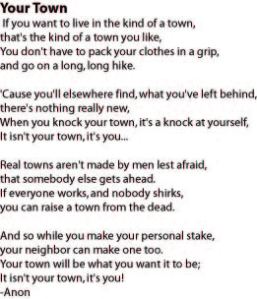
She then recited one of the poems, which speaks of an individual’s role in building up their community.

The poem, "Your Town," is one of Sharette's favorites.

The poem, "Your Town," is one of Sharette's favorites.

“These are the kinds of things that I learned growing up,” Sharette explained, “After a while you see everything in the context of moving forward.”

They are the kinds of things that Findlay also hopes to transmit to her own children and to the students at APA and SNA.

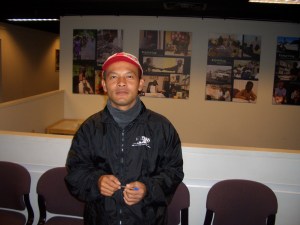
Findlay told of a day that she visited the Granite Peaks adult ESL program for immigrants and refugees, looking for parents who might be interested in enrolling their children in the new school. Her son Bradley, then 8 years old, accompanied her. As she walked in, they saw a row of 12 pictures along one wall.

The photos were of the adult ESL students and included short, personal bios, Findlay said. The students told their names, where they came from and why there are in America. Many had goals to return, someday, to their own country, she said. She was touched by the images, but more so because her son was there to see them first-hand.

“My son got to look down this wall and get exposure to 12 different countries in 10 minutes,” Findlay said with emotion in her voice. He was getting an education, she said, the education of diversity that she hopes is replicated at the School for New Americans.