Salt Lake County faces refugee-housing crisis

by MATT BERGSTROM

At the end of 2007, Salt Lake County Community Resources and Development commissioned a report on the housing situation for refugees within the county. The report, published in December 2007 by Wikstrom Economic and Planning Consultants Inc., revealed a dire situation.

According to the report, Salt Lake is what is known as a “highly-impacted community.” When compared to other counties of relatively similar size, Salt Lake has resettled a disproportionately large share of refugees.

The report gives a number of reasons for this discrepancy. Refugees tend to be very successful here due to Salt Lake’s constantly expanding job market. Simply put, more jobs means the county needs more people to fill them.

Perhaps the main reason is the family-friendly atmosphere of the city. Many refugees who come to the U.S. have large families, of which Salt Lake is traditionally more accepting. Almost one-fourth of the families resettled in Salt Lake in 2007 had 5 or more people in them; with some having as many as 11.

Resettling large families in Salt Lake also leads to large numbers of secondary resettlements. This is when a person, or group of people, decides to relocate to a city to be closer to family after having already been resettled in another part of the country.

But with a steadily growing job market and a near-constant stream of new residents the vacancy rates in apartments in Salt Lake is low. And when vacancy rates are low, rent tends to go up. This is especially true of larger units that are needed to house the larger families being drawn here.

According to the Wikstrom report, an annual income of more than $24,000 per year is required to afford an average priced, one-bedroom apartment in Salt Lake. The average refugee works a minimum wage job and earns about half that amount. This means multiple earners are needed in the home just to afford the cheapest possible option.

Adaptation to apartment life is another housing problem facing refugees. Many who come to the U.S. are coming from refugee camps in Africa or Asia, and often have never lived anywhere else. These camps are not always equipped with the modern conveniences of a Salt Lake apartment.

“Sometimes you have to teach people how to use a light switch,” said Patrick Poulin, resettlement director for the International Rescue Committee in Salt Lake. He and his caseworkers assist refugees assimilating to their new surroundings.

“Imagine having to teach someone that, then have to teach them about a lease, or paying utilities,” he said.

This concern resonates with other refugee care organizations. At a recent refugee service provider network meeting, held by the Utah Department of Workforce Services, housing problems ranging from cooking in apartments with open flames to a bedbug infestation were discussed.

Situations like these make landlords wary of allowing other refugees to rent their units in the future.

Fortunately, local government has not turned a blind eye to the situation. Early in 2008, the Department of Workforce Services opened the Refugee Services Office. It was created with the intent of coordinating the many agencies and nonprofit organizations that work to help refugees in and around Salt Lake.

Gerald Brown, the director of the Refugee Services Office, feels the number of refugees coming to Salt Lake is not going to slow down any time soon. “People will not stop coming here as long as they can get here what they can’t get there,” Brown said.

Salt Lake City has also begun to explore other solutions for the housing crisis. In January 2008, just after the Wikstrom report was released, the Community Resources and Development division of the Utah Department of Human Services assembled a committee to find a solution. The committee, comprised of refugee service caregivers and local business owners, came up with an idea to build temporary housing specifically designed for recently resettled refugees.

The facility, which is being referred to as “welcome housing,” would not only be a place for refugees to live for the first year or two in America, but would also provide onsite casework assistance with a goal of eventual acculturation. This staff would include people to help teach refugees the basics of apartment living in a safe atmosphere where they can develop these skills before having to find permanent housing on their own.

The projected 50-unit project is still far from fruition, said Dan Lofgren, president and CEO of Cowboy Partners, a real estate development and property management company based in Holladay. Lofgren is also a member of the state housing committee.

Until somebody steps up with funding for the project, he said it would never be anything more than an idea. But even money won’t permanently fix the problem.

“There aren’t resources available to build our way out of this,” he said.

The Wikstrom report came to a similar conclusion. According to the report, there needs to be better training to teach refugees good renter practices. Availability of housing is not a panacea for the rest of a refugee’s life as a U.S. resident.

Sudanese ‘Lost Boys’ in Salt Lake City seeking a better life

by REED NELSON

The store is hectic, so much movement that the one focal point is the bustle itself, each individual indistinguishable to the glancing eye. But to those who know the store, it is organized, but not in the casual sorted order consistent with the ordained rules of a normal grocery store.

“We have our own way of doing things in here,” said Simon Kuay, 33, owner of the K&K African Market, and a Sudanese “Lost Boy.” This is the unique way in which the Lost Boys go about, and generally succeed, in living life. They have managed to channel their life experiences into productivity, responsibility and in some cases, an education.

The Second Sudanese Civil War began in 1983, when northern Sudan, which had become economically and religiously divided from the south, imposed its religous will of then-president Gaafar Nimiery upon the south. Nimiery wanted to transform the southern part of Sudan into a Muslim Arab state.

That same year, the Sudanese People’s Liberation Army began secession plans and the government retaliated. It would then escalate into a full-scale civil war and eventually, raids on villages and towns.
In 1987, that civil war displaced 27,000 kids, mostly boys, from Sudan. They traveled for two months to Ethiopia, only to be turned away. For two years they tried to return to southern Sudan until they found refuge in Kenya.

Nineteen years later, Salt Lake has become not only a safe haven, but also a permanent home for some of these refugees. Now there are 90 of these “Lost Boys” enrolled at Salt Lake Community College, and a growing list of alumni.

Augustino Kuol, a student at SLCC and the current president of the Lost Boys and Girls Association, finds his experiences here slightly different than growing up on the road, or as a temporary high school student in Kenya.

“Being here allows me the opportunity to try to rise up,” Kuol said. “But I still wish my circumstances were a little more fortunate.”

Even while Kuol excels, he often finds himself in situations where family would normally come into play. He has not seen his family since he began his journey from Sudan. However, these are the times that the Lost Boys’ friendships, friendships forged in the midst of unspeakable turmoil, come in handy.

“These boys tend to stick together because, growing up, they had to,” said Cindy Clark, who runs the Sudanese Student Association at SLCC.

These kids have had experiences varying from being targeted as children in a civil war to watching close friends die. “Kids have shared stories with me in which they went from being at makeshift [refugee] camp talking,” she said, “to seeing a lion grab a boy and take him away.”

Clark said they have not let these experiences affect them. “You would think that they would have Posttraumatic Stress Disorder or something,” she said. “But they just take it in stride, move on, they know no other life than the one they lived. No traditions can hold them.”

Clark knows the students are not exactly given every advantage as they begin their schooling. But a majority of their time, she said, is spent working twice as hard as those students attending school for the sake of attending school.

“The ones that make it here tend to be the cream of the crop,” she said. “They were also lucky enough to escape the refugee camps.” Clark said they are lucky indeed, because the U.S. government might allow only 20 people from a camp entry into the U.S via a lottery.

A fine line runs between the margins of society and the fabric of society. They have climbed from the lowest of lows, from permanent exile, from the seemingly never ending persecution, Kuol said, across an ocean, to a life that they have improved. 

“You think these kids would have been discouraged long ago?” Clark asked. “They weren’t. They always smile, the happiest kids I know. They have stayed alive being optimistic.”

Diversity is complicated for refugees in Utah

by BRADY LEAVITT

In a state that is 93 percent white, Gerald Brown represents diversity.

Brown is white. He wears bow ties and peers through round-rimmed glasses. When asked if he speaks foreign languages, he says, “Only Southern.” When asked what his epitaph might read, he says, “A Holy Man.” And when asked if refugee caseworkers are tough, he says without hesitation, “Shit.”

Brown, 57, is the director of the Refugee Services Office in the Utah Department of Workforce Services. He works as a sort of traffic cop at the intersection of politics and nonprofit groups, coordinating efforts to help refugees integrate into Utah’s communities and culture.

Brown became director of the Refugee Services Office in February 2008 after Gov. Jon Huntsman Jr. ordered its creation. Huntsman and the state legislature appropriated $200,000 to fund the office, the first time state money has been provided specifically for refugees. The sum is small, Brown said, less than 10 percent of the money he receives from the federal government. However, it as a sign that the state is willing to invest in refugees, he said.

“I need Huntsman for another term,” Brown said, referring to the upcoming elections. “He gets it.”

A self-described “lefty activist type,” Brown wants democratic Sen. Barack Obama to be elected president in November. He figures that with a Democratic president, Republican Gov. Huntsman will be re-elected in Utah and not called to a cabinet position in Washington.

Before Gov. Huntsman’s executive order, the Refugee Services Office consisted of “one guy and a cubicle,” Brown said. Now the office has six employees and one volunteer coordinator.

While he enjoys working in Utah, Brown’s fondness for the state and its governor only goes so far. He expressed frustration with the organizational difficulties of his job. One of his office’s goals is to build a network of trained volunteers to assist caseworkers. But, he said, the bureaucracy is slowing it down.

“Do we have trained volunteers on the ground yet? Nope. Because we’re still meeting,” Brown said.

Brown began his work in the field of refugee services assisting Cambodians at a YMCA in Houston in 1981. It was his first-hand experience that inspired him to be an advocate and an activist. The most effective activists, he said, are those who have had similar exposure to diverse populations.

Brown both praises and criticizes Utah in this respect. He accuses many Utahns as being insular and in many cases ignorant when compared with other groups of people he has worked with.

Peter Robson works as an interpreter for refugees at the Asian Association of Utah. He said that he included his work experience at a refugee resettlement agency on his resume. As he interviewed for jobs this past summer, many employers would ask him about it.

“These were well-informed people, but they were surprised that there were real refugees in Salt Lake,” Robson said.

According to the U.S. Census Bureau, Utah’s population in 2006 was identified as 93.5 percent white and only 5.1 percent black, Asian, Native American or Pacific Islander.

Robson, 23, is a native Utahn. Growing up in his east Salt Lake City neighborhood he was separated, and not just from the refugee community, he said.

“It’s easy to insulate yourself and separate yourself from anyone who is less-privileged,” Robson said.

Robson said his experiences working with the refugee community have changed his underlying career goals – salary and other considerations are no longer as important as the satisfaction that comes from helping people.

Robson is similar to many people that Brown knows in Utah. Brown said he is baffled by how simultaneously sheltered and eager the volunteers he finds here are.

“Utah County is the volunteer capital of the U.S.,” Brown said, “It’s like the perfect job.”

Brown said that diversity is edifying and that people need to begin to realize that the world is getting smaller and people are more reliant upon each other than ever.

While Brown may feel that Utah is not a hub of diversity, he maintains that Utah is the “Wild West for resettlement work,” meaning that he feels so much is possible because people and organizations are so willing to help. And despite his criticism insularity, Brown said that one of the reasons it is so easy to work with people in Utah is that they are conservative and relatively nondiverse. ”

They have no complicated experiences,” he said, “and people seem generally nice.” Brown epitomizes in many ways the unique and unlikely diversity of Utah.

Diversity, Brown said, is a two-way street – a street on which he directs the traffic.

And doing so, Brown said, “I have had the privilege to get to know the world.”

Issa Moursal, determined not to fail

by BRAD TAGGART

Issa Moursal was riding in a truck with his cousin when he felt a burning sensation on the back of his neck. As he reached back to feel what had burned him he noticed blood running down his neck and soaking his shirt.

“I looked at my cousin and the same bullet that grazed the back of my neck had hit my cousin and killed him,” Moursal said. He sat and reflected for a second remembering the terrifying moments.

Moursal, now 38, grew up in Chad, Africa, in a French colony. Moursal had aspirations of becoming a lawyer. He studied hard and for long hours with that goal in mind. He would walk to school with no shoes, and sit under a tree for class, which was typical in Chad where the economy struggled.

Scenes of Niger, Africa. Photos courtesy of Issa Moursal.

Scenes of Niger, Africa. Photos courtesy of Issa Moursal.

In school, Moursal learned to speak two languages. French was his primary language and Arabic was his second language.

He attended high school in Niger and would visit home during his summer vacations. One particular summer Moursal returned to his village for vacation. As Moursal and his sister went to get firewood some government officers from Chad approached them. The officials asked Moursal to tell them where his father was. Moursal’s father was an officer in a rebellious tribe that was trying to overthrow the government. Moursal refused to tell them.

“I knew if I told them [where my dad was] that they would not only kill him, but kill me also,” Moursal said. “So I refused to tell them and they started beating me.”

Moursal’s sister pleaded with him to tell them but Moursal knew the consequences and kept his fathers whereabouts secret. The officers arrested Moursal and took him to a city about 20 miles from his village where he would spend the next week in jail.

While in prison Moursal came in contact with a Catholic priest who knew Moursal from his congregation and had sent Moursal to school in the first place. The priest asked city officials to release him and they did.

After being let out of prison Moursal left for Sudan where he would begin fighting for his tribe and against the government.

“The government is corrupt in Chad,” Moursal said. “They can arrest you for not even doing anything and can kill you if they want with no reason.” Moursal’s tribe joined forces with another and together, they were able to overthrow the government in December 1990.

Issa Moursal holds a traditional mask from Niger. Photo courtesy of Issa Moursal.

Issa Moursal holds a traditional mask from Niger. Photo courtesy of Issa Moursal.

Afterward Moursal was assigned to be part of the security team that would protect the new vice president. Things remained calm for a period of time until the tribe that had helped to overthrow the original government decided to try to take over the new government.

Moursal and his cousins were in a truck protecting the vice president when they were shot at. Moursal recalls the situation being frantic and chaotic. “That is when I felt the burning on my neck,” Moursal said. “I looked and my cousin was dead.”

The fateful event led Moursal to decide to flee Sudan and seek protection. “I had to go into hiding for just a couple of hours,” Moursal said. “Then I traversed across a river and then was smuggled across the border to Nigeria and then to Niger.”

By the time he arrived in Niger, his neck was badly infected. “I went to the University hospital and met a nurse from my tribe to help with my infection,” Moursal said.

Even though Moursal had escaped the war he still had the desire to fight for his people and go back. “The nurse convinced me to stay,” Issa said. “She told me go to talk to the United Nations and they would help me.”

An official from the United Nations listened to Moursal’s plea and decided to protect him with the stipulation that Moursal study and then work for the United Nations. He agreed.

For the next two years Moursal began to realize his dream yet again. He had two years of law school under his belt when he was awarded a scholarship.

After getting the good news of the scholarship, Moursal encountered yet another obstacle in his path. The United Nations had enough lawyers and needed to pull Moursal out of law school and place him in a technical school. He agreed to continue and finished his degree in library science in spite of not being able to become a lawyer.

After a seven-year stay with the United Nations Moursal was offered the chance to come to the United States as a refugee. “They came and interviewed us to see if we could make it in the States,” Moursal said. “I was not convinced that I would be going but knew I had as good as chance as any.”

Moursal was one of 3,000 possible candidates to come to the U.S. Only 27 were selected; he was among the 27.

When granted asylum by the U.S. Moursal needed to find an organization that would accept him and help him with the transition. He came in contact with the International Rescue Committee, which helped Moursal with the final details of his arrival.

On June 4, 1997, one year after Moursal was asked if he wanted to come to the U.S. he arrived in Utah. He was a little different than most of the refugees, though. Usually a refugee needs help getting started.

“Finding a job, paying bills, and other tedious tasks can be a big problem for newcomers,” said Michelle Amussen, a student in the Occupational Therapy program at the University of Utah, who helps the new refugees get settled.

“Most of the time they don’t speak any English at all and this seems to be their biggest downfall,” Amussen said. “If you can speak English it is much easier to find a job, understand mail and paperwork, and navigate through the system.”

Two weeks after his arrival Moursal’s resilience began to shine. He found his first job without the help of the IRC at a Marriott, booking rooms in French.

“I don’t want to be a parasite for society,” Moursal said. “I want to be able to do it on my own and be successful.” He is currently working at Franklin Covey as the International Operation Coordinator and is studying business at the University of Utah working toward his MBA.

Issa Moursal with Mona and Melissa.

Issa Moursal with friends Mona and Melissa. Photo courtesy of Issa Moursal.

“Life is good here,” Moursal said. “I have a successful job and a nice house a beautiful and wonderful wife and two kids.”

“We [the Moursal family] are raising money so they can build wells for the village.” Moursal said. “This is what drives me to get my Ph.D. and get more money so I can help more people. What keeps me here is that everyone in the village has this hope for me to succeed. You have all these people looking up to you and you don’t want to let them down,” Moursal said.

“Success is easier to come by here in the states,” Moursal said. “There are many opportunities to get a good job and support your family.”

Moursal has had a big advantage coming to the U.S. with an education and a background learning languages. “English is the key to success here in the States,” Moursal said. “If you do not speak English you will be stuck with a low-paying job and not be able to move up.”

Issa Moursal's son, Quintin. Photo courtesy of Issa Moursal.

Issa Moursal's son, Quintin. Photo courtesy of Issa Moursal.

Moursal has lived in Salt Lake City for 11 years. His continued success is warranted by his determination not to fail. “I still have the scare that reminds me of where I have been and what I have survived,” Moursal said. “I know I can fight through almost anything.”

LDS Humanitarian Center and Inner City Project helps refugees

Story by MICHAEL OLSON


  • See a slideshow about an English class provided by the LDS Humanitarian Center and hear from a service missionary (best viewed in full-screen mode)

Amy Wylie, 49, and her husband have been volunteering with The Church of Jesus Christ of Latter-day Saints in the Inner City Project for nine years. They started volunteering with the project as service missionaries in a ward in Salt Lake; now they serve as assistant directors of refugee services for the project.

This is their church calling. They turned in their missionary application papers to serve a 30-month service mission, the longest term a service missionary can serve without resubmitting another application.

The LDS church has several programs designed to help refugees adjust to life in Utah. One of them, the Inner City Project, helps prevent people from getting lost in the transfer between agencies giving care to refugees.

For example, at the International Rescue Committee most refugees only have six months before their case is transferred to another agency. However, the Inner City missionaries are always available to help and give service.

“Service missionaries play a bigger role longer term,” Wylie said.

Service missionaries are not the same as the church’s full-time missionaries who spend every day proselytizing. These missionaries are there to help people in the area, whether they are members of the church or not.

About 500 service missionaries currently serve in Salt Lake City. They are not specifically assigned to work with refugees, but it is part of their overall assignment in the ward, or area in which they work.

“When you are assigned to a ward you become a part of that ward and you take what ever the bishop asks you to do,” Wylie said. When missionaries are assigned to work in an area with a large refugee population it is likely the bishop will send them to assist them.

“We serve as a resource to help train. If they have questions and don’t know where to go they will call us and we will help them figure out a plan of action,” Wylie said.

They also help refugee children enroll in school and make sure they are getting the attention in class they need.

“We met one of the lost boys of Sudan in our first mission assignment,” Wylie said. Wilson was 7 years old when he was separated from his family during an attack on his village. He ended up in a refugee camp and hasn’t seen or heard from his family since.

Wilson met the Wylie family during church. He would sit with the family every week because he felt comfortable with them.

One Sunday he handed Wylie a note.

“It said ‘Could I have a picture of your family to remember them by?’ and I realized that he had no picture of a family, he didn’t belong to a family,” Wylie said.

The Wylies went to Temple Square where they took a family picture with Wilson in front of the temple.

Now Wylie shares her copy of the picture with people every chance she gets. She feels that people think it takes too much effort to make a difference in people’s lives.

“Look how simple it was. He now calls me mum and my children his brother and sisters,” Wylie said.

The Inner City Project also plays a role in finding refugees jobs. Missionaries help them find work at the LDS Church Humanitarian Center and at the Deseret Industries.

“It is set up to train them and help them learn skills and move them out to the work force,” Wylie said.

The LDS church established the Humanitarian Center in 1991 in Salt Lake City. It is located on the corner of 1700 South and Bennett Road. According to its mission statement, the center’s mission is three fold: “To prepare emergency relief supplies for shipment worldwide, to train those desiring to develop employable skills and become self-reliant and to offer service opportunities.”

The Humanitarian Center provides various skill training for refugees. They learn computer skills, they attend job etiquette classes to learn appropriate behavior in the work place, and they learn English. A teacher from the Granite School District teaches ESL classes, said Bart Hill, the center’s development manager.

During 2006, 175 refugees were employed at the Humanitarian Center. They are involved in sorting and bailing clothing. Items are sent to areas around the world where they are distributed to the needy.

They also put together packages the Humanitarian Center distributes, including hygiene kits filled with combs and toothbrushes, newborn kits filled with diapers and bottles, and school kits filled with rulers and pencils.

To obtain a job at the center refugees only need an endorsement from the bishop of the area they live in, as well as documentation proving they can legally work in the United States.

They manage the language barrier with help from interpreters who work with local relocation agencies. Some refugees have even learned English well enough to translate for those who need it.

Refugees working for the Humanitarian Center earn wages ranging from $6.55 to $9 per hour. They can earn more in the clothing sorting and bailing departments if they prepare shipments quickly for transport.

A refugee’s job performance is evaluated on a quarterly basis to make sure their work skills are progressing. Once refugees have worked for a year at the Humanitarian Center they are better qualified to work other jobs, Hill said.

“The great thing here is assisting them as they move toward self-reliance,” Hill said.

Luna Sasa, 28, works as a sorter in the medical supplies department at the Humanitarian Center. She helps gets the emergency medical supplies ready to be shipped.

Sasa was born in Sudan. She fled eight years ago with her mother, sister and her then 3-year-old daughter because of war.

She kept getting laid off because she lacked certain skills other jobs required. She was looking for a job she could hold down. Then she heard about the skills training program at the Humanitarian Center from the bishop in her area.

“I went to the bishop and he gave me the paper, and I started working here,” Sasa said.

Since Sasa has started working at the Humanitarian Center she has learned how to use a computer, how to type and how to use programs like Excel and PowerPoint.

Eventually Sasa wants to study at LDS Business College to become a medical assistant.

“Refugees need a lot of friends,” Wylie said. “They need people that just welcome them and take them into their neighborhoods and communities and school systems.”

Wylie and her family invite these friends over to her house in Salt Lake to celebrate holidays together.

“They are still a big part of our family. One night we had about 11 languages in our home,” Wylie said.

Whenever she hears that one of the refugees she stays in touch with has had a child, Wylie rushes over in her van that she has filled with boxes of supplies she gives to refugees. She gives the new parents a box overflowing with baby clothes and blankets.

“They aren’t assignments to us,” said Wylie, “we consider them our brothers and sisters.”

Salt Lake City is fighting human trafficking

by BRAD TAGGART

Human trafficking usually starts with despair and a desire for something better and often ends in tragedy. Human trafficking is the act of illegally transporting victims for slavery from one country to another. It has become increasingly common around the world.

Human trafficking is a multi-billion-dollar industry that relies on hopelessness and unawareness as a means of luring individuals and families to be tricked and sold into slavery. Deborah Bulkeley, a reporter with the Deseret News who has written several articles on human trafficking in Utah, said the majority of victims are women who are usually forced into prostitution.

“These women work just as any other prostitute would but do not receive any compensation for what they do, but rather get abused and suffer for their work,” Bulkeley said.

It is estimated that more than 12 million people are victims of human trafficking; 80 percent are female and 50 percent are under the age of 18, according to the End Human Trafficking Web site. Between 600,000 and 800,000 victims are trafficked across international borders every year and the numbers continue to increase.

Utah’s legislature is now stepping up to the challenge of combating human trafficking locally as well as nationally.

In 2006, The U.S. Department of Justice announced that Salt Lake City would receive $450,000 in grants to supplement a new human trafficking task force. The main priority is the proper training of law enforcement.

“One of the big needs is training of basically everyone from law enforcement to first responders to anyone who could be in a position to identify a case of human trafficking,” said Melodie Rydalch, public information officer for the Utah office of the U.S. Attorney. “We are convinced there are cases out there. We just need to look closer and ask more questions.”

Efforts to identify and prosecute human traffickers are being stepped up. The 79 national convictions involving human trafficking in fiscal year 2006 were more than double the convictions the previous year. Utah had two of those convictions.

With the success comes the knowledge that more needs to be done.

A few different organizations focus on the victims of human trafficking. The International Rescue Committee, headquartered in New York City, has a refugee resettlement office in Salt Lake City

Victims of human trafficking usually arrive at the IRC after they have been found, rescued and stabalized. “Most of our work is to stabilize the refugee until the persecution has stopped and then get them resettled into the country,” said Patrick Poulin, resettlement director for the IRC in Salt Lake.

“It’s important to establish protocols for helping victims once they’re rescued,” Rydalch said.

A second organization is the Utah Health and Human Rights Project. The agency “promotes the health, dignity, and self-sufficiency of refugees, asylees, and immigrants who have endured severe human rights abuses, including torture, war-related trauma, and human trafficking,” according to the UHHP Web site.

Catholic Community Services of Utah is another support group for refugees. CCS “provides comprehensive resettlement services to refugees from various regions of the world,” according to its Web site.

All agencies need volunteers and donations. IRC Salt Lake City, for example, is seeking warm winter clothing, comforters, gift cards to local grocery stores and other items. The office also holds orientation sessions for individuals interested in volunteering.

 “Money is a powerful tool,” Poulin said. “With money we can actually support these victims and give them food and shelter.”

Adapting to a new home in Salt Lake City

by BRAD TAGGART

Have you ever been in an airport and seen a person or family holding a small white bag that says IOM in blue writing? Unless you know exactly what you are looking for, these bags may seem pretty common. However, the bags tell a surprising story that is both incredible and often very sad.

The International Organization for Migration gives these bags to refugees to carry all of their belongings. The small bag, no bigger then a grocery sack, has plenty of room for this task.

Refugees, whether alone or as a family, come from all over the world. Some countries include Ethiopia, Somalia, Burma, Vietnam, Cuba, Bhutan, Iran and Iraq. Many have experienced war, poverty or other hardships that make it necessary to begin a new life far from home. Since January 2008, a total of 388 refugees have been resettled in Utah. Another 75 to 100 are expected to arrive by the end of 2008, said Patrick Poulin, resettlement director for the International Rescue Committee in Salt Lake City.

“When I arrived here in the States there was a shock that went through my body,” said Regina Barbouza, 42, a refugee from Brazil. “I was scared and felt alone but was happy to be safe.”

Some people arrive not knowing what to expect. Many times the families have lived in refugee camps all of their lives. Barbouza and her three children, David, 11, Angelina, 9, and Jose, 6, lived in a small camp before being resettled in the US. They had no running water. Wooden walls provided some shelter from the elements; the floor was dirt. Barbouza declined to comment on the actual reason for fleeing Brazil, but said if she and her family had stayed, she would most likely not be alive today.

Gerald Brown, director of the Refugee Services Office in Salt Lake City, oversees the resettlement process for people who are arriving here for the first time. Many of them are just “fighting for their existence,” Brown said, regarding their state of life.

Brown started working with refugees in Cairo, Egypt. He said he found his “true calling” during the two years he spent there. “It was so crowded [in Cairo] people lived in graveyards. There, I learned the world was not fair,” Brown said. After serving the people of Egypt from 1976 to 1978, he decided he had found his path and began to focus on helping those who could not help themselves.

After a stint in Taichung, Taiwan, teaching English and studying Mandarin, Brown resettled in the US. From 1981 until he accepted his current position with the Department of Workforce Services in May 2008, Brown held a variety of jobs that allowed him to work with Bosnian, Iraqi, Haitian and Cuban refugees.

Six months into his new job, Brown has discovered that helping can be challenging. “With the economy crisis as it is, it has been very difficult to get the support we need,” he said. “We need money. Money for gatherings, clothes, beds, funerals, activities and any other basic needs.”

Brown described a scene of a new refugee family from Karen that is in need of such support. “As you walk in the apartment door of a Karen family, for example, you see shoes left at the door,” he said. “After you take off your shoes they bring the only chair they have for you to sit on. They offer watermelon and bring letters for you to read. Bills, school letters and others all in English.”

The Refugee Services Office helps people understand correspondence, enroll their children in school, find jobs and locate suitable housing.

“If you want support from someone, take that person to visit the refugees in their new home,” Brown said. “Once you see these people and get to know them you will have no problem getting the support you need.” 

The International Organization for Migration continues to safely bring refugees into the country and organizations like the International Rescue Committee and Refugee Services Office help once they arrive in the United States. These organizations persist in the ongoing battle of resettling refugees like Regina Barbouza and her family who need a safe haven and a new start.

Burmese refugee liking life in America

by BRETT PERFILI

Every year immigrants and refugees come to the United States seeking change, looking for opportunity and trying to discover some success in their new country. And as most Americans wake up on weekdays and head to work to make a living, Sebastian Palsuk, a Burmese refugee, is right there with them doing the same.

Palsuk, 31, has been living in Salt Lake City since he arrived from Malaysia in 2007. He is currently working for the LDS church at the Humanitarian Center on 1665 S. Bennett Way. He works in the production area, where he sifts through carts full of clothes sent from all over the country. He sorts the clothes, separating items that are in better shape from those that are more worn. The clothes are then moved to be sold at Deseret Industries stores located around the country.

He enjoys his job and everything about the United States.

“Whatever I want to do I can. Policy is very good for me,” Palsuk said. “If I want to work I can.”

Palsuk left behind a world of frustration where he was beaten and jailed. He once lived in a place where every move he made was monitored. Palsuk was told what he could and could not do. Here in the United States his world of aggravation has morphed into a land of freedom.

However, this was not always the case. He was a teacher at a primary religious school in a Christian village in Burma during the 1990s. One day the Burmese military showed up at the school and told Palsuk that he needed to allow Buddhists in his school. Palsuk did not like the idea, because he does not agree with Buddhism and did not want students of that religion attending his school. He was beaten for being uncooperative. Members of the military struck him in the head and pulled him out of the school. He was then arrested and sent to jail for four months in Burma.

Palsuk said that is something he will never forget, but wishes he could.

After he was released from jail things did not get any easier. His father advised him to move to Malaysia. There he was arrested again for not having a passport. He was sent to jail for a year.

Palsuk said the prisoners were always sweaty from the heat and dizzy due to the lack of food.

At night, when guards and prison workers could not see them, a group of Christians would gather and secretly pray and worship. The jail tolerated no religion of any kind, and if caught the prisoners were punished more.

“Every day we make worship and devotion,” Palsuk said.

When he was released from the Malaysian prison he learned he was not allowed to return to Burma, unless he wanted to go back to jail there.

So, he applied to get into the United States as a refugee. He was eventually granted permission to make the journey to America.

When he arrived in 2007, he worked with the International Rescue Committee in Salt Lake City to get started on the right foot. In December of 2007 he joined the IRC as an interpreter for incoming Burmese refugees. He found this helped him to learn to speak English more fluently. The IRC is an organization that helps the resettlement process for refugees by arranging places to stay, resources and providing finances.

The first job Palsuk landed was working for a Crystal Inn in Salt Lake City as a housekeeper. However, he was not learning about America and lacked communication with Americans, so he decided to quit and try to find a job where more interaction with people existed. Learning to speak English is Palsuk’s top priority.

His current job at the Humanitarian Center is ideal.

“I get more experience and also know more English,” Palsuk said.

Bart Hill, the center’s development manager, enjoys working with Burmese refugees.

“They are hard working,” Hill said. “They want to improve their situation. They have as good or better work ethic than others.”

Palsuk is doing just that.

He has his high school diploma, and is taking English classes at night through the Humanitarian Center. He plans to attend Salt Lake Community College. He said he wants to be a businessman, but could not find the words to explain exactly what kind.

His job at the Humanitarian Center is temporary; Palsuk is allowed to work there for only one year. But, he knows that what he has learned working there the past seven months will help him when he is forced to seek other employment. The LDS church will assist him with his job search when the time comes.

When he is away from his busy day sifting through used clothes or learning English, he is at his North Salt Lake apartment hanging out with his two Burmese roommates, Mangcung and Zawzawnaing. He likes to gather with them and others and play soccer in the park on Saturdays. He also keeps himself occupied during his free time by working on the Toyota that he was able to obtain through a bank loan.

This is also something Palsuk has found to be a privilege in the United States.

“I want to buy a car, I can,” Palsuk said. “Everyone in my country can’t buy a car. Whoever is working they can buy a car.”

His favorite aspect of this country, though, is the people. He has found Utahns to be very kind and helpful.

“People are good for me,” he said. “When I need help they help me. In my country no way. If you got into trouble they didn’t help.”

And for the people who know Palsuk, the feeling is mutual.

Elease Thompson, Palsuk’s job coach at the Humanitarian Center, loves working with him.

“He is one of the kindest men I have ever met,” Thompson said, making Palsuk blush. “I don’t know why some girl doesn’t snatch him up. He is so willing to help a woman.”

Palsuk’s goal is to become a U.S. citizen in five years.

Although Palsuk has bad memories of Burma and Malaysia, he is on a path to create good memories in his new country.

Bhutanese celebrate holiday, new life in SLC

Story and photos by MATT BERGSTROM

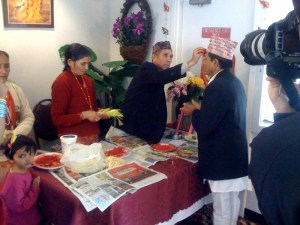
Thursday, Oct. 9, was an important day for Hindus around the world. It was the celebration of Dashera, the victory of the goddess Durga over the demons who stood in the gods’ way during creation.

For a group of Bhutanese refugees in Salt Lake City, it was also a celebration of a different victory.

Thursday was the first time the small Bhutanese community in Salt Lake City has officially gathered since refugees began arriving in the city in April 2008. The gathering was held at the Taj India restaurant at 4515 S. 900 East.

Bhutanese celebration

Bhutanese celebration

For nearly 20 years, these families had been living in refugee camps in Nepal. Most of that time the Bhutanese coexisted peacefully with their Nepali hosts. For the past few years, tense relations between China and Tibet have driven more refugees into Nepal. This flood of new arrivals pushed the Nepali government to its breaking point, prompting officials to make an appeal to the United Nations for help. The U.N. decided to resettle the Bhutanese who had long been without a home of their own.

Nearly 250 Bhutanese have resettled in Salt Lake since April. Among them are many members of the Dulal family.

Biren Dulal, 26, was only 8 years old when his life was uprooted and he moved with his family from his home in Bhutan to a camp in southeast Nepal. Today he barely remembers why he had to leave his home. He thinks it had something to do with the Buddhist government wanting Hindus to convert in the interest of national identity.

The actual reason seems to still be in dispute. According to the Web site for Human Rights Watch, the exodus was based on ethnic reasons rather than religious ones. The government of Bhutan in the late 1990s was interested in establishing a firmer national identity. The dispute is whether ethnic Nepalese in Bhutan chose to leave or were forced out by the government.

Regardless of the reason for leaving, Biren said life in the camp was difficult, but not unbearable.

Refugees were seldom allowed to leave. They had their own schools and shops and most of their basic needs were met. However, under certain circumstances, refugees could get permission to live outside the camp.

Biren left the camp for the first time at 18 years old to attend Kalimpong College in eastern India. After earning his bachelor’s degree he went to Katmandu to teach middle school science. A short time later he decided to return to the camp where most of his family still lived to continue his teaching there.

Soon after, members of Biren’s family began being resettled in the U.S. He decided it would be best if he joined them.

Biren Dulal arrived in San Diego on June 21, 2008. He had been sent to live with a brother and sister who had already been resettled there. Biren did not care for San Diego, but is too polite to say why.

Biren Dulal at the celebration.

Biren Dulal at the celebration.

He was then allowed to join the rest of his other brothers and sisters in Salt Lake City. The former teacher now divides his time between his job as an interpreter for the International Rescue Committee in Salt Lake, the nonprofit group that helped resettle him, and his volunteer work teaching English to other Bhutanese in town.

Ultimately he would like to get back to teaching science.

Travis Zirker, an IRC caseworker for many members of the Dulal family, said getting back to work is a common desire. A few of Biren’s brothers also were teachers in Nepal before coming to America.

One of those brothers is Ghana Dulal, who Zirker said has become a sort of unofficial community leader.

In the small Indian restaurant packed on an unseasonably warm autumn afternoon with almost 200 Bhutanese refugees, guests from various resettlement organizations and members of the press, Ghana Dulal offered a speech of gratitude and, in a small way, victory.

He talked of their hardships while encamped in Nepal and of the warnings they received from friends before leaving. They were told they would not be allowed to be Hindus in America.

In the end, Ghana Dulal summed up what all the Bhutanese were feeling, and what those who have not been there could not understand, when he said, “We are no longer refugees. We are free people.”

A big change is coming for the IRC in SLC

by MATT BERGSTROM

Imagine you have just contracted a life-altering disease. You find a specialist who knows how to treat it and the two of you work together to improve your quality of life. Now imagine that after six months you are told you have to go to a new specialist. The new doctor is just as qualified, but knows very little about your specific needs. You now have to go back and find a system that works for you both.

This is what life is like for newly arrived refugees in Salt Lake City. They are given six months to grow accustomed to one aid organization, and then their case is handed over to another, Patrick Poulin said. Poulin is the resettlement director for the International Rescue Committee in Salt Lake.

The IRC is an international nonprofit organization that specializes in resettling refugees from around the world in the United States.

The IRC is also the first doctor in the scenario given above.

When the U.S. State Department decides who will be given a new home here, they approach groups like the IRC and ask them how many refugees their organization can take on. The IRC then gives them a number. When the two agree which cases will be handled, the IRC is given all the information on each person being resettled.

The next job is deciding which of the IRC’s 17 U.S. regional offices will handle each case.

Once the local office has the information and has arranged for the refugee to enter the country, the staff have six months to do everything they can to help people get resettled and become self-sufficient.

According to the IRC’s Web site, staff and volunteers work together to help refugees obtain “the tools of self-reliance: housing, job placement and employment skills, clothing, medical attention, education, English-language classes and community orientation.”

This is where the second specialist gets involved.

After six months of assistance from the IRC the refugees and their cases are transferred to the Asian Association of Utah.

The AAU, which is also a nonprofit organization, works with refugees to improve their situation by upgrading housing, finding permanent employment so they can become completely self-sufficient. The goal of the AAU is to have refugees settled into a job, a community and a way of life that will best facilitate their individual needs.

Both organizations have similar goals, but Poulin says it’s a difficult transition for someone coming from a completely different world to have to adjust to a new aid organization so quickly. That is why he and the IRC have been trying to extend their involvement with refugees from six months to as many as 24 months. Poulin feels this is ample time for refugees to get settled into their new surroundings and firmly anchor their new life in America.

Lina Smith, program director for resettlement for the Asian Association of Utah, agrees with Poulin. “I think whatever works for the refugee, I’m for it,” Smith said.

The AAU currently handles all refugee cases in the state including those managed by other nonprofits.

Smith said the IRC will begin working with refugees for up to two years beginning in January. She feels this will help ease the workload of the AAU’s four full-time caseworkers who currently oversee more than 80 cases each. Her organization will still be there to help refugees who need assistance after the first two years.

Smith and Poulin agree that a more equal share of the responsibility between the two organizations is beneficial for the refugees and the nonprofits. But they still worry about money.

Both organizations receive funding from the State Department, but Smith and Poulin feel that it is not enough. Currently, refugees receive $425 a month on which to live.

Poulin said Gov. Jon Huntsman Jr. has set aside an additional $200,000 from the Utah state budget for refugee services in 2009. Poulin also says The George S. and Dolores Dore Eccles Foundation has promised the IRC a $50,000 grant.

Poulin is convinced the additional funding will help greatly with the overall success of their program. He said, “If we are able to provide more quality services to refugees … then we are successful.”