Rose Park: Diverse in culture, united by community

Story and photo by MELANIE HOLBROOK

The Salt Lake City neighborhood, Rose Park, is well known by its diversity in culture. However, what people may not know is that its groups and councils bring the community together.

Brad Bartholomew, Rose Park community council chairman, said in a telephone interview that groups such as the community council, the Lions Club and the Rose Park Revival are just a few organizations in the community.

“There are also a group of people who mainly like to get together just to hang out and get to know others in Rose Park. They have one or two food drives every year as well,” Bartholomew said.

Rose Park’s community council meets the first Wednesday of every month to discuss what’s happening in its neighborhood, to discuss concerns from community members or organize community events.

The Rose Park Revival, a committee created for fun in the neighborhood, has held events such as the “Crop Swap” and the “Fun-O-Rama.” The crop swap is an opportunity for residents to share produce from their garden and get to know their neighbors.

According to the revival’s website, “The feedback received was very positive but insightful as well. Folks here are so kind that the idea of selling the fruits of their gardens was a bit foreign, when they usually just give them away to neighbors and friends.”

The crop swap allowed people to swap things like Armenian cucumbers for a bushel of apples. The event was held in August 2011 and was a success. “I was even surprised at the quantity and quality of offerings given the late spring and earliness of the date,” wrote Jim Harper, a community member, in a post on Rose Park Revival’s website.

Mario Organista at Westpointe soccer field.

Mario Organista, 20, a Rose Park resident, said his neighborhood “definitely has several ways of bringing people together.”

One unifying activity for Rose Park community members is soccer. Residents from all over the neighborhood come together for games. It gives members a chance to interact and cheer for fellow friends and family. “Soccer games are just full of energy and puts everyone in a good mood. After having a good time with your neighbors, you don’t want to have tension,” Organista said.

Organista has lived in Rose Park his whole life and has enjoyed it. “There’s usually stuff going on for the community to get together and have fun,” he said.

He said a unique way that the community is unified is through there being a lot of different cultures. “There isn’t just one race or culture that is a minority; there’s so many different people, it makes us have more in common,” Organista said.

Spy Hop and UNP: Shining some light on the west side of Salt Lake City

Story and photo by COLLIN McLACHLAN

What if you turned on the radio and heard this: “A young man was stabbed today in a probable gang fight in Bountiful.” Would you be surprised? Now imagine if the radio said it was in Rose Park.

“Stereotypes don’t reflect crime statistics,” said Sarah Munro, associate director of University Neighborhood Partners.

Founded Nov. 1, 2002, UNP is a program that “brings together University and west side resources for reciprocal learning, action, and benefit.” According to its website, UNP collaborates with communities and nonprofit organizations in an effort to “provide access to higher education.” Its drive comes from the idea that education is the key to strengthening both families and communities.

“UNP is not a service organization,” Munro said. “What we do is meet with local nonprofit organizations on the west side and establish partnerships that will benefit the community.”

UNP has many challenges to its work. “The difficult thing is that people want to know what changes are happening,” Munro said.

She said it’s difficult for UNP to measure its success because success doesn’t come from UNP’s work alone. Since its main focus is to create partnerships, UNP finds success when its partners do.

This doesn’t mean that success cannot be tracked. One organization that UNP has partnered with in the past is Spy Hop Productions.

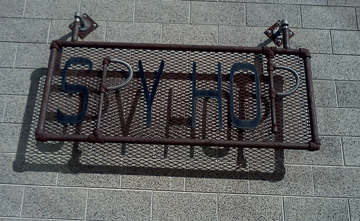
Spy Hop Productions works to help students on the west side.

Spy Hop Productions is a youth media arts and educational enrichment center. Spy Hop’s purpose, according to its website, is to “empower youth to express their voice and with it create a positive change in their lives.”

According to the site, Spy Hop works with some 1,800 students every year in the fields of documentary arts, video production, audio engineering, music and interactive media. Founded in 1999, Spy Hop has been “acknowledged by the Sundance Institute as setting the standard for media arts learning across the nation.”

Students learn things at Spy Hop that go beyond the classroom. “These kids are being taught to express themselves in a positive way,” said Virginia Pearce, director of Marketing and Community Programs in a phone interview. “It gives the kids a chance to be proud of something, which goes a long way.” A lot of students at Spy Hop live on the west side and come from backgrounds which Spy Hop refers to as “underprivileged.”

Spy Hop works directly with its students over long-term mentor-based instruction. The students get hands-on tutoring as they work on media stories, documentaries or music recordings. “There are so many success stories, I couldn’t think of just one,” Pearce said.

Matt Mateus, a programs director at Spy Hop, shared one student’s story that can be counted as a success for both Spy Hop and UNP. He says a student who grew up in Rose Park in an underprivileged family came to Spy Hop wanting to be a recording engineer. But he needed special classes that Spy Hop couldn’t provide. Spy Hop did, however, have contacts with universities that offered those classes. After the student had worked to raise the money, Spy Hop helped to send him to a school in Arizona that had a recording engineer program. “That student now works in Salt Lake where he owns his own recording studio,” Mateus said in a phone interview.

Spy Hop and UNP do still share a common belief that drives each organization. “Preparing students for higher education is directly related to Spy Hop’s programming goals,” Mateus said. The organization collaborates with Salt Lake Community College (SLCC) quite a bit.

“A lot of our students are underserved,” Mateus said. “They usually don’t have the opportunity to jump into the U of U, so they go to SLCC.”

These types of success stories are different from the articles normally published in the newspaper.

Salt Lake City Bicycle Collective offers Community Bike Shop programs to west-side youth

Story and photo by CECELIA FENNELL

The University of Utah Community Bike Shop has a bike on the roof.

The Community Bike shop, located at the Salt Lake Center for Science Education, offers tools and know-how for people to fix their bikes. In addition to providing basic bike repairs, The Community Bike Shop offers youth programs.

Middle-school aged students residing on the west side of Salt Lake City volunteer at this community bike shop and teach other children from that community how to fix and repair bikes. Students learn how to teach the children by taking classes taught by bicycle instructors from the Salt Lake City Bicycle Collective, a nonprofit organization located at 2312 S. West Temple.

Thanks to University Neighborhood Partners of the University of Utah, the Community Bike Shop and the Salt Lake City Bicycle Collective — two organizations with similar missions — were able to partner.

“Through this partnership, volunteer instructors from the collective teach student volunteers how to fix bikes,” said Sarah Munro, associate director of UNP.

According to its website, UNP’s mission  is to “redress historical inequity by understanding systematic barriers that have prevented access to higher education and to rewrite that history so residents of the west side see themselves as holders and creators of knowledge.” UNP serves as a bridge between organizations with similar goals and interests, Munro said.

The Salt Lake City Bicycle Collective was founded in April 2002 by five bicycle enthusiasts: Jonathan Morrison, Edward Whitney, Brenton Chu, Brian Price and Jesse Ratzkin. Its mission “is to promote cycling as an effective and sustainable form of transportation and as a cornerstone of a cleaner, healthier and safer society.” According to the website, the “Collective provides refurbished bicycles and educational programs to the community, focusing on children and lower income households.”

The Collective offers seven programs and services, two of which are youth programs for children living on Salt Lake City’s west side. One, Earn-A-Bike, helps kids learn bicycle mechanics and confidence.

“Kids get to come in, pick out a bike and they get to keep it. The catch is they have to take it all apart and put it back together themselves,” said Jonathan Morrison, executive director of the Salt Lake City Bicycle Collective.

Bike mechanical skills aren’t the only skills learned through Earn-A-Bike. According to the Collective’s 2009 annual report, “In addition to learning bike mechanics, the children are mentored in time and resource management and many students become valuable mentors to their classmates.”

Morrison sees the impact his instruction has on his students, how it affects not only them, but also the kids they will teach.

“The best part was when they used their extra time and knowledge to become a peer-mentor,” Morrison said. “As an Earn-a-Bike instructor, those moments where the student becomes the teacher make it all worth it,” he said.

Another youth program, Trips for Kids, reconnects city youth with Utah’s mountains through mountain biking. Participants are able to take trips to Bonneville Shoreline Trail, the Mormon Pioneer Trail and Liberty Park with the help of adult and youth volunteers. According to the annual report, “Trips for Kids opens up the world of cycling to at-risk youth through mountain bike trips, which include lessons in personal responsibility, achievement, environmental awareness, practical skills and the simple act of having fun.”

Locations of the Bicycle Collective have extended to the Day-Riverside Library, the Ogden Bicycle Collective and the University of Utah community bike shop, located near the Utah Museum of Fine Arts. Each location shares its volunteers and other nonfinancial resources. While services are limited to low-income youth and families on the west side, everyone is invited to volunteer. Students at the U may wish to volunteer at the campus bike shop.

For more information, call 801-FAT-BIKE (328-2453).

Sorenson Unity Center a product of collaborations

Story and photo by DEREK SIDDOWAY

Community gardens, dental services, recreation center and art gallery; the Sorenson Unity Center offers a plethora of activities for residents of the Glendale and Poplar Grave neighborhoods, all rolled into one convenient package.

Built in 2008, the Sorenson Unity Center (formerly the Sorenson Multicultural Center) is the result of combined labors between Salt Lake City, Salt Lake County and various nonprofit organizations. Located at 900 W. 1383 South, the center houses a combination of services — computer labs, fitness facilities and child care, to name a few — that community members can take advantage of.

“The great thing about the unity center is we have so many diverse programs and services,” said Director Nichol Bourdeaux, 36. “It really is a one-stop show for the community members of the Glendale area.” Past examples of the center’s “diverse programs and services” include Planned Parenthood, computer literacy classes, food preservation and canning, relationship and substance abuse workshops and film screenings.

This gallery, located at the southern entrance of the Sorenson Unity Center, features "Reflections" by Alyssa Chamber. It showcases a wide array of human emotion.

Bourdeaux says the community has “embraced” the center and uses it for various public and private functions. However, this “one-stop show” serves more than a stage for community activities. Numerous venues are available for long and short-term rent as well, including conference rooms, theatres and classrooms. The Sorenson Unity Center also allows community members to exhibit their art in two galleries positioned at the south and east entrances. Past exhibits include “Reflections,” an exhibit by community member Alyssa Chamber that explores the spectrum of emotion people experience throughout life’s trials.

“We are really working as a collaboration: nonprofit, community agencies and government agencies providing services to the community. It’s not one entity providing something,” Bourdeaux said. “Because of the variety of programming and services it’s a natural collaboration between all the different cultures; this is their community center.”

Examples include Horizonte, an alternative school that teaches adults English as a second language and basic education classes. KUED’s Ready To Learn Workshop spans a six-month period and covers a variety of parenting classes on topics ranging from child development to anti-bullying and nutrition. Salt Lake Donated Dental operates in the southeastern corner of the center and provides discounted or free dental hygiene services.

Patrons who take advantage of the center’s offerings don’t need to make special arrangements if they have children. Parents can place their children in the drop-off Child Care Center while exercising or attending classes. Children ages 8 weeks through 8 years can be placed in childcare Monday through Friday for as low as $1.50 per hour.

The Computer Clubhouse, a computer lab specifically for children ages 10 and up, allows neighborhood youth to “use technology creatively to acquire the tools, problem solving skills and confidence to lead successful lives,” according to the Sorenson Unity Center’s website. In addition to open access, children can attend scheduled classes such as Lego robotics, engineering, graphic design and film design.

The Sorenson Unity Center houses a variety of nonprofit organizations selected through its Programming Partnership.

Not just any program is admitted, however. In order to ensure the quality of nonprofit organizations, the Sorenson Unity Center developed a Programming Partnership in 2011. Programs must follow the stipulated guidelines in order to use the center. Requirements include proper food and business permits, identifying the Sorenson Unity Center as a partner and adherence to scheduled meeting times. Programs wishing to continue their service at the end of the year-long agreement must be re-approved by the center.

“We are working with 25 local nonprofit organizations that want to provide services to the community for free,” Angela Romero said. Romero is the program coordinator at the Sorenson Unity Center and is responsible for selecting partner organizations.

“Through the programming partnership we have specific guidelines to match what we do here,” she said.

While Romero admits fine tuning may be necessary, she sees the partnership as a vital part in the collaboration between the Sorenson Unity Center and outside organizations.

“Our biggest goal is to make sure everyone in the Salt Lake community is aware of the services we provide,” Romero said. “This place is for them.”

Refugees learn at The English Skills Learning Center

Story and photo by NATHANIEL BINGAMAN

Imagine moving to a new country where you do not know the language and you do not have any formal educational experience. Even holding a pencil is new to some. This is the case for thousands of refugees every year. But, with the help of the English Skills Learning Center in Salt Lake City, these individuals are able to learn basic skills such as reading and writing in English.

Beth Garstka, the volunteer coordinator for the ESLC, said more than 16 million refugees live around the world and more than 1,100 come to Utah per year. These individuals come from countries such as Afghanistan, Egypt and Sudan. They are people suffering from war, natural disasters and famines. They come to America with the hope of freedom and improving their lives, but many of the refugees do not have a formal education.

The ESLC offices are located at 631 W. North Temple. It was originally called Literacy Volunteers of America-Wasatch Front (LVA-WF). Its founding member, Mary Hausen, formed LVA-WF in 1988. She was previously involved with an affiliate in Connecticut.

The organization’s first mission was to help improve literacy in adults and those learning English as a second language. In 2001, due to the rapid growth of refugees in the world and non-English speakers in the community, the organization focused solely on English as a Second Language.

The nonprofit organization is unique because it works with a student’s availability. “If they do not have transportation we will meet them at a library or church, anywhere that is convenient for them,” Garstka said.

Multiple class options are available to the students, including one-on-one classes and small group classes that have four to 10 students at a time. Many students participate in classes that prepare individuals to become United Sates citizens. There are even classes to help parents better communicate with teachers and enable them to read their child’s report card. Best of all, the classes are free.

Students have a good reason to come to class. “We teach the people what they want to learn, not what they don’t have interest in,” Garstka said.

The ESLC focuses on where the students are in their life. For example, if students want to drive so they can get to work, they will be taught to read the necessary books and learn writing skills so they can obtain a driver’s license. If they want to obtain United States citizenship, the ESLC will teach lessons pertaining to obtaining that goal.

Jose Amezcua participated in a program offered by the ESLC while in grade school.

“We teach people simple things like the alphabet or even the proper way to hold a pencil,” Garstka said.

The tutors are volunteers 18 years of age or older. These volunteers go through a 14-hour training session where they learn how to teach reading, writing, listening skills and speaking activities. No previous teaching or tutoring experience is required and individuals do not need to know another language because all classes are taught only in English. For those wanting to volunteer, the ESLC offers information on various volunteering opportunities.

“We have amazing volunteers who love being here,” Garstka said.

When the ESLC first began it had a program called “I Can Read” aimed at elementary students who were reading below grade level. The program was eventually adopted by the Utah State Office of Education and used in schools throughout the state.

“The ESL program helped me a lot,” said Jose Amezcua 29, who took ESL classes while he was in grade school. “Without it I would have had no friends and it would be hard for me to get an education in this country.”

Now a college graduate and an electronics salesman at a local Sears store. Amezcua is grateful for the ESL program and the help he received. “Without the classes it would have been hard for me to go to college and get a job,” he said. “Without a job it would be hard for me to take care of my wife and family,”

Learning a new language is difficult for almost everyone, but The ESLC helps make that transition a little easier.

The Salt Lake Film Society shines the silver screen across community barriers

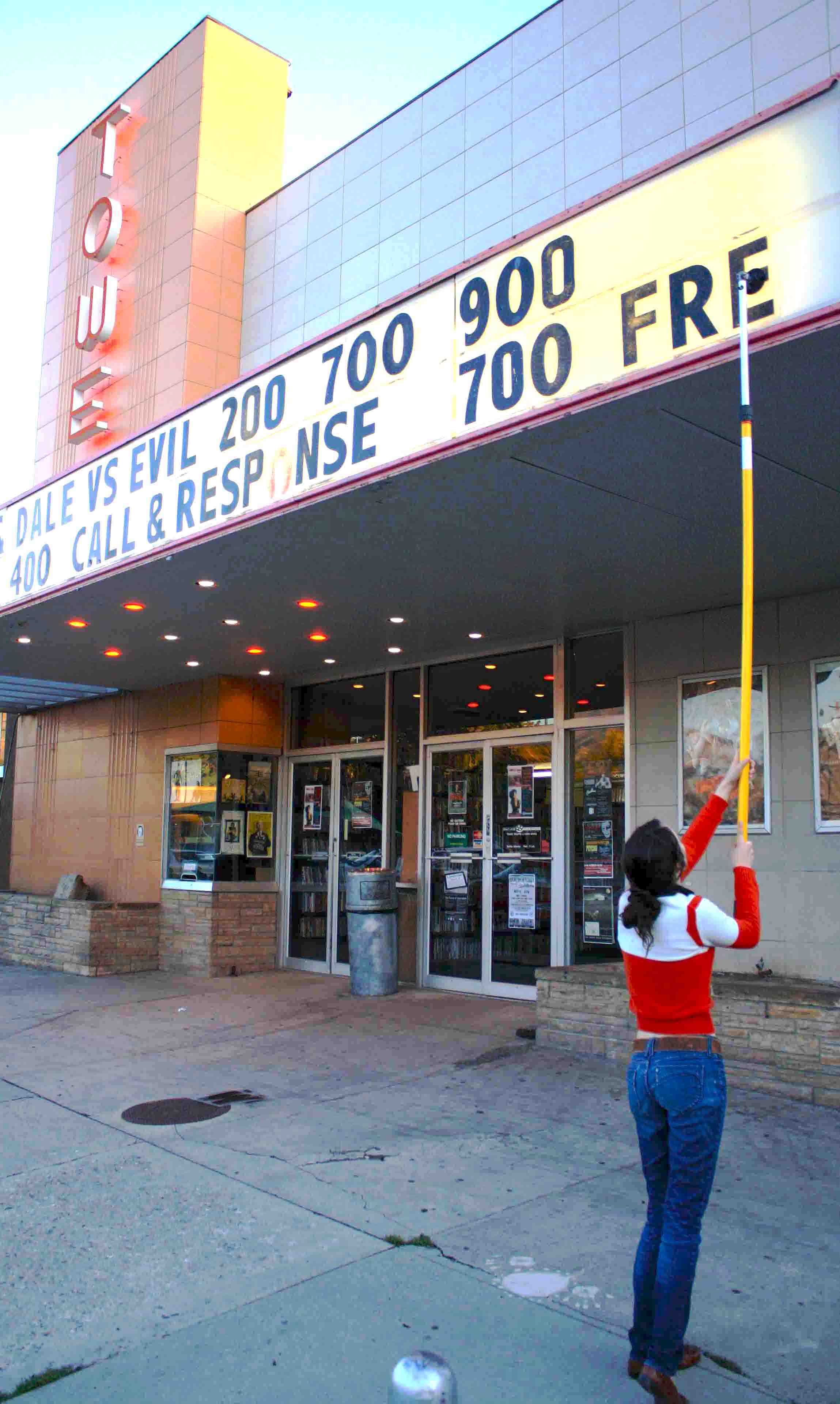
Dagny Horton of the Salt Lake Film Society changes the Tower Theatre marquee for a showing of the film "Call + Response" for the YWCA

Story and photo by ZACK RENNER

As he sits in front of the Coffee Garden at 9th and 9th in Salt Lake, 24-year-old film student at the University of Utah, Jordan Connelly looks paler than anyone should in early September.  It could be his natural complexion or just as well his passion.

Connelly, as well as a film student, has been a member of the Salt Lake Film Society (SLFS) for three years. He spends more than his fair share of time in a cool dark theater expressing his love the best way he knows.

“The quality of life in a community is reflected in how that community nurtures artistic expression within it,” Connelly said when asked what role art holds in a community.  As a community nonprofit organization and art house for the showcase of independent film, the SLFS reflects the culture and diversity present in Salt Lake’s communities.

What began with Kris Liacopoulos’s fight for preservation of the local Tower Theatre in 2001, has 10 years later has grown into what the SLFS mission statement calls, “the premiere film establishment of our community.”

Since its inception, SLFS has endeavored to keep independent film a part of the lives of Salt Lake City community members like Connelly. It currently owns and operates the Tower Theatre in the 9th and 9th neighborhood as well as the multiplex Broadway Centre Cinemas on 111 East and Broadway in Salt Lake City.

“We bring the art form of cinema in its most culturally diverse form on a daily basis. Without the Salt Lake Film Society and our community here in Utah in particular, we wouldn’t have access to these films and the thoughts and ideas behind these films,” said 39-year-old SLFS Executive Director Tori Baker in a phone interview, “It’s so important to bring that to any individual community in whatever form you can.”

The society coordinates educational programs about and through film. Its website boasts that over 950 local filmmakers have been able showcase their work on the Broadway and Tower theater screens during designated open screen nights and festivals.

Through programs like the ongoing Utah Screenwriters Project, the Society provides workshops to those who make it through the application process. The 30 that are accepted receive mentoring from Hollywood professionals in producing their own screen productions.

For those who simply want to enjoy film, SLFS theaters are also the only place to see independent and foreign films that otherwise would have no chance to shine on mainstream theater screens in Salt Lake.

One important tradition of community involvement for the SLFS is its youth outreach program: Big Pictures Little People. Each year for the last seven years, the SLFS has paid for and facilitated 900 to 1,000 low-income children, ages 5 to 12, to see family friendly cinema yearly. During the summer months, volunteers for the program organize buses, free concessions, commemorative toys and a comfortable seat in a cool theater with their friends and families.

Collaborating with nonprofits such as the YWCA, the Road Home and the Utah Health and Human Rights Project, the SLFS presents children an opportunity to see appropriate movies and shorts as its website describes. Of those movies was Hayao Miyazaki’s “Spirited Away,” a critically acclaimed Japanese animation film about a girl wandering into a mystic realm of gods and monsters.

“It was an enhancement of our program,” said Jacob Brace, Neighborhood Partners executive director. “It helped make opportunities that are culturally relevant and child friendly available to all children regardless of socio-economic background.”

However, it is not always as easy to drum up a bus full of enthusiastic patrons. When it comes to bringing in members of specific communities to the silver screen, it can be difficult to appeal to the right audience for each film.

“We are humble in terms of our capacity, and in terms of our number of staff for work on the marketing as well as fund raising components,” Baker said. The challenge in selecting films from current and past productions is making decisions on what is topical and what patrons want to see.

A part of being an advocate and art house for independent and foreign film is the ability to give diverse and often marginalized voices a platform for articulation.  These “crossover films,” as Baker calls them, help communicate to an audience that otherwise would not go out for a film.

For instance, the Tower Theatre hosts an LGBT movie night on the first Monday of the month. Through the event, members of the LGBT community have an occasion to gather and enjoy films and discuss narratives relevant to their community. While programs such as this one can pertain to a specific group of people, there are programs of interest that appeal to a wide audience, regardless of gender, age or ethnicity.

However, the complexity in promoting niche films raises as notice to the society of a film’s arrival is commonly as short as two weeks. In the past, advertisements in Spanish language newspapers proved a valuable avenue for promoting Latino cinema, but some communities are harder to target.  A flier or handbill is sometimes not enough to spread word and, as a result, a film often fails to reach the full breadth of its demographic.

While SLFS is a community nonprofit relying on grants from the government, it is also an art house meaning it sells venue to film as art. And unlike other nonprofits, it is able to generate revenue through tickets as well as membership and donations.

Looking to appeal to a variety of demographics, the Society has created assorted types of membership. It has tiers in different price ranges to suit varying levels of interest in film. The basic “Super 8” level membership costs $4.99 monthly or $50 annually and includes $1 off admission, two Tower Video rentals as well as Society news updates via newsletters and email. On the other hand, the higher echelon “Chronik” level membership costs $29.99 monthly or $300 annual and includes free admission to regular-run movies, limitless free rentals, and admission to two members only Sundance Festival screenings.

The Salt Lake Film Society is always looking for ways to expand its membership and donations. As the technology of film grows beyond its ability to keep up, pressure comes down on modernizing the aging theaters.

“We are going to see more challenges in keeping the facility presentable. People know that it’s different than a Larry Miller theater… Our challenge ahead of us now is to keep up with any of those things that are moving faster than we can raise money for [them],” said Baker.

Physical, emotional hope provided to west-side residents by The Salvation Army

Story and photos by TOM BETAR

In more than 37 years working for The Salvation Army, a small girl hugging and loving a simple doll at Christmas is still one of the most memorable images for Major Richard Greene.

The Salvation Army, 438 S. 900 West, provides west-side residents with food, clothing, toys and perhaps most importantly, hope.

With the holidays fast approaching and the temperature taking a nosedive, service and charity of all kinds begin to be in higher demand. The Salvation Army Salt Lake City Corps, or simply The Salvation Army, is a religious-oriented nonprofit organization that aims to help needy families and children with everything from food and clothing to toys and spiritual support. The organization, located at 438 S. 900 West, does substantial work for neighborhoods on the west side of Salt Lake City, such as Rose Park and Glendale.

The west side roughly extends from 21st South up to the Davis County line and from Interstate 15 west to the railroad tracks near Redwood road before the industrial section begins. This area historically harbors much diversity and has accrued some negative stereotypes over the years, such as being a poor or undereducated, working-class area. These factors make the west side a focal point for many nonprofit and other charitable organizations that want to help these families and their children lead happier and more productive lives.

Even small items such as Christmas dolls can make a big difference for children of needy families.

Greene, the Salt Lake Basin coordinator, facilitates all the work of The Salvation Army north of Provo up to the northern Utah and Idaho border by handling much of the business aspects of the organization and coordinating finances and programs. He is looking at retirement in a few years, but his long tenure with the organization has left him with some lasting memories. In addition to seeing a small child become so elated over a Christmas doll, Greene mentioned a few other noteworthy experiences in his career in an email interview: “Seeing a grown man go back to school and receive his GED (certificate) in part because of our encouragement and seeing individuals come to a new joy and peace in their lives as they accept Jesus and start to live a new free life with Him.”

In terms of service to west-side residents specifically in the Glendale and Rose Park areas, Greene said his organization provides many options. He said there is a food bank where families can get dry food and perishables once a month and also vouchers are provided so that the families can receive clothing from thrift stores. There is even a community garden that residents can weed, plant and harvest, with The Salvation Army providing the water.

The Salvation Army is a nonprofit organization, which means that it must exist for the public benefit and it is constrained in that earnings cannot be distributed to owners. All profit must be put back in circulation within the organization. Funds come mainly through donations, government grants, private donors and charitable programs such as the Red Kettle and the bell ringers. There are also programs such as Angel Tree and Toys 4 Tots that provide gifts and toys to children at Christmastime. Greene said thousands of children throughout Salt Lake City receive toys through these similar programs.

Although there may be preconceived notions about what the Salvation Army is all about, Greene said these are not always accurate.

“Most people think of the Salvation Army as a thrift store or the Christmas bell ringers,” Greene said. “We are in fact a church that preaches Jesus Christ as the savior of the world. We serve the public because we know that is what Jesus would have us do, (but) we provide service to anyone without a need for a commitment or lifestyle change.”

Matthew Nish, 32, is the family services manager for The Salvation Army  and has been working there since 2008.

Nish said The Salvation Army is more than 120 years old and was originated in England by a Methodist preacher who started a church called the Christian Mission that was later renamed The Salvation Army. He said the organization then moved to Canada and eventually the United States.

“One of their first mottoes was soup, soap, and salvation,” Nish said. “They would walk down the street singing songs and playing music and they received a lot of persecution at first, but from then to now the Salvation Army has become a worldwide organization and our mission statement is to preach the gospel in the name of Jesus.”

The Salvation Army receives boxes of food and other necessities that are delivered to and collected by struggling residents.

The family services branch works to provide services such as emergency food boxes, clothing vouchers, spiritual support, counseling and referrals to residents. Nish said there have been some changes due to the economy. Most aspects of the drug treatment program, as well as space for the community dining hall, have been dropped due to lack of funding. However, The Salvation Army is now working on a mobile operation to take food to low-income housing units.

In order to be eligible for all these services, certain criteria must be met. The resident must have photo identification for all adults in the household, as well as identification for children. The resident must also have proof of address and income.

Nish said there are some unique aspects to working on the west side, but the goal is to try to help any and all residents.

“This is a tougher part of town and it’s largely Hispanic,” Nish said. “There are some different variables here. But it’s cool to see that since we’ve been over here the past two years we’ve been able to see God move and more people coming to our church. There is a lot of versatility here but all individuals and their families need help so we’re here to do that.”

Nish knows firsthand the powerful changes that The Salvation Army can create.  His first association with the organization was through the drug treatment program in 2007.

“I came empty handed and I didn’t have anything really,” Nish said. “They gave me hope, they gave me food, they gave me somewhere to stay, they gave me some friends and they also introduced me to my savior, Jesus. It’s through that venue of the drug treatment program that I got my life back.”

Nish is now more than four years sober and since becoming employed by The Salvation Army, he works to help others in the way he was helped years ago.

“It’s been a life-changing experience,” Nish said. “I used to wander around aimlessly in life and now I have direction. I have love for my fellow man and I have love for God and I have love for myself. Call me a rehabilitated man.”

Call The Salvation Army the catalyst.

Salt Lake City organizations take wide approach to solving community challenges

Story and photo by RYAN McDONALD

Nearing the end of a stay in Palermo, Italy, while completing her doctoral dissertation, Sarah Munro was asked by some townspeople what knowledge she had to offer them after researching their way of living.

Members of the community wait to hear from Communidades Unidas Development Director Rose Maizner at The Pink Dress, an annual event held by the organization that took place on Oct. 14, 2011, at Pierpont Place in Salt Lake City.

She realized she had focused so much time and attention on her studies that she had missed a great opportunity to use her knowledge to help others.

Vowing to change that, Munro joined University Neighborhood Partners (UNP), which works as a sort of “bridge” between different groups of people and organizations that are in existence to promote positive changes. UNP focuses its efforts in  the neighborhoods of Rose Park, Glendale, Westpointe, Jordan Meadows, Poplar Grove, State Fairpark and People’s Freeway on the west side of Salt Lake City. One of UNP’s goals is that more students from these neighborhoods will one day attend the University of Utah.

“People don’t know how to talk to each other,” said Munro, UNP’s associate director, about why it exists.

One of the main premises behind UNP is that in order to help solve one problem, other issues need resolution, too. For example, in order to help kids have an opportunity for advanced education, not only do they need to be educated, but their parents also need to be taught how to help their children succeed.

UNP is not the only organization that uses multiple areas of focus to help solve one problem. Created in Midvale about 12 years ago by the city mayor, Comunidades Unidas (Communities United) was originally a neighborhood initiative to help reduce the high infant mortality rate and other prenatal problems in the Latino community. CU quickly realized, however, that more issues needed to be addressed to help curb these problems than a “Band-Aid solution,” said Rose Maizner, CU’s interim director.

“Women put their health very last,” Maizner said in describing how Latinas prioritize responsibilities over themselves.

Because so many things are affected when women get sick, such as their ability to work and the well-being of their children, CU not only helps people with the prevention of health problems, but also with the management of good health. For example, CU holds weekly Zumba classes at Salt Lake Community College.

CU, located at 1341 S. State St. in Salt Lake City, also serves immigrants and refugees from around the world.

Depending on which country immigrants or refugees are from, many are aware of the importance of staying healthy. But many women say, “We know what the risks (causes of illness) are, we just don’t know how to find help.”

Helping to provide access to women’s health care — such as offering mammography clinics and prenatal education — is still a mainstay of what the nonprofit organization does. Maizner said CU also involves itself in other facets of the lives of immigrants and refugees. CU strives to prevent a minor problem, such as an illness, from becoming a colossal list of challenges for a family.

“The ideal story is someone who comes to prenatal clinic, then we can show them other things,” said Maizner, who majored in multicultural psychology and Hispanic studies.

She likened “other things” such as community involvement to Maslow’s Hierarchy of Needs. She said one of the biggest challenges the organization faces is helping people move beyond survival mode and “getting to that next level of society,” such as being involved in school PTAs.

While CU is not in place to force immigrants and refugees to “become American,” Maizner said the organization feels it is crucial for the people with whom they work to gain the skills they’ll need to function from day to day, such as learning English.

“We stress the importance of being part of the larger society,” she said.

In addition, Maizner said it is just as important that those already here assimilate to these new members of their communities. In that vein, Maizner said CU is always looking for community volunteers to help with things like giving people rides to medical appointments.

University Neighborhood Partnership brings together university and west-side resources

Story and photo by SHELLY GUILLORY

Sarah Munro sat in a small community center in downtown Palermo, a city in southern Italy, after spending15 months conducting doctoral research with women who are active in the dangerous anti-Mafia movement. The director of the community center asked Munro to present her research regarding what she learned about the history and economic and social issues.

But Munro had one thought: I do not have anything to offer you that you don’t already know.

Speaking at the community center in 2000, surrounded by the director and the women who utilized the programs the center offered, Munro said she realized she missed an opportunity to use research in a way that was useful for the people she followed, interviewed and studied.

“As a researcher I had gone in there as researchers are trained to do, with my own questions, where it would have been an opportunity if I thought about it differently, to ask them what their questions were,” she said.

After finishing her doctoral work, Munro came to the University of Utah in 2002 with her husband, but knew she didn’t want to be a full-time academic. She heard about The West Side Initiative — a project that looked at how the U could become more engaged in west-side neighborhoods, which were ethnically diverse, socially and economically marginalized in Salt Lake City and underrepresented in student enrollment at the U.

The University Neighborhood Partnership  evolved in 2003 after Irene Fisher, who led the West Side Initiative, conducted more than 300 interviews with residents, leaders, organization officials, city officials and university faculty and administrators. Fisher, director of UNP until 2006, found that residents wanted to increase opportunities for youth through education, create initiatives to expand and support community leadership, and strengthen health, housing, employment, business, safety and environmental capacities.

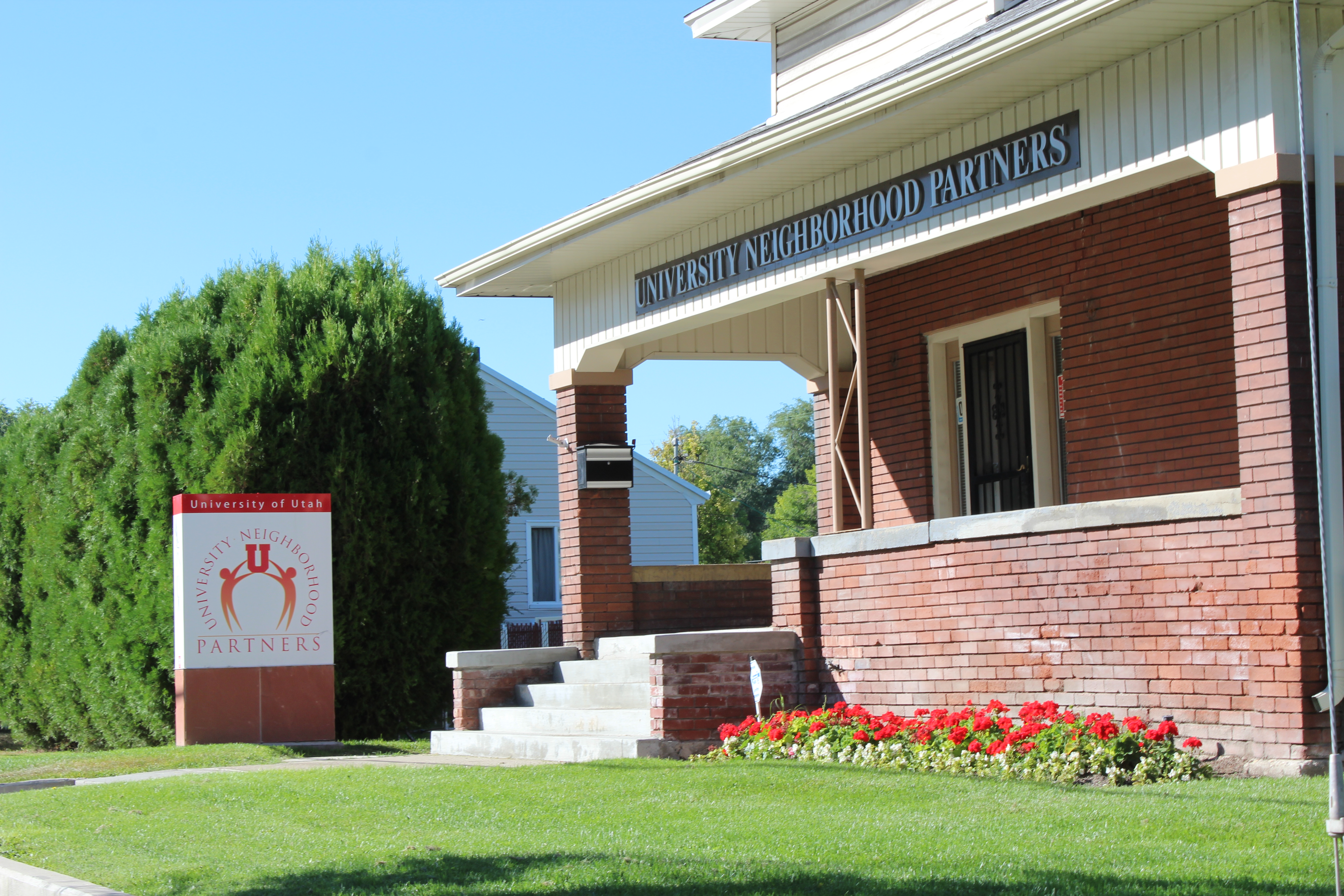
The University Neighborhood Partners, located on 900 W. and 1060 South, brings together university and west-side resources.

Munro was responsible for developing UNP’s approach, which she said in an email provides a broader national conversation about truly collaborative community-based research and what defines that.

UNP acts as a mediator and bridge to the U and west-side nonprofits, resident groups and city governments and focuses its work in seven west-side neighborhoods, including Rose Park, Glendale, Poplar Grove, Westpointe and Jordan Meadows.

“The idea is not that the university goes out and does something in the neighborhood,” said Munro, now UNP’s associate director. “It’s not community service. It’s not doing it for them. It’s setting up collaborations where we find people, who are working on those issues in the neighborhood, and the university, who can bring together their teaching, research and community-based work, so we are learning from each other.”

Munro said UNP has more than 34 partnerships. Forty-three departments, including linguistics, engineering, and social work, and 40 community organizations, such as the U’s Lowell Bennion Community Service Center, are also involved. They all focus on and identify issues, including access to healthcare, language barriers, transportation and literacy, that challenge west-side residents to obtain the economic and educational opportunities that residents in other communities have.

Though UNP doesn’t directly do the work, the program has helped create partnerships that foster youth programs, life skill classes, resident committees, English classes, healthcare clinics and youth programs.

The UNP-Hartland Partnership Center is one example of a partnership that provides services that help overcome an issue, including lack of sufficient healthcare, which impedes access to higher education.

According to its website, The UNP-Hartland Partnership Center  is a project that implements programs to help residents living in the Seasons of Pebble Creek apartments, located on 1616 South, near Redwood Road, and those in the surrounding west-side communities. In addition to English-as-a-second language classes, financial classes and youth programs, the center offers health education.

Center Coordinator Kimberly Schmit said in a phone interview that UNP-Hartland Partnership Center is a not a clinic with direct medical services.

“They have a health-education referral program,” she said. “The partner is the College of Nursing at the U; the faculty and students do the work.”

One concrete example of research that helps west-side residents is a study done by researchers from the College of Social Work at the U, who focused on the mental health of children with refugee backgrounds. The researchers interviewed 22 service providers, including Valley Mental Health, Catholic Community Services and the Utah Health and Human Rights Project, as well as 21 youth with refugee backgrounds, who had been in the U.S. for at least a year.

Data from the interviews yielded a curriculum with lesson plans that focus on seven topics, such as social skills, emotional health, school rules, laws and safety, and family roles.

“This is where it becomes community building,” Schmit said. “They were getting their questions answered through her research. [The researchers] partnered with them, did the research and then gave them back her findings. That is where it is a little different [from other research]. We are looking for the partnership with the residents. The residents are the leaders.”

UNP’s Munro said research conducted by students at the center and in other UNP partnerships is not just for publication, but also helps the community strengthen itself.

“I see a big role for research,” she said. “But the way I want to see it done in the world is in really close connection with the people you are researching and letting the questions emerge from that.”

University Neighborhood Partners, Bad Dog Arts collaborate for Salt Lake City’s west side

Story and photo by BROOKE MANGUM

The University Neighborhood Partners (UNP) and Bad Dog Arts are collaborating to provide underprivileged youth on Salt Lake City’s west side opportunities to learn, discover and express themselves through art.

UNP is a program at the University of Utah that forms partnerships with organizations like Bad Dog Arts to create a greater sense of community between the U and west-side neighborhoods. It serves as a liaison between the U and west-side nonprofit organizations, resident groups and city governments.

“The reason for the focus on the west-side neighborhoods was because those neighborhoods were historically marginalized within Salt Lake City socially and economically and were incredibly under-represented at the U in terms of where students came from,” said Sarah Munro, UNP associate director.

UNP has been in this building since 2003.

Originally called the West Side Initiative, UNP developed about 10 years ago in response to feedback gathered during 300 interviews with area residents. Currently, UNP has 34 partnerships with 43 departments at the U that each focus on identified issues within the community such as race, ethnicity, religion, political views and geography.

“All of the UNP partners contribute to the community in different ways depending on their area of expertise,” said April Daugherty, program coordinator at Bad Dog Arts during an email interview. “Since our focus is in the arts, our role is to bring art into the community. Our role with UNP fulfills our mission to inspire youth from diverse cultures and offer art experiences to populations who would otherwise not have the opportunity.”

Bad Dog Arts has partnered with UNP for three years. It is located at 824 S. 400 West in Salt Lake City. Bad Dog Arts is a nonprofit organization that aims to inspire “at-risk and underserved” youth ages 5 through 18 to experience the power and freedom to imagine, dare, learn and challenge themselves through art. The hope is that  youth will develop self-confidence and be able to use these skills throughout their lives.

“It is a form of expression that has no boundaries, transcending language barriers,” said Victoria Lyons, Bad Dog Arts co-founder and director, in an email interview. “Bad Dog programs instill confidence and pride and give children a safe space to discover their innate creativity, artistic ability, purpose, and potential.”

Through the partnership of Bad Dog Arts and UNP, art classes are offered on a weekly basis at UNP’s Hartland Partnership Center. The center, located at 1060 S. 900 West, is often used as a place for campus-community partnership activities to take place.

During the fall and winter of 2011 and the spring of 2012, Bad Dogs Arts will be working with UNP on a mural art project that will be displayed at the Hartland Partnership Center.

“This project will be a collaborative effort of all the residents and staff of Hartland, involving children, teens and adults,” Daugherty said. “The theme of the project is ‘Community.’ Art brings people together and on this scale can really function as a tool for building community.”

Through activities and programs like this, UNP and its partners hope to bring together the U and west-side resources and create a community environment of learning that is mutually beneficial.

“Learning is reciprocal,” said Sarah Munro, UNP associate director. “There is important knowledge in a lot of different places and different forms. It is critical for people to learn to recognize that in others.”