Senior pets find homes with senior citizens

by Gillian King

Imagine being in the final years of your life and not having a place to call home. Think of being completely alone without any family or anyone who loves or cares for you. Think of what it would be like to have no control over your own future. That is the predicament that homeless pets find themselves in every day, but that doesn’t mean they have to stay in this situation forever.

Organizations such as the Humane Society of Utah have an abundance of homeless pets awaiting adoption and the majority are senior pets. The society has come up with a way to help these seniors find a home, though. Placing Animals with Loving Seniors, or P.A.L.S., is a program implemented by the Humane Society that was developed to help find homes for the senior cats and dogs that fill the shelter.

Senior citizens, defined by the Humane Society as persons 65 and older, can adopt senior cats or dogs, age 2 or older, for a discounted adoption fee. Dogs are $25 each and cats are free. This helps raise the probability these animals will be able to find a forever home with a loving person.

The animals aren’t the only ones seeing a benefit from this program. Placing senior pets with senior citizens gives both parties the interaction and companionship they may otherwise be lacking. According to Amber Hansen, an adoption counselor with the Humane Society, many seniors are wary of the program because they don’t want to worry about chasing down a new pet or bother with cleaning up after it or having to train it, issues that may be less likely with an older pet.

“The program is a benefit to seniors because the animal already is who they are going to be,” Hansen said. She added that senior citizens often don’t have the energy or patience to adopt a younger animal, such as a puppy or kitten. Adopting a pet that has already been housebroken and grown out of its juvenile phase is a perfect fit.

Not only does the individual adopting the pet gain companionship, but there are also health benefits to having a pet.

“We have people come in with prescriptions (for a pet) from their doctors,” said Mary Rancipher, an adoption counselor with the Humane Society. She said people with conditions such as bipolar disorder or Attention Deficit Hyperactivity Disorder often come in looking for companion animals at the request of their doctor.

“Having something they can focus their attention on and have love them unconditionally provides huge health benefits,” Rancipher said. She should know. She has her own companion animal to help her with her needs. When her pet went missing she described herself as going “nuts” without it.

The health benefits from owning a pet are well documented. According to the Centers for Disease Control, a person’s blood pressure, cholesterol levels, triglyceride levels and feelings of loneliness can all be decreased by owning a pet.

Groups such as the Delta Society are dedicated to the ideal that animals can help improve a person’s health and emotional well-being.

“People are healthier and happier because companion, service and therapy animals enrich and positively impact their everyday lives,” their Web site states.

Whether it is at the behest of a doctor for health benefits or simply for a little companionship at home, the Humane Society’s P.A.L.S. program can help seniors find a senior pet that complements them and their situation. For more information on the P.A.L.S. program and for a complete listing of animals, visit the Humane Society online or in person at at 4242 S. 300 West in Murray.

Affinity fraud increasing among the elderly

by Alexis Young

Often at home alone, and happy to talk to anyone willing to stay on the phone with him, Dale Alexander was not about to pass up the opportunity to make an effortless $8,000. As it turns out, he was the victim of a wretched scheme.

Alexander’s case illustrates something prosecutors call “affinity fraud.” It is a scam that victimizes members of tight groups, such as religious or ethnic communities, professional organizations or the elderly into putting money toward a deceitful investment.

Utah has seen an increase in affinity fraud cases among the elderly. “The number of complaints coming into the Division of Securities has certainly increased during the economic downturn,” said Keith Woodwell, director of the Utah Division of Securities.

“The con artist made the investment seem worthwhile” by guaranteeing the money and claiming that it was only a limited-time offer, Alexander, 75, said. “He confessed he had a big wad of cash in hand, and it soon could be mine.”

Alexander had to meet the con artist within an hour at a local McDonald’s with $8,000 cash. If he made it within that time frame, the con artist would match the $8,000.

When they met, the con artist snatched the money and ran like the wind. “I should have never fallen for it in the first place, but I didn’t dare go after my money. I didn’t know if he had a gun,” Alexander said.

Affinity fraud targeting seniors has become a serious problem. Both federal and state laws have recognized this problem, and there are now enhanced penalties for con artists who target seniors and convince them to invest their retirement savings. During the time of an economic downturn, senior citizens want to ensure the future of their retirement.

“The recession has had a negative impact on the savings of many seniors, making them more vulnerable to con artists who prey on the fear of declining stock portfolios,” Woodwell said.

The large majority of fraud cases that the Division of Securities investigates involve some form of affinity fraud, or some kind of relationship between the perpetrator and the victim before the scam happens. Unfortunately, some affinity fraud cases do involve family members taking advantage of one another and the inherent trust involved in the family relationship.

“Older adults are notorious for scams, and family is most likely to scam each other,” said Scott Wright, director of the Gerontology Interdisciplinary Program at the Center on Aging at the University of Utah.

According to national estimates, only 1 in 10 cases of affinity fraud are reporte

“Numerous seniors remain quiet when they have been a victim,” Woodwell said. “No one likes to admit to themselves or others that they have been taken advantage of. This horror is perhaps even greater for seniors who do not want to be seen as incompetent of managing their own financial affairs.”

The Division of Securities actively publicizes all major cases and has an ongoing investor education program. The division organizes public service announcements and works alongside the media to help educate the public. On a regular basis, the division staff speak to various community groups about how to recognize and avoid affinity fraud. In addition, a statewide tour began in fall 2009 to help protect people against identity theft.

To avoid becoming an affinity fraud victim, the Division of Securities has straightforward advice.

“If an investment opportunity sounds too good to be true, it almost certainly is,” Woodwell said. “If you know someone through an existing social network, it is not a reason to invest with that person. You should check out an investment offer before you invest.”

The Division of Securities can help because it has access to national databases.  Staff check to see if the person making the offer is properly licensed as an investor and if he or she has a history of complaints or other problems.

Like Dale Alexander, many seniors are home alone and happy to talk to someone. The next thing they know, they are giving away financial information, only to be left penniless. If you believe you have been a victim of affinity fraud, contact the Division of Securities at (801) 530-6600 or file a complaint online.

Seniors enjoy friendly world competition

Story and photo by Jenna Cannon

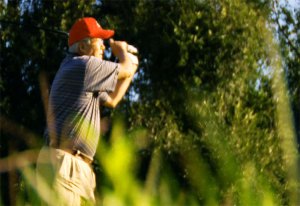
A hush fills the cool air with the silence of intense concentration. Two hands, worn with age, seem to feel at home as they knowingly grasp the steel club. A deep exhale and the club swings, sending the golf ball soaring over the lush, green course. The intensity dissipates and a broad grin deepens the smile lines on the golfer’s face.

James Newton

James Newton practices his golf swing at the Salt Lake Country Club.

James Newton, a 68-year-old Utah athlete, has just experienced his favorite pastime. He plays golf at least once a week to perfect his swing and improve his putting. He is preparing to compete in an international senior sporting competition known as the Huntsman World Senior Games.

“It’s always a great experience. I love being able to play all day and just have fun,” Newton said. He has been competing in the games for five years. His sport of choice is golf.

The Huntsman World Senior Games began in 1987. It showcases 26 different sports. Kyle Case, CEO of the Huntsman World Senior Games, said the games currently host more than 9,500 athletes. These athletes come not only to compete, but also to socialize and learn about maintaining a healthy lifestyle.
The Senior Games are held each October in St. George, Utah. According to its Web site, the theme of the games is, “To foster worldwide health, friendship and peace.”

The health aspect is the sporting events and health clinics. Each sport caters to the skills and abilities of the athletes. Some of the sports can be played with a partner or team, such as bowling and basketball. Other sports are solo activities; these include the triathlon, swimming and archery.

In addition to physical sports, the Senior Games includes two mental sports. These allow seniors to exercise their minds. They use their mental skills by playing bridge or chess.

A popular sport among the senior women is tennis. Elouise Jensen, a 77-year-old Utah athlete, is an avid tennis player. Sporting a freshly styled blond bob and a contagious smile, Jensen excitedly talks about the Senior Games. She prides herself in her 11-year involvement in the games. She loves to go down to the games with her girlfriends to play tennis in the warm southern Utah weather.

“We just have so much fun!” she exclaimed.

Jensen feels that participating in sports keeps her young and healthy. This is apparent with her jaunty stroll and radiating healthy glow. She plays tennis with a group of friends twice a week. This keeps her active and prepared to participate in the Senior Games each year.

Newton also believes that staying active keeps an aging person healthy. When he golfs he likes to walk the course instead of renting a golf cart. He will play an entire round of 18 holes without ever sitting in a golf cart.

“All that walking keeps me young,” he said.

In addition to the athletic aspect of the event, the Senior Games promotes senior health by offering a health clinic and healthy lifestyle lectures. The clinic offers health testing for various diseases and ailments that afflict the elderly. Health-care professionals present the lectures and answer questions from the audience.

Promoting senior health is just one feature of the Senior Games. Another is to emulate worldwide friendship and peace. Athletes from 20 different countries attend the games, bringing with them a sense of worldwide unity.

“It’s unbelievable. We get players from far off places like Romania,” Jensen said.

The assembly of so many athletes in one location fosters friendship and encourages socialization. Newton thoroughly enjoys meeting new people at the games.

“It’s fun getting to know people. I stay in contact with many of the folks and I even e-mail a fellow I met from Australia,” he said.

The competitors are able to socialize in venues other than on the field. Various activities are made available to the athletes and visitors of the games. These activities include opening ceremonies, a western dinner-dance, an international festival and a talent show.

The Senior Games gives the elderly a unique opportunity filled with competition, activities and learning. A games regular, Charmaine Halversen, 84, enjoys the socialization and the athleticism that the games invoke.

“My favorite part is the association and the element of delight in seeing what older people can do,” she said.

Aging with flair

Story and photo by Jessica Calderwood

It all started with a red fedora and a poem.

The items were a 55th birthday present from Sue Ellen Cooper to a good friend in 1998.

“When I am an old woman I shall wear purple with a red hat which doesn’t go and doesn’t suit me,” wrote English poet Jenny Joseph in her 1961 poem titled “Warning.”

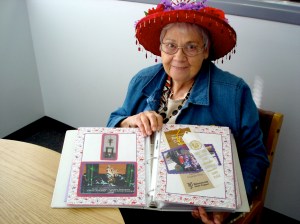
Doris Isom

Doris Isom of the Jordan Jewels proudly displays her Red Hat scrapbook.

This poet’s wry words inspired Cooper and a group of five friends in Fullerton, Calif., to dress up in red hats and purple clothing and go out for tea on April 25, 1998.
Thus began the Red Hat Society.

Word spread, and soon thousands of local chapters consisting of 20 to 25 members began to dot the map. Women everywhere wanted to join in this light-hearted attitude toward aging. The poem has become the credo of Red Hatters worldwide.

Today, there are approximately 30,000 chapters in all 50 states and more than 25 countries. In order to wear the red hat and purple clothing, one must be a woman over 50. Those not meeting the age requirement wear pink and lavender. Leaders of the chapters are referred to as Queen Mother and members call themselves Red Hatters.

It is almost inevitable for us to reach a stage in life when loss becomes very prominent, whether it is loss of loved one, health, mobility or even enthusiasm for life. Linda Torres sees this in the lives of the people she interacts with every day. Torres is the Engage Life Director at Atria Senior Living in Sandy, Utah.

Doris Isom, 86, is Queen Mother to the Jordan Jewels, who consider the West Jordan Senior Center their home base. Isom began frequenting the senior center to ward off loneliness after her husband died six years ago. In response to the urging of the staff, Isom headed up organizing a chapter of the RHS at the senior center in 2006.

The Red Hat Society “provides an avenue for silliness,” Torres said.

Each member in the Atria Sandy RHS chapter embraced silliness to create their own Red Hat name, not required for Red Hatters, but still fun. “Sexy Savannah,” “Magical Millie,” “Bold and Beautiful Bernice,” “Ruthless Ruth,” “Whimsical Wendy” and “Witty Wanda” have enjoyed ice cream socials, facials, makeovers and a formal tea party with fine china.

“I think everyone likes to feel that they belong to something,” Torres said.

For Judi Freegardy, 58, that was the biggest reason she sought out the Red Hat Society in the little town of Payson, Ariz. Freegardy grew up in Phoenix and relishes the country life she now enjoys in Payson. The population difference is significant, with Phoenix at about 1.5 million and Payson a mere 14,000.

“I wanted to feel connected to my little community,” Freegardy said.

After hearing about the Red Hat Society in Payson, Freegardy knew she’d found her way to get connected. But she discovered neither of the two existing chapters was open to new members. Each chapter tries to keep their number around 20 to 25 so they can gather more easily.

So, Freegardy decided to put an ad in the newspaper inviting the women of Red Hat age in the community to gather for lunch at a local restaurant. She was floored when 72 women showed up.

Now years later, there are 10 to 15 chapters in the small community of Payson. Freegardy is part of a chapter of women who don their personalized red hats and go out to lunch every week.

To show her personality and love of gardening, Freegardy sports purple overalls with her red hat. “Embellishing your hat shows who you are in the tribe,” Freegardy said.

Doris Isom is especially proud of her elaborately decorated hat. Isom’s hat features a tiara, by virtue of her status as Queen Mother, and dangling purple beads trim the brim. She smiles as she recalled her reaction after affixing the beads; her hat reminded her of one of her mother’s lamp shades.

“Ninety-nine point nine percent of the girls in Red Hats reach out and volunteer for their community, we’re not just out being silly and having lunch,” Freegardy said.

That is especially true for the Jordan Jewels, whose activities are largely service oriented. A look through Isom’s lovingly compiled scrapbook shows the Jordan Jewels decorating the Children’s Justice Center of Salt Lake County every year for Christmas, volunteering for the county by making more than 200 scarves for the homeless and crafting quilts for Project Linus.

Isom fondly recounts cruising through West Jordan on the back of a Harley, her feather boa streaming in the wind. The Jordan Jewels join with the Bikers Against Child Abuse in West Jordan on its annual ride.

Simply put, there are no rules. Members show up if they want, there’s no pressure or dues. The RHS is women coming together to edify one another and embrace life and aging with humor and flair.

Low-income older adults find warmth in cold winter months

Story and photo by Lee Horton

Many older adults are faced with dilemmas they never imagined they would have to confront. Should they pay to eat or buy medicine? Or should they pay to heat their home?

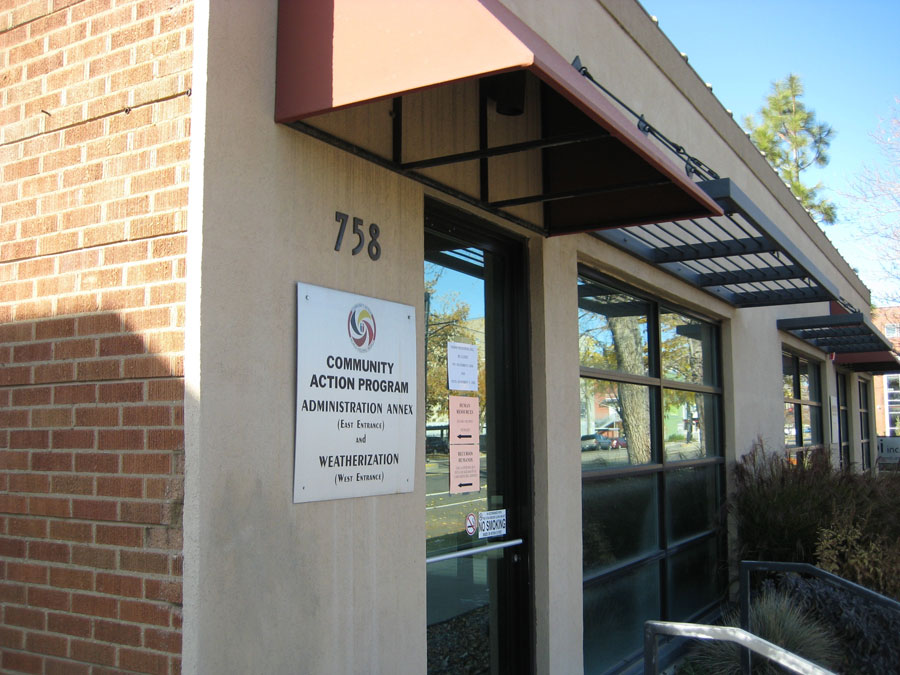
The Community Action Program, located at 764 S. 200 West in Salt Lake City helps weatherize the homes of low-income older adults.

“When (older adults) were working, they expected Social Security to solve all of their needs,” said Dale Canning, a deputy director at the Salt Lake Community Action Program (CAP). “That isn’t possible.”

Heating a home, though important, falls behind food and medical care in order of importance. Through the Weatherization Assistance Program, CAP helps heat low-income households by implementing cost-effective solutions.

“Our goal is to make it so they can afford to pay their bills,” Canning said.

The Weatherization Assistance program was started by the U.S. Department of Energy in 1976. It has three main goals: to save energy, to save money and to decrease greenhouse gases. The program is for low-income households, especially those with elderly or disabled residents. Canning estimates that half of the people who receive the benefits of the program are older adults, with a fairly even mix of couples and single individuals.

Many older adults don’t need the helping hand of the Weatherization Assistance Program. “Luckily, most seniors don’t have big house payments,” Canning said.

But not all are so fortunate. “We will go into homes where people are sitting around the house in blankets,” Canning said. “Their furnace won’t start or they will have broken windows, but no money to fix them.”

In 2008, the program helped 340 households save an average of $300 each by reducing their energy consumption, Canning said.

There are many ways CAP helps decrease heating bills through the Weatherization Assistance Program. They fix what Canning called “dangerous furnaces.” These furnaces have high carbon monoxide levels, don’t vent properly, have broken heat exchangers or don’t start at all. If a furnace is operating at 80 percent efficiency it will be replaced at no cost by a furnace that runs at 90 percent or better.

Some houses will have a set-back thermostat put in. These thermostats have a timer that automatically turns the heat down at a preset time at night and turns it back on at a desired time in the morning. This helps reduce energy use without forcing residents to remember to control the temperature themselves.

CAP will also implement cost-effective air sealing measures so that a house doesn’t lose its conditioned air. When necessary, CAP will insulate a home, fix broken or cracked windows, install compact fluorescent light bulbs and exchange shower heads.

Often CAP will install carbon monoxide and smoke detectors when doing the other improvements, “just to make their house a little more safe,” Canning said.

The benefits of the Weatherization Assistance Program are free for those who qualify. To be eligible, a household must be at 150 percent of the poverty level or lower. Older adults who work can have 20 percent deducted. Those who pay for their medical expenses with their own money can receive credits that go toward the services of the Weatherization Assistance Program.

Before CAP begins the weatherization work, a house must go through an energy audit. The audit suggests improvements that the home needs to be more energy efficient and cost-effective. CAP doesn’t just go through and fix everything. They need to make sure the improvements are worthwhile.

“Everything we do needs to pay for itself before it stops working,” Canning said.

While CAP does the labor, the work is funded by many different organizations. The bulk of the money comes from the U.S. Department of Energy. Funds are also provided by the Department of Health and Human Services through the Low Income Home Energy Assistance Program (LIHEAP) nationally, the Home Energy Assistance Target (HEAT) program locally, as well as Questar and Rocky Mountain Power.

CAP will also get money this year from the American Recovery and Reinvestment Act. Canning expects the ARRA stimulus will enable the Weatherization Assistance Program to help up to 1,000 people in 2009.

Many campus, community services available to American Indians

by RITA TOTTEN

American Indians and anyone interested in learning more about Indian culture can visit the many centers in Salt Lake City and at the University of Utah campus.

Transitioning from high school to college or from one college to another can be a difficult process. Assisting in that transition is the American Indian Resource Center at the U. Becky McKean, an administrative assistant at AIRC, said staff work with different offices on campus to establish partnerships.

“We draw from each other,” McKean said.

Some of the groups working with the AIRC are academic, such as the American Indian Science and Engineering Society. Others, like the Inter Tribal Student Association, focus on student life. The Center for Ethnic Student Affairs has within its office a Native American coordinator who advises students and helps with scholarships, McKean said.

She said this year, AIRC Director Beverly Fenton was able to get the Ute Mountain Ute Tribe in-state tuition for its students.

“The Ute Mountain Utes are located in Colorado, but since they are part of the Ute Tribe they were granted in-state tuition thanks to Beverly’s work,” McKean said.

AIRC is located near the dorms in a house donated by Fort Douglas. McKean said that when the Fort downsized 15 years ago, the house was given to the American Indians.

AIRC encourages students to use the building as a meeting place for groups and activities and strengthens connections with the community. It also helps students get involved with internships and work-study programs.

McKean said they are trying to be active in bringing people into the center. Twice a week a writing tutor comes to the AIRC to assist students with papers and homework assignments and to help improve their writing, McKean said. The AIRC also has a computer lab available for students and McKean hopes to get a grant to purchase more computers.

“The goal of the Center is to act as a liaison between the U and tribal communities,” McKean said. The Center is currently working on developing a brochure and a Web site to advertise the available services throughout the community. McKean said she hopes to bring the community into the center. This fall, while visiting the U, tribal leaders from across Utah and neighboring states were welcomed into the Center. A potluck was also hosted which brought a sizeable crowd of students and faculty to the Center.

Other on-campus resources include the American West Center, which is working with the Utah Division of Indian Affairs to develop teaching guides for grade school children to inform and educate them on current issues and history of Utah’s American Indians. Also, the Center for American Indian Languages focuses on the study of indigenous languages.

The state of Utah gets its name from the Ute Tribe. Support for members of the Tribe and other American Indian tribes come from a variety of places.

A local resource available to tribal members is the Indian Walk-In Center.

Brenda Chambers, an employee and health specialist for the center, said in an e-mail that the purpose of the Walk-In Center is to support and provide wellness services to people with respect to values and heritage of American Indians and Alaska Natives.

The Walk-In Center sees members from tribes all over Utah, including the Utes, Paiutes, Goshute, Shoshone and Navajo. Chambers said the Walk-In Center serves as a meeting place. In addition, anyone who wants to learn more about American Indians can gather at the Center and take advantage of the services and information available.

Chambers said the Center offers services in many different areas, including health services, counseling, community outreach, events and general assistance. Within each area different services are available to the community. For example, people seeking housing can take advantage of housing referral services. Children visiting the center can take part in the literacy project and attend leadership meetings.

A major issue for American Indians is health-related problems such as diabetes. The Walk-In Center offers nutrition information and presentations as well as screenings for diabetes. Health promotion and prevention is a big part of what the Walk-In Center does.

Supporting all aspects of native life is important, but it’s also important to inform non-native people as well. McKean said she hopes the resources available on and off campus will “help educate the community and bring us closer together.”

Adopting Native American children

by ALLISON JOHNSON

Alpine residents Katherine Thompson, 43, and her husband Joseph, 48, were devastated when they found out they could not have children. After exploring several options, they decided to adopt. However, it took the couple more than five years to finally receive a child because of one major stipulation. The child had to be Native American. 

Native American adoption always has been a complex issue. In 1958, the Indian Adoption Project was created by the Child Welfare League of America and the Bureau of Indian Affairs. According to CWLA, the project placed Native American children with white foster and adoptive families. The project was part of a widespread ideal that Native American children needed to be “integrated” into white society.

According to a study conducted by the First Nations Orphan Association, as many as 68 percent of all Native American children  between 1941 and 1978 were placed in orphanages, boarding schools, foster homes, or were adopted at one point in their lives.  

In 1978, Congress passed the Indian Child Welfare Act. According to the National Indian Child Welfare Association, the act made Native American adoption more ethical. Since then, NICWA has worked to enforce the Indian Child Welfare Act and promote the rights of Native American families and tribes.

Today, thanks to efforts like the Indian Child Welfare Act, Native American adoption is much more ethical. However, it is yet to become mainstream. When the Thompsons wanted to adopt a Native child, they did not know where to start.

“Since we are Native American, we wanted a Native American child,” Katherine said. “However, adopting a full Native American child is very difficult.”

They initiated the adoption process in 1994, but could never seem to find any agencies that specialized in — or even knew anything about — Native American adoption. They worked with many national adoption agencies, but had no luck.

 “We could not find any information anywhere,” Katherine said. “Resources were just not out there.” 

When given the chance to adopt an African American child in 1997, the Thompsons decided not to go through with it because of cultural reasons.

“While we would certainly love a child of any race, we wanted a Native American child,” Katherine explained. “We wanted to be able to share our culture with our child and pass on those traditions. We didn’t feel we could do that with an African American child.”

Finally, in 1998, they discovered an adoption agency called the Cherokee Nation Adoption Program. The agency specializes in placing Cherokee children with adoptive parents. Katherine and Joseph, who are Navajo, were relieved to finally find an agency who could help them.

“Within nine months of finding [the agency] we adopted Isabel. We were thrilled,” Joseph said. “She is our joy.”

Today, Isabel is an 8-year-old third grader. Her elementary school teacher, Susan Jones, believes Katherine and Joseph have done a good job of teaching Isabel about her Cherokee culture.

“She seems to be very well adjusted,” Jones said. “I can tell that she is aware of her heritage and is proud of it.”

Some couples, like the Thompsons, want to adopt Native American children because of cultural reasons. Other couples find that the opportunity just falls right into their laps.

Salt Lake City residents Julian Sanford, 39, and his wife, Megan, 35, have been foster parents for the past seven years. In July 2004, they began fostering a young Navajo child, Hannah.

“We had never fostered an Indian child before,” said Megan. “It was a big change when Hannah came to live with us.”

After fostering the child for six months, the couple decided they would like to adopt Hannah. The adoption process lasted more than a year, but, finally, Hannah officially became part of the family.

“Finally adopting [Hannah] didn’t change how we felt about her,” Julian said. “We loved Hannah the second we met her and have always considered her our daughter.” 

Initially, the Sanfords were worried about raising a Native American child. More than three years after adopting Hannah, it is still a concern, but has gotten easier.

“We were worried that we wouldn’t be able to teach [Hannah] about her culture,” Megan said. “Over the past few years we have made a real effort to make sure Hannah knows about her heritage. We want it to be a part of her life.”

The Sanfords have been introducing Hannah to other Native American children, taking her to cultural celebrations and teaching her about Cherokee history to make sure she grows up with a strong sense of identity.

Refugees celebrate First Thanksgiving in America

by MATT BERGSTROM

  • Virtually attend the First Thanksgiving celebration.

Each of us probably has many unique memories of Thanksgiving, but they probably all centered on turkey, stuffing, mashed potatoes, pumpkin pie and family. We remember the pilgrims who broke bread with their native hosts in this new land. And eventually we go around the table and take turns naming things for which we are grateful. Family, friends, freedom, the list goes on, and these are just the Fs.

But who remembers their first Thanksgiving? All the memories seem to blend together over the years, the result of too much stuffing and tryptophan-induced comas. Most of us likely can’t recall the first time we tasted cranberry sauce, or watched with trepidation as dad carved the bird; cautiously keeping his fingers clear of the blade.

For the thousands of refugees who come to this country every year, these experiences are as foreign to them as their many languages and traditions are to us.

That’s why this year the International Rescue Committee and American Express decided to hold a First Thanksgiving celebration for new refugees.

The First Thanksgiving is a new national celebration organized by the IRC’s corporate headquarters in New York. Salt Lake was one of three cities to host a dinner, along with Boston and Phoenix. American Express offered to house the Salt Lake event Thursday, Nov. 18, at its Taylorsville office.

Smiling volunteers and employees from the IRC greeted refugees arriving at their first Thanksgiving dinner. Once checked in they were ushered through the spacious lobby of American Express’ office past an 8-foot-tall Statue of Liberty. Just beyond the statue lay a long red carpet rolled out for the guests of honor.

Servers greeted guests along the red carpet and offered them drinks and appetizers as the refugee families meandered closer to the office lunchroom that had been transformed into a banquet hall for the evening.

All the while the journey down the hallway was accompanied by a Middle Eastern melody. At the end of the carpet, two men, Iraqi refugees, sang while one of them kept time on a small, Yamaha keyboard. An older Iraqi woman stopped to listen and sing along to the music as everyone else arriving followed suit.

The long hallway continued to fill with people as those arriving paused to admire the black and white photographs propped on easels along the carpet. Pictures of women and children, mothers and their newborn babies, stood single file on either side of the red carpet like members of a reception line.

This exhibit of photos was the premier of The Newest Americans series by Salt Lake-based photographer Stanna Frampton.

Frampton is a longtime friend of Patrick Poulin, the IRC’s Salt Lake resettlement director. For years she had asked Poulin if there was some way she could help him in his work. They came up with the idea of photographing the newest Americans, children born to refugee mothers. She began taking the photographs a year ago. Frampton said it was difficult at first because many of the mothers didn’t fully understand why someone wanted to take their picture.

Frampton recalls a Somali woman in particular who was so nervous to be in the studio it was all the photographer could do to get her to smile. Every time the woman would begin to laugh she would cover her face. Yet the resulting photograph is one of the most memorable of the series. The slender young woman in a long dark gown shields her smiling face from the camera as her young child lies lazily against her shoulder.

Every photograph has an interesting story, Frampton said. She asked each of the mothers a series of questions about their new life in America during the shoot. When she asked them how they felt knowing their babies were born American citizens they were unanimously overjoyed.

Frampton has found her own joy in getting to know these new mothers. “I have learned so much,” she said. “I’m still learning.”

Joy spilled over from the refugees, government officials, and refugee service providers as they all continued to spill into the banquet hall. More than 20 finely dressed tables filled the large room that usually accommodated American Expresses employees on their breaks.

The music died down as the nearly 200 guests began taking their seats.

George Biddle, executive vice-president of the IRC, emceed the evening. Biddle took a moment to thank all the participants and especially those who helped plan the event. He then introduced Salt Lake County Mayor Peter Corroon and former Salt Lake City Mayor Palmer DePaulis. DePaulis, who was recently appointed director of community and culture by Gov. Jon Huntsman Jr., appeared behalf of the governor who was celebrating his wedding anniversary.

Corroon and DePaulis presented proclamations, one from the county and one from the state, declaring Nov. 14, through Nov. 20, Refugee Appreciation and Celebration Week.

Next, Janet Harris, vice president of development for the IRC, addressed the crowd. Harris related a story about taking a taxi from the airport to her hotel in Salt Lake. Her cab driver happened to be a Somali refugee who was resettled by the IRC a few years ago.

She asked the driver how he liked his new life here. He told her he was happy because he has three things here he did not have at home: freedom, opportunity and safety.

Harris revealed why the IRC decided to hold it’s largest event in conjunction with Thanksgiving. “All cultures have some form of harvest holiday,” she said. “So there is common ground there.”

She then reminded everyone about the pilgrim’s very first Thanksgiving; a dinner held by a group of people who had been forced to leave their homes in search of freedom, opportunity and safety.

With the speeches done it was time for the entertainment.

A group of women and young girls from Burundi and Rwanda performed rollicking native dances in traditional costumes.

They were followed by a quartet of young Burundian men in green and white robes, each with a tall drum. The men set up their instruments on stage and began a 20-minute marathon of intense drumming and call-and-response shouts. By the time they were done they were drenched with sweat and the audience was as excited from their robust meal and lively entertainment.

As the evening wound down the attendees discussed their new memories. Their reveries were filled with hope of future events and newborn traditions. This Thanksgiving dinner was a bit different from the traditional memories of the holiday so many have, but the new memories it provided for it’s guests, both the refugee families and the others there, will surely be no less poignant and no less meaningful.

The smiling faces leaving the American Express building that evening may have seemed foreign and each was unquestionably different, but as Patrick Poulin pointed out earlier that evening, whether you say markozy, banyaba, or ji shu tin baday, it still just means thanks.

Media influenced Native American voters

by JESSICA DUNN

The Black Eagle family of the Crow Tribe adopted president-elect Barack Obama, whose new name is “One Who Helps People Throughout the Land,” during his visit to the Crow Nation in Montana on May 19, 2008.

Obama was the first presidential candidate to visit the reservations of the Crow Nation. He was adopted in a private ceremony, and then he gave a speech ensuring Native Americans that their well-being is a priority to him.

He promised to honor the government-to-government relationships and treaties, to appoint an American Indian policy advisor and to host an annual summit with tribal leaders. Obama also vowed to improve trust funds, education and health care for reservations all over the country.

“I want you to know that I will never forget you,” Obama said in his speech to the Crow Nation. “You will be on my mind every day that I am in the White House.”

Obama’s visit and speech had an impact on the early support from Native Americans.

“I think people were impressed with his commitment he showed by just going to the reservation,” said Harlan McKosato, the host for Native America Calling, in a phone interview.

Native Americans overwhelmingly supported Obama by more than 80 percent, according to a poll conducted by Native Vote Washington, a voter advocacy group based in the state of Washington. And like most demographics this election, voter turnout for Native Americans also saw an increase.

“Before a lot of people didn’t vote because they said it didn’t matter who was in the administration because things didn’t change for Native peoples. They were treated the same and ignored the same,” said Donna Maldonado, general manager of KRCL. “The tribes saw promise in Obama. … I think he is our hope for the future.”

Native American support can be attributed to many factors, including Obama’s promise of change and better voter education overall.

Change

Obama has promised change to the Native American community. And while most are skeptical about promises made by a politician, a lot of people think he can change things, McKosato said.

Native Americans see Obama as someone they can identify with because of his diverse heritage, said Ella Dayzie, executive director of the Indian Walk-In Center in Salt Lake City, in an e-mail interview.

A follow-through on those promises will first be seen through Obama’s appointments within his cabinet and other positions. He has promised to create an American Indian advisor position to better meet the needs of the Native communities. Obama has also proposed an annual summit with Native American tribal leaders.

“With a Native American cabinet chair, the hope is that the U.S. government can now be well informed about the special set of challenges American Indians face, from issues of sovereignty to access to affordable health/behavioral health care,” Dayzie said. “One cannot ignore what is in front of him/her daily.”

Obama has already named six Native Americans to various transition teams. Mary Smith, Mary McNeil and Yvette Roubideaux have been assigned to work on justice, agriculture and health issues respectively, and John Echohawk, Keith Harper and Robert Anderson will advise Obama on changes within the Interior Department, according to Change.gov.

Obama has also promised money towards improvements for Native American health care and education. His economic and infrastructure development plan includes an increase in the federal minimum wage and adequate funding for the Indian Housing Block grant, according to the First Americans Fact Sheet at Obama’s Web site.

Obama’s promises to Native Americans created greater interest in the election within the Native communities. Voter education on the issues and candidates also influenced voter turnout.

Voter Education

Voters had a vast amount of information at hand about the election, from the newspaper and television to the Internet and YouTube. Most of the sources contained general information on candidates and issues. However, some programs focused on Native American issues and voting.

KRCL-FM is a public radio station in Salt Lake City, Utah, founded in 1979 as a community radio station where all issues could be discussed. KRCL has always been committed to having diverse voices on the air, said Maldonado general manager of KRCL.

Various ethnic groups, including Native Americans, have had airtime since the beginning. Today, the Native American slot is on Sunday mornings. Native America Calling, a live call-in program based in Albuquerque, N.M., that discusses issues specific to the Native American community, is rebroadcast on KRCL at 6 a.m. And, at 7 a.m., Living the Circle of Life plays traditional powwow music and contemporary American Indian music from local and national artists.

Native America Calling is an hour-long program that airs every weekday at 1 p.m. Eastern time on select stations. The program’s topics range from financial issues to a book of the month. During the presidential campaign, the program evaluated the topics and candidates from a Native American point of view.

“Native [America] Calling on KRCL helped in bringing news/reports about the issues that matter to Native American voters,” Ella Dayzie said.

Some of the election topics included discussions about political parties, Native veterans, women’s vote, young voters and planning for Election Day. The program also talked about the reaction to Obama’s win and discussed the promises Obama made to Native Americans.

Native America Calling has had full phone lines each time the election was discussed, said McKosato, the show host.

“People were more interested in this campaign than ever before,” he said.

Native America Calling helped get the issues out to Native Americans. The show used politics related to the community to spark an interest in the election and get people motivated to vote. 

AIROS Native Radio Network also used the radio and Internet to give Native American voters a voice. AIROS is an all-Indian Internet radio that is broadcast 24 hours a day through web streaming. It had audio, video, news articles and podcasts covering the election from a Native perspective. AIROS reporters used their stories to link Native communities to the election. They covered the 2008 Native Vote Initiative campaigns, presidential candidate rallies and Native American support.

The National Congress of American Indians expanded its Native Vote Initiative this year in an aggressive campaign to get more Native Americans to vote. The 2008 initiative had four core plans: provide training to educate, engage and mobilize voters; ensure fairness of voting laws and protect Native voters; educate candidates on issues important to Indian Country; and get the Native Vote message to media and the general public. Volunteers from tribal communities visited with people, even going door to door, to educate individuals about issues and help them register to vote.

“The NCAI’s Native Vote team has done a great job on getting the ‘vote’ out and educating the American Indians about both parties so that [they] can make an informed decision,” Dayzie said.

The End Result

Obama’s goals and promises to better Indian Country have brought a new hope to Native Americans. And due to a focus on the Native American voters and issues, Obama now has the opportunity to keep his promises to them and people all over the United States.

Acquiring health care a dangerous struggle for American Indians

by JAMIE A. WELCH

American Indians are 249 percent more likely to die from diabetes compared to the general U.S. population. They are also 533 percent more likely to die from tuberculosis and 627 percent more likely to die from alcoholism. Without enough medical treatment and health care coverage, American Indians are subjected to a life expectancy of 71.1 years. This is four years less than that of the general U.S. population.

According to a report by the Utah Department of Health in 2001, 17.3 percent of American Indians and Alaska Natives have been unable to get the health care they need. This figure can only be fought by tackling some of the most difficult problems within the health care world as it pertains to American Indians.

A major factor is geography. Melissa Zito of the Utah Department of Health serves as the Indian health liaison/health policy consultant. She compared the state of American Indian health to a ripple effect in a pond. “The closer you are to the center, the higher quality you will receive,” she said. Many American Indians live far away from major cities and hospital clinics. The farther they are from a clinic, the lesser their chance of attaining quality health care.

One resource, the Indian Walk-In Center of Salt Lake City, assists registered American Indians with gaining access to medical resources such as immunizations, acute or chronic health care, eye care services, nutrition counseling, dental services, and primary health care. Often, however, the help the center offers is limited and can be difficult to attain.

To qualify for coverage at the Walk-In Center, Zito says individuals must be registered members of an American Indian tribe. The center’s Web site lists the steps individuals must take to register for health services. An individual must bring a photo ID, documentation of income, proof of residency, Social Security numbers for self and family members, documentation of Indian blood, and a basic knowledge of which type of health insurance is needed. Because nearly 50 percent of Utah’s American Indians live on reservations, it can be difficult to obtain such documentation without traveling to a larger city and filling out forms for each article, which can be a time-consuming task.

LeAnna VanKeuren, health program manager of the Indian Walk-In Center, recognizes the challenges facing American Indians. She said another major struggle the health care world encounters is the “lack of data to accurately describe the health status of American Indians who live on reservations.” In other words, without detailed information, it is difficult to estimate exactly what kind of help most American Indians need and how many need it.

So, if an American Indian needed emergency care and didn’t know the kind of coverage he or she had or the medical history of the patient, time could run out for the patient, assuming the distance traveled to get urgent treatment was not a factor involved.

Anthony Shirley, coordinator of recruitment and financial aid at the University of Utah College of Nursing, says health care access for American Indians is in a worse state than it was 10 years ago.

In an e-mail interview, Shirley said “most American Indians are not insured so they [are referred] out of the Indian Walk-In Center in Salt Lake City. These doctors and nurses and health professionals are unknowledgeable of our culture so we often do not get referrals within the Salt Lake Valley.” Also, many people are forced to return to the reservation to find an Indian health service clinic or hospital.

Another problem, Zito admitted, is that “it’s difficult to get folks enrolled in the health care they need so desperately.” Older generations of American Indians are not accustomed to receiving regular health check-ups and therefore see little reason to travel far away to get them. This is especially dangerous because American Indians are at a high risk for developing diabetes. Without habitual care, suffering can be prolonged.

“Diabetes is at all-time high for American Indians,” Shirley wrote in his e-mail. He said the problem “is a combination of education/awareness and demographics. Many American Indians are not educated on proper diet and with many American Indians living on the reservation, the only resources they have are cheap foods that contribute to diabetes.”

Zito recognizes this as well, saying, “Diabetes is a problem in the social, cultural and physiological parts of American Indian society.” It is a problem that is especially difficult to combat without modern treatment such as insulin and medications.

Currently, the Utah Department of Health uses the Utah Indian Health Advisory Board (UIHAB) to connect tribal, state and federal governments in an effort to better address American Indian health policies and concerns. UIHAB is also used to establish trust among governmental groups and American Indian organizations. And, according to Article III of the board’s bylaws: “UIHAB will advise and make recommendations for improved physical, mental, emotional, and spiritual health of American Indian people in Utah.”

Zito quoted a historic phrase used by Cherokee leaders to say, “as long as the grass grows and the rivers flow the government will provide for the Native people.”