Equality Utah: Facing bias takes no toll on this organization’s open mind, open heart

by VANESSA NELSON

Meet Mike Thompson, the executive director of Equality Utah. Originally from Tulsa, Okla., Thompson is no stranger to living in the heart of a religious community. He grew up as a Baptist. But when asked about his job fighting for lesbian, gay, gisexual and transgender rights in Salt Lake City, Thompson says, “It’s amazing.”

He graduated from the University of Oklahoma with a double major in business and communication then went to work for the oil industry. But it didn’t spark a fire in him. He decided to move to London, England, where he began working with special-needs kids. This is where he found his love for nonprofit work.

Equality Utah — originally called Unity Utah — was founded in 2001. Thompson began working for the organization in the spring of 2004 after a stint at a nonprofit in Denver, Colo. 

Thompson was hired to work on the “No on 3” campaign and raise money for the campaign against the amendment. Although it passed, Equality Utah gained recognition for political pull in the community. 

Equality Utah has been very involved in getting hate-crimes bills passed in the legislature. In 2005, the organization endorsed Taylorsville Mayor Russ Wall and made advances with sexual orientation rights. 

In 2006, Equality Utah, with the help of Ralph Becker, got house bill 148 vetoed. It would have affected partners from getting employment benefits. “Issues of marriage shouldn’t impact issues of employment,” Thompson said.

This year Equality Utah interviewed 29 mayoral candidates before deciding to endorse Ralph Becker. Although Equality Utah didn’t endorse Dave Buhler, they have worked together on many issues regarding gay rights.

The biggest goal for Equality Utah is to secure rights and protections for LGBT couples and families. Thompson doesn’t believe in shutting people out, even if they don’t support his community or organization. He believes in creating a dialogue, having conversations and developing relationships between everyone, especially the people who don’t understand Equality Utah and the LGBT community’s views or opinions. In creating this dialogue people start seeing them as individuals, rather than as stereotypes.

“I’m a lot of other things besides my sexual orientation,” Thompson said.

Thompson loves his job because he can influence and change his part of this world. Although Equality Utah does not take an activist approach in demanding changes, the organization is drawing attention and gaining strength. One way it gains support is linking social events to the work that organizers and volunteers do. Some events have been held at popular local restaurants or bars, making it a more enjoyable experience for everyone participating.  

In the coming months Equality Utah will be fighting to get the bullying bill brought back. It would protect middle school and high school kids who are bullied for their sexual orientation.


Preparation now can pay off later

by BRYNN TOLMAN

Many people in the world today worry about what tomorrow will bring. Will I be prepared? Will my family be safe? How will we survive if this economy doesn’t turn around?

Preparation is key to finding answers to these and many other questions.

Althea Sam, a student at the University of Utah and an American Indian, said these questions are constantly on her mind. She worries because with her current school load she only works part-time and no longer lives at home with her parents.

“There isn’t usually a lot of extra cash at the end of the day,” she said. However, Sam recognizes the importance of being ready. “It is always necessary. Even students can be prepared,” she said.

Sam explained in a recent interview that the best option for this is going back to the old ways of canning food, saving and being smart about spending.

The Church of Jesus Christ of Latter-day Saints is one organization that encourages setting aside essentials for a rainy day. The Church has compiled many resources and tools to help families and individuals around the world get started on something that can be intimidating: food storage and preparation.

Church officials say people need to be ready for adversity in every aspect of life. The three most important elements to being prepared for the future are education, employment and food. A good education will be the base for a solid future. This base leads to a good job that will make it possible to meet the basic needs in life including the final element, food.

Jeff Newey, an employee of the LDS Church, was part of a team that put together several pamphlets to distribute to people worldwide. This collection is called “All Is Safely Gathered In.”

One pamphlet, “Family Finances,” discusses how managing money now can be helpful later in life. The pamphlet advises avoiding debt, using a budget, building a reserve, and teaching family members “financial management, hard work, frugality and saving.” It also includes a budget worksheet.

The second pamphlet, “Family Home Storage,” teaches readers how to gather food and save a little extra money in case of emergency. It discusses the following topics: three-month supply, drinking water, financial reserve and longer-term supply. “Its purpose is to give people hope and to simplify the message,” Newey said.

While the pamphlets don’t detail every necessity, they can help anyone prepare for the unexpected.

“The Navajo tribe [in New Mexico], lost a lot of money on Wall Street,” said Irene Wixom. “Most Navajo people just have to deal with downturns in the economy, they don’t have mortgages, they don’t anticipate these problems.” She explained that while living on the reservation, Navajos have nothing to do with the mess that the economy is in. “They didn’t get caught up in all the loan problems, they didn’t make the mess,” she said.

Wixom, a Navajo, explained that many Navajos have not been preparing for anything drastic to happen.

Her own family, on the other hand, has been saving for years and trying to put a little food away so that in times of need they will be ready. Wixom, her husband and their three children now live in Salt Lake City and worry about their family and friends still on the reservation.

“They don’t have mass transit or even a huge selection of cars. Some of the roads are in pretty bad condition and that limits them. … It’s harder to be careful,” Wixom said.

“We haven’t decided to do anything new,” she said, explaining that it’s the little things that are going to make the difference. The few things the Wixom family have been focusing on are cutting back spending and planning their trips instead of just jumping into the car.

“We budgeted for years to get rid of our mortgage and other debts,” she said. “The only debt we have now is student loans for the kids’ education.” They are still comfortable today because of careful budgeting earlier in life. 

“There are more important things than big houses and big cars; your child’s education for example. Those are the things we worried about,” Wixom said. 

Wixom stressed the importance of being wise. She said the best way to prepare for the downturns in today’s economy is to stay up to date about what is going on in the world.

“People get busy and are uninformed. They didn’t see it coming. When the bubble burst we were ready,” she said. She stressed the fact that this should be common sense.

Many organizations and resources exist to help people get started on preparing for those unexpected turns in life. As Newey said, resources are available to “give people hope and simplify the message.” With all the tips, though, common sense is also important.

“If you can’t afford that cup of coffee from Starbucks don’t drink it,” Sam said. “Everyone loves that cup of coffee, but be responsible.” 

Tips for being prepared (from “All is Safely Gathered In”)

  • Avoid debt: Spending less money than you make is essential to your financial security. Avoid debt, with the exception of buying a modest home or paying for education or other vital needs. Save money to purchase what you need. If you are in debt pay it off as quickly as possible.
  • Have a back-up supply: Build a small supply of food that is part of your normal, daily diet. One way to do this is to purchase a few extra items each week to build a one-week supply of food. Then you can gradually increase your supply until it is sufficient for three months. These items should be rotated regularly to avoid spoilage. For longer-term needs, and where permitted, gradually build a supply of food that will last a long time and that you can use to stay alive, such as wheat, white rice and beans.
  • Use a budget: Keep a record of your expenditures. Record and review monthly income and expenses. Determine how to reduce what you spend for nonessentials. Plan how much you will save, and what you will spend for food, housing, utilities, transportation, clothing, insurance and so on. Discipline yourself to stay within your budget plan. A budget worksheet is a useful tool to help you with your plan.
  • Build a reserve: Gradually build a financial reserve and use it for emergencies only. If you save a little money regularly, you will be surprised how much accumulates over time.
  • Drinking water: Store drinking water for circumstances in which the water supply may be polluted or disrupted. If water comes directly from a good, pretreated source, then no additional purification is needed; otherwise, pretreat water before use. Store water in sturdy, leak-proof, breakage-resistant containers. Consider using plastic bottles commonly used for juices and soft drinks. Keep water containers away from heat sources and direct sunlight.

Refugees receive health care in Salt Lake Valley

Story and photos by MICHAEL  OLSON

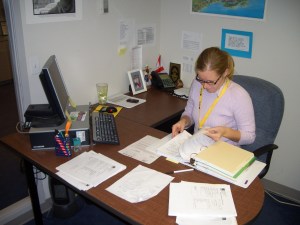
A translator enters Amelia Self’s office at the International Rescue Committee. She greets him while handing him a piece of paper. It is a form for the doctor to fill out during a refugee’s medical appointment.amelia-selfs-office

“Will you ask the doctor if he needs to make a follow-up appointment for when he finishes the prescription?” Self tells the translator. “Let me know and I’ll make the appointment, OK?”

Self, 28, is one of the health programs coordinators at the IRC in Salt Lake City. She is responsible for the health care of more than 400 refugees, coordinating their appointments with primary care physicians, specialists and dentists. Self must also make sure their appointments are scheduled with doctors who accept Medicaid, the insurance refugees are given for their first eight months here.

Trying to schedule their medical appointments during this eight-month time frame can be tricky. It can take as long as five months to get in to see a specialist, should a refugee need it. Then Self only has a three-month window to schedule any follow-up appointments.

Amelia Self works at her desk at the IRC.

Amelia Self works at her desk at the IRC.

Self also has to make sure an interpreter is present for the appointments. These translators usually provide transportation for refugees to the doctor’s office as well.

“It’s pretty intense but it keeps us busy,” Self said.

The medical needs of refugees coming to the US vary greatly. Some have received medical care before their arrival; others may not have received proper medical care since birth.

Dr. Margaret Solomon, 37, specializes in internal medicine and pediatrics at the University of Utah Redwood Health Center. She sees refugees after their medical screenings and makes sure their children are in good health.

The Burmese and the Bhutanese have been in refugee camps for 10 to 20 years. Their health has not been monitored the way it should have been, Solomon said. People coming out of these camps usually need to be treated for things like malnutrition and skin rashes.

Self said refugees from Iraq are often treated for high blood pressure and trauma-inflicted injuries because a lot of them are torture survivors. These individuals are referred to the Utah Health and Human Rights Project, a nonprofit mental health agency.

Self sends her clients only to doctors who have worked with refugees in the past, or who have expressed interest in working with them so she can be sure they are getting the best care possible.

It also helps that these physicians want to be involved with refugees because appointments can be time consuming. Self said working through an interpreter and trying to get through all of the refugee’s concerns can turn a 15-minute appointment into 45 minutes.

Within 30 days of their arrival in America refugees need to have a medical screening, which is a basic physical examination. Doctors also check for any communicable diseases, the most common among refugees being tuberculosis, Hepatitis B and Guardia.

Translators are vital to the information gathering process. Through them the IRC coordinates with refugees and other care providers.

“We rely heavily on on-call medical interpreters,” Self said. “Most of them are former refugees themselves.” They must have a proficiency in English and their native language.

“We’ll assign them appointments and they will contact the family to make sure they know about it,” she said. Then interpreters report back to her any follow-up appointments.

Many refugees are sent to the Redwood clinic to see specialists such as gastroenterologists and cardiologists. Any specialists not on staff are just a phone call away and refugees are referred to them if necessary.

Many refugees speak very little English and the doctor’s office is full of medical terminology that can be difficult to understand. Solomon is grateful that translators are present during appointments.

“They’ll clue us in on some of the cultural things and other things refugees are worried about that we don’t think about,” Solomon said.

It can be difficult to find translators for some languages, Solomon said, but they make due with the help they can get.

She remembers an appointment with a patient from Sudan who spoke only her native tribal dialect. Solomon had to speak through an Arabic translator, who relayed the information to the patient’s son, who translated for his mother.

Solomon said it can be difficult to rely on translators to explain complex medicine instructions.

“It’s hard for me to know what is being translated to the patient,” she said.

Han Win, one of the IRC’s Burmese interpreters, has worked as an English translator for more than 14 years. He finds it challenging to accompany refugees to the doctor’s office.

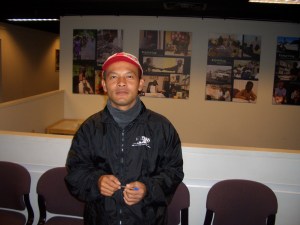
Interpreter Han Win

Interpreter Han Win

Like most translators, Win must find words to explain what the doctor is trying to convey while gauging the refugee’s reaction and expounding upon anything they have difficulty understanding.

“If I said it directly the same words to them they don’t understand what it means. I have to explain that term in detail more than what the doctor said,” Win said.

Providing for refugees’ health needs can be a frustrating task, but also a rewarding one, Solomon believes.

“I really enjoy providing health care for refugees,” Solomon said. “I’ve been here [at the Redwood Health Center] three years and I’ve been seeing some of these families that whole time.”

SLC charter school helps refugee students become ‘citizens’

Story and photos by BRADY LEAVITT

Each school day the uniformed elementary and middle school students of American Preparatory Academy in Draper, Utah, stand at their desks to face the American flag. They recite in unison “The Pledge of Allegiance” and sing “The Star Spangled Banner.” Dressed in matching white shirts, navy vests and sweaters, plaid skirts and khaki slacks, it is difficult to discern that these charter school students come from all sorts of social, economic and cultural backgrounds. But next year, if Director Carolyn Sharette has her way, APA will have an even more diverse student body.

American Preparatory Academy Director Carolyn Sharette

American Preparatory Academy Director Carolyn Sharette

Sharette, 49, plans to open APA’s first satellite campus in fall 2009. The school, located at 2650 S. Hempstead Road in West Valley City, will be called The School for New Americans. The school will focus on helping refugee children integrate into Utah and American society. SNA will accomplish this by maintaining a specific percentage of local, refugee and immigrant students at the school. It is designed to help all students catch up in subjects the struggle with at a pace and level suited to their needs.

“These kids who are 13 and go into seventh grade, when do they get to go back and work on kindergarten phonetics?” asked Catherine Findlay, a volunteer who is helping to coordinate the school’s efforts with refugee service organizations in Salt Lake City. SNA, she said, will be a perfect fit.

The student body will be precisely tailored. SNA’s official target student profile is 140 “settled” refugees — meaning they have been in the country for at least one year — who have strong spoken English skills, with eight to 12 refugee children per grade, kindergarten through ninth. Up to 25 percent of the total student enrollment will be refugees. The remaining portion will be students from the surrounding areas as well as any others who are able to get into the school.

Achieving this blend of students is complicated. According to Sharette, federal law prohibits charter schools from discriminating against any applicant, meaning  the school cannot just admit the desired 140 refugees if any other students are already on the waiting list. In other words, a wealthy white child has as much right to attend SNA as any refugee.

To deal with this, the school is informing refugee families before any others, Findlay said. Findlay, 41, has been working to contact potential families through representatives from refugee service organizations like the International Rescue Committee, The Asian Association of Utah and the Refugee Services Office in the Department of Workforce Services.

The first application period for refugee families ended on Nov. 30, Findlay said, after which SNA began accepting all students on a lottery basis. In future years, all students, refugee or not, have to be admitted by drawing. The school has some power to give added “weight” to certain at-risk groups like refugees. Weighted students have a higher chance of being picked in the lottery, but that will be the only tool available to maintain the desired balance, Findlay said.

To succeed with ‘those kids’

APA has become immensely popular in recent years; a student may have to wait years to be admitted. Sharette said she has felt APA’s model would be successful with all types of students since the school opened in 2002. However, the school’s critics discredit the results because of its location in affluent Draper, Sharette said.

A third-grade class at the American Preparatory Academy sit mostly at attention. In August 2009, APA will open a second campus in West Valley City aimed at helping refugee children.

A third-grade class at the American Preparatory Academy sit mostly at attention. In August 2009, APA will open a second campus in West Valley City aimed at helping refugee children.

“Who wouldn’t succeed with ‘those’ kids?” Sharette said people have asked her.

But they miss the point, she said. The programs and curriculum that APA uses are designed to work for gifted and struggling students alike, and it is not fair to discount results based on socio-economics.

“We want the opportunity to show that, and it’s best for us to do that in an economically-challenged population,” Sharette said. SNA is “the proving ground for our model.”

As a charter school, APA has a greater degree of flexibility in choosing the curricula it uses than many of Utah’s public schools. APA emphasizes grouping students based on ability and not necessarily age or grade level in subjects like reading, spelling and mathematics. A student who requires 20 repetitions to learn something will not be grouped with students who require 200 repetitions, Sharette said.

The new school will replicate the programs already in place at the APA Draper campus, Sharette said. APA and SNA are charter schools, meaning they receive government money but operate autonomously from school districts’ governing boards.

APA’s record of increasingly high test scores is a measure of success for both the entire school and individual students, Sharette said. This is because APA only uses and adapts curricula based on research, Findlay said.

“It’s not like we’re a bunch of parents who say, ‘Oh, we’d like to try this,’” Findlay explained. Instead, all the coursework is picked based on academic research and adapted through statistical feedback teachers collect in their classrooms.

APA also uses a method of call and response called Direct Instruction in the classroom. As the class moves through material, the teacher repeatedly cues students to respond individually or as a group. Many educators consider the method because it focuses heavily on rote memorization and recitation. But Sharette swears by it. One benefit of direct instruction for refugee children, she said, is that it encourages them to vocalize responses, which will accelerate their learning of the English language.

Opponents to the chartering program have criticized schools like APA of funneling tax dollars away from traditional public schools, increasing the strain on an already overworked system. Sharette sees charter schools as a great way to relieve stress on growing districts by giving parents an alternative for their children’s educations.

The school not only focuses on helping children to develop academically, but also emphasizes citizenship and patriotism, Sharette said. Students receive a grade in citizenship based on their participation and preparation, their punctuality and their adherence to school rules. A student can get straight A’s in all academic subjects but fail citizenship, she said.

The students and teachers at APA recite the “Pledge of Allegiance” and the national anthem each day. The Veterans Day celebration is the biggest holiday at the school, according to Laura Leavitt, 48, a third-grade teacher at APA. Sharette hopes APA will give incoming refugee and immigrant populations the skills and tools to function in America, to prepare all students to be citizens.  

A wake-up call

Getting the permission and resources to start the school was a three-year process. In 2005, Sharette applied with the Utah State Office of Education to open a second campus but was denied. The law at that time did not allow charter schools to have satellite campuses, she said.

It was disconcerting, she said, to be denied a second campus in spite of APA’s record of success. At the time, 2,850 students were on an admissions waiting list for the school. Sharette contacted several senators and representatives who she knew were supportive of charter schools.

“To have that denied was kind of a wake-up call for legislators as well,” Sharette said. “They were interested in helping us to make sure the law wasn’t the thing that was keeping us from being able to replicate.”

The law allowing charter schools to open satellite campuses passed in Utah’s 2007 general legislative session. In April 2008, Sharette received permission to open SNA in August 2009.

“It was very exciting because I have such confidence this will go forward and that it will be great for so many families,” Sharette said.

Excitement and worry

Not everyone shared her enthusiasm, Sharette said.

Opening the new school will require Sharette to be away from APA for much of the time. Some parents and teachers feel insecure, if only briefly, when they think she is leaving the campus, Sharette said.

“All we have to do is remind them that we’re taking this to 560 new kids, bringing them the same things that they’ve experienced [in Draper],” Sharette said.

Others worry about how to deal with the difficulties of working with refugee children: how the school will overcome language barriers, how the school will furnish transportation for students, how the school will provide meals and after-school programs — services offered by Utah’s state governed education system.

Sharette described a meeting she held in her office with workers and educators from the refugee services community to see how APA and SNA could complement their work: “When I came into the meeting, there were a lot of feelings being expressed about the hugeness of the problem,” Sharette said.

She said the representatives asked her — even challenged her — to explain why SNA would accept only 140 refugee students. How would SNA deal with children who came without food? What would they do when they came without appropriate clothing? Were there after-school programs? The conversation lasted for about 30 minutes and turned sharply negative, said Findlay, who was present at the meeting.

Sharette nodded, acknowledging each concern. Then she directed the group’s attention to a framed quilt that hangs in her office.

The 4-by-4-foot quilt has the painted handprints of 25 orphans who live on a farm in Zambia. Sharette is a member of the board of directors for Mothers Without Borders, which runs the farm. Africa has millions of orphans, she said, but we have 25.

“That experience,” she told the group calmly, “has taught me a lot about doing your part, and that making the difference in the lives of 25 kids is worth something.”

Sharette then added, “I want to be really clear that our mission is academic achievement and character development for 140 kids.” And  then she asked the question: “Is that worthless to you? Should we go in a different direction?”

The room was silent.

“One after another said, ‘No, of course not. It will be wonderful to serve these 140 individuals,’” Sharette said. “They started looking at the individuals,” she said, “and that, I think, is the key to this work.”

The legacy lives on

Sharette said she is not sure what people mean when they say, “it won’t work.”

“The ‘it,’ I think, has to do with a group of people who are very overwhelmed by how difficult the big picture is,” Sharette said. “We’re taking one piece and only one piece, and I think that piece is worthwhile for us to take. Is it worthless because we can’t do it all?”

Of the many people interviewed for this story, most, if not all expressed their admiration for Sharette’s ability to motivate people to action and to spread enthusiasm. She is, they said, a perpetual optimist. In an interview, she recoiled at the word “problem” and would only accept a question when it was rephrased it as “challenges and opportunities” the school faces. 

“Carolyn would never acknowledge negativity,” Findlay said.

Sharette recognized that she deals with problems and obstacles differently than many people. She views everything as a learning opportunity and a challenge, never a problem. Her method of dealing with challenges is a product of her upbringing, she said.

A handmade quilt with the hand prints of orphans who live in a Mothers Without Borders farm in Zambia. Carolyn Sharette is a member of its board of directors.

A handmade quilt with the hand prints of orphans who live in a Mothers Without Borders farm in Zambia. Carolyn Sharette is a member of its board of directors.

In her office, near the African quilt, hangs a picture of her father and family with the words “The Legacy Lives On” written across the bottom. He taught his children to be advocates in the community and encouraged positive thinking, she said. Sharette said her father would pay $100 to any of his children and grandchildren who memorized a collection of inspirational poetry he helped publish.

She then recited one of the poems, which speaks of an individual’s role in building up their community.

The poem, "Your Town," is one of Sharette's favorites.

The poem, "Your Town," is one of Sharette's favorites.

“These are the kinds of things that I learned growing up,” Sharette explained, “After a while you see everything in the context of moving forward.”

They are the kinds of things that Findlay also hopes to transmit to her own children and to the students at APA and SNA.

Findlay told of a day that she visited the Granite Peaks adult ESL program for immigrants and refugees, looking for parents who might be interested in enrolling their children in the new school. Her son Bradley, then 8 years old, accompanied her. As she walked in, they saw a row of 12 pictures along one wall.

The photos were of the adult ESL students and included short, personal bios, Findlay said. The students told their names, where they came from and why there are in America. Many had goals to return, someday, to their own country, she said. She was touched by the images, but more so because her son was there to see them first-hand.

“My son got to look down this wall and get exposure to 12 different countries in 10 minutes,” Findlay said with emotion in her voice. He was getting an education, she said, the education of diversity that she hopes is replicated at the School for New Americans.

For poverty-stricken Navajo Nation, a wrenching choice between development and the environment

by CHRIS MUMFORD

Elouise Brown stands at the edge of a rise in the middle of the New Mexico desert, pointing toward a barely distinguishable plot of land in the distance that has become the center of a battle in which her family and the entire Navajo Nation have become bitterly divided.

Brown is the head of Dooda Desert Rock (dooda means “no” in Navajo), an organization she formed to oppose the Desert Rock power plant that has been proposed for the nondescript stretch of earth a few miles away. She stands on the edge of the Dooda Desert Rock Camp, located an hour’s drive southwest of Farmington, N.M. 

The controversy over the plant is hardly new to the Navajo Nation and the broader Four Corners community of which it is part: The coal-fired facility would be the region’s third.

But this time things are different. This time the threat is not posed solely by outsiders who intend to plunder the area’s resources, offering a pittance in royalties for the mess they leave behind. Rather, the developers are members of Brown’s own family and tribe, acting with funds and official authorization from the Navajo Nation.

The company co-developing the project, Dine Power Authority (DPA), is an enterprise of the Navajo Nation. And the company’s general manager, Steven C. Begay, by dint of the complexities of Navajo clan structure, is considered Brown’s grandfather.

“He’s not in his right mind, I don’t think,” Brown said of Begay, noting that she treats him with customary familial respect but doesn’t receive the same treatment in return.

Taking a Stand

It’s the first day of Dooda Desert Rock’s (DDR) second annual four-day protest and Brown has returned from pointing out the construction site. She is now sitting in the camp’s central plywood shack, wearing a black Dooda Desert Rock T-shirt and a camouflage army jacket with her last name embroidered on the sleeve.

“We’re nothing to them, we’re nobody to them,” she says, speaking of DPA and its partner, Sithe Global. “They say we’re out in the middle of nowhere, but we don’t consider it the middle of nowhere.”

The walls of the shack are hung with news clippings and timelines that chronicle DDR’s efforts to kill the Desert Rock project. An illustration posted outside, near the entrance, depicts the plant in stark black, a skull and crossbones painted in red inside a column of noxious CO2 rising into the air.

“We don’t have a choice, we have to do this,” she says forcefully. “There’s nobody else doing this so we have to do it.”

But the involvement of DPA has added a unique wrinkle to the issue, one that has opened fault lines within Brown’s family and the broader Navajo Nation community.

With a 25 percent equity stake, the Navajo Nation Council could potentially generate desperately needed jobs and revenue for its 180,000 people, nearly half of whom are unemployed. Yet for Brown, whose activism has been central in stalling environmental approval for Desert Rock in court, the potential for economic benefits means little when the true costs are accounted for.

“It’s totally insignificant,” she said, in a telephone interview before the protest. “What’s more important, money or health?”

Health and the Environment

A passage from the invitation to the DDR protest makes plain Brown’s feelings about the involvement of the Navajo Nation’s government in the Desert Rock project: “Our Navajo leaders are forsaking Traditional Ways to take corporate money to poison our land, foul our air, and steal our waters. This abuse must STOP!”

By “Traditional Ways,” Brown explains that she means “care for everything and everybody.” She was raised by her parents, she says, to “take care of the whole cosmos.”

From the same vantage point where the Desert Rock site is visible, one can also see smoke billowing from the Four Corners power plant, leaving a brown-black streak along the horizon just above Farmington. And just a few miles east from there, barely beyond sight, is the San Juan power plant.

“The two combined are putting high levels of mercury particulates into the air and into the water, because they’re both using the San Juan River,” says Miles Lessen, a math coach for Navajo Nation schools who has lived in the nearby town of Shiprock for about a year, in an interview at the DDR protest. “So people who live down in Sanostee [a town west of Shiprock], this breaks my heart, they’re drinking the water from both plants that are coming through, so they’re getting a higher dosage than even I’m getting.”

For Brown, the health effects she believes were caused by this pollution catalyzed her efforts to block construction of a third coal-fired plant. 

“I’m not going to pinpoint this certain person with this certain ailment, but there’s a lot of cancer patients,” she says. “If you go to the cancer center in Farmington, there’s a lot of people. I’m not just speaking for the Navajo Nation, I’m speaking for all walks of life, all living species. There’s a lot of kids with asthma, respiratory problems of all sorts. There’s babies that were still-born. These don’t just happen constantly for no reason, there’ve got to be reasons behind it,” Brown continues, identifying chemicals, like mercury, released by the San Juan and Four Corners plants as the cause. 

“That’s how I got involved, I wanted to know ‘what can I do?'” she says.

Yet, when confronted with Brown’s dire claims, Desert Rock’s top officials react with a mixture of puzzlement and frustration.

“From a total impact standpoint, I think it’s going to get better before it gets worse. I don’t even see it getting worse, I just see it getting better,” said Nathan Plagens, vice president of Desert Rock LLC, in a telephone interview.

“We have an agreement with the Navajo Nation that for SO2 [sulfur dioxide], every time we emit, we will mitigate 110 percent by reducing SO2 emissions from another source,” he said in describing the first of a three-tier arrangement in which Desert Rock is contractually bound to reduce emissions not only from its own plant, but also from the two existing coal-fired facilities.

After SO2, Desert Rock has pledged to reduce nitrous oxide and acid rain using similar formulas at the contractually mandated second and third tiers respectively.

As for mercury, the plant wouldn’t use the San Juan River. Instead, its water would come from an aquifer located a mile below the surface of the land. And Desert Rock is classified as a non-discharge plant, meaning none of the water it uses will be re-released into the environment, Plagens said.

“The majority of the water that we’re using is basically for pollution control,” he said, with a hint of irony in his voice. “I don’t know where mercury can get in to come in contact with the water.”

But the real sticking point, from the standpoint of the courts and the Environmental Protection Agency, has been carbon dioxide (CO2) emissions. The gas is a major contributor to global warming, yet the EPA is not currently authorized to regulate it, according to Plagens. And a coalition of environmental groups, including DDR, has used the lack of CO2 regulations to appeal the EPA’s permit for the Desert Rock plant in court.

“The Environmental Appeals Board will say whether the EPA has to regulate CO2 permits,” said Plagens. “If they do have to regulate CO2, then a lot of things would be thrown on the table.”

At the DDR protest, Brown stresses the widespread consequences of allowing another coal-fired power plant to be built.

“Where are kids in their future generation going to go when the global warming gets worse? When there’s no more good air quality for them to breathe? What are they supposed to do?” she says.

And she’s not alone in her concern. “Unfortunately, every day, I’m losing my life expectancy. I eat healthy and I take care of myself, but I’m inhaling carcinogenic material,” Lessen says. “People down here, they’re getting it even worse.”

And while Sithe Global and DPA have promised to set aside funds generated by the plant to disassemble the facility and restore the environment after its resources are exhausted, there are currently no such plans for CO2 reduction.

Begay refers to the global warming claims of Brown and her associates as “nebulous.” “There are no rules the EPA can go by,” he said.

“It’s the same old garbage they’re coming up with that’s already been discussed,” he said.

The Promises

In forming DPA, the Navajo Nation set the standard for a broad paradigm shift currently taking place in Native American communities nationwide. Alongside tribes like the Crow and Blackfeet, the Navajo are pursuing a more active role in developing their own energy resources, including renewables like wind and solar in addition to traditional coal, oil and gas.

“The old-school is to lease the land, lease the resources,” said Begay, DPA’s general manager, in a telephone interview.

“We’re doing things under a new approach, with more participation and more equity,” he said.

Projections for the Desert Rock facility indicate that the equity Begay speaks of could translate into as much as $50 million in annual revenue for the Navajo Nation, whose yearly budget is $96 million, according to the 2000 census.

In testimony before the Committee on Indian Affairs on May 1, 2008, Begay emphasized the potential economic impact of the proposed plant.

“This project, which would create thousands of jobs during its four-year construction phase, 200 permanent, family-wage jobs in the power plant and another 200 well paying jobs in the adjacent Navajo mine during its lifespan, is absolutely critical to the economic future of the Navajo Nation, one of the most impoverished areas of the United States, with 50 percent unemployment,” he said, in a transcript of his testimony retrieved from the Department of the Interior’s Web site.

And, while already substantial, the revenues become all the more significant in the face of the potential closure of several plants that use Navajo-owned coal, which Desert Rock Vice President Plagens predicts could cost the Navajo Nation $40 million to $60 million per year in lost royalties.

The looming shortfall underscores the vagaries inherent in royalty schemes that have become a major force behind the push to take on a more active, management role in energy resource development.

“A lot of underhanded tactics have taken place in the past,” said Duane Matt, technology coordinator for the Office of Surface Mining, a division of the Department of the Interior. “I think [Native American tribes] need to have a personal, vested interest in what’s going on.”

In particular, Matt, who provides technology and training to Native American mining enterprises, referred to a recent lawsuit in which a Blackfoot woman sued the U.S. government for $47 billion in unpaid royalties.

Decided on Aug. 7, 2008, for 1 percent – $455 million – of the amount originally sought, the Cobell v. Kempthorne case exposed the flaws of the “old school” land-lease system of which Begay spoke. He said the case is partly responsible for a stipulation in agreements between DPA and Sithe Global requiring that all financial disputes be resolved in Navajo courts rather than in U.S. federal courts.

Royalty graft is likewise part of the checkered legacy left by the San Juan and Four Corners plants that has engendered deep mistrust among Brown and her supporters. But they remain unconvinced that the equity arrangement with Desert Rock will offer a significant improvement over the past.

“There were a lot of things promised that were not fulfilled – jobs, economic growth,” said Brown, adding later that the Navajo people would have to be “stupid to fall for this again.”

Miles Lessen, the math coach, points to inadequacies in the status quo to explain why he is pessimistic about the idea of things changing much under the Desert Rock model. “I think you talk to most people, stay around here for a while, talk to most people over in Sanostee and Shiprock and Gallup and all over and they’ll tell you there’s a lot of money that the tribe gets and most of the people here don’t see any of it,” he says.

Moreover, extravagant promises of economic development have a hollow ring to Brown and her supporters, who question whether the Navajo Nation will ultimately be able to raise the hundreds of millions of dollars necessary to purchase an equity stake in the project.

“If it’s projected as a 3.7-billion-dollar project and it’s not going to be built for another four or five years, I almost guarantee it’s going to be double that,” said Michael Eisenfeld, an environmentalist with the San Juan Citizens Alliance, an organization that opposes the plant.

“Where do they think they’re going to get the money for this?” he asked in a telephone interview.

Moved Yet Unmoved

At the Dooda Desert Rock Camp, Brown talks about being forced from her previous three protest campsites, which were located closer to the Desert Rock construction zone. Members of her own family even attempted to drive her off the current site, summoning grazing officials and Navajo rangers to expel her.

“We can’t trust anybody,” she says. “Everybody’s doing this for greed.”

For Brown and her supporters, who include major environmental groups like the Sierra Club in addition to concerned area residents, opposition to the plant is not a simple choice between economic rewards and environmental preservation. It is a rejection of the premise that money cures all ills and brings nothing but happiness.

“To me, money’s not everything,” Brown says. “Money can buy a lot of things, but when your relative’s going to die from cancer, you’re not going to take that money that you earned from the coal-burning power plant and go buy your relative back.”

Perhaps the most tragic fallacy of all, she says, is the notion that people can no longer live without the comforts of modern technology.

“We’ve done without electricity coming into our house, we’re doing fine,” she says. “We live as good as any of you, anybody out there. We’re living as well as DPA does, or Sithe. And we may be hauling water; I don’t see any faucet in here, do you? They don’t need it either, they’re just lazy.”

Salt Lake County faces refugee-housing crisis

by MATT BERGSTROM

At the end of 2007, Salt Lake County Community Resources and Development commissioned a report on the housing situation for refugees within the county. The report, published in December 2007 by Wikstrom Economic and Planning Consultants Inc., revealed a dire situation.

According to the report, Salt Lake is what is known as a “highly-impacted community.” When compared to other counties of relatively similar size, Salt Lake has resettled a disproportionately large share of refugees.

The report gives a number of reasons for this discrepancy. Refugees tend to be very successful here due to Salt Lake’s constantly expanding job market. Simply put, more jobs means the county needs more people to fill them.

Perhaps the main reason is the family-friendly atmosphere of the city. Many refugees who come to the U.S. have large families, of which Salt Lake is traditionally more accepting. Almost one-fourth of the families resettled in Salt Lake in 2007 had 5 or more people in them; with some having as many as 11.

Resettling large families in Salt Lake also leads to large numbers of secondary resettlements. This is when a person, or group of people, decides to relocate to a city to be closer to family after having already been resettled in another part of the country.

But with a steadily growing job market and a near-constant stream of new residents the vacancy rates in apartments in Salt Lake is low. And when vacancy rates are low, rent tends to go up. This is especially true of larger units that are needed to house the larger families being drawn here.

According to the Wikstrom report, an annual income of more than $24,000 per year is required to afford an average priced, one-bedroom apartment in Salt Lake. The average refugee works a minimum wage job and earns about half that amount. This means multiple earners are needed in the home just to afford the cheapest possible option.

Adaptation to apartment life is another housing problem facing refugees. Many who come to the U.S. are coming from refugee camps in Africa or Asia, and often have never lived anywhere else. These camps are not always equipped with the modern conveniences of a Salt Lake apartment.

“Sometimes you have to teach people how to use a light switch,” said Patrick Poulin, resettlement director for the International Rescue Committee in Salt Lake. He and his caseworkers assist refugees assimilating to their new surroundings.

“Imagine having to teach someone that, then have to teach them about a lease, or paying utilities,” he said.

This concern resonates with other refugee care organizations. At a recent refugee service provider network meeting, held by the Utah Department of Workforce Services, housing problems ranging from cooking in apartments with open flames to a bedbug infestation were discussed.

Situations like these make landlords wary of allowing other refugees to rent their units in the future.

Fortunately, local government has not turned a blind eye to the situation. Early in 2008, the Department of Workforce Services opened the Refugee Services Office. It was created with the intent of coordinating the many agencies and nonprofit organizations that work to help refugees in and around Salt Lake.

Gerald Brown, the director of the Refugee Services Office, feels the number of refugees coming to Salt Lake is not going to slow down any time soon. “People will not stop coming here as long as they can get here what they can’t get there,” Brown said.

Salt Lake City has also begun to explore other solutions for the housing crisis. In January 2008, just after the Wikstrom report was released, the Community Resources and Development division of the Utah Department of Human Services assembled a committee to find a solution. The committee, comprised of refugee service caregivers and local business owners, came up with an idea to build temporary housing specifically designed for recently resettled refugees.

The facility, which is being referred to as “welcome housing,” would not only be a place for refugees to live for the first year or two in America, but would also provide onsite casework assistance with a goal of eventual acculturation. This staff would include people to help teach refugees the basics of apartment living in a safe atmosphere where they can develop these skills before having to find permanent housing on their own.

The projected 50-unit project is still far from fruition, said Dan Lofgren, president and CEO of Cowboy Partners, a real estate development and property management company based in Holladay. Lofgren is also a member of the state housing committee.

Until somebody steps up with funding for the project, he said it would never be anything more than an idea. But even money won’t permanently fix the problem.

“There aren’t resources available to build our way out of this,” he said.

The Wikstrom report came to a similar conclusion. According to the report, there needs to be better training to teach refugees good renter practices. Availability of housing is not a panacea for the rest of a refugee’s life as a U.S. resident.

Navajo rug sale supports American Indian elders

by JAMIE A. WELCH

Life on the Navajo reservation and in traditional hogans made people strong. Years of following sheep around the desert, watching children move away from their homes and weaving together strand after strand of coarse sheep’s wool to create hundreds of rugs in a single lifetime has given the elders at the 19th Annual Navajo Rug Show and Sale their dedication to each piece.

The rug show took place Nov. 7-9, 2008 in Deer Valley Resort’s Snow Park Lodge in Park City, Utah.

Rug weaving is a historic Navajo, or Diné, tradition and is honored in the show that was formed specifically to support the Adopt-A-Native Elder Program (ANE).

This program, created to benefit Navajo elders, began in the 1980s through the efforts of Linda Myers, a Park City woman who was impressed by an early display of Navajo rugs from elders in northern Arizona. Soon after that event, Myers got involved in collecting and distributing medical, food, and hygienic supplies to elders living on the Navajo reservation in southern Utah and northern Arizona.

A group of supporters eventually joined Myers and the Adopt-A-Native Elder Program was established. Mary Phillips, one of the many volunteers at the rug sale, said it is “an honor to work with Linda. The program’s success is truly inspiring and shows Linda’s devotion not only to the elders themselves, but to the Navajo tradition [of rug weaving.]”

According to the program’s Web site, there are more than 2,500 people involved in the program today. Most are from the United States but some are from other countries as well.

Rosita Van den Berg is one such volunteer. Rosita is from Holland and became interested in the program while visiting a fan site of American Indian actor Jay Tavare. 

Tavare, an avid supporter of ANE, has information regarding the program on his personal Web site and on his Facebook and MySpace pages. Van den Berg, who attended the event this year, created a painting to honor American Indian people and donated it to be auctioned off with its proceeds going to the program.

Tavare, known best for his roles in the TV miniseries “Into the West” and films “The Missing” and “Cold Mountain,” has supported ANE for seven years. He has attended the rug show for the past three years. “It definitely brings awareness about the culture of Native Americans,” he said. He hopes his support can act as “a symbol to reach across nations and get the message as far out as possible.”

Another supporter at the show was author Rose Johnson-Tsosie of “Finding Helen – A Navajo Miracle.” Tsosie was born on the Hopi reservation of northern Arizona in 1950 but she and her twin were taken from her biological mother at birth and were placed for adoption. The siblings were raised by a white family, Albert and Wilmont Johnson, in Cache Valley, Utah, where they grew up never learning much about their American Indian heritage. Tsosie said all she was aware of was that “growing up Navajo in a white society was different only because I knew my skin was different.”

In 1983, Tsosie reconnected with her biological mother, a Navajo, while serving a mission for The Church of Jesus Christ of Latter-day Saints in the Arizona Holbrook Mission. Through tears Tsosie said, “there are many exciting times in my life but this is the ultimate dream when I got to hold my mother and my mother got to hold me.”

Since then, Tsosie has been actively involved in the American Indian communities of California and Utah. She now travels around the country promoting her books and speaking about and on behalf of American Indians.

Attending the ANE rug show gave Tsosie a chance to show the reason she says she loves being Navajo: “learning the tradition of my heritage.” Tsosie also said, “I do respect my heritage. I am still learning about who I am, about where I am going and where I have been.”

About 28 weavers were featured in this year’s rug show. Their ages ranged from the early teens to nearly 100 years old.

Patrina and Diana Furcap, ages 13 and 12, are sisters. They learned to weave from their mother at about 6 years old. Each sold one hand-made rug on the first day of the show. “I think it’s important to keep the tradition going from one generation to the next. We shouldn’t lose it because it’s art,” Patrina said.

Most of the weavers present were women. However, four men also participated. William Whitehair, who has been weaving since he was 7, said gender differences might be rooted in history. When European settlers arrived, they brought with them their traditional form of household with women at home doing domestic activities and men outside working in farms. Although the American Indian way is matriarchal, many Native people adopted the European style and over time, weaving became primarily a female activity. Still, Whitehair said, he weaves because he’s “always enjoyed the art.”

At the show, rugs were sold at prices ranging anywhere from $150 to several thousand dollars. Prices are indicators of the quality of each rug and the amount of labor involved.

Linda Myers explained, “It’s not about the weaving itself. It’s about how when you go up and feel these rugs and you feel the hands of the weavers…that’s one of the gifts of purchasing the Navajo rugs all woven by hand. All these rugs carry that beautiful spirit of the weaver and their hands and the patterns.”

Designs range from the simplistic “Diamond” pattern (a single shape woven throughout a rug) to the intricate “Tree of Life.” This rug is a story, beginning with a “wedding basket.” At the bottom of the rug is the basket, usually woven in yellow or brown, which symbolizes the beginning of a family. From the basket grows a tall corn stalk with many branches growing from both sides. Birds of all colors are perched on the branches, each representing older generations of the family. There are also birds in flight on either side of the stalk, which stand for the younger generations. At the top is the “tassel” of the corn which holds the pollen. In Navajo tradition, corn pollen is offered with prayers, giving significance to the tassel being the tallest point on the Tree of Life. This rug can be woven in any color assortment ranging from rich dark colors to pastels.

Proceeds from the rug sales go to support the ANE program in buying food, firewood, and other items for Native elders. Individuals also could purchase balls of yarn in various shades to donate to elders for use in weaving. Some customers chose to sponsor a specific elder and invited him or her to choose the colors they liked the best. Additional donations can be made at the Web site.

The Adopt-A-Native Elder program has been a success for more than 20 years. One weaver has been a part of the program since its inception. Weaver Grace Smith-Yellowhammer of Teesto, Ariz., feels blessed to play a part in ANE and is proud of the international community involved. “We are all connected,” she said, “One voice, one prayer, one heart.”

Diversity is complicated for refugees in Utah

by BRADY LEAVITT

In a state that is 93 percent white, Gerald Brown represents diversity.

Brown is white. He wears bow ties and peers through round-rimmed glasses. When asked if he speaks foreign languages, he says, “Only Southern.” When asked what his epitaph might read, he says, “A Holy Man.” And when asked if refugee caseworkers are tough, he says without hesitation, “Shit.”

Brown, 57, is the director of the Refugee Services Office in the Utah Department of Workforce Services. He works as a sort of traffic cop at the intersection of politics and nonprofit groups, coordinating efforts to help refugees integrate into Utah’s communities and culture.

Brown became director of the Refugee Services Office in February 2008 after Gov. Jon Huntsman Jr. ordered its creation. Huntsman and the state legislature appropriated $200,000 to fund the office, the first time state money has been provided specifically for refugees. The sum is small, Brown said, less than 10 percent of the money he receives from the federal government. However, it as a sign that the state is willing to invest in refugees, he said.

“I need Huntsman for another term,” Brown said, referring to the upcoming elections. “He gets it.”

A self-described “lefty activist type,” Brown wants democratic Sen. Barack Obama to be elected president in November. He figures that with a Democratic president, Republican Gov. Huntsman will be re-elected in Utah and not called to a cabinet position in Washington.

Before Gov. Huntsman’s executive order, the Refugee Services Office consisted of “one guy and a cubicle,” Brown said. Now the office has six employees and one volunteer coordinator.

While he enjoys working in Utah, Brown’s fondness for the state and its governor only goes so far. He expressed frustration with the organizational difficulties of his job. One of his office’s goals is to build a network of trained volunteers to assist caseworkers. But, he said, the bureaucracy is slowing it down.

“Do we have trained volunteers on the ground yet? Nope. Because we’re still meeting,” Brown said.

Brown began his work in the field of refugee services assisting Cambodians at a YMCA in Houston in 1981. It was his first-hand experience that inspired him to be an advocate and an activist. The most effective activists, he said, are those who have had similar exposure to diverse populations.

Brown both praises and criticizes Utah in this respect. He accuses many Utahns as being insular and in many cases ignorant when compared with other groups of people he has worked with.

Peter Robson works as an interpreter for refugees at the Asian Association of Utah. He said that he included his work experience at a refugee resettlement agency on his resume. As he interviewed for jobs this past summer, many employers would ask him about it.

“These were well-informed people, but they were surprised that there were real refugees in Salt Lake,” Robson said.

According to the U.S. Census Bureau, Utah’s population in 2006 was identified as 93.5 percent white and only 5.1 percent black, Asian, Native American or Pacific Islander.

Robson, 23, is a native Utahn. Growing up in his east Salt Lake City neighborhood he was separated, and not just from the refugee community, he said.

“It’s easy to insulate yourself and separate yourself from anyone who is less-privileged,” Robson said.

Robson said his experiences working with the refugee community have changed his underlying career goals – salary and other considerations are no longer as important as the satisfaction that comes from helping people.

Robson is similar to many people that Brown knows in Utah. Brown said he is baffled by how simultaneously sheltered and eager the volunteers he finds here are.

“Utah County is the volunteer capital of the U.S.,” Brown said, “It’s like the perfect job.”

Brown said that diversity is edifying and that people need to begin to realize that the world is getting smaller and people are more reliant upon each other than ever.

While Brown may feel that Utah is not a hub of diversity, he maintains that Utah is the “Wild West for resettlement work,” meaning that he feels so much is possible because people and organizations are so willing to help. And despite his criticism insularity, Brown said that one of the reasons it is so easy to work with people in Utah is that they are conservative and relatively nondiverse. ”

They have no complicated experiences,” he said, “and people seem generally nice.” Brown epitomizes in many ways the unique and unlikely diversity of Utah.

Diversity, Brown said, is a two-way street – a street on which he directs the traffic.

And doing so, Brown said, “I have had the privilege to get to know the world.”

LDS Humanitarian Center and Inner City Project helps refugees

Story by MICHAEL OLSON


  • See a slideshow about an English class provided by the LDS Humanitarian Center and hear from a service missionary (best viewed in full-screen mode)

Amy Wylie, 49, and her husband have been volunteering with The Church of Jesus Christ of Latter-day Saints in the Inner City Project for nine years. They started volunteering with the project as service missionaries in a ward in Salt Lake; now they serve as assistant directors of refugee services for the project.

This is their church calling. They turned in their missionary application papers to serve a 30-month service mission, the longest term a service missionary can serve without resubmitting another application.

The LDS church has several programs designed to help refugees adjust to life in Utah. One of them, the Inner City Project, helps prevent people from getting lost in the transfer between agencies giving care to refugees.

For example, at the International Rescue Committee most refugees only have six months before their case is transferred to another agency. However, the Inner City missionaries are always available to help and give service.

“Service missionaries play a bigger role longer term,” Wylie said.

Service missionaries are not the same as the church’s full-time missionaries who spend every day proselytizing. These missionaries are there to help people in the area, whether they are members of the church or not.

About 500 service missionaries currently serve in Salt Lake City. They are not specifically assigned to work with refugees, but it is part of their overall assignment in the ward, or area in which they work.

“When you are assigned to a ward you become a part of that ward and you take what ever the bishop asks you to do,” Wylie said. When missionaries are assigned to work in an area with a large refugee population it is likely the bishop will send them to assist them.

“We serve as a resource to help train. If they have questions and don’t know where to go they will call us and we will help them figure out a plan of action,” Wylie said.

They also help refugee children enroll in school and make sure they are getting the attention in class they need.

“We met one of the lost boys of Sudan in our first mission assignment,” Wylie said. Wilson was 7 years old when he was separated from his family during an attack on his village. He ended up in a refugee camp and hasn’t seen or heard from his family since.

Wilson met the Wylie family during church. He would sit with the family every week because he felt comfortable with them.

One Sunday he handed Wylie a note.

“It said ‘Could I have a picture of your family to remember them by?’ and I realized that he had no picture of a family, he didn’t belong to a family,” Wylie said.

The Wylies went to Temple Square where they took a family picture with Wilson in front of the temple.

Now Wylie shares her copy of the picture with people every chance she gets. She feels that people think it takes too much effort to make a difference in people’s lives.

“Look how simple it was. He now calls me mum and my children his brother and sisters,” Wylie said.

The Inner City Project also plays a role in finding refugees jobs. Missionaries help them find work at the LDS Church Humanitarian Center and at the Deseret Industries.

“It is set up to train them and help them learn skills and move them out to the work force,” Wylie said.

The LDS church established the Humanitarian Center in 1991 in Salt Lake City. It is located on the corner of 1700 South and Bennett Road. According to its mission statement, the center’s mission is three fold: “To prepare emergency relief supplies for shipment worldwide, to train those desiring to develop employable skills and become self-reliant and to offer service opportunities.”

The Humanitarian Center provides various skill training for refugees. They learn computer skills, they attend job etiquette classes to learn appropriate behavior in the work place, and they learn English. A teacher from the Granite School District teaches ESL classes, said Bart Hill, the center’s development manager.

During 2006, 175 refugees were employed at the Humanitarian Center. They are involved in sorting and bailing clothing. Items are sent to areas around the world where they are distributed to the needy.

They also put together packages the Humanitarian Center distributes, including hygiene kits filled with combs and toothbrushes, newborn kits filled with diapers and bottles, and school kits filled with rulers and pencils.

To obtain a job at the center refugees only need an endorsement from the bishop of the area they live in, as well as documentation proving they can legally work in the United States.

They manage the language barrier with help from interpreters who work with local relocation agencies. Some refugees have even learned English well enough to translate for those who need it.

Refugees working for the Humanitarian Center earn wages ranging from $6.55 to $9 per hour. They can earn more in the clothing sorting and bailing departments if they prepare shipments quickly for transport.

A refugee’s job performance is evaluated on a quarterly basis to make sure their work skills are progressing. Once refugees have worked for a year at the Humanitarian Center they are better qualified to work other jobs, Hill said.

“The great thing here is assisting them as they move toward self-reliance,” Hill said.

Luna Sasa, 28, works as a sorter in the medical supplies department at the Humanitarian Center. She helps gets the emergency medical supplies ready to be shipped.

Sasa was born in Sudan. She fled eight years ago with her mother, sister and her then 3-year-old daughter because of war.

She kept getting laid off because she lacked certain skills other jobs required. She was looking for a job she could hold down. Then she heard about the skills training program at the Humanitarian Center from the bishop in her area.

“I went to the bishop and he gave me the paper, and I started working here,” Sasa said.

Since Sasa has started working at the Humanitarian Center she has learned how to use a computer, how to type and how to use programs like Excel and PowerPoint.

Eventually Sasa wants to study at LDS Business College to become a medical assistant.

“Refugees need a lot of friends,” Wylie said. “They need people that just welcome them and take them into their neighborhoods and communities and school systems.”

Wylie and her family invite these friends over to her house in Salt Lake to celebrate holidays together.

“They are still a big part of our family. One night we had about 11 languages in our home,” Wylie said.

Whenever she hears that one of the refugees she stays in touch with has had a child, Wylie rushes over in her van that she has filled with boxes of supplies she gives to refugees. She gives the new parents a box overflowing with baby clothes and blankets.

“They aren’t assignments to us,” said Wylie, “we consider them our brothers and sisters.”