Bhutanese celebrate holiday, new life in SLC

Story and photos by MATT BERGSTROM

Thursday, Oct. 9, was an important day for Hindus around the world. It was the celebration of Dashera, the victory of the goddess Durga over the demons who stood in the gods’ way during creation.

For a group of Bhutanese refugees in Salt Lake City, it was also a celebration of a different victory.

Thursday was the first time the small Bhutanese community in Salt Lake City has officially gathered since refugees began arriving in the city in April 2008. The gathering was held at the Taj India restaurant at 4515 S. 900 East.
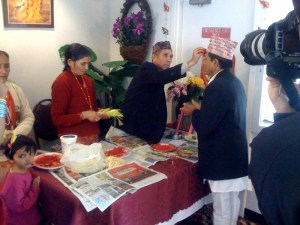
Bhutanese celebration

Bhutanese celebration

For nearly 20 years, these families had been living in refugee camps in Nepal. Most of that time the Bhutanese coexisted peacefully with their Nepali hosts. For the past few years, tense relations between China and Tibet have driven more refugees into Nepal. This flood of new arrivals pushed the Nepali government to its breaking point, prompting officials to make an appeal to the United Nations for help. The U.N. decided to resettle the Bhutanese who had long been without a home of their own.

Nearly 250 Bhutanese have resettled in Salt Lake since April. Among them are many members of the Dulal family.

Biren Dulal, 26, was only 8 years old when his life was uprooted and he moved with his family from his home in Bhutan to a camp in southeast Nepal. Today he barely remembers why he had to leave his home. He thinks it had something to do with the Buddhist government wanting Hindus to convert in the interest of national identity.

The actual reason seems to still be in dispute. According to the Web site for Human Rights Watch, the exodus was based on ethnic reasons rather than religious ones. The government of Bhutan in the late 1990s was interested in establishing a firmer national identity. The dispute is whether ethnic Nepalese in Bhutan chose to leave or were forced out by the government.

Regardless of the reason for leaving, Biren said life in the camp was difficult, but not unbearable.

Refugees were seldom allowed to leave. They had their own schools and shops and most of their basic needs were met. However, under certain circumstances, refugees could get permission to live outside the camp.

Biren left the camp for the first time at 18 years old to attend Kalimpong College in eastern India. After earning his bachelor’s degree he went to Katmandu to teach middle school science. A short time later he decided to return to the camp where most of his family still lived to continue his teaching there.

Soon after, members of Biren’s family began being resettled in the U.S. He decided it would be best if he joined them.

Biren Dulal arrived in San Diego on June 21, 2008. He had been sent to live with a brother and sister who had already been resettled there. Biren did not care for San Diego, but is too polite to say why.

Biren Dulal at the celebration.

Biren Dulal at the celebration.

He was then allowed to join the rest of his other brothers and sisters in Salt Lake City. The former teacher now divides his time between his job as an interpreter for the International Rescue Committee in Salt Lake, the nonprofit group that helped resettle him, and his volunteer work teaching English to other Bhutanese in town.

Ultimately he would like to get back to teaching science.

Travis Zirker, an IRC caseworker for many members of the Dulal family, said getting back to work is a common desire. A few of Biren’s brothers also were teachers in Nepal before coming to America.

One of those brothers is Ghana Dulal, who Zirker said has become a sort of unofficial community leader.

In the small Indian restaurant packed on an unseasonably warm autumn afternoon with almost 200 Bhutanese refugees, guests from various resettlement organizations and members of the press, Ghana Dulal offered a speech of gratitude and, in a small way, victory.

He talked of their hardships while encamped in Nepal and of the warnings they received from friends before leaving. They were told they would not be allowed to be Hindus in America.

In the end, Ghana Dulal summed up what all the Bhutanese were feeling, and what those who have not been there could not understand, when he said, “We are no longer refugees. We are free people.”

A big change is coming for the IRC in SLC

by MATT BERGSTROM

Imagine you have just contracted a life-altering disease. You find a specialist who knows how to treat it and the two of you work together to improve your quality of life. Now imagine that after six months you are told you have to go to a new specialist. The new doctor is just as qualified, but knows very little about your specific needs. You now have to go back and find a system that works for you both.

This is what life is like for newly arrived refugees in Salt Lake City. They are given six months to grow accustomed to one aid organization, and then their case is handed over to another, Patrick Poulin said. Poulin is the resettlement director for the International Rescue Committee in Salt Lake.

The IRC is an international nonprofit organization that specializes in resettling refugees from around the world in the United States.

The IRC is also the first doctor in the scenario given above.

When the U.S. State Department decides who will be given a new home here, they approach groups like the IRC and ask them how many refugees their organization can take on. The IRC then gives them a number. When the two agree which cases will be handled, the IRC is given all the information on each person being resettled.

The next job is deciding which of the IRC’s 17 U.S. regional offices will handle each case.

Once the local office has the information and has arranged for the refugee to enter the country, the staff have six months to do everything they can to help people get resettled and become self-sufficient.

According to the IRC’s Web site, staff and volunteers work together to help refugees obtain “the tools of self-reliance: housing, job placement and employment skills, clothing, medical attention, education, English-language classes and community orientation.”

This is where the second specialist gets involved.

After six months of assistance from the IRC the refugees and their cases are transferred to the Asian Association of Utah.

The AAU, which is also a nonprofit organization, works with refugees to improve their situation by upgrading housing, finding permanent employment so they can become completely self-sufficient. The goal of the AAU is to have refugees settled into a job, a community and a way of life that will best facilitate their individual needs.

Both organizations have similar goals, but Poulin says it’s a difficult transition for someone coming from a completely different world to have to adjust to a new aid organization so quickly. That is why he and the IRC have been trying to extend their involvement with refugees from six months to as many as 24 months. Poulin feels this is ample time for refugees to get settled into their new surroundings and firmly anchor their new life in America.

Lina Smith, program director for resettlement for the Asian Association of Utah, agrees with Poulin. “I think whatever works for the refugee, I’m for it,” Smith said.

The AAU currently handles all refugee cases in the state including those managed by other nonprofits.

Smith said the IRC will begin working with refugees for up to two years beginning in January. She feels this will help ease the workload of the AAU’s four full-time caseworkers who currently oversee more than 80 cases each. Her organization will still be there to help refugees who need assistance after the first two years.

Smith and Poulin agree that a more equal share of the responsibility between the two organizations is beneficial for the refugees and the nonprofits. But they still worry about money.

Both organizations receive funding from the State Department, but Smith and Poulin feel that it is not enough. Currently, refugees receive $425 a month on which to live.

Poulin said Gov. Jon Huntsman Jr. has set aside an additional $200,000 from the Utah state budget for refugee services in 2009. Poulin also says The George S. and Dolores Dore Eccles Foundation has promised the IRC a $50,000 grant.

Poulin is convinced the additional funding will help greatly with the overall success of their program. He said, “If we are able to provide more quality services to refugees … then we are successful.”

Gerald Brown: Fighting for those who cannot fight back

by REED NELSON

The man is happier than any man should rightfully be for a 7:30 a.m. meeting, but in his line of work, this is the least stressful part of his day. Donned in a bow tie, thick-rimmed glasses with Coke-bottle lenses, and topsiders, and for a man in his position, he looks the part.

He deals with grants (or lack thereof), crime (both with clients and against), family issues (his and his clients), resettlements, and the acclimation of oppressed people in a foreign land.

His name is Gerald Brown, 57, and for the better part of three decades, he has been working with refugees in locations such as New York City and Houston before arriving in Salt Lake City in 2002.

Now, as the Director of Refugee Services, in the Utah Department of Workforce Services, Brown is under constant pressure from the weight of two separate worlds. He must keep his budget in line, because he is a government employee. And he must also keep the refugees he helps happy, healthy and in tune, because he knows they are the ones who can get lost in the shuffle.

“We provide eight months of Medical service and cash assistance for those who qualify,” Brown said with a hint of empathy, ” the problem with Utah is a lot of time there is no one to look after them after that.”

Brown began his work with refugees in Houston for four years, then continued his work in the melting pot that is New York City. He understands that it was a good place, if not the most mundane, to earn his stripes. He was thrown into the middle of the daily struggle that is resettlement with a group of Cambodian refugees.

“Once I began to learn to communicate with them I could plant a seed,” Brown said, “and once the seed is planted, it can be enforced to the nth degree.”

He ran a resettlement house for 10 years in New York, and that led him to a job as a political asylum officer in Kansas in 1998. (Political asylum differs from refugee status, only because asylum deals exclusively with political conflict and oppression. A refugee is oppressed from any and all angles.)

After Kansas, Brown moved to Salt Lake to bolster the resettlement program, before ending up with the Utah Department of Workforce Services

“When I came here, we had one guy in a cubicle, now we have six,” Brown said with a grin. And his grin is genuine, because when he works with such a limited, but demanding, clientele, he needs all the sure handed help he can get.

Now he has a volunteer training program in place, and help, at least with a face, has arrived. His caseworkers are now fully trained, and now they can manage each responsibly and compassionately. The training program is essential, Brown said, especially when handling home visits with refugees.

“Volunteers untrained can cause more trouble they help most of the time,” Brown said. Which is why his case workers are equipped not only to handle face to face interaction with their clients, but the behind the scenes business as well.

Those volunteers have now taken on a heavy load of individual cases. The case management process requires the caseworkers to be fully versed in the refugees’ rights; otherwise a lot of necessary services are not readily available. It is Brown’s job to make sure his workers can access those services.

Brown understands that he is fighting an uphill battle, but the battle far from over. He has reached members of the Salt Lake community indirectly, which is a testament to his influence. Some do not even know who to see when they first arrive.

“My family never knew where to go, and I am still the only English speaking member of my family,” said Sean Keranovic, a Salt Lake Community College student originally from Prijedor, Bosnia. “Our neighbors got in touch with a case worker back in 2002, and their transition has been made much easier. No late bills, no missed school, and very little confusion.”

So while Brown deals with his 11-year-old son (“He wants to be a journalist,” Brown said with a chuckle) and his family life, he is always making sure that no case is left untouched.

Society has the propensity to complicate things, and complication can often bury the unprepared. Gerald Brown deals with people who have had few choices in life, and makes sure they don’t slip all the way through the cracks. And despite the long hours, he still manages to keep a broad smile on his face.

“Man, I’ve had the privilege to know the world,” Brown said, with the same smile adorning his face, directed more to himself than anyone in particular. “To learn [about people from other countries] is like another college degree free of charge. Cool.”

TEA of Utah

by JENNIFER MORGAN

Teinamarie Nelson and Rebecca Wilder were having lunch one day and discussing an issue they heard about from the media regarding transgender people that they thought was unfair. The two women wanted to do something to help transgender people and those who interact with them so they didn’t make the news the same way. They decided to form a nonprofit organization but, it wasn’t until Christopher Scuderi came on board that things started moving.

Transgender Education Advocates, or TEA (pronounced “T”), was established in 2003 as a volunteer organization. It is an affiliate program of the Utah Pride Center and its mission is “to educate the public on transgender issues for better understanding and awareness of discrimination towards the transgender population.”

TEA offers a Gender 101 class, which aims to make people aware of individuals who don’t fit the binary gender system. Scuderi said 50 percent of the classes they teach are requested while the other half are through TEA’s outreach efforts. Because TEA doesn’t have an office of its own, classes are offered in the Utah Pride Center or at the organization receiving the training.

One group that received the Gender 101 training recently was the Public Safety Liaison Committee. PSLC is a group of individuals in service-related professions, including firefighters, police officers and EMTs that aim to educate those in their field about LGBT issues. Rachel Hanson of the Utah Pride Center and Scuderi conducted the training for PSLC, which lasted about an hour and half. Hanson felt it was a success because people openly talked a lot about biases and other subjects that came up during the presentation. Another good gauge for determining whether the training went well, is if participants feel free to ask questions. “I can often tell when people feel comfortable because they ask questions without worrying about sounding dumb,” she said. “A lot of people don’t understand transgender people.”

Gary Horenkamp, PSLC’s co-chair, said the training was “a well-organized, well-presented learning activity” with useful information that he hadn’t heard anywhere before. Horenkamp also is the project leader for OUTreach Ogden, which supports the “personal growth, acceptance and equality” of LGBTQ people and serves Box Elder, Morgan, Weber and Davis Counties. Gender 101 classes are available throughout the year, but TEA also hosts special events.

During November, TEA hosted a number of events in recognition of Transgender Awareness Month. For 2007 it brought in two speakers to provide workshops for medical and legal students and professionals. TEA also observes the Day of Remembrance annually on Nov. 20 with a candlelight vigil. The memorial commemorates transgender people who have lost their lives due to hate-crime violence.

Although it wasn’t a hate crime, Scuderi tells of an individual who was involved in a car accident that died because of a lack of understanding. When paramedics arrived they had to cut away clothing and when they discovered the genitalia of the victim didn’t match the rest of their appearance they were shocked. Apparently they laughed and poked fun but never helped, which resulted in the victim’s death. Some people have a hard time seeking medical help because they don’t know how they will be treated.

In the Salt Lake City medical community there are four family doctors who advertise that they treat transgender patients, but only one, Dr. Nicola Riley, is still accepting new patients. The others had to stop because their practices were too large. Riley received TEA’s 2006 award for Individual of the Year, while Equality Utah was given the Organization of the Year award for its work. Riley received this award partly because of her willingness to continue accepting transgender patients.

If a transgender person decides to have gender reassignment surgery, or GRS, they may have a difficult time finding a surgeon as well. Scuderi estimates there are a dozen throughout the United States, but none are in Utah. The closest surgeons are in Colorado, California or Arizona. Outside of the country, Thailand has the most GRS surgeons because of its progressive views regarding gender.

TEA’s 2007 keynote speaker, Dr. Marci Bowers, has a waiting list of 150 people. Her practice is located in Trinidad, Colo., which is the “transgender capital of the world” according to the city welcome sign. Born Mark Bowers, she transitioned later in life after marrying and having children although she had thoughts about becoming a woman by the age of 5. Bowers has helped more than 500 patients through this process and is considered a world-renowned surgeon. She has been a guest on “Oprah” and “Larry King Live.”

Locating a surgeon is just one challenge facing individuals. Securing funding also can be problematic. Many people can only afford changes from the waist up and can feel incomplete because of it. A few insurance companies cover GRS, but it has to be written into the plan. For male-to-female surgery, Scuderi estimates the cost ranges from $8,000 to $22,000. Female-to-male surgery costs considerably more: $30,000 to $150,000.

Because the costs are out of reach for many, TEA established the Cans For Change program. Aluminum cans are collected for recycling and the money goes toward a scholarship. The scholarship fund was developed to help with a portion of general reassignment surgery costs for an individual on a need basis. You can e-mail TEA to arrange a pick up of clean cans any time. While it has yet to raise enough to consider applicants, TEA hopes to have $1,000 soon for this purpose.

Due to confidentiality and stigma, few statistics are available on the transgender population. But Scuderi and Rachel Hanson believe the transgender youth population is growing. They think this is partly due to the media. Films such as “Boys Don’t Cry” and Barbara Walter’s segment on “20/20” bring exposure to the transgender community. Also, the Internet provides a forum for youth to discuss their lives and issues in a safe environment.

Hanson is the youth director at the Utah Pride Center and facilitates the transgender youth group that meets weekly. She said many transgender people are not receiving support from family or friends so they are at a higher risk for suicide and other self-destructive behavior than gay and lesbian youth.

Utah law doesn’t allow the promotion of homosexuality in schools. Hanson says that when they have approached schools to educate them they often shy away from the training because they’re afraid it’ll fall under the “promotion” of alternative lifestyles.

Scuderi says TEA has had conversations with two school boards. “We’ve contacted most of them, but they’ve either declined or haven’t returned emails or phone calls.”

On campus and elsewhere, the most obvious place transgender people encounter problems is the bathrooms. If a female has male genitalia and goes into the boy’s bathroom she’s more likely to have a problem than using a girl’s restroom.

Another place that is high risk for transgender people is correctional facilities. Currently when someone is picked up they are placed in holding cells based on their genitalia. Because their outward appearance is generally different than those their holed up with, they become easy targets for harassment or worse. Horenkamp said there was a senior officer from SLCPD at the Gender 101 training and he felt it was well received.

Respect, accuracy key to coverage, GLAAD strategist says

by YEVGENIYA KOPELEVA

The Gay and Lesbian Alliance Against Defamation offered a presentation on media essentials on Oct. 16, 2007, in support of Pride Week at the University of Utah. Adam Bass, the Northwest media field strategist for GLAAD, encouraged aspiring journalists to recognize and write effective pro-LGBT messages.

“A good example of an effective pro-LGBT message could be something like this: University of Utah Pride is an opportunity to showcase our diverse student body and let every student know he or she is valued as a member of the community,” Bass said.

GLAAD’s media field strategy teams provide training to help lesbian, gay, bisexual, transgender people and straight allies illustrate more effectively the power of local media to encourage respect, inclusion and acceptance. In addition, the teams work closely with organizations and individuals to develop strategies and contacts, create news coverage and train spokespeople. Bass’ role is to be a community and media resource for whoever is writing or speaking about the LGBT community.

He encourages people to correct misrepresentations and factual errors in the media by responding with a message that will educate and inform others. “When you respond to a story or an article, do stay positive and be for, not just against something,” Bass said. “Don’t make it us versus them.” He believes it is vital to stick to what you know, since the message must match the messenger, but also said not to be afraid to be on the offensive. Bass told the audience to remember to reclaim facts and valuable statements with proper language and not to repeat the opponent’s negative message.

For example, when writing letters to the editor, Bass said it’s essential to respond to the defamatory coverage by clarifying the misconception or inaccuracy of an opponent. “The strategies for writing a letter to the editor are: making a strong affirmative statement, tell your personal story, support your statement with facts and strengthen the existing positive message of your organization,” Bass said.

Once you have created an effective message, the next step is knowing your audience. Bass said there is no such thing as a general audience; rather, individuals need to speak to the “movable media,” those who will be affected by the issue or subject. “It’s important to tell your personal story and to let your message come from experience, but to also know your boundaries,” Bass said. He encourages people to use “buzz” words like freedom, justice, democracy, love and commitment to build bridges with readers or the audience. The goal is to convince your audience that your position is reasonable and persuasive.

“It’s simply about taking the personal story and making it a universal message. For example, try using the Oprah effect; ask someone to sit on a couch and tell you their story,” Bass said.

On the other hand, the goal of writing an opinion editorial is to summarize an issue, develop a persuasive argument and propose solutions. The strategies behind writing an opinion piece are: Begin with your personal story, include facts and make the complex issue clear. “Whether it’s a letter to an editor or an opinion editorial, it’s essential to keep it short and concise, to be specific in the response and to not assume audience knowledge,” Bass said.

He said he approached the editor of the Daily Utah Chronicle at the U about publishing the word “homosexual” in a story. In response, the staff committed to altering their pre-existing style rules to appropriately address the LGBT community. “The explanation of the term as a scientific branding propagated by a number of anti-gay publications made it clear to me that we should include more specific instructions on use of the word in our own style guide,” said Matthew Piper, editor-in-chief of the Daily Utah Chronicle.

GLAAD, the third largest LGBT civil rights group in America, strives to change hearts and minds by altering the way media portray the LGBT community. “We are a media advocate and watchdog for the LGBT community,” Bass said.

The organization was founded in New York City in 1985 in response to the defamatory anti-gay media coverage during the beginning days of the HIV/AIDS crisis in the United States. GLAAD’s mission is “to promote and ensure fair, accurate and inclusive representation of people and events in the media as a means of eliminating homophobia and discrimination based on gender identity and sexual orientation.”

GLAAD strives to meet people where they are and to foster broader conversations with anyone and everyone. “We talk about stories to open hearts and minds,” Bass said.

NLGJA low on numbers, high in benefits

by STEPHANIE FERRER-CARTER

They are called under-represented, minority groups for a reason. Groups that fall under this category often have their images skewed, stereotyped or all together forgotten in America’s newsrooms.

In 1975, the National Association of Black Journalists was founded in an attempt to combat this growing problem. Other ethnic minority groups — Hispanic, Asian and Native American — followed suit, establishing their own associations all sharing the same goal, an effort to find a solution to misrepresentation through education.

Then, in 1990, the National Lesbian and Gay Journalists Association (NLGJA) was founded. It was time to address the needs of a group that was not identified by their ethnicity or race, but by their sexual orientation.

Headquartered in the nation’s capital, NLGJA has spread across the nation into 25 chapters, located in cities or states that have at least 10 official members. According to NLGJA executive assistant Brian Salkin, the Indiana chapter and the Nashville, TN, chapter were the most recent to be instated, Alaska will be the next state to add a chapter.

“As an organization we do primarily three things: we first advocate for fair coverage of LBGT issues in the media, we advocate for equal work place benefits in news media and related fields and we train professionals,” Salkin explained.

According to NLGJA’s Web site, approximately 1,300 “journalists, media professionals, educators and students” who are gay, straight, lesbian, bisexual and transgender have become members in NLGJA’s nearly two decades of existence.

Two of those members reside and work in Utah. Salt Lake City is one of four cities and states that are categorized as significantly smaller groups called satellite chapters.

The low membership in Utah may come as a surprise considering the benefits NLGJA offers. The group strongly advocates for equal work-place benefits, and labels itself as a support group, providing a wide variety of programs such as the Diversity Oversight Committee and Podunk, a task force for the group’s smaller markets. NLGJA also posts job listings, events calendars and provides resources, such as an official LGBT style guide.

“And then there are the intangible benefits,” Salkin said. “It serves as a huge networking pool for our members and people who want to be members .… It provides you with someone who you can relate to as a fellow journalist who is out.”

NLGJA is especially student friendly. For an annual fee of $25 aspiring journalists can apply for scholarships and internships that are offered through the group. An Excellence in Student Journalism Award with $1,000 in prize money that student members can qualify for is offered. And perhaps most importantly, students can find professional mentors willing to share the experiences and challenges of being gay and working in a newsroom.

Much like gay journalists, Salt Lake has some stereotypes of its own to break. JoSelle Vanderhooft, NLGJA’s Utah representative and assistant city editor at QSaltLake, said the state’s reputation makes her somewhat of a “celebrity” at NLGJA conventions. “They say, ‘Wow, Utah. What’s that like,’” Vanderhooft said.   

What is Utah like?

As far as media coverage, QSaltLake and the Pillar are two examples LGBT media publications in the state.

In Vanderhooft’s opinion, KSTU FOX 13 has provided some of the best LGBT coverage in the state. However, a story by another Utah television station about gay men soliciting sex in Memory Grove, a park in Salt Lake City, warranted Vanderhooft’s harshest criticism.

“It was ridiculous. They made a lot of assumptions. If I had known about it I would’ve called NLGJA’s rapid response task force,” Vanderhooft said. The rapid response task force referring is a part of NLGJA that examines specific complaints from media consumers and journalists. 

Her criticism has nothing to do with sexual orientation. Vanderhooft said she felt the story did not have accurate sources. Vanderhooft fully believes a “straight” journalist is just as cable of covering the LGBT population as a “gay” journalist would be; it just takes a little more effort. “You’ve got to be educated. You’ve go to do your homework,” she said.

Gay or straight, bisexual or transgender, the fact is, a journalist is likely to be asked to cover a story involving the LGBT community at some point in his or her career. NLGJA is there to act as a watchdog, but more importantly, to help journalists make sure their coverage is accurate.

“We’re actually having conversations about gay marriage … it makes for a different newsroom,” Vanderhooft said. “Ultimately, I’m looking forward to the day we won’t need to say LGBT media and people just write about it.”

Becker is backed by Equality Utah

by CLAYTON NORLEN

With a donation of $7,500 and a commitment to volunteer involvement in mayoral candidate Ralph Becker’s campaign, Equality Utah is endorsing who it believes can advance its mission.

Becker has proposed the adoption of a universal human rights initiative that is broken into three categories: Comprehensive Ordinances and Policies, Domestic Partner Policies and Compliance and Enforcement. These measures will encourage the progressive development of current legislation and further the protection of human rights in Salt Lake City.

“A fundamental part of growing a great American city is making sure every citizen is protected by the law and treated equally,” Becker wrote online in his announcement of proposed incentives. “As Salt Lake continues to develop and grow, I want to make sure that every person feels they are safe and secure in this community.”

In advocating these measures, Becker is supporting Equality Utah’s key issues, such as the development of anti-bullying, equal access policies for students at all levels of education and furthering the adult designee program to include domestic partners as beneficiaries.

Utah’s lesbian, gay, bisexual and transgender community’s biggest enemy is bias, said Mike Thompson, executive director for Equality Utah. The mission of Equality Utah is to secure equal rights and protections for LGBT Utahns and their families. Its political action committee is determined to encourage legislation and vocal support of politicians and measures that move it closer to its goal.

“We are the political activist group for the LGBT community, and if only 10 percent of our members volunteer it can make a significant impact on the mayoral race,” said Will Carlson, manager of public policy for Equality Utah. “$7,500 was the cap on what we could donate, and it’s significant because it illustrates Becker’s support for our mission.”

As a lobbying organization Thompson explained, the strength of Equality Utah is in its education of politicians and the citizen representation it embodies on the hill. Because Equality Utah wanted to invest its money in the individual whom it felt would be best for the communities it represents, it waited until the primary elections to endorse a candidate.

Thompson said that the filter through which all of Equality Utah’s decisions run is its mission statement. The issues that surround the LGBT community cannot be simplified into a yes or no questionnaire. Because of this, Thompson explained that it is important to maintain relationships with politicians so Equality Utah can speak openly with officials and encourage dialogue.

“Politicians are realizing the impact the LGBT community can have in elections,” Thompson said.

Buhler didn’t comment on Equality Utah’s decision to endorse Becker instead of him, only saying, “It was their decision.”

“My feeling is that everyone should be treated the same in providing any city service, be it picking up someone’s garbage or providing insurance,” Buhler said. “I can’t think of why we’d treat anyone differently. If elected, we’ll treat everyone the same.”

David Everitt, campaign manager for Becker, said Equality Utah’s donated funds will go into a general campaign account to cover advertising, rent and other costs in the mayoral race. Everitt didn’t specify what the money would be used for, saying only that once money is donated to the campaign it covers whatever costs it is needed for.

“There’s always more doors to knock on,” Everitt added.

Volunteers who participate on behalf of Equality Utah in the race will be put to work knocking on doors, placing signs and stuffing envelopes. Volunteers can also donate their time to data entry, making phone calls or doing what Everitt described as general office work.

“It’s all about building relationships with both sides of the party line. This allows us to strive towards a fair and just Utah,” Thompson said. “[Utah] is where change needs to take place. What are you going to do, make a blue state bluer? No — [Utah] is where the challenges are.”

Activists discuss Utah marriage ban

by CLAYTON NORLEN

The passage of Amendment 3 in November 2004 to the Utah Constitution, which outlawed same-sex marriage, was widely debated at the time as an amendment that would protect traditional nuclear families.

When the amendment passed by a two-thirds vote in 2004, gay activists said many voters forgot to consider how families in the queer community would be affected.

The Hinckley Institute of Politics at the University of Utah, in conjunction with the Lesbian, Gay, Bisexual and Transgender Resource Center and the Queer Student Union, hosted a forum to debate the controversial amendment on Oct. 16, 2007.

The forum had prominent panel members from the local political scene, including the Stonewall Democrats and Utah Log Cabin Republicans. Also on the panel were human rights activist group representatives like Equality Utah and the Transgender Education Advocates of Utah.

“It is the youth who are going to make a change,” said Mel Nimer, a member of the Utah Log Cabin Republicans, and one of five panelists. “In my generation, being gay was an unspeakable sin, but now in your generation, 70 to 80 percent of the youth are accepting and welcoming to members of the gay community.”

Amendment 3 served to redefine marriage in Utah to consist of the legal union between a man and a woman, adding that no other domestic union would be given the same legal standing.

“Amendment 3 is a big challenge for the LGBT community,” said Rep. Jackie Biskupski, D-Salt Lake City. “Now it will be legal battles in the courts to ensure the rights of the LGBT community in Utah. If you think your silence is appropriate, think again — it is silence that is so damaging.”

Biskupski said involvement in groups such as Equality Utah and access to technology make it easy to express opinions on the issue to representatives, encouraging students to speak out to lawmakers by doing simple things such as sending text messages to their representatives’ Blackberries.

“For me, the reason I stay and I advocate is because if we don’t stay together and unite, then what are we doing?” asked Christopher Scuderi of TEA. “We need to stand together as the LGBTQ community, and all marginalized groups need to stay together because we are all fighting for the same basic human rights.”

Every panelist reiterated the importance of political activism from all individuals who are eligible to vote, saying that the catalyst for change in any state or city is public participation.

“You guys are young,” Becky Moss of the Stonewall Democrats told the audience. “You’ve got voices and new ideas, and it is you who needs to be out there advocating for action. I’m old, and our tactics can only carry us so far. Get registered and vote. We need the public to get out and vote, so there can be an accurate representation in Utah.”

Although the forum was dominated by panelists who agreed on issues affecting the queer population, the audience had different reactions to the panel’s ideas of achieving equality.

“It’s good that these issues are being talked about, but we’re being overly optimistic,” said Sydney Rhees, a senior majoring in psychology. “It’s hell out there, and change will only come slowly this way. This panel will talk about change but they won’t stand up and make it happen. I don’t think things are getting any better. They’re still difficult.”

Rhees married his partner in 2004 in Massachusetts, where same-sex marriages are legal and recognized. But when Rhees moved to Salt Lake City in 2005 to pursue his education, both his health and car insurance that were provided through his partner’s insurance plan were revoked. 

The Defense of Marriage Act gives states the autonomy to recognize only marriages or civil unions they wish to, because of this act when Rhees moved to Utah his marriage to his partner was considered invalid and his benefits were stripped away. Biskupski said numerous legal battles would have to be fought and in conjunction with educational efforts by the queer community before Amendment 3 could be struck from the Utah Constitution.

“Changing the Constitution to get something out is harder than getting something in it,” Biskupski said. “There is so much educational and grassroots efforts that need to take place over the next few years to get the support needed, and even then it will be incredibly difficult to get something through Capitol Hill.”

Student embodies center’s core values of social justice

Story and photo by JAIME WINSTON

Construction is particularly loud outside the offices of the University of Utah’s Center for Ethnic Student Affairs.

Visitors to the office take a longer route due to the work being done to improve the Union building, which houses CESA. Despite the inconvenience, students inside the offices are building relationships and a support base.

According to CESA’s mission statement, the group assists ethnic students in navigating cultural, economic, social and institutional barriers. Valery Pozo, peer mentor for the program, embodies these principles, Luciano Marzulli said.

“She is a scholar, highly intelligent, well organized and really dedicated to our core values like social justice, equity and education,” said Marzulli, CESA Latina/o Program Coordinator.

In addition to working at CESA, Pozo is a resident advisor at the university’s Benchmark residence halls and co-chair for the campus branch of Movimiento Estudiantil Chicano de Aztlan — MEChA. She is in her third year at the university and vocal about issues regarding Latina/o students.valery-pozo

Pozo said after she earns an undergraduate degree in history, she plans to pursue a master’s degree at Arizona State University and become a high school counselor. “Counselors have a vital role in students’ careers and students’ futures,” she said.

Pozo was born in Salt Lake City, but her parents are originally from Peru. When they came to Utah, they worked for another couple who discouraged them from teaching Pozo Spanish. The employers felt it would hold Pozo back. Now she is learning the language at school, but some instructors have assumed she already knows it and is looking for easy credit.

“I’ve been asked if I know Spanish and to leave the class because it’s not fair to the other students,” she said.

Students experiencing similar struggles often visit Pozo at CESA. One student approached Pozo because her parents were pressuring her to go into a science field even though she did not enjoy it. Eventually, the parents realized their daughter needed to make her own decisions about the direction her life takes.

Pozo’s mother inspired her daughter’s path in life. “I don’t think she realizes it, but my mother influenced me a lot in how I want to frame my life in social justice,” Pozo said. Her mother talked to her at a young age about issues like the United Fruit Company’s presence in South America and listened to news and political debates with her.

“When I was younger I was listening to the 1996 Democratic presidential debates and I rooted for Bill Clinton like no other,” Pozo said. She is now supporting the candidacy of Hillary Clinton and met Chelsea Clinton when she campaigned for her mother at the university in January.

Aside from politics, Pozo is concerned with the way students are treated. Many educators show a lack of respect for identities of ethnic students and do not expect much of them academically, she said. Since Pozo was an honors student at East High School, teachers treated her better than other ethnic students, she said.   

Students at CESA tell each other about professors and other students who unintentionally make intolerant remarks. Pozo experienced this herself, when a professor repeatedly used the term “Latin American whore” to refer to his frequent visits to Latin America. “But just his language was ridiculous,” she said.

Some instructors do understand other cultures and encourage minority students to achieve, Pozo said, such as Theresa Martinez, associate professor in the Department of Sociology. Pozo also has noticed some high school counselors supporting students who want to get involved with MEChA and go to college.

Many students Pozo has met in MEChA have been discouraged from pursuing higher education. Pozo worked with one student who was told she was not cut out for a writing course by an instructor. Situations like this are not uncommon, Pozo said, especially for undocumented students.

A controversial bill, HB 241, preventing undocumented students from paying in-state tuition unless they do not have a job outside of school was recently debated. Undocumented students face many challenges already, Pozo said. An example is one of her high school friends. “She’s been here since she was really little,” Pozo said. “I don’t think it’s fair that we went to high school together, we did a lot of things together, and all of a sudden she wasn’t supposed to attend higher education.” Pozo and MEChA lobbied against the bill, which did not make it to the Senate floor.

The bill would have perpetuated the status of second class citizens placed on undocumented students, Pozo said. “If they don’t have an education, they don’t have the tools to pursue other goals and careers.” A limited number of scholarships are available to undocumented students. According to the university’s income accounting and student loan services, the in-state tuition for lower-division freshman with one credit hour is about $661, while an out-of-state student pays about $1,900.

Pozo said she stands up for what she believes in, even when it doesn’t have much impact. However, a handful of representatives like state Rep. David Litvak, D-Salt Lake, listens to the MEChA students and keeps them aware of what is going on inside the legislative sessions.

Colleen Casto, who does community outreach for diversity at the university, said the general public doesn’t always get a sense of the challenges immigrants face. “They don’t understand how difficult it is, the bureaucracy, how many years it takes people to get here and the compelling reasons why they come here,” she said.

Pozo was a student in Casto’s honors think-tank class on immigration. “Sometimes when a group of students gets stuck on something she tends to jump in and facilitate,” Casto said. The students went to Mexico during Winter Break 2006 to develop an immigration resource guide book. “They worked really hard on it and the reason they did all the research is because they found that the general public didn’t understand it,” said Casto, who supports the lobbying that MEChA has done.

Groups like Black Student Union and Asian American Student Association also have shown their support for MEChA’s efforts. This year, CESA is focusing on cross cultural leadership and how to work with other student groups, Pozo said. MEChA helped BSU and AASA with their high school conferences, while those organizations assisted MEChA in fundraising efforts. Members of all three groups are often seen forming bonds in the CESA offices.

Most students who utilize the office come quite often. “It’s weird seeing a student you don’t see regularly,” Pozo said. Like many students, she experiences a sense of community at CESA. “I can come and share my experiences and my frustrations or laugh at some stupid racist comment,” she said.

“Students know each other and it’s a very close knit community,” said Feleti Matagi, director of the university’s Opportunities Scholar Program and former program coordinator for Pacific Islanders at CESA. Many of the students he assisted at CESA told him about incidents of racism. “I’ve had several students who had experiences where they expressed issues in their life and other students disrespected or disregarded it,” he said.

As a high school counselor, Pozo wants to assist students who have been overlooked because of their race and utilize the knowledge she is gaining at CESA today.

MESA: Representing the underrepresented

by PHI TRAN

Think for a moment about all the educational programs being offered to students. Now think about the programs that are specifically aimed toward underrepresented populations, ethnic minorities and women. If you cannot think of any then you have not heard of MESA: the Mathematics, Engineering, Science Achievement Program.

This national program helps ethnic minority and female students achieve educational goals by providing them with an array of educational and financial opportunities as well as support. Although MESA helps all of these students, Hispanic and Latino/Latina students in particular have seen the advantages of being in the program.

The number of Hispanic students in MESA has steadily increased over the years. According to the MESA 2007 Fall Manual, Utah has 114 schools that implement the program. Hispanic students involved in MESA increased from 1,413 last year to 1,653. Although it is not a large increase, it is a significant growth. The specific reason for the increase of Hispanic participants in the program is unknown – however it is proof that the program is a positive influence on Hispanic students.

Furthermore, Hispanic students have seen for themselves the results and progress that can take place with being a member of MESA. Jhoanna Quezada and Marily Hernandez, 8th-grade students from Brockbank Junior High, said other students who are not involved in the program should definitely consider it. “It can [help] keep your grades up. It helps our nationality grow and it gives Hispanics a better image,” Quezada said.

Social networking is another added benefit for younger students. “You get to interact with other schools and it helps different cultures work together,” Hernandez said.

Dr. Lyn Burningham, the Alternative Language Services Consultant and the director of MESA at the Jordan School District, said the students are usually exposed to two stages of language acquisition in the program, cognitive academic language proficiency and basic interpersonal communication skills. With exposure to academic language, Burningham said, students tend to feel less marginalized and more comfortable in social settings.

The program offers a variety of activities that allow the students to learn social skills. Some of the activities include monthly meetings, field trips to universities, science fair projects and annual contests, such as MESA Day.

This year, MESA Day for junior high students in the Granite district was held March 19 at the Utah Cultural Celebration Center in West Valley City, but the location for this event varies by year and by district. During the event, students from all 16 middle schools participated in six activities:  the egg drop, krypto, trebuchet, super slinger, surprise and the mystery activity. These activities are designed to challenge the students to use math, engineering and science education to complete the specific objectives of the competition.

In addition, MESA introduces students to large corporations that are actively involved in the program’s industry advisory council, such as L-3 Communications, ATK Launch Systems Group and Intermountain Health Care. When students interact with these large companies, it provides these students with a possible vision of their future, as well as exposes them to many types of opportunities such as scholarships and internships as well.

MESA also helps other students who may not be interested in math, engineering, or science. Ayleen Velez, the TBD department manager of Nordstrom, was a member of MESA throughout junior high and high school.

“They taught me a lot of public speaking skills, interviewing skills, and how to be myself and open in public and show charisma,” Velez said.

She obtained a scholarship through the program and although she decided to major in interpersonal communication. “I feel like it really helped me establish who I am and I use a lot of the skills they taught me,” Velez said. She also believes MESA assists Hispanic students in cases where parents do not have the knowledge of how the school system works or are not able to teach their children how to get into college.

Moreover, the program assists with SAT/ACT preparation, provides career counseling and mentoring and tutoring sessions. Because students are expected to obtain good grades in order to stay in the program, MESA tracks their grades and progress. Most students join the program when they first enter junior high either through recruitment at registration or through a referral from a math or science teacher. Other students join because their friends are in it or because their siblings were in it. Burningham said the earlier students join the program the better because they can take full advantage of MESA and its benefits.

In fact, the Granite district has begun implementing MESA into elementary schools. Currently seven elementary schools administer the program: Jackling, Academy, Monroe, Silver Hills, Stansbury, Wright and Fox Hills. Charlene Lui, the director of MESA and Education Equity for the Granite district, said it hopes to obtain more funding so eventually all of the elementary schools will have MESA.

“It’s a great learning environment for kids to be in and I feel like it helps them to be more well-rounded,” Velez said.

According to the fall manual, the MESA vision is to provide educational opportunities to all ethnic minority and female students through this program and its partnership with higher education and business industries. “It helps students solidify academic achievement and also provides them with a sense of belonging,” Lui said. The Utah MESA program has been helping the underrepresented population for 20 years.