American dream true for Utah woman who went from poverty to community leader

Eunice Jones speaks with University of Utah journalism students about her life.

Story and photo by DANA IGO

As a child growing up poor in the Philippines, Eunice Jones paid for school supplies by selling fried dough rolled in sugar to the local townspeople.

Now Jones, 51, sells properties as an associate broker of a Re/Max Masters franchise in Salt Lake City.

How she moved from living in a hut in a seaside village to living in Utah as a distinguished member of the community is a true story of success that begins at her roots.

“My parents always told us that they could not give us anything but education,” Jones said.

As the seventh of 11 children, she was used to feeling hungry and going to school barefoot. Her family’s home had no electricity or running water and she often did school work by the dim light of a gas lamp. Yet her parents made sure she and her siblings studied hard and went to school every day.

Her parents’ strong emphasis on education pushed Jones to excel and in 1980 she graduated in the top-10 of her class at the University of Manila with a degree in marketing.

In 1986 she was offered an opportunity to work in the United States as a catering manager at the former Hyatt Wilshire in Los Angeles.

Jones, a single mother, had to leave her sons, Thomas, 2, and Andrew, 2 months, with her mother and sister in order to move to the U.S.

Even though she had to part with her children, the chance to come to America was something she couldn’t refuse. With the help of her friends and family, she scraped together the money for airfare and got on a plane to California.

“I only had a suitcase, $50 in my pocket and a dream of a better life,” Jones said about her arrival in the U.S.

Los Angeles was like nothing she’d experienced before. She saw a washing machine for the first time. Her friend’s mother had to help her figure out how to use it and it didn’t turn out well – ­ all of her clothes shrank. Until she got her first paycheck, Jones had to borrow everything from friends.

She moved to Las Vegas to work at the Las Vegas Hilton in 1989. It was there that she felt secure enough in her job and situation that she obtained visas to bring her sons from the Philippines to join her.

In 1995 Jones remarried and moved to Utah with her new husband and children. She was hired by the Salt Lake City Hilton, but the work wasn’t challenging so she took real estate classes at night in order to switch careers. A year later she received the Better Homes & Gardens Rookie of the Year award. She opened her own Re/Max franchise in 2003.

When she and her husband divorced in 2009 she sold her franchise to Re/MAX Masters, where she now works as an associate broker.

Aside from real estate, Jones also devoted considerable time and energy to the Asian community of Utah.

She is a leader in the Utah Filipino community and organizes the Utah Asian Festival. In 2005 Jones and Judge Raymond Uno founded the Utah Asian Chamber of Commerce, which helps bring Asian businesses together throughout the state. Jones is also head of the Asian Advisory Council, which is a part of the Utah Office of Ethnic Affairs.

Jones’ story is a testament to the American dream and she has no regrets about coming to the U.S.

“My lifestyle [in the Philippines] was not as free as it is now,” she said.

Her son, Andrew “A.J.” Jones, 24, feels the same way. He has visited the Philippines twice with his mother and says it was a humbling experience.

“It was definitely a culture shock for me to see 12 people living in a small home, or in their shop/home on the side of the road,” he said.

A.J., who is currently working on a bachelor’s degree in education at the University of Utah, also attributes who he is today to his mother. In high school, when he wanted to play sports, his mother would tell him grades came first. Now he balances sports and school as a Little League coach at Olympus High School. He says his mother set the example for making education his focus.

“She has taught me to be very passionate and to want something,” he said. “She wanted a better life for us and she knew this was the only way.”

Former Miss Asia Utah says pageantry is more than beauty

by KENDRA WILMARTH

Lipstick and nylons fly across the room. Hairspray pollutes the air as women hold down aerosol nozzles sculpting each strand of hair in place. Women glide down runways with chiseled smiles and a glimmer of confidence in their stride. But this isn’t a fashion show, this scene is one of hopeful women competing at local beauty pageants to be considered for a crown identifying them as the next year’s titleholder.

In Utah countless pageants are available for young girls and women to compete in. Pageantry has become a popular outlet for women to get involved in their community, while at the same time earning scholarship money.

Miss Asia Utah is one of these pageants. The program began in 2008 and now takes place every June when the Utah Asian Festival is held in Salt Lake City. Asian women aged 17 to 25 are given the opportunity to showcase their talent and elegance while on stage. The pageant is open to anyone who is at least 50 percent of Asian descent and willing to be a role model for her community and the Asian-American community.

“We believe that these young women have a responsibility to do something in the community, it’s not just a pageant,” said Agnes Higley, chairwoman of Miss Asia Utah, in a phone interview.

Higley said the pageant is a way for women to personally develop. The program helps women gain and maintain confidence as well as high self-esteem. According to the pageant’s mission statement,  participants through this program will be able to foster relationships through friendship and cultural interactions. Higley said one of the main reasons for starting this pageant was the lack of knowledge in younger generations about their ethnic roots.

“There’s a lot of Asian-Americans who were born here, and they don’t know a lot about their cultures,” Higley said.

Women competing will also learn to understand about their own heritage and embrace others in their cultural differences. According to the mission statement, the pageant promotes intercultural unity among Asian-Americans in Utah. Judges pick winners based on talent, national costume, evening gown and eloquence in interviews. Each year different sponsors finance the pageant and provide the winner with a unique scholarship amount.

courtesy of Nicole Abalos

Abalos wins crown and title of Miss Asia Utah in 2009. Courtesy of Nicole Abalos.

Nicole Abalos was crowned Miss Asia Utah in 2009. The University of Utah student and former ROTC cadet says the program is a great way to showcase the diversity and multicultural societies here in Utah. In an e-mail interview Abalos said pageantry brings young women from all over the state to represent their ethnic heritage and unites them in many different ways.

Abalos became involved in pageantry in 2007 when she was given the title of Miss Philippine. Although she is one-half Filipino, one-fourth Japanese and one-fourth German, Abalos was mainly raised with Filipino traditions and also speaks some Tagalog, a major language in the Philippines.

Many doors have been opened for Abalos since her crowning, including opportunities with school, volunteering and even job interviews. Through the preparation of the pageant Abalos says she learned more about herself, was able to gain confidence and the self gratitude from helping others. Winning the pageant gave her not only a window to become a role model in her community, but also was an educational experience.

“The pageant has taught me a great deal about my ethnic roots which include, respect to elders, giving back, and keep traditions through every generation,” Abalos said in her e-mail.

Abalos, now 20, competed for the title of Miss Utah USA on Oct. 22. While she had hoped to receive the crown, for her it wasn’t about winning.

“It’s about finding who you are and why you should be the face or example of communities within the state,” Abalos said.

The Miss USA program is gaining more cultural depth. The current Miss USA is the first Arab-American titleholder. The 2010 Miss Utah USA is Russian and the previous winner was Bulgarian. Abalos says she believes it’s exciting to have contestants with such varied cultural backgrounds competing in pageants.

“This just proves how diverse our country is and the opportunities available to everyone,” Abalos said.

The former Miss Asia Utah says being involved in these competitions helps her learn from many amazing women who live around the state. Although Abalos didn’t win the title of Miss Utah USA, she said she will continue to be a great example and leader.

“I work hard for what I deserve and give back to those less fortunate,” Abalos said. “Hoping to be a role model to younger girls is all I could ask for.”

Utah Asian Chamber of Commerce looking to expand scholarship program

Story and photos by KAREN HOLT BENNION

Growing up near a small village in the Philippines, she would often go to bed on an empty stomach. She spent her summers selling snacks like a vendor at a baseball game just to earn enough money to buy school supplies. She and her 10 brothers and sisters got by without running water or electricity. The only positive aspect in her life was the looking forward to each new school year. For Eunice Jones, education would be her salvation.

Eunice Jones discusses her life, past and present, with student-journalists at the University of Utah.

In her early teens, her parents moved the family to a small apartment in nearby Manila. Jones said the two-bedroom, one bathroom home seemed like a far cry from their “humble beginnings” back in her village. Life became a little easier for the family.

She eventually graduated from high school, and with the financial help from a college scholarship and her family, graduated in the top 10 of her class from a college in Manila. “That’s what we do,” Jones says. “We all help each other.” She got a job and settled down with her husband. They had two sons. However, after her husband left them, Jones decided it was time to venture outside of her home country. This meant breaking the rules of Philippine culture. She was supposed to live with her parents until she remarried.

She left her sons — one of whom was still breastfeeding — behind with her family and moved to Los Angeles, where she had been offered a job with the Hyatt Corp. “It was quite eye opening,” Jones says about her arrival in in that city. However, after three years of saving enough money she was able to obtain visas for her children and fly them to the U.S.

After marrying her second husband, they moved with him to Salt Lake City where she still worked in the hotel business. Finally, Jones decided she was ready for another challenge and earned her realtor’s license. During her first year as a realtor Jones was chosen as Rookie of the Year by Better Homes and Gardens magazine for her outstanding sales skills. She admits she owes it to selling snacks as a little girl in the summer. “I was in sales since I was a little girl,” she says.

In 2005, Jones, along with former Third District Judge Ray Uno, decided to establish the Utah Asian Chamber of Commerce. That same year, they also founded the Chamber’s scholarship program with the help of founding sponsor Zion’s Bank. Three scholarships were awarded at $1,000 each. Currently, the Chamber’s charitable foundation offers partial scholarships to an average of 15 students a year. Jones would like to see the scholarship program grow with more sponsors helping to offer full scholarships to high school seniors.

U student Amy Tran received a UACC scholarship in 2010.

One of last year’s recipients, Amy Tran, says the UACC Scholarship Program has helped her in more ways than one. A sophomore in business at the University of Utah, Tran says not only does the program give financial help, it also offers the students chances to receive training in leadership skills from local UACC members.

“The UACC is really supportive and motivating,” she says.

An awards gala and fundraiser for the scholarship program is held every spring. All of the students are invited to attend. They meet each other and are introduced to members of the UACC. The members then teach the students how to network and make connections. Tran says, “They all really try to get to know you.”

Another student at the U has been awarded the UACC’s scholarship for three years in a row. The last time she was awarded the scholarship she received the highest score of all the applicants. Michelle “Mika” Lee is currently earning her master’s degree in occupational therapy. She is also a part-time intern for the UACC. Lee works as the event coordinator.

“Education is placed high in my family — my father got a Ph.D. and my mother got her B.S. early,” Lee wrote in an e-mail interview.

UACC President Lavanya Mahate congratulates Mika Lee at the 2010 Scholarship Gala.

Both students agree that more publicity is needed in order for the scholarship program to grow. Tran heard about the scholarship through her uncle, who is a member of the UACC. She never heard anything about it at her high school. Scholarship co-founder, ZeMin Xiao, says their program is still small compared to other minority programs in the area. The main reason for this, she believes, is due to a stereotype that Asian-Americans do not need scholarships. People view Asian-Americans as the “Model Minorities,” she says. Tran agrees; when she told her friends she was going after different scholarships they told her she didn’t need them.

“You’re Asian, you’re smart, you’ll be fine,”  her friends said.

Xiao would like the Salt Lake community to know there is a scholarship specifically targeting Asian-Americans.  She says the program is constantly trying to find more sponsors. Some of the supporting companies include Merrimack Pharmaceuticals, Crocker Ventures Ltd. and vSpring Capital.

Now divorced, Eunice Jones dedicates more time with members of the UACC to help mentor Asian-American students and to try to get the Salt Lake community to realize that by helping to fund their scholarship program, it is investing in the future of all Utahns. After all, her family invested in her.

Bullying, stereotyping must give way to acceptance, say Asian-American women of Utah

Story and photos by KAREN HOLT BENNION

No one realized that when she entered the room, this petite 5-foot-2-inch tall frame would pack such a powerful punch.

Linda Oda grew up in Ogden’s “Red Light District.” It was known for being the toughest and most violent section of town. At an early age, she learned how to protect herself from bullies and thieves. When she was 12 years old, she stood up to a potential thief (called a “dorobo” in the Japanese culture). He pressed a knife against her stomach and told her he could kill her. She then flashed a knife she had been using to trim heads of lettuce and said, ” I could kill you too.” She was unhurt. Even more tragic was the death of her father. One day, he came upon a “dorobo” robbing the store. The thief took $100.

Then he bludgeoned her father to death.

These experiences were some of the many that toughened Oda on a daily basis and drove her into survival mode. In elementary school, Oda soon found out that fighting back was the only way she could endure. “A lot of times I had to fight for my life,” Oda said. Name calling and being driven apart from the “white kids” was her way of life. It was yet another element that motivated her to eventually stand up and walk away from being labeled as an “other” by students with racist attitudes.

Oda said that during the 1940s and 1950s, Japanese-Americans who were not sent to internment camps were relegated to the lower-income neighborhoods. They were ignored and made to feel invisible. For her, it was all a matter of having to prove herself and to break out of the tightly-woven stereotypical mold of being a soft-spoken, passive Asian-American woman.

She admits that her hard childhood was the key motivator for her to succeed as an adult. Right after high school she headed to college and eventually earned her doctorate at Weber State University. She has been an elementary school  teacher, a middle school principal and a dominant figure in helping new refugees adjust to life in Utah and find well paying jobs.

She is now the director of Asian Affairs for the Governor’s Office of Ethnic Affairs. Although she has made a name for herself, she admits that even today she still feels that she must constantly prove herself in the “white man’s world,” as she calls it. Her optimism overflows as she speaks of communities in Utah helping the growing number of minorities and immigrants feel included, especially women. She is driven to bring positive changes to her community. For example, Oda is currently working on bringing young Asian men and women together for an Asian Youth Leadership Summit. The conference will teach teens to overcome feelings of doubt and offer them tools to be successful in education and in leadership roles after high school graduation.

Today, the number of Asian-Americans in Utah is steadily increasing. According to both the U.S. Census Bureau and The Utah Minority Bar Association, the Asian-American population is second only to the Hispanic population. Asian-Americans make up 4.1 percent of the state’s citizens.

Another advocate for the Asian-American community works at the University of Utah. Tricia Sugiyma works at the Student Center for Ethnic Affairs and is the adviser for the school’s Asian-American Student Association. At the AASA’s first meeting of the fall semester, Sugiyama’s face lit up as more and more curious students entered the room. Soon, more than 40 students filled the room. Their families had come from places such as Southern China, Japan, the Philippines, Vietnam and Korea.

Chaw Wguyen, left, and Ming Lam attend AASA's first meeting of fall term.

After hearing the story about Oda, a small group of freshman women said they hadn’t experienced the same type of bullying that she did. They said their families and friends are supportive of them and have encouraged them to get a good education. Chaw Wguyen and Ming Lam, both 18, said the U is already pretty diverse and so far they haven’t noticed any kind of outward bullying. However, others in the group said they have noticed a more subtle type of disdain arising from various comments they hear. One student said because she is Asian, people automatically expect her to be extremely smart. “I’m really not; I have to study hard like everybody else.”

“I know,” said another student. “I get so sick of complete strangers coming up to me and telling me how silky and smooth my skin looks, like I’m some sort of a doll or something.”

Sugiyama said the definition of bullying has changed since the days of WWII. “Taunting of Asian-Americans still exists,” she said, “just in different ways.” “Cyber bullying” is a real danger, especially among young girls. Other methods of intimidation aren’t as extreme; however, the impact can be felt just the same.

“Asians-Americans are viewed by many, especially in the media as perpetual foreigners,” Sugiyama said. She believes that many movies and televisions programs portray Asian women as exotic looking seductresses, or passive subservient women who make good wives. Men don’t fare much better. They are depicted as warriors and Kung-Fu fighters.

Talking with peers is a good way to feel secure about oneself, say Linda Oda and Tricia Sugiyama.

Sugiyama’s parents were born in Japan, but she grew up in Sandy. She was raised and assimilated into the prevailing culture of that area. It was when she was in college that she realized much of her family’s culture had been forgotten. She now maintains a balance of being “Americanized” as she puts it, and still celebrates her family’s heritage while helping other young women find their own place in today’s society.

Both Oda and Sugiyama feel all young women need a support system. Becoming involved with clubs and organizations is a good way to secure and build confidence. Sharing feelings of being left out with a trusted peer or mentor can also help students realize they aren’t alone, they aren’t invisible, they don’t have to be an  “other.”

In search of a new life

Story and photos by Leigh Walsh

The transition into old age is an inevitable life experience that can be a daunting thought for many. However, the transition into a new life and culture presents Utah’s aging refugees with the most challenges.

As the American flag is raised outside Catholic Community Services in Salt Lake City, three Bhutanese refugees have begun their day’s work inside. Padma Dhungle, Tara Gautam and Krishne Adhikari, each over the age of 65, arrived in the U.S. in 2008 with little more than hope packed in their hearts.

The American flag stands outside Catholic Community Services in Salt Lake.

They had spent the last 17 years in a refugee camp in Nepal, hopeful they would be offered a second chance at life. Their prayers were answered when they were relocated through the United Nations High Commissioner for Refugees (UNHCR) resettlement program.

“We had the feeling of happiness when we heard we could come to the United States,” Dhungle said through an interpreter. “So far it has been good,” he added with a smile.

Catholic Community Services in Salt Lake brings in about 600 refugees each year. The organization does its utmost to make the transition as smooth as possible for each of the immigrants. Aden Batar, director of refugee resettlement and immigration at CCS, explained the main goal is to integrate refugees into the community and provide them with the tools necessary for them to become self-sufficient.

“We help them with case management, job placement, housing, health services and immigration,” Batar said.

Life can be tough for many of the refugees who are resettled in Utah. “Everything is foreign to them when they first arrive,” Batar said. “The weather, the people, the food. It is all different.”

Simple everyday tasks can present obstacles for the refugees. Refrigerators, toilets and ovens are basic concepts to many of us, but are unrecognizable to some immigrants.

These difficulties pose an even bigger challenge for older refugees. They have spent most of their lives surrounded by a culture they are both familiar and comfortable with.

“Country by country the religion and culture is different. It is important to adjust to the new life cultures and new traditions,” Dhungle said.

According to Batar, older refugees can feel isolated, particularly when family members go to work and school. “In the culture where they come from, every day they go to their neighborhood and everybody knows each other. They have people they can talk with,” he said. “I think they miss that socialization.”

Dhungle, Gautam and Adhikari have benefited from the fact they all embarked on this journey together. They have been united since they first entered the refugee camp in Nepal in the early 1990s.

Keshab Adhikari, a case manager at CCS, said it helped greatly that they arrived here with their families. This provided the refugees with some stability as the environment around them changed dramatically.

From left to right: Keshab Adhikari, Krishne Adhikari, Tara Gautam and Padma Dhungel.

The three older refugees are very appreciative of everything the CCS has done for them.

“Each day we learn new things,” Gautam said. “At first we were unsure where to go, who to talk to, how to travel. Day by day we are learning new things and adapting to life in the U.S.”

They each work with CCS and are responsible for various chores around the center. Keshab Adhikari explained they would be paid by the state because they are all part of Salt Lake County Aging Services.

Batar recognizes language as one of the biggest barriers to a successful transition into the community. Dhungle, Gautam and Adhikari speak Nepalese among themselves but they have not yet grasped English. “We take classes to learn English for one hour each night,” Adhikari said. The refugees are hoping to improve their English so everyday tasks, like going to the grocery store, become easier for them.

A smooth transition into a new community is integral to the success of CCS resettlement efforts. Batar said one of the keys to this is community acceptance. “The community here has been very receptive to the refugees,” he said. “We would not be able to bring as many refugees into the state otherwise.”

Many religious groups around Utah get involved with volunteer work and provide much-needed support to the older refugees when they first arrive. “The Salt Lake community has been excellent to us,” Dhungel said. “They are lovely people.”

Along with the voluntary effort from the community, CCS depends heavily on donations from local people.

“Donations are the main source of funding for our program,” Batar said. Monetary and in-kind donations are fundamental in giving the refugees the best help possible. “All the furniture, household items, clothing and children’s toys that are given to the refugees are donated by the community,” he added.

It is important for older refugees to have some stability around them as they adapt into a new culture. For many, their family is their rock, but others depend on their faith to get them through the hard times.

“We have a lot of diverse religious groups in the state of Utah so they easily find a place that they can worship freely,” Batar said. Many refugees have found comfort in practicing their beliefs without reprisal from other religious groups.

With the current wars in Iraq and Afghanistan, the civil unrest in Somalia and the human rights issues in Burma, many older people continue to be stranded in refugee camps around these areas. The community support for refugees is extremely important if the resettlement efforts are to continue.

The majority of refugees the CCS works with are younger children. However, Batar said many of the refugees coming from Bhutan are older adults. They are immigrating with their families and all their children are over the age of 18.

The UNHCR, a branch of the U.N. established in 1951, has assisted millions of refugees over the years, including Dhungle, Gautam and Adhikari. Camps were set up in Nepal in 1991 after the Bhutanese government attempted to implement a “one nation, one people” program. This campaign attempted to integrate the minority groups into mainstream society and it was met with backlash. Many people in Southern Bhutan were forced to flee as a result.

According to the UNHCR Web site, refugees have to move if they are to save their lives or preserve their freedom. “If other countries do not let them in, and do not help them once they are in, then they may be condemning them to death — or to an intolerable life in the shadows, without sustenance and without rights.”

The foundations of American culture are built on freedom and opportunity for all and the Salt Lake community has been very helpful to CCS in their resettlement efforts. There are numerous opportunities to help refugees who are living in overcrowded camps around the world. As Batar said, they are not just relocating for a better quality of life, they are fleeing their circumstances.

Dhungle, Gautam and Adhikari have reached a stage in their lives where stability is vital. They are not focusing on returning to Bhutan. In fact, they want to bring more family here. “We are trying to make Salt Lake our home. We will be living here for the rest of our lives,” Dhungel said.

Retired university professor looks past adversity

Story and photos by Jessica Gonzales

  • Meet Fred Buchanan, a retired University professor living with Parkinson’s disease.

In his soft yet prideful Scottish accent, Fred Buchanan recites a poem by memory written by his favorite poet, Robert Burns. As he tries to muster the simple words from his lips, he stops and pauses momentarily. He apologizes with a smile, says “Sorry, it’s my Parkinson’s,” as his hands moderately tremble from shaking. “You have your good days and you have your bad days sometimes.”

At 78, Buchanan is one of approximately one million Americans living with Parkinson’s disease, according to the Parkinson’s Disease Foundation. Sufferers of this neurological disease lack dopamine in the cortex section of their brains that affects basic motor skills. As a result, tremors, rigidness and slow movement are symptoms patients with Parkinson’s often experience. Currently, there is no cure for the disease, only medication or surgery to temporarily relieve and slow down the progression of symptoms.

Retired university Professor Fred Buchanan reads poetry in his home in Salt Lake City.

Buchanan was diagnosed in 1992 after his son noticed tremors in his hand at a concert. He saw a doctor who later diagnosed him with Parkinson’s disease during the same year.

“I was surprised,” he said. “I’m very fortunate to be able to do anything.”

With the help of taking a total of 18 pills, he is able to have around 10 hours of good movement throughout the day. But he still experiences symptoms in his daily routine. Shaking and stiffness have inhibited his movement and he largely has to rely on his wife to help him with simple tasks such as buttoning his collar and sleeves.

“I was independent before but now I’m dependent,” he said. “I just miss the freedom I had.”

Rama Buchanan, his wife of 46 years, takes care of her husband makes sure to help him when he’s struggling and remind him to take his medication. After seeing two of her family members go through Parkinson’s disease, she credits her love and patience to find strength with her husband’s situation.

“Families are forever,” she said. “We do a lot of things together and we help each other. You just take it one day at a time.”

Buchanan, who was born in Steventson, Scotland, moved to Salt Lake City in 1949 with his parents to be closer to family and the Church of Jesus Christ of Latter-day Saints. After serving a Mormon mission for two years in his native country, Buchanan returned to Salt Lake and was encouraged to attend the University of Utah by a family friend who was a professor there. The inspiration to learn became a pursuit he valued and as he said in a proud voice, “Scratch a Scot and find a scholar.”

After graduating from the University of Utah with bachelor’s and master’s degrees in history, Buchanan went to Ohio State University where he received his doctorate in 1967. In 1977, he became an associate professor in education studies at the University of Utah. He retired in 2003.

A published scholar and writer, Buchanan has written several academic books and chapters about Scotland and the history of education in Utah. “A Good Time Coming: Mormon Letters to Scotland” and “A History of Education in Utah” feature his academic work from research as a university professor.

Buchanan’s small library in the basement of his home is filled with his academic work, Scottish literature and religious publications that symbolize his love and appreciation for learning.

“I’m so curious about many things,” he said. “I’d like to be remembered as someone who appreciated creativity.”

Buchanan is currently conducting two more projects before his Parkinson’s

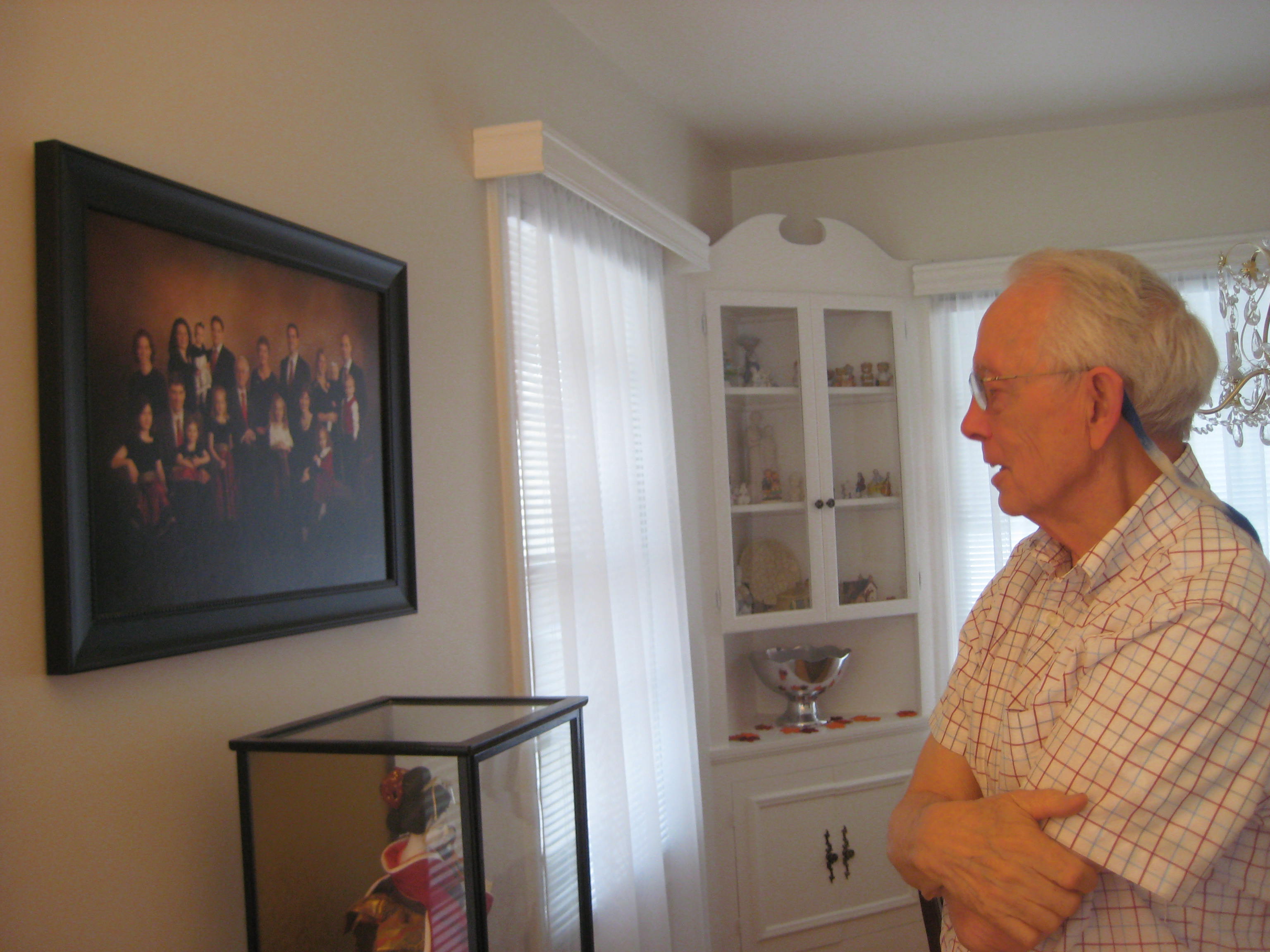
Fred Buchanan looks at a picture of his family, who he says has given him strength while suffering through Parkinson's disease.

begins to interfere more with his daily life. His first is to write a book about his wife’s family history that was central to Scottish immigration, primarily to Utah. His second project, with the help of his journal that he’s written in for the past 35 years, is an autobiography for his family and friends to remember him by.

“I like to think that something happens to you after you die,” he said.“But if not, this is what I will have left behind.”

Although his Parkinson’s is an obstacle, Buchanan said he wouldn’t let that get in the way of what he wants to do. With support of his family, friends and his faith, he says that he’ll be able to look past the complications the disease has given him.

“I don’t think God or nature gave it to me as a challenge,” Buchanan said. “But given that I have it, I look at it invariably, except for to take a nice nap in the afternoon.”

Wiis are for the young at heart

Story and photo by Kelli Coomes

Farrell Sorensen eagerly awaits the arrival of his great-granddaughters.

“What are we playing today?” the three girls ask in unison. Hallie, 8, Hannah, 6, and Hollie, 4, are spending the day with their great-grandparents.

“What do you want to play?” Farrell Sorensen asks.

“Baseball!”

“Tennis!”

“Bowling!”

“How about we play all three?” Farrell suggests. “We’ll take turns.”

His wife, Darla, comes in and sets up the only modern technology in the house that she’s figured out: the Nintendo Wii. Remotes get handed around and the games begin.

The four run around the room, squeals coming from the girls and laughter from Farrell. A whirlwind of motion continues for most of the day, stopping only long enough to change games and players. As more family come to visit, teenagers and adults take turns playing with the grandparents and the girls.

The children tire before the Sorensens are done playing.

“They used to be too shy to talk to us,” Darla said. “We’re too old, we make them nervous. But now they come over all the time and love to spend time with us.”

There is a computer in the house, but they have a hard time figuring out how to use it. Their grandson, Jason Sorensen, 29, has been over many times to teach and re-teach them how to use the Internet, e-mails and how to save the photos they take. They can work the TVs and the radio, but that’s about it. They’ve broken three karaoke machines so far.

“They’re fine until they press buttons or try to explore on their own,” Jason said. “It’s the joke in the family to not let them touch electronics.”

But Farrell, 86, and Darla, 84 have found a way to bridge the age differences in their family. The Wii has brought five generations together under their roof.

“Now they all come to us,” Farrell said with a smile. “Used to be we’d see everyone around family reunions and holidays. Now they don’t ever leave.”
They own family games like “Wii Sports,” “Mario Party 8,” “Mario Kart,” “Pokémon” and other games the younger kids can play. They also have games for the teenagers and adults who come to visit, such as “Zelda,” “SoulCalibur” and “Brunswick Bowling.”

When the grandkids first gave Farrell and Darla the Wii, it was Christmas and they couldn’t figure out what it was. Their grandsons, Jason and Casey Walker, 30, had to come show them what it was and how to hook it up.

“They were afraid to touch the Wii,” Casey said. “We went over a few times until we were sure they had it figured out.”

“It’s easier than most electronics,” Darla said. “There aren’t a lot of buttons to push and the words on the screen are big enough for us to see.”

Farrell grins as he catches his breath. “It’s easy to use and gives us a great time with the grandkids and great-grandkids. Best present the youngsters ever gave us.”

Farrell mostly only uses it for when his great-grandkids come to play with him. He enjoys the time they spend together. “Keeps me young at heart,” he said.

The adults enjoy watching the kids play with the grandkids. “It’s nice to have your kids begging to see their great-grandparents,” Sandy Sorensen said. “Plus, you get a free babysitter when you need one. The grandparents would love to take them for a day.”

Darla loves to play with the kids too, but she uses the Wii even when there are no kids around. Darla enjoys “Wii Fit,” a game that teaches yoga moves, improves balancing, strength and has aerobics exercises.

The Sorensens are part of a growing trend. Sports enthusiasts who are older and sedentary because of injuries or worn-out joints are now enjoying playing games again.

The Wii gives them the opportunity to play sports without the jarring impact the real sport would cause. Baseball no longer has the jarring on the arms that comes with hitting the ball. Bowling is no longer so hard on the knees and hands and tennis no longer requires so much running on a court.

Some senior centers have Wiis and are having tournaments. The Columbus Senior Center even had a competition where the seniors team beat the teenagers team in bowling. In October in Houston, there was a major Wii competition for seniors held with participants from all over the nation. The categories included sports games, intellectual games and the “Wii Fit.”

Darla enjoys her “Wii Fit” for the aerobics. She begins her stepping exercise and then turns on her favorite show. “I exercise while I watch my soaps,” Darla said. “It’s better than any other exercise tape I have; I actually have to watch those.”

Every day she does her stepping exercise. Sometimes when she’s feeling up to it, she tries the balance games, skiing is her favorite, and once in a while she does a yoga pose.

“It records what and when I do these things,” Darla said. “That way, when ‘grandpa’ teases me about sitting around and watching my soaps all day, I can show him that at least I wasn’t sitting.”

Bringing the family closer to them was one thing they had hoped for. Having it bring them closer to each other was something they never expected.

“Now we can spend more time together,” Farrell said. “She’s not one for sports so we’d spend time in different rooms watching TV. Now we’re playing games together.”

Darla added: “We now have a common interest that makes us laugh and play together. After 60 years of marriage, a little excitement is nice.”

A Utah farmer who never tires

Story and photo by Kelli Coomes

Dawn breaks over the trees. A man with a silver head of hair looks out over his herd of cattle, gazing toward the sun as the first rays of sunshine illuminate his gruff-looking silhouette. He’s already been up and working for a few hours.

Farmer


Dell Walker whistles as he grooms his horse Lou at his farm in Provo, Utah, last fall.

The sunlight slowly crawls across the land, like a veil being lifted from a piece of art. As the valley becomes lit, the farm comes to life. All that can be seen are acres of growing hay, a small herd of cattle, a few horses and chickens scratching the ground.

At 78, Dell Walker stands straight while surveying the work he has ahead of him. He has animals to feed, hay to haul and cattle to herd. He begins saddling his horse; his hands seem to be moving with a will of their own.

This is his family’s land. Held for generations. It borders the eastern edge of the Provo River, in the southern end of Provo, Utah. The house no longer sits on the farm. It was torn down when the farm became prosperous enough for the family to move into town. That was when Walker was only 10.

“We are a dying breed,” Walker said, his eyes sad. “Our children don’t work the land with us.”

Walker has three grown children. He has many grandkids and a few great grandchildren. None of them are interested in the land, except to sell it, Walker said. “Over my dead body.”

He’s no longer young enough to take care of all the land. A little more than a third of the farm property is now rented out. Horse owners can grow their own hay and house their horses for a monthly fee. The hay that Walker produces is used to feed his own three horses. The land is divided into multiple pastures, old-fashioned fences of chicken wire and log posts marking the boundaries.

Walker’s patch of farmland is one of the many farms that sit next to each other. Across from the paved road that runs as a border on the south edge of the farmland is a stream, and south of that, the homes of many of the farmers. A lot of the land has been sold for development projects.

“We pass on, and the kids left behind pass the land on,” said Glen Horton, who owns the land next to Walker’s. Horton is one of the lucky ones, according to many of the farmers around here. His children are farmers, too.

“It’s sad,” said Joann Walker, Dell’s wife. “We’re losing our culture as Utahns.”

Joann helps with the chickens on the farm and feeding the workers who come during haying season. She still collects fresh eggs for their meals at home, though they buy milk at the store. Milking cows are more expensive than cows for slaughter. They take their herds to auction and to the meat house.

In 78 years, Dell Walker has fought on foreign soil, worked at Geneva Steel, has fought cancer, has had two major heart surgeries and still continues working on his farm. At a young age, he lost his three middle fingers in an accident while working at Geneva Steel. “Finger and thumb are all I need,” he said with a smile.

More than five years ago, Dell Walker was diagnosed with Lymphoma cancer. “It was one of the worst days of my life,” Joann said, tears coming to her eyes at the memory. “He walked out and told me we’d be OK, and I believed him.” After two years of chemotherapy, he is in remission.

Three years before that, they found a heart murmur and he had heart surgery. It is normally something found at birth, but his had been missed. The doctors also missed it when he underwent heart surgery 15 years ago because of a major heart attack.

None of this has stopped his stride. Dell smiled and shared his secret: “Hard work and a reason for working.” He owns his house and the income from the farm is keeping him and his wife in the life they enjoy. “We’re happy,” Joann said.

Live long and live well

Story and photo by Alexis Young

When she underwent back surgery a year ago, the doctor told Lois Stromberg to expect at least 12 months for a full recovery. However, only five months after surgery, she was exercising 20 minutes a day and walking more than expected.

Lois Stromberg believes if you Incorporate this food into your diet every day, it will assist in a healthy long life.

Stromberg has been diagnosed with osteoporosis, has had three hip replacements, several broken bones and faced back surgery, all within the last 15 years.

Carrie Hinckley, Stromberg’s daughter, thinks it is remarkable that her mother has little to no pain on a daily basis and hardly ever complains.

Stromberg, 88, believes the solution to no pain and a healthy, long life is “daily exercises, a positive mental attitude, and a support group: your family.” Not your sedentary senior citizen, Stromberg explains word for word the key principles to aging well.

The idea of aging well is for people to maintain a healthy lifestyle as they age by applying choices that improve active, strong and secure lives. As with any sport, if you have a routine and practice it on a daily basis, your game can improve. The same principle can be applied to aging.

“It is within your power to motivate yourself, to exercise and keep practicing by going the extra mile,” Virginia Rhodes, a service coordinator for senior citizens, said.

In Rhodes’ nine years of experience with seniors, she has seen how lifestyle positively affects aging and assists in the avoidance of illness. With the results exercising generates, it is especially beneficial when you plant the center of attention on abdomen exercises.

“It has significantly helped them with their posture, back pain, and getting up from chairs,” Rhodes said.

Rhodes’ career goal is to stay educated with the latest developments to healthy aging. She takes several courses to enhance her knowledge, and is always creating new exercises to keep seniors motivated.

Motivation is certainly one area in which Lois Stromberg is not lacking. Before she even gets out of bed to wander through her home, which has the sensational aroma of fresh coffee, she commits to accomplishing one goal before starting her day. The goal can be anything from dusting, watering her garden, walking to and from her daughter’s house, or when she is in the need of a challenge, changing sheets.

“It gives me the greatest satisfaction to know I can still do it,” Stromberg said.

Directly after completing her goal, her next mission is to get a “full dose” of exercise.

“I reserve at least 20 minutes a day…. It’s what the rehabilitation center recommended after my back surgery.”

Stromberg’s basic reason for staying motivated is the fulfillment she achieves through her accomplishments. In addition, she is always concerned that if she does not continue to be persistent with her goals and positive outlook, she will lose her enthusiasm toward life.

“Having a vibrant mentality can lead to the aspiration of living young at any age,” Stromberg said.

You live a high-quality life, with working joints and a high sense of energy until the day you die. “So aim to feel like you’re 30 even when you’re 80,” Stromberg said. “Staying young involves your emotions and physical health, personal hygiene, close contact with family and friends, and paying close attention to your eating habits.”

Having the energy of an 8-year-old, hardly any wrinkles and being slim as a toothpick, Stromberg’s ambition is to always feel young. In a kitchen that has nothing but an abundance of fruit, vegetables, yogurt and fish, she claims her energy levels skyrocketed when she changed eating habits nearly 10 years ago.

Aside from exercising daily, eating healthy foods and continuing with her goals, Stromberg shares her final secret to aging well. Family, she said, has been the key to motivation, the drive to achieving her accomplishments, the desire to live long and live well. It gave her the will to carry on when her husband died three years ago. The days are now lonesome, and the evenings are unpleasant, but Stromberg said she remains in high spirits. Eager to spend time with her friends and family every day, Stromberg whispered, “If you haven’t got a family, you haven’t got much.”

Elderly share stories at the of end of life

Story and photo by Alicia Williams

  • Watch a slide show of Tina Chavez telling her favorite story (best viewed in full screen mode).
  • Editor’s note: Tina Chavez passed away Dec. 22, a little over a month after this interview was given.

Stories told by the elderly express memories collected over a lifetime and filled with loving moments, tragic and monumental events and the valuable lessons learned through mistakes and successes. Sharing these stories offers undeniable joy, especially to individuals who have a preciously short amount of time left in their life.

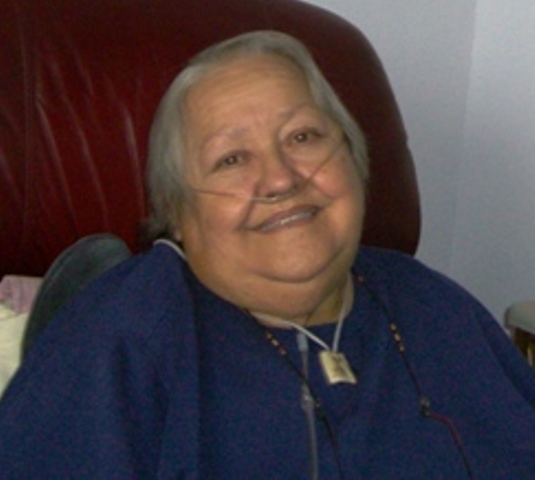
Tina Chavez at her home in West Jordan, Utah.

Evidence of the truthfulness of this shines in the ailing face of Augustina “Tina” Chavez, 71, as she recounts the memories of her beloved home in Las Cruces, N.M. It’s one of her many treasured stories recently published in a book for future generations to cherish.

“Where I come from, Las Cruces, it’s nothing but desert, dry heat, and the skies are always blue. There’s no pollution and the sun is 103 degrees in the summer. It’s warm and it’s beautiful,” Chavez said in a strained whisper as she tries to be heard above the soft whirling hum of a machine tucked neatly beside her recliner.

Chavez has been physically bound to her home in West Jordan and to the dialysis machine helping to keep her alive since her kidneys began to fail in 2004. While Chavez admits to desperately missing her Catholic Church back home, she said God brought a wonderful blessing into her life when she moved to Utah in 2007.

“When you’re an active person like I was, and then all of a sudden it stops just this quick. You can’t walk, you can’t move and the only thing you have left is God and the angels he sends,” Chavez said. “The people who come to visit me, I call them my angels, because they are angels, angels unaware, because God is telling me I am not alone.”

She is referring to the people associated with LifePath Home Health, Hospice & Family Care. Located in several major cities across Utah, the in-home medical service is offered to terminally-ill patients diagnosed with six months or less to live.

The patient receives visits from doctors and registered nurses to address medical health issues, and licensed clinical social workers to manage the needs of the family. There are bereavement specialists to help with grief, certified nurse assistants to address a patient’s personal care and chaplaincy for spiritual needs. Finally, hospice volunteers befriend and support patients during the last days of their life.

Hospice support consists of patient companionship, respite care for family caregivers, oral histories, yard and house work and all types of therapy: pet, music, massage and aroma. Shannon Thompson, the volunteer coordinator at LifePath Hospice, said she draws upon her 25-plus years of experience to complete the daunting process of locating qualified volunteers, training them in end-of-life care and then diligently matching them with an individual in need of comfort.

“The hospice program is extremely important, because it’s a setting in which someone is willing, from the heart, to give, listen and participate in what an individual is going through or what an individual needs,” Thompson said. “The support is freely given from a volunteer to share that life, those moments, and the end with an individual who is ultimately going to pass.”

For Tina Chavez, Thompson expertly chose Brady Petersen, a 23-year-old pre-med student studying exercise physiology at the University of Utah. Peterson said he learned of LifePath at the Lowell Bennion Community Service Center on campus and began volunteering a year and half ago.

“It’s been a blessing, because they send me visitors once a week like Brady. When Brady first came, he wanted to know a little bit about me and I just started talking,” Chavez said. “He asked me if I minded if he wrote a book about the interesting stories I had been telling him.”

Volunteers who seek knowledge from the experiences of the elderly find a unique opportunity to actually feel the lessons being taught.

“You do gain a lot from them when they are talking about their lives. They have a different attitude about life, and the important things in life,” Petersen said.

At the same time, whenever someone engages the elderly in sharing their stories, and when they take the time to listen to them, they’re validating the worthiness of that individual’s life experiences.

“It’s usually takes a visit or two and then it doesn’t feel like I’m volunteering anymore. It doesn’t feel like I am working, it’s just visiting with a person who really appreciates your time,” Petersen said.

The inspiration to write Chavez’s life story, or oral history, came to Petersen after his initial visit with her. She was down, emotionally, but he said he noticed a drastic change once she began talking about the stories of her past.

Completely absorbed in her storytelling, Chavez becomes animated and descriptive. At one point, she beautifully sings a song in Spanish, stopping intermittently to translate it into English. At times she laughs; at other times she cries, but the clear sparkle in her eyes signifies the overwhelming pride she holds in the precious memories of her life.

“Brady told me I have wonderful stories and I told him that’s my life, the stories. I’ve had a good life,” Chavez said.