Utah Krishna Temple holds annual Festival of Colors

The Krishna Temple in Spanish Fork

Story, video and photos by ANDREAS RIVERA

When the time came for the flinging of colors and burning of Holika, the temple priest counted down from 20. Hundreds of students waited in anticipation to throw colors at their friends. When the countdown came to one, everybody threw their powder and the temple grounds erupted into a storm of colors. As the dusty air cleared, people were covered in a mixture of pink, purple, yellow, green and other colors. Impatient people had already been dipping into their colors and smearing them on each other, but when the final countdown came, nobody came out from the cloud of colors untouched.

With the end of winter and the dawn of spring comes the Holi Festival, also known as the Festival of Colors. Celebrated all over the world by followers of Hare Krishna, it is one of the largest and best known Hindu holidays.

In Utah, it is celebrated at the Lotus Krishna Temple in Spanish Fork. Many people, who are not even Hindu, come to celebrate the changing of the seasons with traditional Indian festivities. All are invited, especially college students looking for a fun Saturday afternoon.

Caru Das Adikari, the temple priest, said that the festival celebrates diversity.

As the master of ceremonies, he got up on stage and described the origins of the festival. He told the Hindu story of Holika the witch who was immune to fire and would take babies with her into the fire and burn them. One day she took a boy named Prahlad. This boy was a devout follower of Krishna, and prayed every day. So when Holika took Prahlad into the fire, Krishna protected him and it was the witch who burned to death in the fire. Caru said if you put your faith in God, he would always have your back.

Traditionally the festival is celebrated by burning an effigy of Holika. The throwing of colors is the main event of the festival. The colors are a dyed flour, which is imported from India.

This year 20,000 people attended the festival, about double that of last year. Last year’s turnout forced the temple to conduct two separate festivals, one in the morning and another in the afternoon.

Caru said only 500 Indian families live in the Utah Valley, and even fewer who regularly attend the temple.

Caru said students are so attracted to the festival because it enriches and enhances relationships, both “horizontally” and “vertically.”

“Horizontally, meaning the people around you, and vertically, meaning with God,” he said at the festival.

He said it is known as Brigham Young University’s spring break.

“It is so integrated on BYU, that all you need to do is tell one person on campus the date, and within 40 minutes, everybody knows,” he said.

Caru conducted a poll among the attendees, and discovered 35 percent to 40 percent of the attendees were BYU students.

“At first people will feel uncomfortable, but you look around and you see everyone is having a good time and no one is taking themselves seriously,” he said.

After a 20-second countdown, the temple grounds erupted

The festival is said to have been celebrated for 5,000 years in India and was started by Krishna himself, Caru said. The celebration is on a much bigger scale in India and a lot less organized. It is at such a scale that people will be throwing colors in the streets, at friends and strangers alike.

Caru was born Christopher Warden in New Jersey. In 1969 he traveled to Sydney, Australia, where he visited the Krishna Temple regularly and later became a member of the International Society for Krishna Consciousness. He returned to America in 1975 and traveled the country spreading Krishna Consciousness.

According to an essay by BYU student Chad Young, the Utah temple was established by Caru and his wife, Vaibhavi, in 1987. That year, he bought an old AM radio station along with an acre of land in Spanish Fork so that he could conduct a Krishna themed radio station and start a temple. The temple started off in a smaller building, but a newer, more traditional temple was built in 2001 next to the old one. Ever since, they have been maintaining and living on the temple grounds, sharing Krishna culture and traditions such as Holi Festival with Utahns.

“The temple is more of a tourist attraction, we don’t really go around converting one or two people, but we try to spread awareness throughout the area,” Caru said.

On stage, Caru mentioned that the first Holi Festival in Utah 12 years ago only had about a dozen participants throwing colors at one another and chanting together.

Caru said one of his favorite aspects of the festival was the massive chanting of Hare Krishna. “Saying the name of God, effectively gets you closer to God,” he said.

People who go to the festival usually return, Caru said, and each time they do, they gain a greater understanding of what the festival is about.

“If nothing else they take away the Hare Krishna mantra, ringing in their ears for days,” Caru said as he laughed.

The festival featured performers such as the band Mantra Rock and a troupe of traditional Indian dancers, Shatakshi Goyal. Inside the temple, attendees danced and chanted to the rhythmic sounds of India. Participants respected the traditions of the temple and removed their shoes before entering the temple. People who attended the festival were treated to fresh orange juice and could purchase authentic Indian cuisine such as curry with rice.

Brooke Richmond, a sophomore from Utah Valley University, said her roommates dragged her out to the festival. At first she didn’t think it would be fun, but when she got there, she got into the spirit of things.

“I’m definitely going again next year,” Richmond said.

Hilary Dalton, a senior from Hillcrest High School, said it was her second year attending and it gets better every year.

“I love the atmosphere and vibe of the whole gathering,” Dalton said.

Truthfulness, compassion, tolerance: How Falun Gong saved a life

by KEITH R. ARANEO-YOWELL

Lang-hao Lin shifted uncomfortably in her seat when she flipped to the page in a Falun Gong history book with an image of a young girl bound to a chair with rope, and surgical tubing going into her bloody nostril.

“This is similar to what happened to me,” Lin said. “They put some kind of medicine into the thing they force-feed you. After feeding, you’re in semi-consciousness, dreaming all day, you’re not clear-minded anymore.”

Lin, who asked that her real name not be used, was referring to the treatment she received while serving a two-and-a-half-year sentence in a forced labor camp in Shanghai, China. Her crime was practicing Falun Gong or Falun Dafa, a philosophy that holds tolerance, compassion and honesty as its three pillars of spirituality.

“It’s not a religion,” Lin said. “It’s culture generated from the 5,000-year-old Chinese history.”

Started in 1992 by Li Hongzhi, Falun Gong draws from Buddhist and Taoist principles of self-improvement without the worship of a deity. It emphasizes qigong, a meditative practice that uses slow movements and controlled breathing as a way of spiritual enrichment.

Hongzhi’s book, “Falun Gong,” teaches the physical and spiritual aspects as well as how to meditate. Practitioners begin by assuming four standing meditation positions and one final sitting position. The legs and torso remain static while the hands move slowly around the body in ways that “mix and merge the universe’s energy with the energy inside the body.”

In this way, many practitioners believe that the ritual has powerful supernatural healing capabilities.

Because of the changes she perceived in those around her, Lin, 37 started attending Falun Gong meditation in Shanghai in 1997.

“I witnessed with my own eyes so many people getting healthy bodies by just doing [Falun Gong] exercises,” Lin said. “Before, they even had cancer. It was like a miracle happening around me.”

Lin said the practice grew rapidly because of its simplicity and effectiveness and, while there is no official entity monitoring the number of practitioners, the Congressional Research Service’s report titled “China and Falun Gong” estimates the number of practitioners during the mid-1990s to be anywhere from 3 million to 70 million.

Despite its wide adoption in Chinese society, however, the Chinese government made the practice of Falun Gong illegal in July 1999.

Roger Tsai is an attorney for Parsons, Behle & Latimer who would later help Lin attain status as a political asylee. He said the Chinese government felt threatened by Falun Gong’s popularity.

“[The Chinese Communist Party] was worried about how popular Falun Gong was,” Tsai said. “At one point the size of this group was larger than the size of the communist party, so it was a potential challenge.”

A government official was later quoted in print and broadcast for the Xinhua News Agency (a Chinese news outlet) as saying, “Those who jeopardize social stability under the pretext of practicing any qigong will be dealt with according to the law.”

Even though there is no official record of the number of arrests for practicing Falun Gong, the Wall Street Journal reported in 2000 that more than 30,000 practitioners had been arrested in the first year of the Chinese government’s ban of the practice.

Lin was pregnant with her daughter and working in Shanghai when Falun Gong was made illegal. She continued to openly attend Falun Gong meditation even though she had heard stories of the Chinese government sending practitioners to prisons and labor camps. “I was scared,” Lin said. “I did not want to be persecuted, but I did not stop.”

In 2001, Chinese authorities found Lin at her work. “At first, I was not [arrested] because I had a baby, and they gave me a one-year nursing period,” Lin said. “They told me, if after one year [I did] not denounce Falun Gong, they would send me to a labor camp.”

After receiving threats from the government and hearing accounts of life in labor camps, she decided she had no choice.

Lin went into hiding for a year in Nanjing, a city roughly 200 miles northwest of Shanghai. “My husband and my daughter didn’t know where I was. I dared not go out. After one year,” Lin said, “I missed home so much, I made one phone call to my husband. I told him where we could meet, but when I went, there were police waiting already. I didn’t even get to see [him].” Lin believes her husband’s phone was tapped.

Lin would spend the next two-and-a-half years in a forced labor camp assembling American products, a task she said was assigned to her because she could read English. She slept on a plank of wood. She was not allowed to talk. She shared a single toilet and a cell the size of two standard parking spaces with up to 10 other women.

For 10 days, Lin did not eat or drink water as a way of protest. “If you refuse to eat or drink, they use a tube to force-feed you,” Lin said stoically. “It’s not to save your life, it’s for punishment.”

Had Lin simply signed a document renouncing Falun Gong, authorities would have allowed her to go free. She said she couldn’t do it because it goes against the truthfulness that Falun Gong holds paramount over suffering. “It isn’t true, so I couldn’t do it,” Lin said.

After her release from the labor camp in 2005, Lin was only able to continue her Falun Gong practice in secret because the Chinese government continued to monitor her activity. Lin was unable to attend public meetings, protests, rallies or Falun Gong meditation.

Reprieve came only in 2008, when Lin’s husband accepted The University of Utah’s offer to study for one year as a visiting scholar. Her husband left China while Lin and her daughter acquired passports and visas to stay in the United States for the rest of his time at the University of Utah.

After a few months of talking with her husband about staying in the U.S., Lin approached Roger Tsai to obtain status as a political asylee, which would grant her one year of legal residence in the U.S. With Tsai’s help, she submitted her case for political asylum to the U.S. Department of Homeland Security’s office of U.S. Citizenship and Immigration Services in 2009. Two months later, she and her family were allowed an extra year in the United States after her husband’s visiting scholarship ended in August 2009.

Lin still studies Falun Gong year round. Once a week, she and a group of other practitioners meet in Salt Lake City’s Liberty Park during the spring and summer, and with one of the elderly practitioners at a nursing home on 700 East during the rest of the year. Robin, who asked that his full name not be used, practices Falun Gong with the group of other adherents at the park. He said Falun Gong does not advertise and is open to anyone who wishes to participate.

When Lin and her family became political asylees, they became eligible to apply for permanent residency in the U.S. Tsai assisted in this process and Lin and her family submitted the paperwork in March 2010. They are still waiting to find out if they’ll be able to stay in Utah indefinitely.

Retired university professor looks past adversity

Story and photos by Jessica Gonzales

  • Meet Fred Buchanan, a retired University professor living with Parkinson’s disease.

In his soft yet prideful Scottish accent, Fred Buchanan recites a poem by memory written by his favorite poet, Robert Burns. As he tries to muster the simple words from his lips, he stops and pauses momentarily. He apologizes with a smile, says “Sorry, it’s my Parkinson’s,” as his hands moderately tremble from shaking. “You have your good days and you have your bad days sometimes.”

At 78, Buchanan is one of approximately one million Americans living with Parkinson’s disease, according to the Parkinson’s Disease Foundation. Sufferers of this neurological disease lack dopamine in the cortex section of their brains that affects basic motor skills. As a result, tremors, rigidness and slow movement are symptoms patients with Parkinson’s often experience. Currently, there is no cure for the disease, only medication or surgery to temporarily relieve and slow down the progression of symptoms.

Retired university Professor Fred Buchanan reads poetry in his home in Salt Lake City.

Buchanan was diagnosed in 1992 after his son noticed tremors in his hand at a concert. He saw a doctor who later diagnosed him with Parkinson’s disease during the same year.

“I was surprised,” he said. “I’m very fortunate to be able to do anything.”

With the help of taking a total of 18 pills, he is able to have around 10 hours of good movement throughout the day. But he still experiences symptoms in his daily routine. Shaking and stiffness have inhibited his movement and he largely has to rely on his wife to help him with simple tasks such as buttoning his collar and sleeves.

“I was independent before but now I’m dependent,” he said. “I just miss the freedom I had.”

Rama Buchanan, his wife of 46 years, takes care of her husband makes sure to help him when he’s struggling and remind him to take his medication. After seeing two of her family members go through Parkinson’s disease, she credits her love and patience to find strength with her husband’s situation.

“Families are forever,” she said. “We do a lot of things together and we help each other. You just take it one day at a time.”

Buchanan, who was born in Steventson, Scotland, moved to Salt Lake City in 1949 with his parents to be closer to family and the Church of Jesus Christ of Latter-day Saints. After serving a Mormon mission for two years in his native country, Buchanan returned to Salt Lake and was encouraged to attend the University of Utah by a family friend who was a professor there. The inspiration to learn became a pursuit he valued and as he said in a proud voice, “Scratch a Scot and find a scholar.”

After graduating from the University of Utah with bachelor’s and master’s degrees in history, Buchanan went to Ohio State University where he received his doctorate in 1967. In 1977, he became an associate professor in education studies at the University of Utah. He retired in 2003.

A published scholar and writer, Buchanan has written several academic books and chapters about Scotland and the history of education in Utah. “A Good Time Coming: Mormon Letters to Scotland” and “A History of Education in Utah” feature his academic work from research as a university professor.

Buchanan’s small library in the basement of his home is filled with his academic work, Scottish literature and religious publications that symbolize his love and appreciation for learning.

“I’m so curious about many things,” he said. “I’d like to be remembered as someone who appreciated creativity.”

Buchanan is currently conducting two more projects before his Parkinson’s

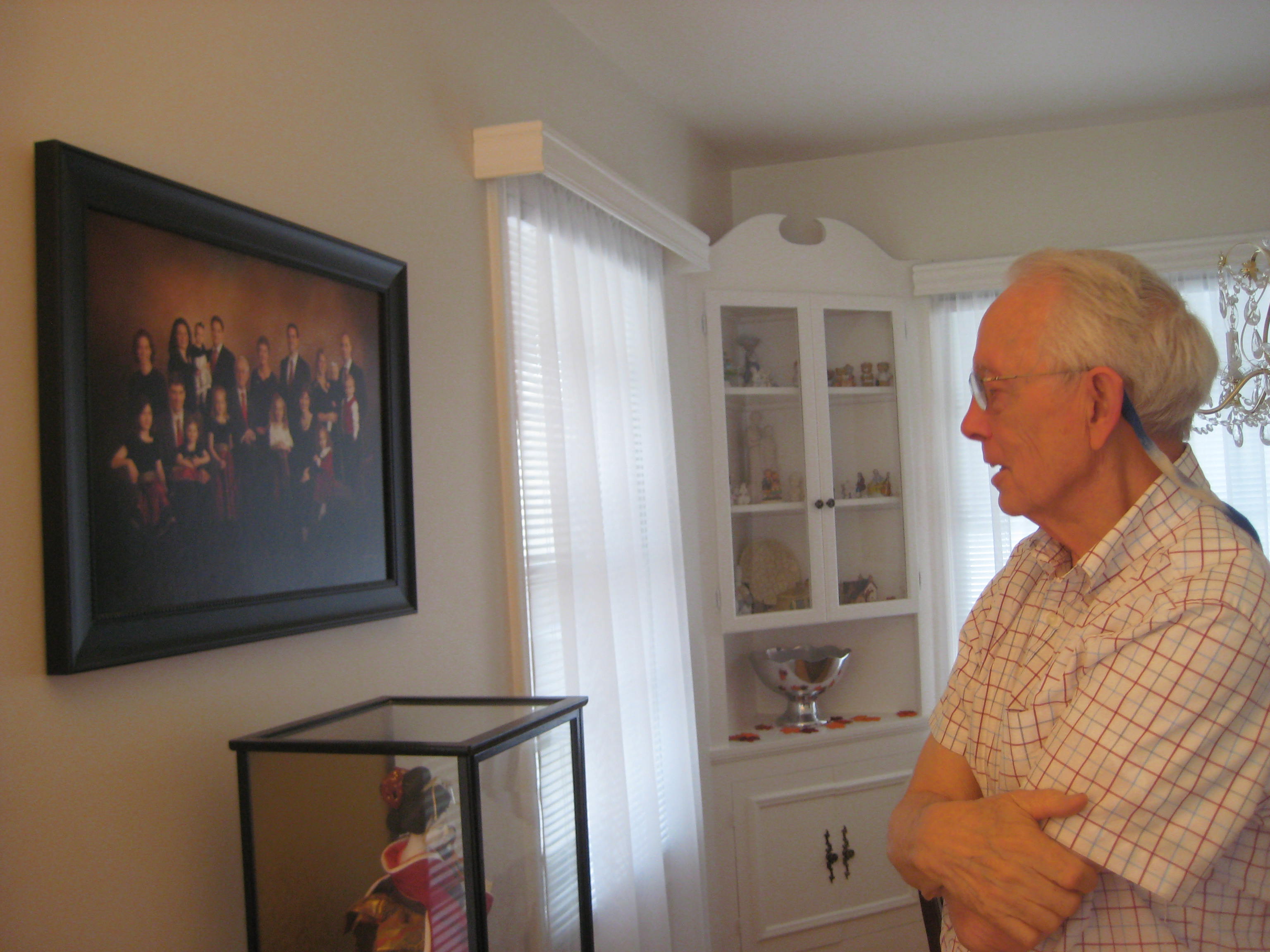
Fred Buchanan looks at a picture of his family, who he says has given him strength while suffering through Parkinson's disease.

begins to interfere more with his daily life. His first is to write a book about his wife’s family history that was central to Scottish immigration, primarily to Utah. His second project, with the help of his journal that he’s written in for the past 35 years, is an autobiography for his family and friends to remember him by.

“I like to think that something happens to you after you die,” he said.“But if not, this is what I will have left behind.”

Although his Parkinson’s is an obstacle, Buchanan said he wouldn’t let that get in the way of what he wants to do. With support of his family, friends and his faith, he says that he’ll be able to look past the complications the disease has given him.

“I don’t think God or nature gave it to me as a challenge,” Buchanan said. “But given that I have it, I look at it invariably, except for to take a nice nap in the afternoon.”

Lost in translation: A check-up with a Burmese refugee

by BRADY LEAVITT

Reporter’s note: Journalists traditionally remove themselves from the narrative of their articles to create an authoritative, objective tone in their writing. As I see it, the goal of the reporter is to become the invisible lens through which the reader, listener or viewer gets the truth. However, as I did the reporting for this story I unwittingly became an active participant in the day’s events. It was irresistible. To remove myself from the story would be to be to withhold the truth from the reader. So, in the interest of objectivity, this story is about me.

Zuli is a Burmese hill tribe refugee. As of November 2008, he had been in the United States for one year and two months. He has no last name. His medical records separate the second syllable from the first to form the required first-name, last-name construction: Zu Li.

For Zuli, everything is difficult. His wife is sick. He cannot find work. His shoulder aches all the time. As a Muslim living in Salt Lake City, he finds it hard to find Halaal meals, foods consistent with Islamic dietary code. Above all else, Zuli has a single, suffocating problem that envelops every part of his life — he speaks no English.

On Nov. 18, I accompanied Peter Robson, a translator from the Asian Association of Utah, to take Zuli to a routine doctor’s appointment to have his shoulder checked.

As climbed into his car, Robson, 23, explained he would be translating the medical staff’s questions from English to Thai. We were driving to pick up his partner, Kamar, who would translate from Thai to a mixture of Burmese and Karen, two of the languages Zuli speaks. The process would then repeat in reverse to convey Zuli’s responses to the nurses and doctors.

Kamar, 19, also a Burmese refugee, learned to speak Thai while growing up in refugee camps near the Thailand-Myanmar border. He has been in the U.S. for a little more than one year. Utah-born Robson, a native English speaker, learned to speak Thai while serving a two-year mission for The Church of Jesus Christ of Latter-day Saints. That is where Robson and I first met, and where I also learned to speak Thai.

“Do you ever worry that when you translate something…?” I started to ask.

“Yes,” he replied without hesitation. “Always”

I asked Robson how he knows when the chain of translation has broken down.

“By the answer they give,” Robson said. “I mean, you ask them the last time they threw up and they answer ‘No’ — you know something got lost.”

Kamar, Robson said, was very excited that I was coming. When we saw Kamar, Robson commented on how “dressed up” he was, saying that Kamar normally wears ragged jeans and T-shirts. That day he wore khaki slacks, a green dress shirt and faded red, white and blue flip-flops.

“Why aren’t you listening to music,” he asked Robson in Thai from the back seat of the car.

“Because I’m enduring an interview,” Robson responded, now speaking in Thai and motioning to me.

Kamar pulled out a knockoff mp3 player and informed me that he and Robson only listen to Burmese hip-hop in the car.

“What do you think of America,” I asked in Thai as we drove.

Kamar looked slightly annoyed. “I don’t think,” he said. “I’m listening to music.”

* * *

Zuli lives in a one-bedroom apartment in Rose Park with his wife, Poriba, and his five or six grandchildren. I say “five or six” because nobody, including Zuli, could give me a sure answer of how many people live there. He is either 55 or 59 years old, depending on whether one trusts his medical records or Zuli.

A pile of shoes lined the small entryway of the apartment. A moist, sour smell blanketed the apartment as we walked in. A collection of cardboard sheets ripped from packing boxes lined the wall, the names and phone numbers written on them. The names were written in Burmese making it impossible to tell to whom they belonged, but Zuli quickly asked me for my number which he added to the collection. The only other real decorations were the Islamic wall calendars, unidentifiable stains on the carpet and family pictures printed on inexpensive copy -paper and stuck to the wall with masking tape.

We sat cross-legged on the floor just next to a full-length sofa. Zuli began speaking in a dizzying blend of backwoods Thai and Burmese. He was animated and cheerful as he spoke. Peter listened to him and nodded.
Zuli said something to me, and flashed a tobacco-stained smile in my direction. I stared, hoping that whatever he said would eventually trickle into the part of my brain that could make sense of it. It never got that far. I smiled, nodded and tried to slink out of the conversation as fast as I could. They chatted for another few minutes before I heard something I did understand.

“Pete, you’re Christian, aren’t you?” Zuli asked.

Robson said he was.

“Christianity and Islam are really similar, you know,” Zuli said. “I say it, EE-bra-him, you say it Abraham.” He rattled off a few more Old Testament names. “They’re practically the same. The only difference is how we say it.”

I slowly began making sense of Zuli’s accent as the conversation continued.

Robson began asking Zuli questions about the day’s events. Zuli responded in garbled Thai half of the time and the rest of the time in a language that lies somewhere along the Thai-Burmese spectrum. Kamar filled the conversation’s gaps. Zuli told Robson that he thought he had an ulcer. He wanted medicine for that in addition to getting his shoulder checkup.

I was understanding about 25 percent of the proceedings when the volume of the conversation grew. Zuli was visibly amused that Robson had forgotten a detail from a previous appointment. Zuli erupted into belly-shaking laughter and pointed at Robson.

“I liked it better when we weren’t friends and he didn’t yell at me,” Robson said quietly to me with a smile.

We left for the clinic.

* * *

I had intended to spend as much time in the background as possible, to avoid interrupting the flow of activities. It was, I found, more and more impossible as we got closer to the doctor’s office.

In the car, Robson told Zuli I am engaged.

“You’ve got a woman?” Zuli cried in an excited spray of spit. “If you get married, I’m coming for sure, and I’ll bring you something.” He trailed off and gestured with his hands to show me just how large the intended gift would be.

A storm of confusion ensued upon our arrival at the University Healthcare Redwood Health Center in Salt Lake City. The translation system was about to be stretched to the limit.

A woman sitting with a nervous-looking Asian man was in the waiting room, which was full of people who spoke at least half a dozen languages. She jumped up to ask if we were the translators. The woman, an LDS service missionary, told us she had scheduled an appointment for her client but the hospital did not have anyone they could even call who speaks his language, Karen. The woman pleaded for our help after Zuli’s appointment as we were whisked into the exam room.

In the exam room, Zuli’s demeanor changed. He had been laughing and smiling and speaking almost non-stop, but now he was now silent and stared blankly at the wall, making eye contact with no one. A medical assistant came in and asked Zuli how tall he was.

“Zuli, how tall are you?” Robson translated.

Kamar translated the question into Burmese. Zuli spoke.

“Eight,” Kamar said, in Thai.

“What? What do you mean eight? He said eight,” Robson said in Thai and English.

In a flurry of further translation, and after standing Zuli back to back with Kamar, it was determined that Zuli is 5 feet 2 inches tall. The assistant did not seem too worried about actually measuring Zuli and entered his height into the computer.

“How is your shoulder,” the assistant asked.

Another 45-second volley of translation passed and Zuli again said, “Eight.”
It then became clear that Zuli was referring to a picture chart that medical staff uses to help patients rate the level of pain they are feeling. A rating of one is on the 10-point chart is associated with no pain and has a corresponding smiley face. An eight corresponds to a face with furrowed eyebrows and squinting eyes, the level of pain Zuli was feeling.

“Oh! I get it,” Kamar said. “See, I thought you were asking ‘how tall does it hurt’ a minute ago.”

The nurse laughed. I laughed. Robson laughed. Zuli did not. The medical assistant left and the room fell silent.

“Pete. Pete, help me, OK? Help me get this ulcer taken care of,” Zuli said quietly. Robson nodded and looked down at the floor.

The doctor came in and began to ask Zuli questions via the translation team. He said he was amazed at how efficient they were when compared to some he has worked with. The doctor checked Zuli’s shoulder and recommended an injection. Robson mentioned Zuli wanted medicine for an ulcer. The doctor said he would schedule a colonoscopy.

Robson stopped and looked at me. “How do you say colonoscopy in Thai?”
I thought about it and came up with the rough translation — a combination of words: check, look at and butt. We looked at Kamar who stared blankly at us.

“Oh wait. Yeah, I think my dad had one of those,” he said. He fired a stream of Burmese at Zuli who did not respond.

Robson then mentioned to the doctor that the Primary Care Network, a low-budget insurance plan provided by the Utah Department of Health for jobless refugees, covered Zuli.

The doctor stopped smiling and began typing furiously at his computer.

“I’m sorry, there’s nothing else I can do, then,” he said. “That’s the worst insurance on the planet. It doesn’t cover anything.”

The doctor had been planning to refer Zuli to an orthopedic surgeon to inject medicine into his shoulder and to have Zuli return for colonoscopy. Because of the insurance, all he could recommend was to have Robson help Zuli file an appeal to the local insurance representative to have the treatments covered, he said. Kamar was still explaining the treatment plan to Zuli who said, “Look, I don’t know what’s wrong with me. All I know is that I hurt. And I don’t want it to hurt anymore.”

The doctor said if the appeal was denied, the best he could do was to schedule an appointment to have the injection done by a non-specialist doctor at the clinic. He asked whether Robson would accompany Zuli at that time or if it would be some other, “clueless translator.” Robson asked the doctor several more questions about Zuli’s options, to which the doctor replied he did not know.

At that moment that I became suddenly disenchanted with the whole process. The translation had been fun and somewhat exciting, if cumbersome, but now I felt as though Robson was the only one who understood Zuli’s needs and no one seemed able to tell him what to do.

We took Zuli to the pharmacy to buy the Tylenol the doctor recommended and some medicine for his wife. We passed the LDS service missionary who was still waiting with her client for a non-existent translator. A friend of Kamar happened to walk by at that moment and offered to help translate.

Robson decided to stop by the Asian Association to report to Zuli’s caseworker. This was Robson’s first time to meet the person primarily responsible for Zuli’s needs, but was his tenth time to help Zuli. Even the caseworker had difficulty giving Robson clear direction of how to help Zuli further.

* * *

Before we headed home, I decided to seal my lack of objectivity and journalistic disinterest by inviting Zuli, Kamar and Robson to lunch. We ate at an Indian restaurant called Curry in a Hurry, which, Zuli was delighted to find out, serves Halaal food.

Back at the apartment, Robson began explaining to Zuli how to take the medicine. Zuli wrote the directions on the bottles in Burmese. I noticed six or seven other orange bottles that held medicine similar to what we had just picked up. Robson asked Zuli to throw them away.

We were about to leave when Zuli insisted he wanted to give me something. He went into the back room and returned with a plain white T-shirt. He presented it to me as a token of his thanks. He could not remember my name so he called me “my son” and restated his intention to get me something “really good” for my wedding. We left.

Robson told me he would be paid only for the time he spent translating, excluding transportation time, or about three of the six hours that he had spent helping Zuli that day. But he gets more than money out the deal, he said.

“There’s something compelling about the refugee, something charismatic about spending time with them,” Robson said quietly as we drove, listening to a mix of Thai patriotic music played by a squeaky brass band. “It helps me keep things in perspective – if school or my social life isn’t going how I want, it helps me realize how outrageously well-off I am.”

He summarized the day by saying, “It’s pretty healthy, I think, to hang with these people.”

I think so too.

Preparation now can pay off later

by BRYNN TOLMAN

Many people in the world today worry about what tomorrow will bring. Will I be prepared? Will my family be safe? How will we survive if this economy doesn’t turn around?

Preparation is key to finding answers to these and many other questions.

Althea Sam, a student at the University of Utah and an American Indian, said these questions are constantly on her mind. She worries because with her current school load she only works part-time and no longer lives at home with her parents.

“There isn’t usually a lot of extra cash at the end of the day,” she said. However, Sam recognizes the importance of being ready. “It is always necessary. Even students can be prepared,” she said.

Sam explained in a recent interview that the best option for this is going back to the old ways of canning food, saving and being smart about spending.

The Church of Jesus Christ of Latter-day Saints is one organization that encourages setting aside essentials for a rainy day. The Church has compiled many resources and tools to help families and individuals around the world get started on something that can be intimidating: food storage and preparation.

Church officials say people need to be ready for adversity in every aspect of life. The three most important elements to being prepared for the future are education, employment and food. A good education will be the base for a solid future. This base leads to a good job that will make it possible to meet the basic needs in life including the final element, food.

Jeff Newey, an employee of the LDS Church, was part of a team that put together several pamphlets to distribute to people worldwide. This collection is called “All Is Safely Gathered In.”

One pamphlet, “Family Finances,” discusses how managing money now can be helpful later in life. The pamphlet advises avoiding debt, using a budget, building a reserve, and teaching family members “financial management, hard work, frugality and saving.” It also includes a budget worksheet.

The second pamphlet, “Family Home Storage,” teaches readers how to gather food and save a little extra money in case of emergency. It discusses the following topics: three-month supply, drinking water, financial reserve and longer-term supply. “Its purpose is to give people hope and to simplify the message,” Newey said.

While the pamphlets don’t detail every necessity, they can help anyone prepare for the unexpected.

“The Navajo tribe [in New Mexico], lost a lot of money on Wall Street,” said Irene Wixom. “Most Navajo people just have to deal with downturns in the economy, they don’t have mortgages, they don’t anticipate these problems.” She explained that while living on the reservation, Navajos have nothing to do with the mess that the economy is in. “They didn’t get caught up in all the loan problems, they didn’t make the mess,” she said.

Wixom, a Navajo, explained that many Navajos have not been preparing for anything drastic to happen.

Her own family, on the other hand, has been saving for years and trying to put a little food away so that in times of need they will be ready. Wixom, her husband and their three children now live in Salt Lake City and worry about their family and friends still on the reservation.

“They don’t have mass transit or even a huge selection of cars. Some of the roads are in pretty bad condition and that limits them. … It’s harder to be careful,” Wixom said.

“We haven’t decided to do anything new,” she said, explaining that it’s the little things that are going to make the difference. The few things the Wixom family have been focusing on are cutting back spending and planning their trips instead of just jumping into the car.

“We budgeted for years to get rid of our mortgage and other debts,” she said. “The only debt we have now is student loans for the kids’ education.” They are still comfortable today because of careful budgeting earlier in life. 

“There are more important things than big houses and big cars; your child’s education for example. Those are the things we worried about,” Wixom said. 

Wixom stressed the importance of being wise. She said the best way to prepare for the downturns in today’s economy is to stay up to date about what is going on in the world.

“People get busy and are uninformed. They didn’t see it coming. When the bubble burst we were ready,” she said. She stressed the fact that this should be common sense.

Many organizations and resources exist to help people get started on preparing for those unexpected turns in life. As Newey said, resources are available to “give people hope and simplify the message.” With all the tips, though, common sense is also important.

“If you can’t afford that cup of coffee from Starbucks don’t drink it,” Sam said. “Everyone loves that cup of coffee, but be responsible.” 

Tips for being prepared (from “All is Safely Gathered In”)

  • Avoid debt: Spending less money than you make is essential to your financial security. Avoid debt, with the exception of buying a modest home or paying for education or other vital needs. Save money to purchase what you need. If you are in debt pay it off as quickly as possible.
  • Have a back-up supply: Build a small supply of food that is part of your normal, daily diet. One way to do this is to purchase a few extra items each week to build a one-week supply of food. Then you can gradually increase your supply until it is sufficient for three months. These items should be rotated regularly to avoid spoilage. For longer-term needs, and where permitted, gradually build a supply of food that will last a long time and that you can use to stay alive, such as wheat, white rice and beans.
  • Use a budget: Keep a record of your expenditures. Record and review monthly income and expenses. Determine how to reduce what you spend for nonessentials. Plan how much you will save, and what you will spend for food, housing, utilities, transportation, clothing, insurance and so on. Discipline yourself to stay within your budget plan. A budget worksheet is a useful tool to help you with your plan.
  • Build a reserve: Gradually build a financial reserve and use it for emergencies only. If you save a little money regularly, you will be surprised how much accumulates over time.
  • Drinking water: Store drinking water for circumstances in which the water supply may be polluted or disrupted. If water comes directly from a good, pretreated source, then no additional purification is needed; otherwise, pretreat water before use. Store water in sturdy, leak-proof, breakage-resistant containers. Consider using plastic bottles commonly used for juices and soft drinks. Keep water containers away from heat sources and direct sunlight.

Repatriation closes karmic circle for Native Americans

by ANNE ROPER

When the Great Salt Lake receded in the late 1980s, American Indian remains began jutting out along on its shoreline. Then the remains started to go missing, presumably stolen. The state had to step in.

Utah adapted a federal law, the Native American Graves Protection and Repatriation Act of 1990, or NAGPRA, to standardize the way remains are handled. When Native American remains are found, an individual or tribe may claim them and have them repatriated, which means to return items to a descendant or culturally affiliated tribe.

A claim can be made on remains if at least one of three things is proven: lineal descendant, cultural affiliation, or if the remains were found on their aboriginal land.

A lineal descendent is someone who can trace their ancestry to the remains he or she is trying to claim. If this can’t be proven, a tribe may then try to prove cultural affiliation. But Rebecca Nelson, research assistant for the Utah Division of Indian Affairs, said it’s difficult to get people to agree on what that means.

“What osteologists and scientists in the archaeology community believe is cultural affiliation really doesn’t have a lot of meaning to American Indian people,” Nelson said.

According to the U.S. Department of the Interior’s Web site, cultural affiliation can be established when “geographical, kinship, biological, archeological, linguistic, folklore, oral tradition, historical evidence, or other information or expert opinion — reasonably leads to such a conclusion.” But since it is a Native American belief that everything is related, scientific evidence means nothing, Nelson said.

When neither cultural affiliation nor a lineal descendant can be proven, the last resort to claim remains is proof of aboriginal land. This is the area that gives Ron Rood, assistant state archaeologist, the most trouble because “those remains could possibly have no relation to lineal descendant or cultural affiliation,” he said.

If no claims are made, the remains are buried with a ceremony in Utah’s burial vault at the mouth of Emigration Canyon in This is the Place State Park, which has been blessed.

The remains are buried as soon as possible because it is a common Native American belief that if remains are unburied, the individual’s spirit roams the earth seeking rest, Nelson said. This can cause karmic imbalances that result in physical harm to their descendants.

Bruce Perry, chairman of the Northwestern Band of Shoshone, said the Shoshones don’t believe this because they have been Mormon since 1880; they just believe the remains should be buried properly.

Perry said they have repatriated and buried two individuals found in a cave on Hill Air Force Base.  He believes the bones discovered along the Great Salt Lake were Shoshone because that was their aboriginal land. The tribe didn’t have a lot of money at the time, so they couldn’t afford to give the remains a proper Shoshone burial, which involves wrapping them in a buckskin that costs about $500. The two individuals are buried in their cemetery 3 miles from the Idaho border in Washakie, Utah.

Rood is delighted when tribes make claims. Repatriation is a way to bridge communication between Native Americans and the scientists studying their ancestors, he said.

“As a scientist, and an archaeologist and an anthropologist, I believe repatriation is very important. It’s a way, conceivably, for archaeology and tribes to really work together,” Rood said. “It bridges those gaps to find out what really happened.”

Rood has been working on a case that has rewritten history. Seven Native American remains were found in a mass grave in Nephi. All were male and one was as young as 10 years old. Pioneer journals described a skirmish with who Rood believes are Goshutes that led to the deaths. From examining where the fatal shots hit, Rood could deduce that the men and boy were killed while they were running away, not in self-defense.

About once a month, Rood receives a call about human remains, which he said keeps him busy. He can tell “almost immediately” if the remains are from a Native American person because of differences in cheekbones and eyeholes.

One case stands out to both Rood and Nelson. A hunter found the remains of a baby near Fillmore. It was buried with glass trading beads, a woven basket, and a metal plate and cup with “all the pomp and circumstance that was required at the time,” Rood said. Since the baby was only about a year old, its sex could not be determined. The Paiute Tribe made a claim on the remains.

When artifacts like the beads are found in a gravesite, they are repatriated along with the rest of the remains. They are considered funerary objects and are also covered under NAGRPA. The artifacts found with the baby have stayed very close to it throughout the entire process, which can take about a year, Rood said.

This is a great example of successful repatriation for Nelson because “it was obvious someone loved that baby very much.”

LDS Humanitarian Center and Inner City Project helps refugees

Story by MICHAEL OLSON


  • See a slideshow about an English class provided by the LDS Humanitarian Center and hear from a service missionary (best viewed in full-screen mode)

Amy Wylie, 49, and her husband have been volunteering with The Church of Jesus Christ of Latter-day Saints in the Inner City Project for nine years. They started volunteering with the project as service missionaries in a ward in Salt Lake; now they serve as assistant directors of refugee services for the project.

This is their church calling. They turned in their missionary application papers to serve a 30-month service mission, the longest term a service missionary can serve without resubmitting another application.

The LDS church has several programs designed to help refugees adjust to life in Utah. One of them, the Inner City Project, helps prevent people from getting lost in the transfer between agencies giving care to refugees.

For example, at the International Rescue Committee most refugees only have six months before their case is transferred to another agency. However, the Inner City missionaries are always available to help and give service.

“Service missionaries play a bigger role longer term,” Wylie said.

Service missionaries are not the same as the church’s full-time missionaries who spend every day proselytizing. These missionaries are there to help people in the area, whether they are members of the church or not.

About 500 service missionaries currently serve in Salt Lake City. They are not specifically assigned to work with refugees, but it is part of their overall assignment in the ward, or area in which they work.

“When you are assigned to a ward you become a part of that ward and you take what ever the bishop asks you to do,” Wylie said. When missionaries are assigned to work in an area with a large refugee population it is likely the bishop will send them to assist them.

“We serve as a resource to help train. If they have questions and don’t know where to go they will call us and we will help them figure out a plan of action,” Wylie said.

They also help refugee children enroll in school and make sure they are getting the attention in class they need.

“We met one of the lost boys of Sudan in our first mission assignment,” Wylie said. Wilson was 7 years old when he was separated from his family during an attack on his village. He ended up in a refugee camp and hasn’t seen or heard from his family since.

Wilson met the Wylie family during church. He would sit with the family every week because he felt comfortable with them.

One Sunday he handed Wylie a note.

“It said ‘Could I have a picture of your family to remember them by?’ and I realized that he had no picture of a family, he didn’t belong to a family,” Wylie said.

The Wylies went to Temple Square where they took a family picture with Wilson in front of the temple.

Now Wylie shares her copy of the picture with people every chance she gets. She feels that people think it takes too much effort to make a difference in people’s lives.

“Look how simple it was. He now calls me mum and my children his brother and sisters,” Wylie said.

The Inner City Project also plays a role in finding refugees jobs. Missionaries help them find work at the LDS Church Humanitarian Center and at the Deseret Industries.

“It is set up to train them and help them learn skills and move them out to the work force,” Wylie said.

The LDS church established the Humanitarian Center in 1991 in Salt Lake City. It is located on the corner of 1700 South and Bennett Road. According to its mission statement, the center’s mission is three fold: “To prepare emergency relief supplies for shipment worldwide, to train those desiring to develop employable skills and become self-reliant and to offer service opportunities.”

The Humanitarian Center provides various skill training for refugees. They learn computer skills, they attend job etiquette classes to learn appropriate behavior in the work place, and they learn English. A teacher from the Granite School District teaches ESL classes, said Bart Hill, the center’s development manager.

During 2006, 175 refugees were employed at the Humanitarian Center. They are involved in sorting and bailing clothing. Items are sent to areas around the world where they are distributed to the needy.

They also put together packages the Humanitarian Center distributes, including hygiene kits filled with combs and toothbrushes, newborn kits filled with diapers and bottles, and school kits filled with rulers and pencils.

To obtain a job at the center refugees only need an endorsement from the bishop of the area they live in, as well as documentation proving they can legally work in the United States.

They manage the language barrier with help from interpreters who work with local relocation agencies. Some refugees have even learned English well enough to translate for those who need it.

Refugees working for the Humanitarian Center earn wages ranging from $6.55 to $9 per hour. They can earn more in the clothing sorting and bailing departments if they prepare shipments quickly for transport.

A refugee’s job performance is evaluated on a quarterly basis to make sure their work skills are progressing. Once refugees have worked for a year at the Humanitarian Center they are better qualified to work other jobs, Hill said.

“The great thing here is assisting them as they move toward self-reliance,” Hill said.

Luna Sasa, 28, works as a sorter in the medical supplies department at the Humanitarian Center. She helps gets the emergency medical supplies ready to be shipped.

Sasa was born in Sudan. She fled eight years ago with her mother, sister and her then 3-year-old daughter because of war.

She kept getting laid off because she lacked certain skills other jobs required. She was looking for a job she could hold down. Then she heard about the skills training program at the Humanitarian Center from the bishop in her area.

“I went to the bishop and he gave me the paper, and I started working here,” Sasa said.

Since Sasa has started working at the Humanitarian Center she has learned how to use a computer, how to type and how to use programs like Excel and PowerPoint.

Eventually Sasa wants to study at LDS Business College to become a medical assistant.

“Refugees need a lot of friends,” Wylie said. “They need people that just welcome them and take them into their neighborhoods and communities and school systems.”

Wylie and her family invite these friends over to her house in Salt Lake to celebrate holidays together.

“They are still a big part of our family. One night we had about 11 languages in our home,” Wylie said.

Whenever she hears that one of the refugees she stays in touch with has had a child, Wylie rushes over in her van that she has filled with boxes of supplies she gives to refugees. She gives the new parents a box overflowing with baby clothes and blankets.

“They aren’t assignments to us,” said Wylie, “we consider them our brothers and sisters.”

Niños on skis

by ERIK DAENITZ

Twelve years ago the Rev. Bob Bussen, pastor of Saint Mary’s of the Assumption Parish in Park City, Utah, saw a divide in the community.

“I noticed that we had challenges in Park City embracing our diversity,” Bussen said. “I challenged the city that we needed to find ways to build bridges, noticing that I needed to do that as well.”

The result of Bussen’s challenge was the Niños on Skis program, which he envisioned as a way for Hispanic and non-Hispanic families and children to come together while having fun skiing.

The success of the program is due in part to the efforts of sponsor families who agree to ski with children who otherwise might not be able to enjoy the slopes of Park City.

In addition, Park City Mountain Resort, Aloha Ski and Snowboard Rental, and St. Mary’s provide equipment and services that make skiing free for children who participate.

Normally, a youth day ticket at the resort costs $50 while passes for Utah students between ages seven to 17 range from $175 to $225. However, the resort’s involvement with the Niños program lifts this burden.

“Park City Mountain Resort has just been fabulous because they give all our kids free passes and make it possible to do everything,” Bussen said. “Aloha we just kind of got to know and they got involved, too. St. Mary’s provides clothes through the St. Lawrence thrift store in Heber City.”

However, these opportunities did not always exist, and it has taken some effort to get the program where it is today.

“We live in this world-class resort and have many Hispanic families here,” said Ernest Oriente, the Niños on Skis program director. “Many of them were going back and forth to work or school every day looking up at these amazing mountains but never getting to experience them.”

Oriente became involved in the program 10 years ago after reading about it in a church bulletin. With Puerto Rican heritage on his mother’s side of his family, Oriente identifies with diversity and the need to extend opportunities to all.

“We must remember that we are a nation of immigrants,” Oriente said. “We are a melting pot of cultures.”

Starting out with eight children, the Niños program has consistently grown under Oriente’s direction. This year 51 boys and girls participated.

“Ernest and Father Bob collaborated on the program,” said Garrett Glenn, a Park City High School student who volunteers with the program. “Ernest is the director and does a lot of the work, and Father Bob is there to provide support.”

Niños on Skis enables children with minimal or no ski experience to eventually ski some of the most challenging terrain at the resort, such as runs off the Jupiter lift, which services black and double black diamond terrain.

“My favorite part of the mountain is King Con, but I’ve been up to Jupiter too,” said Martin Heredia, 9, who began learning to ski with the program two years ago.

The ability of new participants to rapidly improve their skills is due mainly to the structure of the program.

During the first three Saturdays of December, sponsor families pick up the children and bring them to the resort by 9 a.m. Half an hour later children are grouped based on skill level and experience with ski instructors who teach the children until noon.

After the free lessons, all of the children, instructors, and sponsor families converge at the bottom of the Payday lift and head to lunch at the resort center.

“It’s not unusual that lunch will run over $1,000,” Oriente said. “Lunch is paid for by St. Mary’s church and wonderful donations that are given to us by the community.”

When participants are filled up and warmed up, the sponsors take the children back out if they want to continue skiing into the afternoon.

“After the first three Saturdays it’s ski whenever you want and as much as you want with the children,” Oriente said. “The kids I have now, we’ve skied over 15 times with them already.”

Also, many times a boy or girl will be paired with a sponsor who is in middle school or high school, fostering new friendships.

Jessica Murphy, a 9th-grade student at Treasure Mountain International School, skis with Oladyd Angeles, a 2nd-grade student at Trailside Elementary School.

The two ski together throughout the season and Murphy further aids Angeles in learning better technique.

“I usually go in front and she follows,” Murphy said.

Angeles, who has lived in Park City her whole life, said she likes the mountains and that her favorite part of the program is getting to ski.

Another pair who ski together is the duo of high school student Garret Glenn and Martin Heredia, a 4th-grade student at McPolin Elementary School.

“I like the big jumps,” said Heredia, when discussing his favorite part of skiing. “But I’ve made friends, too.”

When skiing together, Glenn said he prefers to let Heredia lead as he watches from behind to make sure Heredia is OK.

“It’s a good program,” Glenn said. “I like to be able to ski with him and help him out, help him get a little more practice and experience.”

Although he is only 9, Heredia already has a plan for his skiing future.

“When I am older I will teach other people to ski, too,” he said.

These examples of service and friendship illustrate that the program is about much more than just skiing.

“In my opinion this program has gone on to become the most interconnected relationship between the Hispanic and non-Hispanic community that exists in Park City,” Oriente said. “This is more than a cursory event. This can be a 12-month relationship, an ongoing relationship that takes many shapes and forms.”

While the Niños program fosters these connections, St. Mary’s is behind other efforts to improve integration.

“We have Spanish masses, but we also have a bilingual mass that we do during Lent and Holy Week,” Bussen said.

He also said he has seen improvements in the school systems, healthcare services and with other programs such as the Big Brothers and Big Sisters program, the Boy’s and Girl’s Club and the tennis program that St. Mary’s helps run.

In fact, the children who participate in Niños on Skis can segue straight into St. Mary’s tennis program, Oriente said. It provides another opportunity for interaction and learning by allowing boys and girls to transfer from a winter sport to a summer sport.

It seems that the divide that once existed in Park City is being joined.

“You keep making steps, you keep making strides,” Oriente said. ” I don’t know about the rest of Utah, but I know that in my own world in Park City we care. In the Niños program we can’t touch 10,000 lives, but I know we can touch the lives of 51 children, and that for me means a lot. I know that in some small way we are making a contribution.”

Bhutanese celebrate holiday, new life in SLC

Story and photos by MATT BERGSTROM

Thursday, Oct. 9, was an important day for Hindus around the world. It was the celebration of Dashera, the victory of the goddess Durga over the demons who stood in the gods’ way during creation.

For a group of Bhutanese refugees in Salt Lake City, it was also a celebration of a different victory.

Thursday was the first time the small Bhutanese community in Salt Lake City has officially gathered since refugees began arriving in the city in April 2008. The gathering was held at the Taj India restaurant at 4515 S. 900 East.

Bhutanese celebration

Bhutanese celebration

For nearly 20 years, these families had been living in refugee camps in Nepal. Most of that time the Bhutanese coexisted peacefully with their Nepali hosts. For the past few years, tense relations between China and Tibet have driven more refugees into Nepal. This flood of new arrivals pushed the Nepali government to its breaking point, prompting officials to make an appeal to the United Nations for help. The U.N. decided to resettle the Bhutanese who had long been without a home of their own.

Nearly 250 Bhutanese have resettled in Salt Lake since April. Among them are many members of the Dulal family.

Biren Dulal, 26, was only 8 years old when his life was uprooted and he moved with his family from his home in Bhutan to a camp in southeast Nepal. Today he barely remembers why he had to leave his home. He thinks it had something to do with the Buddhist government wanting Hindus to convert in the interest of national identity.

The actual reason seems to still be in dispute. According to the Web site for Human Rights Watch, the exodus was based on ethnic reasons rather than religious ones. The government of Bhutan in the late 1990s was interested in establishing a firmer national identity. The dispute is whether ethnic Nepalese in Bhutan chose to leave or were forced out by the government.

Regardless of the reason for leaving, Biren said life in the camp was difficult, but not unbearable.

Refugees were seldom allowed to leave. They had their own schools and shops and most of their basic needs were met. However, under certain circumstances, refugees could get permission to live outside the camp.

Biren left the camp for the first time at 18 years old to attend Kalimpong College in eastern India. After earning his bachelor’s degree he went to Katmandu to teach middle school science. A short time later he decided to return to the camp where most of his family still lived to continue his teaching there.

Soon after, members of Biren’s family began being resettled in the U.S. He decided it would be best if he joined them.

Biren Dulal arrived in San Diego on June 21, 2008. He had been sent to live with a brother and sister who had already been resettled there. Biren did not care for San Diego, but is too polite to say why.

Biren Dulal at the celebration.

Biren Dulal at the celebration.

He was then allowed to join the rest of his other brothers and sisters in Salt Lake City. The former teacher now divides his time between his job as an interpreter for the International Rescue Committee in Salt Lake, the nonprofit group that helped resettle him, and his volunteer work teaching English to other Bhutanese in town.

Ultimately he would like to get back to teaching science.

Travis Zirker, an IRC caseworker for many members of the Dulal family, said getting back to work is a common desire. A few of Biren’s brothers also were teachers in Nepal before coming to America.

One of those brothers is Ghana Dulal, who Zirker said has become a sort of unofficial community leader.

In the small Indian restaurant packed on an unseasonably warm autumn afternoon with almost 200 Bhutanese refugees, guests from various resettlement organizations and members of the press, Ghana Dulal offered a speech of gratitude and, in a small way, victory.

He talked of their hardships while encamped in Nepal and of the warnings they received from friends before leaving. They were told they would not be allowed to be Hindus in America.

In the end, Ghana Dulal summed up what all the Bhutanese were feeling, and what those who have not been there could not understand, when he said, “We are no longer refugees. We are free people.”

La Quinceañera: Tradition and symbolism in Salt Lake City

Story and photos by TERESA GETTEN

Photo by Teresa Getten

Panaderia Flores sells Quinceañera cakes.

La Quinceañera may seem to be just a fancy, dressed-up version of a sweet 16 celebration, but to those within the Hispanic Catholic community it is not just an overblown birthday party. It is a religious tradition, rich in symbolism and faith.

The word itself comes from the Spanish words “quince,” 15, and “años,” years. Some Hispanic cultures teach that this rite of passage was passed down from the ancient customs of the Aztecs. Similar to other ancient cultural initiation rights throughout the world, 15 was the age a young woman left her family to become a wife and mother.

The tradition is not just a time to celebrate the moment when a girl becomes a woman, but also a time for a girl to renew her relationship with God, not as an innocent child, but as a virtuous woman.

Josie Martinez teaches Quinceañera classes at Our Lady of Guadalupe Catholic Church. She explains that La Quinceañera is not solely an event for society to bless the girls with adult privileges, such as dating or drinking alcohol.getten2

“It’s a time to petition the dear Lord, to bless and help them in their life, whatever road they choose, asking God to bless them to be chaste and pure,” Martinez said with an affectionate voice.

Martinez prepares the girls for the tradition by teaching six mandatory two-hour classes. She begins with the traditions of the Aztecs who honored woman and her ability to give life. Then she reminds her students that a woman’s body is special and pure. She will have new challenges as a woman and must live a life of faith, good morals and principles to receive God’s blessings.

“The ceremony is not a sacrament, however, but a sacred tradition,” Martinez said, before adding quickly, “but it’s still not allowed if you didn’t do the classes.”

Nellie Strada, 27, had been listening to the conversation as she cut out cartoon animals for her Sunday school lesson. When Martinez started to explain the ceremony, she pulled her chair across the small room to help fill in the details. She had a warm smile that never left her animated face. The corners of her mouth turned up even while she spoke.

The ceremony includes a special mass, “Misa de Accion de Gracias,” proceeded by a procession similar to that of a wedding. Fourteen “chambolandas,” similar to groomsmen, and fourteen “damas,” similar to bridesmaids, walk down the aisle in a single line before they sit down. The last to emerge is la quinceañera.

She is dressed in a modest white gown to symbolize purity. The gown is often embellished with pearls and lace. She also wears a diamond tiara to show that she is a princess of God. At the altar she kneels on a special satin pillow often embroidered with her name. Special prayers are offered by the priest, parents, and sometimes godparents, “padrinos.” When the ceremony ends, the young woman places her flowers at the statue of the Virgin Mary.

“We do not adore her [the Virgin Mary] as a god, but because she is a symbol of what we should be as women,” Martinez said.

During the ceremony the girl is given a rosary, and a bible symbolizing her faith in God. The gifts are presented by her padrinos.        

“It’s the most beloved and precious moment in a girls life.” Strada said. “The feeling is something special, because we are blessed to keep values and do what is right.”getten3

The customs of La Quinceañera may vary in each Hispanic culture, but the symbolism behind the tradition is the same –- a celebration of a young girl’s journey from child to adult.

After the ceremonial mass the festivities begin. The large celebration is usually held at a reception hall. Family and friends are invited to honor la quinceanera’s passage into womanhood.

She is introduced, and the 15-year-old makes her big entrance. The night starts and the first dance as a young woman is with her father.

“During the last dance with their dad everyone is crying. It’s like your dad is giving you freedom,” said Salutina Estralla,  Strada’s 17-year-old sister. She came into the room earlier unnoticed and was quietly cutting out Noah’s ark in the corner before joining the conversation. Estralla abandons her work, places her chin in her hands and continues to listen to Strada’s descriptions.  

The second dance is with her chambelan, her boy chaperone. He could be a friend or a relative. They perform a traditional waltz, followed by a presentation of gifts.

The first gift is doll, often dressed like the quinceañera princess. This is the last doll she will ever receive.

She is also given earrings, a reminder to listen to God’s word, and a bracelet or ring, symbolizing the infinite circle of life and the continuous stages of womanhood. Toward the end of the presentation, the father takes off his daughter’s shoes and puts on her first pair of high heels.

Her family and friends welcome her as a grown woman. The tradition then turns into a celebration with music, dancing, cake and food.       

Gifts for the event are sold in shops that specialize in Quinceañeras. These stores are not usually listed in the phonebook, but within the Hispanic community they are easy to find. “When we want to shop, we just get out. We don’t advertise or have Web sites.” said Ivett Ramieze, 26, who works in a Quinceañera shop called El Rafael. The shop is a family-owned business located inside the Latino Mall on Redwood Road, the west side of Salt Lake City.

The preparation for La Quinceañera often begins years in advance. Families save money, and the girls plan their colors and themes          

“Now that I’m older I think it’s a waste of money. When I was a girl, the parents had to pay for it,” Ramieze said.

Ramieze estimates the cost of a Quinceañera to be between $2,000 and $10,000. However, the parents do not pay for the whole event. Her family and friends will buy most of the gifts.

She pulls out a white Quinceañera gown with cream colored pearls on the floral embroidered satin material. Under the dress was a ruffled petticoat. The store also sells porcelain dolls dressed in similar gowns made of satin and lace, with sequins, beads and ribbons. The doll will be presented at the reception.

The store carries almost every gift and accessory needed for the Quinceañera. On the shelves are kneeling pillows, jewelry, ceramic figurines called “bolos” that are passed out after the ceremony,  bouquets, veils, diamond tiaras, satin-covered bibles, champagne glasses, invitations and sample books for corsages, cakes.

Panaderia Flores, a bakery not too far from the Latino Mall on Redwood Road, sells multi-tiered cakes adorned with pastel sashes, roses and ribbons.

Rita Valencia, the owner of San Rafael, talked about her oldest daughter’s Quinceañera in Mexico. She spoke with a thick accent but her animated hands made up for any words lost in her translation from Spanish to English.     

“It’s like so proud for us to see our daughter is a woman,” Valencia said. Her hand pressed against her chest before she added, “and that she is pure.”

Her younger daughter wasn’t allowed to have a Quinceañera because she had a boyfriend before she turned 15. Valencia’s eyes became wet and the corners of her mouth turned down, pulling her whole face down with it. She sighed and turned her head, silent for a moment. But it was a small moment.

Valencia’s countenance transformed back to her animated self again and she clasped her hands together as she spoke of her plans for her 11-year-old granddaughter’s Quinceañera. Her granddaughter’s name is Angel, so Valencia and her sisters are planning an angel theme. They are trying to figure out how to lower God’s saints from the ceiling decorated like the heavens. Of course, Angel has a say in it, too.

Many little girls dream about what their Quinceañera will look like. Valencia said little girls as young as 6 come into her shop and say, “I want that for my Quinceañera!”

Not every Catholic Latina girl has a Quinceañera when she turns 15. It is not a necessary sacrament, but a sacred tradition. They can choose not to for any reason.

Vanessa Clavijo is from Peru but has lived in Ogden, Utah, for several years. She is 14 but plans to celebrate with her friends and plans on having a sweet 16 party.

“Quinceaneras are more traditional in Latin America,” said Clavijo. “Maybe if we still lived in Peru I would have one, but it’s more of a choice in America.”

La Quinceañera ceremony may change as it blends with other cultures, but the meaning will stay the same, just as the ancient rituals of the Aztecs have become the ceremony it is today. Whatever form the tradition will take, the transition from girl to woman will always be a time for friends and family to rejoice.