MESA: Representing the underrepresented

by PHI TRAN

Think for a moment about all the educational programs being offered to students. Now think about the programs that are specifically aimed toward underrepresented populations, ethnic minorities and women. If you cannot think of any then you have not heard of MESA: the Mathematics, Engineering, Science Achievement Program.

This national program helps ethnic minority and female students achieve educational goals by providing them with an array of educational and financial opportunities as well as support. Although MESA helps all of these students, Hispanic and Latino/Latina students in particular have seen the advantages of being in the program.

The number of Hispanic students in MESA has steadily increased over the years. According to the MESA 2007 Fall Manual, Utah has 114 schools that implement the program. Hispanic students involved in MESA increased from 1,413 last year to 1,653. Although it is not a large increase, it is a significant growth. The specific reason for the increase of Hispanic participants in the program is unknown – however it is proof that the program is a positive influence on Hispanic students.

Furthermore, Hispanic students have seen for themselves the results and progress that can take place with being a member of MESA. Jhoanna Quezada and Marily Hernandez, 8th-grade students from Brockbank Junior High, said other students who are not involved in the program should definitely consider it. “It can [help] keep your grades up. It helps our nationality grow and it gives Hispanics a better image,” Quezada said.

Social networking is another added benefit for younger students. “You get to interact with other schools and it helps different cultures work together,” Hernandez said.

Dr. Lyn Burningham, the Alternative Language Services Consultant and the director of MESA at the Jordan School District, said the students are usually exposed to two stages of language acquisition in the program, cognitive academic language proficiency and basic interpersonal communication skills. With exposure to academic language, Burningham said, students tend to feel less marginalized and more comfortable in social settings.

The program offers a variety of activities that allow the students to learn social skills. Some of the activities include monthly meetings, field trips to universities, science fair projects and annual contests, such as MESA Day.

This year, MESA Day for junior high students in the Granite district was held March 19 at the Utah Cultural Celebration Center in West Valley City, but the location for this event varies by year and by district. During the event, students from all 16 middle schools participated in six activities:  the egg drop, krypto, trebuchet, super slinger, surprise and the mystery activity. These activities are designed to challenge the students to use math, engineering and science education to complete the specific objectives of the competition.

In addition, MESA introduces students to large corporations that are actively involved in the program’s industry advisory council, such as L-3 Communications, ATK Launch Systems Group and Intermountain Health Care. When students interact with these large companies, it provides these students with a possible vision of their future, as well as exposes them to many types of opportunities such as scholarships and internships as well.

MESA also helps other students who may not be interested in math, engineering, or science. Ayleen Velez, the TBD department manager of Nordstrom, was a member of MESA throughout junior high and high school.

“They taught me a lot of public speaking skills, interviewing skills, and how to be myself and open in public and show charisma,” Velez said.

She obtained a scholarship through the program and although she decided to major in interpersonal communication. “I feel like it really helped me establish who I am and I use a lot of the skills they taught me,” Velez said. She also believes MESA assists Hispanic students in cases where parents do not have the knowledge of how the school system works or are not able to teach their children how to get into college.

Moreover, the program assists with SAT/ACT preparation, provides career counseling and mentoring and tutoring sessions. Because students are expected to obtain good grades in order to stay in the program, MESA tracks their grades and progress. Most students join the program when they first enter junior high either through recruitment at registration or through a referral from a math or science teacher. Other students join because their friends are in it or because their siblings were in it. Burningham said the earlier students join the program the better because they can take full advantage of MESA and its benefits.

In fact, the Granite district has begun implementing MESA into elementary schools. Currently seven elementary schools administer the program: Jackling, Academy, Monroe, Silver Hills, Stansbury, Wright and Fox Hills. Charlene Lui, the director of MESA and Education Equity for the Granite district, said it hopes to obtain more funding so eventually all of the elementary schools will have MESA.

“It’s a great learning environment for kids to be in and I feel like it helps them to be more well-rounded,” Velez said.

According to the fall manual, the MESA vision is to provide educational opportunities to all ethnic minority and female students through this program and its partnership with higher education and business industries. “It helps students solidify academic achievement and also provides them with a sense of belonging,” Lui said. The Utah MESA program has been helping the underrepresented population for 20 years.

Local newspaper marks 15 years of bringing communities together

by DAVID SERVATIUS

She calls it the “Field of Dreams” mentality, a reference to the iconic 1989 Kevin Costner film. If you build it, they will come. It is why, Sandra Plazas says, she and her mother, Gladys Gonzalez, went to work in the dining room of their two-bedroom apartment in the early 1990s to create the region’s first Spanish-language newspaper.

“People were saying to me, ‘You’re crazy! How are you going to do that? There are no Hispanics in Salt Lake City,'” Plazas recalls. “And I kept thinking, ‘No, not yet.'”

The mother-daughter team, both new arrivals in the Salt Lake Valley at the time, worked day and night and eventually launched Mundo Hispano in 1993. The new tabloid-style newspaper was free, printed monthly and had a circulation of 1,000. The first issue took more than a month to produce.

The pair worked alone for the first five years, doing everything, but as Plazas had predicted, the readers came quickly. Today the paper is printed weekly and boasts a total readership in the tens of thousands, with distribution from Ogden in the north to Provo in the south and a full-time staff running things from day to day.

The two initially had to give away space at no cost, but slowly the advertisers came, too. Each week, the back cover now showcases companies like Home Depot, Coca Cola, McDonalds and Zions Bank. This fall, Mundo Hispano will celebrate 15 years of being what Plazas calls “a bridge of integration between the Hispanic and non-Hispanic communities along the Wasatch Front.”

Plazas says she is currently on a mission, not only to bring people together, but also to make her newspaper an invaluable source of information for local Hispanic communities. One way she says she tries to do this is by closely monitoring the activities of state and local government, and by reporting on these activities in a way that helps readers understand the connection to their own lives.

“People are arriving in Utah every day with vastly different levels of cultural understanding and assimilation,” Plazas says. “A vibrant local media is important to all of them.”

Her role as the founder and editor of the newspaper has led to involvement with the Hispanic Legislative Task Force, a group of about 15 local community leaders who meet when the state legislature is in session to analyze proposals relevant to the community and advocate either for or against them. She says she spoke with Utah Gov. Jon Huntsman Jr. during the recent battle over legislation that would have denied in-state tuition rates to undocumented students.

“I pointed out that it would be much more difficult to achieve his goals for economic development in the state without an educated public,” she says.

Plazas, 37, was born in Colombia and raised in that country and Ecuador. She fled Bogotá with her family and moved to Salt Lake City in 1991 at the height of the narcotics-related violence that was rocking most of Central America at that time. She says that extortion and threats of retribution were commonplace.

“My country is a great country,” she says. “But when they say they are going to kill you, they mean it.”

When she and her family got to Utah, Plazas says the only work they could find was cleaning floors in a bank, which marked an ironic turnabout in their lives. In Colombia, her mother, a college graduate with a business degree, had worked in the banking industry. The family had employed maids of its own at home. But, surprisingly, the language in their new country was an even bigger challenge than family pride.

“You think you speak English well because you speak it so much more than anyone around you,” she says. “Then you come here and it’s, like, ‘What?’ No one speaks what they teach you in school!”

Plazas, who has a degree in communications and describes herself as “a bit of a dreamer,” says she became a journalist because she wanted to show people the truth behind things. She originally saw herself as a war correspondent, but has since come to prefer softer and more individual-oriented stories.

She has interviewed her favorite author, Isabel Allende, and one of her favorite musical artists, Gloria Estefan, for stories. She profiled George W. Bush for an assignment while he was in Salt Lake City campaigning the year before he became president.

In the future, Plazas says she will be working to increase Mundo Hispano’s advertising sales in order to generate more revenue. With the extra money, she plans to increase the number of pages, increase circulation and, ultimately, grow it into a daily newspaper with statewide distribution.

Former gang members start new lives with West Valley program

by JAIME WINSTON

Gang colors are prohibited at Project 180 in West Valley City.

“During a normal meeting they have to wear a white T-shirt and cover tattoos and any gang markings,” said Kenny Dorrell, director of the gang intervention program.

Project 180 teaches students, who are court ordered or voluntary participants, strategies to leave the gang life. Dorrell and other mentors meet with the youth Tuesday and Wednesday nights at the West Valley Community Center. The group is succeeding in reaching the needs of the former and current gangbangers.

“We’re growing big time,” said Richard Pendarvis, program director at the WVCC. “We’re at 20 active students right now, which is the most we’ve been at in a long time.”

According to Project 180’s mission statement, the program replaces gang components of students’ lives with resources and opportunities for success. The official launch date was summer 2006. Although the group is in West Valley, participants come from all around the Salt Lake area.

The students can play pool or X-Box before a meeting starts and guidance begins. Most members are about 16 and each has to go through an interview process before being admitted. “We like to have a good environment where the kids feel comfortable,” Dorrell said. “But the real strength is in our mentorship. We get involved with them and try to befriend them.”

Dorrell shares his own gang experiences with the students. Growing up in Salt Lake, his friends and older brothers were in gangs. By the time he was 10, he wanted to be in one too. Dorrell’s father enrolled him in a private Christian school to keep him away from that lifestyle. However, it didn’t prevent him from starting a mock gang with friends when he was 15, which eventually developed into a real one.

“I surrounded myself by people who were in that lifestyle and started wearing a color and representing the hood,” Dorrell said. “That lasted until I was about 20.” As time went by, he saw his friends’ lives getting worse and knew he had to get out of it. Some of them still wear the gang color.

“They identify their gangs as their family and I understand that completely because they want to fit in and be involved with something,” Dorrell said. “But just because you do that doesn’t mean you need to do things like stealing and drug dealing.” A student in the program, who asked not to be named, knows all about the criminal activity gangs take part in. “With my situation and what I was facing I would have been on my way to prison when I was 18,” he said.

An older sibling got the student involved with a gang when he was just 8. When he was 11, the student was initiated into the gang by being jumped, or beaten up. Other members of his family also were involved.

He said retaliation is crucial when a rival gang begins to taunt, or “bang” on another. “Usually anytime anybody tries to bang on you or say something, you’ll try to bang right back,” said the student, who is now 17. “If you don’t bang back and one of your homies sees you, you’re going to get banged on at a private meeting.”

Most “banging” is done over what colors a rival gang wears. Whenever an enemy attacked, he felt he had to come back twice as hard, which usually caused violence. Since attempting recently to leave the gang life, he has proudly walked away from fights he would have joined prior to enrolling in the program.

“It’s not worth it for me to deal with them or for them to come at me sideways,” he said. He has told his former gang partners he doesn’t want to be involved anymore and is trying to change his life for the better.

“Misery likes company and they’ll take anyone with them,” the student said. “That’s all a gang is. Misery. Miserable people trying to take anyone they can with them.”

Greg, a mentor who asked that his last name be withheld, left his local gang when he saw the misery he caused his loved ones.

While holding onto drugs for other gang members, Greg was pulled over by police and subsequently arrested. As he sat in his jail cell, he thought about the path he had taken in life. This course led him to join his gang when he was 13. Thirteen years later, he still was immersed in the culture. When Greg got out of jail he found his mother crying.

“I spent half my life doing things to people that shouldn’t be done to another human being,” Greg said. “In my opinion the whole gang lifestyle is ignorant; you’re persecuting and killing people who are just like you for false causes.”

Activities his gang used to do include assaults, robberies, extortion, beer runs and grand theft auto. “You name it, we pretty much did it,” Greg said. “I ruined a lot of people’s lives and now I have the power to make a difference for these youth and the community.”

Former New Mexico police officer Ed Britt worked in the violent crimes division and often encountered gangs like the one Greg was in. “There was always something going on,” he said. “We handled everything from murder, assaults and rapes to child molestation cases.”

From his experience with gang members, he found that the best approach to take was a direct one. “What I used to do is intermingle with them,” he said. “If you get out there as an officer and really touch them and talk to them and get to know them, they’ll be more open to you and they trust that you’ll be there for them when they need some help.”

Britt is no longer a police officer, but he continues to assist youth involved with gangs through Project 180. Lately, he’s been teaching the participants anger management skills and strategies to interact with others. At a recent meeting, the students played basketball to learn teamwork. It’s important for the program to get the participants to work together to show them that their past rivalries are artificial, Britt said.

“They are all just normal kids,” Britt added. “But when I ask them they say they are scared of being in their neighborhoods without being affiliated.”

Another Project 180 member said he became associated with gangs through his friends and was “jumped in” when he was about 12. Four years later, he wanted to leave and was “jumped out” by four or five of his gang counterparts.

“We smoked and we partied,” he said. “You feel like you’re big and bad.”

He was out partying while his parents were home worrying. But when he left the gang, he became the one who was concerned. He was frightened by the possibility a rival would recognize his face when he was with his loved ones. His fears came true recently when shots were fired while he was spending time with his girlfriend.

Levi knew leaving his gang would be dangerous. Nonetheless, he faced his fear and quit. “I was ready to ride or die anyway and now there’s just a little more honor and meaning behind that,” said Levi, a mentor who asked for his last name not to be revealed. After leaving, it wasn’t easy for him to adjust to a normal life.

Levi was initiated at age 12 and dedicated his adolescence to using drugs, committing crimes and being a gangster. “By time I was 16, I was doing time for armed robbery,” he said. A year later he was released, only to be brought back to prison numerous times for gang activity.

When he was 18, he studied the teachings of Jesus Christ while in jail. When he got out, he felt torn between his gang and new-found faith. He decided it was best to separate himself from the gang and devote himself to Christianity.

“I was trying to live for Jesus and do drugs at the same time. That’s not an easy thing to do,” he said. He discovered Project 180 and asked for help with his drug habit. In exchange, he volunteered with the program.

Levi was given the assistance he needed which enabled him to pursue other goals, like becoming a cage fighter. “These guys helped me bring that dream to reality,” said Levi, who is also a father.

“When I was a youngster – slanging and banging – I didn’t listen to nobody with a 9 to 5 and I didn’t listen to nobody who really knew what was going on,” Levi said. “But maybe if a trained fighter came in and said ‘listen I’m someone who knows what’s up’ it might have had a little more impact.”

Although he turned his back on the gang life, Levi said he won’t completely shut out members of his old gang, the ones still stuck in a pit of madness. He knows exactly what he’d tell them if they asked for his assistance. “I’ll be happy to help, but I’m not going to sacrifice my family’s well-being or my personal beliefs any longer to wallow in that pit with you guys,” he said. “It’s nasty down there.”

Levi shares his experiences of faith, fighting and gang activity with the participants to help them make informed choices and avoid the mistakes he made.

La Quinceañera: Tradition and symbolism in Salt Lake City

Story and photos by TERESA GETTEN

Photo by Teresa Getten

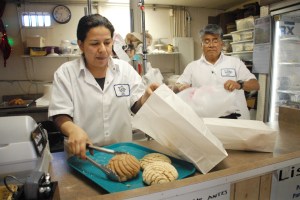
Panaderia Flores sells Quinceañera cakes.

La Quinceañera may seem to be just a fancy, dressed-up version of a sweet 16 celebration, but to those within the Hispanic Catholic community it is not just an overblown birthday party. It is a religious tradition, rich in symbolism and faith.

The word itself comes from the Spanish words “quince,” 15, and “años,” years. Some Hispanic cultures teach that this rite of passage was passed down from the ancient customs of the Aztecs. Similar to other ancient cultural initiation rights throughout the world, 15 was the age a young woman left her family to become a wife and mother.

The tradition is not just a time to celebrate the moment when a girl becomes a woman, but also a time for a girl to renew her relationship with God, not as an innocent child, but as a virtuous woman.

Josie Martinez teaches Quinceañera classes at Our Lady of Guadalupe Catholic Church. She explains that La Quinceañera is not solely an event for society to bless the girls with adult privileges, such as dating or drinking alcohol.getten2

“It’s a time to petition the dear Lord, to bless and help them in their life, whatever road they choose, asking God to bless them to be chaste and pure,” Martinez said with an affectionate voice.

Martinez prepares the girls for the tradition by teaching six mandatory two-hour classes. She begins with the traditions of the Aztecs who honored woman and her ability to give life. Then she reminds her students that a woman’s body is special and pure. She will have new challenges as a woman and must live a life of faith, good morals and principles to receive God’s blessings.

“The ceremony is not a sacrament, however, but a sacred tradition,” Martinez said, before adding quickly, “but it’s still not allowed if you didn’t do the classes.”

Nellie Strada, 27, had been listening to the conversation as she cut out cartoon animals for her Sunday school lesson. When Martinez started to explain the ceremony, she pulled her chair across the small room to help fill in the details. She had a warm smile that never left her animated face. The corners of her mouth turned up even while she spoke.

The ceremony includes a special mass, “Misa de Accion de Gracias,” proceeded by a procession similar to that of a wedding. Fourteen “chambolandas,” similar to groomsmen, and fourteen “damas,” similar to bridesmaids, walk down the aisle in a single line before they sit down. The last to emerge is la quinceañera.

She is dressed in a modest white gown to symbolize purity. The gown is often embellished with pearls and lace. She also wears a diamond tiara to show that she is a princess of God. At the altar she kneels on a special satin pillow often embroidered with her name. Special prayers are offered by the priest, parents, and sometimes godparents, “padrinos.” When the ceremony ends, the young woman places her flowers at the statue of the Virgin Mary.

“We do not adore her [the Virgin Mary] as a god, but because she is a symbol of what we should be as women,” Martinez said.

During the ceremony the girl is given a rosary, and a bible symbolizing her faith in God. The gifts are presented by her padrinos.        

“It’s the most beloved and precious moment in a girls life.” Strada said. “The feeling is something special, because we are blessed to keep values and do what is right.”getten3

The customs of La Quinceañera may vary in each Hispanic culture, but the symbolism behind the tradition is the same –- a celebration of a young girl’s journey from child to adult.

After the ceremonial mass the festivities begin. The large celebration is usually held at a reception hall. Family and friends are invited to honor la quinceanera’s passage into womanhood.

She is introduced, and the 15-year-old makes her big entrance. The night starts and the first dance as a young woman is with her father.

“During the last dance with their dad everyone is crying. It’s like your dad is giving you freedom,” said Salutina Estralla,  Strada’s 17-year-old sister. She came into the room earlier unnoticed and was quietly cutting out Noah’s ark in the corner before joining the conversation. Estralla abandons her work, places her chin in her hands and continues to listen to Strada’s descriptions.  

The second dance is with her chambelan, her boy chaperone. He could be a friend or a relative. They perform a traditional waltz, followed by a presentation of gifts.

The first gift is doll, often dressed like the quinceañera princess. This is the last doll she will ever receive.

She is also given earrings, a reminder to listen to God’s word, and a bracelet or ring, symbolizing the infinite circle of life and the continuous stages of womanhood. Toward the end of the presentation, the father takes off his daughter’s shoes and puts on her first pair of high heels.

Her family and friends welcome her as a grown woman. The tradition then turns into a celebration with music, dancing, cake and food.       

Gifts for the event are sold in shops that specialize in Quinceañeras. These stores are not usually listed in the phonebook, but within the Hispanic community they are easy to find. “When we want to shop, we just get out. We don’t advertise or have Web sites.” said Ivett Ramieze, 26, who works in a Quinceañera shop called El Rafael. The shop is a family-owned business located inside the Latino Mall on Redwood Road, the west side of Salt Lake City.

The preparation for La Quinceañera often begins years in advance. Families save money, and the girls plan their colors and themes          

“Now that I’m older I think it’s a waste of money. When I was a girl, the parents had to pay for it,” Ramieze said.

Ramieze estimates the cost of a Quinceañera to be between $2,000 and $10,000. However, the parents do not pay for the whole event. Her family and friends will buy most of the gifts.

She pulls out a white Quinceañera gown with cream colored pearls on the floral embroidered satin material. Under the dress was a ruffled petticoat. The store also sells porcelain dolls dressed in similar gowns made of satin and lace, with sequins, beads and ribbons. The doll will be presented at the reception.

The store carries almost every gift and accessory needed for the Quinceañera. On the shelves are kneeling pillows, jewelry, ceramic figurines called “bolos” that are passed out after the ceremony,  bouquets, veils, diamond tiaras, satin-covered bibles, champagne glasses, invitations and sample books for corsages, cakes.

Panaderia Flores, a bakery not too far from the Latino Mall on Redwood Road, sells multi-tiered cakes adorned with pastel sashes, roses and ribbons.

Rita Valencia, the owner of San Rafael, talked about her oldest daughter’s Quinceañera in Mexico. She spoke with a thick accent but her animated hands made up for any words lost in her translation from Spanish to English.     

“It’s like so proud for us to see our daughter is a woman,” Valencia said. Her hand pressed against her chest before she added, “and that she is pure.”

Her younger daughter wasn’t allowed to have a Quinceañera because she had a boyfriend before she turned 15. Valencia’s eyes became wet and the corners of her mouth turned down, pulling her whole face down with it. She sighed and turned her head, silent for a moment. But it was a small moment.

Valencia’s countenance transformed back to her animated self again and she clasped her hands together as she spoke of her plans for her 11-year-old granddaughter’s Quinceañera. Her granddaughter’s name is Angel, so Valencia and her sisters are planning an angel theme. They are trying to figure out how to lower God’s saints from the ceiling decorated like the heavens. Of course, Angel has a say in it, too.

Many little girls dream about what their Quinceañera will look like. Valencia said little girls as young as 6 come into her shop and say, “I want that for my Quinceañera!”

Not every Catholic Latina girl has a Quinceañera when she turns 15. It is not a necessary sacrament, but a sacred tradition. They can choose not to for any reason.

Vanessa Clavijo is from Peru but has lived in Ogden, Utah, for several years. She is 14 but plans to celebrate with her friends and plans on having a sweet 16 party.

“Quinceaneras are more traditional in Latin America,” said Clavijo. “Maybe if we still lived in Peru I would have one, but it’s more of a choice in America.”

La Quinceañera ceremony may change as it blends with other cultures, but the meaning will stay the same, just as the ancient rituals of the Aztecs have become the ceremony it is today. Whatever form the tradition will take, the transition from girl to woman will always be a time for friends and family to rejoice.

Refugee caseworkers work long hours in Salt Lake City

by MICHAEL OLSON

Originally from Rwanda, Africa, Valentine Mukundente and her parents were relocated to Salt Lake City as refugees. Before they came to America, however, Mukundente and her family were sent to a refugee camp in Zambia where she spent her high school years. In Zambia, Mukundente worked as a translator for the United Nations High Commissioner for Refugees while her family waited to be relocated to America. She had learned French and Swahili as a child in Rwanda and English while in high school.

Mukundente is a resettlement caseworker at the International Rescue Committee in Salt Lake City. She has worked there for more than a year.

“I love working with refugees because I used to be one,” said Mukundente. Armed with experience as a refugee she is able to keep from getting burned out from the extreme demands on her time as a caseworker. Instead, she finds it easy to relate to the refugees she helps because she was a refugee herself.

Life as a refugee caseworker is not easy on family life. Mukundente recently married a man she knew from Rwanda. He came here as a refugee and now they have a 6-month-old baby boy.

“It’s difficult because we don’t have time to go home,” Mukundente said about their schedules. Sometimes they have to pick up a refugee family from the Salt Lake International Airport in the middle of the night.

Caseworkers take them to their new house and show them how to use the stove and other appliances. This is the first time most Africans and Burmese have seen a stove or a light switch, Mukundente said.

Sometimes refugees will visit the IRC’s downtown office on 400 South to ask questions or for help reading their mail, often just as Mukundente is on her way out the door to go home to her family. But she gladly stays late to help them. After all, she used to be a refugee herself.

Seven caseworkers are currently employed at the IRC. Mukundente is responsible for 30 cases, but some caseworkers handle as many as 70 cases at a time.

“That’s too much,” she said. If she were to focus on one of her 30 cases a day, it would take a month to get through them all.

A case may consist of a single refugee, or it could be an entire family, some with as many as 11 members.

Caseworkers at the Asian Association of Utah are just as busy. Lina Smith, the director of Utah Refugee Employment and the Community Center at the Asian Association, supervises six caseworkers, who handle between 50 and 70 cases each.

Smith has been with the Asian Association for eight years. Five of the six caseworkers she employs are currently or were at one time refugees.

“I find the refugees don’t get as burned out,” Smith said. “They have been through what the people in their cases are going through.” That motivates them to get the refugees through the difficult process of adjusting to life in Utah.

Of all the places for refugees to be resettled, Utah is one of the best locations in the nation, said Gerald Brown, director of the Refugee Services Office of the Utah Department of Workforce Services.

“People here tend to be willing to help,” Brown said. Some social workers have a tendency to become jaded, but that seems to happen less in Utah.

Brown said that the perfect workload would be 20 cases for every caseworker. Because of the shortage of caseworkers it is very important that they set boundaries to avoid getting burned out.

For example, caseworkers decide whether to give out their personal contact information.

“I have some caseworkers that give out their cell phone numbers and then they have to choose whether to answer it or not,” Smith said.

The IRC’s Mukundente usually chooses not to give out her cell phone number, but some refugees still find it out from friends who know their number.

When they call they usually just have a question that can be taken care of later. Mukundente asks the refugee if it can wait until during work hours when they can talk about it. If it is a genuine emergency, such as when a child falls and breaks his arm, Mukundente directs the family to call 911 or a person at the IRC who handles emergency situations and can translate for the refugees.

“We tell them when they first get here to call 911 in an emergency, but they forget,” Mukundente said. “The first person on their minds is their caseworker.”

Despite the stress and the long hours, Mukundente loves her job.

“People have something in their blood, something they like to do,” she said. “This is not a job you do for money. You do it because you love it.”

SLC refugee agencies fight for time, money

by BRADY LEAVITT

The flight attendant lifts the microphone to his lips and smiles. He announces that in an effort to cut costs the scheduled pilot has been laid off. Fortunately, a good-intentioned passenger has skimmed a copy of the pilot’s handbook and is volunteering to fly the plane.

It is a metaphor used by Patrick Poulin, the resettlement director of Salt Lake City’s International Rescue Committee, to describe the nonprofit world’s forced dependence on non-professionals in its work.

“Who would stay on the plane?” Poulin asked. “But when it’s poor people we say, ‘Let’s have volunteers do it.'”

The IRC is one of two refugee resettlement agencies in Salt Lake County and works to facilitate the transition of refugees into a foreign society. Locating the right people and the money with which to pay them is a problem that agencies like Poulin’s confront regularly. But progress can sometimes come in small steps.

One step came in February 2008 when Gov. Jon Huntsman Jr. ordered the creation of theRefugee Services Office within the Department of Workforce Services. He ordered the appropriation of $200,000 to assist refugee resettlement efforts. Organizations like the IRC tend to rely primarily on the federal government to support their operations. Huntsman’s executive order marked the first time that state money has gone specifically to the aid of local refugees.

The unprecedented allocation is significant but only in a symbolic way, said Gerald Brown, director of the Refugee Services Office. Brown said the $200,000 represents less than 10 percent of the funding his office receives from the federal government, but it’s a start.

“It shows that the state is willing to invest money,” he said, but “we need a lot more money.”

The Refugee Services Office acts as a coordinator among various agencies and organizations, like the IRC. The office is responsible for routing federal funds to the groups. It also pays the salaries of a handful of social workers at the IRC.

The federal government has agreements with the IRC and nine other national nonprofit organizations to resettle refugees across the country. When a refugee comes into the care of a resettlement agency, the agency receives $425 of direct assistance for that person. An additional $425 is also given to pay for things like office space, utility bills and caseworkers’ salaries, at the organization’s discretion. But, much of the administrative funds end up being used as direct assistance

“$425 doesn’t go very far,” Poulin said. “We face a choice between paying [refugees’] rent or paying staff.”

It’s a difficult choice, Poulin said. According to the IRC’s 2007 financial statement, 90 percent of the funds it received were used in program services — relief, resettlement and others. Seven percent of the funds were for administrative costs. No specific guidelines exist to mandate how the federal money is used, but the IRC provides cash assistance and purchases goods and services on the refugees’ behalf. It creates the dilemma of trying to help more people or giving overworked staff pay raises.

“The problem,” Poulin said, “is that we can’t close our doors and we don’t want to.”

When they arrive in Salt Lake City, refugees who are eligible can enroll in support programs like Medicaid or Temporary Assistance for Needy Families, programs available to the general public. Those who do not qualify can receive cash and medical assistance from the U.S. Department of Health and Human Services for up to eight months. However, after the eight-month period is up, they may only receive benefits based on eligibility. That means they could receive nothing.

To complicate matters further, the IRC’s charter only allows enough funding for caseworkers to work with refugees for six months before responsibility for that person is shifted to secondary organization, according to Poulin. This, he said, is where many refugees fall through the cracks.

Keeping refugees out of the cracks, then, is a problem of time and money — six months to help people who come from a foreign country, who may speak little or no English and who often have no family ties on the continent, much less Salt Lake City, become self-reliant.

“It’s not even six months in reality,” Brown said, noting that caseworkers are often overwhelmed by the number of people with whom they work. The IRC resettled 546 refugees in Salt Lake City during the 2007 fiscal year with over one-third arriving in September alone.

“One of the founding principles of the refugee program is, early as possible, self-sufficiency,” Brown said. It is a good idea in theory but is not always the best for the refugee, he said.

“When people come in, there’s a lot of pressure to put them into any kind of job as fast as you can do it,” Brown said.

However, it is difficult to focus on helping people be successful in a job when they are still grappling with a completely foreign environment. Poulin described a group of Burmese who were afraid to leave their homes in Salt Lake City homes after spending years in refugee camps in Thailand, not allowed to wander more than a few hundred yards from their compound. Volunteers and caseworkers struggled to help people feel comfortable doing every day tasks like going to the grocery store, riding public transportation and finding their way to and from school.

Working in such sensitive circumstances requires having people with the language capacity and professional training to do the job well, Poulin said. The IRC maintains a workforce of between 50 and 60 volunteers and a handful of paid employees, Poulin said. They cannot handle many more than this and still provide adequate support to the volunteers. What are needed, he said, are professionals.

“We’re trying to build our capacity to serve but we don’t want to just throw volunteers at refugees,” Poulin said.

The Refugee Services Office is working with resettlement organizations to build a trained volunteer network to assist in case management. It is working to secure additional funding for caseworkers’ salaries.  Both the IRC and the Refugee Services Office are working to extend the time they work with refugees from six months to 24 months, hopefully guiding more people to what Poulin calls the IRC’s ultimate goal: a person’s becoming a citizen of the United States.

“It’s going to be huge when we pull it off,” Brown said.

Salt Lake City IRC assists refugees

by REED NELSON

Refugee. According to the Immigration and Nationality act, a refugee is described as: “Any person who is outside any country of such person’s nationality or, in the case of a person having no nationality, is outside any country in which such person last habitually resided, and who is unable or unwilling to return to, and is unable or unwilling to avail himself or herself of the protection of, that country because of persecution or a well-founded fear of persecution on account of race, religion, nationality, membership in a particular social group, or political opinion.”

It is a term that is tossed around, but is seldom acknowledged by the majority of the population. As with all jobs that require a strong stomach, and an even stronger will, the people who work with refugees experience similar turmoil, similar angst. It takes a different kind of person to deal with the same issues as their clientele, and a still more unique person to be able to smile before, during, and after a hard days work. 

Cue Patrick Poulin.

It is Patrick Poulin’s job to make the difficult road that lies ahead for those refugees as seamless as possible. He is the resettlement director for the International Rescue Committee a private non-profit organization. As director he oversees about 400 to 500 placements a year. 

“We do a couple of things, first we try to get legal status, then we deal with the social and psychological issues,” Poulin explained, choosing his words carefully and thoughtfully. “We deal with a lot of people who have miserable existences, so we try and hook them into the resources available.”

There are plenty of resources available, such as help with bills, educational opportunities, and living situations, but the literature and general information about them does not always reach the necessary audience. Refugee Sean Keranovic of Prijedor, Bosnia, never met Poulin, but wishes he had. “My family and I didn’t have access to any of the things we needed,” he said. “Education, I missed nearly a year of school when I moved here, and only because we didn’t understand how to get me registered.”

To ensure something like this cannot happen under his watch, Poulin now has forged relationships with the right people, those with access to funding and information, to help his clients with the most amount of help possible. These resources, not only were not readily available to his clientele, but when he started, Poulin was not all that wired into the system himself.

He began his humanitarian tendencies by joining the Peace Corps, which sent him to Mali. After his experiences over there, he knew had a career in helping those people who could not always help themselves.

Following his Peace Corps stint, he never looked back. “I enjoy helping out supplanting the real support people need,” Poulin said, smiling. It is his caring nature that has driven him to keep with his career. 

That career has even brought him all the way overseas again, to places in Western Africa, where he is needed as much as he is stateside. “When I went over to the Ivory Coast and Liberia, I found that the refugees were very appreciative,” Poulin recalled. “There wasn’t enough, Liberia feels like they are the 51st state, and that we [the U.S.] would save them.” 

And while there might not be the sufficient funds overseas, Poulin has enough trouble accounting for the cost of programs stateside. With a group as small and isolated as refugees, not a lot of attention can be called to individuals. By working for an organization like the IRC, he has sacrificed material gain for moral gratification.

The IRC has now brought over 800 refugees successfully into Utah, and they all have to go through Poulin. And the goal for the organization is to successfully settle 12,000 refugees in the United States. 

Poulin understands that it is a lofty goal, especially when the word successful is  included in the goal. But he does have a plan for each of them, and cares for them individually, not as a lump sum.

When asked about his goals for each refugee, he does not have lofty aspirations, and would rather see them succeed than anything else. “In two years, I want to get them out of poverty, that’s our goal,” Poulin said, stressing the time it would take. “The more independent they are, the more successful we are.”

“We’re not in it for the personal gain. We are a group of humanitarians,” Poulin said. “We’re just stretched thin, we probably have one-third of the programs and amenities we should. But either you burn out or you find yourself very dedicated.”

As with all public programs, funding is not only an issue, but also the prevailing one on Poulin’s mind right now. The IRC does include charity events in its calendar, such as the Chili Affair and the nationally held First Thanksgiving, to try to make the lives of the refugees and Poulin alike, easier. When Poulin has the funds to work with, he can provide not just emotional and psychological help to the refugees.

The jobs that require a little bit of emotional elasticity, possessing a good spirit always helps. Sometimes the work can get a little disheartening, but he always has a positive outlook on his line of work.

Even when it gets heavy, he understands the emotional and work related lines that can be crossed. “You have to be able to smile,” Poulin said.

Mormon church lends help to refugees

by BRETT PERFILI

Every year people throughout the world come  to the United States for something better, whether it’s opportunity, a place to live or lifestyle. Some of these people are refugees who have fled from their native countries to seek better chances in their lives.

According to the United States Department of State a refugee is a person that may be fleeing from their country to get away from war or persecution on account of race, religion, or nationality.

A refugee must first go through the requirement process to get into the United States. The process is not a short task. It can take foreigners years to gain permission to get into the United States, said Patrick Poulin, resettlement director of the International Rescue Committee in Salt Lake City.

Typically, refugees making the jump to the United States ride a bumpy road to success.

Elissa McConkie, resettlement operations officer for IRC, said over a telephone conversation, they usually can’t speak English. They are typically poor and most likely have little working experience. 

Seventeen IRC locations stretch across the United States. The Utah location at 231 East and 400 S. receives major help from The Church of Jesus Christ of Latter-day Saints, which takes a heavy load off for the organization.

“There are several levels of support from the LDS church,” McConkie said. “If we didn’t have support from the LDS church our job would be much more difficult. It contributes so much.”

IRC takes in refugees and attempts to start the newcomers on the right foot throughout the first few months of their stay. The agency makes the arrangements allowing the refugees to obtain food, jobs and shelter. Staff members and volunteers contribute to the committee by helping make these necessary accommodations, and by personally working with the refugees.

Every year fluctuates on the amount of refugees from countries around the world coming into Utah. McConkie estimates there are approximately 900 that come to Utah a year. Out of those, 450 come through IRC. Catholic Community Services, a different agency located in Salt Lake City assisting refugees, receives the rest.

McConkie said the money from the government is not sufficient for what the refuges need. The federal government gives the IRC $425 for each refugee who comes in.

“That is not a lot of money,” McConkie said. “It [the church] helps us stay within our budget.”

The church grants vouchers to the refugees to Deseret Industries. The vouchers go directly to the newcomers so they can go shop themselves, McConkie said. Most of them are not used to Utah’s weather, thus, with these vouchers they can make sure they are seasonally prepared.           

“We would be purchasing these items if it wasn’t for the church,” McConkie said.

The government requires that refugees contain certain necessities in their homes, such as hygiene and basic foods. The church provides these products at cheaper costs through theWelfare Square mini store, which offers these certain goods at cheaper costs.

Most importantly, the LDS church offers jobs to the refugees through Deseret Industries stores, the LDS Humanitarian Center and the manufacturing center.

“They get a sense of work,” said Poulin, IRC’s resettlement director. “It’s a great opportunity.”

When the refugees begin work, they learn a trade they can take with them when they move on. The employment received for the refugees through the church is not permanent. It lasts only a few months. They are being trained.

Not only do they receive working experience, but are assigned a mentor that works with them. The mentor follows up with the individual once the training is over.

“Our goal is for everyone in our training to have a mentor,” said John Yancey, LDS Humanitarian Center assistant manager, during a telephone conversation. “That person is not only helping to look for jobs after training here, but housing and other things in life.”  

McConkie said the church hires people on a monthly basis, but it does depend on the time of year. She also said the training grounds for the refugees are very supportive environments.

“They can learn what’s expected of them,” McConkie said. “They are so excited to be working.”

A certain goal the IRC wants to achieve is not to see refugees return once they have gone through the program.

“When a refugee gets a job we don’t hear from them as much because they don’t need us as much,” McConkie said.  

And for the refugee’s sake this can happen more often than not due to the support from the LDS church.

IRC Salt Lake City extends its care

by MICHAEL OLSON

It all started with an idea, Albert Einstein’s idea.

As a German refugee, Einstein came to America to escape the tyrant Adolf Hitler. Einstein used his influence and money to help others escape from Germany.

Thanks to Einstein an American branch of an already existing European relief agency was founded in 1933. This branch later grew to become the International Rescue Committee.

The IRC is a nonprofit organization that helps refugees around the world rebuild their lives. Their local offices are located in downtown Salt Lake City, with other offices spread across the U.S. from New York to Los Angeles.

Refugees are people who had to flee their homelands because their lives were in danger. They cannot return to their homes so they need new ones, and that is where the IRC comes in.

“The U.S. is by far the largest humanitarian provider,” said Patrick Poulin, resettlement director for the IRC. “In Salt Lake City we receive between four and five hundred refugees a year.”

This year, its 75th anniversary, the Salt Lake IRC is increasing its ability to help with the beginning of the extended case management program. This will lengthen the time IRC has to help refugees from six months to 24 months.

The program is starting small out of necessity, according to Stacey Shaw, the caseworker who was hired at the beginning of 2008 to develop the new extended program. Of the seven caseworkers employed at the IRC, Shaw is the only one currently handling cases in the new program.

Eventually the IRC would like to give extended care to all of the refugee families it helps, but without state funding it will not happen.

“It is a matter for the state, if they decide to do it or not,” Shaw said.

Right now the 26 cases Shaw handles are the only ones in the 24-month program due to lack of funding. In fact, the only reason the program exists at all is because of a private grant made to the IRC.

It takes five years before refugees can become U.S. citizens. Before this year the IRC could only help them during the first six months, just enough time to get families on their feet by setting them up in a place to live, and providing them with the funding to feed and clothe themselves.

Currently the IRC’s new program can only accommodate the families that will benefit most from the extended care. These families are usually chosen because of mental or physical health issues.

Casemanagers pick refugee families up from the airport, help sign the lease on their home and help find them jobs. They also provide refugees with transportation to and from doctor’s appointments for health checks.

Many of these refugees have a difficult time understanding and speaking English. One of the IRC’s roles is to provide caseworkers and volunteers to help them break through the language barrier.

“Some people need a ton more dental or doctor appointments,” Shaw said. “We are here as a safety net to make sure they don’t fall through the cracks.”

The IRC also helps refugees get health insurance and register their children in school. It also teaches them skills some people take for granted, such as using public transportation, budgeting their income and sorting important mail.

Sometimes refugees will get confused by a piece of mail, Shaw said. It could be anything from an important bank statement to a doctor’s bill.

“We can do these little kinds of prevention before it becomes something big,” Shaw said.

Usually after six months the IRC hands off care of refugee families to the Asian Association of Utah where they continue to receive assistance.

“It is not necessarily a seamless switch,” said Poulin of the IRC. What happens when it comes time to renew the lease, or if a refugee loses a job and needs help to find a new one?

The Asian Association, like the IRC, is a nonprofit organization and helps refugees in any way it can. However, switching agencies during the refugee’s adjustment period can be difficult because they have to get used to a new agency.

“Six months is not enough time to become self-sufficient,” said Gayane Manukyan, a volunteer coordinator for the Asian Association. Refugees tend to get lost when switching caseworkers and agencies. “If you stay with the same family from the first day it is easier.”

The ultimate goal of the IRC is to empower refugees to support themselves. Shaw and the extended case program are a means to reaching that goal.

“Since we’ve been working with the families, we feel we have a unique opportunity to continue helping,” she said.

By taking care of little problems refugees have now, their transition into life in America will be made easier, Shaw said. “Having a contact like me can prevent a crisis from happening.”

Dual Immersion Academy succeeds despite setbacks, bigotry

by DAVID SERVATIUS

Some people see unmet needs in their communities, wonder why, hope that somebody will do something, then forget about it in the rush of daily life. Other people, like freelance journalist Patricia Dark, see these same unmet needs and realize they are the “somebody” that everybody else is hoping for.

“If something doesn’t exist and there is a need you can see, or if you don’t find what you need, you create it,” Dark said in a recent interview.

It was that determined mindset that led to the opening last year of the Dual Immersion Academy, Salt Lake City’s first public charter school at which both Spanish and English speaking students are placed in classes together and spend their days learning with each other, and from each other, in both languages.

When Dark came to the United States with her family three years ago, her Argentine-born daughters, Elizabeth and Kathryn, were 4 years old and 2 years old, respectively, and spoke only Spanish. Within a couple of years, Dark said, she noticed they were speaking only English and had actually begun to forget their native Spanish.

“I didn’t know you could lose a language,” she said. “It amazes me how few people in America speak a second language. It also amazes me how many new arrivals to the country don’t realize the need to speak English.”

As Dark and her family settled in Salt Lake City, she also noticed a troubling lack of visibility when it came to the different local non-white populations, populations with proud histories and rich traditions to contribute.

“There was no diversity, no color, no culture here,” she said. “No stories.”

She said she was familiar with the dual immersion concept of teaching and recognized how that model could work to address both of these problems. Within months she had recruited a group of local mothers and filed the necessary state paperwork to launch a charter school.

The academy, located at 1155 South Glendale Drive in Salt Lake City, opened its doors in September 2007. Roughly half of the 350 students come from Spanish speaking homes and half come from English speaking homes. All books and learning materials are bilingual.

One day the students do everything in Spanish and the next day they do everything in English. The result, Dark said, is students who are “not only bilingual, but also bi-literate.” She said studies show that students from these types of schools are 70 percent more likely to go to college.

“The kids use more of their brains,” she said. “They are like zombies the first week. It’s a lot of work to do everything in two languages.”

It is also a lot of work, as Dark said she quickly discovered, to open and run a first-of-its-kind charter school. Several problems arose that she had not foreseen, and most of the ones she had been anticipating turned out to be worse than expected.

“Opening a school is like building an airplane in the air,” she said. “I had no idea how difficult it would be.”

The school ran out of funding before the cafeteria could be completed, and the outdoor tent being used as a temporary facility blew apart in a recent storm. The students now eat lunch in the classrooms, which are carpeted. Combine kids, food and carpet and you get a mess, Dark said, and teachers have had to relinquish their much-needed preparation time in order to supervise.

Dark also has to contend with ignorance and bigotry on a daily basis, and said she has been startled by the intensity of it. She has received frightening and angry calls demanding to know why she is giving “illegal aliens” a free education, or wondering how she could dare to teach Spanish in an English-speaking country.

Dark, 41, was born in New York and raised in a bilingual household. Both of her parents worked at the United Nations – her father as an Argentine diplomat and her mother as a clerk. She attended college at Columbia University, majoring in international politics. During her junior year, she said, a serendipitous mix-up over an internship assignment in England resulted in both a career and a husband.

Instead of working in Parliament as planned, she was given a job at a London publication where current Salt Lake City Weekly writer Stephen Dark was working as the business editor. When the internship ended, she had a marriage that she described as an adventure and a career writing for newspapers and magazines that would take her to three different continents.

Dark moved with her family from Buenos Aires to Salt Lake City three years ago after the collapse of the Argentine economy. When she arrived, she took a position with Mundo Hispano, a regional Spanish language newspaper. She said she learned a great deal about the local Hispanic community while reporting for the newspaper and recognized many things that could be done to help community business owners.

She got involved with the Utah Hispanic Chamber of Commerce and, last year, was named its executive director, becoming the first woman to serve in that post. Since taking the helm, she has worked to increase small-business membership and has developed a series of chamber-sponsored workshops on topics ranging from taxes to marketing.

“So much of the knowledge necessary to be successful as a business owner is practical details that can’t be taught in a classroom,” Dark said. “But there was really nowhere locally to learn these things.”

Dark also saw a need for networking opportunities and started hosting a series of events at the chamber. At one of these, she said, a local man with a small cleaning service met a vice president at Wells Fargo Bank. That man now has 500 employees and a long-term contract to clean the Wells Fargo Building in downtown Salt Lake.

However, Dark said she considers the Dual Immersion Academy her greatest achievement – and her biggest headache. She said she still needs a great deal of financial help to make it completely what she envisions. At the moment, the school can’t even provide bus service to the students, which hinders recruitment efforts.

She is, at least, encouraged by the support she gets from Utah Gov. Jon Huntsman Jr., who took time during the Crandall Canyon mine disaster in Aug. 2007 to attend the school’s grand opening. And she knows that, despite all of the problems, she is doing exactly what she set out to do.

“The important thing is that the kids are learning,” she said. “And we are achieving diversity.”


Dual Immersion Academy triunfa a pesar de contratiempos y fanatismo

por DAVID SERVATIUS; traducido por MIGUEL PALMA NIETO

Algunas personas reconocen que hay cierta necesidad en sus comunidades, se preguntan porque existe, y esperan que alguien haga algo al respecto. Después siguen con su vida cotidiana y lo olvidan. Otras personas, como la periodista independiente Patricia Dark se dan cuenta de estas necesidades y ven que ellos son el “alguien” que los demás están esperando.

Recientemente un una entrevista Dark dijo: “Te puedes dar cuenta que hay algo que necesitas pero no existe, entonces si no encuentras eso que necesitas, lo construyes.”

Esa mentalidad fue lo que llevo el abrir la escuela Dual Immersion academy cual abrió el ano pasado. La primera escuela publica donde ambos estudiantes latinos y norte americanos toman parte en clases y aprenden de uno al otro, tanto como en ingles como español.

Dark se mudo con su familia desde la Argentina a los Estados Unidos hace tres años. Sus hijas Elizabeth 4 años y Kathryn de 2, hablaban español. Pero en un par de anos Dark se dio cuenta que sus hijas hablaban solo ingles y se les estaba olvidando su lenguaje natal.

“No sabia que podrías perder un lenguaje,” dijo Dark. “Me asombra como pocas personas en América hablan un segundo idioma, y también el hecho do como aquellos que acaban de llegar no se dan cuenta de la necesidad de hablar el Ingles.”

“Aquí no había diversidad, o color o cultura. No hay historias.”

Ella estaba familiarizada con el concepto de combinación en el sector educativo, y reconoció como este modelo podría ayudar en resolver estos problemas. En unos meses ella recluto a madres en la comunidad y llenaron los papeles requeridos por el estado para empezar una escuela charter.

Esta academia esta localizada en 11 south Glendale Drive en Salt Lake City. Abrió sus puertas en Septiembre 2007. Aproximadamente la mitad de los 350 estudiantes vienen de hogares donde se habla español. Y la otra mitad en donde se habla ingles. Todos los libros y materiales son bilingües

Un día los estudiantes hacen todo en español y el otro día lo hacen en ingles. Dark dice que los estudiantes “no solo son bilingües, pero también leen y escriben en ambos idiomas.” También menciona que hay estadistas que dicen que los estudiantes cuales van a este tipos de escuela tienen 70 por ciento mas en posibilidad de ir a una Universidad.

La Sra. Dark dice que “los niños usan mas su cerebro. Son como zombis en la primera semana. Es mucho trabajo hacer todo en dos lenguajes”

También se dio cuenta que es mucho trabajo abrir y manejar una escuela que es la primera de su tipo. Hubo muchos problemas que Dark no había previsto, y aquellos cuales anticipo fueron peor de lo que ella esperaba.

“Abrir una escuela es como construir un avión en el aire. No tenia idea que tan difícil podría ser.”

Los fondos de la escuela se agotaron antes de que la cafetería pudiera ser terminada. Y una carpa cual eras usada temporalmente como salón fue destruida después de una tormenta. Los estudiantes ahora comen su almuerzo en los salones, cuales tienen alfombra. “Combina a niños, comida y alfombra y tienes un salón sucio,” dijo Dark. Y los maestros tienen que supervisar a los niños cual quita el tiempo para poder prepararse para sus clases.

A parte de eso Dark se enfrento contra ignorancia y fanatismo. Recibía llamadas donde personas demandaban saber porque les daba educacion gratis a ilegales, o porque enseñaba español en un país donde se habla ingles.

Dark de 41 anos nació en Nueva York y creció en un hogar bilingüe. Sus padres trabajaban para la Naciones Unidas — su papa como un diplomata Argentino, y su mama como vendedora. Ella fue a la Universidad de Columbia, donde se recibió en política internacional. Durante su penúltimo ano escolar mientras hacia un servicio de interno en Inglaterra resulto en conseguir carrera y marido.

En lugar de trabajar en Parlamento como ella planeaba, le dieron un trabajo en un periódico en Londres donde Stephen Dark que ahora escribe para el periódico local Salt Lake City Weekly, estaba trabajando como editor. Cuando su trabajo como interno termino, Dark estaba en un matrimonio cual ella describe como una aventura, y con una carrera escribiendo para periódicos y revistas que la llevaron por tres continentes.

Dark se mudo de la Argentina a Salt Lake City hace tres años cuando callo la economía de dicho país. Aquí, empezó a trabajar para Mundo Hispano. Un periódico regional en español, ella aprendió bastante acerca de la comunidad latina y mientras reportaba para el periódico reconoció que muchas cosas se podrian hacer para ayudar a los dueños de negocios en la comunidad latina.

Se involucro en el Utah Hispanic Chamber of Commerce. Y el ano pasado fue nombrada director ejecutivo, convirtiéndose en la primera mujer en servir en dicho puesto. Desde que tomo el mando, a trabajado en incrementar el numero de negocios locales y a desarrollado series de talleres que hablan de asuntos como la mercadotecnia.

“Hay mucho conocimiento que es necesario para tener éxito como dueña/ño de tu propio negocio. Son cosas que no se aprenden en la escuela. Y no había lugares donde aprender estas cosas.”

Dark también vio la necesidad en crear una red de oportunidades en la comunidad hispana. Organizo eventos en el comercio hispano donde latinos interactuan unos con los otros. Dark cuenta que en uno de estos eventos un hombre que tiene su servicio de limpieza conoció al vicepresidente del banco Wells Fargo. Ese hombre ahora tiene 500 empleados y un contrato de largo plazo para limpiar edificios de Wells Fargo en el centro en Salt Lake City.

A pesar de todo, Dark considera a Dual Immersion Academy su logro mas grande tanto como un gran dolor de cabeza. Todavía se necesita gran ayuda financiera para ver terminada su visión. Por el momento la escuela todavía no puede proveer servicio de autobús para los alumnos cual hiere los esfuerzos en reclutar mas estudiantes.

Algo que le da animo a Dark es el apoyo del Gobernador Jon Huntsman Jr., quien a tomado tiempo durante el desastre de la mina Crandal Canyon el año pasado para atender la apertura de la escuela. Y ella sabe que a pesar de todo los problemas que a tenido ella esta haciendo exactamente lo que se propuso.

“Lo importante es que los niños aprendan y que alcancemos diversidad.”