Low-income older adults find warmth in cold winter months

Story and photo by Lee Horton

Many older adults are faced with dilemmas they never imagined they would have to confront. Should they pay to eat or buy medicine? Or should they pay to heat their home?
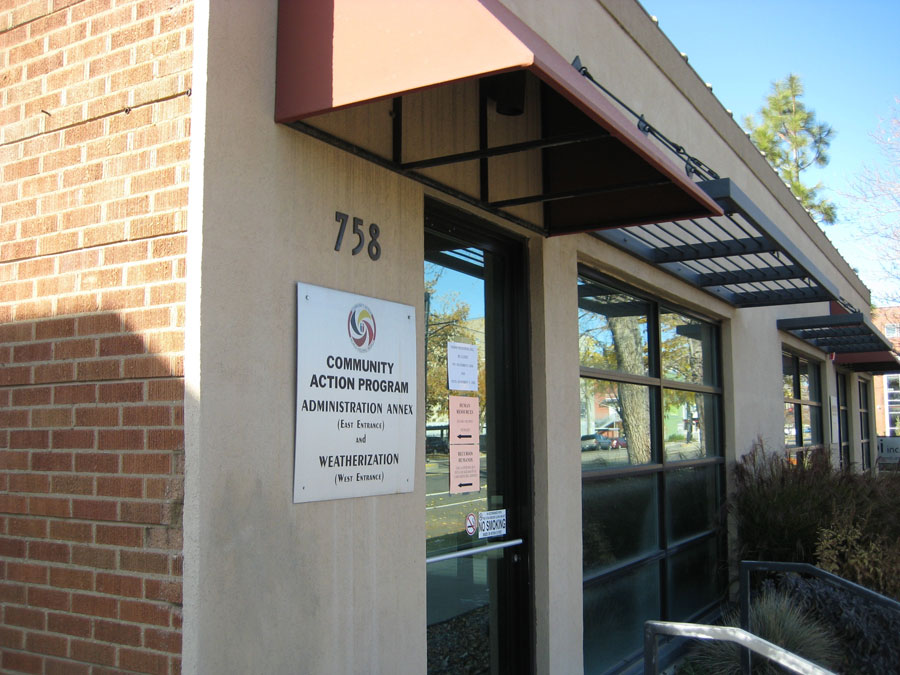
The Community Action Program, located at 764 S. 200 West in Salt Lake City helps weatherize the homes of low-income older adults.

“When (older adults) were working, they expected Social Security to solve all of their needs,” said Dale Canning, a deputy director at the Salt Lake Community Action Program (CAP). “That isn’t possible.”

Heating a home, though important, falls behind food and medical care in order of importance. Through the Weatherization Assistance Program, CAP helps heat low-income households by implementing cost-effective solutions.

“Our goal is to make it so they can afford to pay their bills,” Canning said.

The Weatherization Assistance program was started by the U.S. Department of Energy in 1976. It has three main goals: to save energy, to save money and to decrease greenhouse gases. The program is for low-income households, especially those with elderly or disabled residents. Canning estimates that half of the people who receive the benefits of the program are older adults, with a fairly even mix of couples and single individuals.

Many older adults don’t need the helping hand of the Weatherization Assistance Program. “Luckily, most seniors don’t have big house payments,” Canning said.

But not all are so fortunate. “We will go into homes where people are sitting around the house in blankets,” Canning said. “Their furnace won’t start or they will have broken windows, but no money to fix them.”

In 2008, the program helped 340 households save an average of $300 each by reducing their energy consumption, Canning said.

There are many ways CAP helps decrease heating bills through the Weatherization Assistance Program. They fix what Canning called “dangerous furnaces.” These furnaces have high carbon monoxide levels, don’t vent properly, have broken heat exchangers or don’t start at all. If a furnace is operating at 80 percent efficiency it will be replaced at no cost by a furnace that runs at 90 percent or better.

Some houses will have a set-back thermostat put in. These thermostats have a timer that automatically turns the heat down at a preset time at night and turns it back on at a desired time in the morning. This helps reduce energy use without forcing residents to remember to control the temperature themselves.

CAP will also implement cost-effective air sealing measures so that a house doesn’t lose its conditioned air. When necessary, CAP will insulate a home, fix broken or cracked windows, install compact fluorescent light bulbs and exchange shower heads.

Often CAP will install carbon monoxide and smoke detectors when doing the other improvements, “just to make their house a little more safe,” Canning said.

The benefits of the Weatherization Assistance Program are free for those who qualify. To be eligible, a household must be at 150 percent of the poverty level or lower. Older adults who work can have 20 percent deducted. Those who pay for their medical expenses with their own money can receive credits that go toward the services of the Weatherization Assistance Program.

Before CAP begins the weatherization work, a house must go through an energy audit. The audit suggests improvements that the home needs to be more energy efficient and cost-effective. CAP doesn’t just go through and fix everything. They need to make sure the improvements are worthwhile.

“Everything we do needs to pay for itself before it stops working,” Canning said.

While CAP does the labor, the work is funded by many different organizations. The bulk of the money comes from the U.S. Department of Energy. Funds are also provided by the Department of Health and Human Services through the Low Income Home Energy Assistance Program (LIHEAP) nationally, the Home Energy Assistance Target (HEAT) program locally, as well as Questar and Rocky Mountain Power.

CAP will also get money this year from the American Recovery and Reinvestment Act. Canning expects the ARRA stimulus will enable the Weatherization Assistance Program to help up to 1,000 people in 2009.

Families face difficult decisions when it comes to aging parents

by Jenna Cannon

She could sense that her memory was slipping away. So, at age 92, Phyllis Duncan made a life-changing decision. She wanted to move into an assisted living facility.

On the other hand, 95-year-old Beth Harris decided to stay at home. This choice enabled her to maintain her independence but required assistance from her family.

The choice of moving into an assisted living facility or remaining at home is not only a hard decision for an aging person, it is also hard on the family.

Duncan had seen other families go through hardships when faced with caring for elderly parents so she decided to take matters into her own hands. She sacrificed her independence for the well-being of her children. But many elderly individuals are like Harris and try to keep their independence intact by staying at home.

Deciding what to do when a parent is no longer able to care for him- or herself is a difficult decision that many families are faced with.

“People wait and wait, often at their own expense and health,” said Scott D. Wright, director of the Gerontology Interdisciplinary Program Center on Aging at the University of Utah.

There are numerous options to consider, but determining which option will work best for a family and an aged person is hard to agree upon. Many families try to take care of the parent, but there comes a point when they can no longer provide the care.

Utah families have been hit hard with this dilemma. “Utah is the fifth fastest growing state for an aging population,” Wright said.

Connie Carter can attest to this. Her family is currently faced with caring for two parents. She is Duncan’s daughter and Harris’ daughter-in-law.

The situation with Harris has brought many hardships. Harris still lives at home, but cannot be left alone for more than two hours at a time. Carter said caring for Harris is a lot of work and puts a strain on the family.

Despite this, Harris’ family wants to keep taking care of her at home due to financial reasons. Carter said they don’t think it’s necessary to put her in a care center when they can help her for a fraction of the cost.

According to pricing information on assistedlivingutah.com, the cost of elderly living facilities can cost upwards of $4,000 a month. To some, avoiding this hefty fee is worth the extra work that caring for a parent requires.

Carter’s mother, Phyllis Duncan, is paying for medical treatment and housing costs at Canyon Creek Assisted Living & Memory Care in Midvale, Utah. In order to pay for her care, Carter’s family was forced to sell her home. Proceeds from the sale are being used to pay her living expenses.

“This decision was easier than fighting over what to do and causing a rift between family members,” Carter said. In her experience, she has seen that most families that end up taking care of the elderly end up having hard feelings. Because of this she is relieved that her mother made the decision for them. Her family has been calm and peaceful about the situation.

Harris’ family is in control of her care and they are able to maintain her assets. However, these positive aspects come at the cost of her children’s personal health and well-being. On the other hand, Duncan is given 24-hour medical assistance and is able to live in an environment that satisfies her needs.

Determining what to do comes down to maintaining the highest levels of health and happiness for all the parties involved. The situation that works for one family may not work for another family.

Harris still seeks her independence by staying at home. She is happy and comfortable there, but her children worry about her deteriorating health. Carter hopes they can respect her wishes and continue taking care of her at home.

Duncan is now 97. Her memory loss is increasing, but she exhibits no signs of health problems. Her family is pleased to know she is well taken care of and she is content with her choice to move into an assisted living facility.

Senior fitness class makes working out fun

Story and photo by Alexis Young

Sheila Alford, an energetic 90-year-old, can officially say goodbye to her walker thanks to an exercise program designed for older adults.

When she began participating in EnhanceFitness at the Tenth East Senior Center, Alford could not complete a single arm curl with five pounds fastened to her wrist. But after just four months in the program, she was able to complete 20 repetitions.

“I have seen just about every single one of my bodily functions improve,” Alford said. “It’s the teacher, she really makes me motivated.”

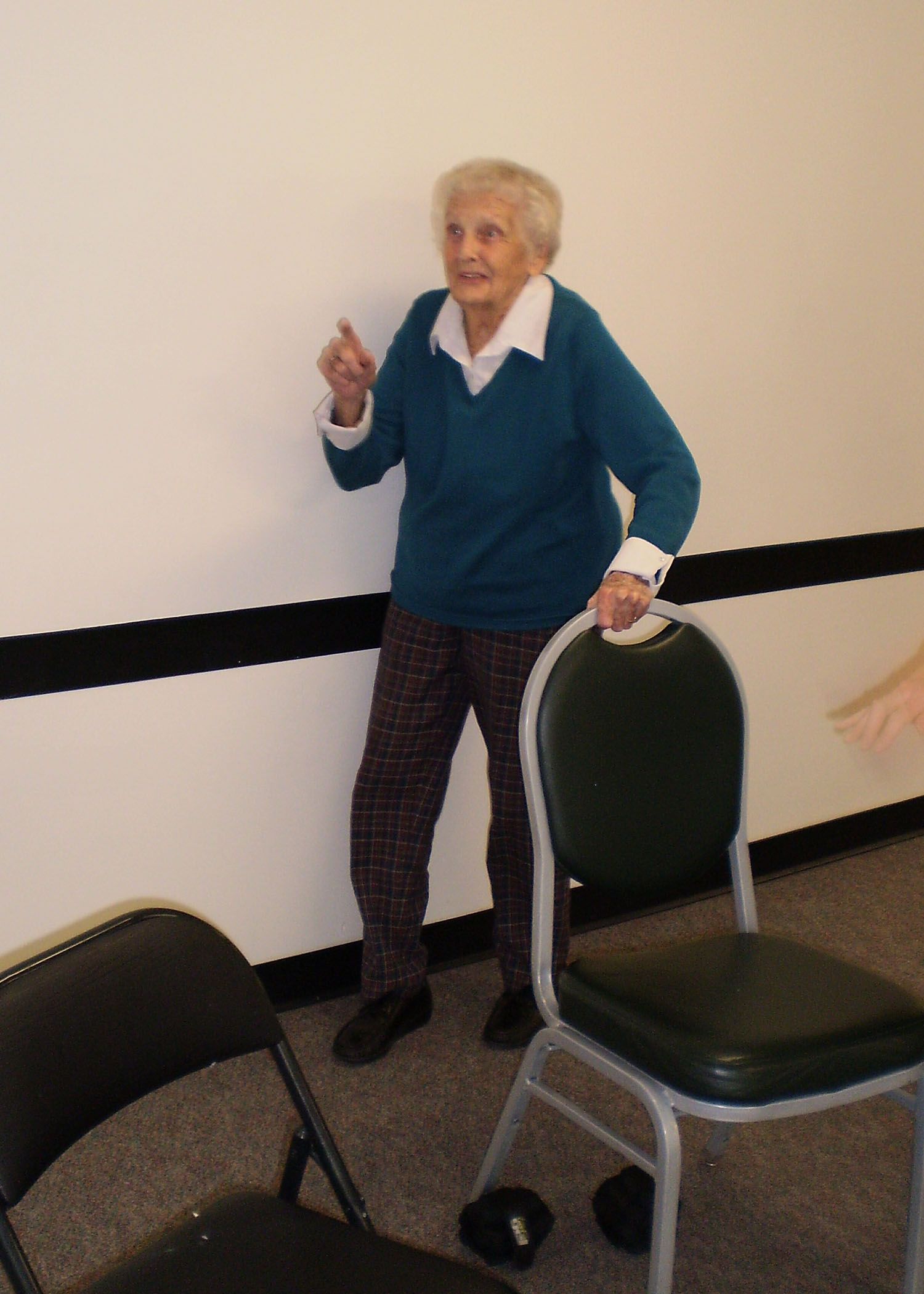
Sheila Alford dances to music as part of the EnhanceFitness exercises at the Tenth East Senior Center

Alford found exactly what she was looking for in EnhanceFitness, an exercise program taught at seven different locations across Utah. These classes are designed for older adults at all fitness levels and focus on aerobic activity, strength conditioning, flexibility and balance.

Nichole Shepard, the health and fitness instructor at the Tenth East Senior Center, is amazed by Alfords’s positive attitude. Shepard said she is a great example to everyone because does not let life bring her down.

“Instead of giving in to age, she goes along with it, and makes the best of what she has. She not only comes to my class three times a week, she attends two other fitness classes in her spare time,” Shepard said. “Sheila has made huge improvements, visually you can see she has more energy during class routines.”

Adding her own personal touch to every exercise class, Shepard creates the playlists to set music from the 1940s, 1950s and 1960s. She also choreographs every cardiovascular routine, adds verbal tasks during the strengthening sequence and incorporates a joke at the end of every clas

“They actually get mad at me now if I don’t bring along a joke,” Shepard said, “and because they are all having fun, they don’t realize their bodies are getting a great workout.”

EnhanceFitness is all evidence based, and was developed by the University of Washington’s Health Promotion Research Center (HPRC). According to the HPRC Web site, research has revealed participants of EnhanceFitness do significantly improve their health. In a survey done in 2008 by HPRC, seniors were asked about improvements in their physical capabilities. More than 94 percent said they had maintained or greatly improved their physical capabilities. And in 2006, the International Council on Active Aging recognized Project Enhance, which includes EnhanceFitness, as the sixth most innovative active aging program in North America.

At community senior centers around the state, EnhanceFitness is a free program providing a one-hour supervised class three times per week on an ongoing basis. The customized program allows the instructors to be creative and choreograph their own routine, yet still retain the EnhanceFitness exercises that have been proven to help older adults in maintaining and improving their strength, balance, posture, endurance and emotions. EnhanceFitness also incorporates alternative exercises in the program specifically intended for frail seniors. A participant such as Sheila Alford can do these exercises by using a support or sitting in a normal chai

“The most challenging part for me is when I have to move my feet during cardio; my arms are OK, but most of the time I have to hang on to my chair,” Alford said.

The energy was soaring through the roof during a recent visit to the Tenth East Senior Center. The open room was filled with 10 enthusiastic women throwing their hands up in the air and dancing around the circle of chairs to the song, “When the Saints go Marching In.” The ball really got rolling when it came time to strength train. Participants had to count the number of arm curl repetitions they were completing in Spanish. After the arm exercises, the women were instructed to lift their leg while holding onto a chair and recalling a variety of things such as cities, states, colors, animals or candy bar

“A verbal task significantly helps the seniors with their cognitive abilities,” said Michaelene Waters, a health educator for Salt Lake County and the founder of EnhanceFitness in Utah.

Waters started teaching EnhanceFitness classes in Utah at two different locations: the Draper Senior Center and Tenth East Senior Center. Seven classes are now offered at different locations around the Salt Lake Valley.

“My main focus now is growing the program. I would like to see EnhanceFitness in all of the senior centers throughout Utah,” Waters said.

Attendance at the Tenth East Senior Center is growing and the demand for more classes is increasing.

“Participants at the senior center range from 75 to 80 years old, and women by far are the most common types who participate,” Water said.

At the Tenth East Senior Center, participants fill out a questionnaire and perform a fitness check when they enroll. The check-up is then repeated every four months throughout the program. The fitness test is comprised of three things: how many times a participant can rise from a chair and stand up in 30 seconds; 30-second arm curls with five pounds fastened to the wrist; and the 8 feet up and go, which is a test that utilizes cones for balance and agility.

“The best part of EnhanceFitness is the social aspect of group exercise. They put in more effort when they are all together and they just have fun,” Waters said.

In all seven locations throughout the state, the success rate remains high.

“The program is ongoing and not very many people drop out, most people stick with it,” she said. “The only reason someone might drop out is if they get injured or have to move.”

Research conducted by HPRC over the past 15 years has demonstrated that getting sufficient physical activity, including strength training, helps people with arthritis, improves balance, helps to prevent falls and helps seniors to become more socially connected.

“Strength training is [one of] the most beneficial parts to EnhanceFitness, and is one of the most important aspects an older adult can incorporate into his or her life,” Waters said.

From time to time, Sheila Alford does not want to come to class, but says she comes for the health benefits and to see her friends. Alford is one of many who can affirm the values of EnhanceFitness and what it has added to her life.

“We will all age, but how we age is a personal choice. You can let age get the best of you, or you can continue to challenge your mind and your body,” Nichole Shepard said.

For more information about the EnhanceFitness program, contact Michaelene Waters at mwaters@slco.org.

Assistance is available for job-seeking seniors

by James Williams

Starting her day at 5:30 every morning, Betty Nielsen has a cup of coffee, takes a shower, gets dressed and catches the news headlines on a local television station. She does all this before catching the bus headed toward her job in downtown Salt Lake City.

There is one thing that sets her apart from the other commuters on the bus, though: Nielsen is 68.

“I’ve been working all my life,” Nielsen said, “there’s no reason to stop now.”

Nielsen is among the growing population of senior citizens who remain in the workforce. Some work out of necessity, while others work by choice, but one thing is certain: The number of seniors in the workplace is increasing.

According to the United States Department of Labor, between 1977 and 2007 the number of employed workers over 65 increased 101 percent. The number of women, like Nielsen, increased nearly 147 percent.

Employment of those 75 and older also increased by a staggering 172 percent during the same period.

Nielsen works out of necessity. Aside from her paycheck, Social Security is all she has to cover expenses.

“Bills pile up and Social Security just doesn’t cover them all,” she said. “I have to work to survive.”

Other seniors are also in her situation. According to “Older Workers,” a career guide produced by Utah’s Department of Workforce Services, Social Security benefits accounted for 37 percent of the older population’s total income in 2005. This might explain why a growing number of senior citizens are choosing to work full time.

In fact, according to the Department of Labor, 56 percent of today’s employed seniors, 65 and older, work full time. In 1995, only 44 percent of employees 65 and older worked full time. Today, the average employee over the age of 65 makes $605 per week.

Although the number of senior citizens in the workforce has risen nationwide, the overall unemployment rate also has increased. Currently, the unemployment rate sits at just above 10 percent, the highest in nearly two decades. This rate has affected many people, including senior citizens, and has made it more difficult to find employment.

Despite the tough economic times, companies are still hiring, and there are resources available to senior citizens who would like assistance with finding employment.

One place seniors can turn to is Salt Lake County Aging Services. Through the Senior Employment Program, seniors have found employment.

“We’re a good place to start,” said Charlyn Hanson, a program representative.

Hanson, who herself participated in the program, believes it’s successful. “It’s a good program,” she said.

In fact, the program is so popular there is a three-month waiting list just to be admitted, Hanson said.

The program is open to anyone who resides in Salt Lake County and is over the age of 55. But, since the program receives federal funding, participants in the program must meet federal income requirements, which can be obtained directly from Salt Lake County Aging Services.

Once admitted into the program, seniors are given a part-time, minimum-wage job with a government office or nonprofit organization. Participants learn the skills they need to perform the job, including computer skills.

Seniors can remain in the program for one or two years, but during that time they must be actually looking for a job and register with the State’s Department of Workforce Services, Hanson said.

For those who do not qualify for the program, Salt Lake County Aging Services can still help. A folder in the lobby contains new job leads and seniors are welcome to look through it.

The county also has two employment specialists who can sit down with seniors and assess their situation, teach them interview skills and give résumé assistance.

“Even if they don’t qualify for the program, we can give them encouragement,” Hanson said.

Another place where seniors can seek assistance is LDS Employment Services.

“Our services are open to anybody,” said Frank Sano, manager of the Centerville office.

Like Salt Lake County Aging Services, LDS Employment Services is a resource center, not an employment agency. The goal is to send people out with leads, but they also provide two useful programs that are free and open to anyone.

The first is known as the Career Workshop, which is a six-hour class that is spread over two days. Seniors learn an effective way to present themselves to employers in 30 seconds, as well as the importance of résumés, cover letters and interview techniques. They also participate in a mock job interview.

Businesses spend between $3,000 and $5,000 on similar programs for their employees, Sano said. “People who have taken both say our free one is just as good.”

The other program offered is known as the Professional Networking Group. This program puts jobseekers together where they can network, or share needs and job leads, with each other. Networking is an important tool for jobseekers.

“That’s where most of the jobs are found,” Sano said. “Lawyers, CEOs and chiropractors have all attended.” The program has even helped start a few new businesses.

Catholic Community Services of Utah and Jewish Family Services also provide employment leads and other assistance to those in need.

The number of seniors who remain in the workforce continues to increase, and despite a high unemployment rate, there is hope for seniors who are looking for employment. Employers are starting to see the benefits of hiring older workers.

“Employers are realizing that old can be good,” Sano said. “They bring a strong work ethic.”

Independent living: a community of friends

Story and photos by Paige Fieldsted

When you walk into Parklane Senior Apartments in downtown Salt Lake City, residents can be heard laughing and telling jokes. Men and women prepare to go out into the brisk November air. Staff bustle about, interacting pleasantly with the residents. If you close your eyes and just listen you might think you were in a university common area or workplace break room, not a retirement home.

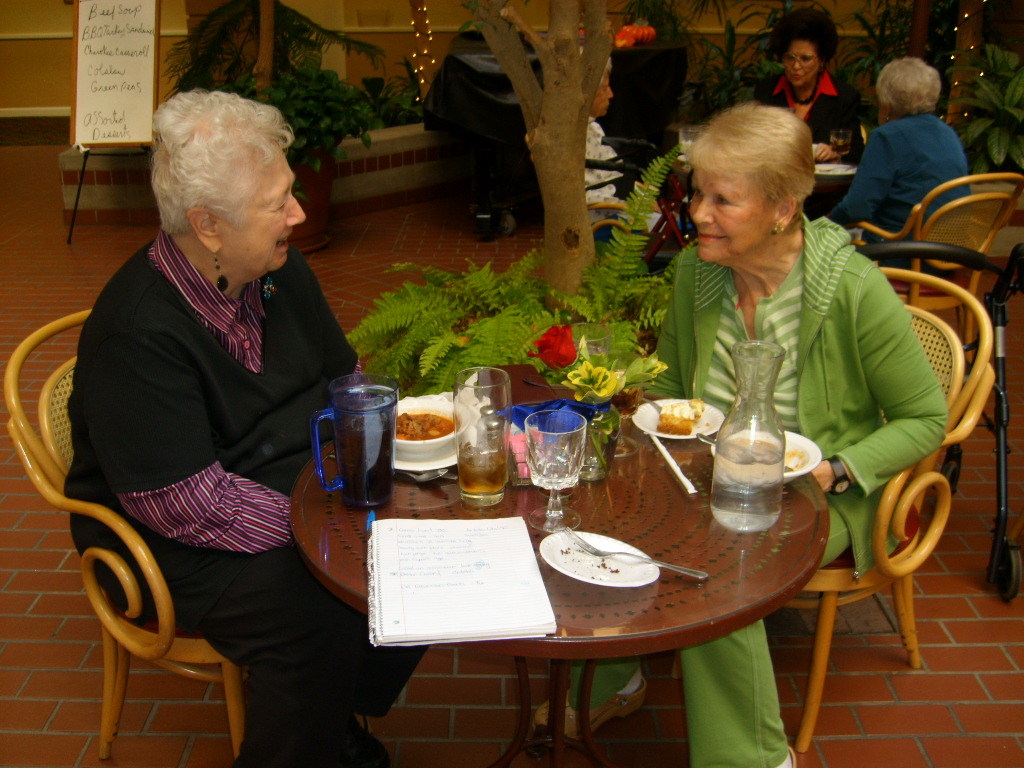
Carma Lunt and Pat Grossman gossip over lunch in the atrium at Parklane Senior Apartments.

Residents appear happy. Sitting down for lunch with Carma Lunt, 80, and Pat Grossman, 76, reinforces that notion. The two women laugh and joke with each other as they gossip about their neighbors.

Independent living communities like Parklane not only provide opportunities to make new friends, but also usually include all amenities and activities for residents.

Jamie York, director of marketing at Parklane, said that despite all the amenities and what she describes as “resort-style living,” most older people are reluctant to move away from their homes and are afraid of giving up their freedom and independence. She said, however, they usually transition smoothly once they arrive.

“Once they get here and see what it’s like they say, ‘Why did I wait so long?’” York said.

The luxury of having meals, laundry service and transportation on site comes with a price, though. Units at Parklane range in price from $2,500-$4,000 a month. Lunt said although the rates may seem high, it was actually cheaper to live at Parklane than it would have been to maintain her own house.

“By the time you pay taxes and utilities and everything else I just decided it would be cheaper,” Lunt said.

Even though all amenities are included, not all seniors may be financially able to live in a place like Parklane. York said they frequently offer specials that reduce rates by $300-$500 a month. She also said veterans are often eligible for a stipend that can help cover the cost of rent.

“Lots of people think places like this are out of reach,” York said. “But once they sit down and really look at everything, more people can afford it than think they can.”

Other independent living communities around the valley have similar pricing and amenities to that of Parklane. Highland Cove and The Coventry have units ranging from $1,900 for a studio to $3,300 for two bedrooms. Millcreek retirement has one and two bedroom units ranging from $2,395-$2,695.

York said planning ahead and looking into independent living options sooner rather than later makes it easier for residents and their family to work out finances. And the social interaction and freedom offered by independent communities can be priceless.

Although both Lunt and Grossman have lived at Parklane less than a year, they have become fast friends. Grossman points to Lunt when asked what her favorite thing about living there is.

“You make good friends,” Lunt said. “Her family is my family and my family is her family so you do have that relationship here, which is really good.”

At Parklane new residents are greeted by a welcoming committee and set up with other residents to accompany them to meals in order to help them make friends faster. York said the staff has the welcoming down to a science.

“Here there is no new kid on the bus,” York said. “People usually make friends quickly.”

Not only is the retirement community great for making friends, but it also has produced several couples throughout the years. Although most of the community’s residents are single females, York said a few couples live in the building and there are a few who met at Parklane and are now married and living together.

“We’ve even got a love boat kind of thing going on here,” York said, laughing.

Lunt and Grossman gossip about the couples who have emerged since they moved to Parklane, saying they have seen a few couples get married and others who are “coupled up” but not married. The women erupt into giggles reminiscent of junior high days when they talk about the couples at Parklane.
The women stop their storytelling every few minutes to say hi to residents walking by; they seem to know everybody. Lunt said every Wednesday some of the residents open a convenience-store-like shop that sells toilet paper, soap, cards and other household items, and that the business keeps her in the loop.

“That keeps me knowing the people here and the way they act and the things they do,” Lunt said. “It keeps you entertained.”

It’s the social interaction aspect that makes independent living facilities worthwhile for seniors looking to retain their independence.

“When seniors live alone they can get lonely with no social interaction,” York said. “They can get depressed; they stop eating and are more susceptible to falls. People that have social interaction live longer, so when they live at home alone their life span decreases.”

A study in the June 2009 issue of the “Archives of Internal Medicine” showed that elderly people who are more socially active retain their motor skills longer. The study found that a decrease in social activity increased risk of dying or developing a disability by 50 percent.

Lunt, who used to live in an assisted living facility, said that living in an independent living facility provides much more social interaction.

“When I lived there, there were only about four people I could have a conversation with,” Lunt said.

At most independent living facilities residents must be able to take care of their own needs and not require 24-hour medical attention. Lunt said residents needing lots of attention either must have an aide to help them full-time or move elsewhere.

The atrium at Parklane is a social hub of activity where residents enjoy most of their meals and activities.

Residents at Parklane have the option to enjoy three restaurant-style meals or cook something for themselves in their full kitchens. Most residents prefer to eat the meals in the atrium, not only for ease but also for dietary purposes.

“I eat all my meals here,” Lunt said. “I can cook better food than they serve but because I have diabetes it is healthier to eat down here.”

Meals are one of the many amenities offered at independent living communities like Parklane. Most facilities offer housecleaning and transportation services and set up activities for the residents to participate in.
Both women agree that while they like the housekeeping and meals, they enjoy their independence as well.

“It’s like having your own place,” Lunt said. “It’s very independent living. I have my own car so I can go where I want and do what I want to do. You’re really on your own and can do what you want.”

While most residents participate in the activities, it is the housekeeping, meals and maintenance that the residents really enjoy. Lunt said before she moved to independent living, taking care of her house was almost overwhelming.

“I kept thinking ‘What am I doing in this house, taking care of these things by myself when I would a lot rather be waited on?’” she said.

York said most residents come to Parklane at the request of their children.
But Lunt’s son, Scott, said it was his mom’s idea to move into a retirement community. Scott said he and his siblings first brought up the idea but were quickly corrected by their mother.

“I didn’t know where I was moving but I just decided I wasn’t going to be responsible for a house anymore,” Lunt said. “That is why I moved here because I didn’t want anyone to be responsible for me.”

Joy in the golden years

Story and photo by Jenna Cannon

What is the key to being happy in life’s later years? Riches? Career? Health? These are some of society’s theories about happiness. Clyde and Nancy Neilson have a different outlook on the subject.

Clyde and Nancy Neilson spend time with each other at their home in Cottonwood Heights.

“Feeling like you have a purpose and being needed by the ones you love is what makes you happy,” Clyde Neilson said.

Elderly people often become depressed when they realize they are nearing the end of their lives, said Kenneth Poulsen, gerontology care manager at the Magna Senior Center in Magna, Utah. But those who have meaningful relationships have a more positive outlook on life, he said.

“Relationships and social connections appear to be the key to aging well,” said Scott D. Wright, director of the Gerontology Interdisciplinary Program Center on Aging at the University of Utah.

These relationships can be found in friends, family members, a spouse or a neighbor. “Studies have shown that having someone to spend time with improves the quality of life for the elderly,” Poulsen said.

The Neilsons say their relationship is a positive influence in their lives. They have been happily married for 54 years. Although they have trials and problems they say they find joy in the little things.

At the age of 79, Clyde’s face holds a youthful expression of wonder rather than that of worry that so often comes with age. His wife said she long ago gave up trying to tame his hair. It sticks up in various places as though he’s a young boy who has been outside playing.

Nancy Neilson is 72. Unlike her husband, she reveals some worry in her face. But with a word or two her husband can crack her nervous exterior and have her giggling like a teenage girl.

The Neilsons give off the distinct impression that they really care for one another. “It makes me feel special when I can do something that brings my husband joy,” Nancy said.

“I’ve seen many couples that love each other, but are too concerned with themselves to make it work. Some people don’t understand that you have to put your spouse’s needs first and vice versa to truly be happy,” said Carol Washburn, a psychologist of marriage and family relationships.

The Neilsons said they try to look out for one another in every aspect of their lives, from work, to family, to health.

Both have fairly good physical health, but Nancy’s mind is slowly ebbing. “She has trouble remembering things all the time,” Clyde said. Because of her memory loss, he takes her to work with him at Miller’s Honey Company at least once a week to stimulate her mind.

Clyde retired many years ago, but he still works because he finds it entertaining. He laughed at the idea of retiring.

“The best part of retirement is the anticipation. When it actually gets here it’s not that fun,” he said.

He also likes to work because he can bring in extra money for things like vacations and an inheritance for his four children, he said. They make him feel needed.

“I think it’s important for us to have enough money to leave to our kids when we’re gone,” he said.

Nancy expressed concern that her husband does more for her than she does for him. With this assessment she anxiously began picking at her nails. With a loving smile, Clyde reached across the table and held his wife’s hand gently in his callused fingers.

“You do more for me than I could ever dream of,” he told her genuinely.

These small acts of charity illustrate the importance of having someone to care about and care for you in return.

“When the elderly people at the senior center have the opportunity to help one another, the joy on their faces is truly memorable,” Poulsen said.

Another couple in their late 60s said doing little things for one another keeps them happy. Jim and Connie Carter like to surprise one another to maintain the youthful joy in their relationship.

“Jim knows I love cupcakes from Backer’s so he brings me home a delicious chocolate cupcake every once in a while,” said Connie. “It’s a welcome surprise that I will never tire of.”

The Carters also try to spend plenty of time with one another. They recently started doing financial consulting together.

“The time we spend working together has become a real treat in our lives,” Jim said.

Many elderly people have lost their spouse but are still content and happy with their lives. Washburn attributed this to the other relationships they maintain.

“Surrounding yourself with family members or other people you love is an ideal move towards happiness,” she said.

Grace Pace, an 86-year-old widow, said when she starts feeling lonely she remembers her children. With the click of a button she can call a family member to ease the burden of loneliness.

“It’s been hard ever since my husband passed, but having my family around keeps me upbeat. Sharing my life with my family truly makes me happy,” she said.

Planning for death in life

by Gillian King

Couples often delight in planning for new babies, anniversaries, birthdays and their children’s weddings. They set aside money for their children’s college fund and for their own retirement. They make plans to buy a new house or travel around the world. One thing that couples may not look forward to planning, however, is their own funerals.  The desire to not leave a burden for their children is pushing many seniors to do so, though.

Geraldean Densley, 81, and her husband, Fred, think it is important to make sure they have as much planned as possible so their children will not have to try to guess what the couple’s wishes are.  They also want to make sure their children do not have to worry about paying for funeral expenses.

“We have money in savings for that,” Geraldean said, “and my husband says it will be enough.”

Many couples worry about leaving a burden for surviving family members and so have set aside money to lessen the burden. Noel Taylor, 78, and his wife are among those individuals who have made the necessary financial arrangements.  Taylor is not shy about what his wishes are either, and he makes sure he discusses them with his family. “It’s something that needs to be talked about,” Taylor said.

Taylor also said he does not believe in spending a lot of money on funerals, and would like his own to remain as low-cost as possible. He does have one specific request, though.

“I’ve been looking into green funerals,” Taylor said.  A green funeral would mean that his body would not be embalmed and the use of a special casket would be required. He believes it is important to be environmentally friendly even in death. Taylor has already begun shopping around for his casket so that his family will have one less thing to worry about.

Buying things such as caskets pre-need, or before an individual dies, can make the actual funeral arranging much easier for surviving family members. This is why more people are buying what they can while they can.

“We already have our plots in Riverton,” Geraldean Densley said. “We bought those about 20 years ago.” The decision of where to buy their plots was not made randomly. “Riverton is home,” she said. Densley added that it would not seem right to be buried somewhere else since they have thought of Riverton as their home for most of their married lives.

Taylor has also already acquired plots for himself and his wife. Much like the Densleys, he wanted to pick somewhere that would feel like home.

“We have plots in Pleasant Grove, where my parents are buried,” Taylor said.

He chose to have his plots in the same cemetery because he wanted to be able to be near family. His children are scattered among several states and two countries, so being buried near them would be impossible. He decided being near his parents would be the best option.

But not everyone plans things ahead of time. Genean Warner, 70, and her husband still have a lot of things to figure out.

“We’re one of them procrastinators,” Warner said. “We haven’t planned anything yet. We’ve talked about it, but we haven’t done anything.”

Like Taylor and Densley, however, Warner does know where she wants to be buried. She would like to have plots for her and her husband in Murray, where they live.

Not having formalized plans or designated funds for funeral expenses can present difficulties for surviving spouses or other family members. The average funeral costs around $10,000. Not everyone is able to come up with that amount in short notice either. Social Security can help a little. According to the Social Security Web site, surviving spouses can receive a one-time payment of $255. It may not seem like very much, but every bit helps.

With all the emotions that family members may be feeling upon the death of a loved one, worry is one feeling that Densley does not want her family to have to feel. Anxiety about where the money will come from to fund a funeral or how to carry out her wishes is something she wants to spare her family. There will be enough going on that she does not want her family to have to wonder what she would want or how to accomplish it.

“We have a living will so the kids will know exactly what to do,” she said.

Densley is not the only one trying to reduce confusion. Along with setting up funeral funds and arranging for plots and caskets, Taylor and his wife also took the time to draw up their will.

No matter how much time is taken in planning, there always seems to be more to do, though.

“I keep thinking we should get our headstone, but we haven’t yet,” Densley said.

Diagnosing memory loss

by Kelli Coomes

Imagine standing in your entry hall, keys in hand. You can’t remember where you need to go, only that you have some place to be. A few minutes later, you still can’t remember why you’re standing there.

Brian Fisher, an in-home certified nursing assistant, woke at 6 a.m. to find the 85-year-old man he cares for up and ready for work. Since Arvel hasn’t worked for more than 20 years, Fisher took him to McDonald’s instead. Arvel doesn’t care where they’re going, as long as he’s going somewhere.

Later that day, Fisher drove his patient to the doctor’s office. Arvel’s family was having him tested again for Alzheimer’s. Despite previous tests that showed he does not have the disease, his family keeps sending him to the doctor for further testing.

Arvel knows where he is and who the people around him are. He can understand most things that are told him, Fisher said. But what worries his family is that he cannot remember a lot of the little things. Arvel forgets he doesn’t work, so he gets ready when he wakes. He can’t remember where some things in the house are.

Dr. Edward Zamrini is the director of clinical trials at the Center for Alzheimer’s Care, Imaging and Research. Alzheimer’s Disease isn’t just about memory loss, but how much the loss progresses, Zamrini said. Doctors at the clinic look at how frequently a problem occurs and the loss by degrees, such as remembering where one’s keys are to where one’s car is located.

“To lose one’s memory is the ultimate loss,” said Scott D. Wright, director of the Gerontology Interdisciplinary Center at the University of Utah. “It’s like they’re dying twice.”

Alzheimer’s is the most common cause of memory loss in roughly 50 percent of cases. But it isn’t the only reason for memory loss.

“We jump to it too soon,” Wright said. There are about 25 other factors that can cause memory loss that are ruled out first. These include diet, diseases, stress and medications.

Zamrini said some health issues that cause memory loss include Lewy body disease and dementias like frontotemporal dementia.

Lewy body disease is a disease that is commonly mistaken for Alzheimer’s. Johns Hopkins Medicine states that like Alzheimer’s, Lewy body patients have memory loss, but there are other symptoms that distinguish it such as trouble with attention, hallucinations and symptoms that are similar to Parkinson’s disease. There are often problems with sleeping, falling and depression.

According to the Mayo Clinic, dementia describes a group of symptoms, both social and intellectual, that interfere with daily life.

Dementia, after several tests, can be diagnosed with complete accuracy about 90 percent of the time. However, dementia can lead to and be a symptom of Alzheimer’s.

Alzheimer’s can only be diagnosed with complete accuracy after death. According to the Mayo Clinic, a microscopic exam of the brain is the only way to accurately diagnose the disease. A brain with Alzheimer’s has plaques and tangles that are visible only with a microscope.

One form of dementia that can be tested accurately is frontotemporal dementia. The Mayo Clinic notes that it is commonly mistaken for Alzheimer’s, but it occurs at a much younger age.

The starting age for Alzheimer’s is roughly 65, with incidents increasing every five years. By age 85, people are 40 percent to 50 percent likely to develop it.

Frontotemporal dementia typically develops between the ages of 40 and 70.
Symptoms of frontotemporal dementia vary according to what part of the brain is affected. The term is used for disorders that affect the frontal and temporal lobes of the brain that are associated with personalities, behaviors and language.

Depression is another cause of memory loss. Zamrini said depression often causes forgetfulness. As people get older, they tend to lose their loved ones. Friends and family members die. This can create or add to depression. Often they stop caring about memories, or forget them because they become too painful. Often the memory loss is self-inflicted.

The hardest part for the families of Alzheimer’s patients, Zamrini said, is that they’re physically fit but not mentally well. This distinction is what’s helping doctors re-diagnose patients. Alzheimer’s only affects memory, Zamrini said. Diseases like Lewy body and dementia have some physical symptoms.

The testing for the other diseases is progressing and better diagnoses between them are increasing. Early detection helps with all these issues, Zamrini said.

Nursing homes leave wrong impression on youth

by Paige Fieldsted

  • A look at aging as an athlete through the eyes of John Percival.

Odors of decay, urine, cafeteria food and musky perfume waft down the hallways, assaulting anyone and everyone who enters the building.
A peek into the dimly lit rooms reveals wrinkled men and women snoring in wheelchairs; others are unable to get out of bed.

The scene described above can be found in many nursing homes across the nation. And the underlying message creates fear in the younger population.

“We’re convinced kids walk away thinking, ‘Well, this is it.’ The impression is this is where you do end up at inevitably, ultimately,” said Scott Wright, the director of Gerontology at the University of Utah.

Wright said too often younger people are leaving nursing homes with the fear and misconception that the residents there are a representation of what aging is; that incontinence and immobility are what awaits them with age.

Lonnie Kay Percival has experienced a grandparent, a parent and a father-in-law dying in nursing homes. She says she understands how nursing homes can leave fear in children.

“The smell of old people, plus urine and cafeteria food and I don’t know what else, would be overwhelming,” said Percival, 69. “And there are so many old people all at once. I mean everywhere you look there are old people. I think it is a scary thing.”

Although Wright said it is a common belief among young people that all old people end up in nursing homes, statistics from the 2000 U.S. census illustrate that is not the case.

In 2000, 12 percent of the population was 65 years and older, but only 4.5 percent of the 35 million seniors were living in nursing homes. This number has decreased steadily since the 1990 census.

USA Today reported more than 1.8 million people are currently residing in nursing homes. Despite what seems like a high number, the number of residents in nursing homes is declining.

Even though such a small percentage of the population lives in nursing homes, youth who visit nursing homes and receive no other education are left with the wrong impression about what it means to grow old.

“We always cringe when the preschool or elementary school teachers gather the kids and say, ‘Okay we’re going to go to the nursing home on a field trip,’” Wright said. “You know it’s good for the older adults in the nursing home but (the kids) walk away thinking, ‘Well this is what aging is.’ It’s a very impressionable age and we want younger people to realize that is not necessarily all that aging is.”

Across the nation, education programs are becoming available to better inform the general population about what it means to age.

At the University of Utah, an entire department is dedicated to the study of older people and aging. In Salt Lake City, resources are available for those wanting to learn about aging. An entire section of Utah.gov is dedicated to seniors and information about them.

Percival said education has to be at a more personal level in order to dispel fear.

“I think we just have to organize our service project hours with the young people so that they get to know that they’re not just a wrinkled old person but that inside there is an interesting person,” Percival said. “Because inside they’ve lived a good life and an exciting life and they can share a lot of wisdom with the youth.”

Connecting on a more personal level could help overcome many of the attitudes that people have about aging. Assumptions like getting old means losing the mental and physical capacity to take care of ourselves, and to interact with others.

Wright said changing attitudes about growing old is an important step in changing behaviors now that will affect how we age in the future.

“It’s not just about behavior,” Wright said. “We have to change attitudes about aging.”

While many public school programs are working to changing the attitudes of younger people, Percival believes the change has to begin at home.

“It comes back to some parenting skills. Parents have to explain to children and talk to them,” Percival said. “I don’t know if you can turn that over to the schools and have it be successful.”

Learning is a lifelong process

by Alicia Williams

Everyone’s heard them, probably even said them on occasion: timeless age-related jokes correlating one’s ability to learn with being young.

When it comes to learning, we now know the theory “you can’t teach old dogs new tricks” has been officially replaced with “use it or lose it.”

For the last 53 years, the Seattle Longitudinal Study of Adult Intelligence has been tracking more than 5,000 participants who’ve had mental and physical testing every seven years since 1956. The study has found that intellectual decline in older people’s mental performance is often due to disuse, and it’s reversible.

Not only did two-thirds of participants show improvement, but 40 percent of declining participants returned to pre-declined knowledge levels and have maintained the training effects for more than 14 years. The brain is truly like a muscle that will deteriorate when it isn’t flexed, and just like a muscle, it needs quality stimulation to help it grow and stay strong.

Scott Wright, associate professor and director of the University of Utah’s Gerontology Interdisciplinary Program, said the “age tsunami” has already hit America. During the next several years, 76 million baby boomers will begin to retire.

Every month, 35,000 people are turning 65. Wright said they should be optimistic because they have great potential for the second half of their lives. He said the fastest growing student population will be older than average students, and continuing education is the key to a long, healthy life.

“When I went through grad school, 21 (years old) was actually promoted as the peak of IQ for adult intelligence and that it would decline for forever after that,” Wright said. “Our studies now show intelligence stays about the same across the entire life course.”

Both mental and physical exercise will help the brain stay in peak performance. According to Resources for Science Learning at the Franklin Institute, continually challenging the brain by learning new things, reading and playing games helps to improve function no matter how old one is. Passive observation is not enough; we must interact with different environments to create a challenge for our brains.

The fact is, we’re all aging. The difference is how we choose to age. Cathy House, program director of the Osher Lifelong Learning Institute Continuing Education at the U, said the ability to keep our minds strong and sharp is a reality that only comes from making a commitment to lifelong learning at an early age. Deciding to never stop learning will not only keep the brain healthy, said House, but it will also help to make the aging journey fun and interesting.

House said one of the biggest obstacles to achieving this commitment is youth itself. When we’re young, we’re often required to learn in order to attain something. It isn’t until we’re older that we recognize the desire to learn just for the pleasure of it.

“For the students, if you’re targeting undergrads, it’s a long way until they are 50,” House said. “It’s one of the things I value most about being over the age of 50. It’s just to look back on my life and think about the things I’ve learned. At this stage of my life, I’ve figured out I can learn just about anything that I have an interest in. And that’s pretty cool to know. When I was younger I didn’t really know that.”

The U has an extensive continuing education program that bridges the span of youth to lifelong learners. The Osher program specifically caters to adults older than 50. All of the classes are noncredit: no tests, no grades. Current students range in age from 50 to 90-plus years old.

“Learning is the spice of life; it can add dimensions to your life that you cannot get any other way,” House said. “It’s a way to enhance life, to make it much more interesting.”

The Franklin Institute’s Resources of Science Learning describes the brain as a thinking organ that learns and grows at all ages when it interacts with the world through perception and action. Because research shows that age-related memory loss is a direct result of disuse, mental exercise and stimulation are encouraged. You’ve got to use your brain so you don’t lose it.