Coming into intermediate reporting at first, I honestly thought it was going to be a repetition of what I have already learned out in the “real world,” through the several internships that I have done.
I have done a vast amount of work with the Utah Jazz and the University of Utah Athletics program, focusing largely on football. Throughout working with these different sports teams, I have and continue to receive multiple opportunities to interview others.
Throughout the course of the semester, I have come to realize how much my experiences in this class have strengthened my writing towards my undergraduate education. It has proven how grateful I am for the opportunity to take this class with Holly Mullen.
Holly has been the utmost help and a very beneficial teacher when it comes to improving my writing and becoming successful in my future career path, wherever it may take me.
This class has provided me the opportunity to strengthen my work, provides amazing clips to add to my portfolio and established a more crisp and clearer path for my life after graduation.
Intermediate reporting has been one of the many classes that have been truly beneficial and provided challenges and accomplishment towards my success as a student and future professional. Without classes like intermediate reporting, I wouldn’t be the step ahead of other students fighting for similar career positions.
Through this class, I have been able to learn more about what is going on in the Salt Lake area, the state of Utah and even pertaining to the nation. It has allowed me to become more updated and aware of what is going on in such a fast-paced world.
I’m excited to implement all I have learned in this class to my work, whether it is through interviewing, writing and going about my different projects I am assigned to. I am anxious to see where my life will lead and know that this class will help get me to where my dreams, since a young girl, will take me.
ABOUT ME:
Growing up in a house full of boys with a dad as a football and basketball coach in Southern Nevada, it’s been my goal since a young girl to pursue a career in sports media. Currently a junior at the University of Utah, I study in mass communication and continue to reach my goal of becoming a sideline reporter. Whether it is through covering Utah Ute athletics to the Utah Jazz, my experiences working here in the Salt Lake media industry have helped my passion for sports and journalism grow tremendously.
Derk’s Field photo courtesy of the Utah State Historical Society
For everyday people the world can often seem dull. We wander through our lives, habitually proceeding from task to task. Rarely do we stop to appreciate the
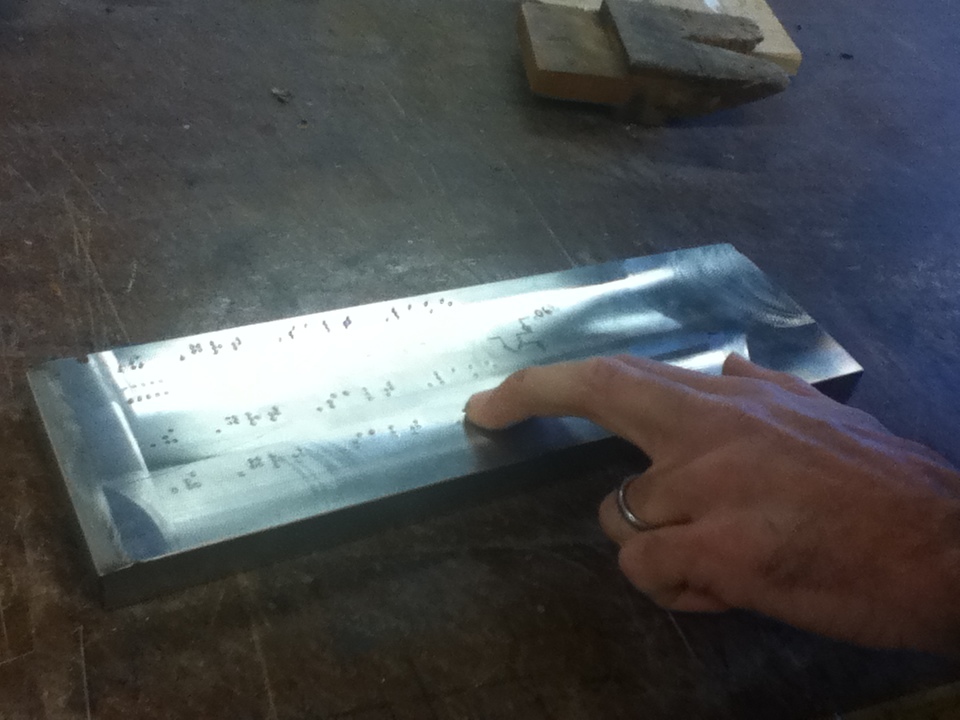
Shawn Porter, 43, with a sample of the Braille text that will be displayed on his artwork.
world around us, much less take inspiration from it.
Shawn Porter, however, is not an everyday person. The facilities supervisor for the arts and sculpture buildings at the University of Utah, Porter sees inspiration in places few would think to look. From that inspiration are born pieces of art that are as reflective of their environments as they are creatively breathtaking.
Porter, who has had work featured in both public places as well as more traditional gallery settings, didn’t begin his career as an artist. In fact, his artistic inspiration stems from more practical creations.
Having grown up in Lehi, Utah, Porter, 43, spent more than 13 years working as a professional woodworker, designing and creating functional pieces of furniture. It was that time spent honing his skills with wood that actually allowed him to branch into art, Porter said.
“The technical end of woodworking or being a craftsman has given me a platform to spring off of as far as making artwork is concerned,” Porter said. “People often say, half-jokingly, if you can build a chair you can build anything.”
Since coming to the U, Porter has expanded his use of materials beyond wood. His time working in the Department of Art and Art History has allowed him to gain a better knowledge of the “artist’s dialogue and process.”
In 2010 Porter began working on a project for the Utah Transit Authority’s (UTA) “art in transit” program. The agency, in collaboration with the Salt Lake City Arts Council, commissions local artists to create pieces for the various TRAX stations and routes that run throughout the Salt Lake Valley.
Porter believes public art, such as his work for “art in transit,” should be reflective of the cultural and historical values of the area in which it’s being placed.
“In a way I think public art is in place to represent the community,” Porter said.
He wants his work to be as much a representation of the public area surrounding it as it is a creative piece of art.
“That’s what public art is really supposed to do. That’s what it’s intended for, in my mind. That is, it isn’t just pretty decoration in a location. It definitely references local environment, culture, history, and it all depends on the history and culture of that area.”
Justin Diggle, an assistant professor of the Department of Art and Art History, at the U, agrees with Porter. Having worked on the committees for both the Salt Lake Art and Design Board in 2003, as well as the University committees, Diggle aided in the selection process for past “art in transit” pieces.
“With any public art I think you have to be sensitive to the area,” Diggle said. “You have to be sensitive to the people who live around there, people who are going to use it.”
Porter’s work will be installed at the 1950 W. North Temple TRAX stop, and will be modeled after the wetlands and waterways that exist between the Salt Lake City Airport and the stop. It’s expected to be installed around September of this year.
Porter said he wants his work to draw attention to the fact that the Great Salt Lake is actually a thriving wetland full of life.
“It [the Great Salt Lake] is not just a wasteland. It’s not just this smelly thing that people think it is,” Porter said. “It really is a thriving ecosystem.”
Porter’s minimalistic design for his “art in transit” project will be made primarily of stainless steel, a bit of a departure from the wood materials he’s used for most of his life. The change has been a good one, he said.
“That’s the challenge I really enjoy. The thinking through an idea and then bringing that to life through the use of different materials and the complexity of those materials.”
Porter’s work will include two large steel plates, elevated two feet above the ground to simulate a river’s surface. It will also include segmented pipes that evoke the idea of river reeds resting among a riverbed of smoothed metal stones. Porter is fabricating three minimalist representations of birds associated with the Utah wetlands that will also be placed throughout the piece.
“I think it’s really critical also to draw visitors into that conversation of—what is this place? What is it like? What might I experience in visiting Salt Lake City?” Porter said.
He wanted to ensure his work reflected more than just the natural surroundings leading up to his stop, but also the areas of public access nearby. For the 1950 W. North Temple stop, that includes the Utah State Library for the Blind and Disabled.
As a way of incorporating the library into his piece, Porter included an artist’s statement about the piece as well as some poetry about the Great Salt Lake and the birds that migrate there. The poetry will be written in Braille, directly on the piece.
A sample of the Braille text that will be featured on Porter's artwork.
Roni Thomas, the public art program manager for the Salt Lake City Arts Council, said that Porter’s inclusion of Braille on the piece was yet another inspiration from the well of his creativity.
“Shawn recognized that there was an opportunity to reach out to an audience that ordinarily couldn’t participate because of their visual impairment,” Thomas said.
Whether it be through addition of Braille, or simply, the inspired reflection of Utah’s beauty, one thing is certain—Porter’s creativity is sure to shine through his new piece.
“A lot of people just look at public art as decoration,” Porter said. “But I think it’s important for people to take something from the work that is there. Whether they recognize that it is a representation of something in their community or not, I think at the base level people can at least take [something] from the aesthetic.”
Food trucks have come a long way in recent years. The mobile restaurateurs of today are shedding the “roach coach” moniker and moving toward haute cuisine.
Since 2010, SuAn Chow has been at the forefront of this movement in Salt Lake City with her blazing yellow Chow Truck, where she serves up her unique brand of fusion cuisine. The Chow Truck’s menu includes tacos, sliders and salads infused with flavors from Asia.
“Everyone understands tacos or sliders or salads,” Chow said. “The twist is the actual base, the marinade, the sauces.”
Panko-crusted tofu, coconut lemongrass chicken and pineapple ginger pork are some of the mainstays of the menu, and Chow offers them in the above-mentioned familiar forms.
Xiaoyuay Lou, a visitor from New York who was in town for the National Association of Corrosion Engineers (NACE) Conference, stopped by the Chow Truck while parked at its weekly spot at the Gallivan Center in downtown Salt Lake.
“The sliders are really good – they’re delicious,” Lou said.
Chow’s flare for blurring the lines between different regional cuisines must have come from her upbringing.
She is a second-generation Chinese-American, born and raised in Salt Lake City. Growing up, her parents owned a restaurant that featured Polynesian themed décor and a menu with both Chinese and American dishes – similar to the campy Trader Vic’s, a legendary California-based franchise popular in ‘50s and ‘60s.
“On his menu, my father had great American comfort food,” Chow said. “He used to make the best breaded veal cutlets and chicken fried steak and roast turkey.”
These are some of the foods she grew up enjoying because her family spent a lot of time at that restaurant, Chow said.
“I always vowed never to get in the business,” she said. “I saw how hard my parents worked and thought there had to be a better way to make a living.”
But in 1985, she started her own restaurant, Charlie Chow’s, in downtown Salt Lake. It was her way of providing a venue for her father to cook traditional Chinese dishes, which is what he made for the family at home.
“I wanted to rescue my father from his restaurant, which was a dying concept,” Chow said.
She noticed the general public was becoming savvier about food and travel and saw a market for authentic Chinese food in Salt Lake.
“We did black bean mussels and clams. I was the first to offer dim sum as appetizers on the regular menu,” Chow said.
Her father died of colon cancer about a year after the opening of Charlie Chow’s, but she held on to the restaurant until 1993.
After she sold the restaurant, Chow moved to New York to explore new career paths. She was the director of creative services at Joseph Abboud and later sold real estate in Manhattan.
Even during her hiatus from the restaurant business, Chow kept an eye on evolving trends in the food world. In the late 2000s, she was reading about the food truck scene in Los Angeles and decided to head west to see what the hype was about.
“I went to L.A. and spent some time on some trucks and I felt it was something that could be great for Salt Lake,” Chow said. “No one else was doing it and I felt that this was something I could do and do well.”
The Chow Truck has been in business for just over two years and already has garnered awards from City Weekly and Salt Lake Magazine for its distinctive offerings. But all the accolades haven’t come easily.
Operating a food truck can be harder than running a brick-and-mortar restaurant, Chow said. With the mobile model, she has to battle the elements and stay on the move to comply with city ordinances that won’t allow mobile food services to stay in one location for more than two hours.
Technical difficulties aside, Chow’s truck has allowed her to connect with her customers and community in a way that’s not possible with a traditional restaurant.
Because of how the food truck is set up, with its large bay windows, Chow and her kitchen staff are able to gauge diners’ responses immediately.
“I always tell my kitchen staff that I’m offering them a kitchen with a view,” Chow said.
There is no full-time chef on board the Chow Truck. Instead, Chow relies on a steady rotation of local chefs to craft special items. Past collaborators include Ryan Lowder of The Copper Onion, who contributed a pork belly taco, and Takashi Gibo of Takashi, who gave the Chow Truck the tako taco – tako is the Japanese word for octopus.
In March, the Chow Truck is featuring a Utah elk slider with himichurri sauce by Ethan Lappe of Cafe Niche.
A first-time customer who was lured in by the intoxicating aromas permeating the Gallivan Center seemed impressed by the Chow Truck.
“I chose the Chow Truck because I could smell it from way over there,” Lindsey Goodman said. “I had the elk slider and it was amazing.”
That kind of reaction keeps Chow motivated.
“Being able to hear people respond to the food is very gratifying,” she said.
Paper, snail mail and telephones are a thing of the past. With the Internet and on-line activity at its peak, criminals have had to evolve with the times. According to the Federal Trade Commission identity theft and fraud cost Americans $1.52 billion last year alone.
And Internet crimes are not just a problem nationally. Salt Lake’s Police Chief, Chris Burbank acknowledges that identity theft is one of the biggest issues as far as crimes go that needs to be solved in Salt Lake.
“Everyone gets upset if someone is shot and killed, but fraud costs more and because no one is dying it doesn’t get the attention of the public. That’s the challenge of the future. It is a failure of a single person if we allow someone to be victimized,” Burbank said in Holly Mullen’s Communications 3660 class, at the University of Utah, February 16th.
These thieves have come up with a plethora of ways to go about stealing money and identities. However, the most common ways of identity fraud involve, surfing the social network, dumpster diving, phis-hing for information, your family and friends and skimming for dollars.
Social networking is a great way to connect with love ones, but it’s also a way that Internet criminals get personal information like age, birthday, and place of employment. A lot of people don’t tear up things like credit card offers and bills from the bank. Crooks will take the information found on those items and use it. Phis-hing is the oldest practice of the five. Phis-hers are the ones who send things to personal emails. These emails will be under the guise of winning something or look like an already familiar website. Both will often direct you to sites that ask for personal information. Often times the scam will look like a refuge in another country asking for help or even a family member asking for help. In fact, family and friends account for half of all fraud cases. Skimming for dollars is where thieves will steal bank and credit information when a debit or credit card used during a gas purchase or ATM withdrawal. It’s called skimming because often times the perpetrator will take small often unnoticeable amounts over a period of time.
Rebecca Jarrett was a victim of both phis-hing and family and friends methods. Jarrett’s grandparents received an email one day indicating that she was in the hospital and needed help to pay some of the medical bills. Her grandparents upon seeing that the email address was in fact hers immediately sent money to the bank account and routing number provided. A few months later Jarrett tried to contact her grandparents and got no response. Jarrett finally found out from another relative what happened. “They said they were upset that they had sent money that they needed back. They were even more upset that they hadn’t heard from me after they’d sent it,” Jarrett said. Jarrett later reconnected with her relatives after they found out that they had been the victims of an Internet crime. However, the damage had been done.
Jared White (this person’s name has been changed at his request) was a victim of social networking. It was during the chaos of the holidays. White and his wife were out of town visiting one of their children. There had been a charge to his primary credit card for an international plane ticket. The airline had called their home phone to verify the charge, but they weren’t home and because the crook had all the necessary information they approved the purchase. White didn’t realize what happened until a few weeks later when he went to check his account and saw that it was way over their limit.
Fortunately after a talk with his credit card company they removed the charges to his account contingent on him completing a fraud report. Unfortunately the villain was never caught. As long as they got their money that neither the credit card company or the airline cared about catching the criminal.
“The whole incident emphasized to me why credit card fraud is at epidemic proportions: the ease by which it is accomplished; the difficulty in catching and prosecuting the perpetrators; and most of all, the apathy of the companies involved. It made it clear to me a lot of fraud is written off with the final cost being borne by the consumer in terms of tighter credit, higher interest rates and fees,” White said.
It’s as Burbank stated. If no one has died the importance of crimes like this go unnoticed and often unpunished, which is why identity theft and fraud is rapidly rising to become the most committed and expensive crimes.
White reflects that he would have done things differently. He would have checked his accounts more frequently so that the individual could have been caught when he tried to fly. White also suggests to, “Check your credit card accounts, even your inactive ones every week or so. Try to limit your online purchases using your major cards, use other sources, like Paypal, which offers good fraud protection. If you have fraudulent charges on one of your cards, report it immediately, first by phone (record the important information about the call), then follow immediately in writing. As I understand the law, consumers have the right to dispute any charge if they report it in writing within 30 days of the charge.”
Many national and local bands are faced with whether signing a label is synonymous with success or if there are other alternatives. Quite a number of local bands have discovered that their goals can be accomplished independently.
Many in the music industry feel that what once was provided by a label can now be provided by themselves. However, even though the divide between signed and unsigned bands essentially no longer exists, many musicians are still undecided.
Do publishers, booking agents, management, sound engineers, producers and labels determine an artist’s success? According to Matt Winegar, a sound engineer, owner and producer of his own local studio in Salt Lake, Secret Sidewalk Recording Studio, labels are slowly on the verge of extinction.
He elaborated by saying that the rules have simply changed and aren’t what they once were. Local and unsigned bands have access to the same resources as larger, signed bands. They can fund and produce the same quality of an album that previously only labels could. They utilize smaller budgets and find new ways to create revenue, which is a concept lost on big labels.
“These days the lure of a label deal is not what it once was. In fact, many artists have figured out how these deals heavily favor the label and at times are detrimental to the natural arc of a bands career,”Winegar states.
Winegar has been in the business for years and has worked with big names like Primus, Coheed and Cambria and local superstar, Royal Bliss who has been on and is currently off of a major label.
Royal Bliss who started in 1998, has experienced firsthand how flawed the label system really is, but also how local bands can have a fairytale ending. They recently independently released, Waiting Out the Storm and cracked iTunes top ten on the rock charts.
After signing with Capitol in 2005, Royal Bliss members spent six months unaware they’d been dropped when the company merged with Virgin in 2008. Disappointed and dissatisfied they chose a smaller label, Merovingian records, in 2010, believing that they would be more personally invested. Unfortunately, they found that in spite of their preferences both the management and the recording company wanted to control the musical direction of the group.
“They wanted us to sound more like Nickelback or Papa Roach. We would write and send the material in and they would say they didn’t like it. They wanted someone else to write for us. All any of the labels did was give us money to cut an album and then put an official stamp on our work,” Richards said.
Royal Bliss divorced its label and management, resulting in lawsuits. In the end, Royal Bliss was able to completely sever ties. The band still owns the rights to all of its music, created its own record label, Air Castle Records, acquired new management, a booking agent and most recently a publisher.
Richards describes Royal Bliss’s experience as disillusioning, “A label should technically work with a band like a well-oiled machine. One band they actually work with will make it big. However, what about the other 20 bands you never hear of that were signed and have nothing to show for it? It’s because of that, that labels either have the ability to take your career and run with it or ruin it.”
The Suicycles and King Niko, are examples of local unsigned bands, that share similar experiences and sentiments. The Suicycles, have only been around for over a year, but have already toured out of state and played some of Utah’s premier shows like, X96’s Big Ass Show, Utah Arts Fest, and Blue Harvest Moon Festival in Ogden. They have also released two EPs, and a full-length album, with another in the works. Producer, sound engineer and owner of Kitefishing Studios, Camden Chamberlain is their lead singer and front-man.
“I’ve always liked tracking all of it myself. I essentially consider myself a label. Plus building the studio was to make sure that I never had to rely on a label to go record. Everything a label can do or provide we provide for ourselves.”
Chamberlain employs what he calls the, “do for yourself” method. “Yes, it’s a new and scary concept and the chances of success are a bit lower, but it’s definitely a lot more rewarding. Why rely on other people in life in general if you can help it?” Chamberlain asks.
Winner of last year’s City Weekly Music Awards King Niko, also has no management, publisher, booking agent, or label. Front-man Ransom Wydner believes that the music industry is changing, but aren’t quite there yet. He indicates that bands like Radiohead and Royal Bliss had time with major labels to build their brands first.
Wydner talks about King Nikos experience with labels, “Warner Brothers is the label we have spent the most time with, but they’re not interested in what labels call ‘Artist Development.’ They want a pre-packaged hit album and a band to go with it.”
All three bands and Winegar agree that record labels are first and foremost a business whose main focus is to make money. Of course, like all investments the money comes with strings attached. Wydner puts it best when he says, “They don’t have anyone’s best interests at heart. They’re a heartless machine of capitalism. That’s not a good or a bad thing it’s just the way it is. The main point I’m trying to make is that even though the major labels are bureaucratic vestiges they still have a role to play in the industry and we still need them as musicians. There are a few exceptions and yes I would love to see something come up and replace them, but that hasn’t happened yet.”
Labels, particularly major labels, are still the biggest bully on the playground, but smaller bands are starting to think for themselves. Perhaps the right formula for success is using a label to build a fan base before going independent.
A trend has been started. With CD sales diminishing worldwide, major labels are losing their appeal and death grip on artists’ creativity and freedoms. Where one has succeeded there will be more, if bands like Royal Bliss continue to pave the way. The ‘do for yourself’ music revolution is just beginning.
Six years ago I moved to Salt Lake City to go to school. Every aspect of my life was focused around being a university student and, although I resided in Salt Lake City, I didn’t really live in Salt Lake City. I found myself caught up in day-to-day student life and ignorant of the world around me. Upon enrolling in this class, I decided I wanted to broaden my horizons and discover the city in which I had been living for years.
As I began to plan and report for my first stories, I quickly realized that the only way to discover a city is to talk to its people–to connect on a personal level with those who make up the community. As I have interacted with the Salt Lake community in reporting for each of my stories, I have realized that Salt Lake City is rich with history, diversity and culture.
For my first story I visited the mental health court in Utah’s Third District Court. I admit I was nervous to go to mental health court for several reasons. I felt very ignorant of and inexperienced with the mentally ill. Furthermore, prior to that experience, I had never been to any kind of court and therefore did not know what to expect. In spite of these fears, I attended and had an eye-opening experience.
At mental health court, I saw the mentally ill as normal, everyday people seeking help to regain control of themselves and their lives. I witnessed a judge who showed concern and compassion for each individual standing if front of her. What impacted me most was a mother who pleaded for her bipolar son. Attending mental health court helped knock down the “me and them” barrier that existed before when I thought of the mentally ill. I was able to better connect and even relate to those attending as we all have our personal struggles. Furthermore, I was able to witness Salt Lake City caring for its mentally ill.
The next couple of stories I wrote were about the Occupy Salt Lake movement and One World Cafe. Reporting for both of these stories allowed me to interact with several of the poorer, homeless citizens of Salt Lake who are trying to make a difference. I was inspired by their selfless vision of taking care of one another (including the homeless) and changing Salt Lake City. I was humbled by their kindness and enjoyed speaking with them and hearing their side of things. I will never forget the people I spoke with and the lessons they taught me while reporting for these stories.
My last story focused on the opening of the City Creek Center. I was intrigued by the City Creek Center and wanted to write a story on it because I felt that the center would change downtown Salt Lake City forever. I enjoyed talking with people about their opinions and views of the center and enjoyed experiencing it for myself.
Reporting for each of my stories has allowed me to see different sides of Salt Lake City. I am grateful to the people who opened up and allowed me to hear their stories.
About Me:
My name is Tricia Oliphant and I am a senior at the University of Utah. I am studying Atmospheric Sciences with aspirations of becoming a broadcast meteorologist. I graduated from George Washington High School in Charleston, W. Va., in 2006. Since high school, I have lived in Utah except for an 18-month period when I lived in Spain as a full-time missionary.
I am fascinated by planes and weather. I interned at NASA Dryden Flight Research Center in Edwards, Calif., during the summers of 2007 and 2008 where my fascination was amplified.
I am currently enrolled in a journalism class at the U in order to help me as a broadcast meteorologist. I have been told by other broadcast meteorologists that it is important to have good reporting skills when working in any position in the broadcast industry. I hope that the stories I write for this journalism class will help the residents of Salt Lake City become more aware of their community.
What if you got paid to do what you love and have grown up doing your whole life? This is the life of Keenyn Walker, who by the age of 20 was drafted twice before signing a contract to play professionally in major league baseball.
“I thought he was crazy not to leave once he was selected out of high school. Not many people are that blessed,” said Jeff Myaer, head baseball coach at Judge Memorial High School in Salt Lake City.
Of all the odds and breaks in life, Walker has been blessed with his share.
Walker who is currently a part of the Chicago White Sox farm league in the Single-A organization is stationed in Kannapolis, N.C. playing for the Intimidators. His journey before making it there may have been a whirlwind to most folks.
As a senior at Judge Memorial, Walker was drafted by the Chicago Cubs, but he turned down that deal and moved on, choosing instead to attend Central Arizona College( CAC) in Coolidge, Ariz., one of the powerhouses for college baseball. After his freshman year at CAC, Walker was drafted again, this time by the Phillies. “It was crazy when I was in high school and got drafted, but then again just a year later is humbling,” Walker said.
Denying the offers from the big league left Walker, a center fielder, wondering if he would get another chance. “After my freshman year of college was over and I turned down another chance to play baseball, my dreams kind of became a blur,” he said. “I didn’t think anyone else would draft me again because I had turned down two teams already.”
Some doubted Walker might get another chance at his dream. “I was drafted when I was in college. I know how hard it is to have that opportunity come your way, but three times is out of this world,” Myaer said.
With many people watching from the outside, few stood strong in his corner, Walker said. Except for one. “My mom has been a huge part in this whole journey,” he said. “When I doubted myself she had the right words to put me back on track to complete what I had set out to do a long time ago.”
“Keenyn is someone who just loves to play baseball,” said his mother, Lori Walker, of Salt Lake City. “In baseball you have ups and downs that come easily and it can transfer over to life as well.”
June 6, 2011 is a day Walker will always remember. “That day I was just at home with my family watching the draft,” he said. “Teams just kept calling me and saying they may take me at this pick,” he said. Nervously walking around waiting for his name to be announced, Walker continuously ate snacks to calm his nerves, as well as talking and joking with the few family members who were present.
“It was a family thing,” Walker said.
After all the hoping and waiting, Walker’s blurry dreams have finally become a reality. Now 21, he was selected as the first overall pick in the 2011 MLB draft for the Chicago White Sox.
“I wake up and I feel like it’s a dream,” Walker said over the phone while training in Phoenix. Being a professional athlete comes with a lot of responsibility, as well as temptations. “I have more money than my mother does now,” said Walker, laughing. But his mother thinks he’s doing just fine.
“I am proud of the decisions he made. Even though they were hard to make, he made the correct ones,” said Lori Walker. “It is crazy seeing my son become something he has wanted to become his whole life.”
“My schedule has been hectic, kind of,” Walker said. He wakes at 8 a.m., goes for a run and then heads to batting practice. He does interviews between ball games. There seems to be an endless number of items to autograph, such as rookie cards, helmets and photos. “Each day I sign about 500 items for people I don’t even know,” Walker said.
“I am so fortunate and blessed to be where I am right now,” Walker said. “This is so crazy. It still hasn’t hit me yet, even though I have already played six minor league games, moved my way up to the single A organization, and now in spring training.”
Although the process to the big leagues is a long bumpy road, things seem to be falling in place for Walker. “I guess the third time is a luck charm,” he said.
Photo credits: Clockwise from top left, Megan Wallo: Keenyn Walker: Central Arizona College, Athletics: Jim Shipman.
Cheyenne Wilson, a freshman small forward on the University of Utah women’s basketball team, gets frustrated with inequity on the court. “If I go to the gym on my own wanting to shoot and there are men’s players wanting to shoot, they basically kick me off or I have to wait until they are done.”
The 2012 U basketball season showed people that the women’s team had a better season than the men’s team. The treatment of the two programs shows that although the women’s team might be better, the men’s team is treated like they are better.
The women’s team went 16-16 and made the Women’s NIT, a postseason invitational tournament. The men’s team went 6-25 and failed to make any of three postseason invitational tournaments that the National Collegiate Athletic Association (NCAA) offers.
The women’s team has had one player transfer in two years. In contrast, 11 players members of the men’s team moved to other programs.
All signs point to the women’s team running a better basketball program, but they don’t get the same treatment as the men’s team in several areas.
Forty years have passed since Title IX went into effect, a federal law that mandated equal treatment between men and women in high school and college athletics, but it looks like there might still be some differences.
Division One sports programs are federally funded meaning they fall under Title IX of the Education Amendments of 1972 which states:
“No person in the United States shall, on the basis of sex, be excluded from participation in, be denied the benefits of, or be subjected to discrimination under any education program or activity receiving federal financial assistance.”
Title IX ensures that both men’s and women’s athletic programs are treated equally and receive the same opportunities. This is the real issue when it comes to the U’s student basketball programs.
Wilson talked about inequalities in getting gym time, but it also goes to the weight room. “Lifting is another issue I have experienced. Lifting at the same time as the men just does not happen, but they seem to be in there quite a bit more than us which makes me think.
Rachel Messer, a junior shooting guard on the women’s basketball team, shares the same frustration. Messer said, “It is just unfortunate because the only difference between the two teams is that one of the teams is made up of men and the other team is made up of women,” Messer said.
Another issue that Wilson brought up was that the two teams were not promoted on an equal level.
Media promotion matters in a game of fan numbers, like NCAA athletics. Some critics say the typical lack of fans in the stands at the women’s games has everything to do with poor advertising.
The men’s games saw around 7,000 people at every home game and the team went 6-9 for season.
By contrast, the women’s games filled 10 to 15 percent of the Huntsman Center for home games. Last season the women’s team went 12-4 at home. The women’s team plays better at home, but the lack of screaming fans in the stands seems to suggest otherwise.
This is where media exposure becomes so important. The more media coverage a team receives, the more people across Utah will get to see what the team has to offer. Could this be the fundamental reason as to why some think the men’s team getting more publicity is wrong?
Nate Cordova, a member of a men’s team that practices against the women, chalks up greater press coverage of the men’s team as the reason for stronger fan support.
“The women get no advertising. I mean the men are garbage but like you go to their games, you always hear about them. Their advertising is way more publicized than the women, but the women are actually kind of good and the men suck so that’s interesting.”
Whether they are television commercials, signs around campus, or most importantly newspaper ads and articles, the men’s team is getting the majority of the media.
Cordova suggested that maybe the difference in male and female physical abilities is the reason for such wide gaps in fan interest and attendance.. “The [women’s] team brings us in to practice against them because we are bigger, faster and stronger than them and it helps prepare them for games. The men’s team does not need to bring anybody in because they are already very athletic and maybe that is why people like to watch them”.
Changing how a group of people are treated has been something this country has battled for hundreds of years. The lingering concerns over athletic inequities under Title IX could be evidence that this battle has yet to be won.
The University of Utah Utes’ 2011-2012 men’s basketball (Voices of Utah) team has completed the most atrocious season in their history. This season marked the Utes first 20-loss season as they tumbled to an uninspiring record of 6-25. They finished 11th overall in their first season as a member of the Pac-12 Conference.
“This season was rough, no way around it, but from where we started we saw improvement throughout the rest of the season.” said junior forward Dijon Farr.
The Utes packaged numerous transfers together to make a team, as eight players left the team last year following Coach Jim Boylen’s exit.
Coach Larry Krystkowiak (Voices of Utah) spun the best team available to him, and though it was a struggle from the start, many team members felt they competed hard in the second half of the season after a distraction in the locker room was resolved.
The team’s best player, senior Josh “Jiggy” Watkins was dismissed from the team January18, due to violation of team rules and constant struggles in the classroom. Watkins was the team’s leading scorer and with assists, with 15.6 points per game and 4.8 assists in only 16 games. The loss of Watkins occurred mid-season, and set the Utes back even more.
A season of few ups but mostly downs hit phenomenal proportions when the Utes suffered a 40- point setback at the University of Colorado on New Year’s Eve. Then the worst loss in the program’s 104 years occurred in the regular season finale, when the Utes lost by 46 points at the University of Oregon.
The Utes’ best victory of the season was at home, against Stanford, which finished in the middle of the pack in the Pac 12. The first conference victory was a January 5 home win against Washington State, 62-60 in overtime. The Utes finished 3-15 in their inaugural season in the Pac 12.
Jason Washburn was the team’s pleasant surprise player of the year as he broke out with 11.4 points per game. The junior center led the team after the dismissal of Watkins, with 6.2 rebounds per game. Washburn was a big fill-in player after starting center David Foster’s injury sidelined him for the season.
Some close to the team say it’s hard to put a team together on the fly and expect to win as the Utes did, especially after so many players left the squad. Krystkowiak has to get a few years of his own recruits to determine the tenor of his success or failure.
The Utes finished their season with a loss in the Pac 12 Tournament to conference champion Colorado, which upset UNLV in the second round of the NCAA Tournament.
The Utes heading into next season will look to schedule more home games at the beginning of the year. This past season the Utes had only six non-conference home games far less than most Pac 12 teams. With a young team, home games scheduled for early in the season can be a great confidence boost. Team managers expect to overhaul the roster as numerous new players come in and some older player will likely transfer out.
“This year was a bad year for our team but coming back next year we hope to get our team situated and turn this thing around,” said junior guard Cedric Martin.
Expect Martin, and Farr to return next year. Kareem Storey, and Chris Hines are among four players who have been granted their release of scholarship to transfer. Center David Foster, nursing his broken foot, is recovering and should be ready for next season team managers mentioned.
Foster was the 2009 Mountain West Conference Defensive Player of the Year as he led to a school record in blocked shots. Coping wit his injury, he said, took its toll. “It was tough to see and watch the guys all year long, but I’m on the road to recovery and look to really help our team become better next season.”
Hines, who at times during the season was the most explosive player on the team, mentioned that the Utes might surprise every team in the conference next season despite the fact that he is transferring.
There might be two new suspected starters in the lineup next year with redshirt transfer guards Aaron Dotson from LSU and Glen Dean from Eastern Washington University. Both started at their previous schools and are expected to be significant upgrades from this year’s starters.
Contrary to what pessimists believe, Utes basketball (Voices of Utah) could be on the upswing. With fall just around the corner, the roster will be set soon and practice will begin. With a healthy Foster and some transfer players coming in, the team could kick into gear. Returning players will bring experience and wisdom and Krystkowiak has every reason to feel upbeat.
“We are looking forward to next season and get everybody together to prove how good this team really can be,” said redshirt transfer guard Aaron Dotson.
University of Utah’s Alyssa Abbott, 22, nears her final season for the Running’ Utes as one of Utah’s finest women’s distance runners.
Abbot began as a sprinter in high school. It was her coach at Galena High School in Reno, Nev., who inspired her to pick up distance running. It helped motivate her in school as she developed a great balance between academics and running.
With no college scholarships offers coming her way and her telephone silent Abbott stayed positive and began dialing numbers.
A phone call to Kyle Kepler, the U’s head women’s track and field/cross country coach, allowed her to become a Runnin’ Ute.
“Alyssa’s greatest attribute from a coach’s point of view is how self-motivated she is. I know that she does all the little things to get better on a daily basis. As a coach you have to have athletes who want success more than you want it for them because they ultimately hold all the cards,” Kepler said.
With Abbott’s motivation, desire to achieve her goals and a solid training schedule; she was well on her way toward a successful college career.
During her freshman year she received daily doses of what college distance running was all about. Abbott led the team as top finisher in both the conference and regional meets in cross-country. Competing in the 800-meter run, Abbott received an invitation to compete at the U.S. Junior Championships at the end of the 2009 outdoor season.
“After my first year I knew then I was a distance runner. I have developed such a strong love and passion for it. I decided to move up the distance I was running and compete in the 1500-meter for the next season,” said Abbott.
Moving to the 1500-meter played in her favor. She was an NCAA regional qualifier in that event and the 800-meter for outdoor track in the 2008 season. Abbott went on to claim a spot in the NCAA national championship for cross-country, with a ninth-place overall finish at the regional championships.
“Going to nationals was a very exciting and fun experience. It was great to compete against the top girls in the nation I had read about. It really motivated me even more after that,” Abbott said.
During the next few seasons she was struck with multiple injuries and surgeries on her knees and feet that set her back.
With her outstanding running career and an award–winning past outdoor track season, she is just as successful academically. Abbott has earned multiple conference student-athlete awards, academic all-conference honors and has been named to ESPN magazine’s Academic All-District Team.
“She has had success as a student athlete on the track as well as in the classroom. I will miss her contagious smile,” Bowman said.
Abbott will receive a degree in exercise sports science in May. She is currently interning at a senior center, and helping patients increase their physical activity. Still waiting to hear back on to where her new life will take her, Abbott’s leadership and success on the field will continue to carry over to new paths.
Again struggling with an injury, this time rehabbing a ligament in her knee, Abbot puts on a Utah uniform in her last season as a Ute. Her success continues to build throughout this spring season.
“She will graduate as one of the University of Utah’s most successful female track and cross country athletes as both a student and an athlete,” Kepler said.


















 voices-of-utah.com