University of Utah music majors plan for mainstream careers

Story and photo by HELEN COX

To ensure employment after college, many University of Utah music majors are investing in additional studies in order to focus on more realistic, contemporary career paths including accounting, medicine and business.

Music major Clark Newell enjoys playing piano and writing music at home, but is planning for a more business-oriented career.

The University of Utah School of Music offers both undergraduate and graduate levels of music study, and its mission statement places much emphasis on education, composition, conducting, performance and theory.

It does not, however, mention career preparedness.

Many students, still passionate about receiving a music education, are thinking of new ways to become financially successful. In modern times and in a down economy, traditional art and music degrees are not typically suited for most careers.

Freshman Richard Contreras, a pianist since age 7, has decided to boost his chances by applying for a double major in piano performance and accounting. While his status at the university allows him to teach piano lessons around Salt Lake City, he only sees this as a way to make some extra cash while in school.

Contreras agrees there is not much of a future in the current job market for anyone who is only majoring in music – there simply aren’t enough jobs out there. He hopes to find a career as an accountant after graduation, and continue playing music on the side.

Ryan Ingle, a junior in the school of music, has a similar story. He is double majoring in music and chemistry. Although he has been singing his entire life and is working toward his Bachelor of Arts in music, Ingle has different career plans – he is going to attend medical school.

“I study music entirely for personal fulfillment,” he said.

Utah’s school of music is well known for its choral, classical and jazz training and has been an accredited member of the National Association of Schools of Music since 1952. But some students suggest the school is not what it could be because the curriculum does not seem to have changed much since 1952, either.

“The program is old-fashioned and inefficient,” said senior Clark Newell, who will receive his Bachelor of Arts in music next year. “I think the degree should still exist and be preserved in its tradition, but they really need to modernize the program and start having some classes that help students to be marketable.”

Newell came to the U with a passion for pop music. A pianist and composer, he joined his first band in junior high school and is concerned that the school of music is ignoring the needs of students who want to write pop or rock and want a more practical major.

“As much as I love music, if I were to do it again I would have chosen a different degree,” Newell said.

Newell decided to add a business minor to his major to gain some business and marketing skills, which he feels are not taught in the music program. With plans to get his Master of Business Administration, Newell hopes to go into arts administration or work in the record industry ­– but realizes that, too, is in danger due to technological advances and a down economy.

Things seem to be up in the air for the school of music, as well. When the acclaimed director of choral studies, Dr. Brady Allred, resigned unexpectedly during fall semester 2010 for “personal and family circumstances,” the school of music started a national search to replace him.

Some students are concerned the U School of Music’s credibility has gone down since he left, canceling the fall concert and leaving many choir students without a permanent professor. Allred has been temporarily replaced by Barlow Bradford, co-founder of the Utah Chamber Artists. The school is still suffering from Allred’s resignation.

“I know a lot of students left when he did,” said Megan McFarland, an a cappella student.

It is certain the music program is exceptional, and is bringing many new faces to the university who may not have enrolled otherwise. The school of music will unquestionably continue to move forward, but with some obvious changes in store for them and their students.

“Music got me into school, but business is gonna get me out,” Newell said.

The University of Utah’s hidden gem: community-based art education

Story and photo by MICHAEL OMAN

Amidst a struggling economy and proposed budget cuts, two things remain clear: education remains an attractive job market and the University of Utah holds a vital key for students seeking to become art educators.

It’s a key few realize exist. Not only is it beneficial to students but also to communities in general.

A group of University of Utah students discuss how to get the word out about their art in the community class.

The magic number: 7.6 percent. Utah’s unemployment rate hovered around this figure for the past several months, according to an online report Utah’s Department of Workforce Service (DWS) published January 2011. The national rate remains at 9 percent.

Mark Knold, DWS’ senior economist, said the reason Utah’s unemployment rate is below the national average is because of its younger demographics. Younger people are more likely able to afford going back to school, “hang out in Mom’s basement, whatever it takes to ride this thing out,” he said in an online podcast.

Those returning to school or those already there should consider this: Despite proposed budget cuts to higher education and public education, one area that maintains strong employment is education — particularly higher education.

According to DWS’ online report, higher education employment projections from 2008 to 2018 should see substantial growth, even though the number of annual job openings might be slim.

In addition, the need for art educators remains a constant.

In an email exchange, Dr. Beth Krensky, associate professor of art at the University of Utah, explained the reason behind that need. “Art education is federally-mandated to be taught in public schools, which may explain the need for faculty members in higher ed,” she said.

That high demand is one reason future educators should start thinking about how to stand out to potential employers now.

College students studying art education, for example, should strongly consider adding service-learning courses to their curriculum. Fine arts advisor at the University of Utah, Liz Abbott explained “some students will do the minimum requirement and they will sometimes wonder why they can’t get a job after school.”

She said students looking to attract future employers must take full advantage of their academic career and find ways of using what they learn outside the classroom.

“I worked in career services and there were lots of students who would show up and say ‘Ok, I’ve graduated, now what do I do to start my job search?’” Abbott said. “They were not going to be as successful in a job search as someone who had already gotten some experience through an internship or something like that.”

Several courses at the university’s College of Fine Arts offer students that ability.

For several years now Krensky has reached out to underserved communities through her class, “Art in the Community.” It does so by harnessing the community-based art education model (CBAE) to provide youth with a stimulating art education.

Trevor Wright participated last year in the service-learning class Krensky offers. It’s “a great way to get started into the art education program, I think,” he said.

“She’s taking two needs and meeting them with one class,” Wright said. “She is actually taking students that are studying art here at the U and trying to put them into the community.”

He noted that communities the class serves are generally underfunded or may even lack interest in the arts.

“It’s their [the youth’s] first time experience with some of the arts,” Wright continued, “but there’s some art forms such as photography — maybe they’ve taken pictures before — but maybe not in the way that was presented to them.”

Another former student of Krensky, Heidi Justice, is now a 2012 master candidate of public service at the Clinton School of Public Service in Arkansas. She speaks fondly of her experience in the class.

During her time in the class Justice noticed the impact CBAE has on kids. It provides opportunities where kids can unleash their natural talents. “One day we had students that spent most of [the] time working on digging up the garden,” she said.

But the kids aren’t the only ones who benefit from the CBAE model the class employs.  “I really enjoyed it!” Justice exclaimed.

She said it provides a valuable set of skills that not only helps in the classroom but also makes finding employment a greater possibility. “[With a big project] there’s a really big necessity to take the time to plan,” she said. It’s something she feels is heavily stressed when designing art lessons for the youth, which is a core essential of the “Art in the Community” class. Taking that experience to future employers is “very important,” Justice explained.

“I think it’s important and it makes you more marketable,” Abbott confirmed.

Krensky previously said she constantly receives such praise from former students. “I’ve certainly heard from my students as they finish up their time at the University of Utah about the impact the class has had on them — in a positive way,” she said.

Wright is among that group of former students who praise the class.

“It’s helped me to develop a personal statement [and] it’s helped me understand why I want to educate,” he said.

Wright believes many at the University of Utah don’t realize the class exists. He notes that students are required to take art courses but many don’t consider “[the] ‘Art in the Community’ class as a class they could take.” Students who do take the course, however, shine like beacons in the sea of future employees.

Community-based art education used as tool by artists to build communities, change lives

Story and photo by MICHAEL OMAN

On a bad day she challenges you to a shouting match. Sometimes she resorts to hitting but not always. Generally she sits in silence, hunched over in her chair, ignoring the world around her. If you’re lucky enough to get a response it comes in the form of inaudible murmurings or a quick nod.

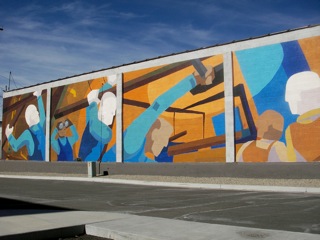
A mural by V. Kim Martinez's University of Utah students on the HB Boys building located at 2280 S. Main St. in Salt Lake City.

This is the scene Dr. Beth Krensky, associate professor of art at the University of Utah, sets in chapter four of the book she co-authored with colleague Seana Steffen. Engaging Classrooms and Communities through Art is a guide on reaching out to people through community-based art education (CBAE) programs.

The girl’s name is Amber. She was 12 years old then. The project: to build a tile entrance for Multimedia Park in Colorado. Some might describe her as a recluse but CBAE changed Amber’s life for the better.

“I have found it remarkable how profound the impact of participating in CBAE has been for so many of the youth and adults I have worked with over the years,” Krensky said. “In my experience, there have always been one or multiple ‘Amber[s].’”

It’s one reason Krensky stands behind CBAE, even in the face of a possible budget cut.

Continued support and patience from a contributing artist, identified as Rae in the book, changed Amber’s attitude. Art became a tool Amber used to express herself. As time progressed she began speaking to others without screaming. She became a leader by encouraging other youth to come and participate in the project. The once shy, tempered Amber even spoke to the media and gave a presentation once the project was completed.

Typically, CBAE works by non-profit organizations encouraging a community to work with a professional artist to produce a work of art.

“[The] facilitator of the project is making sure that people are building community, they’re coming to understand themselves and others,” Krensky said. “Artistic skills are being learned.”

The skills CBAE participants gain benefit those seeking productive careers later in life.

Independent studies confirm the importance of art education. A study published by the Teachers College Press, Studio Thinking, says art education creates “Eight Studio Habits of Mind.” Students learn to “envision, express, observe, reflect, and stretch and explore.” According to the study, the arts often lead to better SAT scores, too.

What makes CBAE unique, Krensky says, is that these projects change the landscape of communities and cross “ethnic barriers, racial barriers, socio-economic barriers, age barriers.” It brings communities together. “It is a place where a message from the community is put forth,” she said.

V. Kim Martinez, associate professor of painting and drawing at the University of Utah, echoes this sentiment.

Martinez teaches a class on murals. Towards the end of each semester the class ventures out into the community to paint a mural they designed in class — sometimes two. She says residents tend to develop a sense of pride for each piece. “They’re more willing to keep the area looking nice,” and, she says, even “businesses tend to remove unsightly drainage pipes.”

The presence of these murals can decrease the presence of graffiti, too. Martinez often hears communities warn, “If you tag this I’ll call the police.”

Her class is only one example of service-oriented classes offered by the university. For the last seven years, Krensky’s class, “Art in the Community,” worked with youth in the Salt Lake area using the CBAE model. Her class currently works with youth through South Salt Lake’s Pioneer Craft House.

Both classes face a major hurdle. The state needs to cut 7 percent from its budget for this upcoming fiscal year. Earlier this month legislation passed that proposes cuts to public education and higher education. Legislators stress the cuts could be temporary. Yet, if put into effect, some funding generally allocated to the University of Utah may vanish.

“We do not have the same funding opportunities that many other colleges have on campus,” Martinez said.

An online Deseret News article published January 31 explains, “The reason for the cuts is what’s being called a structural imbalance totaling some $313 million.” It’s a side effect of no longer receiving federal stimulus money or other sources of revenue the state received during the economic downturn, according to the article.

During the February 2 legislative session Representative Michael Morley R-Spanish Fork, chair member of the Higher Education Appropriations Subcommittee, supported the education cuts. “We think that it is responsible and will help us in solving our structural imbalance,” he said.

The proposed cuts could prove disastrous for some universities, which worries Martinez. “The mural class will not continue if I cannot find funding,” she says. “I often spend well over $700 on supplies a semester.”

Krensky remains hopeful for her class. “I don’t think the cuts will affect the class,” she says. By the earnest look on her face, it’s clear how seriously she takes her commitment to the youth of South Salt Lake. “We’d find a way to make it work regardless.”

Utah musicians sacrifice equipment for survival

Story and photo by HELEN COX

The current recession has several local musicians struggling to sing the blues about the hardships of everyday life – specifically the economic ones.

After saving for almost a year, Alex Jorgenson is able to play music with his own equipment again.

Music, often used as an emotional outlet during hard times, has taken a backseat to financial priorities for many locals in Salt Lake City. They are disgruntled about selling their musical equipment in order to pay the bills and put food on the table. But they are doing what they must to make ends meet.

“I traded my harmonica for a sandwich last week,” local musician Kelsey Perkins said.

It is a matter of survival, but most musicians agree the sales are worth it to keep food in the cupboards and collection agents off their backs. Regardless of the circumstances, it is very difficult to find a local musician in Salt Lake City who can get by without a day job and is not feeling the effects of the down economy.

Liam Hesselbein, of rock and roll bands Calico and The 321s, sold his Rhodes electric piano in April 2010 to make a necessary mortgage payment while he was unemployed.

“I was hoping to hold on to that piano forever, and I could really use it in at least one of my bands at the moment – but ultimately my mortgage came first,” Hesselbein said. “I was lucky to at least be able to sell it for what it was worth.”

Others have not been so lucky. It only takes a quick look into a pawn shop or on eBay or Craigslist to discover there are musicians who are trying to sell their musical equipment for only a fraction of what it is worth.

Matt Dinsdale, upright bassist of the Ugly Valley Boys, sold a guitar, a bass and an amplifier in order to get through the past holiday season. He explains they were all things he did not want to part with, but let them go because he didn’t use them often.

“I figured it was better to keep the bills paid than to have the security of backup equipment, even after having my upright bass take a fall and literally break its neck,” said Dinsdale, who has also played with rockabilly and country groups such as the Sleazetones and Kate LeDeuce.

Heavy metal musician Alex Jorgenson, best known for his guitar and vocal work with the Obliterate Plague and Terra Noir, is another Utahn who has learned about financial priorities the hard way. After being laid off in May 2010, he began working temporary jobs. The difference in income made supporting his family more difficult and he had to pawn his guitar speakers.

“I’ve had to sell a lot of gear,” Jorgenson said. “For the last two years I’ve been a father, and putting food on the table and a roof over our heads is a priority. It’s not just about me anymore.”

Thanks to the aid of his friends and peers, he has been able to borrow equipment – allowing him to continue playing music through difficult times. Jorgenson has been saving money for new speakers since he sold his previous ones nine months ago. Two weeks ago he was able to buy new ones.

Jorgenson remains hopeful for local musicians and the nightlife in Salt Lake City. Despite financial hardships, he has found that many musicians are willing to share and unite for the greater cause of the music.

Eric Elde, guitarist of Iconoclast Contra and Gravecode Nebula, disagrees with musicians who are selling their equipment regardless of financial difficulty.

“How can you call yourself a musician, songwriter or a performer if the means to do so and the tools of the trade are not of the utmost importance to you?” Elde asked.

Elde, who has played in several prominent black metal bands, cringes at the thought of selling his gear. He has gone to great lengths to personalize his own equipment and keep it through rough times, including unemployment.

“If you want to borrow people’s gear and not put any hard work into being a musician or songwriter or whatever, bar none, your music is going to suffer and most likely suck as a result,” he said.

While most musicians agree it is important to try to hold on to necessary equipment at all costs, it may be a while before Utah locals will be capable of doing so without having to sacrifice more important things.

“Utah’s minimum wage isn’t great,” Jorgenson said. “It gets really hard sometimes and you have to do whatever you can to get by.”

Taiko, the heartbeat of Japan

Story and multimedia by Tauna Lynne Price

Watch Kenshin Taiko perform at Utah Valley University


The thunderous beat of a taiko drum echoes through the air. The pounding fills up the empty space in your lungs and consumes your body.

Taiko means “fat drum” in Japanese, according to a Web site dedicated to taiko resources. Tracking the Japanese taiko has proven extremely difficult. “The oldest physical evidence of taiko in Japan is a haniwa clay figure of a drummer that dates from the sixth or seventh century,” notes the Web site.

Taiko is a percussion instrument that performers strike with a pair of bachi. Drums have heads on both sides of the body. The heads, usually made from circles of rawhide, are soaked and stretched at least twice to ensure that the heads are properly shaped and that the tension is uniform on all “sides” of the drum.

Shinto, an ancient Japanese religion, had this mindset when making the taiko. “Because we are taking the life of a cow, we have to reconcile with that spirit and understand we also will be communing with that spirit and then with the tree itself,” said Matthew Stevens, a member of the Salt Lake City group Kenshin Taiko. “We are bringing in nature to make music with us, it is to be celebrated.”

After the tree is cut, a 10-year process begins for one drum to be made. The tree is hollowed out, allowing for the manufacturer to make several drums from one tree trunk. Stevens said the wood must be dried carefully and gradually.

Taiko is used in religious, ceremonial and festival performances. These lines have all assisted taiko in continuing to branch out. Taiko has made its way to America, forming its own legitimate branch on the tree, Stevens said.

It’s not just the beating of a drum; there is a therapeutic connection to the taiko. “And then you spend a moment … with taiko and when you go back, you might find that those problems don’t seem so weighty anymore,” said Stevens, who accesses culture through taiko, helping with the two-way conversation of American taiko and Japanese taiko.

Besides positive therapy results, the taiko also has a very religious connection. Taiko has a spiritual element, which gives many players the feeling of being closer to God. The Japanese Christians share their faith many ways, especially through taiko, said Gordy King, a member of Kenshin Taiko.

Taiko initially was used to define the limits of a village. A villager would beat a drum and runners would go out to the edge of the sound, and that was the limits of the village. People who heard the sound of the drum were part of the village. “We kind of incorporate that in our church,” King said. “We play at the Japanese Church of Christ. When the sound resonates and outsiders hear us play, we are inviting them into our family. If you’ve heard the sound of our drum, then you are part of our family now and you’re welcome to come,” King said. “Our small eclectic group has all different kinds of faiths and races.”

He added: “It’s not just about doing things on stage, it’s about being a community that enjoys making something beautiful together and that’s something really amazing, to create something wonderful for people.”

Taiko introduces musicianship. “Being involved in taiko, [it] very quickly and wonderfully sucked me into a very deep and compelling thread and vein of people,” Matthew Stevens said. “This is a visceral enjoyable fun thing. It’s great to see people look at it from the outside, look at it as shades of impossible, then you find yourself sucked into performing.”

Kim Correa, an active member of Kenshin Taiko, said, “I first saw Taiko performed at a Japanese Village in California when I was a child.”

During the summer of 2009, Correa took her kids to a Kenshin Taiko performance at Red Butte Garden’s Family Night. She found the taiko presentation amazing. Her children, ages 7 and 9, along with other children from the audience swarmed the stage. The performers allowed the children to play the drums. The kids loved it, Correa recalled.

Correa struck up a conversation with Ron Boisvert, a member of Kenshin Taiko. He encouraged her to take advantage of the free lessons the group offers on Mondays and Fridays. The following Monday, she and her children went to the Japanese Church of Christ, Correa said.

“I wasn’t the only person to bring kids along, and although my kids didn’t take an interest in drumming, they made new friends and enjoy playing in the courtyard and sometimes helping out in the kitchen,” Correa said.

She had previous experience on a western drum kit, but she found taiko completely different.

“I fell in love with drumming right away,” Correa said. “I learned songs and rehearsed for a couple of months, then the group, especially Laura Olson, encouraged me to do my first performance.”

Correa made the International Gardens Peace Festival in the summer of 2009 her first stage appearance. Despite her nerves, she completed two songs and had a profound experience.

Correa said taiko became an amazing way to connect with people, feed her artistic side and acquire friendships among a diverse group of people. With any group, there is conflict. However, the Kenshin performers work through their issues, and that has helped Correa strive as an individual.

“We build lasting relationships because not only do we rehearse twice a week and perform often, but we also do group activities like going out to eat, celebrating birthdays, going to plays and local festivals and more,” Correa said.

The appeal, the broad spectrum, use and the charm of Taiko, is wonderful for many different reasons, Matthew Stevens said.

“First, you have a form of music and it comes with all the things that music comes with. Expression, composition, it’s a form of tradition, so you can tap into that long tradition and continue to grow that tradition forward,” Stevens said.

Culture and communication also are important, he said.

“Last is the friendship, a social aspect, you come together as a team, you have social interaction with a very strong tie and almost a very, obviously, physical level and mental level, it reverberates very deeply. You can feel it,” Stevens said.

Master Lu’s Health Center: Northern-style Kung Fu and Old Yang-style Tai Chi

Story and multimedia by LAUREN CARTER

Take a brief tour of Master Lu’s Health Center in Salt Lake City

Master Lu’s Health Center teaches Northern-style Kung Fu and Old Yang-style Tai Chi to students of all ages in Salt Lake City.

“Every student is taught the same way,” said Matthew Stratton, who teaches Northern-style Kung Fu at the center at 3220 S. State St. “There is no belt system so the school has sustained over time by having a type of little brother-big brother and little sister-big sister environment.”

Kung Fu is the practice of external martial arts that involves free hand movements and movements with different types of weapons. Kung Fu is made up of sequences of fast movements called forms. It can take up to two minutes to complete one form. This is because one form can have around 16 movements within it, said Tyehao Lu, who teaches Kung Fu, Tai Chi, Bagua, and Xingyi. He also practices traditional Chinese medicine involving acupuncture and Chinese herbs at Master Lu’s Health Center.

Master Lu’s curriculum involves learning 30 forms before being able to test to become a master. This curriculum takes about seven years to complete. After achieving master status, students learn a new set of forms.

“I don’t believe in teaching fast,” Stratton said. “If I teach them slowly they will learn correctly.”

Some of Master Lu’s curriculum involves learning choreographed two-man fights. These fights take several nights to learn and are checked stance by stance to make sure the students are doing the moves correctly before being taught the next move, Stratton said. These forms are important because they use both offensive and defensive stances, involving a mix of blocks, ducks, kicks, punches and more. The lessons taught in these forms are used as building blocks for more advanced forms. This pace allows students to “throw a little bit of art and style into it but you have to develop it yourself,” Stratton said.

Tai Chi also uses the term form, but it has 108 movements that take about a half hour to complete because they are done more slowly, Lu said. Tai Chi is considered an internal practice of martial arts.

“Kung Fu helps develop muscles first and the outside body, whereas the internal martial arts builds up the spirit first,” Lu said. “Children and adults do more of the Kung Fu because it’s faster and more martial, while more seniors do Tai Chi because it’s low impact and more meditation.”

Bagua and Xingyi are two other forms of internal martial arts. Bagua involves circular movements and is based on the feng shui mirror that has eight trigrams. According to one source, the trigrams are “an ancient Chinese arrangement of eight binary symbols comprised of solid or straight (yang) lines and broken (yin) lines that represents the unity of Heaven and Earth and the blessings that acrue from allignment with natural virtue.”

Traditional Bagua involves walking around the mirror for eight full circles and then doing one hand movement. Practitioners then walk in the other direction eight times and do the hand movement. In all, the routine is repeated eight times.

“That’s some serious walking,” Stratton said. “Here we do eight steps then one hand movement and then go the other way around for eight steps and do the hand movement on the other side.”

Stratton continued, “Xingyi revolves around the elements fire, wood, earth, metal and water.” Xingyi involves straight-line movements and is a very aggressive yet powerful form of martial arts.

While Bagua and Xingyi have only specific directions of movements, Tai Chi does not. Tai Chi has movements that go in every direction, Lu said. The practices of Bagua, Xingyi and Tai Chi are unique because they can all unlock each other’s secrets so students should really study all three, Stratton said.

“For students that are really dedicated you should probably learn Tai Chi first, then Bagua and Xingyi last,” Stratton said. “It’s more than just doing the different forms, it’s studying the movements involved in each form.”

Master Lu’s Health Center encourages students to practice Kung Fu and Tai Chi together to keep balance of their internal and external energies, which is represented by the yin and yang symbol. “The balance has to be there to keep the mind and body sound, they complement each other,” Lu said.

The practice of martial arts has been shown to improve strength, flexibility, general health and memory skills, Lu said. It also works to reduce stress and can calm the mind while improving a person’s sense of discipline.

“If you practice for a while and then stop practicing, those things you learned are still within you so you can take the morals and principles and use them for your whole life,” Lu said.

Stratton believes people who try to learn martial arts with the intention of hurting other people with it will not last very long. He admits people can achieve a certain level but does not believe they can reach the maximum level. But if students just practice for themselves or for self-defense, Stratton believes they can make it to a higher level with the use of patience.

Master Lu teaches several principles to his students that they use in everyday life. Some of these principles are generosity, diligence, righteousness, kindness and loyalty. Instructors also strive to teach students that patience is very important to achieving internal happiness, which is the ultimate goal.

“Martial arts is a way of living,” Stratton said. “If you give back and live right you will get back and be happy.”

The majority of lessons taught are positive, but Stratton is also realistic when it comes to the real world and self defense. “I have to teach that society is not nice anymore,” Stratton said. “When I was a kid I could go play outside all day and my parents wouldn’t have to check on me. Now you can’t leave your kids playing outside without checking on them constantly.”

A key point Stratton stresses in self-defense is situational awareness. Students are taught to be aware of people and places around them and follow the movements of an attacker. So, if an attacker starts to move in a circle, then the student would move in a circle as well, Stratton said.

He also suggests that people don’t scream the word “help” because it won’t attract attention. Instead, they should scream “fire,” because everyone will stop to look for the fire. His advice to his students is to stay calm and be patient in any situation and the things they have learned will come to mind and help them out of the predicament.

Stratton has never had to use his martial arts against anyone. “I don’t look forward to the day I have to use it,” he said. “It would be a very bad day.”

Stratton said Master Lu has inspired him to remain a practitioner of Kung Fu and Tai Chi. However, Stratton dreams about opening his own martial arts center one day. “My goal is to teach teenagers how to communicate with adults and provide leadership for a community,” Stratton said.

Master Lu’s Health Center does more than offer Kung Fu and Tai Chi classes. It also treats patients using Chinese medicine. This medicine includes the use of acupuncture, Chinese herbal medicines and Chinese medical massages, known as Tui Na.

In addition, instructors at the center teach and perform the lion dance, which is a more traditional dance for Chinese New Year. In the lion dance performers do jumps, stacks, double stacks and rolls.

Pending Chinatown in South Salt Lake anticipates fall 2011 grand opening

Story and multimedia by CHLOE NGUYEN

Read the proposal plan for South Salt Lake City’s new Chinatown

Chinatowns have become a major part of the American culture. According to the U.S. Census Bureau, 4.6 percent of the American population was of Asian descent in 2009. Utah’s Asian population was 2.1 percent of the state’s total population of 2.7 million. Since 1952, when Utah’s first and only Chinatown was torn down, there have not been plans for a replacement. But this changes in fall 2011. South Salt Lake City will be the home of Utah’s new Chinatown.

Salt Lake City Chinatown (SLCC) will be replacing the Rocky Point Haunted House, located at 3390 S. State St. For now, a billboard on State Street that announces the project is “coming soon” is the only thing that informs the public of the Chinatown.

The $15-million investment, initially proposed by Chinatown Investments Inc. in 2005, is headed by Hong Kong developers Yue So and Wai Chan. They had hoped to complete construction in December 2007, with a grand opening scheduled for March 2008. Plans called for transforming the area into a tourist attraction, with ceramic tile roofing, paper lamps, granite flooring and Asian-style fountains. But in late 2007, the country’s financial crisis stopped the production process. Banks were unwilling to lend money to business owners and potential clients of the project, according to Andrew So, 26, the project’s manager and son of Yue So and Wai Chan.

So is a graduate of New York University. After completing his degree in economics, So moved back to Utah, where his parents resided while plans for SLCC were in progress; the family is originally from Hong Kong. So says his parents have had their eye on a Salt Lake City Chinatown for about 10 years. He says his role as the project’s manager is his first partnership with the family business. And although So’s Chinese accent can sometimes cause minor barriers when conversing with people in English, he says language isn’t a problem most of the time because the majority of his clients speak in Chinese.

It has been two years since So actively promoted SLCC, but now the project is finally under way once again. “We paid attention to the market and believe now’s the time,” So said. “People are still very interested.”

To a majority of Utahns, SLCC will be their first introduction to a Chinatown in the state. More than 80 Chinatowns are spread across the country, and many are anticipating the day when Utah will be added to the list of states that have a Chinatown. But, actually, Utah was on that list a century ago.

During the 1900s, Plum Alley was the location of Utah’s first Chinatown. It ran north and south, dividing Main and State streets and crossing at 100 and 200 South. Nearly 2,000 Chinese immigrants resided there in 1907, according to KUED. Plum Alley served as the center for Chinese culture in Salt Lake. Chinese people developed a community with grocery and merchandise stores, laundries and restaurants.

The Joss House, an informal place of worship, and the Bing Kong Tong, which helped members of the Asian community find jobs and legal services, were also a major part of Plum Alley. It was a richly textured community.

But with the racial segregation happening during the time, white residents of the state tended to view Plum Alley as a center for widespread vice and illegality, with presence of gambling and opium dens, according to KUED.

In 1952, Plum Alley was torn down and the Regent Street Parking Terrace was erected in its place. Visitors who walk by the location will notice a brown plaque that stands by the street sign labeled as Plum Alley. The location marks Salt Lake City’s Tour Stop #11; the plaque was installed there in 2002 by the Utah Heritage Foundation for the Utah Travel Council. The plaque is the only public reminder of what used to be Utah’s first Chinatown more than a hundred years ago.

Now, over a century later, Utah will once again have another Chinatown.

Unlike the Chinatown in some other well-known locations, such as New York or San Francisco, where the community occupies an entire neighborhood and features street-front stores, SLCC will be similar to an Asian-style plaza, or mall. However, a similar feature will be the gate to the Chinatown and a temple for worshiping the Asian gods, such as Tsai Shen Yeh, the god of wealth, and Guan Yin, the Asian version of the Virgin Mary. Chinatown Investment Inc. has previously opened two successful Chinatowns in Orlando and Philadelphia that carried out the same structural plan.

The project will be a 5.7-acre parcel that will include the structure of the Rocky Point Haunted House and some accompanying undeveloped land. The 63,000-square-foot haunted house will be converted into 48,000 square feet of retail space. The space behind the building will be transformed into an 8,000-square-foot formal Chinese restaurant. The project also aims to have representations of a variety of Asian cuisines. “No two restaurants will have food from the same geographic area,” said So, SLCC’s project manager.

So hopes to include vendors from all parts of Asia, including those from Japan, China, Vietnam, Korea and the Philippines. He says the retail space will include beauty salons, Chinese herbal shops, acupuncture, karaoke rooms, boutiques and massage parlors. The northeastern corner will be used as office space for Asian merchants, such as dentists and attorneys, and retail space for gift shops and smaller convenience restaurants. The project will contain about 30 separate spaces.

So and his family plan to open a 30,000-square-foot Asian market, the largest in the state. It will offer Asian goods, as well as prepared Asian dishes, traditional barbeque and bakery items. Fresh seafood will be available.

SLCC will be a gathering place for Utah’s Asian community. Its parking lot will be used for cultural festivals, such as Chinese New Year, spring and moon festivals. Common areas in the development will be open to community groups. Wi-Fi and public computers will also be available for those who want a place to sit and relax with friends, similar to a coffee shop, So says.

The Chinatown will be a part of the city’s commercial revolution. The project is in a perfect location, according to a 2007 press release by the South Salt Lake Council and Planning Commission. It will be built between State and Main Streets, across from fast food and coffee franchises. The project will be a three-minute drive from Interstate 15, and a short walk from the UTA Trax station, located on Main Street.

SLCC will be the first Chinatown permitted by the Utah legislature, according to Chinatown Investment Inc.’s proposal plans. The project will be completed without public funding and will add to the city’s tax base, which will bring in new high-end customers, according to a report by the city’s Council and Planning Commission. The development team hopes to attract people who are also visiting Yellowstone National Park and other southern Utah parks, So says. It will aim to become a tourist destination for Utah.

“I see it as a community gathering place where the local community can come together,” said former South Salt Lake City Mayor Bob Gray in 2005. His comment was included in Chinatown Investment Inc.’s proposal. “It will be the only development of this type in the western states,” he added.

The project’s production will start up again in February or March 2011, after being placed on hold since 2007. SLCC is expected to hold its grand opening in the fall of 2011.

But So says he has not started marketing the development yet. “We don’t want to lose the confidence from other people in the project,” he said. “Last time we didn’t make it happen as we promised. This time, we want to make sure everything’s ready to go before we actually start the promotional marketing.”

Even though official promotion for SLCC hasn’t started, people are already showing interest in the project.

Tong Zhou, 19, a study-abroad student from China at the University of Utah, is looking forward to having a place to communicate with other Asians. “I am really excited,” he said. “I like to see Chinese be a group and help each other. Chinatown will not only be doing business, but also spread[ing] Chinese culture.”

So says the goal of the project is to create an Asian cultural hub. “There are Asian people scattered everywhere in the state, in different counties,” he said. “We tried to create a center, a place that they can gather and celebrate some Chinese festivals.”

But the Asian community is not the only targeted patron of the project. The development team hopes to draw in non-Asians as well. “It’s a place for non-Asian communities to know more about Asian communities,” So said.

So acknowledges that the majority of Utahns are not of Asian descent, but believes the Chinatown will invite these non-Asians to explore and learn more about the culture of Asian people. A few restaurants and shops are already in the area, but So hopes SLCC will become the place everyone will think of when it comes to Asian culture, markets and cuisines.

Brandon Harker, 21, a U student studying international relations, says the project will be a great way for Asian and non-Asian groups to come together. “I think it will be fun to have something new around that will serve a growing community within Utah,” he said. “It’s always fun to be able to experience a less filtered view of a different culture and experience the cuisine.”

The project is definitely going to happen, So said. He anticipates a majority of the construction will be finished by the grand opening date, so at least some shops and attractions will be open to the public while the remaining construction, if any, continues.

“It’s going to be something really unique for the valley. We’ve never had a project like this before,” said Mike Florence, South Salt Lake City Planner, in a phone interview. “We hope it will be a place that everyone will like.”


This slideshow requires JavaScript.

Utah dance groups teach younger generations about their Filipino heritage

Story and multimedia by DANA IGO

Get a glimpse of Likha’s traditional dance costumes

Manny Evangelista grew up in the Bicol region of the Philippines on the tiny palm tree covered island of Burias.  In 1979, he moved to California to attend Stanford University on a scholarship. An avid skier, Evangelista took a trip to Utah where he broke his back in a skiing accident. During recovery he took a liking to Salt Lake City and made the valley his home.

Though he has spent the majority of his life in America he still remains close to his Filipino heritage through an appreciation of traditional dance and the Filipino language.

Unlike Evangelista, his children lacked knowledge about their heritage. They had trouble straddling the line between American and Filipino culture. “They had fully integrated but there was something missing,” Evangelista said.

In 1996 Evangelista started Likha, the Philippine American Cultural Ensemble of Utah. Likha is a cultural and educational organization focused on teaching children about their ethnic backgrounds as well as teaching the community at large about the Philippines. “There was a need to promote the Filipino culture,” he said.

Likha means creation in Filipino, a fitting title given the organization creates a place for Filipino-Americans to learn about where they came from and who they are.

Dance, which is a major facet of the Filipino cultural identity, is Likha’s signature program and currently includes 37 performers of all skill levels, many being children and teenagers. The dance group performs at festivals like Living Traditions, an annual event in Salt Lake City showcasing cultural traditions from all over the world. They also perform at school assemblies.

Many former dancers of Likha who have gone on to attend universities across the country travel back to perform.  They also teach younger generations about the power of knowing the culture they came from. “They say, ‘I’m in this university because of the fact that I’ve learned to understand who I am,’” Evangelista said.

Like Evangelista, Eunice Jones, 51, grew up in the Philippines. She was the daughter of a farmer and a seamstress who lived in a small village nestled between the mountains and the ocean with their 11 children. In 1986 she moved to Los Angeles for a job opportunity. Later she moved to Las Vegas and finally to Salt Lake City.

Jones, a community leader who heads the Asian Advisory Council and started the Utah Asian Chamber of Commerce, has seen a lack of unity among Filipinos in Utah. She says she wanted to pull them together into one organization. In August 2010 she started the Kulturang Pinoy (meaning Filipino Culture) Ensemble (KPE).

Along with traditional dances, KPE tries to incorporate Tagalog, the root of the Filipino language, into its lessons. Jones doesn’t want children to lose the linguistic connection to their families’ homeland. She says when her own children speak their native language (they were born in the Philippines but moved to the U.S. before age 5) they sound funny because they have become Americanized.

Agnes Higley, the vice president of KPE, said teaching Filipino culture to children is the main reason why she participates in the dance group. She felt Filipinos weren’t represented enough at cultural festivals and KPE was a way to both teach about the culture and give representation in the state.

Currently, KPE has around 35 members composed of children, teenagers and adults. It’s grown fast and has garnered interest from the surrounding community. In September 2010, KPE hosted a fundraiser to help purchase costumes and props for its performances. Donors from all cultures were invited to attend and together they raised enough money for KPE to begin purchasing the items it needs to enhance its dances for festivals, weddings and other events.

Filipino dances reflect the different parts of Filipino heritage, Evangelista said. There are dances that hail from certain geographic areas of the Philippines and dances that are performed for special events. Likha performs three types of dance: ethnic, rural and folk.

Evangelista said folk dances are “Hispanized” or influenced by Spain in both music and style. Ethnic dances are traditionally Filipino and reflect the origination of dance in the Philippines. Rural dances incorporate western images and themes.

Costumes are a big part of Filipino dance performances. A video of Likha’s 2009 performance shows a dance called Polkabol. In it the women wear sunset colored dresses with long, wide brimmed skirts, which conjure images of toned down flamenco costumes. Underneath they wear petticoats, giving the skirts a full appearance. As the women dance they swing their skirts in fluid motions with one hand as they hold fans in the other.

In the Tinikling dance, some women wear knee-length blue skirts with red tulle layered over the top. Other women wear the colors reversed. They all wear blouses of different colors and styles. The men wear white shirts with black pants.

All of the dances, regardless of origin, express aspects of the homeland and the cultural identity of the Filipino people, providing an opportunity for children and community members alike to learn about the Philippines.

Chinese New Year celebrations in Utah bring out many family traditions

story and slideshow by LAUREN CARTER

See images of food, paper lanterns and New Chinatown in Los Angeles


The United States is a melting pot of people from countries all over the world. Many people living in the U.S. carry out traditions that have been passed down through generations from their families’ country of origin. In many Asian cultures, a popular time to carry out traditions is during New Year’s.

“New Year’s always has to be a big celebration, never small,” said Anh Dang, a freshman at the University of Utah, whose family lives in Salt Lake City but originates from Vietnam. “How you celebrate the New Year determines how the rest of the year will be.”

China, Taiwan, Vietnam and Korea celebrate the Chinese New Year. Japan celebrated the Chinese New Year for centuries before switching to celebrate the solar calendar’s New Year. However, some Japanese families still follow some of the traditions associated with Chinese New Year.

Chinese New Year falls on a different date every year, based on the lunar calendar. This date usually falls between January 31 and February 20, according to the solar calendar.

“Traditions for celebrating Chinese New Year are different for each country,” said Sora Lee, a Korean exchange student currently studying fashion design at the U.

Lee usually celebrates the Chinese New Year by cooking traditional Korean food and watching television with her family in Korea. They do not eat specific dishes for certain holidays, Lee said, but eat like they would as if it were a normal day.

Lee’s family doesn’t celebrate by doing certain traditions like other Asian countries. They just rest, meet with family and eat food together, she said. This upcoming year, Lee plans to try celebrating the solar New Year with her brother in Salt Lake City. They plan to celebrate by attending a three-hour Mass at a Catholic Church.

“In the United States it’s so complicated, everything is so different,” said Yuko Takeushi, a Japanese exchange student who is currently majoring in psychology at the U.  Staying in touch with Japanese culture is difficult, she said, but she likes reminiscing about her New Year’s traditions.

Every year Takeushi’s family goes to a shrine or temple in Japan to make wishes to their ancestors. Her family doesn’t have religion, she said, but they relate a lot with Buddhism beliefs. “We wish for God, good health and family,” she said.

Takeushi’s family also declares personal goals for the next year. These goals are written out in “shoozie,” meaning calligraphy in English, on a scroll during their New Year’s Day celebrations, she said.

Dang, whose family came from Vietnam, said his New Year’s traditions involve paying respects to the dead at the family’s home in Salt Lake City. This respect is shown through offerings of food. Their house has to be clean before they can “light incense and offer food to spirits that have passed,” Dang said. “Basically you just do what you want to do but you can’t mess the house up.” After the offering is complete, Dang’s family prepares traditional Vietnamese food for a large dinner. These traditional dishes often include fish, chicken and some style of rice.

Michelle Doong, a senior at the U who has ancestors from Taiwan and China, receives homebahs as part of her family’s traditions. Homebahs, also known as red bags, are filled with money and given to relatives in celebration for New Year’s and birthday celebrations. Doong usually receives one homebah from her parents and each set of grandparents every New Year.

Doong’s family also celebrates by eating traditional Chinese foods that contain some kind of soup, meat, chicken, fish, rice and noodles. “We do a huge dinner with the family,” she said. “There is at least twelve dishes, they want everyone to eat as much as they can.”

This is because of an ancient Chinese legend about a monster named Nein. The legend says that Nein would come on the first day of every New Year to devour anything it could capture. He would usually eat livestock, crops and people, especially children, Doong said.

The people began to leave food out for Nein, believing that if he were full then he would not take their children.  According to the legend, people saw that Nein was scared off by a child wearing red. Since then, red-colored lanterns and scrolls are used for decorations on New Year. The legend also says that Nein is scared away by the loud noise firecrackers make. Thus, fireworks often accompany the Chinese New Year celebrations.

Growing up, Doong learned a similar story where the kids would be taken away by the monster if they did not eat enough food at New Year’s dinner, she said. The twelve dishes they eat always contain some kind of soup, meat, chicken, fish, rice and noodles.

“Everybody loves traditions,” said Erika Minjarez, a junior majoring in mass communication at the U.

Her New Year’s traditions involve her mother and grandmother making traditional Japanese food. “We always have like chow mein, tempura, sushi and then we have American dishes, but I won’t go into that,” Minjarez said. “We’re not hard core into our heritage so it’s nice to have that.” Eating traditional Japanese food is what they have always done to celebrate the New Year; she said she couldn’t picture eating anything else.

Salt Lake City’s Lượm Làm tries to forget her tough past

Story and slideshow by CHLOE NGUYEN

View a slideshow of Làm’s memories as she talks about her tough past


Pictures of smiles hang on the wall. It’s a nice home, comfortable with green indoor plants. She arrives to the interview two minutes late. She’s just gotten home from her job as souschef at the Little America Hotel. It’s 8:02 p.m. and she probably hasn’t had dinner. Within seconds of walking into her house, she takes her coat and boots off and says, “We can start.” She takes a seat on her tan coach next to one of the plant pots. The recorder is pushed to “record.” She tells her story.

Abandoned by her parents shortly after birth in the city of Dĩ An, Việt Nam, Lượm Làm, 41, was the offspring of an affair between a married Vietnamese woman and an American soldier during the Vietnam War. Her name, Lượm, was given to her by her adoptive mother, Hương Vũ. “It means I was ‘picked up,’” Làm said. In Vietnamese, lượm means to pick something off the streets or something that no one else wants.

Làm’s birth mother, Tôi Lê, kept her pregnancy a secret. And when Làm was born in 1969, she became a secret as well. “I was told she hid me,” Làm said. “She tied her stomach so no one would know she was pregnant. I was always sick as a child.”

Vũ thought Làm wouldn’t make it past childhood, so she and Lê signed an agreement: if the baby died of illness, Vũ wouldn’t be held responsible. But if Làm grew strong and led a healthy life, she would no longer have any connections with her birth mother. Làm would only have one mother, her adoptive one.

“[My birth mother] agreed right away,” Làm said. “I guess she didn’t want her family and friends to know she had a daughter like me.”

Like a miracle, Làm’s health improved. She grew up without memories of her birth mother. Làm’s adoptive parents loved her, and so did their son, Làm Văn Phước. They gave her a family to come home to every day after school; meals were present on the table each night. The family of four lived a happy life in the countryside of Dĩ An for the first few years through Làm’s childhood. But school for Làm was a different story.

“People looked at me different, but I didn’t know why,” Làm said. “I was always lonely.”

Others could see that Làm looked different, and so could she. Làm didn’t have the dark hair that others had; hers was light brown. Her skin looked paler than her other classmates; her eyes, not dark. Làm stood out. The 8-year-old girl was called names and bullied. Classmates threw centipedes at her and teachers didn’t care. Not only did she look different from her classmates, she also looked different from her parents and brother.

Làm slowly realized that the parents who loved her since she could remember were not her biological parents. Làm started to wonder who her birth parents were. The face of one woman kept coming to mind. Làm had seen her a few times in Dĩ An when she went to the market with her mom. She had seen her for the first time at 5 years old; a second time at 8. “I didn’t know who she was,” Làm said. “I just knew she gave me money to buy some clothes and food.”

Làm recalls the moment when she was 10 years old, when she realized who her birth mother was. She remembers sitting at the stairs outside of Lê’s shop one day. Her adoptive mother was talking to the woman whom she would soon know as her birth mother. She didn’t hear the conversation, but a “feeling” told her the truth.

Làm recalls Lê as being somewhat happy and excited the first few times she went to visit her birth mother. But after a while, annoyance and bother replaced the happiness and excitement. Làm limited her visits.

Because of the country’s poor economy after the war, money and food became limited. At 14 years old, Làm stopped going to school because her family could not afford to pay her tuition. “It was a cup of rice to four people a day,” Làm remembers. “I went to bed hungry because we didn’t have enough food to eat.”

Làm had to eventually seek financial help from Lê in order to survive. Tears ran down her cheeks as she remembers the pain of humiliation when she asked for money. “Every time I took her money, I’m crying inside,” Làm said. “But I told myself, ‘the family needs it to survive, don’t just think about yourself.’” Làm said her parents’ love was her only motivation to stay strong.

But their love wasn’t enough to keep life going. Làm worked hard as a farmer, but received little pay. Eventually, she gave in to her adoptive parents’ wishes for her to return to her birth mother. They could no longer provide for her what she needed in order to stay alive.

Làm was, however, looking forward to moving in with her birth mother – it would give her the chance to get to know the person who brought her into this world. But Làm’s dream of a happy reunion quickly turned into a nightmare. From the moment she walked into the wide doors of the big house that belonged to Lê, Làm wasn’t her daughter. “I was a slave for her,” Lam said. “I was her housekeeper.”

Làm had to keep her identity a secret. But as the Vietnamese saying goes, giấy không gói được lửa, meaning, paper cannot hold fire – the truth will come out sooner or later. In Làm’s case, it came out sooner.

Suspicion quickly ran through the house and rumors that Làm was actually part of the family spread like a wildfire. Her birth mother looked her in the eye and asked her if she had spread the rumors. Làm remembers that she didn’t know how to answer the harsh questions. Both she and Lê knew the answer to the question. But Làm told her stepsister, “No, I’m not your sister. Don’t listen to the people talk. I am just a daughter of your mom’s friend. My family is too poor, so I’ve come here to work for you; your mom gives me food to eat.”

That night Làm made the decision to return to her adoptive family. “I was OK with going to bed hungry every night, but I want[ed] to live with someone who loves me and I loved them,” Làm said.

When Làm turned 18, she began dreaming about going to America. “I wanted to go over there and make money,” Làm said. “I have to work hard, make money, and take care of my dad and mom and brother. I cannot let them live hungry every day and let people look down on them.” She also had hopes to find her biological father.

Làm’s dream for a better life came to a halt when her paperwork got denied. She resorted to an option that she still regrets to this day – she agreed to an arranged marriage that would, as she thought, bring her to America. She thought wrong. Her paperwork for America was on a long hiatus with no approval date in sight.

Làm married Tuấn Nguyễn on March 19, 1989, in Dĩ An. She acknowledged that there was no love in the relationship, so she didn’t say anything when he cheated on her repeatedly. He also physically abused her. “If I was lucky, 25 out of 30 days a month I got beat[en],” Làm said. “Normal months, I get beat[en] every day.”

On March 10, 1990, she had her first son. When he was 4 months old, she took him and fled. But her in-laws found them and threatened to take her son away from her. With her son in mind, Làm swallowed her pride and continued to stay in a house where she was being physically and mentally abused.

Làm was offered a miracle when her paperwork for America was finally approved. In 1991, after spending 20 years in Dĩ An, Làm, with her husband and son, traveled to the Philippines and waited for the final departure to America.

On Aug. 15, 1992, the three made it to America. Her second son was born on May 18, 1993. “I heard doctors say the word ‘baby’ and I started crying,” Làm said. “My life was hell, how was I going to take care of another baby?”

After moving from Ohio to Utah in 1995, Làm found a job working at Fashion Tech Windows Curtain in Salt Lake City, but was soon let go. She was constantly late to work because she had to rely on her husband for a ride. Without a job and no income for food, she reached a dead end.

Làm tried committing suicide by overdosing on pills. “I didn’t die the first time, so I tried again.” Làm recalls. “The doctors thought I was crazy, they put me in the hospital for crazy people.”

Làm said she remembers the moment before she fell unconscious. The only sound she heard were the crying calls of her two sons. Làm says that her sons’ crying was what kept her from attempting suicide a third time. She couldn’t leave them without a mother, not with the type of father they had. When Làm returned home after being released from the hospital, she filed for divorce.

The divorce would be finalized after a three-month separation period. Nguyễn didn’t want to move out of their current apartment, so Làm and her two sons moved out instead. She remembers the very spots where they slept: 1000 N. 300 West and 1300 S. Main St.

“I didn’t have anywhere to go. I drove around the city for about two weeks, no, it was almost one month,” Làm said. “I took my two sons and slept in my black Mazda while it was snowing outside.”

One of her few friends at the time offered them a place to stay. Shane Christensen, 40, Làm’s present boyfriend, stood up for her when her husband unexpectedly came looking for her. “No one’s done that for me before,” Làm said. “It meant a lot.”

After realizing he could no longer control her, Nguyễn left and never came back.

With her husband finally out of her life, Làm was ready to start fresh. She says she found her first love in 1996. Christensen helped her get welfare, a place to stay, find a job and apply for school.

In 1999, Làm realized she was ready for another marriage, but Christensen wasn’t. He was diagnosed with kidney failure. Although Christensen’s health is stable now, the wedding date is no longer something the couple aims for. “[We’re] comfortable with the way we are now,” Làm said. “I don’t want to marry again. But I’ll always remember Shane helped me 15 years ago. I’ll always be there for him.”

And she has. “She spent time with me at the hospital; she’s there after I came out. She’s taken care of me; she’s helped me through many problems I have with my own life,” Christensen said. “She’s always been there for me; I appreciate her quite a bit.”

Christensen said Làm is one of the kindest people he’s ever met. “Many times we’ll be driving down the street and she’ll see a homeless person,” he said. “She’s gonna stop to give them something. She’ll even come back later if she missed them the first time. You can tell that she cares about everybody.”

Làm simply says, “I was homeless, I know the feeling.”

Still, as comfortable as she may be now in her life, there is one thing Làm says she will never be able to let go of. “I still dream about my real father,” Làm said. “Even if he is dead, I want to find him.”

She also wants an apology from her birth mother. “I want my mom to come to me, look at me and tell me she’s sorry for what she did do me,” Làm said. “I will definitely not be mad at her. I will definitely understand.”

Làm plans to write her a letter that explains how she has felt all these years, how she’s lived, how she wants information about her birth father, and about how she finds it unfair that her step-siblings got to lead a happy life while she led a miserable one.

Her close friend, Sau Ngô, 54, finds it troubling as well. “I think had she been born at a different time, things would be different,” she said in Vietnamese. “It’s the Việt Nam culture back then. Anyone who was mixed was looked down upon. But it’s different now.”

But Ngô believes Làm’s past made her the strong person she is today. “It’s wrong to leave your daughter, it’s very wrong. She had a sad past, so it’s encouragement to do better for her future,” Ngô said. “Sometimes, people will say harsh words to her, look down on her and say she’s not smart or can’t do this, can’t do that; so it’s her strength to do better with her life.”

Làm says she will be finishing her high school diploma at Horizonte Instruction & Training Center in April 2011. She plans to go to college and become a chef. But first, she would like to improve her English with more ESL classes.

“I’m proud of my mom for fighting to survive and I know that she’s gone through everything for me,” said Ming Nguyễn, 17, Làm’s youngest son. “I love my mom. She’s my hero. I’ll do the best I can to be the son she wants. I’m going to make it in life and be successful for her.”

Ming Nguyễn had little to say about his father. “I have a lot of hate for him.”

Làm admits she cries often. Coming home from work each night, she’ll sit in the driveway until her tears are dried because she doesn’t want her sons to see. She says that only those close to her know her story – but not all of it. She keeps the whole story to herself. “I’ve only told half my story,” Lam said. “There’s too much to tell.”

As she wipes the tears from her eyes, Làm smiles. “Thank you,” she says. “You’ve helped me by listening. I needed to tell it to someone.” She gets off her coach and continues to the kitchen of her present-day house. It’s 10:26 p.m. And although it’s late, she can now say that she no longer goes to bed hungry every night.