Interracial marriage acceptance is on the rise in the US

Story and photo by ALEXA WELLS

Anti-miscegenation laws were laws that enforced racial segregation with marriage and intimate relationships by criminalizing interracial marriage and sometimes also sex between members of different races. According to Wikipedia, these laws were first introduced in the United States from the late 17th century by several of the 13 colonies, and also by many states that remained in effect in many U.S. states until 1967. Since this law against interracial marriages was repealed, acceptance has been on the rise.

Fewer than 1 percent of the nation’s couples were interracial in 1970. However, from 1970 to 2005, the number of interracial marriages nationwide increased from 310,000 to almost 2.3 million, or about 4 percent of the nation’s married couples, according to U.S. Census Bureau.

“Utah, like many other states, had a law at one time that prohibited interracial marriages. It was passed by territorial Legislature in 1888 and it wasn’t repealed until 1963,” said Philip Notorianni, director of the Division of State History in an article from Deseret News.

Fitzgerald Royal was born and raised in Salt Lake City and met his wife, Sandra Naybom in 2006 during a Christmas party at Sandra’s neighbors house. Royal is African American and his Naybom is white. They have a 3-year-old  daughter and moved to Los Angeles for work in September 2010.

“My family was very accepting of me marrying a white woman, but her family was not happy with it at first. They thought that I was not worthy of their daughter because of the stereotypes that follow. I think that they have warmed up to me now because of our daughter being in their lives,” Royal said over a phone interview.

With Utah being only 1.3 percent African American, 13.2 percent Hispanic, and 2.2 percent Asian, it is not as likely to have an interracial marriage than in other states with higher diversity.

test

Patricia and Peter Cho with their daughter Nicole.

Peter Cho was born in Hong Kong and moved to London on his own for high school. When he graduated, Cho came to Salt Lake City to attend Westminster college, where he graduated with a degree in computer programming. While he was at Westminster, he met his wife, Patricia Cho, and has now been married to her for twenty five years. Patricia Cho, who was born and raised in Mexico City, also moved to Salt Lake City to attend college and now works as a reservations agent for JetBlue Airlines.

“We like to make sure that our children learn about both sides of their heritage by keeping up with family traditions that we both have experienced from childhood. Traditions such as Chinese New Year and Cinco De Mayo are a big deal in our household,” Peter said. “We travel and visit family in Mexico and Hong Kong quite often because of Patricia’s flying benefits. It gives us the opportunity to show our children where we grew up and learn about their nationality.”

Patricia often feels stereotyped for being in an interracial marriage. “I think that people still have a long way to come on accepting interracial marriage. I get strange looks and judged because I am married to an Asian and I am Mexican. My friends at work ask me why I married Peter, but I don’t see him as being any different than me. I don’t care because I love him and our family that we have made together. I wouldn’t change it if I could.”

In an NBC News story, “Interracial Marriage in US hits new high: 1 in 12,” Daniel Lichter, a sociology professor at Cornell University, said, “The rise in interracial marriage indicates that race relations have improved over the past quarter century. Mixed-race children have blurred America’s color line. They often interact with others on either side of the racial divide and frequently serve as brokers between friends and family members of different racial backgrounds. But America still has a long way to go,” he said.

Fitzgerald Royal and Sandra Royal with their daughter. Photo by Sandra Royal.

Fitzgerald and Sandra Royal with their daughter. Photo courtesy of Sandra Royal.

According to Pew survey data of social and demographic trends, about 83 percent of Americans say it is “alright for black and whites to date each other” jumping up from 48 percent in 1987. With these statistics on the rise, the US society is building its acceptance. The US has come a long way since slavery and black segregation, and the statistics are improving year by year.

“When I look at someone, I don’t really notice their race nor do I care,” Sandra Royal said. “I am just concerned about what type of a person they are. Race does not matter to me at all.”

‘Django Unchained’ — the ‘d’ is silent, but not the critics

Story and photo by RENEE ESTRADA

The 2013 Academy Awards were held on Feb. 24, 2013. Films, actors and others in the industry were honored for their talents. While all the films got their moment in the spotlight, one film seemed to stand out from the rest, and that film was “Django Unchained.”

“Django Unchained” stood out from the rest because of the controversy it garnered in the weeks prior to the awards ceremony. Many spoke out against the film because they believed it to be racist, crude or desentizingly violent.

“Django Unchained” received two Academy Awards: one for best original screenplay, awarded to Quentin Tarantino, and one for best actor in a supporting role, awarded to Christoph Waltz.

The movie is about a freed slave, Django, who joins bounty hunter King Schultz in his search to find criminals. He does so in order to earn the money to buy his wife, Broomhilda, her freedom, and the two can be together again. All along the way he mercilessly kills white slaveowners.

Some critics, namely Aisha Harris of Slate, say the entire film is a blatant slave revenge fantasy. In her piece, “When Blaxplotation Went West,” she argues, “He’s [Django] not standing up on behalf of his fellow subjugated man. You can choose to identify with Django, but if you do, you’re rooting for his overcoming of oppression, not a collective victory for the black race.”

IMG_0214

Meanwhile, blogger and critic Jamelle Bouie argued that while the story of Django may be unrealistic, at least the movie depicts some true aspects of slavery, which is very unlike Hollywood. There is no gentle and kind slaveowner. Calvin Candie, played by Leonardo DiCaprio, accurately portrays the cruel slaveowner who was depicted in history books and imaginations. He is ruthless and probably doesn’t have an ounce of compassion.

Ingrid Gonzalez, a student at the University of Utah, agreed with these sentiments.“’Django’ showed how blacks were treated at that time. The director didn’t cover anything up,” Gonzalez said. “When it came to the treatment of slaves I feel that it was spot on, and to me that’s rare in movies because most movies show kind slaveowners, and there really weren’t many of those.”

Some critics, namely James Rocchi of Box Office, defended Tarantino’s work, suggesting the violence and language used is his style. In his review he wrote that the film combines “his maniacal style of mashed-up fragments from the cultural canon with a seriousness of intent that turns Django into a discussion of both pop and politics.”

A few years ago Tarantino made “Inglorious Basterds,” a fictitious movie in which Jews went in search of Nazis to kill and scalp them. The film enraged Germans for the depiction of Nazis. In an article for the U.K Telegraph, Richard Alleyne wrote, “Germans fear it will turn the Second World War into a comic book adventure in which their countrymen have no redeeming value.”

Others say the language in “Django Unchained” is over the top, considering the n-word is used more than 100 times. “Pulp Fiction,” another film written and directed by Tarantino, is not a movie involving slavery and Tarantino was criticized for his usage of the n-word in that. Given that “Django Unchained” is set in the antebellum South, some might argue the word is more historically relevant than a film set in California during the 1990s.

Some critics say that the violence is what is excessive. Jermaine Spradely, the multicultural editor at the Huffington Post, argues, “The problem is that, by showing non-stop killing, maiming, whipping and beating throughout the entirety of the film, by the end, the viewer is so desensitized….”

Some viewers agreed with that. Sara Scott, a student at the U, said, “I liked the movie but the gore definitely took away from it. The violence was over the top in my opinion, but I knew before I watched it that’s Tarantino’s style.”

While critics may not agree on what the film represents, movies like “Django Unchained” prove that viewers need to watch with a close eye. As controversial as movies can be, that doesn’t always negate their value. Some aspects can be surprisingly accurate, while others can be outright appalling.

Growing up biracial in Utah

Story and photo by CHRISTIE TAYLOR

According to the King of Pop, Michael Jackson, “it doesn’t matter if you’re black or white!” But what about being black and white, or any other biracial mix for that matter?

According to 2010 Census research, people who claim two or more races in Utah make up .027 percent of the total population of 2.7 million. That means just 75, 518 people identify as mixed-race. Eighty-six percent of Utahns, or 2.4 million, are white.

Kenna Scott, 28, whose mother is half white and half Italian and father is African-American, is among those of mixed races. Growing up biracial in Utah proved difficult for her. With little diversity in the state, she learned early that she was different.

Scott, whose darker skin, brown curly hair and big brown eyes are a complete contrast to her fair-skinned, blond-haired, blue-eyed mother, recalled her first experience with racial discrimination.

While attending a preschool in Cottonwood Heights, she was told by a fellow classmate “that their mother did not want me playing with them because I was black,’” she said in an email interview.

It had an enormous impact on her at the time because she never thought of herself as anything but a person, she said.

“I never realized I was black, it never came up,” she said. Her parents divorced prior to her birth and Scott never met her father.

Her mother, who had always taught her to love and accept everyone equally, contacted and met with the parents of the child. “I can remember playing with the other child while our parents yelled in the background,” she said.

It was the first of many times her mom would have to defend her daughter against racism.

While in the first grade a child came into class with mud on his face saying, “Look, I’m Kenna, a black pig,” she said. All the kids in the class laughed, and she spent the rest of the day crying. The hurtful nickname stuck with her through elementary school.

“I could not understand why my skin color affected people, why was I different? What was wrong with me?” she said.

Scott recalled the first time she finally had some answers to those questions.

While in the third grade she learned about Martin Luther King Jr. and saw other people being treated poorly because of their skin color, she said.

“For many reasons I remember that day clearly and remember feeling confident in my skin color, feeling proud,“ she said. Scott realized that being treated poorly by others wasn’t a reflection on her, but on those who saw her only as a black person.

After that life-changing moment, she began telling kids who were teasing her, “You were taught to hate, you do not have to hate me because your parents tell you to,” she said.

While at Butler Middle School, she experienced some diversity and met kids of other races, which helped her feel less lonely, Scott said. The experience was short-lived.

When Scott attended Brighton High School, in Cottonwood Heights, it was a lot less diverse and she was exposed to more extreme adversity. The first week of school someone wrote on her locker, “Your mom is a nigger lover,” she said.

When she complained to the principal, she was told she would need to stay after school to clean it off.

Scott’s mother met with the principal. She told him he better find out who wrote the slur and punish those individuals, not her daughter, Scott said. Two weeks went by and the racial remark remained on her locker. It was finally removed after Scott’s mother threatened to sue.

Shortly after the incident, Scott remembers being ecstatic when she met an African-American girl at school, and the girl seemed equally excited to meet her.

As an attempt to better fit in with the majority white student body, Scott had blond highlights dyed into her hair and wore blue contacts to school. She was shocked when her new friend reacted by telling her she was trying to “act white,” she said.

The girl accused her of being a “traitor” and continuously barked like a dog at her in the hallways over the next couple of weeks. “Without knowing it, she made me dislike or be afraid of black people. Would they all say this?” she remembers thinking.

She felt betrayed by white and black people and wondered where she fit in being both, she said.

“This constant battle is the ultimate metaphor of someone growing up biracial in Utah. We simply do not know where we belong,” Scott said.

Raising Biracial Children,” a book by Kerry Ann Rockquemore and Tracey Laszloffy, tries to help parents and professionals build a better understanding of multiracial identity issues, like those experienced by Scott.

The book, written in 2005, tries to decrease “a wide divide between academics who research biracial identity, and the everyday world of parents and practitioners who raise and deal with mixed-race children.”

Roquemore and Laszloffy’s book description states, “As the multiracial population in the United States continues to rise, new models for our understanding of mixed-race children and how their conception of racial identity must be developed.”

The idea was timely, because five years after the book was published new research showed an increase in interracial marriage.

The Pew Research Poll released in February 2012 shows 71,227 couples entered into interracial marriages in Utah from 2008 to 2010.

The data showed the overall interracial marriage percentage has increased nationally from 6.7 percent in 1980 to 15 percent in 2010.

The poll stated, “43 percent of Americans say that more people of different races marrying each other has been a change for the better in our society.” That is more than four in 10 Americans who feel the change has been positive (44 percent had no opinion either way and 11 percent found it a negative change).

With 22 percent of national, interracial marriages happening in Western states, growing up biracial in Utah seems to be have a new tone for the generations after Scott.

Ussery1600

The Usserys at Maddi’s 2012 graduation from Tooele High School. From left: Morgan, Ben, Maddi and Diana.

Diana Ussery and her husband, Ben, moved to Tooele, Utah, from Illinois when their daughters were 6 and 2 years old. Maddi, now 19, and her sister Morgan, now 15, are half white and half black.

“No one has been blatantly rude or excluding to the girls,” Ussery said in an email interview. Maddi has brought up discussions with friends who were curious about her race, but she’s never mentioned any fights about it.

She said the racial tone in Utah is overall friendly and feels it has been a good place to raise her girls. Some people have been surprised when they discover her husband is black, but they’ve never been rude about it.

“I don’t see actions, mine or others, coming from the race perspective,” Ussery said.

Trying to connect her girls to both sides of their racial identities hasn’t been a big issue in raising them either. “I am very open and I encourage the girls to be so as well. I’ve tried to teach them to look at the person, not the race,” she said.

A part of her does wonder if race has contributed to the lack of close relationships her family has with other families in their community. She also considers religion as a possible problem. The Usserys, who are not Mormon, live in a tight-knit Mormon community.

Karen Henriquez and her husband, Tony, have two kids, Nia, 11, and Ben 6. Karen is African-American and Tony is Salvadoran. Growing up in Midvale, the Henriquez kids have been exposed to a bit more diversity than that offered in Tooele.

In an email interview, Henriquez said her kids “assumed they were Mexican because their sitter is, and a lot of their friends are,” in reference to their racial identities.

When the couple explained to the kids that their dad was actually from El Salvador and mom was African-American, their response was, “but mom you are from Colorado.”

Ben also asked once, “I just thought dad was brown and you were browner, but you are black?” she said.

“I have known black children that have grown up in all-white communities that have struggled when exposed to primarily black communities,” she said.

A trip to Texas last summer to visit Henriquez’s family proved her children didn’t have a problem making that adjustment. The children got along great with their African-American side of the family, she said.

The children had a great time in Texas and can’t wait to go back for a visit, but they seem happy in Utah for the most part, Henriquez said.

As a way of helping their kids develop healthy identities in a state with little diversity, they spend quality time with each child and support and encourage their interests, Tony said in an email interview.

When they were younger, the children were enrolled in a Spanish-speaking daycare. And, even though the provider spoke mostly English, they were surrounded with Latino foods and culture, Henriquez said.

More than anything else, both parents hope their children “have a good education, succeed in life and have patience to deal with the remaining people that do not have the education and wisdom to see past the differences of skin color.”

Salt Lake City band RaeRe combines soul with folk music

Story and slideshow by MADELINE SMITH

Meet the band at RaeRe’s rehearsal

Tanner Crawford gently plucks the strings on his cello. Cameron Jorgensen joins in on his bass drum mirroring Crawford’s rhythm while lightly tapping on the rim of his snare. Scotty Phillips’ soulful vocals fill in the rest of the sound as Fleetwood Mac’s “Landslide” rings through Crawford’s living room.

These three musicians make up RaeRe (pronounced “Ray-Ray”), a local Salt Lake City soulful folk band. Their unusual arrangement of instruments gives insight to the band’s personality.

The members of RaeRe attended Emery County High School, and all throughout, Phillips and Crawford played music together. Their first original song, “I’m a Vegan,” was written during their junior year.

They started writing songs first on the piano, and Crawford would then translate the notes onto the cello.

Crawford also plays an Appalachian dulcimer, a four-stringed instrument that is plucked or strummed, usually heard in bluegrass music. “Hope and Coffee” is currently RaeRe’s only song with the dulcimer.

Phillips struggled at singing with the cello at first, but he learned to sing on key, driven by his emotional connection to the instrument.

“The hardest thing about singing with a cello is that it’s not a typical instrument to sing with by itself,” Phillips said. “It’s usually an instrument that accompanies something else, like a piano.”

In the summer of 2011, Crawford and Phillips were ready to move on from a single accompanying instrument to a fuller sound, and asked Jorgensen to be their drummer.

Crawford and Jorgensen listen to similar genres of music so they thought he would be a good fit. As they practiced, they could feel the music click.

Jorgensen focuses on understanding the structure of the song, and sometimes practices on a full drum kit with cymbals. Occasionally, he’ll bring a hi-hat or crash cymbal onstage, but it doesn’t get more complex than that, he said.

“Adding more drums can easily lead me to overcomplicating my part, which is a huge disservice to the band and audience,” Jorgensen said. “People come to shows to listen, not watch.”

He uses mallets, rods, brushes and sticks to create a variety of tones that suit the mood of any song, he said.

Jorgensen doesn’t just play drums, however. He picked up the guitar in RaeRe’s songs “The Witch” and sometimes plays on “Yellow Daisy.”

“Playing with other bands, your guitarist will leave their guitar at your place and you can’t help but play it,” Jorgensen said.

The band members thought of finding a permanent guitarist, but adding another person with a sporadic schedule to work around seemed like too much of an obligation, Jorgensen said. Also, it would only add so much to a sound they’re already content with.

He said a benefit of having just one string instrument is that Crawford doesn’t have to match another person, and can follow his own formula to suit the atmosphere of Phillips’ lyrics.

Phillips sings about life experiences other people can connect to, such as lucid dreams or a favorite coffee shop.

“I like to write things that I know other people could possibly relate to because music is very special to me as a tool to help other people,” Phillips said.

His lyrics don’t only stem from happiness, however. He said he’s also motivated by hard times he’s been through and tries to create something special from the heart, hoping people will enjoy it.

“Inspiration doesn’t always mean it’s uplifting,” he said.

The mood of Phillips’ words dictates which instrument Crawford plays. Because the dulcimer has a limited range of notes, he uses the cello or piano on more dynamic songs, he said. Also, the cello is better suited for songs with a sad or angry tone.

Jorgensen bases his percussion part off Crawford’s arrangement to fit the overall feeling of the song they’re working on.

RaeRe rehearsed its only love song, “Like Blake,” in Crawford’s living room on Nov. 25, 2012, and even though Phillips isn’t in the same state of mind as when he wrote it, he still gets choked up, he said.

He sings about a past breakup and questions why the relationship didn’t last, after all he and Blake went through and how perfect they were for each other. In the chorus, Phillips references a novel written by Richard Bach about a seagull that is bored of its day-to-day life, titled “Jonathan Livingston Seagull.” It flies higher than the other seagulls and was, as Blake described Phillips, distinctly different.

As they performed this song in Crawford’s Salt Lake City apartment, each member’s eyes closed, and they subconsciously responded to each other’s playing.

“When three talented people care about what they do, a natural chemistry develops,” Phillips said.

Every time Phillips sings, he becomes the music, allowing the words to take control. This makes it easier to convey the emotion he felt when the lyrics were written, he said.

Crawford called it a performance blackout, where he loses himself in the music and doesn’t remember what happened while playing his instrument.

“It can only be achieved safely when you know your music,” he said.

RaeRe’s Audience

Not every member in the band is gay, but it identifies as queer.

Jorgensen said, “If people thought I was gay, I’d be OK with it.”

Phillips said, “There’s nothing specifically homosexual in our songs, but it’s who I am so it reflects in them.”

Even though he doesn’t sing about relationships often, Phillips said he’s not going to incorporate the word “female” as opposed to “male” to please people.

Crawford said despite how the band identifies, straight people hear their music and say, “’Whoa, I feel the same way,’” because they talk about emotions that are human, not specific to just one group of people.

RaeRe carries this theme of openness through its performances, and wants to break the invisible barrier between the musicians and audience.

Crawford said, “Just because we’re on the stage doesn’t mean we can’t interact with the crowd.”

Phillips likes to create a metaphorical sense of comfort while performing. He often sets up end tables and displays items from his house on top of them.

RaeRe’s stage presence is very casual, Jorgensen said. Most bands that have a cellist play in a formal sitting position, but Crawford tries not to look rigid. Jorgensen said they just get into the music.

RaeRe had its debut on July 31, 2012, opening for Jay Brannan at Kilby Court, 741 S. Kilby Court. Phillips, a fan of Brannan, said it was a dream come true.

The band’s second show was at Paper Moon, 3737 S. State St., with The Brian Bingham Band.

On Nov. 6, 2012, they opened again for The Brian Bingham Band, along with Chanda Charmayne at Urban Lounge, located at 241 S. 500 East.

Jorgensen said RaeRe’s audience is often pleasantly surprised about how full of a sound it delivers, despite not having a guitarist.

Phillips said, “Compliments never get old and they never go to my head.”

He recalled receiving a letter from a woman his mom works with, who had connected to RaeRe’s music. She specifically praised each musician, and said “Marilyn’s Song” helped her through a hard time.

Phillips saw her at a Smith’s grocery store and he said she was crying as she hugged him. He was astonished that his band’s music could impact a listener enough that they would be excited to see him.

“To be able to give someone help is the best thing you can do,” Phillips said.

After their performances, the members of the band watch videos recorded during their set. Phillips said it’s surreal to hear people singing along.

RaeRe is focusing on getting its music to new audiences using social media such as Facebook and YouTube.

“You just have to not be afraid to tell people what you’re doing,” Phillips said.

The guys are planning to play more shows in 2013, possibly with an onstage couch to accompany Phillips’ end tables and complete a full living room vibe, Crawford said. Until then, Phillips, Jorgensen and Crawford have a lot to prepare.

The band is getting ready to record its first EP, although it has enough material to record a full album. There are 25 to 30 original songs written, and RaeRe is always in the process of writing more.

“I woke up yesterday and wrote two songs,” Phillips said with a laugh.

pinkdot events come to Utah, by way of Singapore

Story and slideshow  by CHAD MOBLEY

Experience the pinkdot events.

While locked out of her office and waiting on an uncomfortable orange couch for someone to let her in, Valerie Larabee, director of the Utah Pride Center, got started on another busy day by going through emails on her smart phone. Little did she know, she would soon open a message that could effectively spark a revolution for the lesbian, gay, bisexual and transgender community nationwide.

The email, from a man she had never met face to face, contained a YouTube video of an event that took place in Singapore in 2009. It was a powerful visual representation of an extravagant affair that encouraged people to gather in celebration of love — love between all people, regardless of sexual orientation. This celebration was the first of its kind worldwide.

The pinkdot events provide a venue for straight people to come out and publicly display their support of their friends, family members and complete strangers who identify as lesbian, gay, bisexual or transgender. It is a family-friendly celebration with live entertainment, celebrity appearances, refreshments and fun for all people. All races, sexual orientations, genders, religions and ages are invited to attend.

“I saw the video and I immediately knew that we had to do this,” Larabee said. “We had to start doing this here in the US. We particularly needed to start it here in Utah because our big challenge here is getting straight parents to understand that they too could have a gay kid. It’s very likely that they have a gay person in their lives and we would hope that the love that they have for them is enough for them to come out and be visible in their support of them.”

Larabee and her colleagues got to work that day in the fall of 2011.

They instantly envisioned a national phenomenon, so one of the initial steps was purchasing the web addresses for pinkdot in each state; PinkDotUtah.org was the first they acquired. Next they created a task force, called the Support Love Courage Council, whose only objective is planning the pinkdot Utah events. After that, they had to execute the project.

The first pinkdot Utah public celebration occurred in 2011 in Salt Lake City. Another was held in September 2012. Both had more than 2,000 participants.

The most recent event happened in St. George, Utah, on Nov. 3, 2012. It was the first pinkdot to be held outside of Salt Lake City since the celebrations were launched in the United States.

“We were the first permitted public gay event in St. George,” Larabee said. “Pinkdot got covered in their paper, which was amazing. That’s what we are striving for, is to come out and be visible.”

Ken Kimball is the man who sent Larabee the email that ignited the campaign. Since then, he has been at the helm of the Support Love Courage Council as the project lead.

“It’s amazing that it even got through her filter because she gets thousands of emails,” Kimball said. “I sent her the video and Valerie wrote back, ‘You wanna play?'”

Kimball grew up LDS in Utah, but moved away after graduating from Brigham Young University because, he said, he knew he was gay.  He spent the next 20 years living in cities across the country, including Los Angeles; Austin and Dallas, Texas; and Tampa and Miami, Fla. Fifteen of those years he spent with his husband, Miguel. As they prepared to move back to Utah, he said they were scared.

Kimball’s roots within the LDS faith go back to the foundation of the Mormon Church. His ancestors were among the first four Mormon families to come to Utah.

“There might be families that have as much time in the LDS church, but nobody has more heritage than me,” he said.

With that heritage comes a rift within his own family. Kimball is the third oldest of nine siblings.

“I have some siblings that are fully accepting, my parents are really accepting … and I have siblings that won’t let their kids interact with me,” Kimball said. “There’s nieces and nephews I don’t even know.”

In a state that is predominantly Mormon, Kimball and the rest of the 18-member Support Love Courage Council thought it was paramount to craft the pinkdot events in a way that could include all religions. Kimball said he thinks about his family’s inclusion with every decision he makes.

“We didn’t want it to be a political statement. We didn’t want it to be a statement about marriage equality. There were a lot of things we didn’t want pinkdot to be about,” Kimball said. “[Mormon] theology and what they talk about is being loving, being supportive and being caring for all people. So it’s a message of inclusion and celebration by those individuals.”

Events are family-friendly and alcohol-free in an effort to ensure that everyone feels comfortable and welcome.

Ann Clark, a straight ally on the board for the Support Love Courage Council, is one person helping to maximize inclusion in the pinkdot events.

“I’m a parent. I want to show my children that we’re all the same,” Clark said in a phone interview. “I think that’s something as well, that’s why we try to aim for family-friendly.”

Clark became an ally not because she has a gay family member, not because she has a lesbian friend, but because she said she doesn’t understand why people are separated by whom they choose to love. Before joining the Support Love Courage Council, Clark worked on planning the Utah Pride Festival and subsequently became a member of Parents, Families and Friends of Lesbians and Gays (PFLAG).

She understands the importance of holding pinkdot events in large metropolitan areas like Salt Lake City, but feels the events can have a bigger impact on smaller communities, like St. George.

“I think it’s almost more important than doing it here [in Salt Lake City],” Clark said. “I’m an ally and we have a really strong ally backing in Salt Lake City. It’s almost a necessity [in rural places] because there’s not as much acceptance and not as much outreach…. If you put it in communities where more people can join together and watch that acceptance, that’s an important thing.”

Spreading these events across the country has been a slow process, but it is gaining momentum. Kathy Godwin, Mountain West regional director of PFLAG, said in an email how her organization is helping spread the word.

“We use email, we distribute fliers, we get our members to each bring at least one friend,” Godwin said. “It is a simple as that to begin. Outside of Utah, PFLAG does try to report on Facebook, the national PFLAG blog, etc. This builds awareness of this event and the purpose outside of our community. The power of social media.”

The goal of the Support Love Courage Council is to generate awareness of pinkdot Utah events until every state holds its own celebration. It wants to see these events in major cities and smaller rural communities as well. Groups in Florida and New Mexico, among other states, have formally expressed interest in holding their own pinkdot events in the near future. However, Ken Kimball hopes to see a day that these events are no longer necessary.

“I hope that someday the whole pinkdot concept is irrelevant,” Kimball said. “The support, the love and the courage is to love people for who they are. Hopefully it will become something that we don’t need to talk about, that people just do, but we’re not there yet.”

Annual Gay-La and Silent Auction raise funds for the U’s LGBT Resource Center

001

Story and photos by SASCHA BLUME

The culmination of Pride Week at the University of Utah was the Gay-La and Silent Auction at the Jewish Community Center.

Approximately 240 people attended the dinner and silent auction with all proceeds being donated to the LGBT Resource Center at the U.

The money earned at the event went to student scholarships and student emergency funds.

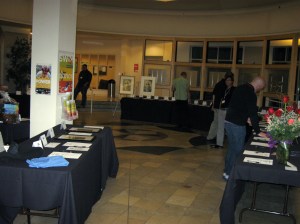
People who attended the event were able to silently bid on numerous items, including: a limited edition collection painting by Trevor Southey, Ballet West tickets and a two-night stay at Hotel Monaco located in downtown Salt Lake City.

The silent auction raised $2,800, with the highest auction item being Southey’s painting. It sold for $500.

gay la_silent auction

The Gay-La Silent Auction featured a wide variety of items.

Attendees enjoyed the meal and the silent auction, but every person who paid to participate in the Gay-La was there because Matthew Breen was the keynote speaker.

Breen, a U alumnus, is the chief editor of the nationwide LGBTQ news magazine, “The Advocate.”

He began his speech by thanking everyone in attendance for their time and kindness toward the U’s effort in championing LGBT equality in Utah.

Breen disscussed the hardships of growing up gay in Salt Lake City during the 1980s and 1990s, and said how thankful he was to be back at the U.

It was while he was at the U, that Breen grew to understand that on planet Earth, it is not easy to conduct one’s life with loving kindness, especially  when the community he grew up in was intolerant toward the LGBT community.

“A younger me would have benefited from Pride Week,” he said.

During the keynote speech, Breen said how important it is for gay and lesbian people to come out as soon as possible. He also encouraged parents and the community to support all people in this process.

It has been 15 years since Breen publicly stated that he is gay. However, this trip to Salt Lake City was the first time he has been openly gay in Utah.

gay la_jim dabakis

Approximately 240 people attended the Gay-La and Silent Auction at the JCC.

In his speech, he encouraged the audience to never forget the hard work and dedication of previous generations and their efforts to end discrimination against the LGBTQ community.

Breen’s speech, however, was not exclusively focused on how far the LGBTQ community has come. Rather, he focused on the idea that people should “take abject lessons to heart,” and that they should “unlearn that there are two sides to the story.” Breen said there is only one truth in a story and that is what people should focus on.

He then discussed the idea that the media and general public still are misinformed regarding what being gay or lesbian is.

Breen explained that in America most people still link pedophilia with gay men. He also said the media and general public still believe that children cannot thrive in a same-sex household. He stated categorically that there is zero evidence to support these myths. The audience responded with loud applause.

The Gay-La also recognized nine students who attend Brigham Young University for their courage and resilience for upholding its Honor Code despite the fact that they are gay. BYU forbids sexual contact between gay people and will expel students for having same-sex relationships.

IMG_0007

BYU students having dinner.

One of the students, Adam White, said, “It is scary to speak up for what you believe to be right, but I found that when I raise my voice to spread awareness and understanding, that it does make a positive difference on this campus.”

Misrepresentation in media portrayal of the LGBT community

Story and slideshow by Adrienne Purdy

See a slideshow of media misrepresentation of gays and lesbians.

Our lives include so much media and television that we often take in what we see without question. But should we? Are groups being represented accurately? Or do the media depict stereotypical images of Asians, African Americans, women and lesbians and gays?

For instance, “Modern Family” is a multi-award-winning TV show that features a media stereotypical gay couple: two middle age white, upper class, extremely flamboyant men who are trying to adopt. But is that how all or even most gay couples are? Or are a wide variety of lifestyles represented?

From Ellen DeGeneres, one of the first high-profile celebrities to come out in 1997, to the many entertainers who have done so in 2012, Hollywood is showing that coming out does not have to include the fanfare of magazine covers and daytime talk shows. For instance, Jim Parsons became one of the first gay men to allow a reporter out them in a story.

In a New York Times profile, the key sentence does not come until more than three quarters of the way through the two-page article: “The Normal Heart resonated with him on a few levels: Mr. Parsons is gay and in a 10-year-relationship and working with an ensemble again onstage was like nourishment, he said.”

Other actors are working to defy stereotypes of gay men. For example, Matt Bomer plays Neal Caffrey in “White Collar”, a white-collar criminal who helps the FBI catch other criminals. He also plays a stripper in the hit “Magic Mike.” Bomer shows that the stereotypical image of a gay man is not only incorrect most of the time, but not important.

Dave Kirtley, who identifies as straight, says, “Celebrities have definitely paved the way for coming out of the closet. Ellen DeGeneres paved the way. Rosie O’Donnell paved the way. ‘Will and Grace’ is huge for the gay community. The LOGO station for gays and lesbians, I mean, they even have their own TV channel.”

But what about celebrities who are the subject of rumors about coming out but will neither confirm nor deny them?

Entertainment Weekly reported, “The media are becoming less tolerant of celebrities they believe to be unforthcoming about their sexual orientation.”

Actors who are openly gay are also showing that coming out in no way hurts their career. Take Chris Colfer, for example, one of the youngest openly gay actors in Hollywood. Stemming from his success on “Glee as one of the only gay kids at the fictional McKinley High School, he is now releasing a new movie that he has written, executive produced and starred in.

Some may say that coming out can hurt an actor’s career. But, as Entertainment Weekly’s Matt Harris wrote, “If your greatest ambition is to be the star of a series of Nicholas Sparks-style sincerity-in-the-rain romantic melodramas, being an out gay man is still probably going to be a handicap. Could an openly gay actor, for example, have gotten cast in Channing Tatum’s role in ‘The Vow’? It’s doubtful. On the other hand, could an openly gay actor have gotten Channing Tatum’s role in ’21 Jump Street’? Absolutely.”

Does this speak to the stereotypes the media portray? If an out gay man can convincingly portray a heterosexual romantic lead better than a straight man, shouldn’t he get the role?

These boundaries and barriers may take some time to break down.

Kristina Spainhower is a UPS driver. Her handle was “Wild Child” until she turned 40, and then she shortened it to “Wild.”

Her partner, Wendy Judson, is a critical care nurse who also happens to be a movie aficionado.

“We vote, we pay taxes, we have jobs, we come home to pets, we donate to charities,” Judson says. “We are just like anyone else. We’re no different.”

Spainhower says that most media portray gays and lesbians in a stereotypical and often-times biased light.

One TV series that Spainhower believes shows situations accurately is “The L Word.”

“The L Word” was a TV series that ran from 2004-2009 about the lives of a group of close-knit lesbians and their interactions with friends and family members with differing opinions about their orientation.

“It’s pretty close to life,” Spainhower says. “The family situations and interactions are very good as well. It’s not something that’s talked about a lot on channels 2, 4 or 5 or in the news or mainstream media.”

Others, like Kirtley, feel that the family situations in “Modern Family” aren’t true to life. “I think that Cam and Mitch [the gay couple] are the quintessential stereotype, and since ‘Modern Family’ is such a successful show and has such a large viewership some people who may not know many gay couples may get the idea that all gay couples are like them which isn’t true,” Kirtley says. “I think Hollywood and the media in general need to portray gay couples, and lesbian couples for that matter, more accurately and with more diversity.”

Jacob Stokes feels that although “Modern Family” does a good job portraying one kind of relationship, it is not the standard of every gay relationship. Stokes, who identifies as gay, says, “As with any culture, you have people on either end of the spectrum and everywhere in between. There certainly are gay couples consisting of flamboyant men who want to adopt children. There are conservative couples whom many would not believe to be gay except for the fact that they like other men. Some men want children, others do not. I think Modern Family has done a good job at portraying one type of couple, but it certainly does not extend to every gay man or relationship,” he said in an email interview.

Spainhower says that neither lesbian nor gay couples are portrayed enough in the media, let alone accurately. She also feels that two women together are more accepted in media and culture than two men are.

Stokes says, “I think that widespread stereotypes take a lot of work and time to change. Just as stereotypes about African Americans or any other historical minorities still linger it will certainly take time for people to regard homosexuality without discrimination or prejudice.”

The Paper Moon, a one-of-a-kind bar in Salt Lake City

Story and slideshow by CARSON HUISKAMP

Take a personal tour of the Paper Moon bar.

There it stood. A rainbow flag painted across the front entrance of the Paper Moon for guests to see.

When it opened in December 1993, there was no such thing as a gay bar, or a bar that had a target audience of mainly the lesbian community in Utah.

Paper Moon co-owner Rhonda Wilson attributed this to two things.

“I do believe it has a lot to do with the liquor laws and the strong standing of the Mormon Church here,” she said.

It is true that Utah has some of the strangest, most strict liquor laws in the entire country. Utah also has one of the most religious populations in the country, with 62.2 percent of the state identifying with the LDS church. But facts like these don’t mean that the entire state is conservative.

In fact the number of people coming out in the LGBT community has boomed in the last quarter century, with an estimated 4 million openly gay people in the US, according to one expert.

According to statistics from Parents, Families, and Friends of Lesbians and Gays, anywhere between 4 and 10 percent of  the population is LGBT. That estimate puts the Salt Lake Valley at roughly 48,000-120,000 LGBT individuals currently.

Also, according to the Advocate, a gay and lesbian news magazine, Salt Lake City is one of the most welcoming LGBT cities in the country.

“While those unfamiliar with the Beehive State are likely to conjure images of the Mormon Tabernacle Choir, far less-oppressive-than-it-used-to-be Salt Lake City has earned its queer cred,” said Matthew Breen in an article published by the Advocate.

Many people will ask, what has changed in Salt Lake City to make it so much friendlier for the LGBT community?

The answer is the social scene.

The Paper Moon, which is located on State Street and 3737 South, plays host to one of the most unique bars in Utah. In a sense, it truly is one of a kind.

“The history of the club is in December [2012] we will be 19 years old,” Wilson said.

“We really are the only lesbian club in the state of Utah,” she said.

When the Paper Moon first opened, the owner didn’t exactly know what the reception would be for the club. But after some thought she went ahead and decided to open anyway.

“The owner herself was lesbian, and she felt the lesbian community needed somewhere to go,” Wilson said. “There were all these gay clubs at the time popping up …, so she felt the girls would like somewhere to go also.”

What really makes the Paper Moon unique is the number of regulars who come to the bar to break away from their everyday lives and join the LGBT community at night.

“I’d say at least 50 percent of the people who come here are regulars,” said Alicia, who asked that her last name not be used in the story.

People may ask, what does the Paper Moon offer that other bars do not? And the answer is simple — fun atmosphere with a little bit of spice and originality for the women who socialize at the venue.

To the right of the entrance, a bar sign of two women kissing shows what this scene is all about.

Inside the bar women dance, sing and play pool with one another as they intermingle without the worry of what others may think.

On Mondays starting at 8:30 p.m., the bar holds its weekly White Trash Texas Holdem’ Tournament.

Tuesday and Thursday nights provide a more vibrant feel to the club, as women can sing and dance under the disco lights for Karaoke night. Or, if they are feeling a little more seductive, a stripper pole and cage are located on the stage.

Free pool is offered every Wednesday for those who want to relax.

Finally, Friday and Saturday nights provide the finale of the week for customers, as local DJs provide the Top 40 DJ House Party Music event all night long for those at the Paper Moon.

All these events held at the Paper Moon each and every week give customers a reason to come back.

“I just think it is a great place for lesbians to come together and be themselves honestly. A lot of times we are singled out and looked upon differently, so I think it’s a great place to come to and be ourselves and be gay,” Alicia said.

Salt Lake City group of drag queens is changing the scene

Story and photos by MADELINE SMITH

Klaus von Austerlitz isn’t your stereotypical drag queen with fake breasts, high heels and glamourous makeup. Instead, he takes the stage with a chalk white complexion and black designs drawn on with eyeliner, a red wig topped off with his trademarked black mouse ears and moon boots.

“I take the stereotype and flip it on its head,” he said. “We make the idea of what women should be gross.”

Von Austerlitz is Tanner Crawford’s stage name. Crawford is a junior at the University of Utah working on a bachelor’s degree in performing-arts design. He specializes in lighting, makeup and wigs and aspires to be a wig master for a professional theater.

Growing up, Crawford felt foreign living in Ferron, Utah, and developed von Austerlitz’s character during high school. It wasn’t until 2011 when Crawford began doing drag that von Austerlitz, a German man, came to life. The foreign roots stem from Crawford’s feelings of being different in his hometown, he said.

“[Klaus] is my idea of what a boy can be,” he said.

He uses his performing-arts design experience in von Austerlitz’s costumes. He said even if the look isn’t 100 percent great, he still has a solid idea and a full design.

During the U’s Pride Week drag show on Oct. 4, 2012, von Austerlitz performed to a remixed version of Carly Rae Jepsen’s “Call Me Maybe.” He mixed the song to transition from the original to a version with ghoulish vocals and a darker sound, and he performed accordingly.

Von Austerlitz pointed to his hand and the numbers 666 every time Carly Rae Jepsen sang, “Here’s my number…,” in her song “Call Me Maybe.”

Crawford said the Pride Week drag show attracted an audience he typically doesn’t see elsewhere. He was unsure how people would react to his performance.

“I was out of my element,” he said. “I just wanted to show what I’ve got.”

Crawford said his strange style stems from his concern about the drag scene being too homogenized. He doesn’t like the idea of drag entailing only dressing up like a woman and lip-synching.

“[It’s] sexist. It’s men putting on what women should be,” he said.

Doing drag is a form of catharsis, a more intimate means of art. He said he uses it to express dark messages that people don’t want to think about. For example, he utilizes revered symbols such as painting an upside-down cross on his forehead and dousing his clothes in blood to inspire people to question societal norms.

Crawford strives to make people more open to being uncomfortable. He also puts himself in unusual situations, including watching disturbing documentaries that force him to learn how to react.

“I try to be comfortable being uncomfortable,” Crawford said. “It makes me more open of a person.”

He said a lot of his costumes are inspired by Japanese horror films such as “Ju-on” and “Ringu.”

Crawford tries to incorporate multiple cultures, such as Japanese and Native American, into his costumes by utilizing dominant symbols like a cross, feathers or culturally-influenced makeup.

Despite using important symbols, he takes precautions not to stigmatize any one group of people.

“I try not to be racist or demeaning,” Crawford said.

He also gets inspiration from the movie “Party Monster,” a story about the original club kids in New York City in the late 1980s who wore flamboyant and bizarre costumes.

The Bad Kids

The movie also inspires Crawford’s friends, a group of five queens who met at Miss City Weekly on June 2, 2011. They discovered a shared interest in challenging the standard image of a drag queen and formed The Bad Kids, named after the famous Lady Gaga song.

Cartel Fenicé, as Scotty Phillips is known on stage, is Klaus von Austerlitz’s drag sister.

“We try to be a collective, all-inclusive group,” Phillips said in a phone interview.

They encourage people to join them, be themselves and express who they are. The Bad Kids don’t follow the rules like traditional drag queens, Phillips said. They don’t portray themselves as women on stage and they’re trying to change the idea of what gender is.

“It’s disrespectful to women,” Phillips said. “It’s like we assume all women have big breasts.”

Instead of wearing fake breasts, The Bad Kids bear messages scribbled on their bare chests with eyeliner, or Kentucky Fried Chicken buckets on their heads with their bodies covered in blood and feathers.

However, The Bad Kids aren’t all about gore. They use the stage to make statements that they feel strongly about, such as abortion and greed.

Phillips dressed as a gypsy for a performance at Metro Bar during the themed show “Politics are a Drag.” He danced to a mash-up of Shania Twain’s “Cha Ching,” “Money” by the Flying Lizards, and “Money, Success, Fame, Glamour” from the movie “Party Monster.”

“[I was] the mystic woman trying to tell the world that what everyone is doing in America is filthy,” Phillips said.

He ended his performance by ripping off his dress to reveal dollar sign pasties covering his nipples and throwing Monopoly money at the audience.

Despite the sometimes-political meaning behind their performances, The Bad Kids never take themselves too seriously, Crawford said.

“We’re like clowns,” he said. “We make people have a fun time.”

The Bad Kids perform on the last Thursday of each month at Metro Bar, located at 540 W. 200 South. Crawford encourages other queens to join the group to ensure fresh, creative performances at the club, and can be reached by email at klausxoxo@hellokitty.com.

Even when they’re not doing drag shows, The Bad Kids dress up and go out for a night on the town, regardless of the public’s reaction. Phillips said this is how they perpetrate their vision and make their presence in the community known.

Philips said some individuals they encounter wonder why the queens don’t wear fake breasts. Others think it’s a bold thing to do in Salt Lake City.

“Some see it as unique, some people expect us to embody what women look like,” he said.

Phillips said being out in the community also creates awareness of the group. Individuals who are interested in doing drag are invited to  connect to The Bad Kids through each of the queen’s Facebook pages.

Crawford said the group tries to be friends with everyone, in part because the drag community in Salt Lake City is so small. Since 1976, the local drag scene has been dominated by The Royal Court of the Golden Spike Empire, a nonprofit organization that is made up of high-fashion drag queens who perform to raise money for Utah charities.

The Bad Kids want to create a spectrum of queens to break away from the standard, Crawford said.

Klaus von Austerlitz waves to the crowd after the crown was given for the best drag queen at the U’s Pride Week drag show, held at Sugar Space on Oct. 4, 2012.

Phillips said The Bad Kids want to do bigger shows in larger venues with a variety of performances.

And Crawford said the group hopes to film videos and post them on YouTube.

“I’m being myself!” he said. “Come do it with me!”

Utah Pride Festival unites community

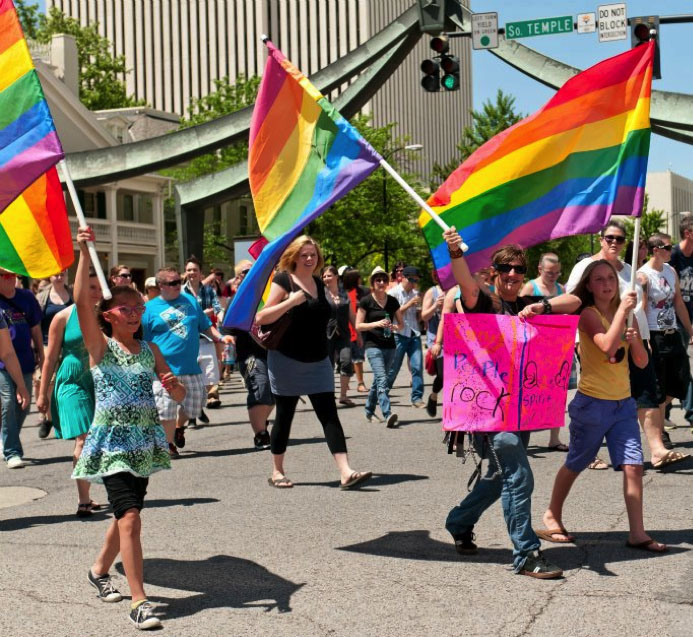
Participants in the annual Utah Pride Festival show their colors as they march holding rainbow flags. Photo courtesy of the Utah Pride Center.

Story by AINSLEY YOUNG

The Utah Pride Festival is a three-day event held each June that allows people of the LGBTQ+ community and their allies to come together to celebrate who they are and to show their true colors.

“People know they can attend the festival and are free to be who they are and they will see 20,000 other people also being free to be who they are. People will also find acceptance and love at the Pride Festival,” said Megan Risbon, executive assistant and volunteer program manager at the Utah Pride Center.

In 2012, there were around 23,000 attendees.

“I think people attend the Pride Festival for many reasons,” Risbon said. “Most people know they can see how diverse our community here in Utah really is at the Festival.”

Risbon said it’s important to attend the festival and make new friends and allies. One way to do this is by volunteering.

“This volunteer had recently come out and was afraid to attend his first Pride Festival without any friends or family. Even though he was hesitant, he signed up to volunteer for a three-hour shift. I assigned him to take tickets at the main gate for that one shift but he ended up working another shift for us that day,” Risbon said.

“After the festival, he emailed me and told me what a wonderful time he had volunteering. He had met so many people when taking tickets and it was a great experience for him. He stated that he was usually quite shy but decided to be super friendly and extroverted while volunteering and because of that, he made many new friends,” she said.

Bexi Lee, a volunteer at Ogden Outreach and the Utah Pride Center, said she has been to the Utah Pride Festival for the last three years in a row.

“It’s a weekend off from work, a chance to hang out with friends and an opportunity to join my community in voicing our needs and wants. Oh, it’s also the first sunburn of the summer,” she said.

Lee said in addition to the parade and shows, there is a lot of information on sexual health. The Utah Pride Festival is also where she discovered the organizations she’s a part of now.

“The more we continue to have the festival, the more opportunities we have to spread our message,” Lee said. “Those who have a different idea of how life should be lived would consider it a victory on their part if the festival was discontinued.”

Brenden Beery, who volunteered as parade monitor at the festival in 2012, said he goes to get more acquainted with the LGBTQ+ community.

“Being a gay male, I wanna know what’s going on in my demographic. It’s more than just a parade; they have political booths and other things like that,” he said.

The booths inform people about the human rights movement and goings on in the fight for marriage equality. There was also a booth from the U doing a study on same-gender attraction.

To Beery, knowing he isn’t the only one is comforting, and he finds that comfort at the Utah Pride Festival.

People attending the festival shows that they are proud of who they are, Beery said.

“It shows there is a generational shift in values regarding the LGBT community,” he said. “They welcome all aspects of human sexuality; it’s not so much a gay pride parade as an equality parade.”

Each year, the festival kicks off with the Grand Marshal Reception where the Utah Pride Center honors its Grand Marshal along with other award recipients.

Saturday’s festivities begin with a 5K run in the morning. Following the run are three simultaneous rallies and marches. The Interfaith Service, Gender Rally and Dyke Rally are held, followed by a joint march to the festival grounds.

When these groups reach the festival grounds, the opening ceremonies are held (national anthem, raising of the rainbow flag above the City/County Building) and the festival is officially opened.

The first few hours of Saturday’s events are set aside for family-friendly activities. Parents may bring their children for family-specific events (clowns, magicians, cotton candy, kid crafts, etc.). Saturday night finishes up with a dance party at the Main Stage.

Sunday begins with the annual Pride Parade. The 2012 festival marked the largest Pride Parade and the largest parade in the State of Utah with over 150 entries, Risbon said.

Also in 2012, the festival welcomed 300 active and faithful LDS members representing Mormons Building Bridges, along with allies and parents of LGBTQ+ people to march at the beginning of the Pride Parade. After the parade, the festival grounds open with music, speakers, vendor booths, bingo, karaoke and other activities being held from 11 a.m. to 7 p.m.