KUED, Sorenson Unity Center, promoting education at home

Story and slideshow by DEREK SIDDOWAY

Take a look inside the Eccles Broadcast Center and view a Ready to Learn Workshop.

According to the 2010 Census, nearly 10 percent (9.5) of Utah’s population is under 5 years old. That is the highest in the nation. Yet Utah, along with North Dakota and Montana, are the only states that do not offer free public preschool.

Jacqueline Voland, community outreach and education services manager at KUED, thought that was a problem. So in 2001, when the Department of Education reopened another grant cycle for the PBS Ready to Learn initiative, she took action.

“Our early literacy campaigns were more focused on hard content and resources,” Voland said. “It is important that we have a one-on-one relation with the community and their services. The Ready to Learn initiative supplements education services and provides tools (for parents) at home.”

At its heart, Voland described the Ready to Learn initiative as seeking to increase parental participation and involvement in school and education. All of the programs are designed around Utah’s educational core curriculum and focus on infancy through third grade. The initiative combines educational programming and a “Learning Triangle,” consisting of “read, view and do principles.” The approach is based on the concept that children learn in different ways. Everything is designed to empower parents to take a more active role in their children’s schooling.

“We are trying to be a public vehicle to support education. The Learning Triangle is the basis for what happens in Ready to Learn,” Voland said. “We are providing (parents) with tools to engage their kids at home.”

The Ready to Learn initiative reaches out through a series of workshops in a variety of locations across the state to educate parents. Beginning with media literacy, the subjects branch into child development, health, safety, nutrition, self-esteem issues and anti-bullying, to name a few. Voland said the workshop themes are based on underlying issues that need to be continually addressed.

“The media literacy workshop is the start of anything we do,” Voland said. “Part of our mission is education of appropriate media: what, why and how you should be watching with children. Not all TV is for kids. Parents need to understand that while the TV is on (children) are consuming information in lots of different ways.”

Parents are the first teacher a child ever has, Voland says. As such they play an integral part in the equation for a child’s academic success. To aid parent involvement, the Ready to Learn initiative provides tools to make parental involvement easier. For every given topic, parents are given lists of children’s books and programming for their kids to enjoy.  To address the “do” part of the triangle, parents complete an activity with their children such as paper cup phones. This exercise teaches basic sound principles.

As part of the do, read, view theme every parent is sent home from the workshop with a book to build at-home libraries. They are also encouraged to acquire library cards.

All workshops provide bilingual presenters and material in Spanish and English if needed. As an added bonus partnering sites that provide a location for the workshop are required to supply refreshments or a meal to participants.

One agency that partners with the Ready to Learn initiative is the Sorenson Unity Center. Located at 900 W. 1383 South, the center collaborates with various nonprofit groups through its Programming Partnership. Voland said KUED had partnered with the Sorenson Unity Center in the past but it wasn’t until July 2011 that KUED was approached about joining the Programming Partnership.

“The early phases with the Sorenson Center relations have been good,” Voland said. “We are a nonprofit and in turn it behooves us to reach out and serve community with programming and services.”

As the Ready to Learn Program Coordinator at KUED, Elise Peterson is all about community outreach and the importance of parental involvement in education. The 28-year-old Peterson taught elementary school for three years before receiving her master’s degree in Child Advocacy at Montclair State University in New Jersey. She describes her position at KUED as the perfect fit for her degree and mission.

“These workshops have been so rewarding for me,” Peterson said. “It’s so important to make education accessible because for certain families school can seem daunting.”

Peterson said the KUED workshops serve 15 different sites in the Salt Lake area and average 20 parents at each workshop. Currently she presents monthly at venues like the Sorenson Unity Center. In addition to scheduling and presenting workshops, Peterson helps sponsor other activities through KUED such as parent or literacy nights.

Peterson presents a different themed workshop every month at the Sorenson Unity Center. She says most requests are for science and math, areas part of the STEM — science, technology, engineering and math — program being implemented by PBS and “Sesame Street” this season.

In keeping with the STEM theme, Peterson’s workshop at the Sorenson Unity Center emphasized these focus areas. Fun with Numbers and Science Exploration taught parents how to implement mathematics and scientific exploration into everyday life. Suggestions for parents included cooking with children, separating laundry into dark and light groups and other daily chores. Every activity in the presentation included exercises that parents could do without setting aside extra time.

One example Peterson recommended was the principle of shadows. Parents were challenged to view an online video clip from KUED and then read one of the children’s books such as “Light” by Molly Bang. Next, parents were encouraged to take their children outside to explore making shadows. Puppets were included in the workshop packet for children to continue their exploration.

“Parents are coming back (to the next workshop) sharing experiences of how education is happening at home and what they are doing with the activities,” Peterson said. “It’s great to see the program working and parents being involved with the materials at home.”

Nancy Holt was a first-time participant in the Ready to Learn Workshops. As a working mother, Holt was intrigued by the concept of implement teaching activities at home and exposing her child to a well-rounded education.

“I heard about the workshop through the Community Council,” Holt said before the workshop. “The concept of a parent workshop to help teach children to learn sounded interesting.”

The turnout to the Sorenson Unity Center’s November workshop amounted to four mothers, but Peterson feels a new parent attending was nonetheless encouraging.

Jacqueline Voland, the community outreach and service manager is satisfied knowing the Ready to Learn Initiative is serving the community and empowering parents.

“Every moment is a learning moment,” she said.

An inside look at the English Skills Learning Center

Story and slideshow by RYAN McDONALD

Attend English class here

A chorus of “I live in Utah” rang from inside the Humanitarian Center of The Church of Jesus Christ of Latter-day Saints in Salt Lake City on Friday, Oct.  28, 2011. The voices were those of seven people from different parts of the world who are learning English through the English Skills Learning Center (ESLC) in preparation to apply for American citizenship. The ESLC is a nonprofit organization headquartered at 631 W. North Temple in Salt Lake City.

Founded in 1988, the ESLC was originally called Literacy Volunteers of America-Wasatch Front, according to an informational brochure. In its early days, the organization provided tutoring for English speakers who struggled to read and write. English classes for both immigrants and refugees were also offered.

Since 2001, the ESLC has focused its efforts entirely in the field of English as a second language, particularly helping adults who are English language learners. The organization mainly helps those who have been identified as having a low income.

In an effort to reach as many students as possible, the organization teaches classes in different places in the community. This allows students to go to a place that is more convenient for them. Classes are held in places such as apartment complexes, elementary schools, libraries and community centers. Under certain circumstances, such as a lack of transportation or the need for a parent to stay home with their children, classes may be taught in a person’s home.

One of the hallmarks of the ESLC is the fact that most of these classes are taught by volunteers.

“The cornerstone of our organization is volunteers,” said Beth Garstka, volunteer coordinator at the ESLC.

Volunteers are recruited and trained by the ESLC staff, Garstka said. They must be 18 years of age, though there have been exceptions to this rule over the years. After 12 hours of training and two hours of observing classes, teachers must be willing to volunteer for 100 hours over six months. This breaks down to about three to five hours per week. Volunteers typically spend between two and three of those hours teaching and the rest of the time preparing for lessons and traveling.

Garstka said no prior teaching experience is necessary and teachers do not need to know another language, since all classes are taught entirely in English.

“It’s (the volunteer system) a way to bridge different worlds together,” Garstka said. “Our mission statement is ‘Bringing the promise of integration, security and empowerment to adult immigrants and refugees in Salt Lake County.’ That promise of integration is key to make sure that the people of the mainstream culture are interacting with the folks that are newly arriving here. That’s definitely a way of bringing them together.”

That being said, Garstka insists that the ESLC is not a language exchange program. Because classes are taught entirely in English for maximum learning, there is no need for class content to be translated into another language.

“I don’t want our volunteers brushing up on their Spanish,” she said.

Armed with about 200 volunteer teachers, the ESLC continues to help more and more newcomers (the term used when referring to immigrants and refugees) learn English each year. According to Garstka, the organization served 735 people in the 2009-2010 fiscal year. In the 2010-2011 year it helped 850. The 2011-2012 fiscal year began in July and the organization is currently serving about 430 people.

The ESLC teaches a variety of classes, as students are placed in certain ones depending on their needs. The Empowering Parents classes are held in elementary schools and are taught to parents of young children. Parents learn how to communicate with their children’s teachers, how to attend parent-teacher conferences and how to call a doctor’s office.

The ESLC also teaches classes to help people who are applying for their U.S. citizenship and need to take a civics and English test.

The third type of class offered is a workplace literacy class. These are taught at places of business where professional teachers and volunteers teach communication skills that are essential in employment.

“Whatever their (the students’) goal is, that is what we are going to focus on,” Garstka said.

Kathy Phan is the teacher of the civics test preparation class that was held in October. A recent graduate of the University of Utah, she began training to become a volunteer teacher in February 2011 and has been teaching since March. Having done extensive volunteer work at different places throughout her life, Phan enjoys the ESLC because of the relationships she has built with both the staff of the organization and the students she teaches.

“I feel like I have a bond with them so I’m more motivated to volunteer and stay,” she said.

As much as she enjoys teaching, it doesn’t come without challenges.

“The hardest part is trying to find the right place for students and find lessons that fit them the best and will help them improve,” Phan said.

On that October day, students in Phan’s class began by reciting a list of terms that they will need to know for the civics test, such as “senators” and “Abraham Lincoln.” The class then moved on to an activity where one student would read a sentence, such as, “The president lives in Washington, D.C.,” and another would write it on a dry erase board.

“If the activity is too easy they’re not going to benefit a huge amount and if it’s too hard it will just confuse them more,” Phan said. “It’s finding that right level. It’s been a troubleshooting kind of thing.”

Although various struggles arose during the class, such as trying to understand what the written abbreviation, “U.S.A.” meant, students recognize the great opportunity of living in the United States.

“I like it (America) for opportunity. I like it for my kids’ school,” said Inocensia Montejano, a student from Mexico.

Mohamed Muse, a Somali who has lived in Utah for a year, has learned that being able to speak English is crucial to having a successful life here. He summed up the reason that the ESLC provides the services that it does.

“(The) English language is key, key, key to life in this country,” he said.

Unity Computer Center and Clubhouse — a decade of technological literacy

Story and slideshow by DEREK SIDDOWAY

Take an engaging visual tour of the many services available at the Computer Center and Clubhouse.

The Unity Computer Center and Carole Costa have come a long way helping people in the past 10 years.

“This place had a tiny computer lab in a trailer and they were looking for people to help with the youth program,” the 41-year-old computer center manager said. “One thing led to another and 10 years later I manage the whole place.”

Originally from France, Costa relocated in 2000 to Utah where she began volunteer work at the Unity Computer Center. Dissatisfied with educational systems she believed placed too much emphasis on testing rather than teaching, Costa left her educational background and began chasing her technological passions.

“I used to be a language arts teacher,” Costa said. “Robotics and computers were a hobby. You never know what your hobbies will lead to.” A year of volunteering later, she hired on part-time and eventually became a full-time employee at the Unity Computer Center.

Looking at the center now, it’s hard to believe it once resided in a trailer. Located at 900 W. 1383 South within the Sorenson Unity Center, today there are two computer labs: the Unity Computer Center for adults and the Unity Computer Clubhouse designed for children and teens. According to the Sorenson Center’s annual report, the Unity Computer Center served 955 adults and 304 youth throughout the 2010-2011 fiscal year and averaged more than 1,100 visits each month.

Keeping with the Unity Computer Center’s mission for computer literacy, a variety of services are available to patrons. In addition to open-access hours, users can attend computer literacy classes, specialized workshops and multimedia activities designed to expand their technological know-how. There are 14 computers available for adult use and 20 for the youth in the Computer Clubhouse.

Intel sponsors 100 Computer Clubhouses across the world. Costa describes the setup as a combination of public and corporation funding from Salt Lake City, the Eccles School of Business and Intel. Like other clubhouses, there is a vast array of multimedia technology for children to explore including graphic design, digital music production, video game design and Lego robotics.

Although the technology is certainly enjoyable for youth, the hope is that they will carry the skills they have learned into college and the job field. Costa, other Computer Clubhouse employees and volunteers place an emphasis on multimedia application in the real world.

“With children the agenda is always to graduate high school and get a better job. Most kids will be the first generation in their family to go to college,” Costa said.

One example is the music room. Inside, children can record, produce and mix to create their own songs in the same fashion the music industry does. As well as gaining valuable technical skills, the youth also learn important social skills such as teamwork. After the children have recorded enough songs to fill a CD they work in Photoshop to create an album cover. They also have the option of creating music videos for their music.

On the adult side, the Unity Computer Center emphasizes a more fundamental approach to computer literacy.  Many patrons have little or no computer background, so starting with foundational skills such as Internet use, email, word processing and other essentials is necessary. Another area of focus is job readiness — updating résumés and online job searching. Classes are held mostly in the morning or evening and are available in English and Spanish.

“The people here are easy to work with and friendly,” Steven Jensen said.

Jensen is a computer center patron and volunteer. He has been coming to the Unity Computer Center on an almost daily basis since 2004. Jensen uses the center to polish and expand his computer skills. By means of Excel, he has created a variety of formula-controlled databases to display in a portfolio for potential employers.

“Right now I’m going through Excel and amortization skills. I use Microsoft Office Suite a lot,” Jensen said. “I create databases of names, addresses and attendance and then I create queries to see how many people have attended within a certain range.”

Jensen also stressed the importance of the Unity Computer Center for locals. He wants to get the word out that the center is a valuable community asset and deserves recognition for its services.

“People can come here who have not gone to college but want a computer background,” he said. “It’s a great place for people who want to use computers.”

Heather Fuller, 50, a staff member since December 2010, has seen firsthand how the Unity Computer Center changes lives. Fuller came to the center after discovering the job on the University of Utah job board.

“I thought it was such an interesting idea of how to help people,” Fuller said. “I loved the concept of what they do here, helping underprivileged children and adults, teaching workshops.”

One of the workshops that Fuller had a hand in was a Mexican cooking blog. Each week for two years, women without any computer background met for classes.

Classes changed every six months. Fuller said students began with “breaking down computers and putting them back together, learning how to type, email and use Facebook, From there they went to film editing and blogging.”

The highlight was the blog, designed by the women, complete with how-to cooking videos they filmed and edited themselves. Carole Costa, who manages the adult side of the computer center in addition to the clubhouse, said it was quite the achievement for women who had started out with little-to-no computer knowledge.

Fuller was likewise proud of the group. “(Patrons) learn everything from simple tasks on the computer to finding a job, to being able to communicate with family and friends — something that would have never been possible because they don’t have a computer at home,” Fuller said. “(The center) provides an amazing experience for every walk of life, every age group.”

Jackson Elementary School moves ahead with Adelante Partnership

Story by MELANIE HOLBROOK

Explore Adelante here

“Adelante,” the Spanish word meaning forward or ahead, is a big part of the lives of students and teachers at Jackson Elementary School. But it’s more than just a word; the Adelante Partnership is a university-school-community partnership that seeks to raise awareness of higher education opportunities and to increase the expectation of university attendance and success among students, families and teachers at Jackson in Salt Lake City.

The Adelante Partnership started in fall 2005 as it kicked off at Jackson, located at 750 W. 200 North. The partnership has five major components: University Visits and Academic Summer Camps, University Service Learning and Mentors, Cultural and Academic Enrichment, Parental and Community Engagement and Research Informing Practice. It has approximately 125 University of Utah mentors and 10 staff members.

Judy Perez, Adelante coordinator, explained in an email that each component gives kindergarten through sixth-grade students hands-on experiences that will help enhance their learning horizon.

“Each grade takes one field trip to the U of U per semester and learns about a subject that fits with their current curriculum. For the summer we offer a four-day camp mostly focused on science since it’s been cut down at their school,” Perez said.

Under the University Service Learning and Mentors, Perez explained boys and girls take a one-year ethnic studies course during their first year in the program. Students complete a total of 11 service-learning hours per semester. Mentors and children build relationships and have conversations about college.

For Cultural and Academic Enrichment, students can learn the Folklorico dance, a traditional Latin American dance that mixes local folk culture with ballet. “Currently we have 40 students participating! We also have oral histories in the second-to-sixth-grade dual classrooms,” Perez said.

Adelante started off with a dual program at Jackson, meaning a program given in English and Spanish. Within the dual program there were initially about 250 children, but since Adelante extended to the entire school there are now about 550 students.

Perez explained that Adelante started the first cohort when the kids were in kindergarten and now they’re in the sixth grade. Every year after that Adelante has followed the students entering in the kindergarten dual immersion program allowing them to work with the whole school.

Enrique Aleman, co-director of the Adelante Partnership, said in an email interview that being in a predominantly Latino community their program found it vital to have a dual program.

“That’s why we chose Jackson Elementary. At the time it was the only public school offering a dual program, the other two schools that offered it were charter or private. We wanted a public school on the west side,” Aleman said.

Students can talk with Adelante mentors and staff whenever they please due to their office being located within the school, allowing students to build stronger relationships.

Some adult relationships children can also build is with their parents.

Aleman and Perez both agree that without parents and families the partnership wouldn’t be where it is today.

“My son is in the 3rd grade at Jackson elementary and absolutely loves Adelante. There’s always something new about him and college to be talked about at the dinner table,” Luisa Vizcarra said.

Vizcarra said neither she nor her husband attended college but they know their son will, thanks to the Adelante Partnership.

“The ambition and kindness of staff is touching. These men and women are truly making a difference in these children’s lives,” Vizcarra said.

When asked what her favorite aspect of the Adelante Partnership was, Perez said in an email, “From the students, to the parents, university mentors, teachers and staff, every day I’m reminded of the work that has made amazing impact and the work that still needs to be done to get more students of color in college. Having students asking me ‘when are we gonna take another field trip to the university?’ or conversations of ‘when I go to college I want to be …’ is like love songs to my ears. I love hearing the impact come out of their mouths.”

Perez said Adelante doesn’t believe in teaching and working with their students in any selective way. They want to bring their ‘home’ into the school and partnership.

“We recognize their struggles and challenges and therefore this is why parents and families are always invited to partake in Adelante decisions,” Perez said.

During field trips students wear their T-shirts that say “Future College Student” that were given to them by Adelante.

Adelante is hoping to extend to all of the west-side schools, yet programs cost money and can be a struggle every year. “One step at a time,” Perez said.

Voices for Utah Children: Advocates for Utah’s children

Story and slideshow by CECELIA FENNELL

Photos courtesy of Voices For Utah Children

See images of Voices for Utah Children

When it comes to issues facing children living in poverty, children have little say about what can be done to improve their situation. Voices for Utah Children, a nonprofit located in Salt Lake City, works with policymakers to advocate for children who wouldn’t be able to resolve health care and living situations on their own.

“Voices for Utah Children is not a direct service provider because public policy can, over time, benefit thousands of kids – long term change is through policy,” said Karen Crompton, executive director of Voices for Utah Children, in a phone interview.

According to its website, Voices for Utah Children was established in 1985 as an advocacy group that does not provide direct services, but a voice for Utah children in public policy decisions. Voices for Utah Children became a member of Voices for America’s Children in 2002. It is located in Salt Lake City.

“The two biggest issues currently facing Utah’s children are education and health care,” Crompton said.

The mission of Voices for Utah Children is to make Utah a place where all children thrive. The organization starts with one question in mind: “Is it good for kids?” At Voices for Utah Children, every child deserves the opportunity to reach his or her full potential. The organization focuses on five key areas that benefit the healthy development of all children – health, school readiness, safety, economic stability and diversity.

Voices for Utah Children worked to reauthorize the Child Health Insurance Program (CHIP). Because of this more children can enroll in health care.

Through the Children’s Health Insurance Program Reauthorization Act of 2009, CHIPRA, the U.S. can now fund enrollment policies that will allow 4.1 million additional children who are not currently covered by Medicaid or CHIP to enroll in health care. Now, any child in Utah can enroll in health care because of the advocates at Voices for Utah Children as well as other partnering organizations.

One partner, First Focus, is an advocacy organization dedicated to helping policy decisions on behalf of children.

According to its website, “The Children’s Health Insurance Program, also known as CHIP provides health coverage to more than seven million low-income families whose income is too high to qualify for Medicaid, but who don’t earn enough to purchase private health insurance on their own. Approximately 42 percent of U.S. children get their health coverage through Medicaid or CHIP.”

Voices for Utah Children uses a data tool called KIDS COUNT to find children in need. Terry Haven is the KIDS COUNT director of Voices for Utah Children and works with statistical information regarding Utah’s low-income children.

According to its website, “Utilizing KIDS COUNT data allows policymakers and community leaders to make data-driven decisions that will provide a better future for our state’s youngest citizens.”

KIDS COUNT shows the numbers of where the highest demand for advocacy is for Utah children, and where the highest amounts of children from low-income families are located.

“The highest number of children living in poverty come from the west side of Salt Lake City, but the highest percentage of children aren’t in Salt Lake County,” Haven said in a phone interview.

According to the 2011 KIDS COUNT data book, the need for child advocacy is all over Utah, not just on the west side.

Because the demand for child advocacy spans across the state, employees of Voices for Utah Children are assigned specific issues to advocate and work with policymakers and community leaders in all cities to accomplish the organization’s mission.

Lincoln Nehring is the senior health policy analyst at Voices for Utah Children and does a lot of lobbying. He does this through testifying at hearings and making presentations to policymakers.

Nehring said that advocacy around health care is categorized into two types: offensive advocacy, and defensive advocacy. Offensive advocacy deals with making changes to a program, simplifying programs and expanding programs. Defensive advocacy helps to resolve issues facing programs that are being threatened.

“When presenting programs and policies to the legislature Voices excels at identifying programs that can improve problems,” Nehring said in a phone interview. “On the offensive side they present why it’s a good idea for the state to move in that direction and all the logistics, how it will be paid for, why it is a good idea, etc. On the defensive side the organization can see the idea from the beginning and when Voices sees something bad that can potentially threaten a good program it’s hard to advocate – response to cut bad ideas is much more difficult,” he said.

Though testifying at hearings and making presentations to policymakers seems both difficult and intimidating, Nehring said the real work comes from the training prior to lobbying. “The bulk of the work is from understanding the issue,” he said.

Each of these directors at Voices for Utah Children encourages people to speak up. They said the best way for people to get involved is to get to know their policymakers.

“Your voice can be important, you can make a difference. A lot of times people feel like they don’t have a voice, like they’re screaming into a hurricane wind – that might be true in some states but not in Utah, one person can make a big difference. The legislature is your neighbor in Utah,” Nehring said.

Spy Hop Productions: a different kind of school

By COLLIN McLACHLAN

Spy Hop Productions teaches self expression through multimedia

If a school had students only do one or two projects a semester, would that school be considered an effective learning facility? If you were to ask students at Spy Hop Youth Media Arts and Entertainment Center, the answer might be a resounding “yes.”

Spy Hop is a nonprofit organization that, according to its website, is committed to helping students ages 13 -19 “express their voice and with it create a positive change in their lives.” It does this by using digital technologies as a means of artistic expression. Spy Hop has programs that teach students self-expression through film, audio, music, web design and video game design.

Rick Wray and Erik Dodd founded Spy Hop in 1999. At the time, Wray and Dodd owned Higher Ground Learning, a for-profit academic tutoring facility. Matt Mateus, programs director at Spy Hop, said in an interview that what Wray and Dodd discovered while tutoring became the basis for forming Spy Hop.

“They found that when they introduced film and video into their tutoring it was way more engaging for the student,” Mateus said.

Since Spy Hop also focuses on the development of the student, rather than simply teaching them technical skills, it uses self-expression as a means to teach students principles such as community awareness, emotional competency and high productivity.

“Our success really comes when youth leave here as engaged productive citizens, they succeed in the work force or higher education and have an opportunity to share their voice with the rest of the world,” Mateus said.

In an effort to achieve this, Mateus told of five fundamental goals that Spy Hop focuses on for all of its programs. These goals focus around: providing a safe after-school program, fostering artistic expression, developing educational and workplace readiness skills, developing emotional competencies and increasing media literacy, personal awareness and global connections.

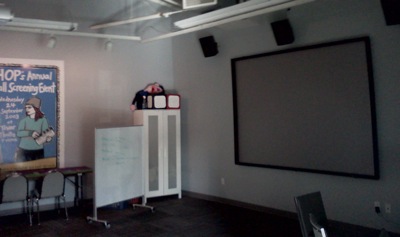
The theater room at Spy Hop

To better reach its vision, Spy Hop has a unique way of working with the students.

“We’re allowed to be different from a public school system. We’re allowed to sit down and really take the time to see what each student really wants to learn,” Matues said. “We really dig into, ‘what are the activities they are doing and how does that relate to our mission?’ ‘How does that relate to our program goals?’”

Because of this teaching technique, teachers at Spy Hop are called mentors. They spend one-on-one time with each of their students to establish a trusting and respectful relationship, along with helping with their projects.

This became apparent when Mateus, who’s a mentor in the music program, was giving a tour of the studio. He noticed a game-design student eating popcorn near the computers.

“Be careful with that popcorn. I don’t want butter all over the keyboard,” Mateus said while walking by. The student responded with a respectful, “Sure thing. Sorry Matt.”

“I still keep in contact with a dozen of my old students that I go to lunch with,” Mateus said. “The feedback I get is really positive.”

Shannalee Otanez, 24, an instructor for Loud & Clear said, “I love it all. I love seeing young people feel empowered to believe in themselves, and to feel like they have something important to share.” She feels she’s in a great position as a mentor at Spy Hop since she’s a former student. “I benefited from it myself, so I get what kind of impact it can have,” she said in a phone interview.

Shalom Khokhar, right, works on his audio project.

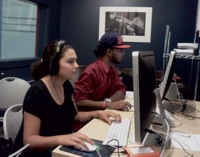
Shalom Khokhar, 19, from South Salt Lake, has come to understand that impact as well. Khokhar is a student in the audio apprenticeship class. He said the two main things that Spy Hop has taught him are priorities and responsibility.

“Once you come in, you sit down and it’s all about your work ethic, which you can apply in your other life too, in social settings, school, education, whatever,” Khokhar said.

When asked what his favorite part of Spy Hop was, Khokhar said, “I’d say the respect that Spy Hop has toward its students. They have a certain trust that they give to students to say, ‘OK come in here, use our equipment and stay in here as long as you want.’”

Spy Hop isn’t just helping students to become better people; it also helps to prepare them for the work force. The students work on projects during after-school hours using modern digital equipment. Khokhar and his apprenticeship class, for example, are currently working on the sound for a film produced by Spy Hop called “River’s End,” which is a story about a boy who, after his dad leaves his mom, goes and plays by a river and meets an imaginary friend. Him and his friend then run away and have some adventures. Khokhar says that a project like this takes skill in sound editing which he is happy to be developing.

Mateus is proud that Spy Hop is helping to create the next work force in the industry. Along with personal and life skills, Spy Hop is providing its students with a leg up by giving them hands-on training.

“To be able to walk into a studio and say, ‘I can work for you guys. I know Pro Tools. I know where to set these microphones up,’ at 17 years old. That’s crazy,” Mateus said. “Because what are they going to be doing when they’re 25?”

Communities United, Mexican Consulate keep Ventanilla de Salud open for Utah immigrants

Stories and photos by TOM BETAR

Take a peek in the Ventanilla de Salud HERE

Peering into the Ventanilla de Salud, or health window, of many Utah immigrants may yield cloudy results, so organizations like Communities United (Comunidades Unidas), are working to remove that opacity and open the windows and doors to allow these individuals to become more healthy, educated and productive members of society.

Integration can be a foreign concept to some, but for the members of CU integration is the critical concept that will allow immigrants to reach their full potential as American citizens and community members.

Rose Maizner, interim executive director of CU, said integration occurs in many ways. But, CU’s two main initiatives are community well-being and the recently updated community engagement.

The community well-being initiative covers a wide range of health-related issues and includes services such as diagnostic testing, prenatal classes, referrals and transportation. Advice is also given to residents so that they can affordably and effectively visit a doctor.

The community engagement initiative focuses on civic and social integration, with an underlying philosophy that immigrants need to understand the systems that exist so they can advocate for themselves and address problems they face. This initiative also promotes the idea that immigrants need to be immersed and involved in their community to make changes and to make it stronger.

Maizner said while most immigrants are not a drain on the healthcare or other systems, it does become a possibility if they do not understand some of the basic processes.

“The goal is to help our immigrants in the community become more integrated into the fabric of our society,” Maizner said. “People are not going to be able to be fully integrated unless they have a basic understanding of how our systems operate. We are providing a bridge between a more marginalized community and the larger community.”

David Monge is the program coordinator for Ventanilla de Salud, which roughly translates to health booth or health window. This program takes place at the Mexican Consulate, 1380 S. Main St., and is part of the health initiative of CU.

Although the name may suggest otherwise, it is essentially a small countertop reception area with employees who provide free services such as basic testing for diabetes and blood pressure, as well as a body mass index calculation that can reveal weight issues.

Rows of chairs fill a large room somewhat resembling the waiting area for the typical DMV. While immigrants wait to receive services from the consulate such as visas, passports or identification, they can also take advantage of Ventanilla de Salud. Health-related posters and images are splashed on the walls, and pamphlets containing health information are prominently displayed along the polished countertop.

Monge said another important aspect of his program is Seguro Popular, which allows the family of an immigrant resident to obtain health coverage in Mexico while the immigrant remains here or tries to travel home.

“Pretty much anyone who walks in can have these services,” Monge said. “One of the key things is that every day in front of this audience here we provide health information. We provide information about a specific topic and about something that matters like heart health, cholesterol, influenza, prenatal care, etc. We invite people to come talk to us.”

Maizner said Communities United was started as a neighborhood initiative in 1999 in Midvale, Utah. It was originally created in response to the high infant mortality rate among immigrants, and also to address the overall understanding of the healthcare and democratic systems among immigrants. The organization expanded rapidly and the main facility is now located in Salt Lake City at 1341 S. State St.

“People had no idea what services were available or how to access them,” Maizner said. “We started as a very small organization and through the passion and commitment of our staff, our administrative team and our board we’ve really grown quite significantly in the past few years. We’re still learning a lot but I think on the whole we’ve been really successful and are poised for continued success.”

Masha Boguslavsky, CU’s multicultural health network and breast cancer program coordinator, came to the United States in 1997 from Uzbekistan, so Russian is her first language. She has been with the organization for almost three years. Previously, she majored in international studies as an undergraduate at the University of Utah. She also worked for the International Rescue Committee and said she has always had an interest in working with immigrants, refugees and nonprofit organizations.

“I get to meet people from all over the world, educate them about health issues, (and) help them get a variety of free services,” she said in an email interview. “So it’s definitely an interesting and rewarding experience to say the least.”

As part of CU’s health initiative, free events are organized where immigrants can get HIV or glucose testing, as well as vision exams and healthcare information from various organizations such as the Huntsman Cancer Institute. Boguslavsky said staff members and volunteers drive immigrants to their medical appointments and interpret services for them.

“I think our programs are of great benefit to our diverse community,” she said. “And we always strive to improve ourselves and to be able to serve our clients more effectively.”

Boguslavsky said physical services are only part of the way in which CU helps immigrants in the community.

“Our goal is to make sure everyone receives information, education and assistance to address the most pressing health needs,” she said. “This includes having knowledge of and access to all available federal and local health services and resources, as well as having accurate information on receiving affordable medical services and getting good results.”

She said mammograms, flu shots, general check-ups, prescriptions and referrals for specialized care are just some of the free services available to immigrants. Classes focusing on educating people about breast cancer and prenatal care are also offered. Boguslavsky said proper health care is important to almost all aspects of an individual’s life, so CU’s free and low cost programs are invaluable to residents.

Boguslavsky said that sickness prevents many people from working, and therefore hours and money are lost for sick residents.

“Health is very important among these particular residents. It affects your family and your life in general so it’s very important to stay healthy. If you don’t have health you can’t provide for yourself,” she said.

All Salt Lake City immigrants can benefit from the services provided by CU, but individuals on the west side are of particular interest to organizations like CU because of the complexity of the area in which they live.

CU’s interim Executive Director Maizner said her organization recently partnered with the EPA to conduct a revealing assessment of both immigrant and non-immigrant populations on the west side. The holistic assessment gauged the general concerns and priorities of these residents.

“The sense that we got from a lot of residents we spoke to is that they feel kind of neglected,” Maizner said. “A lot of people felt like the people who were supposed to be representing them weren’t really representative of the average resident.”

Maizner said working with immigrants on the west side is a challenge in large part because of the area’s unique history and diversity.

“One thing that we found is that the west side is a very fractured community,” she said. “Because of the different patterns of migration there is a big divide between the Caucasian population and some of the newer immigrant populations and even between the immigrant groups themselves.”

This diversity makes it harder to assess the needs and wants of the west side as a whole, and many residents are not motivated to join together collectively.

“It’s hard for people to pull together, to band together, and to address issues that affect all of them because it’s such a fractured and divided space,” she said. “We love to see more collaboration between the long-time residents and the newer immigrants but it’s very far from happening.”

Maizner said the programs and services that her organization provides are received well by the community and that some immigrants may only come to them for health needs.

“By and large people are really receptive to our services,” she said. “I think there is a general sense that there are not a lot of services and programs available to them or that they qualify for, and so people very much feel like we are a resource for them and maybe one of the only resources that they are really comfortable going to.”

Maizner said CU’s staff, many of whom predominantly speak Spanish and are from immigrant families themselves, help clients feel at ease. She said many of her clients learn about CU through word of mouth.

“They understand where a lot of our clients are coming from and some of their concerns and the issues that we need to be sensitive towards,” she said. “We definitely have a good reputation within the community and that’s kind of how we are able to continue to serve our clients.”

Capitol West Boys and Girls Club helps kids with life skills in a safe environment

Story and photo by MELANIE HOLBROOK

Boys and Girls Club at Capitol West

The Capitol West Boys and Girls Club helps boys and girls in its community become productive and caring citizens in a fun and easy-going atmosphere. Located in Rose Park, youth of all ages are invited to spend their time doing various activities so that they can feel in a safe place.

According to the club’s website, the mission of the Boys and Girls Club is “to inspire and enable the youth in communities, especially those who need it most, to become caring and responsible individuals through guidance-oriented adult relationships and engagement in a variety of enriching activities within a safe environment.”

At the Capitol West Club, located at 567 W. 300 North, Teen Center Director Jessica Hill organizes activities, supervises staff and helps out with recreational games. Activities such as basketball tournaments or billiards are held at the club.

“We go on a lot of field trips too; we’ve gone river rafting. I’ve taken them camping and bowling up at the University of Utah,” Hill said.

Hill explained a lot of their programs are based off of drug prevention. A big goal of the club is educating teens on life skills and how to make the right decision in certain situations.

One of the strongest assets the Boys and Girls Club provides is its formula for impact, which consists of Five Core Program Areas.

Hill said those five areas are character and leadership development, education and career development, health and life skills, sports and the arts. These areas are offered to meet the needs of all types of kids who come in and out of the club. These areas can help kids reach their full potential.

“We really just want to focus on healthy lifestyles and academic success. We obviously want them to become educated so that they can have a good lifestyle and good future and contribute to society,” Hill said.

Although the boys and girls are learning things such as life skills and receiving help with academics, it isn’t a school. “We’re making learning a fun thing to do. We want them to come here because they’re having fun,” she said.

Hill said the club is extremely diverse in ethnicity and age; 50 percent of the club is made up of teens (ages 12-18) while the other 50 percent is made up of children younger than age 12. “We’re located in a very tight-knit community, so we have a lot of African refugees, along with a lot of Hispanic kids, a lot of Polynesian kids; pretty much kids from all of the world,” Hill said.

Javier Argueta is 13 years old and has been coming to the Capitol West Club since he was 6 years old. Argueta said he first went because he didn’t have much to do after school and heard about it from his friends in his class. He decided to stay at the club because he loved the people.

“I like the staff because they always talk to me if I ever have problems. This is my second house because I’m always here,” Argueta said.

He said he’s learned a lot at the club over the years. “I’ve learned to be nice to people and to encourage myself.”

Kids such as Javier Argueta became members after hanging around the club for a few days. Hill explained that by offering membership to kids they can feel a sense of belonging, something anyone wants in life. Membership entails simply having the child’s name documented and knowing a familiar face.

Hill explained at the club kids and staff have been able to make close relationships with one another, creating a high level of trust. Kids know they can confide in staff; people are there to help them out with anything, whether it be homework or emotional stress.

Sorenson Unity, Multicultural centers are a good value

by NATHANIEL BINGAMAN

Come see the center

Once upon a time, children could look down, find two quarters on the ground and use them for a full day of fun. Some would say those days are gone. With an economy spiraling downward and unemployment skyrocketing, having fun with just 50 cents is a thing of the past. Or is it?

The Sorenson Unity Center andthe Multicultural Center, at the corner of 900 West and California Avenue, offer activities for children at prices that have probably not been seen in ages. The centers serve the community of Glendale, which is located on the west side of Salt Lake City.

“Glendale is a low income community. I love being able to give back to the kids in this area,” said Kaleigh Clark, who works in the aquatic center.

The centers are community-based facility that are owned by Salt Lake City and provide programs and services to the residents of the community.

Although they are based in the Glendale area, the community they serve is much bigger. Anyone can go to the centers and pay the same price as a local resident.

Seniors pay only 50 cents Monday through Friday mornings and a dollar during the afternoons. Children under the age of 17 can swim for 50 cents on Fridays and on the other days of the week it is only a $1.50.

“The prices are low, but families can also apply for a scholarship program,” Clark said. The scholarships are offered to children whose families qualify for government assistance, such as Medicare and food stamps. The scholarships allow the kids to participate in as many programs as they want for only $10.

In addition to low cost swimming, people can participate in basketball, soccer, snowshoeing, T-ball, softball and the list goes on and on.

“My kids love it. They have so much fun and it costs so little,” said Claudia Corona, whose children have participated in many different activities offered at the centers.

Corona used to take her kids to soccer practice there. At the time she was in need of work. She noticed they had a job opening. Within a couple weeks she was happily greeting patrons at the front desk. You will probably see her warm smile on your next visit.

“I love my job, I am able to see families come in every day smiling and having a good time,” Corona said. “It is fun seeing mothers and daughters come in to take belly dancing classes together.” Yes, for $10 you can learn to belly dance.

The Corona family spends a lot of time at the centers. Her daughter began working there as a volunteer. “She had a great time playing with the kids. She started as being a referee for youth soccer. Now she works here part time.”

Volunteers are able to participate in various sports programs as youth coaches and referees. “We love our volunteers. They do a great job with the kids,” Corona said.

Coaches at the center are asked to take a test to determine their commitment to the children. They are told to focus on sportsmanship, playing as a team and having a good time. These are not the coaches who are going to yell at your child over mistakes they make on the playing field. It’s all about having fun and learning a little in the process.

For you working parents who need a place for your child to stay out of trouble, the Sorenson Unity Center offers after-school programs for kids 5 to 13. The kids in the program take field trips, swim at the pool, hike, do arts and crafts projects and get help with homework. The center also gives the kids a safe place to learn in a connected and safe environment. These children also learn how to give back to their community.

One program allows the children in the after-school program to be involved in a pen pal program. Children at the center write to seniors who are living at the Sunday Anderson Senior Center. “The kids here are so sweet and smart. They love writing and getting the letters,” said Clarissa Warath, a lifeguard at the center.

Many thought the good old days were gone. But at the centers you can take a step back in time. Things are inexpensive and good values are being taught around every corner.

University Neighborhood Partners aims to widen access to education for west side residents

University Neighborhood Partners, located on the west side of Salt Lake City, partners with 25 organizations across the Salt Lake Valley to provide access to education and services for residents of that community.

Story and photo by LAURA SCHMITZ

When Sarah Munro began her dissertation at the University of Michigan, she saw a need to bring access to education to minority communities.

After conducting research in Italy and receiving her Ph.D. in anthropology in 2002, she now works as the associate director of University Neighborhood Partners to make that need a reality.

As part of the president’s office at the University of Utah, UNP is “a bridge between the U and nonprofits on the west side,” Munro said.

UNP was launched in 2002 and acts as that bridge by creating partnerships under three main “umbrellas” — youth and education, community leadership and capacity building.

Serving two ZIP codes and seven neighborhoods on the west side of Salt Lake City, UNP currently boasts about 34 partnerships with 25 organizations. Munro admitted that monitoring the success of UNP is difficult, given that much of its work is seen only by the success of its partners.

“We’re always the convener,” Munro said. “We don’t actually do the work — we bring in community organizers to do the work.”

Munro collaborates with UNP staff in choosing organizations with which to partner. She said she and the seven to 10 staff members then maintain partnerships through ample communication and a positive attitude.

“We’re in constant communication,” Munro said of UNP and its partners. “We sit in both worlds and anticipate needs and goals.”

UNP works by building relationships with organizations that work with underrepresented populations, including refugees and undocumented immigrants. Munro said language, transportation and childcare are major hurdles west-side residents face in accessing basic freedoms, including education and healthcare.

“Our policy is we help anyone who comes to the table,” Munro said. “We don’t choose who we help, the organizations do. We simply create the table.”

According to 2010 census data, about 13 percent of Salt Lake City residents are Hispanic — a 78 percent increase from 2000 census data. As demographics continue to change in the United States, Utah and the Salt Lake Valley, Munro said institutions of higher education must adapt to prepare future students for college by widening access.

“A long-term goal is to move students from the west side to succeed, completing high school and coming to the U,” Munro said. “In 20 years, if the U can’t be more effective at this, it will no longer be the flagship university in the state.”

Rosemarie Hunter, director of UNP, was inspired to join hands with UNP after her time as a social worker. She was involved in the U’s College of Social Work for 16 years.

Hunter said education allows individuals to make choices and decisions from a place of knowledge.

“Education is a shared value across all communities and families,” she said. “Education really is power — anytime you can get access to education, you can take better care of yourself and your family.”

Hunter said UNP’s goal is not to try to jump in and “fix” everything, but to create a “mutual shared space” of learning between members of the west-side community and the U, allowing the U to change to support a more diverse population.

“What we look to do is go into existing places to (allow west-side residents) to interface with university life while going about their daily life,” Hunter said. “The U is learning a lot from residents and their cultural backgrounds and life experiences.”

Another UNP staff member, Brizia Ceja, began working for the organization as a freshman at the U as a student intern.

Originally from Mexico, Ceja moved to the U.S. at 13. She then grew up on the west side and still has family living there. She said she is therefore able to relate to that community on a personal level.

“I’m able to identify with most families I work with,” Ceja said. “I come from an immigrant family. I am the first person in my family to go to college.”

Ceja now works as an academic consultant for UNP to facilitate partnerships with middle and high schools. She said schools on the west side are often crowded with one academic adviser serving many.

“We want to start working with them young to make sure they don’t slip through the cracks,” Ceja said. “We want to make sure students have a safe place with (academic) mentors.”

Ceja said she wants children on the west side to view college as not only a possibility, but a natural progression after high school.

“I want them to know (college) is an option,” Ceja said. “Just like high school follows middle school, college follows high school.”

UNP has established partnerships with two elementary schools, one middle school and two high schools on the west side of Salt Lake City. The organization continues to foster relationships with these students to help prepare hundreds for a collegiate experience.