Increase in tuition worries local students

Story and photo by ARMIN HAMZA

The cost of tuition has increased 9.5 percent in the last year and lawmakers are continuing to transfer the cost of higher education from the state to the students and their families. University of Utah students are worried about the increase in tuition, saying it will make the universities lose quality and affordability.

Student waits at the financial aid desk.

According to Higheredutah.org, which oversees the establishment of policies and procedures, budget and finance for higher education for the State of Utah, the U approved a tuition hike of between 7.5 and 9.5 percent last year. This results in total tuition increase of $471.00 for in-state tuition per semester.

This worries many students who chose to attend the U because of affordability.

“If I knew that the tuition would increase this much I would have attended University of Utah after I was done with my generals,” Kirby Johnson, a freshman majoring in communications at the U, said.

Other students believe the increase in tuition is a result of expansion and improvement of the campus, which in the end will benefit current and future students.  “The increase in tuition doesn’t bother me at all, because I know that the money is invested directly to benefit me as a student,” Jake Sullivan, a junior majoring in engineering at the University of Utah, said.

Tuition costs vary from school to school. According to the Westminster College website, yearly tuition at Westminster College is about $25,980, whereas the University of Utah charges about $6,200 for its yearly tuition. “We are lucky that we don’t have to pay $10,000 a semester at the University of Utah because I know I wouldn’t be able to afford it and I know many others that would be in the same boat,” Sullivan said.

As students worry about the increase in tuition and how the increase will affect the quality and affordability of education, most students and faculty members still believe affordability should be the main concern when it comes to education.

“I believe that the quality of the education the student is getting will always be great,” Michael Bradford, a junior majoring in communication at the U, said, “but because of inflation and the university’s budget cuts, the affordability will become a big problem for the students that are paying out of their pocket.”

Students that take a hit because of the tuition increase each year will look to pay less for tuition at schools that are not as prestigious, instead of looking at schools that give them a better education. Some believe most schools in Utah will see a significant drop in the number of students enrolling each year due to the constant increase in tuition cost.

Students who pay for their tuition using financial aid, are not as affected by the tuition increase as students who pay out of their own pocket. “Even though the increase in tuition made a lot of students worry how they will pay for their tuition, the same students that say that do not pay out of their pocket right now but will after they graduate or get a job with that degree,” Bradford said.

According to the Higher Education website, University of Utah has the highest total tuition increase of all the schools in Utah. The difference in tuition increase between other universities in Utah is not as high as most students would think. Southern Utah University is second on the list with $466 total increase in tuition per semester and Utah State University is third on the list with $303 total increase in tuition per semester for residents.

The website also says the average total tuition increase is 8 percent or $294 in annual tuition for 15 credit hours per semester.  “These increases are necessary to preserve the quality of education at our institutions. Higher Education remains the best investment anyone can make in themselves and their potential,” Jed Pitcher, chair of the State Board of Regents, said.

Although tuition at Utah schools has doubled over the past decade, many students haven’t even noticed the tuition increase. “I just pick the classes each semester and my financial aid pays for them,” Sullivan said. “The education that I am getting is priceless to me so when I graduate I will worry about how much I have to pay.”

Students weigh cost of living on-campus

Story and photos by SCOTT WISEMAN

When students consider housing options, their choices are impacted by variables such as location, amenities, activities and opportunities to increase social circles. Above all, students face the challenge of balancing cost with all of the other options.

Students sit and relax inside the lobby of the Heritage Center.

Current plans for the 2011-2012 academic year expect to see yet another increase in cost for on-campus-housing. The cost for a standard double room will increase $162 per academic year, while the premium four bedroom apartments will increase $23 per month, according to the Housing and Residential Education website.

While Housing and Residential Education is receiving less student housing contract cancellations than the previous year, student applications to live on-campus for the upcoming academic year are increasing, said Scott Jensen, assistant director of Housing and Residential Education.

Even though costs of living on-campus are scheduled to increase, construction for a new student housing building is starting near the Annex building. Tentatively scheduled to open in 2012, this building will contain more than 320 rooms designated for the living-learning program hosted by the Honors College, Jensen said.

Living on-campus may be more expensive, but the benefits that come with it outweigh the monetary costs, Jensen said. Some of the benefits included with living on-campus are easy access to a campus shuttle, prepared meals for students, a convenient location and the security of resident assistants and campus security.

First year students make up 56 percent of all of the students living on-campus, while 19 percent of the entire freshman class resides on-campus, Jensen said.

“The college experience is much more than just reading books,” Jensen said. “Living on-campus offers a unique sense of community— it offers access to all that the university has to offer.”

In reaction to the high price of living on the University of Utah campus, some students have chosen to leave the campus in search of cheaper rent.

“I felt as if living in the dormitories was far too expensive,” said Steven Gonsalves, a former resident of Gateway Heights and a sophomore attending the University of Utah. “I was able to find a room at my fraternity house for only a fraction of the cost of living on-campus.”

While Gonsalves said he did not need many of the additional services provided by living on-campus, he did recommend first year students live on-campus.

“I believe that a first-year student would benefit greatly from the services such as the campus shuttle, mailroom and the prepared food at the Heritage Center,” Gonsalves said. “As a sophomore, I was searching for different aspects of college life, so it was not worth the price for me.”

Jensen said the most frequent reason for student cancellation of housing contracts is financial issues. Students also often cancel contracts due to the required meal plan associated with living on-campus.

When a student determines whether or not they want to live on-campus, the financial commitment is a large factor in the decision, said Jensen.

By living on-campus, students have the opportunity to become part of a community of friends who are living in the same location.

“Freshmen should definitely live their first year on-campus,” said Shawn Pfeuffer, a sophomore currently living in Sage Point. “I lived my first year off-campus and I felt really disconnected from the university. Also, there are plenty of easily accessible resources on-campus to help you with your schoolwork if you live on-campus.”

Students who live on-campus are more likely to achieve more academic success. Students living on-campus see a higher grade point average, as well as a higher return rate to the university than those living off-campus, Jensen said.

Financial aid and scholarships have also been made available to students living on-campus that are determined to fall under the category of need-based aid. Some of the on-campus housing scholarships offered include the Larry H. Miller, athletic and several offered through the honors college.

As far as students paying a higher rate to live in the on-campus community, there are people who feel that the extra benefits received from living on-campus outweigh the price.

“If someone is from out of state and has no previous connections to anyone here, it is definitely worth the extra cost of living,” Pfeuffer said. “You can meet great people every day. It’s a very social environment with many opportunities to make friends.”

Utah women enroll in college despite economy

Story and photo by WHITNEY BUTTERS

Their stories appeared similar to those of many other Utah wives.

Heather Spurlock works with Chase Spencer on a group project during a communication research course. Spurlock returned to school after taking time off to raise her children and is studying interpersonal communication at the University of Utah.

In a state where women often marry and have children at a younger age compared to national averages, postponing a college education to raise their families seemed like the natural choice for Debi Gilmore, Heather Spurlock and Shelley Sorensen.

“What happens [in Utah] is you get married, and money is tight. The man is going to work first, so women think, ‘I will drop out of school and work and help him through,’ but the wife doesn’t get back,” Susan Madsen, associate professor at Utah Valley University and director of the Utah Women and Education Project (UWEP), explained.

And that’s where these women’s stories deviate from the norm: Gilmore, Spurlock and Sorensen made it back to school despite economic challenges.

According to the UWEP, a study designed to “understand and then motivate” women to go to college and graduate, the percentage of women in Utah seeking postsecondary education remained higher than the national average until 2001. In recent years, Utah has lagged behind. Nationally, more than 57 percent of those enrolled in college are women; in Utah, only 49 percent of postsecondary students are women. This difference puts Utah in last place among all other states.

Statistics show percentages of Utah women enrolled by age group hover close to national counterparts until about age 22. It is then that Utah’s percentage falls dramatically short.

While the UWEP found most women in the study who had dropped out of college believed they would return to obtain a degree “sometime in the future,” statistics show the majority of these women will never return.

Tuition costs are among the top reasons many women don’t return to school, especially when economic concerns cause more cautionary spending. But the cost doesn’t go unrewarded. Madsen stated many studies indicate college graduates not only have increased earning potential but they are also less likely to be laid off during economic downturn.

Gilmore, a graduate student studying marriage and family therapy at Brigham Young University, recognized the future monetary rewards of completing her degree.

“A woman with a degree becomes more marketable, and to me, every dollar spent on education is worth it and will eventually come back to bless me in the end,” she said.

She hopes the payback will become evident as she sets up a private practice to counsel families on how to deal with dysfunction in the home.

The thought of the end financial result convinced Spurlock, an interpersonal communication student at the University of Utah, to plunge into tuition costs.

“You can’t just think about now,” she said. “You have to think ahead to the long-term benefits.”

Despite the perception of benefits, the UWEP found many women don’t know how to approach the costs or know where to turn for economic and informational resources to help them return to school.

Several choose to pace their return to college with their ability to pay. Sorensen, a business management student at the Uintah Basin extension of Utah State University, takes a few online classes a semester.

“It’s too late in my life to go into debt for school,” she said. “That’s why I’m paying as I go. If down the road I have to slow up a little to do it, then I will.”

However, a wide variety of outside means are available to fund schooling. Some students such as Gilmore apply for scholarships through universities, while others, like Spurlock, apply for student loans.

The UWEP partnered with 2-1-1 Information and Referral to make information about such financial resources readily available to the public. The study provided databases so anyone can dial 2-1-1 for information or visit their website to access higher education resources and explore various alternatives.

While Gilmore, Spurlock and Sorensen pushed through the economic challenges and found ways to return to school, statistics show this is not usually the case. Madsen said going to college right after high school increases a woman’s likelihood of graduating.

Spurlock, however, believes taking the risk of possibly not completing her education was worth the opportunity to raise a family.

“I don’t regret being home at all,” she said. “Nothing else, money included, compared to that.”

Regardless of when it is obtained, Madsen believes education gives women long-lasting rewards.

“Sometimes we just need to do it, and education is one of those things that is just such a huge investment for the future,” she said, “whether the woman decides to work outside the home or not.”

Utah dance groups teach younger generations about their Filipino heritage

Story and multimedia by DANA IGO

Get a glimpse of Likha’s traditional dance costumes

Manny Evangelista grew up in the Bicol region of the Philippines on the tiny palm tree covered island of Burias.  In 1979, he moved to California to attend Stanford University on a scholarship. An avid skier, Evangelista took a trip to Utah where he broke his back in a skiing accident. During recovery he took a liking to Salt Lake City and made the valley his home.

Though he has spent the majority of his life in America he still remains close to his Filipino heritage through an appreciation of traditional dance and the Filipino language.

Unlike Evangelista, his children lacked knowledge about their heritage. They had trouble straddling the line between American and Filipino culture. “They had fully integrated but there was something missing,” Evangelista said.

In 1996 Evangelista started Likha, the Philippine American Cultural Ensemble of Utah. Likha is a cultural and educational organization focused on teaching children about their ethnic backgrounds as well as teaching the community at large about the Philippines. “There was a need to promote the Filipino culture,” he said.

Likha means creation in Filipino, a fitting title given the organization creates a place for Filipino-Americans to learn about where they came from and who they are.

Dance, which is a major facet of the Filipino cultural identity, is Likha’s signature program and currently includes 37 performers of all skill levels, many being children and teenagers. The dance group performs at festivals like Living Traditions, an annual event in Salt Lake City showcasing cultural traditions from all over the world. They also perform at school assemblies.

Many former dancers of Likha who have gone on to attend universities across the country travel back to perform.  They also teach younger generations about the power of knowing the culture they came from. “They say, ‘I’m in this university because of the fact that I’ve learned to understand who I am,’” Evangelista said.

Like Evangelista, Eunice Jones, 51, grew up in the Philippines. She was the daughter of a farmer and a seamstress who lived in a small village nestled between the mountains and the ocean with their 11 children. In 1986 she moved to Los Angeles for a job opportunity. Later she moved to Las Vegas and finally to Salt Lake City.

Jones, a community leader who heads the Asian Advisory Council and started the Utah Asian Chamber of Commerce, has seen a lack of unity among Filipinos in Utah. She says she wanted to pull them together into one organization. In August 2010 she started the Kulturang Pinoy (meaning Filipino Culture) Ensemble (KPE).

Along with traditional dances, KPE tries to incorporate Tagalog, the root of the Filipino language, into its lessons. Jones doesn’t want children to lose the linguistic connection to their families’ homeland. She says when her own children speak their native language (they were born in the Philippines but moved to the U.S. before age 5) they sound funny because they have become Americanized.

Agnes Higley, the vice president of KPE, said teaching Filipino culture to children is the main reason why she participates in the dance group. She felt Filipinos weren’t represented enough at cultural festivals and KPE was a way to both teach about the culture and give representation in the state.

Currently, KPE has around 35 members composed of children, teenagers and adults. It’s grown fast and has garnered interest from the surrounding community. In September 2010, KPE hosted a fundraiser to help purchase costumes and props for its performances. Donors from all cultures were invited to attend and together they raised enough money for KPE to begin purchasing the items it needs to enhance its dances for festivals, weddings and other events.

Filipino dances reflect the different parts of Filipino heritage, Evangelista said. There are dances that hail from certain geographic areas of the Philippines and dances that are performed for special events. Likha performs three types of dance: ethnic, rural and folk.

Evangelista said folk dances are “Hispanized” or influenced by Spain in both music and style. Ethnic dances are traditionally Filipino and reflect the origination of dance in the Philippines. Rural dances incorporate western images and themes.

Costumes are a big part of Filipino dance performances. A video of Likha’s 2009 performance shows a dance called Polkabol. In it the women wear sunset colored dresses with long, wide brimmed skirts, which conjure images of toned down flamenco costumes. Underneath they wear petticoats, giving the skirts a full appearance. As the women dance they swing their skirts in fluid motions with one hand as they hold fans in the other.

In the Tinikling dance, some women wear knee-length blue skirts with red tulle layered over the top. Other women wear the colors reversed. They all wear blouses of different colors and styles. The men wear white shirts with black pants.

All of the dances, regardless of origin, express aspects of the homeland and the cultural identity of the Filipino people, providing an opportunity for children and community members alike to learn about the Philippines.

Chinese-language classes in Utah schools gaining popularity

Story and multimedia by Karen Holt Bennion

Watch Chinese teacher Jim Groethe work with students at Bingham High School

Listen to Shelley Huang talk about Bingham High School’s Chinese Club


It’s Monday morning and James Groethe is gathering up his teaching materials for the week. He’ll arrive at Bingham High School by 7 o’clock. However, at the end of the day he will be packing up his things in another classroom from another school.

Groethe teaches Chinese at four different high schools in the Jordan School District. “I like the exposure to various schools, students, and such, but it is exhausting,” He says. He currently must drive to Bingham High, Riverton High, Copper Hills and West Jordan High School each week.

Groethe racks up plenty of mileage on his 2002 Acura traveling from one school to another each week — approximately 110 miles for which he does not get reimbursed. He enjoys teaching Chinese and is surprised more students aren’t taking advantage of learning the language.

He learned Chinese while on a mission in Taiwan for the Church of Jesus Christ of Latter-day Saints. When he returned he studied Chinese and worked in Salt Lake City on the Chinese Client Services team for a major financial firm. After eight years with the company, Groethe decided to pursue his longtime dream of becoming an educator. Currently, he is teaching history (in addition to Chinese) at Bingham High School to fulfill a student-teaching internship through Weber State University.

Although he enjoys teaching history, he is grateful for the opportunity to be able to teach a new language to high school students and is surprised at how quickly the students are catching on.

“Learning any foreign language is beneficial to students, but I believe that Chinese is one of the best decisions a student can make. Over a lifetime, Chinese will open doorways and opportunities for these students that are incomparable to other languages,” Goethe says.

Bingham High senior Nikki Mackert agrees. She is taking Chinese II and says learning the language will help her in the future job market.

“I would love to visit China. Right now, with China almost passing up the U.S. in the market, just about any job you want, you’ll be more likely to get if you speak Chinese or have been there,” Mackert says.

She thinks learning Chinese hasn’t been as difficult as most people think. To her, it’s the same as learning to speak and spell English. Although she is happy with Groethe’s teaching technique and likes him as a teacher, she admits having a full-time teacher at her school would be more beneficial for the students. She’d appreciate being able to go to Groethe during the school day to get help instead of having to e-mail him. She also says Chinese classes and clubs are still in the growing phase and trying to make a name for themselves at Bingham.

“It seems like the Chinese classes and clubs are almost invisible in the schools, or have always had problems. I would love to see it much more emphasized,” Mackert says.

Gregg Roberts is the World Language Specialist in the Utah State Office of Education. He and others in his office are confident that Chinese will soon be as common a language to learn in our schools as more traditional languages.

“In fact, statewide we are almost there, for the 2010-11 school year, Chinese is the 3rd most taught foreign language in Utah school behind only Spanish 1st and French 2nd,” Roberts said in an e-mail message. “Hopefully, Jordan School District will be hiring several full time Chinese teachers in the near future.”

Right now, schools in the district receive state funds through the Critical Language Program and the Dual Immersion Program. Money for these programs was available in 2008, when the state legislature passed Senate Bill 41—International Initiatives. The bill was sponsored by Sen. Howard Stephenson, R-Draper.

Roberts was hired by the Utah State Office of Education in 2006. His job was to lead the newly formed World Language Program. In a 2009 interview for the Mandarin Institute, Roberts noted how important it was for Gov. Jon Huntsman Jr. to bring Chinese into Utah’s schools.

“During my initial meeting with Gov. Huntsman, he looked me straight in eye and said, ‘One of the very first charges I am giving you is to get Chinese language programs into our secondary and elementary schools as soon as possible,'” Roberts said in the interview.

Since then, Roberts has been working steadily towards Huntsman’s goal. The former governor, who speaks Mandarin Chinese fluently, is now the U.S. Ambassador to China. Roberts attributes the entire Chinese language program in Utah to Huntsman and Stephenson. “Without their support, Utah would not be one of the recognized leaders in Chinese language education,” he said.

Top companies around the country also are glad to see Chinese introduced to schools. Employers often respond positively to applicants who are fluent in a second language, especially Chinese. Chad Cowan is the director of Lean Business Development for Nike Inc., which has its headquarters in Beaverton, Ore. Cowan has been on countless business trips to China and other regions of Asia such as Japan, South Korea, Thailand and Singapore. His job includes process improvement and systems alignment work. On his trips to Asia, Cowan constantly meets with business leaders who are citizens of the particular country and at times, must rely on a translator to help with meetings.

“In my experience, the ability to speak Chinese, or any other Asian language for that matter, is most beneficial when working with external business partners such as sub-contracted manufactures.” Cowan said in an e-mail interview. He is currently in the process of hiring an employee who can travel to Asia and speak Chinese. He believes that knowing Chinese is an invaluable asset on a résumé.

“In any case, it certainly couldn’t hurt and may very well be the one variable that positively distinguishes one candidate from another,” Cowan said in an e-mail message. “This boils down to a given company’s business model. For NIKE, we’ve got a lot invested in China and it’s a significant component of our source base. Having a Chinese language skills resident inside our organization is key, which we tend to leverage through bi-lingual Chinese employees,” Cowan said.

Meanwhile high school student Nikki Mackert will keep studying Chinese and will dream of the day she travels to China, for a vacation or for a business trip. Groethe will keep teaching Chinese because it’s what he loves to do. Even his mother has caught her son’s enthusiasm for the language. She is a native of Japan and still speaks broken English, Groethe says. However, she is currently taking Chinese II at a junior college near her home in California.

Groethe will continue driving to all four schools for the remainder of the 2010-2011 school year. However, he hopes to land a full-time position teaching Chinese at just one high school next year. “I plan on teaching Chinese and history until I am dead. I love it,” he says.

Gay minorities in Utah can face double discrimination

Story and multimedia by KAREN HOLT BENNION

Watch Jerry Rapier direct a reading of “The Scarlet Letter” for the 2011-2012 season.

Listen to Jennifer Freed talk about Jerry Rapier, director of Plan-B Theatre Co.

Jerry Rapier has made a name for himself in Salt Lake City as an award-winning producer and director.

This is the 11th season of Plan-B Theatre Co. which he founded in 1991 with Cheryl Cluff and Tobin Atkinson. Rapier has been given many honors, including the Salt Lake City’s Mayor’s Artist Award in the Performing Arts in 2008. In 2009, he was given the title of Alternative Pioneer by Salt Lake City Weekly. With many successful plays, a rewarding career and a loyal partner who has been with him for 15 years, some might say that Rapier is living the “American Dream.”

However, despite his current success, he still remembers facing trying times in his past. Jerry Rapier is Asian-American and he is gay. Consequently, he faces a double hardship in Utah.

He was born in Nagasaki, Japan, to an alcoholic mother. When he was 8 years old he was adopted by an American family and went to live with them in New Mexico. Life with his new family was trying at times because his family was “very, very LDS,” he said in an e-mail interview. When he was 23, he mustered all of his courage to come out to the family. Rapier says it was difficult for a few years because they needed time to adjust. “They are great now,” he said.

As a minority who is gay, Rapier is part of a small number of gay minorities in Utah. He says the main reason for the low figure is due to demographics. “This is not a very diverse place, period,” he said in a recent interview. On the other hand, he believes that minorities who are also gay fear coming out because they could be ostracized from their families. “But I will say that I believe this to be changing, slowly, surely,” Rapier said.

“I think it’s almost impossible to live your life now and not know a gay person — and that changes your perspective,” he said in the e-mail.

He remembers how isolated he felt as a teen and is upset by the bullying that is escalating against gay teens today across the country, with some ending in suicides. As a result, Plan B joined 40 other local Outreach Partners to put an end to bullying. The event on Sunday, Nov. 14, was called “Different is Amazing.” The fundraiser included theater, songs and dance. The festivities opened with a short dance by the Ririe-Woodbury Dance Company’s Step Up group, which consists of dancers from Salt Lake City high schools. All proceeds went to the Human Rights Education Center of Utah.

Another advocate for civil rights is Cathy Martinez. She is the director of the Lesbian Gay Bisexual Transgender Resource Center at the University of Utah. She agrees with Rapier about the small number of gay minorities in Utah. While she acknowledges that Utah is predominantly white, she says gay minorities are trapped in a stigma of being “a minority within a minority.” They are virtually forced to live in two communities.

Her experience with international students at the U has led her to realize some Asian families do not embrace or encourage members who have different sexual identities. “We need to talk about race too when we talk of sexual discrimination,” Martinez says. She recounts helping a  gay couple, who were international students studying at the U from China and Korea. When the Korean student’s family found out he was gay, they immediately st0pped paying for his schooling. Without money to continue his studies,  he was forced to return home.

“Not all cultures look down on homosexuality,” Martinez says. Thailand is the Asian hub for sexual reassignment surgery. Moreover, before missionaries arrived in early America many Native American tribes respected gay and transsexual members. They believed them to be two spirited.

Plan B’s latest production, “She Was My Brother,” which was directed by Rapier, is about a government ethnographer who is sent to study the Zuni Tribe of the Southwest in the late 1800s. The government official becomes attracted  to a male transgender tribal member. The tribal member is revered by the Zunis as very wise. Ironically, the Native American calls people in the “white society” uncivilized because of their intolerance to its citizens who fall outside of what society deems normal.

Martinez feels that education about race and sexuality and ability level (blind, deaf and disabled) must filter down to more high schools, junior highs and communities. She is working hard to educate people at the college level.

Brandi Balken, executive director of Equality Utah, says her office is working on educating the public as well. She says that being a gay minority is enduring “double marginalization.”

“There is not state for federal protection in housing and employment based on sexual orientation or gender identity,” Balken says.

Protection is available for those based on race, age and gender under the Civil Rights Act. Moreover, the Americans with Disabilities Act helps those with different levels of ability. However, people at Equality Utah are continually working with local legislators to pass state and federal laws to help all citizens of Utah gain the same rights to fair housing and employment.

Gay and transgendered citizens in seven Utah cities and counties have some protection regarding employment and housing rights.  They include: Salt Lake City, Salt Lake County, Park City, Summit County, Logan, Taylorsville and West Valley City.

With the help of Jerry Rapier, Cathy Martinez and Brandi Balken, the future could look brighter for people of all races and gender identities who are in need of support.

Catholic Community Services helps refugees in Utah

by LAUREN CARTER

Approximately 1,000 Asian refugees take solace in Utah every year, according to the State of Utah Refugee Office. Most of these refugees come from Third World Countries, and have lived in refugee camps for the majority of their lives.

The majority of these people were driven from their homes because they did not support the ruling class that was currently in power. Some refugees are from the formal ruling class and ended up living in camps because their group was thrown from power, said Linda Oda, the director of Asian Affairs in Utah.

According to the State Department’s Foreign Affairs Manual, all refugees go through a several year process before being allowed to come live in the U.S. This process involves the work of the United Nations High Commissioner for Refugees and the Department of State’s Bureau for Population, Refugees and Migration.

It usually takes about three to four generations for a refugee family to become in tune with the American way, Oda said. This transition involves learning English, taking life skills classes, learning American culture and establishing a life in the U.S.

Since 1945, the Catholic Community Services of Utah, has been helping refugee families throughout the first year of their lives in Utah.

“Utah is considered a welcoming state because we have organizations that truly advocate refugees,” Oda said.

When a refugee is relocated to Utah, their case is assigned to CCS or the International Rescue Committee. CCS and IRC are the only two agencies in the state of Utah that are allowed to handle refugee resettlements, said Rebecca Van Maren, the former assistant volunteer coordinator for CCS who also worked with Bhutanese refugees.

CCS’s work begins before the refugee or their family arrives in Utah. CCS finds out information about the family to arrange housing for the family. This information involves knowing the number of people within the family, and if they have any children, knowing the ages and gender of the children. CCS makes sure that the house is ready for the family to move in upon arrival, including fully furnishing the entire house, Van Maren said.

Van Maren said when refugees arrive, CCS sends a case manager to greet them at the airport. From the airport, the case manager then helps the refugee and their family get settled into their new housing. The refugee’s case manager’s job is to help the refugee and their family adapt to American life, and are available for the first year that the refugee is living in the U.S.

“Their case manager is primarily the person who is explaining the services that CCS provides,” Van Maren said.

CCS’s goal is to help the refugees and their families reach a state of self-sufficiency in Utah. This goal is achieved through taking classes, creating a stable life within the community and with the help of their case manager. A case manager’s help can range from signing the refugee up for classes, to explaining how to shop at a grocery store.

One of the biggest difficulties that refugees face is not being able to speak or understand English. CCS can find education classes that teach people who are 90 years old, down to small children the English language, Oda said.

“Without English these people will never get anywhere,” said Maung Maung, an Asian Advisory Council member in Salt Lake City.

CCS offers life skills classes that refugees can take. They also can coordinate volunteers and interns to mentor and visit with the families. These mentors can go to the refugee’s home to teach them basic life skills, as well.

CCS has job developers, who will work with the refugee’s case manager, to find employment for the refugee. These job developers can also help refugees write resumes in English, because a lot of CCS employees speak multiple languages, such as Vietnamese and Mandarin Chinese.

They also offer a refugee foster care program for children. This program provides guardians until the child’s family can be found or until the child reaches 18 years of age.

CCS occasionally works in conjunction with other agencies in Salt Lake to provide opportunities for people from other countries, Van Maren said. Over the summer, CCS provided filing work for Koreans who were here for a three-month language learning internship, she said.

They also offer an array of assistance programs, which include help with immigration status, substance abuse treatment facilities and many facilities to help provide basic services and goods to low-income and homeless individuals all across Utah.

Educating the community about Filipino culture through dance

Story by RICH FAHEY

Filipino children in the Salt Lake Valley are getting involved in a new dance group as a way to help maintain tradition. Kulturang Pinoy Ensemble, or Filipino culture ensemble, gives Filipino youngsters the opportunity to learn traditional dances, and educates the community about the culture as well.

“We have a lot of young Filipinos growing up here, and we’d like for them to learn their culture,” said Teena Jensen, vice president of the Kulturang Pinoy Ensemble, in a phone interview. “It’s also a way to keep them out of trouble.”

The ensemble was developed at the end of August 2010 when some Filipino families became concerned that their children were losing their heritage. Jensen was a dancer in a similar Salt Lake City program that discontinued performances in 1998. The group’s main focus was to educate others about Filipino culture. While the new ensemble is following in their footsteps, it is a learning tool for both the audience and performers.

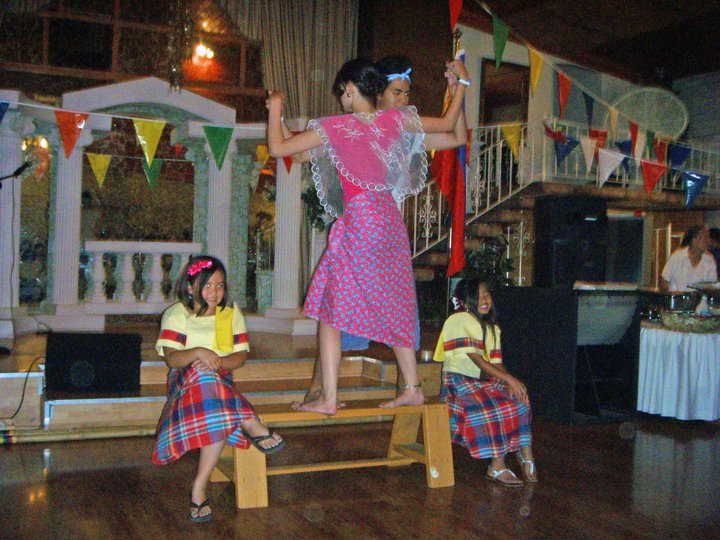
Dancers performing Sayaw sa Bangko, or the bench dance, at the fundraiser. Photo courtesy of Teena Jensen.

The Kulturang Pinoy Ensemble currently consists of 10 children between the ages of 13 and 18. The first performance was held on the evening of Sept. 11, 2010, during a fundraiser to raise money for costumes and props. The girls will wear a balintawak, which is a long dress with butterfly sleeves and a brightly colored overskirt that matches the sleeves. The boys will wear a chino, or brightly colored shirt. When the children outgrow them, plans are in place to pass the costumes down to younger children in hopes of getting more people involved in the ensemble.

Jensen said the program has seen a lot of interest from parents and children alike. When fully developed, the ensemble will have children as young as 5 years old dancing with the group.

“The younger ones come out and watch their brothers and sisters and say, ‘when are we going to start dancing,’” Jensen said.

However, it’s not just about the dancing. The ensemble also encourages the youngsters to learn the Filipino language. During each practice and performance, the children are given a Filipino word of the day. The group includes children who are from the Philippines, as well as those born here. The interaction between them is good for both groups, especially those learning the Pinoy language, Jensen said.

“It’s also learning respect from other Filipino children,” she said. “In the Philippines they respect their parents more than some of the children here do.”

The Philippines are made up of more than 7,000 islands, which creates diversity between the various areas. Jensen said each island has a unique dialect and is like a totally different culture. These different cultures allow for variety in the dances. Each dance has its own meaning and represents a story. Every performance is divided into suites that feature a dance native to a particular area or Filipino culture.

In an e-mail interview, Jensen said one dance suite the ensemble will perform is the Barrio Fiesta Suite. This is comprised of four different dances. The first is the Pista, which displays the lavish preparation for a party. Next is the Gala, also known as the Boholano. This dance comes alive with the clashing of pans, pots, plates, ladles and brooms with firewood, pails and knives to represent a wedding. The third dance is the Kalatong, a popular dance from the province of Batangas that uses bamboo percussion tubes. The finale, and perhaps the most well known of all Filipino dances, is the Tinikling, named after the Tikling bird. For this part the dancers imitate the bird as it avoids traps set by farmers.

The ensemble plans to perform the Barrio Fiesta Suite and others at schools, churches, fundraisers and any time the opportunity presents itself. However, the ultimate goal is to dance at the Living Traditions Festival in May and the Utah Asian Festival in June.

“That’s one of the main reasons for the ensemble, because people were asking – how come there are no Filipino groups performing at these events?” Jensen said.

Eunice Jones, president of the Kulturang Pinoy Ensemble and chairwoman of the Utah Asian Festival, said, “It’s not going to be just a dance group for one organization. It has to be for the whole community.”

Both Jensen and Jones are excited to share the Filipino culture with the community through the Kulturang Pinoy Ensemble.

Utah Asian Chamber of Commerce looking to expand scholarship program

Story and photos by KAREN HOLT BENNION

Growing up near a small village in the Philippines, she would often go to bed on an empty stomach. She spent her summers selling snacks like a vendor at a baseball game just to earn enough money to buy school supplies. She and her 10 brothers and sisters got by without running water or electricity. The only positive aspect in her life was the looking forward to each new school year. For Eunice Jones, education would be her salvation.

Eunice Jones discusses her life, past and present, with student-journalists at the University of Utah.

In her early teens, her parents moved the family to a small apartment in nearby Manila. Jones said the two-bedroom, one bathroom home seemed like a far cry from their “humble beginnings” back in her village. Life became a little easier for the family.

She eventually graduated from high school, and with the financial help from a college scholarship and her family, graduated in the top 10 of her class from a college in Manila. “That’s what we do,” Jones says. “We all help each other.” She got a job and settled down with her husband. They had two sons. However, after her husband left them, Jones decided it was time to venture outside of her home country. This meant breaking the rules of Philippine culture. She was supposed to live with her parents until she remarried.

She left her sons — one of whom was still breastfeeding — behind with her family and moved to Los Angeles, where she had been offered a job with the Hyatt Corp. “It was quite eye opening,” Jones says about her arrival in in that city. However, after three years of saving enough money she was able to obtain visas for her children and fly them to the U.S.

After marrying her second husband, they moved with him to Salt Lake City where she still worked in the hotel business. Finally, Jones decided she was ready for another challenge and earned her realtor’s license. During her first year as a realtor Jones was chosen as Rookie of the Year by Better Homes and Gardens magazine for her outstanding sales skills. She admits she owes it to selling snacks as a little girl in the summer. “I was in sales since I was a little girl,” she says.

In 2005, Jones, along with former Third District Judge Ray Uno, decided to establish the Utah Asian Chamber of Commerce. That same year, they also founded the Chamber’s scholarship program with the help of founding sponsor Zion’s Bank. Three scholarships were awarded at $1,000 each. Currently, the Chamber’s charitable foundation offers partial scholarships to an average of 15 students a year. Jones would like to see the scholarship program grow with more sponsors helping to offer full scholarships to high school seniors.

U student Amy Tran received a UACC scholarship in 2010.

One of last year’s recipients, Amy Tran, says the UACC Scholarship Program has helped her in more ways than one. A sophomore in business at the University of Utah, Tran says not only does the program give financial help, it also offers the students chances to receive training in leadership skills from local UACC members.

“The UACC is really supportive and motivating,” she says.

An awards gala and fundraiser for the scholarship program is held every spring. All of the students are invited to attend. They meet each other and are introduced to members of the UACC. The members then teach the students how to network and make connections. Tran says, “They all really try to get to know you.”

Another student at the U has been awarded the UACC’s scholarship for three years in a row. The last time she was awarded the scholarship she received the highest score of all the applicants. Michelle “Mika” Lee is currently earning her master’s degree in occupational therapy. She is also a part-time intern for the UACC. Lee works as the event coordinator.

“Education is placed high in my family — my father got a Ph.D. and my mother got her B.S. early,” Lee wrote in an e-mail interview.

UACC President Lavanya Mahate congratulates Mika Lee at the 2010 Scholarship Gala.

Both students agree that more publicity is needed in order for the scholarship program to grow. Tran heard about the scholarship through her uncle, who is a member of the UACC. She never heard anything about it at her high school. Scholarship co-founder, ZeMin Xiao, says their program is still small compared to other minority programs in the area. The main reason for this, she believes, is due to a stereotype that Asian-Americans do not need scholarships. People view Asian-Americans as the “Model Minorities,” she says. Tran agrees; when she told her friends she was going after different scholarships they told her she didn’t need them.

“You’re Asian, you’re smart, you’ll be fine,”  her friends said.

Xiao would like the Salt Lake community to know there is a scholarship specifically targeting Asian-Americans.  She says the program is constantly trying to find more sponsors. Some of the supporting companies include Merrimack Pharmaceuticals, Crocker Ventures Ltd. and vSpring Capital.

Now divorced, Eunice Jones dedicates more time with members of the UACC to help mentor Asian-American students and to try to get the Salt Lake community to realize that by helping to fund their scholarship program, it is investing in the future of all Utahns. After all, her family invested in her.

The bridge between authority and leadership

by SHAANTAI LEARY

Linda Oda, director of  Asian Affairs, is a petite Japanese-American woman who feels strongly about authority. As a sign of respect she has a sense to bow every time she meets someone older than she. (Oda did not want to disclose her age, but said she is “29 and holding.”) Bowing has been instilled within her as part of her culture. Custom also dictates that one’s elders should be respected; the phrase “children should be seen and not heard,” is a sign of this.

In addition to her role in the Utah State Office of Ethnic Affairs, she served as a moderator for the “Day of Remembrance,” which was held on Ogden’s 25th Street, also known as Japantown, Feb. 16-18, 2007.

She was raised on Ogden’s 25th Street. Oda’s first job was at the age of 3. Her family lived above the grocery store they owned and operated; her job in the store was to watch for “dorobo,” or shoplifters. She recalled a man asking her if she thought he was going to steal. As she described this confrontation, she put her hands on her hips just as she did when she was a child, and looked up. In a very stern voice she said, “yes.”

When Oda was about 10, her job in the small store was to trim the lettuce and pull off outer leaves so the greens displayed well. One day, a man walked into the store, pressed a knife to her stomach and said, “I could kill you.” Oda did not flinch. She took the knife she had been using on the heads of lettuce, placed it against the man’s stomach, and said, “I could kill you, too.”

She was raised to fight for her life; every day was a battle for her and her family. In fact, her father was murdered on 25th Street for less than $100.

Despite her difficult childhood, Oda went on to become a principal at Taylor Elementary School in Ogden. There, she worked to break the cycle of bullying by attempting to instill respect within her students.

Chase Dunn, 21, is majoring in Middle Eastern studies at the University of Utah. He is well-versed in his studies of culture and religions ranging from Islam to Catholicism. “Bowing is a sign of cultural respect,” he said in a text message. “Bow back. When it comes to authority I tend to think everyone should be met with skepticism. Sure they are older, but they are humans and humans make mistakes and have their own interests [in mind].”

Dunn, who is white, is currently working in Washington, D.C., as an intern for Frances D. Cook, the former ambassador to the Sultanate of Oman. Dunn also has completed study-abroad classes in Cairo and Beirut over the past few years.

”Power and authority should be challenged and unless they can justify themselves, then they should be dismantled,” Dunn wrote. “Remember authority figures and institutions are humans and human built and therefore can be changed.”

For Oda, authority is a compicated issue. She said that one’s “authority, stature and expertise can be diminished” simply because one is “an ethnic minority.” So, people feel as if they have to prove themselves. Oda said she is assertive, not aggressive. “I win and you win, both of us win. To me, that’s an Asian way.”