Welfare Square: the LDS Church helps people help themselves

Story and slideshow by CECELIA FENNELL

Take a tour of Welfare Square.

Upon entering the visitor’s center, guests were kindly ushered into a theater-like room by a missionary. When everyone was seated, the woman introduced herself as a volunteer worker for the Church of Jesus Christ of Latter-day Saints and started a 15-minute video on the history of Welfare Square. The tour began.

Operated by the LDS church, Welfare Square, located at 780 West and 800 South, serves people all over the world as well as locally. It is composed of seven entities: a granary, milk processing operation, bakery, cannery, storehouse, thrift store and an employment center. According to its website, each is designed to help people help themselves through the service and work organized here.

According to the short film, Welfare Square began during the Great Depression and led to the establishment of the church’s welfare program in Salt Lake City. The idea was to build on a tradition of compassion and charity as shown by Jesus Christ whom members of the LDS church and other Christian faiths look to as their savior and redeemer. Here, the church works to follow the example of Christ by providing care for the poor and helping them to become self-reliant.

Rachel Matautia, 22, from Australia, and her companion, Karly Nelson, 22, of California, are missionaries for the LDS church. The women conduct tours at Welfare Square and answer questions visitors may have about the church or its welfare program.

Following the video, they led visitors to the Bishops’ Storehouse. Members of the church as well as nonmembers come here to fill food and clothing orders for people in need.

“All the food here is grown and canned by the church. The products even have their own Deseret labels,” Matautia said.

Members of the church who are in need of food speak with their bishop, who is the presiding leader in a designated area. The bishop then takes these orders to the bishops’ storehouse and fills the orders with the help of other member volunteers. Recipients of food and services are asked to donate some time volunteering to help others in need.

“For everyone that comes in and has orders filled, we ask that they do four to five hours of service here,” said Jim Goodrich, manager of Welfare Square. “It’s not required, but it helps them to build their independence. People who receive goods for free tend to become dependent and the goal is to help people help themselves,” he said.

For people who don’t have bishops and aren’t members of the church, orders are filled for them as well. Offering service in return is suggested, but optional.

“We have over 30 transients come in each day. One thing many people don’t know is that we will serve everyone in need — no matter their background,” Goodrich said.

Funds to assist with maintenance costs come from “fast offerings” by church members. On the first Sunday of every month, church members skip meals and donate what they would have spent on those meals to the church. One hundred percent of fast offerings go toward helping the poor and needy. Members are not required to donate, though most do.

Many of the individuals receiving help through the bishop’s storehouse are unemployed. The LDS church offers help and work options to such individuals through its employment center.

“People who are in need of work or better work can come here to find employment,” Matautia said. “Employees and volunteers work with people to help them prepare for interviews, write better resumes and assist with needed educational training,” she said.

People in need of jobs can sign up for free classes that provide help with training for specific jobs, as well as English classes to help with the language barrier.

Next, visitors were led to a tall, white, grain elevator. The guides asked the tour group how long they estimated the granary building took to build.

“The granary is 178 feet tall and was built in just eight days because it had to be built through a continuous pouring of cement,” said Karly Nelson, the other tour guide.

The Granary stores wheat grown by the church. It is used in the bakery and to create emergency food supply packs called Atmit. The porridge-like substance, the guides explained, originated in Ethiopia; the LDS church perfected the powder and made it available in bulk. The church has served thousands of malnourished people in Ethiopia as well as other developing countries.

Milk and dairy products are also distributed and processed by the church. Cows owned by the church in Elberta, south of Utah Lake, produce the milk.

“The milk and cheese made at the Milk Processing Center is so fresh, the process of the milk going from the cows to Welfare Square is so quick that the milk hardly touches air,” Matautia said.

Before leaving the creamery, visitors sampled chocolate milk, cheese and bread, all produced by the church.

“Everything made is tested with products sold in the stores to ensure good quality. For example, the peanut butter made here is compared to Jif and Skippy to make sure it is the same quality,” Nelson said.

The tour came to an end as visitors made their way to the familiar Deseret Industries. The church-owned thrift store collects second-hand items. People around Utah donate unwanted items and the DI sells them again at a low cost.

“Not everything is second-hand. Many cabinets are made and sold by the church and they’re brand new,” Nelson said.

Many items donated to the DI also go to the church’s Humanitarian Center and are distributed to the poor and needy.

“Deseret Industries is more than just a thrift store,” said Randy Foote, assistant manager of Deseret Industries. “The DI also offers a community voucher program at no cost. Forty-six DIs participate in this program in Utah, but the need is across the board. People use the vouchers to purchase what they need at the DI,” he said.

The LDS church partners with local nonprofits that provide service. Jim Goodrich, manager of Welfare Square, says all excess food, clothing and goods produced at Welfare Square are donated to other local service organizations, like the Utah Food Bank.

“There seems to be a greater need for food and clothing here because of our location,” Foot said. “We often serve people living on the west side because we are on the west side. People need help everywhere though,” he said.

Becky French is a job coach trainer at the DI and works with all types of people. French decided to work here after moving to Utah from Pennsylvania. She said she was praying for work and found the job through LDS Employment Services.

“One of the things I love most is that they help anyone, it doesn’t matter where they came from. We help them to be self-reliant,” French said. She then shared a story of a woman she worked with who came from the west side of Salt Lake. “She was very capable, but she didn’t have any confidence because she had been abused. I challenged her to higher responsibilities and she was always worried at first but she eventually became a department leader and she’s done well,” she said.

French can recount each individual she has worked with and says they may look intimidating on the outside, but once she got to know them she grew to love them.

“I used to see rough-looking people on the street and feel nervous about working with them,” French said. “After spending some time with these people, it doesn’t matter their past. We’re all people with the same needs and we all want to be able to take care of ourselves and our children. When you give someone a chance, you can see the difference.”

Healthy food available for day cares

Story by JOHANNA WISCHMANN

Helping Hands Inc. is a nonprofit organization that works with day care homes to provide a healthy and nutritional diet.

The program works with children under the age of 12 in day care homes. It strives to improve the day cares, mostly run by low-income families, to afford better quality meals for the children.

Helping Hands works with Child and Adult Care Food Program, known as CACFP. CACFP is a federal program that gives healthy snacks and meals to children and adults involved with day care programs.

According to the Helping Hands website, the program helps the caregiver have the funds to purchase better quality of food, such as milk, breads and meats.

It also reimburses homes for healthy meals given to the children, like a breakfast of fruit, vegetables or milk. To get reimbursed for a meal provided for children, a provider has to make a claim.

Day cares and providers can claim up to two main meals and two snacks per child per day.

Susan Ison, executive director at Helping Hands, said that when a provider follows the USDA nutritional guidelines, Helping Hands works with the Utah State Office of Education to receive reimbursement for food given to the day care children and a lot of times the provider’s children.

An estimated 98 percent of providers that Helping Hands supports are from low-income families, Ison said in an email. An estimated 75 percent are from different cultures and ethnicities and don’t speak English. To qualify the providers have to have proper licenses and they must be caring for at least one non-residential child.

Once enrolled, a provider must complete paperwork, including a daily record of the food that the children ate and which children ate what food. This paperwork is given to Helping Hands monthly.

To ensure that the funds provided to the caregivers are being used correctly and to help maintain a healthy, nutritional diet and a healthy environment, Ison said. Helping Hands staff makes an unannounced visit about two to three times a year.

Not only does Helping Hands help with financial situations, staff also offer training on sanitation and nutrition.

“We provide nutrition and care giving training both, in actual training classes at our office and in-home during home visits,” Ison said.

“The biggest help we could receive is letting people know that this program is available to all day care providers, both those who are legally licensed for day care and those caring only for related children,” she said.

Helping Hands has a full menu available with healthy options for families and providers to choose from, like celery sticks, strawberries and peanut butter.

It also keeps information accessible to families by keeping recipes readily available for everybody interested in a healthier diet.

According to the website, Helping Hands also provides more information for providers by using the CACFP site that allows plenty of information and tools to make the use of the nonprofit very easy. For example there is a “food tracker” available for providers to use.

“In the current economic environment, it is more and more difficult to afford good, quality, healthful foods for our children,” Ison said in an email. “I, personally, would not have my child in a day care – whether in a residential day care home, or a day care center – that was not participating on the food program. I feel it is that important!”

Helping Hands has staff available for contact through email or telephone.

To  join Helping Hands fill out a form of information online or visit the location on 2964 W 4700 S, Suite 111 in West Valley City.

Utahns Against Hunger encourages Food Stamps program to those who qualify

Food Pantries only feed a small percentage of Utah's Hungry

Story and photo by CECELIA FENNELL

Efforts to end hunger in Utah continue beyond September, the state’s hunger action month, because food donations and distributions from food pantries only feed a small percent of the hungry.

That’s why Utahns Against Hunger, a nonprofit organization based on the west side of Salt Lake City, works to develop more effective community outreach programs for the larger percentage of Utah’s hungry. It does this by providing programs for low-income communities instead of providing direct services.

“Food pantries only feed a small percentage of the hungry so we provide other options and programs to meet all hunger needs in Utah,” said Mike Evans, associate director of Utahns Against Hunger. One option is the Supplemental Nutrition Assistance Program, also known as SNAP, a food stamps program.

According to UAH’s website, the organization was originally a project run out of Crossroads Urban Center in the late 1970s. As the community realized the need to improve federal nutrition programs statewide, it was established in 1981 as its own nonprofit organization. Since its beginning, UAH has worked to expand the reach of nutrition programs to “an estimated 1 in 6 households in Utah” who struggle to afford enough food by presenting and passing bills through Utah’s legislature. UAH is not an emergency food provider; instead its mission is to work with policymakers and community leaders to shape public policy by making nutrition programs work for the people who need them.

UAH serves all of Utah, but specifically those in need. Evans said the individuals who are most in need happen to live on the west side, which is why most food pantries are located in that area. UAH commonly advertises its events and programs to homes on the west side. In the past, the nonprofit distributed door hangers with information written in English on one side, and Spanish on the other.

According to its website, “UAH offers 17 food assistance programs, projects and initiatives. One program, Food Stamps, also known as the Supplemental Nutrition Assistance Program, or SNAP nationally, provides food assistance to low-income individuals and households through an electronic benefits transfer EBT card called the horizon card.”

Nathan Cram, director of Americorps VISTA, a partner of UAH, has been using food stamps himself over the past two years. Cram qualifies for food stamps because his net income is below the poverty level. He said the horizon card works a lot like a debit card and prevents many cases of fraud because of the rules associated with using it. It can only be used for food items and in stores that sell a majority of food products, he said.

“In order for an individual to qualify for the food stamps program, federal law requires that the individual’s net income be under poverty level,” Cram said. “Essentially they have to live on less than $900 each month,” he said. People can apply for food stamps through the Department of Workforce Services.

“Ninety-seven percent of food given to low-income communities comes from food stamps, only 6.6 percent comes from food pantries,” Cram said in a phone interview.

However, Evans said only 55 percent of those eligible of food stamps participate. “Some don’t know they’re eligible, some would rather seek other options and for others it’s an issue of humility – they want to be able to help themselves,” he said.

As an individual who has participated in SNAP, Cram encourages individuals who qualify for food stamps to participate because the quality of food is better.

“People surprisingly have more obesity in the low-income community because they can only afford foods high in fats and carbohydrates. Food stamps allow higher-quality food,” Cram said.

He also recommends using the food stamp calculator on UAH’s website to get an estimate on eligibility.

Since Utahns Against Hunger is an advocacy organization, it doesn’t need volunteers like food pantries and other nonprofits typically do. Directors of UAH encourage people to speak with local legislative leaders about existing hunger issues as a means to get involved.

“One of the best ways for people to get involved is by talking with their political leaders, volunteering and standing up and having a voice,” Evans said.

Healthy food choices gain value in string-along economy

Story and photo by FLOR OLIVO

As families hang on during the economic crisis many opt to cut down on food budgets and, in doing so, healthier diets.

A woman reaches for fresh fruit at a gas station in Utah.

Support program organizers say creativity, education and knowledge of existing food aid options are key to good nutrition for families passing through hard times.

Research shows good nutrition matters for growing children. Diets high in fat and sugar reduce a child’s ability to learn, focus and remember. Activity and energy levels are also affected.

The federal government has numerous programs geared towards nutrition. Grants for research funding on topics of healthy diets continue to roll out. In 2010 the Food Assistance and Nutrition Programs (FANRP) and the USDA’s Food and Nutrition Service (FNS) created a foundation geared toward the United States Department of Agriculture (USDA)’s child nutrition programs. The research included “incentivizing fruit and vegetable consumption in elementary schools, testing food choice innovations for middle school cafeterias, and drawing attention to healthy choices with lighting,” among others. The grants ranged from $1 million to $25,000 per award.

In 2009 the economic stimulus package increased food stamp benefits by about 13 percent enabling families to receive more money for food.

The same year, the Utah Department of Workforce Services (DWS) served more than 87,000 households, setting a record for the state. In 2010, the average food stamp caseload rose over 130,000.

There is concern and assistance is available but some say it lacks during transitional periods. “Transitional help is needed as families are struggling to make it,” Head Start Family Advocate Heather Johanson said.

Some parents in the program will turn down small raises to ensure they don’t lose food assistance. Many parents are in survival mode. When faced with decisions like good nutrition or paying the rent, food budgets get sliced. Buying “fast food” or prepared meals becomes easier and less expensive with two parents working, concluded Johanson.

Myriam Saavedra, a Jordan school district instructor who works with families daily, says economy is only one aspect of nutrition. Saavedra raised 5 children of her own. She experienced the struggles of concocting healthy meals and believes when budgets are tight, good options and creativity go a long way.

“For example, rice and beans are inexpensive, they have protein and carbohydrates,” Saavedra said. “Add orange juice, rich in Vitamin C, your body will absorb the iron in the lentils and you have a decent lunch. Someone that hasn’t taken a nutrition class would not understand the value of this meal.”

Programs like Women, Infants and Children (WIC) seek to bridge these educational disparities in underprivileged communities by providing assistance with supplemental foods. To receive benefits, qualified participants are required to take nutrition education classes, have iron and weight and height checks and a short meeting with a nutritionist on each visit.

Full-time mother, Jodi Spencer, feels that healthier food choices save money in the long run.

“Healthy food is more expensive, but you have to look at is as an investment,” insists Spencer. “It’s two-fold: your health will be better, less obesity, less doctor visits, etc., and that will, in the end, cost you less, and secondly, if more people opt for organic, non-genetically modified foods, the demand will be higher and the prices lower.”

In the state of Utah there are non-conventional options. Food co-ops are an increasing trend that helps curb costs for those who do not qualify for government help. Participants buy in for $24 and receive one meat share and one produce share. The meat share includes an alternating portion of ground beef, beef cubed steaks, pork ribs or chicken breasts. Produce share has five varieties fresh vegetables and three varieties of fresh fruit.

Most federally funded programs like WIC, Head Start or food stamps include resources for healthier meals. The Utah Department of Health website has information on local WIC offices where women and children can apply for services. Families can apply for food stamps at the DWS office or by visiting DWS’s website. For those who do not qualify for government assistance, the Utah Food Co-op can be helpful.

Overall, the concern for good nutrition for our children exists. Learning the options then making good choices trickles down to us.

Pending Chinatown in South Salt Lake anticipates fall 2011 grand opening

Story and multimedia by CHLOE NGUYEN

Read the proposal plan for South Salt Lake City’s new Chinatown

Chinatowns have become a major part of the American culture. According to the U.S. Census Bureau, 4.6 percent of the American population was of Asian descent in 2009. Utah’s Asian population was 2.1 percent of the state’s total population of 2.7 million. Since 1952, when Utah’s first and only Chinatown was torn down, there have not been plans for a replacement. But this changes in fall 2011. South Salt Lake City will be the home of Utah’s new Chinatown.

Salt Lake City Chinatown (SLCC) will be replacing the Rocky Point Haunted House, located at 3390 S. State St. For now, a billboard on State Street that announces the project is “coming soon” is the only thing that informs the public of the Chinatown.

The $15-million investment, initially proposed by Chinatown Investments Inc. in 2005, is headed by Hong Kong developers Yue So and Wai Chan. They had hoped to complete construction in December 2007, with a grand opening scheduled for March 2008. Plans called for transforming the area into a tourist attraction, with ceramic tile roofing, paper lamps, granite flooring and Asian-style fountains. But in late 2007, the country’s financial crisis stopped the production process. Banks were unwilling to lend money to business owners and potential clients of the project, according to Andrew So, 26, the project’s manager and son of Yue So and Wai Chan.

So is a graduate of New York University. After completing his degree in economics, So moved back to Utah, where his parents resided while plans for SLCC were in progress; the family is originally from Hong Kong. So says his parents have had their eye on a Salt Lake City Chinatown for about 10 years. He says his role as the project’s manager is his first partnership with the family business. And although So’s Chinese accent can sometimes cause minor barriers when conversing with people in English, he says language isn’t a problem most of the time because the majority of his clients speak in Chinese.

It has been two years since So actively promoted SLCC, but now the project is finally under way once again. “We paid attention to the market and believe now’s the time,” So said. “People are still very interested.”

To a majority of Utahns, SLCC will be their first introduction to a Chinatown in the state. More than 80 Chinatowns are spread across the country, and many are anticipating the day when Utah will be added to the list of states that have a Chinatown. But, actually, Utah was on that list a century ago.

During the 1900s, Plum Alley was the location of Utah’s first Chinatown. It ran north and south, dividing Main and State streets and crossing at 100 and 200 South. Nearly 2,000 Chinese immigrants resided there in 1907, according to KUED. Plum Alley served as the center for Chinese culture in Salt Lake. Chinese people developed a community with grocery and merchandise stores, laundries and restaurants.

The Joss House, an informal place of worship, and the Bing Kong Tong, which helped members of the Asian community find jobs and legal services, were also a major part of Plum Alley. It was a richly textured community.

But with the racial segregation happening during the time, white residents of the state tended to view Plum Alley as a center for widespread vice and illegality, with presence of gambling and opium dens, according to KUED.

In 1952, Plum Alley was torn down and the Regent Street Parking Terrace was erected in its place. Visitors who walk by the location will notice a brown plaque that stands by the street sign labeled as Plum Alley. The location marks Salt Lake City’s Tour Stop #11; the plaque was installed there in 2002 by the Utah Heritage Foundation for the Utah Travel Council. The plaque is the only public reminder of what used to be Utah’s first Chinatown more than a hundred years ago.

Now, over a century later, Utah will once again have another Chinatown.

Unlike the Chinatown in some other well-known locations, such as New York or San Francisco, where the community occupies an entire neighborhood and features street-front stores, SLCC will be similar to an Asian-style plaza, or mall. However, a similar feature will be the gate to the Chinatown and a temple for worshiping the Asian gods, such as Tsai Shen Yeh, the god of wealth, and Guan Yin, the Asian version of the Virgin Mary. Chinatown Investment Inc. has previously opened two successful Chinatowns in Orlando and Philadelphia that carried out the same structural plan.

The project will be a 5.7-acre parcel that will include the structure of the Rocky Point Haunted House and some accompanying undeveloped land. The 63,000-square-foot haunted house will be converted into 48,000 square feet of retail space. The space behind the building will be transformed into an 8,000-square-foot formal Chinese restaurant. The project also aims to have representations of a variety of Asian cuisines. “No two restaurants will have food from the same geographic area,” said So, SLCC’s project manager.

So hopes to include vendors from all parts of Asia, including those from Japan, China, Vietnam, Korea and the Philippines. He says the retail space will include beauty salons, Chinese herbal shops, acupuncture, karaoke rooms, boutiques and massage parlors. The northeastern corner will be used as office space for Asian merchants, such as dentists and attorneys, and retail space for gift shops and smaller convenience restaurants. The project will contain about 30 separate spaces.

So and his family plan to open a 30,000-square-foot Asian market, the largest in the state. It will offer Asian goods, as well as prepared Asian dishes, traditional barbeque and bakery items. Fresh seafood will be available.

SLCC will be a gathering place for Utah’s Asian community. Its parking lot will be used for cultural festivals, such as Chinese New Year, spring and moon festivals. Common areas in the development will be open to community groups. Wi-Fi and public computers will also be available for those who want a place to sit and relax with friends, similar to a coffee shop, So says.

The Chinatown will be a part of the city’s commercial revolution. The project is in a perfect location, according to a 2007 press release by the South Salt Lake Council and Planning Commission. It will be built between State and Main Streets, across from fast food and coffee franchises. The project will be a three-minute drive from Interstate 15, and a short walk from the UTA Trax station, located on Main Street.

SLCC will be the first Chinatown permitted by the Utah legislature, according to Chinatown Investment Inc.’s proposal plans. The project will be completed without public funding and will add to the city’s tax base, which will bring in new high-end customers, according to a report by the city’s Council and Planning Commission. The development team hopes to attract people who are also visiting Yellowstone National Park and other southern Utah parks, So says. It will aim to become a tourist destination for Utah.

“I see it as a community gathering place where the local community can come together,” said former South Salt Lake City Mayor Bob Gray in 2005. His comment was included in Chinatown Investment Inc.’s proposal. “It will be the only development of this type in the western states,” he added.

The project’s production will start up again in February or March 2011, after being placed on hold since 2007. SLCC is expected to hold its grand opening in the fall of 2011.

But So says he has not started marketing the development yet. “We don’t want to lose the confidence from other people in the project,” he said. “Last time we didn’t make it happen as we promised. This time, we want to make sure everything’s ready to go before we actually start the promotional marketing.”

Even though official promotion for SLCC hasn’t started, people are already showing interest in the project.

Tong Zhou, 19, a study-abroad student from China at the University of Utah, is looking forward to having a place to communicate with other Asians. “I am really excited,” he said. “I like to see Chinese be a group and help each other. Chinatown will not only be doing business, but also spread[ing] Chinese culture.”

So says the goal of the project is to create an Asian cultural hub. “There are Asian people scattered everywhere in the state, in different counties,” he said. “We tried to create a center, a place that they can gather and celebrate some Chinese festivals.”

But the Asian community is not the only targeted patron of the project. The development team hopes to draw in non-Asians as well. “It’s a place for non-Asian communities to know more about Asian communities,” So said.

So acknowledges that the majority of Utahns are not of Asian descent, but believes the Chinatown will invite these non-Asians to explore and learn more about the culture of Asian people. A few restaurants and shops are already in the area, but So hopes SLCC will become the place everyone will think of when it comes to Asian culture, markets and cuisines.

Brandon Harker, 21, a U student studying international relations, says the project will be a great way for Asian and non-Asian groups to come together. “I think it will be fun to have something new around that will serve a growing community within Utah,” he said. “It’s always fun to be able to experience a less filtered view of a different culture and experience the cuisine.”

The project is definitely going to happen, So said. He anticipates a majority of the construction will be finished by the grand opening date, so at least some shops and attractions will be open to the public while the remaining construction, if any, continues.

“It’s going to be something really unique for the valley. We’ve never had a project like this before,” said Mike Florence, South Salt Lake City Planner, in a phone interview. “We hope it will be a place that everyone will like.”


This slideshow requires JavaScript.

Chinese New Year celebrations in Utah bring out many family traditions

story and slideshow by LAUREN CARTER

See images of food, paper lanterns and New Chinatown in Los Angeles


The United States is a melting pot of people from countries all over the world. Many people living in the U.S. carry out traditions that have been passed down through generations from their families’ country of origin. In many Asian cultures, a popular time to carry out traditions is during New Year’s.

“New Year’s always has to be a big celebration, never small,” said Anh Dang, a freshman at the University of Utah, whose family lives in Salt Lake City but originates from Vietnam. “How you celebrate the New Year determines how the rest of the year will be.”

China, Taiwan, Vietnam and Korea celebrate the Chinese New Year. Japan celebrated the Chinese New Year for centuries before switching to celebrate the solar calendar’s New Year. However, some Japanese families still follow some of the traditions associated with Chinese New Year.

Chinese New Year falls on a different date every year, based on the lunar calendar. This date usually falls between January 31 and February 20, according to the solar calendar.

“Traditions for celebrating Chinese New Year are different for each country,” said Sora Lee, a Korean exchange student currently studying fashion design at the U.

Lee usually celebrates the Chinese New Year by cooking traditional Korean food and watching television with her family in Korea. They do not eat specific dishes for certain holidays, Lee said, but eat like they would as if it were a normal day.

Lee’s family doesn’t celebrate by doing certain traditions like other Asian countries. They just rest, meet with family and eat food together, she said. This upcoming year, Lee plans to try celebrating the solar New Year with her brother in Salt Lake City. They plan to celebrate by attending a three-hour Mass at a Catholic Church.

“In the United States it’s so complicated, everything is so different,” said Yuko Takeushi, a Japanese exchange student who is currently majoring in psychology at the U.  Staying in touch with Japanese culture is difficult, she said, but she likes reminiscing about her New Year’s traditions.

Every year Takeushi’s family goes to a shrine or temple in Japan to make wishes to their ancestors. Her family doesn’t have religion, she said, but they relate a lot with Buddhism beliefs. “We wish for God, good health and family,” she said.

Takeushi’s family also declares personal goals for the next year. These goals are written out in “shoozie,” meaning calligraphy in English, on a scroll during their New Year’s Day celebrations, she said.

Dang, whose family came from Vietnam, said his New Year’s traditions involve paying respects to the dead at the family’s home in Salt Lake City. This respect is shown through offerings of food. Their house has to be clean before they can “light incense and offer food to spirits that have passed,” Dang said. “Basically you just do what you want to do but you can’t mess the house up.” After the offering is complete, Dang’s family prepares traditional Vietnamese food for a large dinner. These traditional dishes often include fish, chicken and some style of rice.

Michelle Doong, a senior at the U who has ancestors from Taiwan and China, receives homebahs as part of her family’s traditions. Homebahs, also known as red bags, are filled with money and given to relatives in celebration for New Year’s and birthday celebrations. Doong usually receives one homebah from her parents and each set of grandparents every New Year.

Doong’s family also celebrates by eating traditional Chinese foods that contain some kind of soup, meat, chicken, fish, rice and noodles. “We do a huge dinner with the family,” she said. “There is at least twelve dishes, they want everyone to eat as much as they can.”

This is because of an ancient Chinese legend about a monster named Nein. The legend says that Nein would come on the first day of every New Year to devour anything it could capture. He would usually eat livestock, crops and people, especially children, Doong said.

The people began to leave food out for Nein, believing that if he were full then he would not take their children.  According to the legend, people saw that Nein was scared off by a child wearing red. Since then, red-colored lanterns and scrolls are used for decorations on New Year. The legend also says that Nein is scared away by the loud noise firecrackers make. Thus, fireworks often accompany the Chinese New Year celebrations.

Growing up, Doong learned a similar story where the kids would be taken away by the monster if they did not eat enough food at New Year’s dinner, she said. The twelve dishes they eat always contain some kind of soup, meat, chicken, fish, rice and noodles.

“Everybody loves traditions,” said Erika Minjarez, a junior majoring in mass communication at the U.

Her New Year’s traditions involve her mother and grandmother making traditional Japanese food. “We always have like chow mein, tempura, sushi and then we have American dishes, but I won’t go into that,” Minjarez said. “We’re not hard core into our heritage so it’s nice to have that.” Eating traditional Japanese food is what they have always done to celebrate the New Year; she said she couldn’t picture eating anything else.

Yellowfinn and The Flying Sumo making waves in Utah’s sushi market

Story and slideshow by SHAANTAI LEARY

Experience the atmosphere of Yellowfinn and The Flying Sumo


“It’s a ‘what do you think I should get’ roll,” said Willie Hatton-Ward, 22, a sushi chef at Yellowfinn, a grill and sushi bar in Salt Lake City.

Hatton-Ward describes his signature roll as an inside-out roll. He tops a bed of rice with seaweed and then fills it with cilantro, jalapeños, and tempura yams and shrimp. He trims the roll with spicy tuna and spicy mayo as well as wasabi-flavored tobiko and serves it with a side of Thai chili sauce. Hatton-Ward’s wry sense of humor is evident in the dish’s name, Flock of Seagals, which is a play on Utah’s state bird and the family of actors whose last name is Seagal.

Hatton-Ward has been working for Yellowfinn for about nine months and has been rolling sushi for about a year. He started his career at the Flying Sumo Sushi bar and grill in Park City, which is also where he was trained in the art of sushi rolling. Hatton-Ward said in order to get started as a sushi chef, it is about “who you know and a dedication level” to the art of making sushi. A sushi chef needs to “be able to handle certain stressful situations.”

Colleen Sharpe, 25, another sushi chef at Yellowfinn, said it can become very stressful to get the rolls out quickly during the dinner rush. Her favorite rolls to do during that time are the basic rolls with only one ingredient, such as a cucumber (kyuri) roll.

Sharpe, who is from Los Angeles, got her start in Big Bear Lake, Calif. She was lucky to be trained by one of the few women sushi chefs. They worked at a restaurant called Ichiban, which was later renamed and now no longer exists.

“If I went back out to LA, I wouldn’t be able to get a job,” Sharpe said. However, in Utah, things are a little different. In Utah, she said, you can take a break and come back because sushi chefs are in demand here.

“You’re always learning something,” Sharpe said. The trick is to “find somebody who’s willing to train you.”

Sharpe feels that in the sushi making world, “if you have any experience, it goes a long way.”

She is occasionally asked to accommodate customers who are allergic to various foods, including fish. She said she must use new knives and sanitize the food preparation station, even if she is busy during peak hours.

Yellowfinn, in Salt Lake City’s Sugarhouse neighborhood, is one of many sushi restaurants in Utah. However, it is one of the few that are actually open on Sundays. Its parent restaurant, the Flying Sumo, is also open on Sundays starting at 5:30 p.m.

Yellowfinn was unusually quiet during a Sunday visit in late October. Both Hatton-Ward and Sharpe said the rainy weather may have delayed dinner customers. The restaurant features dark wood, walls painted in maroon and beige and soft lighting.

Basic rolls cost between $6 and $10. Specialty rolls range from $10 to $15. Every day, the restaurant offers a “Hammertime” special from 3 p.m. to 6 p.m., which consists of $5 rolls and appetizers.

The Flying Sumo, located on the backside of Park City Utah’s Main Street, offers basic rolls costing between $7 and $15 and specialty rolls from $12 to $17. It has catered to everyday diners as well as many celebrities, from Paris Hilton to David Arquette. The room feels a little more like a club, with low lighting and dark red walls. During a recent visit, two televisions located behind the sushi bar played James Bond’s “Golden Eye,” while music by the group Owl City played in the background. It is open every day from 5:30 p.m. to close, which is usually around 10 p.m.

Adam Brown, 37, and Paul Munarriz, who did not state his age, are two sushi chefs at the Flying Sumo who have personally catered to the rich and famous.

Brown said that Paris Hilton and Nicole Richie came in to eat and Paris had broken something. Brown suggested that she go pick one up at Walmart because it is just down the street.

Brown recalled her saying as she sat at the sushi bar, “What’s Walmart? Do they sell walls there?”

Munarriz recounts one of his run-ins with Danny Glover. Munarriz said Glover was eating at the bar and had a plate balancing there. When Munarriz stood up, he almost knocked off the plate.

“He almost went ‘Lethal Weapon’ on me,” Munarriz said. Glover found it to be quite amusing as well.

Brown made a new version of the classic Vegas roll. As an inside-out roll, it contained jalapeño, cream cheese, avocado, salmon, tuna and spicy crab. While doing this he explained that rolling a sushi (meaning seasoned rice) roll is a three-step process for him. The final step is important in order to create a roll that will not fall apart. Brown leaves a small lip of the seaweed to tuck to the bottom of the roll; this prevents it from unraveling as the knife cuts through.

“You should call it the Wendover, patent it, [you will make] a million dollars,” Brown said with a smile across his face.

Another special dish at The Flying Sumo is the Super Mars roll. It is another inside-out roll containing tempura shrimp, sprouts, asparagus and lemon and topped with tuna, avocado, spicy crab, crunchies, tobiko (flying fish eggs) and eel sauce placed across the top. A Mars roll’s base is usually shrimp and cucumber; however, Brown removed the cucumber.

Munarriz said he and the other chefs have their own language and code for speaking to one another. “We’ll never reveal it,” he said.

The Flying Sumo has a sense of peace and serenity that makes people return whenever they are in town. “The Sumo has a special magic about him,” Brown said.

Kyoto Japanese Restaurant – bringing Japan to Utah

Story and slideshow by RICH FAHEY

View a slideshow of Kyoto Japanese Restaurant

Japanese paintings featuring koi fish, birch trees and buildings hang on the walls. A vase of fresh lilies sits on each table, illuminated by a paper lantern hanging overhead. Diners at a table to the left are just out of view thanks to a thin paper wall, allowing light to pass through. To the right, a family of five sits cross-legged with their shoes off. The place is Kyoto Japanese Restaurant.

From the cuisine and décor to the staff, Kyoto Japanese Restaurant is an authentic Japanese eating experience in Salt Lake City.

Founded on Aug. 16, 1984, by Osamu Tada and his wife Yoshiko, Kyoto has developed a large customer base of locals and out-of-state visitors alike. The restaurant is popular among members of both the Asian and white communities.

“We get a lot of customers from around the neighborhood, so we see a lot of the same people eat here often,” Yoshiko Tada said.

Located at 1080 E. 1300 South, Kyoto is easily accessible for visitors as well. The restaurant sees a lot of customers who come for conventions, such as the Outdoor Retailer Market held biannually in August and January. In the winter, snow sports enthusiasts who are on vacation frequent the restaurant.

“When people visit on one vacation, they always come back the next time,” Tada said.

Kyoto has both a lunch and dinner menu and a wide variety of dishes. It also serves Japanese beer such as Sapporo, and hot or cold sake. While the establishment does serve teriyaki chicken, tempura, sashimi and gyoza, it is known mainly for its sushi.

“We serve more traditional sushi than most places in the city,” Tada said.

Three different chefs, all of whom were trained in northern Japan, make the sushi rolls. It serves more traditional sushi so beginners are not as likely to eat at Kyoto, Tada said. One specialty roll that is a common choice for the experienced sushi eater is the Red Dragon roll.

Charles S., an online restaurant reviewer on Yelp, wrote, “My daughter ordered it and it was phenomenal! Best roll I’ve ever tasted … anywhere!”

Another dish served at Kyoto that is difficult to find anywhere else is Dobin Mushi. Made from the very rare pine mushroom, Dobin Mushi is a soup that also includes chicken and vegetables. What makes it special is the rarity of the mushroom and how long it takes to make. Each bowl of soup is heated and served individually in a small clay pot. The lid of the pot doubles as a cup to sip the soup from, similar to tea.

“Japanese people very much appreciate it,” Tada said.

The décor contributes to the authentic feel of Kyoto. The waiting area decorations are replaced every few months to accompany the changing of the seasons. Currently, pumpkins, leaves, an autumn bouquet and paintings representing fall give the small room a festive feeling.

“In Japan it is very important for people to feel the seasons,” Tada said.

Most of the paintings, some of which are extremely rare, are imported from Kyoto, Japan. Others were created by local artists. Kyoto is also home to a variety of beautiful furniture from Japan. In the front of the restaurant is a chest of drawers made of weathered wood. Crafted metal handles and designs give the drawers a worn look. On top sits a well-manicured bonsai tree. At the back of the restaurant in one of the high-occupancy booths is a similarly designed hutch, displaying different Japanese plates and sculptures, all imported from Kyoto.

The seating in the restaurant offers an authentic Japanese experience as well. While Kyoto has standard tables and chairs, it also offers traditional low tables where customers can sit on pillows and take their shoes off, which is customary in Japan.

Adding to the authentic atmosphere is the service. During dinner hours the waitresses, all of whom are Asian, wear kimonos. A kimono is a long robe traditionally worn in Japan that usually depicts a floral design.

“It is unique for Salt Lake City. I can’t think of another restaurant where they wear kimonos,” Tada said.

The staff at the restaurant is helpful and courteous. Some of the waitresses have been working there since it opened more than 26 years ago.

“We are just like a family,” Tada said.

Heather Scaglione, 23, a University of Utah alumna and sushi lover, said, “It’s not just the food that keeps me going back. Every time I’ve gone to Kyoto I’ve had a good experience.”

Southeast Supermarket – helping to maintain culture and diversify Utah

Story and photo by RICH FAHEY

For the majority of Utahns, eating a traditional meal means going to the grocery store for a wide selection of American foods. For the Asian community, eating traditional cuisine requires a little more effort. While most chain grocery stores offer an ethnic aisle, it lacks in authentic Asian food. But several specialty food stores that stock a wide selection of Asian cuisine can be found throughout the valley.

These Asian-specific supermarkets not only supply tasty foods, they also help the Asian community to maintain its heritage and culture.

“Just like language is part of their culture, so is their food,” said Linda Oda, director of Asian Affairs in the Utah State Office of Ethnic Affairs.

Southeast Supermarket, located at 422 E. 900 South in Salt Lake City, is one of these stores. The family-owned and operated business is the largest Asian-specific supermarket in the downtown area. It carries Chinese, Japanese, Korean, Hmong and Thai goods, including foods, drinks, teas, medicines, decorations and kitchen supplies.

Aisle

A wide range of items, both in bulk and individual portions, can be purchased at Southeast Supermarket.

Southeast Supermarket caters to a large number of Asian students from the University of Utah. According to the University of Utah Center for Ethnic Student Affairs, more than 1,300 Asian students are enrolled at the U. This creates a sizeable customer base for the store, especially while school is in session.

“We see a lot of international students, because we have products that they identify with,” said Thanh Trang, a Southeast Market employee and son of the owner.

According to Trang, items like dumplings, pot stickers and instant noodles are popular choices for students because they are quick and easy for people on the go.

These specialty food stores can also have a large impact on Asian-American children growing up in Utah. Growing up in a primarily white city, it is easy for children to become assimilated with American culture.

“You start becoming more American by being part of the community,” Oda said.

Without being exposed to traditional Asian cuisine, a portion of Asian culture can be lost in younger generations. By being part of both communities, children are able to retain some of their heritage and keep an important part of who they are.

“Although I was raised here in the States, and in Japan, I prefer to cook Japanese food for myself because it is always a nostalgic reminder of my childhood,” said Penelope Moffett, 20, a fine-arts graphic design student at the U. “Southeast Supermarket is the only way I can go to Japan, without actually flying anywhere.”

More recently, Southeast Supermarket has seen the number of white customers rise. According to Trang, over the past several years the clientele has changed from mostly Asian, to nearly half Asian and half white. This increase in white patrons shows a larger acceptance of the Asian culture. Oda said this acceptance of Asian cuisine is great for both cultures, and can be attributed to the availability of Asian restaurants and markets throughout the valley.

“It’s a substantiation that I’m OK, and you’re OK,” Oda said.

Another reason for the diversity among customers is the staff at Southeast Supermarket. The store takes pride in its customer service, and the fact that most of the staff speaks English makes it easier for American customers who are unfamiliar with the items.

“I can’t get to this place enough. The place is packed with aisle upon aisle of ingredients to bring your cooking alive,” wrote Stuart M., a Southeast Supermarket customer who posted a review on Yelp.

Coffee Shop in Salt Lake City’s Little America Hotel strives for authenticity with Asian cuisines

Story and photos by CHLOE NGUYEN

Asian seafood salad; beef tournedos with Asian-style salmon steak; vegetable stir fry; grilled chicken breast marinated with a ginger plum sauce — all food you would typically find in an Asian restaurant, right? Not quite.

You can actually find these dishes at the Coffee Shop, located inside the Little America Hotel, a three-star hotel in downtown Salt Lake City. The Coffee Shop is ranked 7th out of the 104 restaurants in the Salt Lake area, according to Virtual Tourist. It has always been known for its traditional “comfort food,” as Ashley Bollinger, 26, the hotel’s community relations manager, calls it. Its menus have had limited changes over the years because they have been well received by customers. But this does not mean there haven’t been accommodations.

“Most of the guests are very vocal with the dishes they like and what they would like to see added,” Bollinger said. “We feel the best way to review or make changes on our menu is to listen to them firsthand.”

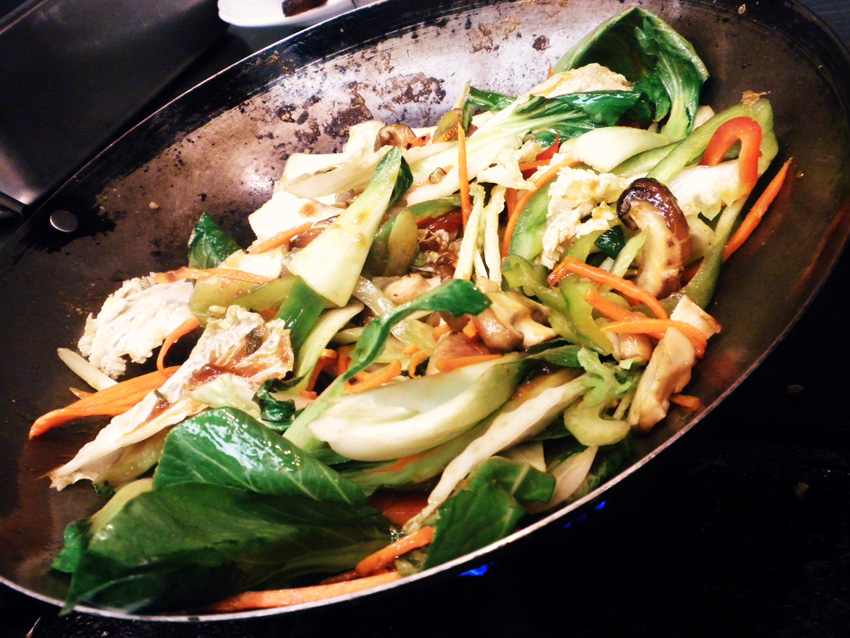
Customers want diverse dishes, including those from Asian cultures, such as seafood salad and marinated ginger plum chicken. And while these dishes are only available through the hotel’s banquet menu, the hotel’s Coffee Shop is always serving their customers Asian vegetable stir fry. And if a dish is requested often enough, the decision to include it in the regular menu is considered.

Besides the customers, the people who make the dishes also contribute to what is on the menu. The hotel’s kitchen staff consists of a diverse group of individuals, including Caucasians, Chinese, Vietnamese, Koreans and Hispanics. “[Because of this,] over the years I have incorporated many different dishes from all around the world in our daily cooking techniques and final products,” said Bernhard Götz, Little America’s executive chef.

Those final products are something to be proud of. Unlike some Americanized Asian dishes served at chain restaurants such as Panda Express or P.F. Chang’s China Bistro, the Coffee Shop is different. The chefs value the authenticity of a dish and the culture behind it.

“The traditional Asian dishes are prepared by my Asian cooks,” Götz said. “They are cooked in the traditional way with authentic ingredients.”

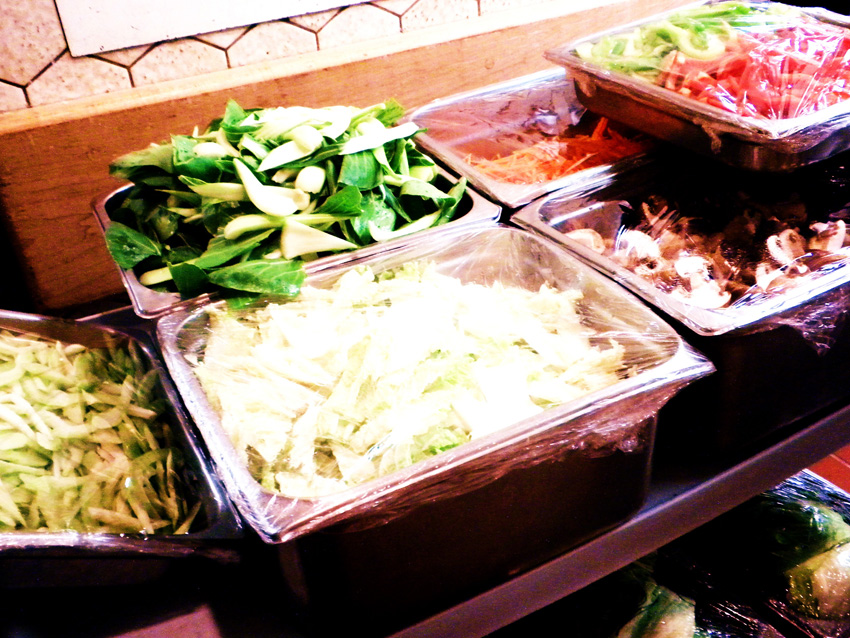
Ingredients native to Southeast Asia are included in the making of the dishes. Soy sauce, pineapple juice and ginger are some of the ingredients that go into the ginger plum sauce. Tofu, Napa cabbage, Bok Choy cabbage and Chinese mushroom are among the native vegetables of Southeastern Asian countries that are included in the vegetable stir fry. And like any authentic Asian dish, rice is always included.

If you ask people of Asian ethnicity, many will tell you that rice is a critical part of their culture. In most Asian cultures, “to eat” is often synonymous with the phrase “eat rice.” This can suggest that rice is of high importance to the people of Asia. Rice can be said to be an identification of the Asian community. “It’s important to keep the ingredients the way they would be as if in Asia,” Götz said. “You can’t get more authentic than that.”

But in America, it’s not always easy to keep the ingredients authentic. Chinese restaurant owners developed American Chinese cuisine when they modified their dishes to suit a more Western appetite. According to China Insight, these restaurants adapted by using local ingredients that were familiar to their customers, like flour. Rice was often replaced with noodles, made from flour. As a result, American Chinese cuisine is usually less pungent than authentic cuisine.

Many of these new dishes were quickly and easily prepared. According to an article by Yao-Wen Huang at Flavor & Fortune, they tend to be cooked with a lot of oil, monosodium glutamate (MSG) and sugar, which authentic cuisines do not commonly use.

It is rare to find an Asian American restaurant that serves Asian dishes with authentic ingredients and cooking methods. But the Little America Hotel recognizes and values the importance of diversity and culture in food. Just like language is a part of culture, so is food. “If we serve Asian food, we want it to be real, not fake,” Götz said. “That’s the whole point of why people come looking for authentic food.”