Swing for Hope fundraiser fights breast cancer

Story by JORDON CAHOON

Ask any athlete and they will be sure to tell you that every game means something. Some games are used for practice, some games are played to prove something and some simply mean more than others. Athletes play for many reasons: pride, fame, personal gain through education or financial means. It’s not very often you see an athlete play for charity.

Kathy Howa tosses the first pitch out at the Mesa Tournament. Photo courtesy of The Swing for Life Foundation.

The Swing for Life Foundation started off as a fundraiser during events like home run derbies and skill competitions, and then started to bloom and have entire games devoted to the cause of increasing awareness and funding for breast cancer. At first, the full games were only in women’s sports like softball, soccer, volleyball, and basketball, but as of 2009 it started to branch over into men’s sports.

Kathy Howa started this non-profit organization in April 2003 after being diagnosed with breast cancer in late August 2002.

“I coach high school volleyball and softball,” Howa said. “After my diagnosis, my athletes chose to wear pink ribbons with my name on them to the games and practices.”

It all started with the “strike out cancer hit-a-thon” where the Rowland Hall softball team rallied around Howa to raise money for the Susan G. Komen Foundation Race for the Cure. They received $12,000 between them and three other schools at the event.

“It’s no secret that the timing is hard to run any kind of foundation, but it’s amazing to see just how generous and giving people are in such hard economic times,” Howa said. “From our officials and field crews, to the volunteers doing all the behind the scenes work. They give up their time, which could be used to help out their families instead.“

Certain schools, such as Cottonwood High School, have spared no expense in making these games something to be remembered by purchasing pink gloves and shoelaces for football and pink head and wristbands along with shoelaces for basketball games. Some schools, like Brighton and Cottonwood, have had entire uniforms designed in pink just for one game.

“Even though we got killed last year, it was an awesome time just seeing all the people show up,” Matt Olsen, former catcher for the Brighton High School baseball team, said. “Pink isn’t really my color though.”

Since that initial fund raising tournament Howa has donated her time and efforts to her own foundation, Swing for Life, and has set a goal to donate $50,000 each year to Huntsman Cancer Foundation’s breast cancer research program. This goal has become increasingly difficult in recent years as the economy continues to spiral downward, but the foundation has made their goal each year so far.

“The biggest thing to look at isn’t the amount of time, money or effort that goes into these fund raisers, but to show people suffering from breast cancer that there are people trying and fighting for a cure,” Howa said. “Plus, I couldn’t give up the sports that I love.”

Healthy food choices gain value in string-along economy

Story and photo by FLOR OLIVO

As families hang on during the economic crisis many opt to cut down on food budgets and, in doing so, healthier diets.

A woman reaches for fresh fruit at a gas station in Utah.

Support program organizers say creativity, education and knowledge of existing food aid options are key to good nutrition for families passing through hard times.

Research shows good nutrition matters for growing children. Diets high in fat and sugar reduce a child’s ability to learn, focus and remember. Activity and energy levels are also affected.

The federal government has numerous programs geared towards nutrition. Grants for research funding on topics of healthy diets continue to roll out. In 2010 the Food Assistance and Nutrition Programs (FANRP) and the USDA’s Food and Nutrition Service (FNS) created a foundation geared toward the United States Department of Agriculture (USDA)’s child nutrition programs. The research included “incentivizing fruit and vegetable consumption in elementary schools, testing food choice innovations for middle school cafeterias, and drawing attention to healthy choices with lighting,” among others. The grants ranged from $1 million to $25,000 per award.

In 2009 the economic stimulus package increased food stamp benefits by about 13 percent enabling families to receive more money for food.

The same year, the Utah Department of Workforce Services (DWS) served more than 87,000 households, setting a record for the state. In 2010, the average food stamp caseload rose over 130,000.

There is concern and assistance is available but some say it lacks during transitional periods. “Transitional help is needed as families are struggling to make it,” Head Start Family Advocate Heather Johanson said.

Some parents in the program will turn down small raises to ensure they don’t lose food assistance. Many parents are in survival mode. When faced with decisions like good nutrition or paying the rent, food budgets get sliced. Buying “fast food” or prepared meals becomes easier and less expensive with two parents working, concluded Johanson.

Myriam Saavedra, a Jordan school district instructor who works with families daily, says economy is only one aspect of nutrition. Saavedra raised 5 children of her own. She experienced the struggles of concocting healthy meals and believes when budgets are tight, good options and creativity go a long way.

“For example, rice and beans are inexpensive, they have protein and carbohydrates,” Saavedra said. “Add orange juice, rich in Vitamin C, your body will absorb the iron in the lentils and you have a decent lunch. Someone that hasn’t taken a nutrition class would not understand the value of this meal.”

Programs like Women, Infants and Children (WIC) seek to bridge these educational disparities in underprivileged communities by providing assistance with supplemental foods. To receive benefits, qualified participants are required to take nutrition education classes, have iron and weight and height checks and a short meeting with a nutritionist on each visit.

Full-time mother, Jodi Spencer, feels that healthier food choices save money in the long run.

“Healthy food is more expensive, but you have to look at is as an investment,” insists Spencer. “It’s two-fold: your health will be better, less obesity, less doctor visits, etc., and that will, in the end, cost you less, and secondly, if more people opt for organic, non-genetically modified foods, the demand will be higher and the prices lower.”

In the state of Utah there are non-conventional options. Food co-ops are an increasing trend that helps curb costs for those who do not qualify for government help. Participants buy in for $24 and receive one meat share and one produce share. The meat share includes an alternating portion of ground beef, beef cubed steaks, pork ribs or chicken breasts. Produce share has five varieties fresh vegetables and three varieties of fresh fruit.

Most federally funded programs like WIC, Head Start or food stamps include resources for healthier meals. The Utah Department of Health website has information on local WIC offices where women and children can apply for services. Families can apply for food stamps at the DWS office or by visiting DWS’s website. For those who do not qualify for government assistance, the Utah Food Co-op can be helpful.

Overall, the concern for good nutrition for our children exists. Learning the options then making good choices trickles down to us.

Fraud: The silent budget killer

Story and photo by ROBERT CALLISTER

Utah legislators have been making the number one budget consumer, Medicaid, their number one priority in 2011. Last year, lawmakers had to fund the state’s $540 million in Medicaid contributions and are now looking for ways to reduce health care costs by addressing fraud, waste and abuse in the system.

Lawmakers debate on the House floor during the 2011 legislative session.

Severe budget cuts are sweeping the state and Utah does not have a dime to waste in any sector. There is mandatory spending for every state, but it can always be adjusted and modified. Medicaid consumes over 25 percent of state funding. It is growing at three times the rate of Utah’s budget.

Lawmakers convene daily in subcommittee meetings to address the unsustainable future of Utah’s health care system. And with the federal government socializing healthcare, it seems as if there will probably be further spikes in Medicaid, says Utah House Minority Leader Michael Litvack.

He estimates there will be an additional 100,000 people on Medicaid in Utah by the year 2014. There are currently 213,000 Utahns who are on the low-income health plan.

Rep. Litvack is on the state’s Social Service Subcommittee that deals with budget cuts. He feels one way to cut superfluous spending for the program is to address fraud in the system.

“I think that Utah is very prone to fraud,” Litvack said. “Perception of the state and instinct would almost have you think otherwise.”

But perception aside, the state faces the reality of a population that does not mind manipulating its government. A recent study conducted by the Federal Bureau of Investigation ranked Utah in the top five states for Medicaid fraud, costing millions of dollars every year.

Reports show the majority of fraud comes from people reporting procedures that don’t occur, falsely claiming disability, misrepresenting identification and medical centers billing for imaginary patients.

Sen. Allen M. Christensen, R-North Ogden, is the chairman of the Social Services Subcommittee. He worries that many people seem detached from their government and are indifferent to manipulating it.

“Generally, human nature makes people feel bad about taking advantage of one another,” Christensen said. “Unfortunately, this same guilt does not apply in taking advantage of the government.”

Rep. Litvack recognizes that aspects unique to Utah’s culture make it particularly prone to fraud.

“For whatever reason, whether it is the trusting culture that we have or whatever, it does seem that we have a big problem with affinity fraud,” he said.

Affinity fraud is known to be rampant in societies with high-levels of trust and admiration. Fraudsters will prey upon members of identifiable groups, such as religious communities. In Utah, research shows that 71 percent of the state’s population belong to the Church of Jesus Christ of Latter-Day Saints.

The combination between lack of respect for the government and willingness to take advantage of trust has turned Utah into a boiling pot of fraud. However, this year’s 45-day legislative session is addressing the situation from various angles.

Lawmakers are currently considering numerous bills regarding Medicaid reform. House bill 174 would require the Department of Health to issue reports to the Legislature before awarding Medicaid contracts. This would serve as an oversight program to monitor credibility of potential health care clients.

Rep. Litvack said the last legislative session appropriated millions of dollars to the Department of Health to create a program to prevent fraud, waste and abuse. The department will select a vendor to look at Medicaid claims on “the front end.”

“The purpose is to tease out as claims come in for payment, which ones represent fraud, abuse and mistakes,” he said. “So we are focusing on cost avoidance rather than cutting budgets.”

Rep. Ronda Menlove, R-Garland, is sponsoring a bill that would direct the Utah Health Department to pilot a program requiring some Medicaid recipients to do community service in exchange for health benefits. She recognized the need to push legislation to “combat a growing entitlement culture in this state.”

Last year there were legislative audits conducted against the Department of Health and Medicaid with strict focus on fraud.

Rep. Litvack sees fraud in a more broad sense and as something that needs to receive constant attention.

“We need to look at this issue in terms of Medicaid broadly,” he said. “Often times we need to think of fraud in terms of the intent of manipulating by billing for procedures that don’t happen or to even bill for patients that we haven’t seen.”

Legislators vary in opinion on certain amendments and bills, but they all recognize the importance of tracking money that goes in and out of the health care system.

Audits will continue to monitor the Department of Health and state Medicaid, said Litvack. Bills will be passed in attempt to reduce manipulation of the system. But legislators such as Sen. Christenson would exhort people to recognize that when they steal from the government, they are really stealing from their neighbor.

Master Lu’s Health Center: Northern-style Kung Fu and Old Yang-style Tai Chi

Story and multimedia by LAUREN CARTER

Take a brief tour of Master Lu’s Health Center in Salt Lake City

Master Lu’s Health Center teaches Northern-style Kung Fu and Old Yang-style Tai Chi to students of all ages in Salt Lake City.

“Every student is taught the same way,” said Matthew Stratton, who teaches Northern-style Kung Fu at the center at 3220 S. State St. “There is no belt system so the school has sustained over time by having a type of little brother-big brother and little sister-big sister environment.”

Kung Fu is the practice of external martial arts that involves free hand movements and movements with different types of weapons. Kung Fu is made up of sequences of fast movements called forms. It can take up to two minutes to complete one form. This is because one form can have around 16 movements within it, said Tyehao Lu, who teaches Kung Fu, Tai Chi, Bagua, and Xingyi. He also practices traditional Chinese medicine involving acupuncture and Chinese herbs at Master Lu’s Health Center.

Master Lu’s curriculum involves learning 30 forms before being able to test to become a master. This curriculum takes about seven years to complete. After achieving master status, students learn a new set of forms.

“I don’t believe in teaching fast,” Stratton said. “If I teach them slowly they will learn correctly.”

Some of Master Lu’s curriculum involves learning choreographed two-man fights. These fights take several nights to learn and are checked stance by stance to make sure the students are doing the moves correctly before being taught the next move, Stratton said. These forms are important because they use both offensive and defensive stances, involving a mix of blocks, ducks, kicks, punches and more. The lessons taught in these forms are used as building blocks for more advanced forms. This pace allows students to “throw a little bit of art and style into it but you have to develop it yourself,” Stratton said.

Tai Chi also uses the term form, but it has 108 movements that take about a half hour to complete because they are done more slowly, Lu said. Tai Chi is considered an internal practice of martial arts.

“Kung Fu helps develop muscles first and the outside body, whereas the internal martial arts builds up the spirit first,” Lu said. “Children and adults do more of the Kung Fu because it’s faster and more martial, while more seniors do Tai Chi because it’s low impact and more meditation.”

Bagua and Xingyi are two other forms of internal martial arts. Bagua involves circular movements and is based on the feng shui mirror that has eight trigrams. According to one source, the trigrams are “an ancient Chinese arrangement of eight binary symbols comprised of solid or straight (yang) lines and broken (yin) lines that represents the unity of Heaven and Earth and the blessings that acrue from allignment with natural virtue.”

Traditional Bagua involves walking around the mirror for eight full circles and then doing one hand movement. Practitioners then walk in the other direction eight times and do the hand movement. In all, the routine is repeated eight times.

“That’s some serious walking,” Stratton said. “Here we do eight steps then one hand movement and then go the other way around for eight steps and do the hand movement on the other side.”

Stratton continued, “Xingyi revolves around the elements fire, wood, earth, metal and water.” Xingyi involves straight-line movements and is a very aggressive yet powerful form of martial arts.

While Bagua and Xingyi have only specific directions of movements, Tai Chi does not. Tai Chi has movements that go in every direction, Lu said. The practices of Bagua, Xingyi and Tai Chi are unique because they can all unlock each other’s secrets so students should really study all three, Stratton said.

“For students that are really dedicated you should probably learn Tai Chi first, then Bagua and Xingyi last,” Stratton said. “It’s more than just doing the different forms, it’s studying the movements involved in each form.”

Master Lu’s Health Center encourages students to practice Kung Fu and Tai Chi together to keep balance of their internal and external energies, which is represented by the yin and yang symbol. “The balance has to be there to keep the mind and body sound, they complement each other,” Lu said.

The practice of martial arts has been shown to improve strength, flexibility, general health and memory skills, Lu said. It also works to reduce stress and can calm the mind while improving a person’s sense of discipline.

“If you practice for a while and then stop practicing, those things you learned are still within you so you can take the morals and principles and use them for your whole life,” Lu said.

Stratton believes people who try to learn martial arts with the intention of hurting other people with it will not last very long. He admits people can achieve a certain level but does not believe they can reach the maximum level. But if students just practice for themselves or for self-defense, Stratton believes they can make it to a higher level with the use of patience.

Master Lu teaches several principles to his students that they use in everyday life. Some of these principles are generosity, diligence, righteousness, kindness and loyalty. Instructors also strive to teach students that patience is very important to achieving internal happiness, which is the ultimate goal.

“Martial arts is a way of living,” Stratton said. “If you give back and live right you will get back and be happy.”

The majority of lessons taught are positive, but Stratton is also realistic when it comes to the real world and self defense. “I have to teach that society is not nice anymore,” Stratton said. “When I was a kid I could go play outside all day and my parents wouldn’t have to check on me. Now you can’t leave your kids playing outside without checking on them constantly.”

A key point Stratton stresses in self-defense is situational awareness. Students are taught to be aware of people and places around them and follow the movements of an attacker. So, if an attacker starts to move in a circle, then the student would move in a circle as well, Stratton said.

He also suggests that people don’t scream the word “help” because it won’t attract attention. Instead, they should scream “fire,” because everyone will stop to look for the fire. His advice to his students is to stay calm and be patient in any situation and the things they have learned will come to mind and help them out of the predicament.

Stratton has never had to use his martial arts against anyone. “I don’t look forward to the day I have to use it,” he said. “It would be a very bad day.”

Stratton said Master Lu has inspired him to remain a practitioner of Kung Fu and Tai Chi. However, Stratton dreams about opening his own martial arts center one day. “My goal is to teach teenagers how to communicate with adults and provide leadership for a community,” Stratton said.

Master Lu’s Health Center does more than offer Kung Fu and Tai Chi classes. It also treats patients using Chinese medicine. This medicine includes the use of acupuncture, Chinese herbal medicines and Chinese medical massages, known as Tui Na.

In addition, instructors at the center teach and perform the lion dance, which is a more traditional dance for Chinese New Year. In the lion dance performers do jumps, stacks, double stacks and rolls.

Luxury and relaxation at The Kura Door Holistic Japanese Spa

This slideshow requires JavaScript.

Photos courtesy of The Kura Door Holistic Japanese Spa

by SHAANTAI LEARY

On the corner, in a quaint neighborhood surrounded by brick homes typical of the Avenues neighborhood, sits a lovely stucco-style building surrounded by trees, bushes and vines; an outdoor patio completes the peaceful picture. A solid wood door establishes the entrance to The Kura Door, a holistic spa located at 1136 E. 3rd Ave. in Salt Lake City.

The massive door is an actual Kura door. In Japan, they are used in the family’s treasure house. Inside the treasure house are several chambers and the Kura door is used for the innermost chamber, which safeguards the family’s most valuable treasures from typhoons, fires and theft. This door was considered very important to the family.

According to the spa’s description of its services, “Our own entrance is adorned with such a door, a door that stood in protection over 150 years ago in Japan and stands again here today as a symbol of the integrity with which we guard our most important treasures – our guests.”

The woman at the front desk checks in guests and offers them comfortable sandals to wear instead of shoes. This helps reduce noise and dirt as guests walk on wood and bamboo floors through the two-story spa. Also, it is customary in Japan to leave one’s shoes in an entrance hall to distinguish the home from the outside environment.

It is very peaceful inside the spa. From the moment a guest makes an appointment to the moment she (and occasionally he) walks out the door, each guest is treated like royalty. A personal locker, showers, sauna and steam rooms and scented, organic lotions are just a few of the amenities that leave guests feeling as if they are a part of the Kura Door family.

A passerby, smiling and looking to the ceiling as if it held the answer, described the atmosphere saying, “There is just something about the Kura Door.”

And for those who have jumped on the green movement, the Kura Door is right up their alley. The spa is a completely green building, with insulation made from old denim, chemical-free paint and state-of-the-art water and air purification systems. In fact, all of the water in the building is recycled using an osmosis process.

The spa was started for a cause. Ali Kulmer, 35, and her husband Mark Kulmer, 37, began the business to help people find a way to heal naturally by finding their inner beauty and making their body better from the inside. Ali Kulmer’s mother was diagnosed with lung cancer and after several different types of natural treatments, she is now cancer free. She was a driving force behind the creation of the spa.

The Kura Door sees many cancer patients as well as those just looking for some relaxation. Guests don a thick, white kimono and relax with a cup of organic herbal tea while they wait to be called for their treatment. The spa is really about one’s well-being and the health of the body, rather than vanity. Consequently, guests won’t find a hair salon or technicians applying acrylic nails. The Kura Door does, however, offer a very wide variety of options to spa.

The Web site features a “How to Spa” page that advises novices to hydrate the body in advance and arrive about 20 minutes early to avoid feeling rushed. This will allow the body and mind to take a break from its busy day. An array of massages are offered, including Seisei, ShiatsuSamurai, Japanese Stone Massage and Four Hands Massage. The most popular treatment is the Kura, what the spa calls its “signature massage.” The unique massages range from 30 minutes to two hours in length.

The Kura Door also offers three body treatments to suit each guest’s needs: the green tea and ginger sea enzyme body wrapancient volcanic ritual and the traditional Javanese lulur body ritual, which “was originally designed as a ritual to prepare a bride for her wedding day.”

In addition, 12 different facial treatments, five different pedicures and six types of body enhancements are offered. Guests can pick and choose the treatments that sound appealing, or consult the Kura Door’s experts for suggestions.

Andy Lynner, 41, is a licensed massage therapist who has been working with the Kura Door since the spa opened in 2003. “It’s not just that we hand them [guests] their robe, let ’em wander around, fend for themselves. It’s really about making sure that they know where everything’s at and if they need anything, they can ask us for that,” Lynner said.

Amanda, 27, director of guest services, has been with Kura Door for more than two years. She said “it’s not just about coming in and getting a service; we really try to create an experience for them (customers), from the moment they step in the door.”

Amanda had been working at a spa in Park City as a massage therapist, when she came to the Kura Door and received a Thai massage. She realized that if she were going to work anywhere, it would be at the Kura Door.

During her visit, she said she was able to sense the spa’s “good energy” and employees’ happiness. She also observed that the spa “was very aesthetically pleasing but still felt warm.” Amanda said that combination can be difficult to achieve. “Either everything looks really perfect, but kind of feels cold, but here they’ve kind of figured out how to do both,” she said.

The Kura Door’s staff take customer satisfaction very seriously. Co-owner Mark Kulmer said, “We want someone to come in here and feel like it’s their house.”

The Kura Door has even won awards from City Weekly, such as “Best Day Spa” in 2008 and “Best Sake Soak” in 2009. As well, Salt Lake Magazine recognized it for “Best Pedicure” in 2010.

Unlike most businesses, the Kura Door’s gift certificates never expire. And, to ensure that customers are satisfied with their purchase, Kulmer said the spa keeps track of every certificate that is sold just in case it is misplaced or stolen. In November, the spa began offering weekly specials, such as a discount on a specific type of pedicure. When gift certificates valued at $100 went on sale for $90, Kulmer said the spa sold 25 certificates in just 15 minutes.

Business picks up around the holidays and during the fall and winter months. The Kura Door also is usually very busy on the weekends, so the best time to visit can be a Monday or Tuesday. Kulmer said the spa has between 500 and 1,000 clients who come at least four times a year.

The Kura Door has 61 employees and the establishment can do 15 appointments at any given hour. Kulmer said if an employee decides to leave, she usually goes away for a sabbatical and then returns. Those who do not come back to the spa stay in touch; the spa works like a business but staff interact like a close family.

Kulmer used to hate to work; he dreaded every day that he had to go in to work for someone else. “When I get home from vacation, I can’t wait to get to work,” Kulmer said, describing his newfound passion, his business, which is the Kura Door.

Educating the community about Filipino culture through dance

Story by RICH FAHEY

Filipino children in the Salt Lake Valley are getting involved in a new dance group as a way to help maintain tradition. Kulturang Pinoy Ensemble, or Filipino culture ensemble, gives Filipino youngsters the opportunity to learn traditional dances, and educates the community about the culture as well.

“We have a lot of young Filipinos growing up here, and we’d like for them to learn their culture,” said Teena Jensen, vice president of the Kulturang Pinoy Ensemble, in a phone interview. “It’s also a way to keep them out of trouble.”

The ensemble was developed at the end of August 2010 when some Filipino families became concerned that their children were losing their heritage. Jensen was a dancer in a similar Salt Lake City program that discontinued performances in 1998. The group’s main focus was to educate others about Filipino culture. While the new ensemble is following in their footsteps, it is a learning tool for both the audience and performers.

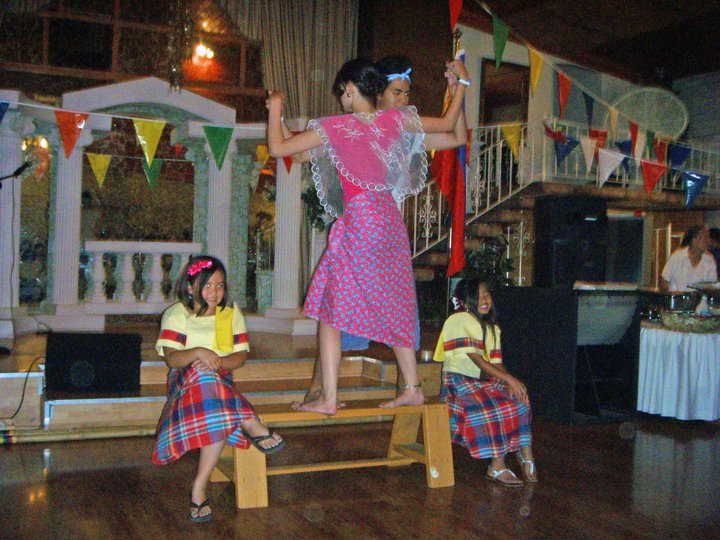
Dancers performing Sayaw sa Bangko, or the bench dance, at the fundraiser. Photo courtesy of Teena Jensen.

The Kulturang Pinoy Ensemble currently consists of 10 children between the ages of 13 and 18. The first performance was held on the evening of Sept. 11, 2010, during a fundraiser to raise money for costumes and props. The girls will wear a balintawak, which is a long dress with butterfly sleeves and a brightly colored overskirt that matches the sleeves. The boys will wear a chino, or brightly colored shirt. When the children outgrow them, plans are in place to pass the costumes down to younger children in hopes of getting more people involved in the ensemble.

Jensen said the program has seen a lot of interest from parents and children alike. When fully developed, the ensemble will have children as young as 5 years old dancing with the group.

“The younger ones come out and watch their brothers and sisters and say, ‘when are we going to start dancing,’” Jensen said.

However, it’s not just about the dancing. The ensemble also encourages the youngsters to learn the Filipino language. During each practice and performance, the children are given a Filipino word of the day. The group includes children who are from the Philippines, as well as those born here. The interaction between them is good for both groups, especially those learning the Pinoy language, Jensen said.

“It’s also learning respect from other Filipino children,” she said. “In the Philippines they respect their parents more than some of the children here do.”

The Philippines are made up of more than 7,000 islands, which creates diversity between the various areas. Jensen said each island has a unique dialect and is like a totally different culture. These different cultures allow for variety in the dances. Each dance has its own meaning and represents a story. Every performance is divided into suites that feature a dance native to a particular area or Filipino culture.

In an e-mail interview, Jensen said one dance suite the ensemble will perform is the Barrio Fiesta Suite. This is comprised of four different dances. The first is the Pista, which displays the lavish preparation for a party. Next is the Gala, also known as the Boholano. This dance comes alive with the clashing of pans, pots, plates, ladles and brooms with firewood, pails and knives to represent a wedding. The third dance is the Kalatong, a popular dance from the province of Batangas that uses bamboo percussion tubes. The finale, and perhaps the most well known of all Filipino dances, is the Tinikling, named after the Tikling bird. For this part the dancers imitate the bird as it avoids traps set by farmers.

The ensemble plans to perform the Barrio Fiesta Suite and others at schools, churches, fundraisers and any time the opportunity presents itself. However, the ultimate goal is to dance at the Living Traditions Festival in May and the Utah Asian Festival in June.

“That’s one of the main reasons for the ensemble, because people were asking – how come there are no Filipino groups performing at these events?” Jensen said.

Eunice Jones, president of the Kulturang Pinoy Ensemble and chairwoman of the Utah Asian Festival, said, “It’s not going to be just a dance group for one organization. It has to be for the whole community.”

Both Jensen and Jones are excited to share the Filipino culture with the community through the Kulturang Pinoy Ensemble.

Coffee Shop in Salt Lake City’s Little America Hotel strives for authenticity with Asian cuisines

Story and photos by CHLOE NGUYEN

Asian seafood salad; beef tournedos with Asian-style salmon steak; vegetable stir fry; grilled chicken breast marinated with a ginger plum sauce — all food you would typically find in an Asian restaurant, right? Not quite.

You can actually find these dishes at the Coffee Shop, located inside the Little America Hotel, a three-star hotel in downtown Salt Lake City. The Coffee Shop is ranked 7th out of the 104 restaurants in the Salt Lake area, according to Virtual Tourist. It has always been known for its traditional “comfort food,” as Ashley Bollinger, 26, the hotel’s community relations manager, calls it. Its menus have had limited changes over the years because they have been well received by customers. But this does not mean there haven’t been accommodations.

“Most of the guests are very vocal with the dishes they like and what they would like to see added,” Bollinger said. “We feel the best way to review or make changes on our menu is to listen to them firsthand.”

Customers want diverse dishes, including those from Asian cultures, such as seafood salad and marinated ginger plum chicken. And while these dishes are only available through the hotel’s banquet menu, the hotel’s Coffee Shop is always serving their customers Asian vegetable stir fry. And if a dish is requested often enough, the decision to include it in the regular menu is considered.

Besides the customers, the people who make the dishes also contribute to what is on the menu. The hotel’s kitchen staff consists of a diverse group of individuals, including Caucasians, Chinese, Vietnamese, Koreans and Hispanics. “[Because of this,] over the years I have incorporated many different dishes from all around the world in our daily cooking techniques and final products,” said Bernhard Götz, Little America’s executive chef.

Those final products are something to be proud of. Unlike some Americanized Asian dishes served at chain restaurants such as Panda Express or P.F. Chang’s China Bistro, the Coffee Shop is different. The chefs value the authenticity of a dish and the culture behind it.

“The traditional Asian dishes are prepared by my Asian cooks,” Götz said. “They are cooked in the traditional way with authentic ingredients.”

Ingredients native to Southeast Asia are included in the making of the dishes. Soy sauce, pineapple juice and ginger are some of the ingredients that go into the ginger plum sauce. Tofu, Napa cabbage, Bok Choy cabbage and Chinese mushroom are among the native vegetables of Southeastern Asian countries that are included in the vegetable stir fry. And like any authentic Asian dish, rice is always included.

If you ask people of Asian ethnicity, many will tell you that rice is a critical part of their culture. In most Asian cultures, “to eat” is often synonymous with the phrase “eat rice.” This can suggest that rice is of high importance to the people of Asia. Rice can be said to be an identification of the Asian community. “It’s important to keep the ingredients the way they would be as if in Asia,” Götz said. “You can’t get more authentic than that.”

But in America, it’s not always easy to keep the ingredients authentic. Chinese restaurant owners developed American Chinese cuisine when they modified their dishes to suit a more Western appetite. According to China Insight, these restaurants adapted by using local ingredients that were familiar to their customers, like flour. Rice was often replaced with noodles, made from flour. As a result, American Chinese cuisine is usually less pungent than authentic cuisine.

Many of these new dishes were quickly and easily prepared. According to an article by Yao-Wen Huang at Flavor & Fortune, they tend to be cooked with a lot of oil, monosodium glutamate (MSG) and sugar, which authentic cuisines do not commonly use.

It is rare to find an Asian American restaurant that serves Asian dishes with authentic ingredients and cooking methods. But the Little America Hotel recognizes and values the importance of diversity and culture in food. Just like language is a part of culture, so is food. “If we serve Asian food, we want it to be real, not fake,” Götz said. “That’s the whole point of why people come looking for authentic food.”

Utah Domestic Violence Council aims to aid members of Asian community affected by abuse

The Utah Domestic Violence Council works with many women's shelters, including the YWCA in Salt Lake City.

Story and photo by DANA IGO

Kenneth Warhola arrived at his Layton home Sept. 8 to find his wife locked in their children’s room. After several attempts to persuade her to open the door he broke it down. She was sitting next to the couple’s two children, Jean, 7, and James, 8, who were covered with a sheet and unresponsive. His wife, Sun Cha Warhola, 44, is charged with strangling them to death.

As the information came out in the Salt Lake Tribune and Deseret News, it was learned that disputes between Sun Cha Warhola and her husband had been ongoing for more than four years.

According to the Tribune, Kenneth Warhola was charged with domestic violence in 2007. In another incident both Warholas were charged after an altercation in a parking lot. One report just weeks before the murders showed that Sun Cha Warhola alleged that her husband had sexually abused their children. The Davis County Attorney’s office reviewed the case and determined the accusations were unsubstantiated, as reported by the Tribune.

The Deseret News wrote that before the murders, Sun Cha Warhola called a Korean newspaper in a desperate attempt for help. She told Inseon Cho Kim, director of the Korean Times of Utah, that she dreaded leaving her husband with their children in the event of a divorce.

While all women have difficulty coming forward to get help for domestic abuse, women in the Asian community face a particular quandary. Prevention and educational programs on domestic crime aren’t targeted to Asian women. A report published by the National Asian Women’s Health Organization suggested that this is because society tends to view the Asian population as a “model minority,” meaning that they are viewed as achieving high rates of success.

Asian women have the lowest rate of domestic violence of any of the major racial groups. A small number of Asian and Pacific Islander women, 12.8 percent, reported having experienced physical assault by a partner at least once in their lifetime, according to a study published by the Asian & Pacific Islander Institute on Domestic Violence. This was the lowest percentage among any racial class surveyed, which was cited by experts as being due to underreporting.

The unwillingness to come forward in cases of domestic violence among Asian women may also be perpetuated by culture.

Dr. Linda Oda, director of Asian Affairs at the Utah Office of Ethnic Affairs, said that abuse in Asian families isn’t often reported because their cultural values tend to stress keeping things within the family.

Unlike Western culture, traditional Eastern culture puts emphasis on the family instead of the individual, leaving Asian women feeling less inclined to report physical and domestic abuse.

The Utah Domestic Violence Council (UDVC), 205 N. 400 West, a nonprofit organization with resources throughout the state, is reaching out to the underserved communities across Utah in an effort to prevent future domestic crimes. In preparation for Domestic Violence Awareness Month in October, the council’s diversity coordinator, Hildegard Koenig, provided information to the Asian Advisory Council so its eleven members could pass it to their respective communities. She approached the council because it connects the Asian community with Oda and her office.

“By working and educating community leaders and building those strong relationships we can start a dialogue on how we can better assist victims of domestic violence in their communities,” Koenig said.

Sometimes the educational materials fall short. Salman Masud, the council’s representative of the Pakistani community, said the materials offered by the UDVC were only written in a few languages, which narrows the ability of non-English speaking Asian immigrants and refugees to know whom to contact in a domestic abuse situation. Currently the brochures are offered in seven languages, including Chinese, Tongan and Samoan. Koenig is seeking individuals to help translate the material into other languages.

Non-English speakers can call The Utah Domestic Violence Link Line, 800-897-LINK (5465). The hotline is currently available in 144 languages, making it a good resource for members of all communities who may not be able to get the printed materials in his or her language.  Many of the UDVC‘s resources can be accessed online, including special reports, training materials and a map of domestic violence programs throughout the state.

Common octopus is anything but

Story and slideshow by KEITH R. ARANEO-YOWELL

Go to any Asian food market in Salt Lake City, and you will likely find bags of deep, blood-red flesh packed in ice. Go to any sushi restaurant and you’re likely to see on the sashimi or nigiri menu an item called “tako” (pronounced like the Mexican “taco”). Buy or order it for the first time and you’ll likely change any previously held beliefs about octopus.

Long considered a delicacy in Mediterranean and Asian (especially Japanese) cuisine, octopus is thought of by many to be prohibitively tough to prepare and chew.

“It’s rubbery, hard to bite and it doesn’t break apart very easily, even when it’s fully cooked,” said George Mateo, a visitor to the Living Planet Aquarium in Sandy.

Still, others wouldn’t hesitate to try it. Mason Childs, 21, works as a server at Market Street Grill. He said, “If it was on our menu at work I would probably try it once or twice.”

Splendidtable.com contributor Mark Bittman writes, “If octopus is properly handled, without fuss, it is reasonably tender. It remains chewy, but so does lobster, or sirloin steak.”

Home cooks can reduce the rubbery texture of octopus using a number of different strategies.  These range from the unusual Italian method of boiling it with wine corks to the brutish, yet obvious, method of beating it against rocks.

Bittman wrote even though these methods are effective, the key to eliminating most of the toughness is slow cooking time at very low temperatures.

Sue Kim, the owner of the Oriental Food Market at 667 S. 700 East in Salt Lake City, said she probably only sells one bag containing four tentacles and the head of an adult common octopus every day on average.

Kim attributes the relatively low rate of sales to the “rubbery” label attached to octopus meat as well as its alien appearance, and at $24.99 per bag, and similar pricing in restaurants around town, it’s considered a delicacy and not a staple.

Nina Clark, 23, is an exercise and sports science major at the University of Utah who said she hopes to pursue a career in public health education. She said octopus is an uncommon dish in Utah because there’s no coast. “We’re not exposed to it,” Clark said. “We’re land-locked.”

Childs said he could see why some people would be hesitant to eat octopus. “They’re scary creatures. To think they can open a mason jar without hands and do it while sitting on top of it. They’re pretty violent in the ocean.”

Others hesitate because of the octopus’ unusual appearance. Lacy Mateo, 20, who was visiting the Living Planet Aquarium with her husband, George, said she would never eat octopus because of the suction cups. Clark expressed similar reservations because of the fluidity of octopus movement.

With a single bulbous sack (or mantle) housing all their internal organs, surrounded by eight suction cup-covered arms and skin that looks like it’s been dead for a number of decades along with its reputation for rubberiness, it’s no wonder Clark and the Mateos find the look of the meat “gross.”

For all their physical irregularities, however, John Lambert, aquarist at the Monterey Bay Aquarium, said they pale in comparison to the strange behaviors he observes on a daily basis.

They can change the color and texture of their skin in a blink of an eye to avoid detection from predators. An article that appeared in Advanced Aquarists Online Magazine described the mimic octopus, which reproduces the rough appearance and movement of more than 15 different marine species native to its habitat of tropical Southeast Asia.

While feeding cancer crabs to the Giant Pacific Octopi at the California aquarium, Lambert, 52, and Aquarium Communications Director Ken Peterson, 61, described the difficulty associated with keeping their two Giant Pacific Octopi, Nano and November.

“There was an institution that was losing fish out of one of its tanks,” Lambert said. “They set up a camera over night and discovered that an octopus in an adjacent tank was crawling out at night, making its way over to the tank the fish were in, and helping itself and then returning to its own exhibit.”

Peterson later added that it had actually happened at the Monterey Bay Aquarium.

Because of the octopi’s desire to explore outside their enclosures, all outer edges of the octopus habitats are lined with Astroturf, which “prevents the octopus from being able to get a grip on it with their suction cups,” Peterson said.

Despite anecdotes of rather adventurous octopi, they spend most of their time in small crevices between rocks on the sea floor and are, therefore, extremely hard to fish. A fisherman for Monterey Fish Co Inc., who wished only to be called Dane, said just shrimp-trapping boats in Monterey regularly catch octopus.

Because the only hard structure in their bodies is a small parrot-like beak where all its tentacles converge, octopi can fit through the extremely small holes in shrimp traps. Lambert also said octopi are apt problem solvers and shrimping traps don’t really pose a challenge.

“They’re certainly very intelligent animals,” Lambert said. “[Researchers] put an item in a jar with a screw lid and the octopus can figure out how to unscrew the lid and get to the item. The first time they see it, it will be a challenge, but they work at it. They’re very tenacious animals.”

Their intelligence and ability to deform their bodies causes problems for shrimping boats in Monterey. Dane said, “Octopi will crawl into the traps and eat the shrimp.”

Shrimpers in Monterey lose an indeterminable amount of money each year due to octopus. According to the California Department of Fish and Game’s 2010-2011 Ocean Sport Fishing Regulations, octopi can only be caught and kept if line or hand-caught.

“[Shrimpers] usually throw [octopi] back,” Dane said. One shrimper who doesn’t always follow regulations said, “If I’m going to lose my catch, I at least want to sell the thing that cost me my paycheck.” For obvious reasons, this fisherman asked that he and his boat not be identified.

With the exception of when fishermen actually bring in an octopus, it is very difficult to find restaurants in Monterey that serve octopus. This is partly due to the aquarium’s decade-long effort to raise awareness across the U.S. about common fishing practices.

The Monterey Bay Aquarium publishes reports on commonly eaten seafood items. According to the 2008 report for common octopus (the species that is sold for food), most of what is sourced for use in the American sushi industry is sold as common octopus, even if it is of a different species.

Kim said she orders the octopus in her store from a Japanese fishery.

According to the report, Kim’s octopus comes from either Morocco or Thailand where the preferred method of octopus fishing is a practice called bottom trawling, in which boats drag fishing nets along the sea floor.

Octopus distributors in Japan also work with fisheries in Spain that catch octopus in pots, which is an artificial habitat perfectly suited to octopus. These pots lie on the sea floor for two to three days before fishermen reel them back in to collect the octopi.

In either case, after it is caught, it is blanched and shipped to Japan to be prepared for sushi by removing the beak, the poison and ink glands, the eyes and the internal organs. It is then frozen and re-exported to the U.S.

Monterey Bay Aquarium’s Seafood Watch Program assesses the ecological sustainability as well as the safety of eating seafood items commonly found in U.S. fish markets. According to the report, “due to the difficulty associated with discerning the actual country of origin of octopus found in US sushi restaurants, [octopus] should be avoided as a general rule. While Spanish octopus (especially pot-caught) is a preferred alternative to North African and Vietnamese octopus, it is rare that sufficient sourcing information is available to the consumer.”

The report, however, does little to address the adverse health effects of heavy metals that continue to build in species moving up the food chain.

In their report titled, “Bioaccumulation of Lead, Calcium and Strontium and Their Relationships in the Octopus vulgaris,” researchers Sonia Seixas and Graham Pierce found that “aquatic animals take up and accumulate lead from water, sediment and food.”

Because there is no way to rid tissue of lead by natural means, Seixas and Pierce observed “concentrations higher than the maximum legally permitted concentration of lead in food.”

Being conscious of how food gets to the dinner plate is a crucial element in public health, exercise and sports science major Nina Clark said. “That’s a big reason I try to avoid seafood in general. I’m aware of the patterns of how fish is shipped, exported and re-exported.”

Market Street server Mason Childs said the surprise he felt learning how octopus gets to the dinner table in a land-locked region illuminates a good deal about his previously held beliefs about seafood and sustainability. At the end of the interview, he asked for a copy of Seafood Watch.

“Eating is one of the most intimate things humans do,” Clark said. “It’s crucial that we educate ourselves on the repercussions of our choices.”

Seasonal flu still a priority for the elderly

Story and photos by Leigh Walsh

The H1N1 swine flu is making the headlines, but the seasonal flu is still the No. 1 concern among Utah’s aging population.

After months of media coverage and hype surrounding the H1N1 flu, the first batch of vaccinations has finally arrived in Utah.

Flu Sign

A flu shot advertisement stands outside a Smith's Pharmacy in Salt Lake City.

The Salt Lake Valley Health Department has announced this first shipment will be reserved for certain priority groups. However, a noticeable absentee from the high-risk group is the elderly population.

This age group is almost always a priority when the seasonal flu vaccines come out each year, so why not for the H1N1? According to the Centers for Disease Control and Prevention, people over the age of 65 are least likely to become sick from the H1N1 virus.

Linda McGraw, director of nursing at Brighton Gardens, a nursing care facility in Salt Lake, explains some of the theories behind why seniors may be less susceptible.

“There was a swine flu epidemic back in the 1970s when they did do some immunizations,” McGraw said. “Experts are thinking this particular group of the population probably got exposed to a certain degree, which built up their immune system. This may be why older people are not as susceptible to getting as sick with the H1N1 virus as the population in their 20s.”

The current media attention is being generated around H1N1, but the worry for the elderly should still be the annual seasonal flu. According to the CDC, 36,000 people die each year from flu-related causes; 200,000 more are hospitalized from flu-related complications. Ninety percent of flu-related deaths and more than half of flu-related hospitalizations occur in people age 65 and older.

The flu season usually runs from October through March, when the virus is at its most rampant. Different venues around the state are currently administering the seasonal flu vaccine. Smith’s Pharmacy on 455 S. 500 East began giving flu shots on Sept. 10.

Camille Sanders, a student pharmacist, said the majority of people they vaccinate at Smith’s are older adults.

“We are actually running out of our batches a bit quicker this year because many people are coming in to get their seasonal flu vaccine earlier,” Sanders said.

Some experts have recommended leaving some space between the H1N1 and seasonal flu vaccines. As of now only priority groups can be immunized against the H1N1. Therefore, older adults are coming in earlier for their seasonal flu shot.

“People want to be prepared for when the H1N1 vaccine is available to them,” Sanders said.

People who are immunized at Smith’s Pharmacy are educated on other preventative measures important to slow down the spread of disease.

“We explain to people the benefits of hand washing and other measures that are important in preventing people getting sick,” Sanders said. “We also hand out an information leaflet to people with any additional questions.”

Brighton Gardens

Residents at assisted living centers, like Brighton Gardens in Salt Lake City, are encouraged to get the seasonal flu vaccine.

The contagious nature of the flu makes it very important to thwart it early, especially in nursing-care facilities around the state. Just by looking around the walls at Brighton Gardens it is evident the flu season is upon us. There are warnings to visitors who may be ill to stay away and instructions about important preventative measures. This community is made up of people with compromised immune systems who are at high risk so it is important to have procedures in place in order to stop the spread of the flu.

McGraw said the epidemiological track system they have in place is to stop diseases spreading before they have a chance.

“We ask who is sick, when did they become symptomatic, what floor do they live on. We start washing and using Clorox to kill germs and extra housekeeping is brought in. We may even ask people not to come down to the dining area,” she said.

Statistics show the seasonal flu is still a major problem in society yet the H1N1 virus has caught the attention of the world. McGraw said this is because the H1N1 epidemic brought a level of panic upon the country because we knew so little about it.

“The sad thing about the H1N1 is that it kills young people who had a lovely quality of life,” McGraw said. “It was traumatic to see young people dying and this caused people to sit up and listen.”

Research shows 30 percent of all Americans over the age of 65 don’t get an annual flu vaccine. With the flu season upon us it is vital for people, particularly older adults, to get out and get immunized.

“People do die from seasonal flu, that is why we encourage everyone to be vaccinated,” McGraw said.