Su banco opening up opportunities

by ERIK DAENITZ

Su Banco is not just a “survival skills” language program.

Instead, graduates leave Su Banco with advanced English skills in speaking, reading and writing.

“The purpose of the program is to give students the English skills they need to pursue the career they want here,” said Rick Van De Graaf, the program coordinator.

Many of the students already possess professional knowledge that they acquired in other countries, Van De Graaf said. However, their proficiencies with English may not be quite good enough to break into the jobs they desire.

Su Banco was launched in the spring of 2005 to help these individuals. It is offered through the English Language Institute at the University of Utah.

The class was the vision of Theresa Martinez, assistant vice president for academic outreach at the U. With the help of Zion’s First National Bank, her vision now is a reality.

The name Su Banco came from Zion’s involvement. It refers to banking services that the bank markets to the Latino community.

All students who are admitted to the program receive scholarships from Zion’s. The scholarship covers 80 percent of the $1,400 cost, and if students complete the three-month class they receive reimbursement for the remaining 20 percent.

“We owe a huge debt of thanks to Scott Anderson,” Martinez said.

Anderson, the president and chief executive officer of Zion’s, was instrumental in getting the program started, Martinez said.

Martinez, a member of Zion’s board of directors, brought the idea of an advanced English language program to Anderson in 2005 after spending a semester interviewing her colleagues in continuing education about her objectives.

Within months Su Banco became a reality and Van De Graaf was hired to coordinate the program and teach the classes.

He brought experience from community-based English language programs and looked forward to teaching students in an advanced class.

“Most of the people at this level are extremely concerned with education,” Van De Graaf said. “They are completely committed to learning English, or they wouldn’t be here.”

Wilder Guadalupe came to the United States with a degree in animal science engineering from Universidad Nacional Agraria La Molina in his home country of Peru. One of his goals is to receive a master’s degree in business administration from a university in the United States.

However, in order to be admitted to many universities he must pass the TOEFL, or Test of English as a Foreign Language. Students take the test near the end of the Su Banco class.

“Passing the test will help me reach my goals,” Guadalupe said. “I want to get an MBA degree and after that maybe a Ph.D. I think it’s very important for me to get this type of degree, and it’s another opportunity to improve my English level.”

Guadalupe plans on combining his experience in animal science and business with his continually improving English skills.

His experience buying, selling and trading grains and animal food commodities gives him valuable business expertise along with is understanding of the agricultural industry, Guadalupe said. “After graduation I want to look for a position in a financial institution focusing on agricultural topics and international trade.”

Gloria Villarreal, another Su Banco student is thankful for the opportunity Zion’s Bank has provided students like her.

While Guadalupe looks toward opportunities in business, Villarreal has a different career in mind.

“I like working in computing,” Villarreal said. “I also work for the Salt Lake school district and I am so happy. Everyday, seeing the kids makes me so happy.”

Villarreal took English classes at the Horizonte Instruction and Training Center in South Salt Lake City, but the classes focused mainly on grammar and written English. The Su Banco classes are giving her new exposure to vocabulary and words she never heard before, which helps her communication in all aspects.

“I would like to continue to study until I learn perfect English,” Villarreal said. “I’m not going to stop.”

With her improvements in the English language she brings another skill to her job in the school district.

She serves as a translator between parents, teachers and administration when language barriers exist, she said.

While improving job opportunities is a focal point of all the students, Jaime Mendoza brought up an additional motivation for improving his English skills.

“I have a son who is 4 years old,” Mendoza said. “He spends most of his time with people that speak English. He speaks more English than Spanish, and I want to be able to understand my son. Someday in the future I would like for him to speak Spanish and English well.”

Mendoza, who came to the United States from Peru, began learning English from friends and classes in school. However, he became too busy working to continue with classes.

Now he is dedicating more time to learning.

“It’s very good and very interesting,” Mendoza said. ” I really want to go to school for my family and for myself to be better.”

Su Banco is more than a basic English language class. It demands students’ time and effort.

“We have to study every day,” Gloria Villarreal said. “If we do not do our homework we must go home and not come to class. But I like that. If the teacher is not pushing us we will not study.”

Nevertheless, all of the participants recognize that their hard work will open new doors.

“If we improve our communication we can get a better job,” said Dinora Melendez, another Su Banco student. “That means a better life.”

Local exhibit promotes acceptance, offers historical perspective

Story and photo by JEFF DUNN

It’s been almost two years since the largest public demonstration in Utah’s history. On April 9, 2006, roughly 43,000 Latinos marched in Salt Lake City, promoting unity in the Hispanic community and petitioning the state for comprehensive immigration reform.

This year, Armando Solorzano is bringing the rally back to life with a photo-documentary titled “Invisible No More: Latinos Dignity March in Utah.” Solorzano says he received more than 4,000 pictures from participants in the demonstration before settling on 700 of the most striking images.

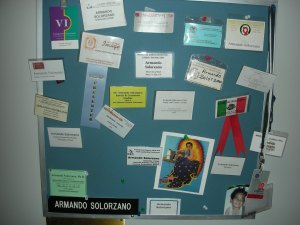
“The reason I did the exhibit was to provide a different aspect to the undocumented immigrants,” Solorzano said. “The whole idea was to portray their feelings, their hopes, their expectations and the love they feel for the United States.”armando-solorzano

The exhibit has been successful so far, according to Solorzano. More than 85,000 people visited when the documentary was first displayed at the city library, and about 8,000 people showed up in February to see the exhibit at Westminster College.

Solorzano and his staff have a goal of 100,000 people viewing the photographs, and with trips to Dixie State, Weber State and the University of Utah scheduled for later this year, that goal seems attainable.

Solorzano, a professor of family and consumer science at the U, said the exhibit helps dispel negative stereotypes about Latinos.

“The whole intention [of the documentary] was to humanize their experience, because the perception is that these people are coming here to violate the law or to engage in criminal acts,” he said. “But that is not true.”

Tony Yapias, the main organizer of the march, donated more than 1,500 photos taken by his wife and son.

“Our purpose was to send a message to the rest of the country that we need immigration reform,” he said. “The march was a huge success. There’s been nothing like it in the history of this state.”

Though the march did not immediately achieve the immigration reform its organizers hoped for, Yapias said the march has promoted change in other ways. For example, since 2006, the state has received a record number of applications for citizenship and hundreds of thousands of Latinos have registered to vote.

“We’re beginning to see the fruits of the march,” he said. “We accomplished a lot more than we ever expected.”

Yapias said the documentary has provided him a window to the past and an opportunity to contextualize the march.

“When you’re doing something, you don’t realize what you’re doing,” he said. “The documentary opened up a new perspective for us to look back and realize what happened.”

Yapias said Solorzano has been an instrumental contributor to Utah’s Latino community.

“Professor Solorzano is one of the unique professors in the state,” he said. “I’m glad to have had an opportunity to work with him.”

Gonzalo Palza, who continues to work with Yapias in promoting immigration reform, helped organize the walk and also participated.

“It was empowering, a great, great moment for Latinos in the state,” he said. “It triggered some concerns from the status quo. It triggered a bunker mentality. For the first time, [the status quo] really felt threatened. The state realized this is an issue that needs to be dealt with and cannot be ignored.”

But Palza also is quick to point out that the demonstration had negative results as well. He feels that the march has limited reform bills from being passed and encouraged anti-immigration legislation. Some have become even more entrenched in their fears and stereotypical views since the rally, he said.

Still, Palza believes the event brought the Latino community together in a powerful way.

“It was a great opportunity for us to display our unity,” he said. “Everybody who participated in the march felt really good.”

Solorzano’s collection of photographs has brought thousands together, as well. He said the media often focus on negative aspects of the Latino community, but he wants to use the exhibit to focus on its contributions and history in the state.

“Our struggles, our contributions, our participation in political or religious areas is not taken into consideration,” he said. “It looks like we don’t have a history, despite the fact that we have been in this place, in Utah, for about 15,000 years. Nobody knows about us.

“The intention of the exhibit was to document, to bring history alive again, and to remind people that we are bringing important components for the history of the state,” he added.

And Solorzano knows plenty about history, among other things. He was born in Ciudad Guzman, Mexico, but has lived in the United States for 32 years. He has an impressive academic resume, holding multiple degrees from several institutions. He said his constant desire to learn has given him motivation in school.

“Part of my way of living is I need to learn something every day,” he said. “I can’t go to bed without knowing something new. The only reason I like to learn is that I like to teach and share with others.”

Solorzano has been learning about other cultures his entire life. His mother is French, his father is Native American and his wife is Italian American.

“The majority of people believe that Mexicans are mainly Spaniards or Mestisos,” he said. “It’s pretty interesting, because my diversity has been at the roots of who I am.”

As for his two children, “they identify themselves as members of the cosmic race. My children are the combination of all races and different nationalities and countries,” he said.

Solorzano said the United States is about 20 years away from the most important change in the country’s history.

“By the year 2035, minorities or people of color will become the majority in the United States,” he said. “In order to come to that transition in a peaceful way, we need to understand each other more. I think that the racism and discrimination that people typically face is based on a lack of knowledge.”

The tenured professor said he works daily with students to promote diversity and, more importantly, acceptance.

“In my classes, I try to make the students more aware of the situation,” he said. “The whole idea is that we can come together and live in peace. Twenty years from now, America will look very, very different.

“By understanding people of a native background, Asian background, or Latino background, we will be able to maintain this society as one of the most exciting places to live in the world.”

It’s an early spring day, and the late afternoon light sifts through the half-drawn blinds hanging in Solorzano’s office window. Most of his colleagues and students are on their way home, having already absorbed a day’s worth of teaching and learning. Not this man. He sits attentively at his computer, still typing, still working, still dreaming.

Plazas making difference in Utah’s Hispanic community

by JEFF DUNN

Sometimes inspiration can come from an unlikely source. For Sandra Plazas, it came from a door-to-door salesman.

Two years after the first copies of Utah’s first bilingual newspaper came off the press, Plazas and her mother, Gladys Gonzalez, had had their share of difficult challenges. When the two began Mundo Hispano in May 1993, they didn’t have a staff of writers, editors or designers, and the women were forced to multitask to get everything ready for press. Financial issues added to the burden, and by 1995, the women were tired and discouraged and ready to quit.

“I didn’t think I could make it,” Plazas says.

The salesman learned of the family’s struggles in getting the paper off the ground and offered encouragement. He told of his own father who had given up too soon on a business venture years before.

“He said, ‘When a tough time comes, after that you find a solution. Don’t give up.”

They didn’t. Though impossibly long hours continued for the next few years, the women persisted, and in 1998 the paper turned the corner.

“For the first five years, I didn’t know what a vacation was,” she says. “I forgot that even existed. It was a lot of work. Thank God for technology.”

More than 10,000 copies of Mundo Hispano now are printed every week, with issues being distributed from Ogden to Payson. The paper became the official Spanish language portal of KSL in 2006.

“The thing I learned best is persistence,” Plazas says. “Even when times are tough.”

The paper’s co-founder says the mission of Mundo Hispano is to bring people together, not pull them apart. That, she says, is what makes the paper stand out against the backdrop of other bilingual and Spanish-language papers in the U.S.

“We focus on integration, they focus on separation. That’s the difference,” she says.

Plazas hopes the paper provides people the opportunity to get to know Utah’s Hispanic population.

“We are humans,” she says. “We may speak a different language, but we’re still from planet Earth. We believe that as each community learns from each other there is going to be a lot more understanding.”

Though Plazas has never made a personal profit off the paper, she says she’s more concerned with Mundo Hispano having a positive impact on the community.

“We believe the newspaper has a mission of integration, of getting to know each other,” she said. “And that’s why we do it.”

The integration effort has required Plazas and Gonzalez to work countless hours side-by-side. The editor says she and her mother have learned to work well together over the years.

“It’s not usual to work with your mother for 15 years and still be friends,” she said, smiling. “We fight sometimes.”

Sandra Plazas fled political unrest in Colombia in 1991, looking for safety and new opportunities with her mother and brother. The Mormon family relocated to Salt Lake City because they wanted to be close to the Church of Jesus Christ of Latter-day Saints, she said.

But Plazas and her brother were frustrated when their mother, who had worked in a high position in a Colombian bank, could not find comparable work in Utah. Instead of working in American banks, she began cleaning them to make ends meet.

“In the beginning, I wasn’t happy,” she said. “Now I love the USA, but at first, I didn’t. When you come here you’re starting just like everyone else.”

Plazas said it took her a year before she was conversant in English. She attended language classes full time while juggling a full work schedule during her first 12 months in Utah.

“It was really, really hard,” she said. “I hated it with a passion. I can’t tell you how much I hated it.”

Despite her initial struggles with acculturation, Plazas has become a significant player in Utah’s Hispanic community. When she’s not working at the paper or her and her mother’s ad agency, La Agency, which provides much of their income, Plazas takes time to coach an underprivileged boys soccer team, aptly named Mundo Hispano.

“That has been one of my most rewarding moments, to show those kids a different world,” she said. “It’s been an incredible experience for me.”

The former youth soccer player says she requires the boys, who are 15 and 16, to keep up on their grades and stay out of trouble to be eligible to play on the team. Plazas encourages her players to succeed in school and says she wants them to aim for college.

“I believe that any kid, if you raise the bar and give them expectations, they will step up,” she said.

The coach often serves as a mediator between the players and their parents. She told of one instance where a player had got into trouble for sneaking out at night to be with his girlfriend. The parents called her and asked for advice. She first talked to the son and then the parents until the issue was resolved.

“I don’t lie when I say I am like their mom,” she said. “Sometimes it’s not easy. One thing I try to teach them is not only getting but giving back.”

Plazas says she is certain the team has made a lasting impact on the players.

“If I talk about achieving success in life in general, I would say the soccer team [is the greatest]. I know I have changed the life of at least one of those kids.”

Local chef finds success and celebrity after fleeing Cuba

by DAVID SERVATIUS

Adalberto Diaz makes his weekly cooking class a hands-on experience for students. Photo by David Servatius.

Adalberto Diaz makes his weekly cooking class a hands-on experience for students. Photo by David Servatius.

It is seafood and pasta night. The menu includes smoked spinach fettuccini with shrimp, fresh tuna seviche and crab cakes on fennel angel nests. The room is full of upscale, white, middle-aged men and women, some seated, some up and moving around. The atmosphere is unruly, the air full of laughter, shouting and clapping.

At first glance the kitchen area looks like a bizarre three-ring circus with shooting flames, flashing blades and a grinning, wise-cracking Cuban in the middle of it all, barking directions. Like a ringmaster, he is stirring with one hand, pointing with the other, telling the crowd how to chop onions correctly and instructing a woman at his side to drop her battered scallops into the fryer one at a time.

It is not a circus, though. It is just a typical night at the popular weekly cooking class taught by local chef and television personality Adalberto Diaz. Every Wednesday in the center showroom of the Roth Concept Center in Salt Lake City, Diaz creates a unique menu and a beautifully presented, delicious meal for 24 emerges from this organized chaos. But before everyone finally sits down and eats, there are two hours of fun.

“This is not a cooking show,” Diaz tells the audience at the outset. “I’m not cooking for you. You are cooking with me. Now who wants to help me with skewers?”

One class member yells, “I do. I do.”

“Not you,” Diaz snaps. “You are the pan washer.”

The crowd erupts into laughter and applause.

“I don’t know how he does it,” kitchen assistant Chelsea Smoltz says. “Every night I’m sure that we won’t get done in time to eat, or that someone will lose a finger or burn their face. But it always works out better than I’m expecting. The people just love him.”

Diaz, 35, has come from a different place and a different life than what he knows now. He says it is hard to believe that just seven short years ago he was sitting alone in a Texas detention center, terrified, between two worlds and unsure what would become of him.

Born in Havana in 1972, Diaz grew up with three brothers, two aunts, a grandmother and a great-grandmother in what he calls “the family house,” a modest but spacious two-story structure built by his grandfather in 1948.

“There were at least 10 people living there all the time,” Diaz says. “I always cooked with my grandmother. I never got any credit, I was just a helper for her, but I loved doing it and I learned a lot.”

When he was 9 years old, he used a pressure cooker — most Cuban families were too poor to afford traditional ovens — to make a lemon sponge cake. A neighbor tasted it, loved it and wanted one. He says he made another, charged his neighbor three pesetas, or about 15 cents, and realized he had a way to earn extra money for the family.

In Castro’s Cuba, however, the capital to purchase supplies for a private business was hard to come by. Diaz says he set up a system in which he would repair leather shoes in exchange for rum, which he would, in turn, trade for eggs, flour and other essentials.

Later, after high school and his required two years of service in the Cuban military, Diaz enrolled in the culinary school at the Hotel Sevilla in central Havana, where he also worked as a tourist entertainer. From the hotel, he ran a private, forbidden, baking business on the side, sometimes working all night to keep up with the ever-growing demand for his pastries, cakes and breads.

He says he became friends with three Salt Lake City nightclub promoters who made frequent trips to host parties on the island in violation of U.S. law. For years, Diaz helped them prepare the food for their parties.

In 2000, he was noticed by the Cuban government.

“I found out I had been what we called ‘tagged,’” Diaz says. “Not for my business, though. It was because I had had too much direct contact with the Americans. I couldn’t work at the hotel anymore unless I spied on my friends for the government. I’m not that kind of person so I lost my job.”

That May, he says his best friend Rafael Labrada convinced him it was time for both of them to leave the country for good. Diaz was unemployed, probably now unemployable, and as officials snooped into his life there was suddenly the very real possibility of jail.

“I found out that a big project linking all of the government computers was almost done,” his friend Labrada says. “That would make it impossible for a marked person like Adalberto to ever leave the country, for any reason. If he was going he had to do it within a week or so.”

The two went into hiding in Havana while the necessary documents were secured, going out only early in the morning or late at night. On May 24, Diaz told his family he was going on a camping trip and began a journey out of Cuba to a new life with his three American friends in Salt Lake City who had urged him to come.

“I was afraid to stay in Cuba, I had a big fear of jail, but I also wanted to leave,” Diaz says. “It wasn’t just fear. I knew that if I didn’t leave I would not improve as a chef, or as a person. The hardest thing was leaving my mother, not knowing when I would see her again.”

Using phony work visas, Diaz and Labrada took a short flight to Mexico City. Under the U.S. “Wet Feet, Dry Feet” policy, implemented in 1995, Cubans caught at sea trying to enter the country are turned back, but those apprehended on American soil are allowed to apply for asylum. Because of this policy, the U.S. Department of Homeland Security says Mexico has become the most popular route into the country for Cuban refugees.

In Mexico City the two were picked up by a “mule,” an American man they paid $3,000 to smuggle them to the border town of Reynosa. When they arrived in Reynosa, Diaz says they were instructed by their mule to cross the bridge over the Rio Bravo River into Hidalgo, Texas, on foot, and to tell the guards on the other side they were Cuban and seeking political asylum.

When the two refused to return to the Mexican side of the border to wait for their paperwork, they were taken by federal agents to the U.S. Immigration and Naturalization Service processing center at Port Isabel, on the Gulf Coast of Texas. Labrada would be released in a matter of days, but Diaz would stay for what he says were the worst three weeks of his life.

“There were cells, with bars,” he says. “It was a jail. There were six or seven curved buildings with big walls and lots of fences, and everything was ugly gray, everything, except for the uniforms. They were bright blue, for the good guys, like me, and bright orange for the criminals.”

Labrada says he and Diaz were separated as soon as they arrived. “They didn’t like anyone having friendships inside the place,” he says. “But we would see each other sometimes, at meals or in the bathrooms.”

Diaz says the bathrooms were probably the worst part of the entire ordeal. “There was no privacy,” he says. “If someone happened to have diarrhea you could hear it all over, and, even worse, smell it. Cubans are private people. I was so stressed that my hair turned white with dandruff.”

After what he says seemed like an eternity, his paperwork was processed and Diaz was free and in America. He and Labrada reunited in Miami and, after a long bus ride, arrived in Utah in the wee hours of the morning on the Fourth of July.

“I was stinky and tired, but the first thing I did was go to the Fourth of July parade in Provo, to celebrate being in America,” Diaz says. “I remember thinking, ‘This is a parade? This is how they celebrate?’ It was lame! There was no music, no dancing. I was expecting Brazilian Carnival and it was a bunch of white people walking.”

When the parade was over, however, the reality of life as a new immigrant in America set in. For almost a year Diaz worked as a laborer, painting and installing Sheetrock for a construction company. He says it was hard physical work. Then, in 2001, two of his friends opened a restaurant called Orbit in downtown Salt Lake City. They heard Diaz had been well-known in Cuba for his pastries and hired him as the restaurant’s pastry chef.

A year later he was running his own show as head chef at a trendy new restaurant and deli called Juhl Haus where, just like with his neighbor and his lemon cake all those years ago, a stranger was so impressed with something he cooked that it changed the direction of his life.

Marie Ritchie, the showroom manager at the Roth Concept Center, where most of the cooking programs on local television networks are taped, hired Juhl Haus to cater a party. One of the menu items Diaz prepared for the event was a spicy tomato soup.

“It was the best tomato soup I had ever tasted in my life,” Ritchie says. “I had wanted to start cooking classes in the big center showroom where we do television, so Adalberto and I talked about it that night. Within days we were working together and within two or three weeks we offered our first class.”

Ritchie says the weekly classes quickly started filling up and she noticed it was Diaz himself that people were coming for as much as it was his food or his recipes.

“He is like an artist, and he is a natural entertainer,” she says.

Ritchie knew that local television station KUTV needed someone for a cooking segment on its mid-day news program, and, on a hunch, recommended Diaz to the producers. The station hired him in 2003 and he was a hit with viewers.

Today, in addition to teaching his weekly classes, Diaz hosts a cooking segment every Tuesday on local television station Fox 13 and is the head chef for Granatos Restaurants, overseeing a staff of 13 people in four Salt Lake Valley locations.

As this week’s class ends and his assistants clean up the dishes, a crowd of students lingers to chat with Diaz. Some are thanking him, some cracking jokes and others asking questions.

“That was the most fun I’ve had in a very long time,” Tooele resident Karen Doolittle says. “He is very amusing, and the meal was incredible. I feel like I just had Thanksgiving dinner.”

A lot has changed for Diaz in a very short time, less than eight years, but he says he’s only just begun. He plans to publish a cookbook in the near future and would like to open an authentic Cuban restaurant in Salt Lake City at some point.

“I’ve packed 70 years of life into 35 years,” he says. “I am going to relax for at least a little while and enjoy this life I have. Celebrity is not important to me. Seeing someone’s face light up because of something you said to them or gave them to eat is what is important to me.”

Niños on skis

by ERIK DAENITZ

Twelve years ago the Rev. Bob Bussen, pastor of Saint Mary’s of the Assumption Parish in Park City, Utah, saw a divide in the community.

“I noticed that we had challenges in Park City embracing our diversity,” Bussen said. “I challenged the city that we needed to find ways to build bridges, noticing that I needed to do that as well.”

The result of Bussen’s challenge was the Niños on Skis program, which he envisioned as a way for Hispanic and non-Hispanic families and children to come together while having fun skiing.

The success of the program is due in part to the efforts of sponsor families who agree to ski with children who otherwise might not be able to enjoy the slopes of Park City.

In addition, Park City Mountain Resort, Aloha Ski and Snowboard Rental, and St. Mary’s provide equipment and services that make skiing free for children who participate.

Normally, a youth day ticket at the resort costs $50 while passes for Utah students between ages seven to 17 range from $175 to $225. However, the resort’s involvement with the Niños program lifts this burden.

“Park City Mountain Resort has just been fabulous because they give all our kids free passes and make it possible to do everything,” Bussen said. “Aloha we just kind of got to know and they got involved, too. St. Mary’s provides clothes through the St. Lawrence thrift store in Heber City.”

However, these opportunities did not always exist, and it has taken some effort to get the program where it is today.

“We live in this world-class resort and have many Hispanic families here,” said Ernest Oriente, the Niños on Skis program director. “Many of them were going back and forth to work or school every day looking up at these amazing mountains but never getting to experience them.”

Oriente became involved in the program 10 years ago after reading about it in a church bulletin. With Puerto Rican heritage on his mother’s side of his family, Oriente identifies with diversity and the need to extend opportunities to all.

“We must remember that we are a nation of immigrants,” Oriente said. “We are a melting pot of cultures.”

Starting out with eight children, the Niños program has consistently grown under Oriente’s direction. This year 51 boys and girls participated.

“Ernest and Father Bob collaborated on the program,” said Garrett Glenn, a Park City High School student who volunteers with the program. “Ernest is the director and does a lot of the work, and Father Bob is there to provide support.”

Niños on Skis enables children with minimal or no ski experience to eventually ski some of the most challenging terrain at the resort, such as runs off the Jupiter lift, which services black and double black diamond terrain.

“My favorite part of the mountain is King Con, but I’ve been up to Jupiter too,” said Martin Heredia, 9, who began learning to ski with the program two years ago.

The ability of new participants to rapidly improve their skills is due mainly to the structure of the program.

During the first three Saturdays of December, sponsor families pick up the children and bring them to the resort by 9 a.m. Half an hour later children are grouped based on skill level and experience with ski instructors who teach the children until noon.

After the free lessons, all of the children, instructors, and sponsor families converge at the bottom of the Payday lift and head to lunch at the resort center.

“It’s not unusual that lunch will run over $1,000,” Oriente said. “Lunch is paid for by St. Mary’s church and wonderful donations that are given to us by the community.”

When participants are filled up and warmed up, the sponsors take the children back out if they want to continue skiing into the afternoon.

“After the first three Saturdays it’s ski whenever you want and as much as you want with the children,” Oriente said. “The kids I have now, we’ve skied over 15 times with them already.”

Also, many times a boy or girl will be paired with a sponsor who is in middle school or high school, fostering new friendships.

Jessica Murphy, a 9th-grade student at Treasure Mountain International School, skis with Oladyd Angeles, a 2nd-grade student at Trailside Elementary School.

The two ski together throughout the season and Murphy further aids Angeles in learning better technique.

“I usually go in front and she follows,” Murphy said.

Angeles, who has lived in Park City her whole life, said she likes the mountains and that her favorite part of the program is getting to ski.

Another pair who ski together is the duo of high school student Garret Glenn and Martin Heredia, a 4th-grade student at McPolin Elementary School.

“I like the big jumps,” said Heredia, when discussing his favorite part of skiing. “But I’ve made friends, too.”

When skiing together, Glenn said he prefers to let Heredia lead as he watches from behind to make sure Heredia is OK.

“It’s a good program,” Glenn said. “I like to be able to ski with him and help him out, help him get a little more practice and experience.”

Although he is only 9, Heredia already has a plan for his skiing future.

“When I am older I will teach other people to ski, too,” he said.

These examples of service and friendship illustrate that the program is about much more than just skiing.

“In my opinion this program has gone on to become the most interconnected relationship between the Hispanic and non-Hispanic community that exists in Park City,” Oriente said. “This is more than a cursory event. This can be a 12-month relationship, an ongoing relationship that takes many shapes and forms.”

While the Niños program fosters these connections, St. Mary’s is behind other efforts to improve integration.

“We have Spanish masses, but we also have a bilingual mass that we do during Lent and Holy Week,” Bussen said.

He also said he has seen improvements in the school systems, healthcare services and with other programs such as the Big Brothers and Big Sisters program, the Boy’s and Girl’s Club and the tennis program that St. Mary’s helps run.

In fact, the children who participate in Niños on Skis can segue straight into St. Mary’s tennis program, Oriente said. It provides another opportunity for interaction and learning by allowing boys and girls to transfer from a winter sport to a summer sport.

It seems that the divide that once existed in Park City is being joined.

“You keep making steps, you keep making strides,” Oriente said. ” I don’t know about the rest of Utah, but I know that in my own world in Park City we care. In the Niños program we can’t touch 10,000 lives, but I know we can touch the lives of 51 children, and that for me means a lot. I know that in some small way we are making a contribution.”

Mundo Hispano: Uniting the community for 15 years and counting

by PHI TRAN

Mundo Hispano, once a small publication, has grown into Utah’s largest Spanish language newspaper. Sandra Plazas, the general editor and co-founder of the paper said it is more than just a newspaper; it is a bridge of understanding between the American and Hispanic communities in Utah.

Plazas said that Mundo Hispano believes that each community has something to say and through communication, people will learn from each other. It is “a mission of getting to know each other,” she said.

Mundo Hispano has become the voice of the Latino community. It covers the important aspects that affect the community such as legislative issues.

“It’s also a tool for us to help teach our kids,” Plazas said. “It’s hard for a lot of kids here to maintain their language because everything around them is in English.” Mundo Hispano can help people with their fluency in Spanish.

Plazas came to Utah with her mother, Gladys Gonzalez, in 1991 from Bogota, Colombia. At the time, Plazas was 20 years old and had just graduated from Universidad Externado de Colombia with a degree in communication.

Gonzalez had a business degree from Los Libertadores University and worked for Manufacturers Hanover Trust, now Chase Manhattan Bank. She also had three years of journalism experience.

Yet finding a job in Utah proved to be difficult. Plazas said employers would tell them that they were either over- or under-qualified.

They ended up cleaning floors. It was unacceptable, Plazas said they did not want to do this forever and they thought, “What could we do that will give us a future but is something that we enjoy doing?” This was the motivation behind creating Mundo Hispano.

Some people criticized the idea of creating a Spanish newspaper in 1993. One person told them, “You’re crazy! How are you going to do that? There is nothing Spanish in Utah.” A Salt Lake Tribune representative said, “You’re making the biggest mistake of your life. The [Hispanic] population in Utah is never going to be big enough to actually support your newspaper.”

Plazas responded to these comments with a quote from one of her favorite movies, The Field of Dreams, “If you build it they will come.” She and her mother decided they would take their chances because they believed the Hispanic population would grow and they were right. According to the 2006 U.S. Census Bureau, Utah’s Hispanic population is at 11.2 percent.

Although both Gonzalez and Plazas had an extensive background in journalism it was still difficult launching a newspaper because they had to do everything themselves. They reported, wrote and edited the news, designed the layout and even delivered the newspapers. Because they were so low on resources, they still had to work full-time jobs to pay their salaries and support their families. Plazas said they worked 52 hours straight without any sleep. “As hard as it was, I think it has been great because it has given me the opportunity to learn every little aspect of my business,” she said.

Mundo Hispano has gone from a mere 1,000 copies per month to a circulation of 10,000 per week. Seven freelance writers contribute articles as well as one correspondent in Mexico City and one in Colombia. The paper has a readership of 2.7 per copy, which means there are approximately 23,000 people reading the newspaper. Plazas said that they plan to expand the newspaper in the future. She said she would like to see Mundo Hispano distributed statewide with correspondents in Europe in the next five years.

In addition to Mundo Hispano, they own a marketing consulting firm called the Hispanic Marketing Consulting La Agency, which helps businesses by showing them how to target the growing Hispanic population. One important aspect that Plazas said the agency teaches other businesses to remember is that the entire Hispanic community cannot be boxed into one category. In fact, there are 25 different Hispanic cultures in Utah alone and Plazas said the challenge for most businesses is accommodating to all the different cultures.

Needless to say, this mother-daughter team has accomplished a great deal since they moved to Utah in 1991. Mundo Hispano is a family business that they created from the ground up. “It has been our baby,” Plazas said. People have put a lot of trust in the newspaper.

DIA: The first fully bilingual school in Salt Lake

by PHI TRAN

¿Habla Español? No? Then you may be one of the many young Hispanics in Salt Lake City who has either forgotten their Spanish or never learned it. This was the motivation for establishing the Dual Immersion Academy, the first fully Spanish-English bilingual school in Utah.

Patricia Quijano Dark, the one of the proud founders of DIA, said she was shocked to see how quickly and easily her daughters Kathryn, 5, and Elizabeth, 7, forgot their Spanish after only a few months of attending a local public school. Dark, 41, who speaks four different languages — Spanish, English, French and Italian, said that being able to speak more than one language comes naturally to her and she could not imagine her daughters not being able to speak Spanish, their first language.

Dark believes that being bilingual is a talent that most people want to possess and those who possess this talent should preserve it. However, after looking around at the local public schools for her daughters, she found that some children were not able to communicate in their native language because everyone else spoke English. “The other schools had no diversity, no color, no stories,” Dark said. She did not see the opportunities she wanted her daughters to experience in other public schools so she created one of her own. “I thought it would be easier to open up a school. It wasn’t,” she admitted.

Dark and the school administrators did not take into account the many different cultures and socioeconomic differences and they were unprepared to handle some of the situations that arose. “Opening a school is like building an airplane in the air,” she said.

Families were coming to the staff and faculty about personal issues at home for assistance they could not provide. Dark recalls having to deal with child services a number of times. This was not the school’s purpose. However, the school administrators did not want to completely ignore these people who came to them for help so they hired a social worker as the assistant director of the school to handle these situations.

DIA also has been a target of discrimination. Dark said that she has received many statements and responses about why they should not build this school. One person in particular wrote, “Why would people want to learn Spanish when this is an English speaking country.” Dark was bewildered. She could not understand why there was so much anger and why people were so opposed to the idea of a bilingual school so much.

Despite some of the criticism DIA has encountered, Dark said there is no discouragement. In fact, there are plans to expand the school in the future.

DIA opened in September 2007 and is located at 1155 S. Glendale Drive in Salt Lake City. It has 350 students currently enrolled this year, in kindergarten through sixth grade. However, Dark said the school will add grades 7 and 8 by 2009. Sixty percent of the students attending DIA are of Hispanic descent. Every class and every subject is taught in Spanish and in English. The textbooks that are provided are printed in both English and Spanish. Each grade has two classrooms, one for teachers who speak only Spanish to the students and another for teachers who speak only English to the students. Dark said it is easier for children to learning a second language, because their minds are much more able to adapt to language development. She also said that when a child is bilingual at a young age it is 70 percent more likely that they will go to college.

One setback that Dark has been working toward resolving: adding a cafeteria to the school. Earlier this year the students ate inside a large tent that was being used as a cafeteria. However, one of the walls to the tent was blown down due to a recent snowstorm, leaving the students no other choice but to eat in their classrooms. Since lunchtime is only 30 minutes long and the teachers have to supervise the children, this leaves them with no time to prepare for the afternoon classes. DIA is appealing to the public for funding.

Nonetheless, DIA has had many accomplishments since it opened. “It’s the most successful thing I’ve done,” Dark said.

Although she believes that education is an important aspect, it was not always her focus. In addition to DIA, she has been a journalist for more than 20 years and has worked in England, Argentina, and the U.S. She is also the first woman to be hired as the executive director of the Utah Hispanic Chamber of Commerce. Dark said rather than focusing on the business end of things, Dark will focus on integration.

She wants to help those who wish to start a business by introducing them to UHCC. She has formed monthly workshops so that people may converse with the owners of larger corporations. Dark said that her journalism background has definitely helped her to teach the small-business owners about networking opportunities and finding ways to improve their trade.

With all this on Dark’s plate she still finds time to dedicate to her family and to DIA. She said it is a matter of balancing everything that you care for in your life. Dark believes that if you start something you cannot give up on it and if you truly care about it you will make time for it.

Newspaper struggles to achieve media diversity on U campus

by DAVID SERVATIUS

In a way, the name of the newspaper tells its story. Venceremos! It is determined and defiant, a rallying cry during the Cuban revolution and an echo of the U.S. civil rights movement. Literally translated, it means, “We will win.” Or, in some cases, “We shall overcome.”

Venceremos is the University of Utah’s Spanish-English bilingual student newspaper and, as the name suggests, its history over the years has been a struggle to simply stay in existence. In January 2008, the paper returned to campus after being shelved and abandoned for more than four years.

Editor-in-Chief Stephany Murguia, a senior majoring in mass communication, said in a recent interview that the first issue of the resurrected quarterly publication took more than six months to produce and that 10,000 copies were printed and distributed across campus. The issue focused on immigration, which dominated the news while the Utah legislature was in session this year, but also looked at crime and what Murguia called “other underreported stories.”

Murguia was born in Mexico and grew up in California. She has lived in Salt Lake City for the last seven years and graduated from Copper Hills High School before attending the University of Utah. She said Venceremos isn’t just valuable because it will publish stories others aren’t interested in, but because it can actually get the stories others can’t.

“We build up a trust relationship within the community,” she said. “We can get the sources to talk to us that other publications can’t. I know people at the [Salt Lake] Tribune who have trouble getting access to parts of the community, and especially getting pictures.”

She said she ultimately wants to expand readership beyond the student body and encourage community members from the larger Salt Lake Valley area to contribute stories in both English and Spanish on a regular basis.

“We want to create a space that’s really accessible,” she said. “We want to create a community space, something bigger than just us at the university.”

Venceremos was first created in 1993 by a small group of students in order to address what they saw as a dearth of coverage in the local media of the issues that concerned their minority communities. For almost a decade the staff at the paper worked to change that.

Then, in 2003, Venceremos was forced to halt production. Luciano Marzulli, who was an editor then and who advises the current team, said in an email statement that staff members at the time had become somewhat overextended with community activism and were suddenly asked to give up the space and equipment they had been using.

“The momentum of the paper was slowing down anyway and the loss of equipment and office space was like the final straw that pushed the publication into hiatus,” he said.

The paper may have gone on hiatus, but the need for it in the community did not. Marguia, who was in high school at the time and had written a couple of columns for the paper, said that she and Marzulli recognized this need and kept alive the idea of re-launching the newspaper at some point.

“Year after year it was a constant thought with us,” Murguia said. “There was a group of about four of us and we kept copies around and we kept saying to each other that we would bring it back.”

A 2005 study by the National Association of Hispanic Journalists looked at coverage of Latino communities and issues in American weekly news magazines. It showed that, in the few stories that were published about these communities, the coverage was focused almost exclusively on migrants as a problem for U.S. society.

A report on the study’s findings said the number of Latino sources in stories was too low, the word “illegal” appeared too frequently and hurtful stereotypes were rarely challenged. It concluded: “Sadly, such representations may often make it difficult for Latinos to also see themselves beyond these one-dimensional depictions.”

Marzulli put it more bluntly. “The driving force to re-launch the paper has been the consistent and steadfast anti-immigrant and downright racist reporting that takes place in the majority of, if not all, mainstream media outlets,” he said. “The importance of Venceremos is the voice and perspective that it offers to counter that racism.”

Last year Murguia was able to use a communication department internship to finally do what she and Marzulli had talked about for years. Venceremos is in production once again, but the small staff still struggles to keep the newspaper afloat. Murguia said the first issue had to be written, designed and laid out on her personal laptop computer. The staff shares space with the Center for Ethnic Student Affairs in the Olpin Student Union building.

She said they were able to get funding from the University Publications Council, which provided half of what they needed. Other sources, including the departments of humanities and social work, provided the rest.

“That was enough to just do the first issue, to cover the cost of printing and distribution,” Murguia said. “But it didn’t help us to get any equipment or our own space to produce the next issues.”

She said similar funding has been secured for the production of future issues and she is also selling advertising space.

“It’s frustrating starting from scratch again,” she said. “Not only raising money, getting funding, but also a lack of existing infrastructure. But it’s something I have to do.”

Sandra Plazas is the co-founder and current editor of local Spanish-language newspaper Mundo Hispano. She understands Murguia’s drive to make Venceremos a reality. Plazas and her mother worked alone for months in the dining room of their two-bedroom apartment to create their publication, and for many of the same reasons.

“You feel a sense of mission, a need to give voice to your community,” Plazas said during an interview at her office. “You also want to let people know the things that are important for them to know. You want to show what services are available and educate newcomers about what they need to do in order to live here.”

Murguia said the second issue of the new Venceremos will be distributed in late April and an issue will follow every three months after that. Eventually she would like to make it a monthly, or even a weekly, publication. At some point, if her plans succeed, Murguia may be forced to consider a name change for the newspaper — to something like Ganamos! We won.

Hispanic health care difficult for patients, doctors

by JEFF DUNN

It’s a typical Monday afternoon at Dr. John H. Newton’s downtown orthodontist office. Patients are flipping through entertainment magazines, checking their voice mail or engaging in light conversation. In an adjoining room, Newton is tightening wires and applying fresh rubber bands. Of the nine people waiting in the cushioned chairs, four are Hispanic. And they all have different stories to tell.

Cassandra Avila, 16, attends night school at Horizonte High School to make room for her busy work schedule. The teenager works as a Subway sandwich artist five days a week. She’s required to work to help her single mother cover expenses, particularly health care. (Her parents are still married; however her father resides in Pachuca, Mexico, after giving his immigration papers to his brother 20 years ago.)

“I have a job so I’m helping,” she said, speaking of health care costs. “I hardly have time for myself. I have to make time to come to the dentist.”

Though she knew about the cost of orthodontia when she began the treatment program, Avila said she wanted braces to help correct her severely crooked teeth.

“My teeth were really messed up. I had a tooth up here,” she said, pointing to her upper gums near her left nostril.

Avila’s teeth are nearly straight now, and she happily reports her braces will be off in a few months. She should be happy. She’s worked harder than most 16-year-olds for her movie star smile.

Anna Cataxinos, 41, has also sacrificed for her health coverage. She actually worked for a time in medical records at a local hospital. While working there, the daughter of Chilean immigrants said she often got requests from different departments to translate for Spanish-speaking patients.

“A lot of people needed help understanding simple things like changing rooms,” she said. “Learning a new medical system is difficult and complicated for them.”

Despite being fluent in Spanish, Cataxinos said she struggled with different dialects and confusing medical terminology.

“It’s the terms that are hard,” she said. “It took me awhile. I didn’t trust myself to remember.”

Cataxinos said she knew the patients needed as much medical information as possible, so she made a list of all the terms she needed to know so she could make sure she got everything correct.

Avila agreed that translating complicated procedures for family members or friends can be extremely taxing. Her aunt, for example, doesn’t speak English and therefore doesn’t feel comfortable going to the doctor’s office alone.

“Every time she goes, she gets me or my cousin to go with her,” Avila said. “There are some big words they use, like doctor language that I don’t get. I speak both languages fluently, but it’s hard for me to understand.”

More importantly, it’s hard for her aunt to understand. Avila said it often requires repeated, simplified translations before her father’s sister-in-law can grasp what’s going on.

“I let her know until she gets it, and then she’ll go, ‘Oh, okay,'” Avila said.

Explaining the financial side of health care is even more challenging, according to Cataxinos. She said many Latin Americans she has worked with are used to different payment plans and protocols.

“The system is so different in South America,” she said. “Here things work so differently. They have to learn a whole new system.”

Dr. Newton, who has worked as an orthodontist for three decades, estimated he sees Spanish-speaking patients once or twice a month. He said many times the Hispanics people are required to have their children translate for them, which makes things difficult.

“There’s a lot lost in translation,” he said. “[The kids] frequently don’t understand the financial aspects, and 12-year-olds have a hard time explaining.”

Though working with child translators is strenuous and time consuming, he said he’s happy to do it. However, he said he knows several orthodontists who aren’t as willing.

“There’s that attitude that, ‘Hey, this is America. You have to learn English, because we’re not going to learn Spanish,'” he said.

Erik Storheim, 35, can relate. Storheim is a local dentist fluent in Spanish, thanks to a two-year mission to Santiago, Chile, for The Church of Jesus Christ of Latter-day Saints. He said explaining dental terminology in a foreign language is a constant struggle.

“Even though I speak Spanish, there’s definitely a communication barrier,” he said. “It’s hard to go in-depth and explain procedures. I didn’t learn dental terms on my mission.”

Storheim used periodontal disease prevention as an example of a difficult concept to describe to his Latino patients.

“It’s hard enough to explain to someone who is a native English speaker,” he said. “When I try to explain it with my limited Spanish ability, it’s even harder to convey the importance.”

But the complications don’t stop at the dentist chair. Because no one else on Storheim’s staff speaks Spanish, he is required to handle all the scheduling and financial arrangments for his Hispanic patients. Managing the receptionist’s duties often causes delayed appointments for other patients, he said.

Still, Storheim said it’s not the delays and complications that bother him the most, it’s the lack of care created by the language barrier.

“I get frustrated communicating sometimes,” he said. “I feel like I can’t communicate adequately and educate my patients like I want to. I feel like they don’t get the care they need sometimes.”

Storheim said he genuinely cares about his patients’ well-being and didn’t go through the rigors of dental school just to punch a time card.

“I’m not a dentist just to fill cavities and pull teeth,” he said. “I want my patients to come away more educated about their dental health. I don’t feel that I can provide that service all the time.”

Newton said he has been working with Hispanic clients since he attended orthodontist school at the University of Illinois in the early 1970s. During his last two years, Newton accepted a summer job in Alamosa, Colo., helping undocumented Hispanic workers get adequate health care.

“A lot of people think Colorado’s main source of income is skiing, tourism and John Denver,” he said. “I learned that that’s not true. The main source of revenue for Colorado is agriculture. And of course, they need field hands to work the crop and prepare the fields.”

Newton was one of around 20 upper-class medical students who worked to provide medical attention to needy migrant workers. He described his experience as eye-opening and disheartening.

“It was very hard,” he said. “Many were seriously ill, but they didn’t have any money or medical insurance.”

He also added the experience gave him a better understanding of some workers’ conception of health care.

“It was fascinating to see their folk remedies that didn’t exactly [jibe] with western, traditional medicine,” he said.

Although the team of students and doctors did all they could to help the workers, Newton said they simply didn’t have the resources to take care of everyone.

“It was like trying to hold back the ocean with a broom sometimes,” he said.

The orthodontist said he doesn’t think the situation has improved in the last 30 years.

“They’re outside the system,” he said. “No one’s interested in helping them, because there are no political benefits.”

No one except for dentists like Erik Storheim. Though he has his own financial issues stemming from buying his own practice in January, he said he still tries to help out when he can.

“Sometimes I give people a good deal,” he said. “I’ll say, ‘Listen, this is just for you.’ I don’t want word to get out that I do free dentistry.”

Storheim said assisting others is his way of showing gratitude for all he’s been blessed with.

“Everyone deserves a break once in a while,” he said. “You can always give back.”

An hour has passed, and the waiting room crowd is starting to thin out. The magazines are read, the voice mail checked and the light conversation complete. Dr. Newton appears, motioning in another patient. His tired eyes require no translation.

Neither do theirs.

A diverse education in Salt Lake City

by ERIK DAENITZ

Patricia Quijano Dark wants her daughters to appreciate diversity. But she didn’t find that in the public schools near their home in Sandy, Utah, so she and four other women helped create the Dual Immersion Academy, which opened in September 2007.

“At the Dual Immersion Academy we are achieving more diversity, multiple colors and multiple languages,” she said.

The first fully bilingual school in Utah, DIA teaches all subjects in both Spanish and English to children in kindergarten through sixth grade.

The children quickly develop the ability to read, write and speak in both languages, Dark said. This ability allows students to better communicate with each other, breaking down barriers and increasing the diversity of stories, ideas and experiences.

Armando Solorzano, a researcher and associate professor in the department of Family and Consumer Studies at the University of Utah, agrees with Dark.

“The DIA is very positive,” Solorzano said. “It integrates children at a very early age so children grow up with an understanding of each other’s differences. It breaks the cycle of racism and discrimination.”

DIA helps break down cultural barriers but has other benefits, too. Dark said that students who attend a bilingual school such as the Dual Immersion Academy are 70 percent more likely to attend college than those who do not.

However, in the state of Utah, rising tuition costs are affecting one’s chances of attending college.

In 2002 the Utah Legislature passed House Bill 144, which allowed undocumented students to receive in-state tuition at public universities if they met certain requirements. Now with House Bill 241, the benefit of in-state tuition costs may be repealed.

The bill counteracts much of Dark’s efforts by raising the costs of a college education. At the DIA more than half of the 350 students live below federal poverty standards.

Solorzano said the educational system does not provide the same opportunities to everybody. In fact, halting the potential of Latino students harms not only them, but also the community as a whole.

“Why are we not letting these students come?” he said. “It is limiting opportunities and affecting the economy of Utah. These individuals will not be able to compete in a global society.”

Dark said the buying power of Utah’s Latinos today exceeds $5 billion and by the year 2010 it is expected to exceed $6.5 billion. She said that purchasing power could be diminished substantially if people are unable to attend college and obtain jobs that pay well.

These figures mesh with data released in an article by Mark Alvarez, administrator of minority affairs with the U’s Center for Public Policy and Administration, in an article titled, “Latino Participation.” He expects Latino purchasing power to reach $6.2 billion by 2010.

While there exists a connection between education and business in Utah, the same connection exists in Dark’s own life.

Her goal of educating children dovetails with her efforts to do the same for adults through the Utah Hispanic Chamber of Commerce.

Dark, 41, accepted the position as executive director of the chamber after a career as a reporter in England and Argentina. One of her goals is to provide a resource for immigrants who are unfamiliar with life in Utah.

She recently instituted new workshops that anyone can attend. The program allows people to meet, share experiences, develop new business contacts and enjoy food and refreshments together.

Dark pointed out that many immigrants from other countries are highly educated but still have trouble integrating into a new culture due to unfamiliarity with businesses here and the education system.

Carlos Paz, 27, a U student identifies with this.

Paz holds a bachelor’s degree in business administration from the University of Buenos Aires, an associate degree in health science from Brigham Young University, and he will soon graduate from the U with a bachelor’s degree in exercise physiology and a minor in psychology. He plans to attend medical school after graduation.

Despite his academic success, Paz still encountered some of the challenges that Dark spoke of.

“When I first came to the United States I had to explain the way I was thinking,” Paz said. “For example, when I did math the solution was right but the work I did was different. I would get marked off and have to explain my thinking.”

Paz traveled to the United States for a brief stint in high school before going to college. He said that people expected a lower quality of work from him. They made fun of the way he spoke, and his treatment by classmates was upsetting.

Dark pointed out how preconceived notions about people can lead to incorrect judgments.

“There is a misconception that all Hispanics are the same, and we encounter that in the press,” she said. “Don’t ever underestimate who you are talking to.”

Solorzano has experienced incorrect judgments too. He offered suggestions for how people can avoid stereotypical thinking.

“People need to be educated to start with,” Solorzano said. “They need to start with actual information instead of perception. They need to be open-minded and deal with problems from a more holistic view. They need to break the suspicion that Latinos are here to damage the country. We are not here to damage it. We are here to build it.”

Education is a common theme among these three individuals. They view it as an essential means of self-improvement.

Patricia Dark helps lead two organizations that aim to educate and break down barriers and has met many challenges along the way.

“Opening a school is like building an airplane in the air,” she said. “But, when you dedicate yourself to something you just do it. You don’t walk away from something you start.”

While Dark’s daughters Katie, 5, and Elizabeth, 7, have the unique status of triple citizenship in England, Argentina and the United States, not all immigrants enjoy this benefit.

Undocumented students face adversity in their goals of personal betterment. Yet these students may still have hope for an affordable education.

“One of our biggest supporters is Gov. Jon Huntsman Jr.,” Dark said. “He understands the importance of diversity and languages.”

The outcome for House Bill 241 has not been decided. However, Patricia Quijano Dark and others who value education will continue to advocate for the benefits that it brings.


Una educación diversa en Salt Lake City

por ERIC DAENITZ; traducido por MIGUEL PALMA NIETO

Patricia Quijano Dark quiere que sus hijas aprecien la diversidad en su comunidad. Pero las escuelas publicas cercas de su casa en sandy no ofrecen esto. Así que con la ayuda de cuatro mujeres Dark creo la escuela con el nombre Dual Immersion Academy, cual Abrió sus puertas en Septiembre 2007.

En esta Academia hemos alcanzado mas diversidad, mas color y lenguajes, Dark dijo.

La primera escuela completamente bilingüe en Utah, DIA les enseña a los estudiantes todo tipo de materia en ambos ingles y español, desde kinder hasta el sexto año.

Los niños desarrollan rápidamente la habilidad de poder leer y escribir en ambos idiomas. Esto les ayuda a los estudiantes a comunicarse uno con el otro quebrando la barreras e incrementar los diferentes tipos de historias, ideas y experiencias que tiene cada estudiante.

Armando Solórzano, profesor en el departamento de Estudios de Familia y consumo en la Universidad de Utah, esta de acuerdo con Dark.

“La DIA es algo muy positivo,” dijo Solórzano. “Los niños están en la escuela juntos desde muy pequeños, así crecen juntos entendiendo las diferencias de cada uno. Esto rompe el ciclo de racismo y discriminación.

A parte de romper esas barreras culturales DIA tiene mas que ofrecer, Dark dice que los estudiantes que vienen a escuelas como Dual Immersion Academy tienen un 70 por ciento mas en probabilidad en ir a una universidad.

Sin embargo, en el estado de Utah, el alto costo universitario afecta la oportunidad para que estos niños puedan asistir a una Universidad.

En el 2002 el Estado de Utah paso proposito 144 a ser ley, cual permite a estudiantes indocumentados asistir a una universidad publica, pagar el costo como estudiante local que seria mas barato que pagar como estudiante extranjero. Los jóvenes tienen que tener ciertos requisitos para pagar como estudiante local. Pero con el propósito 241 llega a pasar el beneficio de costo estatal puede ser revocado y los estudiantes tendrán que pagar mas.

Propósito 241 contra ataca los esfuerzos que Dark, subiendo el costo de colegiatura. En DIA mas de la mitad de los 350 estudiantes viven en pobresa.

Solórzano dice que el sistema educativo no ofrece las mismas oportunidades a todos. De hecho detener la educación para latinos daña no solo a ellos, pero también a la comunidad.

“Por que no dejamos que estos estudiantes vengan a estudiar?” dijo Solórzano. “Les estamos limitando oportunidades y afecta a la economía de Utah. Y estos jóvenes no podrán competir con una sociedad globalizada.”

Dark dice que el poder de consumo del los Latinos sobrepasa los $5 billones y para el año 2010 se espera que sobrepase los $6.5 billones. Este poder de consumo disminuirá si estos jóvenes no podrán asistir a una Universidad y obtener trabajos con buen sueldo.

Estos números coinciden con u articulo publicado por Mark Álvarez con el “center for public policy and administation” en la Universidad de Utah. El articulo titulado “Participación del Latino.” El espera que el poder de consumo del latino en Estado Unidos alcance los $6.2 billones para 2010.

Mientras en Utah existe una conexión entre la educación y el negocio. También ay una conexión con la vida de la Sra. Dark.

Su meta de educar a niños va mano en mano a sus esfuerzos a educar a adultos por medio de The Utah Hispanic Chamber of Commerce.

Dark de 41 años de edad acepto la posición de directora ejecutiva en el chamber después de trabajar como reportera en Argentina e Inglaterra. Una de sus metas es proveer un lugar de recursos para imigrantes que no están familiarizados como es la vida en Utah.

Recientemente Dark a organizado pequeños talleres donde la gente se juntan disfrutan de comida y refrescos. Mientras se conocen, comparten experiencias, y crean contactos para expandir o empezar sus propios negocios.

Dark dio a reconocer que muchos imigrantes de otros países están educados, pero tienen problemas integrándose a una nueva cultura debido a no estar familiarizado como el negocio y la educación trabaja en este país.

Estudiante Carlos Paz de 27 años de edad se identifica muy bien con este tipo de casos.

Paz se recibió en administración de negocios en la Universidad De Buenos Aires, y un asociados en Ciencias de salud en Brigham Young University, y pronto se recibirá en fisiología en la Universidad de Utah y una carrera chica en psicología. Una vez de graduarse el planea en ir a escuela medica.

A pesar de sus éxito académico, Paz nos menciona de los desafios con los cuales se a encontrado.

“Cuando llegue a los Estado Unidos tenia que explicar la forma en que estaba pensando,” explico Paz. “Por ejemplo, cuando hacia matemáticas el resultado estaba bien pero el trabajo que hacia era diferente. Así que me marcaban el problema mal, y tenia que explicar mi forma de procesar el problema.”

Paz viajo un poco a los Estado Unidos mientras iba al colegio. Paz menciona, cuando se trataba de trabajos academicos la gente tenia bajas expectativas. Se burlaban de la forma en que hablaba y le molestaba la forma en que los otros estudiantes lo trataban.

Dark menciona como ciertos conceptos que algunos tienen acerca de gente lleva a alguien ser juzgado incorrectamente.

“Ay un concepto erróneo de que todos los Latinos somos iguales, y vemos esto en los medios. No hay que subestimar con aquel quien estas hablando.”

Solórzano también a tenido malas experiencias en la forma que a sido juzgado. El ofrece sugerencias en que forma de evadir el esteriotipo que la gente puede tener acerca de Latinos.

“Primero la gente tiene la necesidad de educarse. Necesitan empezar con información actual en ves de percepciones. Necesitan mantener una mente abierta y enfrentar los problemas en una forma mas pacifica. Necesitan deshacerse de la idea que Latinos están aquí para dañar el país. No estamos aquí para hacerle daño, estamos aquí para construirlo.”

La educación es algo muy común en este tercio. Ellos ven la educación como una forma de mejorarse.

Patricia Dark se a enfrenado con varios retos ya que es parte de dos organizaciones donde la meta es educar y romper barreras.

“Abrir una escuela es como construír un avión en el aire,” expreso Dark. “Pero cuando te dedicas a algo nada mas tienes que hacerlo. No puedes dejar algo que acabas de empezar.”

Las hijas de Patricia Dark, Katie de 5 años y Elizabeth de 7, tienen la rara comodidad de tener tres ciudadanías en Inglaterra, Argentina, y los Estados Unidos. No todos los inmigrantes disfrutan de este beneficio.

Estudiantes indocumentados se enfrentan contra varios obstáculos en tratar de alcanzar sus metas, pero de cualquier manera estos estudiantes tienen esperanza en tener una educación accesible.

“Tenemos el gran apoyo del Gobernador Jon Huntsman Jr.,” menciona Dark. “El entiende la importancia de diversidad y lenguajes.”

Todavía no se a dado el resultado sobre el propósito 241. Pero de todas formas Patricia Quijano Dark y otros quienes valoran la educación seguirán apoyando los beneficios que de a la comunidad.