Mestizo Coffeehouse provides spaces for community projects

Story and gallery by MEG CLASPER

Sometimes the best places are hard to find. Mestizo Coffeehouse, tucked in the Citifront Apartments at 641 W. North Temple, is one such hidden gem. It offers more than just coffee and pastries. It also supports causes.

Established 12 years ago, Mestizo filled a community need for a public meeting space. Since then over 50 organizations have met at the coffeehouse. “Someone said, ‘You do so much.’ We don’t do anything, we just provide the space for it,” said owner David Galván. 

Not everything that goes on at Mestizo is based around an issue or a cause. Many activities happen just for fun. Single people from the local congregation of the Church of Jesus Christ of Latter-day Saints hold frequent comedy nights there. Clubs and groups meet at Mestizo. Many check-ins on its Facebook page come from bible study groups. Other events such as concerts and art walks are scheduled there too.

Gallery

The gallery is the largest meeting space in the coffeehouse. Two moveable wall sections allow for the room to be opened up to the main area. A small sitting area in the center of the gallery features a couch, coffee table and two large chairs. A piano and bass sit across from the couch allowing the room to be used for meetings or music. 

The walls of the gallery are home to pieces of art by local artists. Three month-long exhibits are scheduled to start in April. Each follows an overarching theme of displacement and gentrification: “March for Our Lives,” “Youth Custody,” “Tower of Stories.” They tell the story of how the west side of Salt Lake City is impacted by the school-to-prison pipeline. 

Events such as yoga, tango, musical performances, and larger gatherings are able to use the gallery. With the advantage of moveable walls, the gallery can be used along with the other spaces at Mestizo.

Secondary Space

The secondary meeting space is filled with tall tables. Bar chairs surround the tables leaving room for an additional standing crowd. A floor to ceiling window connects to the emergency exit. The window allows natural light into the space highlighting the blue, orange and red walls.

A stage area is reserved in the front left corner of the room. Two speakers are set up to allow those conducting events or meetings to be heard over the crowd. Events such as karaoke and comedy nights are held in this room, Galván said.

A doorway to Mestizo

The outside seating area is the first thing all visitors see when approaching the business. Hand-painted metal tables and chairs surround the rust-colored awning above the door. Each chair has its own color and designs that add character. The front door is framed by two windows, one of which is decaled with the poem “Mestizo” by Francisco X. Alarcon.

This space in addition to the main seating are more casual areas. Customers can sit, chat, relax, or even work in any area that isn’t reserved at the time.  

Atmosphere of Mestizo Coffeehouse

A large chalkboard calendar sits above the condiment bar. The calendar shows upcoming and weekly meetings. For example, tango happens every Sunday, an open mic night every Wednesday and a meeting of Furries (a group that enjoys animal cosplay) every Friday. This is able to show visitors to the coffeehouse what events are coming up that they might find interesting.

In the main sitting area of the coffeehouse, next to the ordering counter, is a mural depicting several people of all types in the same space. One man is playing a guitar, a woman is painting on a canvas, a few other people are conversing over a cup of coffee. The top of the mural reads MESTIZO (MIXED). In Spanish, mestizo means “mixed” in reference to cultures and families.

“A huge number of people end up here because of diversity,” Galván said.

Mestizo is known by many different groups around Salt Lake City. Students and staff at the University of Utah know the place well.

“Mestizo is an invaluable community space. They are always willing to host activity events, and they have great art and coffee too!” said Bryn Dayton, a senior at the U who works with social justice organizations on campus.

With the coffeehouse’s support and ability to provide space for them, organizations can connect and move forward. Its location is just on the border between west and east Salt Lake City, making it a convenient spot for groups from both sides to interact, work together, or enjoy a cup of coffee or a chai latte. The idea of mestizo in the surrounding community is supported by the coffeeshop. Mestizo Coffeehouse is an inspiration and invaluable space to the community of Salt Lake City.

Mental health service access is limited in Salt Lake’s west side 

Story and photos by JACOB RUEDA

Residents in Salt Lake City’s west side face a lack of access to mental health and drug rehabilitation services. The area’s poverty level could affect residents’ access to care, although the immediate causal factor is undetermined. Other issues such as cost of treatment or zoning could explain why the area has an insufficient number of resources available. 

The Salt Lake County Health Department website says the county provides substance abuse prevention services through “community-based providers” by distributing information regarding drug abuse and prevention. However, the county itself does not provide treatment.

Child and Family Empowerment Services, at 1578 W. 1700 South, Suite 200, is one of the few mental health clinics in Salt Lake City’s west side.

Humberto Franco works at Social Model Recovery Systems, a nonprofit treatment facility in Los Angeles. Franco, a licensed professional in the healing arts, previously worked for a community-based health organization helping addicts in one of the poorest areas of the city. He says the cost of rehabilitation can impact access to it, especially in lower-income areas. But even with greater access, Franco says getting and maintaining qualified staff is a challenge facing treatment centers all around.

“People need to get that background in addiction and not only in psychology” in order for facilities to properly focus on treatment and rehabilitation, Franco says. Certifying and educating staff costs money, which raises the cost of services. With mental health and substance abuse issues becoming more prevalent, government has stepped in to help facilities in their treatment and rehabilitation efforts.

In September 2019, the Substance Abuse Mental Health Services Administration awarded each state $932 million to combat the opioid crisis. It was part of a $2 billion grant from the Trump Administration. 

Aaron, who asked not to be identified because he’s in recovery, says politicians are more in tune with the needs of recovery and mental health than one might think.

“There’s a lot of people lobbying for recovery,” he says. “There’s a lot of representatives that donate their time and effort into working with the recovery community.” During the Rally for Recovery that took place Feb. 21, 2020, at the Utah State Capitol, Aaron heard politicians address the issue of access to mental health and substance abuse care.

Despite government efforts to help centers through funding and initiatives, other financial and socioeconomic factors can affect access to care in low-income areas like Salt Lake City’s west side. When government does not provide, the burden of responsibility falls on a nonprofit group or private organization. 

“A lot of these programs here in Salt Lake City in particular, most of them are privately funded,” Aaron says. Rehabilitation programs can cost $5,000 a month to start. At such prices, individuals in low-income areas may find it difficult to afford treatment. Certifying and maintaining staff aside, rents and property taxes affect the overall price as well. Since taxes are higher in commercial and industrial areas, finding where to establish a treatment facility becomes crucial.

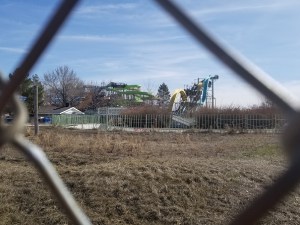
The abandoned Raging Waters Park is a few blocks east of Child and Family Empowerment Services in Glendale. The area is one of the few residential spots in Salt Lake City’s west side.

Salt Lake City’s west side has more industrial and commercial areas than residential, particularly west of Redwood Road. Aaron says his recovery began in a wilderness rehabilitation program for substance abuse. Centers for recovery are usually established in areas that are conducive to well-being. Industrial areas do not serve that purpose. Factors that go beyond zoning can affect access to treatment on the city’s west side.

Leilani Taholo, a researcher and licensed clinical social worker with Child and Family Empowerment Services, says the problem is more complex. She has worked in the field for 37 years developing culturally sensitive programs. She initially designed a trauma intervention program called “Kaimani,” which means “divine power from the wave or the ocean.”

Child and Family Empowerment Services is located in Glendale and is one of the areas in Salt Lake City’s west side where mental health services are readily available.

Her office is located in Glendale and is one of the few centers located on the west side. It provides mental health services through the county’s OPTUM program, which accepts Medicaid and is funded at the state and federal levels.

A lack of overall funding combined with adverse socioeconomic conditions make it difficult for public or private centers to establish themselves in west-side neighborhoods like Rose Park and Glendale, Taholo says.

“I’ve spoken with many colleagues who have said, ‘I’m not sure if I want to put my clinic in Rose Park or in the Glendale area,’” she says. Taholo says her colleagues believe their clients feel safer getting treatment at their east side facilities.

Heads of families in west-side neighborhoods tend to work more than one job to make ends meet. Going to a center at night might leave them susceptible to harm or criminal activity.

Combined statistics from the Salt Lake Police Department for January 2020 show a slight increase in crime activity in District 2 compared with District 1. District 2 starts at Interstate 15 and ends at around 8000 West and goes from Interstate 80 to 2100 South. District 1 goes from I-80 to roughly 2700 North and 900 West to about 8500 West.

Taholo says that despite the perceptions of the west side as being crime ridden, the on-campus shooting deaths of two University of Utah students in 2017 and 2018 refute the idea that crime is strictly a west-side problem.

Regardless of the situation, people from around the west side come to Taholo’s center for help. She says she is amazed at the resilience not just of her clients but the people in the area. “They have taken the few resources that they have,” she says, “and they make it last in ways that you and I would never come up with.”

Bad Dog Arts: Bringing an array of color to west Salt Lake City

Story and photos by KATHRYN A. HACKMAN

In the summer of 1996, one of the most artistic nonprofits the west side of Salt Lake City has ever seen was born. Victoria Lyons and Michael Moonbird founded Bad Dog Arts. Their purpose? To enrich the community through artistic outreach and creative exposure.

The artists have also created public art under the auspices of their sister company, Moon Lyon.

Both organizations have been leaving a vibrant trace all over the state of Utah. Perhaps you’ve seen their art along the wall of Whole Foods Market in Trolley Square? Or if you’ve ever ventured into the town of Gunnison, Utah, maybe you’ve stumbled upon their marvelous tiled mural.

While their work is statewide, there’s no doubt Lyons and Moonbird also have left their mark on west-side neighborhoods under both companies.

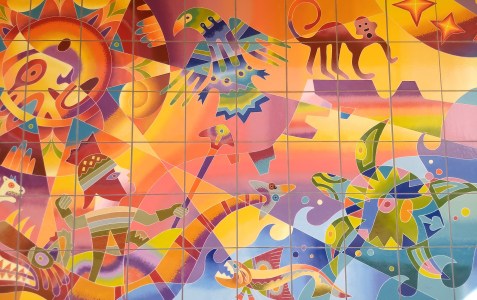
Moon Lyon’s vibrant mixture of warm copper, lively violet and golden yellows are guaranteed to catch the eye of anyone driving past Glendale Library on Concord Street. Visitors are welcomed by a rainbow-like tile mural that takes up a good portion of the library’s south-facing wall.

While the library was still in its developmental phases, a request for proposal, known as an RFP, was sent out to the community. The Glendale neighborhood needed a commission that was representative of the local population as a whole. Moonbird and Lyons knew they were the team for the job.

Their design kept Glendale’s very diverse community in mind.

IMG_20200220_131520035~2

Moon Lyon’s tile mural at the Glendale Library, 1375 S. Concord St.

The inspiration that fueled their commission was folk art from around the world. They wanted their piece to tell the cultural story that is unique to the locals on the west side. Moon Lyon’s final installation does just that.

At first glance, the color palette seems to reference Utah’s southwest landscape. However, under closer inspection, the mural’s meaning reaches far beyond the state’s borders and incorporates a worldwide scene.

In the upper left corner, an amber sun shines. The artistic details call to western Native American tribes. Toward the center swims a teal sea turtle, highlighting the many Pacific Islanders represented in the neighborhood. The multicolored sugar skull on the far right is a nod to the Latino community.

From one side to the other, tile by tile, viewers are taken on a trip around the world.

This global harmony didn’t happen overnight. Moonbird did much cultural investigation to ensure both accuracy and inclusion. Between the research, design process, and installation of the ceramic pieces, this mural was in the making for well over a year.

Bad Dog Arts: collaboration and creativity

Most murals that you see around town are likely painted. However, Moonbird and Lyons prefer to create tile masterpieces. They do this in collaboration with children in the community through their company Bad Dog Arts.

What is Bad Dog Art’s mission? To offer an exposure to the arts for children who may not otherwise receive it. Moonbird and Lyons particularly reach out to children from all across the west side who attend elementary schools like Northwestern and Bachman.

Bad Dog Art’s artistic process is an exciting one. After a design is finalized, a ceramic glaze is applied to a porcelain tile. Rather than use traditional paint brushes, wooden skewers are used to manipulate the liquid glass. This ensures no brush strokes are visible. Once complete, the tile is fired in the artists’ studio kiln and prepared for installation.

From start to finish, Moonbird and Lyons — along with their young Glendale artists — do it all.

“We take a different approach to murals because tile installations are far more long-lasting. But they are quite a bit more time-consuming,” Lyons said.

Visitors to the University Neighborhood Partners (UNP) Hartland Partnership Center are welcomed by one of Bad Dog Arts’ signature tile murals. This piece is proof of what it does best, bringing art directly to the neighborhood, creating an experience for all to be a part of.

This project is quilt-like in its appearance. It’s made up of several 12-by-12 tiles, each one depicting a different UNP partner.

“We’ve developed a number of ways in which we work art into the community,” Moonbird said.

IMG_20200227_130837398~2

Bad Dog Art’s tile mural at the UNP Hartland Partnership Center, 1578 W. 1700 South.

Bad Dog Arts met with each partner represented on the piece. The artists held workshops and focus groups to gather each organization’s ideas. Although this was a time-consuming process, it ensured that the partners were being involved within the creation.

The focal point of the piece is the tree in the center. It’s meant to represent the unity and strength created through the collaboration of the Glendale community and the various UNP partners.

“We work with the community in a very multilayered and interactive way,” Lyons said.

However, it’s the company’s inclusion of the children at the Hartland Afterschool Youth Program that really demonstrates Bad Dog Art’s desire to make art accessible to those who would benefit the most: Salt Lake City’s west-side kids.

Lyons and Moonbird realize that traveling to their studio for an art class may not be a reality for some kids living in the Glendale ZIP code. So, they bring art directly to the children.

In the UNP mural, the multicolored border was designed and created by the Hartland youth. Through this creative process, the children were taught about design, color, and radial symmetry.

It all began with the little ones, artists in the making. They used oil pastels to create the outline. These designs were then brought to workshops with the older kids, where they were introduced to the glazing technique.

According to Lyons, the most essential part of this entire process is “imparting to the kids an ‘I can do it’ attitude.”

Lyons and Moonbird create an experience that demonstrates how art transcends its creative borders and into other academic areas. Bad Dog Arts connects subjects like math, science, and geography to provide a source of visual learning for the students.

“If they complete an art project and feel happy with it, that sense of accomplishment carries over into all other areas of learning,” Lyons said.

Bad Dog Arts also hosts workshops at the Glendale-Mountain View Community Learning Center (CLC), the heart of the west side.

“I was instantly impressed with Bad Dog. Sometimes you partner with arts organizations, and they create cute elementary projects. But that’s not the case with Bad Dog Arts. The things they do are incredible,” said Keri Taddie, the program director of the CLC. “They don’t do anything that’s not quality work.”

Bad Dog Arts is always looking for people who want to contribute to the organization’s artistic impact. You don’t have to be an artist to be a part of it. People from various backgrounds can lend a helping hand. And for those college students wanting to gain professional experience, look for summer internship opportunities.

Women from all walks of life: how the Glendale community came together to celebrate International Women’s Day

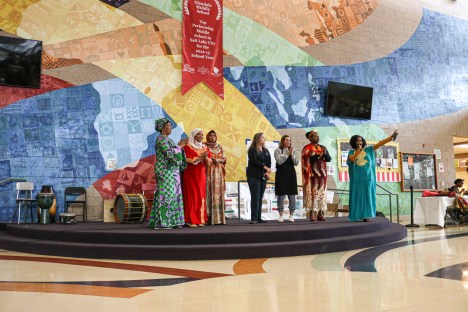
Glendale Middle School, at 1430 W. Andrew Ave. in Salt Lake City, hosted community members for a celebration of International Women’s Day on March 7, 2020.

Story and photo by IVANA MARTINEZ

Women from all nationalities dressed in their own traditional garments took to the Glendale Middle School cafeteria floor in Salt Lake City on March 7, 2020, to celebrate the annual International Women’s Day. 

The women dotting the dance floor swayed back and forth clapping to the music. They cheered on one another in vibrant headscarves and textiles embracing each other in the name of womanhood. 

“As you can see most of these women [are] dressed in their traditional clothing, they want to embrace their true identity and who they really are. And they want to be recognized and to have a voice,” said Fatima Dirie, the refugee community liaison from the Salt Lake City Mayor’s Office. 

The official International Women’s Day is celebrated annually on March 8, which is meant to acknowledge the political, social and economic accomplishments of women all over the world. According to the New World Encyclopedia, the day commemorates women who took to the streets in 1911 to demand voting rights, better wages and shorter working hours. 

The event was sponsored by the United African Women of Hope (UAWH) and co-sponsored by the Utah Refugee Connection, Salt Lake City School District, Department of Workforce Services Refugee Services Office and the Mayor’s Office. 

United African Women of Hope is an organization that started in 2004 after a local woman died in Salt Lake City. 

 Antoinette Uwanyiugira, UAWH organizer, told Voices of Utah the group initially consisted of refugee women who came from the Congo. Now the group works with women from all nationalities.  

“We all manifest the same. It doesn’t matter where you come from, where your background [is], what your religion is. We have the same issues,” Uwanyiugira said.

The organization hosts workshops on topics including domestic violence and substance abuse. United African Women of Hope receives support from the Utah Refugee Connection.

Amy Dott Harmer of the Utah Refugee Connection said the organization helps local refugee communities come together and gather. She mentioned one of the reasons it gets involved is because most refugee groups are learning how to plan an event, especially events that involve the general community.

“Well, I think one of the important things is we’re a much better community,” Harmer said about the women who came together to celebrate International Women’s Day. “When we invite people of different faiths, different cultural backgrounds to come and be involved because then we have a much better understanding of each other.” 

According to the 2017 report by the Kem C. Gardner Policy Institute, approximately 60,000 refugees live in Utah. The vast majority of refugees reside in Salt Lake County and represent countries such as Somalia, the Democratic Republic of Congo, Syria, Iraq, Vietnam, the former Soviet Union and Burma.

A Celebration of Cultures

A handful of dance groups came to Glendale Middle School, located at 1430 Andrew Ave. in  Salt Lake City, to celebrate their country’s traditional dances as a part of the women’s day celebration. 

Evelyn Cruz, who is from Mexico and currently studies at Granger High School, arrived with her dance group to perform traditional Mexican dances such as the jarabe tapatío. 

Evelyn Cruz and her friend dancing the jarabe tapatío at Glendale Middle School on March 7, for International Women’s Day.

She said it feels good to see others who are celebrating their cultures through dance.

“I feel proud, especially seeing others dancing and moving,” Cruz said. 

Fatima Dirie, the refugee community liaison, said how unique these types of events are for women of color. She mentioned how it can be difficult to be the only woman of color in a space that is predominantly white. 

“In today’s event, you actually see women from all walks of life and so the more we’re able to insert ourselves in these different spaces, the more people are going to appreciate diversity and include diversity at the table,” Dirie said, “allow these women to actually be on boards of commission, take a leadership role and allow them to not really be limited to only being mothers because we can do more than that.”  

Dirie mentioned how women can multitask and occupy multiple positions. She said women are more than one identity marker. 

But barriers still exist. Gender pay gap and gender inequality in leadership positions affect women — and particularly higher for women of color. 

According to the Institute For Women Policy Research, women of all major racial and ethnic groups earn less than men of the same group, and also earn less than white men.  

This is why International Women’s Day is still celebrated today — to shed light on issues women continue to face and to celebrate women for how far they have come. 

Dirie said it is important to have allies in the community who can support women on issues such as health care. She said one way to do that is to allow women to talk and men to listen. 

“Once you listen you start understanding and you start realizing you’re not listening just to respond,” Dirie said, “but you’re listening to sort of understand why these women had to go through those challenges, and how they can overcome those challenges.”

This slideshow requires JavaScript.

Residents of Salt Lake’s west side say new dog park will benefit all

Story and photo by CASSANDRA ROSENKRANTZ

Take a moment to think about all the different spaces you go to meet people. In regards to the west side of Salt Lake City, some wonderful places come to mind. Libraries, schools and public centers are among the great places to eat, relieve stress and explore with neighbors.

Our pets, on the other hand, don’t have the same opportunities. They get locked up inside, taken on the shortest of walks and don’t always have enough space to run around. Enter the dog park. This sounds ideal, but dog parks can be hard to find on the west side.

Ray Parker, a manager at Dogs All Day SLC in the Ball Park neighborhood of Salt Lake City, said he has not seen any particularly large dog parks in the area. “That alone is a sign that something needs to happen in order for a dog’s level of happiness to be improved,” he said.

“Salt Lake City is such a big, cramped city — it is challenging to give a dog enough exercise in this environment. Plus, there are so many stress-inducing factors that cause anxiety in dogs. They need a place to cool down and hang with other pups,” he said.

Parker believes that both families and dogs can benefit from a neighborhood dog park that checks all the boxes. It’s much more than just a regular park — it is a place where people can relax, enjoy being in the company of their dogs and share time with like-minded neighbors. 

The Utah Animal Adoption Center (UAAC) in Rose Park took an interest in this issue. In an email to Voices of Utah, the center emphasized the need for dogs to have plenty of room to exercise and socialize. “We have a 3.5-acre field near Jordan River Parkway,” the center explained. “Our dogs can get exercise, play with other dogs and have a space to relax out in the fresh air.” 

Residents on the west side have shared their opposition to the idea of larger dog parks because there are few empty lots where something of this size could fit. “So many new houses, apartment buildings and other structures are being built. No one wants a constant dog barking and children yelling outside their window,” the UAAC said in the email.

The UAAC said that other residents, though, have expressed concern about the cost. They believe the community council members would rather spend money on more significant projects in the neighborhood. The shelter reminds us that there are many considerations when building a park.

Dogs can enjoy many features in a space made just for them. Most parks have a shaded area where dogs and their owners can rest, as well as a specific place for smaller dogs where they can safely play away from the bigger dogs. 

Throw in areas with fresh, clean water to drink and a bathing station and mister to keep everyone cool and you have a recipe for a perfect place for adventure with your best pal.

Tiffany Laedrow, a resident in the Westpointe area, has a 2-year-old mixed breed dog named Baxter who gets walked almost every morning. “It would be great if we could have a park nearby that hosted events where we could meet other dogs and their owners,” she said.

Baxter taking a break from his walk in the Westpointe area.

Laedrow said other cities in Utah have group activities for dog owners every week. She said the Cottonwood Heights Dog Playgroup is one such group. It is comprised of community members with dogs who get together at a local dog park in their neighborhood. Laedrow wishes that the west side of Salt Lake City would offer something similar. 

In a later interview, Laedrow said she had noticed how the community dog meetings impacted the way high-energy Baxter acted throughout the day. “After attending two meetups, Baxter started to calm down when we were at home.” He used up most of his energy playing with other dogs at the park or on a group hike.

“I thought that Baxter was just a young dog with too much energy and that there was nothing I could do except wait until he grew out of it. I was shocked when I learned that he wasn’t the problem, but the problem was me,” Laedrow said. “I live in an apartment and don’t have the space for him to run around like he can when he is at the meetups with other dogs.”

Laedrow is planning to bring this matter up at a community meeting in April 2020 in the hopes of getting a group started on collecting donations to build a gathering place on the west side for dogs and their owners to get to know each other.

Salt Lake City organizations promote community dialogue 

Story and photo by LIAM ELKINGTON

Salt Lake City has never particularly been known to be a diverse town. Due partly to its settlement by primarily white pioneers, Salt Lake City has gained a reputation for being fairly homogeneous. However, throughout the Salt Lake Valley one can find enclaves of unique cultures, cultivating their communities.

Salt Lake City’s west side serves as a home for diverse residents. Cultures can vary between neighborhoods, with each having different modes of expressing their heritage and integration into Salt Lake City as a whole. Several organizations within Salt Lake City are dedicated to not only recognizing and celebrating these differences, but also cultivating a community where differences between residents’ cultural and political backgrounds can be discussed, examined, and learned from.

One such group, Utah Humanities, offers Community Conversation Toolkits designed to provide support for local not-for-profit organizations that wish to host community dialogue events. Utah Humanites’ website features a quote from Lynn Curtis, a participant in the program, who said, “I savor the discussions which have always been engaging, but sometimes difficult.” 

rsz_20200225_142648

The Utah Humanities Council is located at 202 W. 300 North.

The toolkits currently offered by Utah Humanities focus on discussion that surround race and diversity, as well as bridging differences between religious beliefs. While Utah Humanities enables other organizations to host these dialogue events, there are different other events within Salt Lake City that are designed to focus not only on dialogue between community members, but also various forms of cultural and civic education.

The Village Square is a Florida-based organization that is “dedicated to maintaining factual accuracy in civic and political debate by growing civil dialog on diverse issues, and recalling the history and principles at the foundation of our democracy.” The Village Square has an active branch in Utah, which hosts events that encourage participants to engage with issues facing the community, as well as expand attendees’ understanding of Utah’s cultural diversity. 

One of the events featured Andrea Smardon of the KUER podcast “Next Door Strangers.” The podcast focused on the national commentary that our nation has become increasingly divided, and discusses methods that allow individuals to reconnect with their communities in a meaningful way. 

The Village Square events tend to lean political, with events of the past granting participants the opportunity to “speed date” local leaders. One event especially found success in gathering Clinton and Trump supporters during 2016 in an effort to promote civil discourse. 

One could argue that the motivation behind having dialogue between different parties is to achieve understanding, and hopefully to connect in a meaningful way. Utah organization The Golden Rule Project believes that sharing, kindness and compassion are primary facilitators for gaining understanding across any number of social boundaries. 

The website for the Golden Rule Project states that “The Golden Rule Project is not religious, not political, and not associated with any agenda. We promote the Golden Rule as a basic human value.” 

The Golden Rule Project goes about its mission by being involved with numerous organizations, nonprofits and events ranging from farmers markets to Pride parades. Additionally, it hosts community conversation events, again designed to bridge the gap that an individual may feel exists between them and their community.

Communal dialogue can have a real effect on the lives of those involved. Jennifer Mayer-Glenn, director of University Neighborhood Partners, stated the importance of these types of resources. She recalled her work with the Human Rights Commission. Mayer-Glenn collaborated with the Commission as well as west-side communities to host a series of dialogue events designed to determine the needs of Salt Lake residents. These events encouraged discussion regarding the specific cultural, educational and economic challenges faced by the west-side community. The data gathered from these events was used to inform Utah state legislation, and may continue to influence how the west side is perceived by decision-makers in Utah. 

While there are several organizations that provide the space and means for dialogue events, an obstacle facing the communities that could benefit from them is lack of information. “I don’t want to represent community voice,” Mayer-Glenn said. Instead, she said she prefers that communities and organizations are given the resources to speak with each other, that way the needs of the community are being actively expressed.

These organizations are hardly alone in their efforts of community outreach. Many of them place emphasis on collaboration with nonprofits and government bodies like the Human Rights Commission. Ultimately, the goals of these organizations are similar, and require that the community be actively engaged in the discussions being created. The cooperation between these organizations is met with cooperation with the community, so that it may, as Mayer-Glenn suggested, represent its own voice.

Our CASA brings academic opportunity to the west side of Salt Lake City

Glendale-Mountain View Community Learning Center, located at 1388 Navajo St. in Salt Lake City.

Story and photos by CHEYENNE PETERSON

As the school bell sounds with a shrill “brrring,” out walks 17-year-old Anwar with 10 of his classmates from Our CASA, an after-school program offered within the Glendale-Mountain View Community Learning Center. Anwar has a smile from ear to ear as he says goodbye to his classmates and teachers. He then makes his way to the front office, where he waits patiently for his little sister to join him so that they may catch the bus home to their family.

Students with smiles are something you see often in the west-side communities of Salt Lake City, due to the Our CASA organization.

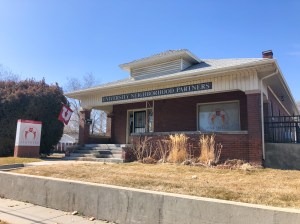
University Neighborhood Partners, located at 1060 S. 900 West in Salt Lake City.

Our CASA (Communities, Aspiring, Succeeding and Achieving) is a program that has collaborated since 2016 with the University Neighborhood Partners (UNP), the Salt Lake City District, Google Fiber, and schools on the west side. The organization consists of students, parents, teachers, and community members who all want to support families living in west-side neighborhoods as they set their sights on higher education and rewarding careers.

Our CASA does this by creating college-themed “lounges” located in classrooms of schools and community centers. The goal of the room is to make it comfortable and home-like for students with couches, desks, computers, and other necessities. Hence, the room is known as a lounge.

According to Sol Jimenez, the education pathways coordinator at the Glendale-Mountain View Community Learning Center, the lounge not only creates a room and place where people can come and get together, but it also serves as a hub for access to college resources and information on continuing education. 

“It is also a place that would hold programing that would involve students, parents, families, and various different people to get more information in whatever that they need, in terms of building an education pathway,” Jimenez said.

UNP Associate Director Paul Kuttner said the first Our CASA lounge was created in 2013 in a combined effort of the Salt Lake Center for Science Education (SLCSE) and a University of Utah social services student.

SLCSE housed the sole lounge until 2016 when Google Fiber chose to give a charitable donation of $50,000 to Our CASA. The funds were distributed equally to the six current Our CASA lounges located in Backman Elementary School, Glendale-Mountain View Community Learning Campus, Northwest Middle School, Salt Lake Center for Science Education, UNP Hartland Partnership Center and West High School.

Kuttner joined the UNP staff in 2016. He said that at each school and community center, a team was brought together of students, parents, teachers, and administrators in order to decide what they planned to do with the money and what activities they wanted brought to the table.

The partners allowed the kids involved at the West High School location to name the program.

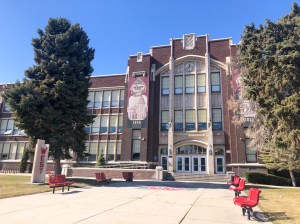
West High School in Salt Lake City, 241 N. 300 West.

“The name Our CASA was submitted by a student at West High School and from there we decided on it being the acronym for Communities, Aspiring, Succeeding and Achieving. Students wanted it to be something that bridges cultures, so they liked having one word in English and one word in Spanish. They wanted it to feel more home-like than school-like,” Kuttner said.

Each school and community center was given the creative freedom to use the Our CASA lounges differently. “We support that, because we figured people on the ground at the school know what’s best. We try to support them in using the space as best as they can,” Kuttner said.

He added that the focus is on community engagement and leadership of families and students. They all offer support for people as they pursue higher education and careers.

The organizers wanted the lounge to create a sense of belonging for students and families. “The feeling you belong and having a safe place to connect in your school is proven to be key for students’ success and family engagement,” Kuttner said.

Helping students apply to and get accepted into college is a focus of Our CASA. This directly impacts the students’ level of confidence and helps them to achieve their educational goals.

“It is wonderful and it’s helpful. It helped me maintain my grades. I get helped with homework and stuff that I don’t understand,” Anwar said. 

Jimenez was initially involved with the basic establishment at the community center. She has seen the number of students who attend Our CASA at Glendale-Mountain View Community Learning Center grow annually. “I think it’s a positive sign that we are doing what we are aiming to do,” she said.


Mestizo Arts and Activism Collective — 13 years later

Story and photo by ALISON TANNER

What began as a safe space for youth to discuss different topics and concerns, has become an engaging and creative platform for young students to take action in their community. In over a decade, the continuously blossoming program is impacting many in the Salt Lake Valley.

Mestizo Arts & Activism Collective (MAA) was co-founded in 2007 by Caitlin Cahill, David Quijada and the late Matt Bradley, remembered as a powerful force in the community for change. These activist researchers were working on several different documentary projects relating to race in schools, immigration issues, and in-state tuition for undocumented citizens.

Along the way, they met with various youth who were passionate about social issues and wanted to get more involved. With a little bit of funding and a big commitment to addressing these topics in a safe space, the MAA was born.

Over a decade later, Caitlin Cahill reflects on the collective’s progress. “It’s so beautiful to see the way it’s developed. I feel humbled and inspired.” Although Cahill has since moved from Utah, she often comes back to visit. “It’s a space of activism, which is a key part of healing in this crazy world we live in.”

So how does it work? Each year, a diverse and intergenerational collective of young activists, artists and researchers work together to address urgent issues in the community. Nearing the end of the school year they work on a final project, created by a specific student or students, showcasing what they’ve learned throughout the year. Students have created everything from documentaries to murals.

MAA is a community partner with University of Utah Neighborhood Partners. UNP’s mission brings the community together by connecting the university and people in west-side neighborhoods with resources in reciprocal learning, action and benefit. As UNP proactively helps historically unheard voices, it acts as a convener, contributing to the decrease of barriers to higher education.

Various MAA mentors mentioned that the collective also provides the opportunity to connect with others and discuss topics that aren’t necessarily taught at school or in their homes.

Artwork serves as a key focus of the collective. Painting. Filming. Drawing. Speaking. Dancing. These young people are allowing others to see that activism is powerful and necessary, displaying it through words, colors and sounds.

Over the last decade there have been significant losses in art education, due to the No Child Left Behind Act of 2002. UNP Director Jennifer Mayer-Glenn mentioned that when the focus shifted to helping students achieve higher skills at math and science, arts education fell to the wayside.

“Many communities relate so much to music, visual art and dance. It is hugely important,” Mayer-Glenn said. “Art is a way to express oppression and repression.”

Although it begins with high school-aged students, the MAA has created an impact with far-reaching effects. With an initiative to help youth find opportunities and remove barriers to higher education, many who began in MAA are giving back, sustaining a successful cycle of change.

MAA members pose for a photo at the Marmalade Branch of the Salt Lake City Library. Pictured from left to right is Caitlin Cahill, Yair Marin, Elizabeth Estrada-Murrillo, Jarred Martínez, Sharay Juarez, Itzél Nava, and Leticia Alvarez Guitérrez.

“MAA is a space where it’s developed and centered around high school-aged youth, but it’s where our leadership has come from. They have a different role, like myself, but we’re all still involved,” said Jarred Martínez, who serves as the MAA advisor with UNP in conjunction with the U. Martínez said that much of where he is today is due to his connection with MAA.

Itzél Nava is a student at the U and a former member of MAA. At a young age, she thought she’d never attend college. She now serves as an MAA mentor, regularly meeting with the students and providing her leadership to the collective.

“Whenever someone asks me to tell them about MAA, I tell them it’s a program that caters to west-side students.” Nava added, “You always hear about the east-side schools and their resources, but now we’re showing everybody what’s happening and what amazing things our students are doing here.”

Amazing things is right. In 2008 to 2010, an ethnically diverse group of student researchers began the “We Live Here” project. Calling attention to the complexity of multi-ethnic/cultural neighborhoods that are often overlooked, students engaged in oral history and research to document the value and contributions of their community. They wanted to challenge assumptions about the west side, creating a multi-layered interactive community history map.

Another student mentor, Yair Marin, has been involved with the program since his sophomore year of high school in Salt Lake City. Of MAA, he said, “It’s especially rewarding because it’s intergenerational. You could call it a second family.”

Marin also said that there have been various instances where students came to the leaders for personal help. Being a mentor allows them to create meaningful bonds that continue long after students have graduated from the program.

Leticia Alvarez Gutiérrez, MAA faculty advisor, said students who participate in MAA while in high school receive university credit for attending 85% of the program. This serves as yet another way that Mestizo Arts & Activism removes barriers for students of minority backgrounds to receive higher education.

“I think for me the most important thing is getting to know who these young people are. It’s a sacred space. We all hold very strong relationships,” Gutiérrez said.

The collective meets every Monday and Wednesday at Mary W. Jackson Elementary school. A full archive of its projects is included on the website. Though MAA is a small organization, the colorful tapestry of its impact is larger than life, as it reaches many in Salt Lake City and beyond.

“Activism is more than protesting. We all want to live in a better world,” said Cahill, MAA co-founder. “This space is creating the world that we all want to live in.”

Hartland Partnership Center has kids dancing into their future

Story and photo by KATHRYN A. HACKMAN

The University Neighborhood Partners (UNP) Hartland Partnership Center.

As the last school bell rings at Mountain View Elementary and Glendale Middle School, 15 to 25 kids make their way to the University Neighborhood Partners (UNP) Hartland Partnership Center. This is their weekday routine, with afternoons full of experiential learning and creative fun. However, once a week, this creative fun is taken to an entirely new level.

Every Tuesday throughout the year, you can find Kelby McIntyre-Martinez, the program director of professional development at the Beverley Taylor Sorenson Arts Learning Program, leading a high energy dance and theater class for the Hartland kids.

Through these performing arts classes, the children can talk about social justice, immigration, identity and cultural differences. This is all thanks to the safe outlet of expression that the arts can provide.

“The arts at Hartland transcend language. They transcend background. As a class, we may not fully understand each other, but we are still creating together,” McIntyre-Martinez said.

She describes an afternoon spent at Hartland as “loud, boisterous and “smiley.'” It’s a time that calls participants to live in the moment. It’s an hour that is full of nonstop energy. “The work that I’m able to do at Hartland is just joy,” McIntyre-Martinez said.

However, this reciprocal bond between the University of Utah and west-side residents didn’t always exist.

In 2003 the University of Utah and west Salt Lake City’s diverse neighborhoods were nothing more than cordial acquaintances. Although they were neighbors in the Salt Lake Valley, their interactions were minimal. That all changed in 2004 with the creation of the UNP Neighborhood Partnership Center.

UNP decided the best way to connect with the west side was to move into the Hartland Apartments, which many Glendale residents called home. 

This newly founded collaboration set out to empower the community, 75% of whom are non-native English speakers, through building university connections and promoting education. They began to offer English language instruction, mental health support, citizenship classes, employment workshops, and educational resources.

This campus-community fusion was designed to ensure that those living in the area had access to a wider range of local resources. Over the years, that’s precisely what they’ve done.

With rapid growth and community involvement, UNP eventually moved into a larger building right across the street.

“The role of UNP is to bring together community residents with the University of Utah, and surrounding organizations,” said Jennifer Mayer-Glenn, the director of UNP.

She said that the greatest enablers for those living on the west side are caring communities, quality teachers and schools, cultural services, and places of belonging.

While UNP offers these educational programs for adults, it certainly hasn’t forgotten about the kids.

The UNP Hartland Neighborhood Partnership Center offers a year-round after-school youth program for the children living in the nearby apartments.

UNP’s model is about being involved with the children and investing time into programs that create pathways to higher education.

Abdullah “Tuna” Mberwa moved from Kenya into the Hartland apartments in 2003, one year before UNP became his neighbor. He was one of the first children to experience UNP’s after-school program. Today, he’s the youth center coordinator.

His experiences allow him to connect with the kids in a very unique way. “I don’t want them to just look at me as the program coordinator, but as a mentor,” he said. Not only does he take on the role of mentor, but also that of a tutor.

Hartland staff like Tuna, and occasional volunteer students from the U, can provide the academic and language support that the children may not receive at home.

Homework is a challenging task for students all across the United States. But for the children at Hartland, there’s an added level of complexity. Many of the students come from countries in Africa, South America, Central America, and the Middle East. Therefore, English is not the primary language spoken among their families.

The academic support that UNP provides is crucial.

But after a studious hour well spent, the kids get to let loose with a university partner. These partners — like McIntyre-Martinez, who also is on faculty at the U — are experts in their craft and teach classes in subjects like art, yoga, and science.

On Tuesdays, the children often rush to get their homework done because they know “Miss Kelby” is coming to dance with them.

Through dance, the children can bring their stories and backgrounds to life and blend them with the arts. Together the students fuse their worlds and create original works.

She ends every class by asking the students if there is anything, they’d like to teach her. A few lessons ago, she said three boys from Mexico showed everyone a song from home. Another time she had two boys teach the class a dance from Burundi.

The arts are a crucial part of the after-school youth program. As McIntyre-Martinez said, ”It creates a space where students feel welcomed and valued. It creates an area where you don’t need to speak the same language to come and jam.”

Not only does her class expose the Glendale children to the arts, but also higher education.

One of the courses she teaches at the U is called Theater for Social Action, which takes place at Hartland. Her college students ditch their textbooks for the afternoon and instead experience what teaching in the arts is really like.

They spend the semester working with the children at Hartland, co-creating, and bringing art to life. Both the students and the children end their 16 weeks of preparation with a performance at the Sorensen Unity Center where they receive the applause that every artist seeks.

This exposure to the collegiate world allows the children at Hartland to envision a future in college. 

Over the past 12 years, McIntyre-Martinez has seen the direct impact that Hartland has had on the children living in west Salt Lake City. She knows this reciprocal model that UNP has works because she sees some of her Hartland kids grow up to join her on the university’s campus as college students. She said, “We’re now reaping the fruits of this awesome partnership.” 

Latinx organizations forge alliance in support of sexual violence survivors

Story and photo by JASMINE BARLOW

 Comunidades Unidades/ Communities United (CU), a Latinx empowerment organization, and the Salt Lake City-based Rape Recovery Center (RRC) have forged a community partnership to heal survivors of sexual violence.

Established in 2016, the partnership is dedicated to providing comprehensive education, community resources, and professional services to support and empower survivors, particularly of Latinx identity. Weekly meetings, specialized trainings, policy negotiations, and coalition building are essential for long-term development and impact.

Barlow_RRC

Art installation project at Rape Recovery Center at 2035 1300 East in Salt Lake City.

According to the National Intimate Partner and Sexual Violence Survey, 50% of Latina women will experience an episode of sexual violence in their lifetimes. Nearly 20% of Salt Lake County residents are Latinx. Staggering statistics, an emergence of Utah’s “minority-majority” demographic, and a tumultuous political climate, particularly immigration rhetoric and policy, are primary motivators for the partnership’s formation.

Stephany Murgia, director of education and outreach at RRC, is hopeful for the future of the partnership, while acknowledging advocacy and healing of Latinx survivors poses a myriad of challenges. “Sexual violence is a huge issue for all communities, more specifically in vulnerable communities,” Murgia says. “The most pressing issue [being] that Latinx survivors are underreporting at higher rates than any other group.”

Murgia says she believes the hesitation of reporting stems from a paralyzing fear of authoritarian backlash and possible deportation, as many victims are undocumented. “If you are undocumented choosing to report to the police or get state funding for victim reparations, police are not supposed to ask about [immigration] status. However, this isn’t always the case,” Murgia explains. “When people see [RRC’s] name, they think we are affiliated with law enforcement.” RRC honors and abides by confidentiality, and wants this precedent to be potential clients. “We will never turn them over to authorities or violate their trust,” she says.

Mayra Cedano, Department of Justice representative and Comunidades Unidades community engagement manager, provides immigration services and advocacy, and is deeply invested in the partnership’s success. Serving as a liaison to local government organizations and councils, Cedano is continually pushing for workplace rights and dignity, particularly Latinx and immigrant women facing workplace harassment. She recognizes limited language options in the community and limited availability of interpreters may de-incentivize survivors to seek help. “What is that telling [people of color] and other groups? What message are we sending to [Salt Lake City]?” Cedano wonders.

Daunting as these challenges may be, Murgia and Cedano are looking forward with optimistic vigor. Murgia reports: “We have seen significant growth in outreach, with Latinx backgrounds making up 30% of clientele.”

To mitigate the language gap, RRC is launching a Spanish speaking-only training for volunteers. Meetings are held on a weekly basis at the Mexican Consulate, allowing opportunities for networking, workshops, and connecting with community resources. Getting involved with No Mas, a domestic violence prevention campaign can also be helpful.

Overall, Murgia and Cedano both urge for a call to action, an essential ingredient for solidarity and effective peace building.