Webster agrees, the definition of beautiful is YOU

Story and slideshow by SHANNON O’CONNOR

Learn more about how people are impacting lives through positive body image.


Lexie Kite, 29, created the nonprofit organization, Beauty Redefined, with her twin sister Lindsay Kite. The idea to start the motivational program was sparked in their media literacy class at Utah State University.

The class opened their eyes to how women are negatively represented in the media. The Kite sisters were angry at how the media transform the public’s idea of what makes a woman beautiful.

“One day my heart started pounding faster and I wanted to spread the word,” Lexie said. Lindsay felt the same way.

They decided to continue their research on body image and the media at the University of Utah and earned PhDs in 2013.

Their doctoral dissertations formed the basis of an empowering visual presentation they have given to “tens of thousands of people across the U.S. since 2009,” according to the website.

“We started through a dinky website, and based on the reviews we realized people were starving for this information,” Lexie said.

Their presentations are a compilation of their research, studies and experiences. “Beauty Redefined teaches audiences to recognize and reject harmful messages about bodies and continuously resist those limiting ideals through the power of body image resilience” according to the website.

Body image resilience is their main promoted message. It is “the ability to combat harmful ideas and bring to light the lies women are told,” Lexie said. The lies that women are just objects and have to look a certain way to be beautiful.

Lexie and Lindsay are passionate and driven to empower women and remind them they are “more than just bodies, more than just something to decorate the world,” Lexie said.

The portrayal of women in the media makes them feel pressured to look a certain way. If women don’t look that way, they may feel negatively about their appearance or get negative critiques from others.

“You’re just fat and ugly and jealous of all the beautiful women,” wrote a woman in an email to the Kite sisters.

“We can use painful experiences as stepping stones and not stumbling blocks,” Lexie said. “We can help provide the skills, resources, and tools to do that.”

Lexie and Lindsay Kite will not stand for women being objectified. They are influencing people around the world to have a positive outlook on body image through their blog, website and presentations.

Another program that promotes positive body image is a University of Utah club called SPEAK (Students Promoting Eating Disorder Awareness and Knowledge). SPEAK chapters are spreading to other universities, including George Washington University and the University of Minnesota. Each chapter has about 100 members.

Some of the 110 members at the U are people who have experienced an eating disorder or a body image issue. Other members, like Jon Junejo, financial director for SPEAK, have not experienced such issues. But they have a passion to educate and help people through their body image struggles.

Members of the U’s SPEAK chapter regularly engage in outreach to elementary schools, high schools, teams and clubs throughout Utah. “The more outreaches we do, the more it becomes evident that our program, and other positive body image programs are worth it,” Junejo said.

Junejo, 21, has been a part of SPEAK since 2013. At first, he joined the club so he could gain public speaking experience. Junejo wasn’t expecting to gain a passion for the importance of positive body image.

“Honestly, after the first outreach I did at Dilworth  Elementary, SPEAK became something much more,” Junejo said. “As I began hearing stories about people’s experiences with the eating disorder epidemic, it became clear to me that I could have a real positive effect on these people.”

SPEAK’s mission is to educate people about the effects from negative body image, body dysmorphia and provide ways to help people struggling with body image.

Body dysmorphia is a “conflict between what you see as an ideal body, compared to what you actually look like,” Junejo said. The disorder can affect people of all ages and may be caused be peer pressure, genes, or culture – including images in the media.

Junejo learned about one result from negative body image, eating disorders. He has not experienced it himself but he has friends who have suffered from anorexia and bulimia.

“Our [SPEAK] goal is to prevent eating disorders in the first place,” Junejo said. “We refer people to treatment centers on an individual case basis.” He added that eating disorders are predominantly emotional issues, but each person has a unique situation. It’s a multidimensional problem that the members of SPEAK are trying to help.

“Who you surround yourself with can dictate how you feel about yourself,” Junejo said. It’s important to have positive people around to overcome negative thoughts. Junejo has been a part of helping people through a struggle that people are scared to talk about.

When people compare themselves to the media, Junejo and the team want them to re-evaluate the source and “think differently about what source is making you feel like you should look a certain way.”

A main source to promote positive body image is through social media.

“They’re [social media sites] great places to get a conversation started with girls and women. We struggle wanting to be a certain way and look like this person, or that person,” said Nicea DeGering, host for “Good Things Utah.” “So when someone says, out loud, ‘just be you, you is good enough’ and it’s said on social media, which is the primary language spoken by young women today, it’s even more of a positive impact.”

DeGering has been a host for “Good Things Utah” for 12 years and graduated in 1995 with her communication, broadcasting degree from Brigham Young University. DeGering is a successful woman, wife and mother to two daughters.

She sees her daughters influenced by the pressure the media have put on women to look a specific way. “It’s something that we talk about in my house on a daily basis,” she said. “When is it OK to just be yourself? The answer should be, every day.”

DeGering didn’t have the same social media issues as her daughters, but she did struggle with her body image growing up. Her peers called her “big” because she was 5 feet 10 inches tall by the time she was in seventh grade.

“Now I’m mad I wasted one minute worrying that I was different,” she said. “Thank heavens there is only one of me, and I want to do me the best I can. Unique needs to be celebrated.”

Beauty Redefined promotes this notion, too: “Reflect on what impact narrow beauty ideals have had on your life and take inventory of the time, money and energy you dedicate to appearance concerns.”

DeGering added, “Looks are the first thing we all see. That’s a fact. And that’s actually OK, as long as you keep looking, as long as you continue to dig deeper beyond that, there is more to everyone. Everyone has their hard times, everyone struggles.”

The media disseminate many unrealistic messages about beauty to women.

“Conversation and awareness are key in making change,” DeGering said. That conversation begins with help from programs like Beauty Redefined and SPEAK, and by influential people like Nicea DeGering.

“Just be you, you is good enough,” DeGering said.

Gamers ‘press start’ in the video game industry

Small business owners and aspiring entrepreneurs struggle to compete in the massive world of the video game industry.

Story, timeline and slideshow by ALEX HARRINGTON

Trace the history of video games in this timeline.

Game Changerz’s appreciation of their craft and customers creates a unique experience for any who visit.


Video games often hold a special meaning to their players. They transport the player to a world with a kind of power that no book or movie can emulate.

This power has influenced and inspired people who enjoy these games. But sometimes, just playing games as a hobby isn’t enough for these devoted fans. Gamers have started to take their beloved medium to the next level by breaking through to start a small business in the video game industry.

One of the more ambitious options is to dive into the retail aspect of the video game industry, something Michael Morrissey, branch manager of the small business Game Changerz, knows plenty about.

Game Changerz, located on the corner of 3300 South and State Street, is often in direct competition with enormous companies like GameStop. Despite this intimidating match-up, its unique connections with the gaming community give it more than a fighting chance against other retail Goliaths.

Morrissey recalled several events that his company has sponsored for fans. These included several Smash Brothers tournaments conventions like “Anime Banzai,” an event similar to the popular Comic Con but with an emphasis on Japanese culture. Game Changerz’s support of these events not only adds to the fun experiences that come from them, but brings the company recognition apart from other stores like it.

This isn’t the only way this small business distinguishes itself. Game Changerz is packed to the brim with old-school classics, including games for the Sega Genesis, Super Nintendo and PlayStation 2. These games are not sold in most large retail stores, as these companies usually limit their wares to games that are only for newer consoles like the PlayStation 4 or Xbox One.

Morrissey said the older, classic stock is another reason that gamers keep returning to Game Changerz. “People want to relive their childhood,” he said. Older audiences who grew up with systems as early as the Nintendo Entertainment System are often out of luck when looking for games they remember from their youth. Game Changerz provides these games, plus a healthy dose of nostalgia that many gamers crave.

However, in an industry where awareness is everything, Morrissey talked about how difficult it is to compete with companies like GameStop that are much more widely known than small businesses like Game Changerz. “People don’t know about (video game-related small businesses),” Morrissey said.

Game Changerz’s business goal is to raise awareness for small retail stores like it and its best bet to do so is by creating a positive experience for customers. The sponsors and customer service encourage not just the purchase of games, but the enjoyment of the gaming experience as well.

Game Changerz’s unique appreciation of customers helps it to survive in the face of stiff competition. Without this business approach, Game Changerz would not stand out amid the crowd of competitors. Living in the shadow of huge businesses can make starting and maintaining a small video game business extremely difficult.

Riley Porter, an avid gamer and frequent customer at Game Changerz, talked about how small businesses add to the video game industry. “Gaming is a big corporate thing,” he said. He applauded small businesses like Game Changerz for intertwining old and new elements of video games, adding to the video game community.

But the difficult struggle to keep from sinking under the crushing weight of large competition isn’t possible for everyone. Whether it’s from a lack of resources or connections, not everyone is equipped to start a small business, especially when facing up against big-name corporations. But, that doesn’t mean it’s the end of the road for hopeful, business-minded gamers.

With the recent growth of technology, new opportunities are appearing for this community. For those who don’t have the resources to start a company from the ground up, new websites have thrown wide open the doors of the video game industry to everyone.

Websites like Twitch.tv and YouTube allow ordinary people to create a living for themselves in the video game industry, becoming gaming entrepreneurs.

For Steve Mossman, who was weaned on video games from just a tot, this has been his dream for many years. From his home in Sandy, Utah, he has created and uploaded several gaming videos to YouTube, under the screen name “TheAnonymousRaccoon.” He often does playthroughs, which are videos of a person playing all the way through a video game, of games like “Streets of Rage 2,” “Zero the Kamikaze Squirrel” and “Mega Man 3.”

Mossman fondly remembered his gaming childhood during an interview. Games like “Castlevania: Bloodlines” for the Sega Genesis and “Super Mario Bros. 3” for the Nintendo Entertainment System (NES) filled his waking hours as a child. He retains as deep a passion for video games today, hoping that his videos will elevate him to the status of the gamers who have made gaming into a career.

Mossman pointed to some of his favorite YouTube personalities, people like Markiplier, PewDiePie and JonTron, as models for his own YouTube channel. All of them actually can make a living just playing and talking about video games.

These people may not have built a small business like Game Changerz. But with little more than their charm and a whole lot of traffic on their channels, they became entrepreneurs who took the pastime of many and elevated it to a legitimate money-making operation.

“It gets bland (without popular YouTube personalities),” Mossman said. “[Your average gamer] ends up being some 13-year-old on Xbox Live with a mic calling you the ‘n-word.’”

He talked about how his favorite YouTube personalities create not only an entertaining experience for their viewers, but also add personality and excitement to the gaming community. “[People like] PewDiePie are charming,” he said. “(They) make you think, ‘I want to watch more.’”

Riley Porter agreed with Mossman’s take on the power of these websites. He talked about his experiences with Twitch.tv and what additional opportunities it provides to gamers. He established a Twitch presence, going by the screenname “lolpikapika” and doing live streams of games like “The Evil Within” and “Destiny.” For fellow gamers like him, “It (Twitch) creates a better foothold in the community,” Porter said.

Gamers today can use little more than their personalities and their Internet connections to almost instantly garner fame in the gaming community. But just because the possibility is there, it doesn’t mean it always pans out.

In regards to becoming popular on Twitch, “(There is) a long buildup, you’ve gotta keep at it,” Porter said.

Mossman experienced much of the same in his struggles to become known on YouTube. “You can’t go anywhere without the right equipment,” he said.

The problem of awareness hits these hopeful entrepreneurs just as hard as small businesses. With the virtual world being so populated, with hundreds of thousands of people trying to gain recognition or success, virtual entrepreneurs have to do more and more to stand out from the crowd.

Though there still are certainly obstacles for gamers looking to make a career for themselves in the video game community. These obstacles take many shapes and sizes, whether it’s fighting for recognition in a market crowded with retail giants, or on the Internet where thousands of others are trying to do the same.

Whatever the medium, retail or in the online gaming community, stories of success that embolden and encourage gamers are everywhere.

Unstructured past creates stable future

Story and slideshow by LIZ G. ROJAS

You’ve read her story, now meet the woman.


It’s been more than three weeks since Katara Nyberg, office manager for a Utah-based lending company, helped the business relocate from Salt Lake City to its new location in Sandy. Nyberg, who is only 23 years old, not only works as office manager but also as a member of the executive team for the lending company.

Nyberg has been with the company for more than four years. Her responsibilities vary from internally setting up software to directing the client services department.

Her commitment makes her an essential part of the company as she grows, learns and directs its structural organization.

Though Nyberg is in a position where not many young adults find themselves, she credits her success to her unstructured past and how it helped create a strong, secure future.

BEGINNINGS

Nyberg was born in Salt Lake to a 15-year-old girl in the early ’90s. She began her education at Hawthorne Elementary, a school on the outskirts of the city.

There, she remembers, was where everything began.

Nyberg’s first grade teacher had asked her to go outside the classroom with her partner to read a book. Before she went out the teacher started examining her, specifically a scab on her wrist.

She was called to the front office where she saw her 3-year-old brother. Next to him, in handcuffs, sat their mother.

“I went through a lot of court from that time,” Nyberg said.

School administrators were under the impression Nyberg was being neglected and/or abused because of the presumed cigarette burns on her wrist and body. As required by the state of Utah, the school contacted the Department of Child and Family Services.

A police officer escorted the confused and scared little girl from the school. While sitting in the police car she remembers being asked if she was hungry.

“I was so frustrated at the fact that he asked,” Nyberg said.

She didn’t understand why this was happening — why her mother was handcuffed and why she couldn’t be with her.

From what Nyberg remembers, her mother wasn’t guilty of abusing her.

A few weeks before the incident her family had gone camping. While camping, Nyberg said she’d gotten some mosquito bites, including one on her wrist. That bite got infected and that’s what her first grade teacher had seen.

She remembers repeating this to court officials during numerous recorded interviews. This made no difference because in court, her recordings were said to be inaudible.

“One day, they say, if you say yes [your mother abused you], you can see your mom,” Nyberg said.

On her mother’s trial date the judge put Nyberg on the stand and asked if her mother had abused her.

“I looked at my mom and she’s staring right at me and she’s bawling,” said Nyberg. “Because the last thing that I said was ‘yes.’”

She then saw as her mom was handcuffed once again and taken from the courtroom.

Nyberg and her younger brother were also separated and sent to live with different foster parents for two years.

LIFE AFTER COURT

Nyberg was living with foster parents when her paternal grandmother was able to get custody after finding out about the children’s situation.

Once her mother was released, she regained full custody after successfully finishing parenting classes at Valley Mental Health.

Nyberg recalls the transitional period her mother experienced.

“My mother is a great mom, but I think because she went to jail so young that really took a toll on her,” Nyberg said. “She was younger than I am now.”

The family moved to Vernal in 2000 where her environment consisted of addictions and police officers.

Nyberg had to take care of herself and her brother. The adults in her life were in no condition to do so.

At the end of sixth grade Nyberg’s grandmother told the children their father had been released from jail. She offered a trip to Nevada to meet their birth father after many years of not seeing him.

In July 2004, they went to Nevada.

After a few days with him, Nyberg asked when she and her brother would return home. He told her they would remain with him. There was no home to go back to — her mother had been evicted and there was nowhere to go.

Devastated, Nyberg resigned to her fate and lived with her father.

Nevada was her temporary home from 2004 until 2009, when she graduated from Spring Creek High School with a scholarship worth $10,000 for academic achievement. The scholarship was to be used in any university in the state of Nevada.

Nyberg knew she had to move back to Utah to reunite with her mother.

There was nothing in Nevada for her. The only way she could think of getting out of Nevada was to attend school in Utah. She packed her bags and enrolled in Salt Lake City’s Paul Mitchell School of Beauty, beginning her education.

PERSISTENCE AND DEDICATION

Nyberg juggled work and school. She had to commute from Salt Lake City to Draper in order to go to work. Eventually she realized she couldn’t keep on commuting. It was making her late to class every day and she needed a job closer to the school.

She started applying to multiple jobs and came across a small start-up lending company in Salt Lake City. With no previous sales experience, she was hired as a junior funding analyst.

Initially, Jantzen Fugate, the CEO and founder, did not want to hire Nyberg. However, after persistence from the former office manager who saw potential for her development, she was hired.

“I have never been more wrong and more pleased at being wrong,” Fugate said.

Nyberg worked her way up from an entry-level junior sales position to director of client services. As director of client services, she helps ensure the fulfillment of services provided by the company like business plan writing, credit repair, website creation and lender matching.

Describing her experience working in the company Fugate said, “It’s because of her relentlessness to outperform other people.”

Shelby Fielden, a close personal friend and coworker of Nyberg’s, admires her attentiveness in their friendship. When referring to Nyberg’s past, she believes the way she’s overcome her situation has molded her into the person she is now.

“I think it made her a stronger person,” Fielden said.  “She does things on her own, she’s very independent.”

Nyberg is currently in school at Stevens-Henager College working on her business administration degree while simultaneously working as director in the client services department. During the day she works at the company and at night she completes her courses.

“My mom was passionate about me being smart because we were poor, we didn’t have money for college,” Nyberg said. “No one in my family even considered going to college.”

She’s driven by success and motivated by past failure.

“Growing up and being successful is what I was always told to do,” Nyberg said. “’Don’t be like me,’ is what everyone always told me. ‘Be different, be better than me. Make sure you go to school.’”

She sighed when she reflected on how she has dealt with the difficulties in her past.

“What else are you going to do,” Nyberg said. “I love myself, and I love my family, I love it because it’s who I am.”

High Uintahs Taxidermy brings memories back to life

Story, photos and slideshow by WILLIAM PHIFER III

Take a behind-the-scenes look at the process of taxidermy.


In the center of Coalville, Utah, lies a small 700-square-foot building filled with hides, horns, antlers and taxidermy forms.

Front door - High Uintahs Tax

The main entrance to High Uintahs Taxidermy in Coalville, Utah. Ironically, a sign directs visitors to a side door because the entry is crowded with life-size mounts.

High Uintahs Taxidermy, owned by Dean Schulte, 49, is located at 31 S. Main St. Specializing in big game taxidermy, Dean strives to recreate a lifelike appearance of the animals that people bring to him.

“I hope that when [people] look into the eye of my work … they can see a spark of character and soul,” Dean said. “That is the most important thing that we really try to work for here, with myself, and with the guys that work for me. I never stopped reinforcing that.”

Dean believes focusing on the detail of an animal’s eyes is what makes them look alive. “We are known for our eye work here. Our eye detail is the foundation,” Dean said. This process entails setting the glass eye into clay and tucking the hide into the clay. This prevents the hide from pulling away from the eye socket when it fully cures.

By doing this, Dean hopes that his work will serve as a commemoration to his clientele and their hunts, especially those of family-related outings. “They are looking at a snapshot of a lifelong memory,” Dean said.

While some of his clients focus on the trophy quality of the animals, Dean said his emphasis on the eyes “is going to make that memory that much more lifelike for them. … It’s the difference of having a sharp image of something and a dry poor piece of photography.”

Dean, a self-taught taxidermist, founded the business in 1993 so he could make a living and support his family, while doing work that he enjoyed. “Most importantly,” Dean said, “I am happy at what I do.”

However, Dean said, “There’s a struggle between the artist and the businessman. I’m an artist first.” He never intended to create a business that would grow and become a huge operation and he has purposefully prevented it. While he has employed as many as eight people at one time, Dean presently employs four people.

Including himself, Dean prefers his current five-man operation. “This is the limit for me, otherwise I’m going to become a manager. I will not be involved on the floor as a taxidermist if I was to add more personnel,” he said.

By running this type of operation Dean is still able to be involved in the work that he is passionate about.

Dean’s passion for taxidermy began in Montana when he was 10 years old and he paid a $1.99 monthly subscription for pamphlets made by the Northwestern School of Taxidermy. However, he only dabbled in it until he was 16. He strayed from it as adult life began to take precedence.

Dean moved to Utah when he was 18 to work in the oil fields with the intention of only working for six to eight months. However, he said the money was good.

On one calm, cold November morning Dean said he and his team of three guys were having trouble with an individual oil drill they were working on. It was the third day they had been working on this particular piece of machinery. Each night the well would build up pressure caused by a mixture of natural gas, oil and water, and his team would follow safety procedures to bleed-off the pressure.

However, the company he worked for at the time did not have an oil and gas separator, which would burn off the natural gas and dump the excess oil and water slurry into a tank.

Dean recalled the events of that morning:

Getting ready for the day, as the well was bleeding down, well what happened is within 5 minutes, all the sudden that well just opened up and it unleashed a huge tremendous amount of [gas]. I don’t know how many cubic feet of gas it dumped into the valley. By the time we could get over to the well and shut the valve, it had already saturated this valley. It was literally like fog, like a fog of natural gas. We were shutting down all the equipment we had started up, basically all your ignition sources, trying to shut them down. Well on the edge of the location there was a trailer, probably like a 6 by 10, that we had lockers in there and we changed our clothes and we had a heater in there. Well that trailer was the last thing we got to and that heater, the piolet lite, it ignited the location. I was probably 10 feet from the door.”

Dean said it felt “like standing by a jet intake on an airplane, just a roar. And obviously all the oxygen is being consumed in the air. Everything just went red.”

Dean suffered third-degree burns on 40 percent of his body and spent six weeks in the hospital. After that he was in and out of the hospital for about five years, while he had multiple operations done on his hands and face. (The other members of his team also suffered burns. One person sustained third-degree burns over 55 percent of his body. Another suffered third-degree burns over 25 percent of his body. The fourth man was in the trailer at the time of the flare and didn’t get burned until he tried to help the other men.)

“It was a swift kick in my ass. I went back to school,” Dean said. “I wasn’t going to let it beat me.”

Doctors told him he would probably never work with his hands again, but Dean set out to prove them wrong. He went back to school to be a machinist and in between surgeries, earned a degree in robotics and automated systems. After that he also spent three years studying electrical engineering. Then at the age of 25, a friend reintroduced him to taxidermy.

“I just kind of realized, second time around, maybe this was my forte, this is what I really want to do. This is what I’m supposed to be doing [and] I just very aggressively pursued it,” Dean said.

In 1993, he started doing taxidermy work out of his garage. Later he moved to a 30-foot by 30-foot building but quickly realized he need more space. He moved his shop into its current location.

Over the years, Dean has raised nine children, all of whom have worked in the shop with him at some point in time.

Stephen Schulte

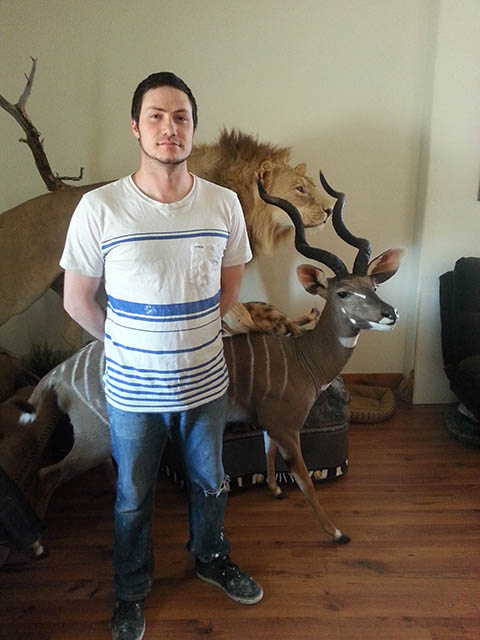
Stephen Schulte stands in front of an award-winning lesser kudu.

His oldest son, Stephen Dean Schulte, 27, is the only one who still works at the shop. He began working for his dad nine years ago, when he was in high school. Father and son both hope he will, one day, take over the family-owned business.

Stephen considers himself lucky to have been able to work for his dad and gain experience in the business.

“There’s guys that go to school for this and they pay like $10, $15,000,” Stephen said. “The best way to do this is, I guess like a tattoo artist, is to apprentice under somebody. I’ve been able to apprentice under him [and] I like doing this. That’s my ultimate goal is to run the business.”

Stephen feels confident about his ability to run the shop with his the help of his wife, who does a lot of the office work. “I pretty much run all the North American sector. I do all the managing [of] the North American stuff, which we do about 200 North American pieces a year.”

While North American animals such as deer, elk, moose, mountain goat, Dall sheep, bear and many others are his area of responsibility, Stephen also works on animals not native to the United States. He said he has done taxidermy on a lot of African animals including antelope species such as springbuck, bushbuck, impala, nyala, and kudu. Stephen is excited to be planning his first trip to Africa in May 2016, and he can’t wait to see all the animals running around.

“Kudu are my favorite. I think they’re pretty,” Stephen said. “They look awesome and I’m excited to go get mine, because I’m going to do something cool with it.” About the size of an elk, greater kudu are an antelope species with large curled horns and hides that are a mixture of grey, brown, black and white.

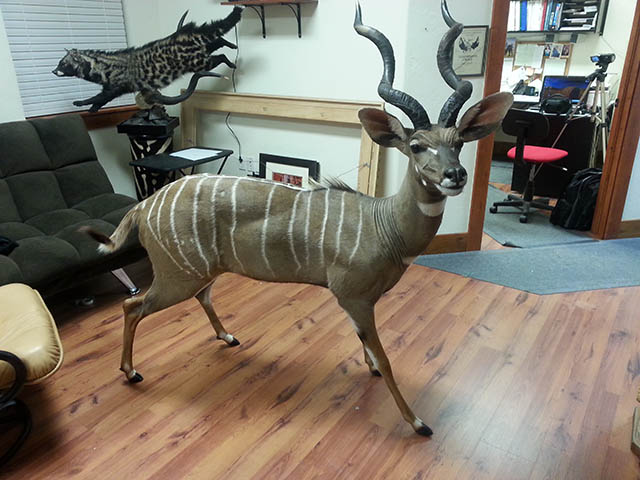
Stephen's award winning lesser kudu

Stephen Schulte did the taxidermy work on this lesser kudu that he entered in the Best of the West Taxidermy Championship. He won second place in the Masters Division with this free-standing piece.

“I’ve mounted a ton of them, but every time I do one I get my reference pictures out and obviously the internet has everything you need,” Stephen said. “You can pull up a million different pictures.”

Like the kudu, there are a lot of animals that Stephen hasn’t had the opportunity to see in real life. He said pictures are the key to good anatomically correct taxidermy.

“That’s the important thing,” Stephen said. “Reference pictures, reference pictures and more reference pictures. My dad will tell you the same thing.”

Stephen added, “A lot of taxidermists don’t [use reference pictures]. What happens is they do so many [animals], but then they start to stylize them to the way they think looks good.” In the long run they end up changing the anatomy of the animal.

This use of reference pictures is something that Dean teaches to all his employees, not just his son.

Kelli Dixon, who is also a hair dresser, does most of the finish work on animals at High Uintahs Taxidermy.

“They’ve taught me a lot here. I mean, I’ve never ran an airbrush before,” Dixon said, “and they taught me to sew.” Dean also taught Dixon the importance of using reference pictures. “Dean has some catalogs down there,” Dixon said. “[He has] books with pictures and stuff and then Google, amazing Google!”

Dixon, who still works out of her home as a stylist, said her new job has given her a different perspective on the art of taxidermy. “I had no idea what taxidermy took. I had no clue that it was all this art,” she said.

She really likes working as a taxidermist, perhaps more than being a stylist, and enjoys the outcome of her job. “You get the animal and you get to fix it up and make them all pretty,” Dixon said.

Dixon plans on being at High Uintahs Taxidermy for a long time because she finds her work very fulfilling. “I like when you tell people what you do, and they look at you like you’re an artist,” she said.

Having found a love for taxidermy, Dixon now appreciates taxidermy a lot more. She said, “Now I look at everything and see. I look at live animals and [I] notice every detail … It’s funny the detail that you start noticing after doing this kind of work.”

It is exactly that kind attention to detail that Dean and his son, Stephen, share. Their craftsmanship is what attracts people to High Uintahs Taxidermy. They want Dean and his team to create a piece of artwork out of the hide, horns and antlers — preserving their experience and bringing the memories back to life.

3 Squares Produce keeps farming alive in Salt Lake County

Story and slideshow by CALLI PETERSON

View the main orchard with 3 Squares Produce owners Ralph Larsen and Jack Wilbur.

Owning a family-operated business for more than 70 years can be tough, but running a farm business in the urban Salt Lake County can prove to be even tougher. Ralph Larsen, initial owner of what is now 3 Squares Produce, never let that stop him from continuing what he knows to do.

WHERE IT BEGAN

Larsen moved to Orchard Drive in Bountiful, Utah, around the age of 9 with his parents and nine brothers and sisters. Since then, he has lived in the same white, green-trimmed farmhouse planting vegetables and growing fruit trees.

“We moved out here in 1938,” Larsen said. “July 18th, I think it was. Orchard Drive was called Orchard Drive because it had orchards.”

While his father worked as a janitor, Larsen and his family looked for other ways to supply their household with the income they needed to sustain a healthy lifestyle.

“Back in the Depression, if you wanted money, you go and find a job,” Larsen said. “We started out picking cherries. We had cows, and we had pigs, chickens, turkeys one year and we had geese.”

As time passed, Larsen chose not to leave his farm life behind. He adamantly continued his family farm and welcomed his brother, wife, daughter and son-in-law to help keep the business thriving.

In 2009, Larsen’s son-in-law, Jack Wilbur, took charge and turned Larsen Farms into 3 Squares Produce.

Wilbur grew up gardening with his father and then married Kari Cutler, Larsen’s daughter, who happened, as Wilbur said, to be a “farmer’s daughter.” This union brought him to Larsen, proving to be just what he needed.

“We started [the orchard] and two gardens,” Wilbur said. “That’s why we call it 3 Squares Produce. My wife likes to say we’re doing our part to help people have three square meals a day.”

But 3 Squares Produce is not just a small farm. Wilbur advanced Larsen’s business and initiated a CSA. The CSA helps the Larsen and Wilbur families stay connected to the community by providing shares to their customers. Wilbur said that about half of the business is a farm and the other half is the Community Supported Agriculture.

Wilbur spends his nights and weekends working at Larsen’s orchard and planting at the other 3 Squares Produce properties. Those properties include: two small orchards in Bountiful, a backyard orchard in Farmington, an orchard in West Valley and four private residence yards in the Salt Lake area.

“In order to make it as a small farm business in the city,” Wilbur said, “you pretty much have to have different fields in different locations. We grow the things that grow the best in the areas that grow the best.”

When Wilbur is not working in the orchards or gardens, he works as a public information officer for the Utah Department of Agriculture and Food, a state agency that promotes and regulates agriculture and business.

“It was not by design, but now pretty much my entire life is agriculture one type or another,” Wilbur said. “I’m either promoting it or writing about it.”

Though farming can turn into serious work, Larsen’s authentic humor and genuine personality keep the family-operated business full of laughs. His stories, told from a straightforward perspective, lead to unmistakably unforgettable stories such as the one about the skunks who enjoyed reading the newspaper.

“You know how we used to get rid of skunks?” Larsen said. “Barrel of water with a ramp going up and put a newspaper up there, see? And the skunks would climb up there to read the paper, and they’d read and fall in and drown.”

Larsen enjoys making jokes and sharing stories. And Wilbur makes sense of the tales.

“Actually, the rest of the story is, he put eggs, I think, eggs or something on the paper,” Wilbur said. “So they didn’t actually get up there to read the paper.”

Larsen chuckled, “Put down they read the paper.”

Even though Wilbur came to take care of the business, 86-year-old Larsen still makes his way working in the blossoming orchard and tending to the tasteful fruits and gardens. He contributes as much as he can to 3 Squares Produce and fills the long work days with wisdom and humor.

“We planted a tree the other day,” Larsen said. “Five years and we’ll be able to start picking. You know how old I’m going to be? Someone’s going to have to hold me up to pick the peaches.”

Wilbur nodded, adding, “He’ll still do it. You bet he will.”

TIMES ARE CHANGING

Though the work of a farmer never seems to be complete, Larsen cannot help but look back on the way things used to be when his home in Bountiful was not surrounded by paved roads and fast-moving cars.

“The street was a dirt road out here,” Larsen said. “We’d go down there and play baseball and football right there in the street.”

Larsen and Wilbur enjoy reflecting on the changes made to Bountiful and farming in general.

“Everything’s changing,” Larsen said. “Twenty years from now it’s going to be really different.”

Wilbur added, “And farming too. There’s not going to be these little farms anymore.”

They often look back on the way things used to be, but they still work just as hard, if not harder, making sure the past is not forgotten.

“Times have changed, and there are not that many farms like this anymore,” Wilbur said. “That’s kind of why we do this — to keep it going.”

Though towns are booming and land is becoming harder to acquire, Larsen and Wilbur still think about the beauty in what farming can do for a community.

“Every year in the spring anything’s possible,” Wilbur said. “That’s the neat thing about farming. Look at those young plants, right now. They’re just going to be wonderful crops with big yields. Who knows what’ll happen.”

WHY THEY KEEP GOING

Though Larsen has spent many years working in the orchards, he still cannot find a way to stop. He says he does what he knows to do.

“Might as well do something,” Larsen said. “It’s a good day when I can get out of bed and walk. If I quit walking, I’ll probably die.”

Wilbur added, “It really does keep you going.”

Wilbur will follow in his father-in-law’s footsteps and continue planting and growing fruits and vegetables.

“I don’t really have a complete sense at what’s going to happen here, but I do have control over what I do,” Wilbur said. “I will probably be doing this the rest of my life.”

Though towns are growing and the weather is uncertain, the life of a farmer finds its way molding into the ever-changing world. 3 Squares Produce discovered a way to keep going and remain family-operated.

“Sometimes our life doesn’t turn out quite the way we think it’s going to,” Wilbur said. “It turns out in ways we can never imagine, but it’s perfect, and that’s sort of what happened here.”

Food trucks serving up a crowd in Salt Lake City

Story and slideshow by DAVID FISHER

See what food trucks are serving up on the streets of Salt Lake City.

Korean barbeque, gourmet grilled cheese sandwiches, slow-roasted barbeque and delectable cupcakes are only a few of the options available during Food Truck Thursdays at The Gallivan Center in downtown Salt Lake City. Hundreds of customers rally in from 11 a.m. to 2 p.m. between 200 and 300 South every Thursday afternoon to purchase endless amounts of street food during a weekly local gathering of food trucks.

Creating a social scene, food truck-goers interact with one another as they wait in line for their food. This is a unique dining experience; the diversity of the dishes and the à la carte style of eating is not something that can be found at a typical sit-down restaurant.

Three years ago, food trucks were required to follow a strict set of laws that prevented them from gathering within private properties of Salt Lake City. However, in April 2012 this law was changed to permit food trucks to gather in these areas and serve a wide variety of customers. This has created a totally new scene, and a plethora of newly successful businesses on wheels.

What started as only four food trucks in 2012, has increased to more than 40 trucks that roll through the streets of Salt Lake City.

One such food truck is Cupbop, a truck known for its Korean food in a to-go cup. Beef, spicy pork, chicken, or a meat combo are options available for customers to enjoy over rice, noodles and vegetables. All meat is slow roasted and marinated in a delectable homemade sauce that owner Junghung Song learned to make on a church mission he served for three years in South Korea. Each cup is covered in a savory sauce that ranges from mild to spicy. Song uniquely named the mild seasoning “baby spice” (level 1 spicy). For those who like a spicier dish, he recommends the “melt your mouth spice” (level 10 spicy).

Cupbop’s motto is “Shhhh, just eat,” which Song describes as not asking what Cupbop is, but rather just trying it for yourself.

Song went to a Salt Lake City restaurant convention in spring 2013 and noticed there were not any Korean food restaurants. This was when food trucks were starting to appear within the city. He wanted to start his own unique Korean barbeque food truck to serve his homemade recipe to customers.

Song quit his job working for an advertising company and decided to pursue running his own local business on wheels. It only attracted a few customers at first, but now Cupbop is one of the most popular food trucks in Salt Lake City. A large line of customers always gathers up the steps of the Gallivan Plaza every Thursday afternoon.

Waiting in line for food can be boring, but Cupbop makes it an experience.

Song is known for having his employees who work within the truck come out and sing and dance with the people waiting in line. Korean pop music echoes through the plaza as customers attempt to sing along to tunes that they are hearing for the first time in a language they may not understand.

“If I’m not having fun, I cannot smile to my customers,” Song said. “A bad experience would make you want to leave, and never want to come back. This is your lunch break. I don’t want you to stress out during an already busy day.”

Song always serves Cupbop with a smile, and hopes to bring a smile to all of his customers’ faces. He wants them to come back for more.

“Sometimes the other food trucks find us annoying because we are so loud,” Song says while laughing.

Song communicates with all of the other owners of food trucks because they are beginning to become their own community. Song runs and operates Food Truck Underground, which allows people to vote on locations for food trucks to gather. Food Truck Thursdays at the Gallivan is just one of many gatherings that occur throughout the week.

One truck that participates in Food Truck Underground is Heidi Cakes Utah, a food truck specializing in gourmet cupcakes made from scratch with fresh ingredients. Known for the eye popping, spotted bright pink motorhome, Heidi Cakes Utah has been serving customers for a little more than two years.

Owner Janine Lestwich wakes up every morning at 4 o’clock to start baking hundreds of her cupcakes in the commercial kitchen attached to the back of the motorhome. All cupcakes are loaded and ready to be sold for $3 apiece by 9 a.m.

What started as a bake sale to raise money for an annual anti-drug and alcohol rally is now a large-scale business. Ten percent of profits that Lestwich makes from selling her cupcakes is given to 4TheSolution.org, which educates youth about the dangers of drugs and alcohol.

With sales and donations combined, Lestwich has raised more than $10,000 toward 4TheSolution.org since the start of her business.

“We are one of the few food trucks which only sells desserts and donates profits to a good cause,” Lestwich said. “We have no competition. Our customers want to keep coming back to support the cause and my business. I really appreciate everybody coming together.”

When the Heidi Cakes Utah truck is not at Food Truck Thursdays, it can be found in downtown Ogden or at local car dealerships.

One of the biggest challenges that both Cupbop and Heidi Cakes Utah face is when the truck decides not to work. This includes engine failure or oil leaks and problems within the kitchen.

“Truck issues are extremely difficult to deal with,” Song said. “It can completely shut down our business and decrease profits, especially in the winter. But it’s worth it because it creates a challenge.”

Both Cupbop and Heidi Cakes Utah inform customers of these problems through social media outlets like Facebook, Instagram and Twitter. Because both trucks do not have an official website, this is their means of communicating to the public.

For Heidi Cakes Utah, Lestwich posts a daily menu and schedule on Facebook and Instagram as to where her truck will be located and what she will be serving that day. She listens to her customers’ words. If they are requesting a specific flavor of cupcake or for her to be at a certain location, she will respond.

“I share a lot of my personal life on my business Facebook,” Lestwich said. “People don’t get angry when I have to take a week off from my truck because they know I am visiting one of my daughters in Tennessee or Texas. Sometimes you just need to put family before business.”

Lorna Balfour, 21, is a customer of Heidi Cakes Utah who has been following the business for the past few months on social media platforms.

“I try to come down to Food Truck Thursdays as much as possible during my lunch break,” said Balfour, who works at the University of Utah. “It’s a place where the community comes together to try new foods that they may not have tried before. I go to Heidi Cakes because of the cause she supports and her red velvet cupcake.”

Balfour follows a multitude of food trucks on Instagram and Facebook so she can stay up to date as to where they are located. Sometimes she posts photos on Instagram of the food she gets from the truck and her friends always ask her about where she got the food in her photographs. She describes it as being a part of a community that is unique to Salt Lake City.

Song explains that with Cupbop, most of his new customers come because they saw social media posts from friends of theirs. Free Cubop is offered to customers who share images of their food on social media to an abundance of followers or give a great review. It is a type of reward that Song likes to give as a thank you for marketing for his truck.

The food truck community within Salt Lake continues to grow as more food trucks are beginning to gather in public places. This creates a village of a melting pot of different styles of food for customers to enjoy. There’s always something new to enjoy, and a new favorite food truck to be discovered.

Homelessness does not mean hopelessness

Story and photos by SHANNON O’CONNOR

From an outsider’s point of view, a homeless person on the side of the road may look intimidating or unapproachable.

“I usually don’t pull over or stop to donate money because I feel like they will waste the money on drugs,” said Sadie Swenson, a Westminster College student. Swenson’s reasoning is a common opinion, but that isn’t always the case.

All homeless people don’t have the same story. They come from different backgrounds and are on the streets for various reasons.

test

Francis Reeding standing on the corner of 400 S. 600 East in Salt Lake City.

Francis Reeding, 65, stands on the streets of downtown Salt Lake City for about six hours a day,  hoping to get enough gas money to go home to California. He has been living out of his car for three months.

Reeding fought in the Vietnam War starting in 1968. When he got home from the war, in 1970, he experienced hearing loss and suffered from Posttraumatic Stress Disorder. Later, Reeding went to the University of Utah in 1976 as a math major. But since then he has struggled to keep a job. Now he feels hopeless and apathetic to get his life back on track.

“It’s embarrassing standing out here holding this dang sign,” Reeding said.

Although it is common to see people holding up a cardboard sign, it does not mean they are all the same. The homeless need a helping hand and The Road Home, located at 210 S. Rio Grande St., can get them off the streets and into housing.

The Road Home is the biggest homeless shelter in Utah and is always ready to help men, women, children and families.

test

The front of the Road Home located at 210 S. Rio Grande St. in Salt Lake City.

“Everyday I see people that I think are beyond hopeless and I see them make it and overcome homelessness,” said Celeste Eggert, Road Home development director.

Eggert has been with the agency for 17 years and has been the development director for 12 years. She fell in love with the shelter because of the clients’ strength and courage and she loves the mission of the Road Home.

The mission is to educate people about shelter and housing and to “get people out of homelessness and back into the community,” Eggert said.

How does this get accomplished? By the effectiveness and success of their programs: Permanent Supportive Housing, Rapid Rehousing and the emergency shelter.

“Collaboration is huge, many of the programs we’ve done have gotten national attention,” Eggert said.

Palmer Court is part of the Permanent Supportive Housing program. Palmer Court, located on 99 S. Main St., is an apartment complex that was purchased by the Road Home. It houses up to 300 of its chronically homeless clients. The chronic clients are people who have been homeless for one year or longer due to mental illness, addiction, or substance abuse. When they live at Palmer Court they sign a lease and pay rent that is reasonable with their income.

Eggert explained how the chronic clients need a slow transition from homelessness to living in housing. Being homeless is all they know and they’re scared of change, on top of trying to combat their personal trials. Specialists are needed for the severe cases. The Road Home is considered to be the general practitioner and they bring in the specialists.

“We try to collaborate, never duplicate services and work closely together,” Eggert said.

The agency partners with people who specialize in a variety of the clients’ necessities, such as jobs, rehabilitation, free medical care, school enrollment for the Salt Lake City districts and therapy. The combination of the staff, specialists and housing is designed to provide Palmer Court clients with a path to recovery.

Rapid Rehousing is the homeless family program. In 2009, it was brought to light that there was an increase in homeless families. Since the program was launched the Road Home reports that “87% of families on that program will never be homeless again.”

What is provided through Rapid Rehousing? According to the website, the families are offered “barrier elimination, housing placement assistance, short term subsidies and supportive services,” until they can get back on their feet.

The third program is the emergency shelter. This is for the clients who need a roof over their head for 24 hours. The men’s and women’s shelters consist of beds, bathrooms, showers, microwaves and hygienic products.

Elise Adams was homeless for five months and never stayed in a shelter.

“They have all these rules and they’re usually run by a church so the rules are often arbitrary. I think it’s easier to sleep in a park undisturbed,” said Adams, who uses a male pronoun.

Once he was informed that the Road Home is not a religious shelter, and there is the emergency shelter program, he admitted he would have stayed there.

Eggert said, “We don’t give up on people, we’re always going to work with them.”

Helping the homeless is financially beneficial for Utah and the community. But more importantly, it’s saving people’s lives. The majority of the beds are used by the clients who stay six months or more. Once individuals get the proper help, they can move up to housing and reach their full potential.

Eggert admits it’s a challenging population to work with. But she said it’s worth it because the staff, donors and volunteers are making a difference. The Road Home is a shelter that recognizes the clients’ unique situations and offers the support needed to overcome homelessness.

Steadman’s Fine Jewelry is proud of its family legacy

Since 1904, four generations of craftsmen have worked with watches, clocks and jewelry

Story and movie by McCALL GRAY

Meet the two men behind the fine quality — and ongoing legacy — of Steadman’s Fine Jewelry.

Four generations and 111 consecutive years later, Steadman’s Fine Jewelry serves the community in more ways than diamonds.

The Steadman family refers to the family-owned and operated business as the “cuckoo shop.” Not because working with family could drive one crazy, but because Steadman’s Fine Jewelry offers clock and watch repairs in addition to its jewelry services. A practice the family has kept alive for more than a century.

In the early 1900s, Edward Steadman was in search of a new occupation. He asked a local Salt Lake City watchmaker if he could apprentice under him but was told he did not have what it took to be a watchmaker or jeweler.

His grandson, Rodney “Rod” Steadman, the current owner of Steadman’s Fine Jewelry, recalled the “exact words” from the story, told to him by his father, Virgil Otto Steadman.

“The watchmaker told my grandfather, ‘all you’re going to do is ruin watches and spoil the trade,’” Rod said. “Now if you tell a stubborn Englishman that he can’t do something, they have to prove to themselves and the world that they can do it.”

Edward prevailed and founded Steadman’s Fine Jewelry in 1904.

The business was located in Murray on the north side of 4800 South, just west of State Street, and west of where the Winger’s Roadhouse Grill now stands.

For roughly two decades Edward successfully ran the business of clock and watch repairs. He then moved the shop almost directly across the street, to 4824 S. State St., where he introduced jewelry sales and repairs.

Edward’s five sons all took a try at the clock and jewelry business, but four of them ended up going in different directions. Rod said, “My dad is the only one that ended up with the business.”

Virgil Otto Steadman took over his father’s business completely after Edward had retired and died in 1957. He had dedicated 53 years to Steadman’s Fine Jewelry by age 81.

Virgil relocated the business to 4844 South, State St. where he later taught his own son, Rod, the family trade. Rod began apprenticing with Virgil at age 12. During his junior and senior year of high school, he got out early on work release and continued to repair clocks and watches.

“While everyone was out playing, I came home and tried to learn the business,” Rod said.

Rod expected to carry on the tradition of watch, clock and jewelry repairs after his father retired. He was never forced into the position to keep the business going, but Rod was devoted to the family legacy. He allowed Steadman’s Fine Jewelry the opportunity to reach the third generation.

Virgil, like his father Edward, successfully ran the family business for 50 years before retiring in 1986. Rod then decided to move the business to its current location at 1217 W. 4800 South in Taylorsville.

“Well, it’s usually the children that ruin it [break the family businesses cycle],” Rod said. “And I didn’t want to be that child to ruin the business.” He jokingly added, “No pressure or anything, but make it work!”

As stated by CNN Money in 2008, “Two-thirds of family businesses fold before reaching the second generation, and just 12 percent make it to the third.”

Rod acquired all the knowledge he could from Virgil. One thing he learned very quickly was how powerful the main springs in the old clocks were. Rod said when the springs — a clock’s power source — are wound, it should only be done in small increments. A vivid memory reminded him of the reason behind the rule.

“I remember my dad and I sitting next to each other working,” Rod said. “He was working on a clock, and put a screwdriver in the end of the key and was winding it up. The next thing I know, the screwdriver whizzed past my face and stuck straight into the wall! His face turned white, you know, he thought it was a horrible thing that he just about got me with the screwdriver that slipped off the key. So there’s a lot of power in those main springs.”

If wound one turn too tight, the main spring can kick back and cause severe damage to not only the clock, but also to the person winding it. Rod recalled customers coming in with their clock, a broken spring and broken fingers.

When it came to watches, Rod said Virgil was one of only two people in the state who had a timing machine and was qualified to certify the watches of the railroad engineers. Every quarter the engineers came into Steadman’s Fine Jewelry to ensure their watches would keep accurate time.

“There was no other communication to rely on besides their watches and the time, but they knew the distance, how long it would take from point A to point B,” Rod said.

Rod also recalled one of his father’s clever watch advertising tactics to show what Steadman’s Fine Jewelry offered.

He said at community fairs, such as the one at Plymouth Elementary School in Taylorsville, Virgil would fly in an airplane and drop out a Wyler watch that he carried in Steadman’s Fine Jewelry. Whoever found the watch got to keep it. The purpose of dropping them from the sky was to show they could survive the fall and still continue running.

Virgil died in 1994 at the age of 78, leaving the legacy in Rod’s hands.

While raising a family of his own two doors down from Steadman’s Fine Jewelry, Rod introduced custom jewelry making to the business for the first time. Previously, the business only offered jewelry repairs and sales.

“We sold a lot [of jewelry], but my dad never got into the manufacturing of it,” Rod said. “So that’s why I decided I wanted to learn how to actually manufacture the pieces that are done by a lost wax method of casting.”

Rod introduced his younger son, Cassidy, to the business at an early age, just as his own father had done. He did not become that involved from the start, though. After he graduated high school he decided to experience other jobs, like construction. But, a shocking experience changed his mind.

“I had a dream that I was working on construction, demolition, and I was going to die on the job site,” Cassidy said. “I had the dream several times. I had to listen to myself, and I quit.”

It came as a surprise to his boss. A month after Cassidy had quit, the parking structure he had been working on in Temple Square downtown had collapsed. He said several people were injured in the accident. That was the moment when Cassidy realized he had made the right decision.

In 2006, he joined his father, Rod, at Steadman’s Fine Jewelry as the fourth generation of the business. He found that he enjoyed creating and doing things with his hands and designing custom jewelry.

Fashion and style are constantly changing, but Cassidy has a great skill for coming up with new ideas for custom pieces. He said it is rewarding to take his own ideas and turn them into something tangible.

“You have to be really self disciplined in this business because you can fall back in other areas, like you can get distracted easy, so keeping motivated really comes from your self-drive,” Cassidy said.

Rod said the jewelry business is very different nowadays, versus what it was during the time his grandfather and father owned and operated it.

“I think it was better in many ways because there were probably only three or four jewelry stores from Salt Lake to Sandy, so there wasn’t a lot of competition,” Rod said. “Now we’re dealing with a dime a dozen.”

There is an evident shift in where jewelry can be bought today. It can be found for a reasonable price at a chain business such as the Shane Company, at a bargain store like Wal-mart Stores Inc., or multiple places on the Internet.

Rod said that when buying jewelry, it is always important to remember to look at the piece in person. Things look different than they do in a picture and on the internet.

“The problem is that people look at jewelry and take it for the price, not the quality,” Rod said. “We’re proud of quality and in-house jewelry. Making jewelry that lasts.”

Christie Steadman, Rod’s wife, said, “I know he [Rod] has great joy and pleasure bringing happiness to couples when they get engaged or for special occasions, making a customized piece of jewelry.”

It is very rare that a family-owned and operated business can survive to the third and fourth generation. That is why Rod and Christie said they would like to see Steadman’s Fine Jewelry carry on into their grandchildren’s generation.

“We were very happy with Cassidy’s decision to become involved,” Christie said. “That was our dream, that our children would carry on the family business and legacy. But the most important thing for us was that our children be happy in whatever decision they made with their careers.”

Cassidy added, “Our goal is to make something that the customer wants and appreciates. Jewelry that will last not only a lifetime, but something they can pass on to their kids someday.”

Diamonds are said to be similar to businesses. There are old ones and new ones, rare ones and common ones. But there is none that compares to the value of Steadman’s Fine Jewelry. Dedicated to the trade and family since 1904.

anne b designs creates employment for Utah refugees and immigrants

Story and movie by MEGAN DOLLE

See the behind-the-scenes action in anne b design’s shop.


Maroufa Fnu sits at a sewing machine in an old pickle factory, stitching together leather and cotton fabric to create a variety of colorful designer bags.

Clutches, handbags, pouches and keepalls are only a few of the creations Fnu, 29, has in her repertoire. She had her own dressmaking business in Afghanistan before immigrating to the U.S. in 2012 to join her husband. She was familiar with sewing machines and retained some transferable skills, but admits that making bags is different than dresses.

Fnu appreciates the job and the ability to earn — and keep — her own money, something that wasn’t a possibility in Afghanistan due to cultural restrictions and norms affecting women. “I’m happier here,” she says about moving to the U.S.

Fnu works for Sarah Burroughs, owner of anne b designs, located in Salt Lake’s Granary Row. Fnu says she’s thrilled to be working for Burroughs, who designs and creates handbags that are sold online and at boutiques across the country, including Utah’s own Unhinged.

Burroughs initially decided she wanted to employ refugees and new immigrants after participating in a humanitarian trip with HELP International in summer 2013. She went to a village in Uganda and taught sewing techniques to the community.

“I came back, and I really liked teaching. I really liked how hard-working international makers were and that they were really skilled,” Burroughs says.

A friend of hers had worked with refugees in a similar industry. Burroughs reached out to her and soon got in contact with local refugee agencies like Catholic Community Services of Utah, Asian Association of Utah and International Rescue Committee in Salt Lake City.

Erica Wood, program specialist at the Department of Workforce Services within the Refugee Services Office, played an instrumental role in helping Burroughs find potential employees.

Wood and representatives from other refugee agencies held initial meetings with Burroughs to ensure she understood refugee culture. They also reassured her that an entire community of organizations was there to support her and her future employees.

Additional services provided by Wood and her team included screening and assessing applicants prior to interviewing, identifying reliable workers, providing job readiness orientation and employment counseling.

“It’s services that we would provide to any employer as long as they seek us out,” Wood says.

Impressed by her organization and passion, Wood was excited to work with Burroughs and help connect her business to the community.

More professional partnerships with refugees

Interestingly, Wood says she has noticed an increasing number of employers in Utah who want to hire refugees. And, she says placement numbers have risen over the past couple of years.

Why the growing interest in this part of Salt Lake City’s population?

It may be due to educational efforts. Wood works alongside refugee agencies in Salt Lake City to inform the community about refugee culture. Wood says she believes her refugee customers are hardworking, loyal and simply looking for an opportunity to be engaged in their new community and to support their families. She hopes to help the community understand that refugees are a great population to work with.

Wood also says it might be due to the labor market.

“Employers are looking to expand their pool of candidates. DWS, as a whole, is dedicated to helping employers increase their workforce while assisting people from all walks of life as they enter or reenter the job market,” Wood says in an email interview.

Utah is also unique in its ability to provide two years of case management. In nearly every other state, this service is only provided to refugees for six to eight months.

Refugees who are resettled in Utah receive support for their family and children in health, employment, success in school and overall cohesion with their community. This extra help can make refugees even more attractive for prospective employers.

“With every refugee who is recently resettled, there’s really a team of people that’s working together to support that refugee individual and the family and their employment search and just them in their communities as well,” Wood says.

Bridging the cross-cultural gap

This team of individuals may be necessary when employees and employers are working to bridge cross-cultural differences.

Since July 2014, Burroughs has trained and hired two other employees in addition to Fnu. Her first employee, a seamster from Afghanistan, simply didn’t come into the shop one day.

Left with impending Christmas orders, Burroughs quickly trained and employed a seamstress from Uganda. But, after months of back-and-forth miscommunication and unrealized expectations, Burroughs once again began searching for a new employee.

“There’s really unfortunate situations where it’s not a good fit, where I learned a lot as a business owner that I need to set these expectations. And so I have,” Burroughs says.

Burroughs has continually changed the way she assesses and evaluates her employees. She realized the need for clear training and employment expectations for all future employees, regardless of their culture. But she has also encountered some complex situations. For example, one employee, perhaps used to bartering in her culture, wanted to haggle over her pay. Another expected Burroughs to deliver supplies to her.

Despite the learning curve, Burroughs is determined to continue employing international seamstresses. “Because they’re great workers,” she says.

Bethany Hyatt, public information officer with the Department of Workforce Services, wants to reassure potential employers that there are individuals ready and willing to help in circumstances like those Burroughs experienced.

“The program is set so that there’s an open dialogue, so that if there’s ever a question an employer has about an employee and expectations … Erica and her team can help answer those questions as specific circumstances change over time,” Hyatt says.

Meeting Maroufa

In July 2014, around the same time Burroughs launched a crowdfunding campaign, she began the process of searching for employees to help fulfill incoming orders.

She heard about a couple of sisters from Afghanistan who resettled in Utah. Burroughs began training the women shortly thereafter, but it ended up being too difficult for her to work with them due to their full schedules.

Months later, after training and hiring two other employees, Burroughs started to realize the disconnect between her and her Ugandan seamstress. One of the sisters from Afghanistan messaged Burroughs on Facebook around this same time. She said her friend, Maroufa Fnu, was interested in a job. She asked for Burroughs’s phone number to give to Fnu.

Instead of waiting for Burroughs to reach out to her, Fnu called her right after receiving the contact information.

“She did a lot of being proactive,” Burroughs says.

Armed with her new skills and expectations, Burroughs was confident this professional relationship would be successful.

After training for three weeks under Burroughs’s direction, Fnu was promoted to a part-time seamstress position with anne b designs. She helps Burroughs fill online and boutique orders by working 20 hours a week.

Fnu is Burroughs’s only paid employee at the moment. She has so far shown herself to be a dedicated and hard worker.

Burroughs hopes to employ more refugees as she expands. She has been grateful for the assistance from Erica Wood and her team at the Department of Workforce Services within the Refugee Services Office. They both continue to be confident about the future of anne b designs and its partnership with local refugees.

“It’s been a success story for each individual, for personal mile markers, some big successes, some small successes,” Wood says. “And Sarah has been a big part of that.”


Editor’s Note: Since this story was published, anne b designs relocated to 17 E. 400 South and Maroufa Fnu moved to Denver, Colorado for family reasons.

The Pie Pizzeria, a hole in the wall that happens to serve some of the best pizza in town

Story and photos by BRANDON RISLEY

Just west of the campus of the University of Utah, The Pie Pizzeria has been a staple of Salt Lake City for nearly 35 years.

IMG_5375-1

The Pie sits down below the University Pharmacy at 1320 E. and 200 South.

With its old-style brick walls and dim lighting the Pie has been labeled “the best hidden secret in Salt Lake City” by its customers and has continued to make “Best Pizza” lists throughout the state’s local papers.

The Pie’s original restaurant lies a block away from the University campus and is located in the basement underneath the University Pharmacy off the corner of 1320 East and 200 South.  With The Pie situated underground and only one sign marking the location it isn’t a very easy place to find.  However “word of mouth” has kept The Pie one of the busiest establishments around campus.

Owner Mathew Palmer has been living the dream ever since his family created The Pie back in 1980. “Every time I walk into the restaurant and see all the people it just makes my day,” Palmer says. “My family and I worked hard to make not only a great tasting restaurant but also a fun hang out spot.”

According to The Pie’s website, “The establishment was remembered by long time Salt Lake residents as Bimbos, in the Cellar in 1965. Bimbos was a pizza and pasta place where a 14 inch pizza was had for only $2.20. One of only three pizza restaurants at the time, the seats were actually wooden pews and closed on Sunday for use as a church.”

Palmer went on to talk about how back in 1980 his family decided that they needed a change of scenery. “Since we were set up right next to the U my parents wanted to make it more of a college atmosphere,” he says. “We changed the name to The Pie, took away the church feel and made it more accessible to students. It was an instant success.” The word quickly spread through the students at the university as they came in by the dozens.

Jennifer Ogden, a Salt Lake City resident and University of Utah alumna in the class of 1987, said that she and her friends spent many nights there hanging out and studying. “Most kids spent their nights in the library but we needed a place where we could be ourselves and not get in trouble,” Ogden says. “We were quite a loud group and it also helped that we loved the pizza.”

The Pie’s mission statement is that it believes that every pizza should take the time and care it deserves. The dough is hand rolled and tossed the traditional way, the meats and vegetables are freshly sliced every morning, and Palmer believes that if a pizza took five minutes to cook than it’d either be a miracle or not taste very good.

“We’re not afraid to take our time because we know that our customers have loved the way we’ve cooked our product for the past 35 years,” Palmer says. “My family believed in making every dish special and I’ve wanted to continue that trend.”

Current University of Utah student Mitchell Orr says that one of the best things about The Pie is that it is open till late at night. “As far as I know there are really only two places around campus that are open late, Village Inn and The Pie,” he says. “With Village Inn not really being within walking distance The Pie is the place to go when experiencing those late night munchies.”

IMG_5378-1

The Pie’s colorful door welcomes Salt Lake City residents and U students alike.

The Pie is open until 1 a.m. on weeknights, 3 a.m. on Friday and Saturday and 11 p.m. on Sundays. It has become one of the most popular hangout places for students. “Living in Salt Lake my entire life I grew up going to The Pie when I was younger but I never truly understood the majesticness of it until I got to college,” Orr says. “Only when you’re tired of studying after midnight and head to The Pie do you taste the greasy toppings and melty cheese of an incredible pizza.”

According to the website The Pie also has not only been voted as one of premier pizza places in Utah by local media such as KSL, Salt Lake Tribune and Salt Lake Magazine, but it was also voted the 7th best Pizza in the nation by Citysearch.com

Palmer couldn’t have been happier with how The Pie has been given so much praise over the years. “In a word, I’ve been overjoyed with (The Pie’s) success,” Palmer says. “My family set out to create a place that people will come to and then go out and tell all their friends and that’s exactly what has happened. I hope to keep this going for another 35 years.”

Ogden says that even after she graduated she still comes back to reminisce about old times. “Everything is still how I remember it,” she says. “Going back there is our way of remembering what we went through and never wanting to do it again. Except for tasting this great pizza.”

The Pie may be small and hard to find but its legacy has made it a whole lot bigger to Utah students.