PAC-12 conference change brings increased revenue

Story and photos by SCOTT WISEMAN

The University of Utah’s athletic department is an organization that has been acknowledged nationally for its prestige in facilities, recruitment, scholarship and ability to thrive.
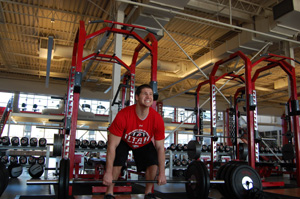
Freshman Tight End Jake Murphy performs a dead-lift excerise during training. The Dee Glen Smith Athletic Center recieved a large amount of funding from PAC-12 television contracts and private donors for reconstruction and expansion.

Starting in the fall of 2011, the department will undergo its largest change yet— a migration from the Mountain West Athletic Conference to the newly-restructured, illustrious PAC-12 Athletic Conference.

Although details about the myriad changes the conference switch might bring are still mostly speculation, it is obvious that some form of change is imminent.

One of the major highlights that has people buzzing is the fact that Utah will now be placed in a Bowl Championship Series conference. Being in one of these six conferences means they will receive a chance at an automatic bid to a BCS bowl game. This is the highest achievement for a team in American college football.

Previously located in the MWC, the Utes did not automatically qualify for BCS bowl games, and found it extremely difficult to appear in those games. If the Utes were to perform at the same competitive level in the PAC-12 as they did in the MWC, they will get the opportunity to routinely appear in games such as the Rose Bowl and the College National Championship.

One of the many changes that are looming in the horizon for Utah’s athletic department— specifically football— include the guaranteed increase in revenue generated from television contracts, ticket sales and the Bowl Championship Series.

Dr. Chris Hill, Athletic Director for the University of Utah, explained that the Utes are guaranteed $2.5 million in television contracts, an increase of $500,000 from last year’s television generated revenue.

When Utah joined the PAC-12, the athletic department agreed on a payment plan for television contracts where they would receive 50 percent of the usual share for their second year in the league, 75 percent for their third year and 100 percent of the revenue share after their fourth year, Hill said.

While Hill did not know the exact figures for the money that the newly restructured television revenue contracts would bring in after the Utes’ fourth year in the league, it is only expected to increase rapidly.

“Money is everything,” said Morgan Scalley, Utah’s football recruiting coordinator. “It allows us to build well-equipped facilities, upgraded equipment, academic services and ton of other options depending on different priorities.”
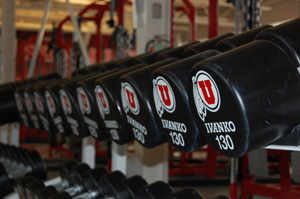
Dumbells are part of the improved equipment replaced in the Dee Glen Smith Athletic Center.

Utah’s athletic department is a separate organization from the university, and the revenue generated from athletics is kept in an internal budget, Hill said. The revenue produced is used for the constant improvement of the athletic department.

This means that all of the student benefits of joining the PAC-12 conference will have to be indirect. Whether or not the addition of a more prestigious athletic department will translate into a more well-known university has yet to be seen.

For Utah’s football team, money comes from a variety of different sources. The revenue is generated from the stadium, ticket sales and private donors, sometimes called boosters, Scalley said.

When asked where the new revenue generated would end up, Hill said the athletic department planned on first upgrading the football center on campus, and then it would turn its attention to recruiting. With an increase in budget, higher salaried coaches and recruiters are given a chance to come to Utah, all with the supreme goal of making Utah the best of the West, Hill said.

“The shift to the PAC-12 conference will make Utah more attractive to talented recruits, leading to more respect for our department,” Hill said. “We hope the change will add visibility to the U as well.”

Students from across the university are becoming increasingly aware of the decision to migrate to a new athletic conference and the implications of the decision.

“I’m extremely excited for football season,” said Christopher Leeson, a student at the University of Utah. “Most importantly, I believe the conference switch will lead to an increase of students at the U, making it an exciting place to attend school.”

Todd Patton, a student at the university studying mass communication, believes the migration to a more prestigious athletic conference will be beneficial to the school in several different ways.

“Getting more revenue leads to having a better team,” Patton said. “If the team generates higher revenue, they have the budget to spend on recruiting, new facilities and top coaches, all of which are things that make a championship team.”

Both students said they did not think the transition of athletic conferences would affect their lives as students dramatically at the university. The transition might take several years to complete, and by that time, several students currently studying at the university will have graduated, Leeson said.

Utah’s athletic department is a separate organization from the university, and the revenue generated from athletics is kept in an internal budget, Hill said. The revenue produced is used for the constant improvement of the athletic department.

“Unfortunately, I wish that some of the extra revenue generated by the athletic department would be shared with other campus organizations,” Leeson said. “Greeks, the Bennion Center and several other clubs are in need of funding so that they can continue to aid the community.”

Swing for Hope fundraiser fights breast cancer

Story by JORDON CAHOON

Ask any athlete and they will be sure to tell you that every game means something. Some games are used for practice, some games are played to prove something and some simply mean more than others. Athletes play for many reasons: pride, fame, personal gain through education or financial means. It’s not very often you see an athlete play for charity.

Kathy Howa tosses the first pitch out at the Mesa Tournament. Photo courtesy of The Swing for Life Foundation.

The Swing for Life Foundation started off as a fundraiser during events like home run derbies and skill competitions, and then started to bloom and have entire games devoted to the cause of increasing awareness and funding for breast cancer. At first, the full games were only in women’s sports like softball, soccer, volleyball, and basketball, but as of 2009 it started to branch over into men’s sports.

Kathy Howa started this non-profit organization in April 2003 after being diagnosed with breast cancer in late August 2002.

“I coach high school volleyball and softball,” Howa said. “After my diagnosis, my athletes chose to wear pink ribbons with my name on them to the games and practices.”

It all started with the “strike out cancer hit-a-thon” where the Rowland Hall softball team rallied around Howa to raise money for the Susan G. Komen Foundation Race for the Cure. They received $12,000 between them and three other schools at the event.

“It’s no secret that the timing is hard to run any kind of foundation, but it’s amazing to see just how generous and giving people are in such hard economic times,” Howa said. “From our officials and field crews, to the volunteers doing all the behind the scenes work. They give up their time, which could be used to help out their families instead.“

Certain schools, such as Cottonwood High School, have spared no expense in making these games something to be remembered by purchasing pink gloves and shoelaces for football and pink head and wristbands along with shoelaces for basketball games. Some schools, like Brighton and Cottonwood, have had entire uniforms designed in pink just for one game.

“Even though we got killed last year, it was an awesome time just seeing all the people show up,” Matt Olsen, former catcher for the Brighton High School baseball team, said. “Pink isn’t really my color though.”

Since that initial fund raising tournament Howa has donated her time and efforts to her own foundation, Swing for Life, and has set a goal to donate $50,000 each year to Huntsman Cancer Foundation’s breast cancer research program. This goal has become increasingly difficult in recent years as the economy continues to spiral downward, but the foundation has made their goal each year so far.

“The biggest thing to look at isn’t the amount of time, money or effort that goes into these fund raisers, but to show people suffering from breast cancer that there are people trying and fighting for a cure,” Howa said. “Plus, I couldn’t give up the sports that I love.”

Fan Fest at risk with budget cuts

Story by JANITA BADON

At the end of each summer, an average of 14,000 fans usually gather with family and friends to meet and greet the University of Utah varsity athletes as part of the annual Fan Fest. But with budgets tight, the popular program is in danger of being cut.

Sophomore guard for the University of Utah women’s basketball team Iwalani Rodrigues takes the fan fest seriously, and believes the Fan Fest helps the program.

“I met so many people because of the Fan Fest,” Rodrigues said. “If they take that away from us, I don’t know of another way to actually get more fans.”

Rodrigues, like many other varsity athletes at Utah, thinks the Fan Fest is beneficial to not only the attendance at the games, but also the support that it brings.

“I mean, of course, we don’t have as many fans as the men’s basketball team or as the football team, but when we have the Fan Fest it’s our (women’s basketball team) way of stealing fans,” Rodrigues said.

Losing the Fan Fest would also disappoint its main audience: the fans. Sasha McKinnon, a self-proclaimed “die hard” football fan, said she loves the Fan Fest, and thinks the Utes could potentially lose fans without it.

“I just think that the Fan Fest gives you a chance to talk to your favorite athlete, and ask all the questions that you want,” McKinnon said. “I think all the women on the varsity team at the U get fans because fans get to know them and are interested in seeing them in action, after meeting them at the Fan Fest. I honestly don’t think people know how good the soccer team is, or how good the volleyball women are, but when they go to the Fan Fest and interact with the players they’re more obligated to go to a game.”

Supporters say the Fan Fest is a great way for the fans to meet the players, get autographs, and eat free food, but Mary Bowman is the one who’s in charge of if it proceeds or not. Bowman, the Associate Athletic director at the U, says simple and plain, we don’t have the money for it.

“The Fan Fest is about $20,000 and it leaves us with not enough money for anything else,” Bowman said. “I personally love the Fan Fest but with economy being as bad as it is I just don’t we have enough money to have it, and have other activities that other fans enjoy.”

Understanding that the Fan Fest is beneficial to the Utah programs and the support for the athletes, Bowman said if they don’t have the funding there’s no way to have a Fan Fest as productive as the ones in the past. Doing a certain number of activities where the athletes are involved such as Scholarship Dinner, Athletes Interaction, and Halloween bowl night, money is limited and needs to be split evenly throughout the year. The Fan Fest just happens to be the one that cost the most money.

Swing through the economy: Baseball leagues grow in numbers

Story by JORDON CAHOON

Even with the economy struggling the past few years, Youth Baseball programs across the valley seem to not only be able to maintain their numbers, but in some cases grow.

The state of the economy in recent years is no secret to anyone. Companies have been cutting back. Those employees that are fortunate to keep their jobs are forced to do the same.

Jared Snell, Academy Sports‘ manager, said the economy really has not affected his store.

“In a down economy, parents are more willing to put their children in sports and buy the proper equipment, before buying an Xbox for the kids or something for themselves,” he said.

The number of participants in the Alta Canyon Babe Ruth League has increased from 2007 through 2010. There were 264 kids playing baseball at Alta Canyon in 2007, 312 in 2008, 328 in 2009 and 338 kids playing in 2010. Even though the league hasn’t had their sign-ups for the 2011 season yet, numbers are expected to be in the same ball park – if not slightly higher.

Todd Smith has been the president of the Alta Canyon Babe Ruth league for the past five years.

“I think the main reason we continue to grow through a down economy would be because by signing up for baseball, we are giving the kids something to do three to four days a week for four to five months, all for a fairly reasonable cost,” Smith said. “Between most teams practicing twice, having two and sometimes even three games a week, parents don’t have to worry about what their kids are doing.”

“Plus baseball is a sport that almost anyone can play, regardless of athletic ability,” Smith added.

Tony Wiseman has been involved with the Mount Olympus Pony Baseball League for nine years. He’s put his three boys through the league and is currently the league president. The Olympus Baseball has seen similar growth over the same time span. It has grown from 318 little sluggers in 2007, to 352 in 2008 and 364 children playing ball in both 2009 and 2010.

“It’s hard to say exactly, but we’re expecting to have close to 400 kids in 2011, hopefully more,” Wiseman said. “The biggest thing is just making sure the league runs smoothly and the kids are enjoying it. After that everything else finds a way to just take care of itself.”

Snell not only supplies the league with their equipment but coaches his sons team in the Alta Canyon league.

“The important thing to remember is that even though money is tight, to make sure that today’s youth still has every opportunity to take part in some type of activity,” Snell said. “Not only are sports a healthy way to pass the spare time, especially compared to playing the Xbox or Playstation, but by playing sports the kids build character and learn how to work together.”

Athlete for life: staying healthy and active in later life

by Paige Fieldsted

Looking at 70-year-old John Percival now you may not guess that he spent the majority of his life involved in athletics. He leans heavily on a cane, just three weeks removed from his second knee-replacement surgery this year. He had the other knee done 12 weeks ago.

John Percival in his home three weeks after having his second knee replacement surgery this year.

Percival’s smiling face turns sober and he chokes up when he’s asked about the surgeries on his knees.
“It’s been hard,” Percival said. “It’s really hard to not be able to do what you want to do. After we’ve been so active it’s hard not to be able to do.”
Percival’s attitude can be echoed by other seniors that aren’t ready to give up the active lifestyle they developed in their youth and as athletes.
Percival has been active for the majority of his life, playing sports from a young age. In high school he participated in football, wrestling and ran track occasionally.
Percival said he got involved in sports in high school because that was the cool thing to do.
“When you’re in high school it is the only thing to do,” Percival said laughing. “You’ve got to be in sports. You don’t get a girl if you not in sports.”
While Percival’s competitive football and wrestling career ended with graduation from high school, he continued his athletic ways by participating in horse racing and rodeo for years.
Percival said the activity level from his youth has carried over into his life now.
“I ran for a number of years until my knees when bad. Then we played with the horses,” Percival said. “It carries over to make a guy more active and it’s carried onto this day.”
Percival isn’t alone in carrying his active lifestyle into his later years. A study published by the “Journal of Aging Studies” showed that younger athletes expect to stay active as they age and that older adults who were athletes have been more active as they got older.
Percival said that up until August, two months before his first knee surgery, he walked four to five miles every day.
Being healthy and active throughout his life has paid off for Percival as he said his two knee surgeries have gone better because he took care of his health right up until the surgeries.
His two knee replacement surgeries were performed only nines week apart.
“I think that being active and in good shape helped with the knee operations,” Percival said. “I think I got along better because the good shape that I was in.”
At his most recent physical therapy appointment doctors told Percival that he is physically three to four week ahead of other patients that had knee surgery the same day as him.
Dr. Steve Aoki, an orthopedic surgeon in sports medicine at the University of Utah Orthopedics Center said that older people don’t heal as well as the younger athletes he works with but that being in better physical condition usually helps.
“Although probably true, that isn’t always the case,” he said. “They certainly don’t rush their rehab like a younger athlete is trying to push it and get back to their sport at a sooner time period. For a lot of our more recreational older athletes there is not that rush.”
Percival attributes the cause of his knees going bad to genetics, but that isn’t the case for all athletes that have to have surgery later in their life. Some older adults have to joint surgery because of participation in the sports they love so much.
Aoki said that athletes often pay later in life for the activities they did in their younger years.
“It becomes a combination of both, genetic factors cause breakdowns of joints and soft tissues and also your activity level plays in,” he said. “It’s pure biomechanics. It’s similar to a car, the more you use a care the more chance you have of that car breaking down in the future. If you subject your body to a lot of stress throughout the lifetime you have a higher risk of joint damage later on.”
Percival’s wife, Lonnie Kay Percival, said she has seen his active lifestyle benefit his health beyond his knee surgeries.
Lonnie Percival, who has never been an athlete, said she can see the differences in the way they have aged and been able to maintain their health.
“He is a lot healthier than I am,” she said. “My back always hurts and I have high blood pressure and cholesterol. He has never had any of those problems.”
A study published by the “American Journal of Sport Medicine” showed that many of the disabilities that plague older adults are modifiable with exercise. Losing muscle mass and bone mineral density can be prevented with low impact exercises.
Another study published by the “Journal of American Academy of Orthopedic Surgeons” supported that same data. The article suggested that 30 to 50 minutes of aerobic exercise a day performed three to five days a week and resistance exercises twice a week could produce significant health benefits.
“To prevent more catastrophic injuries staying well conditioned is important,” Aoki said. “Minimizing high impact activities, and allowing your body to not see the same the stresses over and over will help prevent injury.”
Percival’s involvement in athletics and sports has benefitted him well outside the realm of health, as he said he learned good sportsmanship and the importance of being competitive.
Percival said the biggest impact sports has had on his later life is the competitive nature he was first exposed to in high school. From the work force to family relationships competitiveness has been in every aspect of Percival’s life.
“It’s a competitive world so you need to learn to be competitive,” he said. “In my work life I’ve always tried to do better than someone else so I could get a better job. It’s paid off in terms of better jobs throughout the years.”
Percival has worked many jobs throughout his life from a police officer in his younger years to the plumber he was when he retired five years ago.
The competitive spirit hasn’t just benefited Percival in his work life but has also helped him build better relationships with many of his grandchildren.
“I’m a big BYU fan and not all of my grandchildren are,” Percival said. “It’s fun being around them and teasing each other.”
Lonnie Percival said she has seen his competitive spirit come through during his recovery from knee surgery as well.
“He gets up and does his exercises twice a day and walks and walks and walks because he can’t stand to stay down,” she said. “I would just take a pain pill and go back to bed.”
Percival said he has every intention of continuing his active ways once his knees have healed completely and is planning a trip with his wife to Guatemala in February.
“I think with the new knees I’ll be able to get back to being active,” Percival said. “I’ll get back to walking and riding and the things I want to do.”

Seniors enjoy friendly world competition

Story and photo by Jenna Cannon

A hush fills the cool air with the silence of intense concentration. Two hands, worn with age, seem to feel at home as they knowingly grasp the steel club. A deep exhale and the club swings, sending the golf ball soaring over the lush, green course. The intensity dissipates and a broad grin deepens the smile lines on the golfer’s face.

James Newton

James Newton practices his golf swing at the Salt Lake Country Club.

James Newton, a 68-year-old Utah athlete, has just experienced his favorite pastime. He plays golf at least once a week to perfect his swing and improve his putting. He is preparing to compete in an international senior sporting competition known as the Huntsman World Senior Games.

“It’s always a great experience. I love being able to play all day and just have fun,” Newton said. He has been competing in the games for five years. His sport of choice is golf.

The Huntsman World Senior Games began in 1987. It showcases 26 different sports. Kyle Case, CEO of the Huntsman World Senior Games, said the games currently host more than 9,500 athletes. These athletes come not only to compete, but also to socialize and learn about maintaining a healthy lifestyle.
The Senior Games are held each October in St. George, Utah. According to its Web site, the theme of the games is, “To foster worldwide health, friendship and peace.”

The health aspect is the sporting events and health clinics. Each sport caters to the skills and abilities of the athletes. Some of the sports can be played with a partner or team, such as bowling and basketball. Other sports are solo activities; these include the triathlon, swimming and archery.

In addition to physical sports, the Senior Games includes two mental sports. These allow seniors to exercise their minds. They use their mental skills by playing bridge or chess.

A popular sport among the senior women is tennis. Elouise Jensen, a 77-year-old Utah athlete, is an avid tennis player. Sporting a freshly styled blond bob and a contagious smile, Jensen excitedly talks about the Senior Games. She prides herself in her 11-year involvement in the games. She loves to go down to the games with her girlfriends to play tennis in the warm southern Utah weather.

“We just have so much fun!” she exclaimed.

Jensen feels that participating in sports keeps her young and healthy. This is apparent with her jaunty stroll and radiating healthy glow. She plays tennis with a group of friends twice a week. This keeps her active and prepared to participate in the Senior Games each year.

Newton also believes that staying active keeps an aging person healthy. When he golfs he likes to walk the course instead of renting a golf cart. He will play an entire round of 18 holes without ever sitting in a golf cart.

“All that walking keeps me young,” he said.

In addition to the athletic aspect of the event, the Senior Games promotes senior health by offering a health clinic and healthy lifestyle lectures. The clinic offers health testing for various diseases and ailments that afflict the elderly. Health-care professionals present the lectures and answer questions from the audience.

Promoting senior health is just one feature of the Senior Games. Another is to emulate worldwide friendship and peace. Athletes from 20 different countries attend the games, bringing with them a sense of worldwide unity.

“It’s unbelievable. We get players from far off places like Romania,” Jensen said.

The assembly of so many athletes in one location fosters friendship and encourages socialization. Newton thoroughly enjoys meeting new people at the games.

“It’s fun getting to know people. I stay in contact with many of the folks and I even e-mail a fellow I met from Australia,” he said.

The competitors are able to socialize in venues other than on the field. Various activities are made available to the athletes and visitors of the games. These activities include opening ceremonies, a western dinner-dance, an international festival and a talent show.

The Senior Games gives the elderly a unique opportunity filled with competition, activities and learning. A games regular, Charmaine Halversen, 84, enjoys the socialization and the athleticism that the games invoke.

“My favorite part is the association and the element of delight in seeing what older people can do,” she said.

American Indian mascots

by RITA TOTTEN

The use of American Indian tribal names as mascots and team names is widespread across the sports world. From high school to college to professional athletics, the names and images of American Indians have, in some cases, been exploited for novelty use.

The Atlanta Braves, the Kansas City Chiefs, the Washington Redskins and the Cleveland Indians are just a few of the well-known sports teams that use American Indian tribe names and stereotypes.

The National Coalition on Racism in Sports and Media has been working for years to combat the trend of using tribal names and stereotypical names for mascots. The Coalition believes that not only are these names offensive, they also are harmful to native and non-native children. Images that represent Indians as savages and warriors teach youth that people are less than human.

The National Collegiate Athletic Association released a statement that stated it is the right of the university to choose whatever mascot it wants to represent its school. However, if that mascot is deemed hostile or abusive regarding race or national origin, the association will not allow that particular mascot to be visible at national championships. The ban of racially insensitive mascots went into effect Feb. 1, 2006. The decision to exclude offensive mascots from NCAA championships was made after the NCAA Minority Opportunities and Interests Committee meet and redefined the boundaries.

Over the past 30 years about 30 schools were asked to reevaluate their use of American Indian imagery and name for mascot purposes. The schools then submitted a report to the NCAA. Those wishing to continue the use of the Indian name are now subject to the new NCAA policy that forbids their mascot’s presences at NCAA championships. The University of Utah is among the schools subject to that policy.

But there is support for the use of American Indian names and symbols. Fred Esplin, vice president of Institutional Advancement at the University of Utah, said the use of the Ute name was consented to by members of the Ute Indian Tribe. Tribal leaders agreed to have their name associated with the university as long as no imagery was used along with it, such as cartoon Indians and headdresses.

However, the road to this agreement was not simple. Until about the 1950s or 1960s, the university had used the name Running Redskins for its sports teams. Costumes and headdresses worn by cheerleaders accompanied this name. Conversations began with tribal leaders concerning the use of the Indian image, during which the tribe formally agreed to let their name be used, Esplin said.

Even with formal consent tension from the tribe relating to the insensitive way the Ute name was being portrayed continued, Esplin recalls. In 1984, he said an attempt was made to honor the Tribe in a seemingly sensitive way. A student, who was assumed to be of Ute Indian descent, was selected to don war paint and a headdress and ride bare-chested on a horse from one end of the football stadium to the other carrying a spear. This feeble attempt at honoring the Tribe was abandoned after one season, Esplin said.

The U was in need of a mascot that would be culturally sensitive and appeal to the masses. In 1986 the U formally adopted Swoop, the red tailed hawk, as its mascot. However, the Ute Tribe agreed to allow the use of the Ute name to continue. This agreement included that the U would not use any American Indian imagery, except for the drum and feathers logo, which Esplin said is slowly being phased out.

Since his involvement with the Ute tribe began in 1999, Esplin said he has met with tribal leaders many times about the use of the name. “The Ute Tribe has a sense of pride about being connected to the university through their name,” he said.

He acknowledges that not everyone on campus agrees with the use of the name, but says the decision was made by tribal leaders. If at anytime they are dissatisfied with how the name is portrayed, they have the right to ask the university to discontinue using the name.

Before coming to the U for graduate school, Debra Yazzie, a member of the Navajo Nation, hadn’t been concerned with the use of tribal names as mascots. Her attention was only drawn to it after a photo was published in the sports section of the Daily Utah Chronicle that depicted a racial remark made at a woman’s volleyball game.

In fall 2007, Brigham Young University and the University of Utah met to face off in a women’s volleyball game. Students on the BYU campus are allowed to bring dry-erase boards to games and write messages on them. At this particular match a female student wrote on her whiteboard an offensive phrase that resonated with Yazzie. A photographer from the Chronicle captured one of the offensive images in a photo that later ran in the sports section of the newspaper.

Yazzie said this is an example of why using the Ute name is a bad idea. People misrepresent the Utes and it leaves the Tribe open to cruel comments. But Esplin maintains that it is the right of the Ute Tribe to dictate how and when its name is used.

“It seems to me that other tribes may have a problem with the use of the Ute name, but the Utes themselves have approved it,” Esplin said.

More recently, students at the U sold T-shirts that depicted an American Indian roasting a horned frog over a fire. The image was of a cartoon character of a Ute and the horned frog, the mascot of Texas Christian University, a rival school. The shirts were sold on campus days leading up to football game on Nov. 6, 2008.

Amie Hammond, a U student and a member of the Ute Tribe, saw students on campus selling shirts on her way to class. She called Yazzie and other American Indian students, who asked the vendors to stop selling the shirts. The Indian students then explained to the vendors that the imagery was offensive and that in their culture the horned frog or toad was considered representative of their ancestors.

The students selling the shirts apologized to Yazzie and the rest of the Indian students but moved their operation to the tailgate lot located across campus. There, they were again confronted by a group of angry Indian students who requested that they be more sensitive and refrain from selling the shirts. Hammond said she wanted disciplinary action taken against the students for the misrepresentation of her people.

Esplin said that the students involved have been notified of their offensive behavior and have issued a sincere apology. He said he believes they honestly didn’t know they would offend anyone. Incidences like these are few and far between, he said. But when they do occur the university takes immediate action to correct the problems.

Esplin reiterated how proud the U is to be associated with the Tribe. “They have an honorable, rich tradition and we recognize that,” Esplin said.

Sports are their safe haven

by BRAD TAGGART

When the air starts to get cold and the grass begins to freeze it means one thing here in Utah: church basketball is about to begin.

For many men and women in Utah church basketball is a way to spend time with friends and get to know new members of their communities. However, for two individuals it is much more than that. 

For brothers Hau, 17, and Minh Nguyen, 13, church basketball is a place to belong, an organization to be part of. Church basketball is their release from the harsh reality that invades their past and their minds.

Hau and a friend in Salt Lake City.

Hau and a friend in Salt Lake City. Photo by Brad Taggart

In their home country of Vietnam, Hau and Minh were victims of war and poverty.  They spent most of their childhood in refugee camps where they weren’t able to play sports, much less basketball.

But these two boys were among the lucky ones.  After spending the first nine years of their lives in the refugee camps they were given the opportunity to come to the U.S.  This is a process that takes time and many efforts from many people on their behalf.

“I remember praying to God while I was in the camp to let me free and to live a good life,” Hau said.  “At first nothing happened and I didn’t know if there was a God but then we were helped and freed. I will never forget that God rescued me.”

The International Rescue Committee was the answer to Hau’s prayer.  The IRC is an organization based in New York City that helps individuals and families like these boys come into the U.S. and escape the horrific life of the refugee camps. 

Minh, 13, moved to Dallas before settling in Salt Lake City.

Minh, 13, moved to Dallas before settling in Salt Lake City. Photo courtesy of the Nguyen family.

Once the necessary paperwork was complete the two boys and their mother ended up in Dallas.  This is where they were introduced to the game of basketball and were shown the ropes by some of the volunteers at the IRC.

After spending a few years in Dallas the boys and their mother moved to Utah to be with some relatives from Vietnam.

“All I wanted to know was if there would be basketball in our new home,” Hau said.  “When I found out that there was I was very excited because I really like basketball now.”

The boys were told about church basketball by a friend from school and have not stopped going ever since.  “I didn’t know if it was OK to play basketball at a church,” Nguyen said. “I asked my mom and she said it was OK and that I should have fun. I was really happy when she told me that.”

Randy Kruger, activities coordinator for the Riverside Stake in Salt Lake City, said, “Its great to see so many new faces. They [Hau and Minh] seem to really enjoy the basketball and it’s a good way to befriend some kids or adults in our community that may not be LDS.”

Church ball has been around for several years and every year it seems to get more popular. Members of the LDS church are the ones responsible for inviting those friends who like to play basketball but don’t have anywhere to play it. 

“I have invited a couple of friends,” said Kalab Cox, a member of the 29th Ward basketball team in the Riverside Stake. “My one buddy said that he thought the church was cool for putting together this league.” 

Basketball isn’t the only sport refugees can find in Utah. Soccer is a very popular sport around the world and many refugees have found places to play in the valley on a weekly basis.

In Rose Park soccer begins every Sunday at 9:00 a.m. and lasts until about 1:00 p.m.  Anyone is welcome to play.

Hau is one of many people who play soccer there. “I like to play basketball in the winter and soccer in the summer,” Hau said. “I am really bad at soccer though. I think I am better at basketball so I play that more.”

The sports continue to gain followers and more and more refugees are finding a way to get involved and play the sports they love.

“Over 30 players come out on a regular basis,” said Gilbert Sanchez, a member of the family that started playing every Sunday. “Every Sunday it seems to get bigger and bigger.” Some of the players come from all over the world. 

A small town just a few miles from where Hau and Minh grew up in Vietnam.

A small town just a few miles from where Hau and Minh grew up in Vietnam. Photo courtesy of the Nguyen family.

“We have players from Africa, Asia, South America and from here in Utah,”  Sanchez said. “We want everyone to come play and have fun.”

But Kruger and others hope refugees will continue to find their way to the basketball court.

“I just want to continue to see more and more newcomers,” Kruger said. “If they are or aren’t refugees I want them to feel invited and welcome. That is our whole goal with this church basketball league.”

Hau and his younger brother Minh will continue to play as long as they can. “If they will let me play ’til I am 70 years old I will still come and play,” Minh said. “As long as I can walk and shoot the ball I will keep coming.”