Syrian refugees being forced from home go through intensive resettlement process

Story and photo by KATIE UNDESSER

Refugees are being forced out of their homeland at an alarming rate since the Syrian war broke out in March 2011. The process to resettle them in a third country can take years to complete.

According to the Catholic Community Services of Utah (CCS), a refugee is someone who has been forced to flee their country because of past persecution or a well-founded fear of persecution on account of race, religion, nationality, or because they are a member in a particular social group or hold a political opinion that may diverge from their government’s position.

Humanitarian aid organizations, such as the CCS, have dedicated time toward the help of those refugees in need who decide to apply for third-country resettlement.

Aden Batar, the director of immigration and refugee resettlement at CCS, has committed his life to resettling refugee families who come to Utah by helping them from the moment they arrive to the moment they become self-sufficient.

Batar himself is a refugee from Somalia. He knows firsthand how hard it can be on those who are forced out of their home country. The journey alone tears family members apart.

“When you’re in your country, you either face the hard condition of leaving, or you die. Looking back, I don’t know how I did, but when you don’t have a choice, you just want a new place to survive,” he said.

Most choose life when having to make the decision between living and dying. The journey to a new land takes courage and knowledge. There are two ways to reach safety: by boat or foot.

“If they are going to die staying, a lot are willing to take the risk of surviving a boat ride across the ocean,” Batar said.

When Syrian refugees cross the Mediterranean Sea from Turkey to Greece, there are several obstacles that may arise: starvation, dehydration and suffocation. According to The Independent, the Mediterranean Sea has become the deadliest sea crossing in the world since the start of the refugee crisis.

Even walking on foot from one place to another is not as simple as it sounds, Batar said.

Utah Refugee Education and Training Center, located at 250 W. 3900 South in Salt Lake City, provides opportunities for refugees to access higher education and training programs.

Gerald Brown, state refugee coordinator and assistant director of the Refugee Services Office, spoke about the abrupt travel of a friend who came from Burma.

“It was the middle of the night when he woke up realizing that his house was on fire. He gathered his family and they ran into the nearby jungle. After three days of running, they reached the border,” Brown said.

Many times, the surrounding tribes around a homeland may be the reason a refugee is leaving. Sometimes, a traveling refugee would need to be able to know what language the following tribe spoke in order to save their lives.

Along the expedition, various refugee camps have been set up in order to help the traveling families. Within these camps, refugees have few rights, have no control over their lives and have no future for themselves or their children.

The other pathways for refugees after fleeing their country could be living in cities after registering with the United Nations High Commissioner for Refugees (UNHCR) and receiving food vouchers from an organization or hiding out in cities or jungles as they are subject to arrest and deportation, Brown said.

There are approximately 65.6 million forcibly displaced people worldwide. Of that number, only 189,300 refugees resettle in a third country. That is roughly only 1 percent of the total number, according to the UNHCR.

Throughout the security screening, refugees are required to pass all levels of the steps. In the meantime, refugees are required to remain where they are, whether that is a refugee camp or city.
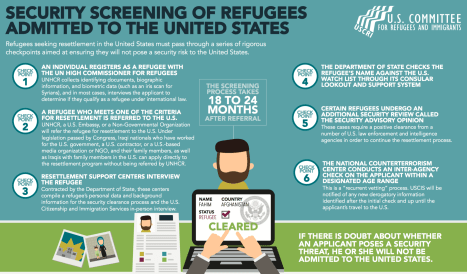
The six-step screening process as defined by the U.S. Committee for Refugees and Immigrants. Graphic provided by Gerald Brown.

The first step in the security screening, Brown said, is the refugee making the decision to apply for refugee status. From there the UNHCR interviews the refugees and then refers the ones who meet the criteria to one of the nine national resettlement agencies.

During this task, there are bars that are set for the refugees coming into the country, Brown. These bars are certain standards that need to be met in order for the refugees to be even considered to resettle in a third country such as the United States.

“If they persecuted someone themselves then they did not pass the bar and cannot become a refugee in our country,” Brown said.

If there is any reason to believe that a person has done something illegal or unjust in their country, then they will automatically get declined resettlement and will not be able to reapply.
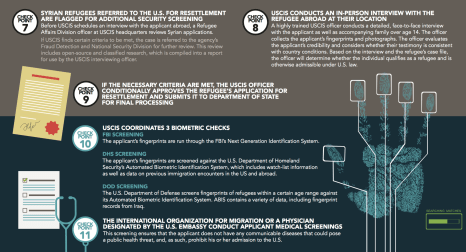
Steps 7-11 of the security screening process as defined by the U.S. Committee for Refugees and Immigrants. Graphic provided by Gerald Brown.

The next step is the security screening. The screening process is aimed at ensuring the refugees will not pose a security risk to the United States. These background checks can take anywhere from 18 to 24 months after referral, according to the U.S Committee for Refugees and Immigrants. During this entire process, the refugees are continuing to stay in the camps.

The final steps include a health screening and eligibility based on the current cap the U.S. has established for incoming refugees. Then, the Department of State works with the nine national resettlement organizations that have affiliate offices that resettle refugees.


Kaya Danae

MY STORIES: 

MY BLOG:

I was initially completely stumped on where my beat would go. I was thrilled to be focusing on refugees as that closely relates to the profession I want to pursue, but wasn’t sure what stories I could come up with locally.

After reaching out to multiple LBGT activists in Salt Lake City, I was incredibly lucky to meet Connell, who put me in direct contact with an LGBT community living in a refugee camp in Kenya. This experience really showed me how important it is to be persistent and make contacts. I definitely went out of my comfort zone introducing myself to people, but it was good preparation and I have been pleasantly surprised with the community interest in this crisis that is happening across the world.

After getting over my self doubt (I had a really hard time establishing myself as a real journalist) and being very critical of my own writing, I think I am starting to find my voice. This is a topic I am very passionate about, so that definitely made it easier. I do want to improve painting a picture for my readers, but since I was just relaying information I heard, that was difficult for me to do in an honest way. I imagine that when I’m on the ground experiencing what I am covering, that will be more plausible.

There were two aspects to this beat that were discouraging that apply to any and all stories I will cover in the future. I had interviews fall through, pushed back, and I had a lot of my contacts never respond to me. I do enjoy the search and challenge of gathering information, but I know that I will be on a shorter timeline in the future and that’s something I’ll need to practice. The other aspect I found difficult was separating opinions and facts. All of the interviews I conducted were very emotional and I was tempted to pour my heart out onto the story. While I did have a call to action at the end of each story, I tried very hard to make objective pieces. I am looking forward to have the opportunity to work on opinion pieces, though.

ABOUT ME:

Kaya Danae is an aspiring international relations correspondent with a passion for human rights advocacy. Danae studies journalism at the University of Utah. As a contributor to Voices of Utah, Danae chose to focus her beat on the mistreatment of LGBTQI refugees, specifically in Kenya. Her passion for international human rights advocacy began during her gap year through Global Citizen Year, where she lived with a host family in Senegal and learned the importance of immersion for understanding and portraying an issue accurately. As Danae progresses in her career, she hopes to emphasize unheard voices and shed light on injustice.

No safe space; how one Salt Lake City resident has welcomed LGBT refugees

Connell O’Donovan at the annual Salt Lake City Utah Pride festival. Photo taken by David Newkirk.

Story by KAYA DANAE

Apollo Kann, a gay Ugandan refugee and HIV/AIDS education activist, landed in Salt Lake City after spending two years in Nairobi, Kenya, waiting to be resettled into the U.S. The first local contact he made was Connell O’Donovan, a genealogist and well known activist for LGBT rights.

The next day Barnabas Wobilaya, Kann’s friend and fellow HIV/AIDS education activist, arrived in Salt Lake City from Nairobi. “I’m professional friends with them,” O’Donovan said with a laugh. “It started out totally informally. Apollo sent me a friend request on Facebook and for whatever reason, I accepted his request!”

After offering his help, O’Donovan arrived at the apartment that Kann, Wobilaya and two other Ugandan refugees had been placed in by the International Rescue Committee. O’Donovan immediately noticed that their apartment was sparsely furnished.

“The IRC had provided very minimal furniture, a table, two chairs, two beds, linens, basic soap, toothpaste, and toothbrushes. They showed up with a literal knapsack each, that was it,” O’Donovan said.

O’Donovan reached out to his social circle and explained the situation, saying, “They need everything, what can you give?” Within 24 hours a truck was filled with everything they could possibly need, including a La-Z-Boy chair and new TV.

“I’ve just been a contact point with my circle of friends and the LGBT Community at large, anything that they need, they contact me. And I reach out and try to find it for them,” O’Donovan said.

He brought Kann and Wobilaya to the Utah Pride Center, where they were introduced to the Executive Director Carol Gnade.

The Utah Pride Center had begun to establish a refugee subcommittee called The Heart and Home Project in November 2016, but plans were changed when Donald Trump became president.

“We had been told by IRC that there would be 25 other LGBT refugees that would be coming from Uganda in June,” Gnade said in a phone interview. “We started scrambling to get a program together for all of these people, but they never came.”

The Heart and Home Project proposed to distribute a pamphlet to resettlement agencies like the International Rescue Committee and Catholic Community Services. These pamphlets would help teach refugees about the LGBT culture and resources in Salt Lake City. The project has been put on hold until more LGBT refugees are resettled into Utah.

The Pride Center currently offers free counseling for LGBT folk and happily welcomes refugees who identify as LGBT. Several refugee resettlement agencies also offer counseling for refugees experiencing PTSD. But LGBT refugees are often hesitant to use the services in fear of being exposed and mistreated.

Aden Batar, the immigration and refugee resettlement director for Catholic Community Services and the first Somalian refugee to step foot in Utah, stressed the importance of befriending refugees. “They (refugees) are leaving their homes, friends and families behind. It is very easy to become isolated. The connections and friendships that are made through our volunteer programs can completely change their lives.”

O’Donovan grew emotional when he began explaining that Uganda is one of the worst countries to live in for the LGBT community.

“You would not believe the circumstances these (LGBT) refugees are coming from,” he said.

In 2014, Uganda passed the Anti-Homosexuality Bill, in which being gay was punishable by death. It has since been updated and the penalty is now a lifetime prison sentence. It is not uncommon for the death penalty to be carried out in more rural areas.

Even if an LGBT Ugandan is placed in a refugee camp, conditions are not much better.

A United Nations Refugee Camp in Kakuma, Kenya, has been known to treat its LGBT enclave especially inhumanely. “There are about 250 (LGBT) refugees that are placed next to the shores of the river. When there is rain, they get flooded out, they’re constantly surrounded by mosquitos. Several of them have malaria, but they’re not getting medicine because they are not a priority. They are given ridiculous charges and sent to jail. The camp security will come by and beat the hell out of them,” said O’Donovan, who has been in contact with LGBT refugees staying at the camp.

Only five gay refugee men are known to be living in Salt Lake City, but two have not publicly come out in fear of being isolated from their own families and friends. Many LGBT refugees live their lives in hiding and secrecy. Even outing themselves in order to be granted asylum can be too dangerous. As openly gay men and HIV/AIDS education activists, Kann and Wobilaya have said they faced discrimination from fellow refugees here in Salt Lake City.

Catholic Community Services and International Rescue Committee have typically resettled approximately 1,200 refugees in Utah each year. Globally, 53 percent of all refugees are from Afghanistan, Somalia and Syria, all of which outlaw (some punishable by death) being an active LGBT citizen. Organizations like these are essential in helping refugees resettle into Salt Lake City, but Connell O’Donovan said that it is our responsibility as citizens to help our refugee neighbors feel welcome, especially those who may feel isolated in their own homes.

Scott Funk

MY STORIES: 

MY BLOG: 

When I first started this semester, I didn’t know what to expect. I was returning to school after taking a semester off and had the fear that my writing would be sub-par because of my break. When I found out the topic for our beat for the class, that fear spiked through the roof as I knew it was topic I was uncomfortable with.

Throughout my whole life I have avoided politics and anything related to that. I have never understood the topics that get talked about, nor have I ever taken an interest. So, when I heard that our beat was on refugees, I feared that I wouldn’t make it through the class — I didn’t even know what the definition of a refugee was.

Profile PicAs I learned the definition, my fear was softened just a little bit, but was still there because of the lack of confidence. I didn’t know where to begin. It wasn’t a topic that I knew anything about, and frankly it wasn’t a topic that interested me. As I began my research, I wanted to find a topic that I could relate to or had at least some interest in.
For my first story, I wrote on the New Roots program, which was centered around gardening and farming — which is something that I used to have an interest in so I figured it might be something I could relate to. And as I started learning about refugees and hearing their stories, I began to become more interested in their lives and their well-being.

As I grew in that interest, I centered my second story around Adjustment Groups, which are groups that are designed to help refugees from a mental standpoint become adjusted to the U.S. While doing this story, Gerald Brown told my class the significance that the involvement of interaction between Americans and refugees have on their lives. Because of that, it peaked my interest in becoming more involved.

I centered my enterprise and final story around a volunteer program called Know Your Neighbor. While writing this story, I had the most interaction with refugees and most eye-opening experiences. I’ll be honest — growing up I was one of those people who when I saw someone who was different than me, I wondered why they dressed, looked and acted differently than I did. I never once asked myself what their background or story might be. Today, every time I see someone who may, to me, fit the description of a refugee, I ask myself what their story might be and I’m curious to find out. I also learned a valuable lesson while attending a volunteer orientation meeting.

While at this orientation a volunteer told a story about a refugee whom she was working with. In this story, she described a conversation that she had with her refugee friend. Within this conversation, the refugee made the comment: “I have too much here.”

She was referencing her home, which was described by the volunteer as empty. But to the refugee, coming from the circumstances of facing death and persecution in her home country to now being in America, she thought she had everything – and in this case, too much. That was an eye-opening experience to me that made me appreciate the items and freedoms that I have in my life.

As a result of reporting on refugees this semester, I have found a new respect and understanding for the refugee community. I look at them differently. I understand them better. I don’t know everything about them, nor will I ever, but at least now I know something. I am no longer blind to circumstances within my own community. My plan is to continue to stay involved by becoming a volunteer, learning more and to hopefully  gain more eye-opening experiences that can change my life, for the better.

ABOUT ME: 

I am currently a student at the University of Utah pursuing a degree in communication in the journalism track and a minor in business. I am currently in line to graduate at the end of the Spring 2019 semester. Before attending The U, I graduated from Salt Lake Community College, where I hosted different sports radio talk shows, as well as wrote for The Globe.

I have interned at Cumulus Media, The Daily Utah Chronicle and ESPN700. Currently I am the beat writer for Utah Football as well as a producer for Utah Golf Weekly and Sports Saturday at ESPN700. I love sports, especially college football. I love being outside and spending time with my family. My career goal is to be a sports broadcaster/analyst and one day make it on ESPN.


Refugees planting new roots in Utah

Story by SCOTT FUNK

War. Persecution. Death. Three things that many people in other countries across the world have to face on a daily basis. They go through life living in their homeland in fear. They’re left with two options: Stay in the country and risk death, or flee for survival. Many choose to stay, but many choose to become refugees.

Aden Batar, director of immigration and refugee resettlement for Catholic Community Services and a Somali refugee himself, said, “Becoming a refugee is the most difficult process a human being can go through. When you’re in your country, you either face the hard condition of leaving, or you die. Looking back, I don’t know how I did it, but when you don’t have a choice, you just want a new place to survive.”

According to a letter to Gov. Gary Herbert included in the Utah Refugee Services Office 2016 report, 1,200 refugees have been resettled in Utah annually by the CCS and International Rescue Committee.

The refugees who are resettled in Utah can choose from different programs to help them adapt to a new culture. One option is the New Roots Program, organized and managed by the IRC.

The New Roots program has the moto: “The food is local. The story is global.” Its purpose, according to the website, is to “enable refugees to celebrate their heritage and nourish themselves and their neighbors by planting strong roots – literally – in their new communities.”

The program consists of three parts: Community Gardening, Micro-Training Farm Program and the Sunnyvale Farmers Market.

Community Gardening Program

This program is designed to help the emotional well-being of the refugees as they try to adjust to a new country, culture and way of life.

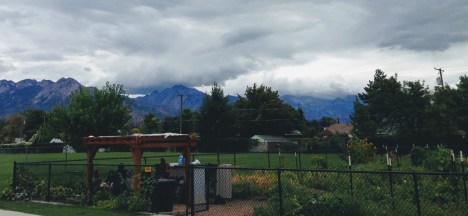
Central Park 1. Photo credit New Roots SLC

In this program, plots of land (approximately 14 feet by 20 feet for 100 total square feet) are reserved for local refugees and their families throughout the Salt Lake community to grow crops from their home country and to come together as a community. Alex Haas, community garden program coordinator, said it is their opportunity to not only work, but also to provide for their family while connecting with others who may come from the same circumstance. There are 15 different gardens throughout the valley that refugees have access to.

Also within this program, Haas said, is the opportunity to meet as a group to develop skills and become accustomed to the new society they are in. Within these adjustment groups refugees can discuss their feelings, learn skills such as how to deal with anger, stress, depression and ultimately become self-sustained as they build a new home.

“The purpose of our community gardening program and adjustment groups is to help refugees become self-sustaining moving forward,” Haas said.

He also said in a phone interview that the gardens are a way to remind refugees of home and that they give them “a sense of comfort, while they enjoy cultural foods, and while they build a community of wellness.”

Micro-Training Farm Program

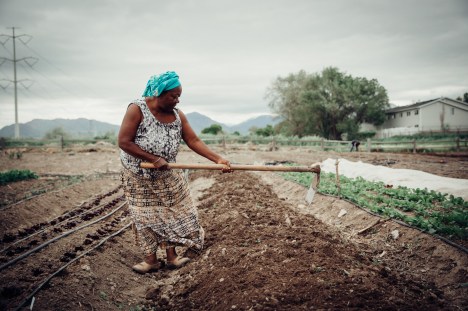
The next step in the New Roots program is the farming aspect. After resettled refugees have participated in the community gardens for a year, they have an opportunity to work on larger plots of lands at the Redwood Road Micro-Training Farm, located at 3060 S. Lester St. in West Valley City, to continue their farming.

Local refugee farming at the Redwood Farm. Photo credit New Roots SLC

Jordan Bryant, manager of the IRC’s New Roots program, said in a phone interview that the farm is maintained by generous grants and donations. The farmers pay different amounts for seeds and plants from their heritage, and tools to grow them to bring their home to Utah.

Currently, Bryant said, there are about 33 farmers who are there on a constant basis. These farmers, each of whom were once strangers, develop a community with one another as they work together to grow and sell their crops at local farmer’s market.

Although it is not the main source of income for their families, the refugees rely on the farming as a source of income for their families. At the same time, they continue to develop relationships and friendships with the other refugees around them.

“It’s more than just a job,” Bryant said. “It’s that they gain access to their home and people to socialize with.”

Sunnyvale Farmers Market

Local refugees buying produce at the Sunnyvale Farmers Market. Photo credit New Roots SLC

The Sunnyvale Farmers Market, located at 4013 S. 700 West in Salt Lake City, gives the refugee farmers the opportunity to provide for their family by taking the food they grow and selling it.  It is also an opportunity to bring food from cultures around the world to the refugee community.

“The farmers market is a great opportunity for income,” Bryant said. “Although it’s not their main source of income, for some it does provide a substantial amount for their family. It also is a community benefit by providing food from the countries of the refugees that are in the community.”

Escaping persecution is a long journey. But after choosing to leave their home to survive, the New Roots program has given refugees the opportuntiy to bring a piece of their culture to Utah.


Zach Carlson

13669692_1243929272314477_505220918381745459_n

MY STORIES: 

MY BLOG:

I did not have any expectations for this beat. I really didn’t know what to expect from this class, even. As the semester went on, I realized how much work this class really is. I learned quite a bit about how to prioritize my stories as I work on them. I also learned that it is incredibly hard to get people to email you back about interviews. I learned from this beat that there are many issues that refugees face once they get here to America. I didn’t know much about refugees before this class and this helped me learn a lot about a large group of people.

I had one huge epiphany during this class: I don’t want to be a journalist. This class, I imagine, is like a trial run of what it is like being a real journalist. I am not good at juggling deadlines and interviews and all the different things that are due. I learned that this is not for me, and that I need to find something else to do for the rest of my life. So, that’s great to learn before I get a real big-boy job.

I did not find it difficult to remain objective. For all my stories, it was just sharing facts and people’s own opinions on the work that they do. I didn’t think that it was too difficult to keep my beliefs out of my writing. All my stories were about people who work with refugees, so maybe I could have written about someone who doesn’t like refugees to make it a more un-objective set of stories.

ABOUT ME:

Hey. It’s me. Zach. I’m a student at the U, as you could probably guess. I assume you’re here because you want to know all about me. I love dogs. That’s the first thing you should know. Dogs are the greatest creatures in existence, tied with polar bears. I’m really into movies, video games and books. I work at a movie rental store. That’s pretty weird, considering it’s 2017. When I’m not crying from the stress of school, I like hanging out with my friends and playing with my puppies. They’re so cute. I love them. My friends are OK, I guess. My dogs are better than them.

University of Utah’s Center for Research on Migration and Refugee Integration builds on success of first year

Story and photos by ZACH CARLSON

The Center for Research on Migration and Refugee Integration is housed in the University of Utah’s College of Social Work. The CRMRI is located in Caren Frost’s office.

The Center for Research on Migration and Refugee Integration opened as part of the College of Social Work at the University of Utah in 2016. Leading this center is Dr. Caren Frost. The CRMRI’s main focus is on obtaining federal grants and analyzing data that it receives from groups like the Catholic Community Services and the International Rescue Committee.

Aden Batar is himself a refugee who works with the Catholic Community Services in Salt Lake City, helping to resettle refugees. With roughly 60,000 refugees here in Utah and hundred more coming each year, these two organizations are working together to help make Salt Lake City home for refugees from around the world.

Each year, the CCS helps resettle roughly 400 to 500 refugees, according to Batar. These refugees are from all over the world, with 53 percent of them migrating or hailing from Afghanistan, Somalia and Syria. Batar says he expects the Syrian Civil War to lead to an influx of Syrian refugees, making Syria the largest source of refugees in the coming years.

As the individuals integrate into Salt Lake City, they obtain education as well as work. Batar says that about 85 percent of refugees become self-sufficient within six months of arriving in Utah. While most parents don’t pursue a higher education once arriving, their children are more likely to go to college, says Caren Frost of the CRMRI.

No information is collected on how many refugees go to the U, but the CRMRI estimates that there are at least 500 students with refugee backgrounds. The CRMRI describe itself as active with students on campus, but it thinks it can always be more involved. It finds itself interacting more with younger children in junior high and high schools, Frost says.

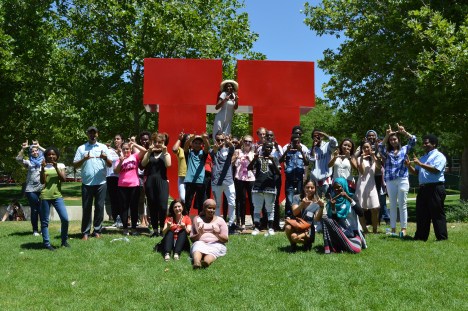
Over the summer of 2017, the CRMRI hosted a workshop at the U for about 25 high school seniors from the Salt Lake Valley who were interested in college. Delva Hommes, the administrative manager for CRMRI, says it had a broad range of students, with some having been in America from two months to two years. The students spoke about a dozen different languages.

Students who attended the summer workshop. Photo courtesy of Delva Hommes.

Volunteers discussed with the students what different aspects of college and campus life are like at the U, why they think the students should go there, and how to help them achieve their goals. The CRMRI hopes to do similar workshops every summer, Frost says.

Frost writes grants and articles, and analyzes data for the CRMRI. “We have information about what country the refugees are coming from, how long they were in camps, what languages they speak, what are their healthcare needs,” Frost says. “We also have information about jobs that they have once they get here, how much they’re getting paid per hour, what other training needs they might have.”

CRMRI celebrated its first year at the U in August 2017. Frost described the program’s first year as “fact finding,” citing repetitive redundancy, also known as tautology where the same idea is said twice but with different words, as an issue that it deals with often. Because it is trying to put people in touch with others, she says it can sometimes be a challenge to coordinate and work with everyone’s schedules.

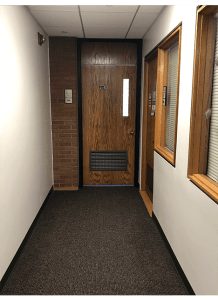
The hallway leading to the CRMRI, which is on the second floor of the College of Social Work.

The research center has three main goals for its second year. First, Frost says “working to define integration. This isn’t just trying to get refugees to assimilate,” she says, “but to encourage a two-way exchange of ideas about different values, different cultural systems, between refugees and those hosting them.”

Her second goal for the center is to create a geospatial map of the Salt Lake Valley. An earlier draft of this was created for the Refugee Women’s Committee, which Frost has chaired for more than five years, she said in a subsequent email interview. This map pinpoints where these women lived in the Valley, the public transportation routes near them, where libraries are and where they can go to get health and dental care.

With this, researchers can see where people are versus the resources individuals need. Frost says these women are in a sort of “resource desert.” The medical care they need is far away, and in case of an emergency those without vehicles might not get the necessary medical attention, Frost says. Frost is looking to further enhance this project by working with individuals within the Department of Geography and with the Social Research Institute, to try to make something useful with this information.

The Center’s final goal of 2017-18 is trying to get more community partners to help the program and do research with it. The CRMRI is constantly learning from its partners, like the Catholic Community Services and International Rescue Committee, about each group’s on-the-ground work, Frost said in a subsequent email interview. It would really like “to be doing more cross-cutting discussions about what research actually is, what we can actually say with things, what kind of data do we actually need,” Frost says.


Alaynia Winter

MY STORIES:

MY BLOG: 

Reporting and writing about refugees throughout this semester has been eye opening in many ways. It has been both challenging and rewarding to be made aware of perspectives different from the mainstream. 

Initially I expected this beat to be easier. I underestimated my resources and how much time it would take to really find sources and build relationships with interviewees. Doing an in-depth piece on an individual or family was effectively impossible because of policies within organizations regarding privacy and possible invasiveness.

I have learned an appreciable amount about my own personal ethics in my journalistic endeavors. I have found I don’t enjoy exploitation pieces and the practice of asking refugees fleeing war and violence to perform their trauma for readers, unless there’s some sort of call to action or way to be a part of the solution.

I did encounter an ethical problem when I had a member of a panel I attended speak to me in private about her experiences within her organization and personal life and I wanted to include it in my story, but ultimately decided to leave it out for respect for her privacy.

I better understand now the importance, and difficulty, of establishing trust when interviewing. I struggled to justify attempting to interview or photograph anyone but a representative of an organization because it felt disingenuous to only reach out to a refugee for their story as a reporter and not have any basis or relationship established.

I had the opportunity to interview many individuals, but the people at the Refugee Services Office were particularly impactful to me. Gerald Brown, Halima Hussein and Alexx Goeller are each particularly inspiring in their own respects. These are people who are passionate about their jobs and work very hard every day to accomplish their goals of empowering others. I was encouraged by them and their devotion as they spoke to me about struggles refugees face and their hopes and dreams for the future.

As a result of my reporting this semester, I did make a vow that when I graduate college I will enroll in a volunteer program and be more involved in the refugee community here in Utah.  This is an amazing class and I would recommend this beat and Voices of Utah to all students who want to pursue the field of investigative reporting.

This beat has been a connecting strand between civic responsibility and reporting for me. Through these interviews and research, I have discovered community programs and included links to resources and information in my stories and hopefully became a catalyst for others in our community to be involved as well.  

ABOUT ME: 

IMG_1910

Alaynia Winter ’18 is from Salt Lake City, Utah. Alaynia graduated from University of Utah with a B.A. in Communication. Alaynia currently holds an internship at KUED Channel 7 in the Department of Digital Media. She has written published stories as a staff writer for University of Utah’s Wasatch Magazine, as well as for Voices of Utah and KUED’s web series Modern Gardener.  She has worked as a freelance photographer since 2013 and currently takes photographs for KUED’s The Hinckley Report. After graduating, Alaynia plans to spend the summer in Spain completing a language immersion study abroad program.

Beyond mental health: welcoming refugees to Utah

Story and photos by ALAYNIA WINTER

“Everything.”

That was the resounding answer from the three refugee panelists who spoke on Sept. 23, 2017, following a documentary movie screening held at The Leonardo museum in Salt Lake City. Each was asked the question: “What were the most difficult aspects of transitioning to living in Utah?”

Everything is different. The weather. The food. The language. The culture and customs. The ethnicity.

Visitor information is posted on the front door of the IRC located at 221 S. 400 West in Salt Lake City.

One of the panelists, Kamal Bewar, came to the U.S. as a refugee from Iraqi Kurdistan during the Iraqi Kurdish Civil War at 22 years old. Since then he has made Utah his home.

“I have been fortunate to have had people who made a difference and made me feel welcome. It has been the individuals who have made the difference in my life,” said Bewar during the event.

He is an example of a political refugee who has successfully created a new life after arriving with close to nothing. Bewar graduated with a Ph.D. from Argosy University in higher educational leadership. He now has a flourishing career working at Salt Lake Community College. He also is president of the Kurdish Community of Utah.

So, what happens when refugees arrive in Utah? First, they are welcomed by International Rescue Committee or another resettlement organization. After they have food and shelter and immediate safety, they are given English classes and tasked with adapting to the new environment.

What is the western answer to this often traumatic experience? IRC, Department of Child and Family Services (DCFS) and many other organizations offer therapy, medication and mental health programs. These programs are beneficial. However, the clinical concept of mental health may be foreign to some New Americans.

Hannah Fox, who was an intern at IRC before accepting a position as a social worker with DCFS said a problem many healthcare workers, social workers and others are seeing, is a systemic disconnect in the way we, as Americans, understand other cultures — and vice versa.

The IRC is nestled between The Rose Establishment and the historic W. S. Henderson Building.

“Our programs take mental health from a very western perspective,” Fox said, “versus where many of them [refugees] come from, they likely do not. So, while we might diagnose and medicate, they might believe in a spiritual or traditional folk remedy.” Visibly exasperated, Fox added, “So when they go to health care workers, and they give them a western experience of mental health care, it really f**** with them. It discourages them from trying again.”

What is found to be actually helpful, said Fatima Dirie, refugee coordinator for the University of Utah, is making a community. Once the programs are over, it’s the relationships and friendships made that create lasting change and true integration.

“As a community, we are not there yet,” Dirie said. “To truly feel welcomed you have to understand each other.”

Fox added, “With refugees that is their ‘therapy.’ It’s home and it’s talking about their culture. It’s sharing their experiences on their terms — not just some white person who has a degree behind a desk.”

Utahns can help make people feel welcome by saying hello, simply smiling, or inviting someone over for dinner. If interested, sign up for a Family Mentor Program, or complete a volunteer orientation at IRC.

Fostering meaningful relationships is what truly matters.


Devon Alexander Brown

MY STORIES:

MY BLOG: 

I was 14 when I knew I wanted to be a journalist. It’s a moment I remember vividly.

I was watching “Almost Famous,” a film that chronicles a teenage music journalist who gets the Rolling Stones assignment of his dreams: observing and interviewing his favorite rock band, Stillwater, as they tour the nation. Headshot

I was blown away.

It confronted me with my own interest in writing and helped me recall all of the encouragement I had received from teachers over the years. The film wasn’t my first introduction to journalism, by any means, but it was certainly the most impressionable. I think seeing someone my age, accomplish something I had never even imagined, helped me realize the viability of writing as a career. And I haven’t looked back.

I can say that covering the refugee and immigrant beat has also been a seminal experience for me. It’s taught me the value of building trust with a source. It’s taught me the importance of time management. It’s taught me the importance of building rapport with a network. It’s taught me how to navigate potentially sensitive subject matter. And most importantly it’s given me the confidence that I need to hold my own in this industry. These lessons are invaluable for any emerging communicator.

When I started this semester I was an anxious mess. Although I had fundamental skills, I’d never really put them into practice in a professional setting. Now, nearly four months later, I feel that I’ve gained an internship worth of experience. And I’m grateful for being challenged with a beat that forced me to get out of my comfort zone.

I’ve always considered myself a writer. Now I know what I stand for. I know what my goals are. And because of my experience reporting for Voices of Utah, I have the confidence to actually claim the title.

And as a writer I choose to be accurate and accountable. I choose to be objective. I choose to write the stories that are important, not only to me and my ideology, but to the people at large. I strive for excellence. And without Voices of Utah, I’m not sure I would know what excellence is.

ABOUT ME:  

I was born and spent most of my life in Crestview. It’s a small, country town in Florida just shy of the Alabama border. I’m also an only child. So I spent a lot of my free time alone. If I wasn’t outside pretending to be a samurai, I was indoors reading and creating fantasies that I could escape to.

I’ve never read a novel by the late author David Foster Wallace, but I’ve always identified with a quote attributed to him: “The purpose of fiction is to combat loneliness.” I think a good book does just that. But as I’ve grown older, I’ve realized that it isn’t necessarily fiction that’s my passion. I just like stories.  And a story doesn’t have to be fictional to be enthralling. It simply needs to be written well.

I’ve moved on from my hometown, but my affinity hasn’t changed. I’m still a logophile. And I’ve carried that love of words throughout my academic career. I’m now a fourth-year communication student at the University of Utah, majoring in journalism, and I hope to eventually become a staff writer for a publication like The Atlantic.

I believe the world needs more writers who are dedicated to their craft, ethics and the process of distributing information. Although the journalism industry seems bleak and many citizens are distrustful of our work, I trust that can change. I trust the people want to be informed by an objective voice and I believe their desires simply aren’t being represented.

There’s hope in the media. I want to play a role in restoring that hope.