Chili Beak, adding some spice to the community

Story and photos by DAVID FISHER

Sometimes food just needs an extra kick. Additional flavors and heat can make what was once bland, become a brand-new taste full of extra zing and spice.

Giselle and Jason McClure of Salt Lake City have concocted an original flavor booster known as chili oil. The McClures create the chili oil in their own basement, only to later be distributed to 22 different locations in the Salt Lake Valley available for purchase. Their concoction prompted them to start their own business, Chili Beak.
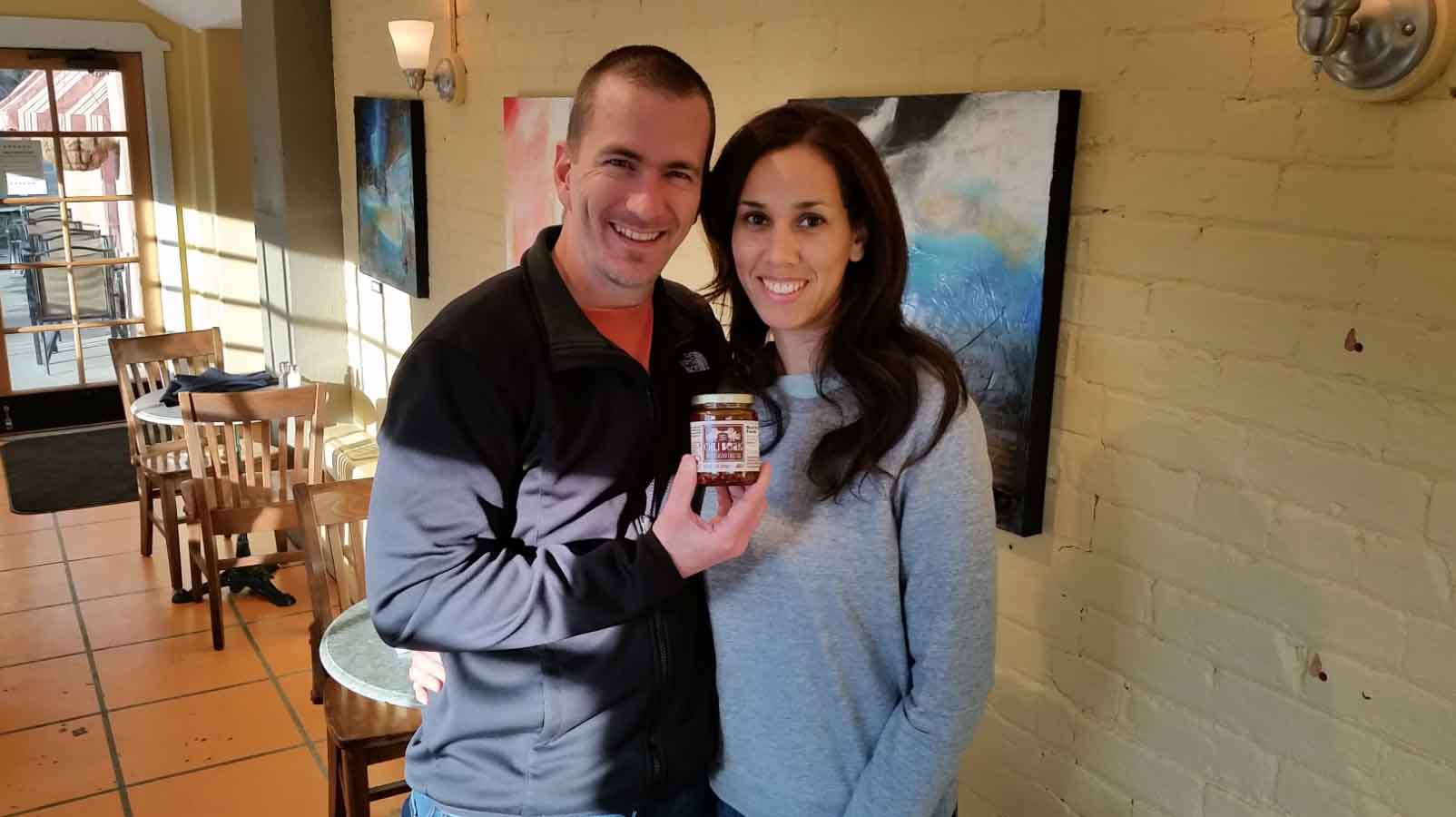
Giselle and Jason McClure show off their latest flavor of Chili Beak.

Giselle and Jason McClure show off their latest flavor of Chili Beak.

Unlike hot sauces and salsas, tomato and vinegar is not added to create chili oil. It is a unique blend of a variety of chili peppers with oil and other spices. The main pepper that is used is called chile de arbol, which means bird’s beak chili. This is where the name Chili Beak came from. It is a completely unique product which the McClures ultimate long-term goal is to see on tables at many restaurants as a replacement to Sriracha.

Chili oil is the ultimate condiment. It can be added to everything from eggs, soups, brownies, and even popcorn. Simply just stir it with a spoon, and scoop it onto food. Its smooth consistency and natural ingredients create a unique flavor that does not upset the stomach. No preservatives are added, and all ingredients are all-natural. It can be used as a marinade, mix in, or even added into recipes to create original new flavors. The flavor of chili oil will be felt first, and then a subtle heat begins to creep into the taste buds.

While visiting Giselle’s family in Mexico years ago, the McClures discovered chili oil. They could not find any product like it in Salt Lake City, so they decided to make it themselves as amateur chefs. After seven months of constant trial and error, and a multitude of coughs and sneezes, they created the perfect mixture.

They considered it better than the recipe they tried in Mexico because of an added smoky flavor. The smokiness is created with a lack of sugar and ginger. This was something different that needed to be experienced by people of the United States. Even Giselle’s family in Mexico was requesting that they have their own to share with their friends and family.

“This would be more than just a food company,” Jason said. “This would be a people company. As a company it is about family and community. We want to bring people together and have fun with it.”

Chili oil is meant to be stirred and served with a spoon.

Chili oil is meant to be stirred and served with a spoon.

Food connects people, creates conversation and promotes new communities. Giselle explains, “If I can share food with somebody, I am happier.”

Only having started their business in August 2014, Chili Beak has expanded tremendously through word of mouth and social media. A Facebook, Twitter and even an Instagram page have been created to promote the business. The McClures wanted to create a responsive community in which people get involved with Chili Beak digitally. This is what began the creatively catchy “Let me Spoon You” campaign, which is named after the unique way to prepare chili oil.

Through social media, and using the hashtag SpoonYourFriends, families are showing how they are using and preparing Chili Beak in their foods. This creates an interactive experience in which creative ideas to use chili oil are shared on Twitter, Facebook and Instagram. It was through this that the ingenious idea of using chili oil on top of vanilla ice cream was discovered by a customer.

For Valentine’s Day, the #SpoonYourValentine campaign was created to share how people were preparing meals for their loved ones with Chili Beak. Chili Beak has created a community for all to get involved with, and has inspired the McClures to want to create a chili oil recipe book based on the inventive recipes customers have shared.

All ingredients that are used to make the chili oil that Chili Beak produces are bought from local businesses within Utah. For example, the salt used within the oil is bought from Utah’s Redmond Real Salt. Local businesses are their own community, and they do whatever it takes to help each other out.

People share their recipes online, such as this mango chutney made with Chili Beak.

People share their recipes online, such as this mango chutney made with Chili Beak.

Kristen Lavelett, executive director of Local First Utah, explains that “locally-owned business create personal stability because of the relationships we build with people. It’s another way to love your neighbors.”

While sampling Chili Beak at farmers markets in the area, the McClures use locally-produced chips and chocolate from Hatch Family Chocolates. The chili oil is added to things like hummus and ranch dressing for people to taste. It’s a challenge when people ask about the hummus and ranch, and not the chili oil itself. The chili oil is what creates the unique spicy flavor to the condiments. But, the McClures enjoy promoting a product that is different to a local community. It is a matter of experimentation to truly discover the one-of-a-kind flavor chili oil produces.

“We love doing this because we truly enjoy it,” Giselle said. “We committed ourselves to something different. We want to inspire people to do more with chili oil. If we can have fun with it and get the community involved, that is a plus.”

Unique, local restaurants bring cultural value to Utah

Story and slideshow by William Phifer III

This slideshow requires JavaScript.

In Layton, Utah, there is a strip of real-estate running along the east side of Interstate 15 that the locals call “restaurant row.” Littered with a copious amount of national chains, the area also has a few unique, local restaurants that bring an irreplaceable cultural value to the community.

Corbin’s Grille is one of those restaurants. Located at 748 W. Heritage Park Blvd., Corbin’s is a family-owned business that is operated by Jake Garn, whose father is the landlord of the location. Since its opening in 2006, Garn has learned a lot about running a small local restaurant.

“I’ve learned that appreciating the local food, instead of chains, isn’t something that comes automatically to most Utahns,” he said in a phone interview.

However, as time has progressed and people have learned about Corbin’s Grille, Garn said, “I’d like to think everyone is starting to appreciate the value of local flavor a little bit more.”

Garn said his favorite way to make the restaurant a unique place for patrons is by “bringing something that’s a local creation – something people out of town can try and look forward to.”

To help him consistently achieve this goal, Garn appointed Jimbo Snarr the executive chef in 2014. Snarr understands that the owners of Corbin’s Grille are looking to provide a unique experience for their customers.

“Our goal is to take good classic dishes that people really like and make them classy and higher-end,” Snarr said.”[To do] this we use a lot of fresh ingredients and we make everything in house.”

One example of a popular dish that is made at Corbin’s Grille is the spinach artichoke dip. While almost every restaurant has its own variation of this common appetizer, Snarr said most receive it pre-made and frozen from other vendors. Unsatisfied with any of those inexpensive variations, Snarr said that Corbin’s Grille preps its spinach artichoke dip in-house using fresh ingredients.

Another popular dish at Corbin’s Grille is the lemon asparagus salmon, created at the restaurant during a cooking competition among the cooks. The fresh sushi-grade king salmon is pan-seared in a sauce consisting of white wine, lemon juice, fresh tomatoes, asparagus and other ingredients. This particular salmon dish is one of three offered at Corbin’s Grille and it is the only one that is not cooked over a wood fire grill.

Chefs utilize a white almond wood fire to grill everything from steak, seafood, chicken and burgers, to asparagus and lemon wedges, which are used on seafood dishes. Snarr said the intense heat sears the edges of the steak and really locks in the flavors and juices.

While the food itself is a unique part of Corbin’s Grille, Snarr says that is just part of what makes eating there a distinctive dining experience. Snarr believes the open kitchen and experienced staff also create an inviting atmosphere for the clientele.

“We’re an open book, come on in. We have an open kitchen. Anybody can walk up,” Snarr said, “and watch my guys cook. We do it proper, we do it right … and everybody can see it and know it. I think that’s what makes us popular.”

In the spirit of transparency, Corbin’s Grille does cooking demonstrations where restaurant management share their recipes and techniques. Snarr said some people don’t understand why they are divulging “restaurant secrets” and giving people the tools to make their dishes at home.

In his experience, Snarr said, “People are still going to come to us when they don’t want to cook, because they still like to come out” and have a fine dining experience.

Anthony Lella also recognizes the value of unique restaurants, which is why he is entertaining the idea of opening his own Italian restaurant in the Ogden area.

Lella, formerly the general manager of Iggy’s Sports Grill in Layton, is from a family with strong Italian roots.

He has identified a lack of quality Italian restaurants in the northern Utah area. He also has recognized an increasing trend toward homemade food and cultural culinary diversity.

Recalling a visit to Utah years before he moved to Ogden, Lella said he went out to eat with someone who had never eaten prosciutto, which is an Italian cured ham.

“I was so shocked that this grown woman had no idea what this was, that I’d been eating all my life,” Lella said. “So I think things like that, specialty markets, are just emerging in Utah.”

Lella has considerable experience working in restaurant management, both in and out of state, and knows that location is a key factor in making a restaurant unique.

“If there’s anything I’ve learned about running a restaurant the last 13 years – location is key,” Lella said. “Think about where you’re at now [and] what has the opportunity to be there in five years.” If someone else builds a similar, competitive restaurant right across the street, he said both restaurants can lose their unique quality.

Lella has been searching for an ideal restaurant location in the Davis County area to bring authentic Italian food and culture to the beehive state.

He already has a clear vision of what the menu will include: four different risotto dishes, homemade fettuccine and gnocchi. He has also considered making his own sausage, meatballs, mozzarella and ricotta.

Like management at Corbin’s Grille, Lella is eager to provide a unique venue where patrons can enjoy fresh food made in-house.

Retro Betty, a boutique that keeps vintage alive in Salt Lake City

Story and photos by McCALL GRAY

Vintage is often imagined as objects layered in dust, likely tucked away in an attic with a musty smell lingering about.

Behind the pink door of Retro Betty, vintage is anything but dusty. Lively music from the 1940s, ’50s and ’60s is humming on a record player. Clothing, furniture, accessories and gifts from those eras fill every corner of the local boutique, creating an eclectic maze of color.

Vintage is brought back to life.

Amanda Parrish, owner of Retro Betty, wears items you can find in her store.

Amanda Parrish, owner of Retro Betty, wears items you can find in her store.

Owner Amanda Parrish established Retro Betty in September 2012. Retro Betty opened just three months shy of her 30th birthday. Parrish said she had always dreamed of opening her own business and made it a goal to make it happen by that milestone.

“I’ve always loved vintage. I grew up around it,” Parrish said. “I had older grandparents who were born in 1906, so I knew the style.”

The boutique’s name expresses her love for the timeless style. Parrish said she sees the word retro as colorful, and the name Betty reminds her of a 1940s housewife.

“Back in the day people would always say, ‘Oh she’s a Betty,’ meaning she was pretty,” Parrish said. “So that’s what I wanted my store to be.”

Retro Betty, at 2821 S. 2300 East in Salt Lake City, offers a combination of genuine vintage and new items that mimic the vintage style. The boutique is filled with a vast variety, including women and men’s clothing, accessories, home and seasonal décor, and handmade greeting cards and banners made by Parrish’s mother, Kim Holmes. Parrish also taps into her creative side and refinishes furniture, giving it a new look with sometimes just a new coat of paint. The merchandise is priced anywhere between $1 and $150.

Holmes said, “I love creating one-of-a-kind paper goods for her store. It brings me joy to do that for her, and it gives me something to do.”

Other than the blend of new and old, Retro Betty is different from similar stores such as Now & Again and Maeberry Vintage in Salt Lake City. It does not run on consignment. Parrish personally scouts out the merchandise for her boutique at estate sales and flea markets, and often travels outside of Utah to cities such as Los Angeles and New York. She also attends two vintage trade shows every year.

Parrish features seasonal finds in the kitchen corner, such as cake stands, tea towels and bakeware.

Parrish features seasonal finds in the kitchen corner, such as cake stands, tea towels and bakeware.

Parrish said she can never choose just one favorite item in her store. “I love everything [in the boutique]! Everything in here is something I’ve picked out,” she said.

But, she said some of her most-liked pieces are those that seem to be the hardest to find. Vintage radios, cameras and typewriters in good condition are the pearls among the oysters.

Ashlie Roberts, a returning customer, said, “This is a great place to find unique gifts for others. It’s hard to describe, you just have to see it in person to get the full effect.”

Customers will always find Parrish at Retro Betty on Monday from 10 a.m to 6 p.m. and Tuesday through Saturday from 10 a.m. to 7 p.m.. With no employees, she enjoys running the shop alone and interacting with the customers who visit.

The proof is in the Facebook posts to her Retro Betty business page. Ashleigh McMahon posted that she was “beyond excited” to go meet Parrish. Parrish said her customers are happy when they walk in and see her, because it makes their experience more personal.

She is considering registering her business with Local First Utah, which promotes shopping at locally-owned businesses such as Retro Betty.

Kristen Lavelett, executive director of Local First Utah, said, “The difference between shopping at a big business and a small business is profound. By shopping locally, it increases our personal stability and increases relationships with the community and who we do business with.”

Since opening, the community and local businesses have supported Retro Betty. There is no competition with other vintage stores because Parrish said the owners like to help each other out. They frequently get together to coordinate vintage shows and Instagram product giveaways to their followers.

“If someone walks in looking for something specific and I don’t have it, I’ll send them to the people that do. They do the same for me,” Parrish said.

She said her business allows her to continually give donations to the community. The Toys for Tots Foundation, cancer fundraisers and local schools are among the recipients.

“I like to help out the local schools. A lot are independent and not funded by the government, so I find those are the ones that need it the most,” Parrish said.

One of those private schools is Canyon Rim Academy. Parrish has contributed Retro Betty gift certificates for school fundraisers. Parrish has also supported Skyline and Olympus high schools by donating costumes for their school plays.

Apart from giving back to the schools near Retro Betty, Parrish also assists churches, such as the Christ United Methodist Church on 2375 E. 3300 South, and recently supplied gift certificates to its Wesley Bell Ringers for the group’s 2015 Valentine’s Day Dinner Dance.

Lavelett, with Local First Utah, said, “When you walk into a locally-owned business you know they’re not there to make money, they’re there to give back to the community.”

Parrish is delighted that her small business allows her to give back to the community. Seeing her customers’ reactions when they walk into Retro Betty is also fulfilling to her, and is what keeps her going.

“What I have here is unlike what they’ve seen before,” Parrish said. “It’s the moments when a woman comes out of the dressing room twirling in one of the dresses that show me I am making people happy.”

Social media makes or breaks small businesses

Story and photo by ALEX HARRINGTON

Small-business owners struggle to find the time in their lives to simply start a business, let alone worry about the smaller tasks like establishing a presence in social media. But, having a solid presence on social media like Facebook, Twitter, or Instagram is critical.

Kristen Lavelett, executive director for Local First Utah, knows from her own work with the educational group how important social media influence can be. Local First Utah has more than 20,000 followers on Facebook, through which it informs its audience about various campaigns and services it offers. Local First Utah can quickly and effectively distribute information about its mission.

However, social media are not all rainbows and sunshine. There are difficulties with social media that aspiring business owners must grapple with as well.

One artist, Talin Tanielian, experienced these difficulties firsthand. She had been creating art from a very young age, dabbling in everything from watercolors to animation. She even traveled to France to take art courses at “Gobelins,” a prestigious art school where she received training from animators who worked with Walt Disney Studios and Pixar. After she graduated from the University of Utah, she started thinking about turning this passion into a career.

She began selling her art out of her home in Sandy, Utah, via online websites like “Deviantart.” In January 2014, she turned this process into a new business, “TabbyToons.” To start to advertise her newly built business to a wider audience, she branched out from Deviantart and posted various drawings she had done on Facebook and Instagram.

Though she could now more easily distribute her art and show off her talents, Tanielian found the change from doing art as a hobby to doing it for a living was much more daunting than she expected. Before creating her business, she received nothing but positive feedback for her many art pieces. Hardly anyone outside her friends and family had access to her drawings, paintings, and animations. However, when she started using Facebook and Instagram as a medium to advertise her various creations, she experienced an unexpected and disheartening result.

Her newfound viewers began critiquing her art, posting comments from the constructive to the downright cruel. Tanielian said it was difficult to receive “harsh feedback from others.”

But she realized these critiques didn’t have to have a negative impact on her or the artistic reputation she created. She strove to use the criticism as another positive aspect of social media, rather than retreating from the judgments people have made about her art. “Feedback is inspirational and pushes me to keep going forward,” she said.

So Tanielian embraced social media. She put her art out on Facebook and Instagram and prepared for the judgments that would inevitably come from complete strangers. “[TabbyToons] adds to who I am and what I do,” she said.

Her business has grown from a small group of admirers to dozens of fans and buyers, due largely to social media. She said she still has a long way to go to get “TabbyToons” where she wants it. But her goal is to have multiple websites devoted solely to selling her art.

Ann Marie Thompson said the Women's Business Center is available to help all small-business owners, both women and men.

Ann Marie Thompson said the Women’s Business Center is available to help all small-business owners, both women and men.

This growth may have occurred in a small business like Tanielian’s, but can a larger, locally-owned business expect the same success?

Ann Marie Thompson, program director of the Women’s Business Center, works with small businesses ranging from a one-woman operation like Tanielian’s to larger ones. She swears by the importance of this online presence. “[The] Women’s Business Center utilizes social media every day,” she said. “Business appears to be driven more by social media than traffic.”


Locally owned boutique, Unhinged, is unique

Story and photos by NATHAN ASTILL

Store

Unhinged storefront at the Sugar House location.

Unhinged is the oddity, the outside-of-the-box store, the artistic Neverland. It is one of Pan’s lost boys that never quite grew up.

“Purveyors of the oddly beautiful,” says Amy Taggart, manager of Unhinged at 2165 S. Highland Drive. Her friendly, welcoming smile reflects the store’s atmosphere. She is holding a cup of coffee, sitting on an old wooden chest. The chest is for sale. The lights hanging from the ceiling all around her are as well.

Then again, that’s not unusual here. Everything in the store is for sale — from the clothing, to the artwork, to the organic soaps. Even the enormous wooden canoe hanging high up on the wall is for sale. If a person sees something they like, they can buy it. It’s a fairly new idea that makes the experience of shopping at Unhinged unique. “It is much more of a destination location,” Taggart says.

Owner Corey Folster, 45, grins as he says that’s exactly what he was aiming for. “I wanted to bring something different to Salt Lake. It’s so easy to get lost in the brick and mortar experience when shopping online, so I knew when I created this business that I wanted to provide a fun atmosphere,” he said. “I hated when I would go into shops and I couldn’t buy certain things that caught my eye.”

Folster used to manage other stores, such as Urban Outfitters and Forever 21, before he founded Unhinged. He opened the business in the Sugar House neighborhood in 2011, and in 2014 relocated a couple blocks south to a bigger and better location.

Folster opened another Unhinged in Provo in 2013. He plans to open a third shop, called Rewind Exchange, in Provo on Friday, April 3, 2015.

While Folster hadn’t initially planned to carry a lot of local merchandise, that began to change over time as he started to meet fun local artists and designers. “It’s really neat when you can add a local element to it,” he says.

Unhinged carries products made by more than 25 local designers, from Cardi Allyson, who created hellbent, a clothing brand with a Gothic twist, to Mieke Okamura, owner of Purring Buddha, a company specializing in the creation of organic soaps, lotions and lip balms.

Wallets

Handmade leather wallets created from old cowboy boots, by Salvage West.

Forty percent of the merchandise Unhinged carries is created by local artists through upcycling. Upcycling is the process of reusing old materials that may seem like trash to some people, in order to create new products with significantly higher quality and value. Take Salvage West, for instance. The owner crafts slickly designed wallets from the leather of old cowboy boots.

But while the value of these products may be higher, Unhinged prides itself on its competitive, more affordable prices. And while some of the art the store carries may not be everyone’s cup of tea, its purpose is making something out of nothing. Folster likes his artists to be one of a kind and more often than not, exclusive to the store. Most importantly, he wants to be able to sell things that are of high quality.

While selling quality merchandise is not much of a challenge, getting the word out about the store is. Advertising is expensive and Folster believes that “getting people out of their normal shopping modes and into their neighborhoods” is one of the hardest things about owning a local store.

Folster has been taking a different route to traditional advertising as he tries to support his company and its local artists through online media exposure. Unhinged has a strong online social media presence through its Facebook, Tumblr, Pinterest and Instagram pages. It also participates in the Sugar House Art Walk, a nonprofit organization whose mission is to promote local art and music in the Sugar House community.

“People need to realize that we have a lot of the same stuff as the big department stores,” Folster says.

But while they may have the same items as the bigger stores, the shopping experience is different. Unlike the bigger department stores, Unhinged carries local brands that have not been made on an industrial level. And because of this, customers are able to purchase clothing and art, among other things, that is one-of-a-kind.

Bathproducts

Organic bath products, by Purring Buddha, are on display at Unhinged Sugar House.

Not only does Unhinged offer the same things in a more unusual way, but buying local is much better for the community.

Kristen Lavelett, executive director of Local First Utah, has a goal for buying local. “Our vision for buying local is for it to become as common as recycling is now,” she said. “The difference between big business and small business is profound. Small local businesses can help to enhance our local community.”

Now moving forward, one thing is certain for Folster — change. “One thing I love is changing things up,” he says. “It’s not about being crazy, it’s about thinking differently about things. I would love to eventually have our own Unhinged line.”

Folster plans to grow Unhinged, aiming on getting bigger in home décor offerings, particularly once Rewind Exchange opens in April 2015.

When asked over email about the feel of this new store, Folster said, “The vintage and preowned modern clothing will be carefully chosen to reflect a current well thought look that matches our customers[‘] tastes. It won’t be like a thrift store or resale shop that has a big assortment of random items. It will feel ‘collected.’”

Collected, like the artwork Taggart walks by hanging next to the stairs of the Sugar House store she manages. “Art is a creative outlet,” she explains, “a means of communicating something. Corey [Folster] was born for retail, and as the company continues to grow he will keep on reinventing the wheel.”

Salt Lake’s Sweet Cake Bake Shop provides something most bakeries can’t

Story and photo by RYAN CARRILLO

Sweet Cake Bake Shops, located in Salt Lake City and Kaysville, offer customers something that few other places can: a completely gluten-free experience.

SweetCake

Sweet Cake Bake Shop in Salt Lake gives people with gluten intolerance the ability to feel like anyone else.

“We are committed to providing the tastiest, freshest gluten-free treats that anyone with Celiac or gluten intolerance deserves, just as much as anyone else [does],” said Amber Camelli, the shop manager. Camelli oversees day-to-day operations at Sweet Cake Bake Shop’s Salt Lake location at 457 E. 300 South.

Every single thing on the shop’s 150-item menu is gluten-free.

Why so much emphasis on gluten? For people with extreme cases of gluten sensitivity, this particular ingredient must be completely avoided. The Celiac Disease Foundation reports that for these individuals, consuming even crumbs of gluten is enough to make them sick. The organization believes that one out of 100 people are affected with the illness.

The foundation defines gluten as the protein found most commonly in wheat, barley and rye. It is also in a variety of other common food ingredients.

Currently, the only treatment for Celiac Disease and other gluten intolerance is to avoid gluten entirely. Celiac Disease, untreated, can cause infertility, gall bladder malfunction, dementia, regular migraines, epileptic seizures and cancer in the gastric tract.

A diagnosis of Celiac Disease or similar intolerance often leads to overwhelming feelings and requires a complete lifestyle change that isn’t easy to make.

“I hated having to give up my favorite foods, [even though] eating gluten made me feel so sick and so weak,” Dana Shumway said via Facebook.

Shumway was diagnosed with Celiac Disease 12 years ago. At the time she was only 10 years old. This was long before the gluten-free product availability offered today.

“Although [it] was very difficult to miss out on my favorites, I think the biggest challenge for me was having to be different,” she continued. “I got to be the odd girl who had to pack special lunches for field trips, miss out on a class treat and bring a special, nasty mind you, piece of pizza for a birthday party.”

For Shumway and others like her, this transition can make social situations extremely hard to navigate. Picture Thanksgiving without its warm, buttery rolls or Christmas without sampling the frosted sugar cookies left out for Santa. Imagine how awkward it would be to show up at a work potluck, only to find you couldn’t eat anything there.

These very situations can leave someone feeling like an outcast. That’s been one of the driving forces behind Sweet Cake Bake Shop’s success. The shop is most busy during the holidays, providing customers with the traditional rolls, pies and other sweets that have become staples of family dinners during the festive season.

“Thanksgiving is crazy,” Amber Camelli said. “We start taking special orders for it at least a month early, and then about a week before [Thanksgiving] we have to cut it off because we have reached our production limit.”

Camelli said that during this busy time the staff arrive at 5 a.m. and typically work 16-hour days. Even with all the chaos involved, she realizes that their sacrifice makes a big difference in the lives of the shop’s customers.

That same commitment is felt in the shop’s day-to-day operations, which creates a strong sense of loyalty from customers.

Before having a baby in 2014, Alisha McIntosh would make a weekly trek from Orem to Sweet Cake Bake Shop in Salt Lake. Why travel so far? For her specifically, it was because of the bakery’s soft red velvet cupcakes with fluffy white frosting and fresh-from-the-oven sugar cookies.

Amber McIntosh is an active member of the Facebook group Gluten Free Utah, a group that connects state residents who suffer from gluten intolerance. Even after being gluten-free for eight years, she still has some difficulties maintaining a gluten-free lifestyle.

In a Facebook conversation she said, “The hardest thing is missing some foods that are very difficult to find gluten free. [Also] different social functions where there might be a pot luck and not knowing what I can eat [is difficult].”

Few bakeries can match Sweet Cake Bake Shop’s dedication to be gluten-free. The combination of the shop’s large menu and reputation for quality gluten-free products is enough to tempt people from far away to visit the Salt Lake location. Amber Camelli said some customers make the drive from St. George to Salt Lake just to visit the bakery.

“So many things have changed for us since going gluten free,” said Alison Richman via Facebook. She was diagnosed with Celiac Disease during the spring of 2014. “The hardest [change] is the inability to walk into a restaurant, bakery or café and order whatever we’re in the mood for.”

Richman said, “We don’t eat sweets on a regular basis, but anytime a bakery treat is called for, [Sweet Cake Bake Shop] is our go-to spot.”

Ensuring small business survival by learning from failure

Story and photo by LIZ G. ROJAS

Starting a business is never an easy step, especially when the odds are stacked against aspiring business owners.

According to a study published on statisticbrain.com, 44 percent of businesses fail within the first three years in operation.

Pyramid Auto Sales on Redwood Road in Salt Lake City.

Pyramid Auto Sales on Redwood Road in Salt Lake City.

The Alpizar family owns Pyramid Auto Sales, a used car dealership that has been operational in Salt Lake City for 18 years.

Silvia Alpizar said in a phone interview that she decided in 2013 to open a second location in Pleasant Grove replicating the business model used in Salt Lake City. She invested approximately $20,000 in preparing the dealership for the opening in August 2013.

As months passed, Alpizar noticed that the Utah County location was different from the Salt Lake City location, especially in the demographics of the clients. In the original location, clients were mostly Hispanic and therefore the advertising centered on that community.

But the demand from the Latino community was close to nonexistent in Utah County. Instead, with two universities in the area, college students made up the new market.

For Alpizar, the momentum of working with young adults held for only a few months.

As summer 2014 approached, students started heading back home.

“Sales dropped and we didn’t have enough money to keep on paying rent or [for advertising],” Alpizar said.

Low sales because of the inconsistent market made money tight for Alpizar. And she said cars weren’t being turned over within the 90-day window that is necessary for dealerships to make a profit.

About 10 months after opening Pyramid Auto Sales in Pleasant Grove, Alpizar was forced to close the business.

Since then, the Alpizar family has focused their efforts on the Salt Lake City dealership and have expanded business into online sales and advertising. KSL is currently one of the many platforms in which sales are promoted and increased.

In January 2015, statisticbrain.com reported numbers on business closures from the U.S Census Bureau. One of the biggest problems businesses faced was not enough cash flow through sales. This was either by underestimating the market, lack of planning or not being able to achieve successful funding.

One organization works to help Utah businesses gain sales by educating the public on the importance of buying local. Kristen Lavelett, executive director of Local First Utah, said that out of every $100 spent at an independent business, $55.40 is returned to the local economy. Conversely, only $13.60 is returned to Utah’s economy when people shop at franchises.

Some residents, such as Armando Castillo, a student at LDS Business College, said if given the choice to buy from a franchise or local business, he chooses local. “I work with locally owned businesses so I try to help them be successful,” Castillo said.

The awareness and education that local organizations are offering the public may help in increasing sales for independent businesses, which in turn increases cash flow.

However, entrepreneurship is no easy task and recognizing that the success of the business itself depends on the entrepreneur makes it no easier.

In the study cited earlier about business failures, the No. 1 cause for small business failure is incompetence, which is defined as lack of knowledge about business, or spending beyond means, etc. This amounted to 46 percent of start-up failures. Other causes included lack of managerial experience and insufficient inventory.

Starting a business is not an easy step. Silvia Alpizar closed her second business even though she has 18 years of experience owning a car dealership.

Extensive market research, financial knowledge and determination are necessary assets for success.

“We weren’t familiar with the market; we feel like we wasted time and money,” Silvia Alpizar said.

Maeberry Vintage collaborates with local artists through Instagram

This slideshow requires JavaScript.

Story and slideshow by MEGAN DOLLE

In her spare time as a child, Rachael Skidmore reveled in trips to her local thrift store, combing through piles of discarded attire in search for that rare and timeless treasure.

Skidmore, now 27, admits that vintage clothing has always made her feel beautiful. She still looks forward to those trips to the thrift store, and has since turned this uncommon passion into a commercial venture. At her business, Maeberry Vintage, located on 207 E. Broadway in Salt Lake City, Skidmore showcases her coveted possessions.

Tireless exploring of thrift outlets, estate sales and yard sales seem to be the secret behind creating a timeless inventory.

“It’s not just old stuff, these are treasures. It’s hard to find those quality pieces,” Skidmore said.

Skidmore simply needs potential customers to appreciate her passion and hard work. Yet, she faces another problem. Location. Maeberry Vintage is situated in the basement of a local retro furniture store.

“I do miss the light of day,” Skidmore said when speaking about her unconventional location. She has found that owning a physical store is more difficult than her experiences with an online business through Etsy, an e-commerce website for handmade or vintage items. “It’s hard for some people to find us. … Getting people here is a challenge,” Skidmore said.

Large companies with enormous marketing budgets don’t appear to have a problem creating foot traffic. Local businesses, on the other hand, need to be more resourceful. How do these resilient entrepreneurs overcome such an overwhelming task? The answer is collaboration.

Salt Lake City business owners and artists have built supportive relationships with one another through Instagram, a popular social networking application. These collaborations allow each participant to take advantage of following, thus dramatically growing his or her own client base and social media reach.

In Skidmore’s case, she is able to reach out to local photographers and stylists through the photo-sharing platform, offering her inventory for trade. Artists with upcoming shoots can rent the clothing for free in exchange for photographs that will be used in marketing by both parties.

Instagram is also an important tool for artists Zach French, 20, and Audrey Tran, 19, who use it for marketing and collaborations. Her boyfriend, French, is majoring in photography at Salt Lake Community College and describes himself as a fashion and street photographer. Tran runs a fashion blog, working alongside French as a stylist and makeup artist.

“I have always loved fashion, it’s always been my passion,” Tran said in a phone interview.

Tran found Skidmore’s store through Instagram and discovered she was searching for artists to collaborate with. Tran jumped at the opportunity to get creative with Maeberry Vintage’s wardrobe. French photographed Tran and other models in a variety of outfits and accessories.

“We have something that is valuable to photographers, which is basically a huge wardrobe full of lots of period pieces, a lot of interesting items that are fun to photograph,” Skidmore said. “They get a wonderful opportunity to put the wardrobe together and it’s free of charge. We get wonderful images of our items in the store and that social media part is just huge.”

That social media part is huge for Maeberry Vintage. When customers arrive, Skidmore asks each of them how they found out about her hidden store. The No. 1 answer she receives is “Instagram.” The young business owner attributes this to her collaborations with local artists like Tran and French.

Yet Skidmore isn’t the only one who benefitted. Tran also experienced a dramatic rise in social media presence since their collaboration — from 1,500 to 2,000 followers in just two weeks.

“I’ve seen a huge increase in my followers. … A lot of them were due to Maeberry Vintage,” Tran said in a phone interview.

Between the three locals involved in this collaboration, their Instagram posts reach almost 14,000 people.

Tran and French appreciate these collaborations because they are also discovering the difficulty of building a client base. In February 2015, they rented a shared space in a studio together at 329 W. Pierpont Ave. French is excited about the opportunity, but they also have some clear concerns.

“So far it’s going great. I love the space. … I think that I will be able to take my art to the next level here,” French said in a phone interview.

But Tran understands the need for increased social media reach and collaborations. “It’s just hard to spread your name out there,” she said.

Kristen Lavelett, executive director of Local First Utah, knows that marketing is one of the biggest challenges entrepreneurs face.

“Actually expressing who they are is the hardest things for businesses to do. They certainly can’t hire marketing firms, they can’t afford traditional media advertising,” she said.

While Lavelett recognizes the preferred social media platform may differ for each business owner depending on his or her style, she identifies an increasing number of younger users on Instagram. For local clothing companies and artists, Instagram seems to be the new way to reach their target market.

Lavelett expressed it simply, “[Instagram] allows you to very quickly visually represent your business.”

Calli Peterson

MY STORIES: 

MY BLOG:

I came into this semester as a strategic communication major switching over to journalism. It was not a drastic change; I was still in the communication sequence. But that didn’t mean I wasn’t starting something new.

Right away, I knew there was something different.

Journalism looks more at the people, the culture and the various ways to describe surroundings. As journalists, we explore the unknown and bring light to the hidden wonders of the world. Those wonders, this semester, just happened to be the businesses I covered.

When I first started searching for topics, I was a little worried. I didn’t know if I was going to be able to write for a business beat. It was something I had never done before, and I needed to find a way to incorporate my style of writing into this beat.

My strategic communication background came in handy as I worked on the business beat. I was able to understand why and how owners try to become recognized in the community. By writing about the businesses, I was able to learn more about how they have advanced their appearance.

This semester I wrote stories about people who started businesses in Salt Lake City. The stories didn’t make me want to adopt a dog from an animal shelter or donate all I had to the homeless. They didn’t change my life. But they did show me how to be a better journalist. I needed to improve my reporting skills, advance my social media brand and uncover the hidden entrepreneur treasures in SLC. I needed that realization that I still have much to learn.

By writing for this beat, I gained a greater knowledge of small businesses in Salt Lake. I realized that there are great people who have started with nothing and created something much bigger than they could have expected. That would be my takeaway.

ABOUT ME:

You would think writing a biography about yourself would be the easy part, wouldn’t you? But that’s the thing: I don’t want to write about myself. I want to write about the people around me and about the people who remind me of myself but are not actually me. That’s what inspires me to write and especially what inspires me to take on this journalism major.

I grew up in a small town of a 143 people (last counted) in northeast South Dakota. The area where I lived consisted of the same people doing the same thing with the same friends. There’s not really room for branching out or, at least, it’s not really expected. That’s why I changed the status quo. I chose to be the only student in my high school graduating class to leave the state, attend a large university and start my life in a big (yes, it’s big) city.

OK, so the story of a small-town girl moving to a big city may get a bit old, but that’s my story. I’m a small-town girl who broke away from the conformity of small-town life. And I couldn’t be happier with how my life has turned out.

I came to the University of Utah in the fall of 2013. Currently, I hold a position in University Information Technology as a documentation writer for Unified Communications. I also write for the Arts and Entertainment desk for the Daily Utah Chronicle.

Recently, I changed my communication major sequence to journalism, and I’m happy with the decision I made. I have a lot more to learn and a lot more to improve on, but I’m ready to take on new challenges. Looking forward in life, I have no idea what I plan on doing. But I know that writing will be, in some way, a part of whatever it is.

Liz G. Rojas

MY STORIES:

MY BLOG:

When I was little I thought I was going to be a mathematician.

The numbers produced an insatiable curiosity and expanded my mind to all the endless possibilities — the numerical mysteries held within our own world.

While in high school I thought of possible careers I could pursue in the math field until one fateful day I took a political science class. I immediately and unknowingly fell in love with politics, news and storytelling. That same insatiable curiosity to understand the world around me shifted toward journalism.

Throughout the years I’d experienced writing a variety of different stories, most of which were political or of social awareness.

At the start of the semester. I had no idea what reporting on small business was about. My young, world-devouring 19-year-old mind just wanted to report on what I knew and felt comfortable doing. When the semester’s beat was initially announced I was disappointed and confused. Reporting on  business was going to be a roadblock to what I cared about most.

Shouldn’t business reporting be more for finance or business majors?

I couldn’t have been more wrong.

In previous classes I had developed a strong interest in learning about human communication and firmly believed those communication principles were solely constrained to humanities-related courses.

After these past months I have learned a valuable lesson and a personally saddening one on industry stereotyping.

Business isn’t constrained by finances or money. Every aspect of business affects you and me and most importantly, there are stories in the business industry that need to be shared. Stories that shouldn’t be confined to the walls of a business/finance classroom.

It was saddening to realize this because it’s a lesson I thought I already knew, but somehow seemed to have forgotten; it was valuable because I always want to strive for improvement even if it means tearing down current ideologies and building new ones.

Learning to report on a topic I wasn’t familiar with taught me to always pay attention and never underestimate. There’s a story within every industry, every business, every person. As a gatekeeper and storyteller it’s my responsibility to find those stories.

Being a journalist demands a lot. The road is a long one, and a low-paying one at that. However, after that day in my political science class it was evident to me why I wanted to pursue journalism.

My goal is to help people. Give the public factual information and they’ll have the power to make the best decisions for themselves. As Sir Francis stated,  knowledge is power.

ABOUT ME:

Liz Rojas is a journalism and international studies student at the University of Utah.

She attended the Utah County Academy of Sciences (UCAS), an early college STEM high school in Orem, Utah.

The UVU Review (Utah Valley University’s Independent Newspaper) published her first article at the age of 16. Throughout high school, she wrote for both college and high school newspapers.

In May 2014, Liz graduated from high school (UCAS) with an associate’s degree in University Studies.

Even though her secondary education was based around STEM she developed a passion for writing, politics and human rights issues.

Liz believes in the power of education. An educated/informed public is strong and intellectually free.

Her passion for politics and government prompted her to pursue a second major in International Studies with an emphasis in foreign relations and security.

She’s interned with Utah’s abc4utah and currently works as a finance manager for a Lending Company in Sandy, Utah.

When she’s not reading the news or working, she enjoys Latin dancing and watching Academy Award-winning films. Utah’s Real Salt Lake Club team and any Ute-related sport will always have a piece of her heart.