Jenna Levetan

MY STORIES:

MY BLOG:

I was excited to choose the beat of sustainability because it is something that means a lot to me. I try to live a very ‘green’ lifestyle and I wanted to take the time to help others understand the benefits. I believe that in order to write an interesting story, the writer must be interested in it first.

Covering this beat has shown me how hard the university is working towards becoming leaders in sustainability. It has also shown me the incredible teamwork they have at the Office of Sustainability.  I have had the honor of working with incredible people whose vision is to improve the world we live in. Being able to sit down and talk to the sustainability team helped me see into their community, especially because it is so small. Everyone involved in the projects I have reported on is in it to win it!

This class has helped me with my professional development because it has helped me understand the importance of making connections with the people you interview. This is because the more comfortable they are with you, the more willing they are to help you out.  The interviews, long hours of editing and out of class experiences have also helped me become a better journalist.

I refuse to believe that journalism is a dying breed and I am passionate about meeting new people and telling their stories through the written word. News is everywhere and I am excited to make a career out of it.

ABOUT ME:

Steve Jobs once said, “You have to trust in the dots to connect your future. “ As a fourth year college student I try to remember these words daily. I had my ah-ha moment of figuring out that I wanted to be a journalist four years ago when I was a junior in high school. I was on the TV journalism staff and it was my responsibility to write the entire weekly broadcast. It was then that I found my niche and I have not stopped asking questions since. Curiosity drives my life.  For the first five years of my life, I was too shy to take my head out of my mothers lap and now I have a lot of time to make up for. I look at journalism as getting a mini education and my goal is to learn something new everyday.

In one year I will graduate from the University of Utah with a degree in mass communication with an emphasis in journalism. I am passionate about my career choice and I am excited about where it will take me. My dream job is to be a TV field reporter that will allow me to travel. News is everywhere and I want to surround myself with it. I am not meant to live my life as a desk-jockey!

University of Utah pushes to become more sustainable

Watch Myron Willson, Director of Office of Sustainability at the University of Utah, talk about sustainability.

Story and multimedia by JENNA LEVETAN

With the help of the Office of Sustainability, the University of Utah is taking on major efforts to become more sustainable and carbon neutral.  Despite the falling economy, the budget for the Office of Sustainability is staying concrete and student projects have been expanding.

The Office of Sustainability is an on-campus program that is looking to help improve sustainable efforts. The office has been up and running since October 2007 and is located in the Annex building.

Over the last three years the sustainability staff has been working on promoting responsible practices and encouraging students to think green and adopt more eco-friendly behaviors. They want students to ask themselves if they are living beyond their ecological means. In other words, are you consuming more natural resources than nature can regenerate?

The sustainability office has also been mapping out a strategic plan for enhanced campus sustainability with anticipated cost savings and external funding opportunities.

The Office of Sustainability may seem like a program in danger of budget cuts, but because the office is funded by several different sources they are standing strong. The main base of funding comes from the health science campus, academic affairs and the facilities management program. The secondary source of funding comes from students. Every student gives the office $2.50 each semester in their tuition for a total of $150,000 a year.

The Office of Sustainability director, Myron Willson knows students don’t typically support these fees, but believes in the long run it will actually save students money.

“We are starting to see a difference,” Willson said. “We have energy saving programs, we have sponsored undergraduates for research opportunities, we are getting more and more students applying for funding to do their research or to do projects that they are interested in on campus. So I think people will start to see more evidence in the coming year.”

For the most part, budgeting priorities usually are given to projects that will help with green house gas reduction. However, they are willing to re-direct priorities when it comes to student ideas.

“This is an educational institute,” Willson said. “So when opportunities come up to work with students and curriculum to make a difference, there are programs and efforts that we do that may not have a direct or measurable impact, but long term it will grow support.”

With that money they are also sponsoring graduate students to do environmental research.

Getting students to become more sustainable has been easier for the office because the idea of being green has become somewhat trendy. The environmental studies program has been at the University of Utah since 1994, much before it was cool to be concerned with climate change. Since then it has been getting more popular every year.  According to University records, five years ago there were only 150 declared majors and today there are 265.

John Pruitt is a junior at the University of Utah and decided to become an environmental study major because he wants to make an economic impact.

“I’m interested in saving energy,” said Pruitt. “It could be argued economically, but I also look at it as being more efficient. All money starts from energy and it makes sense to be involved around it, and some may rub off on me more so in that field.”

Student involvement is increasing outside of the environmental study major as well. According to the University’s Recycling Coordinator Joshua James, being involved is as easy as knowing what the difference is between the black and blue garbage cans.  “With our poor economy students are doing more and more to help save them money,” James said. “With recycling increases, we have saved about $60,000 on trash dumping fees.”

The money that is saved from the trash dumping fees goes back into the recycling program and facilities management fund.

The university has evaluated virtually every aspect and mapped a path to a sustainable campus by doing everything from organic gardens, to recycling, to building energy and providing shuttles. While the economy continues to rise the campus is becoming more eco-friendly with changes the students can see.

Michael Oman

MY STORIES:

MY BLOG:

The economy. When I first heard our beat topic would focus on Utah’s economy I was a bit frightened. Ok, maybe more like terrified. It’s a huge — often very complex — issue to cover. What I failed to realize is how interconnected every facet of our lives is to the economy. That soon changed. In fact, the greatest lesson I learned reporting on Utah’s economy is how fragile it truly is.

One area where this seems most evident is in regards to community-based art education — or CBAE. It wouldn’t be a stretch of the imagination to describe CBAE as having permanent residency underneath a guillotine. In other words, due to ongoing economic turmoil these programs are constantly under threat of losing funding. Many CBAE programs in Utah are operated through local universities like the University of Utah, which rely upon government funding. Although Utah’s economy is improving, reporting on the arts illustrated just how difficult convincing legislators not to cut funding to a university’s art department can be.

Part of the problem, my sources explained, is that the arts are under appreciated. It’s easy to do. After all, how does gathering a group of kids to snap a few photos or paint pictures on a tile walkway benefit anyone? The natural answer always seems to be, “It doesn’t.” But you’d be wrong. I was wrong. Community art provides much more than a pretty walkway. Contrary to popular belief, after-school art programs aren’t just a free goof-off hour for kids. It’s actually a place serious learning occurs. I should know, I’ve seen the stack of lesson plans for the University of Utah’s “Art in the Community” class.

Here’s what I think many miss. These kids are safe. Many CBAE projects tend to take place after school hours, so parents don’t have to worry about where their children are. The child is not on the corner buying drugs or home alone. He or she is in a safe, structured environment where, although individual creativity is encouraged, there is a strong emphasis on education.

My biggest battle was figuring out how to best obtain the children’s background information — what’s their life story? Many of the participants in CBAE projects live in poverty. How do you talk about that with a child? The short answer: you don’t. Still, I pondered the SPJ code of ethics for days searching for the answer, lost somewhere between being truthful and doing no harm. Ultimately, my undergraduate status guided my decision. In my mind, nothing justifies causing any harm to a child for an undergraduate news story.

There were a few challenges reporting the effect Utah’s economy plays on CBAE; yet, it was a really enlightening experience, forever changing how I view the arts. I failed to understand how valuable art actually is. Who knew it could touch so many different aspects of a person’s life?

This experience broadened the scope of topics I hope to cover as a journalist. Education has always been in the forefront of my mind. It seems that very little reporting is done on the subject. News reports on art education are less common. It’s something I think needs to change.

To me, journalism is a science. It’s objective and doesn’t take sides. It’s fact-driven. When evidence suggests something to be true however, there’s a fundamental duty to inform the public. This is the one rule I’ll live by throughout my career as a journalist. It’s the reason I’ll fight to give art education the voice it readily deserves.

ABOUT ME:

Five o’clock. Time for the evening news. This was the nightly ritual my family practiced ever since I could speak. Admittedly, it’s a boring routine for a five-year-old, but my dad’s obsession with current events quickly rubbed off on me. Often times I pictured myself as the journalist in the field covering the latest turmoil in the Middle East or interviewing the scientist who discovered a neighboring planet. What inspired me the most back then was the thought that, “Hey, it’d be cool if Dad watched my segment every night.”

While my dad was, undoubtedly, a huge influence, I partially attribute my increasing obsession with journalism to growing up in the small town of Price. Not much exciting happened there. I often yearned to escape to a place where something interesting actually happened — a place where the biggest story of the day didn’t revolve around rescuing cats from trees. Other children would probably relieve their boredom through video games or cartoons. I did too but, ironically, I was much more content dreaming of being in front of the camera.

Despite my love for journalism, it actually wasn’t my original plan early on in my academic career. I always nurtured my artistic side and, as a result, I pursued a graphic design degree. That was easier said than done. My associate degree came quickly enough and was relatively pain-free. However, once I reached the university level there was no equivalent degree. There was one option: start over. So, here I sit inside my intermediate journalism summarizing my own unique life journey. Here I am, falling back upon a childhood obsession — something that was clearly meant to be. Hey Dad! It’s five o’clock, let’s get started.

Community-based art education used as tool by artists to build communities, change lives

Story and photo by MICHAEL OMAN

On a bad day she challenges you to a shouting match. Sometimes she resorts to hitting but not always. Generally she sits in silence, hunched over in her chair, ignoring the world around her. If you’re lucky enough to get a response it comes in the form of inaudible murmurings or a quick nod.
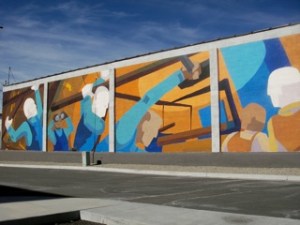
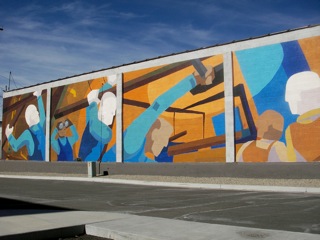
A mural by V. Kim Martinez's University of Utah students on the HB Boys building located at 2280 S. Main St. in Salt Lake City.

This is the scene Dr. Beth Krensky, associate professor of art at the University of Utah, sets in chapter four of the book she co-authored with colleague Seana Steffen. Engaging Classrooms and Communities through Art is a guide on reaching out to people through community-based art education (CBAE) programs.

The girl’s name is Amber. She was 12 years old then. The project: to build a tile entrance for Multimedia Park in Colorado. Some might describe her as a recluse but CBAE changed Amber’s life for the better.

“I have found it remarkable how profound the impact of participating in CBAE has been for so many of the youth and adults I have worked with over the years,” Krensky said. “In my experience, there have always been one or multiple ‘Amber[s].’”

It’s one reason Krensky stands behind CBAE, even in the face of a possible budget cut.

Continued support and patience from a contributing artist, identified as Rae in the book, changed Amber’s attitude. Art became a tool Amber used to express herself. As time progressed she began speaking to others without screaming. She became a leader by encouraging other youth to come and participate in the project. The once shy, tempered Amber even spoke to the media and gave a presentation once the project was completed.

Typically, CBAE works by non-profit organizations encouraging a community to work with a professional artist to produce a work of art.

“[The] facilitator of the project is making sure that people are building community, they’re coming to understand themselves and others,” Krensky said. “Artistic skills are being learned.”

The skills CBAE participants gain benefit those seeking productive careers later in life.

Independent studies confirm the importance of art education. A study published by the Teachers College Press, Studio Thinking, says art education creates “Eight Studio Habits of Mind.” Students learn to “envision, express, observe, reflect, and stretch and explore.” According to the study, the arts often lead to better SAT scores, too.

What makes CBAE unique, Krensky says, is that these projects change the landscape of communities and cross “ethnic barriers, racial barriers, socio-economic barriers, age barriers.” It brings communities together. “It is a place where a message from the community is put forth,” she said.

V. Kim Martinez, associate professor of painting and drawing at the University of Utah, echoes this sentiment.

Martinez teaches a class on murals. Towards the end of each semester the class ventures out into the community to paint a mural they designed in class — sometimes two. She says residents tend to develop a sense of pride for each piece. “They’re more willing to keep the area looking nice,” and, she says, even “businesses tend to remove unsightly drainage pipes.”

The presence of these murals can decrease the presence of graffiti, too. Martinez often hears communities warn, “If you tag this I’ll call the police.”

Her class is only one example of service-oriented classes offered by the university. For the last seven years, Krensky’s class, “Art in the Community,” worked with youth in the Salt Lake area using the CBAE model. Her class currently works with youth through South Salt Lake’s Pioneer Craft House.

Both classes face a major hurdle. The state needs to cut 7 percent from its budget for this upcoming fiscal year. Earlier this month legislation passed that proposes cuts to public education and higher education. Legislators stress the cuts could be temporary. Yet, if put into effect, some funding generally allocated to the University of Utah may vanish.

“We do not have the same funding opportunities that many other colleges have on campus,” Martinez said.

An online Deseret News article published January 31 explains, “The reason for the cuts is what’s being called a structural imbalance totaling some $313 million.” It’s a side effect of no longer receiving federal stimulus money or other sources of revenue the state received during the economic downturn, according to the article.

During the February 2 legislative session Representative Michael Morley R-Spanish Fork, chair member of the Higher Education Appropriations Subcommittee, supported the education cuts. “We think that it is responsible and will help us in solving our structural imbalance,” he said.

The proposed cuts could prove disastrous for some universities, which worries Martinez. “The mural class will not continue if I cannot find funding,” she says. “I often spend well over $700 on supplies a semester.”

Krensky remains hopeful for her class. “I don’t think the cuts will affect the class,” she says. By the earnest look on her face, it’s clear how seriously she takes her commitment to the youth of South Salt Lake. “We’d find a way to make it work regardless.”

Flor Olivo

MY STORIES:

MY BLOG:

This beat helped me learn a couple new things, reminded me of others and reinforced my desire to constantly learn.

Parents like to protect their children’s hearts. This is the way it should be and I was happy to learn that it is still very true for most parents I came in contact with. There are many programs and resources for families and children, sometimes these programs are not used because there is little access to information. Some parents don’t know the value or they simply don’t know programs exist. And yet other parents may know of programs and their value but choose to teach their children in their own way. All of these strategies are okay as long as the general purpose of parent’s choices is to promote growth and positive development. I know that I want to be a journalist. I want to be a bilingual reporter. Because language creates barriers, I want to write stories that can be interpreted for Spanish and English speaking communities.

I believe in the nuclear family structure, not because it is what society easily accepts but because I have seen it work in my life. I feel that this beat has helped reinforce that but at the same time has reminded me of the people in the margins who want the same happiness. I honestly believe that if someone is willing to work hard to acquire something they should be given the opportunity to succeed in that endeavor. The programs and information I was able to find apply to all types of families. Unconventional families should rely more heavily on the resources that are available to alleviate the burdens society may place on them.

I also learned to have a backup plan, to remember people can be flakes. I am a lot more passionate about discovering truths and investigating life than most people so I can’t expect people’s response to an interview request to align with my interests. Different people care about different things.  I feel that when we are reporting it is important to provide resources and to give a call to action to enable civic responsibility. The power of the media is amazing because it reaches so many lives, places and settings.

ABOUT ME:

I’m 26 years old; I started college the semester after I graduated from high school. When I hear someone say, “You’re still in school!” I remember my mom’s words, “Yeah, but most students don’t get married twice and have 3 children in between.”

In addition to overcoming domestic violence and being a single mom for 3 years, I have worked the entire time I’ve been in school. I’ve had ups and downs but my support system, hard work and perseverance have enabled me to construct 9 years of combined work experience.

I have worked in a broad spectrum of odd tasks within my jobs. Interpreting documents, providing customer service for both Spanish and English speaking customers, appearing in several Spanish language ads used for local recruitment, constructing documents and training manuals for an emerging internet based company and much more, all while raising my children.

I know that I want many things from life, and I have been able to pace myself so that I can value and do each one well. I love my heritage, and filling my days with my huge loud family.  I want my children to enjoy their childhood. I want to go to law school and one day own a business. I’ve been labeled as organized but this is the only way I plan to accomplish my goals.

Writing has always been my passion; in the midst of life I’ve been able to work doing this in diverse ways. I have traveled to document events for SLCC and the University of Utah. I’ve had the opportunity to broaden my writing skills with business and grant writing courses through the Latin American Chamber of Commerce. A couple of years ago, a group of friends and I started an organization to disseminate information relevant to the progress and integration of Spanish speaking residents in Utah. And recently, writing stories for Venceremos, the University of Utah’s Latino/a newspaper, has infatuated me. I have been able to apply new tenets of diverse writing and grown as a narrator of life both in English and Spanish.

I know the future holds my dreams and I’m working hard to bring them to life. I will never stop writing and I will never stop working.

Healthy food choices gain value in string-along economy

Story and photo by FLOR OLIVO

As families hang on during the economic crisis many opt to cut down on food budgets and, in doing so, healthier diets.

A woman reaches for fresh fruit at a gas station in Utah.

Support program organizers say creativity, education and knowledge of existing food aid options are key to good nutrition for families passing through hard times.

Research shows good nutrition matters for growing children. Diets high in fat and sugar reduce a child’s ability to learn, focus and remember. Activity and energy levels are also affected.

The federal government has numerous programs geared towards nutrition. Grants for research funding on topics of healthy diets continue to roll out. In 2010 the Food Assistance and Nutrition Programs (FANRP) and the USDA’s Food and Nutrition Service (FNS) created a foundation geared toward the United States Department of Agriculture (USDA)’s child nutrition programs. The research included “incentivizing fruit and vegetable consumption in elementary schools, testing food choice innovations for middle school cafeterias, and drawing attention to healthy choices with lighting,” among others. The grants ranged from $1 million to $25,000 per award.

In 2009 the economic stimulus package increased food stamp benefits by about 13 percent enabling families to receive more money for food.

The same year, the Utah Department of Workforce Services (DWS) served more than 87,000 households, setting a record for the state. In 2010, the average food stamp caseload rose over 130,000.

There is concern and assistance is available but some say it lacks during transitional periods. “Transitional help is needed as families are struggling to make it,” Head Start Family Advocate Heather Johanson said.

Some parents in the program will turn down small raises to ensure they don’t lose food assistance. Many parents are in survival mode. When faced with decisions like good nutrition or paying the rent, food budgets get sliced. Buying “fast food” or prepared meals becomes easier and less expensive with two parents working, concluded Johanson.

Myriam Saavedra, a Jordan school district instructor who works with families daily, says economy is only one aspect of nutrition. Saavedra raised 5 children of her own. She experienced the struggles of concocting healthy meals and believes when budgets are tight, good options and creativity go a long way.

“For example, rice and beans are inexpensive, they have protein and carbohydrates,” Saavedra said. “Add orange juice, rich in Vitamin C, your body will absorb the iron in the lentils and you have a decent lunch. Someone that hasn’t taken a nutrition class would not understand the value of this meal.”

Programs like Women, Infants and Children (WIC) seek to bridge these educational disparities in underprivileged communities by providing assistance with supplemental foods. To receive benefits, qualified participants are required to take nutrition education classes, have iron and weight and height checks and a short meeting with a nutritionist on each visit.

Full-time mother, Jodi Spencer, feels that healthier food choices save money in the long run.

“Healthy food is more expensive, but you have to look at is as an investment,” insists Spencer. “It’s two-fold: your health will be better, less obesity, less doctor visits, etc., and that will, in the end, cost you less, and secondly, if more people opt for organic, non-genetically modified foods, the demand will be higher and the prices lower.”

In the state of Utah there are non-conventional options. Food co-ops are an increasing trend that helps curb costs for those who do not qualify for government help. Participants buy in for $24 and receive one meat share and one produce share. The meat share includes an alternating portion of ground beef, beef cubed steaks, pork ribs or chicken breasts. Produce share has five varieties fresh vegetables and three varieties of fresh fruit.

Most federally funded programs like WIC, Head Start or food stamps include resources for healthier meals. The Utah Department of Health website has information on local WIC offices where women and children can apply for services. Families can apply for food stamps at the DWS office or by visiting DWS’s website. For those who do not qualify for government assistance, the Utah Food Co-op can be helpful.

Overall, the concern for good nutrition for our children exists. Learning the options then making good choices trickles down to us.

Robert Callister

MY STORIES:

MY BLOG:

This semester has afforded me with a variety of opportunities for personal, academic and professional growth. Reporting on the 45-day legislative session provided me with a better understand of state politics and how government works. The Utah economy beat gave me another way to view the legislative process. Balancing the state budget is critical in basically every decision.

Reporting on Utah politics made me much more empathetic towards the state and its economy. Legislators are constantly worried about the return on investment from every project to which they are asked to appropriate funds. Money is everything and the community’s decisions are influenced heavily on the status of the economy.

I have always felt comfortable talking with people on a personal level. It is more difficult for me to converse with someone professionally and with journalistic intent. Reporting on state politics and interviewing various legislators helped me break out of my comfort zone and feel more comfortable conducting professional interviews. I think that this skill will be beneficial to me in whatever career I pursue.

I learned how to take very specific notes and critically listen. I improved my ability to sift through a lot of information to find the most important facts. Sitting in on various subcommittee meetings and legislative floor sessions helped me learn how to summarize large amounts of confusing data.

I gave a very concentrated effort this semester to discover just how passionate I am about becoming a professional journalist. I found out that I have a love-hate relationship with the craft. On one hand, I love learning a variety of new things, gathering information, interviewing interesting people and being a civic watchdog. On the other, I realized that I have to manage my stress level while under strict deadlines. I furnished a strong passion for politics and personal relations. This semester’s experience helped me take another step towards my own self-actualization.

Fraud: The silent budget killer

Story and photo by ROBERT CALLISTER

Utah legislators have been making the number one budget consumer, Medicaid, their number one priority in 2011. Last year, lawmakers had to fund the state’s $540 million in Medicaid contributions and are now looking for ways to reduce health care costs by addressing fraud, waste and abuse in the system.

Lawmakers debate on the House floor during the 2011 legislative session.

Severe budget cuts are sweeping the state and Utah does not have a dime to waste in any sector. There is mandatory spending for every state, but it can always be adjusted and modified. Medicaid consumes over 25 percent of state funding. It is growing at three times the rate of Utah’s budget.

Lawmakers convene daily in subcommittee meetings to address the unsustainable future of Utah’s health care system. And with the federal government socializing healthcare, it seems as if there will probably be further spikes in Medicaid, says Utah House Minority Leader Michael Litvack.

He estimates there will be an additional 100,000 people on Medicaid in Utah by the year 2014. There are currently 213,000 Utahns who are on the low-income health plan.

Rep. Litvack is on the state’s Social Service Subcommittee that deals with budget cuts. He feels one way to cut superfluous spending for the program is to address fraud in the system.

“I think that Utah is very prone to fraud,” Litvack said. “Perception of the state and instinct would almost have you think otherwise.”

But perception aside, the state faces the reality of a population that does not mind manipulating its government. A recent study conducted by the Federal Bureau of Investigation ranked Utah in the top five states for Medicaid fraud, costing millions of dollars every year.

Reports show the majority of fraud comes from people reporting procedures that don’t occur, falsely claiming disability, misrepresenting identification and medical centers billing for imaginary patients.

Sen. Allen M. Christensen, R-North Ogden, is the chairman of the Social Services Subcommittee. He worries that many people seem detached from their government and are indifferent to manipulating it.

“Generally, human nature makes people feel bad about taking advantage of one another,” Christensen said. “Unfortunately, this same guilt does not apply in taking advantage of the government.”

Rep. Litvack recognizes that aspects unique to Utah’s culture make it particularly prone to fraud.

“For whatever reason, whether it is the trusting culture that we have or whatever, it does seem that we have a big problem with affinity fraud,” he said.

Affinity fraud is known to be rampant in societies with high-levels of trust and admiration. Fraudsters will prey upon members of identifiable groups, such as religious communities. In Utah, research shows that 71 percent of the state’s population belong to the Church of Jesus Christ of Latter-Day Saints.

The combination between lack of respect for the government and willingness to take advantage of trust has turned Utah into a boiling pot of fraud. However, this year’s 45-day legislative session is addressing the situation from various angles.

Lawmakers are currently considering numerous bills regarding Medicaid reform. House bill 174 would require the Department of Health to issue reports to the Legislature before awarding Medicaid contracts. This would serve as an oversight program to monitor credibility of potential health care clients.

Rep. Litvack said the last legislative session appropriated millions of dollars to the Department of Health to create a program to prevent fraud, waste and abuse. The department will select a vendor to look at Medicaid claims on “the front end.”

“The purpose is to tease out as claims come in for payment, which ones represent fraud, abuse and mistakes,” he said. “So we are focusing on cost avoidance rather than cutting budgets.”

Rep. Ronda Menlove, R-Garland, is sponsoring a bill that would direct the Utah Health Department to pilot a program requiring some Medicaid recipients to do community service in exchange for health benefits. She recognized the need to push legislation to “combat a growing entitlement culture in this state.”

Last year there were legislative audits conducted against the Department of Health and Medicaid with strict focus on fraud.

Rep. Litvack sees fraud in a more broad sense and as something that needs to receive constant attention.

“We need to look at this issue in terms of Medicaid broadly,” he said. “Often times we need to think of fraud in terms of the intent of manipulating by billing for procedures that don’t happen or to even bill for patients that we haven’t seen.”

Legislators vary in opinion on certain amendments and bills, but they all recognize the importance of tracking money that goes in and out of the health care system.

Audits will continue to monitor the Department of Health and state Medicaid, said Litvack. Bills will be passed in attempt to reduce manipulation of the system. But legislators such as Sen. Christenson would exhort people to recognize that when they steal from the government, they are really stealing from their neighbor.

Armin Hamza

MY STORIES:

MY BLOG:

The beat I was covering has definitely helped my professional development in such a way that it made me get out of my comfort zone and write about something that doesn’t necessarily interest me, but would interest the reader. It also made me look at things from a different perspective because it is always easy to write about something that the writer likes. I always hoped that I would be going into a field of journalism where I can write about a topic that I want to write about and writing about something else helped me realize that it’s mostly not the case.

Writing about tuition increases made me think deeper about how I can provide a different perspective on something without giving my own opinion, especially when I don’t have a lot of knowledge about the subject. I think the hardest thing for me to do was to not give my own opinion, and leave it up to the sources to direct the story. I know that I won’t always have the luxury to choose what I will write about, but I am hoping I can at least pick a topic, which I can lean towards and hopefully explore it enough so it is interesting to me and the reader.

I also found out that reporting is not as easy as I initially thought. Most of my reporting background comes from sports. I was put in a situation where I didn’t have a lot of knowledge about tuition increase, so it was challenging to make myself prepared before I talked to the community or students. It is important to me that the person who I am talking to knows that my questions are credible. Talking to the students about the tuition increase and finding out what their opinion is made me look at my own views about it. I always reminded myself during the writing process or when I talked to the public that I am only there to report in order to prevent possibility of being bias.

ABOUT ME:

My name is Armin Hamza and I was born in Bosnia. I also lived in Germany for almost 8 years. I have been living in Utah ever since then. I have two sisters and they are both older then I.  My favorite things to do are, play soccer, listen to music, watch soccer, taking photos, art, web design, and everything else that is fun. My strength as an individual is communicating with people that I know and finding out what is interesting about them. My biggest challenge that I had to overcome is realizing that I wont be playing soccer anymore due to my knee injuries, at least not competitively. My biggest challenge that I want to overcome now is approaching people that I don’t know because it will help me become a better journalist. I would like to pursue a Journalism career and see where it takes me. I was originally a computer science major, which I will continue to pursue after I get an undergraduate degree in Journalism.  I would love to live in Europe again some day, but you never know where the world can take you. My dream job would be anything that has to do with traveling. When I look back my life will hopefully look like I was picturing it, no regrets and have fun in anything that I do. My favorite quote is, “In three words I can sum up everything I’ve learned about life: it goes on.” ~ Robert Frost.

Increase in tuition worries local students

Story and photo by ARMIN HAMZA

The cost of tuition has increased 9.5 percent in the last year and lawmakers are continuing to transfer the cost of higher education from the state to the students and their families. University of Utah students are worried about the increase in tuition, saying it will make the universities lose quality and affordability.

Student waits at the financial aid desk.

According to Higheredutah.org, which oversees the establishment of policies and procedures, budget and finance for higher education for the State of Utah, the U approved a tuition hike of between 7.5 and 9.5 percent last year. This results in total tuition increase of $471.00 for in-state tuition per semester.

This worries many students who chose to attend the U because of affordability.

“If I knew that the tuition would increase this much I would have attended University of Utah after I was done with my generals,” Kirby Johnson, a freshman majoring in communications at the U, said.

Other students believe the increase in tuition is a result of expansion and improvement of the campus, which in the end will benefit current and future students.  “The increase in tuition doesn’t bother me at all, because I know that the money is invested directly to benefit me as a student,” Jake Sullivan, a junior majoring in engineering at the University of Utah, said.

Tuition costs vary from school to school. According to the Westminster College website, yearly tuition at Westminster College is about $25,980, whereas the University of Utah charges about $6,200 for its yearly tuition. “We are lucky that we don’t have to pay $10,000 a semester at the University of Utah because I know I wouldn’t be able to afford it and I know many others that would be in the same boat,” Sullivan said.

As students worry about the increase in tuition and how the increase will affect the quality and affordability of education, most students and faculty members still believe affordability should be the main concern when it comes to education.

“I believe that the quality of the education the student is getting will always be great,” Michael Bradford, a junior majoring in communication at the U, said, “but because of inflation and the university’s budget cuts, the affordability will become a big problem for the students that are paying out of their pocket.”

Students that take a hit because of the tuition increase each year will look to pay less for tuition at schools that are not as prestigious, instead of looking at schools that give them a better education. Some believe most schools in Utah will see a significant drop in the number of students enrolling each year due to the constant increase in tuition cost.

Students who pay for their tuition using financial aid, are not as affected by the tuition increase as students who pay out of their own pocket. “Even though the increase in tuition made a lot of students worry how they will pay for their tuition, the same students that say that do not pay out of their pocket right now but will after they graduate or get a job with that degree,” Bradford said.

According to the Higher Education website, University of Utah has the highest total tuition increase of all the schools in Utah. The difference in tuition increase between other universities in Utah is not as high as most students would think. Southern Utah University is second on the list with $466 total increase in tuition per semester and Utah State University is third on the list with $303 total increase in tuition per semester for residents.

The website also says the average total tuition increase is 8 percent or $294 in annual tuition for 15 credit hours per semester.  “These increases are necessary to preserve the quality of education at our institutions. Higher Education remains the best investment anyone can make in themselves and their potential,” Jed Pitcher, chair of the State Board of Regents, said.

Although tuition at Utah schools has doubled over the past decade, many students haven’t even noticed the tuition increase. “I just pick the classes each semester and my financial aid pays for them,” Sullivan said. “The education that I am getting is priceless to me so when I graduate I will worry about how much I have to pay.”