Andreas Rivera

MY STORIES:

MY BLOG:

Following a specific beat has helped me understand what I will be doing as a journalist for most likely the entirety of my career. I realize that I will need a specialty, since it is no secret that the general “everyman” reporter is a dime a dozen and has trouble getting jobs in the media business. I need to have a skill and/or field of expertise to make me stand out in the job market.

Covering the Asian beat has made me think more about diversity and made me realize that everyone isn’t fighting the same fight. As someone coming from a Mexican and South American heritage, how I look at diversity, discrimination, social classes, etc. is completely different than from how someone with an Asian background sees these things.

Other things I’ve learned while covering this beat is that Asian stereotypes seem to be more acceptable in society than most other racial stereotypes. I’ve noticed this while watching television and the movies. A typical portrayal of an Asian person in popular culture usually incorporates: martial arts, excellence in math, long ponytails, buckteeth, slanted eyes, ridiculous accents, and ninja/samurais. It is more common to see these, than say, stereotypical images of a black man eating fried chicken and watermelon, or a lazy Mexican napping under a sombrero. Those examples you may see in edgy comedy, but are generally unacceptable; however, I see the stereotypical Asian in just about every form of media.

I’ve also realized that there are some people who don’t believe that there is a battle to fight, regardless of their ethnic background. They believe that the battle has already been won and we are a completely diversified, “color-blind,” society. Although I don’t fully agree with them, I find it very interesting. Roger Tsai from the Utah Asian Chamber of Commerce asked me, “Is it really a good thing to be color-blind?”

ABOUT ME:

I was born to be a writer. At least that’s what my aunt once told me when I showed her my latest homemade comic book when I was 6. The comic was about a witty hero, Ricky Raccoon, and his friends and how they would stop his evil brother, Robo Raccoon, from taking over the forest. Somehow I’ve always known that writing was in my future. Even when my mind wandered to other things like being a professional wrestler, being a paleontologist (dinosaur hunter), or a detective, it all came back to writing.

I was born in West Jordan, a suburb of Salt Lake City. I grew up with a huge imagination thanks to the tons of books and comics my parents supplied me with. It was around the beginning of middle school that I turned my full attention to writing again, and I wrote short stories for the school magazine.  One was a Harry Potter fan fiction, another was about a desperado in the old west, and another was about a group of teenagers escaping a shadowy figure in an old factory.

Upon entering Alta High School, I didn’t really know what to do as a career. It was by accident I ended up on my high school’s yearbook staff. Gathering up facts and telling a story from them was fun to me, and the next year my teacher suggested I join the newspaper staff. To this day, some of my favorite stories were published in that paper, which incidentally won an award for best school newspaper of the state. Ironically, sports section was my least favorite beat to cover, but I won an award for an article about our girl’s soccer team winning state.

I am currently a student at the University of Utah, majoring in mass communication. I am also writing for the Daily Utah Chronicle as a part-time news writer. It’s a fun job and is introducing me to the field.

Experts talk about the decline of traditional media, and they talk about the difficulty of getting a job in this industry. I have been told that I am making a mistake by going into a field that is slowly going down the drain. Even those close to me have questioned my decision, but I do believe I have a future in writing; writing for a newspaper wether it is paper or online, writing fiction novels, or even about a witty raccoon and friends trying to save the world.

Emily Rodriguez-Vargas

MY STORIES:

MY BLOG:

Sitting on my interviewee (and recently-found) friend’s sofa munching on deep-fried frog legs from Thailand, I came to an interesting realization: the job of a journalist is to investigate and report, but the work doesn’t always end there.

It’s been truly life-changing for me to watch Asian Americans from various walks of life while covering this beat. At the Utah Asian Chamber of Commerce gala, I watched successful Asian American entrepreneurs receive rewards, ambitious students proudly accept scholarship awards, and others celebrate with their friends.

At other events, I’ve learned more from individuals and the trials they have faced to be where they are now than I could possibly hope to understand from a history lesson. Many of these people are refugees and immigrants. When I talk to them about their struggles as a foreigner learning a new language and adjusting to life in new surroundings, we can connect because I understand what they are going through. I’ve been there, twice.

No, I never suffered from political persecution, and I never spent time in a refugee camp, but I know what strength it takes to carry on and tackle each new challenge despite all obstacles. In a way, these stories teach about how important it is for those who can help, to do so in the best way they can.

While I try my best to convey what I see in a story, I know that I’m the one gaining the most out of the experience. The more involved I get in hearing each story, the more I decide that just writing their story isn’t enough.


ABOUT ME:

As a Colombian American raised in Europe, I love exposure to different cultures, languages, and people. I find myself driven by one passion after the next.

On a normal day you’ll probably find me in the library, lost in an ever-growing pile of books on politics, law and social justice, listening to European online streaming radio stations while doing my homework, or checking up on the latest of my favorite blogs over a cup of tea.

One way to accommodate all of these interests was my decision to double major in mass communication with an emphasis in journalism, and international studies. My minor in French, for which I recently was able to do a study-abroad program in Québec, Canada, serves as my balance and language outlet.

I’ve worked as an opinion columnist for the Daily Utah Chronicle, a writer for Wasatch Woman Magazine, and most recently as a news reporter for KCPW-FM radio. I’ve also loved working on the other side of the aisle in a Utah state agency or in a congressional office in Washington, D.C.

When I find a quiet moment, I like to experiment in the kitchen, attempt to keep my balance through yoga poses, and plan my next adventure. Next up is working behind the scenes of the European Parliament. While I’m in Brussels, I’ve decided to try my hand at photography. I plan to live in Manhattan some day and catch up on all of the books I have on my shelves, just dying to be read.

Keith R. Araneo-Yowell

MY STORIES:

MY BLOG:

While I was sitting across the table listening to the subject of my third story recount the atrocities that befell her at the hands of the Chinese government, I realized this story would change me. I never would have anticipated any assignment, school or otherwise, to have such a profound effect on the way I think about misfortune and coping. I wanted everyone to be able to take away the things I did from my interaction with Miss Lin.

It was in her strength that I found determination to tell her story in a way that would not only convey the emotion I felt hearing it, but also do her and any other victims of persecution justice. It proved difficult to do without sounding slanted, and I still feel there is improvement to be made.

It was the prospect of reporting challenging and relevant stories that originally drew me to study journalism. Throughout this semester, and especially reporting for story 3, I realized a lot about myself, the media and this class in general.

I’m of the opinion that journalism would be a tool that I would use to augment any other future endeavor, but it’s becoming more and more clear that I could find the art as a profession one of true satisfaction and real fulfillment.

ABOUT ME:

I am a senior at the University of Utah, graduating Winter 2010 with degrees in economics and mass communication with a focus in journalism. I have always loved the pursuit of knowledge in any field, which is what drew me to study journalism. I keep bees and play a variety of different instruments, including the bass, the drums, the banjo and the guitar.  I hope to continue my education by pursuing a master’s or PhD in econometrics (a form of applied statistics).

Growing old when gay

by Gillian King

  • See a slide show of resources older people within the GLBT community can go to.

The process of growing older can prove to be difficult for many people, especially when it comes to navigating government benefits and retirement. However, for individuals such as Pamela Mayne the process can prove to be especially nerve-racking. “It has been a harrowing experience to get what we are entitled to,” Mayne said.

Mayne, 64, and her domestic partner, Ann, have had to put a lot of hard work and energy into ensuring their benefits are set up the way they need them to be. Hard work that legally married couples generally don’t have to worry about. Their problems are rooted in the fact that they are a lesbian couple, and despite being together for the last 37 years many organizations don’t recognize their relationship.

The simple act of getting on each other’s insurance proved to be trying for the couple. After Mayne’s partner retired, Mayne wanted to make sure the primary and secondary coverage for their health insurance was correct. “When I called Medicare, no one knew what to do because they didn’t recognize domestic partners,” Mayne said.

Medicare isn’t the only place where the two have run into trouble. When Mayne retired, she had to take her retirement in one lump sum instead of monthly payments. “It would have been nice to have monthly payments,” Mayne said, “but if something were to happen and I died, the benefits would die with me. I couldn’t leave it to Ann like I could if we were a married couple.”

These types of experiences aren’t unique to this couple. According to Jo Merrill, a doctoral student in counseling psychology and a teacher in the Gender Studies program at the University of Utah, couples across the nation are having similar experiences. Merrill did a qualitative study of aging experiences of older lesbian couples and found some noticeable trends.

“Some of the unique concerns for LGBT (lesbian, gay, bisexual, transsexual) couples are legal invisibility, right of inheritance and social security benefits,” Merrill said. She added these problems mostly stem from domestic partnerships not being legally recognized, and marriage not being available for these individuals. Without some sort of legal or familial bond, Merrill says many of these couples feel their benefits are never really secured, no matter how much money they pay to make sure they are.

Trying to secure benefits is a familiar task for Mayne. She and her partner set up living wills so that if anything were to happen to either of them their money and property would go where they want it. Since the state of Utah doesn’t recognize domestic partnerships, the process of drawing up the documents was much more expensive and time consuming. When comparing the process of her setting up a living will as opposed to her married, heterosexual daughter Mayne said, “It cost three times as much for us because there is no legal relationship so there are a lot more papers to sign.”

The process of setting up things like insurance and living wills can be difficult for LGBT seniors to navigate, but luckily they are not alone. The Utah Pride Center holds monthly events for SAGE Utah to help individuals navigate the unfamiliar territory of aging within the gay community. According to Jennifer Nuttall, Director of Adult Programs at the Utah Pride Center, SAGE (services and advocacy for gay, lesbian, bisexual and transgender elders) offers social avenues, workshops and educational opportunities that seniors in the LGBT community would otherwise not have. They work closely with Salt Lake County Aging Services and address issues that are unique to LGBT seniors.

More than anything Nuttall says that through SAGE individuals can receive the support they are in need of. “It is important to have people that are supportive and affirming of who you are,” Nuttall said. She mentioned that other groups, such as grief groups, aren’t always supportive to people living LGBT lifestyles. Individuals feel like they need to hide information about themselves and their sexuality, which isn’t helpful during trying times, such as attempting to cope with the death of a partner. At SAGE events these individuals don’t need to hide who they are, they can make connections and get the support they need.

The Utah Pride Center works not only to provide support for individuals, but also to give them access to workshops where they can learn things such as how to best organize their legal documents. Mayne knows firsthand how difficult this can be, as she has been running into problems as long as she has been with Ann. Her partner already had five children and was pregnant when they got together, and they raised the children together. While Mayne considers all of her partner’s children as her own, the government does not. One year when filing taxes it made more sense for Mayne to claim the children as dependents than for her partner to. They did the research to make sure they could legally do it, and filled out all of the needed forms. “Then we got audited,” Mayne said. She took in the IRS brochure that stated they could legally file their taxes this way. “They let us do it, but made it clear that we shouldn’t try to again,” she said.

Because of these kind of difficulties, some couples take extreme measures to get legal custody of children. “Utah doesn’t allow (same sex) couples to adopt, so often couples will move out of state for a couple years to get residency in another state where adoptions are allowed,” Merrill said. She said then the couples could move back and have the adoption upheld by the state of Utah. This option is not a convenient one for many couples. Couples must have the necessary funds to be able to pick up and move to another state for a couple years, something that many don’t have at their disposal.

Moving out of the state to adopt children wasn’t the only measure Merrill discovered people were taking to ensure legal family bonds. Some elderly couples take advantage of a loophole in the system and one will adopt the other. “Two of the couples I spoke with were in the process of adoption,” Merrill said. She said if one partner could prove that the other was dependent on him, or her, for care then the dependent partner could be legally adopted. “It shows the subversive moves couples have to make out of necessity,” Merrill said. She spoke to one couple that had recently completed the adoption process. The couple told her they finally felt their partnership couldn’t be dissolved because they had been given legal status as a family.

Legal status as a family would make life a lot easier for Mayne and her partner. “We don’t even qualify for a family pass at the recreation center in Bountiful,” Mayne said. When they tried to purchase one they were turned down.

Not getting passes to the local recreation center may be inconvenient, but not compared to future expenses. “When setting up our finances, we decided to get long-term care insurance,” Mayne said. She has researched prices at assisted living facilities and found results that were unfavorable to her situation. She said for the first person to enter a facility it would cost $2,600 a month, and then for the spouse it would be $600. Since her and her partner aren’t legally spouses, they would have to pay $2,600 each, something she would have a much more difficult time affording, which is what prompted her to get an insurance plan to cover the expenses.

Making sure expenses will be covered and paperwork is set up the way it should be is something that many LGBT couples believe can’t be put off until retirement age. Nyhra Snyder, 22, and Ashley Cordova, 23, have already begun to get their affairs in order. They have both made each other the beneficiaries of their life insurance policies in the event that anything may happen. They too have been faced with discrimination though. “When I was filling out my life insurance policy at work I made Ashley the beneficiary and put her down as my life partner, but the HR manager changed it to ‘friend’ even though there was a life partner option on the form,” Snyder said. She recognizes that her generation has less discrimination than previous ones though. “I’m just grateful for what people have done before us,” she said.

Even with the inconveniences and discrimination, Merrill says many elderly LGBT couples say things are better than they used to be. Whether it is from changes in society or changes due to age it is difficult to tell. “Most participants felt more accepted as they got older,” Merrill said. She noted this might be a result of the heterosexual community desexualizing older people.

Mayne agrees that in most cases people are more accepting. She also said as she ages she doesn’t let things bother her as much, and she has become less hostile toward unfriendly comments. “We kind of ignore it,” Mayne said, “plus our hearing is getting worse.”

Scammers prey on elder finances

by Alicia Williams

Editor’s note: The names in this story have been changed to protect identity.

“They’ve cleaned out my checking account for the last three months in a row,” 74-year-old Lilly said. “It’s a scam. Instead of depositing the money; they’ve stolen my Social Security.”

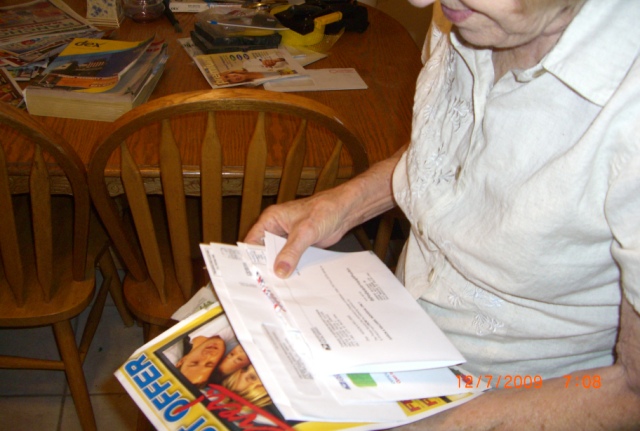
Lilly throughly reads each piece of her mail.

We’ve heard the heartbreaking stories far too often. Elderly theft occurs all over the United States to a variety of people in vastly different ways. But all the victims have one vulnerable commonality, trust. And that’s exactly what today’s thieves are banking on when they target the elderly.

Lilly said she received a fax from a business developer in Switzerland. He wanted her to invest his $22.5 million into small businesses in the United States. She had to pay the money back, in six years, but he would give her 50 percent of the profits. Con artists may create new, unique lies, but their techniques are always the same. Gain their trust, and then steal their money.

In an effort to expose the true magnitude of the problem, the MetLife Mature Market Institute published the results of their March 2009 study “Broken Trust: Elders, Family, and Finances.’’ The authors estimate elderly victims in 2008 lost $2.6 billion.

The MMMI study reports several tips to help prevent financial abuse of older adults. It’s important to keep all mail and records organized to avoid easy access to financial information. It suggests keeping informed of new scams and fraud tactics to watch out for, and most importantly, stay alert to possible situations where financial abuse can occur.

The study also that showed financial abuse is most frequently committed by a family member, friend, caretaker or someone in close contact with the victim. However, the highest theft profits came from business and industry crimes, which accounted for more than half of elderly financial losses.
Commercial organizations exude trustworthiness. Most elderly have a very trusting nature, and they often believe it must be legitimate if it’s a business. Unfortunately, dishonest businesses only operate to steal money, and the thefts are often applied in cunning, unique ways. The following true stories are good examples of the more common approaches people should be aware of.
The MMMI study shows information is a powerful defensive tool that elderly people can use to protect themselves from fraud. Taking the time to intricately explain common fraud tactics to your elderly loved ones could potentially save them from 21st Century crooks.

Dishonest Lending Institutions
Alma, 72, and her husband, Sione, live on a fixed income of $1,540 a month derived from Social Security and a small retirement pension. Alma is soft-spoken and extremely polite. She said their financial problems began in 2008 after she phoned a loan company advertising “fast money.” She’d promised her grandson some funds for his wedding.
Unfamiliar with mortgage loan intricacies, Alma and Sione signed for a high-risk second mortgage loan that has jeopardized her family’s financial security and their home.

“I needed the money, and they were nice. They handled everything over the phone, and they came to my home so we could sign the papers,” Alma said.

The company didn’t require any pre-qualifications for income, credit, or debt to ratio. The last monthly statement provided the principal balance of the first mortgage, and a tax notice established the value of their home. After confirming there was substantial equity, the lender approved the loan and closed it within 48 hours.

Alma said she didn’t know the 30-year loan for $10,000 has an interest rate of 29 percent. “Is that bad?” she asks. In fact, she doesn’t remember much about the transaction, other than the title people told her a monthly payment amount she said “sounded right.”
The new payment is $349 a month, but when you add it to their existing first mortgage payment of $1,065, they’re now paying $1,414 a month. That leaves them exactly $126 a month to live on.

They can’t afford the payments Alma said, and the lender has started foreclosure proceedings. Alma said she’s very afraid her family will find out. She’s too embarrassed to ask her brother for help, she said, and she doesn’t want to financially burden her children.
“My husband is very ashamed. He doesn’t like me to talk about it,” Alma said. “Sometimes at night, I can’t sleep. I know it was a mistake, but we needed the money.”

Alma said she still doesn’t know if the lending company did anything wrong. Despite all of her current financial problems she said she would do the loan again, she really needed the money.

Miracle Cures and Consumer Scams

A few of the products Lilly takes each day to keep herself healthy.

Some elderly are desperate for age-defying products. Lilly’s intense energy is barely contained as she describes the wondrous product that’s changed her life, water. The multi-level marketing company’s Web site reports the alkaline ionized water to be “rich in minerals, purged of free radicals and free of contamination.”

Currently, Lilly buys the water by the gallon from a local distributor; she had 30 of them in the back of her mini van, a month’s supply. But, she said she’s saving money so she can buy her own machine. She quickly explains how the $4,000 machine pays for itself. Once she’s a distributor, she only needs to get eight people to buy one, and then she’s made all her money back, plus she’ll get to drink the water for free.

There’s a problem though, Lilly can’t seem to save any money. Recently divorced, her only source of income is an $868 monthly Social Security check. She’s rented a place with her twin sister, Diane, after losing her home to foreclosure in July. They’re two months behind, and they were served a three-day eviction recently, but Lilly said it’s not her fault.
Investment scammers drained her checking account. The bank has assured her the money stolen last month will be returned Lilly said, because they convinced her to keep the account open. She said she’ll pay her rent, when she gets her money back.

Within a few minutes, Lilly switches the conversation back to health products. “You wanna know why I’m so healthy?” she asks with a broad smile. “I drink Alaska’s wild blueberries. They keep me young.”

Confidence Scams
Not all elderly fraud victims are poorly informed or easily deceived. Bill, 83, is a retired structural ironworker. He considers himself very business savvy as the owner of several rental properties in Utah and Pennsylvania. He said his wife of 51 years, who passed away in March 2008, was a licensed realtor and investor.

In 2007, the couple contacted a title company to obtain information about a potential investment. The friendly title officer paid special attention to them, eventually creating a personal relationship. Bill said that’s when she extended an invitation to invest in her private real estate venture.

Actually, the first investment was very good, Bill said. In late December of 2007, the couple loaned the title officer $15,000 as a second mortgage on her fixer-up property. She paid the loan back with interest by July 2008. One month later, Bill, now without his wife’s expertise, loaned her $50,000, on the same property. Only this time, the loan wasn’t put on the property as a second mortgage; Bill was placed in a very risky, forth position.

“Trustful. I really trusted her,” Bill said. “Why wouldn’t I?”

The title officer made two mortgage payments, before she stopped paying altogether. Bill said she periodically contacted him, during the foreclosure process. Then one week before the property went to auction, she requested an additional $15,000 loan from him. She said she really wanted to try saving it. Bill said he politely declined.

Because the home didn’t sell at the November foreclosure auction, the title reverted to the first mortgage lender. The second, third and fourth lenders all lost their investments. Bill said the experience has made him more aware. He’ll definitely speak with an attorney in the future to avoid being taken advantage of again, especially by someone he thought he could trust.

“As far as I know, it’s (the $50,000) a complete loss,” Bill said. “But, she keeps promising me that she’s gonna pay me back, even though they’re going bankrupt.”

Tackling football injuries is a lifelong challenge

by Evan Frank

The sun hasn’t reached the peak of the mountains yet, but a lone room in the University of Utah football coach’s offices is lit. A long hallway of experience and tradition leads to John Pease’s office. He sits in his chair, looking at different formations for the team’s upcoming game against the University of Wyoming. Fleetwood Mac quietly plays from the mini speakers on his desk.

John Pease coached at the professional and collegiate levels. During his playing days he suffered several injuries.

Pease was a junior college All-American halfback in 1961 and linebacker in 1962 at Fullerton Community College before playing at the University of Utah for two years. Now 66 years old, Pease is the assistant head coach at Utah and oversees the defensive line.

He reaches for his briefcase and searches for something.

“Where is it?” he asks. After a couple moments pass, he pulls a single sheet out of the bag; an X-ray of his lower back. A steel rod with six screws is shown in the X-ray. Pease credits running on cement for years, along with football, as the reasons why one of his lower disks has become nonexistent over the years. Even though Pease’s playing career after college was short lived, he still accumulated 11 concussions.

With football injuries getting more attention in the national spotlight, the debate has attracted the attention of lawmakers and medical experts.
Congress is currently investigating the long-term effects of head injuries with current and former professional football players. If there is a solution, members of Congress hope to find it soon to prevent further injuries.
The real question is if a solution exists. According to Pease, there is no prevention.

“Play soccer or baseball if you don’t want to take those chances,” Pease said.

Roy Jefferson, 66, played at Utah with Pease and was drafted in the second round of the National Football League draft by the Pittsburgh Steelers. Jefferson played for the Baltimore Colts alongside hall of fame quarterback, Johnny Unitas. During the 1970 season, his one season with the Colts, Jefferson and his team was on the winning side of Super Bowl V.

During the later years of his NFL career, Jefferson said he tore the cartilage in his knee while playing a game. Despite the fact that he was injured, Jefferson finished the rest of the season. The trainers would use needles to inject medicine into Jefferson’s knee to temporarily relieve the pain. One year later, Jefferson retired from the league and the game he had played for so long.

“I’d be a junkie if I kept playing,” Jefferson said. “Too many pills.”

Jefferson agrees with Pease with the lack of prevention on the playing field.

“There’s no way to prevent concussions,” Jefferson said. “The players are too big, too fast and too quick

Pease’s friend, former Pro Bowl player Hardy Nickerson, once said about playing in the NFL, “Get in your car, put on your seat belt, and run into a brick wall for twenty Sundays in a row.”

With no real prevention out there, it may be puzzling to people as to why these men put their bodies through such pain and trauma.
When playing football is your career, Pease says a player makes a lifetime decision.

Paul Silvestri, the head football trainer at Utah for the past two seasons, says football is a physical and brutal sport.

“It’s going to continue to affect athletes down the road,” Silvestri said.
The injuries can be severe, but Silvestri said he and his staff do as much as possible to prevent further damage. It is difficult to predict what the training staff does now will help the players once they are done with football, he adds.

“Give them plenty of time to heal and do the best you can,” Silvestri said about rehabbing a player.

Jefferson has a different take on injuries.
As Silvestri said, giving the body plenty of time to recover is essential. Jefferson does not believe the players have that chance.

“They train too much,” he said.
Jefferson stresses the small amount of time given to recover from serious injuries.

“I believe that’s why you see so many injuries,” he said.

Silvestri brought up the possibility of developing arthritis after having surgery on a joint. Arthritis in retired professional football players has become a topic of study. The American Journal of Sports Medicine conducted a study on 36 of the 41 members of the 1969 Super Bowl winning team. The study took place 35 years after the winning game. During the study, the players were tested for a number of medical conditions. Twenty-four out of 36 reported having painful inflammation and stiffness. The report concluded that the players who had arthritis still had a long and fulfilling career with no apparent long-term detrimental effects on physical or mental health.

During the 1987 NFL season, players were first tested for steroids. It wasn’t until 1989 that players received disciplinary action for using the drug. The ban on steroids occurred well after the playing days of both Pease and Jefferson.
Steroids can have fatal consequences for users. While death from steroids does not occur frequently, the side effects of using steroids range from elevated blood pressure, harmful changes in cholesterol and an increased risk of cardiovascular disease.

Pease said former teammates who took steroids during their playing days now have trouble doing normal activities such as jogging. Most of the players he knew of who used steroids are now crippled in their retirement years, Pease added.

While the physical and sometimes mental aspects of playing football can be harmful, there are upsides.
When Pease had prostate cancer, he credits receiving treatment from the John Hopkins Medical Institute to his football connections.

“You get the best care,” he said.

According to the NFL Players Association, 2.4 percent of college players become professionals in football. Out of 100,000 people who play high school football each year, only 215 will ever make an NFL roster. That is not to say the injuries will be less severe if a player does not play professional football. Another possibility is having a career-ending injury occur before the chance to even play in the NFL.

“Hopefully they have their degree and they can find something else in life,” Pease said.

Jefferson, whose left knee has been operated on three times, will have to have it replaced. His right hip will also need to be replaced.

“If I don’t take Vicodin here and there, oh God, they hurt like heck,” Jefferson said. “It’s the price you pay, I guess.”

The drug Vicodin that Jefferson mentions is used specifically to relieve pain. Vicodin, along with several other painkillers, are used excessively by NFL players. Most notably, in 1996, Green Bay Packers quarterback Brett Favre, admitted to being addicted to Vicodin and was in treatment for 46 days.
Pease stresses that players make the choice to play football and they accept the risks.

His wife, Chris Mickelson, has told her husband that football players have spent their whole career ruining their bodies, and should stop complaining.

Through all the injuries Pease has seen during his years of coaching, he still has strong feelings about the game he fell in love with long ago.

“I wouldn’t change anything,” he said. “Playing football is a wonderful occupation.”

Older adults should not fear violent crime

by Lee Horton

The older adults at the Tenth East Senior Center in Salt Lake City aren’t afraid of being targets of violent crime by strangers. They know the benefits of going to the center outweigh the potential of harm that might occur. Many of them don’t even think about the possibility of crime.

“I’ve never been afraid of that,” Josephine Chappell said.
Chappell, who goes by “Jo”, is 97 years old, and has been going to the Tenth Street Senior Center for over 40 years. The center has been operating for 46 years.

“They weren’t open very long when I started coming,” Chappell said.

Jerry Urlacher, center manager, is inclined to believe most of the people who come to the center feel like Chappell.
“I am confident that the majority of the people who come here do so without fear,” Urlacher said. “Maybe there are some who are afraid, but they are willing to risk it because of the advantages.”

Dean Allen Hall and his wife, Mary, understand the potential for crime. “I can see why, when you get to a certain age, you would worry about that,” Dean Hall said.

The Halls have seen the media coverage of crime. The front page of every newspaper, like the copy of the USA Today Mary is flipping through, highlights shootings, murders and home invasions. But beyond the gang activity he has read about, Dean Hall is not concerned. “I don’t scare too easily,” Hall said.

Scott Wright, director of the Gerontology Interdisciplinary Program at the University of Utah does worry, but not about senior safety.

“Older adults have the highest fear of crime,” Wright said, “but are one of the lowest victims of crime.” Wright wonders if bodies and minds that have weakened with age make people question their personal safety in the outside world. Wright doesn’t want these fears to prevent older adults from getting out and continuing to experience life. “Life is long, or could be,” Wright said. “There is great potential for the second half of life.”

Records show violent crimes against older adults to be rare. The Utah Department of Health’s Bureau of Criminal Identification classifies murder, kidnapping/abduction, forcible rape, forcible sodomy, sexual assault with an object, forcible fondling, aggravated assault, simple assault and intimidation as violent crimes. According to the BIC’s preliminary 2008 statistics, people ages 60-95 were victims of only 785 of the 5,840 of violent crimes in Salt Lake City. That is just over 7 percent of the total.

Sergeant Gary Trost investigates violent crimes for the Salt Lake City Police Department. He doesn’t see many crimes committed against older adults by strangers. “We don’t see a lot of elderly abuse that is non-family,” Trost said.

While confident that the people who come to the Tenth East Senior Center aren’t afraid, Urlacher worries about those who don’t come.
“What frustrates me is there might be many who would benefit, but they are afraid,” Urlacher said.

Tenth East offers much to older adults. Pool tables, exercise programs, a computer lab, plus harmonica, art and Spanish classes are among the services the center provides to older adults. Each individual has his or her own reason to come to the center.

Urlacher says it isn’t what they do, but that they are doing something. “I think the very, very best thing is people are indeed out of their houses,” Urlacher said. “They’re with other people. They’re able to participate in exercises or be stimulated by the classes.”

Wright agrees that getting out is important. “The fountain of youth is being mentally and physically active,” Wright said.

While he whistles along to the song accompanying the exercise class at the other end of the cafeteria, Heinz Winkerman folds forks, knives and spoons into napkins, one at a time.

Because getting the silverware ready is a crucial part of serving meals that not many people think about, Urlacher calls Winkerman the “unsung hero of the center.”

Winkerman has been coming to Tenth East for seven years. He says he has been helping with the utensils for about six. Without warning, Winkerman went blind four months ago. “I said ‘what’s going on? Are the lights on or off?’” Winkerman said.
Winkerman thinks having a place to go and things to do has helped him deal with being blind. He admits that it has been tough, but feels that adapting is important. “You have to,” Winkerman said. “Life goes on.”

Despite his blindness, Winkerman still doesn’t worry too much about being a victim of a violent crime. He says his children and the people he goes to church with take good care of him, and a van gives him a ride to and from the Tenth East Senior Center whenever he wants to go.
Winkerman, Chappell and the Halls say they go to Tenth East every day. As they leave their house, crime isn’t one of their worries. The lone precaution Chappell and the Halls make is not going out when it is dark.

The Halls are more worried about the lack of manners by the people of Salt Lake City than becoming a victim of crime. Chappell is more concerned with how she is going to get her groceries and run errands. She feels she has no reason to be afraid of being hurt.
“Everybody’s been royal to me,” Chappell said. “Everybody.”

Athlete for life: staying healthy and active in later life

by Paige Fieldsted

Looking at 70-year-old John Percival now you may not guess that he spent the majority of his life involved in athletics. He leans heavily on a cane, just three weeks removed from his second knee-replacement surgery this year. He had the other knee done 12 weeks ago.

John Percival in his home three weeks after having his second knee replacement surgery this year.

Percival’s smiling face turns sober and he chokes up when he’s asked about the surgeries on his knees.
“It’s been hard,” Percival said. “It’s really hard to not be able to do what you want to do. After we’ve been so active it’s hard not to be able to do.”
Percival’s attitude can be echoed by other seniors that aren’t ready to give up the active lifestyle they developed in their youth and as athletes.
Percival has been active for the majority of his life, playing sports from a young age. In high school he participated in football, wrestling and ran track occasionally.
Percival said he got involved in sports in high school because that was the cool thing to do.
“When you’re in high school it is the only thing to do,” Percival said laughing. “You’ve got to be in sports. You don’t get a girl if you not in sports.”
While Percival’s competitive football and wrestling career ended with graduation from high school, he continued his athletic ways by participating in horse racing and rodeo for years.
Percival said the activity level from his youth has carried over into his life now.
“I ran for a number of years until my knees when bad. Then we played with the horses,” Percival said. “It carries over to make a guy more active and it’s carried onto this day.”
Percival isn’t alone in carrying his active lifestyle into his later years. A study published by the “Journal of Aging Studies” showed that younger athletes expect to stay active as they age and that older adults who were athletes have been more active as they got older.
Percival said that up until August, two months before his first knee surgery, he walked four to five miles every day.
Being healthy and active throughout his life has paid off for Percival as he said his two knee surgeries have gone better because he took care of his health right up until the surgeries.
His two knee replacement surgeries were performed only nines week apart.
“I think that being active and in good shape helped with the knee operations,” Percival said. “I think I got along better because the good shape that I was in.”
At his most recent physical therapy appointment doctors told Percival that he is physically three to four week ahead of other patients that had knee surgery the same day as him.
Dr. Steve Aoki, an orthopedic surgeon in sports medicine at the University of Utah Orthopedics Center said that older people don’t heal as well as the younger athletes he works with but that being in better physical condition usually helps.
“Although probably true, that isn’t always the case,” he said. “They certainly don’t rush their rehab like a younger athlete is trying to push it and get back to their sport at a sooner time period. For a lot of our more recreational older athletes there is not that rush.”
Percival attributes the cause of his knees going bad to genetics, but that isn’t the case for all athletes that have to have surgery later in their life. Some older adults have to joint surgery because of participation in the sports they love so much.
Aoki said that athletes often pay later in life for the activities they did in their younger years.
“It becomes a combination of both, genetic factors cause breakdowns of joints and soft tissues and also your activity level plays in,” he said. “It’s pure biomechanics. It’s similar to a car, the more you use a care the more chance you have of that car breaking down in the future. If you subject your body to a lot of stress throughout the lifetime you have a higher risk of joint damage later on.”
Percival’s wife, Lonnie Kay Percival, said she has seen his active lifestyle benefit his health beyond his knee surgeries.
Lonnie Percival, who has never been an athlete, said she can see the differences in the way they have aged and been able to maintain their health.
“He is a lot healthier than I am,” she said. “My back always hurts and I have high blood pressure and cholesterol. He has never had any of those problems.”
A study published by the “American Journal of Sport Medicine” showed that many of the disabilities that plague older adults are modifiable with exercise. Losing muscle mass and bone mineral density can be prevented with low impact exercises.
Another study published by the “Journal of American Academy of Orthopedic Surgeons” supported that same data. The article suggested that 30 to 50 minutes of aerobic exercise a day performed three to five days a week and resistance exercises twice a week could produce significant health benefits.
“To prevent more catastrophic injuries staying well conditioned is important,” Aoki said. “Minimizing high impact activities, and allowing your body to not see the same the stresses over and over will help prevent injury.”
Percival’s involvement in athletics and sports has benefitted him well outside the realm of health, as he said he learned good sportsmanship and the importance of being competitive.
Percival said the biggest impact sports has had on his later life is the competitive nature he was first exposed to in high school. From the work force to family relationships competitiveness has been in every aspect of Percival’s life.
“It’s a competitive world so you need to learn to be competitive,” he said. “In my work life I’ve always tried to do better than someone else so I could get a better job. It’s paid off in terms of better jobs throughout the years.”
Percival has worked many jobs throughout his life from a police officer in his younger years to the plumber he was when he retired five years ago.
The competitive spirit hasn’t just benefited Percival in his work life but has also helped him build better relationships with many of his grandchildren.
“I’m a big BYU fan and not all of my grandchildren are,” Percival said. “It’s fun being around them and teasing each other.”
Lonnie Percival said she has seen his competitive spirit come through during his recovery from knee surgery as well.
“He gets up and does his exercises twice a day and walks and walks and walks because he can’t stand to stay down,” she said. “I would just take a pain pill and go back to bed.”
Percival said he has every intention of continuing his active ways once his knees have healed completely and is planning a trip with his wife to Guatemala in February.
“I think with the new knees I’ll be able to get back to being active,” Percival said. “I’ll get back to walking and riding and the things I want to do.”

Sharing pets changes lives

by Kelli Coomes

  • Click here to see pictures of people sharing their pets with senior citizens.

It’s 9:55 a.m. at the Murray Care Center. Seniors are in the recreation room listening to Christmas music being played on a piano. Heads nod on occasion; eyes are slightly glazed over as the seniors look at things beyond the walls.
At 10 o’clock, heads turn and smiles appear as the entertainment comes through the door. Dogs of different breeds, colors and sizes come walking in with their owners.
Gaylen Derr, the executive director of Therapy Animals of Utah, helps direct animals and owners around the room to different seniors, making sure everyone meets at least one dog today. Derr smiles at everyone and talks to people as they pet the dogs. Santa and Misses Claus walk around handing out stuffed dogs to everyone.
Therapy Animals of Utah is a program in Salt Lake City that helps register people and their pets for animal-assisted therapy and animal-assisted activities. They also help coordinate events like this at senior centers around Utah.
Deborah Carr and William, her sheltie, walk around visiting the seniors in the room. “There was a man just sitting off to the side, all alone,” Carr said. “William could tell he needed him. They just sat there and stared at each other for ten minutes, William just staring up at him and the man staring back. He talked to William in a low voice like they were old friends. It brought me to tears, how special that moment was for the two of them.”
William wanders the rows of seniors looking at everyone, stopping at each chair. The music is playing in the background and many reach down absent-mindedly and pet William. When they’re done, he moves to the next. He needs no prompting from Carr. William visits a senior center home at least once every other week; he seems to know what to do to help these people.
Lola, another sheltie, and her owner Susie, walk around socializing too. Susie has been a registered team member since 1999 and this is her third dog she’s registered. She also has two more shelties at home that are registered.
“I love it,” Susie said. “I should have done it sooner.”
For the seniors that cannot get to the recreation room, the animals are taken to them. A group of the dogs follow their owners from room to room.
Joanne has been working with Therapy Animals of Utah for a number of years with her Chihuahua, Bambi.
“It’s been so rewarding,” Joanne said with a smile as she hands Bambi off to Thomas Covert, a senior resident. Covert cannot get out of bed easily and lies there with Bambi on his lap.
Although Bambi is usually part of the reading program at elementary schools, she likes to visit seniors. Bambi has been registered for two years and has been active in visiting people that need her.
Liebe, a Leonberger, walks the halls with his owner. Requests come from seniors that want to see the huge dog that’s walking past their room. His head sits quietly on knees and the side of beds while he’s petted and talked to. Those that are a little frightened and surprised by his size are soon monopolizing him, his gentle nature winning them over.
There are other dogs and owners wandering around the recreation room and the halls. Liberty, a black poodle, is energetic as she meets new faces. Charlie, a golden retriever, and Callum, a Shetland sheepdog, bring smiles and laughter wherever they go.
All of these pets have been registered through either Therapy Animals of Utah or the Delta Society. The Delta Society was started in the mid-1970s in Portland, Ore., by a veterinarian and a psychologist. According to their Web site, they believed that animals help people and that there wasn’t enough research and information out there. They began one of the first credible researches that showed the positive impact animals have on humans.
Over the course of years, they have found multiple benefits to pet therapy and activities. In a compiled list of research benefits, they list lower blood pressure, a decrease in loneliness for those in long-term care facilities, lower cholesterol and many other benefits. Animals also help increase the perception to cope with illnesses and loss of loved ones.
Research done by the Delta Society showed that brightly-colored fish in tanks can help control behavior and increase the eating habits of people with Alzheimer’s.
Animal assisted therapy (AAT) and animal assisted activities (AAA) are different in a number of ways.
AAT is always under the supervision of a therapist, said JoAnn Turnbull, director of marketing at The Delta Society. A specific goal for the patient is established before the therapy animal visit takes place, and the results of the session are recorded in the patient’s records, Turnbull explained.
The interaction with the animal is personal. The elderly patient is the only one playing with the pet. The times and dates are set and constant. The length of the sessions is determined by the physician and what they think the patient can handle.
AAA is very different from AAT in that the visits are much more casual for the pets and the patients. They are usually held in homes, senior centers and other facilities. They have more of a meet-and-greet atmosphere. There can be many elderly people playing and interacting with an animal at one time. There is no set time for these visits and the visits can be as long or as short as the owner wants.
Susie and her three shelties are part of the workshops for training pets and owners to go out and participate in these activities.
There is a screening for the pet to make sure it is reliable, predictable and can be controlled by its owner or handler. Therapy Animals of Utah and the Delta Society look for animals that are people-oriented rather than animal-oriented. It won’t leave the people it is assisting to play or check out another animal nearby.
They look for animals that can remain calm around sudden or loud noises are easy for the elderly to handle. It is harder for them to respond quickly enough if the animal panics or bolts. Animals that enjoy being held, petted and hugged for long periods of time by people that are not the owners are another thing they look for, Derr said.
There are also training courses for pet owners. They make sure that the owners also have good social skills and can handle the pet effectively in different situations.
Therapy Animals of Utah are always inviting volunteers to come and join them. They can register any domestic animal, birds, dogs, cats, llamas, miniature horses, guinea pigs, pot-bellied pigs and many others.
For the people that have never heard of AAA and AAT or are interested in learning more, Deborah Carr suggests reading up on the subject and then coming out with a team to an event. People can contact Therapy Animals of Utah to see what they do and see it for themselves.
“Coming with us makes people want to do this,” Carr said. “It changes your life.”

She won’t let arthritis slow her down

by Jessica Calderwood

Berit E. Blomquist, 76, gestures with her crippled hands as she recounts her lifelong aspirations for independence in spite of her condition. Blomquist was diagnosed with rheumatoid arthritis about 30 years ago.

Rheumatoid arthritis (RA) is an autoimmune disease that leads to the inflammation of joints and other surrounding tissues. Inflammation is the body’s natural response to infection or other threats, but in rheumatoid arthritis, inflammation occurs inappropriately and for unknown reasons. This disease affects 1.3 million Americans, 70 percent of which are women. The symptoms include fatigue, flu-like symptoms, muscle pain and joint pain. The disease affects each person differently. In fact, some speculate that RA may be multiple diseases combined that share commonalities.
This is not an old person’s disease, said Mary Haynes, who has worked at the Arthritis Foundation in Salt Lake City for about 30 years. Haynes herself, now 72, was diagnosed with RA at age 26. The disease is typically diagnosed in the active years of life, age 30 to 50, Haynes said. So, to continue a productive lifestyle with RA, determination and hard work are important, according to the Arthritis Foundation Web site.

Although she didn’t begin showing signs of the disease until her 30s, Blomquist was no stranger to dealing with hardships at an early age. Hers has been a life of independence and perseverance from the very beginning. She grew up in northern Finland in a city called Vasa in the 1930s and ‘40s, during World War II. Blomquist’s eyes grow distant as she recounts what it was like to live while war was being waged on her own soil.

With their father sent off suddenly to fight on the Russian front and their mother forced to work, Blomquist and her sisters were on their own, even when the air raid sirens sounded. Blomquist is the middle of three daughters.
On one such occasion, Blomquist recalls running with her sisters to the bomb shelter, which was in the basement of the local police station. They had a kick sled that one or more of the sisters would ride on while someone kicked it along the ice and snow. This time, Blomquist’s younger sister had her dolls on the seat. Suddenly, the sled got stuck in the snow. So the older sisters moved to abandon the sled and continue running. Blomquist looked back to see her little sister yanking at the sled in the cold and wailing, “I’m not leaving my dollies!”

It would seem independence and bravery were ingrained in Blomquist from the beginning.

When she was 18, Blomquist began taking English classes from the Mormon missionaries and began investigating The Church of Jesus Christ of Latter-day Saints. Her father didn’t approve and when she was baptized, he kicked her out of his house. That’s when Blomquist decided to move to the United States.

“I didn’t even have a towel,” Blomquist said.

So, she moved out and began to save the money she would need to make the trip to America. After years of saving and waiting three years for a visa number, Blomquist was finally able to immigrate to the United States in 1955. She was 22 years old.

Upon arriving in America, Blomquist got a job at the Genealogical Society in Salt Lake City. She was surprised at some of the requirements implemented for women in the workplace. She was a little irked at the idea of mandatory resting time. “On every floor there were big rooms with cots. Women would have to go in there and lie down and rest for 20 minutes and then go back to work,” Blomquist said.

“It was really backwards. I was coming here to America, and it was supposed to be so forward thinking, and it was like taking two or three steps backwards,” Blomquist said. She points out that Finland was one of the first countries to give women the right to vote, in 1906. Blomquist comes from a family of independent women. Her grandmother owned her own business as well as her great-grandmother.

While working at the Genealogical Society, Blomquist met her husband, Richard, who was born and raised in Utah. He was in the veteran’s hospital with amoebic dysentery at the time. They met through mutual friends and he asked her to help him with some of his genealogy. She began visiting him and they hit it off and were married when she was 24.
As an independent woman, Blomquist was shocked to find that she needed her husband’s permission to get a checking account. When she arranged to travel back to Finland in 1965 for the first time since immigrating, she was surprised again when her husband had to sign for her to get a passport.

Blomquist had a strong desire to continue her education, so she and her husband decided to use their savings to put her through school. On top of working on her degree and starting a family, she began feeling symptoms of rheumatoid arthritis. She refused to let it slow her down. Blomquist was able to earn her bachelor’s degree in biology from the University of Utah, and went on to teach Biology at Kennedy Junior High for two years. When she was in her 30s, a friend recruited her to teach in the new biology department at Salt Lake Community College.

She eventually went back to school and got the equivalent of two master’s degrees or the same as a PhD. Blomquist taught at SLCC for 28 years. During her years there, she became the department head for Biology and taught anatomy, physiology, microbiology, nutrition, health, and pathophysiology in spite of her increasingly painful rheumatoid arthritis.

Blomquist retired at 69 in August of 2002 when her husband was diagnosed with cancer, and has lived alone in her home since her husband passed away. Living alone has challenged Blomquist’s determination to continue being independent. Her RA has made it increasingly difficult to do things for herself.

“You learn in your life certain things you have to do or else someone will put you in a nursing home,” Blomquist said. For her, a nursing home would be the end of her independence.

After 52 surgeries in her life, most of which have been related to her RA, Blomquist now has 14 artificial joints. Every movement is painful for someone with RA. So, she learns to cope, with the pain and with the loss of function.
“The trick is to maintain strength, stamina, and flexibility in joints,” Mary Haynes, of the Arthritis Foundation, said. Blomquist strives to do just that. No matter how much it hurts, you must keep moving, Blomquist says.

After a moment of consideration, Blomquist lists of some routine tasks she’s been forced to modify because she no longer has any grip in her hands. For instance, she’s learned to dry off after a shower by draping the towel over her back and gripping the towel between her knees to dry the hard to reach back. She uses fingernail clippers that you don’t need to grip, but just slip your finger through a loop instead. Blomquist also bought a car specifically for the ignition located on the floor, which is much easier for her to operate than one at the steering wheel.

“It’s amazing what she does,” Shauna Horn, Blomquist’s hair stylist and close friend, said. Horn sees Blomquist every week to wash and dry her hair. Horn has observed the innovative ways Blomquist has adapted her habits. She remembers a discussion the two had about planting bulbs in their flower beds and how Blomquist has devised a system by gripping sticks with her wrists to position the bulbs correctly. Horn notices everyday adaptations that Blomquist doesn’t even think about anymore, like pulling her coat on at the shoulders with her teeth.

“Every day, there are fewer things that I can do,” Blomquist said. “There comes a point when you have to learn to live with it.”

Blomquist is determined to maintain her independence as long as she can. She continues to press forward, continually adapting, because it’s not in her nature to quit.