Utah Krishna Temple holds annual Festival of Colors

The Krishna Temple in Spanish Fork

Story, video and photos by ANDREAS RIVERA

When the time came for the flinging of colors and burning of Holika, the temple priest counted down from 20. Hundreds of students waited in anticipation to throw colors at their friends. When the countdown came to one, everybody threw their powder and the temple grounds erupted into a storm of colors. As the dusty air cleared, people were covered in a mixture of pink, purple, yellow, green and other colors. Impatient people had already been dipping into their colors and smearing them on each other, but when the final countdown came, nobody came out from the cloud of colors untouched.

With the end of winter and the dawn of spring comes the Holi Festival, also known as the Festival of Colors. Celebrated all over the world by followers of Hare Krishna, it is one of the largest and best known Hindu holidays.

In Utah, it is celebrated at the Lotus Krishna Temple in Spanish Fork. Many people, who are not even Hindu, come to celebrate the changing of the seasons with traditional Indian festivities. All are invited, especially college students looking for a fun Saturday afternoon.

Caru Das Adikari, the temple priest, said that the festival celebrates diversity.

As the master of ceremonies, he got up on stage and described the origins of the festival. He told the Hindu story of Holika the witch who was immune to fire and would take babies with her into the fire and burn them. One day she took a boy named Prahlad. This boy was a devout follower of Krishna, and prayed every day. So when Holika took Prahlad into the fire, Krishna protected him and it was the witch who burned to death in the fire. Caru said if you put your faith in God, he would always have your back.

Traditionally the festival is celebrated by burning an effigy of Holika. The throwing of colors is the main event of the festival. The colors are a dyed flour, which is imported from India.

This year 20,000 people attended the festival, about double that of last year. Last year’s turnout forced the temple to conduct two separate festivals, one in the morning and another in the afternoon.

Caru said only 500 Indian families live in the Utah Valley, and even fewer who regularly attend the temple.

Caru said students are so attracted to the festival because it enriches and enhances relationships, both “horizontally” and “vertically.”

“Horizontally, meaning the people around you, and vertically, meaning with God,” he said at the festival.

He said it is known as Brigham Young University’s spring break.

“It is so integrated on BYU, that all you need to do is tell one person on campus the date, and within 40 minutes, everybody knows,” he said.

Caru conducted a poll among the attendees, and discovered 35 percent to 40 percent of the attendees were BYU students.

“At first people will feel uncomfortable, but you look around and you see everyone is having a good time and no one is taking themselves seriously,” he said.

After a 20-second countdown, the temple grounds erupted

The festival is said to have been celebrated for 5,000 years in India and was started by Krishna himself, Caru said. The celebration is on a much bigger scale in India and a lot less organized. It is at such a scale that people will be throwing colors in the streets, at friends and strangers alike.

Caru was born Christopher Warden in New Jersey. In 1969 he traveled to Sydney, Australia, where he visited the Krishna Temple regularly and later became a member of the International Society for Krishna Consciousness. He returned to America in 1975 and traveled the country spreading Krishna Consciousness.

According to an essay by BYU student Chad Young, the Utah temple was established by Caru and his wife, Vaibhavi, in 1987. That year, he bought an old AM radio station along with an acre of land in Spanish Fork so that he could conduct a Krishna themed radio station and start a temple. The temple started off in a smaller building, but a newer, more traditional temple was built in 2001 next to the old one. Ever since, they have been maintaining and living on the temple grounds, sharing Krishna culture and traditions such as Holi Festival with Utahns.

“The temple is more of a tourist attraction, we don’t really go around converting one or two people, but we try to spread awareness throughout the area,” Caru said.

On stage, Caru mentioned that the first Holi Festival in Utah 12 years ago only had about a dozen participants throwing colors at one another and chanting together.

Caru said one of his favorite aspects of the festival was the massive chanting of Hare Krishna. “Saying the name of God, effectively gets you closer to God,” he said.

People who go to the festival usually return, Caru said, and each time they do, they gain a greater understanding of what the festival is about.

“If nothing else they take away the Hare Krishna mantra, ringing in their ears for days,” Caru said as he laughed.

The festival featured performers such as the band Mantra Rock and a troupe of traditional Indian dancers, Shatakshi Goyal. Inside the temple, attendees danced and chanted to the rhythmic sounds of India. Participants respected the traditions of the temple and removed their shoes before entering the temple. People who attended the festival were treated to fresh orange juice and could purchase authentic Indian cuisine such as curry with rice.

Brooke Richmond, a sophomore from Utah Valley University, said her roommates dragged her out to the festival. At first she didn’t think it would be fun, but when she got there, she got into the spirit of things.

“I’m definitely going again next year,” Richmond said.

Hilary Dalton, a senior from Hillcrest High School, said it was her second year attending and it gets better every year.

“I love the atmosphere and vibe of the whole gathering,” Dalton said.

Finding the needle to success

Story and photos by EMILY RODRIGUEZ-VARGAS

A 3-year-old boy sits barefoot on the pavement at 2248 S. 440 East in South Salt Lake City, with a weary look on his face. Watching other children laugh and play at the Hser Ner Moo community center for refugees, he remains on the sidewalk alone.

Unfortunately, not all Asian individuals have been lucky enough to have had the kind of upbringing and opportunities to succeed. Some of them have never had the chance to learn and grow.

This necklace made out of coconut was brought over from Thailand.

More than 2,000 immigrants arrive in Salt Lake City each year, according to reports by the International Rescue Committee. The majority of these immigrants come from Burma and other Asian countries. Many of them were allowed asylum into the U.S. due to political persecution. Many children have never lived outside of refugee camps, or have been exposed to the freedoms they find in Utah.

Roger Tsai, an immigration attorney at Parsons, Behle & Latimer and former president of the Utah Asian Chamber of Commerce, said that although many refugees from Japan, Korea and China generally tend to have more education under their belt, many other people in Asian countries still struggle to access basic schooling.

In the Hser Ner Moo Community Center for refugees, students of all ages are learning English in school while acclimating to American culture. In the afterschool program, they come together to do homework, play games, and use the English vocabulary they picked up in school. With the help of volunteers, the center coordinates activities, outings and trainings for the children to enjoy.

Lewe La Sa shows off a traditional scarf.

Lewe La Sa, 17, who is Burmese, arrived in the U.S. only 18 months ago from a refugee camp in Thailand. She came to the center to get help with her homework, as she was trying to get through a full class load during her last year at Cottonwood High School. Sa showed motivation to learn for her classes and improve her English skills as she transitions from the life she knew growing up in the camp, where she was an excellent student. She speaks Karen, some Thai and now English. She said her mother never had the opportunity to go to school.

Sa dreams of attending the University of Utah and becoming a nurse. If that doesn’t work out, she said, she wants to be a social worker and help refugees from her country.

“Many people come here that speak Karen, but it’s very difficult for them to understand English at first,” she said. “I also want to be an interpreter, they really need one.”

Sa and her younger sister, Paw Ku Sher, currently teach a refresher course of Karen to refugee children between the ages of 4 and 14 every Saturday.

Special occasions in Burma require specific dresses.

“If they have lived here for a long time, they don’t remember their family’s native language very well,” she said. Her next step toward achieving her academic goals is succeeding at the upcoming college entrance exams.

Kaity Dixon, an IRC volunteer coordinator, said in an orientation to volunteers in Salt Lake City that it’s a true struggle to learn to read and write in a foreign language when you haven’t learned to do so in your own native tongue.

“In an instant, reading directions and completing necessary paperwork for daily life becomes a barrier to progress in a new country,” she said.

Without organizations like the IRC and other offices, as well as on-site tutoring for refugee children and services for whole families, personal, financial or educational achievements for these individuals might be too far out of reach.

A Japanese saying captured this complex situation of giving direction right at its point: “When one has no needle, thread is of little use.” The programs offered now could expand or improve in the near future by greater participation and community involvement for maintaining these vital services.

Maybe there is hope for the young boy on the sidewalk after all.

Creating opportunities for artisans

Story by EMILY RODRIGUEZ-VARGAS

Those looking for unique Asian or African handwork and artisanship in Utah need not look much farther. These homemade treasures and more are now available for sale through a nonprofit organization for artisan refugees recently organized in Salt Lake City, Pathways to Self-Sufficiency.

Photo courtesy of Wanda Gayle

At the launching of the Global Artisans project of this organization on March 30, 2010, at the Salt Lake City Main Library, tables were lined up in a conference room displaying true cultural riches. Handcrafted jewelry, knitted clothing for young and old, homemade cards and other objects were portrayed and sold by artisans. Not only are these crafts practical, but they also show the potential of self-sufficiency of refugees.

As women and men craft these gifts for sale they are actively pursuing the chance to provide for themselves. At the same time they learn vital business skills. The artisans from many different countries presented and sold their work to attendees. Although not all of them spoke English fluently, they were all eager to use the language skills they did have to sell their merchandise. Some of them even worked on their various projects at the event, creating traditional woven baskets from Africa and knitted baby socks. As refugees, they can put their skills to work and offer local shoppers diverse and unique selections.

According to the Pathways’ Web site, a refugee is “any person who is outside any country of such person’s nationality, and who is unable to return to, and is unable to avail himself or herself of the protection of that country because of persecution or a well-founded fear of persecution on account of race, religion, nationality, membership in a particular social group, or political opinion.”

Photo by Emily Rodriguez-Vargas

The best part about this nonprofit program is that the artisans are able to make some profit without extensive business education and marketing skills. Pathways and its volunteers support the artisans in the promotion of merchandise. In a step-by-step process the artisans learn the craft, like sewing or knitting, with supervised assistance from volunteers, then they prepare it for sale on the Global Artisans‘s online store.

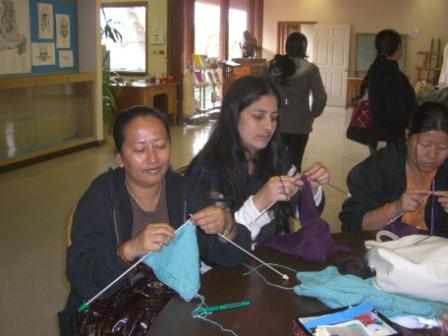
Once a week, men and women who want to make an extra income meet for a few hours of training. At the Pioneer Craft House they receive supervision by experts in the respective fields, and together they learn, talk and laugh. Many times the artisans bring in knitting work they’ve completed at home for a last check, or they ask questions about how to improve their craft.

The artisans have a supervisor to help improve their sewing and knitting. Photo by Emily Rodriguez-Vargas

This program also offers free entrepreneurial training at Salt Lake City Community College by a group of volunteers. The Global Artisans project can only accept a limited number of people at one time. Through these business courses, training by specialists and on-the-job help, the artisans are placed in the best position to know how a business works for the future.

Missy Larsen, a volunteer coordinator for Pathways, said the project helps to close the gap between other organizations and services. While there are various groups to support refugees, this specific opportunity not only helps them immediately, but also gives them long-lasting business knowledge and skills they can apply to supporting themselves later on.

Larsen said she first got involved in helping refugees when she supervised a service project for youth. But it turned into something she couldn’t walk away from.

Photo courtesy of Wanda Gayle

“There are so many needs a refugee family has, from finding a job to needing to drive to appointments,” Larsen said. This program directly helps them to succeed and make some money to live on.

Ze Min Xiao, refugee services liaison for Salt Lake County, is a volunteer and one of the driving forces behind Pathways. She advocates helping refugees in Salt Lake City to become self-reliant, which she said is a great step forward. With the support from American Express in providing a grant for the market goods, the artisans can take home their profit, with only 10 percent of the proceeds going to cover overhead costs.

“We volunteer,” Xiao said of those who make Global Artisans happen. “We don’t keep a penny.”

Xiao explained how getting a job and being able to successfully integrate into the community is especially challenging for refugees. Learning to live in a new country can create emotional stress and people often encounter financial difficulties if they cannot find work because of language barriers.

Participants are working on necklaces, pillow cases and jewelry. Photo by Emily Rodriguez-Vargas

Laxmi Timsina, 23, makes necklaces and bracelets. She’s also trying her hand at sewing artwork on pillowcases. She has been involved with Global Artisans since she arrived from a refugee camp in Nepal in 2009. She was practically raised in a refugee camp, she said, after her family left Bhutan because they were Hindu under a Moslem ruler. Although she already learned to speak English in the camps, she said it’s particularly difficult to find a job as a refugee. This is especially unsettling when working against a deadline.

“The government helps us for six months, but after that we are on our own,” she said. Although money is tight, she hopes that other family members can join her here in Utah soon.

Her friend Nirmala Kattel, 22, is also involved with making jewelry for Global Artisans. A Bhutanese herself, she said her family was forced to go against their religious beliefs when the King had Hindus persecuted. They then stayed in Nepalese refugee camps, where she spent most of her life. Kattel said it was a challenge to acclimate to life in Utah, especially in the first months. She lives with her husband and in-laws, and she is still getting used to the greasy and sweet American food.

“It takes time,” Xiao said. “Refugees have to learn English and learn how to operate in a new society.” That is where Global Artisans steps in to help out.  The services teach those seeking an extra source of income to work for it and benefit from the promotion of the program. They also learn to start a business, Xiao said. “It’s all about empowering others.”

Common octopus is anything but

Story and slideshow by KEITH R. ARANEO-YOWELL

Go to any Asian food market in Salt Lake City, and you will likely find bags of deep, blood-red flesh packed in ice. Go to any sushi restaurant and you’re likely to see on the sashimi or nigiri menu an item called “tako” (pronounced like the Mexican “taco”). Buy or order it for the first time and you’ll likely change any previously held beliefs about octopus.

Long considered a delicacy in Mediterranean and Asian (especially Japanese) cuisine, octopus is thought of by many to be prohibitively tough to prepare and chew.

“It’s rubbery, hard to bite and it doesn’t break apart very easily, even when it’s fully cooked,” said George Mateo, a visitor to the Living Planet Aquarium in Sandy.

Still, others wouldn’t hesitate to try it. Mason Childs, 21, works as a server at Market Street Grill. He said, “If it was on our menu at work I would probably try it once or twice.”

Splendidtable.com contributor Mark Bittman writes, “If octopus is properly handled, without fuss, it is reasonably tender. It remains chewy, but so does lobster, or sirloin steak.”

Home cooks can reduce the rubbery texture of octopus using a number of different strategies.  These range from the unusual Italian method of boiling it with wine corks to the brutish, yet obvious, method of beating it against rocks.

Bittman wrote even though these methods are effective, the key to eliminating most of the toughness is slow cooking time at very low temperatures.

Sue Kim, the owner of the Oriental Food Market at 667 S. 700 East in Salt Lake City, said she probably only sells one bag containing four tentacles and the head of an adult common octopus every day on average.

Kim attributes the relatively low rate of sales to the “rubbery” label attached to octopus meat as well as its alien appearance, and at $24.99 per bag, and similar pricing in restaurants around town, it’s considered a delicacy and not a staple.

Nina Clark, 23, is an exercise and sports science major at the University of Utah who said she hopes to pursue a career in public health education. She said octopus is an uncommon dish in Utah because there’s no coast. “We’re not exposed to it,” Clark said. “We’re land-locked.”

Childs said he could see why some people would be hesitant to eat octopus. “They’re scary creatures. To think they can open a mason jar without hands and do it while sitting on top of it. They’re pretty violent in the ocean.”

Others hesitate because of the octopus’ unusual appearance. Lacy Mateo, 20, who was visiting the Living Planet Aquarium with her husband, George, said she would never eat octopus because of the suction cups. Clark expressed similar reservations because of the fluidity of octopus movement.

With a single bulbous sack (or mantle) housing all their internal organs, surrounded by eight suction cup-covered arms and skin that looks like it’s been dead for a number of decades along with its reputation for rubberiness, it’s no wonder Clark and the Mateos find the look of the meat “gross.”

For all their physical irregularities, however, John Lambert, aquarist at the Monterey Bay Aquarium, said they pale in comparison to the strange behaviors he observes on a daily basis.

They can change the color and texture of their skin in a blink of an eye to avoid detection from predators. An article that appeared in Advanced Aquarists Online Magazine described the mimic octopus, which reproduces the rough appearance and movement of more than 15 different marine species native to its habitat of tropical Southeast Asia.

While feeding cancer crabs to the Giant Pacific Octopi at the California aquarium, Lambert, 52, and Aquarium Communications Director Ken Peterson, 61, described the difficulty associated with keeping their two Giant Pacific Octopi, Nano and November.

“There was an institution that was losing fish out of one of its tanks,” Lambert said. “They set up a camera over night and discovered that an octopus in an adjacent tank was crawling out at night, making its way over to the tank the fish were in, and helping itself and then returning to its own exhibit.”

Peterson later added that it had actually happened at the Monterey Bay Aquarium.

Because of the octopi’s desire to explore outside their enclosures, all outer edges of the octopus habitats are lined with Astroturf, which “prevents the octopus from being able to get a grip on it with their suction cups,” Peterson said.

Despite anecdotes of rather adventurous octopi, they spend most of their time in small crevices between rocks on the sea floor and are, therefore, extremely hard to fish. A fisherman for Monterey Fish Co Inc., who wished only to be called Dane, said just shrimp-trapping boats in Monterey regularly catch octopus.

Because the only hard structure in their bodies is a small parrot-like beak where all its tentacles converge, octopi can fit through the extremely small holes in shrimp traps. Lambert also said octopi are apt problem solvers and shrimping traps don’t really pose a challenge.

“They’re certainly very intelligent animals,” Lambert said. “[Researchers] put an item in a jar with a screw lid and the octopus can figure out how to unscrew the lid and get to the item. The first time they see it, it will be a challenge, but they work at it. They’re very tenacious animals.”

Their intelligence and ability to deform their bodies causes problems for shrimping boats in Monterey. Dane said, “Octopi will crawl into the traps and eat the shrimp.”

Shrimpers in Monterey lose an indeterminable amount of money each year due to octopus. According to the California Department of Fish and Game’s 2010-2011 Ocean Sport Fishing Regulations, octopi can only be caught and kept if line or hand-caught.

“[Shrimpers] usually throw [octopi] back,” Dane said. One shrimper who doesn’t always follow regulations said, “If I’m going to lose my catch, I at least want to sell the thing that cost me my paycheck.” For obvious reasons, this fisherman asked that he and his boat not be identified.

With the exception of when fishermen actually bring in an octopus, it is very difficult to find restaurants in Monterey that serve octopus. This is partly due to the aquarium’s decade-long effort to raise awareness across the U.S. about common fishing practices.

The Monterey Bay Aquarium publishes reports on commonly eaten seafood items. According to the 2008 report for common octopus (the species that is sold for food), most of what is sourced for use in the American sushi industry is sold as common octopus, even if it is of a different species.

Kim said she orders the octopus in her store from a Japanese fishery.

According to the report, Kim’s octopus comes from either Morocco or Thailand where the preferred method of octopus fishing is a practice called bottom trawling, in which boats drag fishing nets along the sea floor.

Octopus distributors in Japan also work with fisheries in Spain that catch octopus in pots, which is an artificial habitat perfectly suited to octopus. These pots lie on the sea floor for two to three days before fishermen reel them back in to collect the octopi.

In either case, after it is caught, it is blanched and shipped to Japan to be prepared for sushi by removing the beak, the poison and ink glands, the eyes and the internal organs. It is then frozen and re-exported to the U.S.

Monterey Bay Aquarium’s Seafood Watch Program assesses the ecological sustainability as well as the safety of eating seafood items commonly found in U.S. fish markets. According to the report, “due to the difficulty associated with discerning the actual country of origin of octopus found in US sushi restaurants, [octopus] should be avoided as a general rule. While Spanish octopus (especially pot-caught) is a preferred alternative to North African and Vietnamese octopus, it is rare that sufficient sourcing information is available to the consumer.”

The report, however, does little to address the adverse health effects of heavy metals that continue to build in species moving up the food chain.

In their report titled, “Bioaccumulation of Lead, Calcium and Strontium and Their Relationships in the Octopus vulgaris,” researchers Sonia Seixas and Graham Pierce found that “aquatic animals take up and accumulate lead from water, sediment and food.”

Because there is no way to rid tissue of lead by natural means, Seixas and Pierce observed “concentrations higher than the maximum legally permitted concentration of lead in food.”

Being conscious of how food gets to the dinner plate is a crucial element in public health, exercise and sports science major Nina Clark said. “That’s a big reason I try to avoid seafood in general. I’m aware of the patterns of how fish is shipped, exported and re-exported.”

Market Street server Mason Childs said the surprise he felt learning how octopus gets to the dinner table in a land-locked region illuminates a good deal about his previously held beliefs about seafood and sustainability. At the end of the interview, he asked for a copy of Seafood Watch.

“Eating is one of the most intimate things humans do,” Clark said. “It’s crucial that we educate ourselves on the repercussions of our choices.”

Truthfulness, compassion, tolerance: How Falun Gong saved a life

by KEITH R. ARANEO-YOWELL

Lang-hao Lin shifted uncomfortably in her seat when she flipped to the page in a Falun Gong history book with an image of a young girl bound to a chair with rope, and surgical tubing going into her bloody nostril.

“This is similar to what happened to me,” Lin said. “They put some kind of medicine into the thing they force-feed you. After feeding, you’re in semi-consciousness, dreaming all day, you’re not clear-minded anymore.”

Lin, who asked that her real name not be used, was referring to the treatment she received while serving a two-and-a-half-year sentence in a forced labor camp in Shanghai, China. Her crime was practicing Falun Gong or Falun Dafa, a philosophy that holds tolerance, compassion and honesty as its three pillars of spirituality.

“It’s not a religion,” Lin said. “It’s culture generated from the 5,000-year-old Chinese history.”

Started in 1992 by Li Hongzhi, Falun Gong draws from Buddhist and Taoist principles of self-improvement without the worship of a deity. It emphasizes qigong, a meditative practice that uses slow movements and controlled breathing as a way of spiritual enrichment.

Hongzhi’s book, “Falun Gong,” teaches the physical and spiritual aspects as well as how to meditate. Practitioners begin by assuming four standing meditation positions and one final sitting position. The legs and torso remain static while the hands move slowly around the body in ways that “mix and merge the universe’s energy with the energy inside the body.”

In this way, many practitioners believe that the ritual has powerful supernatural healing capabilities.

Because of the changes she perceived in those around her, Lin, 37 started attending Falun Gong meditation in Shanghai in 1997.

“I witnessed with my own eyes so many people getting healthy bodies by just doing [Falun Gong] exercises,” Lin said. “Before, they even had cancer. It was like a miracle happening around me.”

Lin said the practice grew rapidly because of its simplicity and effectiveness and, while there is no official entity monitoring the number of practitioners, the Congressional Research Service’s report titled “China and Falun Gong” estimates the number of practitioners during the mid-1990s to be anywhere from 3 million to 70 million.

Despite its wide adoption in Chinese society, however, the Chinese government made the practice of Falun Gong illegal in July 1999.

Roger Tsai is an attorney for Parsons, Behle & Latimer who would later help Lin attain status as a political asylee. He said the Chinese government felt threatened by Falun Gong’s popularity.

“[The Chinese Communist Party] was worried about how popular Falun Gong was,” Tsai said. “At one point the size of this group was larger than the size of the communist party, so it was a potential challenge.”

A government official was later quoted in print and broadcast for the Xinhua News Agency (a Chinese news outlet) as saying, “Those who jeopardize social stability under the pretext of practicing any qigong will be dealt with according to the law.”

Even though there is no official record of the number of arrests for practicing Falun Gong, the Wall Street Journal reported in 2000 that more than 30,000 practitioners had been arrested in the first year of the Chinese government’s ban of the practice.

Lin was pregnant with her daughter and working in Shanghai when Falun Gong was made illegal. She continued to openly attend Falun Gong meditation even though she had heard stories of the Chinese government sending practitioners to prisons and labor camps. “I was scared,” Lin said. “I did not want to be persecuted, but I did not stop.”

In 2001, Chinese authorities found Lin at her work. “At first, I was not [arrested] because I had a baby, and they gave me a one-year nursing period,” Lin said. “They told me, if after one year [I did] not denounce Falun Gong, they would send me to a labor camp.”

After receiving threats from the government and hearing accounts of life in labor camps, she decided she had no choice.

Lin went into hiding for a year in Nanjing, a city roughly 200 miles northwest of Shanghai. “My husband and my daughter didn’t know where I was. I dared not go out. After one year,” Lin said, “I missed home so much, I made one phone call to my husband. I told him where we could meet, but when I went, there were police waiting already. I didn’t even get to see [him].” Lin believes her husband’s phone was tapped.

Lin would spend the next two-and-a-half years in a forced labor camp assembling American products, a task she said was assigned to her because she could read English. She slept on a plank of wood. She was not allowed to talk. She shared a single toilet and a cell the size of two standard parking spaces with up to 10 other women.

For 10 days, Lin did not eat or drink water as a way of protest. “If you refuse to eat or drink, they use a tube to force-feed you,” Lin said stoically. “It’s not to save your life, it’s for punishment.”

Had Lin simply signed a document renouncing Falun Gong, authorities would have allowed her to go free. She said she couldn’t do it because it goes against the truthfulness that Falun Gong holds paramount over suffering. “It isn’t true, so I couldn’t do it,” Lin said.

After her release from the labor camp in 2005, Lin was only able to continue her Falun Gong practice in secret because the Chinese government continued to monitor her activity. Lin was unable to attend public meetings, protests, rallies or Falun Gong meditation.

Reprieve came only in 2008, when Lin’s husband accepted The University of Utah’s offer to study for one year as a visiting scholar. Her husband left China while Lin and her daughter acquired passports and visas to stay in the United States for the rest of his time at the University of Utah.

After a few months of talking with her husband about staying in the U.S., Lin approached Roger Tsai to obtain status as a political asylee, which would grant her one year of legal residence in the U.S. With Tsai’s help, she submitted her case for political asylum to the U.S. Department of Homeland Security’s office of U.S. Citizenship and Immigration Services in 2009. Two months later, she and her family were allowed an extra year in the United States after her husband’s visiting scholarship ended in August 2009.

Lin still studies Falun Gong year round. Once a week, she and a group of other practitioners meet in Salt Lake City’s Liberty Park during the spring and summer, and with one of the elderly practitioners at a nursing home on 700 East during the rest of the year. Robin, who asked that his full name not be used, practices Falun Gong with the group of other adherents at the park. He said Falun Gong does not advertise and is open to anyone who wishes to participate.

When Lin and her family became political asylees, they became eligible to apply for permanent residency in the U.S. Tsai assisted in this process and Lin and her family submitted the paperwork in March 2010. They are still waiting to find out if they’ll be able to stay in Utah indefinitely.

Japanese Americans still face racial prejudice in Utah

by EMILY RODRIGUEZ-VARGAS

Most wars are fought overseas, far away from the Utah desert where during World War II a Japanese American internment camp was located.

Another fight, however, is still silently taking its toll on citizens waiting for justice, no matter their race.

Koki Omura, a graduate student at the University of Utah, hopes to become a professional musician. Photo courtesy of Omura.

Koki Omura, a Japanese graduate student in music performance at the University of Utah, went without dinner one night because a waitress in Wyoming refused to take his order, let alone serve him.

Omura said he experienced some acts of prejudice and teasing about his accent while growing up in New Jersey, but the experience of being ignored completely was a first.

“Outside of school, things happen,” said Omura, who is from Tokyo. “The countryside and small villages that haven’t seen an Asian before are the worst.” An avid tuba player, Omura left his home country behind to pursue his dream of becoming a professional musician.

America has a history of discrimination against Asian-Americans that peaked following Pearl Harbor.

Executive Order 9066 was signed by President Franklin Roosevelt on Feb. 19, 1942. The decree forced 120,000 individuals of Japanese heritage from their homes along the Pacific Coast into prisoner camps in the Intermountain West between 1942 and 1945, for the fear they could be loyal to Japan. The years of the internment represent a time Japanese-American citizens want to forget.

Ann Takasaki, a resident of Spanish Fork, Utah, said her family was given two weeks’ notice after this order to get rid of all belongings that didn’t fit in two suitcases, and to leave their home in Santa Anita, Calif., with no prospect of returning.

“They boarded a train from San Francisco for the Heart Mountain internment camp in Wyoming without any property, money or work to look forward to,” Takasaki said.

In these camps, individuals and families were kept together by strict camp rules, high fences and aggressive security officers who were not afraid to use their firearms. Living in difficult conditions, these individuals were cut off from the world as they knew it. When these prisoners were released after two or three years in the camps, they had to start over and re build their lives from nothing.

Compensation for this discrimination toward Japanese citizens was not offered until the 1980s, when each prisoner received $10,000 from the U.S. government as restitution for the imprisonment. Today, the Day of Remembrance on Feb. 19 serves as recognition of the suffering of Japanese Americans at Utah’s Topaz and other camps throughout the West.

In the attempt to return to their homes, many families took the train as far as they could afford in one day, and then stopped to work in smaller villages so they could earn enough money for their next train ticket. Takasaki’s family tried to return to California, but, as many Japanese families in the same circumstances, they ended up finding work on a produce farm in Utah.

The Nishimoto family also resettled in Utah after they were released from Heart Mountain. Joanie Nishimoto, who lives in Heber City, Utah, said the camp’s treatment of her family was severe.

“The prisoners in the barracks were fed the same thing every day: potatoes and corned beef with sweet rice, just anything but Japanese food,” Nishimoto said.

She said the current prejudice against Japanese Americans isn’t anything like what it was at that time. But it will still take significant cultural mixing to fight the prejudices, because she said Utahns have a tendency to stay with their own groups. As the only Japanese student in her high school in Jerome, Idaho, Nishimoto said, “I was pretty enough to be Homecoming Queen, but not a date.”

Despite the years that have passed since these camps existed, Utah still has a long way to go in cultural reform. Paul Fisk, 28, co-president of the Salt Lake City Chapter of the Japanese American Citizens League, said there are still incidents of discrimination and inappropriate stereotyping of Asian ethnic groups in our neighborhoods.

Wesley Sasaki-Uemura, an associate professor of history at the U, said Japanese Americans learned from the internment “not to suffer injustices silently and obediently.” He believes it’s important to speak out, regardless of which racial or ethnic group is being discriminated against.

“One needs to see the parallels with the treatment of other groups,” he said, “and one needs to do what one can to address inequities.”

Affirmative action is debated at Utah 2010 general session

Story and photo by ANDREAS RIVERA

In 1969, President Lyndon B. Johnson signed into law an executive order that stipulated employers must “take affirmative action to ensure that applicants are employed, and that employees are treated during employment, without regard to their race, color, religion, sex or national origin.” Other laws, policies and initiatives like this were meant to give minority populations equal opportunities in employment and education. These polices are known as affirmative action.

Some lawmakers in Utah say that these policies have served their purpose and need to go.

H.J.R. 24, which was introduced in the 2010 General Session, states that it shall “prohibit the State, public institutions of higher education, and political subdivisions from discriminating against or granting preferential treatment to any individual or group on the basis of race, sex, color, ethnicity, or national origin with respect to public employment, public education, or public contracting; and provide exceptions.”

The 2010 Legislature debated the need for affirmative action.

The bill’s aim is to remove past affirmative action laws concerning public-sector establishments such as government and education. Proponents of the bill want candidates for employment or education given opportunities based on merit and not race, gender, or national origin. Republican Rep. Curtis Oda of Davis County is the chief sponsor of the bill.

“There is a difference between a hand-up and a handout,” Oda said. “If an employer is hiring and they have three or four candidates, shouldn’t they hire the most qualified candidate?”

To his surprise, Oda, who is of Asian descent, has been criticized by the Japanese community.

“If anyone should be embracing this bill, I would think it would be the Japanese,” Oda said.

The Japanese have a work ethic that drives them, he said. “After the internment of Japanese during World War II, the Japanese did not openly call themselves victims, they overcame the stigma.”

He added later, “You can not fight discrimination with more discrimination, that’s hypocritical.”

The bill would still protect people against discrimination, something that is human nature, he said. The bill’s goal is to put people’s value in their merit, not their minority group.

If someone suspects they were turned down because of their ethnicity even though they were the best qualified person, they could report it, but only because they believe it was racism that prevented them from getting the job, Oda said.

He said religion was not included in the bill because religion is a choice.

However, many oppose the bill and think there will be negative repercussions.

Roger Tsai, an attorney for Parsons, Behle & Latimer who sits on the board of directors of the Utah Asian Chamber of Commerce, said he is concerned about diversity of the public sector.

He said the chamber has stated it is against the bill.

“It is important to recognize diversity, but it does not mean you have to have a rainbow,” Tsai said.

Tsai said The University of Utah’s goal is to diversify, but how can it when it cannot give any advantages to minority groups for attending?

Tsai is worried about what the bill will mean for minority groups at the U. He said he is not sure what it means for funding for these groups. “Is it discrimination to give these groups money?”

It is important to have diverse outlooks on campus because it actually benefits the white majority, Tsai said. Students will be competing in the global economy.

Brittney Vuong, a freshman who is first-generation Vietnamese, said she agrees with the bill. “Different skin color should not deserve special treatment,” Vuong said.

Michael McFall, the news editor for the Daily Utah Chronicle who is first-generation Chinese, said when affirmative action was proposed, it worked well, but it may not be necessary now.

Both Oda and Tsai asked the question: When will we know when we are all equal?

Oda said, “If you go looking for prejudice, you will find it.”

Tsai said, “What’s changed? Are we all on an equal playing field? We have come so far, women are attending college at a higher rate than men.”

The bill made it past the committee stages of legislation, but failed to gain support and did not get the required two-thirds majority to become a law.

Despite this, Oda said this will not be the end of the debate.

UACC strives to educate people about the organization

But outreach takes time, money

by KEITH R. ARANEO-YOWELL

The Utah Asian Chamber of Commerce (UACC) was founded “to foster Asian … small businesses with activities that result in a prosperous and economically healthy Asian community,” according to its online mission statement.

But, leaders in Salt Lake’s Asian community say the city’s demographics — and current economic woes — make it difficult to reach out to prospective members.

Between 1990 and 2004, Utah’s Asian population nearly doubled in size, from 25,696 to 46,132. Still, Asians comprise only about 2.1 percent of the total population of 2.7 million and own only 1.5 percent of the businesses in Utah, according to the Utah Office of Ethnic Affairs and U. S. Census Bureau.

According to the UACC website, chamber membership can cost businesses between $100 and $1,000 per year, depending on the number of employees.

Most of the Asian-owned businesses in Salt Lake City’s 9th and 9th neighborhood would have to pay only $200 per year to maintain membership.

Despite the nominal cost, the owners of one Salt Lake City supermarket — who wished to remain nameless — wondered: Why spend marketing dollars on 2 percent of the population?

Other local entrepreneurs also said they had to weigh membership costs against the benefits it offers.

Sue Kim has been operating the Oriental Food Market at 667 S. 700 East for 37 years. Even though the chamber is around to benefit businesses like hers, she said she’s unsure membership will help more than the hard work she already invests in her business.

“I know such a thing exists,” Kim said in an interview, “but I don’t even know if the Asian Chamber of Commerce is actively working to help Asian businesses or not.” She added that Utah’s Asian community is so small, the chamber seems almost unnecessary.

Kim’s isn’t the only well-established business that hasn’t joined the chamber.

Linda Lin has owned and operated Big Ed’s, the beer bar-cum-hamburger joint across from the University of Utah, for 29 years.

“I don’t have time. I work too hard,” Lin said while preparing four different meals in a kitchen that can barely accommodate two people. “Most people are regulars who come every day. It’s very busy here all the time and I get very good business.”

She said the money and time UACC membership would cost her might detract from the hard work that keeps regulars in the stools.

Roger Tsai, an attorney with Parsons, Behle & Latimer and the former president of the Utah Asian Chamber of Commerce, said there isn’t a perceived need for an entity like the UACC because the lack of cultural diversity makes ethnicity almost a non-issue for people and businesses like Big Ed’s and the Oriental Food Market.

“[The Asian chamber] is primarily a shoestring organization that’s volunteer-run,” Tsai said in a phone interview. “Our outreach efforts have been purely by word of mouth through events that get media attention.”

Those events include the annual scholarship and awards gala, which recognizes outstanding Asian business owners and celebrates young leaders in the area. On April 2, 2011, 10 scholarships were awarded.

Tsai believes the online membership directory does not adequately reflect the organization or its members, who must remember to add and update their own contact information.

When the chamber first started in 2005, he said a group of members assembled a directory of Korean businesses and families. But after five years, only 30 percent of the information was still relevant.

Also, the high turnover rate for new small businesses, not just those that are Asian-owned, makes it increasingly difficult to maintain an up-to-date directory. Tsai said even the Salt Lake Chamber of Commerce, which represents every business in Salt Lake City, has a 40 percent turnover rate for small businesses from year to year.

Robert Rendon said the number of entries in an online member directory is not a fair assessment of the health of an organization such as the UACC. Rendon, who serves on the advisory board for the UACC and is also a member of the board of directors for the Utah Hispanic Chamber of Commerce, said educating an entire ethnic community is a learning process that can take a number of years.

In a telephone interview, Rendon recalled the speed at which the Hispanic chamber was able to gain traction as a real benefit in the Hispanic community.

“If you look at the Hispanic chamber, they have a business directory with probably 300 members,” Rendon said. “But, they started in 1992.”

He also noted that the UACC does not have a full-time employee. “It really makes a difference,” Rendon said, “when you have someone working on your chamber full-time” and promoting it to the community.

UACC board member Raymond Uno believes the recent economic downturn has affected the chamber’s ability to attract members. “When people are struggling financially it’s really hard to get them to sacrifice money and time when they’re having a hard time just feeding the family,” said in a phone interview.

Aprirak Pruksirisumbut, 35, is the owner of Tasty Thai at 1302 S. 500 East. He hasn’t pursued membership with the chamber yet because his restaurant has only been open since 2009.

“It’s been very busy, so I don’t have time to become a member,” Pruksirisumbut said in an interview. He added that it is important for Asian-owned businesses to network and help each other build their clientele and that in the future he will probably put more thought into joining the UACC.

Networking is one reason to join the chamber. But Tsai said the cultural homogeneity and the relatively small Asian population in Utah are additional reasons for supporting the UACC.

“Something that almost every major business based in Utah knows, understands and is facing, is how do we make Utah a more diverse welcoming place? Not just for people who are minorities,” he said, “but for people coming from out of state who feel like Utah is different.”

Businesses make more money in a diverse marketplace of ideas, Tsai said. “So, it’s within the larger business community’s interest to foster a vibrant minority community, because at the end of the day, that’s what every other major city has.” Membership in the chamber is just one of the ways businesses can foster diversity.

Pacific Citizen surviving times of declining traditional media

Story and photo by Andreas Rivera

The Pacific Citizen exists both online and in a monthly print edition.

In September 1929, a small, Asian-run newspaper was first published in San Francisco and has been in print ever since.

Today, The Pacific Citizen is now available both in print and online, and in these times of declining print media, it is still finding ways to connect with its audience.

The PC was started by the Japanese American Citizens League; members have a subscription to the print version of the newspaper that is published and mailed all over the country.

Jeff Itami, a member of the Pacific Citizen’s editorial board,  said the economic problem has affected the paper like any other business. The PC has had to cut operating costs and do some fundraising. According to the PC’s Web site, only six staff members publish the paper, not including contributors.

Even though the paper is part of the JACL, the PC covers a broad variety of issues such as Asian news, profiles of famous Asian Americans and pieces about historical events. It also has no cultural affiliation, meaning its content is not exclusive to Japanese, but to all Asian Americans, said Paul Fisk, co-president of the JACL chapter in Salt Lake City. “It brings a lot of news coverage others don’t.”

Itami said the print version of the Pacific Citizen is declining in circulation. Fisk said membership is steadily declining to the JACL, which could mean declining subscriptions to the PC.

“A lot of our key members are older,” Fisk said. “They are passing away and not a lot of new members are joining.”

About 30,000 people subscribe to the print version, Fisk said, some of whom were Japanese-Americans who were held at internment camps during World War II.

Other reasons for decline in membership are the many splits the JACL experiences due to its stances on certain issues in the media.

Fisk said the JACL lost members during World War II due to its lack of vocalization and action while Japanese-Americans were being interned in camps.

Another, more recent event, occurred when 1st Lt. Ehren Watada, was discharged from the U.S. Marine Corps because of his vocal opposition and refusal to take part in the war in Iraq. The JACL supported Watada, while many members thought it was not relevant to them, creating another split in membership, Fisk said.

The number of print subscriptions the PC has does not reflect its reach, Itami said. The paper is focusing on expanding its online popularity.

Despite the decline of the print version of the paper, Itami said the PC is reaching out to a younger audience. Recently the PC reformatted to a magazine format to appeal to younger readers.

“We are connecting to a younger audience through blogging, MySpace, Facebook, and YouTube, bringing that traffic to the PC,” Itami said. “Traffic is only going up,”

According to the PC’s Web site, it receives about 450,000 hits per month.

Itami said he is not worried about the PC’s financial future. The PC’s advertising revenue (which accounts for 50 percent of the paper’s income) is increasing.

“The PC is not a luxury,” Itami said, “it’s basic information we all need.”

Japanese, American or both?

by KEITH R. ARANEO-YOWELL

The Web site for the Utah Japanese-American Citizens League (JACL) is bad, and Salt Lake chapter’s co-president, Paul Fisk, recognizes this.

For an organization representing an entire group of Utahns, the Web site looks disorganized and messy at best. There isn’t a unified theme. The Salt Lake City chapter’s most current electronic newsletter is more than a year old. There are spelling and punctuation errors everywhere. The events calendar for 2010 is almost completely empty. Hollow text boxes dot the pages like tiny picture frames shouting to the world, “Hey! There’s nothing here!”

During a group interview with University of Utah students, Fisk, 27, explained the state of the Web site in these terms.

“One of the problems recently has been that because of declining membership rates, [the JACL] has cut back on some programs,” Fisk said. “It’s probably the same for maintaining the Web site.”

Floyd Mori, the JACL’s national executive director, said membership is on the decline for myriad reasons.

“The Nisei generation [second-generation Japanese Americans] is passing on rapidly with an average age near 90,” Mori said in an e-mail interview. “Also, young people do not see the direct issue of civil rights on an every day basis as before.”

Indeed, the FBI’s 2008 Hate Crime Statistics Table reported only 137 incidents of hate crimes against the broadly defined group of Asian/Pacific Islanders across the entire country.

“The JACL’s primary goal,” Fisk said, “is defending the civil rights of all Americans, particularly Japanese Americans.”

The most pressing civil rights issue currently on the Salt Lake chapter’s list is an offensive poster at a Winger’s Grill & Bar in Murray. The chain’s advertisement depicts a chicken with a Fu Manchu mustache and a Japanese flag headband with the caption, “We use only the finest oriental chickens in our oriental chicken salad.”

Decoration at a Winger's chain in Murray, Utah, advertising its Oriental chicken salad. The sign was subsequently removed. Photo courtesy of PAUL FISK

The JACL’s role doesn’t end at civil rights, though.

“It works to promote cultural, educational and social values of Japanese Americans, and preserve the heritage and legacy of the Japanese-American community,” Fisk explained. But as the lines separating Japanese from American begin to blur, the “Japanese-American” community will be ever more difficult to define.

Floyd Mori attributed this to the high cross-cultural marriage rate among Asian-Americans.

Noriko Okada is a Japanese citizen living in Salt Lake City who runs an English-Japanese translation service. She said it’s easier to classify herself as either American or Japanese and not necessarily Japanese-American. In an interview, Okada, 37, explained these definitions can change depending on the context of her experience.

“When I’m actually stating my opinions and doing what I want to do, I feel American, on the other hand when someone reminds me that I’m an immigrant, at that moment I become Japanese.”

Mori agreed there is no clear-cut definition of what makes a person of Japanese descent living in America a Japanese American. Nor does he know at what point that person ceases to be Japanese.

This nebulous definition of identity presents a problem. How does an organization preserve the Japanese-American experience, when there is seemingly no agreed-upon definition of Japanese American?

“The Japanese-American population’s high rate of cross-cultural marriage leads to the propensity for less association with the Japanese culture,” Mori said. “At the same time, there is a resurgence of younger people wanting to discover ‘who am I?’ The younger generations seem to be moving more towards identifying as an Asian-American rather than simply a Japanese-American.”

While the JACL does have difficulty defining the group for whom they advocate, they do see this as an opportunity for growth in a new direction on a national scale, Mori said. “The JACL must appeal to a broader base beyond the Japanese-American community.”

Looking ahead, Mori plans to change the structure of the JACL to rely more heavily on the skills of business and marketing professionals. “In the past and present, we have been governed by a board interested mostly in advocacy and community action. There will have to be a mix of community action and professional skills,” Mori said.

Mori said if the Utah chapters of the JACL want to mitigate declining numbers, they have some work to do.

“Membership takes aggressive recruitment. The local members have to be active in actually asking others to join,” Mori said. “If they ask, they will join because the JACL has a great tradition and has a lot to offer in terms of cultural activities as well as advocacy opportunities.”

Mori agreed that reassessing the Web site might be a good start.