Muriel Torrance loves her senior center

by James Williams

  • Hear Muriel Torrance describe some of her favorite activities offered at her senior center. (Slide show best viewed in full-screen mode.)

Seniors Dilice Marrell, Ethelyn Calober, Robert Cason and Lani Newhart play bridge at the senior center in Bountiful, Utah.

Many activities compete for a senior’s time. There are visits from grandchildren, appointments with doctors and for some seniors, employment responsibilities. With these, and several other commitments, and only 24 hours in a day, it can be difficult for seniors to decide what activities to participate in and what activities to skip. The Golden Years Senior Center in Bountiful, Utah is one place where seniors will find activities they do not want to skip.

“We have dancing, oil painting, wood carving, stained glass, exercise, and computer classes,” said Karen Henderson, director of the Bountiful center.
The center, which is located at 726 S. 100 East, is open Monday through Friday from 8 a.m. until 5 p.m. This senior center is for active people 60 and over looking to find friends, entertainment and have food, Henderson said. “The center is for active and healthy seniors,” she said. The center is becoming increasingly popular, and averages between 80 and 100 seniors every weekday.

Muriel Torrance is one senior who frequently attends the center. For her, the time she spends here is well worth it. While here, there are several activities she participates in, but the activity she looks forward to most is bingo.

“I come for bingo,” Torrance said. “We have bingo Monday and Wednesday.” She plays with about 18 other seniors for some interesting prizes, which add intrigue and variety to the common game. “On Monday, we get white elephants, you know, the stuff people have laying around their house that they don’t want any more,” Torrance said. On Wednesdays, each player pays $1 to play and receives a gift worth $1 for each bingo. “We’re not playing for money. We’re playing for goodies,” Torrance said. “We have fun doing that.”

Torrance, along with the other seniors, get excited for these prizes, but not as excited as they got when they were allowed to play for money. Participants used to receive used to receive 80 cents for each bingo, but the county forced the prize change when it was determined that the 80 cent prize violated the state’s gambling laws. Reluctantly, the center made the change. “They didn’t like that,” Henderson said.

One senior donated these books to the center's library after his wife passed away.

One reason Torrance loves bingo is that she used to be the bingo caller at the center.
For years, her voice echoed through the halls of the center, and was often followed by the shout of “bingo” by an excited senior, but she reluctantly gave up the position after a short stay in a local hospital. “I get too short of breath now,” Torrance said.

Although she doesn’t call bingo anymore, the ailment that has not kept her away from the activity she loves. She still plays bingo every Monday and Wednesday at the center, and she still gets excited when she gets bingo. “I love to win,” Torrance said.

While her days of calling bingo at the center are over, She does still call bingo once a month on a bus ride to Wendover, Nevada, which is a trip sponsored by the center. It is a trip that she looks forward to every month. “I go all the time,” She said.

While most of the activities offered at the center are free, the trip to Wendover does have a fee. “It costs $13 and you have to sign up early, because a lot of people like to go to Wendover,” Torrance said. The bus, which holds 44 people, is usually full every month. Playing bingo on the bus makes the drive more enjoyable, and gives seniors the opportunity to socialize with each other. “It gets us in the mood to gamble and gets us ready to win, I’m happy to call it,” Torrance said.

In addition to bingo, seniors on the bus receive a drink of either soda or water and some cookies. Once in Wendover, the fun begins. Everyone receives a free buffet at a Wendover casino, and $5, which Torrance says helps pay for the trip. “It’s a lot of fun,” she said.

Torrance’s other favorite activity at the center is the sing a long. “On Thursdays we have a sing a long,” she said. There is a band made up of seniors who play, while the other seniors sing songs. “We sing songs from way back. Not from this generation or the one before, but from World War II,” Torrance said. Those seniors who do not want to sing can dance to the music. “Some of our seniors really get into that,” Henderson said.

Torrance finds the dancing to physically grueling to participate in, but does love to watch those who dance. One group she watches is known around the center as the tapping grannies.

The tapping grannies are a group of eight senior women who tap dance every morning at the center. “They are fun to watch,” Torrance said. Torrance has never attempted to dance with them, but Henderson has. “I danced with them one day,” Henderson said. “I couldn’t even walk off the stage afterwards. I don’t know how they do it every day.”

Occasionally, Torrance expresses her creative side at the center during the silversmith and ceramics classes. “I don’t do it very often,” she said, but when she does, she has fun.

Her friends enjoy these classes too, and things they have all made some creative things in the past. “One senior made me earrings out of the trains on the Utah state quarter,” Henderson said. If a senior can think of it, making it is possible with the help of the instructors and the equipment. “All we have to do is provide our own material,” Torrance said. “The center provides the rest.”

Every day Torrance looks forward to lunch at the center with her friends. Because Torrance has diabetes, she frequently brings her own lunch from home, but that doesn’t stop her from enjoying herself. “I bring my own tea bag, and the they provide me with a cup of hot water, and I make my own tea,” she said.

Because this center receives money from the federal government, Torrance’s friends are asked to pay a $2.50 donation for their meal, which Torrance says most of them pay. “We talk and socialize as we eat, and have a good time,” she said. “It’s all voluntary, but if people don’t make donations, I don’t think this place would survive,” Torrance said.

Although most seniors donate money, some seniors donate more than that. One man who frequently attends the center donated a majority of the books in the center’s library. “His wife loved to read, and when she passed away he donated all of her books to us,” Henderson said.

Others, like Torrance, support the center by volunteering. “We have between 150 and 200 volunteers,” Henderson said. Torrance volunteers through bingo calling, while others, like Jim Hassett, volunteers through providing transportation. Although Jim is not a senior, he enjoys volunteering at the center. “My job is to pick people up, bring them here for lunch and bring them home afterwards,” he said. Hassett enjoys helping people, and has been volunteering at the center for a few years now. “We couldn’t function without our volunteers.” Henderson said.

Torrance is grateful for her senior center. “I try to come here every day,” she said.”I love the people here, I love being able to socialize, I love this place.” The few hours she spends are well worth her time. “We have a lot of fun here,” she said.

Seasonal flu still a priority for the elderly

Story and photos by Leigh Walsh

The H1N1 swine flu is making the headlines, but the seasonal flu is still the No. 1 concern among Utah’s aging population.

After months of media coverage and hype surrounding the H1N1 flu, the first batch of vaccinations has finally arrived in Utah.

Flu Sign

A flu shot advertisement stands outside a Smith's Pharmacy in Salt Lake City.

The Salt Lake Valley Health Department has announced this first shipment will be reserved for certain priority groups. However, a noticeable absentee from the high-risk group is the elderly population.

This age group is almost always a priority when the seasonal flu vaccines come out each year, so why not for the H1N1? According to the Centers for Disease Control and Prevention, people over the age of 65 are least likely to become sick from the H1N1 virus.

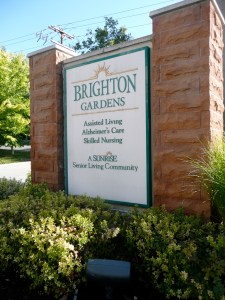
Linda McGraw, director of nursing at Brighton Gardens, a nursing care facility in Salt Lake, explains some of the theories behind why seniors may be less susceptible.

“There was a swine flu epidemic back in the 1970s when they did do some immunizations,” McGraw said. “Experts are thinking this particular group of the population probably got exposed to a certain degree, which built up their immune system. This may be why older people are not as susceptible to getting as sick with the H1N1 virus as the population in their 20s.”

The current media attention is being generated around H1N1, but the worry for the elderly should still be the annual seasonal flu. According to the CDC, 36,000 people die each year from flu-related causes; 200,000 more are hospitalized from flu-related complications. Ninety percent of flu-related deaths and more than half of flu-related hospitalizations occur in people age 65 and older.

The flu season usually runs from October through March, when the virus is at its most rampant. Different venues around the state are currently administering the seasonal flu vaccine. Smith’s Pharmacy on 455 S. 500 East began giving flu shots on Sept. 10.

Camille Sanders, a student pharmacist, said the majority of people they vaccinate at Smith’s are older adults.

“We are actually running out of our batches a bit quicker this year because many people are coming in to get their seasonal flu vaccine earlier,” Sanders said.

Some experts have recommended leaving some space between the H1N1 and seasonal flu vaccines. As of now only priority groups can be immunized against the H1N1. Therefore, older adults are coming in earlier for their seasonal flu shot.

“People want to be prepared for when the H1N1 vaccine is available to them,” Sanders said.

People who are immunized at Smith’s Pharmacy are educated on other preventative measures important to slow down the spread of disease.

“We explain to people the benefits of hand washing and other measures that are important in preventing people getting sick,” Sanders said. “We also hand out an information leaflet to people with any additional questions.”

Brighton Gardens

Residents at assisted living centers, like Brighton Gardens in Salt Lake City, are encouraged to get the seasonal flu vaccine.

The contagious nature of the flu makes it very important to thwart it early, especially in nursing-care facilities around the state. Just by looking around the walls at Brighton Gardens it is evident the flu season is upon us. There are warnings to visitors who may be ill to stay away and instructions about important preventative measures. This community is made up of people with compromised immune systems who are at high risk so it is important to have procedures in place in order to stop the spread of the flu.

McGraw said the epidemiological track system they have in place is to stop diseases spreading before they have a chance.

“We ask who is sick, when did they become symptomatic, what floor do they live on. We start washing and using Clorox to kill germs and extra housekeeping is brought in. We may even ask people not to come down to the dining area,” she said.

Statistics show the seasonal flu is still a major problem in society yet the H1N1 virus has caught the attention of the world. McGraw said this is because the H1N1 epidemic brought a level of panic upon the country because we knew so little about it.

“The sad thing about the H1N1 is that it kills young people who had a lovely quality of life,” McGraw said. “It was traumatic to see young people dying and this caused people to sit up and listen.”

Research shows 30 percent of all Americans over the age of 65 don’t get an annual flu vaccine. With the flu season upon us it is vital for people, particularly older adults, to get out and get immunized.

“People do die from seasonal flu, that is why we encourage everyone to be vaccinated,” McGraw said.

A sport for life

Story and photos by Leigh Walsh

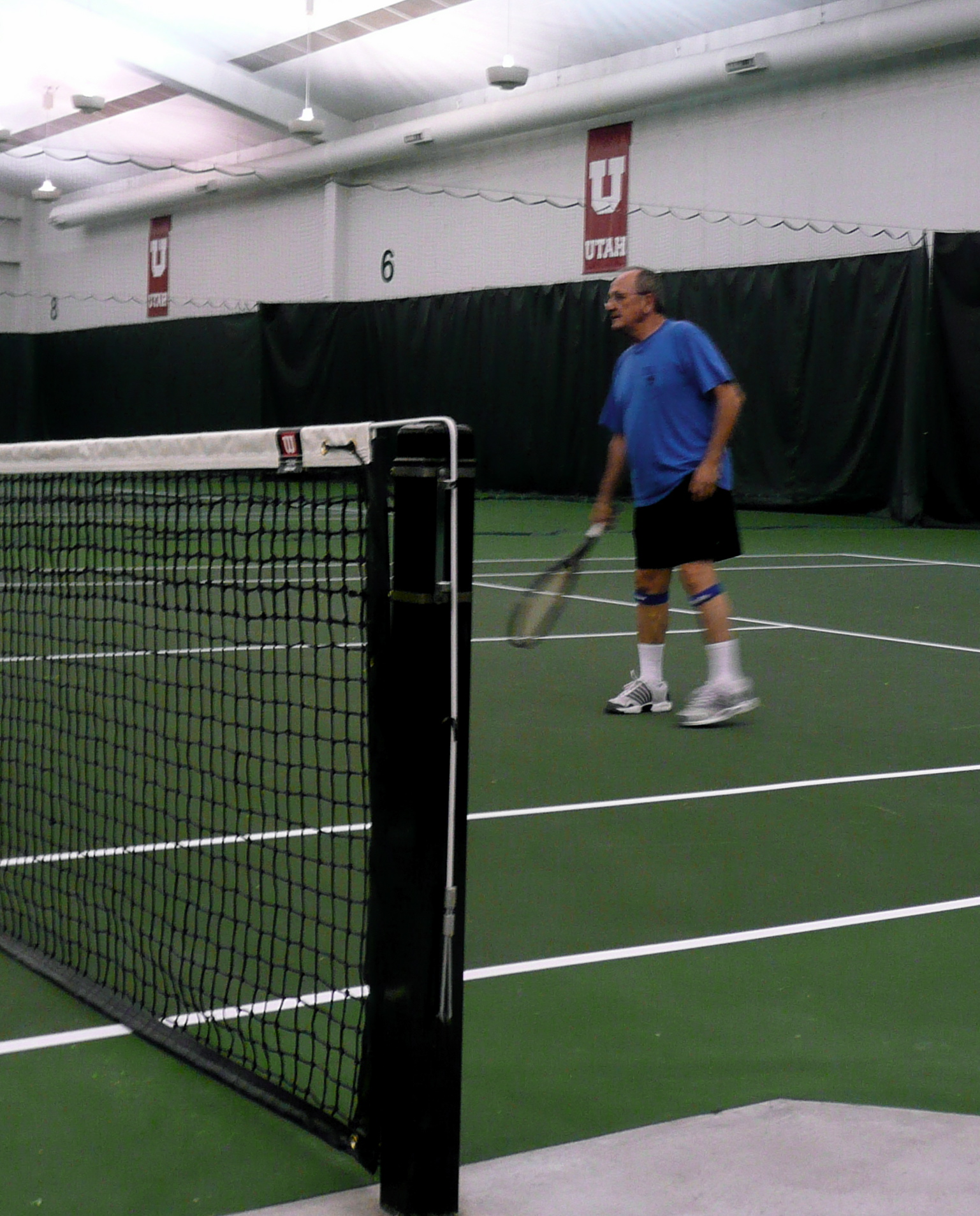
Raymond Haeckel, 73, is not one to sit back and let aging get the better of him. As he sits in the George S. Eccles Tennis Center in Salt Lake City, waiting for his practice partners to arrive, he reflects on the game of tennis and how it keeps him young.

“Tennis helps me age,” Haeckel said. “I feel my balance is better, I am more mobile and I can walk more briskly. Some people my age that don’t exercise have problems with simple tasks.”

Haeckel is determined to remain active and delay the inevitable aging process as long as possible. He credits his great quality of life and ability to be self-sufficient on his physically active lifestyle.

Raymond Haeckel, 73, prepares to return a shot during a tennis game at George S. Eccles Tennis Center.

Janet M. Shaw is an associate professor at the University of Utah who teaches courses specifically related to aging and exercise. Shaw said staying physically independent is an American ideal that we have as we get older.

“One of the goals of successful aging for most people is to be able to do things for themselves,” Shaw said.

Haeckel retired in 2002 from his job as the executive director of government, community and public relations at the University of Utah. At first he wasn’t too sure what he would do with all the hours in a day.

“I’m an anxious person. When I retired I didn’t have to deal with deadlines, and the fast tempo that I was used to had begun to slow down,” Haeckel said.

He knew he needed a plan, and one thing he was sure of was a portion of his time would be set aside to play some tennis.

Haeckel has made some lifelong friendships through the game of tennis. He meets with friends at least three times a week to play the sport they all share a common interest in. As Haeckel’s tennis buddies begin to stream in the door for today’s game, it is easy to see why he takes pleasure in these get-togethers.

Klaus Schmitt stands at the net during his doubles game at the George S. Eccles Tennis Center.

Klaus Schmitt has been playing tennis with Haeckel since the early 1960s. He shares Haeckel’s views on the role of tennis in his own life.

“Being physically active improves the quality of everything in my life,” he said.

Schmitt, a professor in mathematics, loves to travel but there is one catch: “I will travel everywhere as long as I can take my tennis racket with me,” Schmitt said with a smile.

Both men reflect on memories of playing on the old campus courts where the new biology building sits today.

“We used to play daily with our shirts off at high noon,” Haeckel recalled with a gleam in his eye.

Haeckel and Schmitt appear to be the exception and not the rule when it comes to older adults and exercise. Inactivity in the older adult population is a major problem today. According to the Centers for Disease Control and Prevention, the loss of strength and stamina attributed to aging is in part caused by reduced physical activity. By age 75, about one in three men and one in two women engage in no physical activity whatsoever.

Experts claim physical activity over the course of one’s life is of most benefit to an individual but it is never too late to start. Janet Shaw said physical activity is very important right now because there are lots of baby boomers in their early 60s who are still functional.

“Now is the time to capitalize on it and ask: How do I get into a routine of really helpful physical activity that I can continue as I get older?” Shaw said.

It can be difficult for older adults to begin exercise programs, especially when they haven’t been active for much of their lives. Recommendations can be made but the decision ultimately lies with the individual involved. Shaw emphasized the importance of enlisting help from a professional or a physically active friend for those people foreign to exercise.

“You have got to get people into it very slowly in a way that is very safe to them,” she said.

A major problem among the aging community is the increase in the number of fatalities due to falls. According to the CDC, in 2005, a total of 15,800 people aged 65 years and older died from injuries related to falls. An additional 1.8 million were treated in emergency departments for nonfatal injuries from falls.

According to the CDC, physical activity can be a good preventative measure to help limit the number of falls in older adults. Shaw recommends activities good for muscle strength and power in relation to helping balance.

“Catching oneself really requires that people be able to move quickly, and have a certain amount of strength to be able to hold up their own body weight,” Shaw said.

Haeckel and Schmitt are determined to postpone the aging process. “If I go two days without exercise I feel sluggish,” Haeckel said. “I enjoy having a good quality of life. I need one if I want to keep up with the grandkids,” he added.

The women they are playing tennis with find it funny Haeckel and Schmitt are being interviewed for an aging article. “You’re interviewing these two young guys?” they ask. Maybe they have a point. After all, you are only as old as you feel.

In search of a new life

Story and photos by Leigh Walsh

The transition into old age is an inevitable life experience that can be a daunting thought for many. However, the transition into a new life and culture presents Utah’s aging refugees with the most challenges.

As the American flag is raised outside Catholic Community Services in Salt Lake City, three Bhutanese refugees have begun their day’s work inside. Padma Dhungle, Tara Gautam and Krishne Adhikari, each over the age of 65, arrived in the U.S. in 2008 with little more than hope packed in their hearts.

The American flag stands outside Catholic Community Services in Salt Lake.

They had spent the last 17 years in a refugee camp in Nepal, hopeful they would be offered a second chance at life. Their prayers were answered when they were relocated through the United Nations High Commissioner for Refugees (UNHCR) resettlement program.

“We had the feeling of happiness when we heard we could come to the United States,” Dhungle said through an interpreter. “So far it has been good,” he added with a smile.

Catholic Community Services in Salt Lake brings in about 600 refugees each year. The organization does its utmost to make the transition as smooth as possible for each of the immigrants. Aden Batar, director of refugee resettlement and immigration at CCS, explained the main goal is to integrate refugees into the community and provide them with the tools necessary for them to become self-sufficient.

“We help them with case management, job placement, housing, health services and immigration,” Batar said.

Life can be tough for many of the refugees who are resettled in Utah. “Everything is foreign to them when they first arrive,” Batar said. “The weather, the people, the food. It is all different.”

Simple everyday tasks can present obstacles for the refugees. Refrigerators, toilets and ovens are basic concepts to many of us, but are unrecognizable to some immigrants.

These difficulties pose an even bigger challenge for older refugees. They have spent most of their lives surrounded by a culture they are both familiar and comfortable with.

“Country by country the religion and culture is different. It is important to adjust to the new life cultures and new traditions,” Dhungle said.

According to Batar, older refugees can feel isolated, particularly when family members go to work and school. “In the culture where they come from, every day they go to their neighborhood and everybody knows each other. They have people they can talk with,” he said. “I think they miss that socialization.”

Dhungle, Gautam and Adhikari have benefited from the fact they all embarked on this journey together. They have been united since they first entered the refugee camp in Nepal in the early 1990s.

Keshab Adhikari, a case manager at CCS, said it helped greatly that they arrived here with their families. This provided the refugees with some stability as the environment around them changed dramatically.

From left to right: Keshab Adhikari, Krishne Adhikari, Tara Gautam and Padma Dhungel.

The three older refugees are very appreciative of everything the CCS has done for them.

“Each day we learn new things,” Gautam said. “At first we were unsure where to go, who to talk to, how to travel. Day by day we are learning new things and adapting to life in the U.S.”

They each work with CCS and are responsible for various chores around the center. Keshab Adhikari explained they would be paid by the state because they are all part of Salt Lake County Aging Services.

Batar recognizes language as one of the biggest barriers to a successful transition into the community. Dhungle, Gautam and Adhikari speak Nepalese among themselves but they have not yet grasped English. “We take classes to learn English for one hour each night,” Adhikari said. The refugees are hoping to improve their English so everyday tasks, like going to the grocery store, become easier for them.

A smooth transition into a new community is integral to the success of CCS resettlement efforts. Batar said one of the keys to this is community acceptance. “The community here has been very receptive to the refugees,” he said. “We would not be able to bring as many refugees into the state otherwise.”

Many religious groups around Utah get involved with volunteer work and provide much-needed support to the older refugees when they first arrive. “The Salt Lake community has been excellent to us,” Dhungel said. “They are lovely people.”

Along with the voluntary effort from the community, CCS depends heavily on donations from local people.

“Donations are the main source of funding for our program,” Batar said. Monetary and in-kind donations are fundamental in giving the refugees the best help possible. “All the furniture, household items, clothing and children’s toys that are given to the refugees are donated by the community,” he added.

It is important for older refugees to have some stability around them as they adapt into a new culture. For many, their family is their rock, but others depend on their faith to get them through the hard times.

“We have a lot of diverse religious groups in the state of Utah so they easily find a place that they can worship freely,” Batar said. Many refugees have found comfort in practicing their beliefs without reprisal from other religious groups.

With the current wars in Iraq and Afghanistan, the civil unrest in Somalia and the human rights issues in Burma, many older people continue to be stranded in refugee camps around these areas. The community support for refugees is extremely important if the resettlement efforts are to continue.

The majority of refugees the CCS works with are younger children. However, Batar said many of the refugees coming from Bhutan are older adults. They are immigrating with their families and all their children are over the age of 18.

The UNHCR, a branch of the U.N. established in 1951, has assisted millions of refugees over the years, including Dhungle, Gautam and Adhikari. Camps were set up in Nepal in 1991 after the Bhutanese government attempted to implement a “one nation, one people” program. This campaign attempted to integrate the minority groups into mainstream society and it was met with backlash. Many people in Southern Bhutan were forced to flee as a result.

According to the UNHCR Web site, refugees have to move if they are to save their lives or preserve their freedom. “If other countries do not let them in, and do not help them once they are in, then they may be condemning them to death — or to an intolerable life in the shadows, without sustenance and without rights.”

The foundations of American culture are built on freedom and opportunity for all and the Salt Lake community has been very helpful to CCS in their resettlement efforts. There are numerous opportunities to help refugees who are living in overcrowded camps around the world. As Batar said, they are not just relocating for a better quality of life, they are fleeing their circumstances.

Dhungle, Gautam and Adhikari have reached a stage in their lives where stability is vital. They are not focusing on returning to Bhutan. In fact, they want to bring more family here. “We are trying to make Salt Lake our home. We will be living here for the rest of our lives,” Dhungel said.

The key to successful aging

by Leigh Walsh

Researchers say the social support network surrounding an older adult is a great predictor of their health status.

For many people, aging is seen as something that needs to be defeated. It is the enemy, and billions of dollars each year are spent on preventative measures to avoid it.

It may be hard to believe but the answers to successful aging may not lie in a bottle of anti-aging cream or in the hands of a plastic surgeon.

Many experts believe a simple companion you can confide in is a vital aspect of aging happily. Scott Wright, professor and director of gerontology at the University of Utah, echoes this opinion. “Social connections and the quality of relationships you can depend on are a key to aging,” Wright said.

Being physically active over the course of your life can also slow down the aging process. Wright said activities such as yoga and tai chi are very important for balance and coordination. Being physically active is a great preventative measure for certain illnesses and injuries.

Joseph Hansen, a 72-year-old retired accountant, credits his wife and his love of tennis for keeping him young.

“They both keep me on my toes,” said Hansen with a cheeky grin. “I found my soul-mate over 40 years ago and I am still as happy today as the day I met her.”

A recent study at the University of Rochester found that 7.6 million older adults feel the need for more social support in America. On hearing this statistic, which was published in the American Journal of Public Health, Hansen shook his head and sighed. He believes he is fortunate not to be one of these and he claims he would be lost without the support of those around him.

The researchers also examined the correlation between social support and health status in older adults. Their conclusion emphasized social support itself is an important feature of quality of life, and there is a need for social intervention among both healthy and ill older adult populations. Dependable relationships can make all the difference.

The ability to be independent is a value many Americans hold in very high regard. A common fear among the aging community is how their physical and mental well-being will change as they get older.

“I like to live in the present and not worry about the future,” Hansen said. “All I can do now is enjoy being healthy and being surrounded by fantastic support from family and friends. Who knows what can happen tomorrow?”

Why do almost 7.6 million older Americans feel they are lacking in social support? Is it our culture, or does the problem stem from multiple factors? Wright talked about areas of the world known as Blue Zones, where people live extraordinarily long and healthy lives.

Loma Linda, Calif., Sardinia, Italy, and Okinawa, Japan, are three of a handful of places that are considered Blue Zones. Researchers have not found one sole reason for the longevity of life in these regions of the world, but they have made some general observations.

The Blue Zones/AARP Vitality Project is sponsored by United Health Foundation. According to the Web site, there are six common factors among these places: no smoking, a plant-based diet, constant moderate physical activity, social engagement, legumes and at the top of their list: family. Blue Zone researchers claim family and a good social circle are great predictors of a healthy life.

Wright said 35,000 people reach the age of 65 every month in America and Utah has the fifth-largest population of elderly people. This “age tsunami” is causing major financial headaches for the government, which makes healthy aging as important now as it has ever been.

In the current economic climate, the generation of baby boomers is placing an extreme strain on Medicare and Social Security. If people are living a healthy lifestyle illness and injuries will be reduced, which will relieve the strain on government finances. The Social Security Administration recently stated that monthly Social Security and Supplemental Security Income benefits for more than 57 million Americans will not automatically increase in 2010. This will be the first year without an automatic Cost-of-Living Adjustment (COLA) since they went into effect in 1975.

This nation is getting older and statistics show the aging population will continue to rise. Researchers at the University of Richmond stated, “Our findings outline the benefits of future efforts to reduce social isolation and improve social health among this large and fastest-growing segment of the U.S. population.” The elderly community should not become society’s forgotten population.

Retired university professor looks past adversity

Story and photos by Jessica Gonzales

  • Meet Fred Buchanan, a retired University professor living with Parkinson’s disease.

In his soft yet prideful Scottish accent, Fred Buchanan recites a poem by memory written by his favorite poet, Robert Burns. As he tries to muster the simple words from his lips, he stops and pauses momentarily. He apologizes with a smile, says “Sorry, it’s my Parkinson’s,” as his hands moderately tremble from shaking. “You have your good days and you have your bad days sometimes.”

At 78, Buchanan is one of approximately one million Americans living with Parkinson’s disease, according to the Parkinson’s Disease Foundation. Sufferers of this neurological disease lack dopamine in the cortex section of their brains that affects basic motor skills. As a result, tremors, rigidness and slow movement are symptoms patients with Parkinson’s often experience. Currently, there is no cure for the disease, only medication or surgery to temporarily relieve and slow down the progression of symptoms.

Retired university Professor Fred Buchanan reads poetry in his home in Salt Lake City.

Buchanan was diagnosed in 1992 after his son noticed tremors in his hand at a concert. He saw a doctor who later diagnosed him with Parkinson’s disease during the same year.

“I was surprised,” he said. “I’m very fortunate to be able to do anything.”

With the help of taking a total of 18 pills, he is able to have around 10 hours of good movement throughout the day. But he still experiences symptoms in his daily routine. Shaking and stiffness have inhibited his movement and he largely has to rely on his wife to help him with simple tasks such as buttoning his collar and sleeves.

“I was independent before but now I’m dependent,” he said. “I just miss the freedom I had.”

Rama Buchanan, his wife of 46 years, takes care of her husband makes sure to help him when he’s struggling and remind him to take his medication. After seeing two of her family members go through Parkinson’s disease, she credits her love and patience to find strength with her husband’s situation.

“Families are forever,” she said. “We do a lot of things together and we help each other. You just take it one day at a time.”

Buchanan, who was born in Steventson, Scotland, moved to Salt Lake City in 1949 with his parents to be closer to family and the Church of Jesus Christ of Latter-day Saints. After serving a Mormon mission for two years in his native country, Buchanan returned to Salt Lake and was encouraged to attend the University of Utah by a family friend who was a professor there. The inspiration to learn became a pursuit he valued and as he said in a proud voice, “Scratch a Scot and find a scholar.”

After graduating from the University of Utah with bachelor’s and master’s degrees in history, Buchanan went to Ohio State University where he received his doctorate in 1967. In 1977, he became an associate professor in education studies at the University of Utah. He retired in 2003.

A published scholar and writer, Buchanan has written several academic books and chapters about Scotland and the history of education in Utah. “A Good Time Coming: Mormon Letters to Scotland” and “A History of Education in Utah” feature his academic work from research as a university professor.

Buchanan’s small library in the basement of his home is filled with his academic work, Scottish literature and religious publications that symbolize his love and appreciation for learning.

“I’m so curious about many things,” he said. “I’d like to be remembered as someone who appreciated creativity.”

Buchanan is currently conducting two more projects before his Parkinson’s

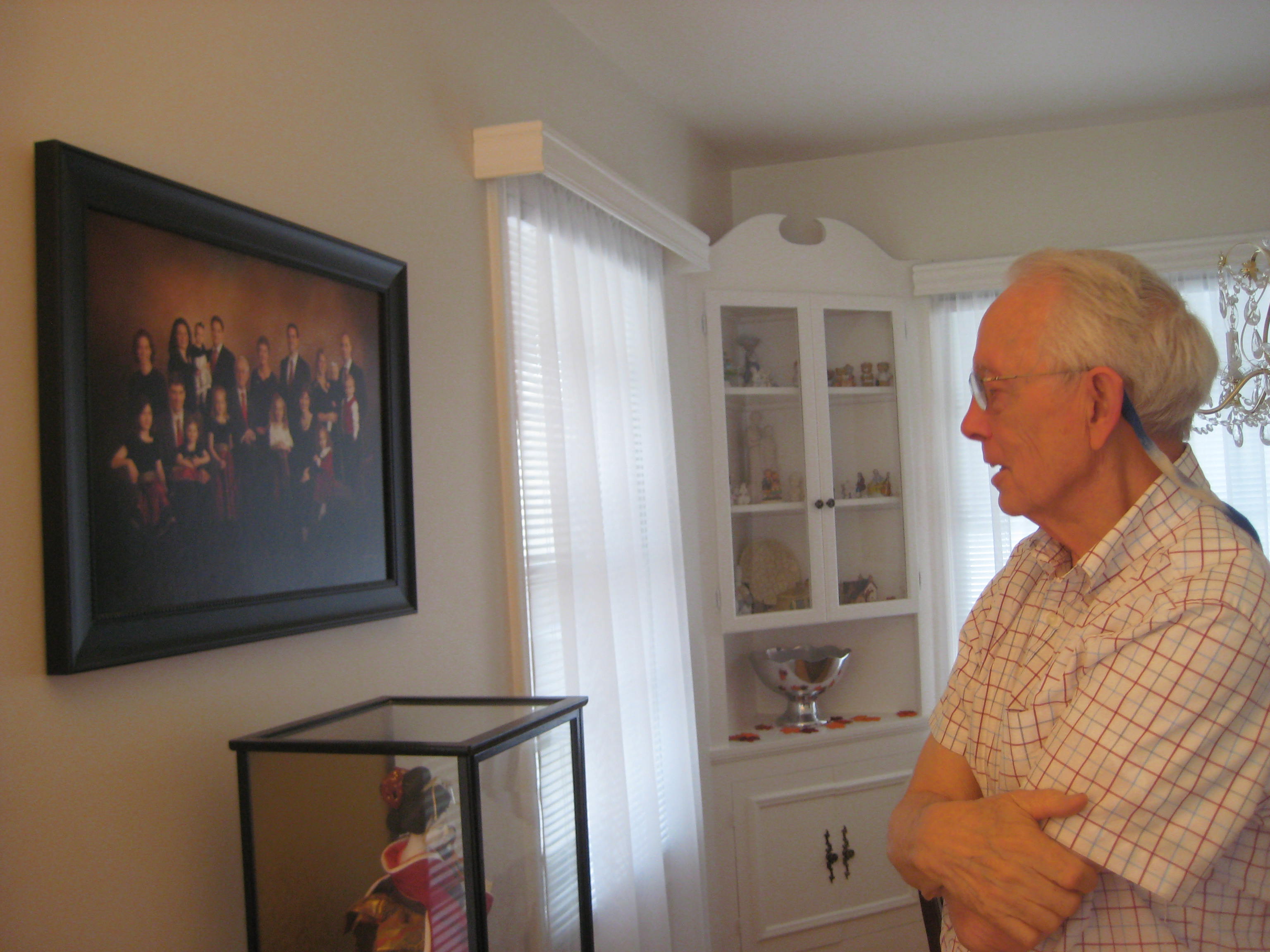
Fred Buchanan looks at a picture of his family, who he says has given him strength while suffering through Parkinson's disease.

begins to interfere more with his daily life. His first is to write a book about his wife’s family history that was central to Scottish immigration, primarily to Utah. His second project, with the help of his journal that he’s written in for the past 35 years, is an autobiography for his family and friends to remember him by.

“I like to think that something happens to you after you die,” he said.“But if not, this is what I will have left behind.”

Although his Parkinson’s is an obstacle, Buchanan said he wouldn’t let that get in the way of what he wants to do. With support of his family, friends and his faith, he says that he’ll be able to look past the complications the disease has given him.

“I don’t think God or nature gave it to me as a challenge,” Buchanan said. “But given that I have it, I look at it invariably, except for to take a nice nap in the afternoon.”

Seniors can take a chance on gambling

by Evan Frank

Donald Sindric has worked as a steam fitter for 32 years. Depending on the job, he works 12-hour days, six days a week. Sindric, 60, may be employed, but he also enjoys the thrill of gambling in the hope of hitting the big jackpot one day.

“It started with sports betting,” Sindric said.

Each football season, Sindric participates in several pools around work.
He also travels every year with his wife and in-laws from Wisconsin, where he has played in most of the casinos, to Minnesota and Iowa.

“We’ll go up along the Mississippi River and stop in Iowa to go river boat gambling,” Sindric said.

In total, Sindric believes they travel close to 900 miles for the entire trip.
When the state of Wisconsin did not allow lottery tickets, Sindric would travel to Illinois to purchase them.

“I do it for the enjoyment,” Sindric said. “I’m always hoping to hit it big.”

While he may not have won a six-figure jackpot, Sindric has won $10,000 on a $2 lottery ticket. He buys tickets five to seven days a week on average. Over the years, Sindric has lost track of how much money he has spent on lottery tickets and gambling games alike.

For older people like Sindric, gambling can be an enjoyable time. For others, it can be a dangerous habit that is uncontrollable.

In places such as Las Vegas and Atlantic City, gambling is the lifeblood of the community. In 2007, Nevada casinos earned $12.8 billion with slot machines and table games such as keno and bingo, with sports betting being prominent as well. According to the University of Las Vegas Center of Gaming Research, other games such as twenty-one, baccarat, craps, roulette and poker brought in more than $3 billion. Atlantic City is home to 11 casino resorts with three more currently under construction, and 33 million people on average visit each year.

According to the Arizona Office of Problem Gambling, researchers at Pennsylvania State College of Medicine and the University of Pennsylvania surveyed elderly people 65 years and older and found 70 percent had been involved with some kind of gambling in the past year.

Addiction comes in many forms from alcohol, drugs, food, to even gambling.
In 1980, the American Psychiatric Association accepted compulsive gambling as a disorder of impulse control.

The Council on Compulsive Gambling of New Jersey states compulsive gambling has three phases: winning, losing and desperation.

During the winning phase, the gambling wins help enhance a person’s ego and self-image. When a person loses, it is seen as bad luck.

As an older gambler begins to lose continually, they will borrow money to continue gambling in an attempt to break even. If the losing continues, they may go as far as selling their possessions or mortgaging their property.

“While the elderly gamble less than other age groups, the impact of gambling addiction may be more devastating as once savings are gone, that is it, they are not able to go back into the workforce,” said Keith Whyte, executive director of the National Council on Problem Gambling.

The National Council on Problem Gambling is a site dedicated to educating people about pathological gambling. The site has extensive information on the addiction itself and what a person can do to get better.

The Council on Compulsive Gambling states if an elderly person gets to the third stage, they may become obsessed with trying to cover their losses. Suicide can play a part if the addiction is not treated.

Bingo, according to Whyte, is the most popular game among seniors, with slots being a close second. Whyte said the amount of senior gamblers is not as much as other age groups, though.

Whyte said women tend to start gambling at an older age.

Phyllis Knudson, 74, has gambled since the casinos became prominent in Wisconsin during the late 1980s.

“I usually play the poker slot machines because you can make choices instead of just pushing a button,” Knudson said.

While casinos are a major attraction, they are not the only places to gamble. The track, which normally hosts dog and horse racing, has become a popular place for people to wager.

“Some of my friends asked me to come along on a gambling weekend,” Knudson said.

During the trip, she won $29 at the track, along with $79 at a casino they visited later on.

“Since then I have won some and lost some––enough to keep me coming back,” Knudson said. “But, it is strictly entertainment for me.”

Knudson said she knows when to stop. “If I am losing, I quit, and if I am winning, I still stop at a certain point so that I don’t lose what I have won,” she said.

Whyte said many seniors play for the social aspect of gambling, along with the exciting activity it may bring.

For a while, Sindric and his wife, along with their friends, would have a poker game once a month. He said the monthly games slowly stopped after the wives started talking more than playing.

“I don’t consider myself a gambler because I don’t do it for a living,” Sindric said.

Once he retires, he doesn’t see himself gambling any more than he does now. “I like to win,” Sindric said.

Wiis are for the young at heart

Story and photo by Kelli Coomes

Farrell Sorensen eagerly awaits the arrival of his great-granddaughters.

“What are we playing today?” the three girls ask in unison. Hallie, 8, Hannah, 6, and Hollie, 4, are spending the day with their great-grandparents.

“What do you want to play?” Farrell Sorensen asks.

“Baseball!”

“Tennis!”

“Bowling!”

“How about we play all three?” Farrell suggests. “We’ll take turns.”

His wife, Darla, comes in and sets up the only modern technology in the house that she’s figured out: the Nintendo Wii. Remotes get handed around and the games begin.

The four run around the room, squeals coming from the girls and laughter from Farrell. A whirlwind of motion continues for most of the day, stopping only long enough to change games and players. As more family come to visit, teenagers and adults take turns playing with the grandparents and the girls.

The children tire before the Sorensens are done playing.

“They used to be too shy to talk to us,” Darla said. “We’re too old, we make them nervous. But now they come over all the time and love to spend time with us.”

There is a computer in the house, but they have a hard time figuring out how to use it. Their grandson, Jason Sorensen, 29, has been over many times to teach and re-teach them how to use the Internet, e-mails and how to save the photos they take. They can work the TVs and the radio, but that’s about it. They’ve broken three karaoke machines so far.

“They’re fine until they press buttons or try to explore on their own,” Jason said. “It’s the joke in the family to not let them touch electronics.”

But Farrell, 86, and Darla, 84 have found a way to bridge the age differences in their family. The Wii has brought five generations together under their roof.

“Now they all come to us,” Farrell said with a smile. “Used to be we’d see everyone around family reunions and holidays. Now they don’t ever leave.”
They own family games like “Wii Sports,” “Mario Party 8,” “Mario Kart,” “Pokémon” and other games the younger kids can play. They also have games for the teenagers and adults who come to visit, such as “Zelda,” “SoulCalibur” and “Brunswick Bowling.”

When the grandkids first gave Farrell and Darla the Wii, it was Christmas and they couldn’t figure out what it was. Their grandsons, Jason and Casey Walker, 30, had to come show them what it was and how to hook it up.

“They were afraid to touch the Wii,” Casey said. “We went over a few times until we were sure they had it figured out.”

“It’s easier than most electronics,” Darla said. “There aren’t a lot of buttons to push and the words on the screen are big enough for us to see.”

Farrell grins as he catches his breath. “It’s easy to use and gives us a great time with the grandkids and great-grandkids. Best present the youngsters ever gave us.”

Farrell mostly only uses it for when his great-grandkids come to play with him. He enjoys the time they spend together. “Keeps me young at heart,” he said.

The adults enjoy watching the kids play with the grandkids. “It’s nice to have your kids begging to see their great-grandparents,” Sandy Sorensen said. “Plus, you get a free babysitter when you need one. The grandparents would love to take them for a day.”

Darla loves to play with the kids too, but she uses the Wii even when there are no kids around. Darla enjoys “Wii Fit,” a game that teaches yoga moves, improves balancing, strength and has aerobics exercises.

The Sorensens are part of a growing trend. Sports enthusiasts who are older and sedentary because of injuries or worn-out joints are now enjoying playing games again.

The Wii gives them the opportunity to play sports without the jarring impact the real sport would cause. Baseball no longer has the jarring on the arms that comes with hitting the ball. Bowling is no longer so hard on the knees and hands and tennis no longer requires so much running on a court.

Some senior centers have Wiis and are having tournaments. The Columbus Senior Center even had a competition where the seniors team beat the teenagers team in bowling. In October in Houston, there was a major Wii competition for seniors held with participants from all over the nation. The categories included sports games, intellectual games and the “Wii Fit.”

Darla enjoys her “Wii Fit” for the aerobics. She begins her stepping exercise and then turns on her favorite show. “I exercise while I watch my soaps,” Darla said. “It’s better than any other exercise tape I have; I actually have to watch those.”

Every day she does her stepping exercise. Sometimes when she’s feeling up to it, she tries the balance games, skiing is her favorite, and once in a while she does a yoga pose.

“It records what and when I do these things,” Darla said. “That way, when ‘grandpa’ teases me about sitting around and watching my soaps all day, I can show him that at least I wasn’t sitting.”

Bringing the family closer to them was one thing they had hoped for. Having it bring them closer to each other was something they never expected.

“Now we can spend more time together,” Farrell said. “She’s not one for sports so we’d spend time in different rooms watching TV. Now we’re playing games together.”

Darla added: “We now have a common interest that makes us laugh and play together. After 60 years of marriage, a little excitement is nice.”

Survival the solution for older homeless men

Story and photo by Lee Horton

The front door is open while a man sleeps in his new studio apartment. It isn’t an accident. After years of being homeless, the man finally gets a place he can call his own. He just isn’t ready to believe it, or to let go of the life he has become accustomed to.

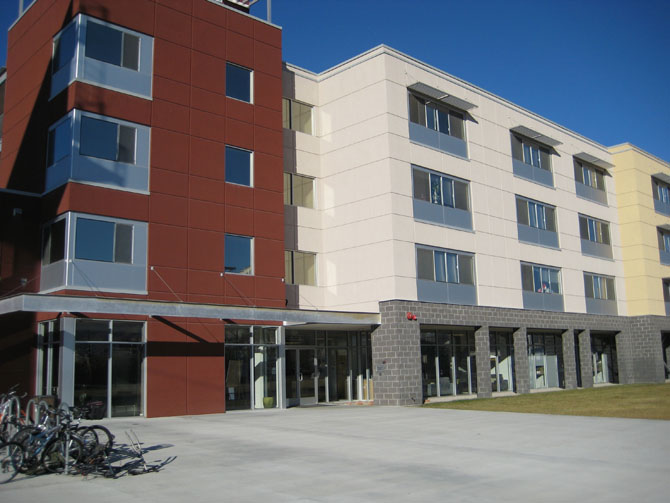
The Sunrise Metro Apartments, located at 580 S. 500 West in Salt Lake City, provide permanent shelter for chronically homeless men.

So, he purposely leaves the entrance open. He’s not the only one who does so.

“When you go into an apartment and close the door, you’re alone,” said Joyce Crockett, a case manager at The Road Home, a nonprofit service agency in Salt Lake City that helps shelter and feed the homeless. “As much as these guys want to get out of shelter, they hadn’t been alone alone for a long time.”

Crockett said one man continued to sleep outside for almost a month after he moved into his apartment.

“It is a surprisingly difficult adjustment,” Crockett said.

The Sunrise Metro Apartments, 580 S. 500 West in Salt Lake City, are a housing-first project opened by The Road Home in 2007. It provides apartments to men who have been chronically homeless.

A person needs to spend more than 700 nights in a shelter to be considered chronically homeless. Most clients of Sunrise Metro have been living on the streets for as long as seven to 10 years. Many of them are older adults.

The number of older adults who will be homeless and will need assistance from a shelter or other programs is only going to increase, said Alesia Wilson, a licensed clinical social worker at The Road Home.

“Because of the economy, the demographic is going to change,” Wilson said. “Society has always been able to take care of the elderly, but it is getting more difficult.”

She said a lot older adults are becoming homeless because their families are not able to afford to take care of them, or to put them nursing homes. Many others are ending up on the streets because they’ve lost their 401(k) money.

Wilson said homeless people live an average of 20 years less than people who have a consistent roof over their head.

Sunrise Metro takes some of the male older adults out of shelters and gives them their own apartment. Despite the difficult adjustment, having the responsibility of their own home is significant for chronically homeless older adults.

“There are a lot of self-esteem issues with being homeless,” Crockett said. “We see people accepting who they are and not being embarrassed of who they are. They feel comfortable in their own skin for the first time in a really long time. They have a nice apartment, and it’s pretty stable. They’re not on the street, they’re not in the shelter. They don’t feel like such a loser.”

The housing is permanent, but the residents still struggle to accept their good fortune. Crockett said many of the residents worry about the program leaving their lives as easily as it entered it. They also question why they are so lucky.
“A lot of people feel they don’t deserve it,” Crockett said.

The more the residents become accustomed to having their own apartment, the more confident they feel. The newfound self-esteem helps them take more risks.
One risk they take is being more social. Crockett has seen many people who never interacted with anyone at the shelter open up.

“When we see them, when we have an activity, having a conversation with a stranger or another tenant, it is very heart-warming,” Crockett said.

The best measure of success is the number of residents Sunrise Metro has been able help to reconnect with their family.

“There are a lot of people here who haven’t had any involvement with their family for a very long time,” Crockett said.

It often isn’t easy to get older homeless men to get in contact with their family. Case managers at Sunrise Metro ask residents about their family and if they want to talk to them. At first, the residents are uncomfortable with the thought and decline the invitation. Many of them feel guilty for causing their family to fall apart.

The residents will start to think about their family more and more after being asked. Eventually, they are ready to take action.

“Some families are very excited when they call,” Crockett said. “Sometimes, they just haven’t called their family. Their families want to know where they are and what they are doing.”

Crockett said the confidence to take the risk to get in touch with their family usually starts with having a suitable place to live.

“The fact that they have a place to live is probably the biggest drive to find their families because they have a nice apartment, and they’re not on the street, not in the shelter,” she said.

Residents also gain self-confidence from obtaining employment. Sunrise Metro has case managers who help the residents write up a resume. “They have more skills than they think,” Crockett said.

The struggling economy has made finding a job a more difficult task. The businesses usually willing to hire older homeless men don’t have any openings. Even the normally reliable Deseret Industries doesn’t have openings.

“When you can’t get them a job at the D.I.,” Crockett said, “you know things are bad.”

Older homeless adults also face age discrimination. Crockett believes these men are physically capable of doing most jobs. They just need an opportunity.

The case managers are on-site five days a week. Besides assisting the men with their job search, case managers also hook them up with resources and help them get out and functioning in the community. If the men are unable to find jobs, the case managers help the men through the Social Security process.
Case managers also help the residents put together a case plan. Crockett calls Sunrise Metro a “client-driven program.” This means the residents decide on their goals. Case managers make sure the residents are meeting their goals. If they are not, the case manager will refine the plan or revamp what isn’t working.

Case managers also get to know each resident’s specific situation so they don’t head back down the path they are trying to leave.

“The [purpose] of having on-site services is to be available when you see a problem that people fall in that leads them to be homeless,” Crockett said. “You would be here to interrupt that, whatever their cycle is.”

Residents also have therapy services available with Alesia Wilson through The Road Home. But they don’t often they take advantage of it.

“It’s not really their priority,” Wilson said. “They’re more in survival/crisis mode. Staying alive is all they need.”

Both Wilson and Crockett believe living through homelessness has made the residents resilient.

“These are strong people in a lot of ways,” Crockett said. “They’ve had to be in order to survive.”

Just getting a place to live after all the years of living in the streets and in shelters is enough to call Sunrise Metro a successful endeavor, Crockett said. “I think it allows them to die with some dignity.”

Volunteering at any age

Story and photo by Jessica Gonzales

Ann Mayne moved to Salt Lake City from Texas in 1991 to be closer to her son after her husband died. The change was difficult for her, and adjusting to a new community with no friends and little family made her feel helpless. At age 60, she was uncertain of what her future would be like now that she was alone.

“One morning I woke up and I said ‘What am I going to do with the rest of my life?’ I had no roots here, no sense of belonging,” she said.

Mayne’s life changed later that year after seeing a flyer for the Retired and Senior Volunteer Program (RSVP) at her local library. RSVP is part of one of the largest volunteer programs offered to those 55 years and older and is sponsored through the Salt Lake County Aging Services. After contacting the program, she was put in touch with the Utah Cancer Society, where she volunteered her time as a record taker and became actively involved working in other community partnerships.

Eighteen years later, Mayne continues to volunteer her time taking records in various projects, including the Healthy Aging program and RSVP at the Salt Lake County Aging Services. She spends most of her time volunteering when she can, tracking RSVP volunteer hours and collecting data from organizations involved in the program. “Volunteering has saved my life,” said Mayne, now 78. “When you help others, you help yourself.”

For seniors like Mayne, RSVP is an opportunity for them to donate their time to serving the needs of the community. Tutoring, providing meals for the elderly and involvement in environmental awareness programs are some of the many activities volunteers participate in through RSVP.

According to the Corporation for National and Community Service, RSVP significantly increases public support for organizations and increases the number of clients served in the organization. In return, volunteers benefit from the socialization with those whom they interact and gain a sense of belonging for contributing their time.

“They do like the involvement of what they’re doing and the fact that they are helping someone is very important to them,” said Vicki Hansen, program assistant for RSVP at Salt Lake County Aging Services. “Then they find out it makes a difference in their own lives as well.”

RSVP began in 1971 as part of a national network of community service programs called Senior Corps. Its mission is to provide volunteer opportunities for the aging community to use their talents and skills to help out their local community. RSVP has been a major success nationwide and in 2006, there were around 480,000 volunteers nationally who donated 66 million hours of their time in their local communities through the program.

Salt Lake County Aging Services has sponsored the program since 1974. There are currently 1,150 active volunteers whose ages range from 55 to 99. Last year alone, more than 200,000 hours of volunteer service were contributed to 70 community organizations, such as the University of Utah Hospital, local school districts and art museums. Collecting diverse agencies and programs is what Hansen aims to provide to guarantee volunteers are placed in an organization where they feel comfortable and confident to volunteer in.

“It’s all about matching the interests of the volunteer,” Hansen said. “Whenever someone is passionate about something and they’re enjoying what they’re doing, they feel better about what their involvement is.”

At the Kearns Food Pantry, most of the workers are RSVP volunteers. A total of 14 RSVP volunteers are active at the pantry, many who have been there for several years. Last month, the pantry fed about 2,900 needy people and volunteers donated 350 hours of their time.

“We wouldn’t have a food pantry if we didn’t have volunteers,” said Bobbie Mayberry, coordinator for the Kearns Food Pantry. “They love coming here.”

Loretta Mann, 77, became an RSVP volunteer for the pantry two years ago after she noticed an advertisement for the program at her local library. After retiring from her job at a local bank, she decided volunteering would be a great opportunity to spend her free time and engage with others in her community. Mann donates eight hours of her time each week at the Kearns Food Pantry with other volunteers whom she considers her family. She sorts and distributes food alongside with other RSVP volunteers, who have given meaning to her life .

“I really feel like I’m helping,” she said with a large grin on her face. “It will make you feel like you are needed.”

Loretta Mann, right, participates with other RSVP volunteers at the Kearns Food Pantry.

“The feedback I get from folks is amazing,” Vicki Hansen said. “The more involved they stay, the more healthy they seem to be.”

For the future of the RSVP program, Hansen hopes to see the amount of volunteers increase and become involved as the Baby Boomer generation retires. The benefits she says, will not only strengthen the community, but also strengthen the confidence of the volunteer and unlock the hidden talents they may have never discovered.

“We’re looking for people who want to initiate change,” Hansen said. “The more we have that, the better off our community will be as a whole.”