Will Social Security disappear?

Story and photo by Alexis Young

Social Security may be in jeopardy after the baby boomers, bigger than any generation before them, retire. There are about 78 million baby boomers in the U.S. The oldest will turn 62 next year, which is the age they qualify for Social Security benefits.

Rob Ence, the Utah state director of American Association of Retired Persons and an upcoming baby boomer himself reaching retirement age.

Social Security will be put to the test. Rob Ence, the state director of American Association of Retired Persons (AARP) in Utah, said without changes, Social Security faces a long-term economic shortfall.

“Payments of Social Security will rapidly exceed the baby boomer surplus. The system will only be able to pay out 70 percent of projected benefits after the year 2037, not the 100 percent current benefits,” Ence said.

According to the AARP Web site, Social Security is a public welfare program that started in January 1937. It is funded by taxes and administered by the federal government. Benefits are based on your year of birth, 35 of your highest years of earnings, and the age at which your benefits begin.

“It is not a retirement plan, and was never intended to meet all the needs in retirement, but rather a floor to protect against poverty in longevity,” Ence said. Social Security has always been designed to give a minimum level of support, and was designed to provide for sustenance needs.

Many baby boomers did not plan for retirement. “Consumption and debt accumulation have been the trend, and the self-indulgence will force dramatic reduction in lifestyle during retirement,” Ence said. “Because baby boomers haven’t saved, it is going to be quite difficult for them to rely exclusively on Social Security income. Those that do will have hardships in the cost of living expenses.”

Ence, an upcoming baby boomer himself reaching retirement age, is one of the few who is properly saving for retirement. “I am now 57, I have an excellent defined benefit plan with my employer, and I set aside 11 percent of my income monthly in a 401(k),” Ence said. “If my health is good, I plan to work full time until age 68-70.” Not having to depend entirely on Social Security, and planning on a sufficient monthly income after he retires, Ence intends to travel and participate in extensive service throughout Utah and perhaps abroad.

According to AARP’s November 2009 Social Security report, 49.9 million people throughout the country receive Social Security benefits (about 16 percent of the population). The Social Security Administration estimates 91 percent of Americans age 65 or older receive benefits. Among these people, Social Security is the major source of income for two-thirds and virtually the only source of income for the other one-third.

Rising unemployment, declining savings and an upcoming wave of baby boomers reaching retirement age has increased the number of people applying for Social Security benefits, which are available as early as age 62.

“It is unwise for a person to file for Social Security before age 66. People should work as long as they want to and are able,” Laura Polacheck, an attorney with AARP, said. Older adults, who take Social Security benefits before age 67, the established retirement age, get a reduced monthly amount. Polacheck said people need to think earnestly about the outcomes of taking early retirement benefits and consider their options.

Heather Spencer, an associate economics instructor for the University of Utah, points out taking a reduced benefit now may weaken one’s expectations of life later on. “Most Americans view Social Security as a retirement plan, and feel entitled to benefits when they are 65 or older,” Spencer said. “Be realistic, you want to plan on having the same standard of living both pre- and post-retirement.”

For an individual born after 1943, every year you delay the acceptance of benefits after your normal retirement age, you get a delayed retirement credit of 8 percent up to age 70, according to the Social Security Web site.

Spencer offered a list of suggestions that the government needs to do to keep Social Security viable for future generations:

• Make yearly adjustments that keep up with inflation.
• Change the cost of living from the average wage to the consumer price index.
• Increase the retirement age to 69.
• Raise the amount of income subject to Social Security taxes.
• Reduce benefits.
• Invest the trust fund money in reliable products.
• Make Social Security “means” tested, which suggest if a person does not need the extra income, they would not collect the benefits.
• Advance retirement assistance that meets the needs of American workers.

“Those things alone will more than account for any projected shortfalls, and will keep Social Security solvent for the unknown future,” Spencer said.

When asked if Social Security is going away or going to continue, Ence said he did not think it will go away, nor would he want it to. “It is the most successful social program ever created in our country, and a model for success internationally,” he said. “We need to recognize that Social Security needs to be modified to be sustainable, and not a burden for future generations.”

Home safety for the elderly

Story and photos by Jenna Cannon

  • Click here to learn more about home safety for the elderly.

A hint of lemon oil wafts through the air, giving the room a summery aroma. Sunlight sneaks in through the window, dancing across the face of the room’s occupant. Grace Pace, 86, moved into this room at her eldest daughter’s house for health reasons. Her condition has greatly improved, so she will soon be returning to her own home. But first, changes must be made to ensure her safety.

Grace Pace sitting in her room at her daughter's house in Sugarhouse.

“I am just thrilled to be able to go back home,” Pace said. “It wasn’t easy to leave, but my health just wasn’t good enough to stay there. That was our first house,” Pace said with closed eyes. She paused and seemed to be reminiscing about memories in her house. “That house is my home where we raised our six children,” she said with a smile.

Pace rented her house to her son and daughter-in-law while she was living with her daughter. During this one-year period, she underwent physical therapy. She said the results were more than she had ever hoped for.

Pace’s daughter, April Thompson, was amazed to see her mother’s recovery. “The improvement in my mom’s health is truly miraculous,” Thompson said. “She seems ten years younger. I can’t believe how much healthier she is.”

Pace is now able to return to her beloved home. To ensure her well-being, she has hired a private consultant to assist her with making her home safer. Some renovations must be made to reduce the risk of accidents related to old age.
Changing the home is a way for the elderly to stay in control of their lives.

“Aging declines the body, but people will adapt,” said Scott D. Wright, director of the Gerontology Interdisciplinary Program Center on Aging at the University of Utah.

Steve Davis is helping Pace with the renovations. He has been assisting elderly clients remodel or “elder-proof” their homes for more than 15 years. Davis said a number of changes can be made throughout the home to make it safer for the elderly.

Kitchen Safety
The kitchen can be a very dangerous area for the elderly. They may stand on a stool to try to reach items on high shelves and end up falling and getting seriously injured, Wright said.

“You need to move the most used items to lower shelves to prevent the person from climbing onto a chair or stool and falling,” Davis said.

Davis also said sinks can be difficult to adjust because of reduced motor abilities in the elderly. The sink needs to have a single-handle lever faucet so seniors can easily adjust the water and turn it on and off, he said.

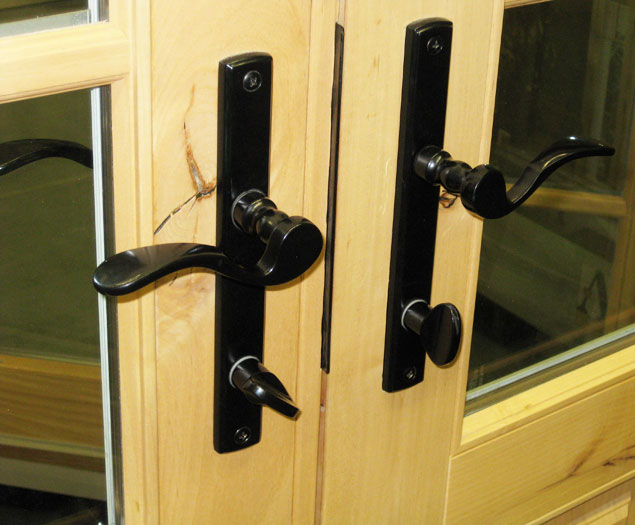
Lever handles on doorknobs assist the elderly with opening doors.

Lever handles on doors are also a helpful addition to the home.

Another kitchen renovation Davis considers is replacing cupboard handles. Cupboards with handles that a hand or finger can slip through work best because they are easier to grab onto. This is especially helpful for individuals with arthritis, he said.

Bathroom Safety
“One of the highest risk areas for not only the elderly, but for people in general, is the bathroom,” Davis said. “The surfaces are wet and slippery so people are more likely to slip and fall.”

To remedy the dangers that a bathroom holds for seniors, Davis suggests putting grab bars in the bathtub and around the toilet. These bars give the person additional support to get in and out of the tub.

“Non-slip floor mats are essential in the tub and on the floor outside the tub. These provide a secure surface so that slipping doesn’t occur,” Davis said.

Pace is having grab bars installed in her shower. She also uses a shower chair for additional support. “It’s easier to sit and wash myself because I don’t have the strength to stand for that long,” she said.

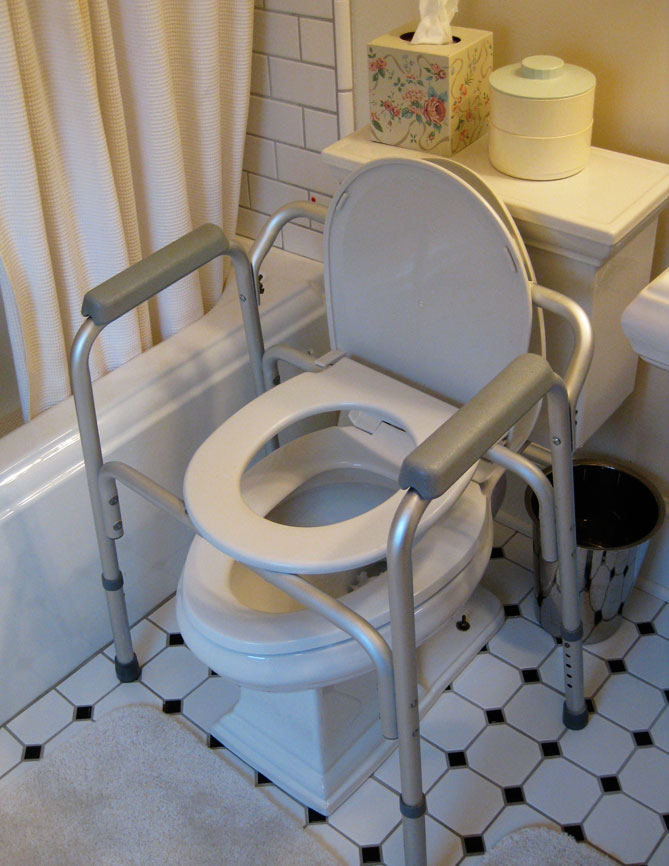
An elevated toilet seat assists elderly persons in regaining a standing position.

The level of the toilet can also be a problem for the elderly. Pace has a special seat attachment that goes over her toilet to raise it up to a comfortable level for use.

“Elevating the seat makes it easier for the person to regain a standing position,” said Stanley P. Wells. Wells, a physical therapist, treats many elderly patients at his clinic in Sandy. He said his experience with these patients has made him aware of little things that help individuals with mobility.

Flooring
Flooring is an important aspect of safety for older adults. Davis recommended replacing hardwood floors or tile with low-pile carpeting. This provides traction without creating an additional hazard. “Shag carpets can also be a tripping hazard because they are springy and a person can get a toe caught in the carpet,” Davis said.

If there are area rugs, it is essential to secure them down. Davis recommended using a floor mat under the rug or tacking the rug to the floor. It is important to use rugs without any fringe because the fringe is an additional tripping hazard.

Other things to watch out for are items on the floor that could be the cause of a fall. “Things such as brooms and wastebaskets need to be put in the closet so the person doesn’t trip and get injured,” Davis said. Tripping hazards can also include laundry baskets, newspapers, decorations and ottomans.

Stairs
According to the U.S. Department of Trade and Industry, stairs cause the most serious accidents involving seniors. For this reason, it is essential to utilize the stairs cautiously.

Pace has trouble going up and down stairs because of ankle and back problems. She plans on installing a stair lift so that she can ride up and down the stairs without any risk of falling.

If the cost of a stair lift is not within an elderly person’s budget, Davis suggests moving items that are on other floors to the main floor. This allows the occupant to have access to their belongings without the risk of falling down the stairs, he said.

Other Safety Measures

Davis mentioned that harm from external forces such as intruders or natural disasters are a fear that the elderly face. Pace said she is concerned she will not be able to do anything if there is an emergency in her home.

“It is necessary to have working smoke alarms and carbon monoxide detectors for safety,” Davis said.

Another safety measure is home security. Davis suggested installing some sort of alarm system or putting locks on all windows and doors.

Because the cost of home security systems can be daunting, seniors can consider other options. Sandy City Police officer Glen Williams offered some alternatives to installing a security system. He said putting bushes with thorns directly in front of windows could deter a criminal from entering. It also frightens potential intruders if there are motion-sensing lights around the house, he said.

Pace decided to install a security system. She said the cost of the system was in her budget and worth every dime. “You can’t put a price on feeling safe,” she said.

With all of the home improvements, Pace said she feels prepared to return home in safety. “My doctor thinks I’m in good enough health to live on my own,” she said. He recommended that she have a family member nearby in case of an emergency. He also said she should continue her physical therapy treatments.

Pace is thrilled with the prospect of moving back home. “I feel like I am young again and I’m starting an exciting new life,” she said.

A Utah farmer who never tires

Story and photo by Kelli Coomes

Dawn breaks over the trees. A man with a silver head of hair looks out over his herd of cattle, gazing toward the sun as the first rays of sunshine illuminate his gruff-looking silhouette. He’s already been up and working for a few hours.

Farmer


Dell Walker whistles as he grooms his horse Lou at his farm in Provo, Utah, last fall.

The sunlight slowly crawls across the land, like a veil being lifted from a piece of art. As the valley becomes lit, the farm comes to life. All that can be seen are acres of growing hay, a small herd of cattle, a few horses and chickens scratching the ground.

At 78, Dell Walker stands straight while surveying the work he has ahead of him. He has animals to feed, hay to haul and cattle to herd. He begins saddling his horse; his hands seem to be moving with a will of their own.

This is his family’s land. Held for generations. It borders the eastern edge of the Provo River, in the southern end of Provo, Utah. The house no longer sits on the farm. It was torn down when the farm became prosperous enough for the family to move into town. That was when Walker was only 10.

“We are a dying breed,” Walker said, his eyes sad. “Our children don’t work the land with us.”

Walker has three grown children. He has many grandkids and a few great grandchildren. None of them are interested in the land, except to sell it, Walker said. “Over my dead body.”

He’s no longer young enough to take care of all the land. A little more than a third of the farm property is now rented out. Horse owners can grow their own hay and house their horses for a monthly fee. The hay that Walker produces is used to feed his own three horses. The land is divided into multiple pastures, old-fashioned fences of chicken wire and log posts marking the boundaries.

Walker’s patch of farmland is one of the many farms that sit next to each other. Across from the paved road that runs as a border on the south edge of the farmland is a stream, and south of that, the homes of many of the farmers. A lot of the land has been sold for development projects.

“We pass on, and the kids left behind pass the land on,” said Glen Horton, who owns the land next to Walker’s. Horton is one of the lucky ones, according to many of the farmers around here. His children are farmers, too.

“It’s sad,” said Joann Walker, Dell’s wife. “We’re losing our culture as Utahns.”

Joann helps with the chickens on the farm and feeding the workers who come during haying season. She still collects fresh eggs for their meals at home, though they buy milk at the store. Milking cows are more expensive than cows for slaughter. They take their herds to auction and to the meat house.

In 78 years, Dell Walker has fought on foreign soil, worked at Geneva Steel, has fought cancer, has had two major heart surgeries and still continues working on his farm. At a young age, he lost his three middle fingers in an accident while working at Geneva Steel. “Finger and thumb are all I need,” he said with a smile.

More than five years ago, Dell Walker was diagnosed with Lymphoma cancer. “It was one of the worst days of my life,” Joann said, tears coming to her eyes at the memory. “He walked out and told me we’d be OK, and I believed him.” After two years of chemotherapy, he is in remission.

Three years before that, they found a heart murmur and he had heart surgery. It is normally something found at birth, but his had been missed. The doctors also missed it when he underwent heart surgery 15 years ago because of a major heart attack.

None of this has stopped his stride. Dell smiled and shared his secret: “Hard work and a reason for working.” He owns his house and the income from the farm is keeping him and his wife in the life they enjoy. “We’re happy,” Joann said.

The technological age

by Jessica Calderwood

Where do you aspire to be at age 75? Do you envision living in a nursing home, reliant on the care of others, or do you imagine your own familiar home where you are living independently?

Being independent and living in your own home is the biggest goal for aging people, said Scott Wright, director of the Gerontology Interdisciplinary Center at the University of Utah.

Gerontology is the study of the social, psychological and biological aspects of aging. There is now an emerging field of study called gerontechnology. It combines the field of gerontology and the field of technology. The goal and main focus of this field is to help older adults maintain their independence and quality of life throughout the aging process.

Many older adults, like Gayle Olson, 81, enjoy independence.

“I’m not up in the technology,” Olson said.

Although she feels she is not technologically savvy, Olson benefits from technological advances that make her home life easier and more fulfilling.
She enjoys staying in touch with her 11 children and their families over the phone. However, she doesn’t own a cell phone.

It gives her peace of mind to know that her Social Security check will be electronically deposited into her bank account each month. She knows it’s there, but doesn’t use a computer.

She relies on the weather report from the local news to plan her outings.

Such simple things may not seem technologically advanced. However, they are important in maintaining independence and happiness in Olson’s life.

“The fountain of youth is being active,” Wright said. Most importantly, if a person can stay physically and mentally active, they will have a higher quality of life at any age.

For those willing to learn, there are computer games that monitor and exercise cognitive ability.

There are now sensors that can be installed in the home to notify a caregiver if a person is potentially unsafe. For example, caregivers would know if a person has fallen down or has not turned off the stove.

Health technologies that monitor blood pressure, respiration and other conditions in real time while the person is at home reduce the need for frequent doctor visits.

Medication dispensers provide the correct medicines at the appropriate times, reminding a person to take them using flashing lights and sounds.

For people like Olson, utilizing technological advances to improve quality of life can be something as simple as listening to a book on CD when eyesight begins to deteriorate.

Gerontechnologists focus on these specific aspects of life that can be improved through technology: health, housing, mobility, communication, leisure and work.

The International Society for Gerontechnology (ISG), established in 1997, is a nonprofit organization in the Netherlands. It has branches and members throughout the world and organizes conferences every two to five years.

The seventh world conference of the ISG will occur in Vancouver, Canada, in May 2010. Experts in gerontechnology will share their knowledge and experience. The conference is a meeting of the minds of professionals who desire to apply their expertise and the latest technology to enhance the health, functional capacity and quality of life of older adults.

Another organization focusing on applying technology to the issue of aging is the Center for Aging Services Technologies (CAST), which was organized in 2002.

CAST is an international coalition of more than 400 technology companies, aging-services organizations, businesses, research universities and government representatives working together under the sponsorship of the American Association of Homes and Services for the Aging.

Both of these organizations involve the coming together of experts in their respective fields. They have the desire to apply technology in new and innovative ways to improve the lives of aging adults.

Wright believes within 20 years, technology will transform what it means to grow old. The technological advances and applications will not only improve the longevity and health of older adults, but will also help them adapt to the natural aging process.

Aging adults can look forward to many new and exciting advances in technology. One of those advances is the invention of future home assistant robots like the robulab10 being developed by ROBOSOFT of France. Different models of this particular robot will provide cognitive assistance or physical assistance in the home.

Utah seniors calling assisted-living facilities home

by Gillian King

Individuals who live in assisted-living facilities may very well be lost without them. According to Brett Burns, executive director of the Wellington Senior Residence, people most commonly enter an assisted-living facility when they are in need of more interaction, activities and care than they are otherwise receiving. At what age this occurs is different for everyone, but at the Wellington the average age of the residents is about 84 years old.

Senior citizens living in assisted-living facilities are able to engage in activities with friends who also live there. This gives them the much-needed interaction that can sometimes be lacking when seniors live alone, or with family members who may have other obligations to tend to.

“The fountain of youth is being active, both mentally and physically,” said Scott Wright, the director of the Gerontology Interdisciplinary Program at the University of Utah.

Assisted-living facilities can be seen as places that deter getting old, instead of places where people go once they are already old. According to Burns, keeping their bodies fit and their minds sharp with the available activities can keep the residents of assisted-living facilities feeling more youthful longer.

The care provided at an assisted-living facility goes beyond the bonds of friendship and delves into life’s necessities. Residents are helped with tasks such as medication monitoring, meal preparation and bathing.

“The bathroom is really just a bad place for older adults,” Wright said.

A decrease in mobility translates to an increased risk of slipping or falling. Fear of injury convinces many seniors to look at assisted-living facilities as an option. With the additional care that such a facility is able to provide, Burns said the risk of accidents is reduced considerably as compared to living at home.

Many facilities, such as the Wellington, provide the benefit of having balanced, nutritional meals made for residents three times a day. Burns said this gives them the essential nutrition they may otherwise be lacking due to inability to provide it for themselves.

As people age it may become increasingly difficult to care for the yard and home. Also, many seniors have reported feeling less safe in their homes as they age.

“Older adults have the highest fear of crime of any age group,” Wright said.

Taking this into consideration, it is understandable why more seniors are turning to options such as assisted-living facilities, even though Wright said the chance of a senior citizen actually being a victim of a crime is quite low.

Safety and peace of mind come with a price tag, however. Burns said cost is the No. 1 reason why people choose to not live in an assisted-living center.

“If your nest egg isn’t huge it can be difficult. On average it can cost $2,000 to $3,000 per month,” he said.

Wright said being able to live in your own home for as long as possible is what the aging community collectively aims for. However, there comes a point where it may no longer be an option. Even living with family members becomes less possible over time, because the care a person needs exceeds the abilities of the family and the time it can provide.

Individuals may also need more social interaction and activities than what they receive at the home of their family.

Putting a family member in an assisted-living facility may not always be the first route people choose, but it often ends up being worth considering.

Wright said people will generally care for an older adult longer than they will their own children.

But, there comes a time when they must make decisions about living arrangements. Burns said the Wellington sees anywhere from two to five new residents each month.

Program helps older adults get around

by Lee Horton

For most of us, the ability to drive is a privilege. Having that privilege taken away would be akin to having our independence taken away.

When people obtain their driver’s license as a teenager, they gain the ability to go almost anywhere they want, provided they have the resources. The freedom to roam as they please only increases over the next 30, 40 or 50 years. The older people get, though, the more their physical abilities start to dwindle. Often, the privilege of independent transportation is taken away, but their need for transportation still exists.

“Things weaken with loss,” said Scott Wright, director of the Gerontology Interdisciplinary Program at the University of Utah. “It’s important to let (older adults) know they have options.”

When it comes to catching a ride to an important doctor’s appointment or the pharmacy, or to do other essential errands, an option older adults in Salt Lake County have is the Salt Lake County Aging Services’ Senior Transportation Program.

The Senior Transportation Program provides rides to people 60 years old and older who have no other means of transportation.

“A lot of people in their 70s and 80s can drive,” said program manager Bob Prottas. “(A person) might be able to drive to the store, the library, church or other places near her home, but she might not be comfortable driving to the University of Utah.”

Prottas reports the free service has been put to good use.

“We do 50,000 rides per year,” Prottas said. “We’re north of 200 every week.”

According to the Aging Services Web site, the Senior Transportation Program drives older adults to medical appointments, physical therapy, pick up prescriptions or to visit family members in hospitals. Some riders only use the services when their usual modes of transportation are unavailable. Others use it on a regular basis. The frequency often depends on the rider’s nearby family support.

“Some don’t have family, or they’re out of town, or they don’t give a damn,” Prottas said.

Wright and other gerontologists feel such programs go beyond the medical benefits in helping adults live healthier, longer lives.

“We feel mobility is critical for older adults,” Wright said.

Many older adults fear crime and the other dangers of the world. Statistics, however, show they are not often victims of crimes. Wright feels it is important these fears don’t stop older adults from venturing beyond the walls of their home. Just being out and interacting with the world is crucial.

“The fountain of youth is being mentally and physically active,” Wright said.

Prottas adds internal pride and a type of self-esteem to the list of benefits of the Senior Transportation Program. “It helps them maintain their independence,” he said.

The program allows older adults to not only take care of their essentials, but also to arrange the weekday rides to fit their schedules.

Driving positions are filled by both employees and volunteers, all of whom must pass a criminal background check. They also must possess the right kind of personality. Prottas considers driving older adults a “social-type job,” and therefore looks to hire outgoing people.

The Senior Transportation Program has 64 volunteers and is always looking for more. Just about anybody with a clean record and a driver’s license can volunteer.

“(The volunteers) range from their mid-20s to their mid-60s,” Prottas said. “Some of our volunteers are more apt to be clients.”

The service is available Monday, Tuesday, Wednesday and Friday from 8 a.m. to 4:15 p.m., and Thursdays from 9:30 a.m. to 4:15 p.m. Rides can be scheduled up to a week in advance. Prottas recommends getting it scheduled as close to that week as possible, as the schedules fill up fast.

There is no cost, though Aging Services sends out slips recommending a $2 donation for each trip. Because some clients do not pay and others pay more than $2, Prottas says the average received donation per ride is $1.75. With 50,000 trips in a year, according to Prottas, the program brings in approximately $87,000 per year.

Among those 50,000 rides are group grocery shopping trips prearranged with participating senior centers. Individual grocery excursions, though, do not fall within the “essential” category. The same is true for rides to movies, hairdressers or to the mall. Prottas and the Senior Transportation program will help people meet their needs, but satisfying wants is left up to the riders themselves.

Live long and live well

Story and photo by Alexis Young

When she underwent back surgery a year ago, the doctor told Lois Stromberg to expect at least 12 months for a full recovery. However, only five months after surgery, she was exercising 20 minutes a day and walking more than expected.

Lois Stromberg believes if you Incorporate this food into your diet every day, it will assist in a healthy long life.

Stromberg has been diagnosed with osteoporosis, has had three hip replacements, several broken bones and faced back surgery, all within the last 15 years.

Carrie Hinckley, Stromberg’s daughter, thinks it is remarkable that her mother has little to no pain on a daily basis and hardly ever complains.

Stromberg, 88, believes the solution to no pain and a healthy, long life is “daily exercises, a positive mental attitude, and a support group: your family.” Not your sedentary senior citizen, Stromberg explains word for word the key principles to aging well.

The idea of aging well is for people to maintain a healthy lifestyle as they age by applying choices that improve active, strong and secure lives. As with any sport, if you have a routine and practice it on a daily basis, your game can improve. The same principle can be applied to aging.

“It is within your power to motivate yourself, to exercise and keep practicing by going the extra mile,” Virginia Rhodes, a service coordinator for senior citizens, said.

In Rhodes’ nine years of experience with seniors, she has seen how lifestyle positively affects aging and assists in the avoidance of illness. With the results exercising generates, it is especially beneficial when you plant the center of attention on abdomen exercises.

“It has significantly helped them with their posture, back pain, and getting up from chairs,” Rhodes said.

Rhodes’ career goal is to stay educated with the latest developments to healthy aging. She takes several courses to enhance her knowledge, and is always creating new exercises to keep seniors motivated.

Motivation is certainly one area in which Lois Stromberg is not lacking. Before she even gets out of bed to wander through her home, which has the sensational aroma of fresh coffee, she commits to accomplishing one goal before starting her day. The goal can be anything from dusting, watering her garden, walking to and from her daughter’s house, or when she is in the need of a challenge, changing sheets.

“It gives me the greatest satisfaction to know I can still do it,” Stromberg said.

Directly after completing her goal, her next mission is to get a “full dose” of exercise.

“I reserve at least 20 minutes a day…. It’s what the rehabilitation center recommended after my back surgery.”

Stromberg’s basic reason for staying motivated is the fulfillment she achieves through her accomplishments. In addition, she is always concerned that if she does not continue to be persistent with her goals and positive outlook, she will lose her enthusiasm toward life.

“Having a vibrant mentality can lead to the aspiration of living young at any age,” Stromberg said.

You live a high-quality life, with working joints and a high sense of energy until the day you die. “So aim to feel like you’re 30 even when you’re 80,” Stromberg said. “Staying young involves your emotions and physical health, personal hygiene, close contact with family and friends, and paying close attention to your eating habits.”

Having the energy of an 8-year-old, hardly any wrinkles and being slim as a toothpick, Stromberg’s ambition is to always feel young. In a kitchen that has nothing but an abundance of fruit, vegetables, yogurt and fish, she claims her energy levels skyrocketed when she changed eating habits nearly 10 years ago.

Aside from exercising daily, eating healthy foods and continuing with her goals, Stromberg shares her final secret to aging well. Family, she said, has been the key to motivation, the drive to achieving her accomplishments, the desire to live long and live well. It gave her the will to carry on when her husband died three years ago. The days are now lonesome, and the evenings are unpleasant, but Stromberg said she remains in high spirits. Eager to spend time with her friends and family every day, Stromberg whispered, “If you haven’t got a family, you haven’t got much.”

Apple’s iPhone: a benefit for senior citizens

by James Williams

The Gateway Mall in Salt Lake City has something for just about everyone. There are clothing stores, sporting good stores, restaurants and even a movie theater. Nestled among them all is the only Apple Store in the city.

Here, customers come and go all day looking at the various computers, iPods and iPhones on display. Though looking is nice, experimenting with devices such as the iPhone is even better.

“They are very easy to use,” said Katie Towne, an iPhone specialist at the store. “There are applications on the iPhone for just about everyone,” she said. And that includes senior citizens.

“Utah is the fifth fastest growing state for the aging population,” said Scott Wright, director of gerontology at the University of Utah. Senior citizens want to know what they can do and where they can move to live longer, he said. For many seniors, Utah is one of those places. Technology, like the iPhone, can help them navigate their new community.

“We are living longer and it is going to revolutionize our society much like the industrial revolution in England,” Wright said. For senior citizens this type of technology can ease the challenges they face today. “Technology is one thing that can help aging adults the most,” Wright said. “It’s the intersect between the generations.”

With more than 85,000 downloadable applications, known as apps, available to iPhone users, senior citizens are sure to find something on the iPhone that can benefit them. One such app that Towne demonstrated is “Evernote,” which helps users with memory troubles. People can record voice notes, type notes and even create visual notes using the iPhone’s camera. All of the stored notes are easily accessible, which is another benefit to users. Evernote “creates sort of a to-do list for people with a bad memory,” Towne said.

One feature that comes standard on the iPhone and can assist senior citizens is the built-in map. It will show the current location of the iPhone on the screen, and when a user double taps the screen, it activates the built-in compass, which will help seniors find addresses and other places of interest.

Another map application designed specifically for senior citizens helps users locate local senior centers.

Yet another app helps senior citizens find decent and affordable housing.

“Sensory loss is a normal part of aging,” said Wright, which is something that Apple has taken into consideration.

The iPhone has almost no buttons, Towne said. “It is easy to use and you do not have to over-think it,” she said.

For senior citizens who have trouble reading small text on cell phone screens, the iPhone‘s zoom feature can help. Towne demonstrated this feature by double tapping the screen with three fingers. Users can also enable the high-contrast mode, which can make the screen more visible.

Towne pointed out the voice-over feature that users can enable if the text still is too small to read. When users enable this feature, the iPhone reads the contents of the screen.

The iPhone seems to appeal to senior citizens. “I’m surprised actually. Many people 60 and above use them,” Towne said.

However, there’s a major drawback to technology like the iPhone. It’s often expensive. According to PC World’s Web site, today’s version of the iPhone costs approximately $235.99 after taxes and fees, with an additional $159.82 in monthly user fees. Senior citizens on a tight monthly budget might find the price tough to afford.

While the iPhone is not a viable option for all seniors, learning about technology can be. The Apple Store at the Gateway Mall can assist senior citizens who want to experiment with cheaper forms of new technology. “It’s never too late to start,” Wright said.

Senior drivers: an annoyance, safety concern or best drivers on the road?

Story and photo by Paige Fieldsted

Seniors on the road is something everyone seems to have an opinion about.

Some say older people should have their driver’s licenses taken away completely. Others think seniors’ driving should just be monitored more closely. Still another group believes seniors are the best drivers on the road.

photo2

Seniors represent 9 percent of the drivers on the road but account for 11 percent of people involved crashes. Senior drivers also make up 11 percent of people involved in fatal accidents.

Although many cite slow driving as the main reason for wanting seniors off the road, are older drivers really posing a risk to other travelers?

According to the 2007 Utah Crash Summary, senior drivers accounted for 10 percent of all crashes and 11 percent of all people involved in accidents.

Sgt. David Moreno of the Utah Highway Patrol said seniors driving the wrong direction on freeways, ramps and other roads is the No. 1 reason for calls involving seniors.

“If we pull someone over going the wrong way, we take their license away,” Moreno said. “We send their license to the driver’s license division where they have to pass a driving test to get it back.”

While seniors (age 65 and older) represented the age group with the smallest number of people in crashes, they were 2.4 times more likely to die in a crash than any other age group.

Accidents caused by health-related issues such as heart attack were the second-highest reason for senior-related calls, Moreno said.

Emily Daines, whose 85-year-old grandfather and 77-year-old grandmother still drive themselves around, said driving with them can be a scary thing.

“I went with my grandpa to a family event this summer, and he nearly got us hit because he assumed a two-way stop was a four-way,” Daines said.

Daines’ other grandma is no longer driving, so she and her parents are responsible for taking her places. Although it is an inconvenience, Daines said it is a necessary precaution.

“Grandma is resentful that she is no longer driving, but she simply doesn’t have the reflexes or the memory to remember where she’s going or how to get home,” Daines said. “It was at that point we knew we had to take the keys.”

There are programs designed to help seniors retain their driving skills and keep them independent longer.

Drivability Adventures in Daily Living, located in Sandy, Utah, is just one of those programs. Paulette Welch, an occupational therapist at Drivability, said not being able to drive reduces quality of life.

“The biggest concern we have is that the senior will not seek driving rehabilitation in time to improve their driving skills and will lose their independence,” Welch said. “The other concern is that some seniors continue to drive thinking that they are fine, but they are unable to learn new skills or change driving behavior.”

Moreno said there is no requirement to repass the driving test in order to keep a license once an individual reaches a certain age. Further, each senior is evaluated on an individual basis when pulled over. He added that without a mandatory retesting age for driver’s licenses in Utah, families should help in keeping unsafe seniors off the roads.

“Family should be involved,” Moreno said. “Families should be really aware and take action as needed.”

Daines said based on the experience she’s had with her grandparents, she feels that having laws in place requiring seniors to pass driving and eyesight tests at a certain age is something that should be implemented.

“I do think they should have to pass a test,” Daines said. “I think lumping people together as unable to drive just because they hit a certain age seems like a blanket judgment, that is a poor idea.”

Welch disagreed, saying that putting such a law in place would amount to age discrimination.

“I am not in favor of such discrimination,” she said. “There are people of all ages that are dangerous drivers.”

Welch did say, however, that if senior drivers are unable to learn new skills and change their driving behavior, they shouldn’t be on the road.

Moreno said that implementation of a senior driving test is not something that is of concern to the highway patrol.

“For now we don’t have the data showing that they are a big enough hazard,” Moreno said. “Teenagers are where all of our energy and focus is right now.”

College isn’t just for the young

by Evan Frank

College is sometimes said to be the best time in a young person’s life. What isn’t said is college can be the best time in any person’s life, regardless of age.

Something that has become more prevalent on campuses is the nontraditional student. According to America.gov, in 2003 around 6.1 million nontraditional students were enrolled in U.S. colleges and universities.

According to the registrar’s office at the University of Utah, the number of nontraditional students over the age of 60 has risen over the past four years.
In 2004, a total of 202 students who were 61 years or older attended the university. This includes both undergraduate and graduate students. Since then, the number has increased to 275. The number of graduate students has remained in the teens from 2004 to 2008.

Life takes people in many directions. People may have children at a young age or decide there isn’t enough time for school at that point in their lives.

Whatever the reason, things tend to get in the way. The good news is that universities don’t have an age limit for learning and growing.

Wendy Thomas, an instructor at the University of Utah, teaches a class that examines lifelong learning for older adults from a global perspective.

“In this course we explore the value of lifelong learning through economic and social lenses, and compare lifelong learning as it currently exists in the United States with models from other countries,” Thomas said.

“This class is for college students young or old,” Thomas said. “The intention is not to help older adults adjust to college, but to teach students about the learning opportunities available to older adults around the globe.”

Scott Wright, director of the Gerontology Interdisciplinary Program at the University of Utah, believes older students are returning to rebuild their skills and knowledge. Another reason is to stay mentally active.

Staying mentally active is important for adults. If this is not achieved, people may mentally decline, which is a result of altered connections among brain cells, Wright said.

According to the Alzheimer’s Association, the organization was founded in 1980. It focuses on providing care and support and conducting research on the disease. The organization states low levels of education have been found to be related to a higher risk of Alzheimer’s later in life.

Thomas, who is also the director at a senior center, says she encourages older adults to continue learning, be active and to be social.

“So many older adults in our country are lonely and isolated, and I’ve seen great outcomes from attendance at senior centers,” Thomas said. “Providing learning opportunities for older adults is one way for them to continue being active.”

While in class, Thomas feels that it is best for her students to interact with each other. Group discussions and group activities are also encouraged.

“In the research that I have done, there are different techniques for students that are older and things that you should consider,” Thomas said. “Older students typically enjoy interaction, especially question-and-answer sessions and discussion.”

Thomas added that older students appreciate instructors who are organized and passionate about their subject.

For most younger students, the purpose of going to college is to obtain a diploma. Older adults may not have the same goals.

“For most older adults the motivation to learn is for personal growth, knowledge enhancement and socialization, not a degree,” Thomas said.

The University of Utah Alumni Association has a scholarship for nontraditional undergraduate students. Students who have been out of school for at least three consecutive years are eligible for the $2,000 scholarship.

“Learning opportunities can be found in everything,” Thomas said. “Informal opportunities are everywhere, learning doesn’t always have to be in a formal setting.”

For example, Thomas said going to a doctor can morph into a formal setting.

“You or your loved one are diagnosed with an illness and after learning of it, you set out to learn more about the illness and you talk to others,” Thomas said.

Joining a support group or taking a class on how to manage the illness are just two examples Thomas mentioned.

College is just one option for older adults to help keep the mind active.