The racial frisk: profiling a concern in Utah

By KATIE HARRINGTON

Asher Koles has a thin black mustache, a dark-olive complexion, and a slim build. He often drives his old Subaru Outback across long, open roads to go fishing and camping. His adventures take him to quiet and beautiful lands.

But sometimes, Koles’ adventures on the road are interrupted by the flashing lights and sirens of police cars.

Koles, a 24-year-old Salt Lake City native, said he is one of many people who are profiled by law enforcement for no reason other than the way they look. His most recent experience occurred last summer when he was driving back to Salt Lake City from a two-month trip in the Pacific Northwest.

“Cars were speeding all around me. But I was the one who got pulled over,” Koles said. “The cop walked up, stuck his head in, and started sniffing around. I said, ‘Do you smell something?’ And he wouldn’t leave me alone until I let him search my car,” Koles said.

But the officer found nothing.

“That experience pretty much sealed the deal for my eternal distrust of police officers,” Koles said. “He pulled me over for a bogus reason because my car looked dirty, I looked dirty, and I was an easy target.”

Magaly McMannis, a legal immigrant from Mexico, said she has been profiled countless times as well. A police officer once issued her a traffic ticket that indicated she was of Indian descent, McMannis said.

“I am not Indian,” Mcmannis said. “And even if I was, I don’t know why that is relevant.”

Amid immigration debates and post-9/11 distrust, racial and ethnic profiling of motorists has become a growing concern in the United States.

The American Civil Liberties Union, or ACLU, has dedicated an entire sector of programming to combat issues associated with racial and ethnic profiling, a practice that disproportionally targets people for investigation and enforcement based solely on skin color or ethnic background.

“[There are] clear and significant racial disparities in the way in which motorists are treated once they have been stopped by law enforcement”, said a national report released by the ACLU in 2007.

The report found that blacks and Latinos are three times more likely to be searched by a police officer once they are pulled over. Blacks are twice as likely to be arrested and four times as likely to be threatened by, or to be victims of the use of force by a police officer.

“While the Department of Justice says that the higher rate of searches of blacks and Hispanics is not necessarily the result of racial bias, it begs a critical question: why are blacks and Hispanics subject to searches disproportionately?” said Dennis Parker, the director for ACLU’s national Racial Justice Project. “It’s a question that needs to be answered.”

In the last seven years, the federal government has transferred substantial responsibility for the enforcement of civil immigration laws to the state and local level, according to a national ACLU report in 2009.

Perhaps the most infamous among recent state laws to address immigration is the 287 (g) program, which allows designated officers in various state and local agencies to perform immigration law enforcement functions that would have otherwise been performed by federal government officials.

The 2009 ACLU report said that the program has been criticized for allowing and encouraging the illegal racial and ethnic profiling and harassment of both immigrants and U.S. citizens.

But Salt Lake City Police Chief Chris Burbank said he will not tolerate racial and ethnic profiling in his police department.

In the 2010 U.S. Census, 22.5 percent of the population in Salt Lake City was documented as Latino and that number was nearly 31 percent in the school system, Burbank said.

“To alienate one-third of the population in Salt Lake City is ridiculous,” Burbank said. “We need the interaction and involvement of everybody.”

Burbank said he is setting the tone for his team of officers so that this problem does not take hold in his department.

“I am a very effective arm of oppression,” Burbank said. “Profiling is wrong. It is my responsibility to not allow this to happen.”

But McMannis said she has simply learned to accept the way she is perceived by certain people in the community.

“People do look at me and it does feel weird,” McMannis said. “But I have learned to not care because it is what it is, I am who I am. My dream as a girl was to live the United States, and my dream came true. That’s what is important.”

The Last Look

Never Stop Crossing Rubicons

By Julianna Clay

Some bands come up with a name by random selection, devise it through drunken epiphany, or select it based on the way the names sounds. Not The Last Look. Their name was inspired by a turning point in world history when Caeser and his men crossed the Rubicon River. Before the crossing, Caeser told his men, “Take one last look at home because after this it will never be the same,” which is how three of the members of The Last Lok felt when they left behind their older project for a new venture. Lead singer Godbout further explains, “The idea of being willing to take a risk that might change the world and the dramatic image of taking the last look at the world as you know it resonated with me and has since become a theme for my life, not just our music. So to me we had no choice but to name the band The Last Look.”

The pop-rock band got their start like many other bands two years ago when Paulie Godbout (guitar and vocals), Dago Marino (bass), and Josh Tomlin (drums) played in a band called Secret Sobriety. All of them decided after a number of years together that they wanted to go in a different musical direction and start something more creative and new. The band went through another guitarist (William T.) before they decided that that vision should include more piano and synth elements. Their friend Hayden Henderson filled in on keys before they finally settled on keyboardist Allison Martin in 2011. Marino said of Martin, “Allison has been a great addition to the band and really adds so much of her artistic presence to the music and visual aspects of The Last Look.”

Although Martin and Tomlin are the only ones with formal training (Martin started learning classical piano at age four, and Tomlin had guitar lessons), every member of The Last Look has been playing in bands for at least ten years. Ironically enough Godbout and Marino were in their first band together. Godbout remembers that they both showed up with the intention of playing bass. In the end they flipped a coin and that’s how he ended up playing guitar, “Then a few years went by and after we fired our singer I filled in until we found a replacement; we’re still looking for that replacement, ha!”

Instead of defining the band as a particular genre, Martin, Tomlin, and Marino describe the band’s sound simply as ‘good rock ‘n roll’. It’s Godabout who delves into the nitty gritty of their sound, describing it as something inspirational, electro, and Dub-Gaze-Core. “If The Replacements met U2 at a bar, wrote a bunch of ideas on a cocktail napkin, then borrowed Pearl Jam’s gear to try out what they’ve come up with, you’d have The Last Look,” he further elaborates.

As far as influences go for the project, all three band members mentioned—in no particular order—Ryan Adams, Michael Jackson, DGeneration, Pearl Jam, and The Replacements. Godabout claims that what sets them apart from their influences is that every member equally makes his or her own artistic contribution to the music. Godabout writes the lyrics, Marino keeps the rhythm going, Martin adds keys and estrogen, and Tomlin helps maintain a precise beat they can all play to. However, what Marino claims really makes the band unique is, “We really do strive to approach matters with a deal of depth. Whether a love song, a narrative about some aspect of life, or an anthem of emotion, we try to attack the subjects sonically and lyrically with something more than surface explanation or examination.”

The Last Look’s new EP, Sehnsucht, is all about life’s diverse depths and emotions. It was recorded in Rigby Road Studios with Joel Pack, who was able to capture and conceptualize all of the band’s crazy and beautiful ideas and concoct them into a finished, cohesive product.

Pack explains what he thinks of the album and the band, “I know the word ‘epic’ gets thrown around a lot, but after listening to their songs over and over again, it’s obvious that they write their songs to sound big, and, well…epic! If you’re into bands like U2 or Angels and Airwaves, I think you’d like them. They can get kind of Police-y too.”

“Breath” and “Pops” are two outstanding songs on the EP. Godabout describes “Breathe” as a sexy and cacophonous song made up of random noises like running power tools, crushing cans, and lighting matches and “ Pops” as a passionate song about breaking stereotypes and molds. Godabout reveals about “Pops”, “I wanted the song to feel like I busted into a church and screamed at the congregation and God and told them exactly how I felt. Joel helped us create an intro that sets that tone for the entire song which is a tribute to my dad who never stops crossing Rubicons.”

Sehnsucht is available for free download at bandcamp and their first EP is available at any Graywhale location near you. Both EPs can be also be purchased at every show, as well as some additional acoustic tracks, available for an appealing trade. Godbout declares, “Josh and I have tons of acoustic tracks that we’d be willing to give you if you bought us a few beers.”

Of three movies, one moves a guy to tears

by: Zachary Arthur

As summer approaches blockbuster movies are hitting the big screen. Over the past month many filmgoers have seen the highest grossing movies of the year—not to mention one of the most famous disaster movies of all time return to the big screen.

“21 Jump Street”, “The Hunger Games”, and “Titanic (in 3D)” are three movies that either opened in the number one spot this year or opened in the number one spot in their original release date.

“21 Jump Street” started the movie extravaganza. Although the movie was clearly pegged as a comedy, there was still anticipation for everything else it might offer and any surprises it had in store.

Jonah Hill and Channing Tatum play bad police officers who are sent back to high school as undercover students because of their immaturity. A new drug is making the rounds at school. The cops are assigned to stop the drug from spreading out the school walls, and to find out who is making and distributing it.

Above and beyond everything else this movie is a comedy. The goal of the film was to make whoever was watching it laugh however I was surprised to find that there was a wide range of action and a small love story that developed on screen.

One particular scene that had the entire theater laughing had the gym teacher confronting Hill and Tatum in the school hall. The gym teacher asks for their hall passes but does not know that Hill and Tatum had just been forced to do a new drug to prove they were legit students.

The key to this movie’s success lies in the acting. Hill was cast as the slightly overweight nerd and Tatum was cast as the athletic and attractive jock. While the movie plays certain angles to mix their roles up, the true comedy of the movie is a result of what actors played what parts.

Kyle Copier, a freshman at the University of Utah, attended the movie. “Every time Jonah Hill is in a movie I can bank on it being funny,” he said. “This movie did not disappoint and although it was not the funniest movie I have ever seen him do, it had other aspects to it that brought the movie to the same level.”

Although “21 Jump Street” was probably the best comedy of the year so far, “The Hunger Games” had to be the most anticipated film of 2012.

Among popular adaptations of young adult novels to film, such as the “Harry Potter” and “Twilight” series, “The Hunger Games” is the newest in the genre and targeted mainly to females, ages 13 to 18. Still, the film has found a way to make a place in the adult market.

In the first three weeks of its run, the movie has made $302 million worldwide and has maintained its top box office ranking the entire time.

The movie has newcomer Jennifer Lawrence take over the lead role of Katniss Everdeen, a poor girl struggling to take care of her mother and younger sister. Lawrence is the highlight of an already bright film.

“The Hunger Games” world takes place in the near future as the country has been divided into 12 districts.

Once a year the country hosts “The Hunger Games,” a competition where a boy and a girl from each district are chosen to compete in a competition in a simulated world with only one way to get out: Fight to the death.

The last person standing gets out and the rewards are plentiful. Apart from Lawrence’s performance as Everdeen, the movie benefits from its unique pacing.

A film with a violent and action-packed theme, “The Hunger Games” waits until about half way to even start the competition. This may sound like a poor plan, but it is perfectly executed.

Heather Reynolds, a junior at Westminster College, thoroughly enjoyed the film.

“If anybody has read the book then they know the movie is a must-see. They nailed most of what the book said, and although they left a few details out, the whole story was still told very well,” Reynolds said.

This was a strong surprise in the box office and one that leaves people wondering about future adaptations.

The most recent release of the three movies is “Titanic (in 3D).” It is a big screen rerelease of the highly touted 1997 movie “Titanic.”

The movie won 11 academy awards and until “Avatar’s” release in 2010, was the highest-grossing movie of all time. The special effects were well beyond the movies years and many were anticipating the chance to see the movie again at the movie theater.

If you hesitant at seeing the film again, or shudder at the length of this movie (195 minutes) then please stop now. If you need a good meal or a nice walk around the park to clear your ones head then please take the necessary steps towards doing that.

This is the same classic that people fell in love with in 1997. Jordana Kahn, a freshman at the University of Utah said, “The movie packs every possible emotion into one package and leaves you wanting to cry and never let go of your loved one at the end of the movie.”

The ship was called by many at the time as “The unsinkable ship” and its design showed why. The boat was large and as luxurious as anybody could imagine.

The one big fault of the ship was that there were only enough life rafts for about half of the ship. The ship ended up hitting an iceberg two days into its voyage and sinking.

The end result was that 2,223 passengers were on the ship and 1,517 died.

Directed by James Cameron, the movie goes builds toward the tragic end for the ship while weaving a love story throughout. Leonardo DiCaprio and Kate Winslet star as the two people on the ship who always find a way towards each other.

DiCaprio plays -Jack Dawson-, a poor American that won his way onto the ship in a game of poker. Winslet plays -Rose DeWitt Bukater-, an English woman unhappily engaged to a wealthy man.

The two could not be more opposite in appearance and demeanor, but the most important aspect to this movie’s success is how DiCaprio and Winslet connect on the screen.

The on-screen chemistry is unmatched and the reason people do not get bored or annoyed with the movie’s extreme length.

As a critic, I have a unique power to potentially influence people’s opinion on seeing a movie. And if anybody questions my validity on these reviews let me leave you with this:

While watching “Titanic (In 3D)” I got a little emotional during one scene. One tear fell from my eye. And since this movie is so great. I’m not ashamed at all.

Getting Dirty: Why children need to be outdoors

Story and photos by KATIE HARRINGTON

A semi-weathered copy of Thoreau’s “Walden is perched on the top shelf of an IKEA bookcase in Nick Harrison’s bedroom, next to a collection of guidebooks, a stack of old climbing magazines and a French pocketknife — the handle made from the trunk of a cork tree. Harrison’s name is engraved on the blade.

A large, unfinished painting of southern Utah’s Castleton Tower is nestled into the corner of the room, near a box of paintbrushes and a piece of notebook paper with the title “2012 TO DO LIST” written across the top:

Keep a clear mind. Visit a different continent. Finish Castleton painting. Push my physical limits. Change someone’s life for the better.

Harrison, a 20-year-old student and a “liftie” at Alta Ski Area, grew up with the Wasatch Mountains in his backyard, inspired by their mystifying allure.

“I am drawn to the outdoors,” Harrison said. “These mountains are my constant source of motivation. I draw them. I climb them. But I didn’t fully appreciate what they had to offer until I got older. Survival, self-reliance, serenity: these are all things you can only truly learn by getting outside.”

But kids today don’t seem to see the outdoors the same way Harrison does.

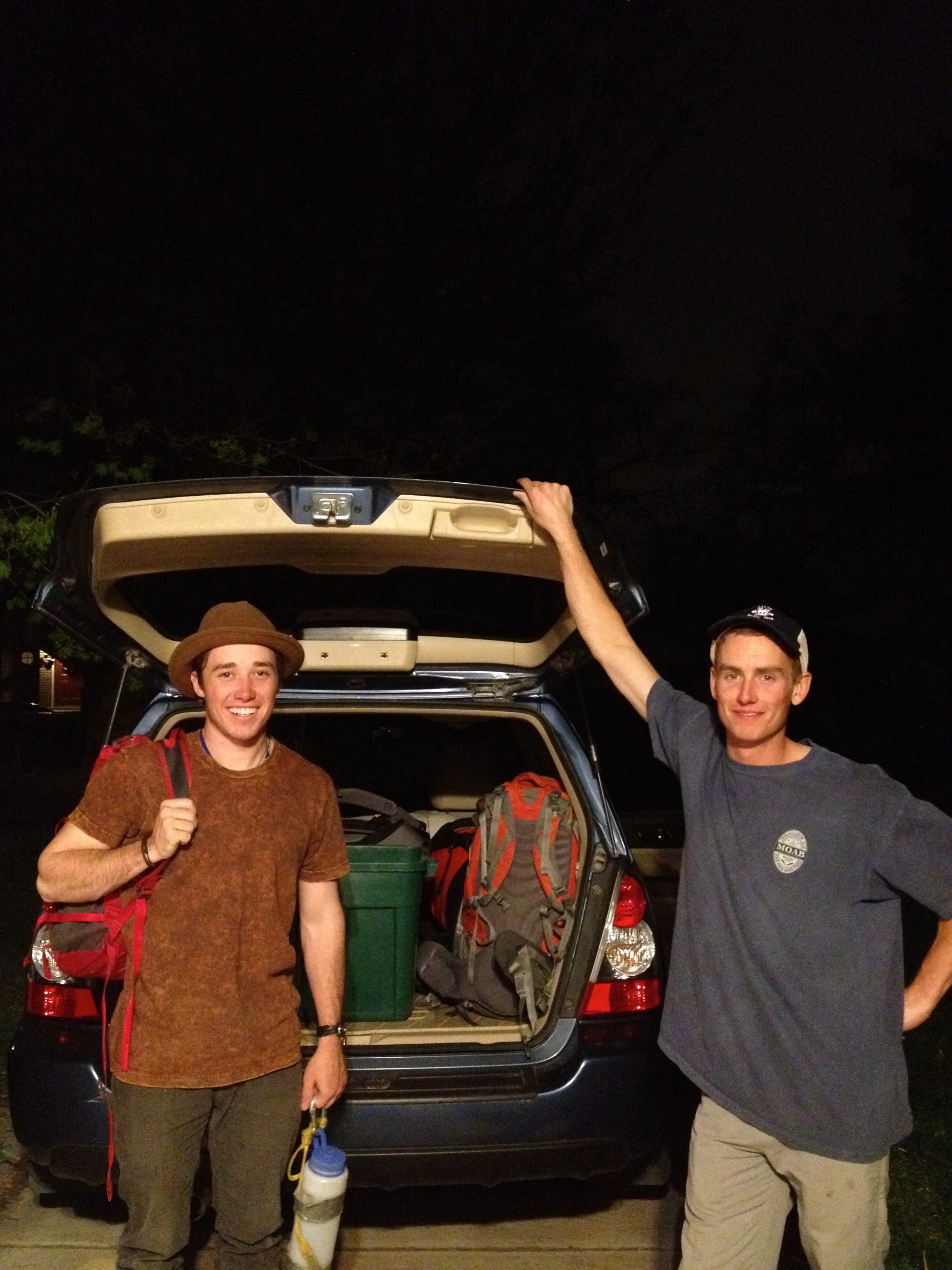
Crowson (left) and Harrison pack their car for a climbing trip in April.

According to a national survey by the Kaiser Family Foundation, kids ages eight to 18 spend an average of 7.3 hours engaging in entertainment media in a typical day. This amounts to more than 53 hours per week.

Be Out There — a National Wildlife Federation campaign that hopes to reconnect children to the natural world — notes that a study in 2005 revealed that children are spending half as much time outdoors than they did 20 years ago.

Neil Crowson — Harrison’s roommate and adventurer counterpart — grew up down the street from Harrison, spending his childhood skiing in the Wasatch Mountains and rock climbing with his father.

“It’s really important for a kid to go out and get himself in the dirt, jump off rocks and cut his knees up, and get on the mountain at a young age,” Crowson said. “If kids do that, then they come to develop ambitions and learn to respect the mountains.”

Both Harrison and Crowson say they have — in one way or another — been defined by their outdoor surroundings, that growing up with the mountains as their playground has given them a sense of place and purpose in a seemingly uncertain world.

The walls of their living room are covered from ceiling to floor with personal photographs that share a common theme: being outside.

The gear room in the basement of their bungalow-style house is crammed with racks of ropes, climbing gear, bikes, skis, backpacks, tents and camp stoves—and a looming odor that can only be created from years of adventuring outdoors.

“I can’t ever see myself leaving the Wasatch completely,” Crowson said. “The people that founded these canyons, both in skiing and in climbing, have also founded tons of areas around the west coast. But you always see them coming back to Salt Lake and that’s because we hold the mountains with such high regard. They define us.”

But that defining power of the mountains — of the outdoors in general — is becoming increasingly sparse among today’s youth, as an increasingly technology-fueled lifestyle drives kids indoors — and keeps them there.

“It’s hard to learn a key set of morals as a kid when the world is changing so rapidly and technology is always advancing,” Crowson said. “It’s always hard to know how to become a man. But the beautiful thing about the outdoors is that it’s a constant. It’s timeless. So the same set of values that existed 100 years ago still exists today.”

Outdoor Nation — a community-based program created by young people, for young people — was founded in 2010 to address the growing disconnect between today’s youth and the outdoors.

“America is in a current state of crisis where its youth are choosing technology over nature, Xboxes (check the proper spelling on X box) over healthy lifestyles,” Outdoor Nation said on its website. “Green spaces in urban areas are either unsafe or non-existent. Families, schools, and media have failed to engage and excite youth about the benefits of the outdoors.”

Judy Brady, a licensed clinical social worker in Salt Lake City, said being outdoors is especially important for a child’s development because it fosters self-esteem.

“One of the ways in which we gain self-esteem is through task mastery,” Brady said. “When a child is outside, he or she gains personal self worth by problem solving, by completing new and challenging tasks.”

A series of studies published in a 2009 edition of Journal of Environmental Psychology found that being outside in nature makes people feel more alive.

“In vital states people demonstrate better coping and report greater health and wellness,” the study reported. “Being outdoors has been proposed to be good for health and well-being because when outdoors, people tend to both interact more with others and get more exercise.”

The sunlight also triggers serotonin and dopamine production, neurotransmitters that help maintain positive feelings in the brain, Brady said. Cases of seasonal depression are seen more often in the winter months because there is less sunlight and people spend less time outdoors.

“When we are surrounded by all man-made objects and man-made ideas — products of our own society — we become dysfunctional,” Crowson said. “We forget how to respond. We are alienated from each other because we are constantly around each other. When you are in the outdoors and there’s nothing but organic sounds, it gives you a chance to really bond with other humans.”

Allison Librett — a lawyer and fitness instructor in Salt Lake City — said that exposing her children to the outdoors at a young age has helped them establish and maintain relationships.

Librett has a nine-year-old and an 11-year-old, both of whom spend their summers at outdoor camps with children of diverse abilities and backgrounds.

“Fresh air, exercise, mental stimulation — these are all such important things for child’s development,” Librett said. “My kids have had the opportunity growing up to interact with the world around them, to know what their imprint is and that they have a purpose.”

Librett said that when her children spend long periods indoors — especially when they are on the computer or playing video games — she notices that they are much more anxious, emotional and frustrated.

Those emotions disappear when her children are engaged in outdoor activities.

Harrison said he hopes that today’s youth will realize what adventuring outdoors has to offer.

“Kids should be excited to get out, to be outside, to breathe fresh air, to see a full moon and a bunch of stars, and hear the coyotes,” Harrison said. “That’s the sickest thing to me: just hearing and seeing and feeling the world as it is. ”

And if Harrison’s convictions about the benefits of nature aren’t heartfelt and persuasive enough, then perhaps a passage marked in his copy of “Walden” is:

“I went to the woods because I wished to live deliberately, to front only the essential facts of life, and see if I could not learn what it had to teach, and not, when I came to die, discover that I had not lived.”

This slideshow requires JavaScript.

Beyond the medical standard: University of Utah offers wide array of beneficial research

Story, Photo, Video, and Audio by JAVAN RIVERA

Additional Photos courtesy of CAROLYN STWERTKA and CRAIG GRITZEN.

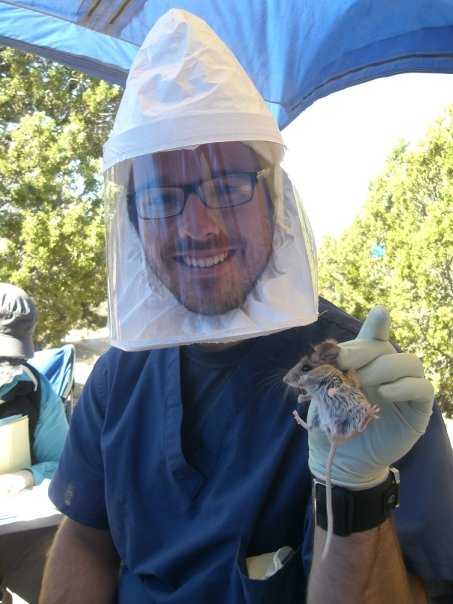
Craig Gritzen doing fieldwork in the Great Basin Desert, in Juab County Utah, 2009. Working with the sin nombre virus requires the use of specialized headgear to prevent human infection.

It’s a delicate and time-consuming process.

University of Utah graduate researcher Craig Gritzen spends his days at the U’s Dearing Lab viewing parasites through microscopes and testing for the sin nombre virus. However, it’s not medical research he’s doing, but biological studies of parasite and virus correlation in Utah’s population of deer mice.

The U is well known for being on the cutting edge of medical research and innovation. With an entire section of the campus dedicated to a fully-functioning research hospital, it can be easy to forget that the university also serves as a quality institution of scientific research that spans from biology and immunology, to meteorology and paleontology and more.

Gritzen is just one of the many students and professionals at the U doing important research that rarely gets the press of its better-known  medical counterparts. But that doesn’t make it any less vital.

“There’s a lot of opportunity for students to pursue their interests,” Gritzen said. “You really find yourself as a scientist when you do research.”

Doing research is exactly how Gritzen spends most of his days. A graduate student pursuing his master’s in biology, the core of Gritzen’s work is investigating possible correlations between the numerous parasites that can be found in the guts of deer mice, and the deadly sin nombre virus that the rodents carry.

Gritzen’s work represents an important step forward in understanding the dangers of at least one type of Hantavirus, a genus of virus that can be fatal to humans if inhaled. He hopes his research can help to track sin nombre virus infection in future deer mice populations and provide more warning for the people who live in deer mice populated areas, such as Emigration Canyon.

“Understanding what parasites are infecting these mice and identifying the effects of the parasites on the mice will allow for researchers to understand whether the parasites will increase or decrease the likelihood of the mice becoming infected by the virus, which in turn can determine the likelihood of humans getting infected due to close proximity to the mice,” Gritzen said.

Protospirura numidica is just one of the many parasites that can infect the digestive tract of Deer Mice.

Gritzen’s research could benefit Utahns who live in close proximity to the mice, who are, by default, at risk of inhaling the rodents’ feces and contracting sin nombre virus. The virus, which fills human lungs with liquid, literally causes the infected human to slowly drown.

“Humans who live in close quarters with the mice are the ones in danger of being infected,” Gritzen said. “It [his research] is important for people who live in environments where the mice can live and thrive.”

Of course, biology isn’t the only field of lesser known, but important research going on at the U. Two graduate researchers at the U’s Atmospheric Sciences Department are working on separate research projects that could shape the future of pollution regulation and legislation, and save energy investors millions of dollars.

Carolyn Stwertka is one of those researchers. She is working on a revolutionary new atmospheric model that could help us truly understand and accurately measure carbon dioxide emissions.

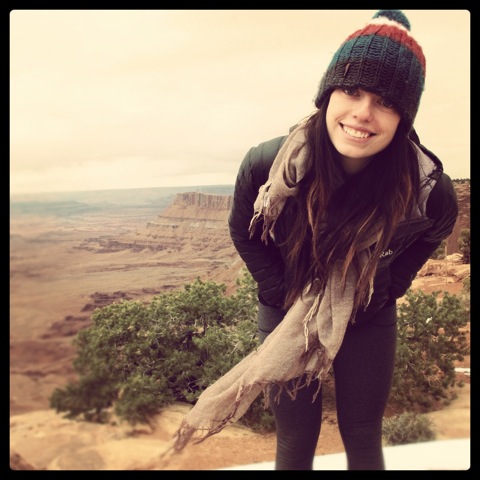
An inversion creeps across the city as Carolyn Stwertka hikes up the Grandeur Trail to gather carbon dioxide density measurements of Salt Lake City’s surface air.

Stwertka, a graduate researcher in the U’s Atmospheric Sciences Department,  is working with a unique set of carbon dioxide measuring sensors set up across the Salt Lake Valley that help measure and compare carbon dioxide output across the valley and into the upper atmosphere. The outcome, Stwertka explained, should help scientists truly understand the amount of carbon dioxide circulation in our atmosphere and its effect on the population.

These sensors, she said, represent the “longest standing, consistently running set of stations in a city in the world.”

Part of what makes Stwertka’s research unique, besides the network of established carbon dioxide sensors, is that Salt Lake City represents an exceptional staging ground for her research and the development of her carbon dioxide tracking model.

“Essentially, Salt Lake City is a great place to study [carbon dioxide circulation] because it’s so isolated,” Stwertka said. “It’s very difficult for air to drain out of this valley.”

What has Stwertka discovered so far?

With research that has spanned from crunching years of data, to a hike up Millcreek Canyon’s  Grandeur Peak lugging a backpack full of electronic, atmospheric measuring equipment, Stwertka’s unpublished results seem to indicate an interesting atmospheric affect.

Carbon dioxide seems to create a sort of bubble around cities like Salt Lake, which  is quite similar to another scientific phenomenon known as the “heat island effect.”

“That [her research] is important because the human population is growing, more people are moving into cities, and more carbon dioxide is being added in the atmosphere,” Stwertka said. “If there is going to be [future] regulation on carbon dioxide, they should be enforced in cities because that is where the highest concentrations of human-created emissions are.”

Stwertka’s research represents real progress, not only in helping to solve Utah’s inversion and pollution problems, but could even be used to better understand global climate change and pollution regulation around the world.

With climate change and global warming becoming a hot topic around the world, Stwertka’s work is extremely relevant, if unconnected to U researcher Ryan Oates’ atmospheric studies.

Ryan Oates uses global climate models to simulate massive increases of carbon dioxide in earth's atmosphere in order to make observations of its affect on the polar vortex.

Oates, whose work is also based in the Atmospheric Sciences Department at the U, is based around an established phenomenon known as a “Stratospheric Sudden Warming Event.”

These warming events take place above the North Pole in the upper part of the atmosphere, known as the troposphere. The events are basically destabilization of the polar vortex, a massive circulation of the atmosphere during the winter months above the North Pole that directly affects mid-latitude weather.

Oates said the cause of these polar vortex destabilization is simply strong weather fluctuations below the vortex.

“The troposphere affects the polar vortex but it also works the other way,” Oates said. “So when you have these sudden warming events, that then impacts storm tracks. ”

That’s where the money comes into play with Oates’ research. With energy representing a billion dollar industry that relies on weather forecasting and the understanding of storm tracks and weather patterns during the winter, adding more knowledge to that database is priceless.

“That [research] is important to investors because it increases both the opportunity and risk of their investments,” Oates said.

Oates’ work is very similar to Stwertka’s research because, much like her, he is interested in discovering the effects of carbon dioxide on the atmosphere, and more specifically, the effects of carbon dioxide increase on the polar vortex.

“I’m seeing how the vortex changes with climate change,” Oates said. “It’s really important because we’ll be able to identify the behavior and frequency of these sudden warming events, thus we’ll be able to see if there is an increase or decrease in [large-scale] tropospheric weather.”

Oates’ preliminary results seem to point to a direct correlation between carbon dioxide increase and an increase in stratospheric sudden warming events, something many weather-sensitive commodity investors will likely find interesting—and profitable.

In the end, whether they’re studying climate change and weather patterns, or mice and deadly viruses, the quiet but deliberative scientific research going on at the University of Utah is more important than most people realize.

“For me science ties into everyday things,” Oates said. “What I love about science is that you can’t isolate it to just one thing. It always has real life implications.”

Katie Harrington

Photo by Hannah Harrington-Dunn

MY STORIES:

MY BLOG:

I remember when it started, when I began to fall in love with journalism.

I was 18. I was sitting on the brown leather sofa in my living room, holding open a crisp copy of The Salt Lake Tribune. It was like any other day: I woke up, brushed my teeth, went to the living room and picked up the paper off of the coffee table. Except that on this day, when I sat down on the couch and turned to the Utah section, I found myself staring at a photograph of me.

It was one of those let-me-perform-the-most-awkward-smile-and-pose-for-you-nervously photographs that you like to forget exists. There I was in all my glory: sitting in the newspaper room at my high school, wearing thick-rimmed glasses, holding the last edition of The Bulldog Press that I’d be a part of, and staring into the camera with wide eyes and a raised brow.

The headline above the photograph read: “Judge teen named Super Journalist”.

Whatever that means.

At 18, I’m not sure you can be “super” at much, except maybe telling wisecracks at inappropriate moments or walking around thinking you’re cooler than everyone else.

But I was most certainly not a Super Journalist, I thought. I was not deserving of the capital S or the capital J. I just liked to write. And there was nothing Super about that.

I began reading the article, skimming the words that I had said to a reporter a week before.

“I just think [journalism is] a good way to help people who don’t have a strong voice,” Katie said. “I feel like I can be a voice for them. Also, journalism is a really good way to spark change or spark a movement toward something.”

A strong voice. Sparking change. Reading those words quickly brought me back to several months prior.

I sat in a dark living room in an obscure Salt Lake City suburb that I wasn’t aware existed. Across from me sat a college-aged kid, shoulders slumping, eyes gazing at the floor. His mother sat next to him, her hand on his knee, as if to say, “I’m here for you sweetie.” His foot was tapping on the floor nervously. I felt nervous, too. Extremely nervous. But ready.

“So, tell me about your accident,” I said.

He didn’t speak much. His mother mostly spoke for him, explaining the fateful night when her son ran a red light — allegedly text messaging — and crashed into another car. That car was carrying a 16-year-old girl named Lauren Mulkey — known for her beauty and vivaciousness — who did not survive the crash.

The only words he muttered clearly during the interview were “I think about her every day,” though even those ones were spoken faintly.

It was apparent that he felt ashamed. But it was also apparent that he wanted to say something. Loudly. Proudly. Without his mother. But he couldn’t. It hurt too much.

If only he could say something loud enough for someone to hear:

Stop being distracted. Stop multi-tasking while you drive. Your life can be altered, shattered, destroyed in a single moment.

It became apparent to me during that interview that I was the person who could say those things loud enough for people to hear. Loud enough for people to acknowledge, to accept.

Looking back at that interview, and at the work I have done in this class, I am constantly reminded why I fell in love with journalism.

I am a voice for those who don’t have one. I am a seeker of voices that would never be heard if it weren’t for my endless desire to make sure that they are.

Throughout this class, I have sought out voices. Voices that had something to say. Voices that were worth hearing. Voices that spoke about law and justice. Voices that spoke about what it means to be creative and happy and human.

This class has given me tools to better find those voices, to have them heard more concisely and eloquently. But most importantly, this class has reminded me why journalism is loved by so many. It’s a profession that focuses on people.

Meeting people. Speaking to people. Influencing people and being influenced by them. The more I write, the more interested in people I become, the more I want to know.

I still believe there is nothing I have done that is all that deserving of that capital S and that capital J once printed in the Salt Lake Tribune. But perhaps I’ve come to realize that what can be defined as “Super” are the thousands of people who make the pages of newspapers worth reading.

They are — and always will be — something Spectacular.

ABOUT ME:

I am studying print journalism at the University of Utah. I’m drawn to journalism because it gives me an opportunity to instill a voice in people who are too afraid to use their own. I have the desire to constantly improve the human condition through my writing.

The Wasatch Mountains have kept me enthralled for 21 years and counting. I was born and raised in Salt Lake City and I am only beginning to discover the wonders that this place has to offer. I live to ski, rock climb, travel, camp, and eat delicious food. I am learning Spanish and attempting to become a self-proclaimed Italian food connoisseur. I want to see the world and experience the cultures that reside within it.

One World Café heightens the food expectations of the non-profit world

This slideshow requires JavaScript.

by Tricia Oliphant

Imagine a menu that offers so much variety it actually changes on a daily basis. You choose your portions and then pay what you are able or what you think your meal was worth. If you do not have money to buy a meal, you can volunteer an hour of your time and eat for free.  Those who serve your food are also the people who helped prepare it, allowing you to find an immediate answer to the age-old question “It looks good, but what’s in it?”

Sounds too good to be true, right?

Such is the organization of One World Café, a non-profit community café in downtown Salt Lake City.

Denise Cerreta founded One World Café in 2003. It is now part of several non-profit cafés nationwide that make up the One World Everybody Eats Foundation. The café provides delicious, healthy meals to all who desire to eat, regardless of their financial situation.

When I heard about this revolutionary idea of choosing my portions and what I wanted to pay for them, I was curious about how it worked. I decided to give it a try with a friend.

Upon entering the café, we immediately noticed the friendly atmosphere. We were greeted kindly by one of the cooks/servers who directed us to choose our plate size. Although we were only required to pay what we deemed fair, we did see price suggestions according to the size of plate written on a blackboard (small: $4 to $6, medium: $7 to $9, large: $10 to $12.)

Our server then described each of the dishes laid out in front of us, buffet style. The main dishes included sweet curry over brown rice, a unique asparagus quiche on a potato crust, and seasoned beef bursting with flavor.

An assortment of fresh salads complimented each of the main dishes, including a zesty marinated carrot and cucumber salad, and a wild rice salad with celery and tomato.

We tried a bit of everything. We also chose a drink from a selection of coffee, tea, soymilk, almond milk, or water.

The One World Café offers a cozy, “feel like you’re eating in your mother’s dining room” atmosphere.  Each of several dining rooms contains only a couple of dining tables to provide a sense of privacy. A patio in front allows for dining al fresco.
In addition to the warm, inviting atmosphere and the plethora of food and dining options, the food itself at One World Café was simply succulent and mouthwatering. The ingredients were clearly fresh. Most were organic.

“I believe in getting food as close to the source as possible,” One World Café manager David Spittler said.

Sunflower Farmers Market donates many of the ingredients used at One World Café.  The café also participates in Community Supported Agriculture (CSA), where a monthly fee is paid to a local farm for its fresh produce.

Spittler became an advocate of fresh, organic food while he worked on a peach farm after high school.  The peaches they shipped to places such as Wal-Mart, Spittler said, were picked while they were still green, thus robbing the produce of many vital nutrients.

Using several of their favorite cookbooks, Spittler and a group of regular volunteers decide how to use the fresh ingredients as they prepare a weekly menu — about a week in advance.

“We try to make the menu as friendly to everyone as possible,” he said.

“My favorite cold dish was the Cucumber and Carrot Zest,” said customer Lauren Snow on a recent visit. “The ingredients were so simple but it had so much flavor, and it’s something I can make at home.”

One other point in One World’s favor: very little food at the café goes to waste. Because customers choose their portion sizes, they eat most of their food.

Furthermore, the food that is left over at the end of the day, such as salads, can often be reused in another dish the following day. Although the hot dishes are not reheated, Spittler said, they are often reused in a soup. Any leftover waste is recycled as compost.

One World’s kitchen is small, but out in the open for all to see.  Customers can watch their meals being cooked. With only one six-burner stove in operation, something is always cooking.

“We can’t prepare large quantities [of food] at one time,” said volunteer Isaac Hoppe. “This is a good thing because it’s fresh.”

Whether you’re looking for a pleasant dining atmosphere, a delicious variety of well-prepared dishes, or would simply like to help feed the hungry of Salt Lake City, the One World Café has something for everyone.

One World Café

41 S 300 East, Salt Lake City, UT 84111

Hours: Wed -Sun, 8 a.m. -7 p.m.; Fri –Sat, 8 a.m. -9 p.m.

Phone: 801-519 – 2002519- 2002

###

https://docs.google.com/presentation/pub?id=1VmCCD4YaEfZgTKii2zE8Y05ysQrLDltQH62rw_XFxUk&start=false&loop=false&delayms=3000

City Creek Center opening brings thousands to downtown Salt Lake City

This slideshow requires JavaScript.

by Tricia Oliphant

Crowds lined the walkway. Parents gripped the hands of their squirming children, who were eager to run off and explore. The shutters of cameras repeatedly clicked.

In one corner a musician put his soul into playing the blues on his saxophone.  In another, musician and performer Steven Sharp Nelson of The Piano Guys entertained a crowd with playful tunes on his cello. The laughter of a nearby group of adolescents resonated as they talked about their plans and what they wanted to see first.

That overflowing excitement most often only theme parks can create filled the masses swarming downtown for the opening of Salt Lake City’s first downtown mall in three decades.

City Creek Center opened on Thursday, Mar. 22, 2012. Like many others, I was drawn to the novelty and newness of City Creek. I decided I had to join thousands of others in visiting City Creek on its opening day so I could answer the question posed by a dear friend of mine, “Is it really as big a deal as it has been made out to be?”

Although City Creek offers ample parking in a giant, heated three-level underground parking garage, I chose to take the TRAX (Utah’s light rail system) to the new shopping center.  In spite of the train being loaded with anxious shoppers of all ages who were also heading for the mall, I thought it offered the convenience of not fighting downtown traffic or hunting for a parking place.

City Creek Shopping Center was funded entirely by cash reserves of the LDS Church and built on three church-owned blocks in downtown Salt Lake City. A sky bridge over Main Street connects two of the blocks and allows shoppers on the second level of the center to cross from one side to the other.

Upon arrival, I was impressed by the classy architecture and design of City Creek Center. I quickly realized this wasn’t just any ordinary mall when I noticed the glass roof is actually retractable. City Creek opens the roof when the weather is just right, providing a view of the open sky and surrounding skyscrapers.

Along with over 90 stores and restaurants, the shopping center offers a wildlife landscape downtown with the re-creation of the historic City Creek that winds through the shopping center’s walkways and plazas—complete with live fish.

In addition to the creek, the shopping center offers a variety of waterfalls, ponds and fountains (one of which is open to children who would like to cool off while splashing in the choreographed blasts of water.) I found each water feature to be quite beautiful and each added a sense of natural serenity to the busy shopping center.

“Standing at the base of the skyscrapers surrounded by rivers and waterfalls was a striking experience of both outdoors and the big city at the same time,” shopper Matt Argyle said. “It’s really breathtaking.”

Benches and tables rest on the edge of the creek and beside the waterfalls. These provide places to relax and enjoy the peaceful atmosphere.

Some believe the quality of the food court can often make or break a shopping center.  City Creek’s food court is nothing to scoff at.

The massive food court is located next to the creek and a waterfall. Diners can eat inside (with many of the tables located next to giant windows in front of the water features) or can dine al fresco.  Both options offer a relaxing place to eat.

The food court is made up of everything from Subway to the Taste of Red Iguana to the Great Steak and Potato Company. Other restaurants, such as The Cheesecake Factory and Texas de Brazil Churrascaria, are also located in the shopping center.

By wandering through City Creek Shopping Center, it soon became clear that people came for much more than shopping and spending. This was a public event, a place for relaxing and enjoyment with friends and family. While taking all this in, I wondered about the future of City Creek and its potential impact on surrounding malls (such as The Gateway, a mere two blocks to the west).

Although City Creek attracted large numbers of people opening weekend, The Gateway was not left completely desolate.

“We were actually pretty busy opening weekend,” said Kara Johnson, an employee at Down East Basics, at The Gateway. Down East Basics, a moderately priced casual apparel store, is not duplicated at the new City Creek Center. “I expected it to be dead,” Johnson said.

Despite the crowds of people at City Creek Center opening weekend, many realized the stores at City Creek were more expensive than they had expected. “They came to Gateway because they knew what to expect,” Johnson said.

Unlike The Gateway, City Creek Center is closed on Sundays. This gives the older mall an extra day to attract shoppers and therefore compete with the novelty of the new shopping center.

Furthermore, although some of the stores are duplicated at both shopping centers (such as Forever 21), many are not. This gives a distinct shopping opportunity at each location.

Johnson said that because she has never been to many of the stores now located at City Creek, she would like to go there just to see what they’re like. “I just want to say I’ve been in a Tiffany’s.”

The uniqueness of the new stores to Utah clearly attracted crowds to City Creek Center.  However, many Utahans are known for being “frugal” and “resourceful”. Higher-end stores may not sit so well with a thrifty people.

“I love City Creek. It’s just so nice,” said Jannali Ouzounian, a new mother from Holladay. “I just wish I could afford to shop at all the stores. A wallet at Tiffany’s [costs] $600.”

“I think Utah could do a lot better by bringing in the outlets,” said University of Utah student Kelly Wolfe. She said that putting in stores such as the Tommy Hilfiger Outlet and Bloomingdale’s Outlet would not reduce the classy appeal of City Creek and would attract a greater portion of the Utah market.

Being a bargain hunter myself, I would love to shop at classy outlet stores downtown. However, I find the higher-end stores at City Creek to be alluring.

How long this allure will last remains in question.

“I think once all the hype wears off, City Creek will be just another mall,” said Utah State University student Elise Olsen. However, once all the hype does wear off, Olsen said she plans to shop at City Creek with hopes of finding good sales on high-priced items.

Only time will tell the fate of City Creek Center and whether it will continue attracting large crowds of people to the downtown area. In spite of this, I found City Creek Center to be beautifully constructed and thought it added class to Salt Lake City.

In answer to my friend’s question, City Creek is quite a big deal — for now.

Holly Mullen

My Blog: They’ll find their way

Late last summer, Professor Louise Degn, with the University of Utah Communication Department, invited me to teach Communication 3660 during spring semester 2012. I had time on my hands. I was doing a little freelance writing and strategic messaging. It sounded like a breeze.

It was anything but. Two months before class was to start, I took a full-time job as interim director of the Rape Recovery Center in Salt Lake City (next to news reporting and writing, I love the non-profit world, and I especially love working with survivors of sexual violence). Suddenly, I was faced with squeezing together several hours a week of teaching, as well as learning how to manage a nonprofit organization.

As I write this blog, one day before the final day of class, I couldn’t be happier about this group of budding journalists. They know how to start, execute and finish a project. The course required them to push boundaries and stretch way past their comfort zones (I hope they will forgive me those cliches). One of the main challenges they faced was venturing out, interviewing and photographing or filming people they did not know. Most of the class members accepted the challenge, and surprised me with the results. They dug for information, they played with new forms of media, they willingly shared their stories with peers and wrote and rewrote throughout an exhausting editing process.

I will repeat what I have so often told the class: Just do what you love. The rest will follow. You see, we talked often in class about the sorry state of journalism employment. Oh, it’s so bad. Oh, it’s not the way it used to be. Oh, there’s no money. There are no jobs. Blah, blah, blah.

If you read the students’ work on the Law & Justice page here on Voices of Utah, I know you’ll see what I see: Young people full of hope and promise and ambition.

They will find their way.

About me:

I am a native of Salt Lake City, a graduate of Olympus High School and a mass communication graduate of the University of Utah (B.S., 1981). It’s hard to believe I started my college career as an anthropology major, because the day I wrote my first story for the Daily Utah Chronicle, I was hooked on news writing. That was in 1979. My senior year, I was appointed editor of the Chrony, and I never, ever looked back.

My journalism career has taken me all over the country. Through the ’80s and ’90s I worked at the Spokesman-Review in Spokane, Wash., then the Saint Paul Pioneer Press in Minnesota, then a defunct alternative weekly in Minneapolis called Twin Cities Reader. Then it was off to Dallas and Fort Worth, where I covered business and politics at the Fort Worth Star-Telegram and moved to another alt weekly, the Dallas Observer (part of the Village Voice Newspaper group).

I realize as I write this biography how really old I am.

I returned to my home town in 1997, where I worked for The Salt Lake Tribune in many capacities for 10 years, including managing editor for sports during the 2002 Winter Olympics and as a metro columnist for five years.

The story is getting long and dull. Suffice to say I still love to write, but now stuff my ideas and dreams into my own private journals. I love politics, skiing fast downhill, running distances, road cycling and my husband, Ted Wilson and my two children, Caitlin Warchol (24) and Sam Warchol (21).

My husband and I keep talking about retiring someday in India.

But retirement seems so far away.

Billy Yang

by BILLY YANG

MY STORIES:

Sim Gill: Policing the police

HB 497: The long arm of the law overstretched

Chowing down with SuAn Chow, goddess of SLC mobile cuisine

Spotlight on Jeremy Lin exposes Linsane Asian stereotypes

MY BLOG: Genuine enjoyment

I had a moment of clarity when I was working on an assignment. It was something that caught me by surprise.

As I was wrapping up my day at the Gallivan Center, where I spent a few hours shooting photos and interviewing patrons of the Chow Truck, when it just struck me. I genuinely enjoyed the work I was doing. It is definitely something I could see myself doing for the rest of my life, I thought.

I love talking. I often say it’s one of my favorite things to do. But I also love hearing stories. And I firmly believe that everyone has a story to tell.

Which other profession allows me to walk around, meet interesting people and tell their tales?

Even though every journalism teacher I have had at the University of Utah has told me journalism is a dying profession, I personally believe there will always be a place for proper journalists.

Being a journalist means going out and getting the story — finding sources, hitting the beat. This is what sets professional journalists apart from basement bloggers.

My class had a guest speaker that I found particularly inspiring and encouraging. Kevin Pang, a features writer at the Chicago Tribune, spent time talking to the class about his career and gave us tips about writing.

There was one thing Pang said that really stuck with me. There will always be jobs for people who can write well, he said.

I was lucky enough to secure a one-on-one meeting with Pang and he agreed to read a couple of articles I wrote for The Daily Utah Chronicle and critique them. When I showed up to the meeting, I was shocked to hear that he enjoyed my work.

Pang told me I am a good writer but there is room for improvement. He then went on to give me tips on how I could make my writing really pop and even introduced me to internships and career building programs at the Los Angeles Times and Chicago Tribune.

The experiences I’ve had this semester were real confidence boosters. While I’ve been told numerous times throughout my schooling that journalism is dying, I am optimistic that there will be a future for me in my dream career.

ABOUT ME:

I’m a journalism major at the University of Utah. It’s my junior year and if everything goes according to plan, I will graduate next spring.

What draws me to a career in journalism is the prospect of exploring the world, hearing interesting stories and retelling them.

As an aspiring world traveler and fledgling foodie, I hope to become a travel writer. I imagine a life of jet setting to stunning locations across the world, eating at the best restaurants and writing about my experiences — basically, getting paid to go on vacation.