Am I Latinx? Or am I Black? What if I’m both?

Story and photos by SHAUN AJAY

The intersection between Latino and Black runs deep in racial and self-perceptions among those who identify as Afro-Latinx. The term Afro-Latinx encompasses those from Mexico, Central and Latin America of majority African descent. The choice rests on the individual and what they choose to identify with. Since Latino is not a race or ethnicity, the term Afro-Latinx is an umbrella for those who identify primarily with their African roots and their ethnicity such as Afro-Dominican or Afro-Cubano. This article tells the experience of three Afro-Latinas in Utah.

Portia Saulabiu

Portia Saulabiu is a retention coordinator and advisor at the Center for Ethnic Student Affairs (CESA) at the University of Utah. She was born and raised in different neighborhoods in Chicago, where her parents had met. Saulabiu’s mother is African-American and her father is a Taíno from Puerto Rico and the Dominican Republic. Saulabiu said she felt a great desire to connect with her father’s side of the family, but growing up in different areas had impeded her.

Saulabiu was raised with her mother and so mainly involved herself with Black culture. It wasn’t until college, when she started to embrace her Latinx culture more. But Saulabiu’s connection to the culture, either through blood or an inborn interest, had begun at a young age. She began speaking Spanish at the age of 8, learning the language formally from middle school through college.

As a college student, she traveled to Cuba for a learning-abroad program, where she worked with a church in rebuilding homes, and conducted research on interracialism. This was her first experience in Latin America and Saulabiu said she began to grow more comfortable with her identity. But coming into contact with a different culture can sometimes mean hardships and miscommunication.

Colorism, she said, played a huge part in her identity as an Afro-Latina. She said there was no greater understanding of the concept of colorism in Latinx homes. Colorism is the prejudice or discrimination against individuals with darker skin tones within the same ethnic or racial group. Saulabiu was often treated differently because of her darker skin. “The color of your skin, your lineage of indigeneity, it all affects how you’re viewed as a Latinx,” she said.  

Her heritage and ancestry is something that Saulabiu couldn’t be taught by her parents. At first, she explained that it was weird having to learn more about her background. “It’s because you’re so socialized to identify yourself as just being Black. But to be Black means so many different things,” she said.

Saulabiu wants more people to be introspective of their racial and cultural identity. Saulabiu said that being Afro-Latinx is not about being Black or being Latinx, it means being Afro-Latinx as its own autonomous identity. “There is value in finding about all parts of yourself,” she said.

Tierra Yancey

Tierra Yancey is a junior anthropology student at the University of Utah. She comes from a military family, so a majority of her childhood involved moving across the country and around the globe. She and her family have been living in Utah for the past 10 years.

Yancey spent most of her time with her mother’s side of the family. Her maternal grandmother is Puerto Rican and her maternal grandfather is African American. Since her mother’s family is also mixed, Yancey did not grow up feeling too different. But on her paternal side, she was often confused with being half white, because of her hair texture or the way she talked.

In her formative teenage years, Yancey mainly identified as being Black. “That’s how I was seen to others, but I knew I was a bit different.” In high school, Yancey said it was hard for her to identify as being Latina, as she does not speak Spanish. “I was never Latina enough,” she said, “but Black people consider you Black enough.” The Black community, she acknowledged, is more accepting of Afro-Latinx than Black people with white ancestry.   

Among her nine siblings, Yancey is the only one with her particular hair texture, which she describes as a more loose, mixed-look style than typical Black hair. “Hair texture is really important in Black culture,” she said. “It can signify what kind of mixes you have.” In her family, Yancey is considered to be lighter skinned, and has “good” hair — traits that make her stand out more among other Afro-Latinx who have coarser hair and darker skin.

Yancey said hair also plays into the concept of colorism. Her grandmother, who is light-skinned, always used to tell her, “Oh! Mija, put sunscreen on. You don’t need to ruin your skin.” Yancey said she felt pressured to highlight those particular standards of beauty as an Afro-Latina. She was told to wash her hair properly, or not spend too much time out in the sun, while her siblings were never told anything.

Yancey continues to explore her identity as an Afro-Latina. She wants to push herself to dive into both cultures by defying the boundaries of racial categories. “It’s like having a plate of tacos, and bowl of baked mac n’ cheese — it’s different, but it’s good.”

Kiara Maylee Grajeda-Dina

Kiara Maylee Grajeda-Dina is an Afro-Latina from Salt Lake City, a business major and aspiring fashion entrepreneur. Both her parents are from Mexico; her mother from Guerrero and her father from Guadalajara. Her upbringing was cultural Hispanic. She goes to Catholic Church and speaks Spanish as her first language.

Grajeda-Dina’s mother has primarily West African ancestry dating back to the 1780s, when enslaved people were brought to the Americas through trade. Afro-Latina is a newer term for Grajeda-Dina and her mother. Before, she said her mother used to just consider herself as Hispanic, but now embraces the new term. Grajeda-Dina pointed out that West African or Black culture is very evident within the area of Mexico where her mother grew up. She said that it was incorporated into the rest of Mexican culture along with indigenous Acapulco and Hispanic traditions.

Grajeda-Dina gave an example of a dance called danza de los diablos (dance of the devils), which originated from slaves who were taken to the state of Oaxaca in 1442 to work in the plantations. The dance features indigenous masks with horse hair and colorful clothing that Grajeda-Dina said is heavily inspired by African culture. She also said that the dance is a special way of protecting the Afro-Mexican legacy from cultural assimilation.

Although colors are celebrated in tradition and clothing, darker skin is disdained. Grajeda-Dina said that she struggles with her skin color as an Afro-Latina. She said she doesn’t feel Black enough, or brown enough in both communities in the U.S. “Being a colored person, your skin speaks volumes before you even open your mouth,” she said. Grajeda-Dina’s family considers her skin as “piel que mada” or charred skin. She compared this to an onion, like layers of skin that you want to peel off. “It’s hard when your culture only embraces parts of you. We’re pitting ourselves against each other.”

With celebrities like Lupita Nyong’o identifying as Afro-Latinx, Grajeda-Dina has found confidence in her identity. Grajeda-Dina said she hopes that more Latinxs start to acknowledge the power of identifying with their roots as an Afro-Latinx. “Knowledge is power,” she said. “Look into what makes up who you are. It’s part of what makes you you.”


This slideshow requires JavaScript.

Redefining success for African-American college students

Story by TREVOR RAPP

President Barrack Obama stood before the nation on Feb. 12, 2013, in his State of the Union address and showed just how much African-Americans can achieve, not necessarily by what he said, but just by being the one who said it.

While debate surrounded what he said, the fact that an African-American was standing in the office as president of the United States of America for a second term was indisputable.

His words also seemed to be directed at others who may struggle to find success because they are classified by others as a minority.

“It is — it is our unfinished task to restore the basic bargain that built this country,” Obama said, “the idea that if you work hard and meet your responsibilities, you can get ahead, no matter where you come from, no matter what you look like or who you love.”

So what does an African-American university student need to do to find success? For Ennis Henderson, a senior at the University of Utah studying business, one of the most important steps is to take control of the process himself instead of giving that control to others.

“I was brought up in the South by a family of strong and proud men and women,” Henderson said. “They raised me to be a capable, responsible and dignified man. It isn’t up to whites, blacks, Hispanics, Asians or anyone else to ‘Let Me’ enjoy anything, much less my own success. I won’t allow a person to position themselves in my life in such a way that they have that kind of power over me.”

A strong sense of self-sufficiency may be one of the reasons Henderson is experiencing success in a campus whose student demographics is only 1 percent African-American.

Defining African-Americans’ struggle for success based not upon outside limiting factors imposed upon them, but rather internal characteristics that have led to success is happening far too little, wrote Professor Shaun R. Harper, director of the Center for the Study of Race and Equity in Education at the University of Pennsylvania.

In “Black Male Student Success in Higher Education: a report from the National Black Male College Achievement Study,” Harper wrote, “For nearly a decade, I have argued that those who are interested in Black male student success have much to learn from Black men who have actually been successful. To increase their educational attainment, the popular one-sided emphasis on failure and low performing Black male undergraduates must be counterbalanced with insights gathered from those who somehow manage to navigate their way to and through higher education, despite all that is stacked against them — low teacher expectations, insufficient academic preparation for college-level work, racist and culturally unresponsive campus environments, and the debilitating consequences of severe underrepresentation, to name a few.”

The study deliberately quickly passes over “anti-deficit research,” such as the fact that in 2002 black males only represented 4.3 percent of students enrolled in higher education, a statistic that hasn’t changed since 1976. Those omissions are not because they are not important. Harper just wants to focus on what’s going right instead. This includes the stories and statistical analysis of more than 200 young, successful black males who were able to find success through the following factors:

  • having parents with consistently high expectations
  • having influential teachers previous to college
  • having a “college-bridge” opportunity that allowed them to get acquainted with the university and classes before starting
  • finding ways to minimize the stress of paying for college
  • being focused in their classes.

Harper wrote there are likely many African-Americans on college campuses who “completely contradict popular narratives of Black male hopelessness. They are somehow debunking longstanding caricatures of Black undergraduate men as lazy, unmotivated, under prepared for college, intellectually incompetent, and disengaged. Find them. Ask them how they got there.”

For Henderson, a student at the U who has achieved success in multiple areas, the success has come from himself. Whether it was from retiring from the United States Marine Corps as an “E-6 Gunnery Sergeant, with an impeccable record, numerous awards, accolades and abilities,” to helping his two daughters graduate from college with graduate and post-graduate degrees.

“I look at these clowns [who try to suppress African Americans] and laugh.” Henderson said. “Therefore — ‘No!’ No one has the power to allow or deny me the opportunity to enjoy my success, unless I’m foolish enough to give it to them. That won’t happen.”

Salt Lake City’s CHOICE Humanitarian, helping African communities

Story and slideshow by ALEXA WELLS

Visit Kenya with three women who volunteered for CHOICE Humanitarian.

CHOICE Humanitarian, The Center for Humanitarian Outreach and Inter-Cultural Exchange, is an organization that helps the countries of Kenya, Nepal, Bolivia, Guatemala and Mexico. According to the website, the goal is to “end extreme poverty and improve quality of life through a bottom-up, self developing village-centered approach.”

CHOICE Humanitarian was founded in 1982 by Dr. Tom Evans and Dr. James Mayfield. It is a registered nonprofit organization and takes pride in making every dollar count with solid management and low administrative costs. The headquarters are located in Salt Lake City.

CHOICE expeditions are open to the general public and all ages and different backgrounds. Each village has different projects depending on their unique needs. There are many different tasks that volunteers may end up working on such as: classroom construction, community water systems, bio-gas digesters, health clinics, personal hygiene workshops, pit latrines, micro-enterprise training and other village needs.

CHOICE Humanitarian focuses efforts on two of Africa’s highly impoverished areas, the Kwale and Kinango districts located in the Coast Province of Kenya and East Africa. According to worldhunger.org, in the Kwale area, 32 percent of the population has been reported to be classified as “food insecure” while 40 percent of the population is in absolute poverty. This district results in one of the highest infant mortality rates in the country.

According to the International Fund for Agricultural Development, about 79 percent of Kenya’s populations lives in rural areas and relies on agriculture for most of their income. Nearly half of the country’s 40 million people are poor, or unable to meet their daily nutritional requirements. In some places the conditions have improved since the early 80s, but the poverty rate has remained the same at 48 percent. Kenya has one of the world’s fastest population growth rates and in the last 30 years the population has more that tripled. This population growth causes the country to not have enough resources, resulting in extreme poverty.

Lisa Crossley lives in Layton, Utah,  and has participated in the Kenya expedition for the last three years with her neighbors, Tasia and Kimberly Jensen. Crossley and the mother-daughter team  first participated in the program in summer 2009, where they helped to build a school. In summer 2010, they returned to the same village and helped to teach the children in the school. And the following summer, after saving money from the previous year, they helped improve the water catchment systems in Kenya for two weeks.

“My whole outlook on life has changed since I started volunteering in this organization,” Crossley said. “You don’t realize how good your life is until you go somewhere like Kenya. The children of the school eat a cup of grains for lunch and are lucky to have a place to sleep at night. They are so grateful for the volunteers and the help that they bring to the village. I highly encourage anyone to come and experience this, because it is life changing to be able to make a difference.”

People who volunteer for these expeditions gain hands-on experience while working on the village projects that they are assigned. According to the CHOICE Humanitarian website, “They can learn how to combat poverty with new strategies, such as important hydro-electric installations now in the planning stages. With CHOICE Humanitiarian imput, these and other humanitarian organization projects will result in better economic conditions for tens of thousands of villagers.”

Tasia Jensen said, “I highly recommend for everyone to go on a humanitarian trip sometime in their life. It really makes you appreciate what you have, and you learn so much about the African culture. I spent most of my time hanging out with the children. I did art projects with them and helped teach some of them how to read and write. One of the art projects that was created by the students of Kwa Mulungu Primary School was auctioned off by CHOICE Humanitarian, and the proceeds were to benefit the villages in poverty around the world. They were so happy that I was there to help them, I loved seeing their smiling faces.”

All of the expeditions with CHOICE Humanitarian run one week long. Those who are interested in applying need to book their expedition three to six months in advance due to medical testing and travel assignments. Those who don’t have the time or money to go on expeditions with CHOICE Humanitarian also have the option to donate money to the foundation, get involved in Women’s Equity programs, volunteer at CHOICE headquarters, or create a fundraiser. For example, people can donate money to purchase school desks for the schools in these countries that need them.

“The best part of the expedition was the first day that we got there,” Kimberly Jensen said. “The villagers had a welcome celebration in our honor, and we danced around and sang to their music. It was an amazing experience. They were all so happy to have us there, it really touched my heart.”

Details about expedition costs and country-specific needs can be found on the CHOICE Humanitarian website. The price of the expeditions range from $1,995 to $2,195 per person, not including airfare. The fees include village lodging, food, ground transportation, project costs and materials, and two nights in a hotel. While working within these communities, volunteers are treated as a welcomed guest as they help with their daily life schedules.

“I would help them with their water supply and carry the water in giant buckets on my head. It was so heavy and the temperature there was so hot, I thought I was going to pass out. Then I thought, wow … this is what they do every single day, when all we have to do is turn on the water faucet,” Tasia Jensen said.

While the expeditions are only one week long, most volunteers stay extra days and book other adventures and things to do before or after. Things like sightseeing trips, safaris and hikes are all common outside of the CHOICE Humanitarian program.

“The first year that we went to Kenya we booked a week long African safari after our humanitarian excursion. I am so glad that we did that, it was a great experience to see all of the wild zebras, lions, cheetahs, elephants and so many more amazing animals,” Lisa Crossley said.

CHOICE Humanitarian continues to lift the spirits of thousands of villagers within the five countries where volunteers work. In Kenya, the major tool to fight against poverty is education.

“I will continue to volunteer for this organization because it has changed my life,” Kimberly Jensen said. “I do not regret a minute of my time I spent helping the villagers and children in Kenya. I will make sure that my kids get to experience what I have experienced, and I hope that more people will become involved in humanitarian projects.”

Using genetics to debunk racism

Story and photos by ALYSHA NEMESCHY

Humans have been dealing with racism for hundreds of years, specifically those who are considered black-skinned by society. Africans have been faced with hardships, trials, slavery and even rejection of being human throughout history.

However, recent studies from geneticists may have the key to ending racism. Geneticists have proven that DNA studies show that all modern-day humans originated in Africa.

According to World•ology, as humans migrated north, “the less melanin they needed in order to gain protection from the risk of skin cancer. …Therefore, over several the course of several thousand years, somewhat lower levels of melanin were produced in the skin/hair of Asiatic humans, giving them a light brown pigmentation. The lightening effect was even more dramatic for humans in sun-poor Europe.”

Thus, prior to migration from Africa that took place roughly 60,000 years ago, the entire human race was black. Differences in skin color have only resulted due to sunlight exposure of ancient ancestors over the course of thousands of years. That completely negates every argument that humans have given for why racism is justified.

Demographic results of Eli Martinez, showing that his DNA comes from many different regions of the world, including Africa.

Demographic results of Eli Martinez, showing that his DNA comes from many different regions of the world, including Africa.

One Salt Lake resident, Eli Martinez, was fascinated by this information and chose to put it to the test by having his own DNA tested.

Martinez was born in Mexico and later moved to Utah. He considered himself 100 percent Mexican growing up and he, like other minorities, faced many difficulties with racism throughout his childhood and into his adult life.

Martinez was passionate about education and learning. He later went on to receive a bachelor of science degree in Spanish. However, while obtaining this degree he was exposed to many different issues regarding his own race that led him to be an extreme advocate for ending racism.

Melissa Sanford, a friend of Martinez, said, “Although a large chunk of society believes that racism is a thing of the past, many people are still faced with segregation and I have seen it firsthand growing up and going to school with Eli.”

After learning about the research being done to prove that all humans are of the same race, and that all people contain the same DNA lineage from an African woman from over 100,000 years ago, he thought that racism could soon be something of the past.

Martinez’ wife, Allison Evans, was interested in her husband’s passion with the African lineage and purchased a DNA test for his birthday. “He was constantly rebutting racist remarks online, at work and with his friends saying that we are all black and our racist ways are and always have been unjustified because, race is only something we as humans have created,” Evans said.

The DNA test results soon returned and his belief of being a full-blooded Mexican was halted. His DNA results showed that he was 40 percent East Asian and Native American. Nearly 30 percent of his background was European and, as expected, he also carried Sub-Saharan African genes as well. Five percent of his DNA showed African descent. He was amazed.

DNA results show those tested what percentage of their lineage comes from where.

DNA results show those tested what percentage of their lineage comes from where.

Martinez is one of many who are working toward ending racism by proving that we are all of the same human race. And ironically enough, we all come from the same race that has faced some of the most difficult hardships and brutalities because of racism.

With evidence being more available to the public, Martinez along with many others hope that racial differences will finally be a thing of the past, and acceptance toward one human race will be settled, officially making us a colorblind world.

Paleoanthropologist Richard Leaky said in a USA Today story, “ If you get to the stage where you can persuade people on the evidence, that it’s solid, that we are all African, that color is superficial, that stages of development of culture are all interactive, then I think we have a chance of a world that will respond better to global challenges.”

University of Utah offers organizations for African Americans

Story and slideshow by ALYSHA NEMESCHY

Take a campus tour and see details about some diversity resources.

University of Utah students’ schedules are filled with events, dances, organizations, clubs, parties and much, much more to keep them busy throughout their academic careers. With all of these opportunities made available to students the question is raised, is the — as a university — making a large enough effort to cater such events to minority students, specifically, those of African descent.

According to the diversity demographics report of 2012-2013 the total number of African Americans studying at the U was 1 percent. Compare that to the 72 percent population of whites, and it becomes obvious why African Americans are often underrepresented at the school.

Comprising only 1 percent of a population makes it is easy and an unfortunate normality to get lost in a sea of those people making up the majority, causing them to go unrecognized and unnoticed.

However, the U is going to great lengths to provide events, organizations and clubs to help African Americans maintain their culture and individual differences while still fitting in on campus. Additionally, the U is making a significant effort to recognize the African American community not just for the minority, but to spread cultural awareness to the majority as well.

The U has an Office for Equity and Diversity that is geared to catering to diverse groups and aiding in their college careers in any way possible. The associate vice president for equity and diversity, Dr. Octavio Villalpando, gives this message on the office’s homepage: The office “is committed to removing barriers that have been traditionally encountered by individuals from underrepresented groups; strives to recruit students, faculty and staff who will further enrich our campus diversity; and makes every attempt to support their academic, professional and personal success while they are here.”

Furthermore, on the office’s homepage there are links for underrepresented groups where information can be found regarding activities, events and calendars showcasing what is being offered to represent different minority groups on campus.

Throughout Black Awareness Month, the office showcased several events for African Americans including a keynote speech by Capt. Marshall E. Allan, a film screening, a black culture night featuring African dance and music, and much more.

One such event that was very popular among students and faculty was a keynote address by the Rev. Jesse Jackson. He spoke to the audience  about success, barriers and how to overcome them.

Jackson addressed the idea of keeping hope alive at the U through equality and said, “We are the generation of hope…Keep hope alive.”

African Americans were brought together and recognized at Jackson’s speech that brought strength to those who made up the minority and brought awareness to those who make up the majority of the population on campus.

In addition to the Office for Equity and Diversity there is a club available to African American students to help them not feel as though their cultural background is being lost while attending a school with such a small percent of African Americans, the Black Student Union.

According to the club webpage, “the mission of the BSU is to foster a sense of community among all students of the African Diaspora at the U. Our goal is to simulate the intellectual, political, cultural and social growth of the Black/African American student body.”

The BSU helps to establish a sense of community while promoting interaction among African American students at the U. Additionally, the BSU organizes venues and means to help address issues.

Jasmine Walton, secretary of the BSU, said in an email that she believes it is still common for African Americans not only on campus, but also in Utah to feel ostracized from the community due to their very low demographic make-up in the state and the division between cultures.

However, Walton believes that through clubs and organizations like the BSU, more can be done to help represent smaller cultural groups on campus and by doing so help spread cultural awareness throughout the U community.

“The BSU helps college students become more successful because they are given a support system on campus,” she said.

In addition to the presidents and secretaries of these clubs going to great lengths to help make the U feel more like home for African Americans, the university in its entirety is trying to be more culturally aware by helping African Americans stand out and take pride in their background rather than blend in.

By funding events for African Americans on campus students both of African descent and of European descent are given the opportunity to learn more about cultural differences and broaden their understanding and respect toward others.

In addition to offering clubs and organizations for African American students at the U, scholarships are also offered to African American students on campus to help further their education and in addition to help increase the amount of diversity that the U offers.

David Pershing, University of Utah president, said scholarships “will provide African American students with important financial assistance, mentoring and academic support as they complete their education.”

It is vital for racial barriers to be brought down at the U in order for African Americans to be able to succeed while gaining an education. With the bringing down of these barriers African American students can better overcome obstacles, further educate themselves and have greater success in life.

According to the diversity demographic report the increase of African American transfer students enrollment from the 2003-2004 school year, to the 2012-2013 school year has more than tripled in number.

Organizations that bring down barriers and help to represent African American students at the U such as the Black Student Union and the Office for Equity and Diversity could be attributed to the growth of African American students on campus.

In the future, the increase of African American cultural awareness among students and faculty will hopefully help drive more diversity to the school and in addition help diverse groups feel welcomed and comfortable while on campus. Ultimately, making the U a better school for diverse students.

Is the LGBT equality movement the civil rights movement of the 21st century?

Story and slideshow by RENEE ESTRADA

Explore the Utah Pride Center and the Office for Equity and Diversity.

Throughout America’s history there have been movements toward equality. Americans who felt alienated or limited by the government protested, petitioned and fought for their rights.

The African-American civil rights movement followed after and spanned three decades, the 50s, 60s and 70s.

Currently, the LGBT equality movement is under way. The basis of the equality movement is to allow gay, lesbian and transgender couples the right to marry and all the rights that come with it, including, but not limited to health insurance benefits, tax benefits and estate filings.

According to David Frum of the Daily Beast, proponents of marriage equality have called it the “civil rights movement of our time.”

Not everybody is happy about this, including Frum and Jack Hunter, another conservative opinion columnist.

In Hunter’s article, “Why Gay Marriage isn’t the 60’s Civil Right’s Fight,” he argues, “There have been instances during the gay-rights movement that arguably could be compared to the black civil rights struggle, like the Stonewall riots of the 1960s or Matthew Shepard murder in 1998. … Still, with the possible exception of the mistreatment of Native Americans, there has been nothing quite like the systematic exploitation and institutional degradation experienced by earlier black Americans.”

Edward Buendía, an associate professor in the ethnic studies department at the University of Utah, disagrees with this notion.

“One of the arguments, against this movement as a civil rights movement, is that you don’t have lynching,” Buendía said in a phone interview. “Yes, there are not gay people being lynched, but we do have individuals that have lost their lives. Some people believe you have to be on the same level of scope to legitimize it and from my point of view, one life is too many to lose.”

In Frum’s article, “Let’s not call marriage equality the civil rights movement of our time,” he argues, “And while homosexuality has always had a large stigma attached to it, the number of gay people denied a job because of their sexuality just utterly pales in comparison to the number of black people denied jobs because of their skin color.”

Frum’s statement brings up another point. You can see when someone is African American. Meanwhile, you cannot see that someone is a homosexual.

The National Association for the Advancement of Colored People has endorsed same-sex marriage. According to a statement from the organization, “The NAACP Constitution affirmatively states our objective to ensure the ‘political, education, social and economic equality’ of all people. Therefore, the NAACP has opposed and will continue to oppose any national, state, local policy or legislative initiative that seeks to codify discrimination or hatred into the law or to remove the Constitutional rights of LGBT citizens.”

Regarding the endorsement, NAACP President and CEO Benjamin Todd Jealous said at a press conference, “Civil marriage is a civil right and a matter of civil law. The NAACP’s support for marriage equality is deeply rooted in the Fourteenth Amendment of the United States Constitution and equal protection of all people.”

In 2004, Utah residents voted to amend the state constitution to include a ban on same-sex marriage. In 2013, three couples challenged it. One of the couples is married in Iowa, but the marriage is not recognized in Utah.

Considering the Advocate, a national gay and lesbian news magazine, named Salt Lake City the gayest city in America in 2012, the statewide same-sex marriage ban is interesting. Granted some of the criteria were more humorous than serious, but the title still revealed Salt Lake City has a large, active, gay community.

“They [same-sex marriage bans] don’t make sense. They are restrictive and anti-people, because anytime the government says, you as a people, even though you didn’t do anything wrong, we are going to deem your existence illegal. That’s discrimination, and that’s wrong,” said Max Green, Equality Utah’s advocacy coordinator.

Green also offers another point. He believes the equality movement is taking an approach that is not seen very often. Supporters and advocates are tackling the most challenging aspect, and then moving on to more basic issues.

“This is the first time we’ve seen a sort of top down approach to an equality movement,” Green said. “In all other movements we’re seen bottom up. With the Civil rights movement, it was let’s start with something like desegregating the buses and desegregating schools, and then desegregating the military … so they went from the base up to the top. With the marriage equality movement it’s really starting at the top and going down, which is an interesting way to do things.”

Civil unions are offered as an alternative to same-sex marriage.

Thomas Allen Harris, who directed and produced a short documentary titled, “Marriage Equality,” disagrees with this alternative.

During an interview with NPR, Harris said that civil unions create a second-class label for gays and lesbian couples, making them less than heterosexual couples.

Some same-sex marriage advocates, including the three couples who are challenging Utah’s same-sex marriage ban, believe these bans are illegal, because of the decision affirmed by Loving v. Virginia.

The case Loving v. Virginia dealt with the legality of interracial marriage. According to a story in Slate, Mildred Loving and Richard Loving were sentenced to one year in prison for violating Virginia’s anti-miscegenation statute, the Racial Integrity Act of 1924. Eventually the Supreme Court ruled that the act violated the Due Process Clause and the Equal Protection Clause of the Fourteenth Amendment. It was clear in the decision of the court that the Justices found this to issue to be a civil rights issue.

In 2007, Mildred Loving issued a statement for her support of same-sex marriage.

“I believe all Americans, no matter their race, no matter their sex, no matter their sexual orientation, should have that same freedom to marry … said Loving. I am still not a political person, but I am proud that Richard’s and my name is on a court case that can help reinforce the love, the commitment, the fairness and the family that so many people, black or white, young or old, gay or straight, seek in life.”

Some say Loving v. Virginia has paved the way for Hollingsworth v. Perry, given their similarities.

Hollingsworth v. Perry is a case that was heard by the US Supreme Court on March 25, 2013. Plaintiffs argued Proposition 8, a voter-approved initiative to ban same-sex marriage in California, violated the Due Process and Equal Protection Clauses of the Fourteenth Amendment to the United States Constitution.

The decision of Hollingsworth v. Perry will not be out until June 2013. It seems until then Americans will have to see if the court deems same-sex marriage to be a civil rights issue.

Buendía sees the legal aspect is where the two movements intersect and share the most similarities. There were been many legal battles over segregation, and there are ongoing legal battles over LGBT rights, including housing and workplace rights.

While the movements bear some resemblances, it is clear there are distinct differences.

“We have to be careful of the significant difference for some people around race and color versus gender and sexual orientation,” Green said. “For some people those qualities don’t mix. We have to respect that and be aware not to rob someone of their identity.”

KUDU: Gifts and decor from Africa helping others from Salt Lake City

Story and slideshow by DANEALLE PLASCENCIA

Visit KUDU gift shop in Salt Lake City, which features handmade items including baskets, masks and clothes.

Many people always think or dream about visiting other countries, states or continents, just to learn about different cultures, food, language and traditions. But sometimes this is impossible to accomplish due to money or time constrains.

However, what would you think if someone told you that you can learn the most important elements of the African culture in Salt Lake City and help poor families with your support?

KUDU, a small business located at 2155 E. 2100 South, does just that. The shop sells gifts and decors directly from Africa. And this is possible because of Susan Clissold.

Clissold was born in South Africa and studied culinary arts there.

She moved to Salt Lake City five years ago with the purpose of just visiting her friend, but she ended up staying and making Salt Lake City her second home.

Clissold got married and she and her husband had a daughter who now is 14 months old.

Clissold credits her mother-in-law, who had just returned from a trip to Africa, with the idea of opening a small shop with handmade items imported from Africa. It seemed a logical next step for the women, who had been working on obtaining the necessary permits to sell the imported items.

After the opening of KUDU three years ago, Clissold’s mother-in-law couldn’t work at the store. The main reason was the short time periods that she was living in Salt Lake City. So she asked Clissold to take over the small business.

The store is named after the kudu, a species of antelope that comes from the savannas and is popular in Africa because of its skin and meat. Also, the horns are used as musical instruments.

The store instantly reflects African culture. The walls are painted with warm colors such as brown and beige, and decorated with masks and paintings from different African artists.

KUDU offers hundreds of handmade items imported and made from African artists.

Some of those items are dishes such as mugs, spoons, spatulas and butter containers, all of which are hand painted.

Clissold sells clothing too, such as hand-knitted scarves made by women from Swaziland. Crocodile belts, baby shoes and animal skins, which are used as blankets or carpets most of the time, are sold at the store.

Musical instruments are indispensable for the African culture. KUDU sells handmade carved drums from different types of wood that makes every drum sound different and unique, as well as kudu horns. They are as long as regular drum sticks but thicker and beige in color.

Beaded giraffes, monkeys and dolls are the most detailed items that this store offers. The bright colors call the attention of any customer who is looking for a gift, especially one for children.

Home decoration is something that Clissold includes in her store. Lampshades made of bamboo, photo frames and Zulu hand-woven baskets are some of the articles that can be added in any home.

“I have items in my house that I bought for the store and I just loved them so much that I keep them as decoration,” Clissold said .

Showing art to the customers in different ways is the main objective of this store. Currently, the store has paintings by Daniel Novela, an African artist who now exhibits his work at Adlou Art Gallery.

“I was always interested in art, even when I was back home,” Clissold said.

Clissold also supports local businesses. She sells chocolate from the Millcreek Cacao; lotions, shampoos, soaps and shea butter are some other items that come from Africa but are packed in the United States that KUDU offers.

Meanings, shapes and animals are an important element for the store.

KUDU sells animal sculptures of elephants, giraffes, monkeys and zebras, which are a representation of the African continent and culture.

Colors as well teach every single customer a meaning. For example, green represents Africa as land, red the color of African ancestors, black the color of the African race and yellow the natural resources the community uses for living.

“Africa is all nature. If you are expecting to see big buildings and streets Africa is really far away from that,” Clissold said.

African culture is based on trading some items for others, and Clissold’s mission is to help African artists by buying the products so they can have a better life back home.

Such is the case for Zimbabwe, who is Clissold’s buyer.

He lives in Africa and talks to the artists and makes arrangements for prices or trading.

“With the money that I get from working with Susan now I have a small little truck that helps me move around to get the gifts,” Zimbabwe said in a phone interview.

But Clissold’s mission entails more than selling items from Africa to people in Salt Lake City.

Her motivation is helping families in Africa to have a better way of living and share her culture with the residents of Salt Lake City. The reason is to show residents what Africa is made of and what they can find in the continent.

Clissold has big plans for KUDU. Recently she started a sale day every month to attract new customers.

Since KUDU is in a two-story building and she only uses the lower floor, Clissold plans to offer massage sessions with oils from Africa. The massages are going to be held two times per month with unique arrangements and decorations from her shop.

Recently, she ordered new paintings that are going to be low cost so anyone can afford to have one at home and help others. She will be exhibiting them sometime during the month of May. Clissold will invite all of her regular customers to stop by.

Since Clissold likes being involved in charity work she is going to be part of a Westminster College event during May. She will donate 15 percent of the sales to an organization that helps poor minority families in Salt Lake City.

“I am really excited to help. It is just hard to be part of many different charity programs at the same time,” Clissold said.

Sales at the store have steadily increased since it opened. Clissold said she has been able to help many more families than she ever expected.

“The store is like my second home, where I can teach people about my culture and help my people to have a better life selling their work. I know Africa is a third-world country and it needs more than one person to change the poverty but I feel satisfied to help just a little bit,” Clissold said.

KUDU is open Monday through Saturday from 11 a.m. to 6 p.m. For more information call (801) 583-5838.

Shades of grey: understanding African-American voices on gun control.

Story and graphics by TREVOR RAPP
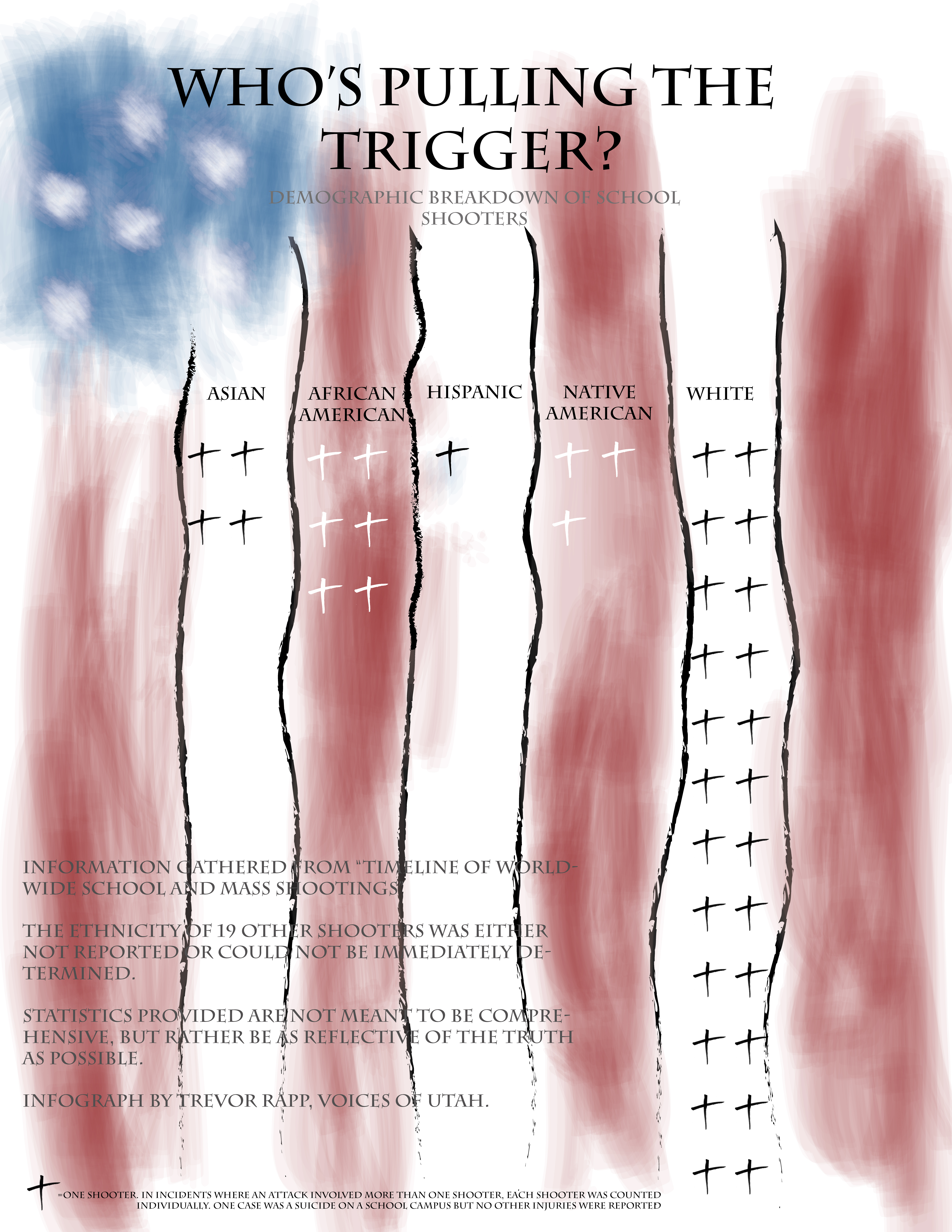
Break downs of the demographics of shooters in school shootings show the vast majority are not ethnic minorities.

What does a gun in a hand of a black man symbolize?

Three highly publicized photographs demonstrate the complexity and disparity of portrayals of the African-American gun culture.

In one, an African-American man stands alone in an apartment facing away from the camera, his head slightly bowed, enough to make out an outline but no details of his face. An AR-15 assault rifle with custom grips, a 30-round magazine and collapsible stock hangs from a sling off his back. His left hand grips a pistol of unknown make and caliber that he points at the ground.

In another, smoke explodes from the barrel of a shotgun being held by an African-American man with salt-and-pepper hair wearing a black Nike polo tucked neatly into blue jeans. He wears black sunglasses and ear protection.

In a third, a young African-American man’s face and upper torso fill the camera frame. Graffiti lines the background and tight braids slip out from underneath his black bandana. His chest is bare and he curls his bottom lip under to better show off the two rows of gold-capped teeth. Both his hands, with his index and middle fingers, form imaginary guns pointed at his head.

The first is of Colion Noir, a self-proclaimed “YouTube Personality, Gun Enthusiast, Budding Attorney, Regular Guy who happens to love Guns.” Noir is also a correspondent for the National Rifle Association.

The second is a photo released on the White House’s Photo Stream on Flickr with the caption, “President Barack Obama shoots clay targets on the range at Camp David, Md., Saturday, Aug. 4, 2012. (Official White House Photo by Pete Souza).” Much debate followed as to whether the photo was genuine or a staged photo-op to appeal to gun rights advocates.

The third is of rapper A$AP Rocky, who was praised by the New York Times for his debut album, “Long.Live.Asap.” the Times described him as being “a Harlem native with an expansive ear … one of hip-hop’s brightest new stars,” and, “a peacock, [rapping] with flair and authority.” One of the hit songs on the album, titled “F**kin Problems,” describes putting “your chrome to your dome,” a reference to putting a gun to your head. Other descriptions include acts of fellatio as making “it pop like an automatic or a nine,” references to automatic weapons and 9 mm pistols.

So what does it symbolize? Does the image of the average Joe portray a means of protection or a sign of paranoia? Is the image of a politician a depiction of high-class recreation or calculated propaganda? And for young, black males and females struggling to create their own identity, does this “art-imitates-life” photo provide insight and inspiration surrounding a successful artist, or social commentary on the numbing allure of becoming someone by racking up “street cred” points?

The answer is multi-faceted, with similar local and national conversations but quite different realities. Most importantly though, it’s a complicated answer that must be looked at through the lens of history, socio-economic factors and influences of the African-American family culture and African-American pop culture.

In the Salt Lake City area the true story for African-American gun violence, or crime for that matter, is not much different than the story for whites, said Salt Lake City Police Sgt. Shawn Josephson.

“It actually is one of those misnomers,” he said. “People tend to think that there is a significant difference [in crime] in the east side [a more densely white-populated area] to the west side [a more densely minority-populated area] and there really hasn’t been over the course of the history of the police department.”

However, the African-American population in Salt Lake City is extremely low. According to the United States Census Bureau, only a mere 2.7 percent of the population of Salt Lake City is African-American compared to 75.1 percent white. When taken in the context of the entire state the amount drops to 1.1 percent.

This makes it very difficult to get a statistical perspective on things like gun violence in the African-American community, Josephson said.

“As far as African-American [population], we are very, very low as far as our percentages go. … One person that’s a bad person can skew the whole percentages,” Josephson said. “I don’t believe [statistics] tell the true story most of the time.”

The same story seems to hold true in local school districts.

Jason Olsen, communication officer for the Salt Lake City School District, said, “We don’t see a greater propensity for violence in schools with a lot of minority students or schools without a lot of minority students. Our concern for school safety spreads across the entire district. It’s not really based on the ethnic diversity of certain schools.”

Olsen admits that concern for school safety was heightened in minority communities post-Sandy Hook, but also says it’s hard to gauge how much.

For example, though an astounding 200 Utah teachers poured into a single concealed weapons class right after the Sandy Hook incidents, Olsen has no way of knowing which teachers have concealed-carry permits, much less how the demographic breakdown is.

“In the Salt Lake School District we abide by the state law, that teachers with a concealed-carry permit are allowed to bring their weapon to school, but that weapon has to remain concealed and in their control at all times,” Olsen said. “Also the key point of what a concealed-carry permit is, is that it is concealed. We don’t necessarily know who would have a weapon and who wouldn’t.”

Later Olsen said, “Were there concerns in those [minority] communities? Yes. Were they greater than any concerns in any other communities? I didn’t get the feeling they were. I think the one thing that especially Sandy Hook has taught us is that acts of violence like this can happen anywhere. … It’s going to take the districts, the students, the community, community leaders, businesses, organizations, it’s going to take everybody to end this problem.”

But even in the apparent lack of a local problem, some Salt Lake City groups have expressed deep concerns about a very different reality of the effect of gun violence on the African-American community on the national level.

Jeanetta Williams, president of the NAACP Salt Lake Branch and tri-state conference of Idaho, Nevada and Utah, wrote a letter to Sen. Orrin Hatch detailing the epidemic proportions of gun-related deaths.

“The leading cause of death among African-American teens ages 15 to 19 in 2008 and 2009 was gun related homicide,” Williams wrote on April 12, 2013. “African-American children and teens accounted for 45 percent of all child and teen gun related deaths in 2008 and 2009 but were only 15 percent of the total child population. Clearly we have a stake in the debate.”

Earlier in the same letter, Williams “strongly” urged Hatch to “support the strongest policies possible, including implementation of a universal background check system; a ban on military-style assault weapons and high capacity ammunition clips; and tough new penalties for ‘straw purchasers’ of any size.”

But the presence of strong African-American voices like Williams’ hasn’t been seen much on the national stages. Since the Sandy Hook massacre of 20 children, the debate over gun control has raged like a white man’s Nor’easter blizzard, causing a whiteout in the mainstream media that has marginalized the African-American community. It’s a sea of Caucasian talking-heads with only a Black “blip” here and there. It leaves many wondering not just what is the African-American perspective, but where is it?

President Barrack Obama has probably been the most visible African-American in the debate. He made similar comments when he returned to Newtown on April 8, 2013, the place of the Sandy Hook massacre, to drum up support for more active gun control measures.

“I know many of you in Newtown wondered if the rest of us would live up to the promises we made in those dark days … once the television trucks left, once the candles flickered out, once the teddy bears were gathered up,” the Huffington Post quoted Obama as saying. “We will not walk away from the promise we’ve made.”
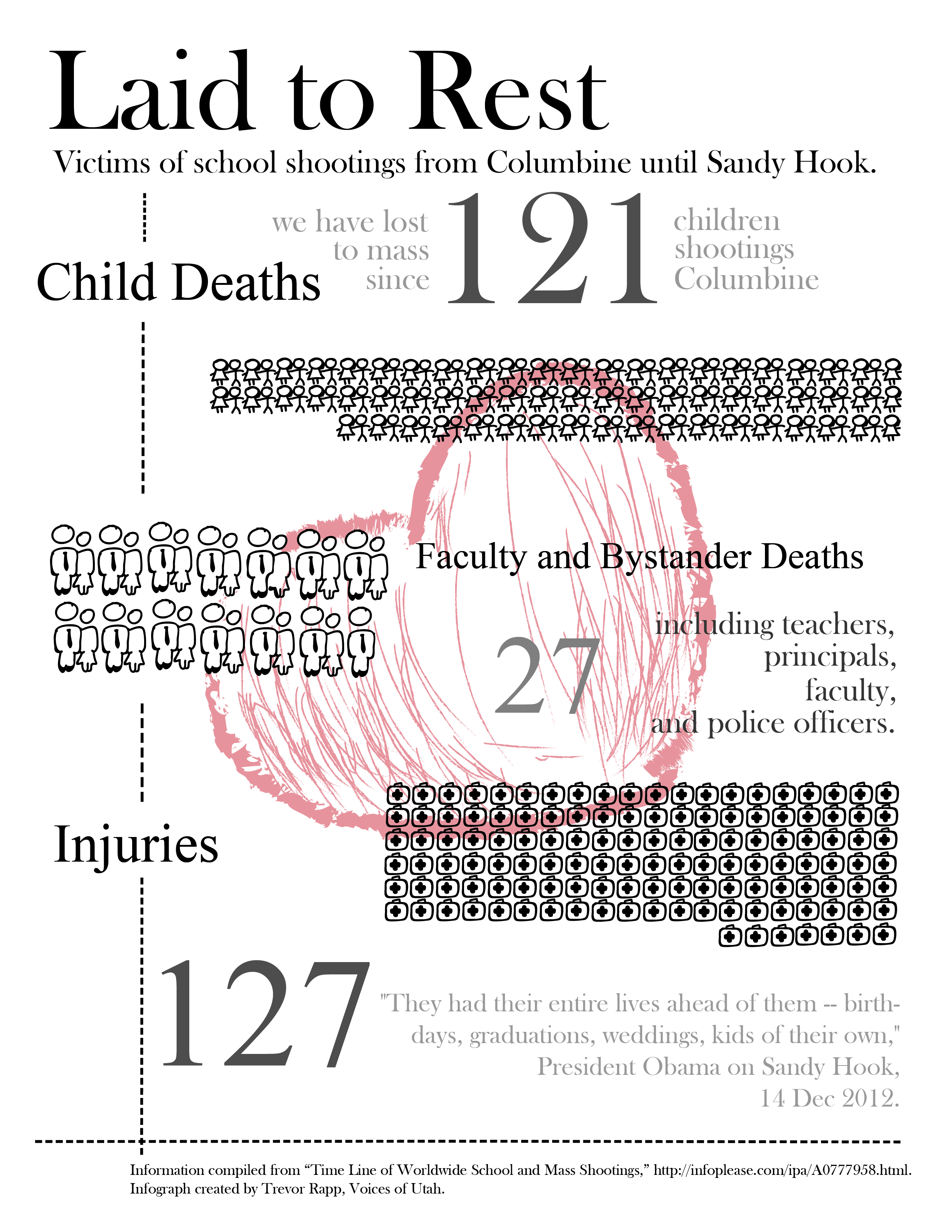
Since the attacks on Columbine rocked the nation until realizations of the Sandy Hook massacre, hundreds of people have been injured or died.

Since the attacks on Columbine rocked the nation until the more recent horrors of the Sandy Hook massacre, hundreds of people have been injured or died in school shootings.

Those promises included 12 Congressional proposals and 23 executive actions, according to a Jan. 16, 2013, New York Times story, “What’s in Obama’s Gun Control Proposal.” Some of the more controversial points included universal background checks, a ban on assault rifles and pistols that have more than one military characteristic (such as pistol grips, forward grips, detachable or telescoping stocks and threaded barrels), a ban on all rifles or pistols that have a fixed magazine that can take more than 10 rounds and a ban on all magazines or clips that hold more than 10 rounds.

In stark contrast to this opinion are other African-Americans like Colion Noir.

“No one wants to fight for their protection, they want the government to do it,” Noir said in a video posted on the NRANews YouTube channel on March 1, 2013. “The same government who at one point hosed us down with water, attacked us with dogs, and wouldn’t allow us to eat at their restaurant, and told us we couldn’t own guns when bumbling fools with sheets on their heads were riding around burning crosses on our lawns and murdering us.”

But all Noir’s bluster hasn’t necessarily allowed him to break through any publicity ceilings. Noir’s YouTube videos for the past month have averaged 60,000 total views, while Piers Morgan, a white male and frequent gun control advocate and commentator on CNN, still beat out those numbers in spite of drawing an all-time low of 87,000 viewers in the 25-54 demographic for his show “Piers Morgan Tonight.”

Still, Noir’s comments prompted a firestorm of blog and Twitter comments from various people. Among them was Russell Simmons, a business magnate who founded Def Jam recordings and Phat Farm clothing.

“Our community is not interested in a corporate sponsored gun group telling us what to do, when their real mission is to make more money for the corporations that line their dirty pockets with rolls of cash and silver bullets,”  Simmons wrote in “The NRA & Black People: Ain’t Nobody Got Time For That!” posted on globalgrind.

If the composition of the NRA board of directors is a reflection of its level of commitment to African-Americans, then perhaps Simmons’ mistrust is not off base. Of the 75 members, only four are African-American. Of these four, one is Karl Malone, the former NBA star who played for the Utah Jazz.

“We’re much smarter than that and certainly can see through their motives,” Simmons wrote. “Until they show a real interest in solving the violence problem in our community, they can keep their Yankee hat-wearing spokesman and their African-American ‘campaigns’ for themselves. In the words of another internet star, ‘ain’t nobody got time for that.'”

While Noir isn’t the only prominent African-American to reference historical violence enacted upon blacks to promote gun rights, such disparate opinions speak not just to the divisive nature of the debate, but also the depth and complexity that underlies the debate about the role guns should play in the African-American community.

Justice Clarence Thomas, the second African-American to serve on the United States Supreme Court, used various references to black history when he wrote in partial support of a 2010 court opinion. In the case involving a Second Amendment challenge to a Chicago ordinance that “effectively bann[ed] handgun possession by almost all private citizens,” Thomas observed that “organized terrorism … proliferated in the absence of federal enforcement of constitutional rights” following the Civil War. In particular, he addressed the Ku Klux Klan and its reign of terror. Thomas wrote that “the use of firearms for self-defense was often the only way black citizens could protect themselves from mob violence.” He added that Eli Cooper, “one target of such violence,” reportedly explained, “‘The Negro has been run over for fifty years, but it must stop now, and pistols and shotguns are the only weapons to stop a mob.”’

Thomas also quoted another man whose father had stood armed at a jail all night to ward off lynchers. That empowering experience, Thomas wrote, left the man feeling hopeful that mob violence could be halted by individual acts of “standing up to intimidation.”

Others have noted the necessity of being armed during the civil rights movement.

“It is a myth that the civil-rights movement was exclusively nonviolent,” wrote Akinyele Umoja, a professor in the Department of African-American Studies at Georgia State University, in “Black Ambivalence about Gun Control.”

Umoja detailed some of the provocations African-Americans suffered during the summer of 1964. Workers and volunteers in the Student Nonviolent Coordinating Committee, a civil rights organization trying to register local African-Americans to vote, were being harassed by “night riders,” white vigilantes who terrorized the SNCC. One night as a posse of night riders followed SNCC workers from the registration office, an 89-year-old woman armed and organized her children, grandchildren and neighbors and formed an ambush which so surprised the night riders that they never returned.

Umoja said in a phone interview that there was a shift between the 1950s and ’60s in how children got guns. Where before the “elders” took an involved role in teaching their children how and for what purposes to use guns, shifts in the general American culture that made it easier to obtain a gun illegally put more guns in the hands of “unstable elements.”

“It was a rite of passage for rural black families to teach children to use arms as a means of survival, for both food and protection. And black girls were trained to shoot to protect themselves from white rapists,” Umoja wrote in the article, which was published in the Chronicle of Higher Education.

But even deep-seated traditions of armed heroism don’t make for clear delineations among African-Americans on issues of gun control.

“There are some people in our community that don’t identify with either of the positions put out by the NRA or liberals,” Umoja said in the phone interview.

Though the rhetoric can be polarizing, the views certainly are not just black and white among the African-American community. Rather, the nuanced grey areas have to be understood through the many factors shaping and influencing the African-American community.

Umoja wrote in the article about social issues including the destabilization of families due to cuts in the federal government’s welfare system, increased individualism among blacks, declines in the manufacturing economy which employed many blacks, and increases in gang activity and the influx of drugs — all of which have led to an increase in cycles of poverty and gun violence, and by extension a motivation to support gun control.

But the fear of violence among under ground elements within the black community hasn’t erased the memory of violence from outside the black community, Umoja wrote. “Gun control for many black activists is at heart an issue of self-determination, self-reliance, and self-defense. But at the same time, we need to provide economic alternatives for black youths trapped in the drug economy; end the ‘war on drugs’ through decriminalization and the treatment of substance abuse as a public-health issue, and provide accessible and culturally relevant education that prepares black students for professions and entrepreneurship.”


From the Journalist’s Notebook, some reflections:

What does a gun in a hand of a black man symbolize?

For Utahns afraid of an overspill of violence from the 1 percent — a non-issue.

For those tired of being political puppets of a national white gentlemen’s club — white ignorance.

For those tired of being in the crosshairs of white oppressors — power.

And for those tired of looking down the wrong end of it — a call to find more peaceful way to build a community.

Utah baseball diamonds a microcosm of nation’s declining black player population

Story and slideshow by TALON CHAPPELL 

View the local baseball culture around Salt Lake City.

When Brooklyn Dodgers player Jackie Robinson broke the color barrier in 1947, he didn’t know that only 30 years later black players would be a staple in American baseball.

He also didn’t know that only 30 years after their resurgence, black players would be rapidly dwindling in number.

The percentage of black professional, collegiate and high school players has dipped every decade since the ’70s. Then, black players like Reggie Jackson, Ozzie Smith and Hank Aaron were dazzling crowds with speedy base running, golden glove plays and 450-foot home run bombs.

Almost nowhere else in the U.S. is this statistic more glaring than in Utah, where black baseball players at all levels are virtually nonexistent.

This begs the question: Why are black kids staying away from baseball diamonds? What can baseball do, in Utah and the rest of the US, to get more black youth involved in what was once America’s favorite past time?

“42” past and present

The story of Jackie Robinson is being chronicled in the new film “42,” named after Robinson’s jersey number which has been retired in every major league stadium in honor of his legacy.

“42” opened in theatres Friday, April 12, 2013.

The movie follows Robinson (played by Chadwick Boseman) through his childhood learning baseball, his rise in the minor and Negro leagues, signing by team executive Branch Rickey (played by Harrison Ford) for the Dodgers and the struggles he faced while playing in a white league and segregated stadiums.

Robinson signed with the Brooklyn Dodgers in 1947, which was one year before the U.S. military was integrated, 10 years before Brown v. Board of Education (1954) and 12 years before the Boston Red Sox became the last major league team to integrate their roster.

Robinson laid the foundation for future generations of black ball players to enter the majors on equal standing with their white counterparts. He also got the black community to watch and pay attention to Major League Baseball.

Michael Wilbon, a respected ESPN baseball and basketball writer (and host of “Pardon the Interruption”) grew up in Chicago during a time when baseball was far more relevant in the black community than it is today.

“The talk in the barber shop wasn’t of Wilt [Chamberlain] and [Bill] Russell nearly as much as it was of [Hank] Aaron and [Willie] Mays,” Wilbon said in a Washington Post story. 

Baseball losing interest among Utah youth

Landon “Land-O” Dickerson is a center fielder for the Layton High School baseball team. He is also the only black player on the baseball team at his school, located about 30 miles south of Salt Lake City.

Dickerson first started playing tee-ball when he was 5 years old and knew that baseball was his sport.

“I grew up playing baseball. I played football and basketball too but nothing made me more excited than going to the batting cages in spring,” Dickerson said.

Dickerson never really paid attention to the fact that he was usually the only black kid on his youth baseball teams. He was too busy playing to care. While he was batting and fielding, his few black peers were pursuing the two other dominant American sports, football and baseball.

“I didn’t even think about it [lack of black players] ’til I started playing comp [competition level] ball. I thought it was weird that no other black kids wanted to play competitively, but everyone said I was weird for liking baseball more anyways so I didn’t really care,” Dickerson said.

Robert Ferneau is the head coach of the Layton High baseball team. He has had a long and illustrious career in baseball.

Ferneau played at Layton High before playing at the collegiate level, first at Snow College (Ephraim, Utah) then at Colorado State University. He then finished his playing career at Weber State University. After an injury kept him from being drafted into the majors, he focused his energy on coaching. After earning a bachelor’s degree in exercise and sports science, he came back to coach his alma mater in 1993.

During his 20-year tenure at the school, Ferneau has noticed the drop in participation from black players.

“There’s usually not a lot [black players] because of our community, but usually a couple per season. Now we get one or two a season, sometimes none,” Ferneau said.

Ferneau doesn’t think there’s a whole lot baseball can do to attract more kids, of all races, to play. But some options he thought would help include building and maintaining better facilities and fields, getting more kids involved with baseball and tee-ball at a young age and spreading exposure of professional black ballplayers.

Utah collegiate baseball completely lacking in diversity

The already dismal percentage of black athletes in baseball further decreases in the college ranks.

The rosters of Utah’s two major collegiate baseball programs (the University of Utah and Brigham Young University) feature no black players between them. Every other Utah college or university’s baseball program is club based and of those programs, only two had a single black player on their roster (Utah State University and Weber State University).

Ryan Madsen played college ball at the College of Eastern Utah in Price, Utah. He too noticed the decline in diversity when he got to the college level.

“I was always used to having a couple non-white guys on my youth and high school teams. When I got to CEU the whole team was white, and a lot of our competition was mostly white,” Madsen said.

Madsen believes that many black high school players don’t aspire to play at the college level because there just aren’t enough scholarships to go around.

“They’d rather try to get a scholarship in a different sport, or stop playing ball to get a job so they can begin to afford paying for college,” Madsen said.

After his two years at CEU, Madsen decided the cost and effort of major collegiate baseball was too high and he focused on his education. He graduated from the University of Utah with a bachelor’s degree in business administration in 2012.

According to a CBS Sports report, NCAA baseball programs can only offer 11.7 scholarships per season. This means that most of those scholarships are split among multiple players, which adds to the already staggering cost of a college education for those athletes in less-than-desirable financial situations.

Only 11.7 scholarships for baseball, as opposed to 85 scholarships handed out by major college football programs. It doesn’t quite add up.

Black players being replaced in the professional ranks

Utah’s three minor league teams have a combined four black players on their rosters, only two of whom are of African-American descent. The state’s most prestigious team, the Salt Lake Bees (AAA affiliate for the L.A. Angels) have no black players on their roster; the Orem Owlz (AA affiliate of the L.A. Angels) have one black player from the Dominican Republic and the Ogden Raptors (AA affiliate of the L.A. Dodgers) have three black players, one from the Dominican Republic, and two from the U.S.

Chances that were once being given to promising young African-American players in major league farm systems are now being given to the wave of players from Latin-American and Caribbean countries.

According to a CNN Money article, most of the reasoning behind the transition from homegrown to foreign players in the majors is purely economic. Because of the relative poverty within these countries, it is cheaper for major league teams to train, develop and sign a player from Latin America or the Caribbean than it is to do the same in the U.S. Because of this, every major league club has an academy that offers schooling and baseball training in the Dominican Republic, as well as 10 clubs that have one in Venezuela.

In response to this, MLB Commissioner Bud Selig set out to build the U.S.’s first homegrown baseball academy.

“We’ve already built development academies in the inner cities … We’ve got one in Compton that everyone raves about, we just opened one in Houston and we’re building one in Miami and Atlanta,” Selig said in an ESPN interview.

Black players only make up roughly 8 percent of major league rosters and 25 percent of those individuals play for three teams (Yankees, Dodgers, Angels). This represents a major decline from the 27 percent in 1975 and even from the 19 percent in 1995. Selig told ESPN “that winning back the African-American athlete [may be] his last hill to climb” before his retirement in 2014.

The Veteran Support Center provides help for Black veterans in Utah

Story and slideshow by LORIEN HARKER

Visit the Veteran Support Center on the University of Utah campus.

There are 147,944 veterans in Utah, according to the Utah census of 2011. Also according to the census, 1.3 percent of the population is African-American.

Needless to say, African-American veterans are a definite minority in Utah.

The history of African-American veterans in the military is rich, and at some times controversial. One of the first African-American regiments to see battle in World War I and World War II was the 369th Infantry Regiment, nicknamed the Black Rattlers or the Harlem Hellfighters. This regiment was segregated from other white regiments, yet the fighters were heavily decorated.

By the end of World War II, the regiment had suffered 1,500 casualties, and 171 members had received the Legion of Honor.

Similar African-American regiments that have served the United States Military, such as the Red Tails, Buffalo Soldiers, and Tuskegee Airmen, are some of the most celebrated regiments in military history. Yet these regiments were all segregated.

Regiments of African-Americans and white troops were not integrated until the Korean War. Though these regiments could now be integrated, it could be supposed that racism and ignorance toward African-Americans still existed.

However, for Roger Perkins, the director of the Veteran Support Center at the University of Utah, a troop is a troop no matter what color they are.

Roger Perkins served in the Army for 21 years, from 1970 to 1991. During his years of service, Perkins says that the only time ignorance toward the African-American troops was displayed was in the barracks, never around a superior officer.

“You find ignorant people everywhere you go,” Perkins says.

Though the military may have a history of segregated regiments, the military now is more diverse. White troops make up 67 percent of the military, black troops make up 17 percent of the military, and Hispanics comprise 11 percent of the military.

These numbers somewhat correspond with the numbers of veterans at the University of Utah. Perkins says the statistics are as follows: 26 Asian, 22 African-American, 80 Hispanic, seven Hawaiian/Pacific Islander, 678 white, and 24 non-specified veterans.

The majority of the African-American troops at the U are in the Army and Marine Corps, Perkins says.

He also says there is no special treatment in the military. People are seen as a troop, and nothing more or less.

In regards to race in the military, Perkins says, “We don’t care.”

Though this is most likely true, the VA Salt Lake City Health Care System offers a support group for minority veterans. But why do they feel that they need this kind of support group?

Jinna Lee, Ph.D., a VA psychologist with the post-traumatic stress disorder clinic, says that the support group was formed for minority veterans to feel more comfortable. The familiarity they feel with a person of color is important.

The Veteran of Color Support Group focuses on helping veterans with post-traumatic stress disorder. Statistics show that one in four veterans will return from deployment with PTSD. Men are more likely to form PTSD from combat, which is why veterans are often diagnosed with the disorder.

Although only four to seven people typically participate in the group, Lee says talking to veterans of the same ethnic background is comforting to the veterans.

“Issues with race and ethnicity do have an impact of how they function,” Lee says in a phone interview.

Lee says these veterans could potentially feel awkward talking to other veterans who are not of their ethnicity, and it’s easier for people of the same culture to understand them.

Stanley Ellington, the executive director for the Utah Black Chamber of Commerce, served in the Air Force for 28 years. During his time of service, Ellington says he was treated fairly.

Ellington also says that the Air Force made it hard to treat people like they weren’t your friends. During deployments especially, because they all relied on each other, there was a “sense of camaraderie” throughout the entire station.

Ellington says it is not so much an issue of color, but an issue of culture in the military. He likens not understanding someone’s culture to a language barrier. If you can’t speak someone’s language, it makes it hard to form a relationship with them — which he says is key.

Ellington says different cultures have different “paths” they use to get to where they want to be in life, and understanding these different paths means “understanding different terms.” From here, the question of understanding veterans of different ethnic backgrounds becomes a question of being fluent in a specific culture, not race.

Lee says there is such an overlap between race and culture, the veterans look for someone of their own culture to talk about things to make themselves feel better.

Kenneth Hartsfield, 26 , a junior at the U majoring in mechanical engineering, is a member of the Air Force. Hartsfield says he joined the Air Force because he “had no reliable plans after high school and did not want to stay at home and get a job.”

“I wanted to see at least a different part of the country and possibly the world,” Hartsfield says.

Hartsfield says his experience with the military has been relatively color-blind. However, life in basic training was rough for some of his comrades.

“It was a melting pot of life experiences where we all had to depend on the next person to cover our shortfalls,” Hartsfield says. “Some had come from inner city while others came that had only seen a handful of minority people.”

Hartfield’s father was a Green Beret, which is why he grew up in a military town in North Carolina. Not only is his father in the military, but his brother, grandfather, uncle and other various family members also serve.

“My father served 27 years in the Army. My brother is in his first year with the Air Force. My paternal grandfather served in World War II and my maternal uncle served in the Army for four years. I have a lot of extended family that is also serving,” Hartsfield says.

He went to basic training after he enlisted, which he said some had a difficult time adjusting to. Tasks such as laundry and asking questions to superiors came as a shock to some newly-enlisted troops.

“It was a huge culture shock for some but growing up in a military town I and the other well cultured kids had no problem adjusting,” Hartsfield says.

Ellington, Lee, Hartsfield and Perkins all say that racial differences could be a source of conflict between troops. However, all agreed that a more likely cause would be cultural differences.