LGBT organizations continually work toward equality in Utah

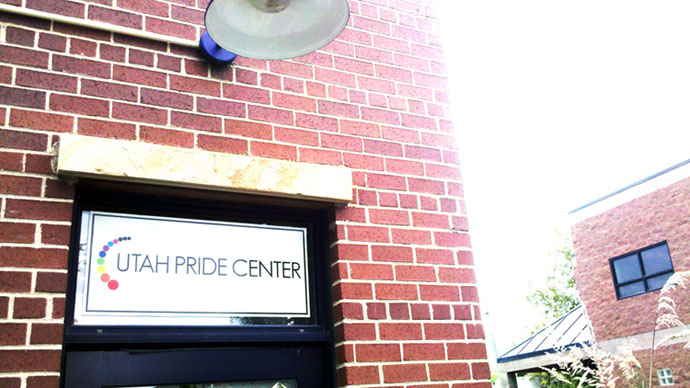
The Utah Pride Center, located at 361 N. 300 West, is an advocate for the LGBT community.

Story and photo by CHAD MOBLEY

Salt Lake City is seen through the eyes of the nation as a conservative and religiously centered metropolitan area whose dominant Mormon culture controls everything from lawmaking to media consumption. However, the population is ever changing and growing more diverse all the time. The lesbian, gay, bisexual and transgender community is one segment of the population with organizations in place to help balance the scales and promote equality among all citizens in Utah. Equality Utah and the Utah Pride Center went to bat for the LGBT community during a recent controversy and the leaders involved felt the outcome was positive.

In late August 2012, KSL refused to air the new NBC comedy, “The New Normal.” That decision caused a media firestorm and many in the LGBT community in Salt Lake City to take action. The issue was covered by news outlets across the country, including the Los Angeles Times, Huffington Post and CBS. When the story first broke, the Utah TV station was portrayed as regressive and bigoted.

Not only did this decision catch the attention of the national media, but enraged advocates for gay rights in America.

GLAAD President Hernon Graddick was quoted in a blog from the organization’s website: “Same-sex families are a beloved part of American television thanks to shows like ‘Modern Family,’ ‘Glee’ and ‘Grey’s Anatomy.’ While audiences, critics and advertisers have all supported LGBT stories, KSL is demonstrating how deeply out of touch it is with the rest of the country.”

Graddick continued, “We invite Jeff Simpson (CEO for Bonneville Media, KSL’s parent company) to sit down with GLAAD and local LGBT families. We know that if he would, he would see that not only are our families normal, but by citing ‘crude and rude’ content and refusing to affirm LGBT families, KSL and Mr. Simpson are sending a dangerous message to Utah. They should make that right.”

Five days after KSL’s decision not to air the program, the director of the Utah Pride Center, Valerie Larabee, along with Equality Utah director, Brandie Balken, her family and another same-sex family sat down for a roundtable discussion with KSL and Bonneville Media.

The organizations then released a joint statement on Aug. 29 regarding the decision to pull the show from the primetime lineup.

According to KSL, “It was helpful to talk together, to better understand issues, and to be able to discuss the reasons behind our decision to not air ‘The New Normal.’ This was not a decision we made lightly and it was not made because of any single issue including gay characters or LGBT families. … We care about and value all members of our community, including LGBT people and their families, and are grateful when there can be the type of cordial and respectful dialogue we have had today.”

Equality Utah and the Utah Pride Center added in the statement, “We had a great opportunity to talk about our families and our kids. We appreciated the opportunity to express our concerns, and to hear firsthand the reasons behind this decision. We accept their explanation that the decision to pull ‘The New Normal’ was not made lightly and it was not made because of any single issue including gay characters or LGBT families.”

After having seen the show, Balken and Larabee agreed with KSL’s decision.

“Having the LGBT presence in the show was important,” Balken said in a telephone interview. “However, more than or equally important to just being present is how we are portrayed. We want to be represented as who we really are.”

Larabee added, “Once we saw the first episode, we got it completely. I agreed with them. We think it is very poorly written.”

One member of the local LGBT community felt relief knowing that advocates are ready to fight for their rights.

“That really does show what they are doing and how effective they are,” said Shalise Mehew of Salt Lake City. “I totally agree, I wouldn’t want it on primetime either.”

After a heated controversy over what seemed to be an anti-gay decision, a simple dialogue  immediately alleviated concerns. A planned protest was cancelled, a joint statement was released and an understanding between two sides of the community was reached.

“It was the first step in helping to create trust between at least a segment of our community and the local media,” Larabee said.

The Utah Pride Center and Equality Utah continually monitor the media to correct any unfair reporting or disparaging portrayals of the LGBT community and its families. The two organizations maintain relationships with the media on a daily basis and they work with GLAAD when they have any major issues surrounding coverage or statements made by those in the media industry.

“Utah Pride Center and Equality Utah work tirelessly to promote tolerance and grow acceptance of LGBT people and families in Utah,” said Graddick of GLAAD on the website. “We are proud to be working with them.”

For the organizations, fighting for equality doesn’t stop with the media. One of their goals is to reach this same type of understanding between the LGBT community and the dominant religion.

“We are really invested in continuing conversations with LDS people,” Balken said. “We live in the same places, work in the same places and have kids in the same schools. Anytime people can and will sit down and really just be real with each other, it’s a great release and it’s positive.”

City Creek Center opening brings thousands to downtown Salt Lake City

This slideshow requires JavaScript.

by Tricia Oliphant

Crowds lined the walkway. Parents gripped the hands of their squirming children, who were eager to run off and explore. The shutters of cameras repeatedly clicked.

In one corner a musician put his soul into playing the blues on his saxophone.  In another, musician and performer Steven Sharp Nelson of The Piano Guys entertained a crowd with playful tunes on his cello. The laughter of a nearby group of adolescents resonated as they talked about their plans and what they wanted to see first.

That overflowing excitement most often only theme parks can create filled the masses swarming downtown for the opening of Salt Lake City’s first downtown mall in three decades.

City Creek Center opened on Thursday, Mar. 22, 2012. Like many others, I was drawn to the novelty and newness of City Creek. I decided I had to join thousands of others in visiting City Creek on its opening day so I could answer the question posed by a dear friend of mine, “Is it really as big a deal as it has been made out to be?”

Although City Creek offers ample parking in a giant, heated three-level underground parking garage, I chose to take the TRAX (Utah’s light rail system) to the new shopping center.  In spite of the train being loaded with anxious shoppers of all ages who were also heading for the mall, I thought it offered the convenience of not fighting downtown traffic or hunting for a parking place.

City Creek Shopping Center was funded entirely by cash reserves of the LDS Church and built on three church-owned blocks in downtown Salt Lake City. A sky bridge over Main Street connects two of the blocks and allows shoppers on the second level of the center to cross from one side to the other.

Upon arrival, I was impressed by the classy architecture and design of City Creek Center. I quickly realized this wasn’t just any ordinary mall when I noticed the glass roof is actually retractable. City Creek opens the roof when the weather is just right, providing a view of the open sky and surrounding skyscrapers.

Along with over 90 stores and restaurants, the shopping center offers a wildlife landscape downtown with the re-creation of the historic City Creek that winds through the shopping center’s walkways and plazas—complete with live fish.

In addition to the creek, the shopping center offers a variety of waterfalls, ponds and fountains (one of which is open to children who would like to cool off while splashing in the choreographed blasts of water.) I found each water feature to be quite beautiful and each added a sense of natural serenity to the busy shopping center.

“Standing at the base of the skyscrapers surrounded by rivers and waterfalls was a striking experience of both outdoors and the big city at the same time,” shopper Matt Argyle said. “It’s really breathtaking.”

Benches and tables rest on the edge of the creek and beside the waterfalls. These provide places to relax and enjoy the peaceful atmosphere.

Some believe the quality of the food court can often make or break a shopping center.  City Creek’s food court is nothing to scoff at.

The massive food court is located next to the creek and a waterfall. Diners can eat inside (with many of the tables located next to giant windows in front of the water features) or can dine al fresco.  Both options offer a relaxing place to eat.

The food court is made up of everything from Subway to the Taste of Red Iguana to the Great Steak and Potato Company. Other restaurants, such as The Cheesecake Factory and Texas de Brazil Churrascaria, are also located in the shopping center.

By wandering through City Creek Shopping Center, it soon became clear that people came for much more than shopping and spending. This was a public event, a place for relaxing and enjoyment with friends and family. While taking all this in, I wondered about the future of City Creek and its potential impact on surrounding malls (such as The Gateway, a mere two blocks to the west).

Although City Creek attracted large numbers of people opening weekend, The Gateway was not left completely desolate.

“We were actually pretty busy opening weekend,” said Kara Johnson, an employee at Down East Basics, at The Gateway. Down East Basics, a moderately priced casual apparel store, is not duplicated at the new City Creek Center. “I expected it to be dead,” Johnson said.

Despite the crowds of people at City Creek Center opening weekend, many realized the stores at City Creek were more expensive than they had expected. “They came to Gateway because they knew what to expect,” Johnson said.

Unlike The Gateway, City Creek Center is closed on Sundays. This gives the older mall an extra day to attract shoppers and therefore compete with the novelty of the new shopping center.

Furthermore, although some of the stores are duplicated at both shopping centers (such as Forever 21), many are not. This gives a distinct shopping opportunity at each location.

Johnson said that because she has never been to many of the stores now located at City Creek, she would like to go there just to see what they’re like. “I just want to say I’ve been in a Tiffany’s.”

The uniqueness of the new stores to Utah clearly attracted crowds to City Creek Center.  However, many Utahans are known for being “frugal” and “resourceful”. Higher-end stores may not sit so well with a thrifty people.

“I love City Creek. It’s just so nice,” said Jannali Ouzounian, a new mother from Holladay. “I just wish I could afford to shop at all the stores. A wallet at Tiffany’s [costs] $600.”

“I think Utah could do a lot better by bringing in the outlets,” said University of Utah student Kelly Wolfe. She said that putting in stores such as the Tommy Hilfiger Outlet and Bloomingdale’s Outlet would not reduce the classy appeal of City Creek and would attract a greater portion of the Utah market.

Being a bargain hunter myself, I would love to shop at classy outlet stores downtown. However, I find the higher-end stores at City Creek to be alluring.

How long this allure will last remains in question.

“I think once all the hype wears off, City Creek will be just another mall,” said Utah State University student Elise Olsen. However, once all the hype does wear off, Olsen said she plans to shop at City Creek with hopes of finding good sales on high-priced items.

Only time will tell the fate of City Creek Center and whether it will continue attracting large crowds of people to the downtown area. In spite of this, I found City Creek Center to be beautifully constructed and thought it added class to Salt Lake City.

In answer to my friend’s question, City Creek is quite a big deal — for now.

Different strokes by different folks: music, marketing and the making of SLC band Girrafic Jam

This slideshow requires JavaScript.

By FRANCES MOODY

Salt Lake City, the city of churchgoers, upstanding families and bar hoppers. Yes, bar hoppers. Salt Lake City’s nightlife hustles and bustles with enthusiastic bar goers ready to be swept away by friendly bartenders, intoxicating drinks and, most of all, electric music.

Lined up and down the streets of the city’s distinctive grid system, which spreads out from the LDS Temple, are bars that showcase jaw-dropping tunes created by talented artists. Among these artists is the band, Girrafic Jam. Formerly known as Hekyll n’ Jive, Girrafic Jam strives to create a new music and business strategy that will keep the bar flies content, yet attract a more diverse crowd.  After sitting down to eat at a crowded Asian restaurant located off State Street in Salt Lake City, Marshall Jones (lead guitarist) Kyle McCann (bass guitarist) explained how their stratagem would work.

Viewing their music as both art and product, Girrafic Jam works to form an effective business strategy that will ensure its success. “We [Girrafic Jam] think of our music as a business, and are planning it from there,” Jones said.

In business terms, the band members aim to prove their product—the music– valuable. How will the band accomplish such a feat and reach the top of the metaphorical skyscraper of success? Hopefully, they will accomplish this task by rethinking and reinventing the local music scene’s expectations. Though the process has commenced, Girrafic Jam waits in the fledging stages of its long climb to the top.

Girrafic Jam’s first stop on the elevator of reinvention came with the addition of two new members: already mentioned bass guitarist, Kyle McCann, and drummer, Courtney Thomas. As a result, Girrafic Jam moved to the first floor of success. “ We are in the works of making our plan of attack,” McCann said as he stared at a mountain of fried rice and chicken on his plate.

McCann and Thomas carried a refreshing tone to the band’s music. This invigorating sound sparked Girrafic Jam’s idea to create a new product. In most cases, changed products call for changed names. Following in the footsteps of companies like Google (once called BackRub), Hekyll n’ Jive transformed into Girrafic Jam.

Girrafic Jam realizes it is not the first product or band to recreate itself. For instance, the band pulls inspiration from other bands’ approaches and sounds, rather than mimicking them. The band describes its style as “[an] infusion of Red Hot Chili Pepper-like grooves, saucy Incubus-style melodies, combined with the sting and sway of Stevie Ray Vaughn type fretwork, and the flow of ambient tirades ala Minus the Bear,” as advertised on former Hekyll n’Jive’s Facebook page.

Perhaps Girrafic Jam’s eclectic sound is the best example of the band’s muses and inspiration. Front man Neil Olsen plays the saxophone, which helped music break away from the staccato sound of humdinger tunes and into the boisterous blasts of jazz. Girrafic Jam utilizes music’s history to mesh genres of music and create unheard, yet mesmerizing melodies, such as the band’s song “Got The Spirit” When heard, the song’s sentimental lyrics and heart-racing solos magnetize the crowd’s hands together in uproarious applause.

Innovative forms of music are important to Girrafic Jam, but so is creating a product that people love. A prized product must be advertised in the right way. With that in mind, the band investigates new forms and arenas for their marketing campaigns.

In Salt Lake City, most bands feel that the best way to sell their music is to play as many gigs at as many bars as possible. Girrafic Jam holds a different opinion altogether. They hope to break away from this local music stipulation through a process of selection.

While performing late at night in dimly lit bars goes against Utah’s societal expectations, to Girrafic Jam, it also creates restrictions. Every Friday night the Metal Gods woo girls with teased hair by performing chart-topping 80s hits at a suburban Salt Lake County bar, Liquid Joe’s. To some, cover songs are fun and alluring. To others, they only offer one side of a band’s talent.

Being family men, Jones and Olsen maintain a hectic schedule to uphold their family oriented lifestyles, while Courtney and McCann strive to improve their musical talents in other ways. Having busy schedules and diverse lifestyles, the band opted to highlight original numbers at fewer shows, as an alternative to selling cover song after cover song like Metal Gods.

The band trusts that this method will attract a more eclectic audience and fashion a more valuable sound.  “A yearning for listening within the audience is more important than doing a weekly gig,” McCann said.

What’s more, Girrafic Jam’s campaign is in the process of social networking and forming a vast Internet presence.  They have connected themselves to several websites, such as Facebook and YouTube. With a well-rounded marketing crusade, Girrafic Jam is sure to attract the wandering eyes of many Internet users and music lovers alike.

One day, Girrafic Jam’s business scheme and innovative force into the music scene may prove successful. Today many of their fans see the end in sight. Perhaps, in the near future, people will line up to hear the exploding sound of Girrafic Jam echoing from the roof of skyscraper success.

“We’re not trying to reinvent the wheel. We find inspiration and implement it into what we are creating [whether it is music or marketing]… That’s what will hopefully help us succeed,” Jones said, after picking up a pot sticker with his fork and placing it on McCann’s plate.

###


Local Utah artist’s work reflects on community, beauty of Utah’s wetlands

Story, video and pictures by JAVAN RIVERA

Slideshow courtesy of Shawn Porter

Derk’s Field photo courtesy of the Utah State Historical Society

For everyday people the world can often seem dull. We wander through our lives, habitually proceeding from task to task. Rarely do we stop to appreciate the

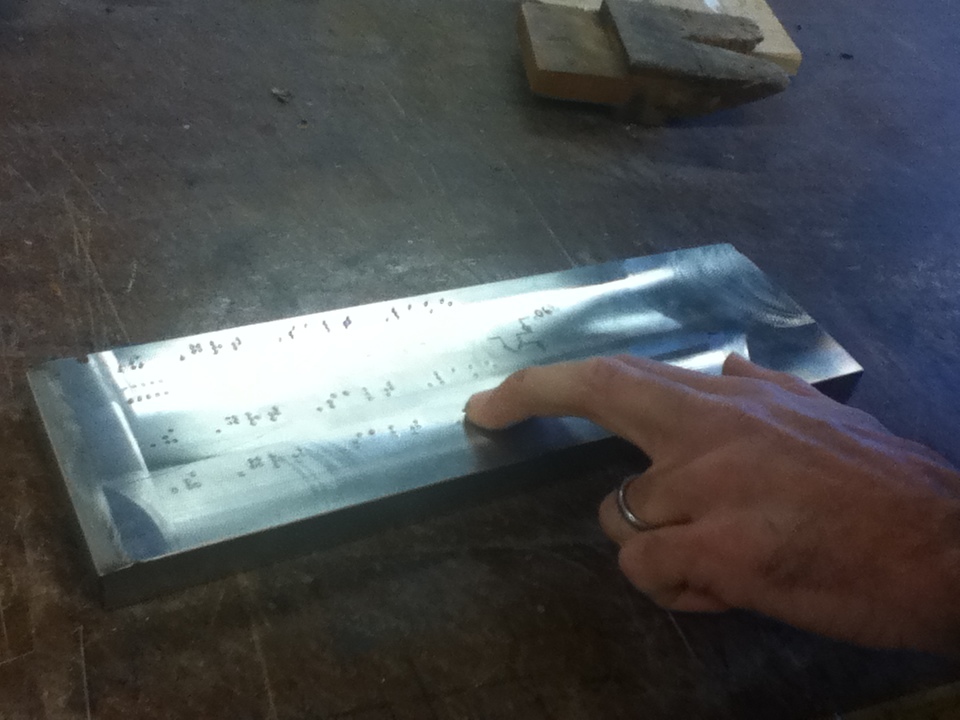
Shawn Porter, 43, with a sample of the Braille text that will be displayed on his artwork.

world around us, much less take inspiration from it.

Shawn Porter, however, is not an everyday person. The facilities supervisor for the arts and sculpture buildings at the University of Utah, Porter sees inspiration in places few would think to look. From that inspiration are born pieces of art that are as reflective of their environments as they are creatively breathtaking.

Porter, who has had work featured in both public places as well as more traditional gallery settings, didn’t begin his career as an artist. In fact, his artistic inspiration stems from more practical creations.

Having grown up in Lehi, Utah, Porter, 43, spent more than 13 years working as a professional woodworker, designing and creating functional pieces of furniture. It was that time spent honing his skills with wood that actually allowed him to branch into art, Porter said.

“The technical end of woodworking or being a craftsman has given me a platform to spring off of as far as making artwork is concerned,” Porter said. “People often say, half-jokingly, if you can build a chair you can build anything.”

Since coming to the U, Porter has expanded his use of materials beyond wood. His time working in the Department of Art and Art History has allowed him to gain a better knowledge of the “artist’s dialogue and process.”

In 2010 Porter began working on a project for the Utah Transit Authority’s (UTA) “art in transit” program. The agency, in collaboration with the Salt Lake City Arts Council, commissions local artists to create pieces for the various TRAX stations and routes that run throughout the Salt Lake Valley.

Porter believes public art, such as his work for “art in transit,” should be reflective of the cultural and historical values of the area in which it’s being placed.

“In a way I think public art is in place to represent the community,” Porter said.

He wants his work to be as much a representation of the public area surrounding it as it is a creative piece of art.

“That’s what public art is really supposed to do. That’s what it’s intended for, in my mind. That is, it isn’t just pretty decoration in a location. It definitely references local environment, culture, history, and it all depends on the history and culture of that area.”

Justin Diggle, an assistant professor of the Department of Art and Art History, at the U, agrees with Porter. Having worked on the committees for both the Salt Lake Art and Design Board in 2003, as well as the University committees, Diggle aided in the selection process for past “art in transit” pieces.

“With any public art I think you have to be sensitive to the area,” Diggle said. “You have to be sensitive to the people who live around there, people who are going to use it.”

Porter’s work will be installed at the 1950 W. North Temple TRAX stop, and will be modeled after the wetlands and waterways that exist between the Salt Lake City Airport and the stop. It’s expected to be installed around September of this year.

Porter said he wants his work to draw attention to the fact that the Great Salt Lake is actually a thriving wetland full of life.

“It [the Great Salt Lake] is not just a wasteland. It’s not just this smelly thing that people think it is,” Porter said. “It really is a thriving ecosystem.”

Porter’s minimalistic design for his “art in transit” project will be made primarily of stainless steel, a bit of a departure from the wood materials he’s used for most of his life. The change has been a good one, he said.

“That’s the challenge I really enjoy. The thinking through an idea and then bringing that to life through the use of different materials and the complexity of those materials.”

Porter’s work will include two large steel plates, elevated two feet above the ground to simulate a river’s surface. It will also include segmented pipes that evoke the idea of river reeds resting among a riverbed of smoothed metal stones. Porter is fabricating three minimalist representations of birds associated with the Utah wetlands that will also be placed throughout the piece.

“I think it’s really critical also to draw visitors into that conversation of—what is this place? What is it like? What might I experience in visiting Salt Lake City?” Porter said.

He wanted to ensure his work reflected more than just the natural surroundings leading up to his stop, but also the areas of public access nearby. For the 1950 W. North Temple stop, that includes the Utah State Library for the Blind and Disabled.

As a way of incorporating the library into his piece, Porter included an artist’s statement about the piece as well as some poetry about the Great Salt Lake and the birds that migrate there. The poetry will be written in Braille, directly on the piece.

A sample of the Braille text that will be featured on Porter's artwork.

Roni Thomas, the public art program manager for the Salt Lake City Arts Council, said that Porter’s inclusion of Braille on the piece was yet another inspiration from the well of his creativity.

“Shawn recognized that there was an opportunity to reach out to an audience that ordinarily couldn’t participate because of their visual impairment,” Thomas said.

Whether it be through addition of Braille, or simply, the inspired reflection of Utah’s beauty, one thing is certain—Porter’s creativity is sure to shine through his new piece.

“A lot of people just look at public art as decoration,” Porter said. “But I think it’s important for people to take something from the work that is there. Whether they recognize that it is a representation of something in their community or not, I think at the base level people can at least take [something] from the aesthetic.”

This slideshow requires JavaScript.

Pushing the envelope: college students set out to bring back handwritten letters

By KATIE HARRINGTON

In between cadaver labs and illustration classes, Carly Bartel — a biomedical illustration student at the Cleveland Institute of Art — sits on the floor of her Cleveland apartment with glue sticks, National Geographic magazines, cardstock, scissors and gel pens surrounding her.

She thumbs through the magazines to find photographs to collage and looks through books to find inspirational quotations.

Bartel, a 21-year-old Salt Lake City native, is making mail.

Carly Bartel explores Cleveland for an afternoon. Photo courtesy of Carly Bartel

“I think it’s sad that no one sends letters anymore because it’s so much more personal than a text message or an e-mail,” Bartel said. “People really appreciate when you take the time to say hello, or thank you or I miss you.”

Bartel and her friends at school started making mail last year as a way to revitalize the tradition of sending handwritten letters.

One autumn day, Bartel said, she opened her mailbox and a fancy and decorated envelope was sitting in the otherwise empty slot.

“I was just so excited,” Bartel said. “The envelope was hand-crafted and the note really spoke to me.”

Amber Esner, a 22-year-old illustration student at Cleveland Institute of Art, sent Bartel that piece of mail.

Esner said she started making mail because she was growing tired of impersonal communication that lacks any creativity.

“We e-mail, we send messages on Facebook, we text. But I think every time someone opens the mailbox and sees something beautiful waiting for them, they’re reminded that creativity and thoughtfulness really do matter,” Bartel said. “That’s something Amber and I are trying to remind everyone.”

In an age of digitized communication, the dying art of letter writing is not only being noticed at a Cleveland art school, but also in the guts of one of our government’s oldest agencies. As our society becomes increasingly engulfed by instant and impersonal communication, there are those who desperately crave the opposite.

The United States Postal Service (USPS) announced last November that it ended the fiscal year more than $5 billion in debt. Their year-end loss would have neared $10.6 billion had Congress not postponed a mandated payment of $5.5 billion to pre-fund retiree health benefits, the agency said.

“The continuing and inevitable electronic migration of first-class mail, which provides approximately 49 percent of our revenue, underscores the need to streamline our infrastructure and make changes to our business model,” said Joe Corbett, the agency’s Chief Financial Officer.

USPS reported in 2010 that its first-class mail volume was 78.2 billion pieces, compared to a reported 103.7 billion pieces in 2001. Similarly, 574,000 people were employed by USPS in 2010 compared to the 775,903 people employed in 2001—a number that steadily declines each year.

The U.S. Government Accountability Office reported that overall mail volume decreased by 20 percent between 2006 and 2010, and that the agency expects to lose another 150 billion pieces by the year 2020.

“It’s easy for me to see that the mail system in this country is being undermined by our constant obsession to socially network or virtually connect,” Bartel said. “I think about how often I sent a text message or how much time I spend on Facebook. Having a relationship with someone via the Internet is so impersonal. It’s not really you communicating, it’s that virtual idea of you.”

Last fall, Esner created a book called “How To Send Mail” as a way to remind people that they can—and should—communicate personally.

The book went through the process of what types of paper one can use, how to build envelopes, what to include inside, and how to write something meaningful, Esner said.

The book was featured at an art gallery near the Cleveland Insitute of Art campus.  Hundreds of people saw the book on display and one of the college’s trustees purchased the book for her personal collection, Bartel said.

Bartel and Esner are not alone in calling out the current generation’s impersonal communication habits.

Stephen Elliot, creator and editor of the online culture magazine The Rumpus.net, launched a print subscription last month called “Letters in the Mail”. Elliot said subscribers receive a letter nearly every week from well-known authors like Dave Eggers and Janet Fitch.

“Think of it as the letters you used to get from your creative friends, before this whole internet/email thing,” Elliot wrote on the site. The letters are circulating to hundreds of mailboxes around the country, Elliot said.

Bartel said she hopes that mail making and letter writing will catch on around the country.

“Making this mail has kind of been a chain reaction. You realize how great it is getting something so thoughtful, and you want to send something back, and to other people. A bunch of us are doing it at school now. I hope this trend spreads outside the art scene here, and into communities everywhere.”

Hannah Harrington-Dunn, 16, received a letter from Bartel in the mail in early March.

The envelope was made of brown cardstock and a bird was perched next to the address. The card inside had green stitching on the cover that read “I love you” and the note inside donned Bartel’s elegant and swoopy handwriting.

“I was having a hard week,” Harrington-Dunn said. “But then I saw this pretty little piece of mail and I was just so content. I started tearing up when I read it and now I just want to save it forever.”

That kind of reaction makes all of her time creating the mail absolutely worth it, Bartel said.

“I feel so much more connected with those whom I care about. It’s my handwriting, and my time spent, and it’s a piece of myself that I give to someone else in order to say ‘I love you’.”

This slideshow requires JavaScript.

Utah Dream Center proves helping goes a long way

Story and slideshow by MELANIE HOLBROOK

Explore the Utah Dream Center

“Our dream is to see you live yours.” That is the slogan of the nonprofit organization Utah Dream Center, which was created to help community members fulfill their dreams.

Whether starting an arts program or a private elementary school, the organization located at 1624 S. 1000 West helps people get started so that more individuals can be assisted in the long run.

In 1998 husband and wife Alfred and Anna Murillo traveled to Los Angeles for a short-term mission project. Already involved with servicing their community, the Murillos brought with them 40 boys and girls to help out at one of the Los Angeles Dream Center’s programs.

Amazed by that center’s goals and projects, such as its after-school programs that provided activities for kids, the Murillos became inspired and knew Salt Lake City needed its own Dream Center.

In January 2000, Alfred and Anna launched the Utah Dream Center, modeled after the one in Los Angeles. With no help yet, the Murillos traveled throughout the U.S. in search of ideas and help from anyone interested.

With creativity and a U-Haul, the Murillos began to follow their dreams in June 2001. With the back of the U-Haul used as their stage they pursued after-school programs for any Glendale-area neighborhood kids who were interested in participating. Starting off simple, boys and girls could come hang out at the U-Haul after school for food and games.

With that, word spread fast. In February 2002 their U-Haul had become their very own facility that they still use today.

With their name already in the public, the Utah Dream Center was able to serve more than 400 kids in the first year.

“People had heard about what we were doing and wanted to get involved. People want to help out and contribute to making something of their community,” Alfred said in a telephone interview.

Over the years the Utah Dream Center has added at least 200 volunteers to their family. Alfred explained that there isn’t a payroll; the organization functions off the work of volunteers.

The Utah Dream Center stays running and thriving through its donors, volunteers and other sources that want to be a part of it. Out-of-state churches and businesses that have heard of the organization will send in donations.

Alfred explained that they’ve never purposely been in the news. The organization doesn’t believe in soliciting or asking people for contributions; people hear about the organization and want to donate.

“We work on helping kids around us, we’re not trying to make a big uproar,” he said.

“The other day I was getting my oil changed and during those 15 minutes we (the employee and I) started talking about what I do. He didn’t charge me for my oil change and handed me $250 because he wanted to help,” Alfred said.

He said it’s the goodness in people and their mentality that keeps their organization going.

Donations to the organization are given in various ways. Alfred said when he took his daughter to the dentist he again got to talking about his work. After listening, his dentist told him to bring kids in and he will work for free. Over the past eight years Alfred has taken in three kids while his dentist has put in thousands of dollars of service just so he can help others.

“Our dream is to see your fulfill your dream. We’re not asking you to make ours. When you help people it spreads a mentality, you want to help people when you’ve been helped,” he said.

Utah Dream Center has four programs in the Glendale area. Those programs are the Arts Academy, Open Door, Provisions for the Ministry and Mobile Medical. A director who came to the Murillos with his or her idea started each program. After discussion of their idea, the Murillos helped them get it started.

“The Open Door is held every Monday night. We’ll have chunks of different segments; half an hour for free time, time for reading and tutoring. We feed them a healthy dinner,” Susanna Metzger said in a telephone interview.

Metzger, the director of the Open Door after-school program, said on average 40 kids come every Monday.

The Arts Academy lets kids engage in music such as piano, drums and singing. The program also incorporates painting and drawing.

“My daughter has been going to Arts Academy for two years now. She’s 8 years old and is so bright — I thank the program,” Gabriela Hardy said.

“Hobbies such as piano or painting can make a child so much more well-rounded and determined to learn and grow at a young age. It shapes them,” she said.

The program Provisions for the Ministries delivers food and donates clothing to various churches every Wednesday.

Mobile Medical is stationed in the U-Haul the Murillos used back in 2001. This program was established to help community members who can’t afford certain medical help. Having it in the U-Haul makes it easier to serve more people.

Hardy isn’t one of the only fans of the organization. Richard Williams, a donor to the organization, said his son isn’t old enough for any of the programs but wants to get him in them when he’s ready.

“I found out about Utah Dream Center through my brother and donated soon after. An organization that helps people succeed in things they want to do, why wouldn’t I want to support something so great?” Williams said.

But community members aren’t the only people who have heard about the organization and want to help out.

Kyle Korver, a former player for the Utah Jazz, became involved with the organization. Korver would give Alfred 30 tickets to every Jazz game for any boys and girls who wanted to attend.

Real Salt Lake presented Alfred and his wife with the “Heroes Among Us” honor at a sold-out game. In the middle of the field, the Murillos were given jerseys with their names on them.

Alfred said one of the greatest honors was when “Good Things Utah” surprised him and his wife with a big metal key that would unlock the door to their new office. Utah Dream Center will be on “Extreme Home Makeover” where the organization will be given an entirely brand-new office; the episode is set to air in summer 2012.

The Utah Dream Center has expanded to help those suffering with problems such as gangs and drugs. There are now locations in Ogden, Provo and Kearns.

“You never know where helping people can take you,” Alfred said.

A closer look at Salt Lake City’s Discovery Gateway children’s museum

Story and slideshow by BROOKE MANGUM

See the world through the eyes of a child at Discovery Gateway

Imagine a place where children’s minds can run free. Imagine a place where children can be whatever they want to be. Imagine a place where play is celebrated. What if this place encouraged and facilitated education and learning as well.

Does that sound too good to be true? This is what Discovery Gateway offers the community.

“Discovery Gateway, and organizations like it, are so important and different from other museums because they inspire children to learn via play,” said Steven Suite, chairman of Discovery Gateway board of directors.

Formally known as the Children’s Museum of Utah, the west-side nonprofit Discovery Gateway is located at 444 W. 100 South. The museum relocated to this 60,000-square-foot building in 2006 and is filled with exhibits of hands-on educational fun.

The museum was founded in 1978 by a group of parents and educators who believed children learned best by “doing.” The museum aims to be one of the most trusted and preferred family discovery centers and child educational resources in the Intermountain West.

The exhibits in Discovery Gateway are designed to address the multiple ways that children learn. All of the exhibits are interactive and inspire learning through creative play. The museum is divided into six zones, each having various hands-on learning experiences. Each section appeals to different age groups and children’s interests.

“What is so cool about our exhibits is that they not only teach children but they get them thinking about possible future fields,” said Lindsie Smith, Discovery Gateway development and marketing director in an email interview. “Each exhibit that we have focuses on a different career field. We have science exhibits, medical exhibits, activities in the theatre and arts, journalism, the possibilities are endless.”

Discovery Gateway is divided into six main zones: the Garden, Kids Eye View, Story Factory, Media Zone, the Studio and the Terrace.

The Garden is a 30-foot beehive that serves as the main entryway to the museum. This exhibit is designed to teach cause and effect. Children and adults work together to keep the hive functioning by performing various mechanical tasks. For example, one child is in charge of feeding plastic balls into a machine while another uses a hand crank to power a fan that moves the balls along the path to the next station. In another part of the hive a child uses foot pedals to activate a vacuum tube that propels the balls back to the beginning. When all the stations and children are working together and doing their job the hive comes alive.

Kids Eye View is dedicated to the museum’s youngest visitors. This zone is divided into multiple mini exhibits designed for tiny hands and budding motor skills. The exhibits within the Kids Eye View capture toddlers’ imaginations by exposing them to life on the farm, construction zones, a life-sized playhouse and every little one’s favorite, the rushing water exhibit.

The Story Factory offers visitors an opportunity to explore the many ways to tell a story. This is the journalism zone that is designed to inspire young future writers to discover the fun in writing and storytelling. The exhibit has something for all levels of writers, from those who are just beginning to craft sentences to those who are more experienced   with using words and modern multimedia.

Media Zone is sponsored in part by KSL 5 news. In this zone children are able to try out any and all media jobs and try their hands at TV and music production. Children can see what it is like to anchor the news, do a weather report and work as a camera operator. This section also has music mixing tables and recording devices where children can learn to make, record and produce their own music.

“My favorite is the news station,” said Gabriel Rosse, 10, a regular museum visitor. “It is so cool! I feel like I am doing the news for real.”

The Studio is a place for little scientists, artists and engineers to let their imaginations run wild. This is a hands-on creative space where children can learn about such things as physics, earth sciences, biology, mathematics and forms of art and architecture. The children are able to build their own mini structures and test their earthquake durability on the vibration tables. They also can conduct their own experiments with vacuum tubes.

The Terrace is home to one of the museum’s most beloved and recognizable exhibits, the Life Flight Helicopter, donated by Intermountain Healthcare. In this area children are able to learn about medical professions as well as search and rescue occupations. The once fully functional helicopter is now a kid friendly version that allows children to experience the thrill of flight using sounds and vibrations. The chopper lights up and makes all of the sounds of real flight such as the hum of the engine, the wind blowing on the tarmac and voices on the radio reciever.

“I love the helicopter,” said Max Smith, 6. Max lives in Salt Lake City and attends Reid School. “It is loud and makes me feel like I am flying fast.”

The museum also hosts traveling exhibits that are featured at Discovery Gateway for a limited time. The most recent exhibit was called PLAY. An exhibit called “Tinker Toys” is expected to début in 2012.

“The exhibits are fantastic,” said Anne Godfrey, a Salt Lake City mother who often brings her children to the museum. “I really feel good about taking my kids here. Not only do the kids love it, but I feel good knowing they are improving their education.”

The people at Discovery Gateway consider their crowning achievement to be the Junior Achievement City (JA City), located on the fourth floor. They are so excited about this exhibit because in their eyes it is the ultimate example of hands-on learning. JA City is in partnership with Junior Achievement of Utah and offers a hands-on learning environment for fifth-graders to gain “real-life” business experience. It is also a place for eighth-graders to learn how to manage their personal finances.

In JA City children run their own mock fully functional city. Using the knowledge they have acquired in the classroom they are able to bring this information to life. The children hold their own elections for mayor and hold different occupations and positions in the community.

Some youth are bankers, others grocery store workers. If it exists in real life it is highly likely that it is represented at JA City. The children involved in the program assume different positions in the mock community and learn valuable lessons about different occupations and the work that goes in to make society function.

“This exercise gives a huge opportunity for youth,” said board chairman Steve Suite. ”The kids have to work together or things don’t run smoothly. It is a lot like our Garden in the lower level but on a whole new scale where they make their own laws and essentially their utopia.”

Suite says Discovery Gateway is a magical place where kids can be kids, but they also learn and have the opportunity to think about their futures.

Boys and Girls Clubs, dealing with stereotypes and challenges

Story and slideshow by COLLIN McLACHLAN

Take a look at the Lied Boys and Girls Club

“Is it this one teacher?”

“No, not that one. Can you find it? Does anybody know what the answer is?”

“Is it this one?”

“Yep, that’s it. Good job, José. It’s true that most kids are not drug users.”

If this sounds like the dialogue of a normal classroom, that’s because it is. The students in this classroom are trying to answer a question from the teacher by finding the answer card that has been hidden in the room.

This typical classroom situation was one that happened at the Lied Boys and Girls Club, which is located deep in the west side of Salt Lake City. People who have stereotypes about this area might like to learn that the kids who were part of this conversation were all Latino or African American. These kids face challenges in their life, just like everybody else. Some are not unusual, while others are totally unique to their generation and circumstance. That’s what the Boys and Girls Club tries to help with.

The Boys and Girls Club of America is a non profit organization that provides after-school activities for children and teens. Founded in 1860, the B&GC of America is devoted to being “a safe place to learn and grow – all while having fun. It is the place where great futures are started each and everyday.”

According to the club’s mission statement, the organization aims to provide its members with “a safe place to learn and grow, ongoing relationships with caring adult professionals, life enhancing programs and character development experiences.”

The B&GC of America is a national organization with branches all over the country. There are two B&GC houses on the west side of Salt Lake, the Lied and the Capitol West. Like all B&GCs, the Lied Club, which is located at 460 S. Concord St. (1235 West), works with kids ages 6 – 18. The kids are divided into two age groups: the Juniors – who range from 6 – 12, and the Teens – who range from 12 – 18.

For the first hour or so kids get to “decompress” by just playing games and hanging out. Most clubs have pool tables, ping-pong tables, full gym and a food court. The club then tries to feed the students a meal every Monday, Wednesday and Friday, with small snacks given out every day. Staff and volunteers will then do an activity with small groups of kids that is centered on learning.

A lot of kids attend the B&GC’s for many reasons. “I like that they help me with my homework and stuff,” said Casandra Darca, 14, in an interview. She has been attending the B&GCs since she was in third grade. “I get to have fun with my friends.”

Darca, like many members at the B&GC, comes from an underprivileged home. Her parents aren’t home during after-school hours so she has nowhere else to go. Her mom signed her up for the club because she used to be a member when she was little. “She liked it when she went here, so she wanted me to try it out,” Darca said.

Many Utah residents often have a stereotype about people on the west side of Salt Lake City. Lied Boys and Girls Club Director Tiffany Harris, 30, in an interview said that some people even start to form stereotypes about the kids she works with. “I’ve encountered a few people, thankfully not many, that will assume that all these kids are bad,” Harris said. “There’re not bad, they’re just kids.”

The kids themselves aren’t bad, but the situation they’re in might be. According to the Utah Refugee Coalition, the state is home to more than 25,000 refugees who come from all over the world.  A lot of refugee housing is located on the west side, so the B&GC works with a lot of refugee children.

Harris says that some of the challenges that these kids face really are unique. “I think there’s a stereotype that assumes that since they’re a refugee, that they’re all suffering from PTSD. That they’re all victims.” She states how sometimes a refugee’s current circumstance is what’s hard, not just their past. “Just coming to a new culture and trying to adapt and acculturate, that takes a lot of internal strength and courage, both from the parents and from the kids,” Harris said.

This does not mean, however, that what lays in these kids’ past aren’t causing problems for them. “We’ve had kids that have drawn pictures of men with AK-47s, and people who have their arms cut off by machetes, because they’ve seen that. They’ve had family members that have been killed,” Harris said.

Harris points out that many B&GC’s are intentionally placed in underprivileged neighborhoods to help improve those communities. She also says that they don’t discriminate against anybody coming. “If you can get here, you’re welcome to come,” Harris said.

It’s this underprivileged circumstance that a lot of B&GC kids are in that can cause more problems. “They’re expecting and wanting cell phones at a young age, because that’s what’s out there,” Harris said.

Kelly Gudall, 18, a volunteer at the Lied Boys and Girls Club, feels that having technology can also be a problem. “I feel like a challenge for them is just going outside,” Gudall said. “I mean they do, but I feel like it’s not as their first choice.”

Society’s increasing dependence on technology, and these kids’ inability to use or purchase technology, causes a very unique challenge for them that has not been seen in previous generations. “In school, they might be required to do some Internet research or type something up,” Harris said. “They don’t have a computer at home, and it can be difficult to find transportation to the library.” Harris points out that these kids have to wait for mom or dad to get home and take them before the library closes at 9 p.m. “That is a challenge that I never had to deal with when I was a child,” Harris said.

Despite helping its kids overcome all these challenges, the B&GC is making a substantial difference in children’s lives. A focus for the club is building relationships with the kids. Gudall says that this is one of her favorite parts of volunteering. She explains that like any classroom there are shy kids and outgoing kids. What she tries to do is get the shy kids to open up to her. “It feels like an accomplishment when a kid warms up to you,” Gudall said. “I like that.”

Harris told a story of a girl who had once shared a secret with her. Her secret was that someone had been hurting her. The club was able to take the appropriate action to help this girl. Harris realizes that it was the relationship between the staff and this girl that allowed her to open up and tell someone. “Right then I felt as though we’re doing what we need to,” Harris said.

The kids at the B&GC have a great way of changing people’s stereotypes, not only about them, but about the west side of Salt Lake itself. When Gudall first started volunteering, she said that she had an expectation of what it was going to be like. “I hate to say, but it was the stereotypical thing. But after the first time I came down here, it was so much fun.”

Gudall also says that her expectation of the west side of Salt Lake has changed. “They all seem really, really nice and really friendly. I’m not scared to come down here at all,” Gudall said.

Bad Dog Arts, Hartland Partnership Center create community mural in Salt Lake City’s west side

Story and slideshow by BROOKE MANGUM

See the murals for yourself

In the fall and winter of 2011 and the spring of 2012, the west-side nonprofit Bad Dog Arts and the Hartland Partnership Center will lead the community of Hartland in the creation of a mural. Once it is completed it will be displayed at the Hartland Partnership Center, located at 1060 S. 900 West, for all to see.

“This project will be a collaborative effort of all the residents and staff of Hartland, involving children, teens and adults,” said Victoria Lyons, co founder of Bad Dog Arts in an email interview. “The theme of the project is ‘Community.’ Art brings people together and on this scale can function as a tool for building the community.”

Bad Dog Arts, located at 824 S. 400 West, and Hartland Partnership Center have been working together for three years. Bad Dog Arts hosts weekly art classes for all ages at the community center. By doing so the staffs of Bad Dog Arts and the Hartland Partnership Center hope to provide an outlet for creative expression to those who typically may not have the opportunity.

The Hartland Partnership is not your run-of-the-mill community center. Along with being a building for community members to congregate, the Hartland Partnership Center, in conjunction with a neighboring apartment complex, serve as a home for more than 800 residents. Of these residents, 75 percent are refugees, or English-as-a-second language immigrants.

April Daugherty, Bad Dog Arts programs coordinator and art teacher, said in a phone interview that she believes its presence at Harland contributes to its unique community in multiple ways. “For one, we are there every week at the same time, offering a certain amount of structure to the community along with providing a positive creative outlet and a healthy form of self-expression,” she said.

Work on the mural at the Hartland Partnership began in mid-summer 2011 and will be 7 feet by 8 1/2 feet when it is completed. Due to the size of the community at Hartland those working on the mural have been divided into groups, each representing a different facet of the community.

“This is a different type of process than we typical use,” Daugherty said. “Since the Hartland community is so large, we wanted to find a way to collaborate so that everyone in the community has a voice.”

Each assembly will be responsible for creating one tile that will be apart of the mural. These groups have chosen mini themes of what they believe community is, that will be represented on their tile. Together the tiles will create one unified piece of art that the entire community can take pride in.

“We feel that this project is very important,” said Ahmed Ali, Hartland Partnership Center programs coordinator. “This is a great opportunity for the community to come together for learning, teaching, and also a way of helping and supporting fellow community members.”

Bad Dog Arts has headed and completed a number of mural and urban art projects throughout the city. It recently completed a mural project at Whole Foods Market in Trolley Square titled, “From Water Tower to Wind Power: Trolley Square Then & Now.” The mural embodies Trolley Square’s historical significance and how the location has changed throughout time.

Shortly before Salt Lake City hosted the Winter Olympics in 2002, Bad Dog Arts completed an urban art project in conjunction with Utah Transit Authority (UTA). The Trolley Square TRAX stop, located at 625 E. 400 South, demonstrates how youth can be involved in urban architecture. The youth involved in the project created multiple murals inspired by stained glass that are featured under every canopy at the TRAX stop. The youth also created brightly colored mosaic tiles that cover the benches as well as other mosaic tiles that can be found all throughout the area.

If all goes according to plan the mural at the Hartland Partnership Center will be completed in spring 2012. The mural will stand as a testament of the community’s ability to work together and the coming together of people from very different backgrounds.

“Art is a form of expression that has no boundaries, surpassing language barriers and the notions of right or wrong,” Daugherty said.

Jackson Elementary School moves ahead with Adelante Partnership

Story by MELANIE HOLBROOK

Explore Adelante here

“Adelante,” the Spanish word meaning forward or ahead, is a big part of the lives of students and teachers at Jackson Elementary School. But it’s more than just a word; the Adelante Partnership is a university-school-community partnership that seeks to raise awareness of higher education opportunities and to increase the expectation of university attendance and success among students, families and teachers at Jackson in Salt Lake City.

The Adelante Partnership started in fall 2005 as it kicked off at Jackson, located at 750 W. 200 North. The partnership has five major components: University Visits and Academic Summer Camps, University Service Learning and Mentors, Cultural and Academic Enrichment, Parental and Community Engagement and Research Informing Practice. It has approximately 125 University of Utah mentors and 10 staff members.

Judy Perez, Adelante coordinator, explained in an email that each component gives kindergarten through sixth-grade students hands-on experiences that will help enhance their learning horizon.

“Each grade takes one field trip to the U of U per semester and learns about a subject that fits with their current curriculum. For the summer we offer a four-day camp mostly focused on science since it’s been cut down at their school,” Perez said.

Under the University Service Learning and Mentors, Perez explained boys and girls take a one-year ethnic studies course during their first year in the program. Students complete a total of 11 service-learning hours per semester. Mentors and children build relationships and have conversations about college.

For Cultural and Academic Enrichment, students can learn the Folklorico dance, a traditional Latin American dance that mixes local folk culture with ballet. “Currently we have 40 students participating! We also have oral histories in the second-to-sixth-grade dual classrooms,” Perez said.

Adelante started off with a dual program at Jackson, meaning a program given in English and Spanish. Within the dual program there were initially about 250 children, but since Adelante extended to the entire school there are now about 550 students.

Perez explained that Adelante started the first cohort when the kids were in kindergarten and now they’re in the sixth grade. Every year after that Adelante has followed the students entering in the kindergarten dual immersion program allowing them to work with the whole school.

Enrique Aleman, co-director of the Adelante Partnership, said in an email interview that being in a predominantly Latino community their program found it vital to have a dual program.

“That’s why we chose Jackson Elementary. At the time it was the only public school offering a dual program, the other two schools that offered it were charter or private. We wanted a public school on the west side,” Aleman said.

Students can talk with Adelante mentors and staff whenever they please due to their office being located within the school, allowing students to build stronger relationships.

Some adult relationships children can also build is with their parents.

Aleman and Perez both agree that without parents and families the partnership wouldn’t be where it is today.

“My son is in the 3rd grade at Jackson elementary and absolutely loves Adelante. There’s always something new about him and college to be talked about at the dinner table,” Luisa Vizcarra said.

Vizcarra said neither she nor her husband attended college but they know their son will, thanks to the Adelante Partnership.

“The ambition and kindness of staff is touching. These men and women are truly making a difference in these children’s lives,” Vizcarra said.

When asked what her favorite aspect of the Adelante Partnership was, Perez said in an email, “From the students, to the parents, university mentors, teachers and staff, every day I’m reminded of the work that has made amazing impact and the work that still needs to be done to get more students of color in college. Having students asking me ‘when are we gonna take another field trip to the university?’ or conversations of ‘when I go to college I want to be …’ is like love songs to my ears. I love hearing the impact come out of their mouths.”

Perez said Adelante doesn’t believe in teaching and working with their students in any selective way. They want to bring their ‘home’ into the school and partnership.

“We recognize their struggles and challenges and therefore this is why parents and families are always invited to partake in Adelante decisions,” Perez said.

During field trips students wear their T-shirts that say “Future College Student” that were given to them by Adelante.

Adelante is hoping to extend to all of the west-side schools, yet programs cost money and can be a struggle every year. “One step at a time,” Perez said.