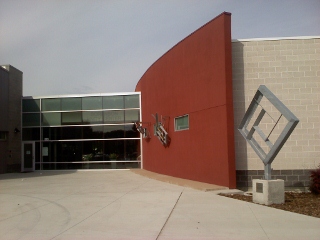
City Creek Center opening brings thousands to downtown Salt Lake City

This slideshow requires JavaScript.

by Tricia Oliphant

Crowds lined the walkway. Parents gripped the hands of their squirming children, who were eager to run off and explore. The shutters of cameras repeatedly clicked.

In one corner a musician put his soul into playing the blues on his saxophone.  In another, musician and performer Steven Sharp Nelson of The Piano Guys entertained a crowd with playful tunes on his cello. The laughter of a nearby group of adolescents resonated as they talked about their plans and what they wanted to see first.

That overflowing excitement most often only theme parks can create filled the masses swarming downtown for the opening of Salt Lake City’s first downtown mall in three decades.

City Creek Center opened on Thursday, Mar. 22, 2012. Like many others, I was drawn to the novelty and newness of City Creek. I decided I had to join thousands of others in visiting City Creek on its opening day so I could answer the question posed by a dear friend of mine, “Is it really as big a deal as it has been made out to be?”

Although City Creek offers ample parking in a giant, heated three-level underground parking garage, I chose to take the TRAX (Utah’s light rail system) to the new shopping center.  In spite of the train being loaded with anxious shoppers of all ages who were also heading for the mall, I thought it offered the convenience of not fighting downtown traffic or hunting for a parking place.

City Creek Shopping Center was funded entirely by cash reserves of the LDS Church and built on three church-owned blocks in downtown Salt Lake City. A sky bridge over Main Street connects two of the blocks and allows shoppers on the second level of the center to cross from one side to the other.

Upon arrival, I was impressed by the classy architecture and design of City Creek Center. I quickly realized this wasn’t just any ordinary mall when I noticed the glass roof is actually retractable. City Creek opens the roof when the weather is just right, providing a view of the open sky and surrounding skyscrapers.

Along with over 90 stores and restaurants, the shopping center offers a wildlife landscape downtown with the re-creation of the historic City Creek that winds through the shopping center’s walkways and plazas—complete with live fish.

In addition to the creek, the shopping center offers a variety of waterfalls, ponds and fountains (one of which is open to children who would like to cool off while splashing in the choreographed blasts of water.) I found each water feature to be quite beautiful and each added a sense of natural serenity to the busy shopping center.

“Standing at the base of the skyscrapers surrounded by rivers and waterfalls was a striking experience of both outdoors and the big city at the same time,” shopper Matt Argyle said. “It’s really breathtaking.”

Benches and tables rest on the edge of the creek and beside the waterfalls. These provide places to relax and enjoy the peaceful atmosphere.

Some believe the quality of the food court can often make or break a shopping center.  City Creek’s food court is nothing to scoff at.

The massive food court is located next to the creek and a waterfall. Diners can eat inside (with many of the tables located next to giant windows in front of the water features) or can dine al fresco.  Both options offer a relaxing place to eat.

The food court is made up of everything from Subway to the Taste of Red Iguana to the Great Steak and Potato Company. Other restaurants, such as The Cheesecake Factory and Texas de Brazil Churrascaria, are also located in the shopping center.

By wandering through City Creek Shopping Center, it soon became clear that people came for much more than shopping and spending. This was a public event, a place for relaxing and enjoyment with friends and family. While taking all this in, I wondered about the future of City Creek and its potential impact on surrounding malls (such as The Gateway, a mere two blocks to the west).

Although City Creek attracted large numbers of people opening weekend, The Gateway was not left completely desolate.

“We were actually pretty busy opening weekend,” said Kara Johnson, an employee at Down East Basics, at The Gateway. Down East Basics, a moderately priced casual apparel store, is not duplicated at the new City Creek Center. “I expected it to be dead,” Johnson said.

Despite the crowds of people at City Creek Center opening weekend, many realized the stores at City Creek were more expensive than they had expected. “They came to Gateway because they knew what to expect,” Johnson said.

Unlike The Gateway, City Creek Center is closed on Sundays. This gives the older mall an extra day to attract shoppers and therefore compete with the novelty of the new shopping center.

Furthermore, although some of the stores are duplicated at both shopping centers (such as Forever 21), many are not. This gives a distinct shopping opportunity at each location.

Johnson said that because she has never been to many of the stores now located at City Creek, she would like to go there just to see what they’re like. “I just want to say I’ve been in a Tiffany’s.”

The uniqueness of the new stores to Utah clearly attracted crowds to City Creek Center.  However, many Utahans are known for being “frugal” and “resourceful”. Higher-end stores may not sit so well with a thrifty people.

“I love City Creek. It’s just so nice,” said Jannali Ouzounian, a new mother from Holladay. “I just wish I could afford to shop at all the stores. A wallet at Tiffany’s [costs] $600.”

“I think Utah could do a lot better by bringing in the outlets,” said University of Utah student Kelly Wolfe. She said that putting in stores such as the Tommy Hilfiger Outlet and Bloomingdale’s Outlet would not reduce the classy appeal of City Creek and would attract a greater portion of the Utah market.

Being a bargain hunter myself, I would love to shop at classy outlet stores downtown. However, I find the higher-end stores at City Creek to be alluring.

How long this allure will last remains in question.

“I think once all the hype wears off, City Creek will be just another mall,” said Utah State University student Elise Olsen. However, once all the hype does wear off, Olsen said she plans to shop at City Creek with hopes of finding good sales on high-priced items.

Only time will tell the fate of City Creek Center and whether it will continue attracting large crowds of people to the downtown area. In spite of this, I found City Creek Center to be beautifully constructed and thought it added class to Salt Lake City.

In answer to my friend’s question, City Creek is quite a big deal — for now.

As online activity rises, so does Internet crime

by JULIANNA CLAY

Paper, snail mail and telephones are a thing of the past. With the Internet and on-line activity at its peak, criminals have had to evolve with the times. According to the Federal Trade Commission identity theft and fraud cost Americans $1.52 billion last year alone.

And Internet crimes are not just a problem nationally. Salt Lake’s Police Chief, Chris Burbank acknowledges that identity theft is one of the biggest issues as far as crimes go that needs to be solved in Salt Lake.

“Everyone gets upset if someone is shot and killed, but fraud costs more and because no one is dying it doesn’t get the attention of the public. That’s the challenge of the future. It is a failure of a single person if we allow someone to be victimized,” Burbank said in Holly Mullen’s Communications 3660 class, at the University of Utah, February 16th.

These thieves have come up with a plethora of ways to go about stealing money and identities. However, the most common ways of identity fraud involve, surfing the social network, dumpster diving, phis-hing for information, your family and friends and skimming for dollars.

Social networking is a great way to connect with love ones, but it’s also a way that Internet criminals get personal information like age, birthday, and place of employment. A lot of people don’t tear up things like credit card offers and bills from the bank. Crooks will take the information found on those items and use it. Phis-hing is the oldest practice of the five. Phis-hers are the ones who send things to personal emails. These emails will be under the guise of winning something or look like an already familiar website. Both will often direct you to sites that ask for personal information. Often times the scam will look like a refuge in another country asking for help or even a family member asking for help. In fact, family and friends account for half of all fraud cases. Skimming for dollars is where thieves will steal bank and credit information when a debit or credit card used during a gas purchase or ATM withdrawal. It’s called skimming because often times the perpetrator will take small often unnoticeable amounts over a period of time.

Rebecca Jarrett was a victim of both phis-hing and family and friends methods. Jarrett’s grandparents received an email one day indicating that she was in the hospital and needed help to pay some of the medical bills. Her grandparents upon seeing that the email address was in fact hers immediately sent money to the bank account and routing number provided.  A few months later Jarrett tried to contact her grandparents and got no response. Jarrett finally found out from another relative what happened. “They said they were upset that they had sent money that they needed back. They were even more upset that they hadn’t heard from me after they’d sent it,” Jarrett said. Jarrett later reconnected with her relatives after they found out that they had been the victims of an Internet crime. However, the damage had been done.

Jared White (this person’s name has been changed at his request) was a victim of social networking. It was during the chaos of the holidays. White and his wife were out of town visiting one of their children. There had been a charge to his primary credit card for an international plane ticket. The airline had called their home phone to verify the charge, but they weren’t home and because the crook had all the necessary information they approved the purchase. White didn’t realize what happened until a few weeks later when he went to check his account and saw that it was way over their limit.

Fortunately after a talk with his credit card company they removed the charges to his account contingent on him completing a fraud report. Unfortunately the villain was never caught. As long as they got their money that neither the credit card company or the airline cared about catching the criminal.

“The whole incident emphasized to me why credit card fraud is at epidemic proportions:  the ease by which it is accomplished; the difficulty in catching and prosecuting the perpetrators; and most of all, the apathy of the companies involved.  It made it clear to me a lot of fraud is written off with the final cost being borne by the consumer in terms of tighter credit, higher interest rates and fees,” White said.

It’s as Burbank stated. If no one has died the importance of crimes like this go unnoticed and often unpunished, which is why identity theft and fraud is rapidly rising to become the most committed and expensive crimes.

White reflects that he would have done things differently. He would have checked his accounts more frequently so that the individual could have been caught when he tried to fly. White also suggests to, “Check your credit card accounts, even your inactive ones every week or so.  Try to limit your online purchases using your major cards, use other sources, like Paypal, which offers good fraud protection.  If you have fraudulent charges on one of your cards, report it immediately, first by phone (record the important information about the call), then follow immediately in writing.  As I understand the law, consumers have the right to dispute any charge if they report it in writing within 30 days of the charge.”

Nonprofits’ motivation brings ‘credibility’ to the community

by LAURA SCHMITZ

Nonprofits, by definition, must exist for public benefit and comply with a “non-distribution constraint,” mandating that net earnings not be directly distributed to owners.

For some, nonprofits are defined by much more.

The Utah Nonprofits Association exists solely to unite more than 600 nonprofit organizations in the state, supported by more than 20 community partners. A part of the National Council of Nonprofits, it also works at the national level, promoting the interests of its organizations to government officials.

An example of one of its collaborators is the national nonprofit, Boys & Girls Clubs of America. With five distinct sites in the Greater Salt Lake area, its Lied club is located at 464 South Concord (1235 West) in Salt Lake City, serving 80 to 100 kids per day.

“I think there is definitely a reputation, a belief system that goes with nonprofits,” said Tiffany Harris, club director for the Lied Boys & Girls Club, in a telephone interview. “They give you more credibility within the community, because your main motivation is your mission. I think when people see that’s your driving force as opposed to money, they are more likely to support you.”

The Boys & Girls Club reaches out to at risk youth, proving resources and a haven away from home. According to its website, after-school hours, between 3 and 6 p.m., are when children are most likely to try drugs and when most juvenile assaults occur.

“We definitely have core members that come,” Harris said. “Most of our kids we see every day. It’s part of their routine — a lot of them walk here after school.”

With 84 percent of its children coming from families considered to be low-income, Harris said the club works to provide them with unique opportunities that might not have been afforded to them.

“We’re starting an art program, having local artists come in,” Harris said. “It’s great, because they have that background and expertise that kids crave and really love. Classes are expensive, so we try to fill that gap that kids wouldn’t get otherwise.”

The Lied club has 10 paid staff members, including four who work with elementary age children and three dedicated to the teen center. The center is open primarily during the high-risk after-school hours, opening each day at 2 p.m.

While nonprofits can apply for 27 types of tax exceptions from the Internal Revenue Service, the Boys & Girls Club functions under the common 501(c)(3). It receives the majority of its funding through local and state grants, private foundations and donations.

“That’s what a healthy nonprofit will do,” Harris said. “You can’t rely on one major funding source, because if that source pulls, your funding is gone.”

However, these organizations are not devoid of any monetary gain, which is a common misconception, said Nancy Basinger, assistant director and service learning manager at the Lowell Bennion Community Service Center at the University of Utah who works extensively with nonprofit’s rights and bylaws.

“The [nonprofit] organization must make a profit, but must also be reinvestigating its own entity,” Basinger said. “The most in-demand nonprofits are those that assist in survival.”

Basinger said one common negative theme she sees within the nonprofit industry is that there are many individuals who are passionate about a cause but have little business experience.

“A lot of [nonprofit] leaders are doing this organization on top of other things,” she said. “They’re acting as social workers and nonprofit workers and have a family and kids.”

Basinger said the passion must be balanced with experience to have a successful impact in the community. She encouraged would-be entrepreneurs to first try partnering with an existing organization before building from the ground up.

“It’s not good to have a million nonprofits competing over the same dollars, rather than a few nonprofits working together under the same dollar,” she said.

Along with its hundreds of nonprofit organizations, Utah has 7.2 active charities for every 10,000 residents, who make up the largest charitable contributors in the United States, based on income. Those living in the Beehive state are also No. 2 in the nation for self-reported volunteering.

Healthy food available for day cares

Story by JOHANNA WISCHMANN

Helping Hands Inc. is a nonprofit organization that works with day care homes to provide a healthy and nutritional diet.

The program works with children under the age of 12 in day care homes. It strives to improve the day cares, mostly run by low-income families, to afford better quality meals for the children.

Helping Hands works with Child and Adult Care Food Program, known as CACFP. CACFP is a federal program that gives healthy snacks and meals to children and adults involved with day care programs.

According to the Helping Hands website, the program helps the caregiver have the funds to purchase better quality of food, such as milk, breads and meats.

It also reimburses homes for healthy meals given to the children, like a breakfast of fruit, vegetables or milk. To get reimbursed for a meal provided for children, a provider has to make a claim.

Day cares and providers can claim up to two main meals and two snacks per child per day.

Susan Ison, executive director at Helping Hands, said that when a provider follows the USDA nutritional guidelines, Helping Hands works with the Utah State Office of Education to receive reimbursement for food given to the day care children and a lot of times the provider’s children.

An estimated 98 percent of providers that Helping Hands supports are from low-income families, Ison said in an email. An estimated 75 percent are from different cultures and ethnicities and don’t speak English. To qualify the providers have to have proper licenses and they must be caring for at least one non-residential child.

Once enrolled, a provider must complete paperwork, including a daily record of the food that the children ate and which children ate what food. This paperwork is given to Helping Hands monthly.

To ensure that the funds provided to the caregivers are being used correctly and to help maintain a healthy, nutritional diet and a healthy environment, Ison said. Helping Hands staff makes an unannounced visit about two to three times a year.

Not only does Helping Hands help with financial situations, staff also offer training on sanitation and nutrition.

“We provide nutrition and care giving training both, in actual training classes at our office and in-home during home visits,” Ison said.

“The biggest help we could receive is letting people know that this program is available to all day care providers, both those who are legally licensed for day care and those caring only for related children,” she said.

Helping Hands has a full menu available with healthy options for families and providers to choose from, like celery sticks, strawberries and peanut butter.

It also keeps information accessible to families by keeping recipes readily available for everybody interested in a healthier diet.

According to the website, Helping Hands also provides more information for providers by using the CACFP site that allows plenty of information and tools to make the use of the nonprofit very easy. For example there is a “food tracker” available for providers to use.

“In the current economic environment, it is more and more difficult to afford good, quality, healthful foods for our children,” Ison said in an email. “I, personally, would not have my child in a day care – whether in a residential day care home, or a day care center – that was not participating on the food program. I feel it is that important!”

Helping Hands has staff available for contact through email or telephone.

To  join Helping Hands fill out a form of information online or visit the location on 2964 W 4700 S, Suite 111 in West Valley City.

Utah nonprofits, Sorenson Unity Center roll with recession

Story and photo by DEREK SIDDOWAY

In the midst of numerous stock market plummets, layoffs and home foreclosures, many people have come to rely on soup kitchens, housing services, welfare entities and charities such as the Salvation Army and Deseret Industries for basic necessities.

According to the Bureau of Labor Statistics, Salt Lake City’s unemployment rate was at 7.4 percent in August 2011. Online real-estate marketing company RealtyTrac reported 560 housing foreclosures in the city throughout September 2011.

With no economic relief in sight, nonprofit organizations in Utah are working tirelessly to meet an increased demand for their service. A 2011 report prepared by the Community Foundation of Utah and Wells Fargo paints a vivid picture.

According to the report, “The New Normal, Changes to Utah’s Nonprofit Economy in the Great Recession”: “Utah nonprofits are, like the families they serve, stretched to the limit,” In addition, “As many as 14 percent have no cash on hand, and are living paycheck to paycheck, much like many of the people who come to them for assistance.”

The report, presented to the Utah State Legislature in February 2011, indicates demand is continuing to increase. In 2009 and 2010, nearly 80 percent of Utah nonprofits saw an increased need for service. These findings hint that up to one-third of Utah nonprofits could be out of business if there is no relief in the immediate future. When the report was published, 70 percent relied on deficit spending or were operating on less than three months of reserve funding.

“There is basically no reserve fund left in the state of Utah for nonprofits,” said Nancy Basinger, assistant director and service-learning manager of the Lowell Bennion Community Service Center. She studied nonprofit interactions with the government for her doctorate research at the University of Georgia in 2003 and is a member of the advisory board at the Nonprofit Academy for Excellence in Professional Education at the University of Utah.

Basinger, who has published various reports and research projects concerning the nonprofit sector in Utah, said nonprofits suffer more in a down economy when demand rises and funding bottoms out. She is concerned over how nonprofits will continue to meet their obligations and serve the community if they are unable to make payroll.

“This is the rainy day and now we’ve got to really figure out what to do,” Basinger said. “The pot is smaller and the (number of) people donating is smaller.”

The pot may be shrinking while demand has done anything but. In addition to providing for the physical needs of their patrons, nonprofits have experienced an increased need for social and mental programs as well.

“Behaviors supported by social services are more in need because of job loss, at-home abuse, substance abuse and no health insurance,” Basinger said.

The Sorenson Unity Center houses a variety of nonprofit organizations selected through its Programming Partnership.

Some nonprofits have responded to these diverse needs by joining forces. For example, the Sorenson Unity Center has found that this strategy benefits patrons in addition to decreasing operational costs. The operation came about in 2008 when the Sorenson Multicultural Center and Salt Lake County approached the city government with a plan to run the center for a reduced cost. Located at 900 W. 1383 South, the Sorenson Unity Center provides services for the Glendale and Poplar Grove neighborhoods.

“Sorenson Unity Center is a way to bring organizations under one roof so that it’s not so difficult to have a million nonprofit organizations competing for the same dollars,” Basinger said. “(Salt Lake City) has decided that it is in its interest as a supporter of society to support the work of those nonprofit organizations. They are working together and accomplishing twice and much with the same dollars.”

Angela Romero, Sorenson Unity Center’s program director, is responsible for the selection of nonprofit organizations through its Programming Partnership. She describes her job supervising the partnership as a way to provide opportunities for the community that would be otherwise unavailable. Nonprofits seeking to use the Sorenson Unity Center’s resources must show Romero the services they will provide to the community before they are approved.

“We want to be a resource through the programs we provide,” Romero said. “We hope individuals can take away something that will help them in dealing with the current economic environment.”

According to its annual report, the Sorenson Unity Center had a total of 8,334 participants in programming activities for the 2010-2011 fiscal year. Overall, the center and its affiliates served more than 18,000 patrons during the past fiscal year. These affiliates — Unity Computer Center, Computer Clubhouse, Donated Dental, Fitness Center, Child Care and general events and meetings — saw a total of 74,283 visitors during the same period.

However, the Sorenson Center and its affiliates receive financing through city funding. This steady source of revenue allows the center to maintain its facilities for the community’s use without wondering where the next check is coming from.

“I think what the recession has done is (create) a greater need for us to provide quality services for individuals that are in our community,” Romero said. “Hopefully more people are able to access the programs we have here.”

Refugees learn at The English Skills Learning Center

Story and photo by NATHANIEL BINGAMAN

Imagine moving to a new country where you do not know the language and you do not have any formal educational experience. Even holding a pencil is new to some. This is the case for thousands of refugees every year. But, with the help of the English Skills Learning Center in Salt Lake City, these individuals are able to learn basic skills such as reading and writing in English.

Beth Garstka, the volunteer coordinator for the ESLC, said more than 16 million refugees live around the world and more than 1,100 come to Utah per year. These individuals come from countries such as Afghanistan, Egypt and Sudan. They are people suffering from war, natural disasters and famines. They come to America with the hope of freedom and improving their lives, but many of the refugees do not have a formal education.

The ESLC offices are located at 631 W. North Temple. It was originally called Literacy Volunteers of America-Wasatch Front (LVA-WF). Its founding member, Mary Hausen, formed LVA-WF in 1988. She was previously involved with an affiliate in Connecticut.

The organization’s first mission was to help improve literacy in adults and those learning English as a second language. In 2001, due to the rapid growth of refugees in the world and non-English speakers in the community, the organization focused solely on English as a Second Language.

The nonprofit organization is unique because it works with a student’s availability. “If they do not have transportation we will meet them at a library or church, anywhere that is convenient for them,” Garstka said.

Multiple class options are available to the students, including one-on-one classes and small group classes that have four to 10 students at a time. Many students participate in classes that prepare individuals to become United Sates citizens. There are even classes to help parents better communicate with teachers and enable them to read their child’s report card. Best of all, the classes are free.

Students have a good reason to come to class. “We teach the people what they want to learn, not what they don’t have interest in,” Garstka said.

The ESLC focuses on where the students are in their life. For example, if students want to drive so they can get to work, they will be taught to read the necessary books and learn writing skills so they can obtain a driver’s license. If they want to obtain United States citizenship, the ESLC will teach lessons pertaining to obtaining that goal.

Jose Amezcua participated in a program offered by the ESLC while in grade school.

“We teach people simple things like the alphabet or even the proper way to hold a pencil,” Garstka said.

The tutors are volunteers 18 years of age or older. These volunteers go through a 14-hour training session where they learn how to teach reading, writing, listening skills and speaking activities. No previous teaching or tutoring experience is required and individuals do not need to know another language because all classes are taught only in English. For those wanting to volunteer, the ESLC offers information on various volunteering opportunities.

“We have amazing volunteers who love being here,” Garstka said.

When the ESLC first began it had a program called “I Can Read” aimed at elementary students who were reading below grade level. The program was eventually adopted by the Utah State Office of Education and used in schools throughout the state.

“The ESL program helped me a lot,” said Jose Amezcua 29, who took ESL classes while he was in grade school. “Without it I would have had no friends and it would be hard for me to get an education in this country.”

Now a college graduate and an electronics salesman at a local Sears store. Amezcua is grateful for the ESL program and the help he received. “Without the classes it would have been hard for me to go to college and get a job,” he said. “Without a job it would be hard for me to take care of my wife and family,”

Learning a new language is difficult for almost everyone, but The ESLC helps make that transition a little easier.

Hair today isn’t necessarily gone tomorrow for Utah women

Watch a multimedia slideshow about women’s beauty habits in a down economy.

Story and multimedia by WHITNEY BUTTERS

Split ends, drab color and shapelessness. Bangs that once framed the face now long enough to obstruct vision. Hair so unruly that even a helmet of hairspray could not keep the temperamental tresses in place.

This is more than just a bad hair day — it’s a sign that it’s time to visit the salon again.

“When your hair isn’t going right, nothing seems to be going right,” said Lila Latu, a customer at the Mane Station Salon in North Salt Lake.

This perceived need for hair maintenance keeps the multi-billion dollar beauty industry going as women continue to spend money on their appearance at varying degrees despite the downturn in the economy.

“Getting hair done is still a necessity,” said Memorie Morrision, assistant salon director and grand salon stylist at Landis Lifestyle Salon in the Marmalade district of Salt Lake City. “It’s not something people go without. It is a reflection of how you see yourself.”

Undying dedication to keeping up appearances allows the beauty industry to flourish while other sectors of the business world flounder.

The Bureau of Labor Statistics states barbers, cosmetologists and other personal appearance workers held approximately 821,900 jobs in the United States in 2008. That number is expected to grow by 20 percent before 2018 due to a growing population and increasing demand for hair service, which is faster than the average growth rate over all occupations.

Landis Lifestyle Salon added to the increasing job opportunities when it opened its doors in Sugar House in 2005. It recently expanded into its second location in Marmalade in September 2010. Morrison said the salon has already surpassed the owner’s expectations and continues to grow “slowly but surely.”

The industry continues to grow despite the fact that many customers are trying different tactics for saving money on hair care. Some try their hands at cosmetology by cutting their own hair at home but often end up turning to the help of professionals in the end.

“I fixed more haircuts in January of 2009 than I ever have,” said Misty Jones, manager of the Winegars Marketplace Great Clips in Bountiful. “I remember once when I fixed five in one day.”

Many cut back by simplifying their hair treatments instead of trying the do-it-yourself approach. Latu decided to keep her hair her natural color so she didn’t have to worry about the cost of upkeep. “I’m just getting a trim today,” she said. “I can’t afford to get it colored.”

Others try to spread the cost over several months by waiting longer in between haircuts. Misty Jones said women who used to get their hair cut every 3-4 months now wait 5-6 months.

Tara Jefferson, a customer at the Marmalade Landis Lifestyle Salon used to make an appointment every six weeks to get her hair cut. She says she now examines her finances each month, often resorting to putting it off until the funds are available. “Even if it’s looking bad, I guess I’ll just have to be extra creative (that) month,” she said. “It does depend on my budget and how badly I need my hair cut.”

While getting hair cut may be seen as an essential, Misty Jones and Morrison both said hair products are one of the first things someone will cut when trying to save money.

“Before the downturn in the economy, it was easy to sell $50 in products to one person,” Misty Jones said. “Now we give someone a recommendation and they automatically ask if they could get it cheaper somewhere else.”

Even specialty stores are experiencing some of the same drop in hair product sales.

“My boss says that it used to be quite a bit busier a couple of years ago, and it’s just slowly declined,” Madison LeMelle, an employee at Classy Chassis beauty supply store in Bountiful, said. “We still get people in, but it’s definitely not as much as we used to.”

Although sales may be down compared to years past, women still seek quality when it comes to hair products. “We use professional brands in here, and it really does make a difference,” LeMelle said. “With the economy, even though it’s bad, people still want to use the best stuff they can.”

Stylists are sensitive to their clients’ financial situations and try to help them prioritize on the essential products. Many consult with their clients and explain the purpose of each product recommendation to achieving the overall desired look. “It’s our job to really hone in on what a person needs,” Morrison said. “They don’t want to pay for a style and not have the same results from home, so products are still important.”

Jefferson’s stylist recommended she purchase enhancer and conditioner from Landis’s Aveda products collection, but she had to further narrow down the options because of tight funds.

“I just got the conditioner, just because I am so strapped financially,” she said. “Next time when I’m rich and famous I’ll get both.”

There are still women who cling to their hair routine sacrifice in other aspects of life in order to maintain it.

Helen Jones used to take her mother to the beauty parlor once a week to get her hair done. “If she missed a week, I knew she must have been sick because she never missed her trip to the salon,” she said.

She has picked up her mother’s tradition and visits her cosmetologist at the Mane Station weekly to get her hair styled. “I would not give up my weekly hair appointment for anything,” she said.

When many women are cutting back on color treatments, Helen Jones holds fast to her habits. “It can get expensive to color it, but it’s worth it no matter what the sacrifice is,” she said.

Regardless of whether a woman chooses to save on hair costs, every cut, color, trim, style and shampoo seems to carry inherent value.

“It’s part of a women’s nature to let people rely on us,” Misty Jones said. “Beauty is a service industry, and it’s our job to make people feel good. It’s an opportunity for women to let someone else do something for them.”

This opportunity to do something for themselves is what Morrison believes drives many women to fill the salon chairs at Landis Lifestyle Salon.

“We try to put value into what we do, and women who come here are willing to pay for the certainty that they will get what they want,” she said. “Our customers know they will get a stylist that will give them time and focus on them.”

More than “me” time, a trip to the salon brings a new sense of self. Morrison said she sees the “mirror face” on a daily basis as she watches a woman’s countenance change when she sees her new hair and a revised version of herself.

Possibly the biggest drive for women to continue to sacrifice money on beauty is the perception it portrays and the transformation of attitude.

“I feel good, and it affects the way people treat you, and that’s why I’m willing to spend what I can spend,” Jefferson said. “Because when you look good, you feel good about yourself. Beauty starts on the inside, but you have to extend that to the outside.”