Uniting for a cause: partnership provides promise of education for refugees in Salt Lake City

Story by ANNA STUMP

The University of Utah, in partnership with Salt Lake Community College and Jesuit Worldwide Learning, is working hard to make it feasible for refugees to earn a bachelor’s degree in social work.

Jesuit Worldwide Learning Higher Education at the Margins (JWL) is a collaborative global partnership that provides an education to those who are marginalized, including refugees, internally displaced people, economically poor, and socially neglected and underserved.

JWL, whose global headquarters is in Geneva, constructs online and in-person learning centers around the world. It offers three levels of educational opportunities, including the Academic or Diploma Program. The online infrastructure allows those in remote villages or in refugee camps, without locally operated schools, to gain an education.

Once a refugee finishes with the programs provided by JWL, the student can begin taking online classes from Salt Lake Community College. Students who complete their last 15 credit hours with SLCC can earn an associate degree. The college has agreed to charge refugees in-state tuition.

Once an associate degree is earned, the University of Utah hopes to take over from there.

Laying the groundwork

Patrick Panos, a professor of social work and director of Global Education and Outreach at the U, is the driving force behind the effort to provide refugees with a chance to earn a bachelor’s degree and become leaders in their respective communities.

“Without an education, all you have is your physical labor to sell. And if all you have is your physical labor, that is a time-limited commodity,” he says.

JWL laid most of the groundwork for SLCC and the U by setting up a structure for education in distant war-torn areas that the colleges wouldn’t dare enter. Panos says he is grateful for the organization’s work.

“They’re going to places where we could not physically go. The University of Utah is not going to go open up a school in Afghanistan. But [the U] can have students in Afghanistan through this process,” he says.

STORY 2 asset

Refugees take pride in their education from the University of Utah. Photo courtesy of Karen Cordova.

Francis P. Xavier, vice president for academics and research for JWL, said in an email interview that the organization currently has learning centers in the Middle East, Asia and Africa. He hopes JWL will become more global in the future.

A trial run proved the functionality of the distance-learning program and the feasibility of providing online classes with little cost to the student. The classes at the U will be offered to student refugees who qualify. That group will become known as a closed cohort, and pay nominal tuition to the College of Social Work rather than to the university as a whole. This is significant because the college will cover the cost of classes so the refugee students don’t have to. “I can charge them a dollar a class, and that‘s OK. And the university is OK with that,” Panos says.

story 2 Case management 2

Graduates of the University of Utah’s Case Management Certificate Program in 2015. Photo courtesy of Karen Cordova.

Technology as a learning tool

Distance learning challenges historical notions of how a university operates. Traditionally, students come to campus, where they have access to amenities such as tutoring centers and the library. But an online delivery of course content makes it possible for refugees and others in marginalized communities to pursue educational opportunities.

The classes at the U will operate through Canvas, an online learning platform that connects professors and students in real time. A library database can be accessed with a student ID, so refugee students are able to access scholarly articles at their fingertips.

Kyle Jensen, director of Canvas user interface, said in an email interview that Canvas is special in terms of communication.

“Canvas, at its core, is a communication tool. As such, we aim to encourage high quality, meaningful interaction opportunities between educators and students. We also spend a lot of time and resources ensuring that Canvas works for everyone.”

Collaboration leads to reciprocal learning

Students within the Canvas classroom have much to gain from this collaboration and cultural exchange, both of which are crucial to the nature of social work. This relationship is valuable, as it allows traditional students to gain other perspectives before entering their profession.

Regarding the distance learners, Panos said, “If you want to have your students have a high impact upon graduation, these are them. They are changing the world. Educate a refugee — change the world.”

Panos pointed out that refugees who are trained in social work are then able to use this knowledge to work within their respective communities to improve the lives of the people living in the camps.

“Social workers learn how to advocate, how to do community development, how to do all of the things about how to reconstitute a community — and bring mental health in, child welfare in, and all those different pieces,” Panos says.

Refugee students speak in the native dialect of fellow asylum seekers, and have intimate knowledge of what is needed in the places where they work. Because of this insight, graduates of the College of Social Work can later seek employment with International relief efforts such as Doctors Without Borders and the United Nations.

Panos has high hopes for the future of the program. He’d like to see it expand beyond the College of Social Work, so students can earn other degrees in fields such as nursing, architecture and education. Panos also said his wish is for more refugees to have access to higher education, made possible by a collaboration of efforts from universities and programs in the U.S.

Xavier, the JWL executive, said his organization currently offers a diploma and some associate degrees. It wants to offer bachelors and master’s degrees and eventually doctoral degrees.

“I look forward [to] JWL becoming a virtual university which offers degrees of high quality for the refugees and the marginalized at affordable cost,” Xavier says.


Flying into mountains: A refugee’s point of view

Flying into mountains: A refugee’s point of view

Story and photo by JACE BARRACLOUGH

“Say what you will about America, there’s definitely a lot more opportunities here.”

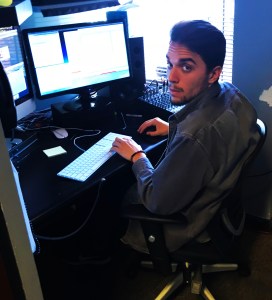
Dario Jokic is a student at the University of Utah. He’s also an aspiring film director and a Fox 13 studio technician. He has spent most of his life in Utah and has no problem integrating himself into different social circles. With no accent or visible cultural differences, people are shocked to find out he’s a Bosnian refugee.

IMG_4453 copy

Dario Jokic edits news at Fox 13 Utah.

Jokic came to Salt Lake City when he was in the first grade. His family’s case worker told them Utah was a mountainous desert with people who practice polygamy.

“We thought we were literally going to fly into mountains … and the first thing that was going to welcome us there was one man with six women,” Jokic says.

The Jokic family was grateful for the welcoming they received from their new friend. They were also a bit relieved.

“She was a really sweet and energetic lady who spoke our language,” Jokic says.

He says the hardest part about his resettlement and integration was learning English.

“I hated English,” he says. “I remember my first time in ESL (English as a Second Language) class, they put me with the wrong teacher who was teaching English in Spanish.”


Gerald Brown, Utah’s state coordinator for refugee resettlement, says ESL is the state’s most costly of all the services offered to refugees who resettle to Utah. However, he says it’s still not enough.

“That funding is very, very limited. You cannot do a decent job with that funding alone,” he says.

Though Brown says there is some help from the private sector, the majority of the funding comes from the federally funded U.S. Office of Refugee Resettlement.

Brown also doesn’t see it getting any better due to recent decisions made by the government. According to the 2016 Refugee Services Office’s Report to the Governor, the State of Utah spent $171,000 on the program. However, Brown predicts that number will drop, which is bad news for non-English speaking refugees like Jokic was.

“The current [presidential] administration has different priorities,” Brown says. “It’s becoming less every year and this year we’re really worried what the budget is going to look like.”

Utah’s Gov. Gary Herbert said in a January 2017 press conference that Utah is still a pro immigration and refugee state, but made it clear those types of issues are strictly handled at the federal level. He also said Utah tried to intervene in the past but was issued a lawsuit as a result.

Gerald Brown speaks highly of the Church of Jesus Christ of Latter-day Saints’ (LDS Church) influence on the state regarding refugee resettlement. Unlike Jokic’s experience with publicly funded ESL classes, the LDS Church funds its own classes to help struggling refugees be successful.

“One of the reasons Salt Lake City and this area is a good place is because of the LDS Church,” Brown says. “They’ve put a tremendous amount of resources into helping refugees.”

While resettlers are learning English in hopes of finding better jobs, they can utilize programs like the refugee table at the Jenibee Market hosted by Jeni Gochnour.

“We provide the table and give 100 percent of their sales back to them,” Gochnour says. “They sold around $300 [at the fall event]!”

Ann Howden, of the group Serve Refugees, donates her time by teaching refugees how to sew. They make bags, pillows, blankets and other items to sell at the refugee table in order to help their families financially.

The Jokic family, themselves, know all too well the sting of trying to make ends meet without proficiency in the English language. Jokic’s father, formerly an economics professor in Sarajevo, had to take a job at a glass factory soon after arriving in Utah. Since he didn’t speak English, and his degree was from another country, it made it impossible to continue his teaching career in the U.S.

Jokic’s mother, however, did speak English and was able to find a job as a counselor for the Department of Workforce Services. She also acquired jobs as a translator for various medical facilities.

Even though there were difficulties, Jokic expresses his gratitude for the change.

“I’m very privileged to be here,” he says. “I know there’s a lot of negative things being spread about the United States, but my life would be totally different if I wasn’t living here.”

He continues, “If I was [in Bosnia] I wouldn’t be going to college. … Say what you will about America, there’s definitely a lot more opportunities here.”

Jokic gives advice to refugees dealing with the trials that come with resettlement.

He says, “Don’t be afraid to ask for help [and] look for people that will care about you.”

IMG_3667

Big Budah, Dario Jokic and Jace Barraclough preparing for Fox 13’s “The Place.” Photo courtesy of Big Budah.

Educated and underemployed: refugee student seeks second degree

Story and photos by DEVON ALEXANDER BROWN

Over 60,000 refugees have been resettled in Utah since the 1970s. Prior to the Trump administration, Utah’s designated voluntary agency affiliatesCatholic Community Services and the International Rescue Committee — were resettling roughly 1,200 refugees a year. While agencies do what they can with the resources they have, many refugees find the adage “it’s not what you know, but who you know,” continues ringing true.

Firas, a refugee from Iraq, has personal testimony of the value of networking. He resettled in Salt Lake in March 2014 by way of the IRC, but he has an uncle whom he lived with after resettling, and who continues to offer emotional and financial support.

Firas, who asked to have his surname withheld, holds a degree in civil engineering from a university in his native Iraq, but was dismayed when he found that using his professional training in the U.S would be difficult. The IRC helped him secure an entry-level position in the customer service sector a few months after arrival, but he felt unmotivated and underutilized by the position because of a desire to continue his profession.

“They [the IRC] will explain that it’s not going to be easy to go back to your job,” Firas said. “This is the general talk about this topic … it’s not going to be easy. Because you’re going to face different stuff, regardless of the language challenge.”

But after some time in Salt Lake, and while living with his uncle, Firas stumbled upon good fortune.

“My uncle is here so we met at the mosque and fortunately I met one of the refugees who came through the same process,” Firas said. “That guy actually was part of the NAAN program [New Academic American Network] … he was asking me what was my major, what did I do in my undergrad. He told me he just finished his master’s at the university which is how I learned ‘OK you actually can go back.’”

up

The UNP main office. University Neighborhood Partners was created in 2001 to empower SLC’s westside residents. Many refugees are resettled on the west side of Salt Lake.

The New American Academic Network is a partnership facilitated by University Neighborhood Partners in conjunction with the University of Utah, the University of Utah International Center and the Department of Workforce Services. Because many refugees arrive without the means and proper credentials to work in their respective fields, the goal of the program is to empower refugees and immigrants through access to higher education. In Firas’ case he is working toward a master’s degree in structural design.

P

The UNP Partnership Center opened in 2004 and brings together over 30 university partnerships and 20 local nonprofits.

Although he was able to enroll at the U through the network, he was forced to initially enroll as a non-matriculated student because he did not meet university requirements. Firas, like local students attending graduate school, was required to pass the Graduate Record Examination, but because his native language isn’t English he also had to pass the Test of English as a Foreign Language exam. Although challenging, Firas passed both exams on his second attempt. He credits his time in customer service with accelerating his English fluency.

Partnerships like the New American Academic Network are essential for educated refugees looking to move beyond underemployment. The Academy of Hope, a fellow partnership facilitated through the U, offers no-cost certificates in professional management, web design and human resources management.

Claire Taylor, director of the Academy of Hope, says language, though a primary challenge, is but one of many obstacles refugees face on their path to higher education.

“A common challenge is not being able to afford the cost of certificate classes,” Taylor said in an email interview. “Another common challenge is carving out the time in their schedules to be able attend all of the classes.”

A relatively new program, the Academy of Hope saw one student enrolled in 2016, but Taylor says the 2017 Spring semester provided a cohort of students. So far seven participants have been refugees.

Thanks to the New American Academic Network, Firas is able to finish his master’s degree. Yet even with tuition assistance, he says it is not easy to support himself and complete his program and the engineering internship he is currently involved with.

“Fortunately my uncle is here and he supports me until now,” Firas said. “I was living with him at the beginning and he and his family helped me a lot. It’s difficult to have a place in a different culture, different society.”

Firas understands that case workers in the IRC are limited in their reach and ability to assist refugees on an extended individual basis. But he also thinks a more thorough and personalized approach in the early stages of resettlement would be beneficial — especially for refugees who are professionally trained.

Gerald Brown, assistant director of refugee services for the Utah Department of Workforce Services, is in agreement. He says his experience with refugees reflects a need for lengthier case management.

“Every new refugee needs case management for at least two years and I would argue for longer than that for many of them,” Brown said in a telephone interview. “It just to me makes common sense. A case manager helps a refugee kind of come up with a plan to meet their needs, to thrive in this community and then sort of follows the plan, helps them adjust over time, [and] gives them information when they need it.”

Although Firas hasn’t obtained his master’s degree yet, he is close and hopeful. And because of his personal good fortunes, Firas says he makes every effort to inform other refugees about lesser known resources that can help them get back on their professional footing.

“I’m still referring anybody who came as a refugee — who has a graduate or even non-graduate [degree],” Firas said. “Either go into community college or to the university … this is the option you have and how to go back to what you like.”

University of Utah’s Center for Research on Migration and Refugee Integration builds on success of first year

Story and photos by ZACH CARLSON

The Center for Research on Migration and Refugee Integration is housed in the University of Utah’s College of Social Work. The CRMRI is located in Caren Frost’s office.

The Center for Research on Migration and Refugee Integration opened as part of the College of Social Work at the University of Utah in 2016. Leading this center is Dr. Caren Frost. The CRMRI’s main focus is on obtaining federal grants and analyzing data that it receives from groups like the Catholic Community Services and the International Rescue Committee.

Aden Batar is himself a refugee who works with the Catholic Community Services in Salt Lake City, helping to resettle refugees. With roughly 60,000 refugees here in Utah and hundred more coming each year, these two organizations are working together to help make Salt Lake City home for refugees from around the world.

Each year, the CCS helps resettle roughly 400 to 500 refugees, according to Batar. These refugees are from all over the world, with 53 percent of them migrating or hailing from Afghanistan, Somalia and Syria. Batar says he expects the Syrian Civil War to lead to an influx of Syrian refugees, making Syria the largest source of refugees in the coming years.

As the individuals integrate into Salt Lake City, they obtain education as well as work. Batar says that about 85 percent of refugees become self-sufficient within six months of arriving in Utah. While most parents don’t pursue a higher education once arriving, their children are more likely to go to college, says Caren Frost of the CRMRI.

No information is collected on how many refugees go to the U, but the CRMRI estimates that there are at least 500 students with refugee backgrounds. The CRMRI describe itself as active with students on campus, but it thinks it can always be more involved. It finds itself interacting more with younger children in junior high and high schools, Frost says.

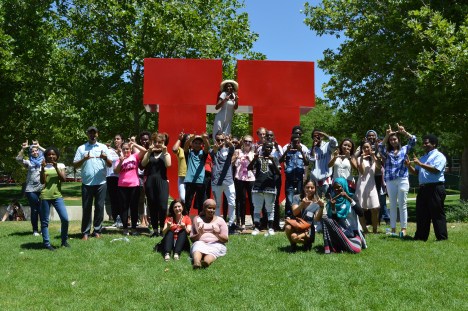
Over the summer of 2017, the CRMRI hosted a workshop at the U for about 25 high school seniors from the Salt Lake Valley who were interested in college. Delva Hommes, the administrative manager for CRMRI, says it had a broad range of students, with some having been in America from two months to two years. The students spoke about a dozen different languages.

Students who attended the summer workshop. Photo courtesy of Delva Hommes.

Volunteers discussed with the students what different aspects of college and campus life are like at the U, why they think the students should go there, and how to help them achieve their goals. The CRMRI hopes to do similar workshops every summer, Frost says.

Frost writes grants and articles, and analyzes data for the CRMRI. “We have information about what country the refugees are coming from, how long they were in camps, what languages they speak, what are their healthcare needs,” Frost says. “We also have information about jobs that they have once they get here, how much they’re getting paid per hour, what other training needs they might have.”

CRMRI celebrated its first year at the U in August 2017. Frost described the program’s first year as “fact finding,” citing repetitive redundancy, also known as tautology where the same idea is said twice but with different words, as an issue that it deals with often. Because it is trying to put people in touch with others, she says it can sometimes be a challenge to coordinate and work with everyone’s schedules.

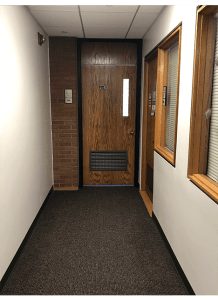
The hallway leading to the CRMRI, which is on the second floor of the College of Social Work.

The research center has three main goals for its second year. First, Frost says “working to define integration. This isn’t just trying to get refugees to assimilate,” she says, “but to encourage a two-way exchange of ideas about different values, different cultural systems, between refugees and those hosting them.”

Her second goal for the center is to create a geospatial map of the Salt Lake Valley. An earlier draft of this was created for the Refugee Women’s Committee, which Frost has chaired for more than five years, she said in a subsequent email interview. This map pinpoints where these women lived in the Valley, the public transportation routes near them, where libraries are and where they can go to get health and dental care.

With this, researchers can see where people are versus the resources individuals need. Frost says these women are in a sort of “resource desert.” The medical care they need is far away, and in case of an emergency those without vehicles might not get the necessary medical attention, Frost says. Frost is looking to further enhance this project by working with individuals within the Department of Geography and with the Social Research Institute, to try to make something useful with this information.

The Center’s final goal of 2017-18 is trying to get more community partners to help the program and do research with it. The CRMRI is constantly learning from its partners, like the Catholic Community Services and International Rescue Committee, about each group’s on-the-ground work, Frost said in a subsequent email interview. It would really like “to be doing more cross-cutting discussions about what research actually is, what we can actually say with things, what kind of data do we actually need,” Frost says.


Refugee mother of seven longs to see husband and sons again

Mother flees Somalia after men in family are kidnapped, relocates to Salt Lake City with her five daughters.

Story and photos by ANNA STUMP

Halimo Ismail was living with her husband and seven children in Somalia when their lives unraveled. One night, Halimo woke to discover that her two sons and husband were missing. She quickly realized that they had been kidnapped, but had no idea by whom or whether they were still alive.

Halimo and her five daughters fled to Egypt in 2011, where they spent the next five years in a small apartment just in view of the pyramids. Her youngest daughter, Asmaa, was just shy of 6 years old. The other daughters were ages 7, 8, and 9.

In February 2017, Halimo Ismail and her daughters resettled in Salt Lake City.

100kb - Voices of Utah-2

A family who lives in the same complex as Halimo Ismail and her family decorates for Halloween.

Asmaa, now 12, sits beside her mom in a two-bedroom townhome in South Salt Lake City, where the smell of incense fills the room with a musky aroma. She agreed to help translate for her mother, who speaks Somali and Pashto but is not yet conversant in English. Communication seems to be a problem outside of the interview, where Halimo finds herself too timid to converse beyond the small Muslim community she is a part of. Young Asmaa translates her mother’s responses to a reporter’s questions in her own words.

“My mom says sometimes she feels people are better than her because they can talk together,” she said.

Asmaa is comfortable communicating due to her inclusive public schooling and speaks in short and well thought out sentences. She is now attending middle school, and has a group of friends who teach her customs that did not exist in Somalia or Egypt. Her middle school offers a variety of extracurricular activities that she takes part in, her favorite being basketball.

“I guess I’m pretty good. I don’t know,” she said with a bashful grin as she gazed down at her feet.

She said her elementary school in Egypt offered no games for the children to play. “It was not as good, the schools. The schools here are better.” Asmaa added that she and her sisters feel welcome in Utah, despite their cultural differences.

100kb - Voices of Utah-10

Children play on a fence in the complex where Halimo Ismail and her daughters live.

The same is not true for her mother, however, who mostly interacts with those who speak in her native tongue. There is a small Muslim population in Salt Lake City, and they support one another like family. It is a tight-knit community and holidays are often spent together. During the last day of Ramadhan, on the holiday known as “Eid al-Fitr,” all of the men get dressed up and the community gathers for dinner. Halimo misses her husband and sons deeply, but still enjoys the sense of unity that surrounds her during religious gatherings.

Gerald Brown, the state refugee coordinator and assistant director of the Refugee Services Office, says it is important for those within the mainstream to become friends with refugees like Halimo, who struggle with seclusion after a long journey through the refugee resettlement process. “I know people who have been here for 12 years and don’t have any American friends,” Brown says.

Volunteers can have a positive impact on the lives of refugees. The Refugee Services Office offers a Refugee Family Mentor Program that helps “guide refugee families in areas such as education, health care, [and] accessing local services and resources.” Brown understands the impact of this program from firsthand experience.

“And even if the refugees can’t speak any English, just having somebody across the table who smiles at them from the mainstream is real important,” Brown says.

His wish for Salt Lake City is for more people to become involved in the lives of refugees through volunteer programs. “To get integration, though, you’ve got to have mainstream [people] getting to know [and] befriending, refugees. Which is why our volunteer program is probably the most important thing that we do,” Brown says.

Nine volunteer agencies operate throughout the country, each of which have affiliates across the US. One organization is the Catholic Community Services. Adan Batar, the director of immigration and refugee resettlement for CCS, says women who are at risk are a priority for Utah.

“Every year, I fill what we call a capacity survey, so I tell them what type of cases I can take — what language, what religion, the mix of the cases,” he said. Utah seeks to take in single mothers with children who are escaping violence, like Halimo and her daughters.

As for Halimo, however, her heart is set on reconnecting with her husband and two sons. She is less interested in becoming an integrated part of Utah culture, and more determined to reunite her family. After five years of uncertainty, she received news upon her arrival in Utah that her husband and sons are alive and currently living in Belgium.

When asked if she believes if her family will be whole again, Halimo Ismail responds in Arabic.

“Insh’Allah.” God willing.


This slideshow requires JavaScript.


Source Citations:


“Get Involved.” Get Involved | Salt Lake City – The Official City Government Website, http://www.slcgov.com/get-involved.


“Home.” Catholic Community Services of Utah, http://www.ccsutah.org/.


Saber, Latifa. “6 Words Everyone Should Know: Muslim Slang 101.” Mvslim, 24 Apr. 2017, mvslim.com/6-words-everyone-should-know-muslim-slang-101/.


Education, skills and connections: Many say this is the pathway to one’s career

Story and slideshow by PEYTON M. DALLEY

Meet Chris Haston, the head photographer for NBC Studios.

In the small neighborhood on Catalina Avenue in Burbank, Calif., one may not recognize the flood light cameras and crew surrounding the house where the production is occurring. But it’s just another day in Hollywood. The crew and cast are filming a pilot for a television show that they hope will become an instant hit.

Among the hustle, directors are yelling “cut,” “quiet on set” and “that’s a wrap.” Assistants fix fly-away hair, and set designers find the perfect angle of lighting.

Chris Haston, NBC’s head photographer, is part of this scene. Haston has been working for the company for 23 years, and can be found behind the camera capturing the perfect angle of every noted Hollywood icon. He also has had cameo roles in sit-coms like “The Office.”

While Haston’s home may be the rolling green hills of Hollywood, he has also shot movies in Park City and Salt Lake City.

Focusing on the success of Chris Haston

Haston attended a junior college in El Camino, Calif., and tried to figure out which art college he wanted to attend. But he realized formal education wasn’t a good fit for him. “I’m glad I didn’t waste four to six years, when I’m already doing what I love,” he said.

Haston worked at a local camera store in Gardena Calif., a job that meshed with his interest in photography.

While working there, Haston began to take photos of off-road racing, and used a studio called Trackside to edit his footage, experiment with lighting and develop his skillset.

He had also built a connection with a man named Frank Carroll, who was an NBC photographer.

“I stayed on that guy constantly for a job at NBC,” Haston said.

After six years, Haston finally was hired for a lab position in the NBC Studios in Los Angeles producing and making film.

“Persistence and work ethic got me the job,” Haston said. “Being hungry and not letting words ‘it’s not possible’ cross your mind.”

Some aspects of success

Haston not only is doing what he loves, but he also knows his cast and crew. Haston said it’s important to treat everyone with kindness and respect in this industry, because it gets people further than any ego.

“Be nice, not egotistical,” Haston said. “Having egos make[s] it impossible to work with [people] in such a competitive field.”

Haston isn’t the only one making dreams a reality. He works alongside photographers Dave Bjerk, Rafael Ortega and Allan Nadel.

Bjerk said timing in the career process is crucial. “Just because something opens up does not mean a person is ready for it,” he said.

Ortega said, “Some people need to go to college for experience. I took pictures and figured out how to use a camera. Can’t say I’m in a better place than I am now.”

Nadel added, “You can definitely make connections in school.”

While the City of Angels may be the hot spot for future careers, connections play a valid role for hitting the big leagues, Haston said.

So how does one break into the field?

Although higher education wasn’t an ideal fit for Haston, others can benefit from taking classes that help them gain skills. The Career Services office located at the University of Utah can be a good resource for students. Director Stan Inman said his office helps current students as well as alumni to tell their story.

While Career Services provides both connections and help with resumes and portfolios, Inman said students “have to have the skillset to do the job.” That becomes the story students can share with their connections.

“Education credentials are important to have,” Inman said. “We provide contacts that can develop into opportunity.”

Students who have graduated from the U can be surveyed and  jobs they have acquired after graduation can be tracked. Although the survey isn’t inclusive, Inman said, the Career Services website shows students as well as potential employers who has hired Utah graduates. Currently, 35 jobs were booked in the film and media industry, and 11 were booked in the theater industry.

“It’s not a cut and paste process,” Inman said. While a job or internship may not happen immediately, it’s important to have the skillset and credentials.

Haston said even in Hollywood, “knowing someone doesn’t get you the job.” But being able to prove yourself with credentials or skillset can help you get a foot in the door.


Traveling Exhibit Program provides Utahns access to high-quality art

Story and slideshow by JORDAN SENTENO

According to the Utah Division of Arts and Museums, the Traveling Exhibit Program (TEP) delivers high-quality, professional exhibits to numerous educational and nonprofit organizations, including underserved communities. The exhibits travel to museums, colleges, universities, community galleries, arts and cultural centers and libraries.

TEP Coordinator Fletcher Booth said the program is particularly important to rural communities where access to high quality, original art is limited. The exhibits nurture understanding of diverse art forms and cultures, promote creativity and encourage cultural activities in local communities. The program also provides artists a way to showcase their artwork, gain public recognition and increase the value of their art.

Laura Durham, who does marketing and communication for the Utah Division of Arts and Museums, said, “The Traveling Exhibition Program is one of the more far-reaching programs we have. It takes visual art to all the regions in the state of Utah, including a lot of schools and community centers that don’t get to see very much artwork.” She added, “The kids especially get very attached to the exhibits when they come to their schools and they hate to see them go. We provide educational materials for the teachers so the kids can interact with the artwork in a meaningful way.”

TEP aims to provide meaningful arts experiences by including educational components that teachers can download and use. The materials vary from exhibit to exhibit. For example, the Design Arts Utah exhibit provides two documents called “Why Teach Art?” and “Looking at Art.” They discuss why art is important and how to look at art in different ways.

“It [TEP exhibits] is the one thing that students will stand and talk about,” said Rhonda Harrison, principal of Fillmore Elementary School, in an interview at Hogle Zoo. “We have seen a lot of conversations about why they think it is drawn or painted. Students look forward to the art work coming [the zoo] once or twice a year.”

Every year, Hogle Zoo sponsors the World of the Wild, which showcases artwork of animals and the wild. According to the Utah Division of Arts and Museums, the goal of the exhibit “is to bring together the works of serious artists who are interested in displaying their view of wild animals, plants and places with which we share our world.”

According to a press release, “by highlighting animals and plants in the wild, this exhibition strives to educate viewers on the challenges faced by artists and techniques used when depicting animals. Additionally, this exhibition strives to draw public awareness to and increase appreciation for the animals and fragile ecosystems depicted.”

The companion curriculum, “Stamp Out Extinction,” “encourage[s] students to examine wild animals in their community that may be endangered or approaching extinction.” Teachers can help students use printmaking techniques to create posters that promote animal conservations.

Rose M. Milovich, preservation manager and exhibition program director at Utah State University Special Collections and Archives, said, “Having the opportunity to see and study original artworks from cultural, aesthetic and technical standpoints can really encourage creative/critical thinking and doing.” Milovich, who was at the zoo, added, “This kind of encouragement can happen for anyone at any age. Our world needs people who can think creatively – people who can examine the work and find solutions to all that faces us.”

Each year, the Utah Division of Arts and Museums curates about 20 traveling exhibits that feature many different mediums, processes and styles. For example, photographs that won prizes at the 2015 Utah State Fair are being shown at Grand County Library in Moab through April 26, 2016. The traveling exhibits are scheduled for one-month periods at $125 per exhibit and people can sign up for them online.

Fletcher Booth, as TEP’s coordinator, then creates a schedule. On average, he arranges about 80 exhibits each year.

Laura Durham said, “Not only does this provide the communities with a new show to look forward to, it’s also great for the artists who have work in the shows. Their audience is greatly expanded as a participant in these exhibitions and they can put all these locations on their resume of where individuals have viewed their artwork.”

Beverley Taylor Sorenson Arts Learning Program: bringing art back into the classroom

Story and photo by JOSH SOUTAS

Elementary school students, due to a greater focus on core subjects, have seen their arts programs shrink and almost disappear. The Beverley Taylor Sorenson Arts Learning Program (BTSALP) is focusing on bringing art back into the classroom.

The BTSALP serves more than 200,000 students in 300 schools across 31 school districts in the state of Utah, including 21 schools across the Salt Lake City School District.

The program, headquartered in Salt Lake City, is administered statewide through the Utah State Office of Education.

According to the website, BTSALP collaborates with deans and staff from the state’s universities to train and provide art specialists to the elementary schools. Those teachers, who are paid for by the organization, help faculty integrate art into their core lesson plans. The specialists also hold weekly art classes that focus on visual art, dance, music and theater, the four disciplines that are sponsored by BTSALP. The program incorporates these different forms of art as a unique approach to reinforce the core curriculum.

The organization reports on its website that student performance is increased in every subject, from language arts and math to social studies and science.

Mountain View Elementary is one of the schools that benefits from the Beverley Taylor Sorenson Arts Learning Program.

Mountain View Elementary is one of the schools that benefits from the Beverley Taylor Sorenson Arts Learning Program.

Mountain View Elementary is one of the 21 schools in Salt Lake City that participates in BTSALP. Kindergartners to fifth graders are introduced to dancing.

Principal Kenneth Limb said his students integrate science into their dance class. “Our fourth graders learn about land forms, and in their dance class they will use dance moves to depict land forms,” Limb said in a phone interview.

North Star Elementary, located in North Salt Lake, has been part of BTSALP for two years.

The school’s visual arts teacher, who started part time, moved to full-time employment after Principal Lew Gardiner saw the impact visual arts had on the students. North Star covers the other half of her salary that is not paid by BTSALP.

“Kids learn in different ways,” Gardiner said in a phone interview. “The BTSALP gives kids a different opportunity to shine and grow because of art, where in the traditional classroom they might not have that chance. Art is key when it comes to learning.”

Janelle Wride, visual arts teacher at Lincoln Elementary, said in a phone interview she believes that creativity is one of the main reasons that art needs to be in the classroom.

After nine years of teaching at the Salt Lake City school, Wride has seen how integrating the arts with the core subjects has made the curriculum more memorable and relevant to students.

Wride said another benefit she has seen in her schools is that art has no language barrier.

“It gives many of the kids in my school whose first language isn’t English a chance to participate, where in the classroom they don’t get that opportunity as often because of the language barrier. It lets the teachers see them in a different light,” Wride said.

She said she also likes to invite faculty into her classroom when she is teaching their students visual art.

“This program is functioning at its best when there is co-teaching, when the teacher is doing artwork with their own students. It gives the students a ‘we are all in this together’ feeling,” Wride said.

Wride also works with a large ethnic diversity and takes culture into consideration when planning lessons.

“Our fourth grade has a lot of Polynesian students, so I decided to incorporate Polynesian art forms into the lesson for that week,” Wride said. “And the Polynesian students really responded, it was interesting to see how well they reacted because they knew what I was teaching about related to them and their culture.”

Peggy Patterson, principal of Lincoln Elementary School in Salt Lake City, said in a phone interview that BTSLAP provides instructors who teach the arts in a way that her teachers cannot.

Patterson also said her music classes have helped the kids with math and science. The students use the beats in music to help them with addition and subtraction.

She has seen the fun that the arts can bring to the core curriculum.

“Every semester we have an informance — not a performance — but an informance, where parents and family are invited to see their kids perform and what they have been working on all semester in the classroom,” Patterson said.

Patterson said she believes that Beverley Taylor Sorenson Arts Learning Program has accomplished what it was created to do — better help students learn core subjects through the use of art.

Utah leaders advocate for more diverse leadership in the future

Story and photos by CHRIS SAMUELS

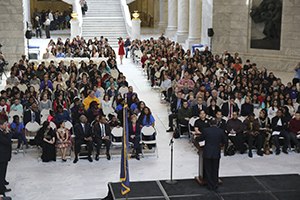
Kyle Reyes, chief diversity officer for Utah Valley University, said he wished that members of the Utah State Legislature — standing on the steps behind him — could be as diverse as the collection of several hundred middle school and junior high students gathered in front of him.

Kyle Reyes speaks to gathered students at Multicultural Youth Leadership Day at the Utah State Capitol, Tuesday, Feb. 16, 2016.

Kyle Reyes speaks to gathered students at Multicultural Youth Leadership Day at the Utah State Capitol, Tuesday, Feb. 16, 2016.

“Wouldn’t it be great to have our legislature reflect the diversity here,” Reyes said. “Our teachers that are in our schools reflect the diversity here in the state, so I think there is always work to be done. I think we can do a lot more, frankly.”

Reyes and other state and education leaders met Feb. 16, 2016, at the Utah State Capitol to speak to about 300 students for Multicultural Youth Leadership Day. In addition to Reyes, other speakers included Utah Gov. Gary R. Herbert and state legislators. A local spoken word group, Truth Cypher, gave a performance, as did a youth step troupe from the True Vine Baptist Church.

Speaking to the gathered youth, Gov. Herbert supported his state for having a long history of diversity and inclusion.

“Our early settlers came from western Europe whether they were Scandinavians, or English people, or Germans, others from Western Europe,” Herbert said. “That diversity is making us even stronger and more successful, particularly in the world’s economy of today, because we have so many different cultures and speak so many different languages in Utah. … We really speak the world’s languages, and that gives us some opportunity for economic growth as we go forward.”

Utah Gov. Gary Herbert speaks to assembled youth at Multicultural Youth Leadership Day at the Utah State Capitol, Tuesday, Feb. 16, 2016.

Utah Gov. Gary Herbert speaks to assembled youth at Multicultural Youth Leadership Day at the Utah State Capitol, Tuesday, Feb. 16, 2016.

Claudia Nakano, director of the Office of Multicultural Affairs, shared Gov. Herbert’s statement, and added that the state continues to be diverse.

“The U.S. Census is predicting by the year 2043, this nation will be a majority-minority nation, and in Ogden and in West Valley, they are already majority-minority cities here in Utah,” Nakano said. “One out of four preschoolers is ethnic and comes from an ethnic background. We’re hoping to inspire leadership, getting involved in your community, civic engagement, and take those seats up here on the hill and pass legislation.”

Youth came from as far as Ogden and Payson to attend the summit. Students listened to the program for about an hour and 20 minutes, which was followed by lunch and tours of the Capitol.

Students from across the state listen to speakers at Multicultural Youth Leadership Day at the Utah State Capitol, Tuesday, Feb. 16, 2016.

Students from across the state listen to speakers at the leadership day, Tuesday, Feb. 16, 2016.

The day at the Capitol is part of a greater initiative by the Office of Multicultural Affairs to involve diverse youth from around the state to become more involved civically. The office also organizes and holds a Multicultural Youth Summit every October, which hosted 2,000 students in October of 2015. The aim of the state-run department is to aid the state in making better outreach efforts to promote civic engagement and cultural diversity in government across the state. The summit is part of these efforts.

The summit, Nakano said, was designed in part by Gov. Herbert’s “66 by 2020” initiative. The project, according to the governor’s website, sets the bar of having 66 percent of Utah’s working-age population with a postsecondary degree or certificate by the year 2020.

“We want to help raise that graduation rate, and now with our changing demographic, we are becoming more diverse, not only in Utah but across the nation,” Nakano said.

Not all sentiments are positive on Utah’s outlook. Nakano conceded that the current makeup of state legislators needs to be more ethnically diverse, which would help support more diversity initiatives and better legislation on equality. Although no statistics are available on the ethnic makeup of the current legislative body, the vast majority are white male.

Kyle Reyes, UVU’s chief diversity officer, echoed these feelings, adding that higher education administrators from around the state are collaborating on diversity reform. But, he said state legislation still needs to be impacted.

“When I talk to people about multiculturalism, I like to say it’s not just another thing we do. It’s how we do business, it’s a lens that we wear,” Reyes said. “And if we can get more people, especially more people in powerful positions to wear those lenses and be a little more sensitive and be more culturally responsible, I think that will go a long way.”

Youth from the True Vine Baptist Church perform at Multicultural Youth Leadership Day at the Utah State Capitol, Tuesday, Feb. 16, 2016.

Youth from the True Vine Baptist Church perform at the Capitol, Tuesday, Feb. 16, 2016.

In the coming years, the Office of Multicultural Affairs will plan additional youth leadership summits and events across the state. Nakano said a smaller summit in addition to the large one in October 2015 was held in Ogden, which hosted 300 children. Smaller summits are anticipated in other cities in Utah, such as St. George, Cedar City and Vernal. The 2016 legislative session added an additional $30,000 in funding for the summit.


The Utah Cultural Alliance: Past, present and future

Story by JORDAN SENTENO

It all began in 1981 as Utah Citizens for the Arts. According to a history of the organization, it led the development of the public art programs in Utah. It also held events to help educate the community and elected officials.

Then, in 1993, it assumed a new identity and became the Utah Cultural Alliance (UCA). Its job is to work with the art and culture organizations as well as the legislators and county governments to solidify funding throughout the state of Utah and its community.

“Everyone and anyone can work with the arts and make a contribution to the community,” said Kate Ithurralde in an email interview. Ithurralde serves on the UCA board as treasurer.

According to UCA’s website, the organization serves as “the voice of the arts, humanities and cultural sector of Utah.” Its mission is to “empower and strengthen this community through advocacy, professional development and awareness.”

Crystal Young-Otterstrom, executive director of UCA, said, “It’s a great way to help the Utah community and for others to get involved and make a difference in the community as well.”

According to the website, UCA has transformed into a membership-driven organization comprised of many museums, corporations, and groups such as the Utah Division of Arts and Museums, the Stewart Foundation and the Salt Lake City Arts Council.

UCA has joined to help support the Utah community through cooperation, communication and advocacy in an attempt to help increase the value of the arts program in the state.

“I choose to be involved because the arts and humanities have a rich history in our state and I think we can do a better job supporting the sector,” said UCA Board Chair Jason Myers in an email interview. “By doing that I believe we will have more vibrant and rich communities — culturally and economically,” said Myers, who manages internal communications at Children’s Miracle Network Hospitals.

Young-Otterstrom said one way that community members can become involved is by becoming an advocate. “The most important part of advocacy is anyone can choose to be involved, can talk to an elected official. It’s really not a hard thing to get in touch with one of them and get involved,” she said in a phone interview.

UCA seeks community involvement to help impact the culture in Utah. The organization is committed to working with people to increase their individual and organizational knowledge of policy issues. UCA also involves the community by hosting events like Arts Day on the Hill in February, which UCA notes is an opportunity for residents to connect with their legislators and discuss why the arts are important.

UCA has a new five-year strategic plan for 2016-2020 that outlines its desire to become the forefront organization of Utah’s cultural issues. A subcommittee of the board factored in the mission, vision and value statements when creating the plan.

The subcommittee identified several guiding principles to help UCA accomplish its goal. For example, the small group recommended creating a separate advocacy branch that will enable UCA to endorse candidates and pursue fundraising to directly support advocacy efforts in Utah.

Another guiding principle is awareness. The organization aims to expand marketing and public relations in order to increase appreciation of the arts. It also plans to develop a Utah Culture Wiki, a comprehensive site about the arts and humanities.

According to UCA’s website, “the Utah Cultural Alliance [looks] to become the top voice of the arts, humanities and cultural sector of Utah.”