Fighting for Utah LGBT rights involves more than just marriage

Brandie Balken, executive director of Equality Utah, works in her office October of 2012 in downtown Salt Lake City.

Story and photo by JAKE GORDON

Fighting for equal rights in behalf of the lesbian, gay, bisexual and transgender community isn’t just about marriage — it is much more complex than that.

Brandie Balken, executive director for Equality Utah, expressed frustration that the public views gay marriage as the main issue.

“When we look at what the equality movement is and what our role in the equality movement is, we are really looking at the beginning of a person’s life all the way through the end of a person’s life,” Balken said in a talk to reporting students at the University of Utah on Sept. 13, 2012. “And I mention that because I think in the popular dialogue today, all we hear about is marriage and I have to tell you that there is so much more that needs to be done.”

The LGBT community has to fight hard for the same human rights that straight people generally take for granted. Rights like visiting loved ones in the hospital, transferring health and retirement benefits to a partner and being recognized as a non-biological parent are some things that Balken has had to fight for with the costly help of a lawyer.

“To secure access to your partner (in a hospital), even if you have been married in another state, you have to get a designated beneficiary contract and you need to establish a will and a trust if property is included,” Balken said. “My partner and I have spent literally almost $10,000 with our attorney preparing contracts to protect our home, to protect our life insurance investments and to protect as best we can our child to make sure that she is cared for.”

Tooele County Justice Court Judge John Mack Dow, who practiced law for 21 years prior to being named judge, talked about the differences between rights for straight and gay relationships.

“If there is a husband and a wife then the rights are transferred automatically in the relationship,” Dow said. “But if it is a homosexual partnership then they have to get the necessary paperwork and even that paperwork can be challenged in court by other family members.”

Balken has forked over the money to work with lawyers to become the medical decision-maker for her partner. When going on trips, Balken makes sure that she packs her paperwork and legal documents, just in case something does happen.

Niki Corpron, a registered nurse at Intermountain Healthcare hospital in Murray, said the hospital has strict policies regarding who can or can’t visit during an emergency.

“If someone is brought in by an ambulance and they have a homosexual partner then they aren’t allowed in to visit without the appropriate paperwork,” Corpron said. “If the partner doesn’t have their papers then they have to contact the family and receive permission from them.”

Balken is not only fighting for herself and her own family, but as executive director for Equality Utah she also is working for equitable rights for all in the state. Balken said Equality Utah was founded in 2001 as a political action committee, or PAC. The purpose of a PAC is to help people get elected into office. Equality Utah also fights legislation that seeks to disallow equal rights to gays.

She said that in the nation marriage is basically a state-by-state determination. Some states allow marriage, some states allow civil unions and some states, like Utah for one, prohibits any or all marriages or civil unions. Therefore, in Utah, equal rights are an uphill battle for Equality Utah and the LGBT community.

One piece of legislation Balken mentioned was a constitutional amendment that passed in 2004 penned by Rep. LaVar Christensen (R-Draper), which was called Amendment 3.

“This amendment to the constitution basically says marriage equality is prohibited, civil unions are prohibited, and any other contractual agreements with substantially equivalent benefits are prohibited,” Balken said. “That went before our legislature, was signed by our governor and put to the ballot in 2004 and more than two-thirds of the population of Utah approved that measure. So, currently in the state of Utah, marriage equality is banned in the constitution as are civil unions.”

Balken also knows that it takes multiple approaches to educate the public about equal rights.

“You have to educate the population about the issues, about the language, and about the implications of unequal policy,” she said. “You have to work with elected officials who are seated to understand the importance of equitable policy and to work with them to change that policy.”

Equality Utah works to get more fair-minded people in office, from the school board all the way up to the state house, to sustain achievable cultural change.

Although it is a long road to travel for equal rights, Equality Utah has had some success in passing some legislation. Balken said the organization passed in 2007 a bullying and hazing statute and a hate crimes prevention law.

“Those may seem like small things,” she said, “but . . . prevention of hate crimes or at least acknowledgement of hate crimes as well as prevention of bullying and hazing behaviors is crucially important.”

The convenience of college obesity

Story and photos by Blakely Bowers

The United States has the highest obesity rate in the world. Obesity is an issue that reaches far beyond the way someone looks. Medical experts have linked excess weight to everything from heart disease and diabetes to chronic back, hip and knee pain.

According to the U.S. Surgeon General, 74.6 percent of Americans are overweight or obese. For the past decade the rates have risen steadily for Americans of all ages and population groups. The difference between being overweight and obese is determined by a person’s body mass index (BMI). Adults with a BMI between 25 and 29.9 are considered overweight. Adults with a BMI of 30 or higher are considered to be obese. Try calculating your own BMI

Studies performed by the Centers for Disease Control and Prevention show that one in every 50 Americans is obese. This number is significantly higher than it was even five years ago. As the number rises, so do the costs. Chronic obesity costs the individual, but the problem has its impact on others fiscally, as well. “Obesity not only costs the patient a whole lot of extra money, but it costs us as doctors. We spend more time with patients who are overweight. The health issue creates many other issues in which rises the rate of diseases and disorders, which in turn impacts us,” said Dr. Cassandra Quigley.

As the obesity rate increases, so do the rates of obesity-related medical problems. Medical problems such as cardiovascular disease, diabetes, and hypertension affect the cost and availability of insurance benefits, which increase the cost for the average person. The rates also cause government programs to pay enormous amounts for those benefiting from the programs.

The Surgeon General estimates the annual medical costs of obesity are as high as $147 billion. On average, obese people have medical costs that are $1,429 more than medical costs of people of healthy weight. More information regarding the dollar amounts of these medical costs can be found at http://www.cdc.gov/obesity/causes/economics.html

“The increasing amount of obese patients I see, is really getting terrifying,” Quigley said.

“I am learning more details of the personal causes behind this disorder, said Laura Welch, a certified nutritionist and health fitness coach. She graduated from BYU with a degree in nutrition, and has been studying it ever since.

“Most of my clients admit that their issue comes from within. They slowly start feeling bad about themselves and overeating and not exercising is their way of coping. The other major problem underlying obesity is accessibility and convenience to fast food and treats that help pack on the extra pounds.”

We can get online, make an order and wait 15 minutes for our meal to show up at our door. We can drive through the local McDonald’s and have our food within seconds. We have instant macaroni and cheese, instant brownies, instant everything. It has become about convenience and price. Fast foods are always the least healthy, but the least expensive option.

The number of overweight college students has also significantly increased in the past decade. In order to understand the increase, I decided to observe and research the habits of students. College lifestyles have a major influence on obesity. We’ve all heard about the “freshman 15,”, a familiar reference to the standard weight gain new college students typically pack on. Studies have shown that three-quarters of students gain weight their freshman year of college. These students can easily form a habit of overeating and overlooking regular exercise. These habits continue to impact their weight for years to come. Research by science daily.

Some University of Utah students say that “convenience” is the main reason for their unhealthy eating habits. It is hard for students to find the right balance while attending college. In a study performed by researchers at the Mayo Clinic in 2009, researchers found that lack of sleep and skipping breakfast are prominent promoters of obesity among students. A jam-packed school schedule, late nights, early morning lectures and exam cramming leave little room for healthy eating habits. Students often reach for the quickest and cheapest options—fast foods low in nutrients but high in calories, fat, and sugar.

“ I go for whatever is cheapest and fastest during my school breaks. I have all the intentions of eating healthier, but when the time comes I don’t want to spend the extra money, or take the time out of my crazy studying and work schedule to make a healthy option.” Mary Earl, a U freshman said.

Sleep is another factor that affects obesity in college students. When the proper amount of sleep gets cut in half, along with a scattered diet, a body has a hard time sufficiently metabolizing. Students are at the most vulnerable state, and the habits are not a top priority. More sleep and obesity related studies can be found here.

“When healthy food becomes more convenient to pick up and cheaper, that’s when I will start eating healthier during this time in my life. It sounds lazy, but it’s true. Convenience and cost are just the factors that play into these habits for me,” Earl said.

obesity(1)

Utah’s Abbott smashes records, leaves as a role model

by MCKENZIE DEAN

University of Utah’s Alyssa Abbott, 22, nears her final season for the Running’ Utes as one of Utah’s finest women’s distance runners.

Abbot began as a sprinter in high school. It was her coach at Galena High School in Reno, Nev., who inspired her to pick up distance running. It helped motivate her in school as she developed a great balance between academics and running.

With no college scholarships offers coming her way and her telephone silent Abbott stayed positive and began dialing numbers.

A phone call to Kyle Kepler, the U’s head women’s track and field/cross country coach, allowed her to become a Runnin’ Ute.

“Alyssa’s greatest attribute from a coach’s point of view is how self-motivated she is.  I know that she does all the little things to get better on a daily basis. As a coach you have to have athletes who want success more than you want it for them because they ultimately hold all the cards,” Kepler said.

With Abbott’s motivation, desire to achieve her goals and a solid training schedule; she was well on her way toward a successful college career.

During her freshman year she received daily doses of what college distance running was all about. Abbott led the team as top finisher in both the conference and regional meets in cross-country. Competing in the 800-meter run, Abbott received an invitation to compete at the U.S. Junior Championships at the end of the 2009 outdoor season.

“After my first year I knew then I was a distance runner. I have developed such a strong love and passion for it.  I decided to move up the distance I was running and compete in the 1500-meter for the next season,” said Abbott.

Moving to the 1500-meter played in her favor. She was an NCAA regional qualifier in that event and the 800-meter for outdoor track in the 2008 season. Abbott went on to claim a spot in the NCAA national championship for cross-country, with a ninth-place overall finish at the regional championships.

“Going to nationals was a very exciting and fun experience. It was great to compete against the top girls in the nation I had read about. It really motivated me even more after that,” Abbott said.

During the next few seasons she was struck with multiple injuries and surgeries on her knees and feet that set her back.

“Alyssa has been a warrior.  She has fought through adversity with chronic injuries, but has never given up or complained,” said Mary Bowman, Associate Athletic Director at the U.

With her outstanding running career and an award–winning past outdoor track season, she is just as successful academically. Abbott has earned multiple conference student-athlete awards, academic all-conference honors and has been named to ESPN magazine’s Academic All-District Team.

“She has had success as a student athlete on the track as well as in the classroom. I will miss her contagious smile,” Bowman said.

Abbott will receive a degree in exercise sports science in May. She is currently interning at a senior center, and helping patients increase their physical activity. Still waiting to hear back on to where her new life will take her, Abbott’s leadership and success on the field will continue to carry over to new paths.

Again struggling with an injury, this time rehabbing a ligament in her knee, Abbot puts on a Utah uniform in her last season as a Ute. Her success continues to build throughout this spring season.

“She will graduate as one of the University of Utah’s most successful female track and cross country athletes as both a student and an athlete,” Kepler said.

###

Utah Dream Center proves helping goes a long way

Story and slideshow by MELANIE HOLBROOK

Explore the Utah Dream Center

“Our dream is to see you live yours.” That is the slogan of the nonprofit organization Utah Dream Center, which was created to help community members fulfill their dreams.

Whether starting an arts program or a private elementary school, the organization located at 1624 S. 1000 West helps people get started so that more individuals can be assisted in the long run.

In 1998 husband and wife Alfred and Anna Murillo traveled to Los Angeles for a short-term mission project. Already involved with servicing their community, the Murillos brought with them 40 boys and girls to help out at one of the Los Angeles Dream Center’s programs.

Amazed by that center’s goals and projects, such as its after-school programs that provided activities for kids, the Murillos became inspired and knew Salt Lake City needed its own Dream Center.

In January 2000, Alfred and Anna launched the Utah Dream Center, modeled after the one in Los Angeles. With no help yet, the Murillos traveled throughout the U.S. in search of ideas and help from anyone interested.

With creativity and a U-Haul, the Murillos began to follow their dreams in June 2001. With the back of the U-Haul used as their stage they pursued after-school programs for any Glendale-area neighborhood kids who were interested in participating. Starting off simple, boys and girls could come hang out at the U-Haul after school for food and games.

With that, word spread fast. In February 2002 their U-Haul had become their very own facility that they still use today.

With their name already in the public, the Utah Dream Center was able to serve more than 400 kids in the first year.

“People had heard about what we were doing and wanted to get involved. People want to help out and contribute to making something of their community,” Alfred said in a telephone interview.

Over the years the Utah Dream Center has added at least 200 volunteers to their family. Alfred explained that there isn’t a payroll; the organization functions off the work of volunteers.

The Utah Dream Center stays running and thriving through its donors, volunteers and other sources that want to be a part of it. Out-of-state churches and businesses that have heard of the organization will send in donations.

Alfred explained that they’ve never purposely been in the news. The organization doesn’t believe in soliciting or asking people for contributions; people hear about the organization and want to donate.

“We work on helping kids around us, we’re not trying to make a big uproar,” he said.

“The other day I was getting my oil changed and during those 15 minutes we (the employee and I) started talking about what I do. He didn’t charge me for my oil change and handed me $250 because he wanted to help,” Alfred said.

He said it’s the goodness in people and their mentality that keeps their organization going.

Donations to the organization are given in various ways. Alfred said when he took his daughter to the dentist he again got to talking about his work. After listening, his dentist told him to bring kids in and he will work for free. Over the past eight years Alfred has taken in three kids while his dentist has put in thousands of dollars of service just so he can help others.

“Our dream is to see your fulfill your dream. We’re not asking you to make ours. When you help people it spreads a mentality, you want to help people when you’ve been helped,” he said.

Utah Dream Center has four programs in the Glendale area. Those programs are the Arts Academy, Open Door, Provisions for the Ministry and Mobile Medical. A director who came to the Murillos with his or her idea started each program. After discussion of their idea, the Murillos helped them get it started.

“The Open Door is held every Monday night. We’ll have chunks of different segments; half an hour for free time, time for reading and tutoring. We feed them a healthy dinner,” Susanna Metzger said in a telephone interview.

Metzger, the director of the Open Door after-school program, said on average 40 kids come every Monday.

The Arts Academy lets kids engage in music such as piano, drums and singing. The program also incorporates painting and drawing.

“My daughter has been going to Arts Academy for two years now. She’s 8 years old and is so bright — I thank the program,” Gabriela Hardy said.

“Hobbies such as piano or painting can make a child so much more well-rounded and determined to learn and grow at a young age. It shapes them,” she said.

The program Provisions for the Ministries delivers food and donates clothing to various churches every Wednesday.

Mobile Medical is stationed in the U-Haul the Murillos used back in 2001. This program was established to help community members who can’t afford certain medical help. Having it in the U-Haul makes it easier to serve more people.

Hardy isn’t one of the only fans of the organization. Richard Williams, a donor to the organization, said his son isn’t old enough for any of the programs but wants to get him in them when he’s ready.

“I found out about Utah Dream Center through my brother and donated soon after. An organization that helps people succeed in things they want to do, why wouldn’t I want to support something so great?” Williams said.

But community members aren’t the only people who have heard about the organization and want to help out.

Kyle Korver, a former player for the Utah Jazz, became involved with the organization. Korver would give Alfred 30 tickets to every Jazz game for any boys and girls who wanted to attend.

Real Salt Lake presented Alfred and his wife with the “Heroes Among Us” honor at a sold-out game. In the middle of the field, the Murillos were given jerseys with their names on them.

Alfred said one of the greatest honors was when “Good Things Utah” surprised him and his wife with a big metal key that would unlock the door to their new office. Utah Dream Center will be on “Extreme Home Makeover” where the organization will be given an entirely brand-new office; the episode is set to air in summer 2012.

The Utah Dream Center has expanded to help those suffering with problems such as gangs and drugs. There are now locations in Ogden, Provo and Kearns.

“You never know where helping people can take you,” Alfred said.

Utah Partners for Health offers community health services with its mobile clinics

Story and multimedia by SHELLY GUILLORY

Volunteer Laura Pexton recounts a story of a mother who arrived at a mobile health clinic with her two young sons, both of whom had fevers, runny noses and coughs. The 20-year-old mother told Pexton, a family nurse practitioner who volunteers with the mobile clinics one to two times per week, that she suffered from asthma and also felt sick. When Pexton placed her stethoscope on the woman’s chest, she noticed the mother moved almost no air in her lungs.

Pexton grabbed a peak flow meter — a device that tests lung capacity and is used to monitor asthma. The meter barely budged when Pexton tested the woman, indicating that her asthma had progressed to a dangerous level. After two nebulizer treatments at the clinic, the woman’s lungs sounded better. Pexton sent the mother home with prescriptions for medications to better control her asthma.

“She would have been someone who ended up in the emergency room and would have ended up hospitalized to get her asthma stable and under control,” Pexton said.  “She was able to come in, we offered her services and kept her out of the emergency room.”

The Utah Partners for Health, started in 2003 and based out of Magna, works within 17 clinics in Salt Lake County, all of which are “for-profit.” Healthcare professionals donate charity care to offer services for those who need treatment.

At these “for-profit” clinics, patients pay a small portion of the services rendered, which include acute care services, dental care, chronic illness management and mental health services. Patients can also receive preventative care, such as well child checks, breast exams and tobacco cessation counseling.

Since 2007, UPFH has also provided access to free health services with its mobile clinics, held three times a week. These mobile clinics are reserved for patients who cannot afford to pay the small fee at the “for-profit” clinics. The mobile clinics rotate locations throughout the Valley and serve residents in Salt Lake, including Glendale and other west-side neighborhoods, who do not have access to healthcare due to cultural or language barriers and lack of insurance or low income.

The mobile clinics operate out of rooms in community-based organizations, such as Horizonte Instruction and Training Center, Mountain View Elementary School, Hser Ner Moo Community Learning Center and Guadalupe Schools.

Executive Director Kurt Micka said mobile clinics save Utah’s healthcare system hundreds of thousands of dollars each year.

“Most of the patients we see wouldn’t see a doctor at all, or [they would] go to an expensive emergency room when conditions have worsened,” he said. “Our cost last year was $18.23 per patient visit, compared to $1,200 for a typical non-critical emergency room visit.”

Micka said the mobile clinics offer most primary care services found in doctor’s offices and have recently started offering eye examinations. Free influenza vaccinations are also available one or two times a year. Patients who want to be seen for primary care services can either walk in or make an appointment. But because of demand, appointments must be made in advance for eye examinations.

At a recent clinic in the Horizonte Instruction and Training Center, 1234 S. Main St., five healthcare professionals treated 71 patients out of two rooms in the fourth-floor library. Unlike Pexton, who volunteers her time, Micka said many of the healthcare professionals who work at mobile clinics are paid.

“The model works best when providers are paid,” he said. “In that way, they consider it a job and always show up. They don’t get distracted with other options with their time.”

UPFH receives funding from grants and mobile clinic supporters, including United Way, American Express, Regence Foundation, UBS Bank and Walmart.

UPFH Associate Executive Director Amy Reed Trebella said many patients who visit the mobile clinics do not understand how the healthcare system in Utah works. She said if the mobile clinics didn’t exist, many people would resort to using expensive resources.

“They go to the emergency room, especially with [the refugee population],” she said. “We find that there are certain communities that come to rely on the ER, which we are trying to alleviate.”

Patients who are treated may be sent home with prescriptions, which can often cost hundreds of dollars without insurance. But Trebella said the clinic has several options for people who need prescription medications.

“We have the Partnership for Prescription Assistance  we can refer people to,” she said. “But for the most part our providers try to write generic prescriptions because they are more affordable. Walmart has a $4 program.  So do Smith’s and other pharmacies. That tends to work very well.”

Trebella also said that although mobile clinics are not set up to follow patients long-term, many people show up every few months and treat the mobile clinics as their primary care physicians.

In addition to her story about the young mother with asthma, Pexton recalls a man who  was diagnosed with diabetes at a clinic. Doctors gave him a glucose meter to check his blood sugar. He also received education about how to manage his diabetes. Two months later he showed up to the mobile clinic with a record book that contained daily blood pressure and blood sugar readings he had tracked since his diagnosis. His blood pressure and blood sugar were normal and he weighed 15 pounds less. He told Pexton he changed his diet and quit drinking soda to help manage his illness.

“It was wonderful to see someone take the information and make changes,” Pexton said. “In that case he was given a prescription for refills on his medication and told to follow-up in three months.”

Salt Lake City Head Start provides comprehensive educational experience for young children

Story and slideshow by TOM BETAR

Explore the Head Start kitchen

The average Head Start  family in Salt Lake City, regardless of the number of members, has an annual income of about $13,947. Some of the children of these families require $5,000 in dental work alone. These alarming numbers come from Kristyn Hancock, the community partnerships manager for Head Start who has been with the organization for more than a year.

The good news is that help is available, and from classrooms to kitchens the staff of Head Start work to educate and support these families so they can be successful now and in the future.

Head Start is a nonprofit organization with 83 classrooms and seven facilities throughout the Salt Lake City Valley that help these needy families overcome financial, educational and health-related obstacles.

The overall mission of the organization, according to its website, is to provide health, education and self-sufficiency to young children and families facing adversity. This entails working with children as early as possible to prepare them for future success in school. About 2,400 children in Salt Lake City, the majority of them ranging from 3 to 5 years old, receive assistance in education and healthcare from the Head Start program. Some of the children are helped from birth until age 2 as well.

Hancock said in a telephone interview that she quit her job doing sales and then was later approached about a position at Head Start. She said even though she may have made more money in sales or other lines of work, she is extremely happy with her decision to work for Head Start.

“I am so fortunate and so thankful to be here,” she said. “I feel like I’m able to give back every single day. Before I never felt like I was able to make a difference. I guess I traded in the big paycheck for a big heart.”

The community partnership aspect of Head Start is built around organizing fundraising and community events that spread the word about the Head Start program. Social media and grant writing fall under this umbrella as well, and Hancock works with many community volunteers to make programs successful.

“Our goal is to be out in the community informing people what Head Start is,” she said. “We are like ambassadors for the program.”

Hancock said every year assessments are done to gauge which areas are in most need of Head Start services, and the west side of Salt Lake City is the frontrunner every year. Although many people may have misconceptions that west-side residents are just sitting around waiting for handouts, Hancock said that is simply not the case for the residents she encounters.

“They are an amazing group of people to work with,” she said. “Many of them are working two or three jobs and they work so hard. They are so resilient. I love working with them.”

In terms of assistance to the children, or “kiddos” as Hancock calls them, the services that Head Start provides in regards to education, healthcare and self-sufficiency all go hand-in-hand.

“For most of our kiddos we are their only opportunity to begin the lifelong education experience,” she said. “I don’t know of any other preschool program that does what we do.”

She said parents play a large role in the development and success of the children, so Head Start tries to involve the parents as much as possible.

“Our goal is to get every child ready for kindergarten and on the same level playing field as their affluent peers,” she said. “We believe parents are a primary asset and we want them to be involved in their child’s education, not just when they (children) are 5 years old but when they are 15. The parents want their kids to succeed and break the cycles of poverty.”

Hancock said in order to properly educate and prepare these children, the first step is to make sure they are healthy and have proper nutrition. This is where people like Brian Ralph come in.

Ralph is the food services director for Head Start and has been in the food business for more than 30 years. He came to Utah to work in the 2002 Winter Olympics and was a food service manager in the Olympic village. He said he fell in love with Utah and now has a job with Head Start. He previously did food service work in the athletic departments of colleges such as Louisiana State University and the University of Colorado.

“There’s really no difference between feeding football players or little kids,” he said. “It’s really the quantity because you still need the healthy food.”

Ralph works in a kitchen located at 2180 S. 300 West that provides Head Start children with diverse, healthy and balanced meals. Food is prepared at the kitchen and then delivered to the classroom sites across town so that children can enjoy nutritional meals to supplement their early education.

“Pretty much the kids will get everything that an adult would eat minus the sugars and the salts,” Ralph said. “The kids learn to trust that the food they are getting is good, so our kids actually do eat our vegetables.”

Ralph said the kitchen uses whole-wheat products and does not serve canned vegetables or deep-fried food. He said the food that is served is restaurant quality and not only nutritional but also ethnically diverse. Meals include vegetarian dishes, jambalaya, beef stir-fry, chicken taco salads, lentil soup, sweet potatoes, fresh grilled tuna casseroles, spinach soufflés and Atlantic salmon — just to name a few.

“We do not believe in buying anything at discounted prices,” he said. “We bring in the best quality we can possibly bring in.”

Ralph said Head Start has a program at the University of Utah where the link between proper nutrition and a better education is visible.

“They (children) are better behaved because they’re not hungry. They are more attentive when it’s time to learn, and they sleep better because their stomachs aren’t hungry,” he said.

In order to qualify for Head Start, a family must be at 100 percent poverty level, which means the income of the household falls below a level set by the government. Hancock, the community partnerships manager, said there are about 1,000 kids on the waiting list for Head Start.

“We serve the neediest of the needy,” she said. “We always have a waiting list.”

Income is not the only criterion. For example, if the father of a family unit is incarcerated, Hancock said that family might be prioritized over another family.

Hancock said in order to measure and quantify success of the Head Start programs a tracking system is now in place for Salt Lake City children. This allows their academic progress to be recorded and analyzed as they move on from Head Start and continue schooling. Because Head Start is a nonprofit, the organization relies heavily on government grants and funding. Consequently, it is closely monitored by the federal government. Data such as test scores can be tracked to reveal the effectiveness of the Head Start programs and help to maintain the high standards.

Patty Mazzoni, Head Start education manager, has been with the organization since 1992. She started out as a teacher and has held her current position for five years. She said the educational aspect of Head Start is codependent on the fulfillment of the other needs for the children.

“We provide an all-around comprehensive education for our children and families,” she said in a telephone interview. “We not only meet the educational needs of a child we also meet the health and nutritional needs.”

Mazzoni said Head Start relies heavily on volunteers and in-kind contributions. For example, medical volunteers such as doctors or dentists provide free health screenings for children in the classrooms.

“Volunteers are a huge part of what we do,” she said. “We encourage parents to volunteer in classrooms.”

She said few other organizations provide the same benefits as Head Start.

“We are probably the only opportunity to place children in a program that will give them a head start in education,” she said.

Mazzoni said there may be some misconceptions out there about exactly what Head Start is and what it is for.

“People think that we are just a daycare to drop kids off,” she said. “We are not at all. We are very comprehensive and we have academic outcomes that we have to show data for.”

Mazzoni said there is something else unique about Head Start that makes her proud to be a part of the organization.

“We serve all children with disabilities, so we are a full-inclusion program,” she said. “We accept any child within our program.”

Being a Head Start employee provides opportunities to make measurable changes in the lives of young children and their families. Food services director Ralph said his job comes with many satisfying rewards, and that results from his work can clearly be seen.

“I enjoy coming to work every day,” he said. “We see the results. We see the change in the children’s weight, we see the change in their attitude, and we see the change in their eating habits. It’s hard to change a child’s eating habits when they’re older.”

Ralph recounted some of the most rewarding experiences he has been a part of since joining Head Start: “When you go into a classroom and you have 3- to 5-year-olds clapping because they enjoyed the meal that was prepared that day, or you have a parent send you a request for a recipe. It’s small steps here. It’s child by child.”

Welfare Square: the LDS Church helps people help themselves

Story and slideshow by CECELIA FENNELL

Take a tour of Welfare Square.

Upon entering the visitor’s center, guests were kindly ushered into a theater-like room by a missionary. When everyone was seated, the woman introduced herself as a volunteer worker for the Church of Jesus Christ of Latter-day Saints and started a 15-minute video on the history of Welfare Square. The tour began.

Operated by the LDS church, Welfare Square, located at 780 West and 800 South, serves people all over the world as well as locally. It is composed of seven entities: a granary, milk processing operation, bakery, cannery, storehouse, thrift store and an employment center. According to its website, each is designed to help people help themselves through the service and work organized here.

According to the short film, Welfare Square began during the Great Depression and led to the establishment of the church’s welfare program in Salt Lake City. The idea was to build on a tradition of compassion and charity as shown by Jesus Christ whom members of the LDS church and other Christian faiths look to as their savior and redeemer. Here, the church works to follow the example of Christ by providing care for the poor and helping them to become self-reliant.

Rachel Matautia, 22, from Australia, and her companion, Karly Nelson, 22, of California, are missionaries for the LDS church. The women conduct tours at Welfare Square and answer questions visitors may have about the church or its welfare program.

Following the video, they led visitors to the Bishops’ Storehouse. Members of the church as well as nonmembers come here to fill food and clothing orders for people in need.

“All the food here is grown and canned by the church. The products even have their own Deseret labels,” Matautia said.

Members of the church who are in need of food speak with their bishop, who is the presiding leader in a designated area. The bishop then takes these orders to the bishops’ storehouse and fills the orders with the help of other member volunteers. Recipients of food and services are asked to donate some time volunteering to help others in need.

“For everyone that comes in and has orders filled, we ask that they do four to five hours of service here,” said Jim Goodrich, manager of Welfare Square. “It’s not required, but it helps them to build their independence. People who receive goods for free tend to become dependent and the goal is to help people help themselves,” he said.

For people who don’t have bishops and aren’t members of the church, orders are filled for them as well. Offering service in return is suggested, but optional.

“We have over 30 transients come in each day. One thing many people don’t know is that we will serve everyone in need — no matter their background,” Goodrich said.

Funds to assist with maintenance costs come from “fast offerings” by church members. On the first Sunday of every month, church members skip meals and donate what they would have spent on those meals to the church. One hundred percent of fast offerings go toward helping the poor and needy. Members are not required to donate, though most do.

Many of the individuals receiving help through the bishop’s storehouse are unemployed. The LDS church offers help and work options to such individuals through its employment center.

“People who are in need of work or better work can come here to find employment,” Matautia said. “Employees and volunteers work with people to help them prepare for interviews, write better resumes and assist with needed educational training,” she said.

People in need of jobs can sign up for free classes that provide help with training for specific jobs, as well as English classes to help with the language barrier.

Next, visitors were led to a tall, white, grain elevator. The guides asked the tour group how long they estimated the granary building took to build.

“The granary is 178 feet tall and was built in just eight days because it had to be built through a continuous pouring of cement,” said Karly Nelson, the other tour guide.

The Granary stores wheat grown by the church. It is used in the bakery and to create emergency food supply packs called Atmit. The porridge-like substance, the guides explained, originated in Ethiopia; the LDS church perfected the powder and made it available in bulk. The church has served thousands of malnourished people in Ethiopia as well as other developing countries.

Milk and dairy products are also distributed and processed by the church. Cows owned by the church in Elberta, south of Utah Lake, produce the milk.

“The milk and cheese made at the Milk Processing Center is so fresh, the process of the milk going from the cows to Welfare Square is so quick that the milk hardly touches air,” Matautia said.

Before leaving the creamery, visitors sampled chocolate milk, cheese and bread, all produced by the church.

“Everything made is tested with products sold in the stores to ensure good quality. For example, the peanut butter made here is compared to Jif and Skippy to make sure it is the same quality,” Nelson said.

The tour came to an end as visitors made their way to the familiar Deseret Industries. The church-owned thrift store collects second-hand items. People around Utah donate unwanted items and the DI sells them again at a low cost.

“Not everything is second-hand. Many cabinets are made and sold by the church and they’re brand new,” Nelson said.

Many items donated to the DI also go to the church’s Humanitarian Center and are distributed to the poor and needy.

“Deseret Industries is more than just a thrift store,” said Randy Foote, assistant manager of Deseret Industries. “The DI also offers a community voucher program at no cost. Forty-six DIs participate in this program in Utah, but the need is across the board. People use the vouchers to purchase what they need at the DI,” he said.

The LDS church partners with local nonprofits that provide service. Jim Goodrich, manager of Welfare Square, says all excess food, clothing and goods produced at Welfare Square are donated to other local service organizations, like the Utah Food Bank.

“There seems to be a greater need for food and clothing here because of our location,” Foot said. “We often serve people living on the west side because we are on the west side. People need help everywhere though,” he said.

Becky French is a job coach trainer at the DI and works with all types of people. French decided to work here after moving to Utah from Pennsylvania. She said she was praying for work and found the job through LDS Employment Services.

“One of the things I love most is that they help anyone, it doesn’t matter where they came from. We help them to be self-reliant,” French said. She then shared a story of a woman she worked with who came from the west side of Salt Lake. “She was very capable, but she didn’t have any confidence because she had been abused. I challenged her to higher responsibilities and she was always worried at first but she eventually became a department leader and she’s done well,” she said.

French can recount each individual she has worked with and says they may look intimidating on the outside, but once she got to know them she grew to love them.

“I used to see rough-looking people on the street and feel nervous about working with them,” French said. “After spending some time with these people, it doesn’t matter their past. We’re all people with the same needs and we all want to be able to take care of ourselves and our children. When you give someone a chance, you can see the difference.”

Healthy food available for day cares

Story by JOHANNA WISCHMANN

Helping Hands Inc. is a nonprofit organization that works with day care homes to provide a healthy and nutritional diet.

The program works with children under the age of 12 in day care homes. It strives to improve the day cares, mostly run by low-income families, to afford better quality meals for the children.

Helping Hands works with Child and Adult Care Food Program, known as CACFP. CACFP is a federal program that gives healthy snacks and meals to children and adults involved with day care programs.

According to the Helping Hands website, the program helps the caregiver have the funds to purchase better quality of food, such as milk, breads and meats.

It also reimburses homes for healthy meals given to the children, like a breakfast of fruit, vegetables or milk. To get reimbursed for a meal provided for children, a provider has to make a claim.

Day cares and providers can claim up to two main meals and two snacks per child per day.

Susan Ison, executive director at Helping Hands, said that when a provider follows the USDA nutritional guidelines, Helping Hands works with the Utah State Office of Education to receive reimbursement for food given to the day care children and a lot of times the provider’s children.

An estimated 98 percent of providers that Helping Hands supports are from low-income families, Ison said in an email. An estimated 75 percent are from different cultures and ethnicities and don’t speak English. To qualify the providers have to have proper licenses and they must be caring for at least one non-residential child.

Once enrolled, a provider must complete paperwork, including a daily record of the food that the children ate and which children ate what food. This paperwork is given to Helping Hands monthly.

To ensure that the funds provided to the caregivers are being used correctly and to help maintain a healthy, nutritional diet and a healthy environment, Ison said. Helping Hands staff makes an unannounced visit about two to three times a year.

Not only does Helping Hands help with financial situations, staff also offer training on sanitation and nutrition.

“We provide nutrition and care giving training both, in actual training classes at our office and in-home during home visits,” Ison said.

“The biggest help we could receive is letting people know that this program is available to all day care providers, both those who are legally licensed for day care and those caring only for related children,” she said.

Helping Hands has a full menu available with healthy options for families and providers to choose from, like celery sticks, strawberries and peanut butter.

It also keeps information accessible to families by keeping recipes readily available for everybody interested in a healthier diet.

According to the website, Helping Hands also provides more information for providers by using the CACFP site that allows plenty of information and tools to make the use of the nonprofit very easy. For example there is a “food tracker” available for providers to use.

“In the current economic environment, it is more and more difficult to afford good, quality, healthful foods for our children,” Ison said in an email. “I, personally, would not have my child in a day care – whether in a residential day care home, or a day care center – that was not participating on the food program. I feel it is that important!”

Helping Hands has staff available for contact through email or telephone.

To  join Helping Hands fill out a form of information online or visit the location on 2964 W 4700 S, Suite 111 in West Valley City.

Voices for Utah Children: Advocates for Utah’s children

Story and slideshow by CECELIA FENNELL

Photos courtesy of Voices For Utah Children

See images of Voices for Utah Children

When it comes to issues facing children living in poverty, children have little say about what can be done to improve their situation. Voices for Utah Children, a nonprofit located in Salt Lake City, works with policymakers to advocate for children who wouldn’t be able to resolve health care and living situations on their own.

“Voices for Utah Children is not a direct service provider because public policy can, over time, benefit thousands of kids – long term change is through policy,” said Karen Crompton, executive director of Voices for Utah Children, in a phone interview.

According to its website, Voices for Utah Children was established in 1985 as an advocacy group that does not provide direct services, but a voice for Utah children in public policy decisions. Voices for Utah Children became a member of Voices for America’s Children in 2002. It is located in Salt Lake City.

“The two biggest issues currently facing Utah’s children are education and health care,” Crompton said.

The mission of Voices for Utah Children is to make Utah a place where all children thrive. The organization starts with one question in mind: “Is it good for kids?” At Voices for Utah Children, every child deserves the opportunity to reach his or her full potential. The organization focuses on five key areas that benefit the healthy development of all children – health, school readiness, safety, economic stability and diversity.

Voices for Utah Children worked to reauthorize the Child Health Insurance Program (CHIP). Because of this more children can enroll in health care.

Through the Children’s Health Insurance Program Reauthorization Act of 2009, CHIPRA, the U.S. can now fund enrollment policies that will allow 4.1 million additional children who are not currently covered by Medicaid or CHIP to enroll in health care. Now, any child in Utah can enroll in health care because of the advocates at Voices for Utah Children as well as other partnering organizations.

One partner, First Focus, is an advocacy organization dedicated to helping policy decisions on behalf of children.

According to its website, “The Children’s Health Insurance Program, also known as CHIP provides health coverage to more than seven million low-income families whose income is too high to qualify for Medicaid, but who don’t earn enough to purchase private health insurance on their own. Approximately 42 percent of U.S. children get their health coverage through Medicaid or CHIP.”

Voices for Utah Children uses a data tool called KIDS COUNT to find children in need. Terry Haven is the KIDS COUNT director of Voices for Utah Children and works with statistical information regarding Utah’s low-income children.

According to its website, “Utilizing KIDS COUNT data allows policymakers and community leaders to make data-driven decisions that will provide a better future for our state’s youngest citizens.”

KIDS COUNT shows the numbers of where the highest demand for advocacy is for Utah children, and where the highest amounts of children from low-income families are located.

“The highest number of children living in poverty come from the west side of Salt Lake City, but the highest percentage of children aren’t in Salt Lake County,” Haven said in a phone interview.

According to the 2011 KIDS COUNT data book, the need for child advocacy is all over Utah, not just on the west side.

Because the demand for child advocacy spans across the state, employees of Voices for Utah Children are assigned specific issues to advocate and work with policymakers and community leaders in all cities to accomplish the organization’s mission.

Lincoln Nehring is the senior health policy analyst at Voices for Utah Children and does a lot of lobbying. He does this through testifying at hearings and making presentations to policymakers.

Nehring said that advocacy around health care is categorized into two types: offensive advocacy, and defensive advocacy. Offensive advocacy deals with making changes to a program, simplifying programs and expanding programs. Defensive advocacy helps to resolve issues facing programs that are being threatened.

“When presenting programs and policies to the legislature Voices excels at identifying programs that can improve problems,” Nehring said in a phone interview. “On the offensive side they present why it’s a good idea for the state to move in that direction and all the logistics, how it will be paid for, why it is a good idea, etc. On the defensive side the organization can see the idea from the beginning and when Voices sees something bad that can potentially threaten a good program it’s hard to advocate – response to cut bad ideas is much more difficult,” he said.

Though testifying at hearings and making presentations to policymakers seems both difficult and intimidating, Nehring said the real work comes from the training prior to lobbying. “The bulk of the work is from understanding the issue,” he said.

Each of these directors at Voices for Utah Children encourages people to speak up. They said the best way for people to get involved is to get to know their policymakers.

“Your voice can be important, you can make a difference. A lot of times people feel like they don’t have a voice, like they’re screaming into a hurricane wind – that might be true in some states but not in Utah, one person can make a big difference. The legislature is your neighbor in Utah,” Nehring said.

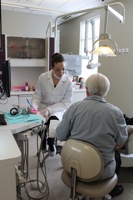
Donated Dental offers free and low-cost dental services

Story and photos by Shelly Guillory

Take a tour of Donated Dental.

Matthew Boyd stood in line with 15 other people outside the locked door of Salt Lake Donated Dental Services for 45 minutes. When an employee unlocked the doors at 8:45 a.m., Matthew squeezed inside the small waiting room located inside the Sorenson Unity Center, hoping he’d be one of seven people picked for free dental services. Within five minutes, more than 25 people packed in and watched the receptionist at the front desk spin a small, gold lottery spinner.

The receptionist reached her hand into the spinner, grabbed a small, folded piece of paper and read the name. An older man smiled, walked up to the desk and provided a letter verifying he had no current income. He was given paperwork to fill out. Other people watched, some wringing their hands together, others sighing.

The receptionist withdrew Boyd’s name when her hand plunged in the second time.

He would finally get — free of charge — the dental services he had put off for years because he couldn’t afford to get his teeth fixed.

“For me, this was my first time coming [to Donated Dental], and I have gotten really lucky,” Boyd said.

According to its website, Salt Lake Donated Dental Services, located at 1383 S. 900 West, works with volunteer dentists to provide free dental services for Salt Lake City’s homeless and low-income population.

Forty-five percent of SLDDS’ patients are homeless, 44 percent fall below the poverty level and 11 percent have state-funded Medicaid. Without volunteer dentists and SLDDS, these individuals would have no other access to dental care.

Executive Director Stephanie Jensen said the free services place quality preventative dental care within reach of those who would not have access to dental care.

“If you ask any agency serving the indigent, they will tell you that dental services are the most difficult services for their clients to obtain,” she said. “Untreated dental caries have long-term impacts on one’s overall health.”

According to Jensen, untreated oral infections can make diabetes difficult to manage, cause complications with heart disease and stroke and impact a person’s self-image.

Randall Kelley, a dentist who has worked for the clinic for a year and a half, said many people resort to pulling their own teeth if they can’t afford to get them treated.

“They need to do something, but they have absolutely no recourse or money,” he said. “Most places you can get a tooth pulled for cheaper than you can get it repaired. If you put off going, a cavity can become something that is potentially a root canal and is painful. You don’t have much choice. It is expensive to repair. A root canal and crowns are five times more expensive than a filling, and they wouldn’t even be able to afford a filling.”

Kelley also said the clinic tries not to extract teeth that are restorable.

“We try to get [patients] into the mode of not [pulling teeth],” he said. “A lot of people certainly have gone to places and said ‘well, just take it out.’”

He said multiple missing teeth could compromise a person’s ability to eat.

SLDDS, which opened in 1990 and is funded through grants and private donations, employs a lottery system. People who want to be eligible for free services must come to the clinic in person to place their name for the drawing held the next day. If their name is picked during the lottery, they must be present at the time of the drawing to receive services.

After his name was called, Boyd waited about an hour and received an exam, X-rays and a treatment plan. The dentist told him he needed four cavities filled, a root canal, two crowns and a cleaning — $4,660 without insurance.

Boyd was also told he needed 10 appointments to get all the dental work done. He dropped his name in the lottery for the next day, but wasn’t chosen.

“I will go back and try as many times as I can to get in,” he said. “When I find a job and get insurance, I will transfer to a different dentist.”

Jensen, SLDDS’ executive director since 2003, said that depending on the services, some patients must enter the lottery for additional appointments.

“Some services are done by appointment only ⎯ dentures, root canals, crowns, bridges, etc. …, but for services such as fillings, they would enter the drawing multiple times for multiple fillings,” she said.

Though it might seem like a lot of work, Jensen said this system works much better than the old system, which was on a first come, first served basis and meant some people camped out overnight in the cold. And a person who walks in with an obvious dental emergency will usually receive services that day.

Boyd, who will get a free cleaning on Dec. 7, said the lottery wasn’t an inconvenience. He is grateful for the opportunity to get dental work for free.

“Otherwise, I would have to wait until I found some type of insurance, which would mean I would have to get a job,” he said. “Who knows how long that could take. If all else fails, I would just have to pay for insurance on my own, which is really expensive.”

In addition to free dental services, the clinic also provides low-cost dental care for those who do not qualify for donated services. On average, these services cost 50 percent less than most dental offices.

Patients interested in low-cost services still must show proof of income, but make appointments instead of participate in the lottery. The discounted program’s profits also help support any portion of the donated services not covered by grants or donations.

Jensen said SLDDS moved inside the Sorenson Unity Center in 2006 after the landlord it rented space from on 4th West and 4th South decided not to renew the clinic’s lease. The city knew that SLDDS wanted to open a facility in the Sorenson Unity Center. SLDDS proposed to the city that if the space were built, it would bring in the program and run it. It was the right time for both parties.

Jensen said that since moving to the new facility, SLDDS saves nearly $15,000 a year in facility expenses and has expanded its low-income client base.

“Our volunteer numbers have increased as have the patient services provided,” Jensen said in an email. “We also have much more stability as the city is able to guarantee us a five-year lease with an option to renew up to 10 years at the current terms.”

Jensen said the clinic currently has 60 volunteer dentists and treats an average of 26 patients a day or 130 a week.

“Some [dentists] come in once a month; others once a year,” she said. “We have quite a few that come in weekly. It just depends on their schedule and availability. The retired dentists usually come in more frequently.”

According to third-quarter statistics posted on SLDDS’ website, dentists donated an average of $5,628 in services each day.

And Jensen knows how important it is for everyone to receive proper dental care.

“Restoring one’s smile removes obstacles of chronic pain and restores self confidence,” she said.