Uniting for a cause: partnership provides promise of education for refugees in Salt Lake City

Story by ANNA STUMP

The University of Utah, in partnership with Salt Lake Community College and Jesuit Worldwide Learning, is working hard to make it feasible for refugees to earn a bachelor’s degree in social work.

Jesuit Worldwide Learning Higher Education at the Margins (JWL) is a collaborative global partnership that provides an education to those who are marginalized, including refugees, internally displaced people, economically poor, and socially neglected and underserved.

JWL, whose global headquarters is in Geneva, constructs online and in-person learning centers around the world. It offers three levels of educational opportunities, including the Academic or Diploma Program. The online infrastructure allows those in remote villages or in refugee camps, without locally operated schools, to gain an education.

Once a refugee finishes with the programs provided by JWL, the student can begin taking online classes from Salt Lake Community College. Students who complete their last 15 credit hours with SLCC can earn an associate degree. The college has agreed to charge refugees in-state tuition.

Once an associate degree is earned, the University of Utah hopes to take over from there.

Laying the groundwork

Patrick Panos, a professor of social work and director of Global Education and Outreach at the U, is the driving force behind the effort to provide refugees with a chance to earn a bachelor’s degree and become leaders in their respective communities.

“Without an education, all you have is your physical labor to sell. And if all you have is your physical labor, that is a time-limited commodity,” he says.

JWL laid most of the groundwork for SLCC and the U by setting up a structure for education in distant war-torn areas that the colleges wouldn’t dare enter. Panos says he is grateful for the organization’s work.

“They’re going to places where we could not physically go. The University of Utah is not going to go open up a school in Afghanistan. But [the U] can have students in Afghanistan through this process,” he says.

STORY 2 asset

Refugees take pride in their education from the University of Utah. Photo courtesy of Karen Cordova.

Francis P. Xavier, vice president for academics and research for JWL, said in an email interview that the organization currently has learning centers in the Middle East, Asia and Africa. He hopes JWL will become more global in the future.

A trial run proved the functionality of the distance-learning program and the feasibility of providing online classes with little cost to the student. The classes at the U will be offered to student refugees who qualify. That group will become known as a closed cohort, and pay nominal tuition to the College of Social Work rather than to the university as a whole. This is significant because the college will cover the cost of classes so the refugee students don’t have to. “I can charge them a dollar a class, and that‘s OK. And the university is OK with that,” Panos says.

story 2 Case management 2

Graduates of the University of Utah’s Case Management Certificate Program in 2015. Photo courtesy of Karen Cordova.

Technology as a learning tool

Distance learning challenges historical notions of how a university operates. Traditionally, students come to campus, where they have access to amenities such as tutoring centers and the library. But an online delivery of course content makes it possible for refugees and others in marginalized communities to pursue educational opportunities.

The classes at the U will operate through Canvas, an online learning platform that connects professors and students in real time. A library database can be accessed with a student ID, so refugee students are able to access scholarly articles at their fingertips.

Kyle Jensen, director of Canvas user interface, said in an email interview that Canvas is special in terms of communication.

“Canvas, at its core, is a communication tool. As such, we aim to encourage high quality, meaningful interaction opportunities between educators and students. We also spend a lot of time and resources ensuring that Canvas works for everyone.”

Collaboration leads to reciprocal learning

Students within the Canvas classroom have much to gain from this collaboration and cultural exchange, both of which are crucial to the nature of social work. This relationship is valuable, as it allows traditional students to gain other perspectives before entering their profession.

Regarding the distance learners, Panos said, “If you want to have your students have a high impact upon graduation, these are them. They are changing the world. Educate a refugee — change the world.”

Panos pointed out that refugees who are trained in social work are then able to use this knowledge to work within their respective communities to improve the lives of the people living in the camps.

“Social workers learn how to advocate, how to do community development, how to do all of the things about how to reconstitute a community — and bring mental health in, child welfare in, and all those different pieces,” Panos says.

Refugee students speak in the native dialect of fellow asylum seekers, and have intimate knowledge of what is needed in the places where they work. Because of this insight, graduates of the College of Social Work can later seek employment with International relief efforts such as Doctors Without Borders and the United Nations.

Panos has high hopes for the future of the program. He’d like to see it expand beyond the College of Social Work, so students can earn other degrees in fields such as nursing, architecture and education. Panos also said his wish is for more refugees to have access to higher education, made possible by a collaboration of efforts from universities and programs in the U.S.

Xavier, the JWL executive, said his organization currently offers a diploma and some associate degrees. It wants to offer bachelors and master’s degrees and eventually doctoral degrees.

“I look forward [to] JWL becoming a virtual university which offers degrees of high quality for the refugees and the marginalized at affordable cost,” Xavier says.


Flying into mountains: A refugee’s point of view

Flying into mountains: A refugee’s point of view

Story and photo by JACE BARRACLOUGH

“Say what you will about America, there’s definitely a lot more opportunities here.”

Dario Jokic is a student at the University of Utah. He’s also an aspiring film director and a Fox 13 studio technician. He has spent most of his life in Utah and has no problem integrating himself into different social circles. With no accent or visible cultural differences, people are shocked to find out he’s a Bosnian refugee.

IMG_4453 copy

Dario Jokic edits news at Fox 13 Utah.

Jokic came to Salt Lake City when he was in the first grade. His family’s case worker told them Utah was a mountainous desert with people who practice polygamy.

“We thought we were literally going to fly into mountains … and the first thing that was going to welcome us there was one man with six women,” Jokic says.

The Jokic family was grateful for the welcoming they received from their new friend. They were also a bit relieved.

“She was a really sweet and energetic lady who spoke our language,” Jokic says.

He says the hardest part about his resettlement and integration was learning English.

“I hated English,” he says. “I remember my first time in ESL (English as a Second Language) class, they put me with the wrong teacher who was teaching English in Spanish.”


Gerald Brown, Utah’s state coordinator for refugee resettlement, says ESL is the state’s most costly of all the services offered to refugees who resettle to Utah. However, he says it’s still not enough.

“That funding is very, very limited. You cannot do a decent job with that funding alone,” he says.

Though Brown says there is some help from the private sector, the majority of the funding comes from the federally funded U.S. Office of Refugee Resettlement.

Brown also doesn’t see it getting any better due to recent decisions made by the government. According to the 2016 Refugee Services Office’s Report to the Governor, the State of Utah spent $171,000 on the program. However, Brown predicts that number will drop, which is bad news for non-English speaking refugees like Jokic was.

“The current [presidential] administration has different priorities,” Brown says. “It’s becoming less every year and this year we’re really worried what the budget is going to look like.”

Utah’s Gov. Gary Herbert said in a January 2017 press conference that Utah is still a pro immigration and refugee state, but made it clear those types of issues are strictly handled at the federal level. He also said Utah tried to intervene in the past but was issued a lawsuit as a result.

Gerald Brown speaks highly of the Church of Jesus Christ of Latter-day Saints’ (LDS Church) influence on the state regarding refugee resettlement. Unlike Jokic’s experience with publicly funded ESL classes, the LDS Church funds its own classes to help struggling refugees be successful.

“One of the reasons Salt Lake City and this area is a good place is because of the LDS Church,” Brown says. “They’ve put a tremendous amount of resources into helping refugees.”

While resettlers are learning English in hopes of finding better jobs, they can utilize programs like the refugee table at the Jenibee Market hosted by Jeni Gochnour.

“We provide the table and give 100 percent of their sales back to them,” Gochnour says. “They sold around $300 [at the fall event]!”

Ann Howden, of the group Serve Refugees, donates her time by teaching refugees how to sew. They make bags, pillows, blankets and other items to sell at the refugee table in order to help their families financially.

The Jokic family, themselves, know all too well the sting of trying to make ends meet without proficiency in the English language. Jokic’s father, formerly an economics professor in Sarajevo, had to take a job at a glass factory soon after arriving in Utah. Since he didn’t speak English, and his degree was from another country, it made it impossible to continue his teaching career in the U.S.

Jokic’s mother, however, did speak English and was able to find a job as a counselor for the Department of Workforce Services. She also acquired jobs as a translator for various medical facilities.

Even though there were difficulties, Jokic expresses his gratitude for the change.

“I’m very privileged to be here,” he says. “I know there’s a lot of negative things being spread about the United States, but my life would be totally different if I wasn’t living here.”

He continues, “If I was [in Bosnia] I wouldn’t be going to college. … Say what you will about America, there’s definitely a lot more opportunities here.”

Jokic gives advice to refugees dealing with the trials that come with resettlement.

He says, “Don’t be afraid to ask for help [and] look for people that will care about you.”

IMG_3667

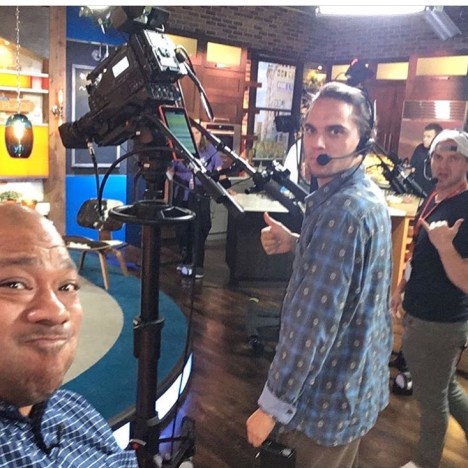
Big Budah, Dario Jokic and Jace Barraclough preparing for Fox 13’s “The Place.” Photo courtesy of Big Budah.

Religious unification for refugees

Story and photos by WESLEY RYAN

Rampant violence across the globe has displaced 65.6 million humans and neighboring countries are showing hesitation toward accepting them. Religious organizations have taken the opposite approach: donating time, resources and money toward the better treatment of refugees.

To address the safety concerns many Americans have, President Donald Trump signed an executive order banning people from countries that were perceived as being incredibly violent. However, the ban was found to be discriminatory toward people from Muslim-majority countries and it lacked justification for national security. Syria, Libya, Iran, Sudan, Yemen and Somalia were no longer banned, at least for a short amount of time.

The ban was not only seen as discriminatory, but also seemed unnecessary, considering what refugees have to do to be granted asylum. Refugees have to undergo various types of screenings, tests and interviews, including biometric scans and in-depth interviews about their life.

Religions have taken an opposing stance. Deciding to preach unity, they’ve opened their arms toward refugees.

“The Church of Jesus Christ of Latter-day Saints is concerned about the temporal and spiritual welfare of all of God’s children across the earth. With special concern for those who are fleeing physical violence, war and religious persecution. The church urges all people and governments to cooperate fully in seeking the best solutions to meet human needs and relieve suffering,” said the response published by the LDS church against the ban toward the Muslim dominated countries.

Last year, the LDS church donated $5 million to nine different resettlement agencies in the United States, including a partnership with Lutheran Immigration and Refugee Services.

The LDS church has even rearranged parts of its own budget so it can permanently donate time and resources toward refugee resettlement and a better life. Sharon Eubank, the director of LDS Charities, credited this generosity toward everyday Mormons when interviewed by the Deseret News.

“The members of the church responded so generously to the letter from the First Presidency and then the invitations at conference,” Eubank said. “We were able to probably quintuple the number of refugee relief projects we were able to do. That’s amazing. Now that won’t happen year after year, but for one year to be able to quintuple the amount of aid that we were able to give to refugees was amazing.”

Mormons are all too familiar with religious persecution, having been chased out of states like Missouri and Illinois, Mormons were forced to create a life in the middle of the desert in Utah. That place is now called Salt Lake City and is also home to 60,000 refugees.

These refugees were forced to leave their homes out of fear of being persecuted, killed or tortured. From a city built on the hope of religious freedom it’s no wonder Mormons have taken so kindly toward refugees.

“The LDS church is the main reason the state of Utah helps refugees out so much,” said Gerald Brown, refugee coordinator for the state of Utah and assistant director of the Refugee Services Office. Donating millions of dollars to refugees and encouraging its members to donate their time has greatly helped the refugee community.

_DSC0028

Bishop Abraham Zurita of the Whitehall Ward in West Valley City, Utah.

Abraham Zurita, a bishop in the Whitehall ward (congregation) in West Valley City, is no stranger to the problems of coming to America. As an immigrant from Mexico, he has lived through the struggles of becoming an American citizen. Preaching a coexistence between citizens and refugees he wants to bridge the gap between the two. As one of the leaders of his church he ensures that they praise kindness and equality.

“We in the congregation have all kinds of people from all kinds of cultures, backgrounds, language and sometimes we even help other beliefs too,” Zurita said. “Helping all of them is a big task. It takes a lot of resources and a lot of money.”

It’s understandable to have people not completely rely on the church, but one person or family can’t do everything themselves. In order for a new family to survive they need help comprehending what is going on around them and what they need to do. Some refugees speak little English and have to guess on where things are, can lead to trouble for both the family and the community they live in.

“Immigrant or a refugee, when you come to a country, you’re by yourself here. And the biggest problem is language,” Zurita said.

_DSC0035

Bishop Abraham Zurita’s tithing envelope for the Whitehall Ward.

It doesn’t matter if the refugees come alone or with a family, trying to understand a new country can be scary and overwhelming. Resources like the LDS church’s EnglishConnect help refugees develop stronger English speaking skills. Without resources that help integrate people into society the person could end up making mistakes in their daily life or even when filing important paperwork.

Zurita and his ward teach classes for refugees in case they don’t know English or enough of it. They will give refugees food if they can’t survive on their own yet. They’ll even support families if their medical bills become too costly. Zurita emphasized the fact the Mormon church can’t do everything, but he believes the church is beneficial toward the refugee community. But, Zurita is right when it comes to refugees, “It’s never enough.”

Located on 1090 S. State St. sits Calvary Baptist Church and for the past 43 years Pastor France Davis has spread his message of unity. Creating programs to help refugees find housing and transportation, Davis has continuously tried doing what he believes is right.

“We open our home. We open our church. We open our community,” Davis said as he passionately talked about sharing the differences we have with refugees.

Davis went on to explain the importance behind this, stating that these people’s religious beliefs is what kept them going for so long. Preaching in their native language allows them to share the story they’ve lived through but also demonstrates the tenacity refugees have. Whether it be Swahili or French, all are welcome, Davis said.

Being a pastor for over four decades, you start to see a lot of change happen in the country, but you also see an enormous amount of repetition. The restrictions being placed on African countries isn’t unique to Davis, considering he believes that this is the same racism we’ve had for years.

On the other hand, Zurita doesn’t believe that the restrictions being enacted are racially or religiously motivated, but, instead, out of fear. Constant attacks and repeated civil wars can start to push a narrative into the minds of everyday Americans. Fear is contagious and can be ingrained into the deepest parts of our society.

“Closing the door is not the answer,” Zurita said. “I don’t get Donald Trump. He has his motives. He acts in random ways that is hard to read. But with… I hope it’s not religiously based and [just] fear from terrorism.”

The current presidential administration has taken steps to prevent the acceptance of refugees. Understanding that there is a fear of something that the people don’t understand, it has taken steps try to stop the fear from spreading. Restricting travel from certain countries was one step it tried taking and now with the recent New York City attack Trump has requested stronger vetting. However, the administration has received a lot of backlash for what it’s tried to accomplish. From the elimination of DACA to the ban on seven countries, there have been thousands of people upset with the decision. The administration has no plans on stopping what it believes is right for the country.

Religions on the other hand, have taken a different approach. Spreading hope, they wish to send a message to the president. Preaching the message of opening up our hearts and communities to these people.

“All people have worth and value. It is not a time to threaten the world or promoting conflict within the country or out of the country,” Davis said.

Refugees in Utah face poor nutrition; doctors and farmers prescribe collaborative response

Story and photo by DANNY O’MALLEY

A national program that provides fresh produce to refugee patients in need of nutrition has arrived in Salt Lake City. VeggieRx, also known as the Fruits and Vegetables Prescription project (FVRx), empowers doctors to prescribe wholesome nutrition in the form of fresh farmers market produce to refugees at risk of malnutrition or other health concerns like diabetes.

At St. Mark’s Family Medicine, in the Millcreek area of Salt Lake City, patients receive prescriptions for $10 toward fresh produce. They take the prescriptions just down the street to the Sunnyvale Farmers Market, to be used up to four times. The market also accepts SNAP, Supplemental Nutrition Assistance Program, which can double the amount of vegetables carried home by refugee patients. The Sunnyvale Farmers Market, an endeavor of the International Rescue Committee through its New Roots farming initiative, is open on Saturday afternoons from July to October every year.

Refugees who are newly resettled face a myriad of challenges, but nutrition and diet are often the most pressing.

Ze Min Xiao, director of the mayor’s Office of New Americans in Salt Lake County, said even the idea of a supermarket can be a challenge to newcomers. Often when a refugee arrives, “suddenly they’re buying processed food, and it’s more expensive and not as good for you. Obesity and lack of vitamins are a problem,” she said.

The transition to the American diet and food culture can be jarring for some. Many refugees struggle to find food they recognize. Familiar ingredients may grow plentifully in other regions around the world, but varieties here in Utah may be nonexistent or prohibitively expensive.

For example, according to cost of living data collected by Numbeo.com, fruit and vegetable prices are anywhere between two and 10 times greater in the United States than in Syria and Somalia. And that’s just for ubiquitous produce like apples, oranges and potatoes — anything remotely exotic is exponentially less likely to be carried by local grocers.

Because of programs like VeggieRx, farming initiatives like New Roots and medical outreach through St. Marks, the avenues to help alleviate issues of nutrition and unfamiliar culture are opening wider. The innovative practice of prescribing access to vegetables packed with nutrients is a direct result of addressing the needs of the refugee community, Xiao said. “We can identify some answers they bring as New Americans,” she added.

Similar programs are already coming to fruition all over the country. VeggieRx was started by Wholesome Wave, an organization centered on increasing accessibility to nutrition and health resources. First piloted in Maine and Massachusetts in 2010, the success on the East Coast has allowed Wholesome Wave to partner with organizations in 48 states as of this writing, as well as Washington, D.C., and the Navajo Nation in the Four Corners area.

Fiona McBride, senior communications associate for Wholesome Wave, has been with the organization since 2014. “We’re really proud of our growth and impact,” she said in a phone interview. “In 2015, we helped about 150,000 people. In 2016, we reached over 550,000.” She expects that growth trend to continue.

The benefit doesn’t stop at the limit of the prescription value either. Refugees and other low-income families are more likely to buy lots of veggies once they get a little, giving an economic boost to the farmers at the market. “We’ve seen that for every $5 in vouchers, they spend an additional $15 on fresh produce,” McBride said. “Our case workers have said that the families can’t believe what they’re getting.”

Patients in greatest need of nutrition are often children. “It’s really powerful to tackle and prevent problems with diet and health starting young,” McBride said.

St. Mark’s Family Medicine is a program with the Utah Healthcare Institute. Diane Chapman, a nurse practitioner involved with the program, said the link between diet and chronic disease can’t be emphasized enough. The majority of patients she sees are refugees. “It’s my primary professional focus and passion,” she said in a phone interview. Often, she said, clinicians have “little context” for a diet that refugee patients might be familiar with. “Dietary change can be difficult for anyone.”

The VeggieRx pilot provided the opportunity for refugee families to align their diet with food similar to that of their countries of origin, at little to no cost. The pilot ran from September to October 2017, through the end of the farmers market season. Chapman said the program goal was to enroll at least 50 patients, which was met, and now the data can be assessed by the Utah Department of Health.

According to a report from the Center for Science in the Public Interest, healthcare costs related to diet are over $950 billion a year. This is especially dangerous for low-income families including refugees.

Fiona McBride said that’s what the VeggieRx program is all about — spending less on healthcare by treating preventable diseases through nutrition. “We’re really trying to show the power of produce to improve personal and environmental health. The money we save in avoiding extremely expensive health problems could transform the country,” she said.

Utah’s pilot of the program is in its infancy, so the exact impact is yet to be seen at the local level. But it has a huge pool of organizers invested in seeing it thrive. The International Rescue Committee, the Utah Department of Health, Salt Lake County and St. Mark’s Family Medicine have made good headway together. Thanks to everyone involved, refugees can eat healthy and avoid burdensome long-term healthcare costs.

Keep your eyes peeled for updates from the Utah Department of Health in early 2018.

Educated and underemployed: refugee student seeks second degree

Story and photos by DEVON ALEXANDER BROWN

Over 60,000 refugees have been resettled in Utah since the 1970s. Prior to the Trump administration, Utah’s designated voluntary agency affiliatesCatholic Community Services and the International Rescue Committee — were resettling roughly 1,200 refugees a year. While agencies do what they can with the resources they have, many refugees find the adage “it’s not what you know, but who you know,” continues ringing true.

Firas, a refugee from Iraq, has personal testimony of the value of networking. He resettled in Salt Lake in March 2014 by way of the IRC, but he has an uncle whom he lived with after resettling, and who continues to offer emotional and financial support.

Firas, who asked to have his surname withheld, holds a degree in civil engineering from a university in his native Iraq, but was dismayed when he found that using his professional training in the U.S would be difficult. The IRC helped him secure an entry-level position in the customer service sector a few months after arrival, but he felt unmotivated and underutilized by the position because of a desire to continue his profession.

“They [the IRC] will explain that it’s not going to be easy to go back to your job,” Firas said. “This is the general talk about this topic … it’s not going to be easy. Because you’re going to face different stuff, regardless of the language challenge.”

But after some time in Salt Lake, and while living with his uncle, Firas stumbled upon good fortune.

“My uncle is here so we met at the mosque and fortunately I met one of the refugees who came through the same process,” Firas said. “That guy actually was part of the NAAN program [New Academic American Network] … he was asking me what was my major, what did I do in my undergrad. He told me he just finished his master’s at the university which is how I learned ‘OK you actually can go back.’”

up

The UNP main office. University Neighborhood Partners was created in 2001 to empower SLC’s westside residents. Many refugees are resettled on the west side of Salt Lake.

The New American Academic Network is a partnership facilitated by University Neighborhood Partners in conjunction with the University of Utah, the University of Utah International Center and the Department of Workforce Services. Because many refugees arrive without the means and proper credentials to work in their respective fields, the goal of the program is to empower refugees and immigrants through access to higher education. In Firas’ case he is working toward a master’s degree in structural design.

P

The UNP Partnership Center opened in 2004 and brings together over 30 university partnerships and 20 local nonprofits.

Although he was able to enroll at the U through the network, he was forced to initially enroll as a non-matriculated student because he did not meet university requirements. Firas, like local students attending graduate school, was required to pass the Graduate Record Examination, but because his native language isn’t English he also had to pass the Test of English as a Foreign Language exam. Although challenging, Firas passed both exams on his second attempt. He credits his time in customer service with accelerating his English fluency.

Partnerships like the New American Academic Network are essential for educated refugees looking to move beyond underemployment. The Academy of Hope, a fellow partnership facilitated through the U, offers no-cost certificates in professional management, web design and human resources management.

Claire Taylor, director of the Academy of Hope, says language, though a primary challenge, is but one of many obstacles refugees face on their path to higher education.

“A common challenge is not being able to afford the cost of certificate classes,” Taylor said in an email interview. “Another common challenge is carving out the time in their schedules to be able attend all of the classes.”

A relatively new program, the Academy of Hope saw one student enrolled in 2016, but Taylor says the 2017 Spring semester provided a cohort of students. So far seven participants have been refugees.

Thanks to the New American Academic Network, Firas is able to finish his master’s degree. Yet even with tuition assistance, he says it is not easy to support himself and complete his program and the engineering internship he is currently involved with.

“Fortunately my uncle is here and he supports me until now,” Firas said. “I was living with him at the beginning and he and his family helped me a lot. It’s difficult to have a place in a different culture, different society.”

Firas understands that case workers in the IRC are limited in their reach and ability to assist refugees on an extended individual basis. But he also thinks a more thorough and personalized approach in the early stages of resettlement would be beneficial — especially for refugees who are professionally trained.

Gerald Brown, assistant director of refugee services for the Utah Department of Workforce Services, is in agreement. He says his experience with refugees reflects a need for lengthier case management.

“Every new refugee needs case management for at least two years and I would argue for longer than that for many of them,” Brown said in a telephone interview. “It just to me makes common sense. A case manager helps a refugee kind of come up with a plan to meet their needs, to thrive in this community and then sort of follows the plan, helps them adjust over time, [and] gives them information when they need it.”

Although Firas hasn’t obtained his master’s degree yet, he is close and hopeful. And because of his personal good fortunes, Firas says he makes every effort to inform other refugees about lesser known resources that can help them get back on their professional footing.

“I’m still referring anybody who came as a refugee — who has a graduate or even non-graduate [degree],” Firas said. “Either go into community college or to the university … this is the option you have and how to go back to what you like.”

Refugee programs and Utah: How effective are federal grants?

Story and photos by ALAYNIA WINTER

What is the largest problem refugee organizations face?

Short Answer: It’s funding.

Temporary Assistance for Needy Families (TANF) is a federally funded and state administered financial assistance program for low-income families with dependent children and pregnant women during their last three months of pregnancy. TANF provides short term financial assistance and aids recipients in finding jobs that will allow them to support themselves.

In 1996, TANF replaced older welfare programs. Today, TANF provides annual grants to all U.S. states. The funds are used to pay for benefits and services distributed by the states.

According to The Department of Workforce Services 2016 report, the majority of refugee services are federally funded through the U.S. Office of Refugee Resettlement (ORR) and the TANF program (with the exception of $200,000 provided by the State of Utah).

Ref_Office

The Refugee Education and Training Center for the Refugee Services Office is located at 250 W. 3900 South in Salt Lake City.

Currently, Utah’s Refugee Services Office administers approximately $4.3 million from TANF and $8.9 million from ORR for refugee services in Utah. Health services receives over $3 million and case management is allocated over $2 million. Skills and employment training and youth services respectively receive approximately $3 million.

Many critics of welfare programs speculate there are better ways to spend and distribute the federal assistance money.

The 1996 welfare reform act, known as the Personal Responsibility and Work Opportunity Act, completely changed the concept of welfare. States have control over how and where TANF money is spent.

According to The Center on Budget and Policy Priorities (CPBB), this money has not been used well. A 2015 fiscal study on TANF funds reported “34% of funds were going to causes not related to family and youth assistance.” The 34% of funding was labeled “other programs.”

In some instances, TANF money can go to a free and public workshop on improving marriages, or a health profession education grant for low-income students at a public high school. One doesn’t necessarily have to be financially “needy” to participate in public welfare programs such as these. The long-term societal benefits and changes can be difficult to measure; however, the money does seem to be going toward refugee programming and public programming in the “other programs” category.

Ref_office2

An “I Am A Refugee” banner in front of the Refugee Services Office building.

Regarding how refugee TANF money is spent, “The caseload has grown. So, the bigger the load, the more time you spend putting out fires,” said Gerald Brown, Utah state refugee coordinator and assistant director for the Refugee Services Office.

The current administration’s decision to cut funding and the looming uncertainty of the future for many refugee organizations in a time with a historically high number of refugees spurs much debate.

According to the Bureau of Population, Refugees, and Migration, the U.S. government plans to cap the number of refugees from around the world at 45,000 in FY 2018. That is the lowest level since 1980.

Refugee resettlement organizations in the U.S. are worried about this drastic reduction. This news brings an inevitable slash in budget as well. Refugee organizations had been pushing the Trump administration to set next year’s refugee cap to at least 75,000, and said this diminution would force many to close their doors or lose valuable programs.

As Utah philanthropist Pamela J. Atkinson, of the Pamela J. Atkinson Foundation said, “Refugees are people who, rather than give up or give in, have chosen to take the higher and harder road and are grateful for the generosity of strangers who reached out with a willing and helping hand.”

The refugee experience: Integrating into American society

Story and photo by BLAKE HANSEN

Outside the Catholic Community Services building, refugees and others sit, waiting for help.

The UN High Commissioner for Refugees (UNHCR) has reported in its “Projected Global Resettlement Needs 2017” that the number of people in need of resettlement for the calendar year will surpass 1.19 million. This number is the equivalent of the number of residents inside of Salt Lake, Davis and Weber counties. The number of refugees in desperate need of relocation equals the same number of people who reside from Draper all the way through Ogden, a distance of about 60 miles.

Many refugees who have been granted relocation to America, specifically to Utah, have a hard time integrating into a vastly different society. But with help of local organizations it is possible to successfully integrate.

The trek out of danger is only the first step for refugees, though. According to various statements made by refugees in an article by The Independent, they arrive in these safe zones. Some are injured, starved, alone, scared and all have suffered extreme loss. They settle in refugee camps where conditions are horrible.

The process to get resettled somewhere can take years, according to the UNHCR. Some people spend the rest of their lives in refugee camps because the lengthy and intense resettlement process can’t even handle the amount of people left without a country to call home. Kids who grow up in these refugee camps have little to no access to education. Doctors and lawyers who were once able to comfortably use their education and expertise to take care of their families are left building their families tin huts just to stay dry. Also, 51 percent of refugees are under 18. Many have narrowly escaped, and are without parents or siblings.

Aden Batar left Somalia with a law degree and with two of his brothers in the late 1980s. At a time when civil war took over the country, Batar and his brothers had no choice but to leave. They had to lie and disguise themselves as members of other tribes and factions just to make it past checkpoints where people were being shot and killed for trying to flee. Batar made it to Kenya alone after one of his brothers was killed for being found at a checkpoint and the other died from a sickness he got during their trek.

“Looking back, I don’t know how I did it,” he said. Batar lived in a refugee camp in Kenya and met his future wife there before finally making it to Utah in 1994. He was lucky enough to have a brother in Logan who helped with his resettlement. Batar is now the director of immigration and refugee resettlement at Catholic Community Services in Salt Lake City where refugees are helped and given the tools they need to integrate.

Atem Aleu escaped from Sudan in 1987. Similarly to Batar, Aleu also fled his country with two brothers. After a lengthy trek between multiple countries, Aleu eventually ended up in Kenya in 1992 with one brother after the other died during their trek. Aleu was 8 years old. Eventually though, after years of suffering through surviving with little food and water, none at times, Aleu made it to the U.S.

“We need to put ourselves in someone else’s shoes. Judgement happens a lot here, people think that because you’re a refugee, you’re some sort of lower person,” Aleu said. He said his organization, which he declined to name, .helps refugees locally in Utah. “Without these organizations in place there is no one to talk to and nowhere to go for help finding jobs, transportation, appropriate housing, etc.,” he said.

Integration is a difficult and lengthy process for refugees after they have already gone through so much just to get here to the U.S. The local organizations in Utah are always looking for volunteers to help in a variety of ways. Some options include mentorship and job placement. Batar also stressed the importance of overall friendly interactions to show a welcome, safe environment where refugees are able to flourish in a new place with opportunity.


Catholic Community Services assisting Utah refugees

Story and photo by BLAKE LANCASTER

Over 60,000 refugees have been resettled in Utah. Integrating into a new community can prove to be just as difficult as getting there, but several organizations — and volunteers — in Salt Lake City help with resettlement.

One such organization is the Catholic Community Services of Utah, whose Refugee Resettlement Program helps individuals reach a point of self-sufficiency by providing them with necessary tools and assistance.

For over 21 years, Aden Batar has been a part of immigration and refugee resettlement at Utah’s Catholic Community Services. Batar himself is a refugee from Somalia who came to Utah with his family in 1996. That same year he got involved with the Catholic Community Services and five years later he became the director of the program.

Now Batar and his organization help refugees from around the world arriving in Utah with housing, financial aid, acquiring jobs, learning the language and much more.

Concepts that seem simple to those who have lived here their whole lives can be brand new to a refugee who has lived a completely different lifestyle in their home country.

For example, a lot of these people have never seen what we would consider everyday appliances like microwaves or refrigerators. Batar and the staff and volunteers from the Refugee Resettlement Program teach them how to adjust to a new way of life. But they can’t do it all.

One of the major obstacles these refugees face is simply learning how to interact with their new community. Batar said volunteers can help new Americans overcome this obstacle by interacting and welcoming refugees to their new home.

“Volunteering can go a long way,” Batar said, “It can teach new refugees a lot of things.”

Volunteers for the resettlement program help in the best of two worlds by assisting with the resettlement process as well as helping teach refugees how their new world works. They assist with tasks including grocery shopping, tutoring school-age refugees and teaching them the English language. The organization understands that not everyone can be a volunteer, but that doesn’t mean you can’t help out in your everyday life.

“It almost feels like people are even scared to have any sort of interaction with refugees around here,” said Robert Dean, a student at Salt Lake Community College. “Locals act like refugees aren’t equal because they aren’t the exact same as the rest of us.”

Dean has a unique perspective on refugees. His mother was a counselor at the school he went to at a young age where a couple of refugee families also had their children attend. To help with these children’s integration into their new lifestyle and school, Dean’s mother helped them make friends by setting up play dates with other students including Dean and his siblings.

He’s maintained his relationships with several of these refugee students, and through them has developed friendships with other New Americans. Dean said that being introduced to refugees at age 7 made it easy to look past the kids being any different than him. He attributed this to his still budding concept of the world as he recalled a memory of his friend Emmanuel, a refugee, who had never seen video games before visiting Dean’s house.

“I can’t even imagine going on the crazy journey all these guys have,” Dean said, referencing his friends. “Making it a little easier can go a long way for them and it only takes a little from us.”

Alyssa Williams, an attorney and coordinator of Utah’s Catholic Community Services Immigration Program, said that no matter what sort of life refugees led in their home country, starting a new beginning and integrating into a brand new culture is one of the toughest parts of what refugees have to go through. It has become clear that help and personal interaction from the community add to a smooth transition to their new lives. But Williams also said that while we need to do our part as a community to help, refugees also help us.

The mural above the Catholic Community Services building by Ruby Chacon depicts the organization and the city’s ability to bridge cultural divides.

“Refugees provide a tremendous value both economically and through rich and diverse cultural experiences to our community,” Williams said. “As a community we need to make them understand the importance they bring as an addition to Utah.”

This becomes more relevant as the Trump administration focuses on allowing fewer refugees into the country.

Williams and the Catholic Community Services want those in charge see that they are politicizing this global issue and affecting lives.

Aden Batar said the month of September, which ends the organization’s fiscal year, is usually the busiest time for CCS. However, 2017 was a different story due to a drastic reduction in the number of refugees coming to the U.S.

Catholic Community Services encourages people to contact their representatives and let them know that they do not support the administration’s policies regarding refugee resettlement.

Syrian refugees being forced from home go through intensive resettlement process

Story and photo by KATIE UNDESSER

Refugees are being forced out of their homeland at an alarming rate since the Syrian war broke out in March 2011. The process to resettle them in a third country can take years to complete.

According to the Catholic Community Services of Utah (CCS), a refugee is someone who has been forced to flee their country because of past persecution or a well-founded fear of persecution on account of race, religion, nationality, or because they are a member in a particular social group or hold a political opinion that may diverge from their government’s position.

Humanitarian aid organizations, such as the CCS, have dedicated time toward the help of those refugees in need who decide to apply for third-country resettlement.

Aden Batar, the director of immigration and refugee resettlement at CCS, has committed his life to resettling refugee families who come to Utah by helping them from the moment they arrive to the moment they become self-sufficient.

Batar himself is a refugee from Somalia. He knows firsthand how hard it can be on those who are forced out of their home country. The journey alone tears family members apart.

“When you’re in your country, you either face the hard condition of leaving, or you die. Looking back, I don’t know how I did, but when you don’t have a choice, you just want a new place to survive,” he said.

Most choose life when having to make the decision between living and dying. The journey to a new land takes courage and knowledge. There are two ways to reach safety: by boat or foot.

“If they are going to die staying, a lot are willing to take the risk of surviving a boat ride across the ocean,” Batar said.

When Syrian refugees cross the Mediterranean Sea from Turkey to Greece, there are several obstacles that may arise: starvation, dehydration and suffocation. According to The Independent, the Mediterranean Sea has become the deadliest sea crossing in the world since the start of the refugee crisis.

Even walking on foot from one place to another is not as simple as it sounds, Batar said.

Utah Refugee Education and Training Center, located at 250 W. 3900 South in Salt Lake City, provides opportunities for refugees to access higher education and training programs.

Gerald Brown, state refugee coordinator and assistant director of the Refugee Services Office, spoke about the abrupt travel of a friend who came from Burma.

“It was the middle of the night when he woke up realizing that his house was on fire. He gathered his family and they ran into the nearby jungle. After three days of running, they reached the border,” Brown said.

Many times, the surrounding tribes around a homeland may be the reason a refugee is leaving. Sometimes, a traveling refugee would need to be able to know what language the following tribe spoke in order to save their lives.

Along the expedition, various refugee camps have been set up in order to help the traveling families. Within these camps, refugees have few rights, have no control over their lives and have no future for themselves or their children.

The other pathways for refugees after fleeing their country could be living in cities after registering with the United Nations High Commissioner for Refugees (UNHCR) and receiving food vouchers from an organization or hiding out in cities or jungles as they are subject to arrest and deportation, Brown said.

There are approximately 65.6 million forcibly displaced people worldwide. Of that number, only 189,300 refugees resettle in a third country. That is roughly only 1 percent of the total number, according to the UNHCR.

Throughout the security screening, refugees are required to pass all levels of the steps. In the meantime, refugees are required to remain where they are, whether that is a refugee camp or city.

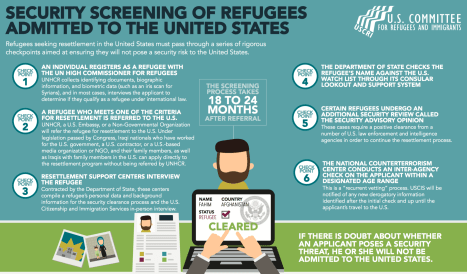
The six-step screening process as defined by the U.S. Committee for Refugees and Immigrants. Graphic provided by Gerald Brown.

The first step in the security screening, Brown said, is the refugee making the decision to apply for refugee status. From there the UNHCR interviews the refugees and then refers the ones who meet the criteria to one of the nine national resettlement agencies.

During this task, there are bars that are set for the refugees coming into the country, Brown. These bars are certain standards that need to be met in order for the refugees to be even considered to resettle in a third country such as the United States.

“If they persecuted someone themselves then they did not pass the bar and cannot become a refugee in our country,” Brown said.

If there is any reason to believe that a person has done something illegal or unjust in their country, then they will automatically get declined resettlement and will not be able to reapply.

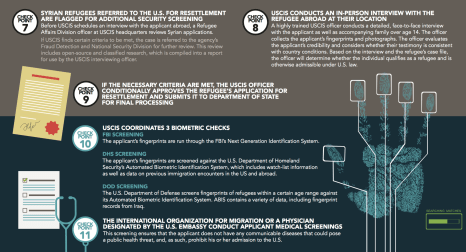
Steps 7-11 of the security screening process as defined by the U.S. Committee for Refugees and Immigrants. Graphic provided by Gerald Brown.

The next step is the security screening. The screening process is aimed at ensuring the refugees will not pose a security risk to the United States. These background checks can take anywhere from 18 to 24 months after referral, according to the U.S Committee for Refugees and Immigrants. During this entire process, the refugees are continuing to stay in the camps.

The final steps include a health screening and eligibility based on the current cap the U.S. has established for incoming refugees. Then, the Department of State works with the nine national resettlement organizations that have affiliate offices that resettle refugees.


No safe space; how one Salt Lake City resident has welcomed LGBT refugees

Connell O’Donovan at the annual Salt Lake City Utah Pride festival. Photo taken by David Newkirk.

Story by KAYA DANAE

Apollo Kann, a gay Ugandan refugee and HIV/AIDS education activist, landed in Salt Lake City after spending two years in Nairobi, Kenya, waiting to be resettled into the U.S. The first local contact he made was Connell O’Donovan, a genealogist and well known activist for LGBT rights.

The next day Barnabas Wobilaya, Kann’s friend and fellow HIV/AIDS education activist, arrived in Salt Lake City from Nairobi. “I’m professional friends with them,” O’Donovan said with a laugh. “It started out totally informally. Apollo sent me a friend request on Facebook and for whatever reason, I accepted his request!”

After offering his help, O’Donovan arrived at the apartment that Kann, Wobilaya and two other Ugandan refugees had been placed in by the International Rescue Committee. O’Donovan immediately noticed that their apartment was sparsely furnished.

“The IRC had provided very minimal furniture, a table, two chairs, two beds, linens, basic soap, toothpaste, and toothbrushes. They showed up with a literal knapsack each, that was it,” O’Donovan said.

O’Donovan reached out to his social circle and explained the situation, saying, “They need everything, what can you give?” Within 24 hours a truck was filled with everything they could possibly need, including a La-Z-Boy chair and new TV.

“I’ve just been a contact point with my circle of friends and the LGBT Community at large, anything that they need, they contact me. And I reach out and try to find it for them,” O’Donovan said.

He brought Kann and Wobilaya to the Utah Pride Center, where they were introduced to the Executive Director Carol Gnade.

The Utah Pride Center had begun to establish a refugee subcommittee called The Heart and Home Project in November 2016, but plans were changed when Donald Trump became president.

“We had been told by IRC that there would be 25 other LGBT refugees that would be coming from Uganda in June,” Gnade said in a phone interview. “We started scrambling to get a program together for all of these people, but they never came.”

The Heart and Home Project proposed to distribute a pamphlet to resettlement agencies like the International Rescue Committee and Catholic Community Services. These pamphlets would help teach refugees about the LGBT culture and resources in Salt Lake City. The project has been put on hold until more LGBT refugees are resettled into Utah.

The Pride Center currently offers free counseling for LGBT folk and happily welcomes refugees who identify as LGBT. Several refugee resettlement agencies also offer counseling for refugees experiencing PTSD. But LGBT refugees are often hesitant to use the services in fear of being exposed and mistreated.

Aden Batar, the immigration and refugee resettlement director for Catholic Community Services and the first Somalian refugee to step foot in Utah, stressed the importance of befriending refugees. “They (refugees) are leaving their homes, friends and families behind. It is very easy to become isolated. The connections and friendships that are made through our volunteer programs can completely change their lives.”

O’Donovan grew emotional when he began explaining that Uganda is one of the worst countries to live in for the LGBT community.

“You would not believe the circumstances these (LGBT) refugees are coming from,” he said.

In 2014, Uganda passed the Anti-Homosexuality Bill, in which being gay was punishable by death. It has since been updated and the penalty is now a lifetime prison sentence. It is not uncommon for the death penalty to be carried out in more rural areas.

Even if an LGBT Ugandan is placed in a refugee camp, conditions are not much better.

A United Nations Refugee Camp in Kakuma, Kenya, has been known to treat its LGBT enclave especially inhumanely. “There are about 250 (LGBT) refugees that are placed next to the shores of the river. When there is rain, they get flooded out, they’re constantly surrounded by mosquitos. Several of them have malaria, but they’re not getting medicine because they are not a priority. They are given ridiculous charges and sent to jail. The camp security will come by and beat the hell out of them,” said O’Donovan, who has been in contact with LGBT refugees staying at the camp.

Only five gay refugee men are known to be living in Salt Lake City, but two have not publicly come out in fear of being isolated from their own families and friends. Many LGBT refugees live their lives in hiding and secrecy. Even outing themselves in order to be granted asylum can be too dangerous. As openly gay men and HIV/AIDS education activists, Kann and Wobilaya have said they faced discrimination from fellow refugees here in Salt Lake City.

Catholic Community Services and International Rescue Committee have typically resettled approximately 1,200 refugees in Utah each year. Globally, 53 percent of all refugees are from Afghanistan, Somalia and Syria, all of which outlaw (some punishable by death) being an active LGBT citizen. Organizations like these are essential in helping refugees resettle into Salt Lake City, but Connell O’Donovan said that it is our responsibility as citizens to help our refugee neighbors feel welcome, especially those who may feel isolated in their own homes.