Is the LGBT equality movement the civil rights movement of the 21st century?

Story and slideshow by RENEE ESTRADA

Explore the Utah Pride Center and the Office for Equity and Diversity.

Throughout America’s history there have been movements toward equality. Americans who felt alienated or limited by the government protested, petitioned and fought for their rights.

The African-American civil rights movement followed after and spanned three decades, the 50s, 60s and 70s.

Currently, the LGBT equality movement is under way. The basis of the equality movement is to allow gay, lesbian and transgender couples the right to marry and all the rights that come with it, including, but not limited to health insurance benefits, tax benefits and estate filings.

According to David Frum of the Daily Beast, proponents of marriage equality have called it the “civil rights movement of our time.”

Not everybody is happy about this, including Frum and Jack Hunter, another conservative opinion columnist.

In Hunter’s article, “Why Gay Marriage isn’t the 60’s Civil Right’s Fight,” he argues, “There have been instances during the gay-rights movement that arguably could be compared to the black civil rights struggle, like the Stonewall riots of the 1960s or Matthew Shepard murder in 1998. … Still, with the possible exception of the mistreatment of Native Americans, there has been nothing quite like the systematic exploitation and institutional degradation experienced by earlier black Americans.”

Edward Buendía, an associate professor in the ethnic studies department at the University of Utah, disagrees with this notion.

“One of the arguments, against this movement as a civil rights movement, is that you don’t have lynching,” Buendía said in a phone interview. “Yes, there are not gay people being lynched, but we do have individuals that have lost their lives. Some people believe you have to be on the same level of scope to legitimize it and from my point of view, one life is too many to lose.”

In Frum’s article, “Let’s not call marriage equality the civil rights movement of our time,” he argues, “And while homosexuality has always had a large stigma attached to it, the number of gay people denied a job because of their sexuality just utterly pales in comparison to the number of black people denied jobs because of their skin color.”

Frum’s statement brings up another point. You can see when someone is African American. Meanwhile, you cannot see that someone is a homosexual.

The National Association for the Advancement of Colored People has endorsed same-sex marriage. According to a statement from the organization, “The NAACP Constitution affirmatively states our objective to ensure the ‘political, education, social and economic equality’ of all people. Therefore, the NAACP has opposed and will continue to oppose any national, state, local policy or legislative initiative that seeks to codify discrimination or hatred into the law or to remove the Constitutional rights of LGBT citizens.”

Regarding the endorsement, NAACP President and CEO Benjamin Todd Jealous said at a press conference, “Civil marriage is a civil right and a matter of civil law. The NAACP’s support for marriage equality is deeply rooted in the Fourteenth Amendment of the United States Constitution and equal protection of all people.”

In 2004, Utah residents voted to amend the state constitution to include a ban on same-sex marriage. In 2013, three couples challenged it. One of the couples is married in Iowa, but the marriage is not recognized in Utah.

Considering the Advocate, a national gay and lesbian news magazine, named Salt Lake City the gayest city in America in 2012, the statewide same-sex marriage ban is interesting. Granted some of the criteria were more humorous than serious, but the title still revealed Salt Lake City has a large, active, gay community.

“They [same-sex marriage bans] don’t make sense. They are restrictive and anti-people, because anytime the government says, you as a people, even though you didn’t do anything wrong, we are going to deem your existence illegal. That’s discrimination, and that’s wrong,” said Max Green, Equality Utah’s advocacy coordinator.

Green also offers another point. He believes the equality movement is taking an approach that is not seen very often. Supporters and advocates are tackling the most challenging aspect, and then moving on to more basic issues.

“This is the first time we’ve seen a sort of top down approach to an equality movement,” Green said. “In all other movements we’re seen bottom up. With the Civil rights movement, it was let’s start with something like desegregating the buses and desegregating schools, and then desegregating the military … so they went from the base up to the top. With the marriage equality movement it’s really starting at the top and going down, which is an interesting way to do things.”

Civil unions are offered as an alternative to same-sex marriage.

Thomas Allen Harris, who directed and produced a short documentary titled, “Marriage Equality,” disagrees with this alternative.

During an interview with NPR, Harris said that civil unions create a second-class label for gays and lesbian couples, making them less than heterosexual couples.

Some same-sex marriage advocates, including the three couples who are challenging Utah’s same-sex marriage ban, believe these bans are illegal, because of the decision affirmed by Loving v. Virginia.

The case Loving v. Virginia dealt with the legality of interracial marriage. According to a story in Slate, Mildred Loving and Richard Loving were sentenced to one year in prison for violating Virginia’s anti-miscegenation statute, the Racial Integrity Act of 1924. Eventually the Supreme Court ruled that the act violated the Due Process Clause and the Equal Protection Clause of the Fourteenth Amendment. It was clear in the decision of the court that the Justices found this to issue to be a civil rights issue.

In 2007, Mildred Loving issued a statement for her support of same-sex marriage.

“I believe all Americans, no matter their race, no matter their sex, no matter their sexual orientation, should have that same freedom to marry … said Loving. I am still not a political person, but I am proud that Richard’s and my name is on a court case that can help reinforce the love, the commitment, the fairness and the family that so many people, black or white, young or old, gay or straight, seek in life.”

Some say Loving v. Virginia has paved the way for Hollingsworth v. Perry, given their similarities.

Hollingsworth v. Perry is a case that was heard by the US Supreme Court on March 25, 2013. Plaintiffs argued Proposition 8, a voter-approved initiative to ban same-sex marriage in California, violated the Due Process and Equal Protection Clauses of the Fourteenth Amendment to the United States Constitution.

The decision of Hollingsworth v. Perry will not be out until June 2013. It seems until then Americans will have to see if the court deems same-sex marriage to be a civil rights issue.

Buendía sees the legal aspect is where the two movements intersect and share the most similarities. There were been many legal battles over segregation, and there are ongoing legal battles over LGBT rights, including housing and workplace rights.

While the movements bear some resemblances, it is clear there are distinct differences.

“We have to be careful of the significant difference for some people around race and color versus gender and sexual orientation,” Green said. “For some people those qualities don’t mix. We have to respect that and be aware not to rob someone of their identity.”

Pride Week at the University of Utah, a ‘top-25’ LGBT-friendly school

Story and photos by DAYLAN JONES

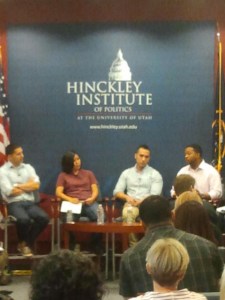
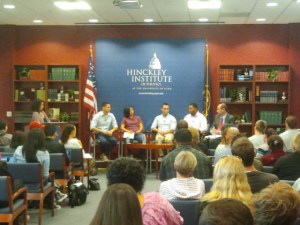
Pannel style discussion at the Hinkley Institute, Oct 4, 2012

Panel discussion at the Hinkley Institute of Politics, Oct. 4, 2012.

The University of Utah was named one of the top 25 most LGBT-friendly colleges and universities in the U.S. by Campus Pride in August 2012. The ranking gave the U something else to celebrate during the annual Pride Week celebration, held Oct. 1-5, 2012.

The rankings are based on data from the Campus Pride Index, which rates colleges and universities on things such as LGBT-friendly policies.

The U received high scores in all categories but LGBT Housing and Residence Life, where it scored a 3.5 of 5 stars.

“We are currently working towards that with the housing department and other necessary departments to have that by the fall [of 2013],” said Kai Medina-Martínez, director of the LGBT Resource Center at the U.

“It’s a good thing,” Medina-Martínez said about the publicity. “When the list came out the major news outlets contacted us, the U’s webpage acknowledged us, and in addition to the school, it’s a really good thing for the state.”

The Pride Week panel at the Hinckley Institute of Politics, Oct. 4, 2012.

The Pride Week panel at the Hinckley Institute of Politics, Oct. 4, 2012.

Pride Week has a different focus or theme every year to educate students and the public about issues in the LGBT community. This year’s theme was “Pride Has No Borders.”

The panel, “Pride Has No Borders: Immigration,” held Oct. 4 at the Hinkley Institute of Politics, focused on the challenges lesbians and gays of color face as they apply for immigration, get jobs and try to make a difference.

“As a woman of color and an immigrant myself I can connect with this,” said Valeria Moncada, a student who attended the panel. “It hurts my heart to see the hardships and unfairness we as people of this country place on immigrants. Immigrants as individuals are treated unfairly but because you are LGBT, you have less rights than a traditional immigrant.”

Pride Week also featured fun events. The Drag Show was a hit and gave new insight to one student. Madeline Smith commented on the “feisty” performers and “huge variety of looks and performances.”

The show, also Oct. 4, was held at Sugar Space in Salt Lake City. “My favorite performance was Klaus von Austerlitz,” Smith said. “He lip-synced to ‘Call Me Maybe,’ but mixed the song so it would change from the original song to a really creepy version and he would dance accordingly. He walked out all stiff like a doll and had 666 written on his hand so every time it said ‘here’s my number…’ he pointed to his hand.”

Smith, who was attending her first drag show, said she was “in awe at how Klaus fought the stereotype that all drag queens have to have fake boobs [and] wear heels…. He creeped out the crowd but everyone loved him.”

Sterling Anderson, a gay student at the U said about Pride Week, “I feel like I can be myself, and accepted for who I am on this campus. I don’t feel I have to hide my status and know I will be respected in that aspect. I feel very fortunate.”

2013: LGBTQ equality in Utah? It has a fighting chance

Story and photo by SASCHA BLUME

With the 2013 Utah legislative sessions set to begin on Jan. 28, the lesbian, gay, bisexual, transgender and queer community is in a political quandary.

Max Green, advocacy coordinator for Equality Utah in Salt Lake City, said, “We’re not asking for special treatment, just the same protection that everyone is provided.”

Green said the national and state elections of 2012 have made an impact on the coming year’s legislative process.

“With so much turnover from the elections not every person is up to date and not every legislator is familiar with the legislative readings,” Green said.

This makes it particularly difficult to have a season-long dialogue about specific legislation, Green said.

In an attempt to bring equal rights and protection to the LGBTQ community, Equality Utah created the Common Ground Initiative in 2012. The nonprofit organization’s mission is: “To secure equal rights and protections for LGBTQ Utahns and their families.”

This proposed initiative was designed to positively impact four problem areas in Utah’s LGBTQ community:

(1) Fair housing and employment (SB 51). Currently, Utahns can be evicted from their house because of their sexual orientation.

(2) Expanding health care (HB 64). Currently, lesbian and gay individuals cannot visit a loved one in a hospital.

(3) Relationship Recognition (SB 126).

(4) Inheritance. LGBTQ individuals are unable to claim inheritance when their partner dies.

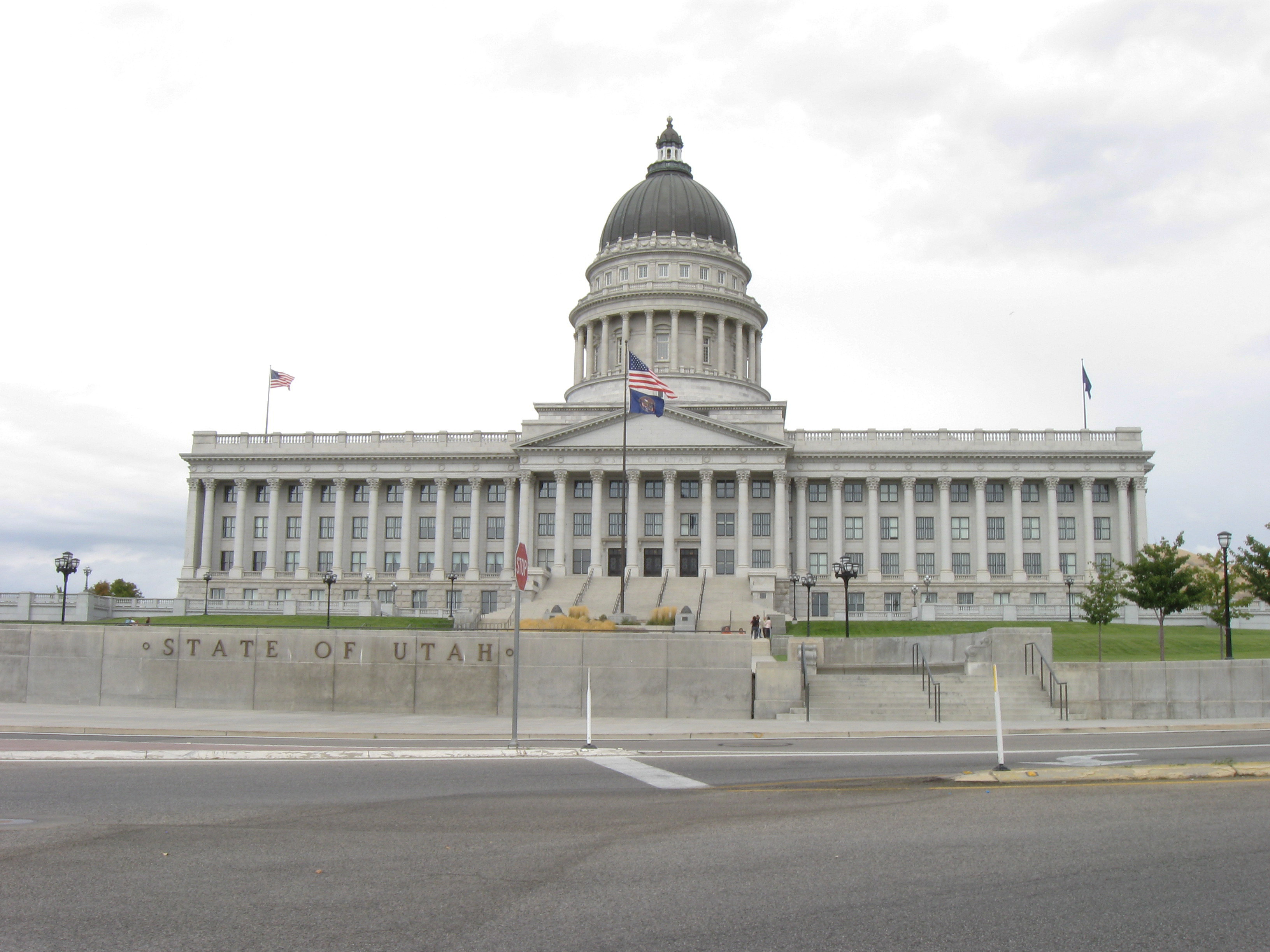
During the 2012 legislative sessions, Utah’s Sate Capitol Rotunda was the site of a rally organized by Human Dignity Utah. The purpose of the rally was to encourage Utah legislators to ratify the Common Ground Initiative.

The rally drew more than 100 people — some carried signs, others sang, but all were there to show solidarity in their quest for equality.

Five speakers addressed the audience and the dozens of lawmakers who watched from the third-floor balcony surrounded by armed Utah Highway Patrol officers.

Sister Dottie Dixon, a local art performer, told the audience, “By showing up here today we’re showing that we are fed up; we’re tired of being ignored, politely dismissed, relegated to second-class citizens.”

Kathy Godwin, president of the Salt Lake Chapter of Parents, Families and Friends of Lesbians and Gays (PFLAG), told the crowd that the majority of Utah citizens and businesses want equal protection for the LGBTQ community. She also said that approximately 70 percent of Utahns encourage state legislators to give civil rights to the LGBTQ community.

Isaac Higham, a keynote speaker with Human Dignity Utah, said after the rally, “I’m sick of the nonchalance of how easily they just dismiss our community and don’t even give us a true fair hearing.”

Higham said that Utah legislators are misinformed regarding what the people of Utah want. He said it’s the job of all Utahns to remind lawmakers that they are in office to work for the people, not just their agenda.

The Common Ground Initiative failed. All four bills went unheard and were effectively tabled.

When it comes to the University of Utah, pride has no borders

Story by VALERIA MONCADA
Photo from the Utah Legal Immigration blog

The University of Utah celebrated Pride Week in October 2012 with many different activities. 

A discussion panel on Oct. 4 was open to U students to inform them about “Pride has no borders,” the theme for the immigration panel. Immigration and equality are two much discussed topics in the United States, and lesbian and gay individuals want to have rights in the U.S just as much as an immigrant does.

Panelists discussed issues that focused on different countries, states throughout the U.S and at one point religion was involved as well. Life becomes much more complicated as a gay immigrant who is interested in issues such as marriage, benefits, receiving citizenship and adopting children.

Panelist Ricky Gutierrez, a graduate student in education, culture and society, said, “I think we need to recognize the way both immigration and sexuality have been intimately connected. We cannot have ideas around being gay without ideas around being white or being black.”

Another discussion was about religion and the LGBT community. Mariana Ramiro Gomez, a graduate assistant at the LGBT Resource Center, said that when she came out her mother didn’t attend church for about two years due to the conflicts that she faced there for supporting her daughter.

Max Green, an advocacy coordinator with Equality Utah said, “The truth is, gay people go to church.”

Green also said that the best way to break down stereotypes is to communicate with church leaders.

“This probably won’t change their opinion, but it will let them know that the people they preach about are in their audience,” he said.

Utah office

The immigration center in Salt Lake City, Utah.

Other concerns had to do with immigration and same-sex marriages. Due to the federal immigration law lesbian or gay citizens cannot marry an immigrant and hope to start the citizenship process. Lesbian and gay individuals face double discrimination: not only are they discriminated against for being immigrants, but they also are discriminated against by the immigrant community for being gay. This also includes the issues they face in the process of coming out to the community.

According to the Immigration Legal Resource Center’s webpage on LGBT immigrant rights, “many immigrants have fled their country of origin due to sexual orientation or gender identity also referred to as SOGI based persecution. Others fear social isolation from their community in the United States.”

Not only does this mean that lesbian, gay, bisexual or transgender immigrants need legal and social services that are unavailable to them because they are both immigrants and gay or bisexual, but they could also face difficulties in obtaining a lawful immigration status.

Max Green of Equality Utah added, “You have absolutely no safeguard, you have no rights and these things prevent people from having real and meaningful relationships.”

Lack of marriage equality for LGBT hinders immigrants’ ability to come to America

Story and photos by MATT ELLIS

For years there has been a struggle for the nationwide recognition of same-sex marriage. Some states have legalized the marriage of same-sex couples, but most have not and political battles wage on. At the center of the debate are liberties that are denied non-married couples. Though these discussions have taken a more prominent role in our culture over recent years, the implications of these policies on immigration have been discussed in far smaller circles.

The University of Utah Hinckley Institute of Politics is where five panelists gathered to discuss rights for LGBT immigrants on Thursday, Oct. 4, 2012.

The challenges that face same-sex couples where both partners are American citizens are compounded exponentially when crossed with issues of immigration, mostly because of the denial of rights that would normally be afforded to a couple trying to enter America.

Many pieces of legislation are under fire by those fighting for same-sex couples’ immigration rights, but the one that may be the most central is the Defense of Marriage Act (DOMA), passed in 1996. Section 3 of DOMA defines marriage exclusively as the union of a man and woman, and the word “spouse” as a reference only to a partner of the opposite sex.

Under these definitions, an American citizen can request citizenship for their partner so long as that partner is of the opposite sex. For same-sex couples, immigration to the U.S. can be vastly more complicated.

Mark Alvarez, an immigration lawyer in Salt Lake City, spoke at a panel at the University of Utah in October 2012 on the difficulties that face same-sex couples who want to immigrate to the U.S.

“It’s because of DOMA,” Alvarez said. “A same-sex couple cannot petition for normal family rights.”

Because an individual has no legal grounds for petitioning for the citizenship of a same-sex partner, the partner often has no way of achieving that status and is forced to leave the country with or without their companion.

Mariana Ramiro works with the LGBT Resource Center at the U. She is originally from Mexico City and has had personal experience with the difficulties of immigration.

She and her family immigrated here illegally, and lived illegally for more than a decade. She eventually got a green card and is now in a five-year probationary period before citizenship where she can still be deported for any reason.

Mariana Ramiro smiles for the camera. She and her partner are enduring the very issues that the panel was assembled to discuss.

Her partner is in a similar situation, which puts a great deal of stress on their relationship.

“I can be with my partner here, but if my partner ends up getting deported there’s no way to [bring us back together],” Ramiro said at the panel. “I either stay here and try to become a citizen, and maybe hope that in the future there is something that will change that I can bring my partner back. But realistically we are going to be separated unless I choose to go back there, but then that would disqualify me from citizenship.”

These fears are very real, even for those who have been legally married in the U.S.

In the case of Pablo Garcia and Santiago Ortiz, whose story was published on immigrationequality.org, the two were legally married in Connecticut but Garcia is not an American citizen.

Ortiz, who was born in New York, is an American citizen but because DOMA overrides local laws even he and his partner are not exempt.

Ortiz has tested positive for HIV and sometimes has to travel abroad to receive treatment. Garcia is unable to accompany him on those trips because he fears he would not be allowed reentry. When Ortiz’s father died Garcia couldn’t even attend the funeral in Caracas, Venezuela.

“You are putting yourself at risk for legal ramifications, for jail time, for pursuit under the state,” Max Greene, the advocacy coordinator for Equality Utah, said at the panel. “Those things prevent people from real meaningful relationships because you are already in the society where some of us aren’t valid. Imagine what that does to someone’s ability to be who they really are.”

But hope is on the horizon for couples like Ortiz and Garcia.

In 2011 the Obama administration announced that it found Section 3 of DOMA to be unconstitutional as it relates to issues of immigration, bankruptcy and public estate taxes. Though there has not been a formal repeal of the law, the administration decided that it would no longer be defended in court.

Eight federal courts, including the First and Second Circuit Court of Appeals, have also found Section 3 to be unconstitutional and as of 2012 several cases regarding immigration were awaiting a response to review in the U.S. Supreme Court.

Additionally, according to the Global Post, the Immigration and Customs Enforcement Agency has announced that deportation will not be a priority for illegal immigrants who have strong family ties in the U.S., specifically those in the LGBT community.

Many have compared the struggles of the LGBT community with the African-American civil rights movement and while that does entail subjugation and oppression, some are hopeful that the end result will be similar and that equality will soon emerge.

Alvarez is confident that, in spite of the political dealings moving at such a slow pace, America is ready for the next step.

“I think our society is [moving] forward,” the immigration lawyer said at the panel. “I firmly believe this country is on its way to marriage equality. The question is when, and I think it’s coming sooner rather than later.”

Utah’s gay and lesbian parental rights

Story and photo by KOURTNEY COMPTON

Your worst fear is realized: your spouse and children have been involved in a horrific accident. In the emergency room you find your spouse on life support, and your children being wheeled into various ICU units.

As you rush to their side, an unstoppable force prevents you from walking in. This is not a force of nature or a force of man; it is a force of law and prejudice. For you are of a same-sex marriage and according to the law, you have no rights here.

This is the reality of Jessica Finnegan’s everyday life. She has been a caring parent and the financial provider for her family for the past 13 years. She paid for the expensive process of in vitro fertilization (IVF) using her brother as the donor, so she and her partner could have two children together. They both had children in prior relationships and together with these two new ones they face constant legal hardships.

Jessica Finnegan, center, Jasmyn, left, Jacquelyn, right.

“I have no rights, I have to lie and tell them I’m the babysitter or Katherine (her partner) to get medical care for my own children,” says Finnegan, who lives in Salt Lake City.

Luckily, she works for XO Communications, a company that offers equal health benefits for all domestic partners whether heterosexual or LGBT.

Many Utah companies are following suit. Intermountain Healthcare (IHC) has decided to extend health care benefits to both same-sex and opposite-sex domestic partnerships.

However, even with this progress, it is just a step toward equality, not a final resolution. This became evident once the employees discovered IHC would not be subsidizing the benefits of LGBT couples. Subsidized health insurance means that part or all of the premium is paid for with state or federal funds to ensure that low-income individuals have access to health care. This means they will likely pay anywhere from $100–$300 monthly more than a legally married couple.

“I commend Intermountain for taking the first small step in allowing access to benefits,” said Brandie Balken, executive director of Equality Utah. “We will continue to have conversations about equity in the way those benefits are applied.”

IHC is the third largest employer in Utah; the first and second are the government and the LDS Church. Neither of these extends healthcare benefits to same-sex partners.

According to the Corporate Equality Index, “57% of Fortune 500 companies offer healthcare benefits to same sex domestic partners.”

Healthcare is just one of the many aspects of life where members of the LGBT community face inequality.

In 2000, Utah adopted a law that prohibits anyone cohabiting with an unmarried partner from adopting or fostering children. Gay men and lesbians who live alone may adopt. One individual who asked not to be identified said, “To get around this law, many same-sex couples hide their lives together, pretending their partner is a renter or hiding them completely. We hung pictures of the LDS temples in our house when we knew they were going to come over and we changed all the pictures of us to pictures of just myself.”

In Utah, close to a third of all gay and lesbian couples living together are raising children. There are 2,900 children currently living in homes with two same-sex parents, according to a 2008 report, by The Williams Institute a national think tank at UCLA Law, dedicated to conducting rigorous, independent research on sexual orientation and gender identity law and public policy.

However, even though there are thousands of children living in same-sex parents homes, the children themselves may not have the same legal rights as opposite-sex married ones.

According to Gay & Lesbian Advocates & Defenders, New England’s leading legal rights organization, in the event of the parents’ death, their children may not receive Social Security survivor benefits. In the event of the legal parent’s death, the non-legal parent may not be able to win a custody hearing against biological relatives.

Not only do they face multiple difficulties in their union together, but in the event of a separation or “divorce,” the non-legal parent does not have any standing in court.

One LGBT couple here in Salt Lake City is currently in the midst of their partnership break up; they said it was primarily because of these inequalities. “Peter,” who asked that his real name not be used, said, “The top frustration of our marriage has been the extra hoops we have to jump through to gain just a fraction of the legal and financial protections that come automatically with a marriage license.”

In February 2008, the Salt Lake City Council unanimously approved an ordinance to create a citywide domestic-partnership registry, providing a mechanism by which employers can extend health care and other benefits to adult designees of their employees.

While Peter has not had to test the effectiveness of the Salt Lake City Registry with a hospital visitation, he and his partner have encountered other problems. He added, “Even though we have paid the thousands of dollars in legal fees and completed the registry to get the paperwork necessary, oftentimes companies choose to ignore the paperwork when it is presented. By the time we have obtained resolution legally, oftentimes the original crisis has passed.”

Peter also said he is frustrated by lawmakers. “The anxiety I feel every winter when the Utah legislature is in session, wondering what kind of hostile and nonsense laws they are going to try and pass.”

He said if he were given the power, the top thing he would change is to get government out of marriage altogether. He said he would start with the elimination of DOMA, the Defense of Marriage Act, enacted Sept. 21, 1996, as he feels it is unconstitutional and an overstep of federal and states rights.

Jessica Finnegan, whose partner was involved in the accident, said, “I have supported my family for over 13 years, I have paid for the house, the food we eat, the medical procedures to bear our children, yet I feel like a renter in my own home.  I have raised my children side-by-side with my partner, yet should anything happen to her, I have no rights to my own family.”

Equality for Utahns based on awareness

Story and photo by PAUL S. GRECO

Awareness is a compelling issue among the lesbian, gay, bisexual and transgender (LGBT) community. “Our biggest obstacle on Capitol Hill in Utah is awareness,” said Brandie Balken, Equality Utah’s executive director.

She said a lack of understanding regarding the rights of the state’s LGBT citizens daunts advocates. Envisioning a fair and just Utah is Equality Utah’s hope.

“Equality means all of us,” Balken said.

Equality Utah, located in downtown Salt Lake City, was established in 2001. It is the state’s largest civil rights organization for LGBT Utahns.

Max Green, a University of Utah alumnus, has been Equality Utah’s advocacy coordinator since December 2011.

Max Green with Equality Utah.

Green said he conducts citizen-lobbying and advocacy trainings to educate people about LGBT concerns. He alerts individuals to help make political changes that will bring equality to Utah’s LGBT community.

He said the primary goal of these trainings is to increase the number of supporters who will vote for more fair-minded officials.

Homelessness among LGBT youth

In 2008, UCLA’s Williams Institute used data gathered from the U.S. Census Bureau to estimate Utah’s LGB population at between 47,000 and 63,000.

In its mission statement, Equality Utah advocates to secure equal rights and protections for LGBT Utahns. Along these lines, Green addressed the concern of self-disclosure. He said there are safety factors involved. “It’s not necessarily safe for everyone to come out,” he said.

“There are people who are so admittedly against the LGBT community,” Green added, “that if it’s their child, they don’t know how they would react.”

He said many youth end up homeless when they come out to their parents.

According to the 2011 Comprehensive Report on Homelessness in Utah, “Sexual orientation is often cited in studies of homeless youth as one of the contributing factors in a youth’s reason for being expelled or running away from home. In the Utah survey, 29% of homeless youth were not heterosexual.”

This survey was conducted by the Volunteers of America Youth Drop-in Center, Salt Lake County Youth Services, the Utah Pride Center and Valley Mental Health. The report was based on youth aged 15 to 24.

LGBT youth and suicide

Another result of inequality and unfairness is suicide. As a member of Utah’s LGBT community, Green lost three close friends – in the course of junior high school through college.

“Not as a result of their sexuality, but their treatment because of their sexuality,” Green said.

According to a 2009 study by the American Academy of Pediatrics, “LGB young adults who reported higher levels of family rejection during adolescence [compared to heterosexual young adults] were 8.4 times more likely to report having attempted suicide, 5.9 times more likely to report high levels of depression.”

Bullying problems

Green said he not only wants Utahns to be aware of the LGBT concerns, but also for the LGBT community to be aware that change can and is happening.

In 2011, two Utah school districts, Salt Lake and Park City, passed an anti-bullying policy that includes sexual orientation. This is enforced among students as well as school employees.

Also involved in promoting equality for LGBT Utahns is the Human Rights Education Center of Utah (HREC), founded by Carla Kelley. She serves as HREC’s executive director and advocates against bias, bullying and discrimination of LGBT individuals.

“We have no right to dehumanize any human being,” Kelley said.

Kelley is not a member of the LGBT community; however, she is a single mother of three with one son who is openly gay.

Civic Ventures recognized Kelley as a social entrepreneur over 60. She also has received several acknowledgements for her humanity efforts. In 2009, Kelley was named Wasatch Woman of the Year by Wasatch Woman Magazine.

Kelley explained that it would be beneficial for individuals to check their biases and ask, “Why do I have these?”  Kelley said self-awareness of personal biases can help individuals better understand inequalities through association.

Equality Utah’s website details ways for individuals to get involved. Similarly, HREC has information on how to advocate for LGBT rights.

Max Green, with Equality Utah, said, “I believe that a better place to live is one where all of its citizens are respected, everyone has value, everyone has the same footing under the law. If society were changed slightly, not just for one group but for all of us, it would make a huge difference on the lives of kids growing up today.”

Raising awareness helps reduce the number of homeless LGBT youth

Story and photo by RACHEL JACKSON

Awareness is the first step toward acceptance.

One of the most important ways to help homeless youth of the LGBT (lesbian, gay, bisexual and transgender) community is through awareness and this is one of the top priorities among LGBT centers in Salt Lake City.

The Utah Pride Center has a youth activities program called TINT (Tolerant Intelligent Network of Teens), which is a vital part of the center. It provides a safe haven for youth ages 14 to 20 — regardless of race, gender or sexual orientation.

The TINT center

The TINT center is part of the Utah Pride Center and is located in the Marmalade district of downtown Salt Lake City.

“We see a high level of family rejection at TINT, if they were accepted it wouldn’t be such a big issue,” said Danielle Watters, director of community support and wellness services at the Utah Pride Center.

Youth can stop in to chat with the volunteers or fellow young people during the designated drop-in times. The open times are typically from 2 to 3 p.m. on weekdays and 6 to 8 p.m. on Saturdays.

The TINT program stresses that it is not just a gay group for youth — the main goal is to give kids a safe place to hang out.

Along with a pool table, a library and video games, TINT offers support groups for youth who are in need of someone who will just listen.

“A physical place where youth can feel safe is really important,” Watters said. “It can be scary for them [to be homeless]. They need a place where they can access basic needs.”

Jaaycob Okumura sought help two years ago from TINT when he was coming out as gay.

“The TINT [center] has helped me by giving me a safe space to grow and learn who I am,” Okumura said in an email. He is now the coordinator for the Queer and Straight Alliance at the Utah Pride Center.

Watters said a young member of the LGBT community can become homeless in several different ways. Family rejection is the most prevalent type; the next most common form is when LGBT students move here for various reasons and have nowhere else to turn after their funds fall short.

Social acceptance also plays a big role in homelessness. Watters said some youth are fired from their jobs because they are LGBT. Then they have trouble getting a new one.

The TINT center also has a program that allows homeless or non-homeless youth to always have a place to eat. According to its website, the center’s motto is, “If the TINT is open, soup’s on!”

Soup isn’t the only thing the TINT center dishes up. The program serves an educational meeting every Saturday to educate LGBT youth on HIV.

The program is called Rise! and its goal is to end HIV in the community. It has a commitment to inspire queer youth to make a change, with the idea in mind that HIV impacts everyone. According to the Rise! website, it takes an effort from all to make the ending of HIV a reality.

It takes a “responsibility of educated community members,” said Brandie Balken, executive director of Equality Utah. “That’s how we build a better community.”

Equality Utah continues to work on implementing laws and informing Utahns in order to reach a point where LGBT members are recognized as a part of the community.

“It’s a top priority to gain visibility and awareness,” Balken said. Equality Utah strives for change and bringing to light the problem of having unequal policy.

Equality Utah has a petition on its website that people can sign. The petition will abolish the law that protects employers from firing a person for being LGBT or being uncomfortable with an employee’s sexual orientation.

According to the Equality Utah website, the No. 1 issue for the LGBT community is “securing measures that prohibit discrimination based on sexual orientation, gender identity and gender expression in employment, housing, public accommodation, education and extension of credit.”

Equality Utah and the Pride Center are both striving for LGBT equal rights and fair treatment for all people.

Another non-discriminative resource for youth is the Homeless Youth Resource Center in Salt Lake City. It is run by the Volunteers of America organization. The center, located at 655 S. State St., also has a drop-in time when youth can stop in for basic needs such as showering and doing laundry.

Last year, 1,047 youth were helped through the programs offered there. The programs include street outreach, drop-in center and a transition home.

Through all of these different resources, youth have a chance to feel safe, know they are not alone and talk to someone who has experience.

“Though I have never been a homeless youth, [TINT] has still been a safe haven for me whenever I have needed it,” Okumura said in an email. “[And it] has given me the opportunity to learn life skills.”

Inequality for same-sex couples in Utah’s laws

Story and photo by ADRIENNE PURDY

“It sucks. It’s just really, really sucky,” Brandie Balken says.

Balken is the executive director of Equality Utah and she has something to say about the lack of fairness of laws in Utah.

For instance, lesbian, gay, bisexual and transgender individuals can be evicted or fired because of their sexual orientation or gender identity. Access to healthcare for LGBT couples is limited and adoption in Utah as a same-sex couples is impossible.

It is legal to fire or evict LGBT people in Utah today. It is legal to discriminate against someone because they are or are perceived as LGBT.

Equality Utah Foundation, based in Salt Lake City, is an organization that aims to educate the general public and the LGBT community alike about issues impacting the LGBT community. It also works at passing legislation and raising awareness.

According to the American Civil Liberties Union, Utah’s laws make it illegal to discriminate based on sexual orientation in public employment, which means it is legal to discriminate based on gender identity in public employment, and to discriminate based on gender identity and sexual orientation in non-public employment.

The Utah legislative session is scheduled to begin Jan. 28, 2013.

Utah’s laws are way behind the 17 other states whose laws prohibit discrimination based on sexual orientation and gender identity in any form in employment.

The Employment Non-Discrimination Act (ENDA) is a pending federal legislation that would protect individuals from discrimination in employment based on an individual’s sexual orientation.

While some states are forward thinking in having equality among all Americans, some states and some national legislation have yet to catch up. This same problem is happening with adoption by same-sex couples in Utah.

According to the Human Rights Campaign second-parent adoption, or adopting the child of a partner, is a legal option in 18 states, a petition option in eight and a possibility in others.

But not in Utah.

A joint adoption, where the couple adopts a child from the biological parents or a child in the custody of the state is a legal option in 18 states, a petition option in two and a possibility in others.

But not in Utah.

Utah is one of two states that prohibit adoption by gay and lesbian couples. The legislation bans any unmarried couple from adopting and since same-sex marriage is not legal in Utah this law extends to the LGBT community.

As Balken says, it is possible to help raise a child for years and still be a legal stranger to that child. Although adoption by same-sex couples is not legal in Utah, it is recognized if completed outside of Utah.

Rocky Dustin, a freelance court reporter, says he does not come across many cases involving same-sex adoptions in part because it’s very uncommon in Utah and adoption legislation has a long way to go.

While Utah may be behind in the adoption aspect, it is much more represented in the case of healthcare.

The Healthcare Equality Index is an annual healthcare survey that rates respondents on their policies related to LGBT patients. Hospitals and clinics are rated based on non-discrimination, visitation and employment non-discrimination policies and training on LGBT care.

The University of Utah Hospitals and Clinics system was a respondent in the poll and qualified in two of the four requirements. This illustrates that as a major health provider in Utah, it is taking steps to improve availability and patient care to all Utahns.

The healthcare system did not, however, meet the requirement for the visitation policy, which “grants same-sex couples the same access as different sex couples.” This includes access to one’s partner as well as children under 18. Until Utah state laws catch up, the Healthcare Equality Index score will remain unchanged.

In 2011 the Salt Lake City School District added medical coverage for domestic partners of district employees. This is the first school district in the state of Utah to do so.

In addition to medical insurance, medical power of attorney is a critical aspect of equality in Utah. For a gay or lesbian couple to be able to have medical power of attorney for their partner, it requires a very expensive process of having multiple documents drawn up to prove that they are indeed able to make those medical decisions. Different-sex couples do not have this problem.

In a phone interview, Peter Asplund, an associate general counsel for the Office of Legislative Research and General Counsel, said, “There are automatic rights with marriage and medical power of attorney is one of them, except in the case of same-sex couples,” he said.

Although laws in Utah regarding equality may be lacking, the overall climate of attitudes toward the LGBT community is changing.

”Forty-two percent said that they have become more accepting,” Balken said, referencing a poll commissioned by the Human Rights Campaign in 2011. “And more than three-fourths now support anti-discrimination laws.”

Equality across the nation and in Utah has been a long time coming and still has a ways to go. But Balken is confident it will happen.

“We saw it first with gender and then race,” Balken said. “This is the next human rights movement.”

LGBT organizations continually work toward equality in Utah

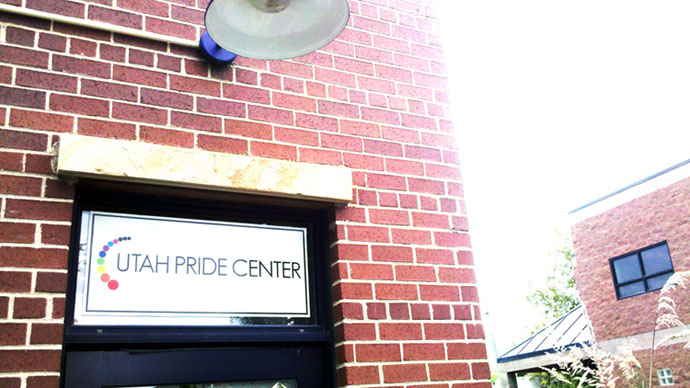
The Utah Pride Center, located at 361 N. 300 West, is an advocate for the LGBT community.

Story and photo by CHAD MOBLEY

Salt Lake City is seen through the eyes of the nation as a conservative and religiously centered metropolitan area whose dominant Mormon culture controls everything from lawmaking to media consumption. However, the population is ever changing and growing more diverse all the time. The lesbian, gay, bisexual and transgender community is one segment of the population with organizations in place to help balance the scales and promote equality among all citizens in Utah. Equality Utah and the Utah Pride Center went to bat for the LGBT community during a recent controversy and the leaders involved felt the outcome was positive.

In late August 2012, KSL refused to air the new NBC comedy, “The New Normal.” That decision caused a media firestorm and many in the LGBT community in Salt Lake City to take action. The issue was covered by news outlets across the country, including the Los Angeles Times, Huffington Post and CBS. When the story first broke, the Utah TV station was portrayed as regressive and bigoted.

Not only did this decision catch the attention of the national media, but enraged advocates for gay rights in America.

GLAAD President Hernon Graddick was quoted in a blog from the organization’s website: “Same-sex families are a beloved part of American television thanks to shows like ‘Modern Family,’ ‘Glee’ and ‘Grey’s Anatomy.’ While audiences, critics and advertisers have all supported LGBT stories, KSL is demonstrating how deeply out of touch it is with the rest of the country.”

Graddick continued, “We invite Jeff Simpson (CEO for Bonneville Media, KSL’s parent company) to sit down with GLAAD and local LGBT families. We know that if he would, he would see that not only are our families normal, but by citing ‘crude and rude’ content and refusing to affirm LGBT families, KSL and Mr. Simpson are sending a dangerous message to Utah. They should make that right.”

Five days after KSL’s decision not to air the program, the director of the Utah Pride Center, Valerie Larabee, along with Equality Utah director, Brandie Balken, her family and another same-sex family sat down for a roundtable discussion with KSL and Bonneville Media.

The organizations then released a joint statement on Aug. 29 regarding the decision to pull the show from the primetime lineup.

According to KSL, “It was helpful to talk together, to better understand issues, and to be able to discuss the reasons behind our decision to not air ‘The New Normal.’ This was not a decision we made lightly and it was not made because of any single issue including gay characters or LGBT families. … We care about and value all members of our community, including LGBT people and their families, and are grateful when there can be the type of cordial and respectful dialogue we have had today.”

Equality Utah and the Utah Pride Center added in the statement, “We had a great opportunity to talk about our families and our kids. We appreciated the opportunity to express our concerns, and to hear firsthand the reasons behind this decision. We accept their explanation that the decision to pull ‘The New Normal’ was not made lightly and it was not made because of any single issue including gay characters or LGBT families.”

After having seen the show, Balken and Larabee agreed with KSL’s decision.

“Having the LGBT presence in the show was important,” Balken said in a telephone interview. “However, more than or equally important to just being present is how we are portrayed. We want to be represented as who we really are.”

Larabee added, “Once we saw the first episode, we got it completely. I agreed with them. We think it is very poorly written.”

One member of the local LGBT community felt relief knowing that advocates are ready to fight for their rights.

“That really does show what they are doing and how effective they are,” said Shalise Mehew of Salt Lake City. “I totally agree, I wouldn’t want it on primetime either.”

After a heated controversy over what seemed to be an anti-gay decision, a simple dialogue  immediately alleviated concerns. A planned protest was cancelled, a joint statement was released and an understanding between two sides of the community was reached.

“It was the first step in helping to create trust between at least a segment of our community and the local media,” Larabee said.

The Utah Pride Center and Equality Utah continually monitor the media to correct any unfair reporting or disparaging portrayals of the LGBT community and its families. The two organizations maintain relationships with the media on a daily basis and they work with GLAAD when they have any major issues surrounding coverage or statements made by those in the media industry.

“Utah Pride Center and Equality Utah work tirelessly to promote tolerance and grow acceptance of LGBT people and families in Utah,” said Graddick of GLAAD on the website. “We are proud to be working with them.”

For the organizations, fighting for equality doesn’t stop with the media. One of their goals is to reach this same type of understanding between the LGBT community and the dominant religion.

“We are really invested in continuing conversations with LDS people,” Balken said. “We live in the same places, work in the same places and have kids in the same schools. Anytime people can and will sit down and really just be real with each other, it’s a great release and it’s positive.”