A closer look at Salt Lake City’s Discovery Gateway children’s museum

Story and slideshow by BROOKE MANGUM

See the world through the eyes of a child at Discovery Gateway

Imagine a place where children’s minds can run free. Imagine a place where children can be whatever they want to be. Imagine a place where play is celebrated. What if this place encouraged and facilitated education and learning as well.

Does that sound too good to be true? This is what Discovery Gateway offers the community.

“Discovery Gateway, and organizations like it, are so important and different from other museums because they inspire children to learn via play,” said Steven Suite, chairman of Discovery Gateway board of directors.

Formally known as the Children’s Museum of Utah, the west-side nonprofit Discovery Gateway is located at 444 W. 100 South. The museum relocated to this 60,000-square-foot building in 2006 and is filled with exhibits of hands-on educational fun.

The museum was founded in 1978 by a group of parents and educators who believed children learned best by “doing.” The museum aims to be one of the most trusted and preferred family discovery centers and child educational resources in the Intermountain West.

The exhibits in Discovery Gateway are designed to address the multiple ways that children learn. All of the exhibits are interactive and inspire learning through creative play. The museum is divided into six zones, each having various hands-on learning experiences. Each section appeals to different age groups and children’s interests.

“What is so cool about our exhibits is that they not only teach children but they get them thinking about possible future fields,” said Lindsie Smith, Discovery Gateway development and marketing director in an email interview. “Each exhibit that we have focuses on a different career field. We have science exhibits, medical exhibits, activities in the theatre and arts, journalism, the possibilities are endless.”

Discovery Gateway is divided into six main zones: the Garden, Kids Eye View, Story Factory, Media Zone, the Studio and the Terrace.

The Garden is a 30-foot beehive that serves as the main entryway to the museum. This exhibit is designed to teach cause and effect. Children and adults work together to keep the hive functioning by performing various mechanical tasks. For example, one child is in charge of feeding plastic balls into a machine while another uses a hand crank to power a fan that moves the balls along the path to the next station. In another part of the hive a child uses foot pedals to activate a vacuum tube that propels the balls back to the beginning. When all the stations and children are working together and doing their job the hive comes alive.

Kids Eye View is dedicated to the museum’s youngest visitors. This zone is divided into multiple mini exhibits designed for tiny hands and budding motor skills. The exhibits within the Kids Eye View capture toddlers’ imaginations by exposing them to life on the farm, construction zones, a life-sized playhouse and every little one’s favorite, the rushing water exhibit.

The Story Factory offers visitors an opportunity to explore the many ways to tell a story. This is the journalism zone that is designed to inspire young future writers to discover the fun in writing and storytelling. The exhibit has something for all levels of writers, from those who are just beginning to craft sentences to those who are more experienced   with using words and modern multimedia.

Media Zone is sponsored in part by KSL 5 news. In this zone children are able to try out any and all media jobs and try their hands at TV and music production. Children can see what it is like to anchor the news, do a weather report and work as a camera operator. This section also has music mixing tables and recording devices where children can learn to make, record and produce their own music.

“My favorite is the news station,” said Gabriel Rosse, 10, a regular museum visitor. “It is so cool! I feel like I am doing the news for real.”

The Studio is a place for little scientists, artists and engineers to let their imaginations run wild. This is a hands-on creative space where children can learn about such things as physics, earth sciences, biology, mathematics and forms of art and architecture. The children are able to build their own mini structures and test their earthquake durability on the vibration tables. They also can conduct their own experiments with vacuum tubes.

The Terrace is home to one of the museum’s most beloved and recognizable exhibits, the Life Flight Helicopter, donated by Intermountain Healthcare. In this area children are able to learn about medical professions as well as search and rescue occupations. The once fully functional helicopter is now a kid friendly version that allows children to experience the thrill of flight using sounds and vibrations. The chopper lights up and makes all of the sounds of real flight such as the hum of the engine, the wind blowing on the tarmac and voices on the radio reciever.

“I love the helicopter,” said Max Smith, 6. Max lives in Salt Lake City and attends Reid School. “It is loud and makes me feel like I am flying fast.”

The museum also hosts traveling exhibits that are featured at Discovery Gateway for a limited time. The most recent exhibit was called PLAY. An exhibit called “Tinker Toys” is expected to début in 2012.

“The exhibits are fantastic,” said Anne Godfrey, a Salt Lake City mother who often brings her children to the museum. “I really feel good about taking my kids here. Not only do the kids love it, but I feel good knowing they are improving their education.”

The people at Discovery Gateway consider their crowning achievement to be the Junior Achievement City (JA City), located on the fourth floor. They are so excited about this exhibit because in their eyes it is the ultimate example of hands-on learning. JA City is in partnership with Junior Achievement of Utah and offers a hands-on learning environment for fifth-graders to gain “real-life” business experience. It is also a place for eighth-graders to learn how to manage their personal finances.

In JA City children run their own mock fully functional city. Using the knowledge they have acquired in the classroom they are able to bring this information to life. The children hold their own elections for mayor and hold different occupations and positions in the community.

Some youth are bankers, others grocery store workers. If it exists in real life it is highly likely that it is represented at JA City. The children involved in the program assume different positions in the mock community and learn valuable lessons about different occupations and the work that goes in to make society function.

“This exercise gives a huge opportunity for youth,” said board chairman Steve Suite. ”The kids have to work together or things don’t run smoothly. It is a lot like our Garden in the lower level but on a whole new scale where they make their own laws and essentially their utopia.”

Suite says Discovery Gateway is a magical place where kids can be kids, but they also learn and have the opportunity to think about their futures.

KUED, Sorenson Unity Center, promoting education at home

Story and slideshow by DEREK SIDDOWAY

Take a look inside the Eccles Broadcast Center and view a Ready to Learn Workshop.

According to the 2010 Census, nearly 10 percent (9.5) of Utah’s population is under 5 years old. That is the highest in the nation. Yet Utah, along with North Dakota and Montana, are the only states that do not offer free public preschool.

Jacqueline Voland, community outreach and education services manager at KUED, thought that was a problem. So in 2001, when the Department of Education reopened another grant cycle for the PBS Ready to Learn initiative, she took action.

“Our early literacy campaigns were more focused on hard content and resources,” Voland said. “It is important that we have a one-on-one relation with the community and their services. The Ready to Learn initiative supplements education services and provides tools (for parents) at home.”

At its heart, Voland described the Ready to Learn initiative as seeking to increase parental participation and involvement in school and education. All of the programs are designed around Utah’s educational core curriculum and focus on infancy through third grade. The initiative combines educational programming and a “Learning Triangle,” consisting of “read, view and do principles.” The approach is based on the concept that children learn in different ways. Everything is designed to empower parents to take a more active role in their children’s schooling.

“We are trying to be a public vehicle to support education. The Learning Triangle is the basis for what happens in Ready to Learn,” Voland said. “We are providing (parents) with tools to engage their kids at home.”

The Ready to Learn initiative reaches out through a series of workshops in a variety of locations across the state to educate parents. Beginning with media literacy, the subjects branch into child development, health, safety, nutrition, self-esteem issues and anti-bullying, to name a few. Voland said the workshop themes are based on underlying issues that need to be continually addressed.

“The media literacy workshop is the start of anything we do,” Voland said. “Part of our mission is education of appropriate media: what, why and how you should be watching with children. Not all TV is for kids. Parents need to understand that while the TV is on (children) are consuming information in lots of different ways.”

Parents are the first teacher a child ever has, Voland says. As such they play an integral part in the equation for a child’s academic success. To aid parent involvement, the Ready to Learn initiative provides tools to make parental involvement easier. For every given topic, parents are given lists of children’s books and programming for their kids to enjoy.  To address the “do” part of the triangle, parents complete an activity with their children such as paper cup phones. This exercise teaches basic sound principles.

As part of the do, read, view theme every parent is sent home from the workshop with a book to build at-home libraries. They are also encouraged to acquire library cards.

All workshops provide bilingual presenters and material in Spanish and English if needed. As an added bonus partnering sites that provide a location for the workshop are required to supply refreshments or a meal to participants.

One agency that partners with the Ready to Learn initiative is the Sorenson Unity Center. Located at 900 W. 1383 South, the center collaborates with various nonprofit groups through its Programming Partnership. Voland said KUED had partnered with the Sorenson Unity Center in the past but it wasn’t until July 2011 that KUED was approached about joining the Programming Partnership.

“The early phases with the Sorenson Center relations have been good,” Voland said. “We are a nonprofit and in turn it behooves us to reach out and serve community with programming and services.”

As the Ready to Learn Program Coordinator at KUED, Elise Peterson is all about community outreach and the importance of parental involvement in education. The 28-year-old Peterson taught elementary school for three years before receiving her master’s degree in Child Advocacy at Montclair State University in New Jersey. She describes her position at KUED as the perfect fit for her degree and mission.

“These workshops have been so rewarding for me,” Peterson said. “It’s so important to make education accessible because for certain families school can seem daunting.”

Peterson said the KUED workshops serve 15 different sites in the Salt Lake area and average 20 parents at each workshop. Currently she presents monthly at venues like the Sorenson Unity Center. In addition to scheduling and presenting workshops, Peterson helps sponsor other activities through KUED such as parent or literacy nights.

Peterson presents a different themed workshop every month at the Sorenson Unity Center. She says most requests are for science and math, areas part of the STEM — science, technology, engineering and math — program being implemented by PBS and “Sesame Street” this season.

In keeping with the STEM theme, Peterson’s workshop at the Sorenson Unity Center emphasized these focus areas. Fun with Numbers and Science Exploration taught parents how to implement mathematics and scientific exploration into everyday life. Suggestions for parents included cooking with children, separating laundry into dark and light groups and other daily chores. Every activity in the presentation included exercises that parents could do without setting aside extra time.

One example Peterson recommended was the principle of shadows. Parents were challenged to view an online video clip from KUED and then read one of the children’s books such as “Light” by Molly Bang. Next, parents were encouraged to take their children outside to explore making shadows. Puppets were included in the workshop packet for children to continue their exploration.

“Parents are coming back (to the next workshop) sharing experiences of how education is happening at home and what they are doing with the activities,” Peterson said. “It’s great to see the program working and parents being involved with the materials at home.”

Nancy Holt was a first-time participant in the Ready to Learn Workshops. As a working mother, Holt was intrigued by the concept of implement teaching activities at home and exposing her child to a well-rounded education.

“I heard about the workshop through the Community Council,” Holt said before the workshop. “The concept of a parent workshop to help teach children to learn sounded interesting.”

The turnout to the Sorenson Unity Center’s November workshop amounted to four mothers, but Peterson feels a new parent attending was nonetheless encouraging.

Jacqueline Voland, the community outreach and service manager is satisfied knowing the Ready to Learn Initiative is serving the community and empowering parents.

“Every moment is a learning moment,” she said.

Unity Computer Center and Clubhouse — a decade of technological literacy

Story and slideshow by DEREK SIDDOWAY

Take an engaging visual tour of the many services available at the Computer Center and Clubhouse.

The Unity Computer Center and Carole Costa have come a long way helping people in the past 10 years.

“This place had a tiny computer lab in a trailer and they were looking for people to help with the youth program,” the 41-year-old computer center manager said. “One thing led to another and 10 years later I manage the whole place.”

Originally from France, Costa relocated in 2000 to Utah where she began volunteer work at the Unity Computer Center. Dissatisfied with educational systems she believed placed too much emphasis on testing rather than teaching, Costa left her educational background and began chasing her technological passions.

“I used to be a language arts teacher,” Costa said. “Robotics and computers were a hobby. You never know what your hobbies will lead to.” A year of volunteering later, she hired on part-time and eventually became a full-time employee at the Unity Computer Center.

Looking at the center now, it’s hard to believe it once resided in a trailer. Located at 900 W. 1383 South within the Sorenson Unity Center, today there are two computer labs: the Unity Computer Center for adults and the Unity Computer Clubhouse designed for children and teens. According to the Sorenson Center’s annual report, the Unity Computer Center served 955 adults and 304 youth throughout the 2010-2011 fiscal year and averaged more than 1,100 visits each month.

Keeping with the Unity Computer Center’s mission for computer literacy, a variety of services are available to patrons. In addition to open-access hours, users can attend computer literacy classes, specialized workshops and multimedia activities designed to expand their technological know-how. There are 14 computers available for adult use and 20 for the youth in the Computer Clubhouse.

Intel sponsors 100 Computer Clubhouses across the world. Costa describes the setup as a combination of public and corporation funding from Salt Lake City, the Eccles School of Business and Intel. Like other clubhouses, there is a vast array of multimedia technology for children to explore including graphic design, digital music production, video game design and Lego robotics.

Although the technology is certainly enjoyable for youth, the hope is that they will carry the skills they have learned into college and the job field. Costa, other Computer Clubhouse employees and volunteers place an emphasis on multimedia application in the real world.

“With children the agenda is always to graduate high school and get a better job. Most kids will be the first generation in their family to go to college,” Costa said.

One example is the music room. Inside, children can record, produce and mix to create their own songs in the same fashion the music industry does. As well as gaining valuable technical skills, the youth also learn important social skills such as teamwork. After the children have recorded enough songs to fill a CD they work in Photoshop to create an album cover. They also have the option of creating music videos for their music.

On the adult side, the Unity Computer Center emphasizes a more fundamental approach to computer literacy.  Many patrons have little or no computer background, so starting with foundational skills such as Internet use, email, word processing and other essentials is necessary. Another area of focus is job readiness — updating résumés and online job searching. Classes are held mostly in the morning or evening and are available in English and Spanish.

“The people here are easy to work with and friendly,” Steven Jensen said.

Jensen is a computer center patron and volunteer. He has been coming to the Unity Computer Center on an almost daily basis since 2004. Jensen uses the center to polish and expand his computer skills. By means of Excel, he has created a variety of formula-controlled databases to display in a portfolio for potential employers.

“Right now I’m going through Excel and amortization skills. I use Microsoft Office Suite a lot,” Jensen said. “I create databases of names, addresses and attendance and then I create queries to see how many people have attended within a certain range.”

Jensen also stressed the importance of the Unity Computer Center for locals. He wants to get the word out that the center is a valuable community asset and deserves recognition for its services.

“People can come here who have not gone to college but want a computer background,” he said. “It’s a great place for people who want to use computers.”

Heather Fuller, 50, a staff member since December 2010, has seen firsthand how the Unity Computer Center changes lives. Fuller came to the center after discovering the job on the University of Utah job board.

“I thought it was such an interesting idea of how to help people,” Fuller said. “I loved the concept of what they do here, helping underprivileged children and adults, teaching workshops.”

One of the workshops that Fuller had a hand in was a Mexican cooking blog. Each week for two years, women without any computer background met for classes.

Classes changed every six months. Fuller said students began with “breaking down computers and putting them back together, learning how to type, email and use Facebook, From there they went to film editing and blogging.”

The highlight was the blog, designed by the women, complete with how-to cooking videos they filmed and edited themselves. Carole Costa, who manages the adult side of the computer center in addition to the clubhouse, said it was quite the achievement for women who had started out with little-to-no computer knowledge.

Fuller was likewise proud of the group. “(Patrons) learn everything from simple tasks on the computer to finding a job, to being able to communicate with family and friends — something that would have never been possible because they don’t have a computer at home,” Fuller said. “(The center) provides an amazing experience for every walk of life, every age group.”

Spy Hop Productions: a different kind of school

By COLLIN McLACHLAN

Spy Hop Productions teaches self expression through multimedia

If a school had students only do one or two projects a semester, would that school be considered an effective learning facility? If you were to ask students at Spy Hop Youth Media Arts and Entertainment Center, the answer might be a resounding “yes.”

Spy Hop is a nonprofit organization that, according to its website, is committed to helping students ages 13 -19 “express their voice and with it create a positive change in their lives.” It does this by using digital technologies as a means of artistic expression. Spy Hop has programs that teach students self-expression through film, audio, music, web design and video game design.

Rick Wray and Erik Dodd founded Spy Hop in 1999. At the time, Wray and Dodd owned Higher Ground Learning, a for-profit academic tutoring facility. Matt Mateus, programs director at Spy Hop, said in an interview that what Wray and Dodd discovered while tutoring became the basis for forming Spy Hop.

“They found that when they introduced film and video into their tutoring it was way more engaging for the student,” Mateus said.

Since Spy Hop also focuses on the development of the student, rather than simply teaching them technical skills, it uses self-expression as a means to teach students principles such as community awareness, emotional competency and high productivity.

“Our success really comes when youth leave here as engaged productive citizens, they succeed in the work force or higher education and have an opportunity to share their voice with the rest of the world,” Mateus said.

In an effort to achieve this, Mateus told of five fundamental goals that Spy Hop focuses on for all of its programs. These goals focus around: providing a safe after-school program, fostering artistic expression, developing educational and workplace readiness skills, developing emotional competencies and increasing media literacy, personal awareness and global connections.

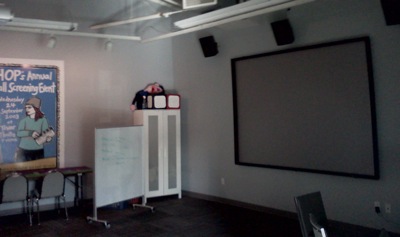
The theater room at Spy Hop

To better reach its vision, Spy Hop has a unique way of working with the students.

“We’re allowed to be different from a public school system. We’re allowed to sit down and really take the time to see what each student really wants to learn,” Matues said. “We really dig into, ‘what are the activities they are doing and how does that relate to our mission?’ ‘How does that relate to our program goals?’”

Because of this teaching technique, teachers at Spy Hop are called mentors. They spend one-on-one time with each of their students to establish a trusting and respectful relationship, along with helping with their projects.

This became apparent when Mateus, who’s a mentor in the music program, was giving a tour of the studio. He noticed a game-design student eating popcorn near the computers.

“Be careful with that popcorn. I don’t want butter all over the keyboard,” Mateus said while walking by. The student responded with a respectful, “Sure thing. Sorry Matt.”

“I still keep in contact with a dozen of my old students that I go to lunch with,” Mateus said. “The feedback I get is really positive.”

Shannalee Otanez, 24, an instructor for Loud & Clear said, “I love it all. I love seeing young people feel empowered to believe in themselves, and to feel like they have something important to share.” She feels she’s in a great position as a mentor at Spy Hop since she’s a former student. “I benefited from it myself, so I get what kind of impact it can have,” she said in a phone interview.

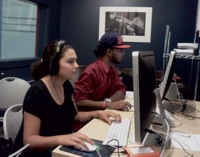
Shalom Khokhar, right, works on his audio project.

Shalom Khokhar, 19, from South Salt Lake, has come to understand that impact as well. Khokhar is a student in the audio apprenticeship class. He said the two main things that Spy Hop has taught him are priorities and responsibility.

“Once you come in, you sit down and it’s all about your work ethic, which you can apply in your other life too, in social settings, school, education, whatever,” Khokhar said.

When asked what his favorite part of Spy Hop was, Khokhar said, “I’d say the respect that Spy Hop has toward its students. They have a certain trust that they give to students to say, ‘OK come in here, use our equipment and stay in here as long as you want.’”

Spy Hop isn’t just helping students to become better people; it also helps to prepare them for the work force. The students work on projects during after-school hours using modern digital equipment. Khokhar and his apprenticeship class, for example, are currently working on the sound for a film produced by Spy Hop called “River’s End,” which is a story about a boy who, after his dad leaves his mom, goes and plays by a river and meets an imaginary friend. Him and his friend then run away and have some adventures. Khokhar says that a project like this takes skill in sound editing which he is happy to be developing.

Mateus is proud that Spy Hop is helping to create the next work force in the industry. Along with personal and life skills, Spy Hop is providing its students with a leg up by giving them hands-on training.

“To be able to walk into a studio and say, ‘I can work for you guys. I know Pro Tools. I know where to set these microphones up,’ at 17 years old. That’s crazy,” Mateus said. “Because what are they going to be doing when they’re 25?”

Spy Hop and UNP: Shining some light on the west side of Salt Lake City

Story and photo by COLLIN McLACHLAN

What if you turned on the radio and heard this: “A young man was stabbed today in a probable gang fight in Bountiful.” Would you be surprised? Now imagine if the radio said it was in Rose Park.

“Stereotypes don’t reflect crime statistics,” said Sarah Munro, associate director of University Neighborhood Partners.

Founded Nov. 1, 2002, UNP is a program that “brings together University and west side resources for reciprocal learning, action, and benefit.” According to its website, UNP collaborates with communities and nonprofit organizations in an effort to “provide access to higher education.” Its drive comes from the idea that education is the key to strengthening both families and communities.

“UNP is not a service organization,” Munro said. “What we do is meet with local nonprofit organizations on the west side and establish partnerships that will benefit the community.”

UNP has many challenges to its work. “The difficult thing is that people want to know what changes are happening,” Munro said.

She said it’s difficult for UNP to measure its success because success doesn’t come from UNP’s work alone. Since its main focus is to create partnerships, UNP finds success when its partners do.

This doesn’t mean that success cannot be tracked. One organization that UNP has partnered with in the past is Spy Hop Productions.

Spy Hop Productions works to help students on the west side.

Spy Hop Productions is a youth media arts and educational enrichment center. Spy Hop’s purpose, according to its website, is to “empower youth to express their voice and with it create a positive change in their lives.”

According to the site, Spy Hop works with some 1,800 students every year in the fields of documentary arts, video production, audio engineering, music and interactive media. Founded in 1999, Spy Hop has been “acknowledged by the Sundance Institute as setting the standard for media arts learning across the nation.”

Students learn things at Spy Hop that go beyond the classroom. “These kids are being taught to express themselves in a positive way,” said Virginia Pearce, director of Marketing and Community Programs in a phone interview. “It gives the kids a chance to be proud of something, which goes a long way.” A lot of students at Spy Hop live on the west side and come from backgrounds which Spy Hop refers to as “underprivileged.”

Spy Hop works directly with its students over long-term mentor-based instruction. The students get hands-on tutoring as they work on media stories, documentaries or music recordings. “There are so many success stories, I couldn’t think of just one,” Pearce said.

Matt Mateus, a programs director at Spy Hop, shared one student’s story that can be counted as a success for both Spy Hop and UNP. He says a student who grew up in Rose Park in an underprivileged family came to Spy Hop wanting to be a recording engineer. But he needed special classes that Spy Hop couldn’t provide. Spy Hop did, however, have contacts with universities that offered those classes. After the student had worked to raise the money, Spy Hop helped to send him to a school in Arizona that had a recording engineer program. “That student now works in Salt Lake where he owns his own recording studio,” Mateus said in a phone interview.

Spy Hop and UNP do still share a common belief that drives each organization. “Preparing students for higher education is directly related to Spy Hop’s programming goals,” Mateus said. The organization collaborates with Salt Lake Community College (SLCC) quite a bit.

“A lot of our students are underserved,” Mateus said. “They usually don’t have the opportunity to jump into the U of U, so they go to SLCC.”

These types of success stories are different from the articles normally published in the newspaper.

The Salt Lake Film Society shines the silver screen across community barriers

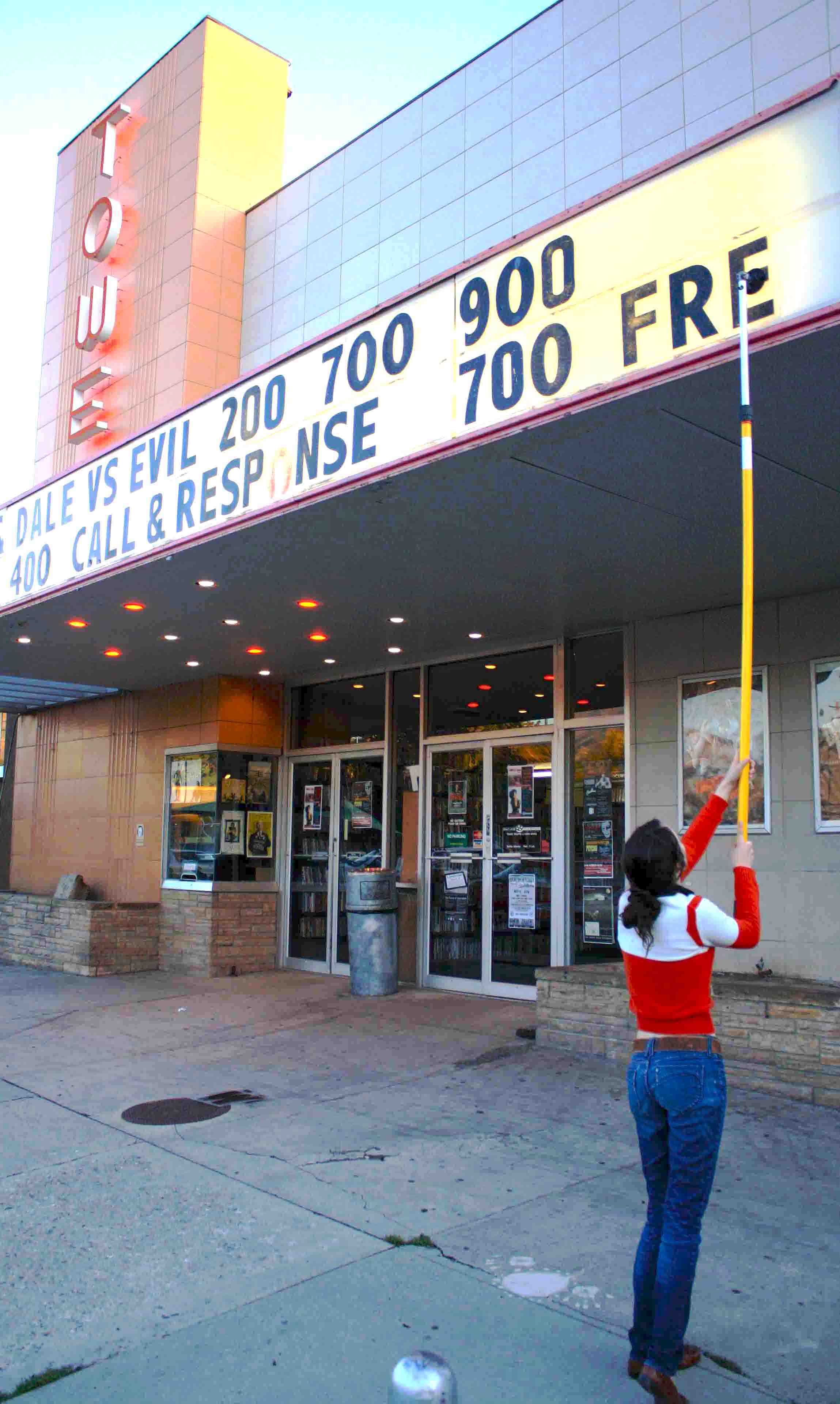
Dagny Horton of the Salt Lake Film Society changes the Tower Theatre marquee for a showing of the film "Call + Response" for the YWCA

Story and photo by ZACK RENNER

As he sits in front of the Coffee Garden at 9th and 9th in Salt Lake, 24-year-old film student at the University of Utah, Jordan Connelly looks paler than anyone should in early September.  It could be his natural complexion or just as well his passion.

Connelly, as well as a film student, has been a member of the Salt Lake Film Society (SLFS) for three years. He spends more than his fair share of time in a cool dark theater expressing his love the best way he knows.

“The quality of life in a community is reflected in how that community nurtures artistic expression within it,” Connelly said when asked what role art holds in a community.  As a community nonprofit organization and art house for the showcase of independent film, the SLFS reflects the culture and diversity present in Salt Lake’s communities.

What began with Kris Liacopoulos’s fight for preservation of the local Tower Theatre in 2001, has 10 years later has grown into what the SLFS mission statement calls, “the premiere film establishment of our community.”

Since its inception, SLFS has endeavored to keep independent film a part of the lives of Salt Lake City community members like Connelly. It currently owns and operates the Tower Theatre in the 9th and 9th neighborhood as well as the multiplex Broadway Centre Cinemas on 111 East and Broadway in Salt Lake City.

“We bring the art form of cinema in its most culturally diverse form on a daily basis. Without the Salt Lake Film Society and our community here in Utah in particular, we wouldn’t have access to these films and the thoughts and ideas behind these films,” said 39-year-old SLFS Executive Director Tori Baker in a phone interview, “It’s so important to bring that to any individual community in whatever form you can.”

The society coordinates educational programs about and through film. Its website boasts that over 950 local filmmakers have been able showcase their work on the Broadway and Tower theater screens during designated open screen nights and festivals.

Through programs like the ongoing Utah Screenwriters Project, the Society provides workshops to those who make it through the application process. The 30 that are accepted receive mentoring from Hollywood professionals in producing their own screen productions.

For those who simply want to enjoy film, SLFS theaters are also the only place to see independent and foreign films that otherwise would have no chance to shine on mainstream theater screens in Salt Lake.

One important tradition of community involvement for the SLFS is its youth outreach program: Big Pictures Little People. Each year for the last seven years, the SLFS has paid for and facilitated 900 to 1,000 low-income children, ages 5 to 12, to see family friendly cinema yearly. During the summer months, volunteers for the program organize buses, free concessions, commemorative toys and a comfortable seat in a cool theater with their friends and families.

Collaborating with nonprofits such as the YWCA, the Road Home and the Utah Health and Human Rights Project, the SLFS presents children an opportunity to see appropriate movies and shorts as its website describes. Of those movies was Hayao Miyazaki’s “Spirited Away,” a critically acclaimed Japanese animation film about a girl wandering into a mystic realm of gods and monsters.

“It was an enhancement of our program,” said Jacob Brace, Neighborhood Partners executive director. “It helped make opportunities that are culturally relevant and child friendly available to all children regardless of socio-economic background.”

However, it is not always as easy to drum up a bus full of enthusiastic patrons. When it comes to bringing in members of specific communities to the silver screen, it can be difficult to appeal to the right audience for each film.

“We are humble in terms of our capacity, and in terms of our number of staff for work on the marketing as well as fund raising components,” Baker said. The challenge in selecting films from current and past productions is making decisions on what is topical and what patrons want to see.

A part of being an advocate and art house for independent and foreign film is the ability to give diverse and often marginalized voices a platform for articulation.  These “crossover films,” as Baker calls them, help communicate to an audience that otherwise would not go out for a film.

For instance, the Tower Theatre hosts an LGBT movie night on the first Monday of the month. Through the event, members of the LGBT community have an occasion to gather and enjoy films and discuss narratives relevant to their community. While programs such as this one can pertain to a specific group of people, there are programs of interest that appeal to a wide audience, regardless of gender, age or ethnicity.

However, the complexity in promoting niche films raises as notice to the society of a film’s arrival is commonly as short as two weeks. In the past, advertisements in Spanish language newspapers proved a valuable avenue for promoting Latino cinema, but some communities are harder to target.  A flier or handbill is sometimes not enough to spread word and, as a result, a film often fails to reach the full breadth of its demographic.

While SLFS is a community nonprofit relying on grants from the government, it is also an art house meaning it sells venue to film as art. And unlike other nonprofits, it is able to generate revenue through tickets as well as membership and donations.

Looking to appeal to a variety of demographics, the Society has created assorted types of membership. It has tiers in different price ranges to suit varying levels of interest in film. The basic “Super 8” level membership costs $4.99 monthly or $50 annually and includes $1 off admission, two Tower Video rentals as well as Society news updates via newsletters and email. On the other hand, the higher echelon “Chronik” level membership costs $29.99 monthly or $300 annual and includes free admission to regular-run movies, limitless free rentals, and admission to two members only Sundance Festival screenings.

The Salt Lake Film Society is always looking for ways to expand its membership and donations. As the technology of film grows beyond its ability to keep up, pressure comes down on modernizing the aging theaters.

“We are going to see more challenges in keeping the facility presentable. People know that it’s different than a Larry Miller theater… Our challenge ahead of us now is to keep up with any of those things that are moving faster than we can raise money for [them],” said Baker.

U’s communication department rebounds from tough times

Watch a multimedia slideshow about the department.

Story and multimedia by SCOTT WISEMAN

The University of Utah’s department of communication is unique in the fact that it is constantly adapting its curriculum to new developments in technology. Along with the conflicts of adjusting to increasing technology, the future of the department was in jeopardy when the recession struck just two years ago.

The department of communication is responsible for teaching approximately 1,500 undergraduate students the ins-and-outs of several different fields including media, public relations, journalism, speech communication, argumentation and conflict studies and organizational communications.

In the present day, the communication department is seeing signs of a healthier economy. The department will not see any budget cutbacks for the upcoming year, as the Utah legislature stepped up state funding.

“Two years ago, we lost many faculty members and their positions,” said Craig Denton, a professor in his 34th year in the university’s communications department. “That’s the way we made our budget cuts.”

Although the department never laid off a single employee, employees who retired or quit their jobs were never replaced. The department spends almost all of its funding on faculty, and the staff was asked to teach extra classes and take more students into their sections without a raise.

“Two years ago, personally I agreed to teach an extra class to help out,” Denton said. “I would’ve preferred not doing it, but I’m a member of a team. Everyone stepped up in a different way, including teaching more classes and taking more students into their classes.”

The recession not only affected faculty, but students as well. The department placed a restriction on the amount of paper each student was allowed to print in the computer labs. The students were asked to bring their own paper to print assignments, said Louise Degn, associate department chair of the communication department.

“This is the first year in two years, projecting into next year, that we will not have any budget cutbacks,” Degn said. “The legislative session just ended and the tax revenues were up enough that they were able to provide funding.”

This is great news for the department, which will look for replacements in the positions lost during the recession. The department can also use extra money to increase the budget for technology and classroom development.

“Our future is looking good, because while we gave up all of those positions to the budget cuts, we’re starting to get them back real quickly,” Denton said. “The university has always seen us as a very important department, so it has always been very supportive in moving new resources to the department.”

One of the distinguishing characteristics of the university’s communication department is the smaller class sizes. Since the department offers a lot of smaller classes, the demand for faculty rises. If the economy is in a stable state, the availability of faculty to teach small classes rises, therefore making it easier to accommodate more students.

The reason that the class sizes are usually 20 is because they’re writing intensive, Degn said. The classes are kept small for the benefit of the students so they can receive individual attention from professors. The computer labs are also physically limited to only 20 slots.

Students in the communication department regularly enjoy smaller class sizes for a variety of reasons.

Chris Leeson, a junior in mass communication, said he enjoys small communication classes because of the individual attention he received from his professors. He said this method of teaching was conducive to learning.

While the communication department focuses on making small classes available to students in media and writing classes, the larger lecture hall style classes are also prominent. Whether one is more effective than the other is up to debate.

“About 5 years ago, I would have said the small classroom setting is by far the better teaching method,” Denton said. “Now, I’m not so sure because of the problems that I am experiencing in the computer labs due to students’ access to the internet. I feel as if I have more attention in a large lecture hall without electronic distractions.”

Along with small and large classrooms, the department offers two to three online classes per year. The department is currently striving to improve in its online department, Degn said.

“Online classes are effective for some people in some classes,” Degn said. “Classes where you have to interact, think critically and give opinions are strained.”

Offering online classes does not save the department money. Instructors are paid the same amount to proctor an online class as they would receive to teach a live classroom.

Another distinguishing characteristic of the communication department is the wide array of technologically advanced equipment available to students. Students involved with photography, video production, convergence journalism and several other classes are given the privilege to borrow equipment for the semester.

“Funding for technology is crucial— we couldn’t do without it,” Denton said. “Although in the past few years there haven’t been any equipment budget cuts, there hasn’t been any new money flowing into it.”

Equipment funding tends to come from a variety of three main sources. These include soft money, money generated by the communication department, or special requests sent to the U tech committee or the research vice president. The main source of funding in recent years has been the generous donations from benefactors.

“We’re really hurting right now for equipment money, and if it wasn’t for the good will of our donors, we would be in very serious straits,” Denton said.

The gracious gifts from donors have provided the communication department with several technology improvements such as two new Mac computer labs, an entire set of portable digital video cameras and a few cameras, all available for students to use.

“The new Mac lab is absolutely gorgeous,” Leeson said. “I had three classes in there, and I loved being able to use them.”

Technology is a crucial tool for all mass communication majors to develop skills applicable in a job, Leeson said. Without the ability to practice concepts learned in class, students would not be able to gain as much experience.

The one underlying issue is that donors do not usually provide financial support to help provide repairs and service to the equipment when needed, Denton said.

“Without the technology, you wouldn’t be able to gain experience by working hands on with the equipment,” Leeson said. “A lot of jobs and internships are looking for prior experience learned in a university setting.”

The department of communication has seen its tough times in recent years due to the recession. The faculty members survived potential layoffs, minimal funding, overtime work and shortages on items as miniscule as paper. Due to the increase in funding from the Utah legislature, things are looking up for the department.

“The guiding circumstance seems to be the economy, although tuition increases every year, the legislature drops the percentage of the cost of education because they have competing interests,” Degn said. “Students still see the value of a college education and continue to come to learn.”

Miss Utah USA’s first minority beauty queen aims for the best in life

Story and slideshow by CHLOE NGUYEN

Whom do you picture when someone says, “Miss Utah USA”? Do you picture a beautiful, tall, blond-haired beauty? Does the image of the all-American-girl-next-door come to mind? Given Utah’s history of beauty queens, you would have been correct. But there is one queen who does not fit the typical description – Soben Huon.

Crowned as Miss Utah USA on Nov. 12, 2005, Huon is by all means American. She is a native of Texas, but she doesn’t have the blond hair or the fair white skin. She has brown eyes, dark hair and sun-kissed skin. Huon is a Cambodian American beauty with the confidence, right talent and attitude for the winning title.

Since 1952, when the pageant coronated its first queen, 57 women have been crowned Miss Utah USA. But Huon was the first, and still remains, the only Asian minority to represent the title at the national Miss USA competition. She is also the first Cambodian American to win a state title in Miss USA history.

“I was raised to embrace a really rich Asian heritage,” Huon said in an e-mail interview. “At home, I learned the Asian way of life and at school, I learned the American way. I feel as much American as I do Asian.”

And to prove she’s got the confidence, Huon entered the competition for Miss Utah USA. She figured it would be a great opportunity to network if she were to win.

But Huon admits she didn’t expect to be awarded the title. She told her mom, who was in California at the time, not to come to the pageant because she didn’t have confidence in winning. But when her name was announced for the crown, Huon had to find a phone fast, to relay the exciting news. “Since then, I learned never to underestimate myself again,” she said.

Huon was unaware she was poised to be the first minority titleholder for Utah until a friend mentioned the fact to her. “By then, I was already mentally prepared to go forward,” she said. “I took a chance and went for it and figured that I can always walk away from a wonderful experience.”

She believes that if ethnicity had been a factor in selecting the winner, then the pageant would have suffered for its lack of diversity. “A person cannot change where he comes from,” Huon said. “But he can certainly change his ideology and opinions.”

Huon was crowned at the age of 22, when she was a senior at Brigham Young University in Provo – she subsequently graduated with a bachelor of arts in political science and international relations. The beauty queen, now 27, was described as a “very kind and determined person” by the Miss Utah USA organization.

Jessica Whitehead, executive assistant of the Miss Utah USA organization, had great things to say about Huon. “Out of the contestants that year, Soben was the most unique and exuded confidence on stage,” she said.

The Utah USA beauty pageant is a competition that selects Utah’s representative for the Miss USA pageant. With a successful history at the national level, Utah has had 20 placements in the top 15 at the Miss USA competition as of 2009. According to the Miss Utah USA organization, ethnicity does not matter as long as the participant is a citizen of the United States, has never been married and has no children.

“We have had several minorities and immigrant participants in the pageants,” Whitehead said. “I do not think that one’s race, religion or background will determine if they will win the pageant.”

Each contestant is judged in the categories of swimsuit, evening gown and interview based on a scale of 1 to 10, with 10 being the highest. From there, the top 15 are chosen to compete again in the swimsuit and evening gown segments on the final night. The top five are then selected based on their performance during the onstage question and answer. “We want[ed] someone that will work hard as Miss Utah USA,” Whitehead said. “[And] will represent herself and her state well at the Miss USA pageant.”

Huon has proven that minorities living in America can make a name for themselves in a country where the white majority rules, at least when it comes to beauty pageants. “I think it gives hope to several other people and encourages them to go for their dreams,” Whitehead said.

And although Huon did not place in the Miss USA nationals on April 21, 2006, in Baltimore, Md., this hasn’t stopped her dream and goal of being and doing her best.

Huon moved to Europe in 2009 for an apprenticeship and will be completing her master’s degree in international relations there in 2011. She is currently residing in Berlin, Germany, playing the role of the American expatriate, enjoying learning about the European cultures and sharing her own with the people there.

“There’s something sizzling in Berlin since the Wall fell 21 years ago,” Huon said. And she wants to be a part of the indescribable historical social change that is occurring in the capital of Germany.

Huon plans to travel across the European Union while she’s there studying – she’s even got a “Places to Go before I Get Married” list. She has already crossed off countries like France, Italy, Spain, Austria and Switzerland from the list.

She’s traveling the world, but she hasn’t forgotten her roots. Huon says she’s still very much Asian, as well as American, even with all of the cultures she’s experienced so far. “I feel like I really stick out like a sore thumb at times, particularly when I am the only Asian in a group of Anglo students or when I am the only American in a group of Germans,” Huon said.

But she says in the end, these experiences just make her even more grateful to live in a time where the progression of diversity is occurring nationally, as well as internationally.

Huon says her minority status hasn’t stopped her from achieving what she wants in life. It’s something she cannot change, and wouldn’t want to. Instead, she focuses on things she can change, like doing her best in her studies and enjoying life as it goes by. The sash and crown were a representation of what she worked hard for, Huon said. And she felt the greater Asian community was excited there was going to be an Asian American representative at the Miss USA competition.

Huon believes her win sent a message to the rest of America that Utah is becoming more diverse. She wants to let minorities know they shouldn’t be afraid to be different and never let the fear hinder them from doing what they want to achieve.

“Be grateful that you are living in an age and society where the majority rules,” she said. “But the ever increasing endorsement of diversity paves a way for minority to have a voice.”

This slideshow requires JavaScript.

Pacific Citizen surviving times of declining traditional media

Story and photo by Andreas Rivera

The Pacific Citizen exists both online and in a monthly print edition.

In September 1929, a small, Asian-run newspaper was first published in San Francisco and has been in print ever since.

Today, The Pacific Citizen is now available both in print and online, and in these times of declining print media, it is still finding ways to connect with its audience.

The PC was started by the Japanese American Citizens League; members have a subscription to the print version of the newspaper that is published and mailed all over the country.

Jeff Itami, a member of the Pacific Citizen’s editorial board,  said the economic problem has affected the paper like any other business. The PC has had to cut operating costs and do some fundraising. According to the PC’s Web site, only six staff members publish the paper, not including contributors.

Even though the paper is part of the JACL, the PC covers a broad variety of issues such as Asian news, profiles of famous Asian Americans and pieces about historical events. It also has no cultural affiliation, meaning its content is not exclusive to Japanese, but to all Asian Americans, said Paul Fisk, co-president of the JACL chapter in Salt Lake City. “It brings a lot of news coverage others don’t.”

Itami said the print version of the Pacific Citizen is declining in circulation. Fisk said membership is steadily declining to the JACL, which could mean declining subscriptions to the PC.

“A lot of our key members are older,” Fisk said. “They are passing away and not a lot of new members are joining.”

About 30,000 people subscribe to the print version, Fisk said, some of whom were Japanese-Americans who were held at internment camps during World War II.

Other reasons for decline in membership are the many splits the JACL experiences due to its stances on certain issues in the media.

Fisk said the JACL lost members during World War II due to its lack of vocalization and action while Japanese-Americans were being interned in camps.

Another, more recent event, occurred when 1st Lt. Ehren Watada, was discharged from the U.S. Marine Corps because of his vocal opposition and refusal to take part in the war in Iraq. The JACL supported Watada, while many members thought it was not relevant to them, creating another split in membership, Fisk said.

The number of print subscriptions the PC has does not reflect its reach, Itami said. The paper is focusing on expanding its online popularity.

Despite the decline of the print version of the paper, Itami said the PC is reaching out to a younger audience. Recently the PC reformatted to a magazine format to appeal to younger readers.

“We are connecting to a younger audience through blogging, MySpace, Facebook, and YouTube, bringing that traffic to the PC,” Itami said. “Traffic is only going up,”

According to the PC’s Web site, it receives about 450,000 hits per month.

Itami said he is not worried about the PC’s financial future. The PC’s advertising revenue (which accounts for 50 percent of the paper’s income) is increasing.

“The PC is not a luxury,” Itami said, “it’s basic information we all need.”

Media influenced Native American voters

by JESSICA DUNN

The Black Eagle family of the Crow Tribe adopted president-elect Barack Obama, whose new name is “One Who Helps People Throughout the Land,” during his visit to the Crow Nation in Montana on May 19, 2008.

Obama was the first presidential candidate to visit the reservations of the Crow Nation. He was adopted in a private ceremony, and then he gave a speech ensuring Native Americans that their well-being is a priority to him.

He promised to honor the government-to-government relationships and treaties, to appoint an American Indian policy advisor and to host an annual summit with tribal leaders. Obama also vowed to improve trust funds, education and health care for reservations all over the country.

“I want you to know that I will never forget you,” Obama said in his speech to the Crow Nation. “You will be on my mind every day that I am in the White House.”

Obama’s visit and speech had an impact on the early support from Native Americans.

“I think people were impressed with his commitment he showed by just going to the reservation,” said Harlan McKosato, the host for Native America Calling, in a phone interview.

Native Americans overwhelmingly supported Obama by more than 80 percent, according to a poll conducted by Native Vote Washington, a voter advocacy group based in the state of Washington. And like most demographics this election, voter turnout for Native Americans also saw an increase.

“Before a lot of people didn’t vote because they said it didn’t matter who was in the administration because things didn’t change for Native peoples. They were treated the same and ignored the same,” said Donna Maldonado, general manager of KRCL. “The tribes saw promise in Obama. … I think he is our hope for the future.”

Native American support can be attributed to many factors, including Obama’s promise of change and better voter education overall.

Change

Obama has promised change to the Native American community. And while most are skeptical about promises made by a politician, a lot of people think he can change things, McKosato said.

Native Americans see Obama as someone they can identify with because of his diverse heritage, said Ella Dayzie, executive director of the Indian Walk-In Center in Salt Lake City, in an e-mail interview.

A follow-through on those promises will first be seen through Obama’s appointments within his cabinet and other positions. He has promised to create an American Indian advisor position to better meet the needs of the Native communities. Obama has also proposed an annual summit with Native American tribal leaders.

“With a Native American cabinet chair, the hope is that the U.S. government can now be well informed about the special set of challenges American Indians face, from issues of sovereignty to access to affordable health/behavioral health care,” Dayzie said. “One cannot ignore what is in front of him/her daily.”

Obama has already named six Native Americans to various transition teams. Mary Smith, Mary McNeil and Yvette Roubideaux have been assigned to work on justice, agriculture and health issues respectively, and John Echohawk, Keith Harper and Robert Anderson will advise Obama on changes within the Interior Department, according to Change.gov.

Obama has also promised money towards improvements for Native American health care and education. His economic and infrastructure development plan includes an increase in the federal minimum wage and adequate funding for the Indian Housing Block grant, according to the First Americans Fact Sheet at Obama’s Web site.

Obama’s promises to Native Americans created greater interest in the election within the Native communities. Voter education on the issues and candidates also influenced voter turnout.

Voter Education

Voters had a vast amount of information at hand about the election, from the newspaper and television to the Internet and YouTube. Most of the sources contained general information on candidates and issues. However, some programs focused on Native American issues and voting.

KRCL-FM is a public radio station in Salt Lake City, Utah, founded in 1979 as a community radio station where all issues could be discussed. KRCL has always been committed to having diverse voices on the air, said Maldonado general manager of KRCL.

Various ethnic groups, including Native Americans, have had airtime since the beginning. Today, the Native American slot is on Sunday mornings. Native America Calling, a live call-in program based in Albuquerque, N.M., that discusses issues specific to the Native American community, is rebroadcast on KRCL at 6 a.m. And, at 7 a.m., Living the Circle of Life plays traditional powwow music and contemporary American Indian music from local and national artists.

Native America Calling is an hour-long program that airs every weekday at 1 p.m. Eastern time on select stations. The program’s topics range from financial issues to a book of the month. During the presidential campaign, the program evaluated the topics and candidates from a Native American point of view.

“Native [America] Calling on KRCL helped in bringing news/reports about the issues that matter to Native American voters,” Ella Dayzie said.

Some of the election topics included discussions about political parties, Native veterans, women’s vote, young voters and planning for Election Day. The program also talked about the reaction to Obama’s win and discussed the promises Obama made to Native Americans.

Native America Calling has had full phone lines each time the election was discussed, said McKosato, the show host.

“People were more interested in this campaign than ever before,” he said.

Native America Calling helped get the issues out to Native Americans. The show used politics related to the community to spark an interest in the election and get people motivated to vote. 

AIROS Native Radio Network also used the radio and Internet to give Native American voters a voice. AIROS is an all-Indian Internet radio that is broadcast 24 hours a day through web streaming. It had audio, video, news articles and podcasts covering the election from a Native perspective. AIROS reporters used their stories to link Native communities to the election. They covered the 2008 Native Vote Initiative campaigns, presidential candidate rallies and Native American support.

The National Congress of American Indians expanded its Native Vote Initiative this year in an aggressive campaign to get more Native Americans to vote. The 2008 initiative had four core plans: provide training to educate, engage and mobilize voters; ensure fairness of voting laws and protect Native voters; educate candidates on issues important to Indian Country; and get the Native Vote message to media and the general public. Volunteers from tribal communities visited with people, even going door to door, to educate individuals about issues and help them register to vote.

“The NCAI’s Native Vote team has done a great job on getting the ‘vote’ out and educating the American Indians about both parties so that [they] can make an informed decision,” Dayzie said.

The End Result

Obama’s goals and promises to better Indian Country have brought a new hope to Native Americans. And due to a focus on the Native American voters and issues, Obama now has the opportunity to keep his promises to them and people all over the United States.