Body Buddies, a Salt Lake City fitness company, changes lives

Story and photos by DAVID FISHER

Working at a desk in an investment firm office was the last thing Kristy Jo Hunt wanted to do for the rest of her life. She decided to take one of the biggest risks she has ever been faced with. Hunt, 28, created her own independently-run nutrition and fitness business known as Body Buddies, without any prior experience in the field of business.

In addition, Hunt was not always a fitness guru.

Three years ago, Hunt was overweight and a victim of binge eating. She also suffers from severe scoliosis. Orthopedic doctors had told her that by age 40 she could be in a wheel chair if she did not change her eating habits and stay active because of her deformed back.

Kristy Jo Hunt poses in the gym after working with a client.

Kristy Jo Hunt poses in the gym after working with a client.

However, she conquered her struggles, gained a newfound interest in the field of health and wellness and worked toward her goals of becoming a professional dancer and fitness instructor.

This new interest eventually motivated Hunt to become a certified personal trainer and fitness nutrition specialist through the National Academy of Sports Medicine. She made drastic changes to her lifestyle, and wanted to help others make lifestyle changes as well. Thus, Body Buddies was launched in January 2014.

Hunt put together a business plan through watching multiple business startup podcasts, attending start-up business conferences and seeking advice from friends and family. She had to make some personal sacrifices along the way, including quitting her full-time job and learning to live off of $20,000 a year.

Those sacrifices underscored her commitment to seeing the success of her clients and independent business.

“Body Buddies is first a people thing, then secondly a business,” Hunt says.

Education is an important aspect of her business model.

Hunt provides weekly coaching calls and meal plans for clients in Utah. The coaching includes a fat loss and muscle gaining workout regime that clients follow on a six-days-a-week basis for 12 weeks. Each workout plan is individualized based on a survey clients fill out at the beginning of this lifestyle change. Questions include food preferences, any kind of physical ailments and a daily schedule.

Clients who pay a base fee of $50 also have access to 250 power food recipes that are full of protein, replace unwanted fats and increase energy levels. Every recipe is taken from her own published cookbook, The Power Foods Lifestyle.

An example of a power foods recipe is Hunt’s chicken ranch slaw burritos. These are a healthy alternative to any kind of processed burrito that is often found in the grocery store. Many of her recipes are healthy replacements to microwaveable freezer meals.

Chicken ranch slaw burritos are one of the many available recipes Hunt provides in her cookbook

Chicken ranch slaw burritos are one of the many available recipes Hunt provides in her cookbook.

“You are the master of yourself,” Hunt explains. “I provide the base, and you create the results.”

Body Buddies originally started with only 50 clients. It now has more than 1,000 clients. Hunt manages multiple client binders, calendars and daily scheduled emails and lists. She even has clients from around the globe in places such as Africa and Europe.

Hunt provides daily coaching calls to her clients. This is where they truly open up about themselves and achieve the results they want to see. She speaks to the individual over the phone and finds out what is and isn’t keeping them motivated. If clients have any questions about their diet, workouts, or life in general. Hunt is available to provide answers.

Some of the best results Hunt has ever seen came from her client, Amy Bellamy, in Salt Lake City. Bellamy has been a client of Hunt’s for almost a year, and has stuck with the Power foods lifestyle the entire time. Hunt explains that Bellamy was constantly motivated to achieve her goals of having a bikini body.

Amy's amazing body transformation from following Hunt's coaching

Amy Bellamy was able to transform her body by following Hunt’s coaching. Photo courtesy of BodBuds Instagram.

Hunt filmed and produced 100 instructional workout videos for her Body Buddies YouTube channel. It was through this channel that many of her clients discovered her business. These videos create an easy and accessible way for clients to understand how to successfully utilize all of their muscles while working out in the gym. For example, clients learn how to successfully perform a seated row weight lift to activate muscles both in their back and in their arms.

Through Facebook, Instagram and Pinterest, Hunt has created a successful way to market to a wide audience of clients.  Hunt has more than 7,000 followers on social media.

Instagram is her main method of gaining followers. She posts workout videos, before-and-after result photos of her clients and motivational quotes every day. It is a quick way to instantly communicate to her followers. However, these posts are only previews of what can come from the full Body Buddies experience.

"The Power Foods Lifestyle" is available for purchase on Hunt's website.

“The Power Foods Lifestyle” is available for purchase on Hunt’s website. Image courtesy of Hunt.

By using hashtags such as #FitFan, #CleanEats and #WeightLossJourney, Hunt has gained public attention of her Instagram posts. These are hashtags that people wanting to start their own fitness journey investigate. Clients see her social media posts and then reach out to her to receive her coaching to start their own fitness journeys. She wants to be the person to help change clients’ lifestyles and make them love their bodies.

Instagram user Tyler Griffin, 23, a student at the University of Utah who uses the handle TGriff08, is a client and one of Hunt’s many followers. “Although I finished my 12-week program with Kristy back in September of 2014 as part of a reshaping of my body during the summer, I still follow her to seek constant new ways to work out, discover new recipes and see the success of many other of her clients who went through the same process that I did,” he says.
Griffin had lost more than 15 pounds during the 12-week process and gained a tremendous amount of muscle to his body. When grocery shopping, he is more aware of the foods that are beneficial to his lifestyle so he can maintain that muscle build that he worked for. 
“There were times when I felt like I wasn’t going to stick to this intense 12- week program,” Griffin says. “But Kristy provided a constant motivational push to keep working for my final goal — and I reached that goal, and I felt like a completely new person when I started my final fall semester.”
Griffin has referred multiple family members and friends to Body Buddies so they could achieve the same lifestyle changes that he accomplished with Hunt’s help.
One such friend was Brooke Legeman, 19, of Salt Lake City who started working with Hunt two weeks ago in hopes of removing the freshman 15 that she gained this past year.
“Being a part of the Body Buddies program is something that I want to commit myself towards to start a completely new health lifestyle,” Legeman said in a phone interview. “Kristy is helping me balance school, work and my fitness goals so that I can achieve the success that I want to achieve. I feel like I am in control of my body and making it back into the shape that I once had … or maybe in even better shape.”
Legeman finds herself going to the gym almost every day now, and avoiding all of the fast food that she was guilty of eating during her freshman year.

Hunt has started her own motivational seminars that she calls “Girls Night Out.” These empowering presentations are held at Salt Lake City gyms. Hunt wants to change the way clients think about themselves, and have their bodies reflect the changes that they can see.

“I’m not a feminist, I’m an empowerist,” Hunt says. “Integrity is the name of the game for people in life. Know where your integrity is at, and never let it crumble.”

Salt Lake City couple takes PALS program into their own hands

Story and slideshow by STACEY WORSTER

Spend time looking at adoptable pets and meet PALS volunteers Carol and Eric Hochstadt.

The Placing Animals with Loving Seniors (PALS) program managed by The Humane Society of Utah benefits both the owner and animal.

Meghan Zach, a volunteer at the Humane Society, said, “It is very beneficial to both the animal and the owner when the owner is in need of a companion and something to worry about, and the animal gets a new loving owner.”

The Humane Society of Utah, located at 4242 South and 300 West, offers low-price deals to people age 65 and older who are looking for a new addition to their life. The adoption fee is waived when they adopt a dog or cat that is at least 8 years old.

“It gives the seniors something to focus on, a reason to get out of the house,” Zach said.

“A lot of the younger dogs are far too energetic for an older adult to take in,” she said in the foyer of the Humane Society. “That is why we strongly push the older dogs for the seniors to adopt.”

Zach said that when an older adult walks in the door, the adoption counselor on duty always asks about their future plans as a pet owner and arrangements that are in place if an emergency were to occur.

“Unfortunately,” she said, “animals are mostly viewed as property so a lot of people are asked if they have a plan if something unexpected were to happen.”

Zach said helping people pick out their new addition is one of her favorite things to do while volunteering.

“It is different helping seniors pick out their new pet because they have decades of experience,” she said. “It is so fun so hear their stories, they love telling them as well.”

Zach is unsure how many older adults adopt pets at the Humane Society of Utah.

“We don’t keep numbers of who buys what dog,” she said. “I usually do at least two or three senior adoptions a week, and I am just one of six adoption counselors so I am sure the other counselors help seniors as well.”

The Humane Society uses word-of-mouth and advertising to spread the word about the PALS program.

“We have two volunteers that go to the senior living centers, we have the PALS program listed on our website and in newspapers,” Zach said. “Every year the advertising to seniors increases, we are just trying to help them find a friend and companion.”

Eric and Carol Hochstadt have taken the PALS program into their own hands.

“We have been volunteering for The Humane Society of Utah since September of 2009,” Eric said. “After retiring we felt that we could do something more to help the dogs in the shelter, this is when we came across the PALS program.”

The couple has spearheaded the program since October 2013. “Making seniors aware of this opportunity is our hope and desire,” Carol said.

Eric said, “We think our work is effective, and the program is progressing if there is awareness.”

So far, the couple only have anecdotal evidence of the program’s success. They hope counselors will begin noting whether an adoption is through the PALS program so they can gather quantitative data.

“Seniors are smart enough to know that there are plenty of costs that go along with owning an animal,” Carol said.

“Just because they get an animal for small cost or free of charge does not mean it won’t be an expensive purchase,” she said.

The Hochstadts said they are passionate about making older adults mindful of all the options that are available to them.

“Even if they don’t go and adopt an animal, it is interaction for them. As long as we’re helping them, we want to be there,” Eric said.

Carol added, “If seniors decide that owning a pet is not the best idea, they can still come to the Humane Society and walk the dogs. It can give them a sense of responsibility and self-worth.”

Walking a dog can help people strike up conversations with strangers. This is another benefit for an older adult who owns an animal.

“It is very important to have interactions if you want to stay sharp throughout aging,” Carol said. “Having a pet opens up that line of communication. Think of the walks you have gone on and recognized someone’s animal and a conversation started because of the pet.”

The biggest addition to the PALS program is the monthly and sometimes weekly visits the Hochstadts make to different Salt Lake City senior centers.

“We have checked out many different senior centers around the Salt Lake City area. Most of them told us we could not bring animals in,” Carol said. “This defeated our purpose of coming in because having animals there is the whole goal and best advertisement we could have.”

However, Tenth East Senior Center allowed Eric and Carol to bring in animals during their visits.

“The person we talked to at the Tenth East Senior Center was obviously a dog lover and wanted to encourage seniors to adopt a pet,” Carol said.

Because this center allowed the Hochstadts to bring in animals from the Humane Society, they decided to recontact the directors of the other senior centers in the area.

“We told them that Tenth East was allowing us to bring in dogs, and it is a county facility,” Carol said. “They didn’t know what to say so they agreed to let us bring in dogs, but they had to be small dogs, and we have to bring potty pads.”

The couple’s persistence paid off.

“It was great, an employee from a senior center that was adamant about us leaving animals outside the door changed her mind,” Carol said. The employee told her, “If you’d like to come once a month, you should.”

The employees who work at the senior centers give the Hochstadts a call and let them know when there are going to be a lot of people in the building.

“We usually arrive around a quarter to eleven. People seem to be there before lunchtime,” Carol said. “Then we end up talking for awhile and leave around 12:30 p.m.”

The Millcreek Recreation Center put up a table for the Hochstadts to set up their display and talk about the PALS program.

“We sat right next to a fireplace. It was very inviting for people to come and visit,” she said. “It was great because they would tell us their stories about their pets. Even if they aren’t particularly interested in adopting a pet, they are able to tell their stories.”

Many aspects of the PALS program are altered to impress aging adults, but giving people the option to take home a pet can be comforting — as long as it’s a good match.

Carol said a family adopted a puppy for their aging mother, and one week later returned it.

“They came back to the Humane Society and adopted a 10-year-old dog and she loved it. Perfect temperament,” Carol said.

The Hochstadts have found that pet owners find it comforting to care for an older animal.

“Just as they shouldn’t be put out to pasture and considered not valuable because of their age, the older animals that are turned in to the shelter shouldn’t be ignored and considered unadoptable,” Carol said.

The couple said this volunteer job is incredibly rewarding.

“People we have helped adopt a pet still thank us every time they see us,” Eric said. “They say they cannot imagine life without their companion.”

Emeritus Salt Lake focuses on building relationships with residents

Story and photo by IAN SMITH

Emeritus Salt Lake offers care to its residents.

Emeritus Salt Lake offers care to its residents.

Picture yourself as an elder, and you know your time on this earth is decreasing. You know you can no longer take care of yourself. You need assistance. To everyone else, it may be time for a nursing home.

You pack up your stuff. Where did the time go, you keep asking yourself? How did life flash that fast and how has it come to this? You set off in the car that takes you to the home. As you pull up your first impression is that it could work for you. But you still have many questions and not that many answers.

“No one wants to go into a nursing home,” said Anne Palmer Peterson, executive director of the Utah Commission on Aging. The Utah Legislature created the commission in 2005 to address issues related to the fast-growing aging population in the state. Peterson said it is a young state, but it also is the “sixth-fastest aging state in the nation.” Among other things, the commission has studied housing options for older adults. The findings were published in New Trends in Housing for Utah’s Aging Population.

“We want people to be thinking proactively about their futures,” she said.

Even so, it can be difficult to leave all of your memories behind you.

The idea of a “nursing home” isn’t too appealing to many people, though.

Brian Culliton, the executive director at Emeritus Salt Lake at 76 South and 500 East, said people have very different opinions of nursing homes.

Every facility is different, whether it’s a nursing home or assisted living center. Some facilities, like Emeritus, offer help for certain issues residents might be dealing with. Dementia, for example, is taken very seriously at the assisted living facility.

“We provide a family orientation with a caretaker,” Culliton said in a phone interview. “We have a well rounded understanding of what that resident’s day looks like. We want to keep it routine. We have other care providers that will come and talk to give a better understanding of the disease.”

Culliton said the staff and volunteers who work at Emeritus Salt Lake are passionate about the work they do and want nothing more than to help the people they are caring for.

Emeritus Salt Lake is located at 76 South 500 East.

Emeritus Salt Lake is located at 76 South 500 East.

“I’m really passionate about attracting the right [residents],” he said. “It’s that feeling of leaving home if anyone has dementia, you’re leaving your familiar space. You’ve been there for 50-plus years and now you’re going to a new space. It goes back to that care.”

Culliton knows that some older adults are afraid to be alone. But, sometimes that fear prevents people from seeking help.

He said Emeritus Salt Lake aims to offer more than just the borderline help. Staff go above and beyond to help the new residents by developing a personal relationship with them as soon as they walk in the door. Residents are given an orientation and shown around the building.

“With assisted living, every department head goes and introduces themselves and gives them the care that they expect,” Culliton said. “We look at it as kind of like a marriage. Know each other right up front. If we look at the process at the point when somebody applies, we go to their house or hospital and get to know the family immediately and when they move in, we talk about what is best and how to care for the seniors.”

Markel Martinez, a resident assistant at Emeritus Salt Lake, knows how important it is to build relationships. He has had residents find friends at the facility and even fall in love.

“I would want the resident to know that I’m there to help them,” Martinez said. “To be their friend that they can trust and talk to.”

The life and success of Kirsten Morrise

Story and slideshow by NATALIE CHRISTENSEN

Meet Kirsten Morrise, her friends and family through photos.
Pierre Robin Syndrome is not a very well-known condition that is found in between one in 8,000 to one in 30,000 children born.

Pierre Robin Syndrome is a condition that comes in three stages, namely a cleft pallet, micrognathia (meaning a smaller jaw) and glossoptosis, an obstruction by the tongue from breathing.

Kirsten Morrise, a resident of Salt Lake City in the Sugar House area, has been dealing with Pierre Robin syndrome from the day she was born.

With her cheery personality and positive attitude, you wouldn’t believe the struggles this 20-year-old has gone through. She has been in and out of hospitals her whole life and  has undergone 40 surgeries. She has struggled with depression, been bullied through school and has overcome some learning struggles.

At a very young age she had a tracheotomy placed on her throat. Not only was this a burden for young Kirsten, but also for her mother Lisa who was taking care of two other children with medical needs.

“Kirsten was very sick and we were basically running an ICU and Timothy (her brother) was bouncing off the walls, and Michael (her brother) needed breathing treatments,” her mother Lisa said. “She was in the hospital 16 times her first year.”

Lisa said it was by the grace of God that she made it through that first year. Even with her two older boys needing help, having a child with a tracheotomy meant she needed to be at Kirsten’s bedside at all times.

When Kirsten had her tracheotomy removed at the age of 1, Lisa was able to return to work while neighbors watched Kirsten. Soon after however, problems started rising again.

“There were days when she couldn’t walk,” Lisa said. “And it was very strange … and things got a lot worse.”

Because of the lack of oxygen to her brain, Kirsten was having seizures which were getting worse and worse. Even with treatment, her seizures weren’t getting any better.

“‘Kirsten is sick get over it,’ was basically the attitude of a lot of professionals had that I talked to,” Lisa said. “But she kept getting sicker and sicker, and it got to the point where she couldn’t sit down on a couch without falling off because she was so out of it.”

As many times as Lisa tried to take Kirsten back to the hospital, they weren’t getting any help.

“And it’s like you’re running into a brick wall,” Lisa said. “It’s the scariest thing in the world to have your child be sick and have people not pay attention to you.”

Finally Kirsten was able to get the treatment but needed more surgeries.

She missed a lot of school because of the surgeries, and her social life wasn’t going very well either. A lot of Kirsten’s friends didn’t know how to treat her because of her surgeries. They saw her as being delicate rather than a normal kid.

“A lot of people don’t know what to say to me, because I’ve been through so much,” Kirsten said. “But I say they’re human. Do I really want them to be fully aware of what I’m experiencing?”

When Kirsten turned 6, she started skiing in Park City with The National Ability Center, a program that helps young kids recognize their strengths and helps build their self-esteem. The National Ability Center allowed Kirsten to participate in downhill skiing, and she had her own instructors to help her.

“My mom got me into skiing to help my upper trunk strength,” Kirsten said. “But as I got older and got better at it, it became not a pursuit (of) something to prove — I’m not delicate — but another activity I could add to my collection of talents I had.”

Kirsten went on in 2009 to win the gold medal in downhill skiing in the Special Olympics in advanced skiing.

Kirsten enjoyed skiing much more than physical therapy, it was more enjoyable and fun, and she could be outdoors. A lot of children with disabilities prefer to have their physical therapy this way, and Kirsten always looks back on the skiing experience with a lot of pride.

In 2005 Kirsten had screws put in her jaw called jaw distractors. The screws were visible on the outside of Kirsten’s face. When the screws were turned it forced her jaw forward so the jaw bone behind it could grow.

When asked if it hurt, she explained, “Yeah, you try getting the bone in your face being gradually moved forward.”

But, she added, “knowing what the end result is supposed to be makes it easier to endure.”

When she was 12, she attended LDS Brighton Girls camp. She enjoyed that summer so much she went back a second time and then finally went back as a helper in the kitchen in 2009 and then worked as the Craft Shack in 2010.

Kirsten loved it so much because the people there didn’t treat her like she was a disabled person. “They treated me like I was a human being,” she said. “There I had a blank slate, no one knew about my past … they let me do everything that everybody else did.”

Even having to wear an oxygen tank on her back as she went hiking her first year, she had fun with the girls telling them she was a cyborg.

If you ask anyone who worked with Kirsten at Brighton Camp a huge grin will come across their face.

Michelle Theurer was one of Kirsten’s good friends who worked at Brighton Camp with her. “It was great she always has something to say,” Theurer said. “So there’s never a quiet moment with her and she’s a really hard worker. Even with her limitations she’ll do whatever she can do.”

Theurer said Kirsten was always positive and was involved. She made things so much more fun because she saw them in a completely different way. “We would have time where we’d just hang out and it would be so fun to tease because she just dishes it right back at you, and she’s really ticklish.”

When Kirsten entered high school at Highland High, she was bullied by students taking her scooter and teasing her, calling her retarded and stupid.

“I have cerebral palsy and I have mood disorders, and I have hypotonia which means low muscle tone,” Kirsten said. “Those things have kind of caused with the bullying because of my posture and people look at me funny and also not being very athletic influenced the bullying.”

While attending high school, Kirsten was also going to college because of how much her surgeries held her back.

Kirsten attended Utah State University, because neither Brigham Young University nor the University of Utah sounded appealing.

“I made a plan to get to college,” Kirsten said. “And even though I got to college late, I had a plan I would get all of my high school work done by a certain time, and I would be able to function well enough to go to college.”

She picked social work as a major because she wanted to help others. “I feel like I have a capacity of empathy and I feel like I can give so much,” Kristen said.

Theurer also attended Utah State with Kirsten.

“Even though she may have challenges,” Theurer said. “She is always quick to realize that others have challenges too. She doesn’t seek for pity, but she does seek to serve others.”

Kirsten is looking toward the surgery that will fix it all. The procedure is called an End to End Anastomosis. Doctors will take out the part of the trachea that is scarred and then sew the ends of her trachea together. She went in early 2013 to Cincinnati to have the surgery done, but her throat wasn’t ready for it. So, on Dec. 10, 2013, she had surgery to advance her upper and lower jaws and tongue.

“Even though I have all these issues, I have a plan for how I’m going to do things and make sure I can do them,” Kirsten said. “I can take care of myself, I can do school, I can go on hikes, just not on big ones, and I’m a gold medalist in downhill skiing. Anything I put my mind to most of the time, I can do.”

For some Utahns with disabilities, religion plays an important role in their lives

Story and photos by NATALIE CHRISTENSEN

Religion plays a huge part in many people’s lives, not only those living in Utah, but also throughout the United States.

IMG_0453

The LDS Chapel at 2700 South and Filmore Street. Kirsten Morrise attends this ward weekly.

According to a 2007 Pew Research Center study, about 78.4 percent of the U.S. is of a Christian faith, while 4.7 percent are of other faith, and only 16.1 percent of the population is unaffiliated with any religion.

Some people with disabilities who have faith look toward their deity in a way that people without disabilities don’t. In Utah especially, religion plays a big part in the lives of many people. About 62 percent of Utahns are members of the Church of Jesus Christ of Latter-day Saints. Three local LDS individuals who have disabilities have a range of different thoughts toward their relationship with their creator.

Jeremy Chatelain is a seminary teacher for the church. Just after he got married, he was on a trip with this family in Idaho because his brother was going to leave on an LDS mission. A tradition in his family when he was growing up was jumping off a bridge near where they liked to vacation. His wife dove in and realized it was really shallow, but she wasn’t able to warn Chatelain. He dove off and broke his fifth and sixth vertebrae, an injury that left him paralyzed from the neck down.

“Religion is a huge aspect of people’s lives who have disabilities,” Chatelain said. “It (religion) gives you a reason to get up in the morning. I think that’s why I keep going every day.”

Chatelain still doesn’t know why this had to happen to him. He admits he doesn’t always have a smile on his face because of what he has to go through every day. But he still looks toward his religion that believes after this life, his body will be made perfect, and that God has a plan for him.

“My faith has been motivation to accomplish the things I’ve wanted to do, along with my family,” Chatelain said.

He earned his master’s degree in education from Idaho State University in 2005, specializing in curriculum and instruction. He is now working on his dissertation about First Amendment implications in LDS Church history from 1829 to 1844 at the University of Utah.

According to a study done by the National Organization on Disabilities, as reported by Disabilities and Faith.org, 85 percent of people with and without disabilities say that religion is important in their lives. Unfortunately, only 47 percent of people with disabilities can attend their church services once a month because of the struggles of getting to their meetings.

Some don’t choose to worship because they feel alienated by their congregation and don’t like the culture of their religion, not their deity, but the way their religion portrays how a person must always act.

Kirsten Morrise, 20, who attends Utah State University, is an active member of the LDS church and loves her religion. But the culture of the religion is something that has rubbed her wrong.

“There’s a stigma to not being within the status quo, the status quo being happy sunshine,” said Morrise, who suffers from Pierre Robin syndrome. The condition makes breathing hard for her because of the way her jaw is structured. She also suffers from forms of cerebral palsy and depression. “Being disabled, people in the church sometimes like to say ‘God made you this way so you could have this trial’ or ‘God is punishing somebody else and making you this way to punish them for something they did.’”

Morrise said she wishes people wouldn’t see her disability as a punishment or a challenge.

But for other people with disabilities, religion can help not only them, but also those in the congregation.

IMG_0454

Metal cross on top of the steeple at the Wasatch Presbyterian Church, 1626 S. 1700 East, in Salt Lake City.

“I’ve learned the hard way that being imperfect and allowing people to help provides blessings in their lives,” said Jeni Sewell Roper, who lives in Orem. “(It) blows me away sometimes at just how much this happens.”

Sewell Roper, who has cerebral palsy, doesn’t like being seen as a person with a disability. Growing up, she didn’t like people helping her. To her, everyone has a disability — hers just happens to be something that everyone can see.

“Well, I teach and I know that we are all divinely designed to be imperfect,” she said in an email interview. “And I believe personally that I said ‘ok’ to this before I was born.”

Sewell Roper admits that during her teenage years she would have committed suicide if it weren’t for her religion. “If this was all that life had to offer what’s the point?” she said.

She taught herself how to walk and doesn’t have to use a wheel chair or crutches. She now participates in and helps out with 5Ks around the Salt Lake Valley and is a part of the National Speakers Association. She speaks to LDS youth groups around the state about her life. The title of her speech is “Wiggle Room.”

“And I’m learning as I speak that my disability helps me relate to people on a very intimate level,” Sewell Roper said. “Because ALL of us have ‘stuff.'”

The Veteran Support Center provides help for Black veterans in Utah

Story and slideshow by LORIEN HARKER

Visit the Veteran Support Center on the University of Utah campus.

There are 147,944 veterans in Utah, according to the Utah census of 2011. Also according to the census, 1.3 percent of the population is African-American.

Needless to say, African-American veterans are a definite minority in Utah.

The history of African-American veterans in the military is rich, and at some times controversial. One of the first African-American regiments to see battle in World War I and World War II was the 369th Infantry Regiment, nicknamed the Black Rattlers or the Harlem Hellfighters. This regiment was segregated from other white regiments, yet the fighters were heavily decorated.

By the end of World War II, the regiment had suffered 1,500 casualties, and 171 members had received the Legion of Honor.

Similar African-American regiments that have served the United States Military, such as the Red Tails, Buffalo Soldiers, and Tuskegee Airmen, are some of the most celebrated regiments in military history. Yet these regiments were all segregated.

Regiments of African-Americans and white troops were not integrated until the Korean War. Though these regiments could now be integrated, it could be supposed that racism and ignorance toward African-Americans still existed.

However, for Roger Perkins, the director of the Veteran Support Center at the University of Utah, a troop is a troop no matter what color they are.

Roger Perkins served in the Army for 21 years, from 1970 to 1991. During his years of service, Perkins says that the only time ignorance toward the African-American troops was displayed was in the barracks, never around a superior officer.

“You find ignorant people everywhere you go,” Perkins says.

Though the military may have a history of segregated regiments, the military now is more diverse. White troops make up 67 percent of the military, black troops make up 17 percent of the military, and Hispanics comprise 11 percent of the military.

These numbers somewhat correspond with the numbers of veterans at the University of Utah. Perkins says the statistics are as follows: 26 Asian, 22 African-American, 80 Hispanic, seven Hawaiian/Pacific Islander, 678 white, and 24 non-specified veterans.

The majority of the African-American troops at the U are in the Army and Marine Corps, Perkins says.

He also says there is no special treatment in the military. People are seen as a troop, and nothing more or less.

In regards to race in the military, Perkins says, “We don’t care.”

Though this is most likely true, the VA Salt Lake City Health Care System offers a support group for minority veterans. But why do they feel that they need this kind of support group?

Jinna Lee, Ph.D., a VA psychologist with the post-traumatic stress disorder clinic, says that the support group was formed for minority veterans to feel more comfortable. The familiarity they feel with a person of color is important.

The Veteran of Color Support Group focuses on helping veterans with post-traumatic stress disorder. Statistics show that one in four veterans will return from deployment with PTSD. Men are more likely to form PTSD from combat, which is why veterans are often diagnosed with the disorder.

Although only four to seven people typically participate in the group, Lee says talking to veterans of the same ethnic background is comforting to the veterans.

“Issues with race and ethnicity do have an impact of how they function,” Lee says in a phone interview.

Lee says these veterans could potentially feel awkward talking to other veterans who are not of their ethnicity, and it’s easier for people of the same culture to understand them.

Stanley Ellington, the executive director for the Utah Black Chamber of Commerce, served in the Air Force for 28 years. During his time of service, Ellington says he was treated fairly.

Ellington also says that the Air Force made it hard to treat people like they weren’t your friends. During deployments especially, because they all relied on each other, there was a “sense of camaraderie” throughout the entire station.

Ellington says it is not so much an issue of color, but an issue of culture in the military. He likens not understanding someone’s culture to a language barrier. If you can’t speak someone’s language, it makes it hard to form a relationship with them — which he says is key.

Ellington says different cultures have different “paths” they use to get to where they want to be in life, and understanding these different paths means “understanding different terms.” From here, the question of understanding veterans of different ethnic backgrounds becomes a question of being fluent in a specific culture, not race.

Lee says there is such an overlap between race and culture, the veterans look for someone of their own culture to talk about things to make themselves feel better.

Kenneth Hartsfield, 26 , a junior at the U majoring in mechanical engineering, is a member of the Air Force. Hartsfield says he joined the Air Force because he “had no reliable plans after high school and did not want to stay at home and get a job.”

“I wanted to see at least a different part of the country and possibly the world,” Hartsfield says.

Hartsfield says his experience with the military has been relatively color-blind. However, life in basic training was rough for some of his comrades.

“It was a melting pot of life experiences where we all had to depend on the next person to cover our shortfalls,” Hartsfield says. “Some had come from inner city while others came that had only seen a handful of minority people.”

Hartfield’s father was a Green Beret, which is why he grew up in a military town in North Carolina. Not only is his father in the military, but his brother, grandfather, uncle and other various family members also serve.

“My father served 27 years in the Army. My brother is in his first year with the Air Force. My paternal grandfather served in World War II and my maternal uncle served in the Army for four years. I have a lot of extended family that is also serving,” Hartsfield says.

He went to basic training after he enlisted, which he said some had a difficult time adjusting to. Tasks such as laundry and asking questions to superiors came as a shock to some newly-enlisted troops.

“It was a huge culture shock for some but growing up in a military town I and the other well cultured kids had no problem adjusting,” Hartsfield says.

Ellington, Lee, Hartsfield and Perkins all say that racial differences could be a source of conflict between troops. However, all agreed that a more likely cause would be cultural differences.

You don’t have to die alone from AIDS in Utah

Story and slideshow by SASCHA BLUME

Visit the Utah AIDS Foundation.

It was the day after Christmas, and it was 25 degrees outside with an abundance of snow on the ground. The building inside was bare, disorganized and in the middle of re-creating itself, the building was busy using the holiday weekend to install new paint and carpet.

The only room that was intact was the decorated memorial room.

The Utah AIDS Foundation was started in 1985 to battle the then AIDS epidemic and worldwide AIDS pandemic.

Today, the Utah AIDS Foundation, located at 1408 S. 1100 East in Salt Lake City, aims to prevent and eradicate AIDS.

In the 1980s and early 1990s there was a stigma around AIDS (Acquired Immunodeficiency Syndrome).

People thought they could get infected with HIV (Human Immunodeficiency Virus) by playing basketball with an HIV/AIDS-infected person.

People thought that if they shopped in a grocery store with an HIV-infected person they would get AIDS.

In response to the HIV/AIDS epidemic, the U.S. government provided funding for HIV/AIDS prevention and management for large cities/states.

The horrors of living with HIV/AIDS

The victims of AIDS vomit most of the day, they have continuous diarrhea, and develop purple blotch marks on their skin.

They lose their hair, their ability to eat and the function of their blood.

The intellectual and emotional damage a human who suffers from HIV/AIDS leads to self-isolation and a disproportionally high rate of suicide.

A plan was hatched

“No one talks about AIDS,” said Mario Duran, the MSM (Men who have Sex with Men) and HIV prevention coordinator for the Utah AIDS Foundation.

According to Duran, they want to end that stigma.

In response to the HIV/AIDS epidemic, The Utah AIDS Foundation created a five-point program that is designed to educate the general public and HIV-positive men about HIV/AIDS.

The Five-Point Program

(1)  Testing

At the Utah AIDS Foundation, the general public is welcome and encouraged to come in for a free HIV/AIDS test Monday through Thursday. People are also encouraged to get tested for all sexually transmitted diseases while they are at the foundation.

Brianne Glenn, the HIV/STI testing coordinator for the Utah AIDS Foundation, says everyone who tests gets an “anonymous number and they are referred to, as their number” while they receive HIV/STI testing.

“About 100 to 200 people come in a month for testing and one to two people a month test positive for HIV/AIDS,” Glenn said.

When a person has a preliminary positive test, they are immediately given a more comprehensive HIV/AIDS test. This procedure is called a confirmatory test.

The Utah AIDS Foundation’s free testing isn’t just for gay men. Straight males/females, swinger groups, and any other type of sexually at-risk person is encouraged to participate in the free testing program.

(2)  Gays and Geeks

According to Duran, the Gays and Geeks club was started because “there is so much stigma around gay masculinity and hyper sexuality.” The Gays and Geeks program is designed for HIV-positive men to come together in a safe environment for friendship and support.

The program is also designed to break down gay social stereotypes. For example, there is a common stereotype that gay men are only interested in working out, wearing high end fashion and having promiscuous sex with as many partners as possible.

The group meets once a month, usually at a movie, park or somewhere “geek orientated.” The Gays and Geeks meetings typically host five to 20 people per outing.

(3) 3-D Doctors

Duran said the Doctors, Dudes and Dinner program was an idea that was “borrowed directly from a Baha’i tradition.”

The Utah AIDS Foundation and two volunteers from the University of Utah spend a significant amount of time locating a doctor and venue that is willing to host the event. During this program a doctor will give an hour-long lecture on their specialty. The lecture is then followed by a free dinner.

The Utah AIDS Foundation set up this program as a response to the social stereotypes that gay men face. Many of these stereotypes include the idea that gay men are unhealthy and make irresponsible sexual decisions that heighten their risk for HIV/AIDS infection.

Because there is so much focus on gay men’s sexual health, the Utah AIDS Foundation felt there was a need for gay men to receive free health advice concerning other health issues that they might deal with.

According to the Utah AIDS Foundation’s website, “each 3-D event has a different intriguing health topic, (travel health, relationships, self-compassion, nutrition, skin care, etc.).”

The website also states, “3-D is a stepping stone to start the conversation on normalizing health in conversations about the gay community because of the unique way 3D is structured.”

(4) Outreach

Often on the weekend you will see Duran and a group of highly trained volunteers canvass the downtown Salt Lake bars and nightclubs handing out sex kits.

These sex kits include two condoms, one packet of silicone lubricant, and several promotional cards highlighting the work and contact information for the Utah AIDS Foundation. Workers distribute 75,000 kits annually.

We want to “talk about sex openly, we want to get a contact list and we try to get people in to test,” Duran, said.

That is the reason why they canvass.

The Utah AIDS Foundation is not interested in ending gay sexual relations, even if, having sexual relations means an HIV-positive man is involved.

(5) Case Management

Despite the dramatic decrease in HIV/AIDS infectious disease cases, people still get HIV/AIDS. When a person tests positive for HIV/AIDS, the Utah AIDS Foundation relies on a few staff members to help them rehabilitate their lives. One of these people is Zoe Lewis, a case manager for the Utah AIDS Foundation.

“This is a place that fights for people,” Lewis said. Because the Utah AIDS Foundation has been helping people battle the virus for almost 30 years, it’s much easier for people to receive great medical treatment when under the support system of the Utah AIDS Foundation. Lewis explained that many people often get very confused and lost when they try to get medical and insurance help on their own.

Lewis is one of several case managers who make sure the HIV-positive man gets complete encouragement to fight the battle against the virus. Case managers make sure every person is “teamed up with doctors and have a health provider.” They also make sure the individual is introduced to a wide and vast support system. This is why the programs Gays and Geeks and 3-D exist. The Utah AIDS Foundation wants to ensure that all HIV-positive men receive not only physical life management skills but, they also want these HIV-positive men to be emotionally happy and stable.

In Utah, AIDS is not a death sentence

“Most clients are afraid to have sex because they are afraid to pass it on. Abstinence is not necessary for an HIV/AIDS-infected person,” Lewis said. “It’s quite possible to have a good sex life.”

Part of the Utah AIDS Foundation’s objective is to adapt to modern HIV/AIDS medical research and prevention techniques.

“Our programs are always trying to accommodate all people’s needs – that’s why, you always see change,” Duran, said.

Part of this worldwide intellectual change is: gay men who are HIV/AIDS-positive can have safe sex.  The Utah AIDS Foundation has numerous suggestions for safe-sex practice for men who have sex with men. These techniques include wearing condoms, practicing oral sex instead of anal sex and many other techniques.

Despite the Utah AIDS Foundation’s best attempt at getting people to consistently practice safe sex, people in Utah still get HIV/AIDS. Regardless of the modern medical advancement of curtailing HIV/AIDS there still is no clinically proven cure for the virus.

This means people still frequently die from HIV/AIDS.

There is a reason why the memorial room stayed intact during the foundation’s Christmas remodeling. No human dies alone at the Utah AIDS Foundation.

The future of homeless LGBT youth in Salt Lake City

Story and slideshow by RACHEL JACKSON

See inside the Homeless Youth Resource Center.

It’s just another Monday for the Volunteers of America Utah outreach team. Members spread out so they can cover more ground and find their target — homeless youth. The team members hop on TRAX, because that is a common place to find them. The next place they look is under overpasses or in parks. They just want to tell them that they have somewhere safe to go.

Volunteers of America is a national nonprofit organization, which was established in 1896 by social reformers Ballington and Maud Booth. A chapter is located in Salt Lake City that has various human services programs, including homeless resources, detoxification services and housing assistance.

A  survey done by Volunteers of America showed that approximately 41 percent of the youth they served in 2010-2011 identified as LGBT.

Although that number has varied slightly since the summer months, Zach Bale, vice president of external relations for Volunteers of America, said that a little more than one-third of the youth he sees are LGBT. The number is disproportionate when compared to the general population of LGBT in the Salt Lake City community, which is 6 to 9 percent.

According to both the Utah Pride Center and Equality Utah, an advocacy organization for LGBT Utahns, there are two central causes to youth homelessness: a lack of recognition and acceptance on both the personal family level and by society in general.


Recognition

Recognizing that homeless youth exist, and realizing that there are specific reasons why they end up homeless, is a crucial step for initiating changes.

According to the 2012 Comprehensive Report on Homelessness in Utah, released Nov. 8 by the Housing and Community Development Division, there was no representation of the LGBT community in both the adult and the teen categories. The survey included race, gender and age, but omitted sexual orientation.

This is one main reason why the state doesn’t know how many homeless people identify as LGBT. Awareness of LGBT homeless people on the state level would enable places like Volunteers of America to receive more funding.

“Awareness is half the battle,” Bale said. The homeless youth center on 655 S. State St., sees about 60 to 70 youth per day. In 2011, more than 1,000 youth were served at the center with basic needs such as accessing laundry services, food and hygienic resources.

The Volunteers of America Homeless Youth Resource Center accepts a small portion of funding on the federal and state level, but the majority of funding comes from local and private donations.

In 2011, Volunteers of America joined advocacy work with Equality Utah. The advocacy work was for the emancipation bill, which allows teens who are 16 and older to make legal decisions for themselves. And for many homeless youth this is a necessity.


Acceptance 

Lack of acceptance is another reason why teens end up on the street.

“We see a high level of family rejection at TINT,” said Danielle Watters, director of community support and wellness services at the Utah Pride Center. “If they were accepted it wouldn’t be such a big issue.”

Utah Pride Center houses TINT, the other downtown youth resource center in Salt Lake City where youth can come to access basic needs.

Utah has the highest population of members of the Church of Jesus Christ of Latter-day Saints (LDS) in the nation — 62.2 percent of the total population.

In a January 2012 Pew Research study on Mormons in America, 65 percent of U.S. Mormons reported that being LGBT should be discouraged by society.

Eliana Birdsall, 20, said, “I have been homeless on and off for about 5 years. It was just easier to be homeless than to have to deal with all of it.”

Birdsall’s mother has been into heavy drug usage for most of her daughter’s childhood. Birdsall feels she has no one to turn to, because the rest of her family members are LDS. She is bisexual and is afraid to tell them. Her aunt came out to her family as a lesbian and they refused to speak with her for several months.

Birdsall uses the homeless youth center almost every day.

Brandie Balken, executive director of Equality Utah, said, “When we look at our homeless youth, they are almost 50 percent [LGBT]. There is an obvious misrepresentation of our LGBT kids who are in our homeless youth population.”

Balken said that one of the reasons why these kids end up on the street is because they do not fit in with their biological families due to a lack of acceptance. The kids then look for a place they can be acknowledged for who they are, and the sexual orientation they identify with. They are either placed with a foster family through the state or they end up roaming the streets in search of shelter.


What is being done?

Volunteers of America also has a homeless outreach program where staff and volunteers search for individuals and families experiencing homelessness. Outreach workers supply people with basic necessities such as food, clothing and other survival material.

“We hop on TRAX, and seek out youth,” Bale said. “The outreach workers find youth and let them know that they don’t need to stay on the street.”

Meals are prepared three times a day at the center, often by volunteers who have purchased the food.

To further help youth, Volunteers of America Utah has partnered with the Utah Pride Center. Each now refers clients to the other organization if staff feel people would be better served or feel more comfortable at the other facility.

Volunteers of America also works with the Fourth Street Clinic. Youth are referred to the clinic when they are in need of medical care. This clinic allows uninsured and homeless individuals the opportunity to become healthy so they can work toward getting back into secure housing.

“We’ve been seeing a lot of kids with kids lately,” Bale said. So the center has had to acquire supplies to help teen mothers in need. The Fourth Street Clinic gives homeless pregnant girls or women the prenatal care they need to give their baby a chance at a healthy life.


What still needs to be done? 

“In an ideal world we wouldn’t have anyone to help, but that’s not the case,” Bale said.

The Homeless Youth Resource Center is looking to expand. Bale said Volunteers of America is searching for a parcel of land that is big enough to construct a building from scratch and incorporate all of the plans for the future.

“We don’t provide shelter,” Bale said. “We want to be able to open an emergency shelter with about 30 beds for youth to sleep in.”

Bale and a group of other staff with Volunteers of America Utah went to various U.S. cities such as San Francisco and Seattle to study and learn from larger cities’ youth resource centers. They found that several cities offer homeless youth employment training and specific skills required to get a job.

Volunteers of America Utah hopes to offer something similar to help homeless youth get off the streets and transition into confident, self-sufficient adult lives.

Transitional housing is another project that Volunteers of America is currently working on. The existing building was scheduled to be remodeled, but on Sept. 16, 2012, an accidental electrical fire destroyed the roof and most of the top floor of the building located at 556 S. 500 East in Salt Lake City.

Two organizations, including the B. W. Bastian Foundation, have donated $50,000 each to support the project. Individuals will be able to live in the Transitional Home for Young Men until they get a job and are capable of supporting themselves.

Bastian said in a 2011 press release, “The fact that over 40% of the homeless youth are on the street because they are ‘not straight’ sickens me. I believe the LGBTQ community owes it to these kids to show them there is love for them. We also need to educate the parents and families of these kids to the truth so that fewer and fewer of these kids end up homeless.”

Getting Dirty: Why children need to be outdoors

Story and photos by KATIE HARRINGTON

A semi-weathered copy of Thoreau’s “Walden is perched on the top shelf of an IKEA bookcase in Nick Harrison’s bedroom, next to a collection of guidebooks, a stack of old climbing magazines and a French pocketknife — the handle made from the trunk of a cork tree. Harrison’s name is engraved on the blade.

A large, unfinished painting of southern Utah’s Castleton Tower is nestled into the corner of the room, near a box of paintbrushes and a piece of notebook paper with the title “2012 TO DO LIST” written across the top:

Keep a clear mind. Visit a different continent. Finish Castleton painting. Push my physical limits. Change someone’s life for the better.

Harrison, a 20-year-old student and a “liftie” at Alta Ski Area, grew up with the Wasatch Mountains in his backyard, inspired by their mystifying allure.

“I am drawn to the outdoors,” Harrison said. “These mountains are my constant source of motivation. I draw them. I climb them. But I didn’t fully appreciate what they had to offer until I got older. Survival, self-reliance, serenity: these are all things you can only truly learn by getting outside.”

But kids today don’t seem to see the outdoors the same way Harrison does.

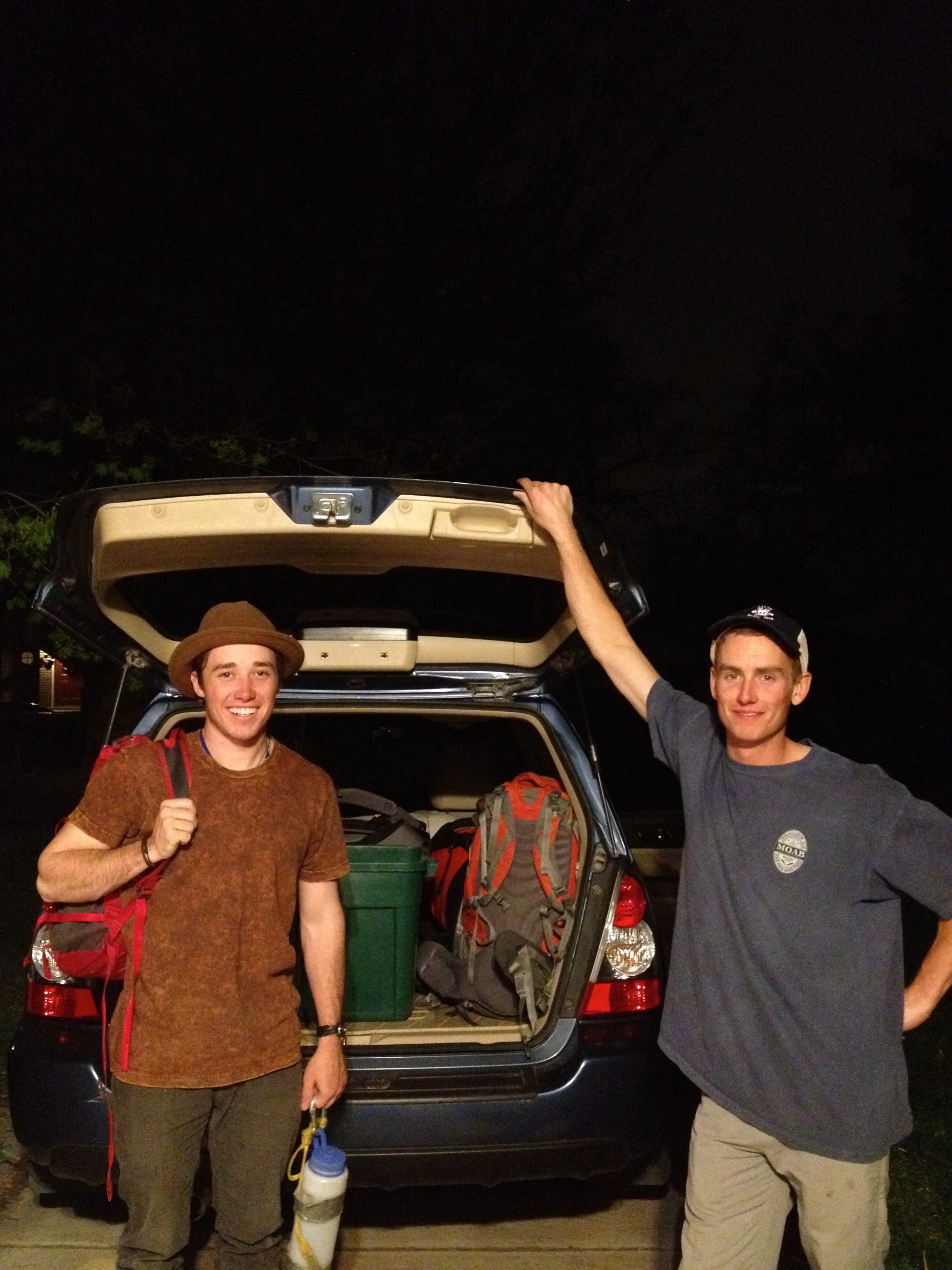
Crowson (left) and Harrison pack their car for a climbing trip in April.

According to a national survey by the Kaiser Family Foundation, kids ages eight to 18 spend an average of 7.3 hours engaging in entertainment media in a typical day. This amounts to more than 53 hours per week.

Be Out There — a National Wildlife Federation campaign that hopes to reconnect children to the natural world — notes that a study in 2005 revealed that children are spending half as much time outdoors than they did 20 years ago.

Neil Crowson — Harrison’s roommate and adventurer counterpart — grew up down the street from Harrison, spending his childhood skiing in the Wasatch Mountains and rock climbing with his father.

“It’s really important for a kid to go out and get himself in the dirt, jump off rocks and cut his knees up, and get on the mountain at a young age,” Crowson said. “If kids do that, then they come to develop ambitions and learn to respect the mountains.”

Both Harrison and Crowson say they have — in one way or another — been defined by their outdoor surroundings, that growing up with the mountains as their playground has given them a sense of place and purpose in a seemingly uncertain world.

The walls of their living room are covered from ceiling to floor with personal photographs that share a common theme: being outside.

The gear room in the basement of their bungalow-style house is crammed with racks of ropes, climbing gear, bikes, skis, backpacks, tents and camp stoves—and a looming odor that can only be created from years of adventuring outdoors.

“I can’t ever see myself leaving the Wasatch completely,” Crowson said. “The people that founded these canyons, both in skiing and in climbing, have also founded tons of areas around the west coast. But you always see them coming back to Salt Lake and that’s because we hold the mountains with such high regard. They define us.”

But that defining power of the mountains — of the outdoors in general — is becoming increasingly sparse among today’s youth, as an increasingly technology-fueled lifestyle drives kids indoors — and keeps them there.

“It’s hard to learn a key set of morals as a kid when the world is changing so rapidly and technology is always advancing,” Crowson said. “It’s always hard to know how to become a man. But the beautiful thing about the outdoors is that it’s a constant. It’s timeless. So the same set of values that existed 100 years ago still exists today.”

Outdoor Nation — a community-based program created by young people, for young people — was founded in 2010 to address the growing disconnect between today’s youth and the outdoors.

“America is in a current state of crisis where its youth are choosing technology over nature, Xboxes (check the proper spelling on X box) over healthy lifestyles,” Outdoor Nation said on its website. “Green spaces in urban areas are either unsafe or non-existent. Families, schools, and media have failed to engage and excite youth about the benefits of the outdoors.”

Judy Brady, a licensed clinical social worker in Salt Lake City, said being outdoors is especially important for a child’s development because it fosters self-esteem.

“One of the ways in which we gain self-esteem is through task mastery,” Brady said. “When a child is outside, he or she gains personal self worth by problem solving, by completing new and challenging tasks.”

A series of studies published in a 2009 edition of Journal of Environmental Psychology found that being outside in nature makes people feel more alive.

“In vital states people demonstrate better coping and report greater health and wellness,” the study reported. “Being outdoors has been proposed to be good for health and well-being because when outdoors, people tend to both interact more with others and get more exercise.”

The sunlight also triggers serotonin and dopamine production, neurotransmitters that help maintain positive feelings in the brain, Brady said. Cases of seasonal depression are seen more often in the winter months because there is less sunlight and people spend less time outdoors.

“When we are surrounded by all man-made objects and man-made ideas — products of our own society — we become dysfunctional,” Crowson said. “We forget how to respond. We are alienated from each other because we are constantly around each other. When you are in the outdoors and there’s nothing but organic sounds, it gives you a chance to really bond with other humans.”

Allison Librett — a lawyer and fitness instructor in Salt Lake City — said that exposing her children to the outdoors at a young age has helped them establish and maintain relationships.

Librett has a nine-year-old and an 11-year-old, both of whom spend their summers at outdoor camps with children of diverse abilities and backgrounds.

“Fresh air, exercise, mental stimulation — these are all such important things for child’s development,” Librett said. “My kids have had the opportunity growing up to interact with the world around them, to know what their imprint is and that they have a purpose.”

Librett said that when her children spend long periods indoors — especially when they are on the computer or playing video games — she notices that they are much more anxious, emotional and frustrated.

Those emotions disappear when her children are engaged in outdoor activities.

Harrison said he hopes that today’s youth will realize what adventuring outdoors has to offer.

“Kids should be excited to get out, to be outside, to breathe fresh air, to see a full moon and a bunch of stars, and hear the coyotes,” Harrison said. “That’s the sickest thing to me: just hearing and seeing and feeling the world as it is. ”

And if Harrison’s convictions about the benefits of nature aren’t heartfelt and persuasive enough, then perhaps a passage marked in his copy of “Walden” is:

“I went to the woods because I wished to live deliberately, to front only the essential facts of life, and see if I could not learn what it had to teach, and not, when I came to die, discover that I had not lived.”

This slideshow requires JavaScript.

In Salt Lake County, a better option for justice

by MCKENZIE DEAN

Since its creation in July 2001, mental health court in Salt Lake County is booming with results– helping not only individuals but the community, as well.

Two to five percent of people in the world deal with some sort of mental illness. Out of that percentage, 17 to 21 percent of inmates in United States jails are mentally ill.

“We do not think prison rehabilitates the person who is struggling,” said Tammi Odegard, Pahrump, Nev., Specialty Court Coordinator.

About 400 miles north of Pahrump, Salt Lake City is also addressing similar issues of treating the chronically mentally ill in the court system.

Mental health court is a combination of criminal justice and mental health agencies. An adult and juvenile mental health court has been established in the Utah courts for many counties. It provides services for treatment and case management, along with community supervision. The program’s goal is to leave each patient with improved mental health and personal well-being.

In addition, mental health court reduces recidivism and improves public safety, Odegard said. The goal is to decrease clients’ contact with the criminal justice system by providing different courts with resources that will improve the social function of the clients. Along with treatment and support, mental health courts link their clients with housing and employment opportunities, as well.

“These types of courts provide immense amounts of advantages to help the client, especially, dealing with their cases. It provides additional incentives for them to do well and prove themselves to the judge that will be their final sentence,” Odgeard said.

Graduating from a type of program like mental health or drug court also helps in a large aspect with other agencies in the judicial system, such as family court and with challenges of child custody. The program requires those who participate to demonstrate responsibility and a desire to change their ways. Officials in Salt Lake County have similar feelings on the issue.

“We need to be smart prosecutors, not zero tolerance,” said Sim Gill, Salt Lake County District Attorney, who has supported mental health and drug courts throughout his career as a prosecutor.

Gill points out that that before the implementation of mental health court in Third District Court in Salt Lake City, the commission of new crimes by the mentally ill hovered at 68 percent. Mental health court has helped decrease that number by 17 to 19 percent.

By keeping the chronically mentally ill from returning to jail time and again, society is saving money on public resources, too, Gill said.

Every 230 days an “event failure” occurs. Gill spoke of an event failure as a criminal who repeats another crime. Results have shown that after one goes through the mental health court, the number of days that a mentally ill person re-offended had increased to 1,300.

Although mental health court is voluntary and requires a long-term commitment — one year on average —  Gill and other proponents believe the program’s benefits far outweigh its costs.

In Third District mental health court, 51 to 100 participants enter the program each year. The court accepts participants who have been diagnosed with Axis I disorders- mental illnesses that are persistent or serious and require medications. Upon completion of the program, participants’ are likely to be reduced or entirely dismissed.

In the process of implementing mental health court in Utah, access to mental health resources has greatly increased. Gill said a vast number of people lack the access to get help, leading to the continuation of repetitive crimes and a resulting burden on the courts. Mental health court has helped to change that.

“We need to take care of their addiction, not just lock them up,” Gill said.

 ###