Salt Lake City Head Start provides comprehensive educational experience for young children

Story and slideshow by TOM BETAR

Explore the Head Start kitchen

The average Head Start  family in Salt Lake City, regardless of the number of members, has an annual income of about $13,947. Some of the children of these families require $5,000 in dental work alone. These alarming numbers come from Kristyn Hancock, the community partnerships manager for Head Start who has been with the organization for more than a year.

The good news is that help is available, and from classrooms to kitchens the staff of Head Start work to educate and support these families so they can be successful now and in the future.

Head Start is a nonprofit organization with 83 classrooms and seven facilities throughout the Salt Lake City Valley that help these needy families overcome financial, educational and health-related obstacles.

The overall mission of the organization, according to its website, is to provide health, education and self-sufficiency to young children and families facing adversity. This entails working with children as early as possible to prepare them for future success in school. About 2,400 children in Salt Lake City, the majority of them ranging from 3 to 5 years old, receive assistance in education and healthcare from the Head Start program. Some of the children are helped from birth until age 2 as well.

Hancock said in a telephone interview that she quit her job doing sales and then was later approached about a position at Head Start. She said even though she may have made more money in sales or other lines of work, she is extremely happy with her decision to work for Head Start.

“I am so fortunate and so thankful to be here,” she said. “I feel like I’m able to give back every single day. Before I never felt like I was able to make a difference. I guess I traded in the big paycheck for a big heart.”

The community partnership aspect of Head Start is built around organizing fundraising and community events that spread the word about the Head Start program. Social media and grant writing fall under this umbrella as well, and Hancock works with many community volunteers to make programs successful.

“Our goal is to be out in the community informing people what Head Start is,” she said. “We are like ambassadors for the program.”

Hancock said every year assessments are done to gauge which areas are in most need of Head Start services, and the west side of Salt Lake City is the frontrunner every year. Although many people may have misconceptions that west-side residents are just sitting around waiting for handouts, Hancock said that is simply not the case for the residents she encounters.

“They are an amazing group of people to work with,” she said. “Many of them are working two or three jobs and they work so hard. They are so resilient. I love working with them.”

In terms of assistance to the children, or “kiddos” as Hancock calls them, the services that Head Start provides in regards to education, healthcare and self-sufficiency all go hand-in-hand.

“For most of our kiddos we are their only opportunity to begin the lifelong education experience,” she said. “I don’t know of any other preschool program that does what we do.”

She said parents play a large role in the development and success of the children, so Head Start tries to involve the parents as much as possible.

“Our goal is to get every child ready for kindergarten and on the same level playing field as their affluent peers,” she said. “We believe parents are a primary asset and we want them to be involved in their child’s education, not just when they (children) are 5 years old but when they are 15. The parents want their kids to succeed and break the cycles of poverty.”

Hancock said in order to properly educate and prepare these children, the first step is to make sure they are healthy and have proper nutrition. This is where people like Brian Ralph come in.

Ralph is the food services director for Head Start and has been in the food business for more than 30 years. He came to Utah to work in the 2002 Winter Olympics and was a food service manager in the Olympic village. He said he fell in love with Utah and now has a job with Head Start. He previously did food service work in the athletic departments of colleges such as Louisiana State University and the University of Colorado.

“There’s really no difference between feeding football players or little kids,” he said. “It’s really the quantity because you still need the healthy food.”

Ralph works in a kitchen located at 2180 S. 300 West that provides Head Start children with diverse, healthy and balanced meals. Food is prepared at the kitchen and then delivered to the classroom sites across town so that children can enjoy nutritional meals to supplement their early education.

“Pretty much the kids will get everything that an adult would eat minus the sugars and the salts,” Ralph said. “The kids learn to trust that the food they are getting is good, so our kids actually do eat our vegetables.”

Ralph said the kitchen uses whole-wheat products and does not serve canned vegetables or deep-fried food. He said the food that is served is restaurant quality and not only nutritional but also ethnically diverse. Meals include vegetarian dishes, jambalaya, beef stir-fry, chicken taco salads, lentil soup, sweet potatoes, fresh grilled tuna casseroles, spinach soufflés and Atlantic salmon — just to name a few.

“We do not believe in buying anything at discounted prices,” he said. “We bring in the best quality we can possibly bring in.”

Ralph said Head Start has a program at the University of Utah where the link between proper nutrition and a better education is visible.

“They (children) are better behaved because they’re not hungry. They are more attentive when it’s time to learn, and they sleep better because their stomachs aren’t hungry,” he said.

In order to qualify for Head Start, a family must be at 100 percent poverty level, which means the income of the household falls below a level set by the government. Hancock, the community partnerships manager, said there are about 1,000 kids on the waiting list for Head Start.

“We serve the neediest of the needy,” she said. “We always have a waiting list.”

Income is not the only criterion. For example, if the father of a family unit is incarcerated, Hancock said that family might be prioritized over another family.

Hancock said in order to measure and quantify success of the Head Start programs a tracking system is now in place for Salt Lake City children. This allows their academic progress to be recorded and analyzed as they move on from Head Start and continue schooling. Because Head Start is a nonprofit, the organization relies heavily on government grants and funding. Consequently, it is closely monitored by the federal government. Data such as test scores can be tracked to reveal the effectiveness of the Head Start programs and help to maintain the high standards.

Patty Mazzoni, Head Start education manager, has been with the organization since 1992. She started out as a teacher and has held her current position for five years. She said the educational aspect of Head Start is codependent on the fulfillment of the other needs for the children.

“We provide an all-around comprehensive education for our children and families,” she said in a telephone interview. “We not only meet the educational needs of a child we also meet the health and nutritional needs.”

Mazzoni said Head Start relies heavily on volunteers and in-kind contributions. For example, medical volunteers such as doctors or dentists provide free health screenings for children in the classrooms.

“Volunteers are a huge part of what we do,” she said. “We encourage parents to volunteer in classrooms.”

She said few other organizations provide the same benefits as Head Start.

“We are probably the only opportunity to place children in a program that will give them a head start in education,” she said.

Mazzoni said there may be some misconceptions out there about exactly what Head Start is and what it is for.

“People think that we are just a daycare to drop kids off,” she said. “We are not at all. We are very comprehensive and we have academic outcomes that we have to show data for.”

Mazzoni said there is something else unique about Head Start that makes her proud to be a part of the organization.

“We serve all children with disabilities, so we are a full-inclusion program,” she said. “We accept any child within our program.”

Being a Head Start employee provides opportunities to make measurable changes in the lives of young children and their families. Food services director Ralph said his job comes with many satisfying rewards, and that results from his work can clearly be seen.

“I enjoy coming to work every day,” he said. “We see the results. We see the change in the children’s weight, we see the change in their attitude, and we see the change in their eating habits. It’s hard to change a child’s eating habits when they’re older.”

Ralph recounted some of the most rewarding experiences he has been a part of since joining Head Start: “When you go into a classroom and you have 3- to 5-year-olds clapping because they enjoyed the meal that was prepared that day, or you have a parent send you a request for a recipe. It’s small steps here. It’s child by child.”

KUED, Sorenson Unity Center, promoting education at home

Story and slideshow by DEREK SIDDOWAY

Take a look inside the Eccles Broadcast Center and view a Ready to Learn Workshop.

According to the 2010 Census, nearly 10 percent (9.5) of Utah’s population is under 5 years old. That is the highest in the nation. Yet Utah, along with North Dakota and Montana, are the only states that do not offer free public preschool.

Jacqueline Voland, community outreach and education services manager at KUED, thought that was a problem. So in 2001, when the Department of Education reopened another grant cycle for the PBS Ready to Learn initiative, she took action.

“Our early literacy campaigns were more focused on hard content and resources,” Voland said. “It is important that we have a one-on-one relation with the community and their services. The Ready to Learn initiative supplements education services and provides tools (for parents) at home.”

At its heart, Voland described the Ready to Learn initiative as seeking to increase parental participation and involvement in school and education. All of the programs are designed around Utah’s educational core curriculum and focus on infancy through third grade. The initiative combines educational programming and a “Learning Triangle,” consisting of “read, view and do principles.” The approach is based on the concept that children learn in different ways. Everything is designed to empower parents to take a more active role in their children’s schooling.

“We are trying to be a public vehicle to support education. The Learning Triangle is the basis for what happens in Ready to Learn,” Voland said. “We are providing (parents) with tools to engage their kids at home.”

The Ready to Learn initiative reaches out through a series of workshops in a variety of locations across the state to educate parents. Beginning with media literacy, the subjects branch into child development, health, safety, nutrition, self-esteem issues and anti-bullying, to name a few. Voland said the workshop themes are based on underlying issues that need to be continually addressed.

“The media literacy workshop is the start of anything we do,” Voland said. “Part of our mission is education of appropriate media: what, why and how you should be watching with children. Not all TV is for kids. Parents need to understand that while the TV is on (children) are consuming information in lots of different ways.”

Parents are the first teacher a child ever has, Voland says. As such they play an integral part in the equation for a child’s academic success. To aid parent involvement, the Ready to Learn initiative provides tools to make parental involvement easier. For every given topic, parents are given lists of children’s books and programming for their kids to enjoy.  To address the “do” part of the triangle, parents complete an activity with their children such as paper cup phones. This exercise teaches basic sound principles.

As part of the do, read, view theme every parent is sent home from the workshop with a book to build at-home libraries. They are also encouraged to acquire library cards.

All workshops provide bilingual presenters and material in Spanish and English if needed. As an added bonus partnering sites that provide a location for the workshop are required to supply refreshments or a meal to participants.

One agency that partners with the Ready to Learn initiative is the Sorenson Unity Center. Located at 900 W. 1383 South, the center collaborates with various nonprofit groups through its Programming Partnership. Voland said KUED had partnered with the Sorenson Unity Center in the past but it wasn’t until July 2011 that KUED was approached about joining the Programming Partnership.

“The early phases with the Sorenson Center relations have been good,” Voland said. “We are a nonprofit and in turn it behooves us to reach out and serve community with programming and services.”

As the Ready to Learn Program Coordinator at KUED, Elise Peterson is all about community outreach and the importance of parental involvement in education. The 28-year-old Peterson taught elementary school for three years before receiving her master’s degree in Child Advocacy at Montclair State University in New Jersey. She describes her position at KUED as the perfect fit for her degree and mission.

“These workshops have been so rewarding for me,” Peterson said. “It’s so important to make education accessible because for certain families school can seem daunting.”

Peterson said the KUED workshops serve 15 different sites in the Salt Lake area and average 20 parents at each workshop. Currently she presents monthly at venues like the Sorenson Unity Center. In addition to scheduling and presenting workshops, Peterson helps sponsor other activities through KUED such as parent or literacy nights.

Peterson presents a different themed workshop every month at the Sorenson Unity Center. She says most requests are for science and math, areas part of the STEM — science, technology, engineering and math — program being implemented by PBS and “Sesame Street” this season.

In keeping with the STEM theme, Peterson’s workshop at the Sorenson Unity Center emphasized these focus areas. Fun with Numbers and Science Exploration taught parents how to implement mathematics and scientific exploration into everyday life. Suggestions for parents included cooking with children, separating laundry into dark and light groups and other daily chores. Every activity in the presentation included exercises that parents could do without setting aside extra time.

One example Peterson recommended was the principle of shadows. Parents were challenged to view an online video clip from KUED and then read one of the children’s books such as “Light” by Molly Bang. Next, parents were encouraged to take their children outside to explore making shadows. Puppets were included in the workshop packet for children to continue their exploration.

“Parents are coming back (to the next workshop) sharing experiences of how education is happening at home and what they are doing with the activities,” Peterson said. “It’s great to see the program working and parents being involved with the materials at home.”

Nancy Holt was a first-time participant in the Ready to Learn Workshops. As a working mother, Holt was intrigued by the concept of implement teaching activities at home and exposing her child to a well-rounded education.

“I heard about the workshop through the Community Council,” Holt said before the workshop. “The concept of a parent workshop to help teach children to learn sounded interesting.”

The turnout to the Sorenson Unity Center’s November workshop amounted to four mothers, but Peterson feels a new parent attending was nonetheless encouraging.

Jacqueline Voland, the community outreach and service manager is satisfied knowing the Ready to Learn Initiative is serving the community and empowering parents.

“Every moment is a learning moment,” she said.

Healthy food available for day cares

Story by JOHANNA WISCHMANN

Helping Hands Inc. is a nonprofit organization that works with day care homes to provide a healthy and nutritional diet.

The program works with children under the age of 12 in day care homes. It strives to improve the day cares, mostly run by low-income families, to afford better quality meals for the children.

Helping Hands works with Child and Adult Care Food Program, known as CACFP. CACFP is a federal program that gives healthy snacks and meals to children and adults involved with day care programs.

According to the Helping Hands website, the program helps the caregiver have the funds to purchase better quality of food, such as milk, breads and meats.

It also reimburses homes for healthy meals given to the children, like a breakfast of fruit, vegetables or milk. To get reimbursed for a meal provided for children, a provider has to make a claim.

Day cares and providers can claim up to two main meals and two snacks per child per day.

Susan Ison, executive director at Helping Hands, said that when a provider follows the USDA nutritional guidelines, Helping Hands works with the Utah State Office of Education to receive reimbursement for food given to the day care children and a lot of times the provider’s children.

An estimated 98 percent of providers that Helping Hands supports are from low-income families, Ison said in an email. An estimated 75 percent are from different cultures and ethnicities and don’t speak English. To qualify the providers have to have proper licenses and they must be caring for at least one non-residential child.

Once enrolled, a provider must complete paperwork, including a daily record of the food that the children ate and which children ate what food. This paperwork is given to Helping Hands monthly.

To ensure that the funds provided to the caregivers are being used correctly and to help maintain a healthy, nutritional diet and a healthy environment, Ison said. Helping Hands staff makes an unannounced visit about two to three times a year.

Not only does Helping Hands help with financial situations, staff also offer training on sanitation and nutrition.

“We provide nutrition and care giving training both, in actual training classes at our office and in-home during home visits,” Ison said.

“The biggest help we could receive is letting people know that this program is available to all day care providers, both those who are legally licensed for day care and those caring only for related children,” she said.

Helping Hands has a full menu available with healthy options for families and providers to choose from, like celery sticks, strawberries and peanut butter.

It also keeps information accessible to families by keeping recipes readily available for everybody interested in a healthier diet.

According to the website, Helping Hands also provides more information for providers by using the CACFP site that allows plenty of information and tools to make the use of the nonprofit very easy. For example there is a “food tracker” available for providers to use.

“In the current economic environment, it is more and more difficult to afford good, quality, healthful foods for our children,” Ison said in an email. “I, personally, would not have my child in a day care – whether in a residential day care home, or a day care center – that was not participating on the food program. I feel it is that important!”

Helping Hands has staff available for contact through email or telephone.

To  join Helping Hands fill out a form of information online or visit the location on 2964 W 4700 S, Suite 111 in West Valley City.

The Salvation Army’s red kettle donations in Salt Lake City

Story and slideshow by NATHANIEL BINGAMAN

See the Salvation Army

Stores are still playing Bing Crosby’s version of “White Christmas” and shoppers are still anxiously looking for the perfect gift. Walking into a local retailer this holiday season, shoppers will notice not much has changed over the years.

Another constant for nearly 120 years is the Salvation Army bell ringers, who have become a staple of the holiday season. Bundled up from head to toe they ring their bells, sing songs and wear funny costumes — anything they can do to help collect donations for the many individuals who can’t afford to be in the store buying that perfect gift.

According to the Salvation Army website, the Red Kettle program began in the winter of 1891 when a Salvation Army Captain by the name of Joseph McFee was upset over the amount of poor people going hungry in San Francisco.

McFee decided he would take matters into his own hands and provide a free Christmas dinner to all of San Francisco’s poverty-stricken residents. But he needed a way to pay for the dinner. He remembered during his military days there was a giant kettle in London in which people would put money to help the poor.

He placed a similar kettle at the Oakland Ferry Landing. McFee raised enough money to feed the community and the rest is pretty much history. Today there are countless kettles across the world.

Here in Salt Lake City the Salvation Army continues what McFee started long ago. There are 91 reported kettle stands in the Salt Lake Valley and Provo, according to Salvation Army’s administrative offices, which are located at 252 S. 500 East in Salt Lake City.

The kettles bring in between $50,000 and $100,000 in Salt Lake City. But the kettles don’t fill themselves. Volunteers and employees found through different employment agencies spend long hours on their feet while trying to keep warm and raising all sorts of donations.

Bell ringers begin hitting the stores the day after Thanksgiving and they are there until Christmas Eve. The bell ringers are out Monday through Saturday, snow, rain or shine. Groups are able to sign up and take shifts from 10 a.m. to 7 p.m. Individuals and families are also encouraged to sign up. If individuals feel they will not be able to devote a whole day to bell ringing they can sign up for shorter shifts.

“My favorite part of my job is being able to see people giving their time to help others,” said Adriane Colvin, volunteer director for the Salvation Army.

People from all walks of life donate their time to help bring in money for those in need throughout the Salt Lake Valley. But is there a little competition between the bell ringers to see who can get the most donations?

“The people who get the most donations are usually people who do something a little more,” Covin said.

“We actually have two groups who wear ‘Star Wars’ costumes while they collect donations,” Colvin said. “Those people always seem to stay a little warmer and bring in a few more donations.”

Salt Lake City is not a place to be a Salvation Army bell ringer if you don’t enjoy the cold weather. How do they stay warm while working for up to a nine-hour shift? “Many stores will allow you to stand inside the door ways to keep warm,” Colvin said.

But a good scarf and knit cap are usually the best trick. “If you don’t have the appropriate clothing for the Utah winters we will provide it for you,” said Ray Young, a member of the Salvation Army and longtime bell ringer.

Young has been ringing a bell for the Salvation Army since 1998. “Every time I ring the bell I feel enormously grateful to be giving my time to such a good cause,” Young said. “It’s a great tradition and I’m proud to be part of it.”

In all those years of ringing a bell for the Salvation Army Young has seen his fair share of donations. His most memorable donation came his first year of bell ringing. Someone donated a number of gold doubloons valued at over $2,500 apiece.

“You always get a few ‘buh hum bug’ guys. But the majority of people are very receptive of what we do and are happy to donate,” Young said.

Along with gold doubloons Young has had people donate expensive tennis bracelets and diamond rings.

In 2010, according to the Salvation Army website, the organization served more then 30 million individuals in need, provided 60 million meals for the hungry, and sheltered 10 million people with nowhere else to go, all because people were willing to give.

The Salvation Army in Salt Lake gets thousands of donations every year. Just like ringing the bell is a yearly tradition to some, donating to the Salvation Army is a tradition for others.

“Every time I leave a store during the holidays and there is someone from the Salvation Army ringing a bell I make sure to put my spare change and sometimes a few dollars into the bucket,” said Joeseph Johnson, 22, who says he has been donating money to the red kettles for as long as he can remember.

“It just makes me feel good knowing my little bit helps,” Johnson said.

Individuals visiting the Salvation Army’s website are able to sign up for a virtual red kettle. Then, they can invite family and friends from all over to donate money to that online kettle. That is something Joseph McFee, the founder of the red kettle project, probably never dreamed he would see happen.

The Salvation Army and it’s red kettles can be found as far away as Korea. But they remain a great way to give back to people in need, either by donation of a person’s time or money. Who knew a kettle and a bell could make such a difference?

An inside look at the English Skills Learning Center

Story and slideshow by RYAN McDONALD

Attend English class here

A chorus of “I live in Utah” rang from inside the Humanitarian Center of The Church of Jesus Christ of Latter-day Saints in Salt Lake City on Friday, Oct.  28, 2011. The voices were those of seven people from different parts of the world who are learning English through the English Skills Learning Center (ESLC) in preparation to apply for American citizenship. The ESLC is a nonprofit organization headquartered at 631 W. North Temple in Salt Lake City.

Founded in 1988, the ESLC was originally called Literacy Volunteers of America-Wasatch Front, according to an informational brochure. In its early days, the organization provided tutoring for English speakers who struggled to read and write. English classes for both immigrants and refugees were also offered.

Since 2001, the ESLC has focused its efforts entirely in the field of English as a second language, particularly helping adults who are English language learners. The organization mainly helps those who have been identified as having a low income.

In an effort to reach as many students as possible, the organization teaches classes in different places in the community. This allows students to go to a place that is more convenient for them. Classes are held in places such as apartment complexes, elementary schools, libraries and community centers. Under certain circumstances, such as a lack of transportation or the need for a parent to stay home with their children, classes may be taught in a person’s home.

One of the hallmarks of the ESLC is the fact that most of these classes are taught by volunteers.

“The cornerstone of our organization is volunteers,” said Beth Garstka, volunteer coordinator at the ESLC.

Volunteers are recruited and trained by the ESLC staff, Garstka said. They must be 18 years of age, though there have been exceptions to this rule over the years. After 12 hours of training and two hours of observing classes, teachers must be willing to volunteer for 100 hours over six months. This breaks down to about three to five hours per week. Volunteers typically spend between two and three of those hours teaching and the rest of the time preparing for lessons and traveling.

Garstka said no prior teaching experience is necessary and teachers do not need to know another language, since all classes are taught entirely in English.

“It’s (the volunteer system) a way to bridge different worlds together,” Garstka said. “Our mission statement is ‘Bringing the promise of integration, security and empowerment to adult immigrants and refugees in Salt Lake County.’ That promise of integration is key to make sure that the people of the mainstream culture are interacting with the folks that are newly arriving here. That’s definitely a way of bringing them together.”

That being said, Garstka insists that the ESLC is not a language exchange program. Because classes are taught entirely in English for maximum learning, there is no need for class content to be translated into another language.

“I don’t want our volunteers brushing up on their Spanish,” she said.

Armed with about 200 volunteer teachers, the ESLC continues to help more and more newcomers (the term used when referring to immigrants and refugees) learn English each year. According to Garstka, the organization served 735 people in the 2009-2010 fiscal year. In the 2010-2011 year it helped 850. The 2011-2012 fiscal year began in July and the organization is currently serving about 430 people.

The ESLC teaches a variety of classes, as students are placed in certain ones depending on their needs. The Empowering Parents classes are held in elementary schools and are taught to parents of young children. Parents learn how to communicate with their children’s teachers, how to attend parent-teacher conferences and how to call a doctor’s office.

The ESLC also teaches classes to help people who are applying for their U.S. citizenship and need to take a civics and English test.

The third type of class offered is a workplace literacy class. These are taught at places of business where professional teachers and volunteers teach communication skills that are essential in employment.

“Whatever their (the students’) goal is, that is what we are going to focus on,” Garstka said.

Kathy Phan is the teacher of the civics test preparation class that was held in October. A recent graduate of the University of Utah, she began training to become a volunteer teacher in February 2011 and has been teaching since March. Having done extensive volunteer work at different places throughout her life, Phan enjoys the ESLC because of the relationships she has built with both the staff of the organization and the students she teaches.

“I feel like I have a bond with them so I’m more motivated to volunteer and stay,” she said.

As much as she enjoys teaching, it doesn’t come without challenges.

“The hardest part is trying to find the right place for students and find lessons that fit them the best and will help them improve,” Phan said.

On that October day, students in Phan’s class began by reciting a list of terms that they will need to know for the civics test, such as “senators” and “Abraham Lincoln.” The class then moved on to an activity where one student would read a sentence, such as, “The president lives in Washington, D.C.,” and another would write it on a dry erase board.

“If the activity is too easy they’re not going to benefit a huge amount and if it’s too hard it will just confuse them more,” Phan said. “It’s finding that right level. It’s been a troubleshooting kind of thing.”

Although various struggles arose during the class, such as trying to understand what the written abbreviation, “U.S.A.” meant, students recognize the great opportunity of living in the United States.

“I like it (America) for opportunity. I like it for my kids’ school,” said Inocensia Montejano, a student from Mexico.

Mohamed Muse, a Somali who has lived in Utah for a year, has learned that being able to speak English is crucial to having a successful life here. He summed up the reason that the ESLC provides the services that it does.

“(The) English language is key, key, key to life in this country,” he said.

Bad Dog Arts, Hartland Partnership Center create community mural in Salt Lake City’s west side

Story and slideshow by BROOKE MANGUM

See the murals for yourself

In the fall and winter of 2011 and the spring of 2012, the west-side nonprofit Bad Dog Arts and the Hartland Partnership Center will lead the community of Hartland in the creation of a mural. Once it is completed it will be displayed at the Hartland Partnership Center, located at 1060 S. 900 West, for all to see.

“This project will be a collaborative effort of all the residents and staff of Hartland, involving children, teens and adults,” said Victoria Lyons, co founder of Bad Dog Arts in an email interview. “The theme of the project is ‘Community.’ Art brings people together and on this scale can function as a tool for building the community.”

Bad Dog Arts, located at 824 S. 400 West, and Hartland Partnership Center have been working together for three years. Bad Dog Arts hosts weekly art classes for all ages at the community center. By doing so the staffs of Bad Dog Arts and the Hartland Partnership Center hope to provide an outlet for creative expression to those who typically may not have the opportunity.

The Hartland Partnership is not your run-of-the-mill community center. Along with being a building for community members to congregate, the Hartland Partnership Center, in conjunction with a neighboring apartment complex, serve as a home for more than 800 residents. Of these residents, 75 percent are refugees, or English-as-a-second language immigrants.

April Daugherty, Bad Dog Arts programs coordinator and art teacher, said in a phone interview that she believes its presence at Harland contributes to its unique community in multiple ways. “For one, we are there every week at the same time, offering a certain amount of structure to the community along with providing a positive creative outlet and a healthy form of self-expression,” she said.

Work on the mural at the Hartland Partnership began in mid-summer 2011 and will be 7 feet by 8 1/2 feet when it is completed. Due to the size of the community at Hartland those working on the mural have been divided into groups, each representing a different facet of the community.

“This is a different type of process than we typical use,” Daugherty said. “Since the Hartland community is so large, we wanted to find a way to collaborate so that everyone in the community has a voice.”

Each assembly will be responsible for creating one tile that will be apart of the mural. These groups have chosen mini themes of what they believe community is, that will be represented on their tile. Together the tiles will create one unified piece of art that the entire community can take pride in.

“We feel that this project is very important,” said Ahmed Ali, Hartland Partnership Center programs coordinator. “This is a great opportunity for the community to come together for learning, teaching, and also a way of helping and supporting fellow community members.”

Bad Dog Arts has headed and completed a number of mural and urban art projects throughout the city. It recently completed a mural project at Whole Foods Market in Trolley Square titled, “From Water Tower to Wind Power: Trolley Square Then & Now.” The mural embodies Trolley Square’s historical significance and how the location has changed throughout time.

Shortly before Salt Lake City hosted the Winter Olympics in 2002, Bad Dog Arts completed an urban art project in conjunction with Utah Transit Authority (UTA). The Trolley Square TRAX stop, located at 625 E. 400 South, demonstrates how youth can be involved in urban architecture. The youth involved in the project created multiple murals inspired by stained glass that are featured under every canopy at the TRAX stop. The youth also created brightly colored mosaic tiles that cover the benches as well as other mosaic tiles that can be found all throughout the area.

If all goes according to plan the mural at the Hartland Partnership Center will be completed in spring 2012. The mural will stand as a testament of the community’s ability to work together and the coming together of people from very different backgrounds.

“Art is a form of expression that has no boundaries, surpassing language barriers and the notions of right or wrong,” Daugherty said.

Unity Computer Center and Clubhouse — a decade of technological literacy

Story and slideshow by DEREK SIDDOWAY

Take an engaging visual tour of the many services available at the Computer Center and Clubhouse.

The Unity Computer Center and Carole Costa have come a long way helping people in the past 10 years.

“This place had a tiny computer lab in a trailer and they were looking for people to help with the youth program,” the 41-year-old computer center manager said. “One thing led to another and 10 years later I manage the whole place.”

Originally from France, Costa relocated in 2000 to Utah where she began volunteer work at the Unity Computer Center. Dissatisfied with educational systems she believed placed too much emphasis on testing rather than teaching, Costa left her educational background and began chasing her technological passions.

“I used to be a language arts teacher,” Costa said. “Robotics and computers were a hobby. You never know what your hobbies will lead to.” A year of volunteering later, she hired on part-time and eventually became a full-time employee at the Unity Computer Center.

Looking at the center now, it’s hard to believe it once resided in a trailer. Located at 900 W. 1383 South within the Sorenson Unity Center, today there are two computer labs: the Unity Computer Center for adults and the Unity Computer Clubhouse designed for children and teens. According to the Sorenson Center’s annual report, the Unity Computer Center served 955 adults and 304 youth throughout the 2010-2011 fiscal year and averaged more than 1,100 visits each month.

Keeping with the Unity Computer Center’s mission for computer literacy, a variety of services are available to patrons. In addition to open-access hours, users can attend computer literacy classes, specialized workshops and multimedia activities designed to expand their technological know-how. There are 14 computers available for adult use and 20 for the youth in the Computer Clubhouse.

Intel sponsors 100 Computer Clubhouses across the world. Costa describes the setup as a combination of public and corporation funding from Salt Lake City, the Eccles School of Business and Intel. Like other clubhouses, there is a vast array of multimedia technology for children to explore including graphic design, digital music production, video game design and Lego robotics.

Although the technology is certainly enjoyable for youth, the hope is that they will carry the skills they have learned into college and the job field. Costa, other Computer Clubhouse employees and volunteers place an emphasis on multimedia application in the real world.

“With children the agenda is always to graduate high school and get a better job. Most kids will be the first generation in their family to go to college,” Costa said.

One example is the music room. Inside, children can record, produce and mix to create their own songs in the same fashion the music industry does. As well as gaining valuable technical skills, the youth also learn important social skills such as teamwork. After the children have recorded enough songs to fill a CD they work in Photoshop to create an album cover. They also have the option of creating music videos for their music.

On the adult side, the Unity Computer Center emphasizes a more fundamental approach to computer literacy.  Many patrons have little or no computer background, so starting with foundational skills such as Internet use, email, word processing and other essentials is necessary. Another area of focus is job readiness — updating résumés and online job searching. Classes are held mostly in the morning or evening and are available in English and Spanish.

“The people here are easy to work with and friendly,” Steven Jensen said.

Jensen is a computer center patron and volunteer. He has been coming to the Unity Computer Center on an almost daily basis since 2004. Jensen uses the center to polish and expand his computer skills. By means of Excel, he has created a variety of formula-controlled databases to display in a portfolio for potential employers.

“Right now I’m going through Excel and amortization skills. I use Microsoft Office Suite a lot,” Jensen said. “I create databases of names, addresses and attendance and then I create queries to see how many people have attended within a certain range.”

Jensen also stressed the importance of the Unity Computer Center for locals. He wants to get the word out that the center is a valuable community asset and deserves recognition for its services.

“People can come here who have not gone to college but want a computer background,” he said. “It’s a great place for people who want to use computers.”

Heather Fuller, 50, a staff member since December 2010, has seen firsthand how the Unity Computer Center changes lives. Fuller came to the center after discovering the job on the University of Utah job board.

“I thought it was such an interesting idea of how to help people,” Fuller said. “I loved the concept of what they do here, helping underprivileged children and adults, teaching workshops.”

One of the workshops that Fuller had a hand in was a Mexican cooking blog. Each week for two years, women without any computer background met for classes.

Classes changed every six months. Fuller said students began with “breaking down computers and putting them back together, learning how to type, email and use Facebook, From there they went to film editing and blogging.”

The highlight was the blog, designed by the women, complete with how-to cooking videos they filmed and edited themselves. Carole Costa, who manages the adult side of the computer center in addition to the clubhouse, said it was quite the achievement for women who had started out with little-to-no computer knowledge.

Fuller was likewise proud of the group. “(Patrons) learn everything from simple tasks on the computer to finding a job, to being able to communicate with family and friends — something that would have never been possible because they don’t have a computer at home,” Fuller said. “(The center) provides an amazing experience for every walk of life, every age group.”

Voices for Utah Children: Advocates for Utah’s children

Story and slideshow by CECELIA FENNELL

Photos courtesy of Voices For Utah Children

See images of Voices for Utah Children

When it comes to issues facing children living in poverty, children have little say about what can be done to improve their situation. Voices for Utah Children, a nonprofit located in Salt Lake City, works with policymakers to advocate for children who wouldn’t be able to resolve health care and living situations on their own.

“Voices for Utah Children is not a direct service provider because public policy can, over time, benefit thousands of kids – long term change is through policy,” said Karen Crompton, executive director of Voices for Utah Children, in a phone interview.

According to its website, Voices for Utah Children was established in 1985 as an advocacy group that does not provide direct services, but a voice for Utah children in public policy decisions. Voices for Utah Children became a member of Voices for America’s Children in 2002. It is located in Salt Lake City.

“The two biggest issues currently facing Utah’s children are education and health care,” Crompton said.

The mission of Voices for Utah Children is to make Utah a place where all children thrive. The organization starts with one question in mind: “Is it good for kids?” At Voices for Utah Children, every child deserves the opportunity to reach his or her full potential. The organization focuses on five key areas that benefit the healthy development of all children – health, school readiness, safety, economic stability and diversity.

Voices for Utah Children worked to reauthorize the Child Health Insurance Program (CHIP). Because of this more children can enroll in health care.

Through the Children’s Health Insurance Program Reauthorization Act of 2009, CHIPRA, the U.S. can now fund enrollment policies that will allow 4.1 million additional children who are not currently covered by Medicaid or CHIP to enroll in health care. Now, any child in Utah can enroll in health care because of the advocates at Voices for Utah Children as well as other partnering organizations.

One partner, First Focus, is an advocacy organization dedicated to helping policy decisions on behalf of children.

According to its website, “The Children’s Health Insurance Program, also known as CHIP provides health coverage to more than seven million low-income families whose income is too high to qualify for Medicaid, but who don’t earn enough to purchase private health insurance on their own. Approximately 42 percent of U.S. children get their health coverage through Medicaid or CHIP.”

Voices for Utah Children uses a data tool called KIDS COUNT to find children in need. Terry Haven is the KIDS COUNT director of Voices for Utah Children and works with statistical information regarding Utah’s low-income children.

According to its website, “Utilizing KIDS COUNT data allows policymakers and community leaders to make data-driven decisions that will provide a better future for our state’s youngest citizens.”

KIDS COUNT shows the numbers of where the highest demand for advocacy is for Utah children, and where the highest amounts of children from low-income families are located.

“The highest number of children living in poverty come from the west side of Salt Lake City, but the highest percentage of children aren’t in Salt Lake County,” Haven said in a phone interview.

According to the 2011 KIDS COUNT data book, the need for child advocacy is all over Utah, not just on the west side.

Because the demand for child advocacy spans across the state, employees of Voices for Utah Children are assigned specific issues to advocate and work with policymakers and community leaders in all cities to accomplish the organization’s mission.

Lincoln Nehring is the senior health policy analyst at Voices for Utah Children and does a lot of lobbying. He does this through testifying at hearings and making presentations to policymakers.

Nehring said that advocacy around health care is categorized into two types: offensive advocacy, and defensive advocacy. Offensive advocacy deals with making changes to a program, simplifying programs and expanding programs. Defensive advocacy helps to resolve issues facing programs that are being threatened.

“When presenting programs and policies to the legislature Voices excels at identifying programs that can improve problems,” Nehring said in a phone interview. “On the offensive side they present why it’s a good idea for the state to move in that direction and all the logistics, how it will be paid for, why it is a good idea, etc. On the defensive side the organization can see the idea from the beginning and when Voices sees something bad that can potentially threaten a good program it’s hard to advocate – response to cut bad ideas is much more difficult,” he said.

Though testifying at hearings and making presentations to policymakers seems both difficult and intimidating, Nehring said the real work comes from the training prior to lobbying. “The bulk of the work is from understanding the issue,” he said.

Each of these directors at Voices for Utah Children encourages people to speak up. They said the best way for people to get involved is to get to know their policymakers.

“Your voice can be important, you can make a difference. A lot of times people feel like they don’t have a voice, like they’re screaming into a hurricane wind – that might be true in some states but not in Utah, one person can make a big difference. The legislature is your neighbor in Utah,” Nehring said.

Spy Hop Productions: a different kind of school

By COLLIN McLACHLAN

Spy Hop Productions teaches self expression through multimedia

If a school had students only do one or two projects a semester, would that school be considered an effective learning facility? If you were to ask students at Spy Hop Youth Media Arts and Entertainment Center, the answer might be a resounding “yes.”

Spy Hop is a nonprofit organization that, according to its website, is committed to helping students ages 13 -19 “express their voice and with it create a positive change in their lives.” It does this by using digital technologies as a means of artistic expression. Spy Hop has programs that teach students self-expression through film, audio, music, web design and video game design.

Rick Wray and Erik Dodd founded Spy Hop in 1999. At the time, Wray and Dodd owned Higher Ground Learning, a for-profit academic tutoring facility. Matt Mateus, programs director at Spy Hop, said in an interview that what Wray and Dodd discovered while tutoring became the basis for forming Spy Hop.

“They found that when they introduced film and video into their tutoring it was way more engaging for the student,” Mateus said.

Since Spy Hop also focuses on the development of the student, rather than simply teaching them technical skills, it uses self-expression as a means to teach students principles such as community awareness, emotional competency and high productivity.

“Our success really comes when youth leave here as engaged productive citizens, they succeed in the work force or higher education and have an opportunity to share their voice with the rest of the world,” Mateus said.

In an effort to achieve this, Mateus told of five fundamental goals that Spy Hop focuses on for all of its programs. These goals focus around: providing a safe after-school program, fostering artistic expression, developing educational and workplace readiness skills, developing emotional competencies and increasing media literacy, personal awareness and global connections.

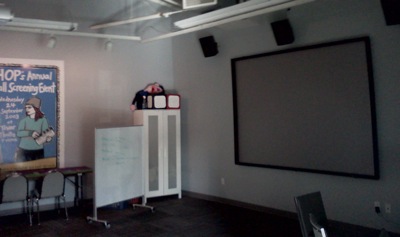
The theater room at Spy Hop

To better reach its vision, Spy Hop has a unique way of working with the students.

“We’re allowed to be different from a public school system. We’re allowed to sit down and really take the time to see what each student really wants to learn,” Matues said. “We really dig into, ‘what are the activities they are doing and how does that relate to our mission?’ ‘How does that relate to our program goals?’”

Because of this teaching technique, teachers at Spy Hop are called mentors. They spend one-on-one time with each of their students to establish a trusting and respectful relationship, along with helping with their projects.

This became apparent when Mateus, who’s a mentor in the music program, was giving a tour of the studio. He noticed a game-design student eating popcorn near the computers.

“Be careful with that popcorn. I don’t want butter all over the keyboard,” Mateus said while walking by. The student responded with a respectful, “Sure thing. Sorry Matt.”

“I still keep in contact with a dozen of my old students that I go to lunch with,” Mateus said. “The feedback I get is really positive.”

Shannalee Otanez, 24, an instructor for Loud & Clear said, “I love it all. I love seeing young people feel empowered to believe in themselves, and to feel like they have something important to share.” She feels she’s in a great position as a mentor at Spy Hop since she’s a former student. “I benefited from it myself, so I get what kind of impact it can have,” she said in a phone interview.

Shalom Khokhar, right, works on his audio project.

Shalom Khokhar, 19, from South Salt Lake, has come to understand that impact as well. Khokhar is a student in the audio apprenticeship class. He said the two main things that Spy Hop has taught him are priorities and responsibility.

“Once you come in, you sit down and it’s all about your work ethic, which you can apply in your other life too, in social settings, school, education, whatever,” Khokhar said.

When asked what his favorite part of Spy Hop was, Khokhar said, “I’d say the respect that Spy Hop has toward its students. They have a certain trust that they give to students to say, ‘OK come in here, use our equipment and stay in here as long as you want.’”

Spy Hop isn’t just helping students to become better people; it also helps to prepare them for the work force. The students work on projects during after-school hours using modern digital equipment. Khokhar and his apprenticeship class, for example, are currently working on the sound for a film produced by Spy Hop called “River’s End,” which is a story about a boy who, after his dad leaves his mom, goes and plays by a river and meets an imaginary friend. Him and his friend then run away and have some adventures. Khokhar says that a project like this takes skill in sound editing which he is happy to be developing.

Mateus is proud that Spy Hop is helping to create the next work force in the industry. Along with personal and life skills, Spy Hop is providing its students with a leg up by giving them hands-on training.

“To be able to walk into a studio and say, ‘I can work for you guys. I know Pro Tools. I know where to set these microphones up,’ at 17 years old. That’s crazy,” Mateus said. “Because what are they going to be doing when they’re 25?”

Donated Dental offers free and low-cost dental services

Story and photos by Shelly Guillory

Take a tour of Donated Dental.

Matthew Boyd stood in line with 15 other people outside the locked door of Salt Lake Donated Dental Services for 45 minutes. When an employee unlocked the doors at 8:45 a.m., Matthew squeezed inside the small waiting room located inside the Sorenson Unity Center, hoping he’d be one of seven people picked for free dental services. Within five minutes, more than 25 people packed in and watched the receptionist at the front desk spin a small, gold lottery spinner.

The receptionist reached her hand into the spinner, grabbed a small, folded piece of paper and read the name. An older man smiled, walked up to the desk and provided a letter verifying he had no current income. He was given paperwork to fill out. Other people watched, some wringing their hands together, others sighing.

The receptionist withdrew Boyd’s name when her hand plunged in the second time.

He would finally get — free of charge — the dental services he had put off for years because he couldn’t afford to get his teeth fixed.

“For me, this was my first time coming [to Donated Dental], and I have gotten really lucky,” Boyd said.

According to its website, Salt Lake Donated Dental Services, located at 1383 S. 900 West, works with volunteer dentists to provide free dental services for Salt Lake City’s homeless and low-income population.

Forty-five percent of SLDDS’ patients are homeless, 44 percent fall below the poverty level and 11 percent have state-funded Medicaid. Without volunteer dentists and SLDDS, these individuals would have no other access to dental care.

Executive Director Stephanie Jensen said the free services place quality preventative dental care within reach of those who would not have access to dental care.

“If you ask any agency serving the indigent, they will tell you that dental services are the most difficult services for their clients to obtain,” she said. “Untreated dental caries have long-term impacts on one’s overall health.”

According to Jensen, untreated oral infections can make diabetes difficult to manage, cause complications with heart disease and stroke and impact a person’s self-image.

Randall Kelley, a dentist who has worked for the clinic for a year and a half, said many people resort to pulling their own teeth if they can’t afford to get them treated.

“They need to do something, but they have absolutely no recourse or money,” he said. “Most places you can get a tooth pulled for cheaper than you can get it repaired. If you put off going, a cavity can become something that is potentially a root canal and is painful. You don’t have much choice. It is expensive to repair. A root canal and crowns are five times more expensive than a filling, and they wouldn’t even be able to afford a filling.”

Kelley also said the clinic tries not to extract teeth that are restorable.

“We try to get [patients] into the mode of not [pulling teeth],” he said. “A lot of people certainly have gone to places and said ‘well, just take it out.’”

He said multiple missing teeth could compromise a person’s ability to eat.

SLDDS, which opened in 1990 and is funded through grants and private donations, employs a lottery system. People who want to be eligible for free services must come to the clinic in person to place their name for the drawing held the next day. If their name is picked during the lottery, they must be present at the time of the drawing to receive services.

After his name was called, Boyd waited about an hour and received an exam, X-rays and a treatment plan. The dentist told him he needed four cavities filled, a root canal, two crowns and a cleaning — $4,660 without insurance.

Boyd was also told he needed 10 appointments to get all the dental work done. He dropped his name in the lottery for the next day, but wasn’t chosen.

“I will go back and try as many times as I can to get in,” he said. “When I find a job and get insurance, I will transfer to a different dentist.”

Jensen, SLDDS’ executive director since 2003, said that depending on the services, some patients must enter the lottery for additional appointments.

“Some services are done by appointment only ⎯ dentures, root canals, crowns, bridges, etc. …, but for services such as fillings, they would enter the drawing multiple times for multiple fillings,” she said.

Though it might seem like a lot of work, Jensen said this system works much better than the old system, which was on a first come, first served basis and meant some people camped out overnight in the cold. And a person who walks in with an obvious dental emergency will usually receive services that day.

Boyd, who will get a free cleaning on Dec. 7, said the lottery wasn’t an inconvenience. He is grateful for the opportunity to get dental work for free.

“Otherwise, I would have to wait until I found some type of insurance, which would mean I would have to get a job,” he said. “Who knows how long that could take. If all else fails, I would just have to pay for insurance on my own, which is really expensive.”

In addition to free dental services, the clinic also provides low-cost dental care for those who do not qualify for donated services. On average, these services cost 50 percent less than most dental offices.

Patients interested in low-cost services still must show proof of income, but make appointments instead of participate in the lottery. The discounted program’s profits also help support any portion of the donated services not covered by grants or donations.

Jensen said SLDDS moved inside the Sorenson Unity Center in 2006 after the landlord it rented space from on 4th West and 4th South decided not to renew the clinic’s lease. The city knew that SLDDS wanted to open a facility in the Sorenson Unity Center. SLDDS proposed to the city that if the space were built, it would bring in the program and run it. It was the right time for both parties.

Jensen said that since moving to the new facility, SLDDS saves nearly $15,000 a year in facility expenses and has expanded its low-income client base.

“Our volunteer numbers have increased as have the patient services provided,” Jensen said in an email. “We also have much more stability as the city is able to guarantee us a five-year lease with an option to renew up to 10 years at the current terms.”

Jensen said the clinic currently has 60 volunteer dentists and treats an average of 26 patients a day or 130 a week.

“Some [dentists] come in once a month; others once a year,” she said. “We have quite a few that come in weekly. It just depends on their schedule and availability. The retired dentists usually come in more frequently.”

According to third-quarter statistics posted on SLDDS’ website, dentists donated an average of $5,628 in services each day.

And Jensen knows how important it is for everyone to receive proper dental care.

“Restoring one’s smile removes obstacles of chronic pain and restores self confidence,” she said.