Latinxs at work: stereotyping results from a lack of sympathy

Story and photo by SAYAKA KOCHI

The population of Latinx is increasing in the Western United States. The Census Bureau’s data says one in four Americans are supposed to be Latinx by 2045. Many people originating from Latin America have crossed the borders to seek high paying jobs for their own dreams to come true or for their families’ sake. On the way to get a better life, many Latinx immigrants encounter stereotypes in their workplaces.

Monica Carpentieri was born and raised in Brazil. After getting married there, she moved with her husband to the United States to pursue her master’s degree. Later on, she started working as a licensed acupuncturist. Monica and her husband have become residents in Scottsdale, Arizona.

“Stereotyping was never overt,” Monica said in an email interview. “I personally had instances though that due to having a Latin accent, people immediately did not give me the credit of being highly educated. Unlike a friend of mine who had a British accent and no formal education.”

Monica’s husband, David, also faced the issue that the employers were ignorant. While he was in the medical residency training in the U.S., one hospital refused him to be a trainee for the following reason: they did not accept medical graduates from Europe. David is from Brazil, located in South America. The hiring manager at the hospital did not know where the country is.

“I was a bit shocked,” David said in an email interview. This case might be rare. But certainly, employers’ ignorance becomes an obstacle to get a job for Latinxs.

Stereotypes that are far from the truth are caused by ignoring true facts and cultural intolerance. The absence of true facts is highly contributed to by media productions. According to research done by an Eastern Washington University student, English-language television programs have often portrayed Hispanics and Latinxs as criminals or gangsters in the past few decades.

In fact, the data provided by the FBI in 2016 proves that more than 80 percent in total arrests were non-Hispanics. True facts are not on TV in many cases.

The same thing can be said about education. The Pew Research Center published a significant report in 2016. The report showed that even though the college enrollment rate of Hispanic U.S. citizens was still low compared to other ethnic groups, the rate of increase was outstandingly high.

Believe it or not, Whites and Hispanics have only 7 percent difference in the college enrollment rate. Recalling Monica’s experience, she has been stereotyped that she was not educated well because of her accent. Like Monica, Hispanics are sometimes unreasonably labeled to be uneducated no matter what kind of higher education degrees they have.

According to a 2017 poll by the Robert Wood Johnson Foundation and the Harvard T.H. Chan School of Public Health, about one in three Latinx poll participants have ever felt discriminated against when applying for jobs because of their ethnicity. The same amount of Latinx participants have experienced that they couldn’t get promoted or a pay raise. What is the main cause of employment discrimination? One of the answers is a false portrayal that Latinx workers are lazy, violent, and uneducated.

Alex Guzman, president and CEO of the Utah Hispanic Chamber of Commerce, said, “Traditionally speaking, the Hispanic community members are very hard workers. They have one, two, or even actually three jobs. Mama works. Papa works. Grandma or grandpa works.”

Story1

The Utah Hispanic Chamber of Commerce is located at 1635 S. Redwood Road in Salt Lake City.

Guzman was born in Guatemala. He was a professional in the strategic marketing field there and also helped foreign companies reach out to the Hispanic community. While continuing his marketing career, he started a political career. However, his children were almost kidnapped twice. To escape from the threats throwing shadows over his family, he got out of his home country and moved to America in 2008. He became an advocate to support Latinx and Hispanic immigrants to become business owners, providing sources and connections.

“They become or became business owners without intent to be business owners. They are intent on surviving. For the business owners, they have to learn how to own a business. They need to know how to pay taxes,” Guzman said.

Utah is one of the states in which the Hispanic population is rapidly growing. According to the data by the Utah Hispanic Chamber of Commerce, the population in Utah now exceeds  450,000. The data also show that Hispanic Utah residents are yearly contributing $9.5 billion to the local economy. Utah’s economy is highly supported by Hispanic hard workers.

Hispanic immigrants are citizens who have civil rights, including equal employment opportunity. Guzman considered equality as “one size does not fit all.” People have different backgrounds, ages, languages, and beliefs. Everyone cannot be treated in the same way.

“There are more than 13,700 Hispanic business owners registered at Hispanic Chamber of Commerce. But actually, the number is more than that. Only 13,700 business owners had the courage to self-identify themselves as Hispanics or minority when they registered their own businesses,” Guzman said.

People tend to estimate who the person is by only looking at the group where he/she belongs in spite of their backgrounds. Stereotyping results from ignorance of who the person is. Hispanic workers and business owners can feel more comfortable with their ethnic identity in a society where they can live fully as citizens.


Effort equals reward for Latinx organizations in Salt Lake City

Story and photos by BRITT BROOKS

IMG_3388 (1)

“DREAMers Life III” by Ana M., 2009.

Twice a year monarch butterflies make a 2,500-mile trek between the U.S. and Mexico. The migration is what keeps them alive. When cold temperatures in the states are unlivable, the warmth of a Mexican winter is the saving grace for this entire species.

Monarchs are more than pretty to look at, though. They’re a symbol for the Latinx community of migrants traveling to the U.S. and elsewhere. Though the journey is long and difficult, the destination promises opportunity, safety and a better life for Latinx individuals and their families.

The immigration process from Central and South America to the U.S. is grueling for even the toughest and most determined, but what happens when immigrants finally cross the border? How are Latinx people — with or without papers — supposed to integrate into American cities? If a language barrier exists, where can immigrants find jobs, housing and education? These kinds of questions are being asked and answered in Salt Lake City by professionals at organizations like the Dream Center, the Utah Coalition of La Raza, and the Utah Hispanic Chamber of Commerce.

The Dream Center at the University of Utah can be found on the south side of campus in the Annex building in the middle of a long hallway dedicated to diversity. Flags and banners hang in bold color, workshops and offices are bustling, and one can’t help feeling better about the world when students of all different cultures and ethnicities are seen thriving.

But the opportunity for higher education isn’t accessible to everyone. Some states bar undocumented citizens from attending universities, even though no federal laws support these actions. Thankfully, Utah isn’t one of them.

Luis Trejo and Brenda Santoyo greet those walking into the Dream Center with smiles and a friendly “what can we do?” attitude. Complete with memorized statistics and an impromptu presentation, Trejo and Santoyo shared some serious knowledge about the college experience of Latinx students in Utah.

Trejo, 19, is a student at the U and peer mentor with Santoyo, 24, a graduate assistant. They help Latinx students with their legal status, career goals, scholarships and strategies for picking the best college. Sometimes, they even recommend that students start at Salt Lake Community College, which is more affordable than the U. The Dream Center is also a resource for community gatherings and conversations and offers a space for local Latinx artists to display their work.

IMG_3392

The Annex building at the University of Utah.

Invigorating orange walls complete with posters and artwork create an environment that is both comforting and energizing. Monarch butterflies are featured in many of the decorations, including two graduation caps made by Santoyo. One of the caps says “Todo lo que hago, lo hago por ustedes.” Everything I do, I do for you. The stories here don’t just educate — they inspire as well.

The faculty are friendly, considerate of sensitive topics and well read on current laws that affect undocumented people here and nationwide. They know about options most students aren’t aware of, such as in-state tuition for anyone during summer semesters. And though the center is located at the U, is offers services to students from any college in the state. “It’s also really important to note we’re the only Dream Center in Utah,” Santoyo said.

Diversity and higher education create a new generation of young adults to tackle inequality, stereotypes and ignorance in an otherwise white-dominated professional world. For years the Latinx community has been marginalized, and Trejo mentioned how dehumanizing it is to call another person illegal.

Civil rights are crucial for Latinxs in America, and an active resistance against prejudice and discrimination has grown considerably in the last few decades. The rapidly growing Utah Latinx populace is at nearly half a million people, as reported by the Salt Lake Tribune in 2018. They strengthen and inspire each other, as well as continue the work of past civil rights leaders, most notably César Chávez.

The Utah Coalition of La Raza was founded in 1992 as a way to ensure the community had an organization to back up Latinx people in multiple situations. UCLR honors the legacy of César Chávez — Mexican American civil rights activist — with a fundraising banquet each year.

Chris Segura, 78, was president of the organization from 1997-99 and spoke about the action and assistance UCLR provides the Latinx community. “They’re an organization that promotes advocacy through education, immigration, civil rights and justice,” he said.

Segura knows plenty about the Latinx experience in education, as he was the first ever Hispanic administrator in Granite School District. As a U alumnus himself, his eyes lit up when talking about the partnership he started with the University of Utah. His plan involved the education and engineering departments at the U with the goal of making more college-credit classes available. This got Latinx students to take university classes in high school and created a higher chance of graduating and earning scholarships for low-income or undocumented students.

One of the biggest facets of the organization as a whole is education. UCLR runs three programs for K-12. The programs include the Utah Latinx Youth Symposium, CommUNITY Club, and Latinos in Action. As written on the website, Latinx are the least likely group to enroll in early childhood education, something UCLR is trying to change with community outreach. Equity in education for all students is important to give the same opportunities no matter their background.

IMG_3391

Hashtags help connect different communities on social media.

Organizations like the Dream Center and UCLR are resources for the Latinx community to have, especially for education. But what happens after graduation? One of the best pathways to success is to become an entrepreneur. Entrepreneurship is especially popular among undocumented people who might not speak English fluently or at all. Barriers against Latinxs aren’t just legal and political but can be seen in our local communities as well, where non-English speakers are all but ignored.

Someone else advocating for Latinxs is Alex Guzman, CEO of the Utah Hispanic Chamber of Commerce and a former politician from Guatemala. He’s versed in all things business and runs the chamber to give counsel about the different strategies for Latinx people when starting their own company in Utah.

When asked about his personal journey he said, “I’m a door maker more than a door opener.” According to Guzman, this is the kind of attitude one should have in order to be part of UHCC. An annual membership fee covers free classes, community gatherings, and networking events and activities. Once members join they have the opportunity to work with other Latinx-owned businesses and be supported and educated on how to succeed in Utah’s culture.

For the historically marginalized Latinx people of America, Utah is making strides. UHCC wants people to thrive and has helped over 13,700 business owners not just with seminars and networking but also political representation in connection with the national Hispanic Chamber of Commerce in Washington, D.C.

Growing diversity is good news for Salt Lake and surrounding Utah cities. And there’s an abundance of hardworking, inspiring Latinx members in communities across the state. Different cultures and experiences not only enrich our communities, but also help with international perspectives as well.

These organizations truly have what’s best for Latinx people in mind, whether they’ve made a journey like the monarch butterfly or were born in the U.S. In a world where the odds are against you, resources, networks and services can be invaluable.


Immigration, business and community: Organizations in Utah assist Hispanic entrepreneurs overcome challenges and find success

Story and photo by MEGAN CHRISTINE

Gladys Gonzalez was forced to leave her home in Colombia due to the unrest in the region in 1991. She was also forced to start her career over when she arrived in the United States.

Many immigrants who come to the U.S. are unable to pursue their previous vocation because barriers exist between foreign academic and professional worlds. They often are obligated to start at the bottom. This is a phenomenon known as brain waste.

Gonzalez, a former bank executive, knew she did not want to start over cleaning banks. She decided to start her own business.

Gonzalez noticed that there was a need for Spanish speakers in Utah to have a sense of community. She decided to create one of the first Spanish newspapers in Utah, Mundo Hispano. Through this process, Gonzalez was required to write a business plan. But, she had no idea where to start.

Pete Suazo, the first Hispanic Utah state senator, assisted Gonzalez with writing that business plan and finding funding. Gonzalez was inspired by his help and thought that everyone should have their own Pete Suazo to help them launch their business.

Suazo died in 2001, but Gonzalez never forgot the kindness he offered her. She wanted to honor his memory by creating similar opportunities for her community. This is where the idea for the Suazo Business Center was born.

The Suazo Business Center launched operations in 2003. It is a nonprofit organization that assists entrepreneurs from underserved, low- to moderate-income communities start and sustain their businesses. These communities include Hispanic, female, and refugee populations.

Story1Asset

Silvia Castro, executive director of the center, noted the uniqueness of the center. “We’re focused on economic development, which isn’t a typical role for a nonprofit,” she said. The reason the organization is a nonprofit is because its clients can’t typically afford a consulting business.

The center offers tools to communities who don’t usually get them, which can in turn end cycles of poverty. “We don’t do it for them, but we teach them how to do it,” Castro said. “To me, that’s our community impact. It goes beyond economics, job creation, sales dollars. I think that when you have a stable family, you have a stable community, and then you look to give back to that community.”

Castro added, “As a nonprofit, we serve the client. We’re looking for the best way to impact the community to grow. It also gives us more credibility within the Hispanic community, that we’re actually out there to help them instead of taking advantage of them.”

There are a variety of reasons these populations may require the center’s help when conducting their business. It is difficult for them to access capital. Regulations are troublesome to understand and almost always changing.

Compliance is one of the main challenges these entrepreneurs face because there are regulations that the Utah Department of Commerce asks business owners to follow that may not be in other states, and that definitely aren’t in other countries.

Business regulations in Utah can change without notification, and it is necessary to keep up with them in order to be compliant and to stay in business. Antonella Packard, the lead business advisor and teacher at the center, said business regulations can be complex. “It’s always going to feel like a stink bomb being dropped in the middle of a room because it’s like ‘Oh, really? I didn’t know that I wasn’t complying, what do I do now?’ Don’t worry, we can help.”

The Suazo Business Center offers a variety of services. It offers six-month-long trainings with either a startup or growth track and one-time workshops that focus on specific topics. The center’s business financing will assist those looking for loans or grants.

The center also does one-on-one business advising where clients are able to have their specific concerns reviewed. These sessions help immigrants and refugees understand how entrepreneurship works in this country. Castro said, “Navigating this government regulation can already be rough. Imagine English is your second language.”

The Suazo Business Center is not the only organization in Utah that is dedicated to helping Hispanic entrepreneurs. The Utah Hispanic Chamber of Commerce is a network of entrepreneurs who seek to increase their business opportunities by providing trainings, scholarships, and market research.

UHCC provides networking avenues, while the center works more on business development. “Our focus is different,” Castro said. “We want to make sure that they (entrepreneurs) have an up and running business first, so our priorities are a little different.”

Alex Guzman, president and CEO of the chamber, said about the center, “We have a very nice and good relationship. We should collaborate and make it a bit better, but in reality, we kind of compete. So rather than help my colleague grow, I’m a little bit selfish. But in business, it helps to be selfish. I’d rather keep that customer for the chamber.”

No matter what organization provides these entrepreneurs with resources to help their businesses grow, it is crucial that it is happening at all. Castro said, “When we talk about the Latino community, it’s always in a negative light. Yet what we see here day in and day out, it’s the things that really should be more out in the public.”

Kyle Lanterman

MY STORY: 

Lanterman_Kyle_UUFTB1627

  •  Exemplary service through University of Utah’s Bennion Center

MY BLOG: Volunteering

ABOUT ME: Kyle Lanterman is currently a student-athlete at the University of Utah enrolled in the College of Humanities and is studying Communication. Some of his research interests include different theories of communication, interpersonal communication and issues with relationships, and journalism. Kyle hails from Long Beach, California where he earned his high school degree at Woodrow Wilson High School. In the city of Long Beach, Kyle spent time as a member of Long Beach Search & Rescue. He enjoys to reading, video games, and various outdoor activities.

Local groups aim to ease Pacific Islander alienation through cultural identity

Story by ADAM FONDREN

Kautoke Tangitau, 30, was shot to death at Club Suede in Kimball Junction near Park City, Utah, on Oct. 14, 2003.

The Deseret News reported on Oct. 16, 2003, that the club, now closed, was hosting the reggae performer Lucky Dube when a fight broke out and Tangitau was assaulted and shot in the chest. Police and paramedics were called but were unable to resuscitate Tangitau. He died shortly after.

The Deseret News also described how Tangitau had a bench warrant for his arrest at the time of his death for failing to appear in court after being arrested and posting bail in July 2002. Charges included: purchase/possession of a dangerous weapon, obstruction of justice, assault on a police officer and carrying a concealed/dangerous weapon.

At the time of the murder, the then Summit County Sheriff Dave Edmunds stated to the Deseret News that he defined the shooting as a gang shooting involving Polynesian gangs.

Lavinia Taumoepeau-Latu, Tangitau’s girlfriend at the time, disputes this claim. She said in a phone interview that the fight was “just a bunch of boys” who jumped him and not a larger example of Pacific Islander gang violence as portrayed in the media. She said the only people in their party at the club were Tangitau, Taumoepeau-Latu and her sister, not an entire gang.

KSL reported on Oct. 13, 2003, that two men, Telefoni Palu and Viliamie Tukafu, were arrested in connection with Tangitau’s murder. At the time, neither was suspected of being the shooter nor was either charged with the murder.

KSL reported on March 10, 2009, that Finau Tukuafu was arrested and charged with the murder. Tukuafu pleaded guilty to third-degree felony homicide of Tangitau and was sentenced to five years in prison. Unable to find witnesses willing to testify against him, prosecutors were unable to convict Tangitau of first-degree murder. As a result, he served his five-year sentence and was released in January 2009. Tangitau is now a free man. His whereabouts are unknown.

“We’ve lost the duty to each other,” Taumoepeau-Latu said, referring to the way in which the Pacific Islander community has lost its way and forgotten its past on the mainland. According to Taumoepeau-Latu, who now lives in Tonga, this loss is due to two main factors: the lack of interaction within the community, and the desire to assimilate into the predominant culture after immigration caused a loss of traditional Pacific Islander cultural ways.

Concerning the participation of young Pacific Islanders in gangs Taumoepeau-Latu said, “They don’t have a sense of who they really are as Pacific Islanders, they don’t know what their responsibilities are to each other.” She continued, “If they did then I guarantee they wouldn’t fight amongst each other.”

Taumoepeau-Latu felt abandoned by her Pacific Islander community when this was all happening. She felt that not only was the portrayal of the Pacific Islander community in the media biased against her, but that her own community was biased and unhelpful toward her.

“This experience taught me a lot about what we’re working against, the disadvantage for the Pacific Islander youth,” Taumoepeau-Latu said when asked about what she felt what were the problems that led to Tangitau’s murder.

Susi Feltch-Malohifo’ou said images of the athlete or the gangster are the primary examples provided to young men of Pacific Islander heritage here in the mainland. Feltch-Malohifo’ou is the executive director of Pacific Island Knowledge 2 Action Resources (PIK2AR), a community outreach program aimed at the Pacific Islander community that provides opportunities for advancement they might not otherwise have. These include business opportunities, opportunities to explore their heritage, to express themselves through art, dance and the spoken word and perhaps most importantly, the opportunity to be surrounded by people of their own community.

Feltch-Malohifo’ou, her organization and its constituent entities have undertaken a concerted effort to reach disenfranchised Pacific Islanders. They have developed programs such as Pasifika Enriching Art of Utah (PEAU), headed by Bill Louis, that uses art to reach out, teach cultural history and provide outlets to the Pacific Islander youth of Utah. Another organization, Kommitment Against Violence Altogether (KAVA Talks), headed by Simi Poteki, uses roundtable discussion among Pacific Islander men to address the issue of domestic violence.

Lastly an event hosted by PIK2AR that specifically addresses the Pacific Islander youth is the People of the Pacific Conference, held on Feb. 22, 2018, at Utah Valley University (UVU). The conference is aimed specifically at Utah high schoolers of Pacific Island heritage with the aim of exposing them to aspects of their cultural heritage. This exposure is done with art, dance, talks and lessons. Most importantly — and in keeping with the general purpose of PIK2AR —  the event gives them a community to belong to and a sense of what it is to be of Pacific Islander heritage.

Through the efforts of PIK2AR, PEAU and KAVA Talks, the feelings of disenfranchisement that some Pacific Islanders experience in society and within their own community will hopefully be reduced. These groups aim to connect their cultural history and possible futures by giving them an inclusive community to exist within.

Nā HALE: A home for Pacific Islander well-being

Story and slideshow by MARISSA SITTLER

In Hawaiian, nā hale means “the houses,” a word that embodies the sense of traditional Hawaiian community. This word is the driving force behind the newly formed umbrella organization for Pacific Islander wellness and resources. HALE is an acronym for Health, Advocacy, Leadership and Education.

Some of the strongest leaders of Utah’s Pacific Islander community came together to hatch the idea of Nā HALE. The idea was devised by members of the Utah Pacific Islander Health Coalition, the University of Utah Pacific Islander Studies Initiative, Margarita Satini from Utah Pacific Islander Civic Engagement Coalition and Charlene Lui from Hui Hawai’i O Utah Hawaiian Civic Club.

The first formal meeting took place in January 2016. During that meeting, an exploratory committee was formed “to research different collaboration models, bylaws and articles of incorporation, and membership structures of existing organizations in other states,” said Jake Fitisemanu Jr. in an email interview. He is the acting chair of the steering committee that is tasked with preparing Nā HALE to become a more formal entity. He is also the council member for District 4 in West Valley City, Utah. 

In April 2016, the Utah Pacific Islander Health Coalition unanimously supported the proposal to create a statewide umbrella group. It was one month later that the name Nā HALE was chosen.

Pacific Islanders have a strong sense of family and community, so it is only natural that many of the already formed Pacific Islander resource groups are some of the main collaborators for this project. In addition to the founding organizations, Fitisemanu said local groups including Queen Center, National Tongan American Society, Beyond Culture, Utah Pacific Islander Behavioral Health Association, Samoana Integrated Language Initiative, Southern Utah Pacific Islander Coalition, Pacific Island Knowledge 2 Action Resource and PEAU Artists Collective are all main members of Nā HALE.

Charlene Lui, director of educational equity for Granite School Districts, is native Hawaiian and has lived in Utah since the 1970s. She and her husband, who is Tongan, have been very involved in the Pacific Islander community in Utah through various groups, such as Hui Hawaiʻi O Utah and the National Tongan American Society.

Lui said in a phone interview that collectively, they have always wanted to strengthen the Pacific Islander community by organizing a group somehow. She sees Nā HALE as “trying to bring everybody together under one umbrella and to strengthen and maximize what every group group does, to collectively share our resources.”

Dr. Kalani Raphael, who is a kidney, electrolytes and high blood pressure specialist at the University of Utah School of Medicine and one of the key members of Nā HALE’s formation, said in a phone interview that the importance of Nā HALE “boils down to recognizing that there’s a lot of disparities in health, economics and incarceration in the Pacific Islander community.” He adds, “We can and should be doing better.”

Fitisemanu sees Nā HALE as a way to strengthen each individual organization’s capacity and reach. “This kind of network can facilitate resource pooling as well as information sharing; for example, a program that has been successful in the Samoan community might be more readily adopted as a best practice among the Tongan community. It also creates opportunity for more impactful civic engagement, when communities can band together and promote policies that are in the best interest of underrepresented communities,” he said.

While Nā HALE is a solidified concept, it is still just that — a concept. The individuals who are working on this project also have full-time careers, which can make it difficult to dedicate extra time to Nā HALE’s formal creation. Despite this, the umbrella organization already has a strong presence in the Pacific Islander community. It was featured as a community-based initiative during the American Public Health Association conference in October 2016 in Denver and was introduced to national partners across the United States and the Pacific territories in May 2017 during a webinar hosted by the Native Hawaiian & Pacific Islander National Network in Los Angeles.

This slideshow requires JavaScript.


Diabetes is a health risk with Pacific Islanders in Utah

Story and photo by JANICE ARCALAS

IMG_2789

Jake Fitisemanu Jr., chair of the Utah Pacific Islander Health Coalition.

Type 2 diabetes is a health risk among Pacific Islanders in Utah. According to a Pacific Islander report done in 2011 by the Utah Department of Health,  the rate of Utah Pacific Islanders is at 13.7 percent. This is nearly double the statewide rate in Utah, which is at 6.5 percent.“The biggest risk factor for diabetes is being overweight or obesity which is a huge problem in Pacific Islanders,” said Dr. Kalani Raphael, a University of Utah associate professor of internal medicine, in an email interview. “Of course obesity is related to poor diet quality and low physical activity, so these factors contribute.”

According to the 2011 report, 63.6 percent of Pacific Islanders in Utah were considered obese. Researchers  defined obesity to be a body mass index of over 30. Poor diet and sedentary lifestyle are the main factors that contribute to Pacific Islanders getting diabetes, said Jake Fitisemanu Jr., chair of the Utah Pacific Islander Health Coalition, in an email interview.

Rice is a common food that is in a Pacific Islander’s diet. Rice has lots of carbohydrates, which can spike blood sugars. “Rice is a huge one and is an unfortunate staple of the diet,” Raphael said. “Potato or macaroni ‘salad’ is another one and lots of processed foods.  I also suspect that there is a low proportion of fruits and vegetables.”

Many Pacific Islanders think that since their family members have diabetes there is nothing they can do about it. “My experience is that it is one of the toughest things to deal with. There is a lot of fatalism meaning that a lot of Pacific Islanders think that since their family members had diabetes that there is nothing they can do about it when there is a lot that can be done to lower their risk,” Raphael said. “Same thing for the complications like kidney failure. I hear a lot of people say that they don’t think they can prevent kidney failure because their family had it.”

One complication with Pacific Islanders who have diabetes is language barriers. According to the report, those interviewed in English had lower obesity rates than those interviewed in Tongan and Samoan. The Utah Department of Health also found that those interviewed in English were more likely to perceive themselves as overweight compared to Samoan and Tongan speakers. “Language barriers for providers that don’t speak the language or have access to an interpreter are an issue. Also providers who don’t understand the culture make it challenging,” Raphael said.

A traditional Polynesian diet wasn’t always like this. “The traditional Polynesian diet was plant-based, varied, and very healthy. This was a protective factor that was further strengthened by the very active lifestyle the ancestors lived. Fast forward to today, that healthy lifestyle and wholesome diet has been replaced by modern sedentary lifestyles and sugary diets that increase the likelihood of developing diabetes.” Fitisemanu said.

Resources are available to Pacific Islanders in Utah who have diabetes. “The Utah Department of Health’s Office of Health Disparities developed a brief video in English, Samoan, and Tongan languages that mention some overall health tips that can help prevent diabetes and promote overall wellness,” Fitisemanu said. “There is also a diabetes pamphlet in Samoan that the UDOH Diabetes program has published. Local health providers from our Pacific communities are also good resources, including Dr. Kalani Raphael, Dr. Liana Kinikini, Dr. Kawehi Au, Uaisele Panisi, [and] Karen Mulitalo.”

Raphael mentioned community resources such as the National Tongan-American Society, which assists with diagnosing diabetes and counseling. It is located at 3007 S. West Temple, Bldg. H, in Salt Lake City. Another resource is the American Diabetes Association of Utah, located at 986 W. Atherton Drive, Suite 220, in Taylorsville.

The report of the health needs of Pacific Islanders advises limiting sugary drinks to help control obesity, which is a factor that causes diabetes.

“Our communities need to be aware of the risk factors and symptoms of diabetes so that they can try to reduce their risks and be able to identify diabetes early on, before serious complications occur,” Fitisemanu said. “Our families, social groups, and churches need to take more proactive roles in encouraging healthy living while providing support for those who seek treatment, and acknowledge and incentivize those who comply with treatment and make improvements. Apathy and normalization are the two worst enemies in this fight against diabetes. Because it’s so prevalent in some families and communities, it can become normalized and ‘accepted’ as an inevitable fact of life, and that notion is not only false but also incredibly dangerous to us as a community.”

Diabetes can be overwhelming but there is hope. “Diabetes is a complicated disease that requires a lot of self-care, but the motivated and informed patient can be successful,” Raphael said.

Pacific Islanders coalesce to preserve their culture

Story and photos by WOO SANG KIM

The Sixth Utah Pacific Island Heritage Month — an annual celebration held to increase the profile of the Pacific Islander communities and raise awareness of the different Pacific Islands — will be held July 28, 2018, from 6-11 p.m. at Sorenson Multicultural Center & Unity Fitness Center at 855 W. California Ave. in Salt Lake City.

Susie Feltch-Malohifo’ou, executive director of Pacific Island Knowledge 2 Action Resources, proposed the observance in 2013 and Gov. Gary J. Herbert declared August as Utah Pacific Island Heritage Month.

Will Unga, career adviser at Salt Lake Community College, has assisted with hosting the annual celebration at the Sorenson center. “The event is like Hawaii. We offer different types of foods and teas. Some people love it. Some people find it interesting. Some of the dishes are lu sipi, palusami, ika, taro and cape. We also have dances like haka, mari, sipi tau and siva tau and arts like tattoos, drawings, ta moko and tatau,” he said.

“We prepare yearlong, working to offer tables for vendors or to let them perform. We want to get to a level of having an application process to elevate the level of quality,” Unga added.

He said the event is extremely short-staffed. Volunteers’ time is limited. More money is needed to hire an overseer. Yet, Feltch-Malohifo’ou’s drive and determination have helped the event to expand exponentially each year.

“The first celebration was a test, the second was going somewhere and the third was phenomenal. The first gathered about 100 people, mostly the families and friends of the event associates. The second had 300 people and the fourth had 600 people,” Unga said.

Micronesia Cultural Booth participated as a vendor at the past celebration. Melsihna Folau, a third-grade teacher at Pacific Heritage Academy who volunteered for the booth, said, “We aim to raise awareness of the current problems of the Micronesian region and educate people about the culture of Caroline Islands, Mariana Islands, Marshall Islands and Kiribati Islands.”

2

Folau helped in hosting the Micronesia Cultural Booth.

Folau said the staff offered food and clothing as samples. Pilolo, tapioca mixed with banana and coconuts, and kemalis, rice mixed with coconuts, are given. The staff also answered questions about the Micronesian region. Most inquired about global warming and what the inhabitants are doing to slow the heating, Folau said.

“It took us six months to prepare. We had to get approved from the Marshallese government, connect to friends in Kiribati Islands, write to tourism management companies and talk to visitors from Guam. Getting the approval was the hard part,” Folau said.

The vendor also increased in size and had to divide. “The Marshallese wanted to have their own things, so they separated last year. They were excited to show their crafts and share things that they were shy about before,” Folau said.

“We are all part of the one history with different perspectives. I was excited to learn from experiences and network with people. I am just happy that I have been a part since the beginning,” Folau said.

The Queen Center, a Pacific Islander nonprofit promoting healthier lifestyles by providing cultural resources, tobacco prevention and advocacy and education, also has participated in the heritage celebration. Tufui Taukeiaho, a health sciences instructor at Granite Technical Institute who served as a committee member to the nonprofit, said, “We helped out by starting a 5K run.”

Taukeiaho said the Queen Center has hosted the run since the first celebration. The 5K started with 80-100 runners but the number surged each year. The funding from the run was given to two families. The husband of one family had a kidney failure and the other family had a 4-year-old boy who had cyclin-dependent kinase-like 5 (CDKL5) disorder — a rare X-linked genetic disorder that results in difficulty controlling seizures and severe neurodevelopmental impairment. Each family received a check of $6,000.

3

Taukeiaho assisted families in need by helping coordinate the 5K run.

“Helping out to host the 5K run as a committee member and handing out the checks to the families was very rewarding to me,” Taukeiaho said.

The celebration increased the cultural awareness even among Pacific Islanders. According to a Salt Lake Tribune article, “One of every four Tongans in the U.S. calls Utah home,” Utah boasts the second largest Tongan population and fourth largest Samoan population in this country. Yet, Unga said, “Second-generation Pacific Islanders have never been home (Pacific Islands). They don’t get any more of the culture, food, and language.”

Second-generation Pacific Islanders responded very positively to the past celebrations. “They can’t get enough. They want more. After the taste, they save up money to go back to the Pacific Islands and see more, especially the language,” Unga said.

They also garnered an opportunity to network with other community members. “I advise and connect students to other Pacific Islanders. I help them get internships and jobs, and refer them to other business contacts,” Unga said. “I help no less than 50 students a year.”

Some students even took part in the fourth celebration by screening a film. Unga said students from Salt Lake Community College made the film incorporating the Pacific Island videotaping techniques learned from the New Zealand filmmakers.

Participants gained novel experiences, too. “When you work with people, you have to learn to compromise. Keeping mind and heart in the right spot answered my question of what I want to accomplish at the UPIHM. Past years have been that way,” Unga said.

“Pacific Islanders are a very small group of minorities,” he said said. “We have challenges because of that, and we have one common goal: To live a happy life. We just want everyone to be successful and try to be good members of the society.”


Why Pacific Islanders in Utah have trouble connecting with mental health care

Story and photo by ALEXANDRA OGILVIE

Most Pacific Islanders live in a clan-based family society, where the family unit as a whole is viewed as more important than the individual, said Susi Feltch-Malohifo’ou, the executive director of Pacific Island Knowledge 2 Action Resources (PIK2AR) in Salt Lake City. Family is so important that many Pacific Island languages don’t distinguish between “brother” and “cousin.”

However, this family-based support system often prevents Pacific Islanders from getting professional help with mental illnesses and domestic abuse.

Karson Kinikini, a Pacific Islander and a licensed professional counselor of mental health, said in an email interview, “As a tribal/family based culture, they may more naturally seek support from within their family system in non-clinical ways. Often times, the concept of counseling (going to talk to a stranger about personal things) seems like a foreign concept to a people who have learned to rely on each other. Polynesians are often LDS in Utah, and so they have another support system of the Church, who they will often talk to before reaching out to a stranger.”

While having a strong support system is key to good mental health, family members and clergy often aren’t trained to give mental health advice. This is generally OK when the problems are about having an unrequited crush, but can become problematic when a family member has an undiagnosed serious mental illness, Kinikini said.

One example of mental illness is depression. Depression can present in many ways other than feeling sad all of the time. In men, it can often show itself as aggression. “All types of mental health problems were positively associated with aggression perpetration,” according to a study in the Journal of Family Violence.

This is certainly not unique to the Polynesian community, but the Organisation for Economic Co-operation and Development reports that Polynesian women are at the same risk for spousal abuse as are women in Somalia and Afghanistan.

Line drawing of sad people

A bipolar woman’s visual description of her illness. Used with permission.

One of the programs that PIK2AR offers is an anti-domestic abuse Pacific Island initiative. Feltch-Malohifo’ou said domestic abuse doesn’t end when families leave the islands and come to Utah. She said the family clan system also contributes to women not seeking help. “Women are expected to carry their share of the family burden.”

According to the Office of the Surgeon General, racism is a major barrier when it comes to getting mental health help. “Ethnic and racial minorities in the United States face a social and economic environment of inequality that includes greater exposure to racism and discrimination, violence, and poverty, all of which take a toll on mental health,” it stated. And for good reason, the office reported, “Their concerns are reinforced by evidence, both direct and indirect, of clinician bias and stereotyping.”

Along with overt racism, racial minorities tend to occupy the lower socio-economic echelons. Kaati Tarr, a Pacific Islander who is a licensed clinical social worker in Salt Lake City, said in an email interview, “In my opinion, it’s a combination of culture and socioeconomic status. Having insurance coverage helps, but still, the co-pay might be considered excessive, especially if paid weekly. $25 x 4 visits a month is $100 dollars that could be used to pay for food and higher priority basic needs.”

According to The Utah Health Department, “16.3% of PIs (Pacific Islanders) reported that someone in their household had been unable to receive needed medical care, tests, or treatments during the past year, usually due to financial barriers.”

Kinikini, the counselor of mental health, said money isn’t the only missing resource — mental health professionals often don’t have translators. “Services available in a native Polynesian language is very difficult to find access to. I, for example, am of Tongan descent but I do not speak Tongan. I have struggled to find native language speaking therapists to refer native language speaking clients to. Consequently, often the solution is to have a family member or friend translate. This can limit the effectiveness of the counseling process.”

Studies have been done on bridging this gap for other racial minorities, such as Latino and black communities. But, few data exist on Pacific Islander communities, so many families and mental health professionals are left on their own to determine best practices.

“The overall rates of mental disorder for many smaller racial and ethnic groups, most notably American Indians, Alaska Natives, Asian Americans and Pacific Islanders are not sufficiently studied to permit definitive conclusions,” the NIH reports.

Tarr, the local clinical social worker, said, “Unfortunately, I don’t have any additional resources to provide you with … that’s part of the issue, I think.”

But local Pacific Islanders like Kinikini and Feltch-Malohifo’ou are working toward closing that gap.

What happens when brave women make waves in their communities

Story and photos by HANNAH CHRISTENSEN

IMG_20180210_113831

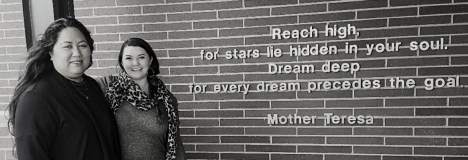
Matapuna Levenson and reporter Hannah Christensen at the SLC Family Justice Center, YWCA.

Pacific Island (PI) women who experience domestic violence often feel powerless, helpless and alone because the American idea of rugged individualism contradicts the ideals of PI collectivism.

Matapuna Levenson, Salt Lake Area Family Justice Center at the YWCA lead guide and advocate, said, “When intimate partner violence occurs, somebody is making you believe that you are not powerful. We need to go back to remembering and believing in ourselves both as individuals and as a people, that we are powerful. We’re resilient, we’re here, we’re alive.” Those of PI descent embody this power and strength through honoring and remembering where they have come from.

Levenson spoke to how this deep connection with their ancestral and cultural roots is sacred to the PI community. They have passed down many traditions, beliefs and ways of living that provide a stark contrast from the colonized white world of America.

Leata Puailoa Hunt is an advocate against domestic abuse. She is a native of Samoa who now lives in Draper, Utah. “In our true culture, high chiefs honor their wives and treat them like queens and then all the daughters in a home are treated like princesses. We keep them in a sacred status,” she said.

Historically, women of the Pacific Islands were in positions of power and held in high regard. Today they are raised to be strong matriarchs. “The good thing about our culture,” Hunt explained, “is we’re trained as girls growing up to be mothers already, we can cook, we can clean, we can solve problems, we can do this. We are independent and we can carry a family, but also at the same time I love that we train our men to respect our women.”

While many PI communities continue to treat women with reverence, something switched when patriarchal systems were introduced to the islands. Levenson, with the YWCA, said, “I’m going to blame patriarchy, because it’s not just white capitalists. Whenever there is an opportunity to have power and control over individual groups or communities, they’re going to do it. And it’s typically men, that’s just history. We have to combat and oppose this historical power.”

Levenson explained how indigenous PI communities did not have these complex power dynamics. A well-known Samoan proverb, “Ó le fogāv’a e tasi,” translates to, “The canoe has one deck.” This is the PI mentality at its best. Everyone is on the same boat, striving toward the same goal, together as equals. It wasn’t until power dynamics were introduced that the canoe became difficult to navigate.

Both Levenson and Hunt spoke about how the hierarchy of power was introduced to PI culture and the result was individualistic thinking. The clash of the collectivist community ideals and the egocentric mentality results in a lot of confusion, cognitive dissonance and anger. This is one underlying reason that domestic violence is happening within PI communities. The contradiction here is that because of the deep-seated beliefs, everyone works together for the greater good of all, and rather than challenge the systemic problem, it is best to ignore or not speak out when there is violence in the home.

Not feeling able to speak out about abuse also stems from the strong PI beliefs in families and family unification, because it is important to protect the family name. Hunt said “a family will hide secrets, like abuse or domestic violence, you know, things that are going on that shouldn’t be going on, that’s actually another key factor because of the family name. They hide it or sweep it under the rug and go forth as a perfect family that has a title.” Hiding these secrets within families is sometimes the only way a family can keep their titles and status in the community.

IMG_20180214_114722

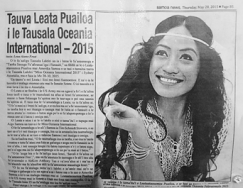
A Samoan newspaper featured Leata Puailoa Hunt in the 2015 Miss Oceana Pageant in Sydney, Australia.

Hunt recalled how there was much less tolerance for abuse in Samoa than there was in American Samoa. “If someone is abusive or commits adultery, they will be fined by the village and if it was really extreme, they would be banished from the village,” she said.

Hunt is an advocate for those who have been abused because she lived through her sister’s domestic violence abuse. “There’s no excuse for it no matter what. I know from my personal upbringing, it is not part of our culture, it is not taught on our homeland.” Hunt advocated for domestic abuse survivors as a contestant in the 2015 Miss Oceana Pageant in Sydney, Australia.

There are many resources in Utah for victims and survivors of domestic violence within the PI community. Pacific Island Knowledge 2 Action Resources (PIK2AR) is one of them. Susi Feltch-Malohifo’ou, co-founder of PIK2AR, started the organization with her husband, Simi Poteki Malohifo’ou. He and other men wanted to get involved with the domestic violence issue in the community. Feltch-Malohifo’ou said of the men who started this group, “They came together because they recognized that there is a problem.” She has been an advocate for women because she herself is a survivor of domestic violence.

Feltch-Malohifo’ou coordinates many programs to provide support for PI women. These programs provide a safe space for them to share their experiences. The YWCA also focuses on empowering women and connecting them with resources. Levenson, who grew up in a domestically abusive home, shared, “I asked a survivor once, ‘What do you need to feel more comfortable in sharing your story?’ And she said very quickly and naturally, ‘I just need to hear other people share theirs.’ And that’s it exactly.”

Additional resources can be found on the Salt Lake Area Family Justice Center’s website, the Utah Domestic Violence Coalition website and the Utah 2-1-1 website. Women also can dial 2-1-1 for help and connection to resources.