Laura Durham: The work of an artistic woman

color

Laura Durham enjoys her job with the Utah Division of Arts and Museums. Photo courtesy of Durham.

Story by JORDAN SENTENO

Utah native Laura Durham has a bachelor’s degree in art history from Brigham Young University. She currently works for the Utah Division of Arts and Museums in Salt Lake City and manages marketing and special projects that encourage public value of the arts in the state.

Growing up as a young girl, she really enjoyed music and art. Both her parents were musicians so she was surrounded by music all the time. The turning point for her was when she was in high school. She went to London with her father when she was 17 to study art and music.

“Since my parents were both musical artists I knew I wanted to do something with art and music and kind of rebelled against them by going into the field of art history,” she said in an email interview.

She has 15 years of working experience with the Utah Division of Arts and Museums. Before being promoted to marketing and public value manager, she worked as the visual arts coordinator. She also does graphic design on the side as a hobby, but has used those skills to create a brand and unique look for the Utah Division of Arts and Museums.

Durham also enjoys cooking, traveling, writing and sharing stories in her spare time. With her enjoyment of music, she sings with the Utah Chamber Artists.

Durham works out of the division’s main office in the historic Glendinning Mansion at 617 E. South Temple in Salt Lake City. Also located there is the Alice Gallery, named after founder Alice Merrill Horne. Durham chose to work at the Utah Division of Arts and Museums because she wanted to work with the arts and build programs, while also giving back to the community.

She serves on many boards, including the Salt Lake Gallery and Utah Emerging Museums Professionals. And she sits on the Downtown Marketing and Events committee, assisting with the Downtown Farmers Market, Dine O’Round and other community events.

She has worked for several other arts programs within the Utah Division of Arts and Museums, and was the visual arts coordinator managing the Rio Gallery and Traveling Exhibits. She also served as the vice president of the Salt Lake Gallery Association from 2003 to 2006.

Durham was program director of the Salt Lake Gallery Stroll from 2005 to 2010. “It was significant because it’s a great anchor in Salt Lake City when it comes to the visual arts,” said Durham in an email interview. “It’s a community event that people can count on each month and it has fostered a fertile environment for new galleries to pop up and join. A lot of business have joined the fun too, as we see more small business rotating local artwork on their walls and opening up their doors for the Stroll.”

unnamed

A piece that Durham designed for “15 Bytes” about Utah artists. Image courtesy of Durham.

She regularly contributes to “15 Bytes,” which is an online visual arts magazine in Salt Lake City. She serves, too, as assistant editor and managing music editor. Durham has developed a longstanding partnership with Artists of Utah, publisher of 15 Bytes. The magazine publishes two free adds every month for the Utah Division of Arts and Museums so it can advertise what is going on in its galleries, literary arts programs and more.

Durham has developed many other partnerships, such as with the Salt Lake Film SocietyUtah Film Center and Utah.com. She is in the process of helping the latter showcase its website and direct tourists to the wide variety of arts that are available here in Utah.

In 2014, Durham completed the Change Leader Program, which is a professional development course. According to the Utah Division of Arts and Museums website, “Participants attend a three-day institute with instruction on assessing environment and the communication and facilitation skills necessary to implement change.” As part of the program, Durham initiated a project called “Utah’s 15 most influential artists.” In a press release about it, Durham said, “Hopefully this program will inspire more people to recognize how art has enhanced their quality of life as well. And hopefully we will nurture a society that more widely and visibly values artists and their contributions.” She  said in the release she believes artists influence our landscape and culture. “I sought to identify Utah artists who influence and impact our community,” she said.


Salt Lake Gallery Stroll Spotlight: Mod a-go-go

Story and photos by PEYTON M. DALLEY

Clear pane windows line the walls and the smell of old furniture fills the room. In the background, a smooth-jazz album spins on the record player.

Welcome to Mod a-go-go, at 242 E. South Temple in Salt Lake City,  and step into the scene of the iconic sitcom “Mad Men.” Jon Hamm’s character, Don Draper, would not be disappointed. With local artwork on the walls as well as a compilation of old-school furniture, this store-turned-gallery is just one of the 36 galleries featured in the monthly Salt Lake Gallery Stroll.

On the main floor, buyers or patrons of the event can look at both furniture and artwork.

But the real masterpieces are located upstairs, where Mod a-go-go hosts its stroll event. And on the night of Feb.19, that event, which focused on landscapes, captured the essence of what artists here in Utah have to offer.

The idea became a reality

Eric Morley and Marcus Gibby are the owners of this local gallery. When artists choose to have Mod a-go-go promote them, Morley and Gibby split the profit 50/50. “We’re a launching pad for artists,” Morley said. “We have had people here who now are featured outside of Utah.”

20160219_191134

Eric Morley, left, and Marcus Gibby, owners of Mod a-go-go, enjoy a break during February’s Salt Lake Gallery Stroll.

He and Gibby set up everything for the artists. “We don’t even require volunteer work,” Morley said, unlike some galleries. “Our goal here is to get artists out of cafes and restaurants and give them a place to showcase their work.”

Morley came up with the idea for the gallery during a project he was working on as part of his MBA. He said his entrepreneur class at Westminster College in Salt Lake City helped spark the idea, because students had to identify a gap in the market. Morley knew the business of art, while his business partner, Gibby, was an artist. Together, the two balance out the scene of the gallery.

Emergining artists

Artists who are interested in showcasing their work through Salt Lake Gallery Stroll must contact the specific gallery they want to work with. For example, Mod a-go-go has an online application that individuals can submit with a sample of their portfolio.

20160219_185011

Artist Laura Beagley and husband James stand by a piece they designed together. James creates the base, and Laura uses copper wire and precious stones to construct the piece.

Artist Laura Beagley promoted three pieces for the first time at Mod a-go-go. She showed delicate sculptures created as part of a “Wishing Forest” theme.

“Wishing trees and the tree of life are what inspire me. Every culture has a tree of life in it [that] links us to the world and heaven,” Laura said. She handcrafts the works with copper cord and precious stones that her husband, James, finds from the Utah mountains. He also helps her set the foundation for her works of art.

20160219_192058

Artist Oscar Da Silva stands in front of his canvas artwork portraying the theme of the West. He was exhibiting for the first time at Mod a-go-go.

“I get different inspirations. I like the feeling of the seasons,” Laura said. Her pieces also reflect a mythical approach and include fairies and fantasy.

Local artist Oscar Da Silva also had his first showing at Mod a-go-go. He had on display six of his original oil pieces portraying the theme of the West.

“I like working with subjects that don’t limit my creativity,” Da Silva said.

He said he prefers to paint portraits, but said he loves the land.

“Take a look around you, that’s inspiration,” Da Silva said. “Inspiration comes, let it find you.”

He is passionate about what he does. S0 passionate, in fact, he quit his full-time job in customer service at the University of Utah to pursue his art. He has shown in galleries across northern Utah.

Gallery Stroll draws crowds of all ages

Word of mouth, and promotions by local media such as City Weekly and SLUG Magazine, are how artists and viewers alike get a snippet of what is offered at the Salt Lake Gallery Stroll.

Natassja and Ryan Turek said it is their second time attending the gallery stroll. They said they are merely “art appreciators,” but hope to one day buy pieces of their own.

The Salt Lake Gallery Stroll on the night of Feb.19, 2016, drew crowds of all ages to venues such as Mod a-go-go. With the scent of old finished wood still lingring in the air, and the record player spinning jazz music, the gallery slowed down for the night. But a  few visitors lingered in the “Mad Men”-like setting.


Beverley Taylor Sorenson Arts Learning Program: bringing art back into the classroom

Story and photo by JOSH SOUTAS

Elementary school students, due to a greater focus on core subjects, have seen their arts programs shrink and almost disappear. The Beverley Taylor Sorenson Arts Learning Program (BTSALP) is focusing on bringing art back into the classroom.

The BTSALP serves more than 200,000 students in 300 schools across 31 school districts in the state of Utah, including 21 schools across the Salt Lake City School District.

The program, headquartered in Salt Lake City, is administered statewide through the Utah State Office of Education.

According to the website, BTSALP collaborates with deans and staff from the state’s universities to train and provide art specialists to the elementary schools. Those teachers, who are paid for by the organization, help faculty integrate art into their core lesson plans. The specialists also hold weekly art classes that focus on visual art, dance, music and theater, the four disciplines that are sponsored by BTSALP. The program incorporates these different forms of art as a unique approach to reinforce the core curriculum.

The organization reports on its website that student performance is increased in every subject, from language arts and math to social studies and science.

Mountain View Elementary is one of the schools that benefits from the Beverley Taylor Sorenson Arts Learning Program.

Mountain View Elementary is one of the schools that benefits from the Beverley Taylor Sorenson Arts Learning Program.

Mountain View Elementary is one of the 21 schools in Salt Lake City that participates in BTSALP. Kindergartners to fifth graders are introduced to dancing.

Principal Kenneth Limb said his students integrate science into their dance class. “Our fourth graders learn about land forms, and in their dance class they will use dance moves to depict land forms,” Limb said in a phone interview.

North Star Elementary, located in North Salt Lake, has been part of BTSALP for two years.

The school’s visual arts teacher, who started part time, moved to full-time employment after Principal Lew Gardiner saw the impact visual arts had on the students. North Star covers the other half of her salary that is not paid by BTSALP.

“Kids learn in different ways,” Gardiner said in a phone interview. “The BTSALP gives kids a different opportunity to shine and grow because of art, where in the traditional classroom they might not have that chance. Art is key when it comes to learning.”

Janelle Wride, visual arts teacher at Lincoln Elementary, said in a phone interview she believes that creativity is one of the main reasons that art needs to be in the classroom.

After nine years of teaching at the Salt Lake City school, Wride has seen how integrating the arts with the core subjects has made the curriculum more memorable and relevant to students.

Wride said another benefit she has seen in her schools is that art has no language barrier.

“It gives many of the kids in my school whose first language isn’t English a chance to participate, where in the classroom they don’t get that opportunity as often because of the language barrier. It lets the teachers see them in a different light,” Wride said.

She said she also likes to invite faculty into her classroom when she is teaching their students visual art.

“This program is functioning at its best when there is co-teaching, when the teacher is doing artwork with their own students. It gives the students a ‘we are all in this together’ feeling,” Wride said.

Wride also works with a large ethnic diversity and takes culture into consideration when planning lessons.

“Our fourth grade has a lot of Polynesian students, so I decided to incorporate Polynesian art forms into the lesson for that week,” Wride said. “And the Polynesian students really responded, it was interesting to see how well they reacted because they knew what I was teaching about related to them and their culture.”

Peggy Patterson, principal of Lincoln Elementary School in Salt Lake City, said in a phone interview that BTSLAP provides instructors who teach the arts in a way that her teachers cannot.

Patterson also said her music classes have helped the kids with math and science. The students use the beats in music to help them with addition and subtraction.

She has seen the fun that the arts can bring to the core curriculum.

“Every semester we have an informance — not a performance — but an informance, where parents and family are invited to see their kids perform and what they have been working on all semester in the classroom,” Patterson said.

Patterson said she believes that Beverley Taylor Sorenson Arts Learning Program has accomplished what it was created to do — better help students learn core subjects through the use of art.

The Utah Cultural Alliance: Past, present and future

Story by JORDAN SENTENO

It all began in 1981 as Utah Citizens for the Arts. According to a history of the organization, it led the development of the public art programs in Utah. It also held events to help educate the community and elected officials.

Then, in 1993, it assumed a new identity and became the Utah Cultural Alliance (UCA). Its job is to work with the art and culture organizations as well as the legislators and county governments to solidify funding throughout the state of Utah and its community.

“Everyone and anyone can work with the arts and make a contribution to the community,” said Kate Ithurralde in an email interview. Ithurralde serves on the UCA board as treasurer.

According to UCA’s website, the organization serves as “the voice of the arts, humanities and cultural sector of Utah.” Its mission is to “empower and strengthen this community through advocacy, professional development and awareness.”

Crystal Young-Otterstrom, executive director of UCA, said, “It’s a great way to help the Utah community and for others to get involved and make a difference in the community as well.”

According to the website, UCA has transformed into a membership-driven organization comprised of many museums, corporations, and groups such as the Utah Division of Arts and Museums, the Stewart Foundation and the Salt Lake City Arts Council.

UCA has joined to help support the Utah community through cooperation, communication and advocacy in an attempt to help increase the value of the arts program in the state.

“I choose to be involved because the arts and humanities have a rich history in our state and I think we can do a better job supporting the sector,” said UCA Board Chair Jason Myers in an email interview. “By doing that I believe we will have more vibrant and rich communities — culturally and economically,” said Myers, who manages internal communications at Children’s Miracle Network Hospitals.

Young-Otterstrom said one way that community members can become involved is by becoming an advocate. “The most important part of advocacy is anyone can choose to be involved, can talk to an elected official. It’s really not a hard thing to get in touch with one of them and get involved,” she said in a phone interview.

UCA seeks community involvement to help impact the culture in Utah. The organization is committed to working with people to increase their individual and organizational knowledge of policy issues. UCA also involves the community by hosting events like Arts Day on the Hill in February, which UCA notes is an opportunity for residents to connect with their legislators and discuss why the arts are important.

UCA has a new five-year strategic plan for 2016-2020 that outlines its desire to become the forefront organization of Utah’s cultural issues. A subcommittee of the board factored in the mission, vision and value statements when creating the plan.

The subcommittee identified several guiding principles to help UCA accomplish its goal. For example, the small group recommended creating a separate advocacy branch that will enable UCA to endorse candidates and pursue fundraising to directly support advocacy efforts in Utah.

Another guiding principle is awareness. The organization aims to expand marketing and public relations in order to increase appreciation of the arts. It also plans to develop a Utah Culture Wiki, a comprehensive site about the arts and humanities.

According to UCA’s website, “the Utah Cultural Alliance [looks] to become the top voice of the arts, humanities and cultural sector of Utah.”

Webster agrees, the definition of beautiful is YOU

Story and slideshow by SHANNON O’CONNOR

Learn more about how people are impacting lives through positive body image.


Lexie Kite, 29, created the nonprofit organization, Beauty Redefined, with her twin sister Lindsay Kite. The idea to start the motivational program was sparked in their media literacy class at Utah State University.

The class opened their eyes to how women are negatively represented in the media. The Kite sisters were angry at how the media transform the public’s idea of what makes a woman beautiful.

“One day my heart started pounding faster and I wanted to spread the word,” Lexie said. Lindsay felt the same way.

They decided to continue their research on body image and the media at the University of Utah and earned PhDs in 2013.

Their doctoral dissertations formed the basis of an empowering visual presentation they have given to “tens of thousands of people across the U.S. since 2009,” according to the website.

“We started through a dinky website, and based on the reviews we realized people were starving for this information,” Lexie said.

Their presentations are a compilation of their research, studies and experiences. “Beauty Redefined teaches audiences to recognize and reject harmful messages about bodies and continuously resist those limiting ideals through the power of body image resilience” according to the website.

Body image resilience is their main promoted message. It is “the ability to combat harmful ideas and bring to light the lies women are told,” Lexie said. The lies that women are just objects and have to look a certain way to be beautiful.

Lexie and Lindsay are passionate and driven to empower women and remind them they are “more than just bodies, more than just something to decorate the world,” Lexie said.

The portrayal of women in the media makes them feel pressured to look a certain way. If women don’t look that way, they may feel negatively about their appearance or get negative critiques from others.

“You’re just fat and ugly and jealous of all the beautiful women,” wrote a woman in an email to the Kite sisters.

“We can use painful experiences as stepping stones and not stumbling blocks,” Lexie said. “We can help provide the skills, resources, and tools to do that.”

Lexie and Lindsay Kite will not stand for women being objectified. They are influencing people around the world to have a positive outlook on body image through their blog, website and presentations.

Another program that promotes positive body image is a University of Utah club called SPEAK (Students Promoting Eating Disorder Awareness and Knowledge). SPEAK chapters are spreading to other universities, including George Washington University and the University of Minnesota. Each chapter has about 100 members.

Some of the 110 members at the U are people who have experienced an eating disorder or a body image issue. Other members, like Jon Junejo, financial director for SPEAK, have not experienced such issues. But they have a passion to educate and help people through their body image struggles.

Members of the U’s SPEAK chapter regularly engage in outreach to elementary schools, high schools, teams and clubs throughout Utah. “The more outreaches we do, the more it becomes evident that our program, and other positive body image programs are worth it,” Junejo said.

Junejo, 21, has been a part of SPEAK since 2013. At first, he joined the club so he could gain public speaking experience. Junejo wasn’t expecting to gain a passion for the importance of positive body image.

“Honestly, after the first outreach I did at Dilworth  Elementary, SPEAK became something much more,” Junejo said. “As I began hearing stories about people’s experiences with the eating disorder epidemic, it became clear to me that I could have a real positive effect on these people.”

SPEAK’s mission is to educate people about the effects from negative body image, body dysmorphia and provide ways to help people struggling with body image.

Body dysmorphia is a “conflict between what you see as an ideal body, compared to what you actually look like,” Junejo said. The disorder can affect people of all ages and may be caused be peer pressure, genes, or culture – including images in the media.

Junejo learned about one result from negative body image, eating disorders. He has not experienced it himself but he has friends who have suffered from anorexia and bulimia.

“Our [SPEAK] goal is to prevent eating disorders in the first place,” Junejo said. “We refer people to treatment centers on an individual case basis.” He added that eating disorders are predominantly emotional issues, but each person has a unique situation. It’s a multidimensional problem that the members of SPEAK are trying to help.

“Who you surround yourself with can dictate how you feel about yourself,” Junejo said. It’s important to have positive people around to overcome negative thoughts. Junejo has been a part of helping people through a struggle that people are scared to talk about.

When people compare themselves to the media, Junejo and the team want them to re-evaluate the source and “think differently about what source is making you feel like you should look a certain way.”

A main source to promote positive body image is through social media.

“They’re [social media sites] great places to get a conversation started with girls and women. We struggle wanting to be a certain way and look like this person, or that person,” said Nicea DeGering, host for “Good Things Utah.” “So when someone says, out loud, ‘just be you, you is good enough’ and it’s said on social media, which is the primary language spoken by young women today, it’s even more of a positive impact.”

DeGering has been a host for “Good Things Utah” for 12 years and graduated in 1995 with her communication, broadcasting degree from Brigham Young University. DeGering is a successful woman, wife and mother to two daughters.

She sees her daughters influenced by the pressure the media have put on women to look a specific way. “It’s something that we talk about in my house on a daily basis,” she said. “When is it OK to just be yourself? The answer should be, every day.”

DeGering didn’t have the same social media issues as her daughters, but she did struggle with her body image growing up. Her peers called her “big” because she was 5 feet 10 inches tall by the time she was in seventh grade.

“Now I’m mad I wasted one minute worrying that I was different,” she said. “Thank heavens there is only one of me, and I want to do me the best I can. Unique needs to be celebrated.”

Beauty Redefined promotes this notion, too: “Reflect on what impact narrow beauty ideals have had on your life and take inventory of the time, money and energy you dedicate to appearance concerns.”

DeGering added, “Looks are the first thing we all see. That’s a fact. And that’s actually OK, as long as you keep looking, as long as you continue to dig deeper beyond that, there is more to everyone. Everyone has their hard times, everyone struggles.”

The media disseminate many unrealistic messages about beauty to women.

“Conversation and awareness are key in making change,” DeGering said. That conversation begins with help from programs like Beauty Redefined and SPEAK, and by influential people like Nicea DeGering.

“Just be you, you is good enough,” DeGering said.

Homelessness does not mean hopelessness

Story and photos by SHANNON O’CONNOR

From an outsider’s point of view, a homeless person on the side of the road may look intimidating or unapproachable.

“I usually don’t pull over or stop to donate money because I feel like they will waste the money on drugs,” said Sadie Swenson, a Westminster College student. Swenson’s reasoning is a common opinion, but that isn’t always the case.

All homeless people don’t have the same story. They come from different backgrounds and are on the streets for various reasons.

test

Francis Reeding standing on the corner of 400 S. 600 East in Salt Lake City.

Francis Reeding, 65, stands on the streets of downtown Salt Lake City for about six hours a day,  hoping to get enough gas money to go home to California. He has been living out of his car for three months.

Reeding fought in the Vietnam War starting in 1968. When he got home from the war, in 1970, he experienced hearing loss and suffered from Posttraumatic Stress Disorder. Later, Reeding went to the University of Utah in 1976 as a math major. But since then he has struggled to keep a job. Now he feels hopeless and apathetic to get his life back on track.

“It’s embarrassing standing out here holding this dang sign,” Reeding said.

Although it is common to see people holding up a cardboard sign, it does not mean they are all the same. The homeless need a helping hand and The Road Home, located at 210 S. Rio Grande St., can get them off the streets and into housing.

The Road Home is the biggest homeless shelter in Utah and is always ready to help men, women, children and families.

test

The front of the Road Home located at 210 S. Rio Grande St. in Salt Lake City.

“Everyday I see people that I think are beyond hopeless and I see them make it and overcome homelessness,” said Celeste Eggert, Road Home development director.

Eggert has been with the agency for 17 years and has been the development director for 12 years. She fell in love with the shelter because of the clients’ strength and courage and she loves the mission of the Road Home.

The mission is to educate people about shelter and housing and to “get people out of homelessness and back into the community,” Eggert said.

How does this get accomplished? By the effectiveness and success of their programs: Permanent Supportive Housing, Rapid Rehousing and the emergency shelter.

“Collaboration is huge, many of the programs we’ve done have gotten national attention,” Eggert said.

Palmer Court is part of the Permanent Supportive Housing program. Palmer Court, located on 99 S. Main St., is an apartment complex that was purchased by the Road Home. It houses up to 300 of its chronically homeless clients. The chronic clients are people who have been homeless for one year or longer due to mental illness, addiction, or substance abuse. When they live at Palmer Court they sign a lease and pay rent that is reasonable with their income.

Eggert explained how the chronic clients need a slow transition from homelessness to living in housing. Being homeless is all they know and they’re scared of change, on top of trying to combat their personal trials. Specialists are needed for the severe cases. The Road Home is considered to be the general practitioner and they bring in the specialists.

“We try to collaborate, never duplicate services and work closely together,” Eggert said.

The agency partners with people who specialize in a variety of the clients’ necessities, such as jobs, rehabilitation, free medical care, school enrollment for the Salt Lake City districts and therapy. The combination of the staff, specialists and housing is designed to provide Palmer Court clients with a path to recovery.

Rapid Rehousing is the homeless family program. In 2009, it was brought to light that there was an increase in homeless families. Since the program was launched the Road Home reports that “87% of families on that program will never be homeless again.”

What is provided through Rapid Rehousing? According to the website, the families are offered “barrier elimination, housing placement assistance, short term subsidies and supportive services,” until they can get back on their feet.

The third program is the emergency shelter. This is for the clients who need a roof over their head for 24 hours. The men’s and women’s shelters consist of beds, bathrooms, showers, microwaves and hygienic products.

Elise Adams was homeless for five months and never stayed in a shelter.

“They have all these rules and they’re usually run by a church so the rules are often arbitrary. I think it’s easier to sleep in a park undisturbed,” said Adams, who uses a male pronoun.

Once he was informed that the Road Home is not a religious shelter, and there is the emergency shelter program, he admitted he would have stayed there.

Eggert said, “We don’t give up on people, we’re always going to work with them.”

Helping the homeless is financially beneficial for Utah and the community. But more importantly, it’s saving people’s lives. The majority of the beds are used by the clients who stay six months or more. Once individuals get the proper help, they can move up to housing and reach their full potential.

Eggert admits it’s a challenging population to work with. But she said it’s worth it because the staff, donors and volunteers are making a difference. The Road Home is a shelter that recognizes the clients’ unique situations and offers the support needed to overcome homelessness.

Swim Utah offers athletes opportunities to train and master elite skills

Story and photos by SYDNEY BULL

Swim Utah has had a reputation for being small but mighty ever since 1990 when the club was founded.

The nonprofit USA swimming club offers year-round professional coaching and technique instruction for youth of all ages and abilities, which prepares athletes for every level of competition, including Olympic trials where swimmers qualify for the USA Olympic Team. In Salt Lake City, the team practices at two pool locations, the University of Utah HPER Natatorium and the Steiner Aquatic Center at the Salt Lake City Sports Complex, adjacent to Utah’s campus.

Swim Utah’s ultimate goal is to inspire and enable its members to achieve excellence in the sport of swimming and life.

Swim Utah’s ultimate goal is to inspire and enable its members to achieve excellence in the sport of swimming and life.

Coaches, parents and club board members commonly say, “It is important for kids to enjoy the sport.” That phrase meshes well with the mission of Swim Utah, which consists of many satisfied members.

Amy Barefield, a University of Utah swim team alumna and assistant swim coach, brings a wide range of experience to the club.

“We do not do a ton of marketing to be honest,” Barefield said. “I know there’s been a lot of debate back and forth. Our intent is to grow strategically; we can’t just do a ton of marketing without having the facilities in place. And the lanes are getting pretty full, so there’s just not enough space at least to get a good quality workout in if we bring in more people. We’ve spent some time purposefully not growing because we do not want to bring new kids in and just frustrate the ones we do have. We want to give everyone a quality experience.”

As a nonprofit organization, Swim Utah relies wholly on fundraisers and donations from outside sources. However, word of mouth serves to market the fundraisers rather well. Besides the general payments from parents that cover the pool fees and the coaches’ salaries, the team relies on fundraising to make sure it has enough in reserve to cover operating costs for about six to three months.

"Swimming has taught me how to live life as a reliable and hard working person with integrity and discipline," Patrick Nordstrom said.

“Swimming has taught me how to live life as a reliable and hard working person with integrity and discipline,” Patrick Nordstrom said.

Patrick Nordstrom, a 17-year-old sprinter for Swim Utah, hopes to swim for the U after graduation. But he agrees that he loves the small size of the club because of his great relationship with his coach.

“Swim Utah is not a very big club which is something I really like about it,” Nordstrom said. “Everybody knows everybody. It’s nice to know everyone on a deeper level other than just swimming. You become very closely knit and it’s like we’re all family.”

Swim Utah does not actively market the club mainly because members appreciate the small size. That ensures the quality of coaching each swimmer receives due to the coach-to-swimmer ratio and maintains the best possible environment to improve the current swimmers’ performance.

But the locations at which the swimmers practice also limit the club’s ability to expand. Lane space availability is Swim Utah’s biggest challenge. It is difficult to fit the entire team in one pool, so the more advanced athletes practice at the Natatorium, while the beginner-level groups practice at the Aquatic Center.

Another challenge is the cost of practicing at a college facility. HPER Natatorium is very expensive compared to other facilities, such as high school pools, because it has higher operating fees, limited time slots and prioritizes University needs.

Although Swim Utah faces a few challenges regarding location and size, it does not struggle with maintaining an excellent coaching staff. Head Coach Mark Gray has had a heavy influence on the club’s successes.

“Coach Mark is my high school coach too, and he’s definitely the right coach for me,” Patrick Nordstrom said. “He’s very polite and he understands all of us. He knows what he’s doing, he’s a very experienced, intelligent and awesome coach.”

“I coach because it’s really fun, I  like to help my swimmers reach their goals and watch them grow.” says Coach Amy Barefield

“I coach because it’s really fun. I like to help my swimmers reach their goals and watch them grow,” says Coach Amy Barefield.

Coach Amy Barefield said, “Our head coach is a genius. He’s very knowledgeable and very well-read. He is very particular about technique and patient with his swimmers,” she said. “He has led many individuals to the National level too. It’s great to have a passionate group of coaches who have a lot to contribute to the team.”

The Board of Trustees, currently led by Susan Winter, operates Swim Utah. As its president, she takes care of all the fiduciary needs of the organization. Winter is in charge of organizing local meets and fundraising events, supporting the coaches and administering the board. She also manages Swim Utah’s bylaws as they’re written out and helps communicate them to members in regards to how the club operates and what decisions need to be made with the other board members.

A lot of the clubs here in Utah have to work extra hard to catch up with other states that have more investment with the sport because they are a lot faster and more competitive. There are a number of meets that occur throughout the season to help swimmers qualify for the next level of competition and Utah’s time standards have actually gotten faster this year so that they can be more exposed to those faster swimmers outside of the state.

“With the time standards getting faster and faster, a lot of the kids here in Utah are working extra hard to catch up with the other states that are around us,” Winter said. “We have very competitive teams in Arizona and California they have much bigger bases, they have much more significant investment in the sport. One of the things we’re presented with here in Utah is that for kids to really be competitive in this sport they need to be exposed to fast swimmers. You need a large base of swimmers to compete against in order to improve your speeds and recognize improvement. One of the challenges here has been the availability of pool space in order to increase those numbers of swimmers participating.”

The LSC, Local Swimming Committee for Utah, recognized that it wants to increase the Utah state time standards and continue to increase them until Utah is in line with the other states around them.

Swim Utah holds an annual USA Swimming sanctioned fundraiser known as Swim-A-Thon where participants earn money for Swim Utah by swimming as many lengths of the pool in a two-hour period. Participants get pledges from businesses, family members, neighbors and friends before the event and swim the amount of lengths based off how much money they raised. Or swimmers can receive pledges per length and collect the money after the Swim-A-Thon is over. Many people from the community get involved. Even the U swimmers volunteer at the event. The minimum obligation for each family is to raise $150 but usually the club members go over and beyond that.

Swim Utah manages to run an organized practice in a rather crowded pool.

The swimmers work hard during practice at HPER Natatorium in its rather crowded pool.

Cindy Nordstrom is a board member in charge of events, fundraisers and activities.

“Pool rental is premium in this state,” she said. “Basically all the money we raise goes to pay for pool rental here (HPER) and at Steiner.”

To help Swim Utah this year, the public is welcome to donate money to help the club meet operating expenses. This year the Swim-A-Thon will take place May 13, from 4 p.m. to 6 p.m.

“In regards to Swim-A-Thon,” Winter said, “our goal this year is to raise $20,000. That seems like a huge amount, however, our team has exceeded that last year. We’re looking for partnerships and donors within the community and appreciate all donations.”


Jorge Fierro accomplishes the American Dream with restaurant, Rico brand

Story and photos by CALLI PETERSON

“The fact that as an outsider coming to this country not speaking any English and not knowing anybody,” said Jorge Fierro, owner of Rico brand and Frida Bistro, “I have been able, with a lot of hard work and a lot of help from my employees and friends, to accomplish the American Dream.”

jorge

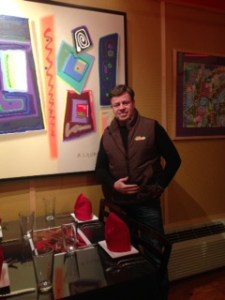
Fierro stands next to one of the paintings in Frida Bistro.

Fierro proved that dreams can truly become reality with deep passion and a lot of hard work. After growing up in Mexico, Fierro decided to leave his home and head to the U.S. hoping to learn English and make a name for himself.

“When I came to Utah in 1985, I didn’t know anybody,” Fierro said.

He said he did not have a place to live, so he ended up staying at a shelter for about a month.

Though his choice of living proved limited, he did not let that stop him from pushing to learn English and searching for a place to work.

“I went to a Catholic church, and they needed a volunteer to wash dishes,” Fierro said. “So, I said ‘Me! Me! I’m a dishwasher!'”

Fierro’s time at the men’s shelter gave him opportunities to see life in a new light. As he became more and more successful, Fierro searched for ways to give back to those around him.

“I was never hungry, so I promised to pay it forward,” he said, raising his sleeve and showing the words, “Pay It Forward,” tattooed on his arm.

And “Pay It Foward,” Fierro does.

In the early 1980s, he gained the friendship of a local couple, Larry and Gail Gerlach. Gail, who was teaching at Shriners Hospitals for Children, hoped to bring some authentic Mexican food to children from Mexico who were undergoing surgeries.

She called Fierro, knowing he would help her accomplish this dream.

“He came up one day and brought food for these kids, and they just exploded with joy,” Larry said in a phone interview. “Gail wrote him a check, and he said, ‘No. No, no, no. Señora, it’s on me, for my people.'”

By this action, Fierro supplied the children with something to look forward to and gained a permanent part in the hearts of the Gerlachs.

“He’s a special friend,” Larry said. “What he did for my wife at that hospital, I think, as much as anything, speaks of his character.”

Fierro actively works with the community by holding fundraisers for nonprofit organizations and initiating the Burrito Project.

The Burrito Project helps to feed the homeless with burritos and bottles of water in Salt Lake City. A large percentage of the homeless, Fierro found, are veterans. This discovery became a significant reason why he works so hard to feed them.

Fierro assembles a group of volunteers who come together to make bean and rice burritos. After the burritos are made, the volunteers hop on bicycles and ride around the city giving burritos to those in need.

This humanitarian effort attracted many volunteers, including University of Utah football players.

“Being able to feed the homeless is one thing, but actually seeing the ins and outs and seeing how these people in the shelter live, it’s very eye-opening,” said Matt Martinez, a former U football player and Burrito Project volunteer. “It’s very humbling to have them say ‘thank you.'”

In a phone interview, Martinez said he has become friends with Fierro and hopes to bring more publicity to this project.

Fierro’s philanthropy has been possible, in part, because one day he had an epiphany about the poor quality of Mexican food in America.

“One day I went to a supermarket, and I bought some flour tortillas and kinds of refined beans and some cheese,” Fierro said. “When I opened them, I was really disgusted with the beans. I thought, ‘What is this?’”

Fierro never dreamed of running his own food business, but after recognizing the lack of quality ingredients in Utah, he realized he needed to do something.

“I was thinking ‘What can I do?'” Fierro said.

He grew up with his mother running a small business. Fierro’s mother would make cooked beans, package them and sell them to markets in Mexico. Having watched her, Fierro had the thought that maybe he could do that too.

Not thinking once more about it, Fierro asked his mother for her cooked bean and creamy salsa recipes and started selling beans downtown at the farmer’s market.

Frida

Frida Bistro is designed with many bright colors and dim lighting. Even the waiting area is decorated to match the design.

Sales started to increase little by little and soon Fierro was approached by someone who represented a small line of farmer’s markets. They asked him if he would be interested in putting a label on his products and selling them.

Fierro jumped at this opportunity and thus was born the Rico brand.

Sales took off, so Fierro started searching for a larger place to prepare and distribute his products. As he was searching, he came across a large warehouse located on 545 W. 700 South.

He turned the warehouse into a place where he and his employees could make the food for the Rico brand.

Then, another opportunity presented itself.

“The front of [the warehouse] used to be my employees’ break room and my office,” Fierro said. “People would drive by and see my employees eating. They would come in and open the door and go ‘Oh, I’m so sorry. I thought it was a restaurant.’ So, OK, let’s start a restaurant.”

And so, Fierro converted the warehouse into a restaurant.

He chose the name Frida Bistro to honor the celebrated artist, Frida Kahlo. “Like Frida Kahlo’s passion for art, Frida Bistro represents Jorge’s passion for food,” according to ricobrand.com.

Bistro

Pictured is one of Fierro’s favorite spots in his restaurant.

Frida Kahlo became the overall theme of the restaurant as paintings of her embellish the walls. Bright colors and dim lighting also contribute to the decorative design of the restaurant which Fierro designed himself.

To add to the authentic feel of the restaurant, Fierro changes the menu every four months or so.

“I took the time to go to Mexico and learn about our gastronomy,” Fierro said. “We created our menu around that.”

In 2011, Frida Bistro was recognized as the best Mexican restaurant in Salt Lake City, according to the Salt Lake Magazine Dining Awards 2011.

Now, Fierro is the proud owner of Rico brand and Frida Bistro and also serves on the board of directors for Local First Utah. He actively works with the community by holding fundraisers for nonprofit organizations and initiating the Burrito Project, which helps to feed the homeless.

He adamantly believes in searching for a passion and is glad he found his calling.

“The most important thing: I love what I do for a living,” Fierro said. “I love what I do for a living.”

The Women’s Business Center: A support in the entrepreneurial journey

Story and photos by LIZ G. ROJAS

One of Utah’s best-kept secrets for aspiring entrepreneurs is the Women’s Business Center, located in downtown Salt Lake City within the Chamber offices.

The WBC is a nonprofit organization that is partially funded by the federal government through the Salt Lake City Chamber. Because the center is a 501(c)(3), it is expected to match the funding it receives through fundraising or sponsors.

The Women’s Business Center’s goal and purpose is to help increase the number of women-owned businesses in the state of Utah through consulting, training and networking opportunities.

The center has been operational for 17 years and has a consultant who provides a variety of different services. Services are free to the public and range from helping with business plans and cash flow projections to government consulting.

Former day-care owner Lorena Sierra missed the opportunity to work with the Women’s Business Center.

Lorena Sierra

Lorena Sierra

“I know a lot of times I needed help with grants and I wasn’t able to apply because I had no idea how,” Sierra said. “I wish I would have known of an organization like that [WBC].”

Sierra owned a day-care center in Utah County alongside her business partner for 17 years. In 2012, after her partner sold her half, Sierra ran out of funding options and chose to sell her business.

According to American Express, her center was 1 of 73,000 businesses in Utah that are women-owned, compared to the 9.1 million nationally that are owned by women.

The Small Business Administration defines a woman-owned business as one that is owned at least 51 percent by a woman. In addition, the woman can make independent decisions regarding the business without being undermined by anyone and is responsible for planning the short- and long-term activities.

Ann Marie Thompson- Program Director for the Women's Business Center

Ann Marie Thompson

Ann Marie Thompson, program director for the Women’s Business Center, says there is demand for a woman-oriented organization because there are different stresses for women than there are for men.

Most women are trying to start a business from home or as an addition to full-time responsibilities. They’re driven by flexibility because their first obligation is to their family. The majority of clients who meet with the WBC have these similar backgrounds and priorities.

Evette Alldredge, a local business owner, was guided by the Women’s Business Center and benefited from its services.

In a phone interview, Alldredge said that she arrived at the center with a partial business plan and high hopes. She met once a week for approximately five months with the center to create a business plan and explore all aspects of the planning.

Alldredge was able to present in front of Utah’s Microenterprise Loan Fund and received funding from the nonprofit for her business.

In April 2014, Evette Alldredge’s business, Super Gym Gymnastics, opened its doors.

However, even though the business center does direct its organization toward women, its services are for everyone. Thompson said that 20 percent of the WBC’s clientele are, in fact, men. She said, “We consult with anyone who wants to come.”

The Women’s Business Center has a broad range of connections and partnerships. Some of the partners are the National Association of Women Business Owners, the Utah Microenterprise Loan Fund and the Utah Governor’s Office of Economic Development.

The center also works with the Salt Lake City World Trade Center and Salt Lake Magazine. The WBC refers clients to the World Trade Center if they need help learning how to import and export.

Salt Lake Magazine features the Women in Business section in the September/October issue. The WBC is highlighted in that issue.

Although the center is associated with the Salt Lake City Chamber it is not confined to the Wasatch Front. Thompson said Google Hangout and Skype are frequently used to communicate with clients throughout the state.

According to the Small Business Administration, twice as many women-owned businesses are opened every day, compared to three years ago. However, there are still barriers that haven’t been overcome by women business owners.

One of the barriers is the compensation gap. Even if a woman is the owner of a business, her salary is lower compared to others in her same position.

“Women choose to pay themselves less, not knowing what others are paying themselves,” Thompson said. “Women are also choosing jobs that pay less. ”

American Express reported in 2014 that the goal shouldn’t be to motivate more women to open businesses, but instead to financially support those who are already established and help them expand.

Regardless, the need for the Women’s Business Center in Utah is crucial. As Lorena Sierra said, “We do need a lot of support. We have the desire to have our own businesses but we don’t have a guide.”

The WBC is one of Utah’s best-kept secret support systems for aspiring business owners.

“If it weren’t for the Women’s Business Center I would not be where I am today,” said Evette Alldredge, owner of Super Gym Gymnastics, who continues to work with the center for a business expansion loan. “I am the most happy, successful entrepreneur.”

Spice Kitchen Incubator helps refugees start food businesses

Story and photos by RYAN CARRILLO

Spice Kitchen Incubator gives certain Utah residents a unique opportunity: a chance to plan and develop a food-based business.

The kitchen incubator primarily assists international refugees who have relocated to Salt Lake City, but also provides services to immigrants and lower-income individuals. The program is part of the International Rescue Committee in Salt Lake City, or IRC SLC, which helps in international crises and relocates refugees in 22 different cities throughout the U.S.

Spice Kitchen Incubator provides everything from ovens to large prep space for the chefs

Spice Kitchen Incubator provides everything from ovens to large prep space for the chefs.

Refugees are individuals forced to leave their native country due to political unrest, war or safety concerns. When they are relocated to the United States, they have to adapt to a completely new culture and way of living.

Spice Kitchen Incubator helps them adjust to some of these changes.

Entrepreneurs, or participants, in Spice Kitchen Incubator aspire to start their own business. These individuals will mostly likely run their own catering business, food truck or farmers market booth by the end of the program.

The program is designed to help each entrepreneur achieve these goals and be successful in the American business market.

“Every entrepreneur’s goals are different but our overall goal is to build self-sufficient businesses,” said Genevieve Healey, the program coordinator for Spice Kitchen Incubator. “Those are the things we are helping them with, [things] like accounting, marketing and connecting them to resources. At a certain point they are comfortable doing that all on their own and they know how to use those resources.”

Spice Kitchen Incubator is divided into two different levels: pre-incubation and incubation. Pre-incubation is designed to help entrepreneurs develop a business plan and teach them how to run a successful business. Incubation is focused on real experience and exposure, putting each participant in control of their business.

Entrepreneurs begin in pre-incubation. They participate in this level for six months before advancing to incubation, depending on their individual needs and progress. During this phase of the program, they are building the foundation for running a business.

Each Saturday, the kitchen incubator hosts workshops for those individuals, covering everything from profit-and-loss and advertising to marketing positioning and food costing. Additionally, each entrepreneur will participate in a focus group. The focus group plays an essential role in the development of the aspiring business owner’s business plan.

“Volunteers from the food industry and the community come and try the entrepreneur’s food and those are entrepreneurs in pre-incubation so they are just developing their menu and what they are going to sell,” Healey said.

Feedback from volunteers is essential. It helps the chefs make adjustments to the business plan. It also can help them develop a mentorship with people in the community.

Kamal is one of 10 entrepreneurs in the pre-incubation stage. As a Bhutanese refugee, he was resettled in the U.S. almost five years ago. He has participated in the Spice Kitchen Incubator for almost a year.

Kamal’s focus group met on March 11, 2015. The chef spent several hours preparing food to present to the group. He said he has enjoyed participating in the program and was excited to share his culture and food with the volunteers and staff. He said he is very appreciative for the help of his wife and daughter, as well as a local volunteer, while preparing for his focus group.

Kamal prepares for his focus group with the help of his wife, daughter and a community volunteer.

Kamal prepares for his focus group with the help of his wife, daughter and a community volunteer.

After pre-incubation, entrepreneurs advance to incubation. This portion of the program typically lasts for 4 to 4 1/2 years. In all, entrepreneurs are able to be in the program for five years. There are currently three entrepreneurs enrolled in the incubation portion of the program. Since the Spice Kitchen Incubator was only opened in 2013, no one has graduated from the program yet.

During incubation, the aspiring business owners begin running an operational business. They start by applying for their business license. Once received, the entrepreneurs begin catering events and participating in local farmers markets.

During the winter, the chefs sell pre-packaged food at the market that they prepare at the Spice Kitchen Incubator’s facilities. The winter market is held every other Saturday at the Rio Grande Depot (300 S. 300 West) from 10 a.m. until 2 p.m. It runs through April 2015.

During the summer farmers market, entrepreneurs rotate between packaged and prepared foods. Prepared foods are cooked on-site rather than at the Spice Kitchen Incubator facilities. Healey said the kitchen hopes to expand its services at this year’s summer market to include one booth dedicated solely to packaged foods and another just for prepared foods. This would give the entrepreneurs more exposure and increase their ability to build a client base. The summer market runs from June 13 to Oct. 24, 2015, and is held each week at Pioneer Park on 300 W. 400 South.

Healey said the farmers market demonstrated how beneficial the incubator’s programs can be for both the business owners as well as the community as a whole.

“The farmers market was a really awesome experience, especially the summer farmers market because it is where we can do prepared foods,” she said. “We’ve said that there is a need for this in the community but it was really cool to have that hands-on [experience], like ‘oh yeah, people really want this.’”

Community members can get involved with the incubator through several different ways. The Spice Kitchen Incubator is always looking for individuals to serve on focus group panels, which requires a commitment of a couple hours each session, as well as help with any other topics related to running a business. Donations can also be made on the incubator’s website.

Maria Gigourtaki, who works as the volunteer and communications coordinator for the kitchen, said volunteers can have some amazing experiences with the program. “[The entrepreneurs] are all so passionate,” she said. “I mean, food is something that gets people together and it’s awesome. You can get to see and meet people, new cultures, new flavors, history, languages, everything. It’s amazing!”