Power of woman: struggle to strength

Story and photo by MCKENZIE YCMAT

We all have a story to tell, all we need is a platform to share it. Two women, Noelle Reeve and Hailee Henson, are both members of the Pacific Islander community and have stories that they believe will inspire people not just within their community, but all women in general.

“I just want to be remembered,” said Reeve, a 23-year-old half Hawaiian woman from Sandy who was recently diagnosed with lupus. “I just want to tell my story like everyone else.”

Lupus is a common disease that causes the immune system to have a hard time telling the difference between good and bad substances going through your body. This forces the body to create an army of antibodies that attack good tissues, which can lead to mild and sometimes life-threatening problems.

Reeve started showing signs of lupus early in her teenage years and decided to visit her doctor after noticing she had become sensitive to light, struggled with fatigue throughout the day and experienced muscle soreness.


28514327_10215218327122531_3995672404635637534_o

Noelle Reeve was diagnosed with lupus at age 20 and now tries to share her story.


“My first appointment was with a rheumatologist I found through Google,” Reeve said. “He looked me up and down and only asked short questions. Every time I would answer he would talk over me. I had hoped I would go in and spend at least an hour doing tests and figuring things out, but I was only with him for 10 minutes.”

After countless appointments with numerous doctors, Reeve felt like she was at a loss and needed to find another route to find the answers she was looking for.

“I realized I wasn’t being taken seriously because of my age, my gender, and possibly even my ethnicity,” Reeve said.

Researchers have found that 50 percent of non-white patients have lupus, compared with 25 percent of whites. Reeve finally discovered a small group of doctors who are aware of these facts and also are members of the Pacific Islander community.

“I felt like I finally found a place where people understood my disease and they also understood my heritage,” Reeve said.

The new group of doctors diagnosed Reeve with lupus and helped her find a treatment that fit her needs. She said she feels like she is managing her disease and living a healthy future.

“I finally feel like I have control of my life and I found it through my own community and my family,” Reeve said. “I hope one day I can help someone else as they have helped me.”

Reeve is trying to get more involved with her community and wants to help others find answers to their health questions by sharing her story with friends and family who struggle with the same things.

“It’s all about family in the Pacific Islander community and that’s the one thing I hope people take away from hearing my story,” Reeve said.

Susi Feltch-Malohifo’ou is the executive director of Pacific Island Knowledge 2 Action Resources, an organization that focuses on violence prevention, economic impact and education within the Pacific Islander community. ““Everything is for the family. That’s why we’re so good at sports, besides our build. It functions the same way as a family. All for one, all for one family,” she said.

Hailee Henson, a 25-year-old from North Salt Lake, grew up in a strong Mormon family but never knew her family heritage. Henson’s mother was born and raised in a white family, but her father was adopted as a child and never knew his ethnic origins.

“I served an LDS mission and spent 18 months with companions who were islanders from Tahiti,” Henson said in an email interview. “I always felt some sort of draw to them and special bond with them, but never knew why. They always joked that I was an honorary Tahitian.”

It wasn’t until early 2018 that her family decided to visit the Polynesian Cultural Center in Hawaii — a trip that pushed her father to get an official DNA test to find out which community he belongs to.

The day after returning home from their Hawaiian trip, the DNA test results had arrived. His father and mother were both Polynesian, making Henson a part of the 56 percent of the Native Hawaiian population to be considered as Polynesian mixed with another race.

“It felt amazing. It felt so right. Honestly, my family was so excited,” Henson said. “But like I said before, I’ve always felt so drawn to the Polynesian culture and this helped that tie make so much sense.”

Henson is currently studying to be a chef at the Culinary Arts Institute in Orem, Utah, and feels like her newfound identity has opened her eyes to a whole new menu.

After learning about her family heritage, Henson wants to understand more about Polynesian cuisine and share her findings with her family.

“I’m obsessed with Island cuisine. It’s such a simple way of life — eating off of the land and appreciating all that you’ve been blessed with,” Henson said. “The islands contain some of the best, fresh produce. They’re so blessed! I’d love to delve further into working with island cuisine and tropical fruits and fresh fish and all the good stuff.”

Reeve and Henson hope to make a change within the Pacific Islander community to show that women have a passion and a story to share that can change many — specifically those in their close communities — for the better.

LoL Hawaiian Grill: Lots of love and laughs in this Sandy restaurant

Story and photos by ALEXANDRA OGILVIE

The restaurant Lol Hawaiian Grill is kind of hard to find, hiding in a strip mall at 9460 S. Union Square in Sandy. The inside is very clean, with bright colors and welcoming music. The smell of slow-cooked pork is enticing as soon as the door is open. There isn’t room for many people with less than a dozen tables, and the kitchen is visible right behind the register.

Seven years ago Lana and Lopi Toleafoa opened their restaurant in American Fork, and about a year ago moved it to Sandy. “When we started out, some of our friends said, ‘Well, you have to find a spot where there are lots of Polynesians,’ but unbelievably, and amazing for us, our clientele, our customer base, is about 70 percent locals from Utah,” she said. “But they love our food.”

And love their food they do: their average on Yelp is four and a half stars out of five. Lana Toleafoa said that’s because “it’s very unique in that all our recipes are made by our family; they’re family recipes and yes there’s a lot of teriyaki barbeque chicken out there, we’ve been known to have the best.”

Of course, Toleafoa said, the most important ingredient used in any mom and pop restaurant is love. “I think it makes a difference that we love what we make.”

Ana, whose family is from Hawaii, loves the authenticity of the food. “A few things they ‘got right’ first of all is flavor. I can tell sauces are scratch made. The overall flavor profile is right on. Second is, the cuts of meat from the short ribs having some fat on them, chicken thigh as opposed to breast and even turkey tails. All cuts you would see used on the island.”

In addition to raving about the food, almost everyone on the first page of Yelp reviews talked about how nice everyone who works at the restaurant is. “You’re treated like family when you come here!” BJ Minson, a regular, said.

Sarah, another regular, wrote, “I love LoL Hawaiian Grill! Friendly staff every time just like being back on the North Shore!” Toleafoa loves learning the story of everyone who comes in, called “talking story” in Hawaii. “We love meeting new customers and getting to know you people every day.”

LoL Hawaiian Grill always offers the basic dishes: barbecue chicken; kalua pork, which is slow cooked until tender; kalbi ribs, a Korean-style dish that is very popular in Hawaii; and garlic shrimp. But if diners want loco moco — rice, a hamburger patty and an egg — they have to come in on a Wednesday. “We find that people look forward to those specials on those days,” Toleafoa said.

“We also make Polynesian dishes, you know, we don’t just focus on Hawaiian,” she said. “What we do have are very popular and people love what we make.” An example of a Polynesian dish they serve is Samoan oka, which comes with traditional Hawaiian poke. Both are made of raw fish, cured with some form of acid, much like Peruvian ceviche.

Lana and Lopi were both born in Tonga and lived in New Zealand before moving to Hawaii and ultimately to Utah when their daughter Juanina was accepted to Brigham Young University-Idaho.

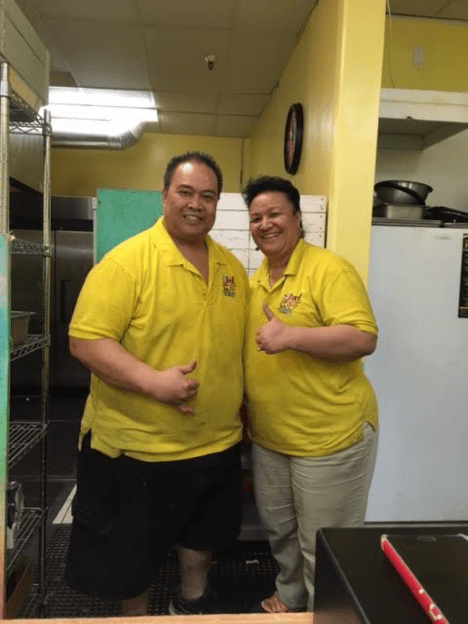
Lana and Lopi Toleafoa, owners of LoL Hawaiian Grill.

“We love our little island, we love the beach, we love the sand, and the ocean, so it’s been a huge, huge adjustment,” Toleafoa said. “But our kids wanted to get off the Rock.”

The LoL in LoL Hawaiian Grill stands for “Lana or Lopi,” but it could also stand for “laughing out loud,” “labor of love,” “love our life,” or “lots of love.” Toleafoa said, “We like to laugh out loud too! It’s catchy; it’s easy for people to remember.”

Despite being in the restaurant almost all day every day, Toleafoa and her husband love being restaurateurs. “It’s a lot of hard work, it gets pretty tiring, but we love what we do, so we hope to grow,” she said. “We work for ourselves, even though it’s really hard work, we’re the first in and the last out kind of thing, so it’s not easy. But just having that option where you don’t have to clock in, clock out, not having anybody to tell you what to do or jump here and jump there.”

They do it to feed their community: “We love that everyone loves to share the spirit of Aloha.”

Pacific Heritage Academy emphasizes heritage in order to succeed

Story and photo by JANICE ARCALAS

IMG_2788 (1)

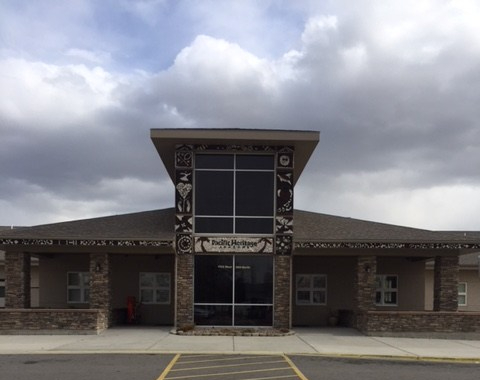
Pacific Heritage Academy opened in 2013.

“Look for the things in common and celebrate the differences,” said Dirk Matthias, director of the Pacific Heritage Academy. The charter school in Salt Lake City guides its students to success by implementing heritage in their daily school life.

Matthias was the school designer for Pacific Heritage Academy. He was drawn to the vision of the school and to work in a diverse community. When there was an opening for the director’s position five years ago, he applied for it and got the position.

Most of the students at the Pacific Heritage Academy located at 1755 W. 1100 North come from demographic sub-groups who struggle in the public school system. The schools in Utah don’t have a role model for students of color, Matthias said. The school helps their students find their roots and wings. Once their students understand their roots, they can grow wings to fly. This means that when the students understand their heritage they can grow.

Kindergarten to eighth grade students are taught Hawaiian, Tongan, Samoan and Spanish heritage at the Pacific Heritage Academy. For nine weeks a student will learn a specific heritage each year till their seventh and eighth grade. Seventh and eighth grade students have the opportunity to choose a heritage, where they will learn more in-depth about the heritage and develop conversational skills. Students have a heritage learning class, where they will learn their target heritage. It will consist of learning the language and culture.

Sisi Muti teaches the Tongan heritage at the school. She said that the students, when learning the language, will learn the alphabet, body parts, days of the week, conversational phrases and action words. The students are also taught Tongan culture songs, dances and legends. Muti also said that the students’ favorite activities are storytelling, games, writing poetry and stories, and making a book about themselves in Tongan.

The students will learn about heritage in their heritage language class, Matthias said. Every Friday they have a community meeting, where they will sing heritage songs. The community meeting also contains a heritage festival every nine weeks. The festival contains a target heritage and they will do all heritages. In addition to the community meetings on Fridays, every morning the students’ day starts with a circle about how they are doing focusing on the Habits of Crew through a video or a reading. They will set a goal keeping the Habits of Crew in mind.

The Habits of Crew contain six elements: Courage, Compassion, Craftsmanship, Responsibility, Perseverance and Collaboration. These elements have a connection to Polynesian heritage. The Habits of Crew is also the narrative of the voyager, which is the school’s mascot.

“We are Voyagers like ancestors of old. We are strong, inventive, courageous, and filled with wonder. Sailing seas of knowledge, we seek understanding and use it with compassion. Looking forward, we honor the past to better see our future. We will find hope and success in spite of wind and change. With our eyes to the heavens, fixed on guiding lights, we know ourselves, our space, our time. We will seek, we will find, we will know new horizons. We are Mighty Voyagers!” This statement at the bottom of the PHA’s website recognizes the characteristics of a voyager and connects them to the school and student success.

The school is coming up on its fifth year and it is starting to see stability. In the beginning, there was a lot of student turnovers. There are over 400 students and it is difficult to see a student’s growth when they start in the middle. Now the school is able to see the students’ growth, who started at kindergarten, who are now in fifth grade, Matthias said.

The teaching staff is also stabilizing. The teachers who are coming to PHA are interested in teaching, the mission and vision of the school, Matthias said. The teachers take leadership in the school and have a lot of say about making decisions at the school.

Just as how their indigenous heritage community is, at the PHA, they don’t leave students behind, Matthias said. When they make mistakes or get into trouble they are there for the students to get back on their feet and work with them to succeed.

The Pacific Heritage Academy’s students succeed through learning about their heritage; roots, so that that they can fly.  For five years, the academy has implemented Tongan, Spanish, Samoan, Hawaiian heritage learning so that the students can see that not only white students can be protagonists in books, but children of color can also be too, Matthias said .

The website contains this quote on the front page. “Through thoughtful inquiry, challenging curricula, rigorous requirements, and compassionate service students learn who they are and what they can become. We create learning experiences and students find their Roots … and their Wings.”

Image courtesy of Nicole Aguirre and Siva Pasefika, a Polynesian dance company based in southern Utah that performs and teaches children and families about Pacific Islands dances and traditions.

Filipinos confused about where they belong

Story and photo by MCKENZIE YCMAT

Logging into Ancestry.com to view the results of a DNA test, Robert Ycmat wasn’t quite sure what he was going to discover. Once he got the results, they confused him even more.

“The results were interesting,” Ycmat said. “Everything seemed pretty standard, but what confused me the most was how they defined me as South Asian/Pacific Islander. I always just considered myself Asian!”

Story1Asset1

Robert Ycmat at home in his study.

This question is one that many have wondered themselves. Are Filipinos considered Pacific Islanders?

Even when searching for Filipino news on the Pacific Citizen website, hundreds of articles appear talking about politics, food and even Hollywood news in the Philippines.

Rumors have spread that the U.S Census Bureau has officially decided to classify Filipinos from Asian to Pacific Islanders, but according to the Census Bureau’s official website, “The Census Bureau has no current plans to classify Filipinos outside of the Asian race category.”

According to the Bureau, the Philippines are legally concerned to be a part of Asia. So doesn’t that answer the question?

The Philippines consists of 7,000 islands and it was Spain that officially tied them all together into one country in the 16th century. The islands start from the north, by Asia, and slowly slant downward toward the east, closer to the Pacific Islands.

Because of this odd gathering of the islands, many Filipinos from the north classify themselves as Asian, whereas those who live in the southeast islands will sometimes classify themselves as Pacific Islander.

“Although I always considered myself Asian,” Ycmat said, “Filipinos have created a culture that is much closer to the traditions of the Pacific Islanders than Asians.”

Susi Feltch-Malohifo’ou, the executive director of Pacific Island Knowledge 2 Action Resources, said, Pacific Islanders consist of Native Hawaiians, Samoans, Chamorros, Fijians, Marshallese and Tongans.

What really brings all these different nationalities together are the unique cultures of the Pacific Islanders.

“We believe in the tradition of family,” Feltch-Malohifo’ou said. “Sacrifice yourself for the good of the family.”

Ycmat agrees with the fact that family was always a staple in the Philippines growing up. It’s one of the main reasons that he decided to learn more about who he is through the services of Ancestry.com.

Although Ycmat only lived in the Philippines through his childhood, moving to the United States in his teen years, he remembers his mother holding onto family traditions throughout his life.

“She always put herself first for our family,” Ycmat said. “Our father was no longer involved with me and my siblings once we moved to America, so my mother put it on herself to keep us close and to keep the traditions alive.”

Just like with most cultures, Filipinos hold onto their traditions tightly. They can find ties in their traditions with Asian culture but also with the Pacific Islander culture as well.

Ycmat’s oldest daughter, Danielle Jansson, recently lived in a small city within the Philippines called Iloilo City for a religious mission.

Jansson discussed the importance of the Filipino culture through food, family and tradition. After some reflection, she finally came up with an answer regarding her thoughts on how Filipinos would identify themselves.

“Probably Asian,” Jansson said. “But, they don’t care and they don’t ask. They just know that they’re Filipino.”

Jansson said the Philippines have taken a lot from the Pacific Island culture like their belief of family and celebration of food. They’ve also taken values from Asians such as individuality and their sense of independence.

“They care about their family, but they also want to take care of themselves,” Jansson said. “They have a personal dream and they want to accomplish it on their own, not just for their family. They’re known for being hard workers and they have no shame. They’re just Filipino.”

Religion plays a big role in culture for both Filipinos and Pacific Islanders.

“Religion, especially the Mormon and Catholic church, teach values of pride and family,” Feltch-Malohifo’ou said. “We naturally gravitate towards these religions because of the teachings of love and community.”

According to the Harvard Divinity School Religious Literacy Project, “Catholicism has been the cornerstone of Filipino identity for millions in the Philippines. Catholicism rapidly spread during the early years of Spanish colonialism.”

After a bloody war called the Philippine–American War in the late 1800s, Americans migrated to the Philippines and even pushed their way through to the Pacific Islands. Because of this, the teachings of the Catholic Church became a common belief among these two countries.

“I kind of like that there’s no clear answer to this question (about identity),” Ycmat said. “It makes Filipinos even more unique than they already are. It almost describes Filipinos perfectly — we do what we want because we want to do it, not because we belong to either.”

Kirby Araullo, who is the program coordinator for the Asian American Studies undergraduate department at the University of Califonia Davis, discusses this question, “Are Filipinos Asians or Pacific Islanders.”

Originally raised in the Philippines, Araullo found that this question was only asked in America. He answers by saying, “It’s up to you. We the people have the power to define and redefine ourselves, as long as we respect each other. ”

Why Pacific Islanders in Utah have trouble connecting with mental health care

Story and photo by ALEXANDRA OGILVIE

Most Pacific Islanders live in a clan-based family society, where the family unit as a whole is viewed as more important than the individual, said Susi Feltch-Malohifo’ou, the executive director of Pacific Island Knowledge 2 Action Resources (PIK2AR) in Salt Lake City. Family is so important that many Pacific Island languages don’t distinguish between “brother” and “cousin.”

However, this family-based support system often prevents Pacific Islanders from getting professional help with mental illnesses and domestic abuse.

Karson Kinikini, a Pacific Islander and a licensed professional counselor of mental health, said in an email interview, “As a tribal/family based culture, they may more naturally seek support from within their family system in non-clinical ways. Often times, the concept of counseling (going to talk to a stranger about personal things) seems like a foreign concept to a people who have learned to rely on each other. Polynesians are often LDS in Utah, and so they have another support system of the Church, who they will often talk to before reaching out to a stranger.”

While having a strong support system is key to good mental health, family members and clergy often aren’t trained to give mental health advice. This is generally OK when the problems are about having an unrequited crush, but can become problematic when a family member has an undiagnosed serious mental illness, Kinikini said.

One example of mental illness is depression. Depression can present in many ways other than feeling sad all of the time. In men, it can often show itself as aggression. “All types of mental health problems were positively associated with aggression perpetration,” according to a study in the Journal of Family Violence.

This is certainly not unique to the Polynesian community, but the Organisation for Economic Co-operation and Development reports that Polynesian women are at the same risk for spousal abuse as are women in Somalia and Afghanistan.

Line drawing of sad people

A bipolar woman’s visual description of her illness. Used with permission.

One of the programs that PIK2AR offers is an anti-domestic abuse Pacific Island initiative. Feltch-Malohifo’ou said domestic abuse doesn’t end when families leave the islands and come to Utah. She said the family clan system also contributes to women not seeking help. “Women are expected to carry their share of the family burden.”

According to the Office of the Surgeon General, racism is a major barrier when it comes to getting mental health help. “Ethnic and racial minorities in the United States face a social and economic environment of inequality that includes greater exposure to racism and discrimination, violence, and poverty, all of which take a toll on mental health,” it stated. And for good reason, the office reported, “Their concerns are reinforced by evidence, both direct and indirect, of clinician bias and stereotyping.”

Along with overt racism, racial minorities tend to occupy the lower socio-economic echelons. Kaati Tarr, a Pacific Islander who is a licensed clinical social worker in Salt Lake City, said in an email interview, “In my opinion, it’s a combination of culture and socioeconomic status. Having insurance coverage helps, but still, the co-pay might be considered excessive, especially if paid weekly. $25 x 4 visits a month is $100 dollars that could be used to pay for food and higher priority basic needs.”

According to The Utah Health Department, “16.3% of PIs (Pacific Islanders) reported that someone in their household had been unable to receive needed medical care, tests, or treatments during the past year, usually due to financial barriers.”

Kinikini, the counselor of mental health, said money isn’t the only missing resource — mental health professionals often don’t have translators. “Services available in a native Polynesian language is very difficult to find access to. I, for example, am of Tongan descent but I do not speak Tongan. I have struggled to find native language speaking therapists to refer native language speaking clients to. Consequently, often the solution is to have a family member or friend translate. This can limit the effectiveness of the counseling process.”

Studies have been done on bridging this gap for other racial minorities, such as Latino and black communities. But, few data exist on Pacific Islander communities, so many families and mental health professionals are left on their own to determine best practices.

“The overall rates of mental disorder for many smaller racial and ethnic groups, most notably American Indians, Alaska Natives, Asian Americans and Pacific Islanders are not sufficiently studied to permit definitive conclusions,” the NIH reports.

Tarr, the local clinical social worker, said, “Unfortunately, I don’t have any additional resources to provide you with … that’s part of the issue, I think.”

But local Pacific Islanders like Kinikini and Feltch-Malohifo’ou are working toward closing that gap.

Empowering cultures in Pacific Islands community in Utah

Story and photo by DAYNA BAE

Utah has the largest Pacific Islander population in the United States per capita. Approximately 38,000 Pacific Islanders are currently living in the state. However, stereotypes against Pacific Islanders are considered a significant obstacle in constructing their own cultural identities.

Susi Feltch-Malohifo’ou is having an interview at the University of Utah.

“Our first, second and third generation, they are floating around with lost identity,” said Susi Feltch-Malohifo’ou, the executive director of Pacific Island Knowledge 2 Action Resources (PIK2AR). “When they are in their home, they are Americans, when they leave, it’s not how we perceive ourselves, it’s about how you perceive me.”

Pacific Islanders often face stereotypes related to their physical strength. They are commonly thought of as athletes due to their physicality. Consequently, many Pacific Islander figures in mass media and pop culture are typically portrayed as security guards or athletes.

In addition, many Americans tend to view different Pacific Islander cultures as one identical culture. This creates yet another stereotype.

In fact, Pacific Islanders consist of Polynesians, Micronesians and Melanesians divided into three different regions. Polynesia includes Hawaiian Islands, New Zealand, Easter Island and the Samoan Islands. Micronesia incorporates the islands of Kiribati, Nauru, the Marianas such as Guam, Fiji, Norfolk Islands and other small islands. Lastly, Melanesia is comprised of the island of New Guinea, Papua New Guinea, the Solomon Islands, New Caledonia, Fiji and few other smaller islands. Since each region has different geographic, historical and weather conditions, there are obvious differences among the Pacific Islanders.

Jacob Fitisemanu Jr., a clinical manager with the Utah Department of Health and an associate instructor of ethnic studies at the University of Utah, said, “Literally hundreds and hundreds of different languages are spoken throughout the Pacific, accompanied by myriad worldviews, artistic perspectives, governance systems, subsistence patterns, etc.”

Despite diverse Pacific Island cultures, a misconception as perceiving them as one group pervades in everyday life.

“When I went to the hula dance class, the instructor told me that she thought every Polynesian knows how to do a hula dance,” Feltch-Malohifo’ou said.

To correct pervading misunderstandings, PIK2AR focuses on emphasizing dissimilarities and cultures of various Pacific Islands communities. The organization offers educational and cultural programs such as the Utah Pacific Island Heritage Month, an annual festival held in August. Regarding the missions of PIK2AR, Feltch-Malohifo’ou said, “To educate outside of our community of similarity between all of our countries, but also some differences.”

Feltch-Malohifo’ou shared what she had witnessed in East Palo Alto, California. “Pacific Island kids were coming to know how to go to college.” She was helping them with filling out the documents. “There was a missing bridge between culture and resources,” she said.

According to NBC News report, many Pacific Islander students have experienced a lack of academic support and information. Some students were frustrated by filling out Free Application for Federal Student Aid (FAFSA) documents. The others did not feel confident about signing up for scholarships.

Although Pacific Islander students are willing to go to college or university, many of them do not have access to adequate information due to lack of appropriate support. Lack of academic resources leads to unfortunate statistics. Empowering Pacific Islander Communities, a nonprofit organization, announced that only 18 percent of Pacific Islander adults have a bachelor’s degree.

Biased perspectives also hinder Pacific Islander students from building cultural identities.

Feltch-Malohifo’ou said, “It feels like they need to uphold stereotypes and they are pigeonholed by everybody around them that they have to be this way.” One of the common stereotypes is that Pacific Islander students play in a football team at school. “How about if they don’t want to be a football player?” she said.

Putting them into a pigeonhole not only influences their school life but also has negative effects in their life.

Although PIK2AR has not yet quantified the depression rate among Pacific Islander teenagers, the suicide rate has increased in Utah and a 12-year-old committed a suicide in 2017, according to Feltch-Malohifo’ou.

As a response, PIK2AR prioritizes children and young students from Pacific Island communities who are suffering from intertwined identity and stereotypes as primary targets.

“We try to educate and reach out to youngsters,” Feltch-Malohifo’ou said.

One of PIK2AR’s cultural preservation education programs is using cultural objects of Pacific Islands communities. They use the objects to educate young students. Kava bowls and tapa cloth are the examples. “A kava bowl, maybe it’s different, but everybody can recognize that it comes from the Pacific Islands community,” Feltch-Malohifo’ou said. With the objects, PIK2AR tries to find cultural commonalities and builds meaning around it. Teaching about shared culture helps young children to differentiate dissimilarities between Pacific Islands cultures as well as the common features. “We teach the history and teach about the objects. Because it still has value,” she said.

Fitisemanu shared his idea about another effective method of cultural preservation. “Teaching and developing literacy and fluency in heritage languages is another important piece, and this process involves updating language with new words to reflect modern contexts that our ancestors never encountered,” he said.

Fitisemanu also suggested that documenting oral histories and perpetuating ceremonies, customs, language and performing arts are all necessary to preserve culture. “But more importantly, to me, is demonstrating the value of these practices and values for contemporary Pacific Island generations, who will ultimately decide what cultural traits to maintain and transmit to future generations,” he said.

A community can also provide a useful way of preserving culture.

Fitisemanu lives in West Valley City, which has the largest Pacific Islander population in Utah. He said that his daughter is involved in many cultural aspects by attending school, participating in cultural dance classes and speaking Samoan language in the community. He said, “Preserving a sense of Pacific Islands identity and culture is facilitated here, whereas it would be very difficult for my family to maintain cultural and language connections if we lived, say, in Sevier County,” he said.

Young Pacific Islander students are currently living in American multicultural and bilingual settings. Within the mixed Pacific Islands culture and American culture, students need help and support to develop their own unique identity.

Fitisemanu said, “We should encourage children to be versed in English and their heritage languages. That kind of upbringing teaches children to be very observant situational learners who pick up on social cues and learn to code switch and see through different perspective lenses.”

Local universities and colleges also put efforts to work with Pacific Island communities. The University of Utah has the Pacific Islander Student Association (PISA), which is a student-run organization within the Center for Ethnic Student Affairs (CESA). The student group enhances learning experiences and provides off-campus opportunities to serve Pacific Islands communities. In addition, the Pacific Islands Studies Initiative (PISI) is an academic collective that makes the U as a premier institution for Pacific Islands studies.

Utah has the largest population of Pacific Islanders per capita in the nation, and it also has numerous organizations and communities to support them. Pacific Islander organizations such as PIK2AR and PISA aim to provide cultural preservation, economic support, domestic violence education and other useful programs for Pacific Islanders in Utah. 

What happens when brave women make waves in their communities

Story and photos by HANNAH CHRISTENSEN

IMG_20180210_113831

Matapuna Levenson and reporter Hannah Christensen at the SLC Family Justice Center, YWCA.

Pacific Island (PI) women who experience domestic violence often feel powerless, helpless and alone because the American idea of rugged individualism contradicts the ideals of PI collectivism.

Matapuna Levenson, Salt Lake Area Family Justice Center at the YWCA lead guide and advocate, said, “When intimate partner violence occurs, somebody is making you believe that you are not powerful. We need to go back to remembering and believing in ourselves both as individuals and as a people, that we are powerful. We’re resilient, we’re here, we’re alive.” Those of PI descent embody this power and strength through honoring and remembering where they have come from.

Levenson spoke to how this deep connection with their ancestral and cultural roots is sacred to the PI community. They have passed down many traditions, beliefs and ways of living that provide a stark contrast from the colonized white world of America.

Leata Puailoa Hunt is an advocate against domestic abuse. She is a native of Samoa who now lives in Draper, Utah. “In our true culture, high chiefs honor their wives and treat them like queens and then all the daughters in a home are treated like princesses. We keep them in a sacred status,” she said.

Historically, women of the Pacific Islands were in positions of power and held in high regard. Today they are raised to be strong matriarchs. “The good thing about our culture,” Hunt explained, “is we’re trained as girls growing up to be mothers already, we can cook, we can clean, we can solve problems, we can do this. We are independent and we can carry a family, but also at the same time I love that we train our men to respect our women.”

While many PI communities continue to treat women with reverence, something switched when patriarchal systems were introduced to the islands. Levenson, with the YWCA, said, “I’m going to blame patriarchy, because it’s not just white capitalists. Whenever there is an opportunity to have power and control over individual groups or communities, they’re going to do it. And it’s typically men, that’s just history. We have to combat and oppose this historical power.”

Levenson explained how indigenous PI communities did not have these complex power dynamics. A well-known Samoan proverb, “Ó le fogāv’a e tasi,” translates to, “The canoe has one deck.” This is the PI mentality at its best. Everyone is on the same boat, striving toward the same goal, together as equals. It wasn’t until power dynamics were introduced that the canoe became difficult to navigate.

Both Levenson and Hunt spoke about how the hierarchy of power was introduced to PI culture and the result was individualistic thinking. The clash of the collectivist community ideals and the egocentric mentality results in a lot of confusion, cognitive dissonance and anger. This is one underlying reason that domestic violence is happening within PI communities. The contradiction here is that because of the deep-seated beliefs, everyone works together for the greater good of all, and rather than challenge the systemic problem, it is best to ignore or not speak out when there is violence in the home.

Not feeling able to speak out about abuse also stems from the strong PI beliefs in families and family unification, because it is important to protect the family name. Hunt said “a family will hide secrets, like abuse or domestic violence, you know, things that are going on that shouldn’t be going on, that’s actually another key factor because of the family name. They hide it or sweep it under the rug and go forth as a perfect family that has a title.” Hiding these secrets within families is sometimes the only way a family can keep their titles and status in the community.

IMG_20180214_114722

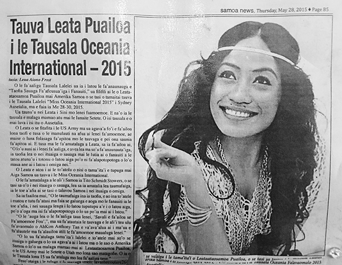
A Samoan newspaper featured Leata Puailoa Hunt in the 2015 Miss Oceana Pageant in Sydney, Australia.

Hunt recalled how there was much less tolerance for abuse in Samoa than there was in American Samoa. “If someone is abusive or commits adultery, they will be fined by the village and if it was really extreme, they would be banished from the village,” she said.

Hunt is an advocate for those who have been abused because she lived through her sister’s domestic violence abuse. “There’s no excuse for it no matter what. I know from my personal upbringing, it is not part of our culture, it is not taught on our homeland.” Hunt advocated for domestic abuse survivors as a contestant in the 2015 Miss Oceana Pageant in Sydney, Australia.

There are many resources in Utah for victims and survivors of domestic violence within the PI community. Pacific Island Knowledge 2 Action Resources (PIK2AR) is one of them. Susi Feltch-Malohifo’ou, co-founder of PIK2AR, started the organization with her husband, Simi Poteki Malohifo’ou. He and other men wanted to get involved with the domestic violence issue in the community. Feltch-Malohifo’ou said of the men who started this group, “They came together because they recognized that there is a problem.” She has been an advocate for women because she herself is a survivor of domestic violence.

Feltch-Malohifo’ou coordinates many programs to provide support for PI women. These programs provide a safe space for them to share their experiences. The YWCA also focuses on empowering women and connecting them with resources. Levenson, who grew up in a domestically abusive home, shared, “I asked a survivor once, ‘What do you need to feel more comfortable in sharing your story?’ And she said very quickly and naturally, ‘I just need to hear other people share theirs.’ And that’s it exactly.”

Additional resources can be found on the Salt Lake Area Family Justice Center’s website, the Utah Domestic Violence Coalition website and the Utah 2-1-1 website. Women also can dial 2-1-1 for help and connection to resources.


Post-incarceration life for the Pacific Islander community in Salt Lake City

Story and infographic by GEORGE W. KOUNALIS

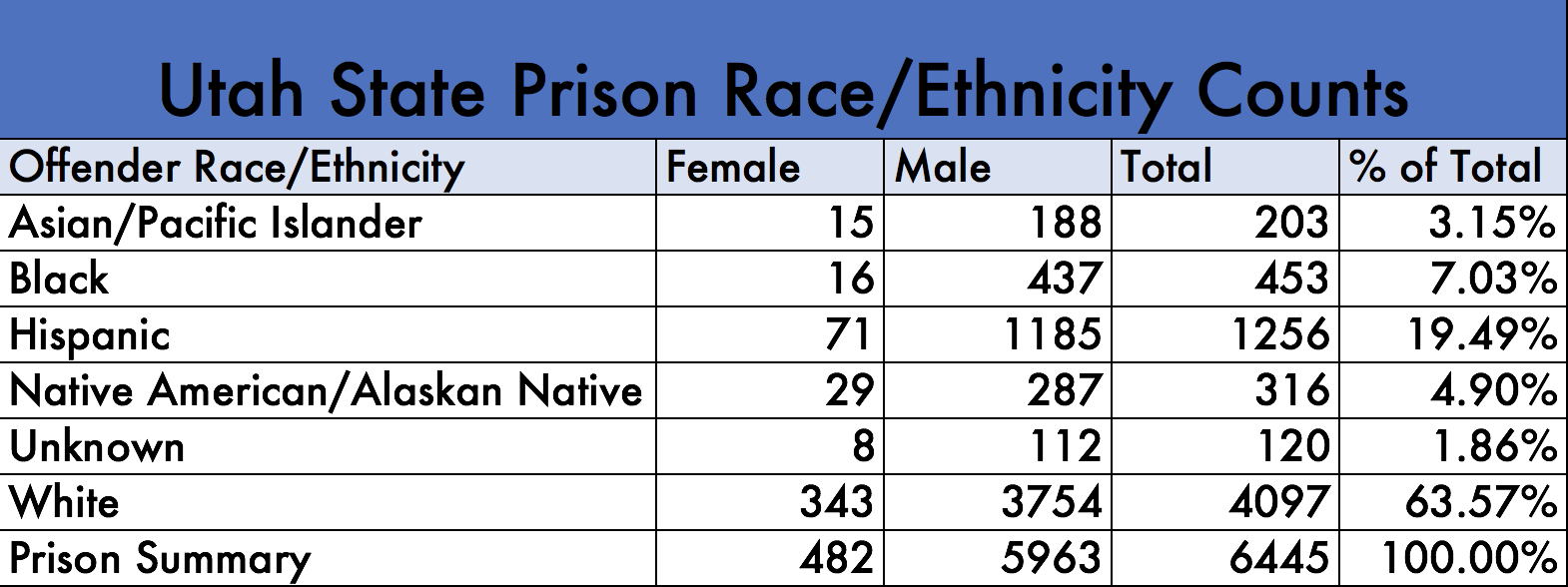
According to the Utah Department of Corrections statistics, Pacific Islanders make up 3 out of every 100 inmates in their population.

Susi Feltch-Malohifo’ou, executive director of Pacific Island Knowledge 2 Action Resources (PIK2AR), said, “Pacific Islanders are 1 percent of the general population in Utah, 4 percent of the prison population, and it’s not getting any better.”

The question arises, what resources are there for those leaving the prison system and what can society do to give former inmates a second chance?

“The color of your skin makes a huge difference. I’m not being racist, I’m speaking from experience,” said Randy Tinoga, 46, in a phone interview about life after prison.

Tinoga came from Hawaii to Utah in 1999. He moved to get away from a meth addiction. In 2002 Tinoga relapsed and went through multiple drug rehabilitation facilities across Salt Lake City. Odyssey House was his last inpatient residential program, and soon after leaving, he began using again in a much bigger manner.

Tinoga received charges in 2005 and was sent to federal prison January 2006 and released in April 2011. Tinoga was put on probation through the federal system until 2014. After getting in trouble, Tinoga has stayed in Utah and has not returned to Hawaii.

When inmates are released they are required to spend six months in a federal halfway house. During that time period, they have to find employment and then they’re expected to contribute back to society.

“The resources are out there, people are afraid to take a chance on a federal felon,” Tinoga said about his post-incarceration life.

“Every person in federal prison feels like you’re starting one to two laps behind everyone else,” Tinoga said. “If you’re a Polynesian convicted felon, you feel like you’re five steps behind everyone else.” These statements speak to what the prison system does to those who go through it and the impact the system has on minorities.

Tinoga said the most important thing needed outside of prison is a telephone and family. “Without a family, you’re playing catch up,” Tinoga said. “Most Polynesians incarcerated come from strong families. They do have a strong support system.”

The concept of family is a significant aspect of Pacific Islander culture. “The collectivist perspective is very important to the Pacific Islander community,” said Oreta M. Tupola, community health worker section coordinator with the Utah Public Health Association.

Tinoga is living in Salt Lake County and involved with PIK2AR’s Kommitment Against Violence Altogether (KAVA) talks, a Pacific Islander male domestic violence advocacy group. “My transition back to public life was easier on my part,” Tinoga said. “If you want to make a change, you have to take a chance! If someone is willing to take a chance on a Polynesian American, take a chance on them.”

Pauliasitolo Vainuku, 39, describes his life after leaving prison. Vainuku went to federal prison for a bank robbery. He was released from prison and had his probation terminated in January 2018.

“A lot of things in our culture, we don’t like to talk about,” Vainuku said in a phone interview. “Abuse is there and it’s not talked about. That’s how a lot of Pacific Islanders join a gang because there’s a cultural understanding there for them.”

Tupola said, “Family is important in Pacific Islander culture. Gangs are from a loss of that identity and trying to look for it again.”

This is where groups like PIK2AR’s KAVA talks come in. They can help those who are struggling with abuse.

Vainuku’s brother, who was involved in a gang, was killed when Vainuku was 12. “After his death I was depressed. I had nobody to talk to,” he said.

Vainuku then turned to robbing at the age of 12. “When you’re depressed you don’t care,” he said. “Certain things you do make you feel alive,” he said, describing how his robbing began.”If you keep doing the same things it becomes normal.”

A couple of months after turning 18, Vainuku was sent to federal prison. “For me it was actually getting away. Getting locked up made me able to escape reality,” he said.

Vainuku said after getting out of prison, there were resources available to him. “There’s a second chance bill that lets small businesses hire us and they bond them for hiring us.” The Second Chance Act of 2007 “was enacted to break the cycle of criminal recidivism; improve public safety; and help state, local, and tribal government agencies and community organizations respond to the rising populations of formerly incarcerated people who return to their communities.”

The bill gives the small business a bond that provides insurance in case a former inmate ends up robbing or doing damage to the business as well as a tax break for the business. Bills like this give former inmates of the federal prison system a second chance.

Vainuku spent six months in a federal halfway house while he worked and saved money to live independently. “The federal halfway house makes you actively look for employment,” Vainuku said.

These programs help federal prisoners when they adjust on the outside, but Utah State prisoners don’t receive many of these resources, according to Vainuku.

According to the Utah Department of Corrections, mental health resources are offered at Utah State Prison for prisoners within the system. “We’re coming out and not getting the help and support with mental health,” Vainuku said. “For the guys in prison, they need to get help in prison and get ready to come out.”

A May 2017 article in the Deseret News backs up what Vainuku said. Many of those in the Utah corrections system are not receiving appropriate care when they leave prison.

Vainuku said the state of Utah could do more to help inmates coming out. “In the state prison, they’re stuck in a cell with their cellie and get a packet. They’re not getting classes or help for life on the outside.” According to Vainuku, this packet is the only resource that state prisoners in Utah receive prior to being discharged.

Racial prejudice within jail is also a factor that makes it difficult for inmates. “Prison is a negative setting, the guards tend to get stuck in a negative mindset with an us versus them mentality,” Vainuku said. “The guards build a prejudice and they do things that upset the prisoners more.”

Tinoga said, “Stereotypes are bad all the way around. A good number of Polynesian men are first-time offenders.” Stereotypes of Pacific Islander men being pushed by society at large creates very negative environments that can hinder the lives of many of these men.

It’s important for society to look beyond stereotypes and give former inmates a second chance. “Just giving someone the opportunity helps,” Vainuku said. “Look at the individual instead.”

Many of these changes that society needs start at a community level. Challenge stereotypes, give individuals a second chance. Community-driven resources are also important.

In a 2016 Seattle Times article, Sarah Stuteville talks about the Formerly Incarcerated Group Healing Together (F.I.G.H.T), a group of former Pacific Islander and Asian inmates who work to provide resources to those leaving the Washington State penal system. The Utah Department of Corrections does offer programs to inmates, however, nothing specifically like the F.I.G.H.T group offered in Washington state.


LGBT Pacific Islanders in Utah face discrimination

Story and photos by SHAELYN BARBER

It takes a village to raise a child, but what happens if that child does not fit into male or female gender identities? In Pacific Islander culture, it is not an issue.

Across the Pacific Island cultures, these individuals are known by many different names. In Samoa, they are Fa’afafine. In Hawai’i, they are Māhū. In Tonga, they are Fakaleiti. These are the people who are not male or female, but somewhere in the middle: a third gender.

The third gender is an integral part of traditional Pacific Island culture, and individuals who fall into this spectrum are highly respected members of society. People who are part of the third gender category do not adhere strictly to stereotypical characteristics of male or female genders, and often display characteristics of both. The Pacific Island third gender category can include people who act or dress in a way that is not associated with the sex they were assigned at birth or people who are sexually attracted to someone of the same gender.

“It’s important to see the similarities between Māhū and transgender identities here in the U.S., but also it’s not just a direct translation,” says Maile Arvin, a native Hawaiian and assistant professor of gender studies and history at the University of Utah. “I think it’s just a little bit different than transgender in the sense that that was a defined role that was honored in Native Hawaiian society, that has its own history.”

Arvin says that traditional gender roles in Pacific Island societies are balanced and are not necessarily matriarchal or patriarchal communities. Within them, masculine and feminine roles are distinctive but receive equal amounts of respect. Men are typically the protectors, workers and financial supporters of their families. Women take on the role of caretakers of the family and the home. People who identify in one of these third-gender identities have a role within traditional Pacific Island societies as well: they are usually the leaders and teachers of spirituality and culture.

“Sometimes it’s hard for non-Hawaiian people to understand what Māhū means,” Arvin says. “So, in some contexts it might just be more convenient to identify as transgender instead of going into explanations about what Māhū is.”

People who identify as a third gender in Pacific Islander societies often find it difficult to explain the meaning to others who are not familiar with it. Despite parallels to LGBT (lesbian, gay, bisexual and transgender) identities, the two are distinct. Someone can identify with both an LGBT identity and an identity in the third-gender spectrum.

“I’m not really picky but I know that I personally identify as feminine pronouns, but then when people see me they’re like, what the heck? I don’t get it,” says Leka Heimuli, who works as a secretary for the Office for Diversity and Multicultural Affairs at the Salt Lake Community College South City Campus. Heimuli is Fakaleiti, the Tongan term for the third gender, and describes herself as a gay man who prefers female pronouns and typically dresses in a masculine way.

Leka

Leka Heimuli, secretary for the Office for Diversity and Multicultural Affairs at the Salt Lake Community College South City Campus

Heimuli is a first-generation Polynesian Tongan American. Her mother and father both emigrated from Tonga searching for opportunities for work, education and a better life. They met in Utah, got married and had six children, a small family by Pacific Island standards, which Heimuli says typically have between 10 and 15 children.

“I feel like when colonialism came, you know, to our shores that’s when you kind of see that drift of, oh, that’s wrong. That’s bad,” Heimuli says. “I think now we kind of use those terms in a derogatory manner.”

The Church of Jesus Christ of Latter-day Saints has raised controversy because of its doctrine concerning the LGBT community. According to church doctrine sexual and marital relationships should only be between one man and one woman, and sex or marriage between two people of the same sex is forbidden. According to the Association of Statisticians of American Religious Bodies, the state of Utah has the highest percentage of constituents in the United States.

“We’re here, you know, like, you can’t control it,” Heimuli says. “There are members [of the Church of Jesus Christ of Latter-day Saints] I feel don’t come out because of like … that stigma that’s maybe placed on them from the church or maybe from the beliefs.”

Heimuli says that while the discrimination against LGBT and third-gender Pacific Islanders within the Church of Jesus Christ of Latter-day Saints is not extreme, these communities do face negative effects, comments and stigmatization from its members.

“Our belief and our history before Christianity came is that we have three genders. So, that’s a norm,” says Susi Feltch-Malohifo’ou, the executive director of Pacific Island Knowledge 2 Action Resources (PIK2AR). “For some reason this plane ride, this 10-hour plane ride to America, changed that.”

Susi

Susi Feltch-Malohifo’ou, the executive director of Pacific Island Knowledge 2 Action Resources

“Food is love” at the Pacific Seas Restaurant and Market in Salt Lake City

Story and photos by SHEHERAZADA HAMEED

IMG_1613V2

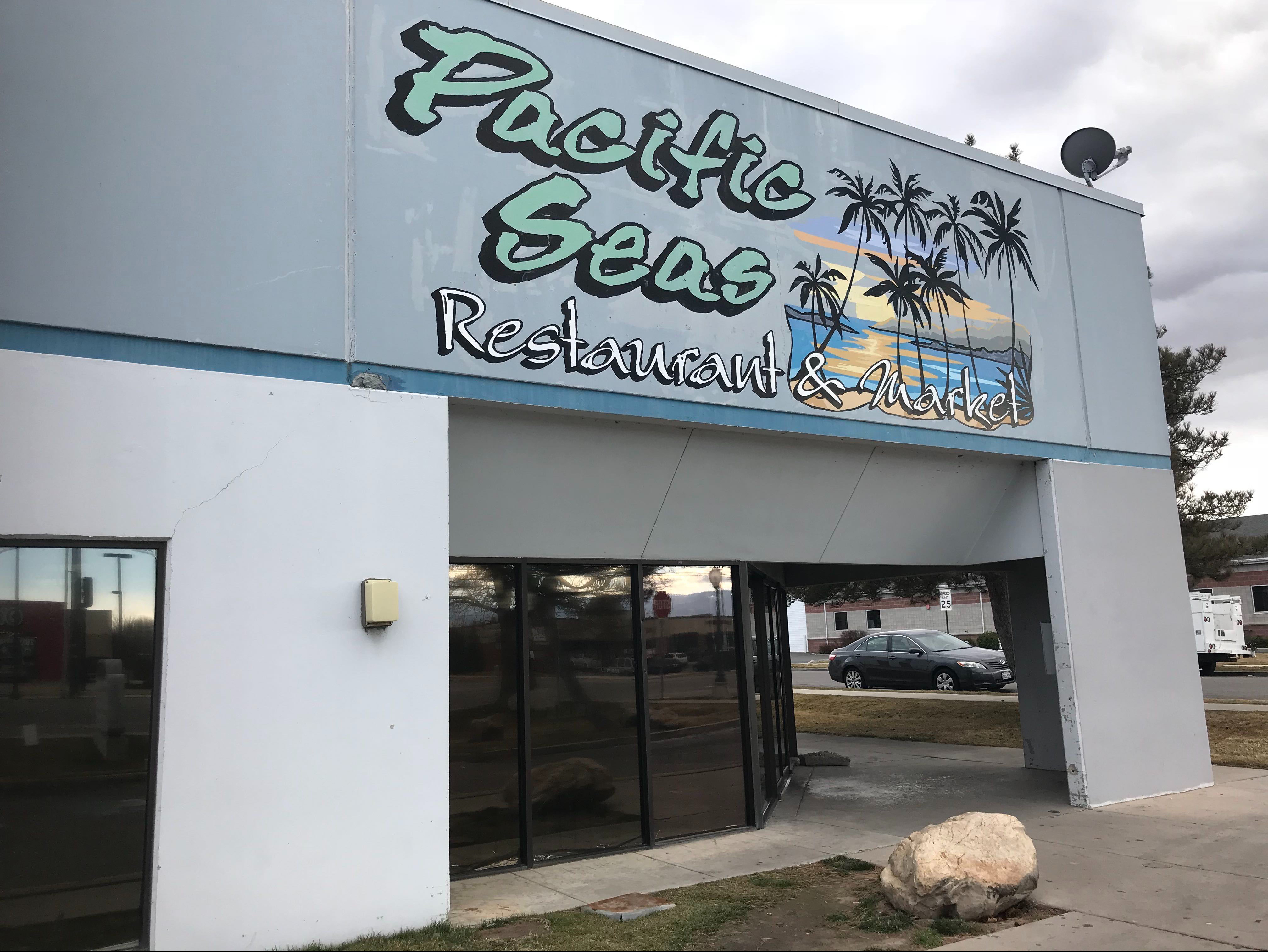
The entrance of the Pacific Seas Restaurant and Market, facing Redwood Road.

According to eua-island-tonga.com, living on the island of Tonga doesn’t mean all the food comes from the sea. The traditional cuisine of the beautiful tropical island consists of two main categories — “food from the sea” and “food from the land.”

The Pacific Seas Restaurant and Market makes it possible to experience Tongan flavors here in Utah. The restaurant is located at 1151 S Redwood Road in Glendale, a neighborhood not far from downtown Salt Lake City.

Family owned and operated for more than 28 years, the restaurant is a popular location for Tongans and other Polynesians to dine. The atmosphere is casual and friendly and pays a large tribute to Tongan athletes. Framed photos of football and rugby players line the walls of the dining room.

The aromas of cooking meat and chicken curry awaken a hunger in the shoppers who come to the market to purchase items such as canned coconut cream, long rice, mackerel fish and corned beef. People often complete their shopping and stay for a meal or a take out.

The kitchen and the counter are run by the family members and overseen by David Lavulo. He is recognizable from the framed newspaper articles that hang on the wall. In one of the articles, David and Leti Lavulo are pictured wearing Mormon missionary badges. In another picture, Lavulo is next to Kalani Sitake, the head coach of Brigham Young University’s football team.

Lavulo left Tonga in 1968 to study in Fiji. A year later he moved to the United States and settled in San Francisco, where he married his wife Leti Lavulo. After five years, they moved to Utah. He said they moved to Salt Lake City because they liked the slower paced lifestyle.

After working in construction and other jobs, he decided it was time to start his own business as a way to serve the local Pacific Islander community.

Lavulo said the restaurant serves almost the same food as in the American cuisine, especially the types of meats. Pork chops, sausage, lamb ribs, chicken curry, fried fish and raw fish are among the menu items. The one thing that distinguishes them is the use of different vegetables.

IMG_1610v2

Lavulo’s open kitchen at the restaurant.

The favorable climate, soil, rainfall and sunshine contributes to the growth of many fruits and vegetables, typical for the Pacific Islands, according to eua-island-tonga.com. 

Taro is a vegetable that grows under the ground. While it is growing, the leaves can be cut and used as greens. Lavulo said they are used instead of spinach.

Another typical root vegetable for the Pacific Islanders is the sweet potato, also called kumara. There are 77 different varieties. “I think you have seen some of those sweet potatoes … not the very soft ones, not the orange ones, but we have kind of white and almost green,” he said.

Another significant item on the menu is the green banana. “It is the remedy to the people in the Pacific that have diabetes,” he said.

IMG_1596v2

David Lavulo shows the green bananas out of his refrigerated walk-in storage.

The animal protein on the menu comes from the variety of fish, chicken, lamb, pork and beef. Although these are relatively lean options, Lavulo reduces calories by healthy cooking. He wraps meats in taro leaves, adds coconut milk and seasoning, then steams the dish. “It is really tasty,” he said.

The signature dish, which is Lavulo’s favorite, is the Rainbow Sushi. It is similar to the Japanese sushi and is prepared with tuna, mahi-mahi, snapper, mixed with coconut milk, tomatoes, onions and cucumber. “All the Polynesian likes to eat fish,” he said, smiling. He opened the walk-in refrigerator and showed boxes of fish from Taiwan.

Lavulo said they cook everything from scratch daily. He took a visitor on a tour of his kitchen. Everything from the ceiling to the floor is spotless. Containers are labeled and vegetables are fresh. He imports his produce (taro, green bananas and yams) from Costa Rica.

“The flavors of the yams from there are different,” he said. He buys his lamb from New Zealand. “We don’t eat the lamb over here, it is not tasty. We also import the taro leaves from Hawaii,” Lavulo added.

To the right of the open kitchen are chafing dishes with steaming side options of taro, yams, yuca and green bananas. The Pacific Seas Restaurant and Market kitchen staff are dedicated to serving fresh meals. The restaurant is open from 11 a.m. to 7 p.m., but at 5 p.m. they stop cooking. “We don’t want the leftovers,” Lavulo said.

Unique beverage options are available. Otai is a beverage made of mango, coconut and sugar; it is a traditional drink made fresh daily at the restaurant.

Lavulo recently visited Tonga and said he was amazed by how much the island has been developed since the last time he was there, 11 years ago. When he first left his homeland, there were still houses made of coconut fronds and today there are modern multistory buildings. ”The [Mormon] Temple was the most beautiful building,” he said.

While Lavulo shares his memories of his trip to Tonga, four family members cook and serve to customers who wait in line to purchase lunch.

On the north wall, there are frames of Tongan beauties and pageant queens. One of Lavulo’s five daughters, Anamarie Lavulo Havea, discussed the female beauty standards in Tonga. The heavier-set women are found to be beautiful. Thin women are considered unattractive. But, she said, when women move to the U.S. they consume a lot of junk food and become even heavier.

Tongan food, however, is particularly wholesome and healthy, because the main ingredients are fruit, vegetables and lean proteins.

Havea is the youngest of Lavulo’s five daughters. She is married and already has children of her own. She has worked in the family business since she was very young. She and her siblings ran the restaurant while their parents served an LDS mission in Papua New Guinea in 2014. Now Havea cooks. On a typical day, she said, 100 to 150 patrons dine at the restaurant. As many as 250 meals are served on a busy day.

IMG_1609v2

Anamarie Lavulo Havea and her nephews work behind the counter, while David Lavulo is overseeing the restaurant.

There is a large poster with an autograph from Will Tukuafu, a Tongan player, from Salt Lake City, who played for the Seattle Seahawks with number 46. His message is “To Pacific Seas, thank you for the great food and continued support for the community.”

Havea added, “This is that food, that you would find in the South Pacific and is what a lot of our NFL players eat.”

According to Susi Feltch-Malohifo’ou, the executive director of Pacific Islanders Knowledge 2 Action Resources (PIK2AR), food in the Pacific Island is related to family prestige and prosperity. She said, “People with more weight, and why we are overweight, signifies that your family has money to feed you. If you are thin that means your family is poor, and there is no food to feed you.”

The Pacific Seas Restaurant and Market is where Pacific Islanders meet for an authentically cooked food and mutual support. Customers seem to be regulars because they know each other and the Lavulo family. The sound from the football game on TV is mixed with lively conversations in the native language. The large pots of steaming taro leaves and cooking meat fill in the dining room with aromas.

For them, the peaceful islanders, Feltch-Malohifo’ou, said, “Food is love in the Pacific Islands culture, and it shows everything with food and service.”